Homework
 grarod
 biol101examb.docx
FINAL EXAMINATION
BIOL 101
SUBMIT ANSWER SHEET to Assignment Folder Final Exam
IMPORTANT: STUDENT PLEASE ANSWER ALL QUESTIONS IN THE ANSWER SHEET DOCUMENT AND SUBMIT THE ANSWER SHEET TO YOUR INSTRUCTOR. FOLLOW ALL INSTRUCTIONS CAREFULLY.
DO **NOT** SUBMIT THIS TEST DOCUMENT FILE TO YOUR INSTRUCTOR.
GENERAL INSTRUCTIONS: This final examination is worth 25% of your overall grade
Read all instructions carefully.
* Do not leave any required questions blank. Make your best guesses.*
**When answering questions for all sections, use the accompanying Answer Sheet. Submit the Answer Sheet document to your Assignment Folder within 3 hours of downloading this document.**
MULTIPLE CHOICE SECTION INSTRUCTIONS: Please answer all questions.
Each question is worth 1 point. Total points for this section is 30 points.
**Do not enter your answers here.** Type in the letter you select as the best answer on the Answer Sheet provided by your instructor.
Use the following information to answer questions 1 and 2 below. ***
Labrador Centronuclear Myopathy (CNM) is genetic disease in Labrador retrievers that results in insufficient muscle function, poor muscles tone, exercise intolerance, and awkward gait. CNM only develops in dogs that are homozygous recessive (pp) for the PTPLA gene. You are a dog breeder and there is one puppy in a new litter that has CNM. Neither of the puppy’s parents have CNM.
1. What are the parents’ genotypes for the gene responsible for CNM?
A) pp and pp
B) Pp and Pp
C) PP and PP
D) PP and Pp
2. Which of the following best describes the mother’s genotype?
A) Homozygous recessive
B) Heterozygous
C) Homozygous dominant
D) Heterozygous and Homozygous dominant
3. In biological systems most of the original energy from the sun is lost as?
A) Light
B) Kinetic energy of motion
C) Heat
D) Potential chemical energy
4. All of the following are common or recurrent themes in biology except?
A) Organisms grow, develop, and reproduce
B) Function determines structure
C) Matter is recycled while energy flows through living systems
D) Living organisms maintain homeostasis
E) Evolutionary processes explain both the unity and adaptive diversity of life
5. In the following chemical reaction, what is carbon dioxide (CO2)?
Organic molecule + 6O2 ⇨ 6CO2 + 6H2O + energy
A) independent variable
B) product
C) substrate
D) enzyme
6. Which of the following is true regarding chemical bonds?
a) Chemical bonds are an unbreakable union of two atoms
b) Chemical bonds are an energetic interaction, or relationship, that occurs between two atoms
c) Chemical bonds are a physical linkage of two atoms
d) Chemical bonds are the result of energy emitted by radioactive atoms
7. The genome of the bacterium, Helicobacter pylori, is composed of 19% guanine. Which of the following must also be true of its double stranded genome?
A) 19% cytosine
B) 62% adenine
C) 31% thymine
D) 19% uracil
8. You observe the following outside your window: A chipmunk is munching away on a bean plant in your garden when a black rat snake grabs and eats the chipmunk. What is the chipmunk in this situation?
A) predator
B) primary consumer
C) prey
D) secondary consumer
E) both B and C
9. You are observing and tracking the population of bobcats in a Pennsylvania state park. At the beginning of your study, there were 48 bobcats in the park. In one year, you counted 60 kittens born and noted the death of 15 bobcats. What is the per capita rate of change for this population of bobcats?
A) 0.3125
B) 1.25
C) 1.5626
D) 0.9375
10. The addition of the green fluorescent protein gene from a jellyfish to the genome of the zebra fish in order to produce a fluorescent green colored fish is an example of what?
a) genetic engineering
b) genetic drift
c) evolution
d) selective breeding
11. Cellular respiration occurs in which types of cells?
a) Bacterial
b) Animal
c) Plant
d) Protist
e) All of the above
12. Dr. Kitty Hauke is studying lobsters in Maine. She noticed that over several years the average length of pincers had increased within this population. She hypothesized that having larger pincers provided a fitness advantage. To test her hypothesis, she introduced 75 large pincer lobsters and 75 small pincer lobsters into an isolated bay area that was similar to the lobsters’ natural sea environment. Over 10 years, Dr. Hauke observed this isolated population of lobsters. What would she likely observe if her hypothesis was incorrect?
A) The percent of lobsters with large pincers would decrease.
B) There were fewer small pincer lobsters mating during mating season.
C) More large pincer lobsters could be found mating during mating season.
D) The percent of lobsters with large pincers would increase.
13. Microevolution is to population as macroevolution is to __________.
A) Individuals
B) Communities
C) Biodiversity
D) Species
14. Active transport requires energy in order to move molecules ____________ the concentration gradient while simple and facilitated diffusion require no energy to move molecules __________ the concentration gradient.
A) Along ; against
B) Along ; along
C) Against ; along
D) Against ; against
15. Limiting factors:
A) Can be unpredictable natural events
B) Can be both biotic and abiotic
C) Can lead to unlimited population growth
D) A and B
E) A and C
F) B and C
G) All of the above
16. Cell is to ________ as gene is to heredity.
A) Organism
B) Organelle
C) Life
D) Biology
17. Allopatric speciation involves geography but _________________ speciation involves genetic change.
A) Sympatric
B) Parapatric
C) De novo
D) Peripatric
18. A common theme in biology is that energy flows through biological systems while matter __________.
A) Flows
B) Cycles
C) Multiplies
D) Stagnates
19. You have discovered a new substance that you suspect may be a living organism. All of the following are characteristics this substance would need in order to be classified as living EXCEPT:
A) Be made of organic molecules
B) Evolve
C) Grow, develop and reproduce with the help of DNA
D) Not contain carbon atoms
E) Use energy and raw materials to survive
20.
The following is a picture of a Tomato Hornworm, which is the caterpillar stage of the five-spotted hawkmoth (Manduca quinquemaculata). The white objects protruding from the caterpillar are wasp eggs. The wasps lay their eggs on the horn worms so that when the larvae hatch they can feed on the worm.
Which term best describes the relationship between the wasps and the Tomato hornworms?
A) Mutualism
B) Competition
C) Predation
D) Symbiosis
***Use the following to answer questions 21-24 below. ***
Consider the following hypothetical metabolic pathway (each letter after the word “Molecule” represents a group of atoms):
21. What is the reactant for this pathway?
A) Molecule C
B) Molecule COO
C) Molecule COOL
D) Enzyme 1
22. What is the intermediate for this pathway?
A) Molecule C
B) Molecule COO
C) Molecule COOL
D) Enzyme 1
23. Which of the following best describes this metabolic pathway?
A) The pathway is anabolic
B) The pathway is catabolic
24. All of the following would allow for more of the product of this metabolic pathway to be produced, EXCEPT?
A) Increasing the amount of Enzyme 2
B) Increasing the amount of Molecule C
C) Adding an activator for Enzyme 1
D) Adding an inhibitor for Enzyme 1
E) Removing an inhibitor of Enzyme 2
25. In Central Dogma: DNA is ________________ into RNA, and RNA is ______________ into proteins.
A) Translated ; transcribed
B) Replicated ; translated
C) Transcribed ; translated
D) Replicated ; transcribed
26. What is the genotype for the individual labeled “1” in the pedigree below? (Black circles or squares represent individuals born with a genetic disease such as cystic fibrosis)
A) AA
B) Aa
C) aa
D) Either AA or Aa
27. Which of the following is an example of sexual selection?
A) A diamondback rattlesnake with a color pattern that allows it to blend in better with the desert sand.
B) A farmer cross pollinating two zucchini plants.
C) Male blue-footed boobies dancing to show off their bright blue feet to female blue-footed boobies.
D) A scientist inserting an Escherichia coli gene into the genome of Staphylococcus aureus.
28. Consider a rabbit, which of the following is true regarding its DNA?
A) All of its cells contain the same DNA.
B) Each cell type contains its own unique DNA.
C) Rabbit brain cells and kidney cells express the same DNA genes.
D) Rabbit DNA uses a different molecular backbone than mouse DNA.
29. Which of the following is the correct order of ecological organizational levels starting from the largest and most inclusive to the smallest and least inclusive?
A) Population > biosphere > community > individual > ecosystem
B) Community > individual > population > biosphere > ecosystem
C) Biosphere > ecosystem > community > population > individual
D) Individual > population > ecosystem > community >biosphere
30. You are studying passive diffusion of a molecule called FLUBBER across a semipermeable membrane, which is mimicking the phospholipid bilayer of eukaryotic cells. FLUBBER moves from side A to B. Which of the following can you conclude?
A) Side A had a lower FLUBBER concentration initially compared to side B.
B) Side A had a higher FLUBBER concentration initially compared to side B.
C) Side A had the same initial FLUBBER concentration as side B.
SHORT ANSWER SECTION
Each question is worth 10 points. Total points for this section is 30 points.
Answer THREE out of the five questions listed below. Each answer should be between two paragraphs and half a page long. Answers will be graded for accuracy and completeness, as well as spelling and grammar.
**Do not enter your answers here** Type your answers into the Answer Sheet provided by your instructor.
1. At the beginning of the spring, Dr. Allan notices that there is an equal distribution of long and short stemmed buttercups in the vacant lot across the street from his house as well as in his own backyard. By the end of the summer he notes that there are mostly long stemmed buttercups in the lot, but mostly short stemmed buttercups in his yard. These observations are examples of what biological principle? Develop a hypothesis to explain Dr. Allan’s observations.
2. You are analyzing the ingredients in a new hot dog that is going to be put on the market soon. A) Explain the biological function of these natural chemicals that you might find in a hot dog: protein, fat, carbohydrate, vitamins.
B) Would it be healthier to eat a hot dog that contains mainly saturated fat, or one that contains mainly unsaturated fat? Explain your answer
3. Male ring-tailed lemurs have stink glands that they use to mark their territories. In addition, dominance among males is established by “stink fighting” where the males rub their “stink secretions” along their tails, and then posturing themselves with tails raised above their head, they wave their stinky tails at each other. The stinkiest male wins.
A) Stink fighting is an example of what evolutionary principle?
B) What might the males be competing for?
4. You have not been feeling well lately and are losing weight despite eating more than you normally do. You go to the doctor and are diagnosed with having a tapeworm. Tapeworms live in your gut and use your body for both housing and food. Is this interspecific interaction between you and the tapeworm an example of mutualism, parasitism or competition? Explain your answer.
5. Discuss a specific example of how human activities can affect the environment.
ESSAY SECTION
Answer TWO out of the 5 questions below. Each answer should be approximately one page long. Answers will be graded for accuracy and completeness, as well as spelling and grammar.
Each question is worth 20 points. Total points for this section is 40 points.
**Do not enter your answers here.** Type your answers into the Answer Sheet provided by your instructor.
QUESTIONS
1. Before bringing a new drug to the marketplace, extensive testing is done on the drug by administering the drug to large numbers of individuals. Explain the importance of the scientific method, sample size, controls and variable in the drug evaluation process.
2. You are a dog breeder and have a female yellow, Fifi, whom you would like to mate in order to get a little of puppies in all three colors (black, yellow, and chocolate). After reviewing her pedigree, you reason out that Fifi’s genotype is eebb. Remember that in Labrador retrievers coat color is determined by two different genes. The first gene (E) causes melanin to be deposited into the fur, while the second gene (B) determines the pigment color with black dominant to brown. You have three potential male labs with which to breed Fifi. Max is a black lab with a brown mom and a yellow dad. Tucker is a yellow lab with two brown parents. Ripley is a chocolate lab with one brown and one black parent.
Mating Fifi to which one of these males will result in puppies in all three colors? What is the correct male’s genotype? What are the genotypes of the offspring? What percentage of the offspring will be black, yellow, and chocolate? Be sure to show your work.
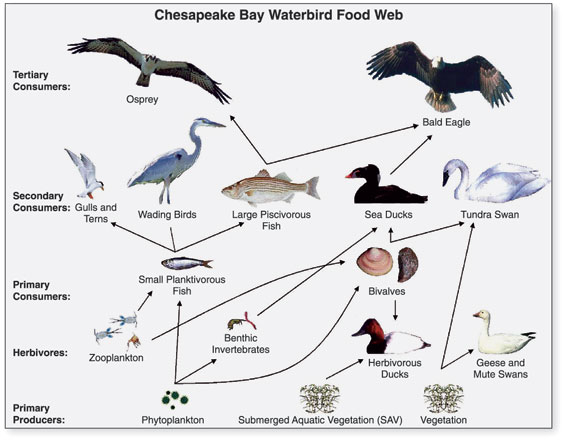
3. Consider the food web for the Chesapeake Bay shown below.
By US Geological Survey (Chesapeake Waterbird Food Web) Public Domain
Give a detailed analysis of this food web. Be sure to address the following in your analysis: a description of the producers and consumers (you do not need to list every organism, but give a few examples along with what makes an organism fall into one class or the other), energy movement through the food web, the number of trophic levels found in this food web, which organisms most efficiently utilize the resources, the way in which of one biogeochemical cycles interacts with the ecosystem of this food web, and how humans can negatively impact this food web.
4. Compare and contrast artificial selection and genetic engineering of organisms. In your answer also include the following: one advantage and one disadvantage for each technique, as well as one example of each.
5. Explain the main stages of mitosis (you may use diagrams) and contrast the processes of mitosis and meiosis in an animal cell.
____________________________________________________________________________
Page 10 of 10