


PSY SOCIAL PSYCHOLOGY MILE 5
 claura
SEE ATTACHMMENT
 a month ago
 5
5
 files (13)
KeyTakeaways7.html
KeyTakeaways8.html
milestone5ins.docx
TableofContents.html
IsCategorizationGoodorBadtextexcerpt.html
SocialCategorization-TheGoodtheBadandtheDangerousmini-lecture.html
Definitionstextexcerpt.html
- Categorizationtextexcerpt.html
- Recategorizationtextexcerpt.html
- WhenFavoritismDoesNotOccurtextexcerpt.html
- IngroupFavoritismandPrejudicetextexcerpt.html
- Stereotyping.html
- ReducingPrejudiceandDiscriminationtextexcerpt.html
KeyTakeaways7.html
- Beliefs about the characteristics of the groups and the members of those groups are known as stereotypes.
- Prejudice refers to an unjustifiable negative attitude toward an outgroup.
- Stereotypes and prejudice may create discrimination.
- Stereotyping and prejudice begin from social categorization—the natural cognitive process by which we place individuals into social groups.
- Social categorization influences our perceptions of groups—for instance, the perception of outgroup homogeneity.
- Once our stereotypes and prejudices become established, they are difficult to change and may lead to self-fulfilling prophecies, such that our expectations about the group members make the stereotypes come true.
- Stereotypes may influence our performance on important tasks through stereotype threat.
KeyTakeaways8.html
- Ingroup favoritism is a fundamental and evolutionarily functional aspect of human perception, and it occurs even in groups that are not particularly meaningful.
- Ingroup favoritism is caused by a variety of variables, but particularly important is self-concern: We experience positive social identity as a result of our membership in valued social groups.
- Ingroup favoritism develops early in children and influences our behavior toward ingroup and outgroup members in a variety of ways.
- Personality dimensions that relate to ingroup favoritism include authoritarianism and social dominance orientation—dimensions that relate to less ingroup favoritism include a desire to control one’s prejudice and humanism.
- There are at least some cultural differences in the tendency to show ingroup favoritism and to stereotype others.
- Changing our stereotypes and prejudices is not easy, and attempting to suppress them may backfire. However, with appropriate effort, we can reduce our tendency to rely on our stereotypes and prejudices.
- One approach to changing stereotypes and prejudice is by changing social norms—for instance, through education and laws enforcing equality.
- Prejudice will change faster when it is confronted by people who see it occurring. Confronting prejudice may be embarrassing, but it also can make us feel that we have done the right thing.
- Intergroup attitudes will be improved when we can lead people to focus more on their connections with others. Intergroup contact, extended contact with others who share friends with outgroup members, and a common ingroup identity are all examples of this process.
milestone5ins.docx
Instructions
Milestone 5 Assessment
Submit a document answering each of the following questions.
Each answer should be 200-250 words long and refer specifically to content from this section with in-text citations*.
You should NOT be using any external resources.
You submission must be in a .doc or .docx format which can be created through google docs
1. On which (if any) social categories do you categorize others? Why do you (or don’t you) categorize? Is your behavior fair or unfair to the people you are categorizing?
2. Consider some of the important social groups to which you belong. Do your group memberships lead to ingroup favoritism or even prejudice?
3. What are some of the ways that prejudice can be combated? Which do you think would be most successful? Why?
4. Have you ever confronted or failed to confront a person who you thought was expressing prejudice or discriminating? Why did you confront (or not confront) that person, and how did doing so make you feel?
*For this class, you can reference text excerpts like this: (Jhangiani & Tarry 2022).
All text excerpts are from Jhangiani, R., & Tarry, H. (2022). If there is a quote or reference within a text excerpt; you include both the original author and year and the author and year of the work where quote/idea was found in the in-text reference. Add "as cited in" before the author in the in-text reference. For example - (Deutsch & Gerard, 1955, as cited in Jhangiani & Tarry, 2022).
Mini lectures/Key Takeaways like this: (Leduc, Fall 2026)
And videos like this ( Title of Video, Youtube 2026)
AI Use Disclosure
Any use of AI must be disclosed with submissions
You should review UMPIs ACADEMIC AND ETHICAL GUIDELINES FOR AI USE
The use of generative AI tools (e.g. Gemini, Co-Piot, ChatGPT, Dall-e, etc.) is permitted in this course for the following activities:
· Brainstorming and refining your ideas;
· Fine-tuning your research questions;
· Finding information on your topic;
· Drafting an outline to organize your thoughts and
· Checking grammar and style
The use of generative AI tools is NOT permitted in this course for the following activities:
· Impersonating you in classroom contexts, such as by using the tool to compose discussion board prompts assigned to you or content that you put into a Zoom chat.
· Completing group work that your group has assigned to you, unless it is mutually agreed upon that you may utilize the tool.
· Writing a draft of a writing assignment.
· Writing entire sentences, paragraphs or papers to complete class assignments.
TableofContents.html
| PSY 200/SOC 200: Social Psychology//Social Psychology (2026 Fall) - Learning Outcome 5 - Stereotypes, Prejudice and Discrimination
1. Social Categorization - The Good, the Bad, and the Dangerous (mini-lecture 3. Categorization (text excerpt) 4. Is Categorization Good or Bad? (text excerpt) 5. Stereotyping (text excerpt) 7. Ingroup Favoritism and Prejudice (text excerpt) 8. When Favoritism Does Not Occur (text excerpt) 9. Reducing Prejudice and Discrimination (text excerpt) 10. Recategorization (text excerpt) 11. Key Takeaways/Mini Lecture |
IsCategorizationGoodorBadtextexcerpt.html
The Benefits of Social Categorization
The tendency to categorize others is normally quite useful. In some cases, we categorize because doing so provides us with information about the characteristics of people who belong to certain social groups (Lee, Jussim, & McCauley, 1995). If you found yourself lost in a city, you might look for a police officer or a taxi driver to help you find your way. In this case, social categorization would probably be useful because a police officer or a taxi driver might be particularly likely to know the layout of the city streets. Of course, using social categories will only be informative to the extent that the stereotypes held by the individual about that category are accurate. If police officers were actually not that knowledgeable about the city layout, then using this categorization would not be informative.
It has been argued that there is a kernel of truth in most stereotypes, and this seems to be the case. There is a correlation between how group members perceive the stereotypes of their own groups and how people from other groups perceive those same stereotypes (Judd & Park, 1993; Swim, 1994). This truth may come in part from the roles that individuals play in society. For instance, the stereotypes (which are held by many people) that women are “nurturing” and that men are “dominant” may occur in part because, on average, men and women find themselves in different social roles within a culture (Eagly & Steffen, 1984). In most cultures, men are more likely to be in higher-status occupations, such as doctors and lawyers, whereas women are more likely to play the role of homemakers and child-care workers. In this sense, the stereotypes are at least partly true for many of the members of the social category, in terms of their actual behaviors. Because men are more likely to be leaders than are women, they may well be, on average, more dominant; and because women are more likely to take care of children, they may, on average, act in a more nurturing way than do men.
On the other hand, we sometimes categorize others not because it seems to provide more information about them but because we may not have the time (or the motivation) to do anything more thorough. Using our stereotypes to size up another person might simply make our life easier (Macrae, Bodenhausen, Milne, & Jetten, 1994). According to this approach, thinking about other people in terms of their social category memberships is a functional way of dealing with the world—things are complicated, and we reduce complexity by relying on our stereotypes.
The Negative Outcomes of Social Categorization
Although thinking about others in terms of their social category memberships has some potential benefits for the person who does the categorizing, categorizing others, rather than treating them as unique individuals with their own unique characteristics, has a wide variety of negative, and often very unfair, outcomes for those who are categorized.
One problem is that social categorization distorts our perceptions such that we tend to exaggerate the differences between people from different social groups while at the same time perceiving members of groups (and particularly outgroups) as more similar to each other than they actually are. This overgeneralization makes it more likely that we will think about and treat all members of a group the same way. Tajfel and Wilkes (1963) performed a simple experiment that provided a picture of the potential outcomes of categorization. As you can see in Figure 12.4 “Perceptual Accentuation”, the experiment involved having research participants judge the length of six lines. In one of the experimental conditions, participants simply saw six lines, whereas in the other condition, the lines were systematically categorized into two groups—one comprising the three shorter lines and one comprising the three longer lines.
Figure 12.4 Perceptual Accentuation

Lines C and D were seen as the same length in the noncategorized condition, but line C was perceived as longer than line D when the lines were categorized into two groups. From Tajfel (1970).
Tajfel found that the lines were perceived differently when they were categorized, such that the differences between the groups and the similarities within the groups were emphasized. Specifically, he found that although lines C and D (which are actually the same length) were perceived as equal in length when the lines were not categorized, line C was perceived as being significantly longer than line D in the condition in which the lines were categorized. In this case, categorization into two groups—the “short lines group” and the “long lines group”—produced a perceptual bias such that the two groups of lines were seen as more different than they really were.
SocialCategorization-TheGoodtheBadandtheDangerousmini-lecture.html
In the sections in this module you will be exposed to some inconvenient and uncomfortable truths about being a social being. We can be really horrible to each other! Social Psychology has quite a lot to say about this.
Social Categorization serves an important purpose for us. Know who is us vs them gives us purpose, makes us comfortable and teaches important things. But in the worst case scenario (which unfortunately actually happens very frequently) it devolves into tribalism
When we categorize, we often tend to stereotype members of other groups. This is making broad sweeping assumptions about them. It is a short cut to what we believe to be knowledge about them.
Stereotypes can easily move on to prejudice wherein we develop negative feelings about members of another group. And then, that prejudice translates in discrimination, behaviors that treat that group unfairly.
Categorization is grouping similar people together
Stereotyping is making assumptions of all members of a group
Prejudice is negative feelings about members of a group based on faulty information
Discrimination is action based on prejudice and stereotyping that has a negative effect on members of a group
Definitionstextexcerpt.html
Contemporary increases in globalization and immigration are leading to more culturally diverse populations in the United States and in many other countries. People from minority groups now account for over one third of the U.S. population, as well as most of the growth in its labor force. Older people are working longer, women are becoming more equally represented in a wide variety of jobs, and the ethnic mix of most occupations is also increasing (U.S. Census Bureau, 2011).
These changes will create many benefits for society and for the individuals within it. Gender, cultural, and ethnic diversity can improve creativity and group performance, facilitate new ways of looking at problems, and allow multiple viewpoints on decisions (Mannix & Neale, 2005; van Knippenberg & Schippers, 2007). On the other hand, as we have seen in many places in this book, perceived similarity is an extremely important determinant of liking. Members of culturally diverse groups may be less attracted to each other than are members of more homogeneous groups, may have more difficulty communicating with each other, and in some cases may actively dislike and even engage in aggressive behavior toward each other.
The principles of social psychology, including the ABCs—affect, behavior, and cognition—apply to the study of stereotyping, prejudice, and discrimination, and social psychologists have expended substantial research efforts studying these concepts ( Figure 12.1). The cognitive component in our perceptions of group members is the stereotype—the positive or negative beliefs that we hold about the characteristics of social groups. We may decide that “Italians are romantic,” that “old people are boring,” or that “college professors are nerds.” And we may use those beliefs to guide our actions toward people from those groups. In addition to our stereotypes, we may also develop prejudice—an unjustifiable negative attitude toward an outgroup or toward the members of that outgroup. Prejudice can take the form of disliking, anger, fear, disgust, discomfort, and even hatred—the kind of affective states that can lead to behavior such as the gay bashing you just read about. Our stereotypes and our prejudices are problematic because they may create discrimination—unjustified negative behaviors toward members of outgroups based on their group membership.
Although violence against members of outgroups is fortunately rare, stereotypes, prejudice, and discrimination nevertheless influence people’s lives in a variety of ways. Stereotypes influence our academic performance (Shapiro & Neuberg, 2007), the careers that we chose to follow (Zhang, Schmader, Forbes, 2009), our experiences at work (Fiske & Lee, 2008), and the amount that we are paid for the work that we do (Jackson, 2011; Wood & Eagly, 2010).
Figure 12.1
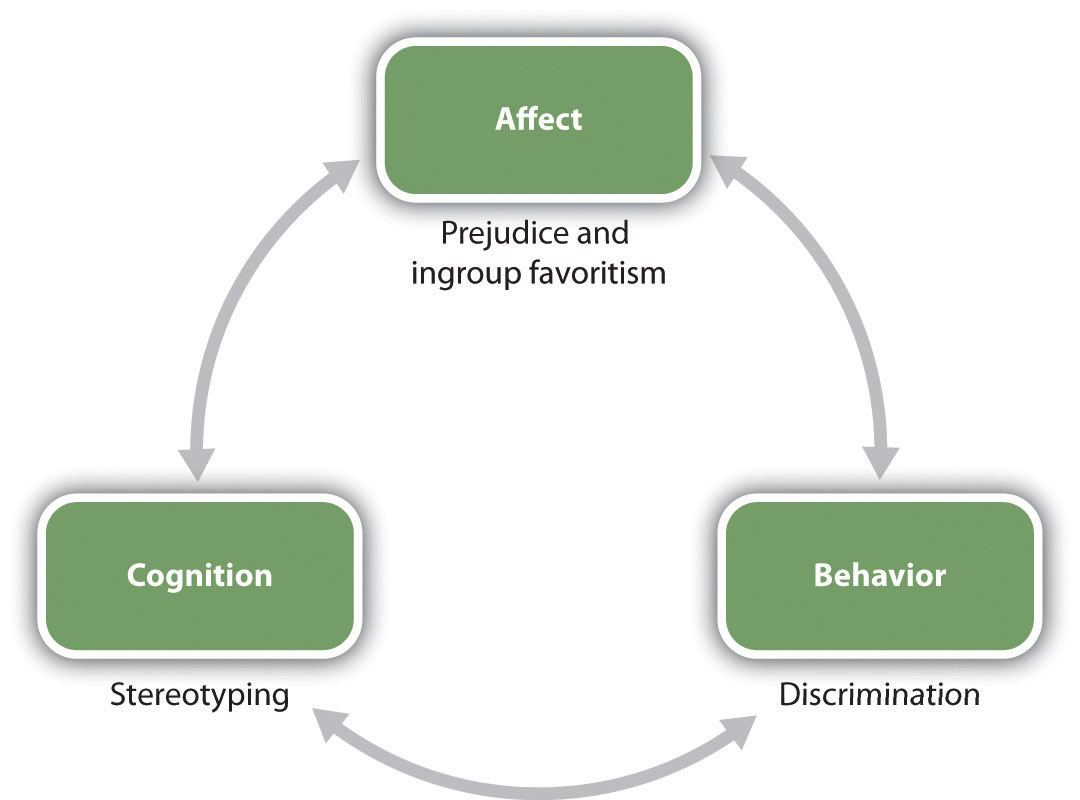
Relationships among social groups are influenced by the ABCs of social psychology.
Stereotypes and prejudice have a pervasive and often pernicious influence on our responses to others, and also in some cases on our own behaviors. To take one example, social psychological research has found that our stereotypes may in some cases lead to stereotype threat—performance decrements that are caused by the knowledge of cultural stereotypes. Spencer, Steele, and Quinn (1999) found that when women were reminded of the (untrue) stereotype that “women are poor at math” they performed more poorly on math tests than when they were not reminded of the stereotype, and other research has found stereotype threat in many other domains as well. We’ll consider the role of stereotype threat in more detail later in this chapter.
In one particularly disturbing line of research about the influence of prejudice on behaviors, Joshua Correll and his colleagues had White participants participate in an experiment in which they viewed photographs of White and Black people on a computer screen. Across the experiment, the photographs showed the people holding either a gun or something harmless such as a cell phone. The participants were asked to decide as quickly as possible to press a button to “shoot” if the target held a weapon but to “not shoot” if the person did not hold a weapon. Overall, the White participants tended to shoot more often when the person holding the object was Black than when the person holding the object was White, and this occurred even when there was no weapon present (Correll, Park, Judd, & Wittenbrink, 2007; Correll et al., 2007).
Discrimination is a major societal problem because it is so pervasive, takes so many forms, and has such negative effects on so many people. Even people who are paid to be unbiased may discriminate. Price and Wolfers (2007) found that White players in National Basketball Association games received fewer fouls when more of the referees present in the game were White, and Black players received fewer fouls when more of the referees present in the game where Black. The implication is—whether they know it or not—the referees were discriminating on the basis of race.
I’m sure that you have had some experiences where you found yourself responding to another person on the basis of a stereotype or a prejudice, and perhaps the fact that you did surprised you. Perhaps you then tried to get past these beliefs and to react to the person more on the basis of his or her individual characteristics. We like some people and we dislike others—this is natural—but we should not let a person’s skin color, gender, age, religion, or ethnic background make these determinations for us. And yet, despite our best intentions, we may end up making friends only with people who are similar to us and perhaps even avoiding people whom we see as different.
KeyTakeaways7.html
- Beliefs about the characteristics of the groups and the members of those groups are known as stereotypes.
- Prejudice refers to an unjustifiable negative attitude toward an outgroup.
- Stereotypes and prejudice may create discrimination.
- Stereotyping and prejudice begin from social categorization—the natural cognitive process by which we place individuals into social groups.
- Social categorization influences our perceptions of groups—for instance, the perception of outgroup homogeneity.
- Once our stereotypes and prejudices become established, they are difficult to change and may lead to self-fulfilling prophecies, such that our expectations about the group members make the stereotypes come true.
- Stereotypes may influence our performance on important tasks through stereotype threat.

