


journal #4
 Jasmine_Lr
Use your journal to:
- Compare and contrast the different feminist theories and frameworks you're reading about, and consider how they help explain the lived experiences of Chicanas/Latinas in the U.S., the Caribbean, and Latin America
- Connect course concepts to current events, media, your own observations, and lived experiences
- Reflect on how gender intersects with race, ethnicity, national origin, immigration status, social class, and sexuality in the readings, and what these intersections reveal about power, privilege, and oppression
- Grapple with ideas that challenge you, confuse you, or that you disagree with, and explain why or which parts you disagree with or are confused by
- Ask questions
What Are Social Institutions?
Taking A Closer Look
So what are social institutions, and why are they important? We touched on social institutions in week 1 when we learned about power and systems of oppression. This week, we are going to closely examine social institutions in order to critically analyze how these social institutions function within and have an impact on Chicana and Latina communities.
Social institutions are organizations that create established patterns of behavior and are organized around particular purposes. Social institutions function through social norms and established rules and/or laws. They are enduring, historical facets of social life that shape our behavior. Social institutions are able to structure thought and behavior by prescribing rules for interaction and inclusion/exclusion.
The following is a list of primary social institutions.
- Education
- The Economy
- The Workplace
- The Law, Government, Politics, and Criminal Justice System
- The Military
- Science
- Healthcare
- The Media
- Religion
- The Family
Together, these social institutions distribute resources to community groups and create and police norms for behavior, including gender norms. (Think back to what you learned about gender norms and gender roles in week 3).
Agents of Socialization
Social institutions can also be thought of as agents of socialization, with the family being the primary agent of socialization. Most other social institutions, such as education and the mass media, would be considered secondary agents of socialization. The following is a list of features of agents of socialization. Think about how these features function in relation to the families that raised us, the schools we've attended, and the media we consume.
- we are born into them
- we are shaped by their expectations, norms, and rules
- we operate within these institutions daily, often operating within multiple institutions at a time
- older generations teach the expectations, norms, and rules of these institutions to the younger generations
Social Institutions and Systems of Oppression
The functions of the social institutions listed above work in tandem and support and maintain systems of oppression in key ways. Think back to the systems of oppression you read about in week 1. (racism, ethnocentrism, sexism, heterosexism, ableism, ageism, etc.)
The following list describes how social institutions, such as the criminal justice system, healthcare, and the economy, support and maintain systems of oppression.
- Social institutions assign and restrict roles and opportunities based on race, ethnicity, gender, sexual orientation, immigration status, ability, and more. For example, social institutions create and police gender norms, assigning various roles to men and women. Social institutions also create the rules and norms of our workplaces, where people perform "gendered" work and certain industries, such as finance and technology, become male-dominated (employ majority men) while other industries, such as nursing and teaching, become female-dominated (employ majority women).
- Institutions distribute resources and extend privileges, resources, and opportunities differently to different groups. For example, tax breaks are provided to married couples as well as wealthy corporations and individuals. In healthcare settings, certain rights and privileges are given to the spouses of patients; however, it wasn't until very recently that same-sex marriage was legalized in the United States, and only heterosexual married couples had access to these rights and privileges. We also know that the criminal justice system in the United States disproportionately polices and incarcerates communities of color.
- Social institutions overlap and work together to uphold and support the functions of one another. One example of how our workplaces and government policies/laws overlap to reinforce economic and gender inequalities is when government labor laws fail to protect farmworkers or domestic workers, two fields where many Latinas are employed, and workplaces can continue to exploit their labor with low wages and poor working conditions. Immigration policies such as those enforced by ICE also create an environment of fear that discourages workers from reporting abuse or organizing for their rights. In this example, we can see how the functions of multiple social institutions work together to maintain power and social hierarchies that disproportionately affect immigrant and working-class Chicana and Latina women.
More Examples
Let's take a look at a few more examples of how social institutions can uphold and maintain systems of oppression. It is important to note that with all of these examples, there is room for resistance against these systems of oppression from within the institutions themselves.
The Family
- The family can reproduce patriarchal values and sexist attitudes by expecting women to prioritize caregiving, modesty, and obedience over independence, reinforcing ideas about traditional gender roles and gender norms
- Machismo and marianismo can limit women’s autonomy and perpetuate gendered double standards
- At the same time, families can also be sites of resistance where women pass down cultural pride, language, and stories that challenge sexism and patriarchy
Religion
- The Catholic Church and other religious institutions have historically reinforced patriarchal family structures and ideas about women’s “proper” roles
- Teachings that condemn LGBTQ+ identities marginalize queer and trans Latinas within their faith communities
- However, many Chicana and Latina feminists reinterpret spirituality and teachings of faith in order to use them as source sof empowerment and resistance.
Science
- Scientific racism and eugenics historically framed Latina and Indigenous women as “inferior”, wrongly justifying forced sterilizations and medical abuse
- Modern medicine continues to marginalize Latinas and other women of color by underrepresenting them in research and ignoring health disparities specific to their communities
- Western science often dismisses Indigenous knowledge systems, reinforcing colonial hierarchies of “legitimate” knowledge
The Military
- U.S. military interventions in Latin America have fueled displacement, migration, and violence that disproportionately affect women and children.
- Military recruitment often targets working-class and immigrant communities, promising economic stability while reinforcing imperialism across the globe
- Sexual assault and gender discrimination within the military reflect broader patterns of sexism and gender-based violence
The Media
- The media has historically portrayed Latinas through narrow, limiting, false, or harmful stereotypes
- White, Eurocentric beauty standards are perpetuated in film, magazines, fashion, and the music industries. These white, Eurocentric beauty standards marginalize Latinas and other women of color while promoting internalized racism and colorism.
- Limited Latina representation behind the camera (writers, producers, directors, etc.) means that stories about Latina women are often not being told by Latinas themselves. Instead, they are often told through a white or male gaze.
Next
On the following pages in this module, we will look closely at how social institutions such as government/politics, education, healthcare, and the mass media function in relation to Chicana/Latina communities. As you move through the remainder of this module, reflect on how what you are reading connects back to what you learned about economic and reproductive justice in week 6, as well as your readings on intersectionality, power, and systems of oppression from weeks 2 and 3.
Guided reading
The following is an excerpt from chapter 7 of your textbook, New Directions in Chicanx and Latinx Studies by Amber Rose González. "Chicanx and Latinx Political RepresentationLinks to an external site." by LibreTextsLinks to an external site. is licensed under CC BY-NCLinks to an external site..
Formal Politics in Chicanx and Latinx Communities
Political representation of Latinx communities creates opportunities to advocate for better policies and new reforms. In the U.S., trailblazing leaders have crossed barriers for Chicanx and Latinx communities, opening new doors for others to continue the work of equity and justice for all. However, Latinx people remain under-represented in nearly all aspects of government and politics. In 2018, Latinx people were only 1% of all local and federal elected officials, according to the NALEO Educational Fund.14Links to an external site. In 2022, that number is similar, with only four U.S. Senators and 40 U.S. Representatives. Women are underrepresented among Latinx elected officials, being only 1 Senator and 12 House Representatives. On the website from Rutgers University, you can explore more statistics about women of color in politics and elected positionsLinks to an external site..
Some of the leaders for Latinx communities in politics include the U.S. Congressperson Romualdo Pacheco who was first elected in 1879 as a Representative from California. Pacheco had previously served as the first Mexican American governor of California in 1875. Even in states that include a high number of Latinx people and voters, such as California, researchers have identified a pattern of underrepresentation, including in appointed and elected positions in state government, county supervisors, school board members, and city-level positions. Groups like the California Latino School Boards Association have emerged to address some of these specific issues of representation and political power. You can learn more about the California Latino School Boards Association on their websiteLinks to an external site..
Federal Representation of Latinx and Hispanic People
At the federal level, the Congressional Hispanic Caucus represents the interests of Hispanic Congresspeople and it includes over 30 members including many Latinx representatives and their allies. Some Latinx Congresspeople are not members of the Caucus, in part due to partisan divides between Republicans and Democrats. In the Senate, U.S. Senator Octaviano Larrazlo from New Mexico was the first Latino and Mexican-American Senator in 1928. Despite gains for representation won in states with high proportions of Latino people, it took decades of additional advocacy before major federal and judicial positions were held by Latinos. For example, there has never been a Latinx President of the United States, Vice President, or Secretary of State. It was not until 1988 that Lauro Cazavos became the Secretary of Education and the first Latinx or Hispanic person to serve in the U.S. Cabinet. On the U.S. Supreme Court, when Justice Sonia Sotomayor was confirmed to her position in 2009, she became the first Latinx person and the third woman to be confirmed to the Supreme Court. In Figure 7.5.1, there is a photo of Justice Sotomayor fulfilling one of her duties on the Supreme Court by swearing in Kamala Harris as Vice President, who is another woman who broke barriers as the first Black person, first Asian person, first multiracial person, and first woman to serve as Vice President of the United States.
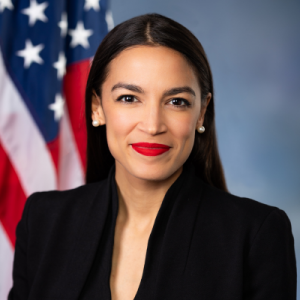
Representative Alexandria Ocasio-Cortez, popularly known as AOC, has been a major figure for Latinx representation in politics. This is in part because she actively embraces her connection to the Latinx community, foregrounding her status as a young Latina woman living in New York City, who recently paid the bills by bartending. Her continued and unapologetic presentation of herself positions her as a capable and strong advocate for diverse people living in the United States, including immigrants, women, and people of color. In Figure 7.5.2, she appears in a photograph, speaking passionately in front of a crowd of people.
Her passion and tenacity represent a commitment to social change and a critical lens that is relatable for many Latinx people as well as her wide range of supporters. The video included in Video 7.5.1 describes what AOC has accomplished as a leading Latinx political figure in her own terms. The video is 4 minutes and 44 seconds long, and it demonstrates the way that Latinx politicians have made a considerable impact on their field and on our broader society.
Video: What has AOC (Alexandria Ocasio-Cortez) accomplished?
Politics and Liberation
Many members of Latinx communities are disengaged from formal political processes, including voting and representation. This is in part due to the exclusion of immigrants from voting, which prevents families from engaging in a shared practice of voting and being represented. The Voting Rights Act of 1965 has had a significant impact on Latino people and their political participation in the United States. Prior to the Act, many Latinos faced barriers and discriminatory practices that limited their access to the voting booth, such as poll taxes, literacy tests, and intimidation tactics. The Act aimed to combat these obstacles and ensure equal voting rights for all citizens, regardless of their race or ethnicity.
The Voting Rights Act has helped empower Latino communities by prohibiting discriminatory practices and ensuring their political representation. It has led to increased voter registration and turnout among Latinos, enabling them to elect candidates of their choice and have a stronger voice in the political process. By eliminating discriminatory voting practices, the Act has paved the way for greater political engagement and representation for Latino individuals and communities.
The Raza Unida party, founded in the late 1960s, emerged as a political movement that sought to address the issues and concerns of Mexican Americans and other Latino groups. The party advocated for self-determination, civil rights, and political empowerment for the Latino community. It aimed to challenge the existing two-party system and provide an alternative political platform for Latino voters. While the Raza Unida party made significant strides in mobilizing and organizing Latino communities, its influence and success were relatively short-lived. The party faced internal divisions and external challenges, including legal battles and limited resources. However, it played a crucial role in raising awareness about the issues faced by Latinos and fostering a sense of political empowerment among the community.
Overall, the Voting Rights Act has been instrumental in expanding political rights and opportunities for Latino individuals and communities, while the Raza Unida party served as a catalyst for political mobilization and empowerment during a crucial period in Latino political history. However, in recent years, there have been changes that have weakened the effectiveness of the Voting Rights Act of 1965. One significant development was the Supreme Court case Shelby County v. Holder in 2013. In this case, the Court struck down a key provision of the Act, namely Section 4(b), which established a formula for identifying jurisdictions with a history of voting discrimination that were required to obtain federal preclearance before making changes to their voting laws.
The Court's decision effectively invalidated the formula used to determine which jurisdictions were subject to preclearance, arguing that it was based on outdated data and no longer reflective of current conditions. As a result, the preclearance requirement was effectively nullified unless Congress could enact a new formula. This ruling has had implications for Latino voters, among others, as it removed a critical safeguard against discriminatory voting laws and practices. In the absence of preclearance, jurisdictions have been able to implement changes to voting laws without prior federal approval, potentially leading to the adoption of laws that disproportionately impact minority communities, including Latinos.
Since the Shelby County decision, there have been concerns about the rise of voter suppression efforts, including the adoption of stricter voter identification laws, reductions in early voting periods, purging of voter rolls, and gerrymandering. These measures can disproportionately affect marginalized communities, including Latinos, by making it more difficult for them to exercise their right to vote and diminishing their political representation.
Efforts to restore and strengthen the Voting Rights Act have been made in Congress, such as the proposed John Lewis Voting Rights Advancement Act. This legislation seeks to update the coverage formula and restore the preclearance requirement, aiming to address the challenges created by the Shelby County decision. However, the act's passage has faced obstacles and partisan divisions, resulting in ongoing debates about voting rights and protections for historically marginalized communities, including Latino voters.
Beyond that, many Latinx people also share the critical perspective that the U.S. government itself and U.S. society are built around principles of division, exclusion, and exploitation and must be critically examined and transformed. Under this view, participation in the system only serves to encourage people to believe in the possibility of reform, while ultimately failing to address the root causes of racism, xenophobia, and intersectional oppression. Among Native American and Latinx Indigenous peoples, this sentiment can be accompanied by a commitment to tribal sovereignty and the creation of modern systems rooted in traditional and sacred relationships with the land.
The contradictions of political representation can also be seen in Puerto Rico, which is a U.S. territory. Although the people of Puerto Rico bear many of the responsibilities of U.S. citizenship, including paying taxes, being drafted, and following the laws created by the government, they are not politically represented at the federal level. You can see a Puerto Rican flag hanging in Old San Juan in Figure 7.5.3, showing the people’s pride in their island. More recently, this lack of representation has had devastating effects in the face of increased hurricanes in the region and the larger dynamics of climate change. While Puerto Ricans are clearly not represented equally in the U.S. governmental system, the people of the island remain persistently divided as to whether to pursue statehood or independence. The Puerto Rico Statehood Admission Act, also known as H.R. 4901 and later reintroduced as H.R. 1522, is a bill that was presented during the 116th and 117th sessions of the United States Congress. Its purpose is to enable Puerto Rico, an unincorporated territory of the United States, to become a state within the Union. The bill was initially introduced in the 116th Congress and reintroduced in the 117th Congress as H.R. 1522 on March 2, 2021. The continued debate over statehood efforts shows how diversity of perspective within Latinx communities and in solidarity with other racial and ethnic groups ultimately contributes to the use of multiple strategies in advocacy and politics. This creates opportunities for future generations to continue the struggle and find new solutions to long-standing systems of white supremacy, xenophobia, and settler colonialism.
Guided Reading
Next, please read the following sections from Chapter 8 of your OER textbook, and don't forget to watch the embedded videos in each section of the reading. Once you have finished reading, consider the reflection questions at the bottom of this page.
Assigned Reading:
- 8.1 The Crisis and Hope in EducationLinks to an external site.
- 8.2 The Struggle for Equality, 1900-1954Links to an external site.
- 8.3 Re-Imagining Education in an Era of Revolt, 1955-1975Links to an external site.
- 8.4 When Ganas is not Enough, 1976-2000Links to an external site.
- 8.5 Aquí Estamos y No Nos Vamos, 2001-2012Links to an external site.
- 8.6 ConclusionLinks to an external site.
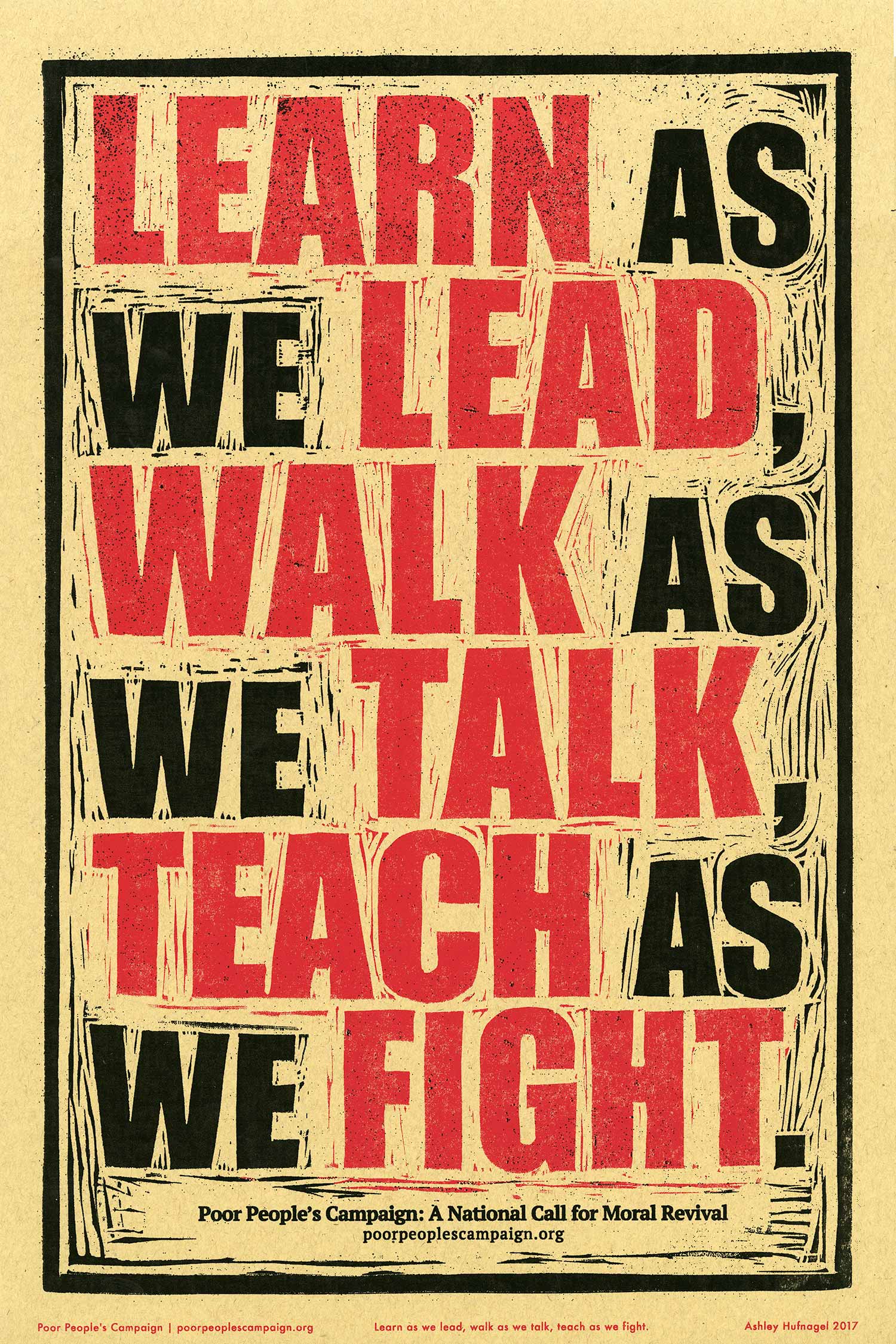
Figure 8.6.1: “Learn as we lead, walk as we talk, teach as we fightLinks to an external site.” by Ashley Hufnagel, JustseedsLinks to an external site. is licensed CC BY-NC-ND 4.0Links to an external site..
 a day ago
 4
4
- I need these questions answered
- 500 words
- Alliance Supermarket and Point-of-Sale (POS) Systems
- Organizational Leadership Teacher Charles only
- For yourstar
- ASI homework
- a220
- Assignment (Phillis Young) Only
- Summarize Terms To be eligible for full credit, you must complete both sections of the assignment. Section One: Defining Terms Based on the...
- Evaluate: -18 + 4(6 ÷ 2)^2 * Your answer

