


journal #3
 Jasmine_Lr
For each journal entry, you will reflect on and synthesize that week's assigned readings and videos. These journals are a space to think through what you are learning in class. This is not a formal . Your journal should be a place for you to work through ideas, ask questions, and make connections between the course learning materials (assigned readings, lecture videos, discussion boards, etc.) and the world around you.
Use your journal to:
- Compare and contrast the different feminist theories and frameworks you're reading about, and consider how they help explain the lived experiences of Chicanas/Latinas in the U.S., the Caribbean, and Latin America
- Connect course concepts to current events, media, your own observations, and lived experiences
- Reflect on how gender intersects with race, ethnicity, national origin, immigration status, social class, and sexuality in the readings, and what these intersections reveal about power, privilege, and oppression
- Grapple with ideas that challenge you, confuse you, or that you disagree with, and explain why or which parts you disagree with or are confused by
- Ask questions
Writing regularly will help you process what you're reading and start formulating your own thoughts, ideas, and opinions related to gender, identity, power structures, and feminist movements.
Gender, sex, and Sexual orientation
Gender, sex, and sexual orientation are terms that are often misunderstood or conflated in society. It is important that we understand the nuance of these terms and the ways in which they have been defined and shaped by culture and history.
In week 1, we discussed the meaning of gender and were provided with the following definition: Gender - Socially constructed roles created by society that define how people should act based on their sex designation. We are given a gender binary – told there are only two gender options, man and woman. In reality, there are infinite genders and infinite ways to express gender identity.
Now let's take a closer look to understand the difference between gender identity and gender expression
- Gender Identity: our personal sense of what our own gender is
- Gender Expression: The way in which people present or express their gender, which can include factors such as physical appearance, clothing, hairstyles, or behavior.
So what is the difference between sex and gender? In week 1, you were provided with the following definition of sex: Sex - Refers to the designation given by doctors/medical professionals, usually at birth, based on biological and physiological characteristics, usually centered around genitalia.
When we are born, a doctor assigns us a sex. This has to do with our biology, chromosomes, and physical body. But even sex is more
complex than that, and it really exists on a spectrum. For example, a newborn baby might have physical or biological traits that do not fit neatly into either category of male or female. These individuals are intersex.
It is important to remember that sex and gender are completely distinct categories. The sex you are assigned at birth does not dictate the gender you will identify with as an adult. However, due to societal norms, once a baby is identified as male or female, it is typically expected to identify with one of two binary genders (man or woman) that correlates with their sex designation (male or female). Some folks never question their assigned gender based on the sex they were assigned at birth, and that's called being "cisgender." However, there are plenty of folks who do question their assigned gender, and that's completely normal and OK too.
In week 1, you were also provided with a definition for sexual orientation: Sexual Orientation - The scientifically accurate term for a person’s enduring physical, romantic and/ or emotional attraction to another person. Sexual orientations can include heterosexual (straight), lesbian, gay, bisexual, queer, asexual, and other orientations. Avoid the offensive term “sexual preference,” which is used to inaccurately suggest that being gay, lesbian, or bisexual is voluntary and “curable.” The following video, created by True Colors United, provides us with a very helpful, visual representation of the differences between gender, sex, and sexual orientation.
Social Constructionism
Our definition of gender states that gender is socially constructed, but what is social construction? How do things such as gender become social constructions? To help us understand these questions, we must first understand the theory of social constructionism.
The following paragraph is an excerpt from the OER textbook, Introduction to Women, Gender Sexuality StudiesLinks to an external site. written by Miliann Kang, Donovan Lessard, Laura Heston, and Sonny Nordmarken.
"Social constructionism is a theory of knowledge that holds that characteristics typically thought to be immutable and solely biological—such as gender, race, class, ability, and sexuality—are products of human definition and interpretation shaped by cultural and historical contexts (Subramaniam 2010). As such, social constructionism highlights the ways in which cultural categories—like “men,” “women,” “black,” “white”—are concepts created, changed, and reproduced through historical processes within institutions and culture. We do not mean to say that bodily variation among individuals does not exist, but that we construct categories based on certain bodily features, we attach meanings to these categories, and then we place people into the categories by considering their bodies or bodily aspects. For example, by the one-drop rule (see also page 35), regardless of their appearance, individuals with any African ancestor are considered black. In contrast, racial conceptualization and thus racial categories are different in Brazil, where many individuals with African ancestry are considered to be white. This shows how identity categories are not based on strict biological characteristics, but on the social perceptions and meanings that are assumed. Categories are not “natural” or fixed and the boundaries around them are always shifting—they are contested and redefined in different historical periods and across different societies. Therefore, the social constructionist perspective is concerned with the meaning created through defining and categorizing groups of people, experience, and reality in cultural contexts."
Introduction to Women, Gender, Sexuality StudiesLinks to an external site. by Miliann Kang, Donovan Lessard, Laura Heston, Sonny Nordmarken is licensed under a Creative Commons Attribution 4.0 International LicenseLinks to an external site.,
Gender Binary
The gender binary is a social construction and a term you will hear often throughout this course. It is important to understand that the gender binary is not the only false binary or example of harmful binary thinking present in our society.
The following paragraph is an excerpt from the OER textbook, Introduction to Women, Gender, Sexuality StudiesLinks to an external site., written by Miliann Kang, Donovan Lessard, Laura Heston, and Sonny Nordmarken.
"Black and white. Masculine and feminine. Rich and poor. Straight and gay. Able-bodied and disabled. Binaries are social constructs composed of two parts that are framed as absolute and unchanging opposites. Binary systems reflect the integration of these oppositional ideas into our culture. This results in an exaggeration of differences between social groups until they seem to have nothing in common. An example of this is the phrase “men are from Mars, women are from Venus.” Ideas of men and women being complete opposites invite simplistic comparisons that rely on stereotypes: men are practical, women are emotional; men are strong, women are weak; men lead, women support. Binary notions mask the complicated realities and variety in the realm of social identity. They also erase the existence of individuals, such as multiracial or mixed-race people and people with non-binary gender identities, who may identify with neither of the assumed categories or with multiple categories. We know very well that men have emotions and that women have physical strength, but a binary perspective of gender prefigures men and women to have nothing in common. They are defined against each other; men are defined, in part, as “not women” and women as “not men.” Thus, our understandings of men are influenced by our understandings of women. Rather than seeing aspects of identity like race, gender, class, ability, and sexuality as containing only two dichotomous, opposing categories, conceptualizing multiple various identities allows us to examine how men and women, Black and white, etc., may not be so completely different after all, and how varied and complex identities and lives can be."
Introduction to Women, Gender, Sexuality StudiesLinks to an external site. by Miliann Kang, Donovan Lessard, Laura Heston, Sonny Nordmarken is licensed under a Creative Commons Attribution 4.0 International LicenseLinks to an external site.,
Traditional Gender Roles or Gender Norms
Traditional gender roles and gender norms are also social constructs. Gender norms are the expectations society places on us based on our gender. For example, because I am a woman, society expects me to care about and keep up with my physical appearance in ways that are deemed feminine, such as doing my hair or putting on makeup. Another example of gender norms in action is in two common phrases, "boys will be boys" and "boys don't cry". These two phrases carry with them the expectation that it is natural for boys to misbehave and that boys are unemotional.
Traditional gender roles are the behaviors and tasks that society expects us to do or take on based on our gender. For example, as a woman, I am expected to prioritize finding a man to marry and raising children. Based on my gender, it is also expected that I will do the majority of the housework, including cleaning and cooking. On the other hand, society expects men to take on the role of the "breadwinner" in the household. Society expects men to prioritize making money and working outside the home over child-rearing and housework.
Marianismo and Machismo
It is important to understand the concepts of marianismo and machismo and where they came from. These concepts are rooted in Spanish colonialism. Machismo is often understood as a form of hypermasculinity, based on traditional gender roles and gender norms.
The following two definitions for marianismo and the virgin/whore complex are provided in the Chapter 5 glossary of your OER textbook, New Directions in Chicanx and Latinx Studies by Amber Rose González. Conclusion. 10 Jan. 2024, https://socialsci.libretexts.org/@go/page/166505.
Virgin/Whore Complex: An example of a dichotomy that was first imposed by the colonial Catholic Church during the Spanish conquest that constructed women as a ‘mujer buena’ or a ‘mujer mala.’ In modern times, this gendered cultural expectation about Chicana womanhood reinforces patriarchy, obliging Chicanas to take on the contradictory roles of obedient wife and mother and to also be sexually available.
Marianismo: The narrative found on one side of the virgin/whore complex, which typifies the deep reverence for La Virgen de Guadalupe who is valued as the subservient all-suffering virgin mother.
Gender Inequality
These gendered expectations placed on us by society work together to create gender inequality. Gender inequality is the unequal access to resources, power, and opportunities between different genders.
Gender inequality is also exacerbated by systemic oppression, such as sexism, which we read about in week 1.
Last week, you read sections 4.1 and 4.2 from Chapter 4 of the OER textbook, New Directions in Chicanx and Latinx Studies. To begin week 6, we are picking back up with section 4.4 titled, Gender, Sexuality, Migration, and Indigeneity. Please read all of section 4.4 and watch the short embedded video titled, "A Queer Native Thanksgiving".
This section will cover the following topics:
- Gender Roles and Family Dynamics
- Gender and Labor
- Gender and Language
- Two-Spirit Identities and Pan-Indigenous Solidarity
- Queer and Trans Migration Experiences
Assigned Reading: 4.4: Gender, Sexuality, Migration, and Indigeneity,Links to an external site.
Challenging the Gender Binary: The Muxes of Oaxaca, Mexico
Watch the short film by Ivan Olita below.
"The latest documentary by Ivan Olita is a piece documenting the far reaches of the southern state of Oaxaca, where, in the Indigenous communities around the town of Juchitán, the world is not divided simply into males and females. The local Zapotec people have made room for a third category, which they call “muxes” - men who consider themselves women and live in a socially sanctioned limbo between the two genders." Olita, Ivan. “Muxes.” Vimeo, 21 Dec. 2016, https://vimeo.com/196684590Links to an external site..
Links to an external site.Links to an external site.
Continuing to chapter 5: feminisms
In week 1, you read the introduction to Chapter 5, titled "The Roots and Routes of Chicana/Latina Feminisms". This week, we are continuing our conversation on Chicana and Latina feminisms as we read the rest of Chapter 5.
First read section 5.2 Fighting for Economic Justice.Links to an external site. Next, read section 5.3 Reproductive JusticeLinks to an external site..
These two sections will cover the following topics: 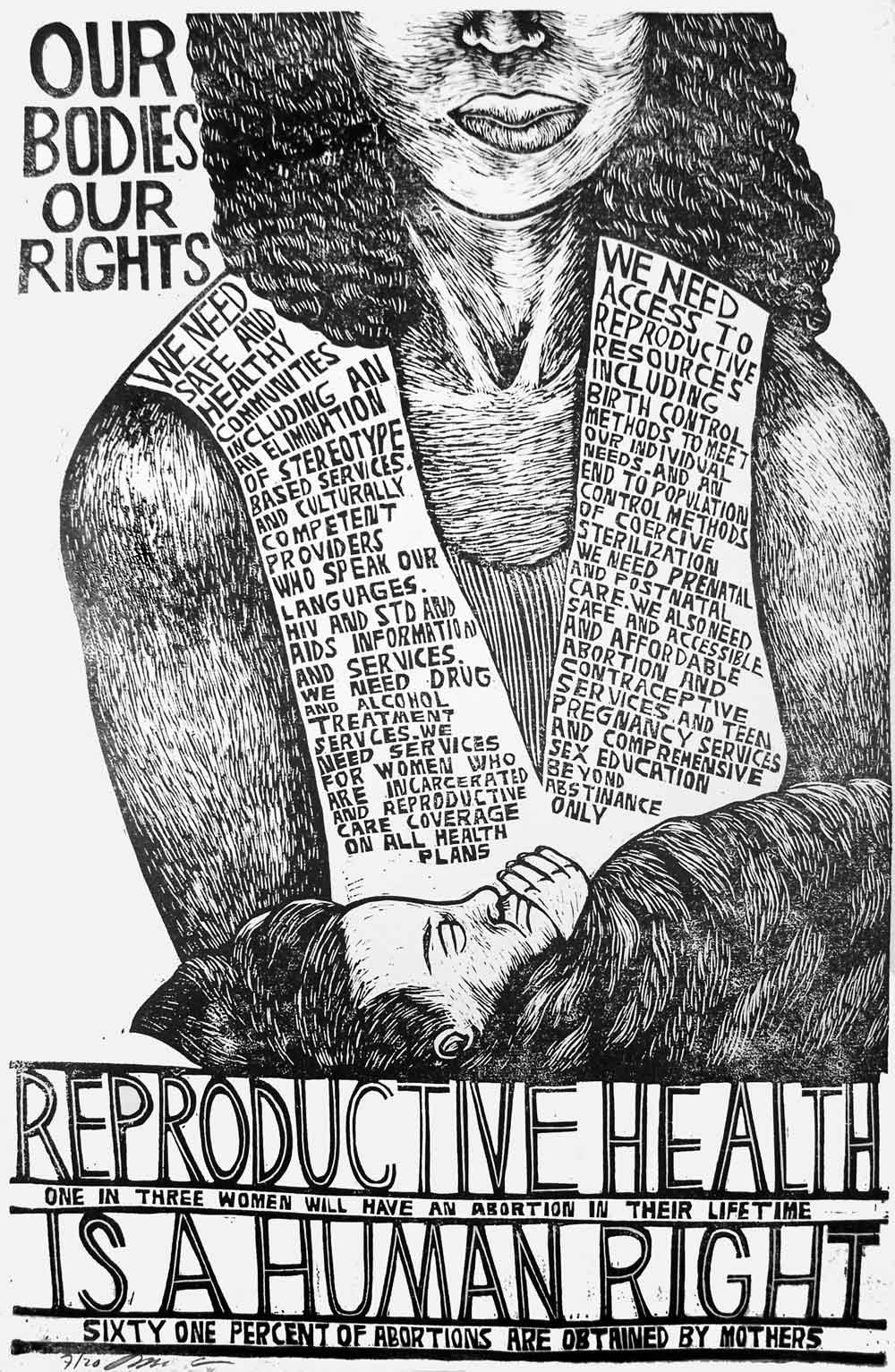
- Labor Organizing
- Welfare Rights
- The Fight for Reproductive Justice
- The History of Reproductive Injustice
Assigned Reading:
- 5.2 Fighting for Economic Justice.Links to an external site.
- Links to an external site.5.3 Reproductive JusticeLinks to an external site.
“Our Bodies Our RightsLinks to an external site.” by Meredith SternLinks to an external site., JustseedsLinks to an external site. is licensed CC BY-NC-ND 4.0.
Latinas in the Labor Movement
After you've finished reading the pages listed above, watch the following Time Magazine video from their series "The History You Didn't Learn" on the history of the important and integral contributions Latinas made to the labor movement. In this video, you will learn about the work of Latina labor organizers, Luisa Moreno and Emma Tenayuca-Brooks, who fought for workers' rights and paved the way for the famous labor organizer, Dolores Huerta, who would come to prominence roughly two decades later.
This video is embedded in section 5.2 of your OER textbook.
Reflection Questions
As you read, take time to pause, reflect, and answer the following questions.
- How did Chicanas and Latinas challenge patriarchy, sexism, and homophobia in their ethnic nationalist movements and in the larger society?
- What are some of the key issues and movements that Chicana and Latina feminists have been involved in? What specific strategies did they utilize in their advocacy work?
 a month ago
 4
4
- Assignment needed to calculate industry average ratios
- CMGT/445: Case Study: Appliance Warehouse – Use Case Analysis
- Essay 5
- Project and Resource Management for the Health Services Organizations
- Global Initiatives
- Statistics last week help
- Research Project
- M1- ENC
- Information governance
- Course Paper Thesis/Outline /Annotated Bibliography

