


1
Question 61:
a) Decision
Reject the null hypothesis
b) Reason for the decision
p-value < alpha
c) Conclusion (write out in a complete sentence)
The significance level is 5%; the evidence is sufficient to conclude of two or more races
in Nevada is statistically higher than that in North Dakota
Question 64:
Null hypothesis: μ1 = 0
Alternative hypothesis: μ2 ≠ 0
Question 65:
p-value = 0.0067
Question 68:
Null hypothesis: μ ≥ 0
Alternative hypothesis: μ < 0
Question 70:
Sample mean difference= -1-1-3-2-1-1-2
SMD = -10/ 6
The sample mean difference = -1.667
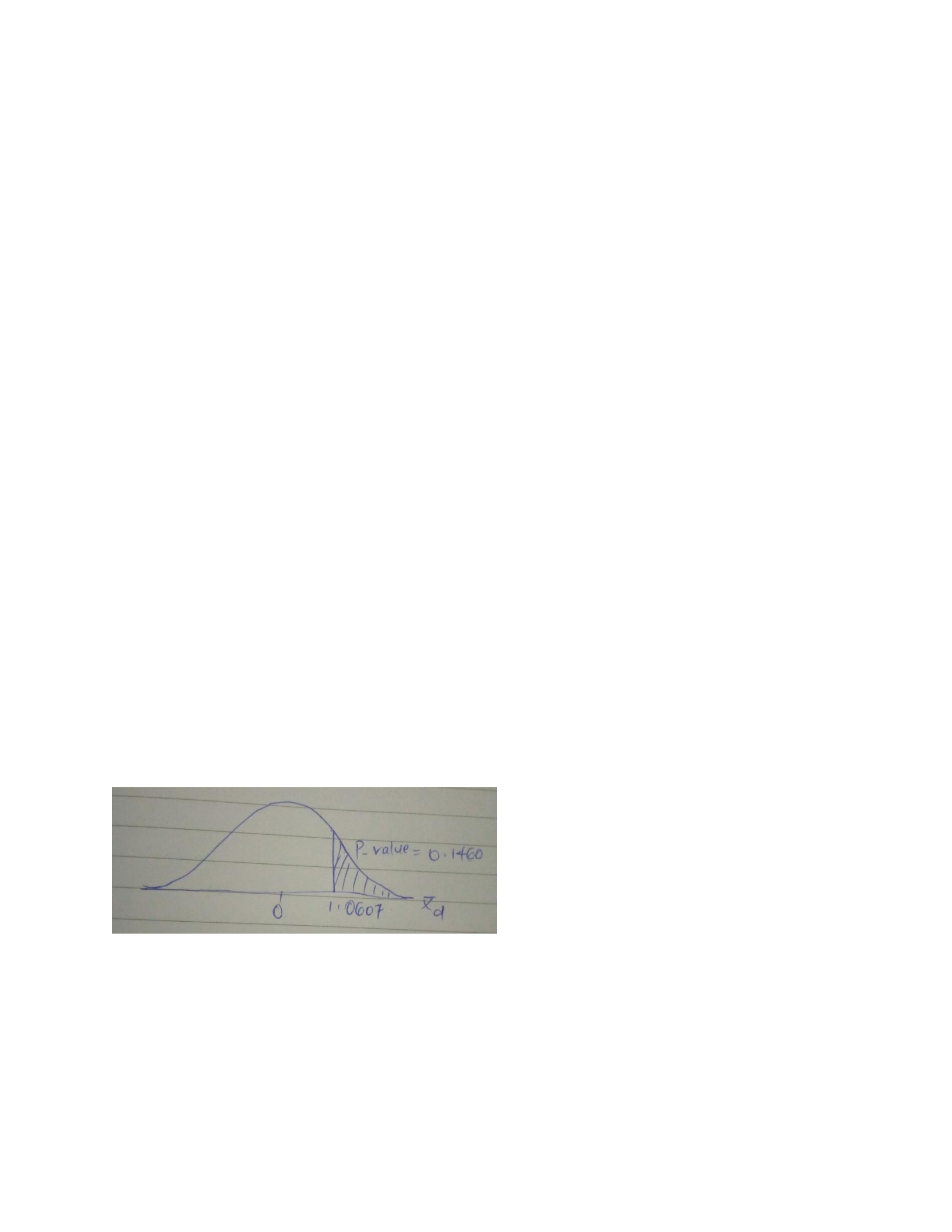
Question 71:
Question 74:
= (163.8 – 12)/ 3.9
= 38.9
Question 78:
Null hypothesis:

2
Alternative hypothesis:
The p-value = 0.042 under a 5% level of significance; therefore, the evidence is sufficient to
reject the null hypothesis.
Question 81:.
Null hypothesis: U1 ≥ U2
Alternative hypothesis: U1 <U2
The p-value = 0.2063; under a 5% level of significance. Therefore, there is sufficient evidence on
not to reject the null hypothesis. hence do not reject the null hypothesis.
Question 89:
There is sufficient evidence to conclude that the statistics night students’ mean on exam 2 is
better than the statistics day students’ mean on exam 2.
Question 106:
Null hypothesis: P1 = P2
Alternative hypothesis: P1 ≠P2
The p-value = 0.003 under a 5% level of significance; therefore, there is enough evidence to
reject the null hypothesis.
Question 108: Test at a 1% level of significance
Null hypothesis: P1 = P2
Alternative hypothesis: P1> P2
The p-value = 0.236 under a 1% level of significance; therefore, the null hypothesis will not be
rejected.
Question 110
Null hypothesis: P1 ≤ P2
Alternative hypothesis: P1 >P2
The test statistic is 0.22 and a p-value = 0.4133 under 5% significance level. Therefore, there is
sufficient evidence not to reject the null hypothesis.

