


1
Chapter 1: Introduction
1.1 Background
612,500 pedestrians aged 15-29 were killed in 2013, which was the number one
cause of death among that age group [1]. Fully automated driving systems are seen as
possible remedies for reducing road traffic fatalities due to the fact that they do not
possess the fundamental issues of human drivers, such as failure to comply with the
rules, lack of attention while driving, etc. Furthermore, decision-making for
automated driving systems (ADS) is a challenging area that plays a key role in fully
automated systems. Especially, developing intelligent systems taking precautious
actions for objects that are currently unobservable but interacting with the ego
vehicle in the future has attracted much attention recently.
According to SAE [2], there are five levels of driving automation. Levels 1-2 are
defined as Automated Driving Assistance Systems (ADAS), whereas Levels 3-5 are
considered Automated Driving Systems (ADS). Level 3-5 systems are expected to
participate partially or fully in decision-making. Currently, only up to Level 3 systems
are available in the market, and the National Highway Traffic Safety Administration
(NHTSA) has projected that level 4-5 autonomy would arrive not before 2025 [3].

2
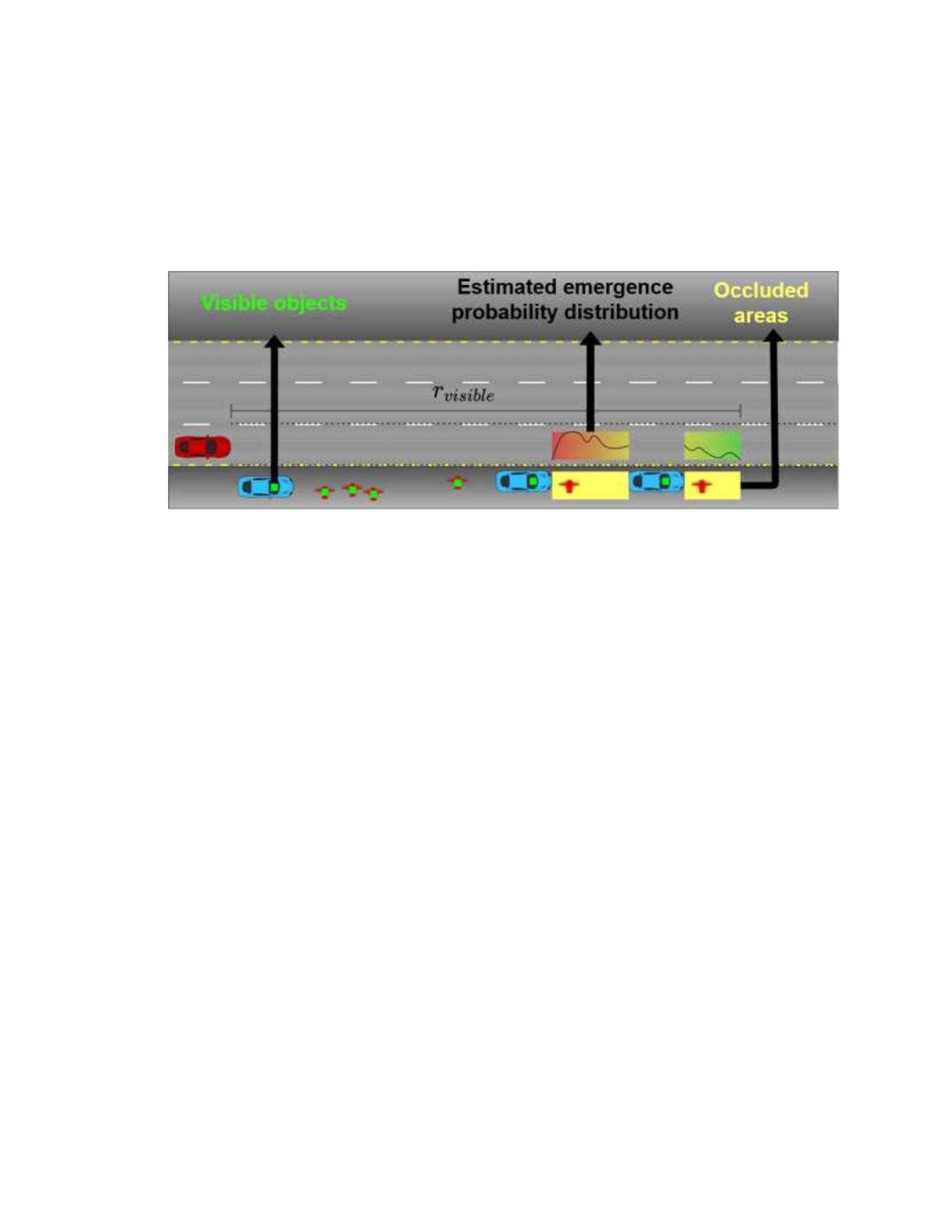
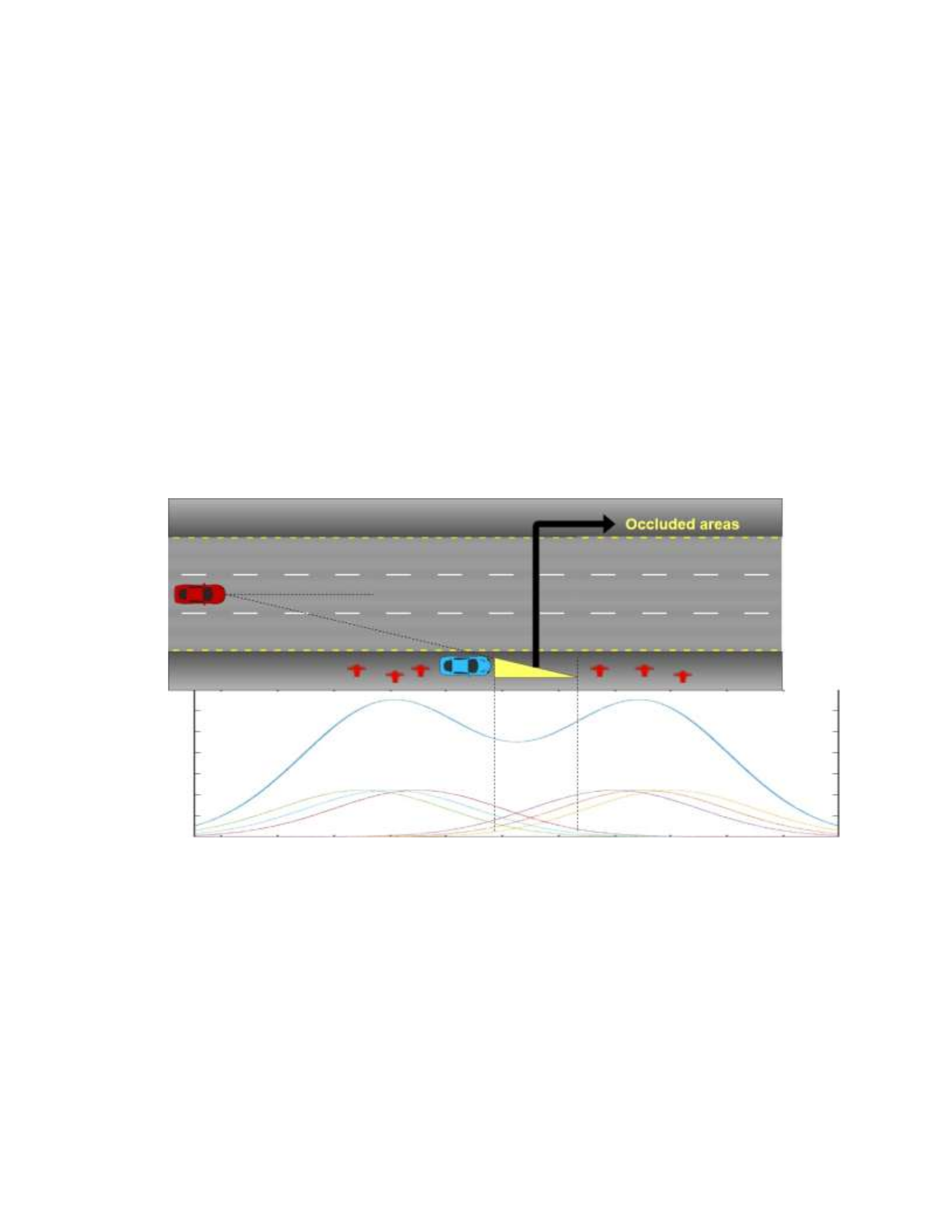
Figure 1.1: An example of environmental cues and how a human driver would easily
decide a similar scheme for emergence probability
The motion prediction and risk assessment are vital in taking precautious actions.
Lefevre et al. [4] categorized the motion prediction and risk assessment methods into
four categories, and stated that despite being computationally more demanding,
interaction-aware methods are more reliable than other methods. Occlusion-aware
[5] risk assessment methods have been proposed as the alternative interaction-aware
methods. Those alternatives vary from solutions based on partially/mixed observable
Markov decision processes (POMDP/MOMDP) [6–13], to solutions based on setbased
methods [14–19].
On the other hand, there are currently two shortcomings of available methods in
the literature. Firstly, human driver performance under occlusion and limited
visibility conditions have been mostly neglected. Secondly, little attention has been
paid to using visible information and prior knowledge to predict pedestrian
emergence out of occluded areas.
This thesis introduces a novel occlusion-aware risk assessment system for ADSs.

3
The proposed method can estimate pedestrian emergence probability from occluded
areas and adjust its driving policy accordingly. Our method’s overview is
demonstrated in fig. 1.3, where the red ego vehicle uses information such as visible
pedestrians and parked cars to assess the probability of emerging pedestrians to
derive an optimal driving policy.
1.2 Literature review
Various methods from set-based methods to the exploitation of behavior of other
participants in a rule-based fashion were used [20–24]. Althoff et al. [20] improved
the reachability analysis to obtain PID controllers and implemented their method on
a real car. In a similar fashion, Magdici et al. [21] generated so-called fail-safe optimal
trajectories, some of which were designated as “emergency maneuvers” so as to stop
the ego vehicle without any collision; furthermore, the “emergency-maneuvers” in
[21] generated by predicting all possible trajectories of other traffic participants
within the given time horizon. Kousik et al. [22] utilized the duality of low-fidelity and
highfidelity models to generate safe trajectories in arbitrary environments, in real-
time; safe trajectories were generated by taking into account the mismatch between
the models. Koschi et al. [23] used set-based predictions, contextual information, and
traffic rules. Koschi et al. compared their method against that of Thorton et al. [12].
However, only visible pedestrians were considered in [23]. Kapania et al. [24] first
utilized the gap acceptance behavior of pedestrians and deterministic limitations of
vehicles. The gap acceptance behavior and the limitations were used by an FSM
controller. The controller yielded whenever possible, or chose the action to avoid
collisions; furthermore, the controller exploited the gap acceptance behavior in the

4
different modes, such as aggressive and conservative. However, none of those works
considered occlusions and invisible traffic participants.
1.2.1 Occlusion-Aware Risk Assessment Methods
On the other hand, occlusion-aware risk assessment methods incorporated
obstructed visibility information. These methods can be categorized into two: the
methods based on POMDP/MOMDP representation and the methods based on reach-
ability analysis.
The methods based on POMDP/MOMDP representation used probabilistic models
and Bayesian filtering [6–13]. These methods could estimate the uncertainties to
incorporate the observation along with reward models. Then, the estimation was used
to extract a sub-optimal driving policy. Bouton et al. [9] focused on extracting the
driving policy at an intersection with POMDP representation; the proposal was
compared against a TTC-based method. However, the results in [9] were rather
ambiguous on the account of the fact that the proposed method was outperformed by
the TTCbased method for denser traffic conditions. Bouton et al. [11] extended the
work of [10,25] on utility decomposition to propose a scalable decision-making
method under sensor occlusions; the proposal could handle multiple road users.
However, the action and state resolution were very low on the account of avoiding
exponentially growing computational demand. Schratter et al. [13] achieved safe
control for occluded pedestrians with POMDP representation and the help of
Automatic Emergency Braking (AEB) systems. However, that method suffered from
the low resolution of statespace, and it could handle one pedestrian. In general,
methods relying on POMDP representation and RL have suffered from real-time

5
inapplicability. In other words, those methods are computationally demanding;
consequently, they are impractical for real-life implementations as the execution time
is rather long in situations that require immediate actions. Secondly, due to lack of
resolution in action and state-space, the driving policy may result in an uncomfortable
driving experience for passengers.
The methods based on reachability analysis determined the risky situations in
advance by over-approximating the future sets of other traffic participants using
reachability analysis [14–19]. Hoerman et al. [14] used dynamic grid maps in three
distinct dynamic grid map layers, namely object-based, object-free, and unobservable
region layer for risk assessment and collision-avoidance; any cell was considered as
occupied had the cell in any of the three layers detected as occupied. Orzechowski et
al. [16] expanded Althoff et al’s reachability analysis so as to also incorporate
occlusions and unobservable traffic users. Furthermore, Orzechowski et al. stated that
Ta¸s and Stiller [17] prioritized safety, did not consider comfort. Naumann et al. [19]
considered the worst-case presumptions for critically unseen traffic users and
claimed to ensure “provably safe but not over-cautious actions”. Furthermore, most of
these methods adopted the notion of blame from [5], which defined safety as choosing
trajectories that do not cause a collision. However, those trajectories may still end in
a collision due to erroneous actions by other traffic participants; moreover, neglecting
to compensate for other’s faults is a major flaw that may result in morally wrong
situations. Those methods assumed the worst-case scenarios in some subset of
possible actions by other traffic participants; specifically, for those which considered
the pedestrians in over-approximated sets. However, a proof of safety by constraining
physical capabilities of other traffic participants is ill-defined, in that there may exist

6
some cases that those constraints are either too conservative or not sufficiently
representative.
1.2.2 Pedestrians’ Response to an Incoming Vehicle: Gap
Acceptance
The assumption that pedestrians are not influenced by traffic flow on the road is
inaccurate; pedestrians are also intelligent dynamic systems that are able to react to
changes in their surroundings. Furthermore, pedestrians also consider their safety,
that is, they want to cross the road safely. Therefore, over-approximating their
possible movements may result in an over-conservative driving policy. Moreover, it is
not very time-efficient to over-approximate the unsafe behaviors, whereas it is not
safe to under-approximate them either.
One possible solution is to model the pedestrian crossing decisions as a function
of the remaining distance between a pedestrian and an oncoming vehicle. One model
of the crossing decision is called the gap acceptance model; the decisions are
probabilistically modeled as a likelihood function. The gap is defined as in (1.1):
D(Distance)
G(Gap) = (1.1)
V (Velocity)
where D is the distance between the ego vehicle and the pedestrian and V is the
velocity of the ego vehicle.
A realistic way to obtain a reasonably accurate likelihood function is to observe a
large number of pedestrians. The gap acceptance model has been studied at various
locations, such as midblock or crosswalk intersections from different cities with
various conditions in [26–29]. Brewer et al. [26] modeled the behavior by a logistic
regression function of the gap; the data were collected at 42 study sites in seven states.

7
Similarly, Cherry et al. [27] also modeled the behavior by a logistic regression function
of the gap; by contrast, more variables, e.g., the effective gap, wait time, vehicle speed,
were used in the model. On the other hand, the influence of illegal parking and car
types were considered in Yannis et al’s work [28,29]. In order to explain the model in
detail, the work of [26] can be used; in their work, a logistic regression fitting tool was
used to estimate gap acceptance with respect to gap between the pedestrian and the
vehicle. The tool fitted the rejection behavior into the (1.2) with βx being a first-order
polynomial function of gap.
p(Gap rejection (1.2)
Conversely, the acceptance behavior was fit into the function in (1.3):
p(Gap acceptance|G = d) = 1 − p(Gap rejection|G = d)
(1.3)
Using (1.3), the gap acceptance characteristics from [26] is demonstrated in Fig. 2.10.
Arguably, this model may not be accurate; however, it is open to further improvement
by more sophisticated deep learning methods. Furthermore, this model has validated
that pedestrians cross rarely should the ego vehicle be very close. On the other hand,
the works on the gap acceptance model have not taken into account the distracted
pedestrians; the absence of such pedestrians is a limitation to the generality of the
model. Accordingly, the proposal should also consider such pedestrians in order to
overcome that limitation.

8
1.2.3 Occlusion-robust Tracking Methods
Occlusion-robuts tracking methods can be facilitated in order to develop a method
that can navigate successfully in scenario with multiple pedestrians. Marron et al. [30,
31] proposed a modified PF, which is called XPFCP for tracking multiple bodies which
modeled multiple objects in one multimodal distribution. This method could
Figure 1.2: Pedestrian gap acceptance characteristics, from Brewer et al.
be useful to track multiple unseen pedestrians with a small modification because their
work can only track objects that were observed previously.
On the other hand, there are currently two shortcomings of available methods in
the literature. Firstly, the possible reasons of humans’ successful driving under
occlusion and limited visibility conditions has been mostly neglected. Furthermore,
little attention has been paid to scenarios in which GPS accuracy is degraded due to
buildings, bridges, trees, etc. [32]. None of the methods has taken into account the fact
that the contextual information could be incorporated into the prior knowledge;
9
hence, the information can be utilized to assess the risk for occluded unseen
pedestrians. In addition, the literature is deficient in formally defining the limitations
of vehicles in terms of safety, and comfort. For example, the distance to stop without
a compromise on safety and the distance to stop without a compromise on
Figure 1.3: An example of environmental cues and how a human driver would easily
decide a similar scheme for emergence probability
passengers’ comfort change with different weather conditions. Consequently, we
believe that considering the limits of safety and comfort for different conditions will
improve robustness and capabilities of ADS.
1.2.4 Contribution of This Thesis
This thesis focuses on whether only contextual information without localization
information can further improve the performance and achieve a human-like behavior.
For example, given that the ego vehicle is the red car in fig. 1.3, could we design a
method that can use visible pedestrians and parked cars to assess emerging
pedestrians’ probability to extract an optimal driving policy? The main contributions
are:

10
• Using contextual information to assess the risk of emerging pedestrians from
occlusions, then utilize this information to extract the driving policy
• Pedestrian emergence probabilities are calculated using a modified logistic
regression curve on the contextual cues
• The proposed controller utilizes the emergence probabilities by using three
driving modes, converted into a structured finite state machine (FSM) to provide
comfortable and safe driving.
1.3 Outline of the Thesis
This thesis proceeds as follows: in Chapter 2, a hypothetical problem is defined to
serve as a mathematical background to define the interactions with certain
assumptions. In this hypothetical problem, there is an object and multiple dynamic
obstacles that share the same path; the formulas and constraints for the object to
navigate on the road without any accidents are carefully defined.
Later, the formulas and constraints are utilized to design the proposed method for
the occluded/unseen pedestrian scenarios. The proposed method uses Bayesian
filtering, a meticulously designed FSM, and an optimization scheme to extract the
driving policy. Moreover, the design of the proposed method is explained in detail.
Secondly, in Chapter 3, the proposed method’s evaluation and the results are
demonstrated and interpreted carefully. Finally, in Chapter 4 final remarks and
limitations of the study are discussed vigorously, and the thesis is concluded with
some possible future directions.

11
Chapter 2: Theoretical Background and Methodology
This chapter formulates the hypothetical problem. Formulation of the
hypothetical problem is useful to define the deterministic limits to avoid collisions.
Later, the chapter introduces the problem of interest, namely avoiding emerging
pedestrians from occlusions, stochastically; the deterministic limits are utilized in this
part. The chapter proceeds with risk assessment using contextual information to the
ego vehicle. After that, the chapter explains the model used for the agents, i.e., the ego
vehicle, the pedestrians. The assumptions used in this work are stated. Finally, the
chapter concludes with the utilization of risk assessment in a control architecture and
provides the design of the controller in the proposed method.
2.1 Theoretical Background
2.1.1 Mathematical Definition of the Problem
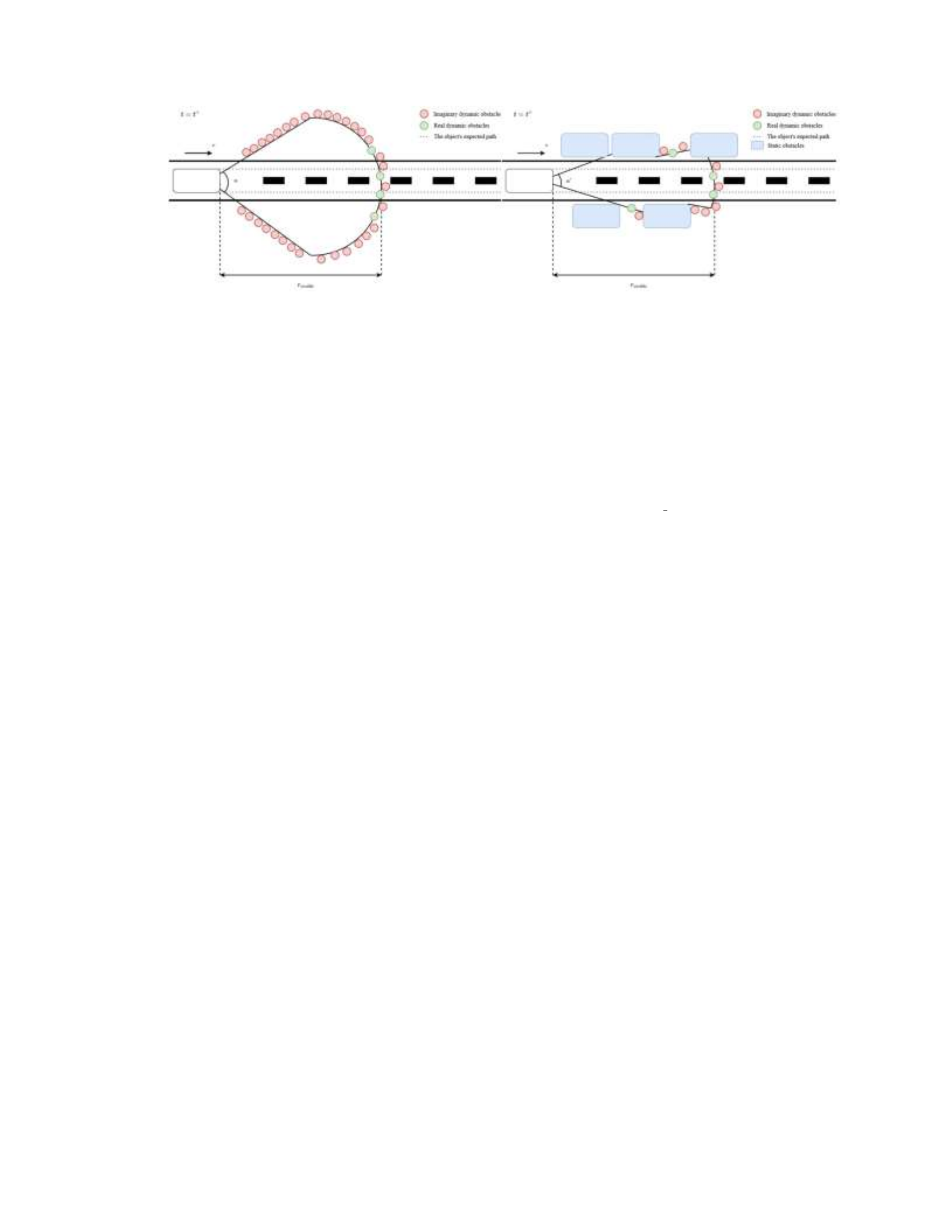
Assume that there is an object moving along its path, whose longitudinal velocity
is controllable and denoted by v, whose visibility range is denoted by rvisible, and whose
viewing angle is denoted by α. Furthermore, assume that there are also dynamic
obstacles that can walk only in the lateral direction; the moving direction of the
obstacles is perpendicular to that of the object. Therefore, the obstacles and the

12
Figure 2.1: An object moving along the path with possible options: either with or
without static obstacles which limit the visibility of the object
object should use the same path; however, the object should not collide with any
obstacles.
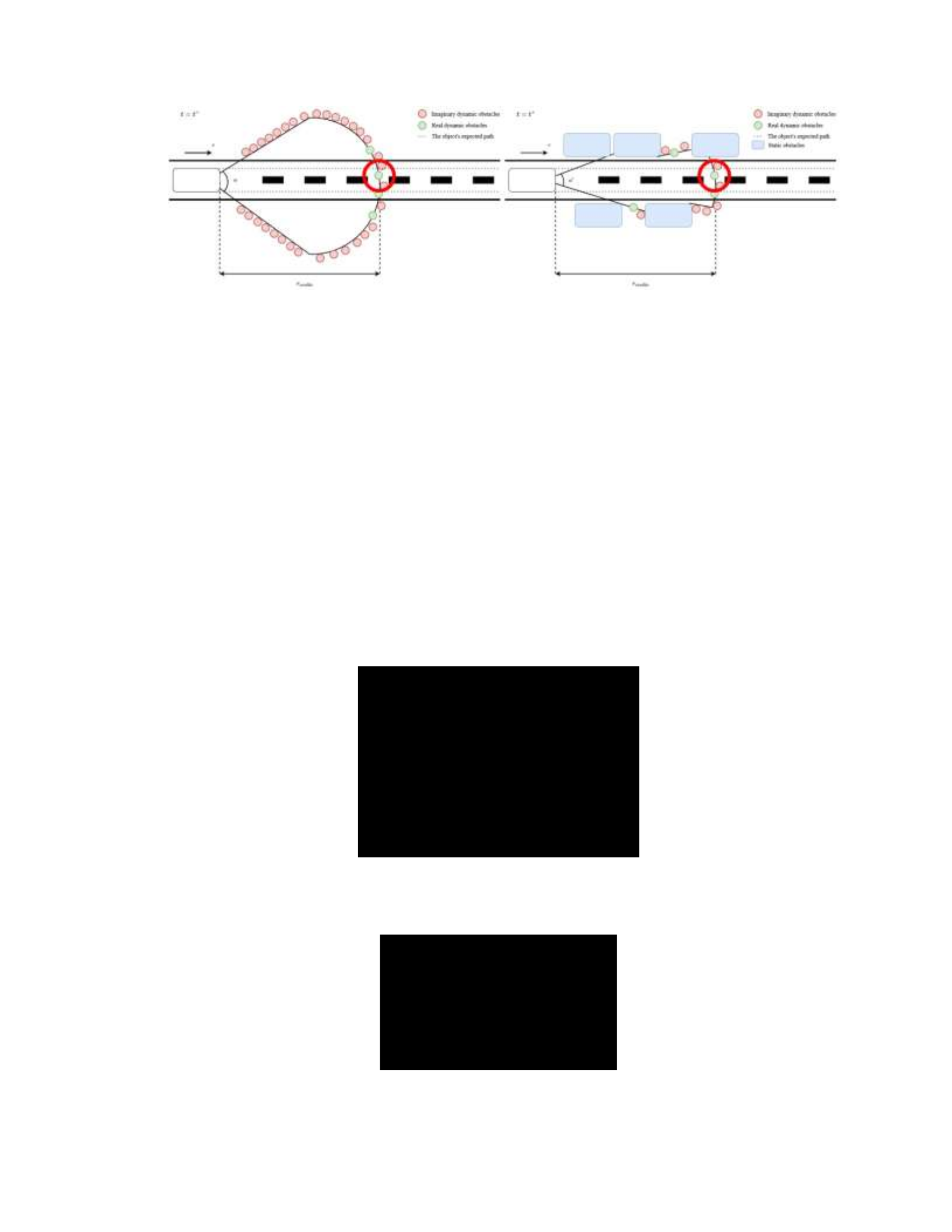
In order to define the limitations for collision avoidance, assume that at t = t−, the
object cannot observe any dynamic obstacle, i.e., there is no obstacle inside the
object’s visibility region. Provided that the obstacles move with a constant velocity
and assuming that the behavior of the obstacles is not influenced by the object, the
current possible locations of the obstacles that would collide with the object can be
found. Now, assume that the object can detect the obstacles whose center of gravity
(CoG) is inside the visibility region. Then, an example scenario in Fig. 2.2 can be used
to define the rules and limitations of the object. The object has the following
limitations:
• It has point-mass model dynamics so it obeys the rules of Newtonian dynamics
for a point-mass object
• It has a certain delay to identify the obstacles after the very first instance of
obstacle detection; this delay is denoted by tsense
13
Figure 2.2: At t = t+, there could be some dynamic obstacles that are at the boundary
of detection
• It has a certain delay to actuate any control to alter its velocity using
acceleration/deceleration; this delay is denoted by tsystem delay
• It cannot realize any acceleration/deceleration value instantly after the delay
tsystem delay, but the acceleration ramps up in a certain time before it reaches the
steady value, this amount of time is denoted by tramp
2.1.2 Deterministic Limitations to Avoid Collisions
A collision occurs the object’s future trajectory and at least the future trajectory of
one obstacle coincide for the same instance. A collision can be categorized by the point
of contact at the instance of collision; either the obstacles can hit the object from its
sides or the object can hit the obstacles. The latter category is considered in this thesis
since such collisions can be avoided by the actions of the object. The object can collide
with an obstacle either:
• is already inside the expected path, and is to stay on the path,
14
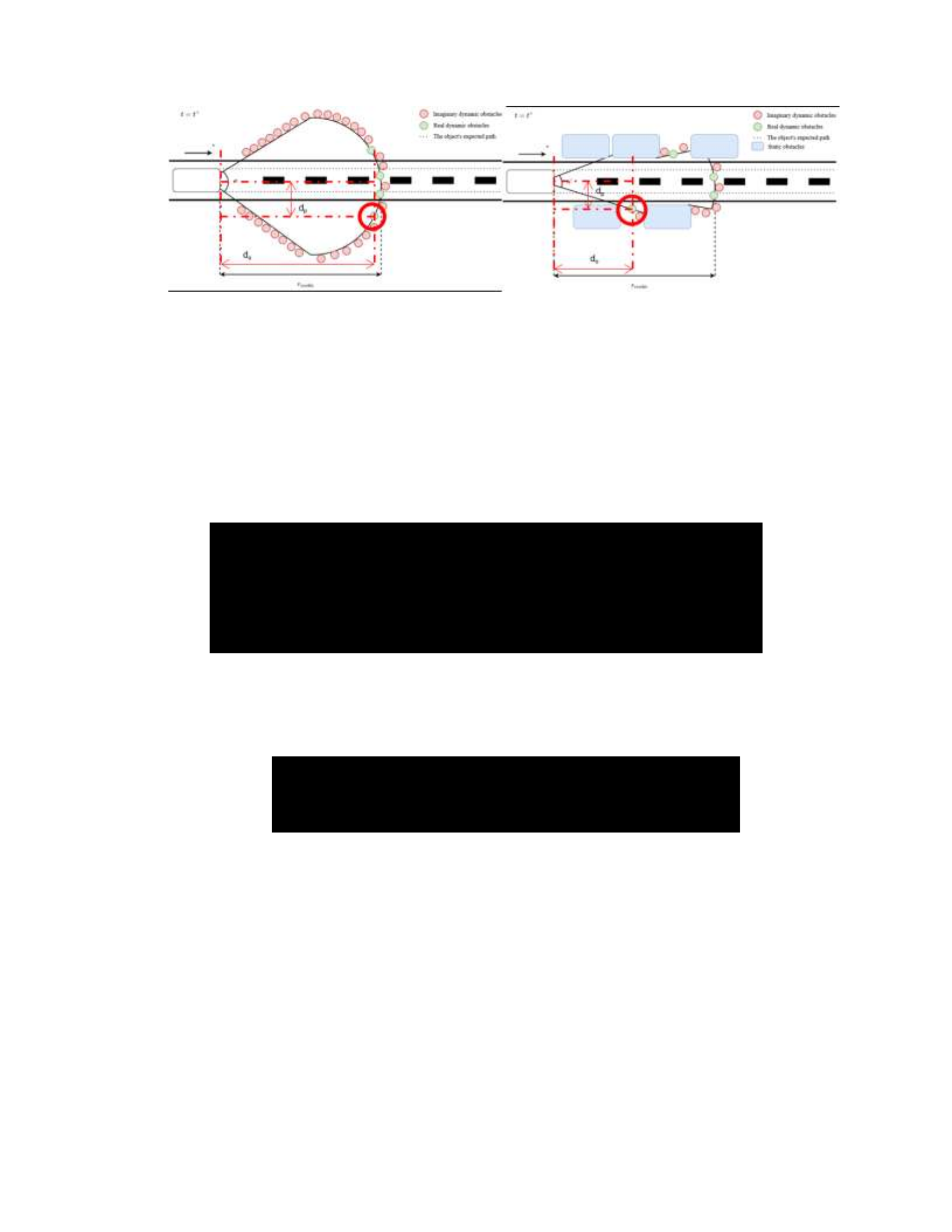
Figure 2.3: An obstacle which is inside the object’s expected path, and which is to stay
inside the expected path
• or the obstacle can be outside of the expected path and is to enter the expected
before the object arrives.
In the first case, as can be seen in Fig. 2.3, the object’s limitation is its visibility
range, rvisible. Assume that the object cannot realize arbitrary accelerations instantly,
but tramp seconds is required to reach the steady deceleration: For t ∈ [0,tramp]:
(2.1)
(2.2)
(2.3)
Then, at t = tramp:
(2.4)
(2.5)
(2.6)
15
Figure 2.4: An obstacle which is outside of the object’s expected path, and which is to
enter inside the expected path
Then, total distance the object travels before stopping from the instance of actuating
brakes:
(2.7)
Finally, including the time to sense obstacles, tsense, and the time to actuate the brakes,
tsystem delay, the total distance that the object travels before stopping is:
(2.8)
Note that, af is a positive acceleration value which is the absolute value of the steady
braking deceleration of the object. The object should always ensure that rvisible >
dstop.
In the second case, as can be seen in Fig. 2.4, the object’s limitation is its visibility
region. Assume that the lateral distance between the CoG of the object and that of an
obstacle is denoted by dp, and the longitudinal distance between the frontal structure

16
of the object and the CoG of an obstacle is denoted by d0; furthermore, assume that
the width of the object and an obstacle are denoted by wobject, wobstacle and the lengths
are denoted by lobject, lobstacle respectively.
Using (2.1)–(2.8):
The fact that there is a region of danger in which the obstacles outside of this region
do not pose a threat to the object can be deduced from (2.9). Additionally, the danger
of collision is a smaller subset of the aforementioned region in which condition in
(2.10) is satisfied.
2.1.3 Moving to the Real Life Problem: Avoiding Emerging
Pedestrians from Occlusions
The limitations and definitions introduced and the formulas obtained in Section
2.1.1 and 2.1.2 is useful to formulate the proposal to avoid emerging pedestrians from
occlusions. The terminology used in Section 2.1.1 and 2.1.2 should be revised so as to
convert the hypothetical problem into a real-life problem:
• the object to the ego vehicle,
• dynamic obstacles to pedestrians (or VRUs in general),
• static obstacles to parked cars, trees, or buildings.
In order to proceed to risk assessment, rewrite the two conditions for a collision,
namely (2.9) and (2.10), with the new terminology:

17
(2.11)
Notice that a new variable dsafe is introduced since the ego vehicle is expected to keep
a safe distance from pedestrians provided that collision avoidance is not necessary,
but the ego vehicle should wait for the pedestrians on the road to cross.
Any pedestrian who is do meters away longitudinally, and dp meters away laterally,
with lateral velocity vped satisfying (2.11) poses a risk to the ego vehicle. However, as
long as (2.12) is not satisfied, the risk could be averted.
There may exist other possible definitions or formulations of the pedestrian
collision avoidance. Nonetheless, the possible definitions or formulations can be
converted into the current problem formulation via a transformation.
2.1.3.1 Vehicle Controllability Limitations and Risk Zones
Considering the variable that the ego vehicle has control over, the safety of driving
is related to (2.12). It is assumed that tsense and tsystem delay are variables that the ego
vehicle cannot alter, but only measure or estimate; by contrast, it is also assumed that
vego, af, and tramp are variables that the ego vehicle can control within their physical
limits. The limitations for the maximum possible deceleration is provided in Appendix
A.
The control of these variables can be categorized in three aspects, namely, comfort,
safety, and efficiency. In fact, there may exist various driving policies which may
prioritize one or two of these aspects. However, in a successful policy, these three

18
aspects should be considered optimally without neglecting any of them. The optimal
consideration should minimally care for the passengers of the vehicle, and ideally for
all road users that the vehicle interacts. Let us denote the positive value for maximum
deceleration of the ego vehicle as amax and the minimum possible time to reach a
steady acceleration/deceleration value as tramp min, and the maximum velocity that ego
vehicle is legally allowed to drive as vego max. Let us also assume that these limitations
are constant values.
Provided that the ego vehicle is in a situation in which it is required to ensure
safety, it is assumed that the ego vehicle will try to reach the steady deceleration of
amax with its limiting time tramp min, let us assume that under this policy the earliest
distance that the ego vehicle can stop is dstop min. On the other hand, when there is no
indication of danger, it is assumed that the ego vehicle will try to reach vego max. On the
other hand, to define an optimal policy in terms of comfort, the experience of comfort
of a passenger inside a car should be investigated. The common sense and personal
experience can be used to undertake the investigation; the passengers are able to
experience both the force and the change in force exerted on their bodies. From
Newtonian mechanics for a constant mass of body, the force exerted on the body is
defined in (2.13):
(2.13) (2.14)
(2.15)
where j denotes the derivative of acceleration in
(2.14) and (2.15), which is also known as jerk. Since both acceleration and jerk

19
perceived by the human body similarly in any direction, the magnitude of acceleration
and jerk is the main factor for the comfort.
Therefore, it can be assumed that an acceleration value between [−acomfort,acomfort]
values and a jerk value between [−jcomfort,jcomfort] are considered to be comfortable.
Determining these values and the values used in the simulation are provided in
Section 3.1.
Here, the distance that the ego vehicle can stop when its positive value of
deceleration is denoted by acomfort; the time to reach that deceleration value without
exceeding comfortable acceleration or jerk value is denoted by tramp comfort. Let us
assume that under this policy the earliest distance that the ego vehicle can stop is dstop
comfort. The ego vehicle can be considered to have imaginary zones, so-called risk zones
as in Fig. 2.5. Assuming that dstop min ≤ dstop comfort, and a reference frame whose origin is
at the CoG of the frontal structure of the ego vehicle is used to define the risk zones,
the longitudinal ranges of the zones are as follows:
• Danger Zone : [0,dstop min]
• Discomfort Zone : [dstop min,dstop comfort]
• Safety Zone : [dstop comfort,rvisible]
This suggestion to use risk zones can be viewed as a geometrical interpretation of
the capabilities of the ego vehicle. Nevertheless, these three zones may submerge or
disappear completely with changing velocity. For example, given a scenario
demonstrated in Fig. 2.5, the ego vehicle could avoid a collision with all of the
pedestrians except the leftmost one was he or she to step on the road before the ego
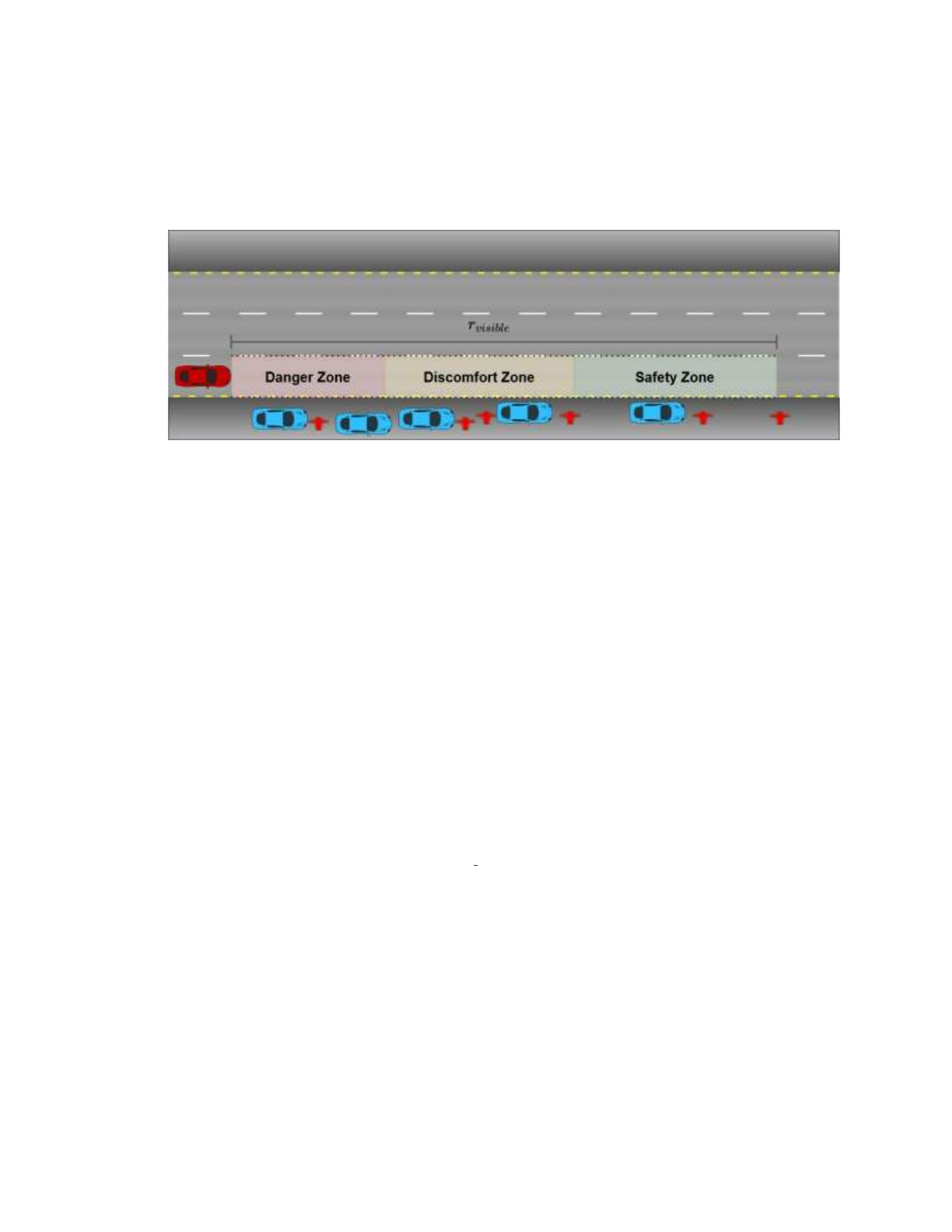
20
vehicle can pass through. Therefore, if it is physically possible for the leftmost
pedestrian to reach the lane at the bottom before the ego vehicle, the ego vehicle
cannot avoid the collision with longitudinal control.
Figure 2.5: Given the limitations of the ego vehicle, the ego vehicle can safely and
comfortably yield to any pedestrians crossing inside the Safety Zone, whereas the ego
vehicle is required to compromise on the passengers’ comfort in order to yield to the
pedestrians inside the Discomfort Zone. Finally, it is not possible to yield or stop before
hitting a pedestrian inside the Danger Zone (Zone sizes are not to scale)
2.1.3.2 Ensuring Comfort for the Passenger inside the Ego Vehicle
Considering the comfort of the passengers and meeting the requirements is crucial
once the safety is ensured. In Section 2.1.3.1, the physical limitations of the vehicle for
the distance traversed before coming to a stop after the instance the braking action
are provided, namely dstop min and dstop comfort; and the disturbances to the comfort of
the passengers are defined. These concepts along with the work of Bae et al. [33], in
which the the lateral and longitudinal acceleration and jerk values are categorized in
terms of comfort limits, can facilitate determining the limitations to the acceleration
and jerk values under different conditions; the details are provided in Appendix A.
Using the reason the following remarks can be deduced:

21
• Any risk within the safety zone could be averted without compromising the
comfort; therefore, no precautious action is required.
• The maximum risk inside the discomfort zone determines the appropriate
reference speed. Moreover, since a risk that will actually happen inside this zone
is going to disrupt the comfort already, the deceleration action should be
actuated without violating the comfort criterion.
• Similarly, the maximum risk inside the danger zone determines the appropriate
reference speed. However, a risk that will actually happen inside this zone is
going to have consequences (e.g., injuries due to collision); therefore, the
deceleration action should be actuated with relaxed comfort criteria (i.e.,
aggressive driving region in Fig. A.1).
2.1.3.3 Designing the Controller
After choosing the appropriate policy to avoid pedestrians, a controller is required
to actuate the control actions. There are several controllers in the literature, such as
LQR controllers, PID controller sliding mode controllers, MPC controllers, etc., and the
topic is well-studied for point mass objects. Each controller scheme has certain
advantages and disadvantages; for example, an LQR controller optimizes a chosen
unconstrained cost function whereas an MPC controller optimizes a chosen
constrained cost function. To limit the jerk and acceleration to ensure comfort, an MPC
controller could be useful. However, quadratically constrained optimization problems
are generally NP-hard whereas the unconstrained problems are solved in polynomial
time [34]. Furthermore, with a small modification, an unconstrained optimization

22
problem can be converted into a constrained one. Starting with the vehicle model and
the traditional LQR optimization scheme:
x˙t = f(¯xt,u¯t) (2.16)
where xt is the state vector at time t, ut is the control vector at time t, and ˙xt is the
derivative of the state vector at time t. If we use a linear model, then the equation
becomes:
x¯˙t = Ax¯t + Bu¯t (2.17)
Specifically, since we use the point mass model, and discretize the dynamics we have
the following equations:
vk+1 = vk + ∆t ∗ ak
(2.18)
dk+1 = dk − ∆t ∗ vk
(2.19)
where vk is the velocity of the ego vehicle, ak is the acceleration value of the ego vehicle
dk, in (2.19), is the lateral distance to the imaginary line tangent to the close side of
the visible pedestrian to the vehicle, and also perpendicular to the ego vehicle’s
direction. Using the vector notation again with the discrete time equations:
(2.20)
(2.21)
(2.22)
The state-space when there are at least one visible pedestrian is represented by
(2.22); since the ego vehicle is expected to yield, the distance between the closest
pedestrian and the vehicle is one of the states. By contrast, if there are no visible
pedestrians to be yielded, then the state-space is represented by (2.18). Then, to use
LQR controller, the quadratic cost function is defined as follows:
ck = (¯xk − x¯ref)T Q(¯xk − x¯ref) + ¯uTk Ru¯k
(2.23)
T−1
J = Xck
(2.24)

23
k=0
(2.25)
(2.26)
)
(2.27)
where K is the Kalman gain, and the optimal control is obtained by minimizing the
cumulative cost J provided that appropriate Q and R matrices are selected.
Moreover, the reference state for cruising with a constant velocity is described in
(2.25), whereas the reference state for yielding to a visible pedestrian on the road is
described in (2.26).
However, one shortcoming of the current state-space modeling is that it is not
possible to limit the jerk since the traditional LQR is not a constrained optimization
formulation. In addition, in the case of implementing this proposal to a real-world
vehicle, a traditional LQR controller will generate unrealistic and high frequency
control actions due to noisy measurements resulting in fluctuations, which the
controller will try to compensate constantly. High-frequency modes of acceleration
can be very uncomfortable, and it may injure the passengers. The equations of LQR
optimization can be revised with the small modification to limit the jerk:
(2.28)
(2.29)
(2.30)

24
where the state-space for yielding with limited jerk is described in (2.29), and the
state-space for cruising with limited jerk is described in (2.30). Since the jerk of a
vehicle is not a realizable control input, the implementation of the LQR controller with
the modification will be similar; the controller will actuate the control input ak
obtained from (2.29) or (2.30).
Finally, we have chosen appropriate Q and R matrices for both the cruising and
yielding and computed the resulting full-state-feedback coefficients K as follows:
2.1.3.4 Occluded Pedestrian Emergence Probability
The collision-free policy for the ego vehicle could be computed were all the
variables to be known. For example, the body dimensions, the velocity and the
location of an unseen pedestrian are unknown. Using the probability theory, a
stochastic policy can be determined that minimizes the collision risk under given
prior assumptions and the history of observation. The contextual information, such
as the parked cars, the presence of a crosswalk, and the presence of pedestrians, can
be utilized to assess a pedestrian distribution in occluded regions. In this thesis, the
probability density function (PDF) of the pedestrians, who might emerge from the
occlusions, as a function of the longitudinal axis at time t is chosen to model the
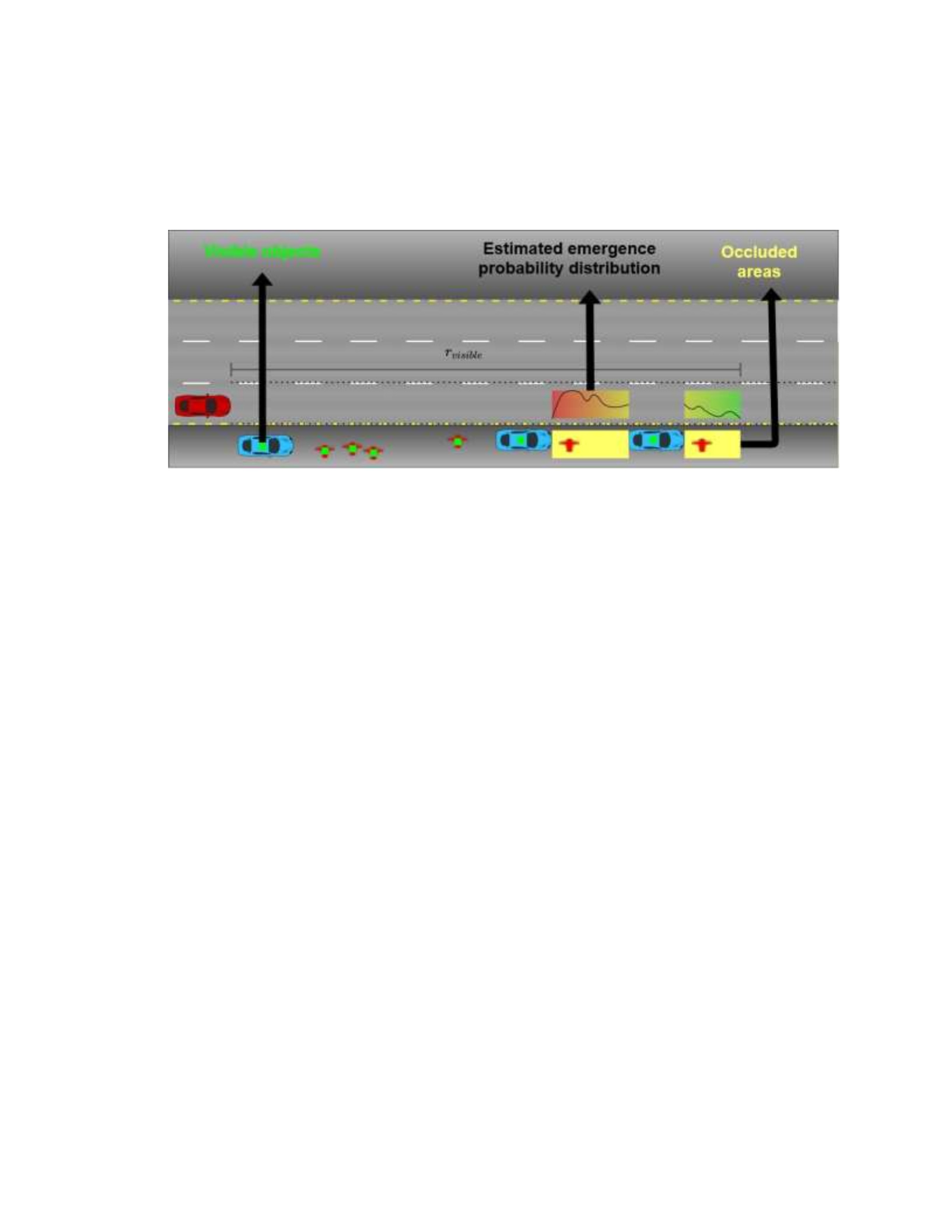
25
uncertainties; the probability function is denoted by fX¯(¯xt). However, that probability
function can only be observed, that is, that function can only be accessed as the
conditional
Figure 2.6: The proposal should utilize visible cues to estimate the emerging
pedestrians’ distribution along the longitudinal axis from occluded areas similar to
what human drivers do, then this risk assessment is used to extract the driving policy
PDF, as described in in (2.31), of emerging pedestrians given the current observations
which is denoted by vector ¯zt.
fX¯(¯xt|z¯t) is distribution of r.v. x conditioned on ¯zt (2.31)
where the observation vector ¯zt can be considered as the contextual information
available at time t, e.g., the number of the parked cars equal to N, the distance to the
crosswalk is d0. For example, the pdf of emerging pedestrians given the contextual
information estimated by the ego vehicle might be as in Fig. 2.6.

26
2.1.4 Bayesian Filtering
A Bayes filter can be utilized to update a probabilistic function with received
observations. Specifically, a Bayes filter is very useful for applications that it is
possible to collect information to understand the environment better. It is a
mathematical tool that gives the best estimate for the current observation history and
the prior knowledge about the probabilistic variable. This best estimate is also known
as belief or belief state. Let us define the observation vector from the initialization to
time t as ¯z1:t, and the actual state of the pedestrians as xt. Belief or belief state is
defined in (2.32):
Bel(¯xt) = p(¯xt|z¯1:t)
(2.32)
Bel−(¯xt) = p(¯xt|z¯1:t−1)
(2.33)
2.1.4.1 Belief Update
As it is discussed before, belief or belief state is the best answer mathematically to
the question of “given the observation history of ¯z1:t, what is the best estimate on the
actual states?”. This question is formulated as two steps in Bayes filters assuming that
the environment satisfies the Markov assumption, i.e., the current states includes all
necessary information to interpret the current state:
Prediction: (2.34) predicts the current state without the observation using the
prior knowledge on the dynamics, p(¯xt|x¯t−1).
Correction: (2.35) corrects this prediction by considering the prior knowledge on
the measurements, p(¯zt|x¯t).

27
Z
Bel−(¯xt) = p(¯xt|x¯t−1)Bel(¯xt−1)dxt−1
(2.34)
Bel(¯xt) = αtp(¯zt|x¯t)Bel−(¯xt)
(2.35)
where αt is the normalization constant to ensure that belief is a probability function
(i.e., the integral of belief over the longitudinal axis is equal to 1). Note that, if there is
no prior information on the distribution of the pedestrians for initialization, belief
should be chosen a uniform distribution.
2.1.4.2 Belief Representations
Some popular types of Bayes filters can be categorized and summarized as in Fig.
2.7. Let us elaborate on each one of them:
Kalman filters have a wide application area that this filter type is the most common
practice for Bayes filters [35]. The fact that multiplying, convolving, or adding two
Gaussian functions creates another Gaussian function facilitate computational
efficiency for Kalman filters. However, computational efficiency advantage is only
available with the assumption that all random variables and noises in the system are
Gaussian distributed random variables, which may be an inaccurate assumptions for
some situations. Although this assumption limits Kalman filter’s generality, together
with extended Kalman filters (EKF), Kalman filters can estimate both linear and
nonlinear dynamics of a system. For example, Kalman filters are the common practice
for distance measurement sensors and GPS tracking systems.
Multi-hypothesis tracking (MHT) extends the unimodality of Kalman filters by
assuming the belief as a mixture of Gaussian distribution (i.e., multi-modal belief
representation) [35]. Each hypothesis constitutes a unimodal distribution such that a
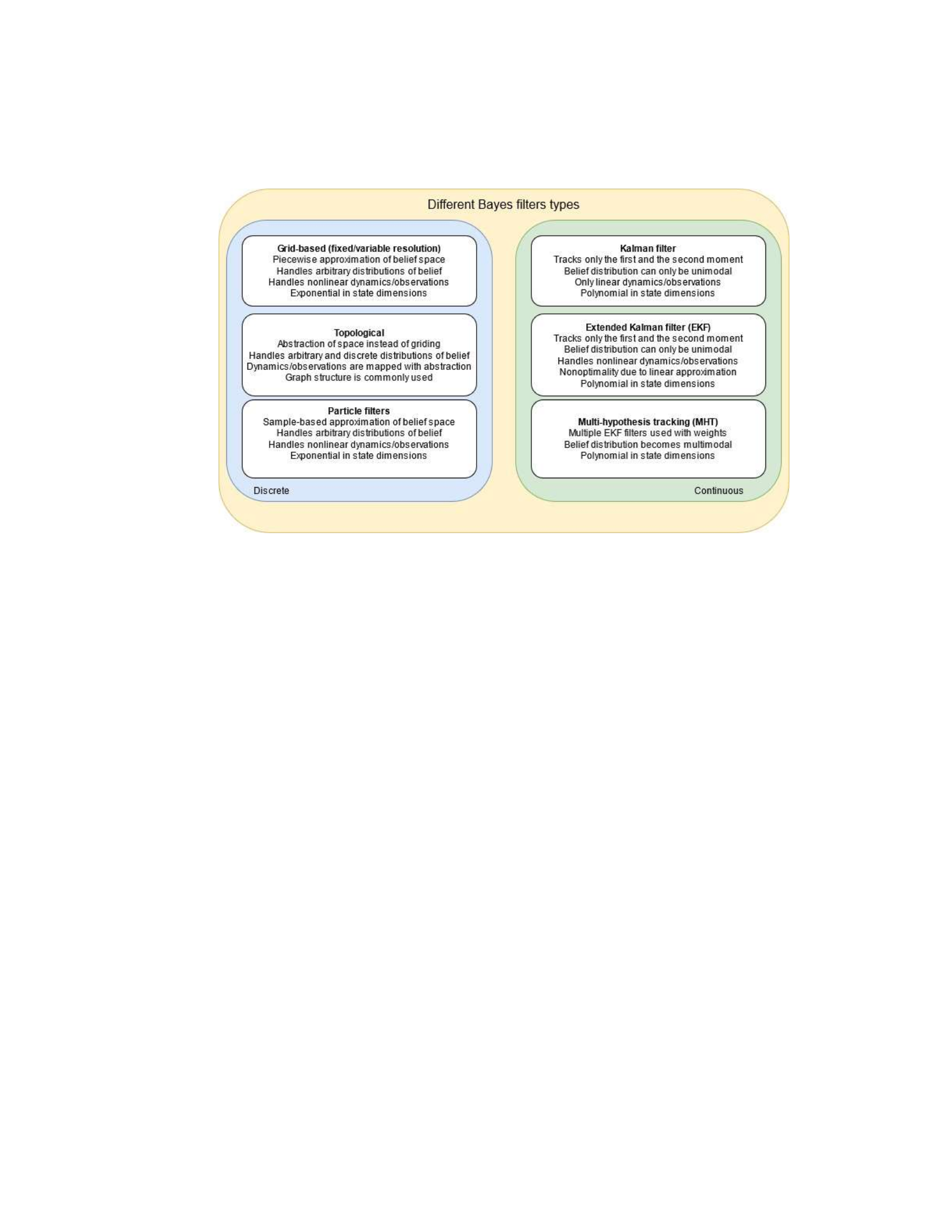
28
Kalman filter tracks this hypothesis. Then, each hypothesis is weighted based on its
accuracy and success to predict the data.
Figure 2.7: Different types of Bayes filters
Grid-based approaches discretize states spatially and assign a single value of belief
for each grid in the belief space. This piecewise segmentation allows grid-based
approaches to assume arbitrary belief distributions. However, computational
complexity is not scalable with the increasing number of grids. Therefore, these
approaches trade-off grid resolution and accuracy with computational complexity.
Particle filters (PF) which are also called sequential Monte Carlo (SMC) methods,
models the belief by sampling the distribution, weighted according to the distribution
itself [36]. Particle filters are much more efficient compared to grid-based methods as
they re-distribute the resources (hypotheses) to the best estimate using a procedure
called sequential importance sampling (or re-sampling) after making the observation.

29
Their capability to represent arbitrary distributions without discretizing the
statespace makes particle filters a common choice where Kalman filters cannot
accurately represent the state-space.
2.1.5 Tracking Obstacles Using Bayesian Filtering
Let us utilize the belief and Bayes filtering in order to estimate the distribution of
the dynamic obstacles. Let us assume that ¯xt represents the position and the velocity
of an obstacle, we will further generalize and redefine ¯xt so as it to represent the
position and the velocity of multiple obstacles. From (2.34), we know the belief
update requires the prior knowledge of transition model p(¯xt|z¯1:t). Let us define the
transition model with a simple kinematic model in (2.36):
(2.36)
where ψ¯ is the process noise vector. Furthermore, p(¯zt|x¯t) is the observation model
which is also required to be a prior knowledge, which is defined in Equation (2.37):
(2.37)
where ¯ϕt is the observation noise vector. And note that, we assumed that the object
can only observe the position of the obstacle whereas observation matrix could be an
I4×4 matrix should the object have a sensor to read the velocity of the obstacle.
30
2.1.6 Prior Probability Distribution Based on Reasoning
2.1.6.1 Presence of Crosswalks
Under the influence of just a crosswalk, one may expect to observe that
pedestrians mostly use the crosswalk to cross the street whereas there still might be
pedestrians that cross outside of the crosswalk, but we expect this behavior to be less
likely as the distance longitudinal distance between the pedestrians and the
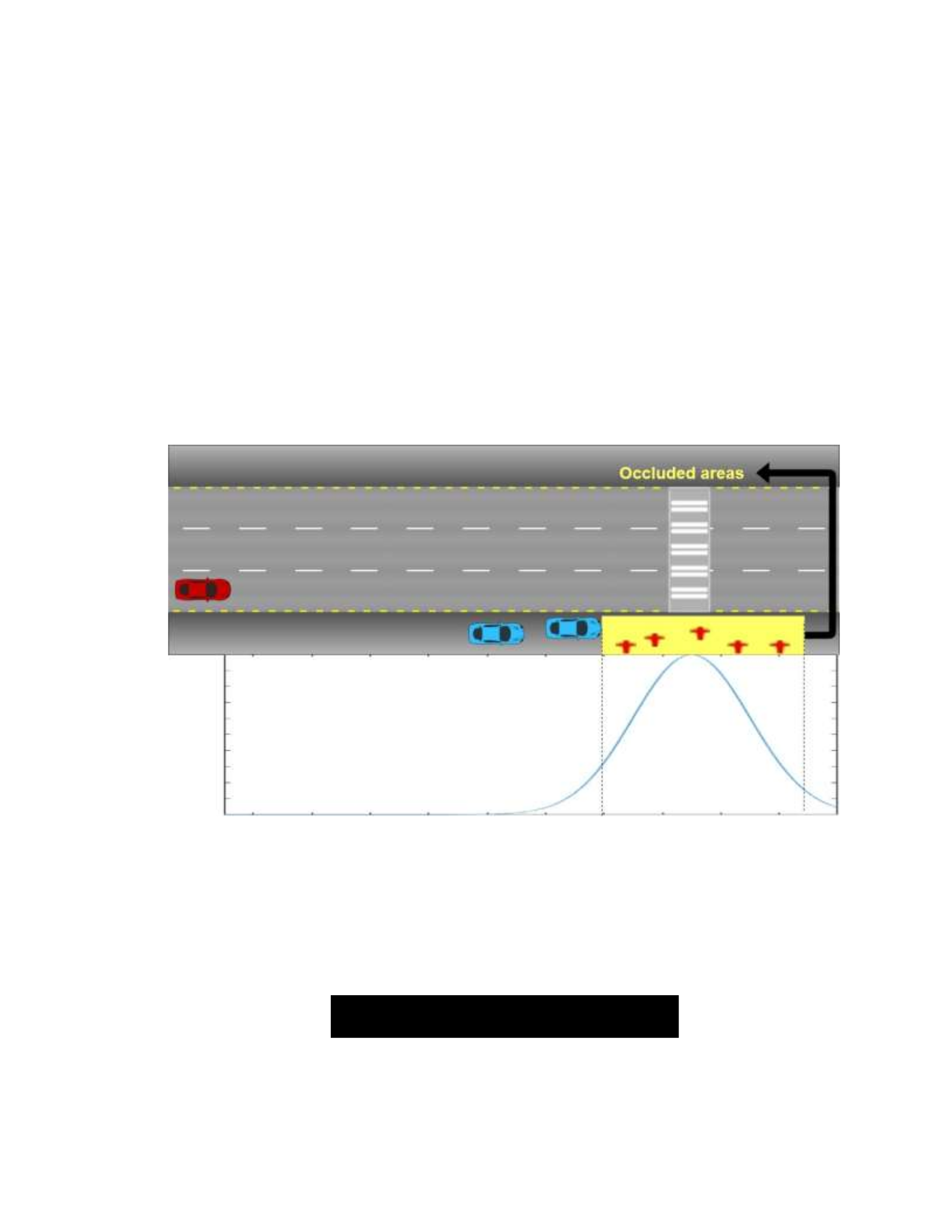
crosswalk increases. This distribution can be modeled using a Gaussian distribution,
and the pdf of the pedestrians’ distribution for the example in Fig. 2.8 is as follows:
Figure 2.8: The occluded pedestrian distribution considering only the presence of the
crosswalk
(2.38)
31
where µcrosswalk is the longitudinal distance between the center of the crosswalk
and the ego vehicle, and the choice of σcrosswalk could vary based on the statistical
behavior of the pedestrians.
2.1.6.2 Presence of Pedestrians
The presence of pedestrians is another indication that it is more likely to observe
emerging pedestrians from occlusions. Even if they stand still, one may expect to
observe that the presence of pedestrians around a pedestrian is more likely. The idea
behind this assumption is that observing a standing pedestrian both means that this
pedestrian may start walking, and there could be other pedestrians occluded/unseen
Figure 2.9: The occluded pedestrian distribution considering only the presence of
other pedestrians

32
around that pedestrian. This distribution can be modeled using a mixture of Gaussian
distribution, and the pdf of the pedestrians’ distribution for the example in Fig. 2.9 is
as follows:
(2.39)
where µiped is the longitudinal distance between the CoG of ith pedestrian and the
ego vehicle, σped is the standard deviation to incorporate the sensor error. The general
formula for N number of pedestrians is as follows:
(2.40)
2.1.6.3 Presence of Parked Cars
A study on human behavior at a signaled crosswalk states that from their analysis,
”group size and traffic density was related to safer behaviors and the nearby presence
of parked vehicles to riskier ones” ([37]). In other words, although one cannot directly
constitute a correlation between the presence of parked cars and the presence of
pedestrians, pedestrians tend to be more distracted, w when they are near parked
cars. Therefore, one can increase the distribution of the occluded pedestrians around
parked cars in order to increase caution since the pedestrians near parked cars are
less likely to behave safely. One can represent this distribution with a mixture, and the
pdf of the pedestrians’ distribution for the example in Fig. 2.10 is as follows:
!
(2.41)
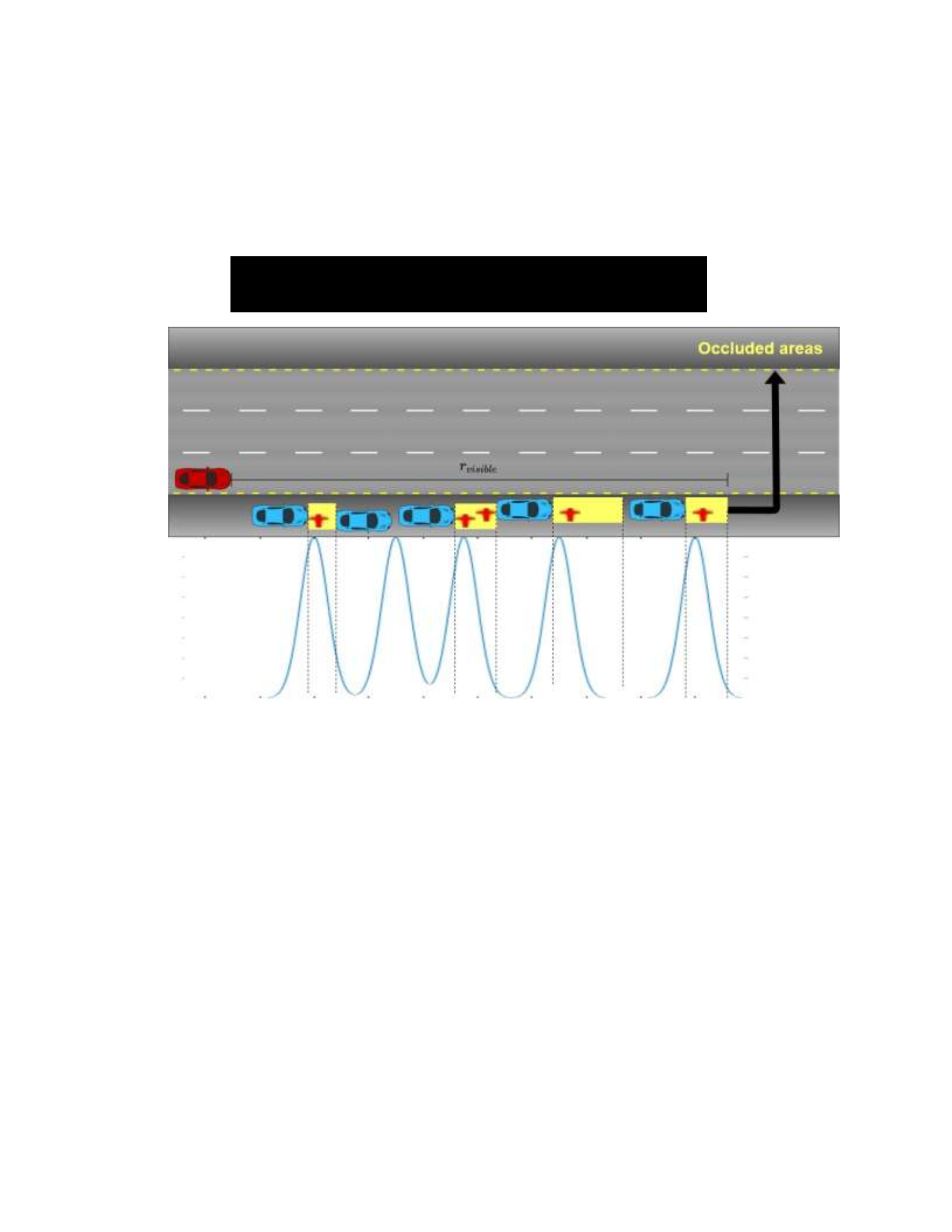
33
where µiparked cars is the longitudinal distances between the ith parked car’s furthest
point to the ego vehicle longitudinally and the ego vehicle, σ value should be chosen
either using statistics or heuristics. The general formula for N number of parked cars:
!
(2.42)
Figure 2.10: The pedestrian distribution only with the presence of parked cars
2.2 Methodology
2.2.1 Risk Assessment
2.2.1.1 Static Risk Assessment using Logistic Regression Prior
Risk assessment is the most crucial part and the main contribution of this work.
Using the prior knowledge of pedestrian distribution and Bayesian inference as
discussed in Section 2.1.6, the PDF and the CDF can be obtained; for example, the
34
functions can be obtained for a scenario in which the crosswalk from Fig. 2.8, the
standing pedestrians from Fig. 2.9, and the parked cars from Fig. 2.10 are present at
the same time. Then, the posterior of the total pedestrian emergence probability along
the longitudinal axis given that the observation of the pedestrians, the parked cars,
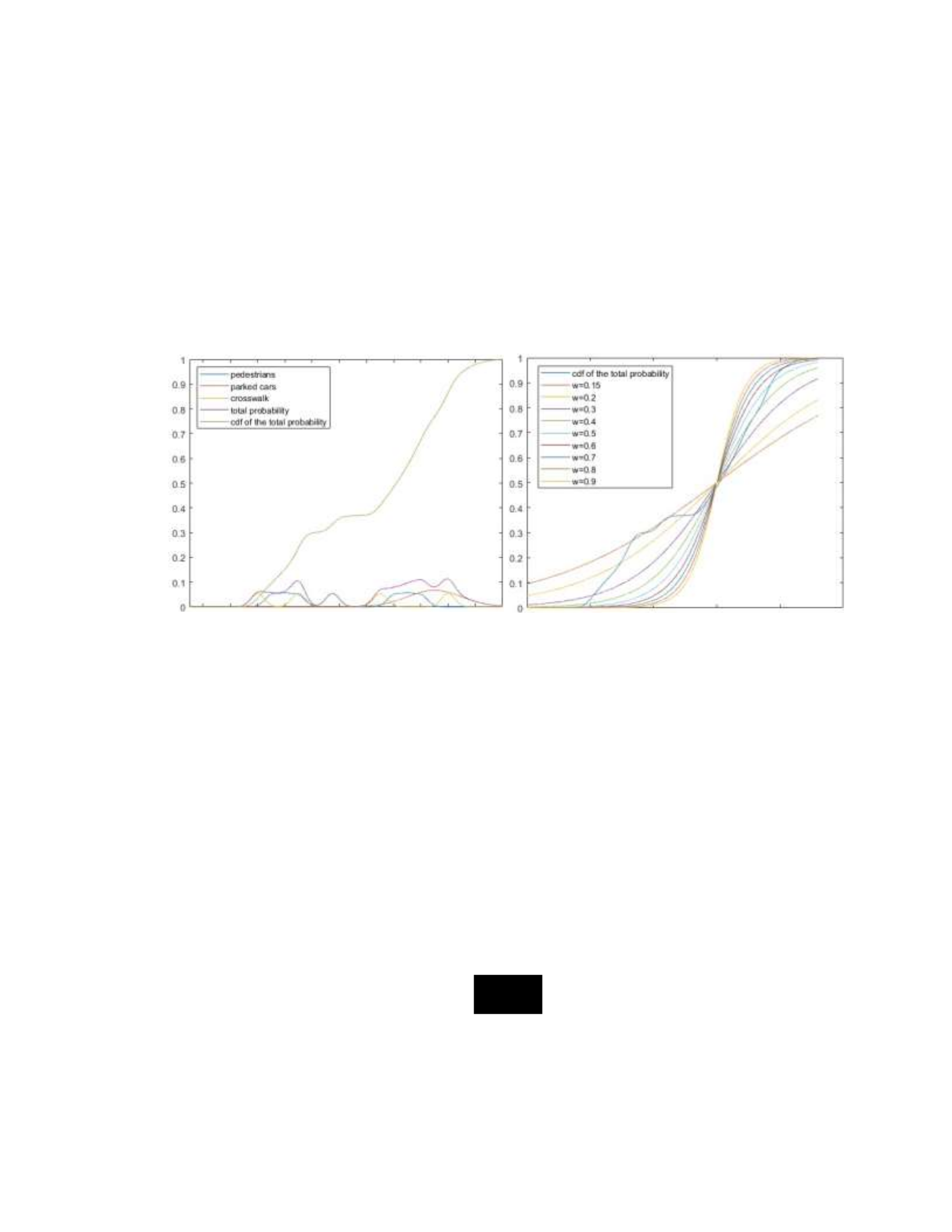
and the crosswalk is demonstrated in Fig. 2.11a. In order to reduce the computational
cost of the estimation of the posterior probability, a collection of piecewise
(a) The contribution of the observation of (b) The cdf of the total pedestrian emergence
pedestrians, parked cars, and the crosswalk to probability along the longitudinal axis, and the
pdf and cdf of the total pedestrian emer- multiple sigmoid functions (1/(1+e−wx)) with gence
probability varying w from the case in Fig. 2.11a
Figure 2.11: An example distribution of emerging pedestrians from occlusions and a
possible expansion of the distribution with piecewise functions
weighted sigmoid functions can be utilized to estimate the posterior probability. First,
let us define the weighted sigmoid function as:
(2.43)
35
which has two horizontal asymptotes at lim = 0 and lim
Then, let us demonstrate the similarity of the example CDF and some weighted
sigmoid functions in Fig. 2.11b. In fact let us also assume that the variable x is the
observation vector at time t z¯t and the variable w is the weight vector of the
observation ¯w. Since the proposal uses possible visible cues, e.g., the number of
parked cars, the number of visible pedestrians, the distance to the crosswalk, the
distance to the closest parked car, and the distance to the closest visible pedestrian;
the probability estimation becomes:
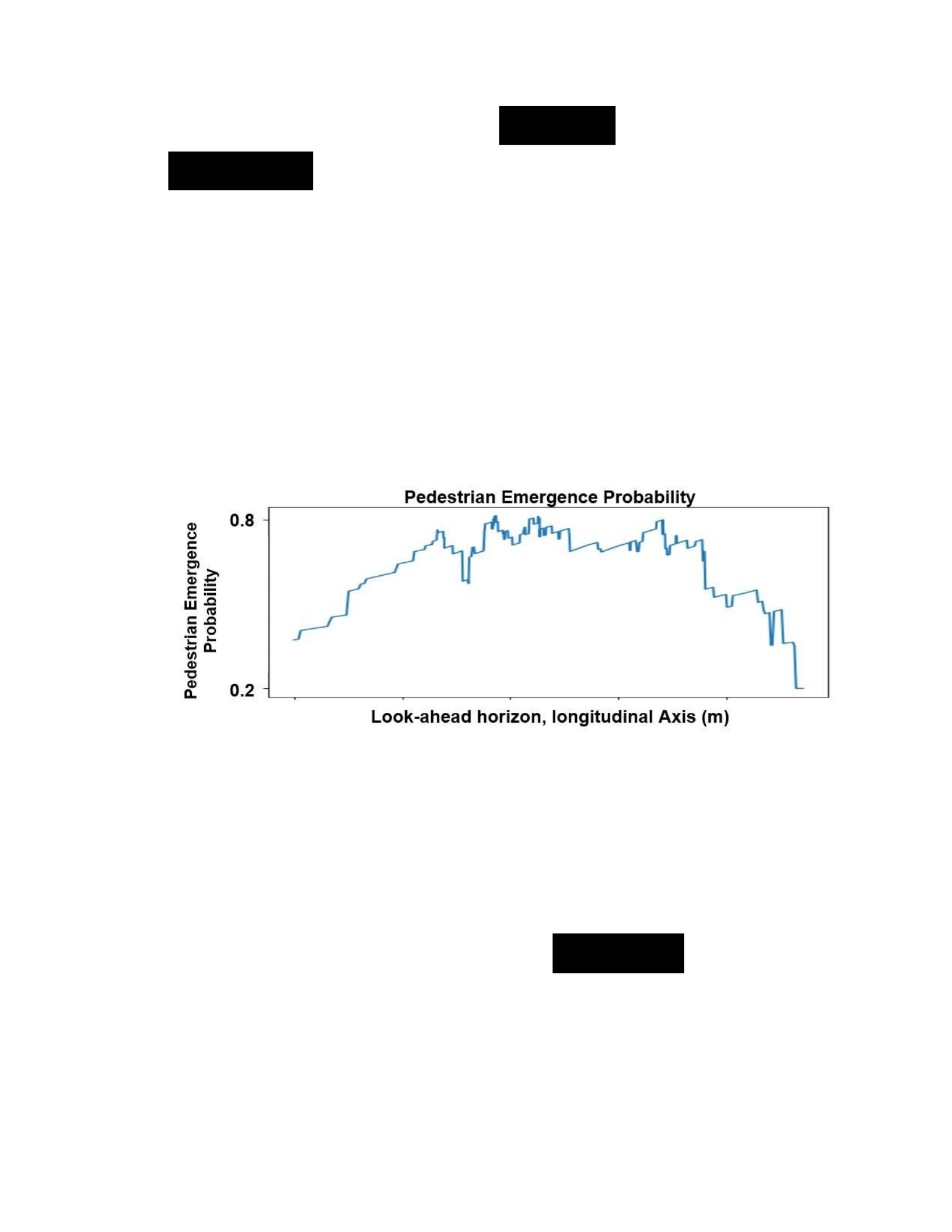
Figure 2.12: An example of the probability distribution of occluded pedestrian
emergence
p(Pedestrian emergence risk (2.44)

36
where ¯zt = [1,n1,n2,d1,d2,d3]T is the observation vector. The definition of the variables
inside the observation vector is given in Table 2.1. A possible pedestrian emergence
probability is demonstrated in Fig. 2.12.
Table 2.1: Elements of ¯zt in (2.44)
Variables
Explanation
n1
the density of parked cars
n2
the density of visible pedestrians
d1
the distance to the crosswalk
d2
the distance to the closest parked car
d3
the distance to the closest visible pedestrian
All measurements are normalized which is achieved by dividing the distance
measurements by rvisible and the quantity measurements (i.e., number of pedestrians,
the number of parked cars) are divided by a predefined maximum number. This way
the number measurements are treated as density information which gives more
useful information than the number information. Furthermore, if any quantitative
measurement such as the number of parked cars is absent, it is considered to be 0;
whereas, if any distance measurement such as the distance to the crosswalk is absent,
it is considered to be 1 which is the normalized value for the farthest distance. The
vector w¯ in (2.44) is the weights of the visible cues, which was chosen by heuristics.
2.2.2 Collision Avoidance
Risk assessment, p(Occluded pedestrian emergence|z¯t, is calculated as explained
in Section 2.2.1; in addition, provided that the ego vehicle determines its risk zones,
and assesses the current risk, then it is also necessary to determine the collision risk,

37
p(Collision|z¯t). Note that, since the quantity measurements such as the density are
discrete, it causes sudden discrete changes at the critical instance of observing or
losing sight of a parked car or a pedestrian. One possible solution could be to divide
the function into sections, that is, using thresholds to define regions in the function,
as in Fig. 2.13, so as to utilize the function in a control architecture.
Then, one possible control architecture could be to use an FSM with distinct states
for each region in the function. As the risk decreases, the ego vehicle could be more
encouraged to drive the speed limit while it should slow down to a proportion of the
speed limit in a risky situation. Let us name the FSM states for each region the function
from Fig. 2.13:
Figure 2.13: A possible utilization of the risk assessment in Fig. 2.12
• For the green region, it is called Normal Drive in which the ego vehicle is given
the reference velocity of the speed limit, vspeed limit,
• For the yellow region, it is called Steady Drive in which the ego vehicle is given
the reference velocity of some proportion of the speed limit, α1vspeed limit,
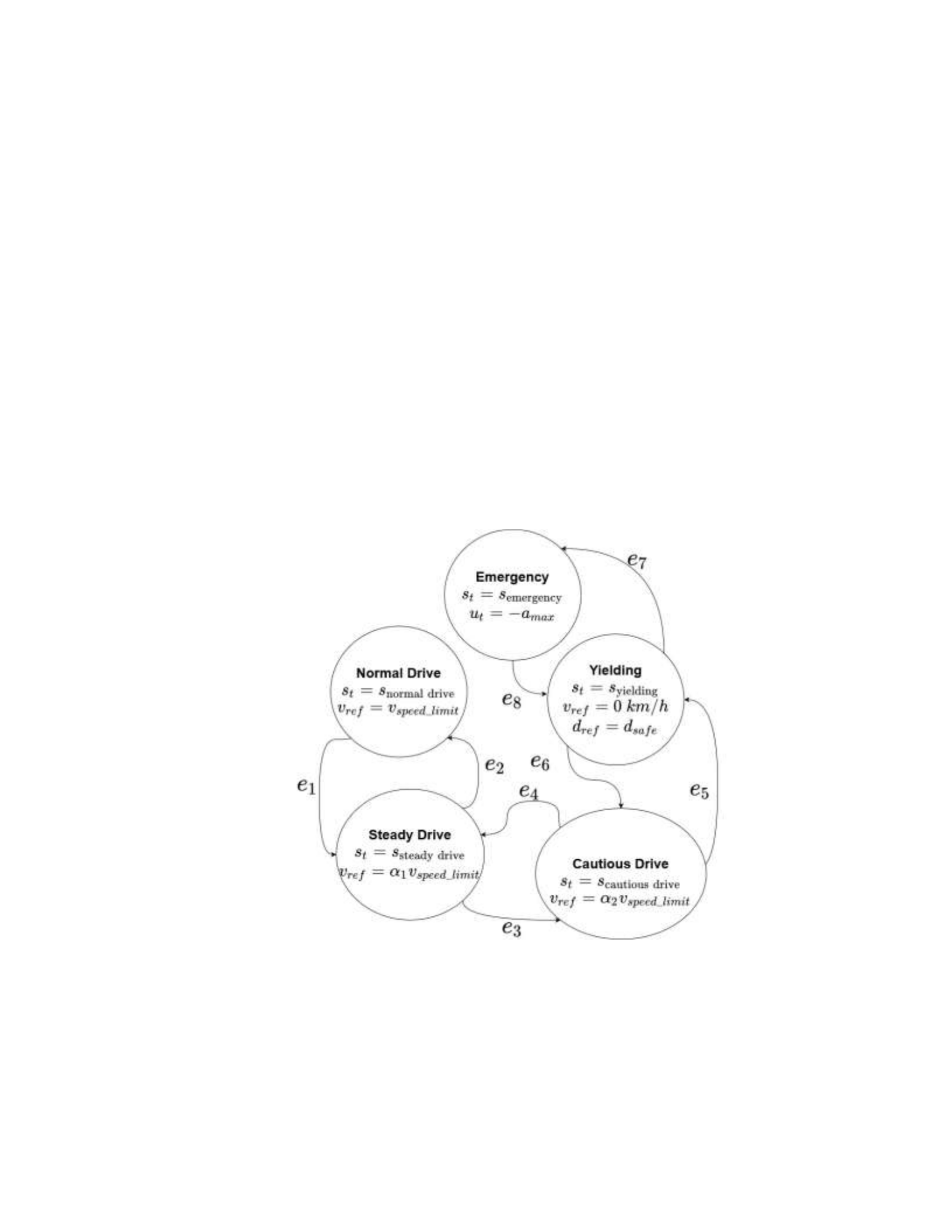
38
• For the red region, it is called Cautious Drive in which the ego vehicle is given the
reference velocity of another proportion of the speed limit, α2vspeed limit.
Note that as the ego vehicle should drive slower for the values of function within the
red region, 0 < α2 < α1 < 1. Also considering a state for yielding a pedestrian when
necessary, and for engaging in maximum braking to avoid collision under dangers, the
FSM architecture in Fig. 2.14 is constructed with state transition conditions are given
in Table 2.2.
The speed limit vspeed limit is calculated as:
vspeed limit = min{Legal speed limit,Safety speed limit} (2.45)
Figure 2.14: The proposed FSM to utilize the quantified risk

39
Table 2.2: State Transitions for the FSM in Fig. 2.14
State Transition
Explanation
e1
p(Pedestrian emergence risk|z¯t) > lsteady
e2
p(Pedestrian emergence risk|z¯t) ≤ lsteady
e3
p(Pedestrian emergence risk|z¯t) > lcautious
e4
lsteady ≤ p(Pedestrian emergence risk|z¯t) ≤ lcautious
e5
A visible pedestrian to be yielded
e6
No visible pedestrian to be yielded
e7
No feasible solution to avoid collision
e8
A feasible solution to avoid collision
where safety speed limit is calculated from the roots of the following in equality:
Then the roots of the inequlity in (2.46) is given as:
(2.47)
(2.48)
The root ∆1 is negative (given that ∆1 < ∆2), as can be seen from (2.47); therefore, safety
speed limit is calculated using ∆2. Furthermore, the safe speed limit is determined by
the choice of af. This choice is arbitrary within the limits of this variable; however, one
reasonable choice would be to both consider safety and comfort and choose a speed
which the ego vehicle could anticipate the risks and slow down or stop before a
pedestrian, a speed such that the condition dstop min ≤ dstop comfort ≤ rvisible
is satisfied.
2.2.3 Controller Design
The interpretation of risk inside different risk zones should be different because a
smaller risk of emergence in danger zone should be approached much more carefully
40
than the same level of risk of emergence in discomfort zone. In other words, the
alertness to the pedestrian emergence probability inside danger zone should be much
higher than the alertness to the pedestrian emergence probability inside discomfort
zone. Therefore, the controller should assign different threshold values to the
FSM architecture per risk zone. The visualization of this process is demonstrated in
Fig. 2.16.
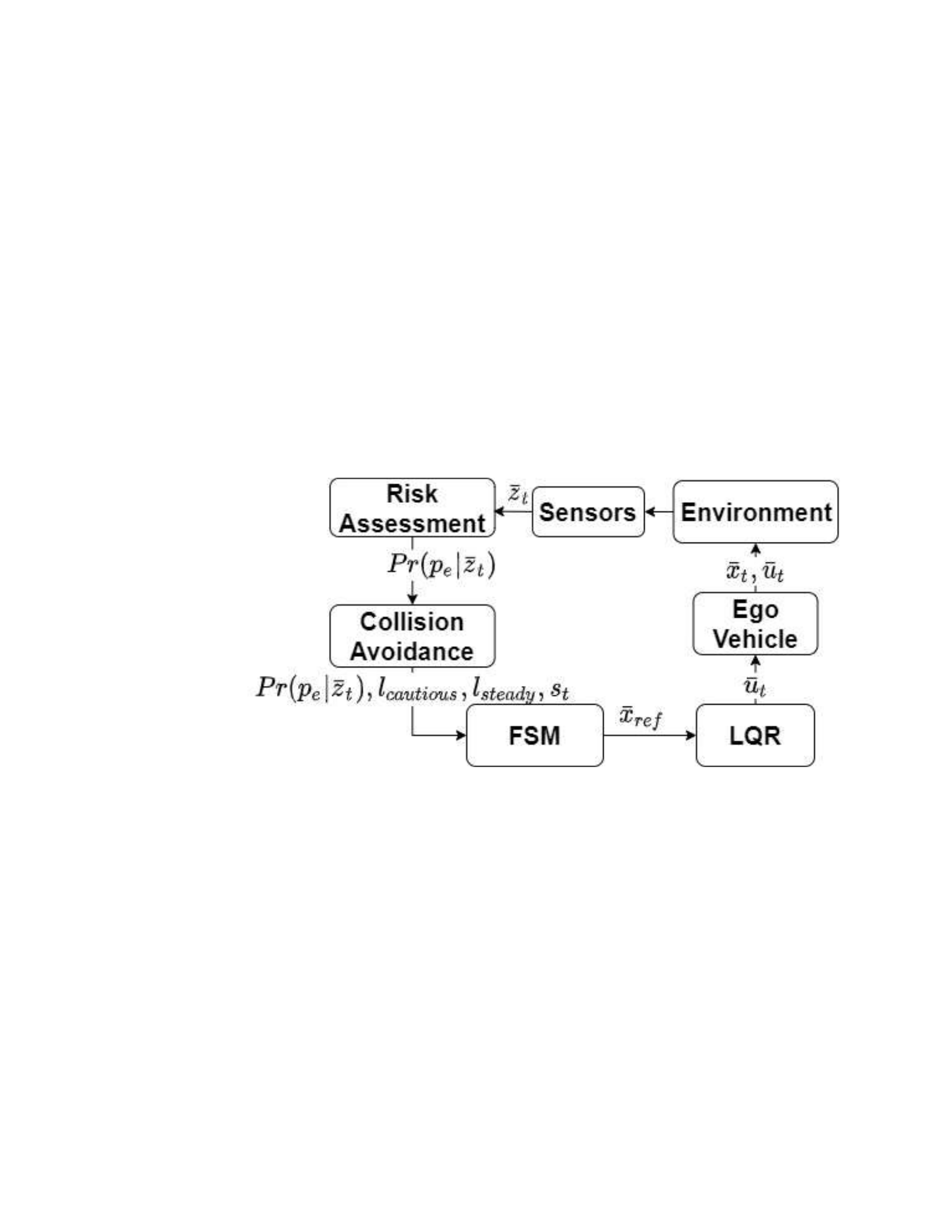
Combining all, the ego vehicle will observe the environment from its sensors to
assess the risk of the emergence of occluded pedestrians. Then, this information is
going to be interpreted differently per risk zone, and this interpretation is going to be
Figure 2.15: Proposed controller architecture
outputted as a reference state. Finally, a longitudinal controller is going to choose the
appropriate control action to reach the reference state within decided control limits.
The flow diagram of the proposed controller architecture is given in Fig. 2.15.

41
2.2.4 Overall Proposed Control Algorithm
After considering the emergence risk in Section 2.2.1 and the collision avoidance
in Section 2.2.2, and the controller design in Section 2.2.3, now these should be
combined in a logical flow, an algorithm to be executed. As it is explained previously
that the ego vehicle does not require to take precautious action against any
pedestrians entering the expected path from inside the safety zone, the algorithm’s
look-ahead distance should be dstop comfort. Then, it should calculate the risk in the
future by considering visible cues within a predefined window; furthermore, it should
have a spatial resolution ∆d. The maximum risk per zone (i.e., danger zone, discomfort
Figure 2.16: Risk interpretation of proposed method inside different risk zones, the
combination of risk assessment and collision avoidance
zone) will be compared against the thresholds to choose the appropriate
deceleration/acceleration limit alimit and jerk limit jlimit with the appropriate FSM state
in the order the ego vehicle to reach the reference velocity vref within the chosen limits.
In addition, as it is crucial to determine the deceleration limitations, which are limited

42
by the friction coefficient between the tires and the road, a look-up table can be used
(Table A.1) provided that the ego vehicle could determine the current weather
conditions.
The algorithm for the proposed controller is as follows where the predefined vari-
ables are tsense, tsystem delay, ∆d, ∆t, lcautiousdanger , lsteadydanger, lcautiousdiscomfort, lsteadydiscomfort,
window size,
system and measurement noises, ψ¯t, ¯ϕt, the current state variables for the ego vehicle
x¯t,ego and the observation ¯zt:
Algorithm 1 The proposed algorithm
1: function proposedController
2: amax ← µroad ∗ g, st+1 ← snormal drive
3: dstop min, dstop comfort ← (2.12)
4: if A visible pedestrian is to be inside the path then
5: if TTC < TTCstop then
6: st+1 ← semergency
7: else
8: st+1 ← syielding
9: else
10: current state ← danger
11: max risk ← 0, current risk ← 0
12: repeat
13: # Update current risk zone
14: if d > dstop min then
15: current state ← discomfort
16: max risk ← 0
17: # Check the neighboring visible cues
18: current risk ← from (2.44)

43
23: ifthen
24:
25:
else if max risk > lcautious then
26:
st+1 ← scautious drive
27: else if current state = discomfort then
28: Set ldiscomfort, lsteady, alimit and jlimit
29: if max risk > lsteady then
30: st+1 ← ssteady drive
31: else if max risk > lcautious then
32: st+1 ← scautious drive
33: d ← d + ∆d
34: until d ≥ dstop comfort
35: return st+1
i
Chapter 3: Evaluation and results
3.1 Evaluation
In order to evaluate the proposal, a straight road is chosen. Furthermore, with
respect to the pedestrian frequency the scenarios are divided into three:
• Suburban scenarios (sc1) where there are one or two pedestrians, one or two
parked cars, and a crosswalk.
• Mildly crowded urban scenarios (sc2) where there are multiple parked cars,
multiple pedestrians and a crosswalk.
19:
if max risk < current risk then
20:
max risk ← current risk
21:
if current state = danger then
22:
Set lcautious, lsteady, alimit and jlimit

44
• Very crowded urban scenarios(sc3) where the parking slots are full, and there are
multiple pedestrians and a crosswalk.
The summary of all scenarios can be seen in Table 3.1 This way it is going to be
possible to observe the strengths and weaknesses of the proposal in various possible
scenarios. Specifically, the mildly crowded urban scenarios and the very crowded urban
scenarios are the scenarios to be addressed the most successful since the GPS
localization accuracy and precision deteriorates in urban locations[32].
In addition, some baseline controllers should be introduced in order to compare
the proposed method. Since the proposal is formulated upon three aspects (i.e.,
comfort, Table 3.1: Scenarios used in the Simulation Environment
Scenario
Road Type
Number of parked cars
Crosswalk
Suburban scenario (Scenario 1)
Straight Road
Several (At most 2)
Yes
Mildly crowded street (Scenario 2)
Straight Road
Multiple, all parking slots are full
Yes
Very crowded street (Scenario 3)
Straight Road
Multiple, but not all parking slots are full
Yes
safety, and efficiency), some of these aspects could be disregarded in the baselines to
demonstrate the outcome. Following this idea it is decided that the proposal is to
compared against four baselines:
• Baseline1 (B1): This baseline is occlusion-unaware, and drives the legal speed
limit of the road (30km/h). It yields to the pedestrians that are on the road will
likely enter its expected path.
• Baseline2 (B2): This baseline is also occlusion-unaware, and drives two-third of
the legal speed limit of the road (20km/h). It yields to the pedestrians that are
on the road will likely enter its expected path.

45
• Baseline3 (B3): This baseline is also occlusion-unaware, and drives one-third of
the legal speed limit of the road (10km/h) only if it observes a crosswalk which
closer than a specific distance; otherwise, it drives the speed limit. It yields to
the pedestrians that are on the road will likely enter its expected path.
3.1.1 Metrics
Defining metrics is as important as choosing the correct baselines to compare
against. A meticulous analysis of the literature was made. Combining the extensive
survey, on important metrics to determine the driving quality, of Jahanagirova et al.
[38] and other additional safety metrics, the metrics that are the most appropriate to
evaluate the proposed method on a straight road are carefully investigated and
selected. The selected metrics are as follows:
• mt1: The total number (successful/unsuccessful) of yields is useful to determine
the pedestrian-friendliness of the methods. A method that can navigate safely
and carefully should be able to yield to more pedestrians.
• mt2: Deceleration (mean, std) is useful to determine the conservativeness of the
methods. A method that can navigate safely and carefully should be able to
resort to smaller magnitudes of deceleration as the precautious actions before
occlusions are in favor of using smaller magnitudes of deceleration.
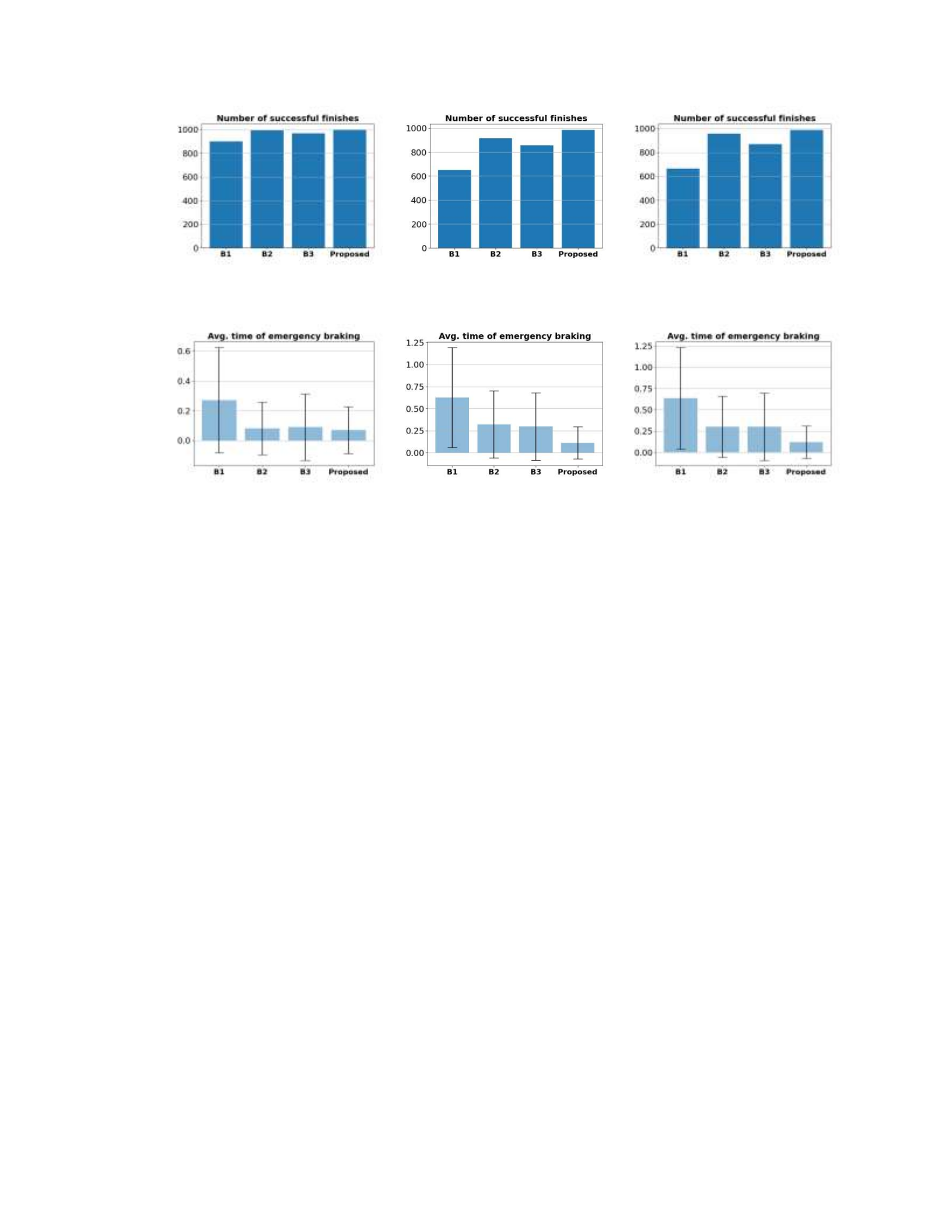
• mt3: The total number of successful finishes is the most essential metric of
safety because it means the method cannot handle risky situations and causes
an accident if this metric is smaller

46
• mt4: Time of emergency braking (mean, std) is similar to mt2, but it is more
specific to the readiness of the method under test on the account of the fact that
a longer duration of emergency braking is a good indication of inability to react
unexpected dangerous situations/
The values for the comfortable jerk and acceleration values are chosen to be acomfort
∈ [−2.0,1.47]m/s2, jcomfort ∈ [−0.9,0.9]m/s3 from [33].
3.2 Simulation
The simulation environment is built from scratch in Python. The flow diagram of
the simulation is demonstrated in Fig. 3.1. To generate realistic scenarios, we have
Figure 3.1: The flow diagram of the simulation inside an episode per frame
considered several aspects of the generation of pedestrians, also the decision-making
of pedestrians. The parameters used in the simulation are demonstrated in Table 3.2.
3.1

47
3.2.1 Modeling Pedestrians
Pedestrians are modeled as point-mass objects with instant velocity change (the
time passed until a pedestrian accelerates to its walking velocity is negligible) and
zero acceleration since the velocity of pedestrians is very small compared to that of
vehicles. Statistical data from Saberi et al. [41] for the velocity of pedestrians also
resulted in a mixture of Gaussian distributions which can be simplified to a Gaussian
distribution with µv ped = 1.5m/s and σv ped = 0.6m/s. In addition, since not all the
pedestrians that a driver sees on the sidewalk will cross the street, we have also
considered generating some pedestrians that will not cross the street at all.
Table 3.2: Parameters used in the Simulation Environment
Parameters
Symb
ol
Values
Road length
lroad
96 m
Lane width
wlane
3 m
Number of lanes
N/A
3
Simulation window size
N/A
1920×5
50
pixels
lroad 96 m rvisible 50 m vped
5 km/h

48
3.2.2 Detecting Occlusions
There could be many possible methods to detect sensor occlusions; however, in
order to focus on the proof-of-concept proposal, we have simplified occlusion
detection by making several assumptions:
• The ego vehicle can sense an object (parked cars, pedestrians, crosswalks) if the
object’s CoG is inside the visibility polygon.
• The ego vehicle can identify different objects it senses them (e.g., the ego vehicle
can distinguish the measurements from different objects).
• The ego vehicle knows its visible range rvisible, and its vision angle α.
• The maximum size of parked cars is known.
There could be some cases in which the given assumptions might be wrong.
However, for the straight road in the simulation environment, the occlusion triangle
calculation is demonstrated in Fig. 3.2.
3.3 Results
The results of the simulation, 1000 episodes per scenario, is demonstrated in
Table 3.3 and in Fig. 3.7 and3.8.
In terms of comfort, the proposed method clearly outperforms in terms its yielding
capabilities (mt1) even though all baseline methods have the exact same FSM policy
for yielding, as demonstrated in Fig. 3.7a–3.7c. Specifically, the proposed method
outperforms the baselines in sc2, by 32.46%, 10.37%, 11.00% respectively. This
clearly shows that, the proposed method is very pedestrian friendly with its
49
yielding capabilities.
In terms of safety, outperformance of the proposed method is clearly visible for
the number of successful finishes (mt3) out of 1000 episodes per scenario, as
demonstrated in Fig. 3.8d–3.8f, where the proposed method outperforms the
baselines in
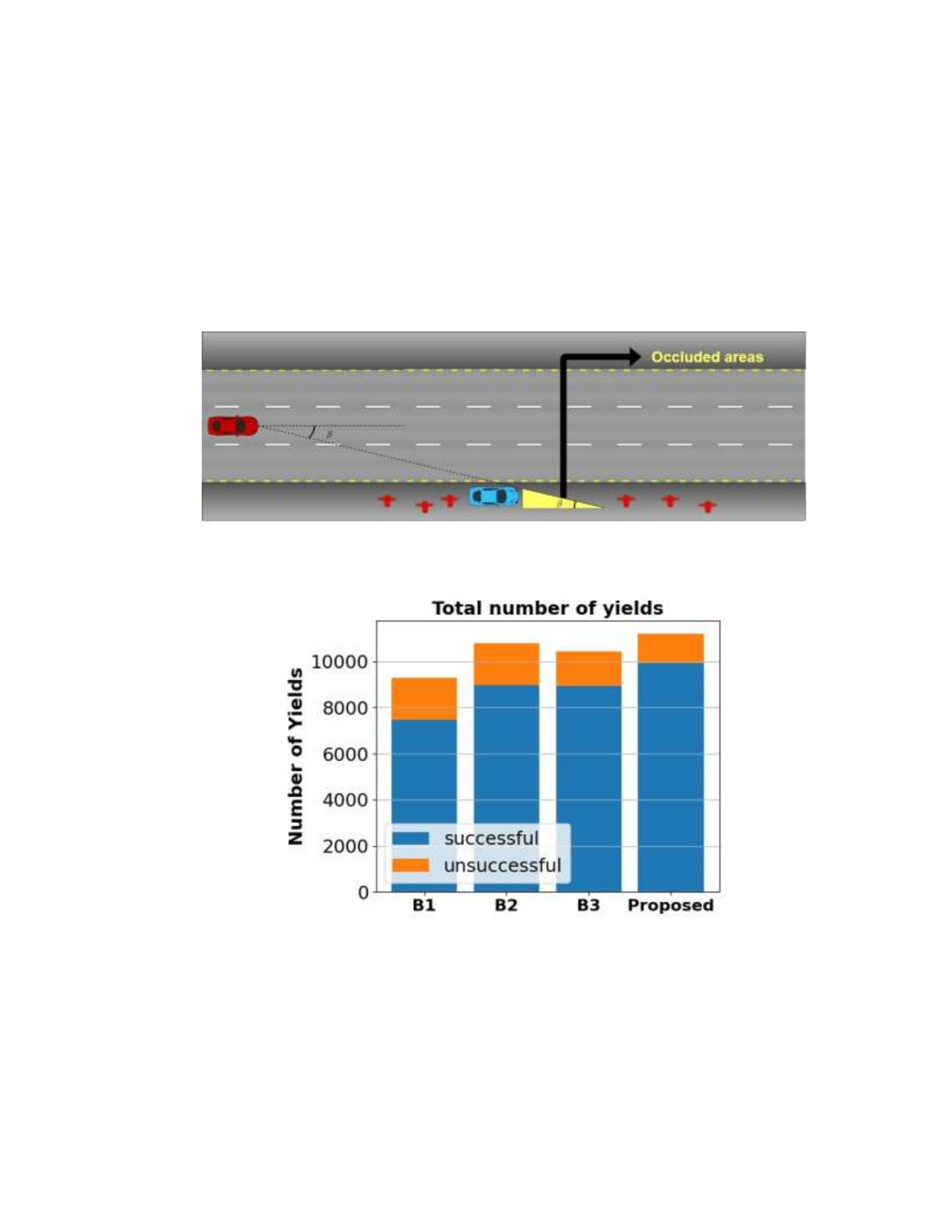
Figure 3.2: How to determine an occlusion triangle
Figure 3.3: Total successful and unsuccessful yields (mt1) of different controllers in
mildly crowded urban scenarios (sc2)
50
sc2 by 51.23%, 7.64%, 15.19% respectively (performance in sc2 is demonstrated in
fig. 3.5). This metric is crucial as it is directly related to collision risk of the method.
Furthermore, the proposed method also outperforms all other baselines both in the
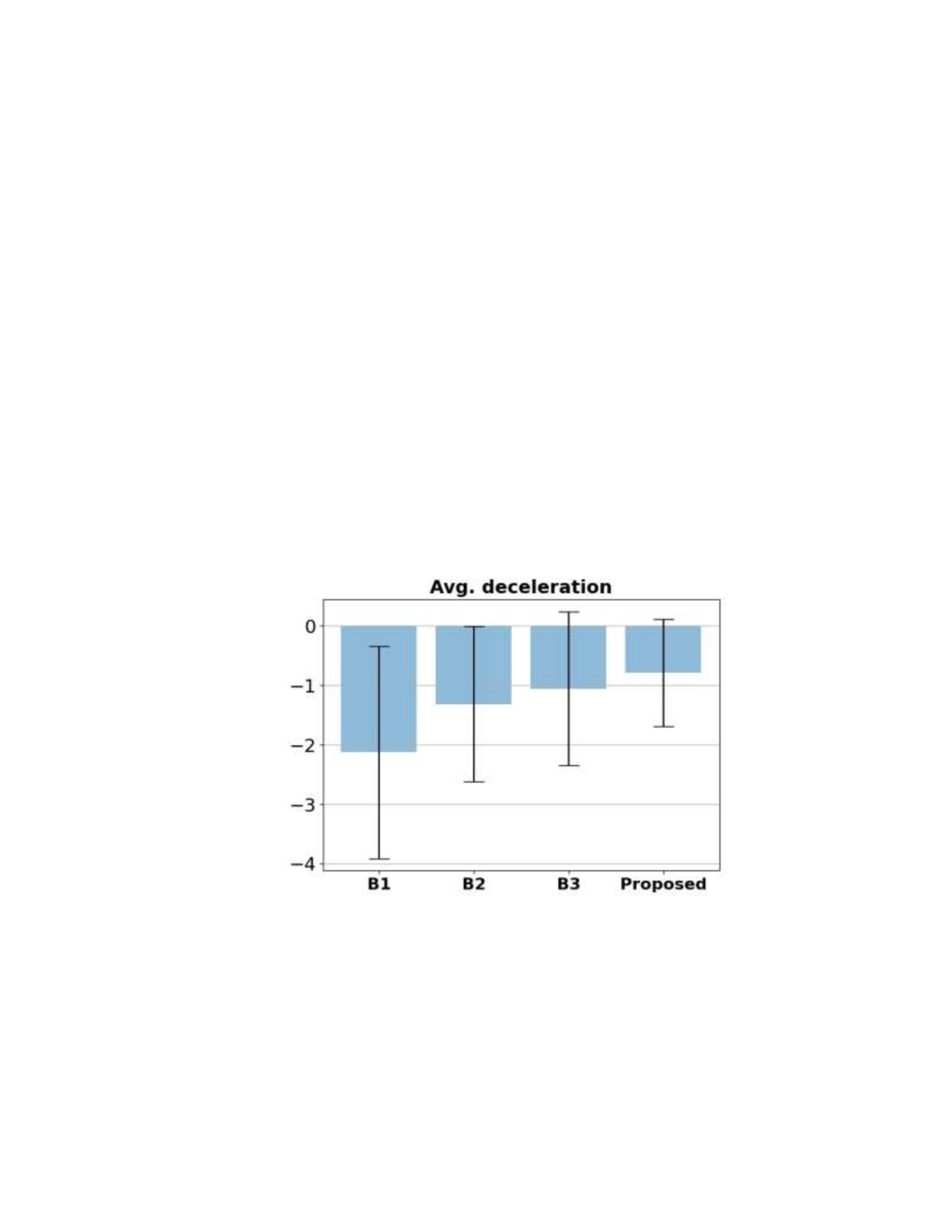
average deceleration (mt2) and the average time of emergency braking (mt4) which
could be interpreted as an indication of how successfully a method anticipates the
incoming risk such that it resorts to minimal deceleration value and emergency
braking (performance in sc2 is demonstrated in fig. 3.6). One important remark is that
in fig. 3.6 total number of yields per controller is different due to the fact that this
metric is only available for successful path completions. In other words, an aggressive
driving style may end up in a collision which in return means that the successful yields
in the episode will not be considered.
Figure 3.4: Deceleration values (mt2) of different controllers in mildly crowded urban
scenarios (sc2)

51
Figure 3.5: The total number of successful finishes (mt3) of different controllers in
mildly crowded urban scenarios (sc2)
Figure 3.6: Average time of emergency braking (mt4) of different controllers in mildly
crowded urban scenarios (sc2)
Table 3.3: Overall Performance of Proposed Controller and Baselines over 1000
episodes
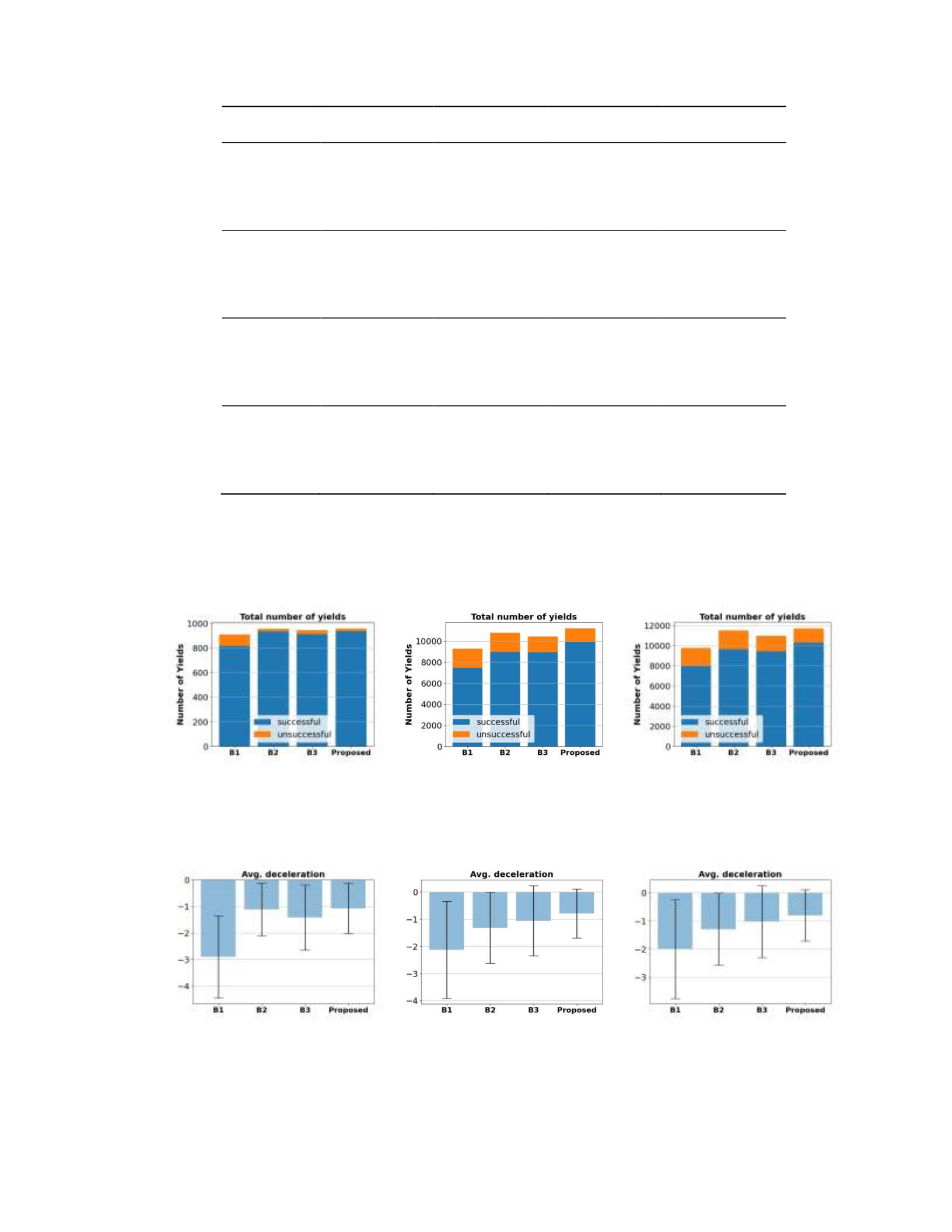
52
Metrics
B1
B2
B3
Proposed
mt1a(sc1)
(817/94)
(934/24)
(912/33)
(937/23)
mt1 (sc2)
(7482/1811)
(8980/1821)
(8929/1496)
(9911/1294)
mt1 (sc3)
(8012/1754)
(9645/1875)
(9449/1535)
(10310/1404)
mt2b(sc1)
(-2.90, 1.55)
(-1.12, 0.99)
(-1.42, 1.23)
(-1.07, 0.95)
mt2 (sc2)
(-2.13, 1.78)
(-1.31, 1.30)
(-1.05, 1.29)
(-0.79, 0.90)
mt2 (sc3)
(-1.99, 1.75)
(-1.29, 1.28)
(-1.02, 1.27)
(-0.80, 0.91)
mt3c(sc1)
898
992
966
996
mt3 (sc2)
652
916
856
986
mt3 (sc3)
664
956
870
988
mt4d(sc1)
(0.27, 0.35)
(0.08, 0.18)
(0.09, 0.22)
(0.07, 0.16)
mt4 (sc2)
(0.63, 0.57)
(0.32, 0.38)
(0.30, 0.38)
(0.11, 0.18)
mt4 (sc3)
(0.63, 0.60)
(0.30, 0.36)
(0.30, 0.39)
(0.12, 0.19)
a mt1: The total number (successful/unsuccessful) of yields
b mt2: Deceleration (mean, std) c mt3: The total number of
successful finishes d mt4: Time of emergency braking
(mean, std)
(a) mt1 in sc1 (b) mt1 in sc2 (c) mt1 in sc3
Figure 3.7: Comfort related results
(a) mt2 in sc1 (b) mt2 in sc2 (c) mt2 in sc3
53
(d) mt3 in sc1 (e) mt3 in sc2 (f) mt3 in sc3
(g) mt4 in sc1 (h) mt4 in sc2 (i) mt4 in sc3
Figure 3.8: Safety related results
Chapter 4: Conclusion and future work
This thesis proposed a probabilistic risk assessment and collision avoidance
method for emerging pedestrians from occlusions. First, the theoretical background
is explained to introduce some useful knowledge for the method. It is shown that the
method can be implemented together with a simple FSM controller to choose the
appropriate velocity for the ego vehicle. Furthermore, the proposal is compared
against several baselines. The method is evaluated against the baselines in three
different scenarios, 1000 episodes with randomized initial conditions per scenario
type, in the simulation environment in Python built from scratch. The method
outperformed these baselines in the predefined metrics. Since the proposal does not

54
rely on accurate map data or accurate and precise localization to achieve occlusion-
aware vehicle control, it could be used in which the localization sensor fidelity is low,
e.g., urban areas, and big metropolitans. Moreover, the proposed method is sensor-
agnostic, in that any sensor type that can provide the required contextual information
can be integrated with the proposed method.
On the other hand, this thesis demonstrates a possible proof-of-concept for the
proposal, and in fact have several limitations that should be overcome before moving
to a real-life implementation of this proposal. One of these limitations is the
assumption of the detection and identification of distinct pedestrians and parked cars,
or other objects without errors. Although the current technology and developments
can provide this assumption for the majority of time, there are also some cases in
which this assumption may not hold, and detection systems fail. The proposed
method might not handle such situations that the detection systems fail, and some
pedestrians and/or some parked cars are not detected; therefore, some occlusions are
missed. Another limitation is due to the simplification of the risk assessment with
another function. The weights of the function that assesses the risk are determined
heuristically, and the optimality of resulting controller have not proven. Therefore,
there may exist a better weight vector, or a better representation of the risk. Lastly,
the simplification such as assessing the risk on a straight road, assuming that the
vehicle is a point-mass object might limit the performance of the proposed method.
Although, we have considered important and realistic phenomena, i.e., the delay in
actuating the control actions and the delay in sensing objects, the aforementioned
assumptions might still deviate the implementation results from the simulated ones.

55
One future direction could further investigate the other possibilities to assess the
probability using other contextual information such as the age of the visible
pedestrians, the possible actions engaged by the visible pedestrians (e.g., presence of
children playing soccer at the sidewalk, presence of distracted pedestrians due to use
of cellphones or a conversation companion). Another possible direction might collect
the data from expert drivers with the given contextual information to find the
correlations between the information and chosen actions/assessed risk. Given a
collected expert driver data, the proposed method’s risk assessment function can be
trained to obtain the most fitting weights. This may improve the performance of the
method. Finally, the proposed method can be extended and developed by
relaxing/removing the assumption, generalizing the proposal for different coordinate
systems and different road architectures.
In conclusion, this thesis might interest some researchers and the proposed
method may encourage these researchers to further investigate the quite promising
and unexplored topic of ”occluded pedestrian risk assessment using contextual
information by providing a proof-of-concept for avoiding occluded pedestrians using
those information. Given the assumptions and simplified problem definitions, the
results and the performance of the proposed method may be affected; however, with
distinct possible future directions, this work can be improved and/or extended.

56
Bibliography
[1] W. H. Organization, Global status report on road safety 2015. World Health
Organization, 2015, pp. ix, x.
[2] “Taxonomy and definitions for terms related to cooperative driving automation
for on-road motor vehicles.” [Online]. Available: https://doi.org/10.4271/ j3216
202005
[3] “Automated vehicles for safety,” Mar 2021. [Online]. Available: https:
//www.nhtsa.gov/technology-innovation/automated-vehicles-safety
[4] S. Lef`evre, D. Vasquez, and C. Laugier, “A survey on motion prediction and risk
assessment for intelligent vehicles,” ROBOMECH journal, vol. 1, no. 1, pp. 1–14,
2014.
[5] S. Shalev-Shwartz, S. Shammah, and A. Shashua, “Safe, multi-agent, reinforcement
learning for autonomous driving,” arXiv preprint arXiv:1610.03295, 2016.
[6] T. Bandyopadhyay, K. S. Won, E. Frazzoli, D. Hsu, W. S. Lee, and D. Rus, “Intention-
aware motion planning,” in Algorithmic foundations of robotics X. Springer, 2013,
pp. 475–491.
[7] S. Brechtel, T. Gindele, and R. Dillmann, “Solving continuous pomdps: Value
iteration with incremental learning of an efficient space representation,” in
Proceedings of the 30th International Conference on Machine Learning, ser.
Proceedings of Machine Learning Research, S. Dasgupta and D. McAllester, Eds.,
vol. 28, no. 3. Atlanta, Georgia, USA: PMLR, 17–19 Jun 2013, pp.
370–378. [Online]. Available: http://proceedings.mlr.press/v28/brechtel13.html
[8] S. Brechtel, T. Gindele, and R. Dillman, “Probabilistic decision-making under
uncertainty for autonomous driving using continuous pomdps,” in 17th
international IEEE conference on intelligent transportation systems (ITSC). IEEE,
2014, pp. 392–399.
[9] M. Bouton, A. Cosgun, and M. J. Kochenderfer, “Belief state planning for
autonomously navigating urban intersections,” in 2017 IEEE Intelligent Vehicles
Symposium (IV). IEEE, 2017, pp. 825–830.
[10] M. Bouton, K. Julian, A. Nakhaei, K. Fujimura, and M. J. Kochenderfer, “Utility
decomposition with deep corrections for scalable planning under uncertainty,”

57
in Proceedings of the 17th International Conference on Autonomous Agents and
MultiAgent Systems, 2018, pp. 462–469.
[11] M. Bouton, A. Nakhaei, K. Fujimura, and M. J. Kochenderfer, “Scalable decision
making with sensor occlusions for autonomous driving,” in 2018 IEEE
International Conference on Robotics and Automation (ICRA). IEEE, 2018, pp.
2076–2081.
[12] S. M. Thornton, F. E. Lewis, V. Zhang, M. J. Kochenderfer, and J. C. Gerdes, “Value
sensitive design for autonomous vehicle motion planning,” in 2018 IEEE
Intelligent Vehicles Symposium (IV). IEEE, 2018, pp. 1157–1162.
[13] M. Schratter, M. Bouton, M. J. Kochenderfer, and D. Watzenig, “Pedestrian collision
avoidance system for scenarios with occlusions,” 2019.
[14] S. Hoermann, F. Kunz, D. Nuss, S. Renter, and K. Dietmayer, “Entering crossroads
with blind corners. a safe strategy for autonomous vehicles,” in 2017 IEEE
Intelligent Vehicles Symposium (IV). IEEE, 2017, pp. 727–732.
[15] M. Lee, K. Jo, and M. Sunwoo, “Collision risk assessment for possible collision
vehicle in occluded area based on precise map,” in 2017 IEEE 20th International
Conference on Intelligent Transportation Systems (ITSC). IEEE, 2017, pp. 1–6.
[16] P. F. Orzechowski, A. Meyer, and M. Lauer, “Tackling occlusions & limited sensor
range with set-based safety verification,” in 2018 21st International Conference
on Intelligent Transportation Systems (ITSC). IEEE, 2018, pp. 1729–1736.
[17] O. S¸. Ta¸s and C. Stiller, “Limited visibility and uncertainty aware motion plan-¨
ning for automated driving,” in 2018 IEEE Intelligent Vehicles Symposium (IV).
IEEE, 2018, pp. 1171–1178.
[18] M.-Y. Yu, R. Vasudevan, and M. Johnson-Roberson, “Occlusion-aware risk
assessment for autonomous driving in urban environments,” IEEE Robotics and
Automation Letters, vol. 4, no. 2, pp. 2235–2241, 2019.
[19] M. Naumann, H. Konigshof, M. Lauer, and C. Stiller, “Safe but not overcautious
motion planning under occlusions and limited sensor range,” in 2019 IEEE
Intelligent Vehicles Symposium (IV). IEEE, 2019, pp. 140–145.
[20] M. Althoff and J. M. Dolan, “Online verification of automated road vehicles using
reachability analysis,” IEEE Transactions on Robotics, vol. 30, no. 4, pp.
903–918, 2014.

58
[21] S. Magdici and M. Althoff, “Fail-safe motion planning of autonomous vehicles,” in
2016 IEEE 19th International Conference on Intelligent Transportation Systems
(ITSC). IEEE, 2016, pp. 452–458.
[22] S. Kousik, S. Vaskov, M. Johnson-Roberson, and R. Vasudevan, “Safe trajectory
synthesis for autonomous driving in unforeseen environments,” in ASME 2017
Dynamic Systems and Control Conference. American Society of Mechanical
Engineers Digital Collection, 2017.
[23] M. Koschi, C. Pek, M. Beikirch, and M. Althoff, “Set-based prediction of pedestrians
in urban environments considering formalized traffic rules,” in 2018 21st
international conference on intelligent transportation systems (ITSC). IEEE, 2018,
pp. 2704–2711.
[24] N. R. Kapania, V. Govindarajan, F. Borrelli, and J. C. Gerdes, “A hybrid control
design for autonomous vehicles at uncontrolled crosswalks,” in 2019 IEEE
Intelligent Vehicles Symposium (IV). IEEE, 2019, pp. 1604–1611.
[25] S. J. Russell and A. Zimdars, “Q-decomposition for reinforcement learning agents,”
in Proceedings of the 20th International Conference on Machine Learning (ICML-
03), 2003, pp. 656–663.
[26] M. A. Brewer, K. Fitzpatrick, J. A. Whitacre, and D. Lord, “Exploration of pedestrian
gap-acceptance behavior at selected locations,” Transportation Research Record:
Journal of the Transportation Research Board, vol. 1982, no. 1, p. 132–140, 2006.
[27] C. Cherry, B. Donlon, X. Yan, S. E. Moore, and J. Xiong, “Illegal mid-block pedestrian
crossings in china: gap acceptance, conflict and crossing path analysis,”
International Journal of Injury Control and Safety Promotion, vol. 19, no. 4, p. 320–
330, 2012.
[28] D. S. Pawar and G. R. Patil, “Pedestrian temporal and spatial gap acceptance at
mid-block street crossing in developing world,” Journal of Safety Research, vol. 52,
p. 39–46, 2015.
[29] G. Yannis, E. Papadimitriou, and A. Theofilatos, “Pedestrian gap acceptance for
mid-block street crossing,” Transportation Planning and Technology, vol. 36, no.
5, p. 450–462, 2013.
[30] M. Marron, J. Garcia, M. Sotelo, D. Fernandez, and D. Pizarro, ”XPFCP”:
an extended particle filter for tracking multiple and dynamic objects in complex
environments, 2005.

59
[31] M. Marr´on, J. C. Garc´ıa, M. A. Sotelo, D. Pizarro, I. Bravo, and J. L. Mart´ın, A
Bayesian Solution to Robustly Track Multiple Objects from Visual Data. Studies in
Computational Intelligence, 2008, p. 531–547.
[32] “Gps accuracy.” [Online]. Available:
https://www.gps.gov/systems/gps/ performance/accuracy/
[33] I. Bae, J. Moon, J. Jhung, H. Suk, T. Kim, H. Park, J. Cha, J. Kim, D. Kim, and S. Kim,
“Self-driving like a human driver instead of a robocar: Personalized comfortable
driving experience for autonomous vehicles,” arXiv preprint arXiv:2001.03908,
2020.
[34] M. K. Kozlov, S. P. Tarasov, and L. G. Khachiyan, “Polynomial solvability of convex
quadratic programming,” in Doklady Akademii Nauk, vol. 248, no. 5. Russian
Academy of Sciences, 1979, pp. 1049–1051.
[35] Y. Bar-Shalom and X. Li, “Multitarget-multisensor [2] y. bar-shalom and xr li,”
Multitarget-Multisensor Tracking: Principles and Techniques, 1995.
[36] A. Doucet and N. de Freitas, “N. gordon, editors: Sequential monte carlo in
practice,” 2001.
[37] A. Dommes, M.-A. Grani´e, M.-S. Cloutier, C. Coquelet, and F. HugueninRichard,
“Red light violations by adult pedestrians and other safety-related behaviors at
signalized crosswalks,” Accident Analysis & Prevention, vol. 80, pp. 67–75, 2015.
[38] G. Jahangirova, A. Stocco, and P. Tonella, “Quality metrics and oracles for
autonomous vehicles testing.”
[39] R. Schram, A. Williams, M. van Ratingen, S. Ryrberg, and R. Sferco, “Euro ncap’s
first step to assess autonomous emergency braking (aeb) for vulnerable road
users,” in Proceedings of 24th Enhanced Safety of Vehicles (ESV) conference, 2015.
[40] M. Edwards, A. Nathanson, and M. Wisch, “Estimate of potential benefit for
europe of fitting autonomous emergency braking (aeb) systems for pedestrian
protection to passenger cars,” Traffic Injury Prevention, vol. 15, no. sup1, p. S173–
S182, 2014.
[41] M. Saberi, K. Aghabayk, and A. Sobhani, “Spatial fluctuations of pedestrian
velocities in bidirectional streams: Exploring the effects of self-organization,”
Physica A: Statistical Mechanics and its Applications, vol. 434, p. 120–128,
2015. [Online]. Available: https://dx.doi.org/10.1016/j.physa.2015.04.008

60
[42] C.-G. Wallman and H. ˚Astro¨m, “Friction measurement methods and the
correlation between road friction and traffic safety: A literature review,” 2001.
[43] W. H. Organization, Global status report on road safety 2015. World Health
Organization, 2015, pp. ix, x.
[44] “Taxonomy and definitions for terms related to cooperative driving automation
for on-road motor vehicles.” [Online]. Available: https://doi.org/10.4271/ j3216
202005
[45] “Automated vehicles for safety,” Mar 2021. [Online]. Available: https:
//www.nhtsa.gov/technology-innovation/automated-vehicles-safety
[46] S. Lef`evre, D. Vasquez, and C. Laugier, “A survey on motion prediction and risk
assessment for intelligent vehicles,” ROBOMECH journal, vol. 1, no. 1, pp. 1–14,
2014.
[47] S. Shalev-Shwartz, S. Shammah, and A. Shashua, “Safe, multi-agent, reinforcement
learning for autonomous driving,” arXiv preprint arXiv:1610.03295, 2016.
[48] T. Bandyopadhyay, K. S. Won, E. Frazzoli, D. Hsu, W. S. Lee, and D. Rus, “Intention-
aware motion planning,” in Algorithmic foundations of robotics X. Springer, 2013,
pp. 475–491.
[49] S. Brechtel, T. Gindele, and R. Dillmann, “Solving continuous pomdps: Value
iteration with incremental learning of an efficient space representation,” in
Proceedings of the 30th International Conference on Machine Learning, ser.
Proceedings of Machine Learning Research, S. Dasgupta and D. McAllester, Eds.,
vol. 28, no. 3. Atlanta, Georgia, USA: PMLR, 17–19 Jun 2013, pp.
370–378. [Online]. Available: http://proceedings.mlr.press/v28/brechtel13.html
[50] S. Brechtel, T. Gindele, and R. Dillman, “Probabilistic decision-making under
uncertainty for autonomous driving using continuous pomdps,” in 17th
international IEEE conference on intelligent transportation systems (ITSC). IEEE,
2014, pp. 392–399.
[51] M. Bouton, A. Cosgun, and M. J. Kochenderfer, “Belief state planning for
autonomously navigating urban intersections,” in 2017 IEEE Intelligent Vehicles
Symposium (IV). IEEE, 2017, pp. 825–830.
[52] M. Bouton, K. Julian, A. Nakhaei, K. Fujimura, and M. J. Kochenderfer, “Utility
decomposition with deep corrections for scalable planning under uncertainty,”
in Proceedings of the 17th International Conference on Autonomous Agents and
MultiAgent Systems, 2018, pp. 462–469.

61
[53] M. Bouton, A. Nakhaei, K. Fujimura, and M. J. Kochenderfer, “Scalable decision
making with sensor occlusions for autonomous driving,” in 2018 IEEE
International Conference on Robotics and Automation (ICRA). IEEE, 2018, pp.
2076–2081.
[54] S. M. Thornton, F. E. Lewis, V. Zhang, M. J. Kochenderfer, and J. C. Gerdes, “Value
sensitive design for autonomous vehicle motion planning,” in 2018 IEEE
Intelligent Vehicles Symposium (IV). IEEE, 2018, pp. 1157–1162.
[55] M. Schratter, M. Bouton, M. J. Kochenderfer, and D. Watzenig, “Pedestrian collision
avoidance system for scenarios with occlusions,” 2019.
[56] S. Hoermann, F. Kunz, D. Nuss, S. Renter, and K. Dietmayer, “Entering crossroads
with blind corners. a safe strategy for autonomous vehicles,” in 2017 IEEE
Intelligent Vehicles Symposium (IV). IEEE, 2017, pp. 727–732.
[57] M. Lee, K. Jo, and M. Sunwoo, “Collision risk assessment for possible collision
vehicle in occluded area based on precise map,” in 2017 IEEE 20th International
Conference on Intelligent Transportation Systems (ITSC). IEEE, 2017, pp. 1–6.
[58] P. F. Orzechowski, A. Meyer, and M. Lauer, “Tackling occlusions & limited sensor
range with set-based safety verification,” in 2018 21st International Conference
on Intelligent Transportation Systems (ITSC). IEEE, 2018, pp. 1729–1736.
[59] O. S¸. Ta¸s and C. Stiller, “Limited visibility and uncertainty aware motion plan-¨
ning for automated driving,” in 2018 IEEE Intelligent Vehicles Symposium (IV).
IEEE, 2018, pp. 1171–1178.
[60] M.-Y. Yu, R. Vasudevan, and M. Johnson-Roberson, “Occlusion-aware risk
assessment for autonomous driving in urban environments,” IEEE Robotics and
Automation Letters, vol. 4, no. 2, pp. 2235–2241, 2019.
[61] M. Naumann, H. Konigshof, M. Lauer, and C. Stiller, “Safe but not overcautious
motion planning under occlusions and limited sensor range,” in 2019 IEEE
Intelligent Vehicles Symposium (IV). IEEE, 2019, pp. 140–145.
[62] M. Althoff and J. M. Dolan, “Online verification of automated road vehicles using
reachability analysis,” IEEE Transactions on Robotics, vol. 30, no. 4, pp.
903–918, 2014.

62
[63] S. Magdici and M. Althoff, “Fail-safe motion planning of autonomous vehicles,” in
2016 IEEE 19th International Conference on Intelligent Transportation Systems
(ITSC). IEEE, 2016, pp. 452–458.
[64] S. Kousik, S. Vaskov, M. Johnson-Roberson, and R. Vasudevan, “Safe trajectory
synthesis for autonomous driving in unforeseen environments,” in ASME 2017
Dynamic Systems and Control Conference. American Society of Mechanical
Engineers Digital Collection, 2017.
[65] M. Koschi, C. Pek, M. Beikirch, and M. Althoff, “Set-based prediction of pedestrians
in urban environments considering formalized traffic rules,” in 2018 21st
international conference on intelligent transportation systems (ITSC). IEEE, 2018,
pp. 2704–2711.
[66] N. R. Kapania, V. Govindarajan, F. Borrelli, and J. C. Gerdes, “A hybrid control
design for autonomous vehicles at uncontrolled crosswalks,” in 2019 IEEE
Intelligent Vehicles Symposium (IV). IEEE, 2019, pp. 1604–1611.
[67] S. J. Russell and A. Zimdars, “Q-decomposition for reinforcement learning agents,”
in Proceedings of the 20th International Conference on Machine Learning (ICML-
03), 2003, pp. 656–663.
[68] M. A. Brewer, K. Fitzpatrick, J. A. Whitacre, and D. Lord, “Exploration of pedestrian
gap-acceptance behavior at selected locations,” Transportation Research Record:
Journal of the Transportation Research Board, vol. 1982, no. 1, p. 132–140, 2006.
[69] C. Cherry, B. Donlon, X. Yan, S. E. Moore, and J. Xiong, “Illegal mid-block pedestrian
crossings in china: gap acceptance, conflict and crossing path analysis,”
International Journal of Injury Control and Safety Promotion, vol. 19, no. 4, p. 320–
330, 2012.
[70] D. S. Pawar and G. R. Patil, “Pedestrian temporal and spatial gap acceptance at
mid-block street crossing in developing world,” Journal of Safety Research, vol. 52,
p. 39–46, 2015.
[71] G. Yannis, E. Papadimitriou, and A. Theofilatos, “Pedestrian gap acceptance for
mid-block street crossing,” Transportation Planning and Technology, vol. 36, no.
5, p. 450–462, 2013.
[72] M. Marron, J. Garcia, M. Sotelo, D. Fernandez, and D. Pizarro, ”XPFCP”:
an extended particle filter for tracking multiple and dynamic objects in complex
environments, 2005.

63
[73] M. Marr´on, J. C. Garc´ıa, M. A. Sotelo, D. Pizarro, I. Bravo, and J. L. Mart´ın, A
Bayesian Solution to Robustly Track Multiple Objects from Visual Data. Studies in
Computational Intelligence, 2008, p. 531–547.
[74] “Gps accuracy.” [Online]. Available:
https://www.gps.gov/systems/gps/ performance/accuracy/
[75] I. Bae, J. Moon, J. Jhung, H. Suk, T. Kim, H. Park, J. Cha, J. Kim, D. Kim, and S. Kim,
“Self-driving like a human driver instead of a robocar: Personalized comfortable
driving experience for autonomous vehicles,” arXiv preprint arXiv:2001.03908,
2020.
[76] M. K. Kozlov, S. P. Tarasov, and L. G. Khachiyan, “Polynomial solvability of convex
quadratic programming,” in Doklady Akademii Nauk, vol. 248, no. 5. Russian
Academy of Sciences, 1979, pp. 1049–1051.
[77] Y. Bar-Shalom and X. Li, “Multitarget-multisensor [2] y. bar-shalom and xr li,”
Multitarget-Multisensor Tracking: Principles and Techniques, 1995.
[78] A. Doucet and N. de Freitas, “N. gordon, editors: Sequential monte carlo in
practice,” 2001.
[79] A. Dommes, M.-A. Grani´e, M.-S. Cloutier, C. Coquelet, and F. HugueninRichard,
“Red light violations by adult pedestrians and other safety-related behaviors at
signalized crosswalks,” Accident Analysis & Prevention, vol. 80, pp. 67–75, 2015.
[80] G. Jahangirova, A. Stocco, and P. Tonella, “Quality metrics and oracles for
autonomous vehicles testing.”
[81] R. Schram, A. Williams, M. van Ratingen, S. Ryrberg, and R. Sferco, “Euro ncap’s
first step to assess autonomous emergency braking (aeb) for vulnerable road
users,” in Proceedings of 24th Enhanced Safety of Vehicles (ESV) conference, 2015.
[82] M. Edwards, A. Nathanson, and M. Wisch, “Estimate of potential benefit for
europe of fitting autonomous emergency braking (aeb) systems for pedestrian
protection to passenger cars,” Traffic Injury Prevention, vol. 15, no. sup1, p. S173–
S182, 2014.
[83] M. Saberi, K. Aghabayk, and A. Sobhani, “Spatial fluctuations of pedestrian
velocities in bidirectional streams: Exploring the effects of self-organization,”
Physica A: Statistical Mechanics and its Applications, vol. 434, p. 120–128,
2015. [Online]. Available: https://dx.doi.org/10.1016/j.physa.2015.04.008

64
[84] C.-G. Wallman and H. ˚Astro¨m, “Friction measurement methods and the
correlation between road friction and traffic safety: A literature review,” 2001. W.
H. Organization, Global status report on road safety 2015. World Health
Organization, 2015, pp. ix, x.
[85] “Taxonomy and definitions for terms related to cooperative driving automation
for on-road motor vehicles.” [Online]. Available: https://doi.org/10.4271/ j3216
202005
[86] “Automated vehicles for safety,” Mar 2021. [Online]. Available: https:
//www.nhtsa.gov/technology-innovation/automated-vehicles-safety
[87] S. Lef`evre, D. Vasquez, and C. Laugier, “A survey on motion prediction and risk
assessment for intelligent vehicles,” ROBOMECH journal, vol. 1, no. 1, pp. 1–14,
2014.
[88] S. Shalev-Shwartz, S. Shammah, and A. Shashua, “Safe, multi-agent, reinforcement
learning for autonomous driving,” arXiv preprint arXiv:1610.03295, 2016.
[89] T. Bandyopadhyay, K. S. Won, E. Frazzoli, D. Hsu, W. S. Lee, and D. Rus, “Intention-
aware motion planning,” in Algorithmic foundations of robotics X. Springer, 2013,
pp. 475–491.
[90] S. Brechtel, T. Gindele, and R. Dillmann, “Solving continuous pomdps: Value
iteration with incremental learning of an efficient space representation,” in
Proceedings of the 30th International Conference on Machine Learning, ser.
Proceedings of Machine Learning Research, S. Dasgupta and D. McAllester, Eds.,
vol. 28, no. 3. Atlanta, Georgia, USA: PMLR, 17–19 Jun 2013, pp.
370–378. [Online]. Available: http://proceedings.mlr.press/v28/brechtel13.html
[91] S. Brechtel, T. Gindele, and R. Dillman, “Probabilistic decision-making under
uncertainty for autonomous driving using continuous pomdps,” in 17th
international IEEE conference on intelligent transportation systems (ITSC). IEEE,
2014, pp. 392–399.
[92] M. Bouton, A. Cosgun, and M. J. Kochenderfer, “Belief state planning for
autonomously navigating urban intersections,” in 2017 IEEE Intelligent Vehicles
Symposium (IV). IEEE, 2017, pp. 825–830.
[93] M. Bouton, K. Julian, A. Nakhaei, K. Fujimura, and M. J. Kochenderfer, “Utility
decomposition with deep corrections for scalable planning under uncertainty,”
in Proceedings of the 17th International Conference on Autonomous Agents and
MultiAgent Systems, 2018, pp. 462–469.

65
[94] M. Bouton, A. Nakhaei, K. Fujimura, and M. J. Kochenderfer, “Scalable decision
making with sensor occlusions for autonomous driving,” in 2018 IEEE
International Conference on Robotics and Automation (ICRA). IEEE, 2018, pp.
2076–2081.
[95] S. M. Thornton, F. E. Lewis, V. Zhang, M. J. Kochenderfer, and J. C. Gerdes, “Value
sensitive design for autonomous vehicle motion planning,” in 2018 IEEE
Intelligent Vehicles Symposium (IV). IEEE, 2018, pp. 1157–1162.
[96] M. Schratter, M. Bouton, M. J. Kochenderfer, and D. Watzenig, “Pedestrian collision
avoidance system for scenarios with occlusions,” 2019.
[97] S. Hoermann, F. Kunz, D. Nuss, S. Renter, and K. Dietmayer, “Entering crossroads
with blind corners. a safe strategy for autonomous vehicles,” in 2017 IEEE
Intelligent Vehicles Symposium (IV). IEEE, 2017, pp. 727–732.
[98] M. Lee, K. Jo, and M. Sunwoo, “Collision risk assessment for possible collision
vehicle in occluded area based on precise map,” in 2017 IEEE 20th International
Conference on Intelligent Transportation Systems (ITSC). IEEE, 2017, pp. 1–6.
[99] P. F. Orzechowski, A. Meyer, and M. Lauer, “Tackling occlusions & limited sensor
range with set-based safety verification,” in 2018 21st International Conference
on Intelligent Transportation Systems (ITSC). IEEE, 2018, pp. 1729–1736.
[100] O. S¸. Ta¸s and C. Stiller, “Limited visibility and uncertainty aware motion plan-
¨ ning for automated driving,” in 2018 IEEE Intelligent Vehicles Symposium (IV).
IEEE, 2018, pp. 1171–1178.
[101] M.-Y. Yu, R. Vasudevan, and M. Johnson-Roberson, “Occlusion-aware risk
assessment for autonomous driving in urban environments,” IEEE Robotics and
Automation Letters, vol. 4, no. 2, pp. 2235–2241, 2019.
[102] M. Naumann, H. Konigshof, M. Lauer, and C. Stiller, “Safe but not overcautious
motion planning under occlusions and limited sensor range,” in 2019 IEEE
Intelligent Vehicles Symposium (IV). IEEE, 2019, pp. 140–145.
[103] M. Althoff and J. M. Dolan, “Online verification of automated road vehicles using
reachability analysis,” IEEE Transactions on Robotics, vol. 30, no. 4, pp.
903–918, 2014.

66
[104] S. Magdici and M. Althoff, “Fail-safe motion planning of autonomous vehicles,”
in 2016 IEEE 19th International Conference on Intelligent Transportation Systems
(ITSC). IEEE, 2016, pp. 452–458.
[105] S. Kousik, S. Vaskov, M. Johnson-Roberson, and R. Vasudevan, “Safe trajectory
synthesis for autonomous driving in unforeseen environments,” in ASME 2017
Dynamic Systems and Control Conference. American Society of Mechanical
Engineers Digital Collection, 2017.
[106] M. Koschi, C. Pek, M. Beikirch, and M. Althoff, “Set-based prediction of
pedestrians in urban environments considering formalized traffic rules,” in 2018
21st international conference on intelligent transportation systems (ITSC). IEEE,
2018, pp. 2704–2711.
[107] N. R. Kapania, V. Govindarajan, F. Borrelli, and J. C. Gerdes, “A hybrid control
design for autonomous vehicles at uncontrolled crosswalks,” in 2019 IEEE
Intelligent Vehicles Symposium (IV). IEEE, 2019, pp. 1604–1611.
[108] S. J. Russell and A. Zimdars, “Q-decomposition for reinforcement learning
agents,” in Proceedings of the 20th International Conference on Machine Learning
(ICML-03), 2003, pp. 656–663.
[109] M. A. Brewer, K. Fitzpatrick, J. A. Whitacre, and D. Lord, “Exploration of
pedestrian gap-acceptance behavior at selected locations,” Transportation
Research Record: Journal of the Transportation Research Board, vol. 1982, no. 1, p.
132–140, 2006.
[110] C. Cherry, B. Donlon, X. Yan, S. E. Moore, and J. Xiong, “Illegal mid-block
pedestrian crossings in china: gap acceptance, conflict and crossing path
analysis,” International Journal of Injury Control and Safety Promotion, vol. 19, no.
4, p. 320–330, 2012.
[111] D. S. Pawar and G. R. Patil, “Pedestrian temporal and spatial gap acceptance at
mid-block street crossing in developing world,” Journal of Safety Research, vol. 52,
p. 39–46, 2015.
[112] G. Yannis, E. Papadimitriou, and A. Theofilatos, “Pedestrian gap acceptance for
mid-block street crossing,” Transportation Planning and Technology, vol. 36, no.
5, p. 450–462, 2013.
[113] M. Marron, J. Garcia, M. Sotelo, D. Fernandez, and D. Pizarro, ”XPFCP”:

67
an extended particle filter for tracking multiple and dynamic objects in complex
environments, 2005.
[114] M. Marr´on, J. C. Garc´ıa, M. A. Sotelo, D. Pizarro, I. Bravo, and J. L. Mart´ın, A
Bayesian Solution to Robustly Track Multiple Objects from Visual Data. Studies in
Computational Intelligence, 2008, p. 531–547.
[115] “Gps accuracy.” [Online]. Available:
https://www.gps.gov/systems/gps/ performance/accuracy/
[116] I. Bae, J. Moon, J. Jhung, H. Suk, T. Kim, H. Park, J. Cha, J. Kim, D. Kim, and S. Kim,
“Self-driving like a human driver instead of a robocar: Personalized comfortable
driving experience for autonomous vehicles,” arXiv preprint arXiv:2001.03908,
2020.
[117] M. K. Kozlov, S. P. Tarasov, and L. G. Khachiyan, “Polynomial solvability of convex
quadratic programming,” in Doklady Akademii Nauk, vol. 248, no. 5. Russian
Academy of Sciences, 1979, pp. 1049–1051.
[118] Y. Bar-Shalom and X. Li, “Multitarget-multisensor [2] y. bar-shalom and xr li,”
Multitarget-Multisensor Tracking: Principles and Techniques, 1995.
[119] A. Doucet and N. de Freitas, “N. gordon, editors: Sequential monte carlo in
practice,” 2001.
[120] A. Dommes, M.-A. Grani´e, M.-S. Cloutier, C. Coquelet, and F. HugueninRichard,
“Red light violations by adult pedestrians and other safety-related behaviors at
signalized crosswalks,” Accident Analysis & Prevention, vol. 80, pp. 67–75, 2015.
[121] G. Jahangirova, A. Stocco, and P. Tonella, “Quality metrics and oracles for
autonomous vehicles testing.”
[122] R. Schram, A. Williams, M. van Ratingen, S. Ryrberg, and R. Sferco, “Euro ncap’s
first step to assess autonomous emergency braking (aeb) for vulnerable road
users,” in Proceedings of 24th Enhanced Safety of Vehicles (ESV) conference, 2015.
[123] M. Edwards, A. Nathanson, and M. Wisch, “Estimate of potential benefit for
europe of fitting autonomous emergency braking (aeb) systems for pedestrian
protection to passenger cars,” Traffic Injury Prevention, vol. 15, no. sup1, p. S173–
S182, 2014.
[124] M. Saberi, K. Aghabayk, and A. Sobhani, “Spatial fluctuations of pedestrian
velocities in bidirectional streams: Exploring the effects of self-organization,”
Physica A: Statistical Mechanics and its Applications, vol. 434, p. 120–128,

68
2015. [Online]. Available: https://dx.doi.org/10.1016/j.physa.2015.04.008
[125] C.-G. Wallman and H. ˚Astro¨m, “Friction measurement methods and the
correlation between road friction and traffic safety: A literature review,” 2001. W.
H. Organization, Global status report on road safety 2015. World Health
Organization, 2015, pp. ix, x.
[126] “Taxonomy and definitions for terms related to cooperative driving automation
for on-road motor vehicles.” [Online]. Available: https://doi.org/10.4271/ j3216
202005
[127] “Automated vehicles for safety,” Mar 2021. [Online]. Available: https:
//www.nhtsa.gov/technology-innovation/automated-vehicles-safety
[128] S. Lef`evre, D. Vasquez, and C. Laugier, “A survey on motion prediction and risk
assessment for intelligent vehicles,” ROBOMECH journal, vol. 1, no. 1, pp. 1–14,
2014.
[129] S. Shalev-Shwartz, S. Shammah, and A. Shashua, “Safe, multi-agent,
reinforcement learning for autonomous driving,” arXiv preprint
arXiv:1610.03295, 2016.
[130] T. Bandyopadhyay, K. S. Won, E. Frazzoli, D. Hsu, W. S. Lee, and D. Rus,
“Intention-aware motion planning,” in Algorithmic foundations of robotics X.
Springer, 2013, pp. 475–491.
[131] S. Brechtel, T. Gindele, and R. Dillmann, “Solving continuous pomdps: Value
iteration with incremental learning of an efficient space representation,” in
Proceedings of the 30th International Conference on Machine Learning, ser.
Proceedings of Machine Learning Research, S. Dasgupta and D. McAllester, Eds.,
vol. 28, no. 3. Atlanta, Georgia, USA: PMLR, 17–19 Jun 2013, pp.
370–378. [Online]. Available: http://proceedings.mlr.press/v28/brechtel13.html
[132] S. Brechtel, T. Gindele, and R. Dillman, “Probabilistic decision-making under
uncertainty for autonomous driving using continuous pomdps,” in 17th
international IEEE conference on intelligent transportation systems (ITSC). IEEE,
2014, pp. 392–399.
[133] M. Bouton, A. Cosgun, and M. J. Kochenderfer, “Belief state planning for
autonomously navigating urban intersections,” in 2017 IEEE Intelligent Vehicles
Symposium (IV). IEEE, 2017, pp. 825–830.
[134] M. Bouton, K. Julian, A. Nakhaei, K. Fujimura, and M. J. Kochenderfer, “Utility
decomposition with deep corrections for scalable planning under uncertainty,”

69
in Proceedings of the 17th International Conference on Autonomous Agents and
MultiAgent Systems, 2018, pp. 462–469.
[135] M. Bouton, A. Nakhaei, K. Fujimura, and M. J. Kochenderfer, “Scalable decision
making with sensor occlusions for autonomous driving,” in 2018 IEEE
International Conference on Robotics and Automation (ICRA). IEEE, 2018, pp.
2076–2081.
[136] S. M. Thornton, F. E. Lewis, V. Zhang, M. J. Kochenderfer, and J. C. Gerdes, “Value
sensitive design for autonomous vehicle motion planning,” in 2018 IEEE
Intelligent Vehicles Symposium (IV). IEEE, 2018, pp. 1157–1162.
[137] M. Schratter, M. Bouton, M. J. Kochenderfer, and D. Watzenig, “Pedestrian
collision avoidance system for scenarios with occlusions,” 2019.
[138] S. Hoermann, F. Kunz, D. Nuss, S. Renter, and K. Dietmayer, “Entering crossroads
with blind corners. a safe strategy for autonomous vehicles,” in 2017 IEEE
Intelligent Vehicles Symposium (IV). IEEE, 2017, pp. 727–732.
[139] M. Lee, K. Jo, and M. Sunwoo, “Collision risk assessment for possible collision
vehicle in occluded area based on precise map,” in 2017 IEEE 20th International
Conference on Intelligent Transportation Systems (ITSC). IEEE, 2017, pp. 1–6.
[140] P. F. Orzechowski, A. Meyer, and M. Lauer, “Tackling occlusions & limited sensor
range with set-based safety verification,” in 2018 21st International Conference
on Intelligent Transportation Systems (ITSC). IEEE, 2018, pp. 1729–1736.
[141] O. S¸. Ta¸s and C. Stiller, “Limited visibility and uncertainty aware motion plan-
¨ ning for automated driving,” in 2018 IEEE Intelligent Vehicles Symposium (IV).
IEEE, 2018, pp. 1171–1178.
[142] M.-Y. Yu, R. Vasudevan, and M. Johnson-Roberson, “Occlusion-aware risk
assessment for autonomous driving in urban environments,” IEEE Robotics and
Automation Letters, vol. 4, no. 2, pp. 2235–2241, 2019.
[143] M. Naumann, H. Konigshof, M. Lauer, and C. Stiller, “Safe but not overcautious
motion planning under occlusions and limited sensor range,” in 2019 IEEE
Intelligent Vehicles Symposium (IV). IEEE, 2019, pp. 140–145.
[144] M. Althoff and J. M. Dolan, “Online verification of automated road vehicles using
reachability analysis,” IEEE Transactions on Robotics, vol. 30, no. 4, pp.
903–918, 2014.

70
[145] S. Magdici and M. Althoff, “Fail-safe motion planning of autonomous vehicles,”
in 2016 IEEE 19th International Conference on Intelligent Transportation Systems
(ITSC). IEEE, 2016, pp. 452–458.
[146] S. Kousik, S. Vaskov, M. Johnson-Roberson, and R. Vasudevan, “Safe trajectory
synthesis for autonomous driving in unforeseen environments,” in ASME 2017
Dynamic Systems and Control Conference. American Society of Mechanical
Engineers Digital Collection, 2017.
[147] M. Koschi, C. Pek, M. Beikirch, and M. Althoff, “Set-based prediction of
pedestrians in urban environments considering formalized traffic rules,” in 2018
21st international conference on intelligent transportation systems (ITSC). IEEE,
2018, pp. 2704–2711.
[148] N. R. Kapania, V. Govindarajan, F. Borrelli, and J. C. Gerdes, “A hybrid control
design for autonomous vehicles at uncontrolled crosswalks,” in 2019 IEEE
Intelligent Vehicles Symposium (IV). IEEE, 2019, pp. 1604–1611.
[149] S. J. Russell and A. Zimdars, “Q-decomposition for reinforcement learning
agents,” in Proceedings of the 20th International Conference on Machine Learning
(ICML-03), 2003, pp. 656–663.
[150] M. A. Brewer, K. Fitzpatrick, J. A. Whitacre, and D. Lord, “Exploration of
pedestrian gap-acceptance behavior at selected locations,” Transportation
Research Record: Journal of the Transportation Research Board, vol. 1982, no. 1, p.
132–140, 2006.
[151] C. Cherry, B. Donlon, X. Yan, S. E. Moore, and J. Xiong, “Illegal mid-block
pedestrian crossings in china: gap acceptance, conflict and crossing path
analysis,” International Journal of Injury Control and Safety Promotion, vol. 19, no.
4, p. 320–330, 2012.
[152] D. S. Pawar and G. R. Patil, “Pedestrian temporal and spatial gap acceptance at
mid-block street crossing in developing world,” Journal of Safety Research, vol. 52,
p. 39–46, 2015.
[153] G. Yannis, E. Papadimitriou, and A. Theofilatos, “Pedestrian gap acceptance for
mid-block street crossing,” Transportation Planning and Technology, vol. 36, no.
5, p. 450–462, 2013.
[154] M. Marron, J. Garcia, M. Sotelo, D. Fernandez, and D. Pizarro, ”XPFCP”:

71
an extended particle filter for tracking multiple and dynamic objects in complex
environments, 2005.
[155] M. Marr´on, J. C. Garc´ıa, M. A. Sotelo, D. Pizarro, I. Bravo, and J. L. Mart´ın, A
Bayesian Solution to Robustly Track Multiple Objects from Visual Data. Studies in
Computational Intelligence, 2008, p. 531–547.
[156] “Gps accuracy.” [Online]. Available:
https://www.gps.gov/systems/gps/ performance/accuracy/
[157] I. Bae, J. Moon, J. Jhung, H. Suk, T. Kim, H. Park, J. Cha, J. Kim, D. Kim, and S. Kim,
“Self-driving like a human driver instead of a robocar: Personalized comfortable
driving experience for autonomous vehicles,” arXiv preprint arXiv:2001.03908,
2020.
[158] M. K. Kozlov, S. P. Tarasov, and L. G. Khachiyan, “Polynomial solvability of convex
quadratic programming,” in Doklady Akademii Nauk, vol. 248, no. 5. Russian
Academy of Sciences, 1979, pp. 1049–1051.
[159] Y. Bar-Shalom and X. Li, “Multitarget-multisensor [2] y. bar-shalom and xr li,”
Multitarget-Multisensor Tracking: Principles and Techniques, 1995.
[160] A. Doucet and N. de Freitas, “N. gordon, editors: Sequential monte carlo in
practice,” 2001.
[161] A. Dommes, M.-A. Grani´e, M.-S. Cloutier, C. Coquelet, and F. HugueninRichard,
“Red light violations by adult pedestrians and other safety-related behaviors at
signalized crosswalks,” Accident Analysis & Prevention, vol. 80, pp. 67–75, 2015.
[162] G. Jahangirova, A. Stocco, and P. Tonella, “Quality metrics and oracles for
autonomous vehicles testing.”
[163] R. Schram, A. Williams, M. van Ratingen, S. Ryrberg, and R. Sferco, “Euro ncap’s
first step to assess autonomous emergency braking (aeb) for vulnerable road
users,” in Proceedings of 24th Enhanced Safety of Vehicles (ESV) conference, 2015.
[164] M. Edwards, A. Nathanson, and M. Wisch, “Estimate of potential benefit for
europe of fitting autonomous emergency braking (aeb) systems for pedestrian
protection to passenger cars,” Traffic Injury Prevention, vol. 15, no. sup1, p. S173–
S182, 2014.
[165] M. Saberi, K. Aghabayk, and A. Sobhani, “Spatial fluctuations of pedestrian
velocities in bidirectional streams: Exploring the effects of self-organization,”
Physica A: Statistical Mechanics and its Applications, vol. 434, p. 120–128,

72
2015. [Online]. Available: https://dx.doi.org/10.1016/j.physa.2015.04.008
[166] C.-G. Wallman and H. ˚Astro¨m, “Friction measurement methods and the
correlation between road friction and traffic safety: A literature review,” 2001. W.
H. Organization, Global status report on road safety 2015. World Health
Organization, 2015, pp. ix, x.
[167] “Taxonomy and definitions for terms related to cooperative driving automation
for on-road motor vehicles.” [Online]. Available: https://doi.org/10.4271/ j3216
202005
[168] “Automated vehicles for safety,” Mar 2021. [Online]. Available: https:
//www.nhtsa.gov/technology-innovation/automated-vehicles-safety
[169] S. Lef`evre, D. Vasquez, and C. Laugier, “A survey on motion prediction and risk
assessment for intelligent vehicles,” ROBOMECH journal, vol. 1, no. 1, pp. 1–14,
2014.
[170] S. Shalev-Shwartz, S. Shammah, and A. Shashua, “Safe, multi-agent,
reinforcement learning for autonomous driving,” arXiv preprint
arXiv:1610.03295, 2016.
[171] T. Bandyopadhyay, K. S. Won, E. Frazzoli, D. Hsu, W. S. Lee, and D. Rus,
“Intention-aware motion planning,” in Algorithmic foundations of robotics X.
Springer, 2013, pp. 475–491.
[172] S. Brechtel, T. Gindele, and R. Dillmann, “Solving continuous pomdps: Value
iteration with incremental learning of an efficient space representation,” in
Proceedings of the 30th International Conference on Machine Learning, ser.
Proceedings of Machine Learning Research, S. Dasgupta and D. McAllester, Eds.,
vol. 28, no. 3. Atlanta, Georgia, USA: PMLR, 17–19 Jun 2013, pp.
370–378. [Online]. Available: http://proceedings.mlr.press/v28/brechtel13.html
[173] S. Brechtel, T. Gindele, and R. Dillman, “Probabilistic decision-making under
uncertainty for autonomous driving using continuous pomdps,” in 17th
international IEEE conference on intelligent transportation systems (ITSC). IEEE,
2014, pp. 392–399.
[174] M. Bouton, A. Cosgun, and M. J. Kochenderfer, “Belief state planning for
autonomously navigating urban intersections,” in 2017 IEEE Intelligent Vehicles
Symposium (IV). IEEE, 2017, pp. 825–830.
[175] M. Bouton, K. Julian, A. Nakhaei, K. Fujimura, and M. J. Kochenderfer, “Utility
decomposition with deep corrections for scalable planning under uncertainty,”

73
in Proceedings of the 17th International Conference on Autonomous Agents and
MultiAgent Systems, 2018, pp. 462–469.
[176] M. Bouton, A. Nakhaei, K. Fujimura, and M. J. Kochenderfer, “Scalable decision
making with sensor occlusions for autonomous driving,” in 2018 IEEE
International Conference on Robotics and Automation (ICRA). IEEE, 2018, pp.
2076–2081.
[177] S. M. Thornton, F. E. Lewis, V. Zhang, M. J. Kochenderfer, and J. C. Gerdes, “Value
sensitive design for autonomous vehicle motion planning,” in 2018 IEEE
Intelligent Vehicles Symposium (IV). IEEE, 2018, pp. 1157–1162.
[178] M. Schratter, M. Bouton, M. J. Kochenderfer, and D. Watzenig, “Pedestrian
collision avoidance system for scenarios with occlusions,” 2019.
[179] S. Hoermann, F. Kunz, D. Nuss, S. Renter, and K. Dietmayer, “Entering crossroads
with blind corners. a safe strategy for autonomous vehicles,” in 2017 IEEE
Intelligent Vehicles Symposium (IV). IEEE, 2017, pp. 727–732.
[180] M. Lee, K. Jo, and M. Sunwoo, “Collision risk assessment for possible collision
vehicle in occluded area based on precise map,” in 2017 IEEE 20th International
Conference on Intelligent Transportation Systems (ITSC). IEEE, 2017, pp. 1–6.
[181] P. F. Orzechowski, A. Meyer, and M. Lauer, “Tackling occlusions & limited sensor
range with set-based safety verification,” in 2018 21st International Conference
on Intelligent Transportation Systems (ITSC). IEEE, 2018, pp. 1729–1736.
[182] O. S¸. Ta¸s and C. Stiller, “Limited visibility and uncertainty aware motion plan-
¨ ning for automated driving,” in 2018 IEEE Intelligent Vehicles Symposium (IV).
IEEE, 2018, pp. 1171–1178.
[183] M.-Y. Yu, R. Vasudevan, and M. Johnson-Roberson, “Occlusion-aware risk
assessment for autonomous driving in urban environments,” IEEE Robotics and
Automation Letters, vol. 4, no. 2, pp. 2235–2241, 2019.
[184] M. Naumann, H. Konigshof, M. Lauer, and C. Stiller, “Safe but not overcautious
motion planning under occlusions and limited sensor range,” in 2019 IEEE
Intelligent Vehicles Symposium (IV). IEEE, 2019, pp. 140–145.
[185] M. Althoff and J. M. Dolan, “Online verification of automated road vehicles using
reachability analysis,” IEEE Transactions on Robotics, vol. 30, no. 4, pp.
903–918, 2014.

74
[186] S. Magdici and M. Althoff, “Fail-safe motion planning of autonomous vehicles,”
in 2016 IEEE 19th International Conference on Intelligent Transportation Systems
(ITSC). IEEE, 2016, pp. 452–458.
[187] S. Kousik, S. Vaskov, M. Johnson-Roberson, and R. Vasudevan, “Safe trajectory
synthesis for autonomous driving in unforeseen environments,” in ASME 2017
Dynamic Systems and Control Conference. American Society of Mechanical
Engineers Digital Collection, 2017.
[188] M. Koschi, C. Pek, M. Beikirch, and M. Althoff, “Set-based prediction of
pedestrians in urban environments considering formalized traffic rules,” in 2018
21st international conference on intelligent transportation systems (ITSC). IEEE,
2018, pp. 2704–2711.
[189] N. R. Kapania, V. Govindarajan, F. Borrelli, and J. C. Gerdes, “A hybrid control
design for autonomous vehicles at uncontrolled crosswalks,” in 2019 IEEE
Intelligent Vehicles Symposium (IV). IEEE, 2019, pp. 1604–1611.
[190] S. J. Russell and A. Zimdars, “Q-decomposition for reinforcement learning
agents,” in Proceedings of the 20th International Conference on Machine Learning
(ICML-03), 2003, pp. 656–663.
[191] M. A. Brewer, K. Fitzpatrick, J. A. Whitacre, and D. Lord, “Exploration of
pedestrian gap-acceptance behavior at selected locations,” Transportation
Research Record: Journal of the Transportation Research Board, vol. 1982, no. 1, p.
132–140, 2006.
[192] C. Cherry, B. Donlon, X. Yan, S. E. Moore, and J. Xiong, “Illegal mid-block
pedestrian crossings in china: gap acceptance, conflict and crossing path
analysis,” International Journal of Injury Control and Safety Promotion, vol. 19, no.
4, p. 320–330, 2012.
[193] D. S. Pawar and G. R. Patil, “Pedestrian temporal and spatial gap acceptance at
mid-block street crossing in developing world,” Journal of Safety Research, vol. 52,
p. 39–46, 2015.
[194] G. Yannis, E. Papadimitriou, and A. Theofilatos, “Pedestrian gap acceptance for
mid-block street crossing,” Transportation Planning and Technology, vol. 36, no.
5, p. 450–462, 2013.
[195] M. Marron, J. Garcia, M. Sotelo, D. Fernandez, and D. Pizarro, ”XPFCP”:

75
an extended particle filter for tracking multiple and dynamic objects in complex
environments, 2005.
[196] M. Marr´on, J. C. Garc´ıa, M. A. Sotelo, D. Pizarro, I. Bravo, and J. L. Mart´ın, A
Bayesian Solution to Robustly Track Multiple Objects from Visual Data. Studies in
Computational Intelligence, 2008, p. 531–547.
[197] “Gps accuracy.” [Online]. Available:
https://www.gps.gov/systems/gps/ performance/accuracy/
[198] I. Bae, J. Moon, J. Jhung, H. Suk, T. Kim, H. Park, J. Cha, J. Kim, D. Kim, and S. Kim,
“Self-driving like a human driver instead of a robocar: Personalized comfortable
driving experience for autonomous vehicles,” arXiv preprint arXiv:2001.03908,
2020.
[199] M. K. Kozlov, S. P. Tarasov, and L. G. Khachiyan, “Polynomial solvability of convex
quadratic programming,” in Doklady Akademii Nauk, vol. 248, no. 5. Russian
Academy of Sciences, 1979, pp. 1049–1051.
[200] Y. Bar-Shalom and X. Li, “Multitarget-multisensor [2] y. bar-shalom and xr li,”
Multitarget-Multisensor Tracking: Principles and Techniques, 1995.
[201] A. Doucet and N. de Freitas, “N. gordon, editors: Sequential monte carlo in
practice,” 2001.
[202] A. Dommes, M.-A. Grani´e, M.-S. Cloutier, C. Coquelet, and F. HugueninRichard,
“Red light violations by adult pedestrians and other safety-related behaviors at
signalized crosswalks,” Accident Analysis & Prevention, vol. 80, pp. 67–75, 2015.
[203] G. Jahangirova, A. Stocco, and P. Tonella, “Quality metrics and oracles for
autonomous vehicles testing.”
[204] R. Schram, A. Williams, M. van Ratingen, S. Ryrberg, and R. Sferco, “Euro ncap’s
first step to assess autonomous emergency braking (aeb) for vulnerable road
users,” in Proceedings of 24th Enhanced Safety of Vehicles (ESV) conference, 2015.
[205] M. Edwards, A. Nathanson, and M. Wisch, “Estimate of potential benefit for
europe of fitting autonomous emergency braking (aeb) systems for pedestrian
protection to passenger cars,” Traffic Injury Prevention, vol. 15, no. sup1, p. S173–
S182, 2014.
[206] M. Saberi, K. Aghabayk, and A. Sobhani, “Spatial fluctuations of pedestrian
velocities in bidirectional streams: Exploring the effects of self-organization,”
Physica A: Statistical Mechanics and its Applications, vol. 434, p. 120–128,

76
2015. [Online]. Available: https://dx.doi.org/10.1016/j.physa.2015.04.008
[207] C.-G. Wallman and H. ˚Astro¨m, “Friction measurement methods and the
correlation between road friction and traffic safety: A literature review,” 2001. W.
H. Organization, Global status report on road safety 2015. World Health
Organization, 2015, pp. ix, x.
[208] “Taxonomy and definitions for terms related to cooperative driving automation
for on-road motor vehicles.” [Online]. Available: https://doi.org/10.4271/ j3216
202005
[209] “Automated vehicles for safety,” Mar 2021. [Online]. Available: https:
//www.nhtsa.gov/technology-innovation/automated-vehicles-safety
[210] S. Lef`evre, D. Vasquez, and C. Laugier, “A survey on motion prediction and risk
assessment for intelligent vehicles,” ROBOMECH journal, vol. 1, no. 1, pp. 1–14,
2014.
[211] S. Shalev-Shwartz, S. Shammah, and A. Shashua, “Safe, multi-agent,
reinforcement learning for autonomous driving,” arXiv preprint
arXiv:1610.03295, 2016.
[212] T. Bandyopadhyay, K. S. Won, E. Frazzoli, D. Hsu, W. S. Lee, and D. Rus,
“Intention-aware motion planning,” in Algorithmic foundations of robotics X.
Springer, 2013, pp. 475–491.
[213] S. Brechtel, T. Gindele, and R. Dillmann, “Solving continuous pomdps: Value
iteration with incremental learning of an efficient space representation,” in
Proceedings of the 30th International Conference on Machine Learning, ser.
Proceedings of Machine Learning Research, S. Dasgupta and D. McAllester, Eds.,
vol. 28, no. 3. Atlanta, Georgia, USA: PMLR, 17–19 Jun 2013, pp.
370–378. [Online]. Available: http://proceedings.mlr.press/v28/brechtel13.html
[214] S. Brechtel, T. Gindele, and R. Dillman, “Probabilistic decision-making under
uncertainty for autonomous driving using continuous pomdps,” in 17th
international IEEE conference on intelligent transportation systems (ITSC). IEEE,
2014, pp. 392–399.
[215] M. Bouton, A. Cosgun, and M. J. Kochenderfer, “Belief state planning for
autonomously navigating urban intersections,” in 2017 IEEE Intelligent Vehicles
Symposium (IV). IEEE, 2017, pp. 825–830.
[216] M. Bouton, K. Julian, A. Nakhaei, K. Fujimura, and M. J. Kochenderfer, “Utility
decomposition with deep corrections for scalable planning under uncertainty,”

77
in Proceedings of the 17th International Conference on Autonomous Agents and
MultiAgent Systems, 2018, pp. 462–469.
[217] M. Bouton, A. Nakhaei, K. Fujimura, and M. J. Kochenderfer, “Scalable decision
making with sensor occlusions for autonomous driving,” in 2018 IEEE
International Conference on Robotics and Automation (ICRA). IEEE, 2018, pp.
2076–2081.
[218] S. M. Thornton, F. E. Lewis, V. Zhang, M. J. Kochenderfer, and J. C. Gerdes, “Value
sensitive design for autonomous vehicle motion planning,” in 2018 IEEE
Intelligent Vehicles Symposium (IV). IEEE, 2018, pp. 1157–1162.
[219] M. Schratter, M. Bouton, M. J. Kochenderfer, and D. Watzenig, “Pedestrian
collision avoidance system for scenarios with occlusions,” 2019.
[220] S. Hoermann, F. Kunz, D. Nuss, S. Renter, and K. Dietmayer, “Entering crossroads
with blind corners. a safe strategy for autonomous vehicles,” in 2017 IEEE
Intelligent Vehicles Symposium (IV). IEEE, 2017, pp. 727–732.
[221] M. Lee, K. Jo, and M. Sunwoo, “Collision risk assessment for possible collision
vehicle in occluded area based on precise map,” in 2017 IEEE 20th International
Conference on Intelligent Transportation Systems (ITSC). IEEE, 2017, pp. 1–6.
[222] P. F. Orzechowski, A. Meyer, and M. Lauer, “Tackling occlusions & limited sensor
range with set-based safety verification,” in 2018 21st International Conference
on Intelligent Transportation Systems (ITSC). IEEE, 2018, pp. 1729–1736.
[223] O. S¸. Ta¸s and C. Stiller, “Limited visibility and uncertainty aware motion plan-
¨ ning for automated driving,” in 2018 IEEE Intelligent Vehicles Symposium (IV).
IEEE, 2018, pp. 1171–1178.
[224] M.-Y. Yu, R. Vasudevan, and M. Johnson-Roberson, “Occlusion-aware risk
assessment for autonomous driving in urban environments,” IEEE Robotics and
Automation Letters, vol. 4, no. 2, pp. 2235–2241, 2019.
[225] M. Naumann, H. Konigshof, M. Lauer, and C. Stiller, “Safe but not overcautious
motion planning under occlusions and limited sensor range,” in 2019 IEEE
Intelligent Vehicles Symposium (IV). IEEE, 2019, pp. 140–145.
[226] M. Althoff and J. M. Dolan, “Online verification of automated road vehicles using
reachability analysis,” IEEE Transactions on Robotics, vol. 30, no. 4, pp.
903–918, 2014.

78
[227] S. Magdici and M. Althoff, “Fail-safe motion planning of autonomous vehicles,”
in 2016 IEEE 19th International Conference on Intelligent Transportation Systems
(ITSC). IEEE, 2016, pp. 452–458.
[228] S. Kousik, S. Vaskov, M. Johnson-Roberson, and R. Vasudevan, “Safe trajectory
synthesis for autonomous driving in unforeseen environments,” in ASME 2017
Dynamic Systems and Control Conference. American Society of Mechanical
Engineers Digital Collection, 2017.
[229] M. Koschi, C. Pek, M. Beikirch, and M. Althoff, “Set-based prediction of
pedestrians in urban environments considering formalized traffic rules,” in 2018
21st international conference on intelligent transportation systems (ITSC). IEEE,
2018, pp. 2704–2711.
[230] N. R. Kapania, V. Govindarajan, F. Borrelli, and J. C. Gerdes, “A hybrid control
design for autonomous vehicles at uncontrolled crosswalks,” in 2019 IEEE
Intelligent Vehicles Symposium (IV). IEEE, 2019, pp. 1604–1611.
[231] S. J. Russell and A. Zimdars, “Q-decomposition for reinforcement learning
agents,” in Proceedings of the 20th International Conference on Machine Learning
(ICML-03), 2003, pp. 656–663.
[232] M. A. Brewer, K. Fitzpatrick, J. A. Whitacre, and D. Lord, “Exploration of
pedestrian gap-acceptance behavior at selected locations,” Transportation
Research Record: Journal of the Transportation Research Board, vol. 1982, no. 1, p.
132–140, 2006.
[233] C. Cherry, B. Donlon, X. Yan, S. E. Moore, and J. Xiong, “Illegal mid-block
pedestrian crossings in china: gap acceptance, conflict and crossing path
analysis,” International Journal of Injury Control and Safety Promotion, vol. 19, no.
4, p. 320–330, 2012.
[234] D. S. Pawar and G. R. Patil, “Pedestrian temporal and spatial gap acceptance at
mid-block street crossing in developing world,” Journal of Safety Research, vol. 52,
p. 39–46, 2015.
[235] G. Yannis, E. Papadimitriou, and A. Theofilatos, “Pedestrian gap acceptance for
mid-block street crossing,” Transportation Planning and Technology, vol. 36, no.
5, p. 450–462, 2013.
[236] M. Marron, J. Garcia, M. Sotelo, D. Fernandez, and D. Pizarro, ”XPFCP”:

79
an extended particle filter for tracking multiple and dynamic objects in complex
environments, 2005.
[237] M. Marr´on, J. C. Garc´ıa, M. A. Sotelo, D. Pizarro, I. Bravo, and J. L. Mart´ın, A
Bayesian Solution to Robustly Track Multiple Objects from Visual Data. Studies in
Computational Intelligence, 2008, p. 531–547.
[238] “Gps accuracy.” [Online]. Available:
https://www.gps.gov/systems/gps/ performance/accuracy/
[239] I. Bae, J. Moon, J. Jhung, H. Suk, T. Kim, H. Park, J. Cha, J. Kim, D. Kim, and S. Kim,
“Self-driving like a human driver instead of a robocar: Personalized comfortable
driving experience for autonomous vehicles,” arXiv preprint arXiv:2001.03908,
2020.
[240] M. K. Kozlov, S. P. Tarasov, and L. G. Khachiyan, “Polynomial solvability of convex
quadratic programming,” in Doklady Akademii Nauk, vol. 248, no. 5. Russian
Academy of Sciences, 1979, pp. 1049–1051.
[241] Y. Bar-Shalom and X. Li, “Multitarget-multisensor [2] y. bar-shalom and xr li,”
Multitarget-Multisensor Tracking: Principles and Techniques, 1995.
[242] A. Doucet and N. de Freitas, “N. gordon, editors: Sequential monte carlo in
practice,” 2001.
[243] A. Dommes, M.-A. Grani´e, M.-S. Cloutier, C. Coquelet, and F. HugueninRichard,
“Red light violations by adult pedestrians and other safety-related behaviors at
signalized crosswalks,” Accident Analysis & Prevention, vol. 80, pp. 67–75, 2015.
[244] G. Jahangirova, A. Stocco, and P. Tonella, “Quality metrics and oracles for
autonomous vehicles testing.”
[245] R. Schram, A. Williams, M. van Ratingen, S. Ryrberg, and R. Sferco, “Euro ncap’s
first step to assess autonomous emergency braking (aeb) for vulnerable road
users,” in Proceedings of 24th Enhanced Safety of Vehicles (ESV) conference, 2015.
[246] M. Edwards, A. Nathanson, and M. Wisch, “Estimate of potential benefit for
europe of fitting autonomous emergency braking (aeb) systems for pedestrian
protection to passenger cars,” Traffic Injury Prevention, vol. 15, no. sup1, p. S173–
S182, 2014.
[247] M. Saberi, K. Aghabayk, and A. Sobhani, “Spatial fluctuations of pedestrian
velocities in bidirectional streams: Exploring the effects of self-organization,”
Physica A: Statistical Mechanics and its Applications, vol. 434, p. 120–128,

80
2015. [Online]. Available: https://dx.doi.org/10.1016/j.physa.2015.04.008
[248] C.-G. Wallman and H. ˚Astro¨m, “Friction measurement methods and the
correlation between road friction and traffic safety: A literature review,” 2001. W.
H. Organization, Global status report on road safety 2015. World Health
Organization, 2015, pp. ix, x.
[249] “Taxonomy and definitions for terms related to cooperative driving automation
for on-road motor vehicles.” [Online]. Available: https://doi.org/10.4271/ j3216
202005
[250] “Automated vehicles for safety,” Mar 2021. [Online]. Available: https:
//www.nhtsa.gov/technology-innovation/automated-vehicles-safety
[251] S. Lef`evre, D. Vasquez, and C. Laugier, “A survey on motion prediction and risk
assessment for intelligent vehicles,” ROBOMECH journal, vol. 1, no. 1, pp. 1–14,
2014.
[252] S. Shalev-Shwartz, S. Shammah, and A. Shashua, “Safe, multi-agent,
reinforcement learning for autonomous driving,” arXiv preprint
arXiv:1610.03295, 2016.
[253] T. Bandyopadhyay, K. S. Won, E. Frazzoli, D. Hsu, W. S. Lee, and D. Rus,
“Intention-aware motion planning,” in Algorithmic foundations of robotics X.
Springer, 2013, pp. 475–491.
[254] S. Brechtel, T. Gindele, and R. Dillmann, “Solving continuous pomdps: Value
iteration with incremental learning of an efficient space representation,” in
Proceedings of the 30th International Conference on Machine Learning, ser.
Proceedings of Machine Learning Research, S. Dasgupta and D. McAllester, Eds.,
vol. 28, no. 3. Atlanta, Georgia, USA: PMLR, 17–19 Jun 2013, pp.
370–378. [Online]. Available: http://proceedings.mlr.press/v28/brechtel13.html
[255] S. Brechtel, T. Gindele, and R. Dillman, “Probabilistic decision-making under
uncertainty for autonomous driving using continuous pomdps,” in 17th
international IEEE conference on intelligent transportation systems (ITSC). IEEE,
2014, pp. 392–399.
[256] M. Bouton, A. Cosgun, and M. J. Kochenderfer, “Belief state planning for
autonomously navigating urban intersections,” in 2017 IEEE Intelligent Vehicles
Symposium (IV). IEEE, 2017, pp. 825–830.
[257] M. Bouton, K. Julian, A. Nakhaei, K. Fujimura, and M. J. Kochenderfer, “Utility
decomposition with deep corrections for scalable planning under uncertainty,”

81
in Proceedings of the 17th International Conference on Autonomous Agents and
MultiAgent Systems, 2018, pp. 462–469.
[258] M. Bouton, A. Nakhaei, K. Fujimura, and M. J. Kochenderfer, “Scalable decision
making with sensor occlusions for autonomous driving,” in 2018 IEEE
International Conference on Robotics and Automation (ICRA). IEEE, 2018, pp.
2076–2081.
[259] S. M. Thornton, F. E. Lewis, V. Zhang, M. J. Kochenderfer, and J. C. Gerdes, “Value
sensitive design for autonomous vehicle motion planning,” in 2018 IEEE
Intelligent Vehicles Symposium (IV). IEEE, 2018, pp. 1157–1162.
[260] M. Schratter, M. Bouton, M. J. Kochenderfer, and D. Watzenig, “Pedestrian
collision avoidance system for scenarios with occlusions,” 2019.
[261] S. Hoermann, F. Kunz, D. Nuss, S. Renter, and K. Dietmayer, “Entering crossroads
with blind corners. a safe strategy for autonomous vehicles,” in 2017 IEEE
Intelligent Vehicles Symposium (IV). IEEE, 2017, pp. 727–732.
[262] M. Lee, K. Jo, and M. Sunwoo, “Collision risk assessment for possible collision
vehicle in occluded area based on precise map,” in 2017 IEEE 20th International
Conference on Intelligent Transportation Systems (ITSC). IEEE, 2017, pp. 1–6.
[263] P. F. Orzechowski, A. Meyer, and M. Lauer, “Tackling occlusions & limited sensor
range with set-based safety verification,” in 2018 21st International Conference
on Intelligent Transportation Systems (ITSC). IEEE, 2018, pp. 1729–1736.
[264] O. S¸. Ta¸s and C. Stiller, “Limited visibility and uncertainty aware motion plan-
¨ ning for automated driving,” in 2018 IEEE Intelligent Vehicles Symposium (IV).
IEEE, 2018, pp. 1171–1178.
[265] M.-Y. Yu, R. Vasudevan, and M. Johnson-Roberson, “Occlusion-aware risk
assessment for autonomous driving in urban environments,” IEEE Robotics and
Automation Letters, vol. 4, no. 2, pp. 2235–2241, 2019.
[266] M. Naumann, H. Konigshof, M. Lauer, and C. Stiller, “Safe but not overcautious
motion planning under occlusions and limited sensor range,” in 2019 IEEE
Intelligent Vehicles Symposium (IV). IEEE, 2019, pp. 140–145.
[267] M. Althoff and J. M. Dolan, “Online verification of automated road vehicles using
reachability analysis,” IEEE Transactions on Robotics, vol. 30, no. 4, pp.
903–918, 2014.

82
[268] S. Magdici and M. Althoff, “Fail-safe motion planning of autonomous vehicles,”
in 2016 IEEE 19th International Conference on Intelligent Transportation Systems
(ITSC). IEEE, 2016, pp. 452–458.
[269] S. Kousik, S. Vaskov, M. Johnson-Roberson, and R. Vasudevan, “Safe trajectory
synthesis for autonomous driving in unforeseen environments,” in ASME 2017
Dynamic Systems and Control Conference. American Society of Mechanical
Engineers Digital Collection, 2017.
[270] M. Koschi, C. Pek, M. Beikirch, and M. Althoff, “Set-based prediction of
pedestrians in urban environments considering formalized traffic rules,” in 2018
21st international conference on intelligent transportation systems (ITSC). IEEE,
2018, pp. 2704–2711.
[271] N. R. Kapania, V. Govindarajan, F. Borrelli, and J. C. Gerdes, “A hybrid control
design for autonomous vehicles at uncontrolled crosswalks,” in 2019 IEEE
Intelligent Vehicles Symposium (IV). IEEE, 2019, pp. 1604–1611.
[272] S. J. Russell and A. Zimdars, “Q-decomposition for reinforcement learning
agents,” in Proceedings of the 20th International Conference on Machine Learning
(ICML-03), 2003, pp. 656–663.
[273] M. A. Brewer, K. Fitzpatrick, J. A. Whitacre, and D. Lord, “Exploration of
pedestrian gap-acceptance behavior at selected locations,” Transportation
Research Record: Journal of the Transportation Research Board, vol. 1982, no. 1, p.
132–140, 2006.
[274] C. Cherry, B. Donlon, X. Yan, S. E. Moore, and J. Xiong, “Illegal mid-block
pedestrian crossings in china: gap acceptance, conflict and crossing path
analysis,” International Journal of Injury Control and Safety Promotion, vol. 19, no.
4, p. 320–330, 2012.
[275] D. S. Pawar and G. R. Patil, “Pedestrian temporal and spatial gap acceptance at
mid-block street crossing in developing world,” Journal of Safety Research, vol. 52,
p. 39–46, 2015.
[276] G. Yannis, E. Papadimitriou, and A. Theofilatos, “Pedestrian gap acceptance for
mid-block street crossing,” Transportation Planning and Technology, vol. 36, no.
5, p. 450–462, 2013.
[277] M. Marron, J. Garcia, M. Sotelo, D. Fernandez, and D. Pizarro, ”XPFCP”:

83
an extended particle filter for tracking multiple and dynamic objects in complex
environments, 2005.
[278] M. Marr´on, J. C. Garc´ıa, M. A. Sotelo, D. Pizarro, I. Bravo, and J. L. Mart´ın, A
Bayesian Solution to Robustly Track Multiple Objects from Visual Data. Studies in
Computational Intelligence, 2008, p. 531–547.
[279] “Gps accuracy.” [Online]. Available:
https://www.gps.gov/systems/gps/ performance/accuracy/
[280] I. Bae, J. Moon, J. Jhung, H. Suk, T. Kim, H. Park, J. Cha, J. Kim, D. Kim, and S. Kim,
“Self-driving like a human driver instead of a robocar: Personalized comfortable
driving experience for autonomous vehicles,” arXiv preprint arXiv:2001.03908,
2020.
[281] M. K. Kozlov, S. P. Tarasov, and L. G. Khachiyan, “Polynomial solvability of convex
quadratic programming,” in Doklady Akademii Nauk, vol. 248, no. 5. Russian
Academy of Sciences, 1979, pp. 1049–1051.
[282] Y. Bar-Shalom and X. Li, “Multitarget-multisensor [2] y. bar-shalom and xr li,”
Multitarget-Multisensor Tracking: Principles and Techniques, 1995.
[283] A. Doucet and N. de Freitas, “N. gordon, editors: Sequential monte carlo in
practice,” 2001.
[284] A. Dommes, M.-A. Grani´e, M.-S. Cloutier, C. Coquelet, and F. HugueninRichard,
“Red light violations by adult pedestrians and other safety-related behaviors at
signalized crosswalks,” Accident Analysis & Prevention, vol. 80, pp. 67–75, 2015.
[285] G. Jahangirova, A. Stocco, and P. Tonella, “Quality metrics and oracles for
autonomous vehicles testing.”
[286] R. Schram, A. Williams, M. van Ratingen, S. Ryrberg, and R. Sferco, “Euro ncap’s
first step to assess autonomous emergency braking (aeb) for vulnerable road
users,” in Proceedings of 24th Enhanced Safety of Vehicles (ESV) conference, 2015.
[287] M. Edwards, A. Nathanson, and M. Wisch, “Estimate of potential benefit for
europe of fitting autonomous emergency braking (aeb) systems for pedestrian
protection to passenger cars,” Traffic Injury Prevention, vol. 15, no. sup1, p. S173–
S182, 2014.
[288] M. Saberi, K. Aghabayk, and A. Sobhani, “Spatial fluctuations of pedestrian
velocities in bidirectional streams: Exploring the effects of self-organization,”
Physica A: Statistical Mechanics and its Applications, vol. 434, p. 120–128,

84
2015. [Online]. Available: https://dx.doi.org/10.1016/j.physa.2015.04.008
[289] C.-G. Wallman and H. ˚Astro¨m, “Friction measurement methods and the
correlation between road friction and traffic safety: A literature review,” 2001. W.
H. Organization, Global status report on road safety 2015. World Health
Organization, 2015, pp. ix, x.
[290] “Taxonomy and definitions for terms related to cooperative driving automation
for on-road motor vehicles.” [Online]. Available: https://doi.org/10.4271/ j3216
202005
[291] “Automated vehicles for safety,” Mar 2021. [Online]. Available: https:
//www.nhtsa.gov/technology-innovation/automated-vehicles-safety
[292] S. Lef`evre, D. Vasquez, and C. Laugier, “A survey on motion prediction and risk
assessment for intelligent vehicles,” ROBOMECH journal, vol. 1, no. 1, pp. 1–14,
2014.
[293] S. Shalev-Shwartz, S. Shammah, and A. Shashua, “Safe, multi-agent,
reinforcement learning for autonomous driving,” arXiv preprint
arXiv:1610.03295, 2016.
[294] T. Bandyopadhyay, K. S. Won, E. Frazzoli, D. Hsu, W. S. Lee, and D. Rus,
“Intention-aware motion planning,” in Algorithmic foundations of robotics X.
Springer, 2013, pp. 475–491.
[295] S. Brechtel, T. Gindele, and R. Dillmann, “Solving continuous pomdps: Value
iteration with incremental learning of an efficient space representation,” in
Proceedings of the 30th International Conference on Machine Learning, ser.
Proceedings of Machine Learning Research, S. Dasgupta and D. McAllester, Eds.,
vol. 28, no. 3. Atlanta, Georgia, USA: PMLR, 17–19 Jun 2013, pp.
370–378. [Online]. Available: http://proceedings.mlr.press/v28/brechtel13.html
[296] S. Brechtel, T. Gindele, and R. Dillman, “Probabilistic decision-making under
uncertainty for autonomous driving using continuous pomdps,” in 17th
international IEEE conference on intelligent transportation systems (ITSC). IEEE,
2014, pp. 392–399.
[297] M. Bouton, A. Cosgun, and M. J. Kochenderfer, “Belief state planning for
autonomously navigating urban intersections,” in 2017 IEEE Intelligent Vehicles
Symposium (IV). IEEE, 2017, pp. 825–830.
[298] M. Bouton, K. Julian, A. Nakhaei, K. Fujimura, and M. J. Kochenderfer, “Utility
decomposition with deep corrections for scalable planning under uncertainty,”

85
in Proceedings of the 17th International Conference on Autonomous Agents and
MultiAgent Systems, 2018, pp. 462–469.
[299] M. Bouton, A. Nakhaei, K. Fujimura, and M. J. Kochenderfer, “Scalable decision
making with sensor occlusions for autonomous driving,” in 2018 IEEE
International Conference on Robotics and Automation (ICRA). IEEE, 2018, pp.
2076–2081.
[300] S. M. Thornton, F. E. Lewis, V. Zhang, M. J. Kochenderfer, and J. C. Gerdes, “Value
sensitive design for autonomous vehicle motion planning,” in 2018 IEEE
Intelligent Vehicles Symposium (IV). IEEE, 2018, pp. 1157–1162.
[301] M. Schratter, M. Bouton, M. J. Kochenderfer, and D. Watzenig, “Pedestrian
collision avoidance system for scenarios with occlusions,” 2019.
[302] S. Hoermann, F. Kunz, D. Nuss, S. Renter, and K. Dietmayer, “Entering crossroads
with blind corners. a safe strategy for autonomous vehicles,” in 2017 IEEE
Intelligent Vehicles Symposium (IV). IEEE, 2017, pp. 727–732.
[303] M. Lee, K. Jo, and M. Sunwoo, “Collision risk assessment for possible collision
vehicle in occluded area based on precise map,” in 2017 IEEE 20th International
Conference on Intelligent Transportation Systems (ITSC). IEEE, 2017, pp. 1–6.
[304] P. F. Orzechowski, A. Meyer, and M. Lauer, “Tackling occlusions & limited sensor
range with set-based safety verification,” in 2018 21st International Conference
on Intelligent Transportation Systems (ITSC). IEEE, 2018, pp. 1729–1736.
[305] O. S¸. Ta¸s and C. Stiller, “Limited visibility and uncertainty aware motion plan-
¨ ning for automated driving,” in 2018 IEEE Intelligent Vehicles Symposium (IV).
IEEE, 2018, pp. 1171–1178.
[306] M.-Y. Yu, R. Vasudevan, and M. Johnson-Roberson, “Occlusion-aware risk
assessment for autonomous driving in urban environments,” IEEE Robotics and
Automation Letters, vol. 4, no. 2, pp. 2235–2241, 2019.
[307] M. Naumann, H. Konigshof, M. Lauer, and C. Stiller, “Safe but not overcautious
motion planning under occlusions and limited sensor range,” in 2019 IEEE
Intelligent Vehicles Symposium (IV). IEEE, 2019, pp. 140–145.
[308] M. Althoff and J. M. Dolan, “Online verification of automated road vehicles using
reachability analysis,” IEEE Transactions on Robotics, vol. 30, no. 4, pp.
903–918, 2014.

86
[309] S. Magdici and M. Althoff, “Fail-safe motion planning of autonomous vehicles,”
in 2016 IEEE 19th International Conference on Intelligent Transportation Systems
(ITSC). IEEE, 2016, pp. 452–458.
[310] S. Kousik, S. Vaskov, M. Johnson-Roberson, and R. Vasudevan, “Safe trajectory
synthesis for autonomous driving in unforeseen environments,” in ASME 2017
Dynamic Systems and Control Conference. American Society of Mechanical
Engineers Digital Collection, 2017.
[311] M. Koschi, C. Pek, M. Beikirch, and M. Althoff, “Set-based prediction of
pedestrians in urban environments considering formalized traffic rules,” in 2018
21st international conference on intelligent transportation systems (ITSC). IEEE,
2018, pp. 2704–2711.
[312] N. R. Kapania, V. Govindarajan, F. Borrelli, and J. C. Gerdes, “A hybrid control
design for autonomous vehicles at uncontrolled crosswalks,” in 2019 IEEE
Intelligent Vehicles Symposium (IV). IEEE, 2019, pp. 1604–1611.
[313] S. J. Russell and A. Zimdars, “Q-decomposition for reinforcement learning
agents,” in Proceedings of the 20th International Conference on Machine Learning
(ICML-03), 2003, pp. 656–663.
[314] M. A. Brewer, K. Fitzpatrick, J. A. Whitacre, and D. Lord, “Exploration of
pedestrian gap-acceptance behavior at selected locations,” Transportation
Research Record: Journal of the Transportation Research Board, vol. 1982, no. 1, p.
132–140, 2006.
[315] C. Cherry, B. Donlon, X. Yan, S. E. Moore, and J. Xiong, “Illegal mid-block
pedestrian crossings in china: gap acceptance, conflict and crossing path
analysis,” International Journal of Injury Control and Safety Promotion, vol. 19, no.
4, p. 320–330, 2012.
[316] D. S. Pawar and G. R. Patil, “Pedestrian temporal and spatial gap acceptance at
mid-block street crossing in developing world,” Journal of Safety Research, vol. 52,
p. 39–46, 2015.
[317] G. Yannis, E. Papadimitriou, and A. Theofilatos, “Pedestrian gap acceptance for
mid-block street crossing,” Transportation Planning and Technology, vol. 36, no.
5, p. 450–462, 2013.
[318] M. Marron, J. Garcia, M. Sotelo, D. Fernandez, and D. Pizarro, ”XPFCP”:

87
an extended particle filter for tracking multiple and dynamic objects in complex
environments, 2005.
[319] M. Marr´on, J. C. Garc´ıa, M. A. Sotelo, D. Pizarro, I. Bravo, and J. L. Mart´ın, A
Bayesian Solution to Robustly Track Multiple Objects from Visual Data. Studies in
Computational Intelligence, 2008, p. 531–547.
[320] “Gps accuracy.” [Online]. Available:
https://www.gps.gov/systems/gps/ performance/accuracy/
[321] I. Bae, J. Moon, J. Jhung, H. Suk, T. Kim, H. Park, J. Cha, J. Kim, D. Kim, and S. Kim,
“Self-driving like a human driver instead of a robocar: Personalized comfortable
driving experience for autonomous vehicles,” arXiv preprint arXiv:2001.03908,
2020.
[322] M. K. Kozlov, S. P. Tarasov, and L. G. Khachiyan, “Polynomial solvability of convex
quadratic programming,” in Doklady Akademii Nauk, vol. 248, no. 5. Russian
Academy of Sciences, 1979, pp. 1049–1051.
[323] Y. Bar-Shalom and X. Li, “Multitarget-multisensor [2] y. bar-shalom and xr li,”
Multitarget-Multisensor Tracking: Principles and Techniques, 1995.
[324] A. Doucet and N. de Freitas, “N. gordon, editors: Sequential monte carlo in
practice,” 2001.
[325] A. Dommes, M.-A. Grani´e, M.-S. Cloutier, C. Coquelet, and F. HugueninRichard,
“Red light violations by adult pedestrians and other safety-related behaviors at
signalized crosswalks,” Accident Analysis & Prevention, vol. 80, pp. 67–75, 2015.
[326] G. Jahangirova, A. Stocco, and P. Tonella, “Quality metrics and oracles for
autonomous vehicles testing.”
[327] R. Schram, A. Williams, M. van Ratingen, S. Ryrberg, and R. Sferco, “Euro ncap’s
first step to assess autonomous emergency braking (aeb) for vulnerable road
users,” in Proceedings of 24th Enhanced Safety of Vehicles (ESV) conference, 2015.
[328] M. Edwards, A. Nathanson, and M. Wisch, “Estimate of potential benefit for
europe of fitting autonomous emergency braking (aeb) systems for pedestrian
protection to passenger cars,” Traffic Injury Prevention, vol. 15, no. sup1, p. S173–
S182, 2014.
[329] M. Saberi, K. Aghabayk, and A. Sobhani, “Spatial fluctuations of pedestrian
velocities in bidirectional streams: Exploring the effects of self-organization,”
Physica A: Statistical Mechanics and its Applications, vol. 434, p. 120–128,

88
2015. [Online]. Available: https://dx.doi.org/10.1016/j.physa.2015.04.008
[330] C.-G. Wallman and H. ˚Astro¨m, “Friction measurement methods and the
correlation between road friction and traffic safety: A literature review,” 2001. W.
H. Organization, Global status report on road safety 2015. World Health
Organization, 2015, pp. ix, x.
[331] “Taxonomy and definitions for terms related to cooperative driving automation
for on-road motor vehicles.” [Online]. Available: https://doi.org/10.4271/ j3216
202005
[332] “Automated vehicles for safety,” Mar 2021. [Online]. Available: https:
//www.nhtsa.gov/technology-innovation/automated-vehicles-safety
[333] S. Lef`evre, D. Vasquez, and C. Laugier, “A survey on motion prediction and risk
assessment for intelligent vehicles,” ROBOMECH journal, vol. 1, no. 1, pp. 1–14,
2014.
[334] S. Shalev-Shwartz, S. Shammah, and A. Shashua, “Safe, multi-agent,
reinforcement learning for autonomous driving,” arXiv preprint
arXiv:1610.03295, 2016.
[335] T. Bandyopadhyay, K. S. Won, E. Frazzoli, D. Hsu, W. S. Lee, and D. Rus,
“Intention-aware motion planning,” in Algorithmic foundations of robotics X.
Springer, 2013, pp. 475–491.
[336] S. Brechtel, T. Gindele, and R. Dillmann, “Solving continuous pomdps: Value
iteration with incremental learning of an efficient space representation,” in
Proceedings of the 30th International Conference on Machine Learning, ser.
Proceedings of Machine Learning Research, S. Dasgupta and D. McAllester, Eds.,
vol. 28, no. 3. Atlanta, Georgia, USA: PMLR, 17–19 Jun 2013, pp.
370–378. [Online]. Available: http://proceedings.mlr.press/v28/brechtel13.html
[337] S. Brechtel, T. Gindele, and R. Dillman, “Probabilistic decision-making under
uncertainty for autonomous driving using continuous pomdps,” in 17th
international IEEE conference on intelligent transportation systems (ITSC). IEEE,
2014, pp. 392–399.
[338] M. Bouton, A. Cosgun, and M. J. Kochenderfer, “Belief state planning for
autonomously navigating urban intersections,” in 2017 IEEE Intelligent Vehicles
Symposium (IV). IEEE, 2017, pp. 825–830.
[339] M. Bouton, K. Julian, A. Nakhaei, K. Fujimura, and M. J. Kochenderfer, “Utility
decomposition with deep corrections for scalable planning under uncertainty,”

89
in Proceedings of the 17th International Conference on Autonomous Agents and
MultiAgent Systems, 2018, pp. 462–469.
[340] M. Bouton, A. Nakhaei, K. Fujimura, and M. J. Kochenderfer, “Scalable decision
making with sensor occlusions for autonomous driving,” in 2018 IEEE
International Conference on Robotics and Automation (ICRA). IEEE, 2018, pp.
2076–2081.
[341] S. M. Thornton, F. E. Lewis, V. Zhang, M. J. Kochenderfer, and J. C. Gerdes, “Value
sensitive design for autonomous vehicle motion planning,” in 2018 IEEE
Intelligent Vehicles Symposium (IV). IEEE, 2018, pp. 1157–1162.
[342] M. Schratter, M. Bouton, M. J. Kochenderfer, and D. Watzenig, “Pedestrian
collision avoidance system for scenarios with occlusions,” 2019.
[343] S. Hoermann, F. Kunz, D. Nuss, S. Renter, and K. Dietmayer, “Entering crossroads
with blind corners. a safe strategy for autonomous vehicles,” in 2017 IEEE
Intelligent Vehicles Symposium (IV). IEEE, 2017, pp. 727–732.
[344] M. Lee, K. Jo, and M. Sunwoo, “Collision risk assessment for possible collision
vehicle in occluded area based on precise map,” in 2017 IEEE 20th International
Conference on Intelligent Transportation Systems (ITSC). IEEE, 2017, pp. 1–6.
[345] P. F. Orzechowski, A. Meyer, and M. Lauer, “Tackling occlusions & limited sensor
range with set-based safety verification,” in 2018 21st International Conference
on Intelligent Transportation Systems (ITSC). IEEE, 2018, pp. 1729–1736.
[346] O. S¸. Ta¸s and C. Stiller, “Limited visibility and uncertainty aware motion plan-
¨ ning for automated driving,” in 2018 IEEE Intelligent Vehicles Symposium (IV).
IEEE, 2018, pp. 1171–1178.
[347] M.-Y. Yu, R. Vasudevan, and M. Johnson-Roberson, “Occlusion-aware risk
assessment for autonomous driving in urban environments,” IEEE Robotics and
Automation Letters, vol. 4, no. 2, pp. 2235–2241, 2019.
[348] M. Naumann, H. Konigshof, M. Lauer, and C. Stiller, “Safe but not overcautious
motion planning under occlusions and limited sensor range,” in 2019 IEEE
Intelligent Vehicles Symposium (IV). IEEE, 2019, pp. 140–145.
[349] M. Althoff and J. M. Dolan, “Online verification of automated road vehicles using
reachability analysis,” IEEE Transactions on Robotics, vol. 30, no. 4, pp.
903–918, 2014.

90
[350] S. Magdici and M. Althoff, “Fail-safe motion planning of autonomous vehicles,”
in 2016 IEEE 19th International Conference on Intelligent Transportation Systems
(ITSC). IEEE, 2016, pp. 452–458.
[351] S. Kousik, S. Vaskov, M. Johnson-Roberson, and R. Vasudevan, “Safe trajectory
synthesis for autonomous driving in unforeseen environments,” in ASME 2017
Dynamic Systems and Control Conference. American Society of Mechanical
Engineers Digital Collection, 2017.
[352] M. Koschi, C. Pek, M. Beikirch, and M. Althoff, “Set-based prediction of
pedestrians in urban environments considering formalized traffic rules,” in 2018
21st international conference on intelligent transportation systems (ITSC). IEEE,
2018, pp. 2704–2711.
[353] N. R. Kapania, V. Govindarajan, F. Borrelli, and J. C. Gerdes, “A hybrid control
design for autonomous vehicles at uncontrolled crosswalks,” in 2019 IEEE
Intelligent Vehicles Symposium (IV). IEEE, 2019, pp. 1604–1611.
[354] S. J. Russell and A. Zimdars, “Q-decomposition for reinforcement learning
agents,” in Proceedings of the 20th International Conference on Machine Learning
(ICML-03), 2003, pp. 656–663.
[355] M. A. Brewer, K. Fitzpatrick, J. A. Whitacre, and D. Lord, “Exploration of
pedestrian gap-acceptance behavior at selected locations,” Transportation
Research Record: Journal of the Transportation Research Board, vol. 1982, no. 1, p.
132–140, 2006.
[356] C. Cherry, B. Donlon, X. Yan, S. E. Moore, and J. Xiong, “Illegal mid-block
pedestrian crossings in china: gap acceptance, conflict and crossing path
analysis,” International Journal of Injury Control and Safety Promotion, vol. 19, no.
4, p. 320–330, 2012.
[357] D. S. Pawar and G. R. Patil, “Pedestrian temporal and spatial gap acceptance at
mid-block street crossing in developing world,” Journal of Safety Research, vol. 52,
p. 39–46, 2015.
[358] G. Yannis, E. Papadimitriou, and A. Theofilatos, “Pedestrian gap acceptance for
mid-block street crossing,” Transportation Planning and Technology, vol. 36, no.
5, p. 450–462, 2013.
[359] M. Marron, J. Garcia, M. Sotelo, D. Fernandez, and D. Pizarro, ”XPFCP”:

91
an extended particle filter for tracking multiple and dynamic objects in complex
environments, 2005.
[360] M. Marr´on, J. C. Garc´ıa, M. A. Sotelo, D. Pizarro, I. Bravo, and J. L. Mart´ın, A
Bayesian Solution to Robustly Track Multiple Objects from Visual Data. Studies in
Computational Intelligence, 2008, p. 531–547.
[361] “Gps accuracy.” [Online]. Available:
https://www.gps.gov/systems/gps/ performance/accuracy/
[362] I. Bae, J. Moon, J. Jhung, H. Suk, T. Kim, H. Park, J. Cha, J. Kim, D. Kim, and S. Kim,
“Self-driving like a human driver instead of a robocar: Personalized comfortable
driving experience for autonomous vehicles,” arXiv preprint arXiv:2001.03908,
2020.
[363] M. K. Kozlov, S. P. Tarasov, and L. G. Khachiyan, “Polynomial solvability of convex
quadratic programming,” in Doklady Akademii Nauk, vol. 248, no. 5. Russian
Academy of Sciences, 1979, pp. 1049–1051.
[364] Y. Bar-Shalom and X. Li, “Multitarget-multisensor [2] y. bar-shalom and xr li,”
Multitarget-Multisensor Tracking: Principles and Techniques, 1995.
[365] A. Doucet and N. de Freitas, “N. gordon, editors: Sequential monte carlo in
practice,” 2001.
[366] A. Dommes, M.-A. Grani´e, M.-S. Cloutier, C. Coquelet, and F. HugueninRichard,
“Red light violations by adult pedestrians and other safety-related behaviors at
signalized crosswalks,” Accident Analysis & Prevention, vol. 80, pp. 67–75, 2015.
[367] G. Jahangirova, A. Stocco, and P. Tonella, “Quality metrics and oracles for
autonomous vehicles testing.”
[368] R. Schram, A. Williams, M. van Ratingen, S. Ryrberg, and R. Sferco, “Euro ncap’s
first step to assess autonomous emergency braking (aeb) for vulnerable road
users,” in Proceedings of 24th Enhanced Safety of Vehicles (ESV) conference, 2015.
[369] M. Edwards, A. Nathanson, and M. Wisch, “Estimate of potential benefit for
europe of fitting autonomous emergency braking (aeb) systems for pedestrian
protection to passenger cars,” Traffic Injury Prevention, vol. 15, no. sup1, p. S173–
S182, 2014.
[370] M. Saberi, K. Aghabayk, and A. Sobhani, “Spatial fluctuations of pedestrian
velocities in bidirectional streams: Exploring the effects of self-organization,”
Physica A: Statistical Mechanics and its Applications, vol. 434, p. 120–128,

92
2015. [Online]. Available: https://dx.doi.org/10.1016/j.physa.2015.04.008
[371] C.-G. Wallman and H. ˚Astro¨m, “Friction measurement methods and the
correlation between road friction and traffic safety: A literature review,” 2001. W.
H. Organization, Global status report on road safety 2015. World Health
Organization, 2015, pp. ix, x.
[372] “Taxonomy and definitions for terms related to cooperative driving automation
for on-road motor vehicles.” [Online]. Available: https://doi.org/10.4271/ j3216
202005
[373] “Automated vehicles for safety,” Mar 2021. [Online]. Available: https:
//www.nhtsa.gov/technology-innovation/automated-vehicles-safety
[374] S. Lef`evre, D. Vasquez, and C. Laugier, “A survey on motion prediction and risk
assessment for intelligent vehicles,” ROBOMECH journal, vol. 1, no. 1, pp. 1–14,
2014.
[375] S. Shalev-Shwartz, S. Shammah, and A. Shashua, “Safe, multi-agent,
reinforcement learning for autonomous driving,” arXiv preprint
arXiv:1610.03295, 2016.
[376] T. Bandyopadhyay, K. S. Won, E. Frazzoli, D. Hsu, W. S. Lee, and D. Rus,
“Intention-aware motion planning,” in Algorithmic foundations of robotics X.
Springer, 2013, pp. 475–491.
[377] S. Brechtel, T. Gindele, and R. Dillmann, “Solving continuous pomdps: Value
iteration with incremental learning of an efficient space representation,” in
Proceedings of the 30th International Conference on Machine Learning, ser.
Proceedings of Machine Learning Research, S. Dasgupta and D. McAllester, Eds.,
vol. 28, no. 3. Atlanta, Georgia, USA: PMLR, 17–19 Jun 2013, pp.
370–378. [Online]. Available: http://proceedings.mlr.press/v28/brechtel13.html
[378] S. Brechtel, T. Gindele, and R. Dillman, “Probabilistic decision-making under
uncertainty for autonomous driving using continuous pomdps,” in 17th
international IEEE conference on intelligent transportation systems (ITSC). IEEE,
2014, pp. 392–399.
[379] M. Bouton, A. Cosgun, and M. J. Kochenderfer, “Belief state planning for
autonomously navigating urban intersections,” in 2017 IEEE Intelligent Vehicles
Symposium (IV). IEEE, 2017, pp. 825–830.
[380] M. Bouton, K. Julian, A. Nakhaei, K. Fujimura, and M. J. Kochenderfer, “Utility
decomposition with deep corrections for scalable planning under uncertainty,”

93
in Proceedings of the 17th International Conference on Autonomous Agents and
MultiAgent Systems, 2018, pp. 462–469.
[381] M. Bouton, A. Nakhaei, K. Fujimura, and M. J. Kochenderfer, “Scalable decision
making with sensor occlusions for autonomous driving,” in 2018 IEEE
International Conference on Robotics and Automation (ICRA). IEEE, 2018, pp.
2076–2081.
[382] S. M. Thornton, F. E. Lewis, V. Zhang, M. J. Kochenderfer, and J. C. Gerdes, “Value
sensitive design for autonomous vehicle motion planning,” in 2018 IEEE
Intelligent Vehicles Symposium (IV). IEEE, 2018, pp. 1157–1162.
[383] M. Schratter, M. Bouton, M. J. Kochenderfer, and D. Watzenig, “Pedestrian
collision avoidance system for scenarios with occlusions,” 2019.
[384] S. Hoermann, F. Kunz, D. Nuss, S. Renter, and K. Dietmayer, “Entering crossroads
with blind corners. a safe strategy for autonomous vehicles,” in 2017 IEEE
Intelligent Vehicles Symposium (IV). IEEE, 2017, pp. 727–732.
[385] M. Lee, K. Jo, and M. Sunwoo, “Collision risk assessment for possible collision
vehicle in occluded area based on precise map,” in 2017 IEEE 20th International
Conference on Intelligent Transportation Systems (ITSC). IEEE, 2017, pp. 1–6.
[386] P. F. Orzechowski, A. Meyer, and M. Lauer, “Tackling occlusions & limited sensor
range with set-based safety verification,” in 2018 21st International Conference
on Intelligent Transportation Systems (ITSC). IEEE, 2018, pp. 1729–1736.
[387] O. S¸. Ta¸s and C. Stiller, “Limited visibility and uncertainty aware motion plan-
¨ ning for automated driving,” in 2018 IEEE Intelligent Vehicles Symposium (IV).
IEEE, 2018, pp. 1171–1178.
[388] M.-Y. Yu, R. Vasudevan, and M. Johnson-Roberson, “Occlusion-aware risk
assessment for autonomous driving in urban environments,” IEEE Robotics and
Automation Letters, vol. 4, no. 2, pp. 2235–2241, 2019.
[389] M. Naumann, H. Konigshof, M. Lauer, and C. Stiller, “Safe but not overcautious
motion planning under occlusions and limited sensor range,” in 2019 IEEE
Intelligent Vehicles Symposium (IV). IEEE, 2019, pp. 140–145.
[390] M. Althoff and J. M. Dolan, “Online verification of automated road vehicles using
reachability analysis,” IEEE Transactions on Robotics, vol. 30, no. 4, pp.
903–918, 2014.

94
[391] S. Magdici and M. Althoff, “Fail-safe motion planning of autonomous vehicles,”
in 2016 IEEE 19th International Conference on Intelligent Transportation Systems
(ITSC). IEEE, 2016, pp. 452–458.
[392] S. Kousik, S. Vaskov, M. Johnson-Roberson, and R. Vasudevan, “Safe trajectory
synthesis for autonomous driving in unforeseen environments,” in ASME 2017
Dynamic Systems and Control Conference. American Society of Mechanical
Engineers Digital Collection, 2017.
[393] M. Koschi, C. Pek, M. Beikirch, and M. Althoff, “Set-based prediction of
pedestrians in urban environments considering formalized traffic rules,” in 2018
21st international conference on intelligent transportation systems (ITSC). IEEE,
2018, pp. 2704–2711.
[394] N. R. Kapania, V. Govindarajan, F. Borrelli, and J. C. Gerdes, “A hybrid control
design for autonomous vehicles at uncontrolled crosswalks,” in 2019 IEEE
Intelligent Vehicles Symposium (IV). IEEE, 2019, pp. 1604–1611.
[395] S. J. Russell and A. Zimdars, “Q-decomposition for reinforcement learning
agents,” in Proceedings of the 20th International Conference on Machine Learning
(ICML-03), 2003, pp. 656–663.
[396] M. A. Brewer, K. Fitzpatrick, J. A. Whitacre, and D. Lord, “Exploration of
pedestrian gap-acceptance behavior at selected locations,” Transportation
Research Record: Journal of the Transportation Research Board, vol. 1982, no. 1, p.
132–140, 2006.
[397] C. Cherry, B. Donlon, X. Yan, S. E. Moore, and J. Xiong, “Illegal mid-block
pedestrian crossings in china: gap acceptance, conflict and crossing path
analysis,” International Journal of Injury Control and Safety Promotion, vol. 19, no.
4, p. 320–330, 2012.
[398] D. S. Pawar and G. R. Patil, “Pedestrian temporal and spatial gap acceptance at
mid-block street crossing in developing world,” Journal of Safety Research, vol. 52,
p. 39–46, 2015.
[399] G. Yannis, E. Papadimitriou, and A. Theofilatos, “Pedestrian gap acceptance for
mid-block street crossing,” Transportation Planning and Technology, vol. 36, no.
5, p. 450–462, 2013.
[400] M. Marron, J. Garcia, M. Sotelo, D. Fernandez, and D. Pizarro, ”XPFCP”:

95
an extended particle filter for tracking multiple and dynamic objects in complex
environments, 2005.
[401] M. Marr´on, J. C. Garc´ıa, M. A. Sotelo, D. Pizarro, I. Bravo, and J. L. Mart´ın, A
Bayesian Solution to Robustly Track Multiple Objects from Visual Data. Studies in
Computational Intelligence, 2008, p. 531–547.
[402] “Gps accuracy.” [Online]. Available:
https://www.gps.gov/systems/gps/ performance/accuracy/
[403] I. Bae, J. Moon, J. Jhung, H. Suk, T. Kim, H. Park, J. Cha, J. Kim, D. Kim, and S. Kim,
“Self-driving like a human driver instead of a robocar: Personalized comfortable
driving experience for autonomous vehicles,” arXiv preprint arXiv:2001.03908,
2020.
[404] M. K. Kozlov, S. P. Tarasov, and L. G. Khachiyan, “Polynomial solvability of convex
quadratic programming,” in Doklady Akademii Nauk, vol. 248, no. 5. Russian
Academy of Sciences, 1979, pp. 1049–1051.
[405] Y. Bar-Shalom and X. Li, “Multitarget-multisensor [2] y. bar-shalom and xr li,”
Multitarget-Multisensor Tracking: Principles and Techniques, 1995.
[406] A. Doucet and N. de Freitas, “N. gordon, editors: Sequential monte carlo in
practice,” 2001.
[407] A. Dommes, M.-A. Grani´e, M.-S. Cloutier, C. Coquelet, and F. HugueninRichard,
“Red light violations by adult pedestrians and other safety-related behaviors at
signalized crosswalks,” Accident Analysis & Prevention, vol. 80, pp. 67–75, 2015.
[408] G. Jahangirova, A. Stocco, and P. Tonella, “Quality metrics and oracles for
autonomous vehicles testing.”
[409] R. Schram, A. Williams, M. van Ratingen, S. Ryrberg, and R. Sferco, “Euro ncap’s
first step to assess autonomous emergency braking (aeb) for vulnerable road
users,” in Proceedings of 24th Enhanced Safety of Vehicles (ESV) conference, 2015.
[410] M. Edwards, A. Nathanson, and M. Wisch, “Estimate of potential benefit for
europe of fitting autonomous emergency braking (aeb) systems for pedestrian
protection to passenger cars,” Traffic Injury Prevention, vol. 15, no. sup1, p. S173–
S182, 2014.
[411] M. Saberi, K. Aghabayk, and A. Sobhani, “Spatial fluctuations of pedestrian
velocities in bidirectional streams: Exploring the effects of self-organization,”
Physica A: Statistical Mechanics and its Applications, vol. 434, p. 120–128,

96
2015. [Online]. Available: https://dx.doi.org/10.1016/j.physa.2015.04.008
[412] C.-G. Wallman and H. ˚Astro¨m, “Friction measurement methods and the
correlation between road friction and traffic safety: A literature review,” 2001. W.
H. Organization, Global status report on road safety 2015. World Health
Organization, 2015, pp. ix, x.
[413] “Taxonomy and definitions for terms related to cooperative driving automation
for on-road motor vehicles.” [Online]. Available: https://doi.org/10.4271/ j3216
202005
[414] “Automated vehicles for safety,” Mar 2021. [Online]. Available: https:
//www.nhtsa.gov/technology-innovation/automated-vehicles-safety
[415] S. Lef`evre, D. Vasquez, and C. Laugier, “A survey on motion prediction and risk
assessment for intelligent vehicles,” ROBOMECH journal, vol. 1, no. 1, pp. 1–14,
2014.
[416] S. Shalev-Shwartz, S. Shammah, and A. Shashua, “Safe, multi-agent,
reinforcement learning for autonomous driving,” arXiv preprint
arXiv:1610.03295, 2016.
[417] T. Bandyopadhyay, K. S. Won, E. Frazzoli, D. Hsu, W. S. Lee, and D. Rus,
“Intention-aware motion planning,” in Algorithmic foundations of robotics X.
Springer, 2013, pp. 475–491.
[418] S. Brechtel, T. Gindele, and R. Dillmann, “Solving continuous pomdps: Value
iteration with incremental learning of an efficient space representation,” in
Proceedings of the 30th International Conference on Machine Learning, ser.
Proceedings of Machine Learning Research, S. Dasgupta and D. McAllester, Eds.,
vol. 28, no. 3. Atlanta, Georgia, USA: PMLR, 17–19 Jun 2013, pp.
370–378. [Online]. Available: http://proceedings.mlr.press/v28/brechtel13.html
[419] S. Brechtel, T. Gindele, and R. Dillman, “Probabilistic decision-making under
uncertainty for autonomous driving using continuous pomdps,” in 17th
international IEEE conference on intelligent transportation systems (ITSC). IEEE,
2014, pp. 392–399.
[420] M. Bouton, A. Cosgun, and M. J. Kochenderfer, “Belief state planning for
autonomously navigating urban intersections,” in 2017 IEEE Intelligent Vehicles
Symposium (IV). IEEE, 2017, pp. 825–830.
[421] M. Bouton, K. Julian, A. Nakhaei, K. Fujimura, and M. J. Kochenderfer, “Utility
decomposition with deep corrections for scalable planning under uncertainty,”

97
in Proceedings of the 17th International Conference on Autonomous Agents and
MultiAgent Systems, 2018, pp. 462–469.
[422] M. Bouton, A. Nakhaei, K. Fujimura, and M. J. Kochenderfer, “Scalable decision
making with sensor occlusions for autonomous driving,” in 2018 IEEE
International Conference on Robotics and Automation (ICRA). IEEE, 2018, pp.
2076–2081.
[423] S. M. Thornton, F. E. Lewis, V. Zhang, M. J. Kochenderfer, and J. C. Gerdes, “Value
sensitive design for autonomous vehicle motion planning,” in 2018 IEEE
Intelligent Vehicles Symposium (IV). IEEE, 2018, pp. 1157–1162.
[424] M. Schratter, M. Bouton, M. J. Kochenderfer, and D. Watzenig, “Pedestrian
collision avoidance system for scenarios with occlusions,” 2019.
[425] S. Hoermann, F. Kunz, D. Nuss, S. Renter, and K. Dietmayer, “Entering crossroads
with blind corners. a safe strategy for autonomous vehicles,” in 2017 IEEE
Intelligent Vehicles Symposium (IV). IEEE, 2017, pp. 727–732.
[426] M. Lee, K. Jo, and M. Sunwoo, “Collision risk assessment for possible collision
vehicle in occluded area based on precise map,” in 2017 IEEE 20th International
Conference on Intelligent Transportation Systems (ITSC). IEEE, 2017, pp. 1–6.
[427] P. F. Orzechowski, A. Meyer, and M. Lauer, “Tackling occlusions & limited sensor
range with set-based safety verification,” in 2018 21st International Conference
on Intelligent Transportation Systems (ITSC). IEEE, 2018, pp. 1729–1736.
[428] O. S¸. Ta¸s and C. Stiller, “Limited visibility and uncertainty aware motion plan-
¨ ning for automated driving,” in 2018 IEEE Intelligent Vehicles Symposium (IV).
IEEE, 2018, pp. 1171–1178.
[429] M.-Y. Yu, R. Vasudevan, and M. Johnson-Roberson, “Occlusion-aware risk
assessment for autonomous driving in urban environments,” IEEE Robotics and
Automation Letters, vol. 4, no. 2, pp. 2235–2241, 2019.
[430] M. Naumann, H. Konigshof, M. Lauer, and C. Stiller, “Safe but not overcautious
motion planning under occlusions and limited sensor range,” in 2019 IEEE
Intelligent Vehicles Symposium (IV). IEEE, 2019, pp. 140–145.
[431] M. Althoff and J. M. Dolan, “Online verification of automated road vehicles using
reachability analysis,” IEEE Transactions on Robotics, vol. 30, no. 4, pp.
903–918, 2014.

98
[432] S. Magdici and M. Althoff, “Fail-safe motion planning of autonomous vehicles,”
in 2016 IEEE 19th International Conference on Intelligent Transportation Systems
(ITSC). IEEE, 2016, pp. 452–458.
[433] S. Kousik, S. Vaskov, M. Johnson-Roberson, and R. Vasudevan, “Safe trajectory
synthesis for autonomous driving in unforeseen environments,” in ASME 2017
Dynamic Systems and Control Conference. American Society of Mechanical
Engineers Digital Collection, 2017.
[434] M. Koschi, C. Pek, M. Beikirch, and M. Althoff, “Set-based prediction of
pedestrians in urban environments considering formalized traffic rules,” in 2018
21st international conference on intelligent transportation systems (ITSC). IEEE,
2018, pp. 2704–2711.
[435] N. R. Kapania, V. Govindarajan, F. Borrelli, and J. C. Gerdes, “A hybrid control
design for autonomous vehicles at uncontrolled crosswalks,” in 2019 IEEE
Intelligent Vehicles Symposium (IV). IEEE, 2019, pp. 1604–1611.
[436] S. J. Russell and A. Zimdars, “Q-decomposition for reinforcement learning
agents,” in Proceedings of the 20th International Conference on Machine Learning
(ICML-03), 2003, pp. 656–663.
[437] M. A. Brewer, K. Fitzpatrick, J. A. Whitacre, and D. Lord, “Exploration of
pedestrian gap-acceptance behavior at selected locations,” Transportation
Research Record: Journal of the Transportation Research Board, vol. 1982, no. 1, p.
132–140, 2006.
[438] C. Cherry, B. Donlon, X. Yan, S. E. Moore, and J. Xiong, “Illegal mid-block
pedestrian crossings in china: gap acceptance, conflict and crossing path
analysis,” International Journal of Injury Control and Safety Promotion, vol. 19, no.
4, p. 320–330, 2012.
[439] D. S. Pawar and G. R. Patil, “Pedestrian temporal and spatial gap acceptance at
mid-block street crossing in developing world,” Journal of Safety Research, vol. 52,
p. 39–46, 2015.
[440] G. Yannis, E. Papadimitriou, and A. Theofilatos, “Pedestrian gap acceptance for
mid-block street crossing,” Transportation Planning and Technology, vol. 36, no.
5, p. 450–462, 2013.
[441] M. Marron, J. Garcia, M. Sotelo, D. Fernandez, and D. Pizarro, ”XPFCP”:

99
an extended particle filter for tracking multiple and dynamic objects in complex
environments, 2005.
[442] M. Marr´on, J. C. Garc´ıa, M. A. Sotelo, D. Pizarro, I. Bravo, and J. L. Mart´ın, A
Bayesian Solution to Robustly Track Multiple Objects from Visual Data. Studies in
Computational Intelligence, 2008, p. 531–547.
[443] “Gps accuracy.” [Online]. Available:
https://www.gps.gov/systems/gps/ performance/accuracy/
[444] I. Bae, J. Moon, J. Jhung, H. Suk, T. Kim, H. Park, J. Cha, J. Kim, D. Kim, and S. Kim,
“Self-driving like a human driver instead of a robocar: Personalized comfortable
driving experience for autonomous vehicles,” arXiv preprint arXiv:2001.03908,
2020.
[445] M. K. Kozlov, S. P. Tarasov, and L. G. Khachiyan, “Polynomial solvability of convex
quadratic programming,” in Doklady Akademii Nauk, vol. 248, no. 5. Russian
Academy of Sciences, 1979, pp. 1049–1051.
[446] Y. Bar-Shalom and X. Li, “Multitarget-multisensor [2] y. bar-shalom and xr li,”
Multitarget-Multisensor Tracking: Principles and Techniques, 1995.
[447] A. Doucet and N. de Freitas, “N. gordon, editors: Sequential monte carlo in
practice,” 2001.
[448] A. Dommes, M.-A. Grani´e, M.-S. Cloutier, C. Coquelet, and F. HugueninRichard,
“Red light violations by adult pedestrians and other safety-related behaviors at
signalized crosswalks,” Accident Analysis & Prevention, vol. 80, pp. 67–75, 2015.
[449] G. Jahangirova, A. Stocco, and P. Tonella, “Quality metrics and oracles for
autonomous vehicles testing.”
[450] R. Schram, A. Williams, M. van Ratingen, S. Ryrberg, and R. Sferco, “Euro ncap’s
first step to assess autonomous emergency braking (aeb) for vulnerable road
users,” in Proceedings of 24th Enhanced Safety of Vehicles (ESV) conference, 2015.
[451] M. Edwards, A. Nathanson, and M. Wisch, “Estimate of potential benefit for
europe of fitting autonomous emergency braking (aeb) systems for pedestrian
protection to passenger cars,” Traffic Injury Prevention, vol. 15, no. sup1, p. S173–
S182, 2014.
[452] M. Saberi, K. Aghabayk, and A. Sobhani, “Spatial fluctuations of pedestrian
velocities in bidirectional streams: Exploring the effects of self-organization,”
Physica A: Statistical Mechanics and its Applications, vol. 434, p. 120–128,

100
2015. [Online]. Available: https://dx.doi.org/10.1016/j.physa.2015.04.008
[453] C.-G. Wallman and H. ˚Astro¨m, “Friction measurement methods and the
correlation between road friction and traffic safety: A literature review,” 2001. W.
H. Organization, Global status report on road safety 2015. World Health
Organization, 2015, pp. ix, x.
[454] “Taxonomy and definitions for terms related to cooperative driving automation
for on-road motor vehicles.” [Online]. Available: https://doi.org/10.4271/ j3216
202005
[455] “Automated vehicles for safety,” Mar 2021. [Online]. Available: https:
//www.nhtsa.gov/technology-innovation/automated-vehicles-safety
[456] S. Lef`evre, D. Vasquez, and C. Laugier, “A survey on motion prediction and risk
assessment for intelligent vehicles,” ROBOMECH journal, vol. 1, no. 1, pp. 1–14,
2014.
[457] S. Shalev-Shwartz, S. Shammah, and A. Shashua, “Safe, multi-agent,
reinforcement learning for autonomous driving,” arXiv preprint
arXiv:1610.03295, 2016.
[458] T. Bandyopadhyay, K. S. Won, E. Frazzoli, D. Hsu, W. S. Lee, and D. Rus,
“Intention-aware motion planning,” in Algorithmic foundations of robotics X.
Springer, 2013, pp. 475–491.
[459] S. Brechtel, T. Gindele, and R. Dillmann, “Solving continuous pomdps: Value
iteration with incremental learning of an efficient space representation,” in
Proceedings of the 30th International Conference on Machine Learning, ser.
Proceedings of Machine Learning Research, S. Dasgupta and D. McAllester, Eds.,
vol. 28, no. 3. Atlanta, Georgia, USA: PMLR, 17–19 Jun 2013, pp.
370–378. [Online]. Available: http://proceedings.mlr.press/v28/brechtel13.html
[460] S. Brechtel, T. Gindele, and R. Dillman, “Probabilistic decision-making under
uncertainty for autonomous driving using continuous pomdps,” in 17th
international IEEE conference on intelligent transportation systems (ITSC). IEEE,
2014, pp. 392–399.
[461] M. Bouton, A. Cosgun, and M. J. Kochenderfer, “Belief state planning for
autonomously navigating urban intersections,” in 2017 IEEE Intelligent Vehicles
Symposium (IV). IEEE, 2017, pp. 825–830.
[462] M. Bouton, K. Julian, A. Nakhaei, K. Fujimura, and M. J. Kochenderfer, “Utility
decomposition with deep corrections for scalable planning under uncertainty,”

101
in Proceedings of the 17th International Conference on Autonomous Agents and
MultiAgent Systems, 2018, pp. 462–469.
[463] M. Bouton, A. Nakhaei, K. Fujimura, and M. J. Kochenderfer, “Scalable decision
making with sensor occlusions for autonomous driving,” in 2018 IEEE
International Conference on Robotics and Automation (ICRA). IEEE, 2018, pp.
2076–2081.
[464] S. M. Thornton, F. E. Lewis, V. Zhang, M. J. Kochenderfer, and J. C. Gerdes, “Value
sensitive design for autonomous vehicle motion planning,” in 2018 IEEE
Intelligent Vehicles Symposium (IV). IEEE, 2018, pp. 1157–1162.
[465] M. Schratter, M. Bouton, M. J. Kochenderfer, and D. Watzenig, “Pedestrian
collision avoidance system for scenarios with occlusions,” 2019.
[466] S. Hoermann, F. Kunz, D. Nuss, S. Renter, and K. Dietmayer, “Entering crossroads
with blind corners. a safe strategy for autonomous vehicles,” in 2017 IEEE
Intelligent Vehicles Symposium (IV). IEEE, 2017, pp. 727–732.
[467] M. Lee, K. Jo, and M. Sunwoo, “Collision risk assessment for possible collision
vehicle in occluded area based on precise map,” in 2017 IEEE 20th International
Conference on Intelligent Transportation Systems (ITSC). IEEE, 2017, pp. 1–6.
[468] P. F. Orzechowski, A. Meyer, and M. Lauer, “Tackling occlusions & limited sensor
range with set-based safety verification,” in 2018 21st International Conference
on Intelligent Transportation Systems (ITSC). IEEE, 2018, pp. 1729–1736.
[469] O. S¸. Ta¸s and C. Stiller, “Limited visibility and uncertainty aware motion plan-
¨ ning for automated driving,” in 2018 IEEE Intelligent Vehicles Symposium (IV).
IEEE, 2018, pp. 1171–1178.
[470] M.-Y. Yu, R. Vasudevan, and M. Johnson-Roberson, “Occlusion-aware risk
assessment for autonomous driving in urban environments,” IEEE Robotics and
Automation Letters, vol. 4, no. 2, pp. 2235–2241, 2019.
[471] M. Naumann, H. Konigshof, M. Lauer, and C. Stiller, “Safe but not overcautious
motion planning under occlusions and limited sensor range,” in 2019 IEEE
Intelligent Vehicles Symposium (IV). IEEE, 2019, pp. 140–145.
[472] M. Althoff and J. M. Dolan, “Online verification of automated road vehicles using
reachability analysis,” IEEE Transactions on Robotics, vol. 30, no. 4, pp.
903–918, 2014.

102
[473] S. Magdici and M. Althoff, “Fail-safe motion planning of autonomous vehicles,”
in 2016 IEEE 19th International Conference on Intelligent Transportation Systems
(ITSC). IEEE, 2016, pp. 452–458.
[474] S. Kousik, S. Vaskov, M. Johnson-Roberson, and R. Vasudevan, “Safe trajectory
synthesis for autonomous driving in unforeseen environments,” in ASME 2017
Dynamic Systems and Control Conference. American Society of Mechanical
Engineers Digital Collection, 2017.
[475] M. Koschi, C. Pek, M. Beikirch, and M. Althoff, “Set-based prediction of
pedestrians in urban environments considering formalized traffic rules,” in 2018
21st international conference on intelligent transportation systems (ITSC). IEEE,
2018, pp. 2704–2711.
[476] N. R. Kapania, V. Govindarajan, F. Borrelli, and J. C. Gerdes, “A hybrid control
design for autonomous vehicles at uncontrolled crosswalks,” in 2019 IEEE
Intelligent Vehicles Symposium (IV). IEEE, 2019, pp. 1604–1611.
[477] S. J. Russell and A. Zimdars, “Q-decomposition for reinforcement learning
agents,” in Proceedings of the 20th International Conference on Machine Learning
(ICML-03), 2003, pp. 656–663.
[478] M. A. Brewer, K. Fitzpatrick, J. A. Whitacre, and D. Lord, “Exploration of
pedestrian gap-acceptance behavior at selected locations,” Transportation
Research Record: Journal of the Transportation Research Board, vol. 1982, no. 1, p.
132–140, 2006.
[479] C. Cherry, B. Donlon, X. Yan, S. E. Moore, and J. Xiong, “Illegal mid-block
pedestrian crossings in china: gap acceptance, conflict and crossing path
analysis,” International Journal of Injury Control and Safety Promotion, vol. 19, no.
4, p. 320–330, 2012.
[480] D. S. Pawar and G. R. Patil, “Pedestrian temporal and spatial gap acceptance at
mid-block street crossing in developing world,” Journal of Safety Research, vol. 52,
p. 39–46, 2015.
[481] G. Yannis, E. Papadimitriou, and A. Theofilatos, “Pedestrian gap acceptance for
mid-block street crossing,” Transportation Planning and Technology, vol. 36, no.
5, p. 450–462, 2013.
[482] M. Marron, J. Garcia, M. Sotelo, D. Fernandez, and D. Pizarro, ”XPFCP”:

103
an extended particle filter for tracking multiple and dynamic objects in complex
environments, 2005.
[483] M. Marr´on, J. C. Garc´ıa, M. A. Sotelo, D. Pizarro, I. Bravo, and J. L. Mart´ın, A
Bayesian Solution to Robustly Track Multiple Objects from Visual Data. Studies in
Computational Intelligence, 2008, p. 531–547.
[484] “Gps accuracy.” [Online]. Available:
https://www.gps.gov/systems/gps/ performance/accuracy/
[485] I. Bae, J. Moon, J. Jhung, H. Suk, T. Kim, H. Park, J. Cha, J. Kim, D. Kim, and S. Kim,
“Self-driving like a human driver instead of a robocar: Personalized comfortable
driving experience for autonomous vehicles,” arXiv preprint arXiv:2001.03908,
2020.
[486] M. K. Kozlov, S. P. Tarasov, and L. G. Khachiyan, “Polynomial solvability of convex
quadratic programming,” in Doklady Akademii Nauk, vol. 248, no. 5. Russian
Academy of Sciences, 1979, pp. 1049–1051.
[487] Y. Bar-Shalom and X. Li, “Multitarget-multisensor [2] y. bar-shalom and xr li,”
Multitarget-Multisensor Tracking: Principles and Techniques, 1995.
[488] A. Doucet and N. de Freitas, “N. gordon, editors: Sequential monte carlo in
practice,” 2001.
[489] A. Dommes, M.-A. Grani´e, M.-S. Cloutier, C. Coquelet, and F. HugueninRichard,
“Red light violations by adult pedestrians and other safety-related behaviors at
signalized crosswalks,” Accident Analysis & Prevention, vol. 80, pp. 67–75, 2015.
[490] G. Jahangirova, A. Stocco, and P. Tonella, “Quality metrics and oracles for
autonomous vehicles testing.”
[491] R. Schram, A. Williams, M. van Ratingen, S. Ryrberg, and R. Sferco, “Euro ncap’s
first step to assess autonomous emergency braking (aeb) for vulnerable road
users,” in Proceedings of 24th Enhanced Safety of Vehicles (ESV) conference, 2015.
[492] M. Edwards, A. Nathanson, and M. Wisch, “Estimate of potential benefit for
europe of fitting autonomous emergency braking (aeb) systems for pedestrian
protection to passenger cars,” Traffic Injury Prevention, vol. 15, no. sup1, p. S173–
S182, 2014.
[493] M. Saberi, K. Aghabayk, and A. Sobhani, “Spatial fluctuations of pedestrian
velocities in bidirectional streams: Exploring the effects of self-organization,”
Physica A: Statistical Mechanics and its Applications, vol. 434, p. 120–128,

104
2015. [Online]. Available: https://dx.doi.org/10.1016/j.physa.2015.04.008
[494] C.-G. Wallman and H. ˚Astro¨m, “Friction measurement methods and the
correlation between road friction and traffic safety: A literature review,” 2001. W.
H. Organization, Global status report on road safety 2015. World Health
Organization, 2015, pp. ix, x.
[495] “Taxonomy and definitions for terms related to cooperative driving automation
for on-road motor vehicles.” [Online]. Available: https://doi.org/10.4271/ j3216
202005
[496] “Automated vehicles for safety,” Mar 2021. [Online]. Available: https:
//www.nhtsa.gov/technology-innovation/automated-vehicles-safety
[497] S. Lef`evre, D. Vasquez, and C. Laugier, “A survey on motion prediction and risk
assessment for intelligent vehicles,” ROBOMECH journal, vol. 1, no. 1, pp. 1–14,
2014.
[498] S. Shalev-Shwartz, S. Shammah, and A. Shashua, “Safe, multi-agent,
reinforcement learning for autonomous driving,” arXiv preprint
arXiv:1610.03295, 2016.
[499] T. Bandyopadhyay, K. S. Won, E. Frazzoli, D. Hsu, W. S. Lee, and D. Rus,
“Intention-aware motion planning,” in Algorithmic foundations of robotics X.
Springer, 2013, pp. 475–491.
[500] S. Brechtel, T. Gindele, and R. Dillmann, “Solving continuous pomdps: Value
iteration with incremental learning of an efficient space representation,” in
Proceedings of the 30th International Conference on Machine Learning, ser.
Proceedings of Machine Learning Research, S. Dasgupta and D. McAllester, Eds.,
vol. 28, no. 3. Atlanta, Georgia, USA: PMLR, 17–19 Jun 2013, pp.
370–378. [Online]. Available: http://proceedings.mlr.press/v28/brechtel13.html
[501] S. Brechtel, T. Gindele, and R. Dillman, “Probabilistic decision-making under
uncertainty for autonomous driving using continuous pomdps,” in 17th
international IEEE conference on intelligent transportation systems (ITSC). IEEE,
2014, pp. 392–399.
[502] M. Bouton, A. Cosgun, and M. J. Kochenderfer, “Belief state planning for
autonomously navigating urban intersections,” in 2017 IEEE Intelligent Vehicles
Symposium (IV). IEEE, 2017, pp. 825–830.
[503] M. Bouton, K. Julian, A. Nakhaei, K. Fujimura, and M. J. Kochenderfer, “Utility
decomposition with deep corrections for scalable planning under uncertainty,”

105
in Proceedings of the 17th International Conference on Autonomous Agents and
MultiAgent Systems, 2018, pp. 462–469.
[504] M. Bouton, A. Nakhaei, K. Fujimura, and M. J. Kochenderfer, “Scalable decision
making with sensor occlusions for autonomous driving,” in 2018 IEEE
International Conference on Robotics and Automation (ICRA). IEEE, 2018, pp.
2076–2081.
[505] S. M. Thornton, F. E. Lewis, V. Zhang, M. J. Kochenderfer, and J. C. Gerdes, “Value
sensitive design for autonomous vehicle motion planning,” in 2018 IEEE
Intelligent Vehicles Symposium (IV). IEEE, 2018, pp. 1157–1162.
[506] M. Schratter, M. Bouton, M. J. Kochenderfer, and D. Watzenig, “Pedestrian
collision avoidance system for scenarios with occlusions,” 2019.
[507] S. Hoermann, F. Kunz, D. Nuss, S. Renter, and K. Dietmayer, “Entering crossroads
with blind corners. a safe strategy for autonomous vehicles,” in 2017 IEEE
Intelligent Vehicles Symposium (IV). IEEE, 2017, pp. 727–732.
[508] M. Lee, K. Jo, and M. Sunwoo, “Collision risk assessment for possible collision
vehicle in occluded area based on precise map,” in 2017 IEEE 20th International
Conference on Intelligent Transportation Systems (ITSC). IEEE, 2017, pp. 1–6.
[509] P. F. Orzechowski, A. Meyer, and M. Lauer, “Tackling occlusions & limited sensor
range with set-based safety verification,” in 2018 21st International Conference
on Intelligent Transportation Systems (ITSC). IEEE, 2018, pp. 1729–1736.
[510] O. S¸. Ta¸s and C. Stiller, “Limited visibility and uncertainty aware motion plan-
¨ ning for automated driving,” in 2018 IEEE Intelligent Vehicles Symposium (IV).
IEEE, 2018, pp. 1171–1178.
[511] M.-Y. Yu, R. Vasudevan, and M. Johnson-Roberson, “Occlusion-aware risk
assessment for autonomous driving in urban environments,” IEEE Robotics and
Automation Letters, vol. 4, no. 2, pp. 2235–2241, 2019.
[512] M. Naumann, H. Konigshof, M. Lauer, and C. Stiller, “Safe but not overcautious
motion planning under occlusions and limited sensor range,” in 2019 IEEE
Intelligent Vehicles Symposium (IV). IEEE, 2019, pp. 140–145.
[513] M. Althoff and J. M. Dolan, “Online verification of automated road vehicles using
reachability analysis,” IEEE Transactions on Robotics, vol. 30, no. 4, pp.
903–918, 2014.

106
[514] S. Magdici and M. Althoff, “Fail-safe motion planning of autonomous vehicles,”
in 2016 IEEE 19th International Conference on Intelligent Transportation Systems
(ITSC). IEEE, 2016, pp. 452–458.
[515] S. Kousik, S. Vaskov, M. Johnson-Roberson, and R. Vasudevan, “Safe trajectory
synthesis for autonomous driving in unforeseen environments,” in ASME 2017
Dynamic Systems and Control Conference. American Society of Mechanical
Engineers Digital Collection, 2017.
[516] M. Koschi, C. Pek, M. Beikirch, and M. Althoff, “Set-based prediction of
pedestrians in urban environments considering formalized traffic rules,” in 2018
21st international conference on intelligent transportation systems (ITSC). IEEE,
2018, pp. 2704–2711.
[517] N. R. Kapania, V. Govindarajan, F. Borrelli, and J. C. Gerdes, “A hybrid control
design for autonomous vehicles at uncontrolled crosswalks,” in 2019 IEEE
Intelligent Vehicles Symposium (IV). IEEE, 2019, pp. 1604–1611.
[518] S. J. Russell and A. Zimdars, “Q-decomposition for reinforcement learning
agents,” in Proceedings of the 20th International Conference on Machine Learning
(ICML-03), 2003, pp. 656–663.
[519] M. A. Brewer, K. Fitzpatrick, J. A. Whitacre, and D. Lord, “Exploration of
pedestrian gap-acceptance behavior at selected locations,” Transportation
Research Record: Journal of the Transportation Research Board, vol. 1982, no. 1, p.
132–140, 2006.
[520] C. Cherry, B. Donlon, X. Yan, S. E. Moore, and J. Xiong, “Illegal mid-block
pedestrian crossings in china: gap acceptance, conflict and crossing path
analysis,” International Journal of Injury Control and Safety Promotion, vol. 19, no.
4, p. 320–330, 2012.
[521] D. S. Pawar and G. R. Patil, “Pedestrian temporal and spatial gap acceptance at
mid-block street crossing in developing world,” Journal of Safety Research, vol. 52,
p. 39–46, 2015.
[522] G. Yannis, E. Papadimitriou, and A. Theofilatos, “Pedestrian gap acceptance for
mid-block street crossing,” Transportation Planning and Technology, vol. 36, no.
5, p. 450–462, 2013.
[523] M. Marron, J. Garcia, M. Sotelo, D. Fernandez, and D. Pizarro, ”XPFCP”:

107
an extended particle filter for tracking multiple and dynamic objects in complex
environments, 2005.
[524] M. Marr´on, J. C. Garc´ıa, M. A. Sotelo, D. Pizarro, I. Bravo, and J. L. Mart´ın, A
Bayesian Solution to Robustly Track Multiple Objects from Visual Data. Studies in
Computational Intelligence, 2008, p. 531–547.
[525] “Gps accuracy.” [Online]. Available:
https://www.gps.gov/systems/gps/ performance/accuracy/
[526] I. Bae, J. Moon, J. Jhung, H. Suk, T. Kim, H. Park, J. Cha, J. Kim, D. Kim, and S. Kim,
“Self-driving like a human driver instead of a robocar: Personalized comfortable
driving experience for autonomous vehicles,” arXiv preprint arXiv:2001.03908,
2020.
[527] M. K. Kozlov, S. P. Tarasov, and L. G. Khachiyan, “Polynomial solvability of convex
quadratic programming,” in Doklady Akademii Nauk, vol. 248, no. 5. Russian
Academy of Sciences, 1979, pp. 1049–1051.
[528] Y. Bar-Shalom and X. Li, “Multitarget-multisensor [2] y. bar-shalom and xr li,”
Multitarget-Multisensor Tracking: Principles and Techniques, 1995.
[529] A. Doucet and N. de Freitas, “N. gordon, editors: Sequential monte carlo in
practice,” 2001.
[530] A. Dommes, M.-A. Grani´e, M.-S. Cloutier, C. Coquelet, and F. HugueninRichard,
“Red light violations by adult pedestrians and other safety-related behaviors at
signalized crosswalks,” Accident Analysis & Prevention, vol. 80, pp. 67–75, 2015.
[531] G. Jahangirova, A. Stocco, and P. Tonella, “Quality metrics and oracles for
autonomous vehicles testing.”
[532] R. Schram, A. Williams, M. van Ratingen, S. Ryrberg, and R. Sferco, “Euro ncap’s
first step to assess autonomous emergency braking (aeb) for vulnerable road
users,” in Proceedings of 24th Enhanced Safety of Vehicles (ESV) conference, 2015.
[533] M. Edwards, A. Nathanson, and M. Wisch, “Estimate of potential benefit for
europe of fitting autonomous emergency braking (aeb) systems for pedestrian
protection to passenger cars,” Traffic Injury Prevention, vol. 15, no. sup1, p. S173–
S182, 2014.
[534] M. Saberi, K. Aghabayk, and A. Sobhani, “Spatial fluctuations of pedestrian
velocities in bidirectional streams: Exploring the effects of self-organization,”
Physica A: Statistical Mechanics and its Applications, vol. 434, p. 120–128,

108
2015. [Online]. Available: https://dx.doi.org/10.1016/j.physa.2015.04.008
[535] C.-G. Wallman and H. ˚Astro¨m, “Friction measurement methods and the
correlation between road friction and traffic safety: A literature review,” 2001. W.
H. Organization, Global status report on road safety 2015. World Health
Organization, 2015, pp. ix, x.
[536] “Taxonomy and definitions for terms related to cooperative driving automation
for on-road motor vehicles.” [Online]. Available: https://doi.org/10.4271/ j3216
202005
[537] “Automated vehicles for safety,” Mar 2021. [Online]. Available: https:
//www.nhtsa.gov/technology-innovation/automated-vehicles-safety
[538] S. Lef`evre, D. Vasquez, and C. Laugier, “A survey on motion prediction and risk
assessment for intelligent vehicles,” ROBOMECH journal, vol. 1, no. 1, pp. 1–14,
2014.
[539] S. Shalev-Shwartz, S. Shammah, and A. Shashua, “Safe, multi-agent,
reinforcement learning for autonomous driving,” arXiv preprint
arXiv:1610.03295, 2016.
[540] T. Bandyopadhyay, K. S. Won, E. Frazzoli, D. Hsu, W. S. Lee, and D. Rus,
“Intention-aware motion planning,” in Algorithmic foundations of robotics X.
Springer, 2013, pp. 475–491.
[541] S. Brechtel, T. Gindele, and R. Dillmann, “Solving continuous pomdps: Value
iteration with incremental learning of an efficient space representation,” in
Proceedings of the 30th International Conference on Machine Learning, ser.
Proceedings of Machine Learning Research, S. Dasgupta and D. McAllester, Eds.,
vol. 28, no. 3. Atlanta, Georgia, USA: PMLR, 17–19 Jun 2013, pp.
370–378. [Online]. Available: http://proceedings.mlr.press/v28/brechtel13.html
[542] S. Brechtel, T. Gindele, and R. Dillman, “Probabilistic decision-making under
uncertainty for autonomous driving using continuous pomdps,” in 17th
international IEEE conference on intelligent transportation systems (ITSC). IEEE,
2014, pp. 392–399.
[543] M. Bouton, A. Cosgun, and M. J. Kochenderfer, “Belief state planning for
autonomously navigating urban intersections,” in 2017 IEEE Intelligent Vehicles
Symposium (IV). IEEE, 2017, pp. 825–830.
[544] M. Bouton, K. Julian, A. Nakhaei, K. Fujimura, and M. J. Kochenderfer, “Utility
decomposition with deep corrections for scalable planning under uncertainty,”

109
in Proceedings of the 17th International Conference on Autonomous Agents and
MultiAgent Systems, 2018, pp. 462–469.
[545] M. Bouton, A. Nakhaei, K. Fujimura, and M. J. Kochenderfer, “Scalable decision
making with sensor occlusions for autonomous driving,” in 2018 IEEE
International Conference on Robotics and Automation (ICRA). IEEE, 2018, pp.
2076–2081.
[546] S. M. Thornton, F. E. Lewis, V. Zhang, M. J. Kochenderfer, and J. C. Gerdes, “Value
sensitive design for autonomous vehicle motion planning,” in 2018 IEEE
Intelligent Vehicles Symposium (IV). IEEE, 2018, pp. 1157–1162.
[547] M. Schratter, M. Bouton, M. J. Kochenderfer, and D. Watzenig, “Pedestrian
collision avoidance system for scenarios with occlusions,” 2019.
[548] S. Hoermann, F. Kunz, D. Nuss, S. Renter, and K. Dietmayer, “Entering crossroads
with blind corners. a safe strategy for autonomous vehicles,” in 2017 IEEE
Intelligent Vehicles Symposium (IV). IEEE, 2017, pp. 727–732.
[549] M. Lee, K. Jo, and M. Sunwoo, “Collision risk assessment for possible collision
vehicle in occluded area based on precise map,” in 2017 IEEE 20th International
Conference on Intelligent Transportation Systems (ITSC). IEEE, 2017, pp. 1–6.
[550] P. F. Orzechowski, A. Meyer, and M. Lauer, “Tackling occlusions & limited sensor
range with set-based safety verification,” in 2018 21st International Conference
on Intelligent Transportation Systems (ITSC). IEEE, 2018, pp. 1729–1736.
[551] O. S¸. Ta¸s and C. Stiller, “Limited visibility and uncertainty aware motion plan-
¨ ning for automated driving,” in 2018 IEEE Intelligent Vehicles Symposium (IV).
IEEE, 2018, pp. 1171–1178.
[552] M.-Y. Yu, R. Vasudevan, and M. Johnson-Roberson, “Occlusion-aware risk
assessment for autonomous driving in urban environments,” IEEE Robotics and
Automation Letters, vol. 4, no. 2, pp. 2235–2241, 2019.
[553] M. Naumann, H. Konigshof, M. Lauer, and C. Stiller, “Safe but not overcautious
motion planning under occlusions and limited sensor range,” in 2019 IEEE
Intelligent Vehicles Symposium (IV). IEEE, 2019, pp. 140–145.
[554] M. Althoff and J. M. Dolan, “Online verification of automated road vehicles using
reachability analysis,” IEEE Transactions on Robotics, vol. 30, no. 4, pp.
903–918, 2014.

110
[555] S. Magdici and M. Althoff, “Fail-safe motion planning of autonomous vehicles,”
in 2016 IEEE 19th International Conference on Intelligent Transportation Systems
(ITSC). IEEE, 2016, pp. 452–458.
[556] S. Kousik, S. Vaskov, M. Johnson-Roberson, and R. Vasudevan, “Safe trajectory
synthesis for autonomous driving in unforeseen environments,” in ASME 2017
Dynamic Systems and Control Conference. American Society of Mechanical
Engineers Digital Collection, 2017.
[557] M. Koschi, C. Pek, M. Beikirch, and M. Althoff, “Set-based prediction of
pedestrians in urban environments considering formalized traffic rules,” in 2018
21st international conference on intelligent transportation systems (ITSC). IEEE,
2018, pp. 2704–2711.
[558] N. R. Kapania, V. Govindarajan, F. Borrelli, and J. C. Gerdes, “A hybrid control
design for autonomous vehicles at uncontrolled crosswalks,” in 2019 IEEE
Intelligent Vehicles Symposium (IV). IEEE, 2019, pp. 1604–1611.
[559] S. J. Russell and A. Zimdars, “Q-decomposition for reinforcement learning
agents,” in Proceedings of the 20th International Conference on Machine Learning
(ICML-03), 2003, pp. 656–663.
[560] M. A. Brewer, K. Fitzpatrick, J. A. Whitacre, and D. Lord, “Exploration of
pedestrian gap-acceptance behavior at selected locations,” Transportation
Research Record: Journal of the Transportation Research Board, vol. 1982, no. 1, p.
132–140, 2006.
[561] C. Cherry, B. Donlon, X. Yan, S. E. Moore, and J. Xiong, “Illegal mid-block
pedestrian crossings in china: gap acceptance, conflict and crossing path
analysis,” International Journal of Injury Control and Safety Promotion, vol. 19, no.
4, p. 320–330, 2012.
[562] D. S. Pawar and G. R. Patil, “Pedestrian temporal and spatial gap acceptance at
mid-block street crossing in developing world,” Journal of Safety Research, vol. 52,
p. 39–46, 2015.
[563] G. Yannis, E. Papadimitriou, and A. Theofilatos, “Pedestrian gap acceptance for
mid-block street crossing,” Transportation Planning and Technology, vol. 36, no.
5, p. 450–462, 2013.
[564] M. Marron, J. Garcia, M. Sotelo, D. Fernandez, and D. Pizarro, ”XPFCP”:

111
an extended particle filter for tracking multiple and dynamic objects in complex
environments, 2005.
[565] M. Marr´on, J. C. Garc´ıa, M. A. Sotelo, D. Pizarro, I. Bravo, and J. L. Mart´ın, A
Bayesian Solution to Robustly Track Multiple Objects from Visual Data. Studies in
Computational Intelligence, 2008, p. 531–547.
[566] “Gps accuracy.” [Online]. Available:
https://www.gps.gov/systems/gps/ performance/accuracy/
[567] I. Bae, J. Moon, J. Jhung, H. Suk, T. Kim, H. Park, J. Cha, J. Kim, D. Kim, and S. Kim,
“Self-driving like a human driver instead of a robocar: Personalized comfortable
driving experience for autonomous vehicles,” arXiv preprint arXiv:2001.03908,
2020.
[568] M. K. Kozlov, S. P. Tarasov, and L. G. Khachiyan, “Polynomial solvability of convex
quadratic programming,” in Doklady Akademii Nauk, vol. 248, no. 5. Russian
Academy of Sciences, 1979, pp. 1049–1051.
[569] Y. Bar-Shalom and X. Li, “Multitarget-multisensor [2] y. bar-shalom and xr li,”
Multitarget-Multisensor Tracking: Principles and Techniques, 1995.
[570] A. Doucet and N. de Freitas, “N. gordon, editors: Sequential monte carlo in
practice,” 2001.
[571] A. Dommes, M.-A. Grani´e, M.-S. Cloutier, C. Coquelet, and F. HugueninRichard,
“Red light violations by adult pedestrians and other safety-related behaviors at
signalized crosswalks,” Accident Analysis & Prevention, vol. 80, pp. 67–75, 2015.
[572] G. Jahangirova, A. Stocco, and P. Tonella, “Quality metrics and oracles for
autonomous vehicles testing.”
[573] R. Schram, A. Williams, M. van Ratingen, S. Ryrberg, and R. Sferco, “Euro ncap’s
first step to assess autonomous emergency braking (aeb) for vulnerable road
users,” in Proceedings of 24th Enhanced Safety of Vehicles (ESV) conference, 2015.
[574] M. Edwards, A. Nathanson, and M. Wisch, “Estimate of potential benefit for
europe of fitting autonomous emergency braking (aeb) systems for pedestrian
protection to passenger cars,” Traffic Injury Prevention, vol. 15, no. sup1, p. S173–
S182, 2014.
[575] M. Saberi, K. Aghabayk, and A. Sobhani, “Spatial fluctuations of pedestrian
velocities in bidirectional streams: Exploring the effects of self-organization,”
Physica A: Statistical Mechanics and its Applications, vol. 434, p. 120–128,

112
2015. [Online]. Available: https://dx.doi.org/10.1016/j.physa.2015.04.008
[576] C.-G. Wallman and H. ˚Astro¨m, “Friction measurement methods and the
correlation between road friction and traffic safety: A literature review,” 2001. W.
H. Organization, Global status report on road safety 2015. World Health
Organization, 2015, pp. ix, x.
[577] “Taxonomy and definitions for terms related to cooperative driving automation
for on-road motor vehicles.” [Online]. Available: https://doi.org/10.4271/ j3216
202005
[578] “Automated vehicles for safety,” Mar 2021. [Online]. Available: https:
//www.nhtsa.gov/technology-innovation/automated-vehicles-safety
[579] S. Lef`evre, D. Vasquez, and C. Laugier, “A survey on motion prediction and risk
assessment for intelligent vehicles,” ROBOMECH journal, vol. 1, no. 1, pp. 1–14,
2014.
[580] S. Shalev-Shwartz, S. Shammah, and A. Shashua, “Safe, multi-agent,
reinforcement learning for autonomous driving,” arXiv preprint
arXiv:1610.03295, 2016.
[581] T. Bandyopadhyay, K. S. Won, E. Frazzoli, D. Hsu, W. S. Lee, and D. Rus,
“Intention-aware motion planning,” in Algorithmic foundations of robotics X.
Springer, 2013, pp. 475–491.
[582] S. Brechtel, T. Gindele, and R. Dillmann, “Solving continuous pomdps: Value
iteration with incremental learning of an efficient space representation,” in
Proceedings of the 30th International Conference on Machine Learning, ser.
Proceedings of Machine Learning Research, S. Dasgupta and D. McAllester, Eds.,
vol. 28, no. 3. Atlanta, Georgia, USA: PMLR, 17–19 Jun 2013, pp.
370–378. [Online]. Available: http://proceedings.mlr.press/v28/brechtel13.html
[583] S. Brechtel, T. Gindele, and R. Dillman, “Probabilistic decision-making under
uncertainty for autonomous driving using continuous pomdps,” in 17th
international IEEE conference on intelligent transportation systems (ITSC). IEEE,
2014, pp. 392–399.
[584] M. Bouton, A. Cosgun, and M. J. Kochenderfer, “Belief state planning for
autonomously navigating urban intersections,” in 2017 IEEE Intelligent Vehicles
Symposium (IV). IEEE, 2017, pp. 825–830.
[585] M. Bouton, K. Julian, A. Nakhaei, K. Fujimura, and M. J. Kochenderfer, “Utility
decomposition with deep corrections for scalable planning under uncertainty,”

113
in Proceedings of the 17th International Conference on Autonomous Agents and
MultiAgent Systems, 2018, pp. 462–469.
[586] M. Bouton, A. Nakhaei, K. Fujimura, and M. J. Kochenderfer, “Scalable decision
making with sensor occlusions for autonomous driving,” in 2018 IEEE
International Conference on Robotics and Automation (ICRA). IEEE, 2018, pp.
2076–2081.
[587] S. M. Thornton, F. E. Lewis, V. Zhang, M. J. Kochenderfer, and J. C. Gerdes, “Value
sensitive design for autonomous vehicle motion planning,” in 2018 IEEE
Intelligent Vehicles Symposium (IV). IEEE, 2018, pp. 1157–1162.
[588] M. Schratter, M. Bouton, M. J. Kochenderfer, and D. Watzenig, “Pedestrian
collision avoidance system for scenarios with occlusions,” 2019.
[589] S. Hoermann, F. Kunz, D. Nuss, S. Renter, and K. Dietmayer, “Entering crossroads
with blind corners. a safe strategy for autonomous vehicles,” in 2017 IEEE
Intelligent Vehicles Symposium (IV). IEEE, 2017, pp. 727–732.
[590] M. Lee, K. Jo, and M. Sunwoo, “Collision risk assessment for possible collision
vehicle in occluded area based on precise map,” in 2017 IEEE 20th International
Conference on Intelligent Transportation Systems (ITSC). IEEE, 2017, pp. 1–6.
[591] P. F. Orzechowski, A. Meyer, and M. Lauer, “Tackling occlusions & limited sensor
range with set-based safety verification,” in 2018 21st International Conference
on Intelligent Transportation Systems (ITSC). IEEE, 2018, pp. 1729–1736.
[592] O. S¸. Ta¸s and C. Stiller, “Limited visibility and uncertainty aware motion plan-
¨ ning for automated driving,” in 2018 IEEE Intelligent Vehicles Symposium (IV).
IEEE, 2018, pp. 1171–1178.
[593] M.-Y. Yu, R. Vasudevan, and M. Johnson-Roberson, “Occlusion-aware risk
assessment for autonomous driving in urban environments,” IEEE Robotics and
Automation Letters, vol. 4, no. 2, pp. 2235–2241, 2019.
[594] M. Naumann, H. Konigshof, M. Lauer, and C. Stiller, “Safe but not overcautious
motion planning under occlusions and limited sensor range,” in 2019 IEEE
Intelligent Vehicles Symposium (IV). IEEE, 2019, pp. 140–145.
[595] M. Althoff and J. M. Dolan, “Online verification of automated road vehicles using
reachability analysis,” IEEE Transactions on Robotics, vol. 30, no. 4, pp.
903–918, 2014.

114
[596] S. Magdici and M. Althoff, “Fail-safe motion planning of autonomous vehicles,”
in 2016 IEEE 19th International Conference on Intelligent Transportation Systems
(ITSC). IEEE, 2016, pp. 452–458.
[597] S. Kousik, S. Vaskov, M. Johnson-Roberson, and R. Vasudevan, “Safe trajectory
synthesis for autonomous driving in unforeseen environments,” in ASME 2017
Dynamic Systems and Control Conference. American Society of Mechanical
Engineers Digital Collection, 2017.
[598] M. Koschi, C. Pek, M. Beikirch, and M. Althoff, “Set-based prediction of
pedestrians in urban environments considering formalized traffic rules,” in 2018
21st international conference on intelligent transportation systems (ITSC). IEEE,
2018, pp. 2704–2711.
[599] N. R. Kapania, V. Govindarajan, F. Borrelli, and J. C. Gerdes, “A hybrid control
design for autonomous vehicles at uncontrolled crosswalks,” in 2019 IEEE
Intelligent Vehicles Symposium (IV). IEEE, 2019, pp. 1604–1611.
[600] S. J. Russell and A. Zimdars, “Q-decomposition for reinforcement learning
agents,” in Proceedings of the 20th International Conference on Machine Learning
(ICML-03), 2003, pp. 656–663.
[601] M. A. Brewer, K. Fitzpatrick, J. A. Whitacre, and D. Lord, “Exploration of
pedestrian gap-acceptance behavior at selected locations,” Transportation
Research Record: Journal of the Transportation Research Board, vol. 1982, no. 1, p.
132–140, 2006.
[602] C. Cherry, B. Donlon, X. Yan, S. E. Moore, and J. Xiong, “Illegal mid-block
pedestrian crossings in china: gap acceptance, conflict and crossing path
analysis,” International Journal of Injury Control and Safety Promotion, vol. 19, no.
4, p. 320–330, 2012.
[603] D. S. Pawar and G. R. Patil, “Pedestrian temporal and spatial gap acceptance at
mid-block street crossing in developing world,” Journal of Safety Research, vol. 52,
p. 39–46, 2015.
[604] G. Yannis, E. Papadimitriou, and A. Theofilatos, “Pedestrian gap acceptance for
mid-block street crossing,” Transportation Planning and Technology, vol. 36, no.
5, p. 450–462, 2013.
[605] M. Marron, J. Garcia, M. Sotelo, D. Fernandez, and D. Pizarro, ”XPFCP”:

115
an extended particle filter for tracking multiple and dynamic objects in complex
environments, 2005.
[606] M. Marr´on, J. C. Garc´ıa, M. A. Sotelo, D. Pizarro, I. Bravo, and J. L. Mart´ın, A
Bayesian Solution to Robustly Track Multiple Objects from Visual Data. Studies in
Computational Intelligence, 2008, p. 531–547.
[607] “Gps accuracy.” [Online]. Available:
https://www.gps.gov/systems/gps/ performance/accuracy/
[608] I. Bae, J. Moon, J. Jhung, H. Suk, T. Kim, H. Park, J. Cha, J. Kim, D. Kim, and S. Kim,
“Self-driving like a human driver instead of a robocar: Personalized comfortable
driving experience for autonomous vehicles,” arXiv preprint arXiv:2001.03908,
2020.
[609] M. K. Kozlov, S. P. Tarasov, and L. G. Khachiyan, “Polynomial solvability of convex
quadratic programming,” in Doklady Akademii Nauk, vol. 248, no. 5. Russian
Academy of Sciences, 1979, pp. 1049–1051.
[610] Y. Bar-Shalom and X. Li, “Multitarget-multisensor [2] y. bar-shalom and xr li,”
Multitarget-Multisensor Tracking: Principles and Techniques, 1995.
[611] A. Doucet and N. de Freitas, “N. gordon, editors: Sequential monte carlo in
practice,” 2001.
[612] A. Dommes, M.-A. Grani´e, M.-S. Cloutier, C. Coquelet, and F. HugueninRichard,
“Red light violations by adult pedestrians and other safety-related behaviors at
signalized crosswalks,” Accident Analysis & Prevention, vol. 80, pp. 67–75, 2015.
[613] G. Jahangirova, A. Stocco, and P. Tonella, “Quality metrics and oracles for
autonomous vehicles testing.”
[614] R. Schram, A. Williams, M. van Ratingen, S. Ryrberg, and R. Sferco, “Euro ncap’s
first step to assess autonomous emergency braking (aeb) for vulnerable road
users,” in Proceedings of 24th Enhanced Safety of Vehicles (ESV) conference, 2015.
[615] M. Edwards, A. Nathanson, and M. Wisch, “Estimate of potential benefit for
europe of fitting autonomous emergency braking (aeb) systems for pedestrian
protection to passenger cars,” Traffic Injury Prevention, vol. 15, no. sup1, p. S173–
S182, 2014.
[616] M. Saberi, K. Aghabayk, and A. Sobhani, “Spatial fluctuations of pedestrian
velocities in bidirectional streams: Exploring the effects of self-organization,”
Physica A: Statistical Mechanics and its Applications, vol. 434, p. 120–128,

116
2015. [Online]. Available: https://dx.doi.org/10.1016/j.physa.2015.04.008
[617] C.-G. Wallman and H. ˚Astro¨m, “Friction measurement methods and the
correlation between road friction and traffic safety: A literature review,” 2001. W.
H. Organization, Global status report on road safety 2015. World Health
Organization, 2015, pp. ix, x.
[618] “Taxonomy and definitions for terms related to cooperative driving automation
for on-road motor vehicles.” [Online]. Available: https://doi.org/10.4271/ j3216
202005
[619] “Automated vehicles for safety,” Mar 2021. [Online]. Available: https:
//www.nhtsa.gov/technology-innovation/automated-vehicles-safety
[620] S. Lef`evre, D. Vasquez, and C. Laugier, “A survey on motion prediction and risk
assessment for intelligent vehicles,” ROBOMECH journal, vol. 1, no. 1, pp. 1–14,
2014.
[621] S. Shalev-Shwartz, S. Shammah, and A. Shashua, “Safe, multi-agent,
reinforcement learning for autonomous driving,” arXiv preprint
arXiv:1610.03295, 2016.
[622] T. Bandyopadhyay, K. S. Won, E. Frazzoli, D. Hsu, W. S. Lee, and D. Rus,
“Intention-aware motion planning,” in Algorithmic foundations of robotics X.
Springer, 2013, pp. 475–491.
[623] S. Brechtel, T. Gindele, and R. Dillmann, “Solving continuous pomdps: Value
iteration with incremental learning of an efficient space representation,” in
Proceedings of the 30th International Conference on Machine Learning, ser.
Proceedings of Machine Learning Research, S. Dasgupta and D. McAllester, Eds.,
vol. 28, no. 3. Atlanta, Georgia, USA: PMLR, 17–19 Jun 2013, pp.
370–378. [Online]. Available: http://proceedings.mlr.press/v28/brechtel13.html
[624] S. Brechtel, T. Gindele, and R. Dillman, “Probabilistic decision-making under
uncertainty for autonomous driving using continuous pomdps,” in 17th
international IEEE conference on intelligent transportation systems (ITSC). IEEE,
2014, pp. 392–399.
[625] M. Bouton, A. Cosgun, and M. J. Kochenderfer, “Belief state planning for
autonomously navigating urban intersections,” in 2017 IEEE Intelligent Vehicles
Symposium (IV). IEEE, 2017, pp. 825–830.
[626] M. Bouton, K. Julian, A. Nakhaei, K. Fujimura, and M. J. Kochenderfer, “Utility
decomposition with deep corrections for scalable planning under uncertainty,”

117
in Proceedings of the 17th International Conference on Autonomous Agents and
MultiAgent Systems, 2018, pp. 462–469.
[627] M. Bouton, A. Nakhaei, K. Fujimura, and M. J. Kochenderfer, “Scalable decision
making with sensor occlusions for autonomous driving,” in 2018 IEEE
International Conference on Robotics and Automation (ICRA). IEEE, 2018, pp.
2076–2081.
[628] S. M. Thornton, F. E. Lewis, V. Zhang, M. J. Kochenderfer, and J. C. Gerdes, “Value
sensitive design for autonomous vehicle motion planning,” in 2018 IEEE
Intelligent Vehicles Symposium (IV). IEEE, 2018, pp. 1157–1162.
[629] M. Schratter, M. Bouton, M. J. Kochenderfer, and D. Watzenig, “Pedestrian
collision avoidance system for scenarios with occlusions,” 2019.
[630] S. Hoermann, F. Kunz, D. Nuss, S. Renter, and K. Dietmayer, “Entering crossroads
with blind corners. a safe strategy for autonomous vehicles,” in 2017 IEEE
Intelligent Vehicles Symposium (IV). IEEE, 2017, pp. 727–732.
[631] M. Lee, K. Jo, and M. Sunwoo, “Collision risk assessment for possible collision
vehicle in occluded area based on precise map,” in 2017 IEEE 20th International
Conference on Intelligent Transportation Systems (ITSC). IEEE, 2017, pp. 1–6.
[632] P. F. Orzechowski, A. Meyer, and M. Lauer, “Tackling occlusions & limited sensor
range with set-based safety verification,” in 2018 21st International Conference
on Intelligent Transportation Systems (ITSC). IEEE, 2018, pp. 1729–1736.
[633] O. S¸. Ta¸s and C. Stiller, “Limited visibility and uncertainty aware motion plan-
¨ ning for automated driving,” in 2018 IEEE Intelligent Vehicles Symposium (IV).
IEEE, 2018, pp. 1171–1178.
[634] M.-Y. Yu, R. Vasudevan, and M. Johnson-Roberson, “Occlusion-aware risk
assessment for autonomous driving in urban environments,” IEEE Robotics and
Automation Letters, vol. 4, no. 2, pp. 2235–2241, 2019.
[635] M. Naumann, H. Konigshof, M. Lauer, and C. Stiller, “Safe but not overcautious
motion planning under occlusions and limited sensor range,” in 2019 IEEE
Intelligent Vehicles Symposium (IV). IEEE, 2019, pp. 140–145.
[636] M. Althoff and J. M. Dolan, “Online verification of automated road vehicles using
reachability analysis,” IEEE Transactions on Robotics, vol. 30, no. 4, pp.
903–918, 2014.

118
[637] S. Magdici and M. Althoff, “Fail-safe motion planning of autonomous vehicles,”
in 2016 IEEE 19th International Conference on Intelligent Transportation Systems
(ITSC). IEEE, 2016, pp. 452–458.
[638] S. Kousik, S. Vaskov, M. Johnson-Roberson, and R. Vasudevan, “Safe trajectory
synthesis for autonomous driving in unforeseen environments,” in ASME 2017
Dynamic Systems and Control Conference. American Society of Mechanical
Engineers Digital Collection, 2017.
[639] M. Koschi, C. Pek, M. Beikirch, and M. Althoff, “Set-based prediction of
pedestrians in urban environments considering formalized traffic rules,” in 2018
21st international conference on intelligent transportation systems (ITSC). IEEE,
2018, pp. 2704–2711.
[640] N. R. Kapania, V. Govindarajan, F. Borrelli, and J. C. Gerdes, “A hybrid control
design for autonomous vehicles at uncontrolled crosswalks,” in 2019 IEEE
Intelligent Vehicles Symposium (IV). IEEE, 2019, pp. 1604–1611.
[641] S. J. Russell and A. Zimdars, “Q-decomposition for reinforcement learning
agents,” in Proceedings of the 20th International Conference on Machine Learning
(ICML-03), 2003, pp. 656–663.
[642] M. A. Brewer, K. Fitzpatrick, J. A. Whitacre, and D. Lord, “Exploration of
pedestrian gap-acceptance behavior at selected locations,” Transportation
Research Record: Journal of the Transportation Research Board, vol. 1982, no. 1, p.
132–140, 2006.
[643] C. Cherry, B. Donlon, X. Yan, S. E. Moore, and J. Xiong, “Illegal mid-block
pedestrian crossings in china: gap acceptance, conflict and crossing path
analysis,” International Journal of Injury Control and Safety Promotion, vol. 19, no.
4, p. 320–330, 2012.
[644] D. S. Pawar and G. R. Patil, “Pedestrian temporal and spatial gap acceptance at
mid-block street crossing in developing world,” Journal of Safety Research, vol. 52,
p. 39–46, 2015.
[645] G. Yannis, E. Papadimitriou, and A. Theofilatos, “Pedestrian gap acceptance for
mid-block street crossing,” Transportation Planning and Technology, vol. 36, no.
5, p. 450–462, 2013.
[646] M. Marron, J. Garcia, M. Sotelo, D. Fernandez, and D. Pizarro, ”XPFCP”:

119
an extended particle filter for tracking multiple and dynamic objects in complex
environments, 2005.
[647] M. Marr´on, J. C. Garc´ıa, M. A. Sotelo, D. Pizarro, I. Bravo, and J. L. Mart´ın, A
Bayesian Solution to Robustly Track Multiple Objects from Visual Data. Studies in
Computational Intelligence, 2008, p. 531–547.
[648] “Gps accuracy.” [Online]. Available:
https://www.gps.gov/systems/gps/ performance/accuracy/
[649] I. Bae, J. Moon, J. Jhung, H. Suk, T. Kim, H. Park, J. Cha, J. Kim, D. Kim, and S. Kim,
“Self-driving like a human driver instead of a robocar: Personalized comfortable
driving experience for autonomous vehicles,” arXiv preprint arXiv:2001.03908,
2020.
[650] M. K. Kozlov, S. P. Tarasov, and L. G. Khachiyan, “Polynomial solvability of convex
quadratic programming,” in Doklady Akademii Nauk, vol. 248, no. 5. Russian
Academy of Sciences, 1979, pp. 1049–1051.
[651] Y. Bar-Shalom and X. Li, “Multitarget-multisensor [2] y. bar-shalom and xr li,”
Multitarget-Multisensor Tracking: Principles and Techniques, 1995.
[652] A. Doucet and N. de Freitas, “N. gordon, editors: Sequential monte carlo in
practice,” 2001.
[653] A. Dommes, M.-A. Grani´e, M.-S. Cloutier, C. Coquelet, and F. HugueninRichard,
“Red light violations by adult pedestrians and other safety-related behaviors at
signalized crosswalks,” Accident Analysis & Prevention, vol. 80, pp. 67–75, 2015.
[654] G. Jahangirova, A. Stocco, and P. Tonella, “Quality metrics and oracles for
autonomous vehicles testing.”
[655] R. Schram, A. Williams, M. van Ratingen, S. Ryrberg, and R. Sferco, “Euro ncap’s
first step to assess autonomous emergency braking (aeb) for vulnerable road
users,” in Proceedings of 24th Enhanced Safety of Vehicles (ESV) conference, 2015.
[656] M. Edwards, A. Nathanson, and M. Wisch, “Estimate of potential benefit for
europe of fitting autonomous emergency braking (aeb) systems for pedestrian
protection to passenger cars,” Traffic Injury Prevention, vol. 15, no. sup1, p. S173–
S182, 2014.
[657] M. Saberi, K. Aghabayk, and A. Sobhani, “Spatial fluctuations of pedestrian
velocities in bidirectional streams: Exploring the effects of self-organization,”
Physica A: Statistical Mechanics and its Applications, vol. 434, p. 120–128,

120
2015. [Online]. Available: https://dx.doi.org/10.1016/j.physa.2015.04.008
[658] C.-G. Wallman and H. ˚Astro¨m, “Friction measurement methods and the
correlation between road friction and traffic safety: A literature review,” 2001. W.
H. Organization, Global status report on road safety 2015. World Health
Organization, 2015, pp. ix, x.
[659] “Taxonomy and definitions for terms related to cooperative driving automation
for on-road motor vehicles.” [Online]. Available: https://doi.org/10.4271/ j3216
202005
[660] “Automated vehicles for safety,” Mar 2021. [Online]. Available: https:
//www.nhtsa.gov/technology-innovation/automated-vehicles-safety
[661] S. Lef`evre, D. Vasquez, and C. Laugier, “A survey on motion prediction and risk
assessment for intelligent vehicles,” ROBOMECH journal, vol. 1, no. 1, pp. 1–14,
2014.
[662] S. Shalev-Shwartz, S. Shammah, and A. Shashua, “Safe, multi-agent,
reinforcement learning for autonomous driving,” arXiv preprint
arXiv:1610.03295, 2016.
[663] T. Bandyopadhyay, K. S. Won, E. Frazzoli, D. Hsu, W. S. Lee, and D. Rus,
“Intention-aware motion planning,” in Algorithmic foundations of robotics X.
Springer, 2013, pp. 475–491.
[664] S. Brechtel, T. Gindele, and R. Dillmann, “Solving continuous pomdps: Value
iteration with incremental learning of an efficient space representation,” in
Proceedings of the 30th International Conference on Machine Learning, ser.
Proceedings of Machine Learning Research, S. Dasgupta and D. McAllester, Eds.,
vol. 28, no. 3. Atlanta, Georgia, USA: PMLR, 17–19 Jun 2013, pp.
370–378. [Online]. Available: http://proceedings.mlr.press/v28/brechtel13.html
[665] S. Brechtel, T. Gindele, and R. Dillman, “Probabilistic decision-making under
uncertainty for autonomous driving using continuous pomdps,” in 17th
international IEEE conference on intelligent transportation systems (ITSC). IEEE,
2014, pp. 392–399.
[666] M. Bouton, A. Cosgun, and M. J. Kochenderfer, “Belief state planning for
autonomously navigating urban intersections,” in 2017 IEEE Intelligent Vehicles
Symposium (IV). IEEE, 2017, pp. 825–830.
[667] M. Bouton, K. Julian, A. Nakhaei, K. Fujimura, and M. J. Kochenderfer, “Utility
decomposition with deep corrections for scalable planning under uncertainty,”

121
in Proceedings of the 17th International Conference on Autonomous Agents and
MultiAgent Systems, 2018, pp. 462–469.
[668] M. Bouton, A. Nakhaei, K. Fujimura, and M. J. Kochenderfer, “Scalable decision
making with sensor occlusions for autonomous driving,” in 2018 IEEE
International Conference on Robotics and Automation (ICRA). IEEE, 2018, pp.
2076–2081.
[669] S. M. Thornton, F. E. Lewis, V. Zhang, M. J. Kochenderfer, and J. C. Gerdes, “Value
sensitive design for autonomous vehicle motion planning,” in 2018 IEEE
Intelligent Vehicles Symposium (IV). IEEE, 2018, pp. 1157–1162.
[670] M. Schratter, M. Bouton, M. J. Kochenderfer, and D. Watzenig, “Pedestrian
collision avoidance system for scenarios with occlusions,” 2019.
[671] S. Hoermann, F. Kunz, D. Nuss, S. Renter, and K. Dietmayer, “Entering crossroads
with blind corners. a safe strategy for autonomous vehicles,” in 2017 IEEE
Intelligent Vehicles Symposium (IV). IEEE, 2017, pp. 727–732.
[672] M. Lee, K. Jo, and M. Sunwoo, “Collision risk assessment for possible collision
vehicle in occluded area based on precise map,” in 2017 IEEE 20th International
Conference on Intelligent Transportation Systems (ITSC). IEEE, 2017, pp. 1–6.
[673] P. F. Orzechowski, A. Meyer, and M. Lauer, “Tackling occlusions & limited sensor
range with set-based safety verification,” in 2018 21st International Conference
on Intelligent Transportation Systems (ITSC). IEEE, 2018, pp. 1729–1736.
[674] O. S¸. Ta¸s and C. Stiller, “Limited visibility and uncertainty aware motion plan-
¨ ning for automated driving,” in 2018 IEEE Intelligent Vehicles Symposium (IV).
IEEE, 2018, pp. 1171–1178.
[675] M.-Y. Yu, R. Vasudevan, and M. Johnson-Roberson, “Occlusion-aware risk
assessment for autonomous driving in urban environments,” IEEE Robotics and
Automation Letters, vol. 4, no. 2, pp. 2235–2241, 2019.
[676] M. Naumann, H. Konigshof, M. Lauer, and C. Stiller, “Safe but not overcautious
motion planning under occlusions and limited sensor range,” in 2019 IEEE
Intelligent Vehicles Symposium (IV). IEEE, 2019, pp. 140–145.
[677] M. Althoff and J. M. Dolan, “Online verification of automated road vehicles using
reachability analysis,” IEEE Transactions on Robotics, vol. 30, no. 4, pp.
903–918, 2014.

122
[678] S. Magdici and M. Althoff, “Fail-safe motion planning of autonomous vehicles,”
in 2016 IEEE 19th International Conference on Intelligent Transportation Systems
(ITSC). IEEE, 2016, pp. 452–458.
[679] S. Kousik, S. Vaskov, M. Johnson-Roberson, and R. Vasudevan, “Safe trajectory
synthesis for autonomous driving in unforeseen environments,” in ASME 2017
Dynamic Systems and Control Conference. American Society of Mechanical
Engineers Digital Collection, 2017.
[680] M. Koschi, C. Pek, M. Beikirch, and M. Althoff, “Set-based prediction of
pedestrians in urban environments considering formalized traffic rules,” in 2018
21st international conference on intelligent transportation systems (ITSC). IEEE,
2018, pp. 2704–2711.
[681] N. R. Kapania, V. Govindarajan, F. Borrelli, and J. C. Gerdes, “A hybrid control
design for autonomous vehicles at uncontrolled crosswalks,” in 2019 IEEE
Intelligent Vehicles Symposium (IV). IEEE, 2019, pp. 1604–1611.
[682] S. J. Russell and A. Zimdars, “Q-decomposition for reinforcement learning
agents,” in Proceedings of the 20th International Conference on Machine Learning
(ICML-03), 2003, pp. 656–663.
[683] M. A. Brewer, K. Fitzpatrick, J. A. Whitacre, and D. Lord, “Exploration of
pedestrian gap-acceptance behavior at selected locations,” Transportation
Research Record: Journal of the Transportation Research Board, vol. 1982, no. 1, p.
132–140, 2006.
[684] C. Cherry, B. Donlon, X. Yan, S. E. Moore, and J. Xiong, “Illegal mid-block
pedestrian crossings in china: gap acceptance, conflict and crossing path
analysis,” International Journal of Injury Control and Safety Promotion, vol. 19, no.
4, p. 320–330, 2012.
[685] D. S. Pawar and G. R. Patil, “Pedestrian temporal and spatial gap acceptance at
mid-block street crossing in developing world,” Journal of Safety Research, vol. 52,
p. 39–46, 2015.
[686] G. Yannis, E. Papadimitriou, and A. Theofilatos, “Pedestrian gap acceptance for
mid-block street crossing,” Transportation Planning and Technology, vol. 36, no.
5, p. 450–462, 2013.
[687] M. Marron, J. Garcia, M. Sotelo, D. Fernandez, and D. Pizarro, ”XPFCP”:

123
an extended particle filter for tracking multiple and dynamic objects in complex
environments, 2005.
[688] M. Marr´on, J. C. Garc´ıa, M. A. Sotelo, D. Pizarro, I. Bravo, and J. L. Mart´ın, A
Bayesian Solution to Robustly Track Multiple Objects from Visual Data. Studies in
Computational Intelligence, 2008, p. 531–547.
[689] “Gps accuracy.” [Online]. Available:
https://www.gps.gov/systems/gps/ performance/accuracy/
[690] I. Bae, J. Moon, J. Jhung, H. Suk, T. Kim, H. Park, J. Cha, J. Kim, D. Kim, and S. Kim,
“Self-driving like a human driver instead of a robocar: Personalized comfortable
driving experience for autonomous vehicles,” arXiv preprint arXiv:2001.03908,
2020.
[691] M. K. Kozlov, S. P. Tarasov, and L. G. Khachiyan, “Polynomial solvability of convex
quadratic programming,” in Doklady Akademii Nauk, vol. 248, no. 5. Russian
Academy of Sciences, 1979, pp. 1049–1051.
[692] Y. Bar-Shalom and X. Li, “Multitarget-multisensor [2] y. bar-shalom and xr li,”
Multitarget-Multisensor Tracking: Principles and Techniques, 1995.
[693] A. Doucet and N. de Freitas, “N. gordon, editors: Sequential monte carlo in
practice,” 2001.
[694] A. Dommes, M.-A. Grani´e, M.-S. Cloutier, C. Coquelet, and F. HugueninRichard,
“Red light violations by adult pedestrians and other safety-related behaviors at
signalized crosswalks,” Accident Analysis & Prevention, vol. 80, pp. 67–75, 2015.
[695] G. Jahangirova, A. Stocco, and P. Tonella, “Quality metrics and oracles for
autonomous vehicles testing.”
[696] R. Schram, A. Williams, M. van Ratingen, S. Ryrberg, and R. Sferco, “Euro ncap’s
first step to assess autonomous emergency braking (aeb) for vulnerable road
users,” in Proceedings of 24th Enhanced Safety of Vehicles (ESV) conference, 2015.
[697] M. Edwards, A. Nathanson, and M. Wisch, “Estimate of potential benefit for
europe of fitting autonomous emergency braking (aeb) systems for pedestrian
protection to passenger cars,” Traffic Injury Prevention, vol. 15, no. sup1, p. S173–
S182, 2014.
[698] M. Saberi, K. Aghabayk, and A. Sobhani, “Spatial fluctuations of pedestrian
velocities in bidirectional streams: Exploring the effects of self-organization,”
Physica A: Statistical Mechanics and its Applications, vol. 434, p. 120–128,

124
2015. [Online]. Available: https://dx.doi.org/10.1016/j.physa.2015.04.008
[699] C.-G. Wallman and H. ˚Astro¨m, “Friction measurement methods and the
correlation between road friction and traffic safety: A literature review,” 2001. W.
H. Organization, Global status report on road safety 2015. World Health
Organization, 2015, pp. ix, x.
[700] “Taxonomy and definitions for terms related to cooperative driving automation
for on-road motor vehicles.” [Online]. Available: https://doi.org/10.4271/ j3216
202005
[701] “Automated vehicles for safety,” Mar 2021. [Online]. Available: https:
//www.nhtsa.gov/technology-innovation/automated-vehicles-safety
[702] S. Lef`evre, D. Vasquez, and C. Laugier, “A survey on motion prediction and risk
assessment for intelligent vehicles,” ROBOMECH journal, vol. 1, no. 1, pp. 1–14,
2014.
[703] S. Shalev-Shwartz, S. Shammah, and A. Shashua, “Safe, multi-agent,
reinforcement learning for autonomous driving,” arXiv preprint
arXiv:1610.03295, 2016.
[704] T. Bandyopadhyay, K. S. Won, E. Frazzoli, D. Hsu, W. S. Lee, and D. Rus,
“Intention-aware motion planning,” in Algorithmic foundations of robotics X.
Springer, 2013, pp. 475–491.
[705] S. Brechtel, T. Gindele, and R. Dillmann, “Solving continuous pomdps: Value
iteration with incremental learning of an efficient space representation,” in
Proceedings of the 30th International Conference on Machine Learning, ser.
Proceedings of Machine Learning Research, S. Dasgupta and D. McAllester, Eds.,
vol. 28, no. 3. Atlanta, Georgia, USA: PMLR, 17–19 Jun 2013, pp.
370–378. [Online]. Available: http://proceedings.mlr.press/v28/brechtel13.html
[706] S. Brechtel, T. Gindele, and R. Dillman, “Probabilistic decision-making under
uncertainty for autonomous driving using continuous pomdps,” in 17th
international IEEE conference on intelligent transportation systems (ITSC). IEEE,
2014, pp. 392–399.
[707] M. Bouton, A. Cosgun, and M. J. Kochenderfer, “Belief state planning for
autonomously navigating urban intersections,” in 2017 IEEE Intelligent Vehicles
Symposium (IV). IEEE, 2017, pp. 825–830.
[708] M. Bouton, K. Julian, A. Nakhaei, K. Fujimura, and M. J. Kochenderfer, “Utility
decomposition with deep corrections for scalable planning under uncertainty,”

125
in Proceedings of the 17th International Conference on Autonomous Agents and
MultiAgent Systems, 2018, pp. 462–469.
[709] M. Bouton, A. Nakhaei, K. Fujimura, and M. J. Kochenderfer, “Scalable decision
making with sensor occlusions for autonomous driving,” in 2018 IEEE
International Conference on Robotics and Automation (ICRA). IEEE, 2018, pp.
2076–2081.
[710] S. M. Thornton, F. E. Lewis, V. Zhang, M. J. Kochenderfer, and J. C. Gerdes, “Value
sensitive design for autonomous vehicle motion planning,” in 2018 IEEE
Intelligent Vehicles Symposium (IV). IEEE, 2018, pp. 1157–1162.
[711] M. Schratter, M. Bouton, M. J. Kochenderfer, and D. Watzenig, “Pedestrian
collision avoidance system for scenarios with occlusions,” 2019.
[712] S. Hoermann, F. Kunz, D. Nuss, S. Renter, and K. Dietmayer, “Entering crossroads
with blind corners. a safe strategy for autonomous vehicles,” in 2017 IEEE
Intelligent Vehicles Symposium (IV). IEEE, 2017, pp. 727–732.
[713] M. Lee, K. Jo, and M. Sunwoo, “Collision risk assessment for possible collision
vehicle in occluded area based on precise map,” in 2017 IEEE 20th International
Conference on Intelligent Transportation Systems (ITSC). IEEE, 2017, pp. 1–6.
[714] P. F. Orzechowski, A. Meyer, and M. Lauer, “Tackling occlusions & limited sensor
range with set-based safety verification,” in 2018 21st International Conference
on Intelligent Transportation Systems (ITSC). IEEE, 2018, pp. 1729–1736.
[715] O. S¸. Ta¸s and C. Stiller, “Limited visibility and uncertainty aware motion plan-
¨ ning for automated driving,” in 2018 IEEE Intelligent Vehicles Symposium (IV).
IEEE, 2018, pp. 1171–1178.
[716] M.-Y. Yu, R. Vasudevan, and M. Johnson-Roberson, “Occlusion-aware risk
assessment for autonomous driving in urban environments,” IEEE Robotics and
Automation Letters, vol. 4, no. 2, pp. 2235–2241, 2019.
[717] M. Naumann, H. Konigshof, M. Lauer, and C. Stiller, “Safe but not overcautious
motion planning under occlusions and limited sensor range,” in 2019 IEEE
Intelligent Vehicles Symposium (IV). IEEE, 2019, pp. 140–145.
[718] M. Althoff and J. M. Dolan, “Online verification of automated road vehicles using
reachability analysis,” IEEE Transactions on Robotics, vol. 30, no. 4, pp.
903–918, 2014.

126
[719] S. Magdici and M. Althoff, “Fail-safe motion planning of autonomous vehicles,”
in 2016 IEEE 19th International Conference on Intelligent Transportation Systems
(ITSC). IEEE, 2016, pp. 452–458.
[720] S. Kousik, S. Vaskov, M. Johnson-Roberson, and R. Vasudevan, “Safe trajectory
synthesis for autonomous driving in unforeseen environments,” in ASME 2017
Dynamic Systems and Control Conference. American Society of Mechanical
Engineers Digital Collection, 2017.
[721] M. Koschi, C. Pek, M. Beikirch, and M. Althoff, “Set-based prediction of
pedestrians in urban environments considering formalized traffic rules,” in 2018
21st international conference on intelligent transportation systems (ITSC). IEEE,
2018, pp. 2704–2711.
[722] N. R. Kapania, V. Govindarajan, F. Borrelli, and J. C. Gerdes, “A hybrid control
design for autonomous vehicles at uncontrolled crosswalks,” in 2019 IEEE
Intelligent Vehicles Symposium (IV). IEEE, 2019, pp. 1604–1611.
[723] S. J. Russell and A. Zimdars, “Q-decomposition for reinforcement learning
agents,” in Proceedings of the 20th International Conference on Machine Learning
(ICML-03), 2003, pp. 656–663.
[724] M. A. Brewer, K. Fitzpatrick, J. A. Whitacre, and D. Lord, “Exploration of
pedestrian gap-acceptance behavior at selected locations,” Transportation
Research Record: Journal of the Transportation Research Board, vol. 1982, no. 1, p.
132–140, 2006.
[725] C. Cherry, B. Donlon, X. Yan, S. E. Moore, and J. Xiong, “Illegal mid-block
pedestrian crossings in china: gap acceptance, conflict and crossing path
analysis,” International Journal of Injury Control and Safety Promotion, vol. 19, no.
4, p. 320–330, 2012.
[726] D. S. Pawar and G. R. Patil, “Pedestrian temporal and spatial gap acceptance at
mid-block street crossing in developing world,” Journal of Safety Research, vol. 52,
p. 39–46, 2015.
[727] G. Yannis, E. Papadimitriou, and A. Theofilatos, “Pedestrian gap acceptance for
mid-block street crossing,” Transportation Planning and Technology, vol. 36, no.
5, p. 450–462, 2013.
[728] M. Marron, J. Garcia, M. Sotelo, D. Fernandez, and D. Pizarro, ”XPFCP”:

127
an extended particle filter for tracking multiple and dynamic objects in complex
environments, 2005.
[729] M. Marr´on, J. C. Garc´ıa, M. A. Sotelo, D. Pizarro, I. Bravo, and J. L. Mart´ın, A
Bayesian Solution to Robustly Track Multiple Objects from Visual Data. Studies in
Computational Intelligence, 2008, p. 531–547.
[730] “Gps accuracy.” [Online]. Available:
https://www.gps.gov/systems/gps/ performance/accuracy/
[731] I. Bae, J. Moon, J. Jhung, H. Suk, T. Kim, H. Park, J. Cha, J. Kim, D. Kim, and S. Kim,
“Self-driving like a human driver instead of a robocar: Personalized comfortable
driving experience for autonomous vehicles,” arXiv preprint arXiv:2001.03908,
2020.
[732] M. K. Kozlov, S. P. Tarasov, and L. G. Khachiyan, “Polynomial solvability of convex
quadratic programming,” in Doklady Akademii Nauk, vol. 248, no. 5. Russian
Academy of Sciences, 1979, pp. 1049–1051.
[733] Y. Bar-Shalom and X. Li, “Multitarget-multisensor [2] y. bar-shalom and xr li,”
Multitarget-Multisensor Tracking: Principles and Techniques, 1995.
[734] A. Doucet and N. de Freitas, “N. gordon, editors: Sequential monte carlo in
practice,” 2001.
[735] A. Dommes, M.-A. Grani´e, M.-S. Cloutier, C. Coquelet, and F. HugueninRichard,
“Red light violations by adult pedestrians and other safety-related behaviors at
signalized crosswalks,” Accident Analysis & Prevention, vol. 80, pp. 67–75, 2015.
[736] G. Jahangirova, A. Stocco, and P. Tonella, “Quality metrics and oracles for
autonomous vehicles testing.”
[737] R. Schram, A. Williams, M. van Ratingen, S. Ryrberg, and R. Sferco, “Euro ncap’s
first step to assess autonomous emergency braking (aeb) for vulnerable road
users,” in Proceedings of 24th Enhanced Safety of Vehicles (ESV) conference, 2015.
[738] M. Edwards, A. Nathanson, and M. Wisch, “Estimate of potential benefit for
europe of fitting autonomous emergency braking (aeb) systems for pedestrian
protection to passenger cars,” Traffic Injury Prevention, vol. 15, no. sup1, p. S173–
S182, 2014.
[739] M. Saberi, K. Aghabayk, and A. Sobhani, “Spatial fluctuations of pedestrian
velocities in bidirectional streams: Exploring the effects of self-organization,”
Physica A: Statistical Mechanics and its Applications, vol. 434, p. 120–128,

128
2015. [Online]. Available: https://dx.doi.org/10.1016/j.physa.2015.04.008
[740] C.-G. Wallman and H. ˚Astro¨m, “Friction measurement methods and the
correlation between road friction and traffic safety: A literature review,” 2001. W.
H. Organization, Global status report on road safety 2015. World Health
Organization, 2015, pp. ix, x.
[741] “Taxonomy and definitions for terms related to cooperative driving automation
for on-road motor vehicles.” [Online]. Available: https://doi.org/10.4271/ j3216
202005
[742] “Automated vehicles for safety,” Mar 2021. [Online]. Available: https:
//www.nhtsa.gov/technology-innovation/automated-vehicles-safety
[743] S. Lef`evre, D. Vasquez, and C. Laugier, “A survey on motion prediction and risk
assessment for intelligent vehicles,” ROBOMECH journal, vol. 1, no. 1, pp. 1–14,
2014.
[744] S. Shalev-Shwartz, S. Shammah, and A. Shashua, “Safe, multi-agent,
reinforcement learning for autonomous driving,” arXiv preprint
arXiv:1610.03295, 2016.
[745] T. Bandyopadhyay, K. S. Won, E. Frazzoli, D. Hsu, W. S. Lee, and D. Rus,
“Intention-aware motion planning,” in Algorithmic foundations of robotics X.
Springer, 2013, pp. 475–491.
[746] S. Brechtel, T. Gindele, and R. Dillmann, “Solving continuous pomdps: Value
iteration with incremental learning of an efficient space representation,” in
Proceedings of the 30th International Conference on Machine Learning, ser.
Proceedings of Machine Learning Research, S. Dasgupta and D. McAllester, Eds.,
vol. 28, no. 3. Atlanta, Georgia, USA: PMLR, 17–19 Jun 2013, pp.
370–378. [Online]. Available: http://proceedings.mlr.press/v28/brechtel13.html
[747] S. Brechtel, T. Gindele, and R. Dillman, “Probabilistic decision-making under
uncertainty for autonomous driving using continuous pomdps,” in 17th
international IEEE conference on intelligent transportation systems (ITSC). IEEE,
2014, pp. 392–399.
[748] M. Bouton, A. Cosgun, and M. J. Kochenderfer, “Belief state planning for
autonomously navigating urban intersections,” in 2017 IEEE Intelligent Vehicles
Symposium (IV). IEEE, 2017, pp. 825–830.
[749] M. Bouton, K. Julian, A. Nakhaei, K. Fujimura, and M. J. Kochenderfer, “Utility
decomposition with deep corrections for scalable planning under uncertainty,”

129
in Proceedings of the 17th International Conference on Autonomous Agents and
MultiAgent Systems, 2018, pp. 462–469.
[750] M. Bouton, A. Nakhaei, K. Fujimura, and M. J. Kochenderfer, “Scalable decision
making with sensor occlusions for autonomous driving,” in 2018 IEEE
International Conference on Robotics and Automation (ICRA). IEEE, 2018, pp.
2076–2081.
[751] S. M. Thornton, F. E. Lewis, V. Zhang, M. J. Kochenderfer, and J. C. Gerdes, “Value
sensitive design for autonomous vehicle motion planning,” in 2018 IEEE
Intelligent Vehicles Symposium (IV). IEEE, 2018, pp. 1157–1162.
[752] M. Schratter, M. Bouton, M. J. Kochenderfer, and D. Watzenig, “Pedestrian
collision avoidance system for scenarios with occlusions,” 2019.
[753] S. Hoermann, F. Kunz, D. Nuss, S. Renter, and K. Dietmayer, “Entering crossroads
with blind corners. a safe strategy for autonomous vehicles,” in 2017 IEEE
Intelligent Vehicles Symposium (IV). IEEE, 2017, pp. 727–732.
[754] M. Lee, K. Jo, and M. Sunwoo, “Collision risk assessment for possible collision
vehicle in occluded area based on precise map,” in 2017 IEEE 20th International
Conference on Intelligent Transportation Systems (ITSC). IEEE, 2017, pp. 1–6.
[755] P. F. Orzechowski, A. Meyer, and M. Lauer, “Tackling occlusions & limited sensor
range with set-based safety verification,” in 2018 21st International Conference
on Intelligent Transportation Systems (ITSC). IEEE, 2018, pp. 1729–1736.
[756] O. S¸. Ta¸s and C. Stiller, “Limited visibility and uncertainty aware motion plan-
¨ ning for automated driving,” in 2018 IEEE Intelligent Vehicles Symposium (IV).
IEEE, 2018, pp. 1171–1178.
[757] M.-Y. Yu, R. Vasudevan, and M. Johnson-Roberson, “Occlusion-aware risk
assessment for autonomous driving in urban environments,” IEEE Robotics and
Automation Letters, vol. 4, no. 2, pp. 2235–2241, 2019.
[758] M. Naumann, H. Konigshof, M. Lauer, and C. Stiller, “Safe but not overcautious
motion planning under occlusions and limited sensor range,” in 2019 IEEE
Intelligent Vehicles Symposium (IV). IEEE, 2019, pp. 140–145.
[759] M. Althoff and J. M. Dolan, “Online verification of automated road vehicles using
reachability analysis,” IEEE Transactions on Robotics, vol. 30, no. 4, pp.
903–918, 2014.

130
[760] S. Magdici and M. Althoff, “Fail-safe motion planning of autonomous vehicles,”
in 2016 IEEE 19th International Conference on Intelligent Transportation Systems
(ITSC). IEEE, 2016, pp. 452–458.
[761] S. Kousik, S. Vaskov, M. Johnson-Roberson, and R. Vasudevan, “Safe trajectory
synthesis for autonomous driving in unforeseen environments,” in ASME 2017
Dynamic Systems and Control Conference. American Society of Mechanical
Engineers Digital Collection, 2017.
[762] M. Koschi, C. Pek, M. Beikirch, and M. Althoff, “Set-based prediction of
pedestrians in urban environments considering formalized traffic rules,” in 2018
21st international conference on intelligent transportation systems (ITSC). IEEE,
2018, pp. 2704–2711.
[763] N. R. Kapania, V. Govindarajan, F. Borrelli, and J. C. Gerdes, “A hybrid control
design for autonomous vehicles at uncontrolled crosswalks,” in 2019 IEEE
Intelligent Vehicles Symposium (IV). IEEE, 2019, pp. 1604–1611.
[764] S. J. Russell and A. Zimdars, “Q-decomposition for reinforcement learning
agents,” in Proceedings of the 20th International Conference on Machine Learning
(ICML-03), 2003, pp. 656–663.
[765] M. A. Brewer, K. Fitzpatrick, J. A. Whitacre, and D. Lord, “Exploration of
pedestrian gap-acceptance behavior at selected locations,” Transportation
Research Record: Journal of the Transportation Research Board, vol. 1982, no. 1, p.
132–140, 2006.
[766] C. Cherry, B. Donlon, X. Yan, S. E. Moore, and J. Xiong, “Illegal mid-block
pedestrian crossings in china: gap acceptance, conflict and crossing path
analysis,” International Journal of Injury Control and Safety Promotion, vol. 19, no.
4, p. 320–330, 2012.
[767] D. S. Pawar and G. R. Patil, “Pedestrian temporal and spatial gap acceptance at
mid-block street crossing in developing world,” Journal of Safety Research, vol. 52,
p. 39–46, 2015.
[768] G. Yannis, E. Papadimitriou, and A. Theofilatos, “Pedestrian gap acceptance for
mid-block street crossing,” Transportation Planning and Technology, vol. 36, no.
5, p. 450–462, 2013.
[769] M. Marron, J. Garcia, M. Sotelo, D. Fernandez, and D. Pizarro, ”XPFCP”:

131
an extended particle filter for tracking multiple and dynamic objects in complex
environments, 2005.
[770] M. Marr´on, J. C. Garc´ıa, M. A. Sotelo, D. Pizarro, I. Bravo, and J. L. Mart´ın, A
Bayesian Solution to Robustly Track Multiple Objects from Visual Data. Studies in
Computational Intelligence, 2008, p. 531–547.
[771] “Gps accuracy.” [Online]. Available:
https://www.gps.gov/systems/gps/ performance/accuracy/
[772] I. Bae, J. Moon, J. Jhung, H. Suk, T. Kim, H. Park, J. Cha, J. Kim, D. Kim, and S. Kim,
“Self-driving like a human driver instead of a robocar: Personalized comfortable
driving experience for autonomous vehicles,” arXiv preprint arXiv:2001.03908,
2020.
[773] M. K. Kozlov, S. P. Tarasov, and L. G. Khachiyan, “Polynomial solvability of convex
quadratic programming,” in Doklady Akademii Nauk, vol. 248, no. 5. Russian
Academy of Sciences, 1979, pp. 1049–1051.
[774] Y. Bar-Shalom and X. Li, “Multitarget-multisensor [2] y. bar-shalom and xr li,”
Multitarget-Multisensor Tracking: Principles and Techniques, 1995.
[775] A. Doucet and N. de Freitas, “N. gordon, editors: Sequential monte carlo in
practice,” 2001.
[776] A. Dommes, M.-A. Grani´e, M.-S. Cloutier, C. Coquelet, and F. HugueninRichard,
“Red light violations by adult pedestrians and other safety-related behaviors at
signalized crosswalks,” Accident Analysis & Prevention, vol. 80, pp. 67–75, 2015.
[777] G. Jahangirova, A. Stocco, and P. Tonella, “Quality metrics and oracles for
autonomous vehicles testing.”
[778] R. Schram, A. Williams, M. van Ratingen, S. Ryrberg, and R. Sferco, “Euro ncap’s
first step to assess autonomous emergency braking (aeb) for vulnerable road
users,” in Proceedings of 24th Enhanced Safety of Vehicles (ESV) conference, 2015.
[779] M. Edwards, A. Nathanson, and M. Wisch, “Estimate of potential benefit for
europe of fitting autonomous emergency braking (aeb) systems for pedestrian
protection to passenger cars,” Traffic Injury Prevention, vol. 15, no. sup1, p. S173–
S182, 2014.
[780] M. Saberi, K. Aghabayk, and A. Sobhani, “Spatial fluctuations of pedestrian
velocities in bidirectional streams: Exploring the effects of self-organization,”
Physica A: Statistical Mechanics and its Applications, vol. 434, p. 120–128,


133
Appendix A: Generalizing the Policy for Different
Conditions and for Driving Comfort
Assuming that one can obtain the road friction coefficient, either by measuring it
or estimating it from the road conditions, and that one can calculate amax using (A.1).
Then one can also calculate dstop value from (2.8). However, there is also another
variable necessary in order to calculate dstop, which is tramp. It is a challenging task to
actually obtain limitation for a vehicle, and it is different for different vehicles.
However, one can use the AEB standards for tramp as in a situation in which the
maximum braking is required, the AEB system is going to be activated. One can see
Appendix to see the conditions required for the activation of AEB systems. Edwards
et al. [40] provided a typical tramp value in AEB systems for 2018+ generation vehicles
to be 0.35 secs.
amax = µroad ∗ g (A.1)
where µroad is the road friction coefficient, and g is the gravitational acceleration value.
However, as one can expect, the road friction coefficient varies with different weather
conditions and road material. [42] gathered the variations due to weather conditions,
which is listed in Table A.1.
Table A.1: Value range for the road friction coefficient for different weather
conditions
1
1
from Wallman and Astrom [42]

134
Condition
Value Range
Dry bare surface
[0.80, 1.0]
Wet bare surface
[0.70, 0.80]
Loose snow
[0.20, 0.50]
Packed snow
[0.20, 0.30]
Black ice
[0.15 0.30]
Loose snow on black ice
[0.15, 0.25]
Wet black ice
[0.05, 0.10]
Figure A.1: Comfortable driving limitations in terms of jerk and acceleration, both in
lateral and longitudinal axes
1
As stated in Section 2.1.2, dstop for amax should always be strictly smaller than visible
range rvisible, that is, the vehicle should never drive a velocity that results in a dstop value
greater than rvisible. For the comfortable driving, [33] provided values for both
acceleration and jerk values as in Fig. A.1.
1
from Bae et al. [33]

