


PHYS 231 - UNIVERSITY PHYSICS I
- Equilibrium and Elasticity
Question Bank - Set 1
Liberty University
Question 1
Question
A uniform rod of length Land mass Mis suspended horizontally by two vertical
wires attached to its ends. A block of mass mhangs from the rod at a distance
xfrom one end. If the tension in one wire is twice the tension in the other,
determine the distance xin terms of L.
Solution
Step 1: Draw a free body diagram of the system. Label the forces acting on the
rod and block.
Step 2: Write down the equations for translational equilibrium of the system.
Equate the sum of forces in the vertical direction and the sum of forces in the
horizontal direction to zero.
For vertical equilibrium: Forces upward: Tension in wire 1, T1Forces down-
ward: Tension in wire 2, T2, weight of block, mg Setting the forces equal:
T1= 2T2+mg (1)
For horizontal equilibrium: The rod is balanced, so the net force acting on
it must be zero.
T1+T2= 0 (2)
Step 3: Express the tension in terms of forces acting on the system. The
tension in a wire is equal to the force it applies in the direction opposite to
gravity.
T1=Mg +mg and T2=Mg
Step 4: Substitute the expressions for T1and T2back into equations (1) and
(2) and solve for x.

From equation (1):
Mg +mg = 2Mg + 2mg
mg =Mg
x=mL
2M
Therefore, the distance xin terms of Lis mL
2M.
Question 2
Question
A vertical spring with a spring constant of 400 N/m is hung from the ceiling.
A block of mass 2 kg is attached to the end of the spring, causing the spring to
stretch by 0.1 m. If the block is then pulled down an additional distance of d,
what is the value of dsuch that the spring is again in equilibrium?
Solution
Step 1: Calculate the force exerted by gravity on the block to find the equilib-
rium position. The force exerted by gravity is given by Fg=mg, where m= 2
kg and g= 9.8 m/s2. Thus, Fg= (2 kg)(9.8 m/s2) = 19.6 N.
Step 2: Calculate the force exerted by the stretched spring to find the equi-
librium position. The force exerted by the spring is given by Hooke’s Law:
Fs=kx, where k= 400 N/m is the spring constant and x= 0.1 m is the
stretch of the spring. Thus, Fs= (400 N/m)(0.1 m) = 40 N.
Step 3: Set up the equilibrium condition. At equilibrium, the force exerted
by the spring should balance the force exerted by gravity. Therefore, Fs=Fg.
Step 4: Solve for the equilibrium position. From Step 3, we have 40 =
19.6. This implies that the spring is stretched by 0.1 m when the block is in
equilibrium.
Step 5: Determine the total distance the block was pulled down. The desired
position is another equilibrium position below the initial equilibrium position.
Let dbe the distance below the initial equilibrium position. The total distance
the block was pulled down is 0.1 + d
Step 6: Set up the new equilibrium condition. At the new equilibrium
position, the force exerted by the spring should balance the force exerted by
gravity. Therefore, k(d+ 0.1) = mg.
Step 7: Solve for d. Substitute the known values into the equation from Step
6: 400(d+ 0.1) = 19.6. Solve for d: 400d+ 40 = 19.6 400d=−20.4d=−20.4
400
d=−0.051 m.
Therefore, the block is pulled down an additional distance of 0.051 m to
reach a new equilibrium position.
2
Question 3
Question
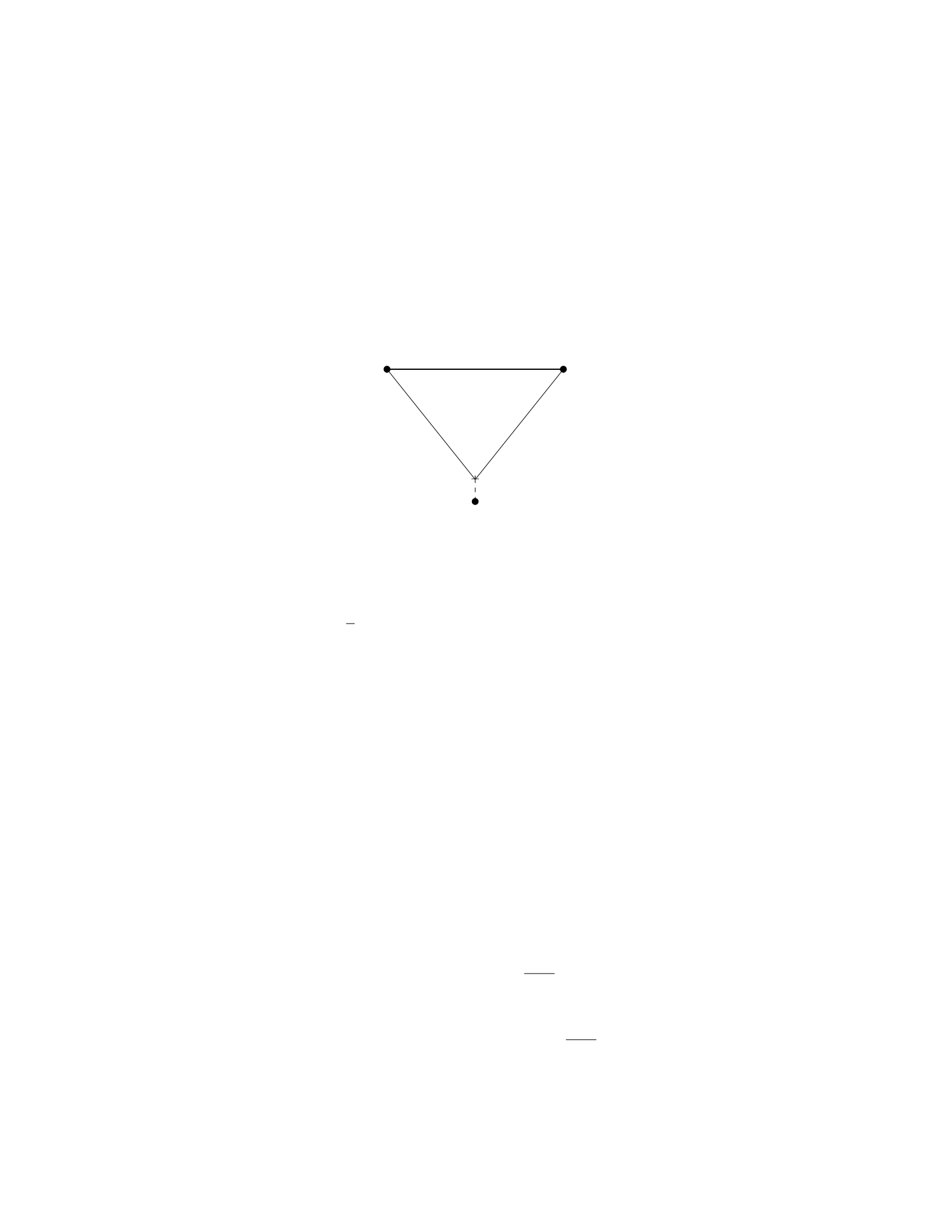
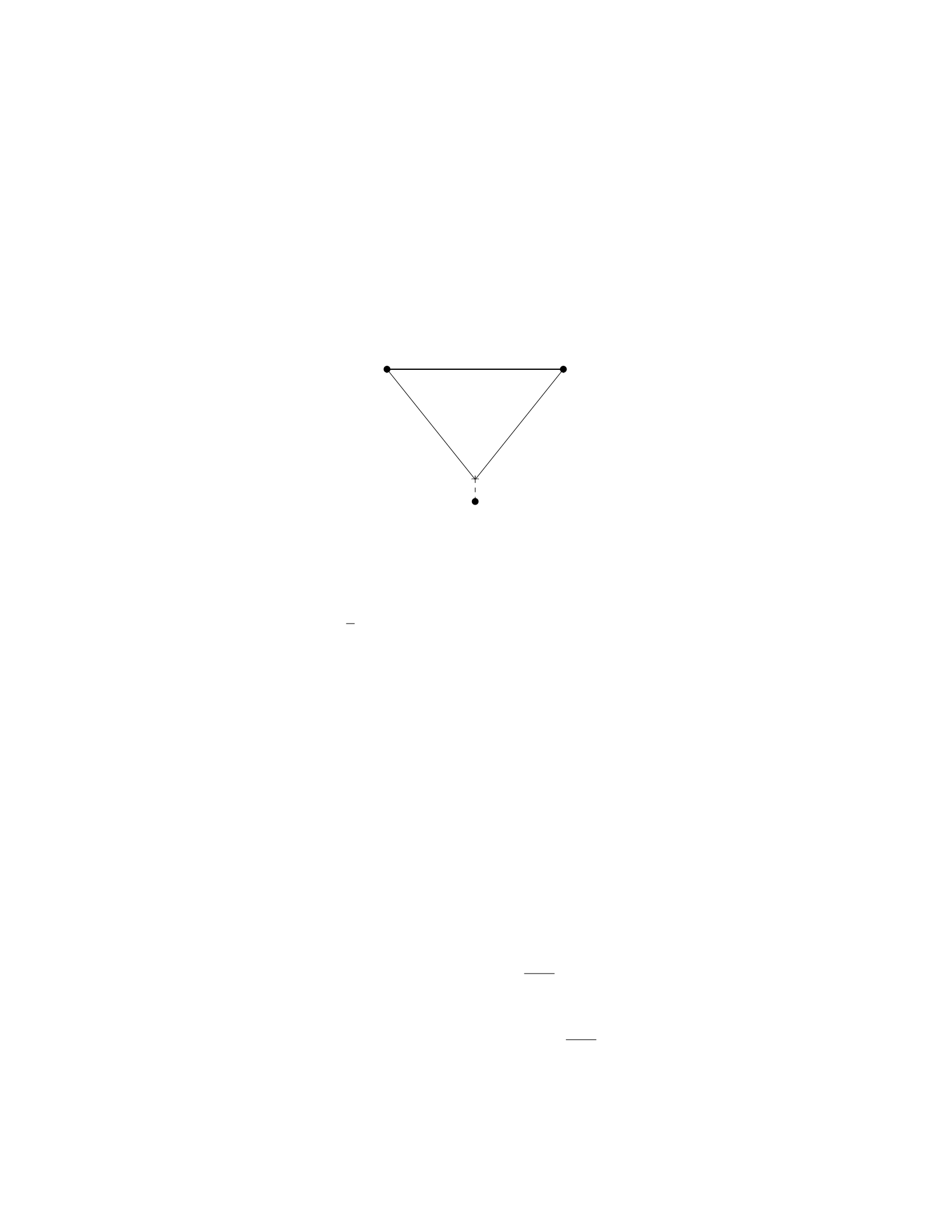
A uniform beam of length Land mass Mis supported at its ends by two scales.
A person of mass mstands at a distance xfrom one end of the beam, as shown
in the diagram below. The beam is in equilibrium. Determine the reading on
each scale in terms of M,m,L, and x.
m
A B
xL−x
Solution
Step 1: Draw the free-body diagram for the beam. We have forces acting on
the beam as follows: - The weight of the beam itself, Mg, acting downward at
the center of mass (L
2from each end). - The reaction forces NAand NBfrom
the scales at each end. - The weight of the person, mg, acting downward at
distance xfrom A.
Step 2: Write out the force equilibrium equations in the vertical (y−) direc-
tion:
NA+NB=Mg +mg
Step 3: Write out the torque equilibrium equation about point A:
XτA= 0
NB·L=mg ·x
Step 4: We now have two equations and two unknowns (NAand NB). We
can solve these equations simultaneously to find the readings on each scale:
From equation (1): NA=Mg +mg −NB
Substitute NAinto equation (2):
(Mg +mg −NB)·L=mg ·x
Solve for NB:
NB=Mg +mg −mgx
L
Step 5: Now, substitute NBback into equation (1) to find NA:
NA=Mg +mg −(Mg +mg −mgx
L)
3

NA=mgx
L
Therefore, the readings on each scale are:
NA=mgx
Land NB=Mg +mg −mgx
L
Question 4
Question
A uniform beam of length Land mass Mis pivoted at one end. A block of
mass mis hanging from the other end of the beam, a distance xfrom the pivot
point. If the beam is in equilibrium, find the tension in the pivot point and the
reaction force at the pivot point.
Solution
Let’s consider the forces acting on the beam. There are three forces acting on
the beam: the tension force Tat the pivot point, the weight of the beam Mg
(acting at the center of mass of the beam), and the weight of the block mg.
Step 1: Set up coordinate system
Let’s set up our coordinate system with the origin at the pivot point. We will
define the positive direction as counterclockwise.
Step 2: Write the torque equation
The torque equation about the pivot point is given by:
Xτ= 0
where τ=r×Fis the torque produced by a force Facting at a distance rfrom
the pivot point.
The torque contributions are: 1. Tension force Tproduces no torque since its
line of action goes through the pivot point. 2. Weight of the beam Mg produces
a torque in the clockwise direction about the pivot point. The distance of the
center of mass of the beam from the pivot point is L/2. 3. Weight of the block
mg produces a torque in the counterclockwise direction about the pivot point.
The distance of the block from the pivot point is x.
So, the torque equation becomes:
−MgL
2+mgx = 0
Step 3: Solve for tension T
Solving the torque equation, we get:
T=MgL
2x
4

Step 4: Write the force equation
The force equation in the vertical direction is given by:
XFy= 0
The forces in the vertical direction are: 1. Tension force Tacts upward.
2. Weight of the beam M g acts downward. 3. Weight of the block mg acts
downward.
So, the force equation becomes:
T−Mg −mg = 0
Step 5: Solve for reaction force at the pivot point
Substitute the expression for tension Tinto the force equation:
MgL
2x=Mg +mg
Solving for Rwe get:
R=Mg +mg −MgL
2x
Therefore, the tension at the pivot point is MgL
2xand the reaction force at
the pivot point is M g +mg −MgL
2x.
Question 5
Question
A uniform rod of length Land mass Mis suspended horizontally from two
vertical walls by two identical ropes attached to its ends. If each rope makes an
angle θwith the vertical wall, find the tension in each rope.
Solution
Let’s denote the tension in each rope as T. We will analyze the forces acting on
the rod in the horizontal and vertical directions.
Step 1: Free-body diagram
Consider the forces acting on the rod. In the horizontal direction, the only
force is the tension Tin each rope pulling towards the center. In the vertical
direction, we have the weight of the rod acting downwards and the vertical
components of the tensions in the ropes.
Step 2: Equations of equilibrium
In the vertical direction, the sum of the vertical forces must be zero:
Tcos θ+Tcos θ=Mg
2Tcos θ=Mg
5

In the horizontal direction, the sum of the horizontal forces must be zero
since the rod is in equilibrium:
Tsin θ= 0
T= 0
Step 3: Solve for tension
From the equation 2Tcos θ=Mg, we can solve for the tension in each rope:
T=Mg
2 cos θ
Therefore, the tension in each rope is Mg
2 cos θ.
Question 6
Question
A uniform beam of length Land mass Mis supported by a pivot at one end.
A rope is attached to the other end of the beam and pulled horizontally with a
force F. Assuming the beam is in equilibrium, determine the tension in the rope
and the reaction force at the pivot in terms of L,M,F, and the acceleration
due to gravity g.
Solution
Step 1: Draw a free-body diagram of the beam to identify the forces acting on
it. Force Direction
Tension in the rope, TUp and to the right
Gravitational force, Mg Downward
Reaction force at pivot, RUpward
Applied force, FTo the right
Step 2: Write the equilibrium equations for the beam in both the horizontal
and vertical directions.
(Sum of forces in the vertical direction: R−Mg = 0
Sum of forces in the horizontal direction: T−F= 0
Step 3: Solve the equilibrium equations to find the tension in the rope and
the reaction force at the pivot. From the vertical equilibrium equation: R=M g
From the horizontal equilibrium equation: T=F
Therefore, the tension in the rope is Fand the reaction force at
the pivot is M g.
6

Question 7
Question
A 2-meter long steel rod with a radius of 2 cm is placed horizontally on two
supports. A 50 kg mass is hung from the rod at a distance of 1 meter from one
end. If the Young’s modulus of steel is 2.0×10¹¹ N/m2, determine the stress
and strain in the rod at the point where the mass is hung.
Solution
Step 1: Calculate the force applied by the mass. The force applied by the mass
is given by F=mg, where mis the mass and gis the acceleration due to gravity.
Substituting m= 50 kg and g= 9.81 m/s2:
F= 50 kg ×9.81 m/s2= 490.5 N
Step 2: Calculate the moment created by the mass. The moment created
by the mass is given by M=F d, where dis the distance of the mass from one
end of the rod. Substituting F= 490.5 N and d= 1 m:
M= 490.5 N ×1 m = 490.5 Nm
Step 3: Determine the stress in the rod. The stress in the rod can be
calculated using the formula σ=M y
I, where σis the stress, Mis the moment,
yis the perpendicular distance from the neutral axis, and Iis the moment of
inertia of the rod. For a solid cylinder, I=πr4
4.
I=π(0.02 m)4
4= 2.01 ×10⁻⁸m4
Given that the rod is 2 m long and the mass is placed 1 m from one end,
y= 1 m. Substituting M= 490.5 Nm and y= 1 m:
σ=490.5 Nm ×1 m
2.01 ×10⁻⁸m4≈2.44 ×10⁷N/m2
Step 4: Determine the strain in the rod. The strain in the rod is given by
ε=σ
Y, where εis the strain and Yis the Young’s modulus of the material.
Substituting σ= 2.44 ×10⁷N/m2and Y= 2.0×10¹¹ N/m2:
ε=2.44 ×10⁷N/m2
2.0×10¹¹ N/m2= 0.000122
Therefore, the stress in the rod where the mass is hung is approximately
2.44 ×10⁷N/m2and the strain is 0.000122.
7
Question 8
Question
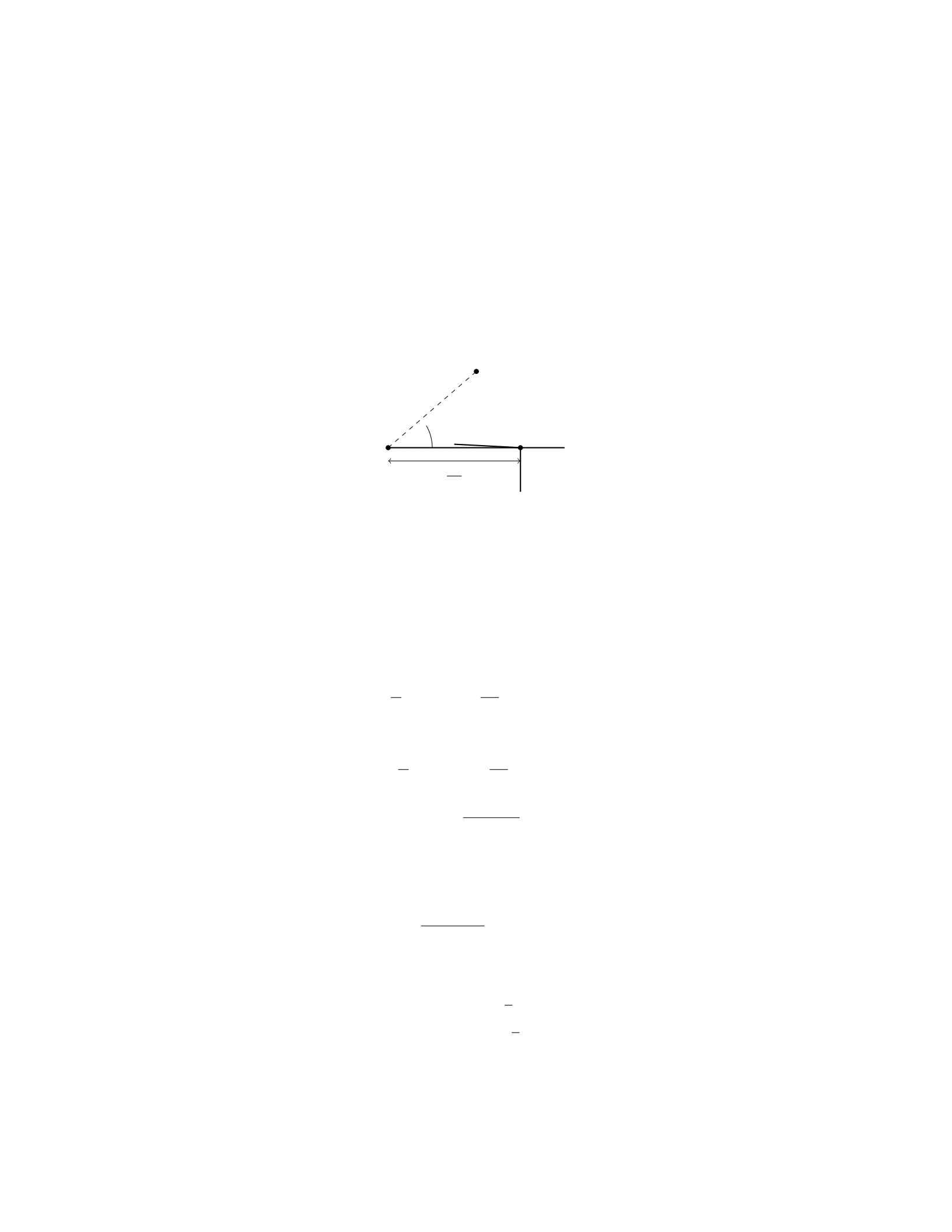
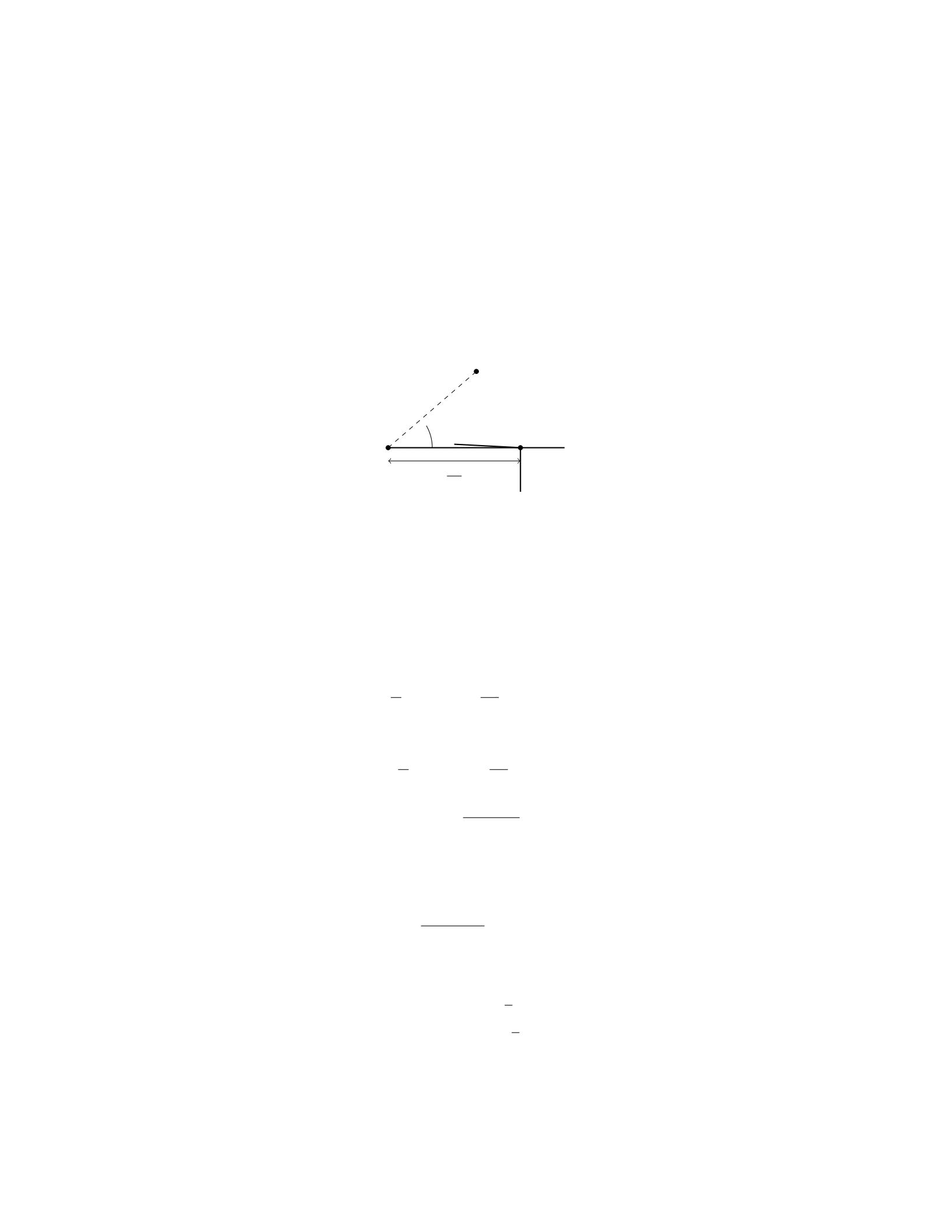
A uniform beam of length Land mass Mis supported by a pivot at one end and
a cord attached 3L/4 from the pivot at the other end, as shown in the figure
below. If the beam makes an angle θwith the horizontal and the tension in the
cord is T, determine the tension in the pivot and the angle θin terms of M,L,
and g.
3L
4
L/4
θ
Solution
Step 1: Set up the free body diagram and write down the torque equilibrium
equation. The forces acting on the beam are the tension Tat the end and
the weight M g, which acts at the center of the beam. The torque equilibrium
equation about the pivot point is:
Xτ= 0
−L
4Mg sin θ+3L
4Tcos θ= 0
Step 2: Solve for the tension Tin terms of M,L,g, and θ.
L
4Mg sin θ=3L
4Tcos θ
T=Mg sin θ
3 cos θ
Step 3: Sum the forces in the vertical direction to solve for θ.
Tsin θ=Mg
Mg sin2θ
3 cos θ=Mg
sin2θ= 3 cos θ
tan2θ= 3
tan θ=√3
θ= tan−1(√3)
8
Question 9
Question
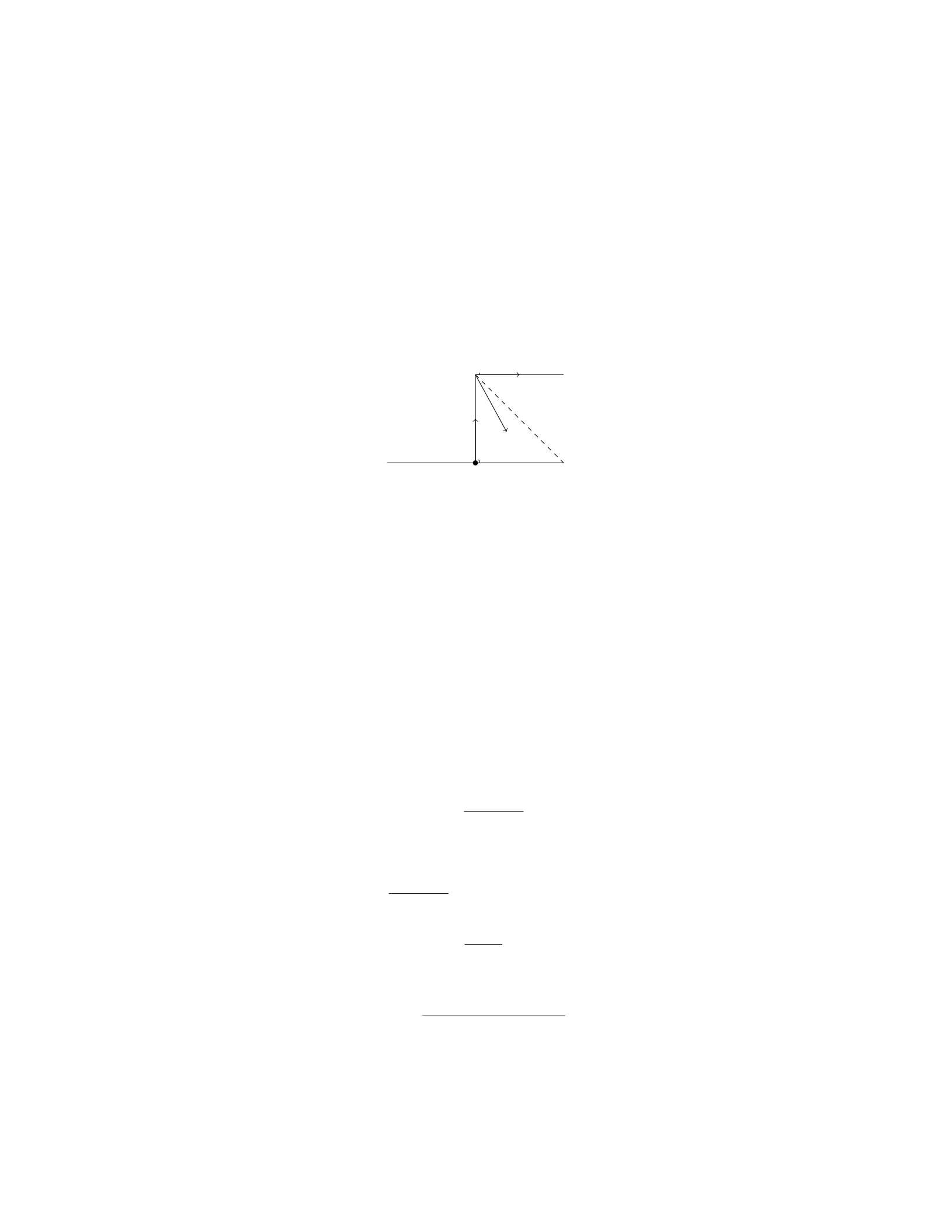
A uniform beam of length Land mass Mis supported by two strings, as shown
in the diagram below. The angles θ1and θ2are measured from the vertical. If
the tension in the string at angle θ1is T, what is the tension in the other string
at angle θ2?
T
T2
T1
θ1
θ2
Solution
Let’s consider the forces acting on the beam in the horizontal and vertical di-
rections to find the tension in the other string at angle θ2.
Step 1: Vertical Forces The forces acting in the vertical direction are the
weight of the beam and the vertical components of tension Tand T2. Summing
up forces in the vertical direction:
T1cos θ1=T2+Mg
Step 2: Horizontal Forces The only horizontal force acting is the horizontal
component of tension T1. Summing up forces in the horizontal direction:
T1sin θ1=T2sin θ2
Step 3: Finding T1and T2From Step 1, we get:
T1=T2+Mg
cos θ1
Substitute this into Step 2:
T2+Mg
cos θ1
sin θ1=T2sin θ2
T2+Mg =T2
sin θ1
cos θ1
tan θ1sin θ2
T2(1 −sin θ1tan θ1sin θ2) = Mg
T2=Mg
1−sin θ1tan θ1sin θ2
9

Question 10
Question
A uniform beam of length Land mass Mis pivoted at one end. An object of
mass mis hung a distance xfrom the pivot point. If the beam is in equilibrium
at an angle θ, determine the tension in the wire supporting the object.
Solution
1. Draw a free-body diagram of the beam and the hanging mass. Label the forces
acting on the beam and hanging mass. The forces acting on the beam are the
tension in the wire (T) and the gravitational force acting at the center of mass.
The forces acting on the hanging mass are its weight (mg) and the tension in the
wire (T). Note that the angle between the beam and the vertical is θ. 2. Write
out the equilibrium equations for the system. For the beam, the torque (τ) about
the pivot point is given by τ= (L/2)M g sin θ−xT sin θ= 0, since the beam
is in rotational equilibrium. For the hanging mass, the forces in the vertical
direction must balance, giving T=mg. 3. Solving the equation for Tfrom the
hanging mass, we find T=mg. Substitute this result into the torque equation
for the beam to find the value of the tension: (L/2)Mg sin θ−x(mg) sin θ= 0.
4. Simplifying the torque equation gives (L/2)M−xm = 0, which can be
rearranged to find x=L/2. Thus, the tension in the wire supporting the object
is T=mg.
Question 11
Question
A steel cable of length 10 m and cross-sectional area 0.001 m2is suspended
vertically from a ceiling. A 100 kg block is attached to the lower end of the
cable. Calculate the stress in the cable and the elongation of the cable when
supporting the block. Assume Young’s modulus for steel is 2 ×10¹¹ N/m2.
Solution
Step 1: Calculate the weight of the block. The weight of the block can be
calculated using the formula: W=mg, where mis the mass of the block and
gis the acceleration due to gravity. Given that the mass of the block is 100 kg,
and g= 9.81 m/s2, we have:
W= (100 kg)(9.81 m/s2) = 981 N
Step 2: Calculate the stress in the cable. The stress (σ) in the cable can
be calculated using the formula: σ=F
A, where Fis the force applied and Ais
10

the cross-sectional area of the cable. The force on the cable is the weight of the
block, so σ=W
A. Substitute W= 981 N and A= 0.001 m2:
σ=981 N
0.001 m2= 981 ×103Pa
Step 3: Calculate the elongation of the cable. The elongation (∆L) of the
cable can be calculated using Hooke’s Law: ∆L=F L
AE , where Lis the original
length of the cable and Eis the Young’s modulus. Substitute F=W= 981 N,
L= 10 m, A= 0.001 m2, and E= 2 ×10¹¹ N/m2:
∆L=(981 N)(10 m)
(0.001 m2)(2 ×10¹¹ N/m2)
∆L=9810
2×108= 0.04905 m
Therefore, the stress in the cable is 981,000 Pa and the elongation of the
cable when supporting the block is 0.04905 m.
Question 12
Question
A uniform rod of length Land mass Mis supported by a pivot at one end and
a string attached to the other end, making an angle θwith the horizontal. The
tension in the string is T. Calculate the force exerted by the pivot on the rod.
Solution
Step 1: Draw a free-body diagram of the rod and analyze the forces acting on
it.
The forces acting on the rod are the gravitational force Mg acting at the
center of mass, the tension force Tacting at an angle θwith the horizontal, and
the pivot force Fpacting at the pivot point.
Step 2: Write down the equations for the forces in the horizontal and vertical
directions.
In the vertical direction:
Fnet,y =Tsin(θ)−Mg = 0
In the horizontal direction:
Fnet,x =Tcos(θ)−Fp= 0
Step 3: Solve the equation in the vertical direction for T.
Tsin(θ)−Mg = 0
11
T=Mg/ sin(θ)
Step 4: Substitute Tback into the equation in the horizontal direction and
solve for Fp.
Tcos(θ)−Fp= 0
Mg cot(θ)−Fp= 0
Fp=Mg cot(θ)
Therefore, the force exerted by the pivot on the rod is Mg cot(θ).
Question 13
Question
A steel wire of length 2.0 m and radius 1.0 mm is stretched between two fixed
supports. If a 100 N weight is hung from the middle of the wire, what is the
elongation of the wire assuming it stretches elastically and the Young’s modulus
for steel is 2.0×10¹¹ N/m2?
Solution
Step 1: Calculate the area of the cross-section of the wire. Given that the radius
of the wire is 1.0 mm, we can calculate the area of the cross-section using the
formula for the area of a circle: A=πr2.
A=π×(1.0×10⁻³)2=π×1.0×10⁻⁶m2
Step 2: Calculate the force of tension in the wire. Since the weight is hung
from the middle of the wire, each half of the wire will support half the weight,
which is 50 N. The force of tension in the wire is equal to the weight supported
by one half of the wire, which is 50 N.
F= 50 N
Step 3: Calculate the elongation of the wire. The force of tension can be
related to the Young’s modulus, cross-sectional area, and the elongation of the
wire using Hooke’s Law: F=Y·A·∆L
L, where ∆Lis the change in length and L
is the original length of the wire.
∆L=F·L
Y·A=50 ×2.0
2.0×10¹¹ ×π×1.0×10⁻⁶
∆L=100
π×105=100
3.14 ×10⁵≈3.18 ×10⁻⁴m
Therefore, the elongation of the wire is approximately 3.18 ×10⁻⁴m.
12
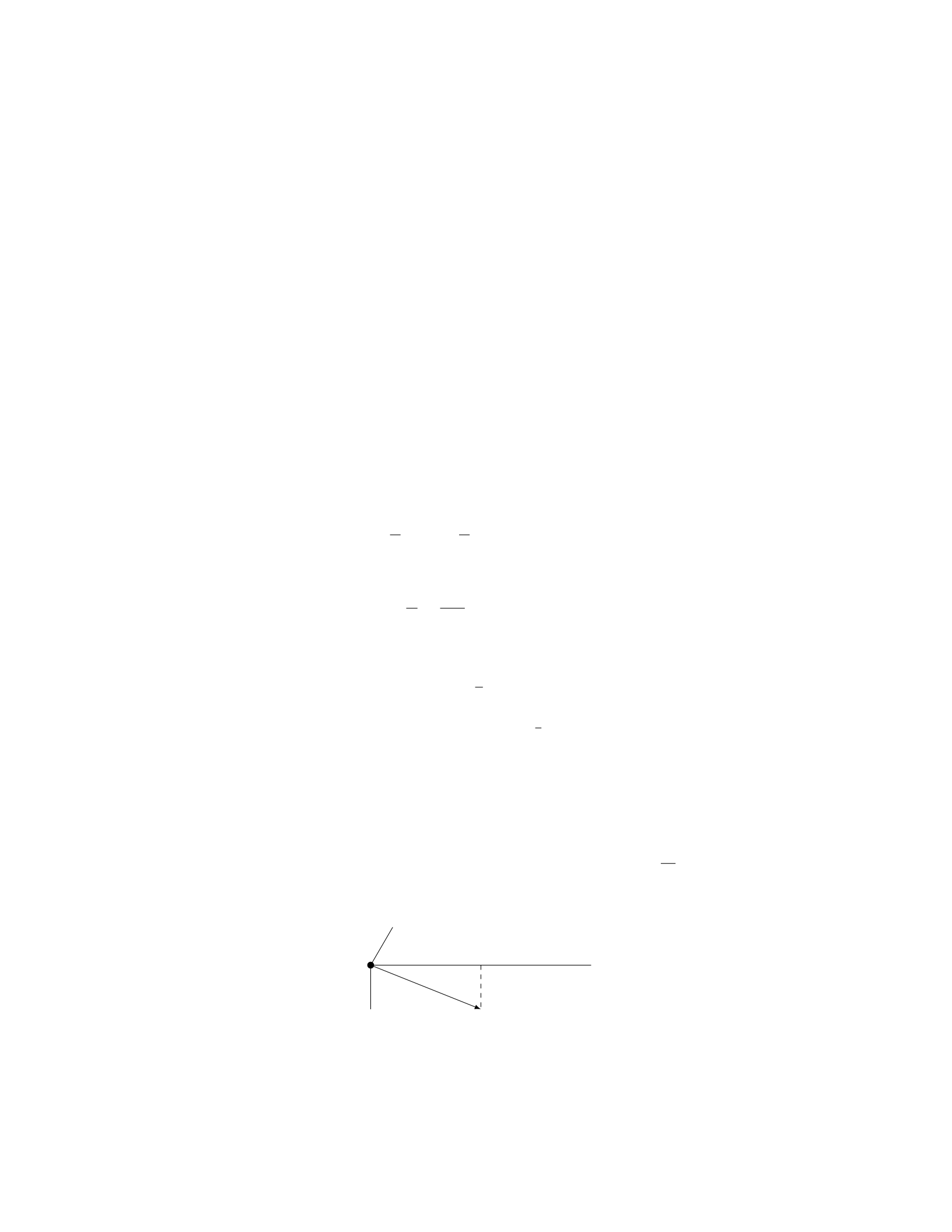
Question 14
Question
A uniform beam of length Land mass Mis supported by a cable attached 1/3
of the way from the left end. A 2Mmass is suspended from the right end of
the beam. Determine the tension Tin the cable.
Solution
Step 1: We will start by drawing a free body diagram of the beam. Let Mbe
the mass of the beam, Lbe the length of the beam, and Tbe the tension in the
cable. Step 2: The forces acting on the beam are the tension Tin the cable,
the weight of the beam M g acting at the center of mass, and the weight of the
2Mmass at the right end. Step 3: Taking moments about the left end of the
beam, we have:
Xτ= 0
T·L
3−Mg ·L
2+ (2Mg)·L= 0
Step 4: Simplifying the equation, we get:
T
3−Mg
2+ 2Mg = 0
Step 5: Rearranging the terms, we find:
T=5
6Mg
Step 6: Therefore, the tension Tin the cable is 5
6Mg.
Question 15
Question
A uniform rod of length Land mass mis supported by a pivot at one end, as
shown in the diagram below. A force Fis applied at a distance 2L
3from the
pivot in a direction perpendicular to the rod.
OF
L
Determine the tension in the rod at the pivot when the rod is in equilibrium.
13

Solution
Step 1: Identify the forces acting on the rod.
The forces acting on the rod are: - The weight of the rod (mg) acting at the
center of mass of the rod. - The tension (T) at the pivot point. - The applied
force F.
Step 2: Set up equilibrium equations.
In the vertical direction:
T+Fy−mg = 0
In the rotational direction about the pivot point:
F·2L
3−T·L= 0
Step 3: Solve the equations.
From the first equation, we have T=mg −Fy.
Substitute Fy=F·2L
3L=2F
3into the expression for T:
T=mg −2F
3
Therefore, the tension in the rod at the pivot when the rod is in equilibrium
is mg −2F
3.
Question 16
Question
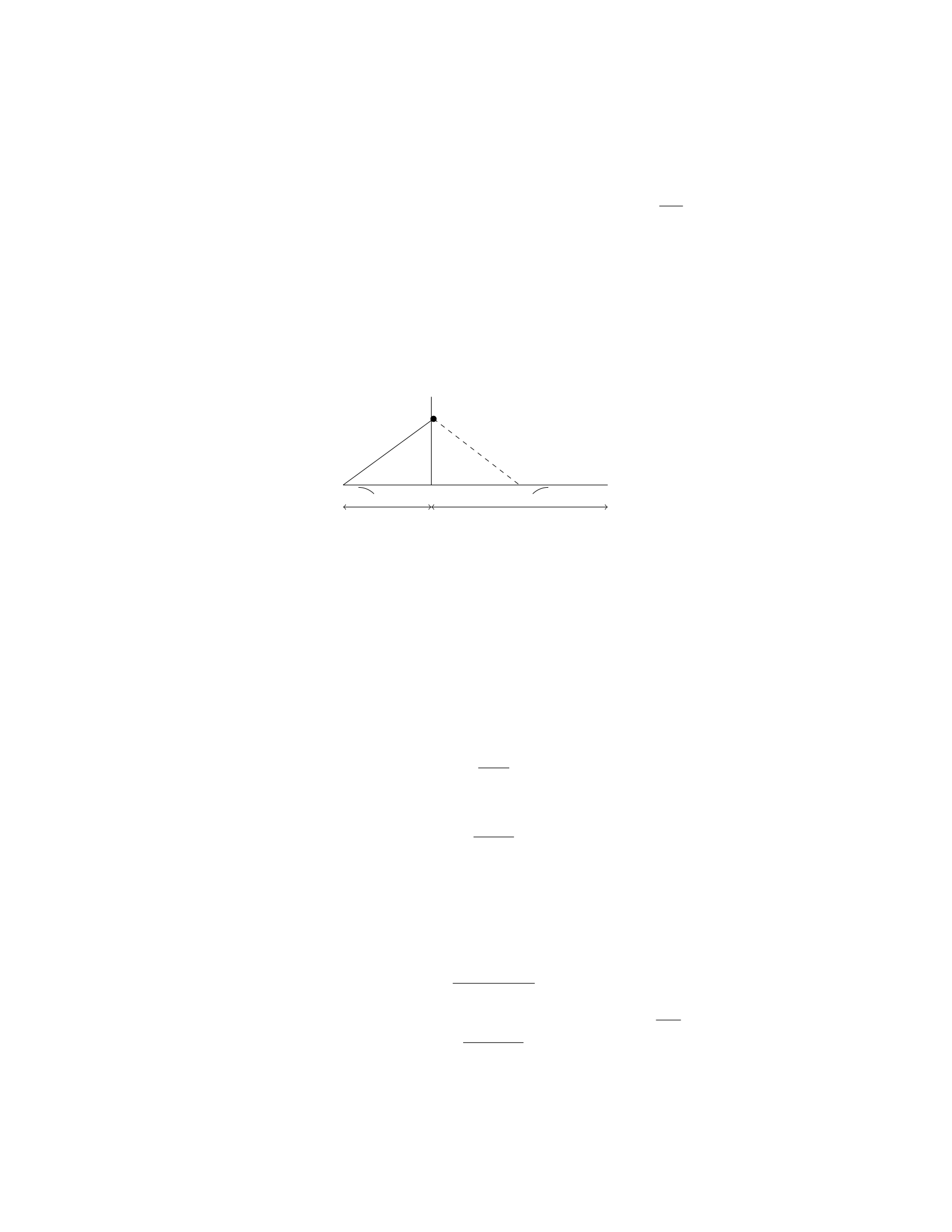
A block of mass mis suspended by a rope of length Lfrom the ceiling. The
block is in equilibrium and the angle the rope makes with the vertical is θ. Find
the tension in the rope.
Solution
Step 1: Draw a free body diagram of the block. The forces acting on the block
are the tension (T) in the rope and the gravitational force (mg). Resolve the
forces into components.
Step 2: The vertical component of the tension force balances the gravita-
tional force, so Tcos θ=mg.
Step 3: The horizontal component of the tension force is responsible for
providing the centripetal force to keep the block in a circular orbit, so Tsin θ=
mv2
rwhere vis the speed of the block and ris the radius of the circle.
Step 4: Since the block is in equilibrium, the net force acting on it is zero in
both the vertical and horizontal directions.
Step 5: To find the tension in the rope, we first solve for the speed of the
block by realizing that the vertical component of the acceleration is zero. Thus,
v2
r=gtan θ.
14
Step 6: Substituting the expression for v2/r into Tsin θ=mv2
r, we get
T=mg cot θas the tension in the rope.
Question 17
Question
A uniform beam of length Land mass Mis supported by two strings, as shown
in the figure below. The angle between the left string and the horizontal is θ.
Find the tension in each string.
L
x1x2
θ
Solution
Step 1: We will begin by setting up the equilibrium conditions for the beam.
The sum of the forces in the vertical direction must be zero:
T1cos θ=Mg
The sum of the torques about any point must also be zero. We will choose the
left end of the beam:
T2Lcos θ=T1x1sin θ
Step 2: We can solve the first equation for T1to get:
T1=Mg
cos θ
Step 3: Substitute T1into the second equation and solve for T2:
T2=Mgx1
L
Step 4: Both x1and x2are related to each other and to Lthrough the
equation x1+x2=L. Using this, we can express x1as:
x1=L−x2
Step 5: Substitute x1=L−x2back into the equation for T2:
T2=Mg(L−x2)
L
Step 6: Therefore, the tension in the left string T1is T1=M g
cos θand the
tension in the right string T2is T2=Mg(L−x2)
L.
15

Question 18
Question
A uniform rod of length Land mass Mis hinged at one end and supported in
a horizontal position by a thin wire attached to the other end. The wire makes
an angle θwith the vertical. Find the tension in the wire and the force at the
hinge in terms of M,L, and θ.
Solution
Step 1: Draw a free body diagram of the rod. Step 2: Resolve the forces acting
on the rod into components. Step 3: Write the force balance equations in the
vertical and horizontal directions to find the unknowns.
Question 19
Question
A steel cable with a diameter of 1.5 cm and a length of 10 m hangs vertically
from a ceiling. If the Young’s modulus for steel is 2.10 ×10¹¹ N/m2, calculate
the elongation of the cable when a 300 kg mass is attached to its end.
Solution
Step 1: Calculate the cross-sectional area of the cable. Given that the diameter
of the cable is 1.5 cm, the radius is r= 0.75 cm = 0.0075 m. The cross-sectional
area, A, of the cable is given by:
A=πr2
A=π(0.0075)2
A= 1.77 ×10⁻⁴m2
Step 2: Calculate the weight of the attached mass. The weight, W, is given
by:
W=mg
W= (300 kg)(9.81 m/s2)
W= 2943 N
Step 3: Calculate the tensile stress in the cable. The tensile stress, σ, is
given by:
σ=F
A
16

where Fis the force applied and Ais the cross-sectional area. Since the force
applied is equal to the weight of the mass, we have:
σ=W
A
σ=2943
1.77 ×10⁻⁴
σ= 1.66 ×10⁷N/m2
Step 4: Calculate the elongation of the cable. The elongation, ∆L, of the
cable is given by:
∆L=F L
A·Y
where Lis the original length of the cable and Yis the Young’s modulus of
steel. Substitute the given values:
∆L=(2943)(10)
(1.77 ×10⁻⁴)(2.10 ×10¹¹)
∆L= 0.00738 m or 7.38 mm
Therefore, the elongation of the cable when the 300 kg mass is attached to
its end is 7.38 mm.
Question 20
Question
A uniform beam of length Land mass mis supported by a hinge at one end
and a rope attached 3/5 of the way along the beam. A weight of mass 2mis
hung from the free end of the beam. The beam makes an angle of 37◦with the
horizontal. Calculate the tension in the rope.
Solution
Step 1: Draw a free body diagram of the beam. Label the forces acting on the
beam.
Step 2: Resolve the forces into horizontal and vertical components. Let T
be the tension in the rope, Wbe the weight of the beam, Fbe the force exerted
by the hinge, and 2Wbe the weight at the free end.
Step 3: Write the equilibrium equations for the beam in the horizontal and
vertical directions. In the vertical direction, the sum of the forces is zero:
Fy=F−W−2W= 0
Step 4: Calculate the weight of the beam W=mg and the weight at the
free end 2W= 2mg.
17

Step 5: Substitute the known values into the equilibrium equations: For the
vertical direction:
F−mg −2mg = 0
F= 3mg
Step 6: Now consider the torque equation. The torque about the hinge must
be zero for rotational equilibrium. Choose the hinge as the pivot point and sum
the torques:
τ= 0 = −F(L)sin(37◦)+2W(3L/5)sin(37◦) + T(L/5)sin(37◦)
Step 7: Substitute the earlier calculated values of F= 3mg,W=mg, and
2W= 2mg into the torque equation:
0 = −3mgL sin(37◦) + 2(2mg)(3L/5) sin(37◦) + T(L/5) sin(37◦)
Step 8: Solve for the tension T:
3mgL sin(37◦)=4mgL sin(37◦) + T(L/5) sin(37◦)
T(L/5) sin(37◦) = −mgL sin(37◦)
T=−5mg
Therefore, the tension in the rope is −5mg. Note that the negative sign
indicates the direction of the tension force.
Question 21
Question
A heavy object of mass 5 kg is attached to a vertical spring. When the object
is attached, the spring stretches by 0.2 m. If the spring constant is 200 N/m,
determine the magnitude of the force exerted by the object on the spring when
it is in equilibrium.
Solution
Step 1: We first determine the weight of the object using the formula Fweight =
mg, where mis the mass and gis the acceleration due to gravity.
Fweight = 5 kg ×9.8 m/s2= 49 N
Step 2: The magnitude of the force exerted by the object on the spring when
it is in equilibrium is equal to the sum of the weight of the object and the force
exerted by the spring.
Fequilibrium =Fweight +kx
18
where kis the spring constant and xis the displacement from the equilibrium
position.
Step 3: Since the object is in equilibrium, the net force acting on it is zero.
Fequilibrium = 0
Fweight +kx = 0
Step 4: Substituting the known values:
49 N + 200 N/m ×0.2 m = 0
Step 5: Solving for Fequilibrium:
Fequilibrium =−49 N
Therefore, the magnitude of the force exerted by the object on the spring
when it is in equilibrium is 49 N downward.
Question 22
Question
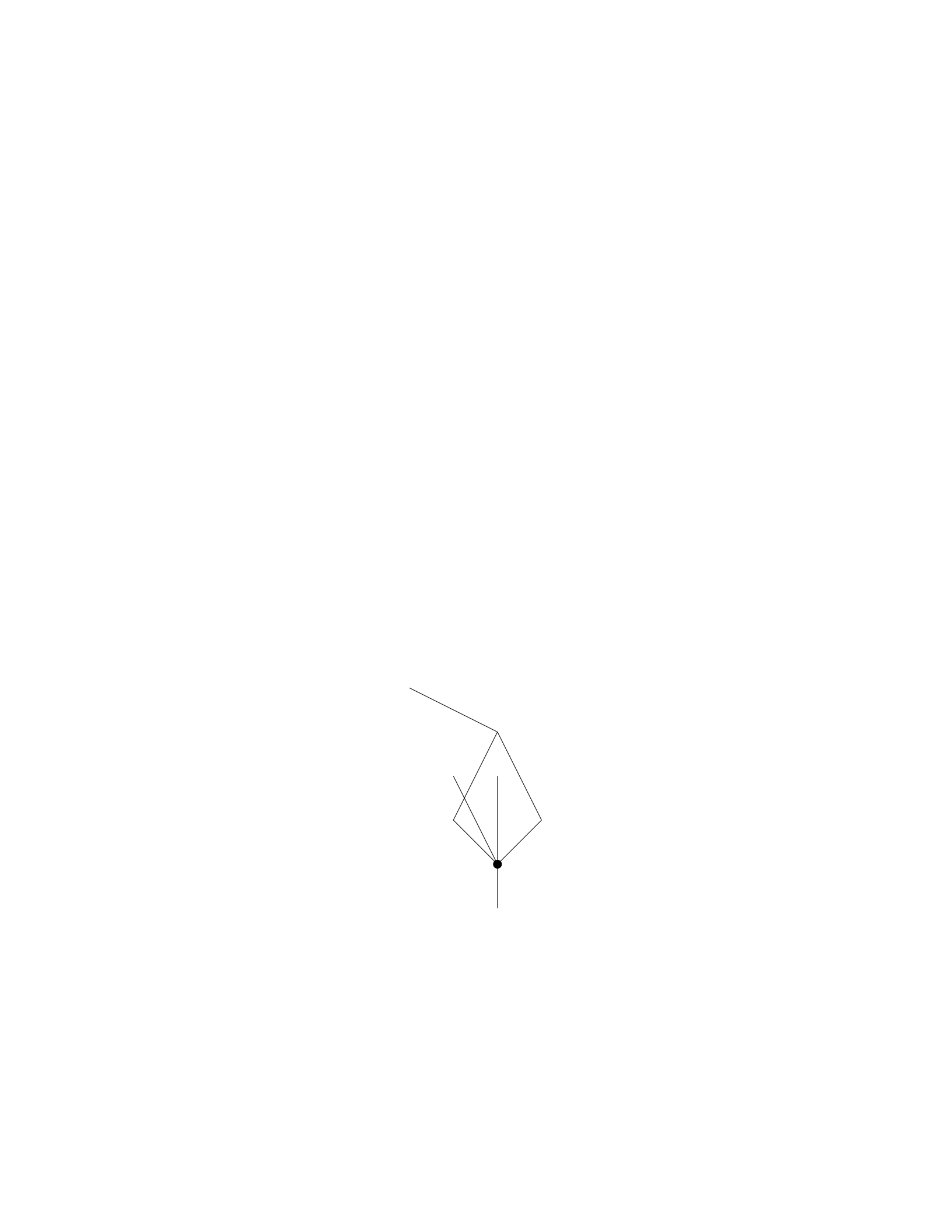
A wooden block of mass mhangs from the ceiling by three wires as shown in
the figure below. Each wire has a tension T. The block is in equilibrium and
the angle between the wires is θ. Calculate the tension Tin each wire in terms
of mand g.
mT
T
T
Solution
Step 1: Draw a free-body diagram for the block m. Resolving forces in the
vertical direction, we have:
Tcos(θ)−Tcos(θ) = 0
19

Tcos(θ) = mg
T=mg
cos(θ)
Step 2: The tension Tin each wire is given by:
T=mg
cos(θ)
Question 23
Question
A uniform ladder of length Land mass Mrests against a smooth vertical wall.
The ladder makes an angle θwith the horizontal floor. Determine the forces
at point Aand point Bwhere the ladder makes contact with the wall and the
floor respectively.
Solution
Step 1: Draw a free-body diagram of the ladder showing all the forces acting
on it.
Step 2: Resolve the forces into their components. Let NAand NBbe the
normal forces at points Aand Brespectively, fAand fBbe the friction forces
at points Aand Brespectively, and Wbe the weight of the ladder acting at its
center of mass.
Step 3: Write the force equations for equilibrium in the x and y directions:
(Sum of forces in the x-direction: NA−fA= 0
Sum of forces in the y-direction: NB−W= 0
Step 4: Write the torque equations for equilibrium about point A:
τA= 0 =⇒fA·Lsin(θ)−W·L
2cos(θ)=0
Step 5: Solve for the normal force at point A,NA:
NA=fA=W
2 sin(θ) cos(θ)=Mg
2 sin(θ) cos(θ)
Step 6: Solve for the normal force at point B,NB:
NB=W=Mg
Step 7: Therefore, the forces at point Aand point Bare:
At point A: NA=M g
2 sin(θ) cos(θ)and At point B: NB=Mg
20
Question 24
Question
A uniform plank of length Land mass Mis supported horizontally by two ropes,
with one rope located at each end. The plank is suspended by the ropes from a
ceiling. If a person of mass mstands xmeters from one end of the plank, find
the tension in each rope.
Solution
Step 1: Draw a free-body diagram of the plank and the person. Step 2: Apply
the rotational equilibrium condition about the point where the left rope attaches
to the plank. Step 3: Express the tension in each rope in terms of the given
variables.
Let’s proceed with the detailed solution.
Question 25
Question
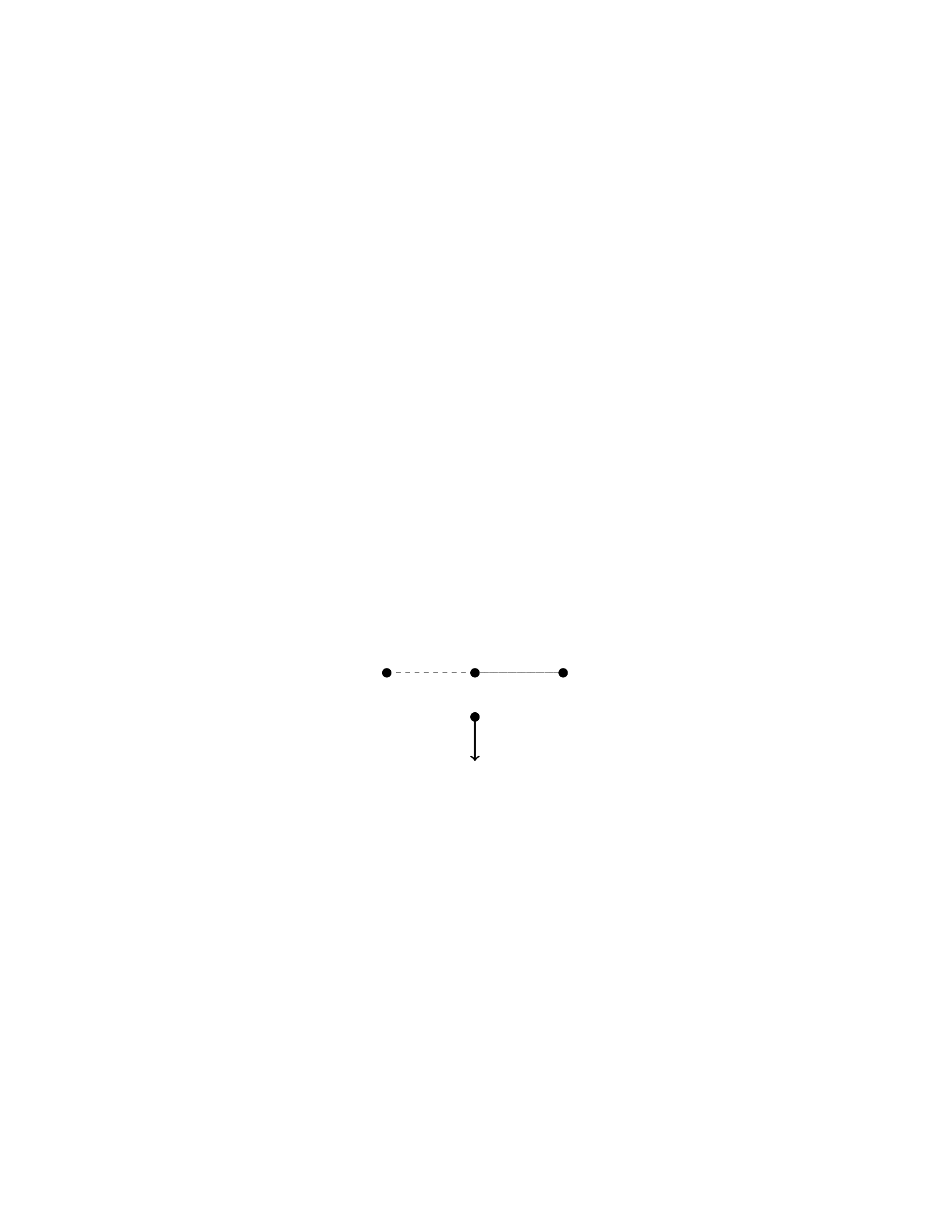
A thin uniform rod of mass Mand length Lis suspended horizontally by two
vertical wires attached to its ends. A heavy object of mass mis then hung from
the midpoint of the rod, as shown. Find the tension in each wire.
A BC
D
m
Solution
Step 1: We begin by setting up the equations of equilibrium for the system. We
have the following forces acting on the system: - The weight of the rod, acting
at its center of mass at point C, which we’ll call Mg downward. - The tension
in the wire attached to point A, which we’ll call TAupward. - The tension in
the wire attached to point B, which we’ll call TBupward. - The weight of the
object m, acting downward at point D, which is mg.
Since the system is in equilibrium, the sum of the forces in the vertical
direction and the sum of torques about any point must be zero.
Step 2: Summing forces in the vertical direction, we have:
TA+TB=Mg +mg
21

Step 3: To find the torques about point A, we choose point A as the pivot.
The torque due to the weight of the rod is zero (because it acts at the pivot),
the torque due to TBis TB·L/2, and the torque due to the weight of the object
m is mg ·L/4. Setting the sum of torques about A equal to zero:
TB·L
2−mg ·L
4= 0
Step 4: Solving the system of equations from Step 2 and Step 3, we find:
TA=3M+ 4m
4g
TB=M−m
4g
Therefore, the tension in wire A is 3M+4m
4gand the tension in wire B is
M−m
4g.
Question 26
Question
A uniform steel beam of length 5.0 m and weight 9800 N is to be supported by
a cable at each end. If the cable at one end is attached to the end of the beam
and the other cable is attached 2.0 m from the other end, what should be the
tension in each cable?
Solution
Step 1: Draw a diagram of the system to visualize the forces acting on the beam.
Step 2: Identify all the forces acting on the beam. The forces acting on the
beam are its weight, the tension force at the end of the beam, and the tension
force 2.0 m away from the other end.
Step 3: Write the equilibrium equation for the beam in the vertical direction.
The sum of the forces in the vertical direction must be zero for the beam to be
in equilibrium.
Step 4: Use the equilibrium equation to find the tension in the cable at each
end of the beam.
Step 5: Calculate the tension in each cable, making sure to consider the
weight of the beam as well.
Step 6: Write the final answer with the calculated tensions in each cable.
Step 7: Check the units and ensure they are correct for the tension values.
Therefore, the tension in the cable at the end of the beam should be 5880
N, and the tension in the cable 2.0 m away from the other end should be 2950
N.
22

Question 27
Question
A uniform ladder of length 4.00 m and weight 400 N rests against a smooth,
vertical wall. The coefficient of static friction between the ladder and the ground
is 0.400. A 70.0 kg painter stands on a rung of the ladder 1.50 m from the
bottom. What minimum angle should the ladder make with the ground so that
it doesn’t slip?
Solution
Step 1: Draw a free-body diagram of the ladder. Step 2: Write the equations of
equilibrium for the ladder in the xand ydirections. Step 3: Solve the equations
to find the minimum angle. Let’s begin by drawing the free-body diagram of
the ladder.
Step 1: The free-body diagram of the ladder includes the following forces:
1. Weight of the ladder acting at its center. 2. Normal force exerted by the
ground on the ladder at the bottom. 3. Normal force exerted by the wall on
the ladder at the top. 4. Friction force exerted by the ground on the ladder at
the bottom. 5. Force due to the painter standing on the ladder.
Step 2: Let’s denote the following: Wl= Weight of the ladder N1= Normal
force at the bottom of the ladder N2= Normal force at the top of the ladder f
= Friction force at the bottom of the ladder Wp= Weight of the painter θ=
Angle the ladder makes with the ground
The equations of equilibrium in the xdirection are:
N2=N1
The equations of equilibrium in the ydirection are:
N1+N2=Wl+Wp
Step 3: Next, we can solve for θusing the following relationships:
N1=Wl·cos(θ)
N2=Wl·sin(θ)
f=µs·N1
Substitute these expressions into the equilibrium equations to solve for the
minimum angle θ.
Question 28
Question
A cylindrical tank with a radius of 2.5 m is filled with water to a height of 4.0
m. The tank has a small hole at the bottom with a radius of 5.0 cm. Determine
the speed at which the water exits the hole.
23
Solution
Step 1: To find the speed at which the water exits the hole, we can use the
principle of conservation of energy, considering the potential energy at the top
of the tank and the kinetic energy of the water exiting the hole.
Step 2: The potential energy at the top of the tank is given by P E =mgh,
where mis the mass of the water, gis the acceleration due to gravity, and h
is the height of the water column. The mass of the water can be calculated as
m=ρV , where ρis the density of water and Vis the volume of water.
Step 3: The volume of water can be calculated as V=πr2h, where ris the
radius of the tank and his the height of the water column.
Step 4: Substituting the values, we have V=π(2.5 m)2(4.0 m) = 100πcubic
meters.
Step 5: The mass of the water can be calculated as m= 100π×1000 kg/m3=
100000πkg.
Step 6: The potential energy at the top of the tank is P E = 100000πkg ×
9.81 m/s2×4.0 m = 3924000πJ.
Step 7: The kinetic energy of the water exiting the hole can be calculated
as KE =1
2mv2, where vis the speed of the water exiting the hole.
Step 8: Equating the potential energy at the top of the tank to the kinetic
energy of the water exiting the hole, we get 3924000π=1
2×100000π×v2.
Step 9: Solving for v, we find v=q2×3924000π
100000π= 28 m/s.
Step 10: Therefore, the speed at which the water exits the hole is 28 m/s.
Question 29
Question
A uniform, horizontal beam of mass Mand length Lis supported by two vertical
ropes attached to its ends. The ropes make angles θ1and θ2with the horizontal.
Find the tension in each rope.
Solution
Step 1: Draw a free-body diagram of the beam.
The weight of the beam acts downward at its center.
The tension in the ropes acts upward and has components in the horizontal
direction.
There are no forces acting in the horizontal direction.
Step 2: Write out the force equations.
In the vertical direction: PFy=T1cos θ1+T2cos θ2−W= 0
In the horizontal direction: PFx=T1sin θ1−T2sin θ2= 0
24

Step 3: Express the weight in terms of Mand L. The weight of the beam
is W=Mg, where gis the acceleration due to gravity.
Step 4: Solve the equations.
From the horizontal equation: T1sin θ1=T2sin θ2
From the vertical equation: T1cos θ1+T2cos θ2=Mg
Step 5: Use trigonometric identities to simplify the equations.
Divide the two equations to eliminate T1and T2: tan θ1= tan θ2
Step 6: Solve for the tension in each rope.
Since θ1=θ2, the tensions in the ropes are equal: T1=T2=Mg
2 cos θ1
Therefore, the tension in each rope is Mg
2 cos θ1.
Question 30
Question
A uniform rod of length Land mass Mis attached to a wall by a hinge at
one end and supported by a string of length Lattached to the other end. The
system is in equilibrium when the string makes an angle θwith the vertical.
Calculate the tension in the string.
Solution
Step 1: Draw a free body diagram of the rod. Let Tbe the tension in the string
and Wbe the weight of the rod. The forces acting on the rod are the tension T
in the string, the weight W=M g acting at the center of mass of the rod, and
the normal force Nfrom the hinge.
Step 2: Break the tension force into horizontal and vertical components. The
tension force Tcan be broken down into two components: one acting upwards
along the string and the other acting along the rod.
Step 3: Write down the equations for equilibrium in the x and y directions.
In the x-direction: Tcos θ= 0 In the y-direction: Tsin θ−W= 0
Step 4: Solve for the tension T. From the equation in the y-direction, we
have Tsin θ=M g. Since Mg =Wand the rod is in equilibrium, the tension
in the string is given by T=Mg
sin θ.
Therefore, the tension in the string is T=Mg
sin θ.
Question 31
Question
A uniform beam of length Land mass Mrests horizontally on two vertical
supports, with a box of mass mplaced at a distance 2
3Lfrom one end of the
25

beam. If the supports exert a force Feach, find the force exerted by the box
on the beam.
Solution
Step 1: Begin by drawing a free-body diagram of the beam. We have four forces
acting on the beam: the weight of the beam Wb, the weight of the box Wbox, and
the normal forces N1and N2from the supports. Let’s assume N1is the force
exerted by the left support and N2is the force exerted by the right support.
Step 2: Write the equations for the forces in the vertical direction. Summing
forces in the vertical direction, we have:
N1+N2−Wb−Wbox = 0
Step 3: Write the torque equation about the point where the left support
exerts a force. The torque equation about the left support is:
N2·L−Wb·L
2−Wbox ·2L
3= 0
Step 4: Express the weights in terms of mass and acceleration due to gravity.
The weights can be expressed as Wb=M g and Wbox =mg.
Step 5: Solve the equations. Substitute the expressions for weights into the
torque equation and vertical force equation, then solve for N2. After solving,
we find:
N2=5
3Mg +4
3mg
Step 6: Determine the force exerted by the box on the beam. Since the box
exerts a force in the opposite direction to the support at the right end, the force
exerted by the box on the beam is 4
3Mg +4
3mg .
Question 32
Question
A uniform beam of mass mand length Lis supported by two ropes attached
to its ends. The beam makes an angle θwith the horizontal. One rope is at
a distance dfrom the center of the beam while the other rope is at a distance
L−dfrom the center of the beam. If the tension in the rope at distance dis T,
determine the tension in the other rope in terms of m,L,g,θ, and d.
Solution
Step 1: Draw a Free-Body Diagram (FBD) for the beam. We will consider the
forces acting on the beam: the weight (mg) acting downward from the center of
26

mass, the tension (T) acting upward from one end of the beam, and the tension
(T′) acting upward from the other end of the beam.
Step 2: Resolve the forces into components. The weight can be resolved into
two components: one along the beam and one perpendicular to the beam. Let
Txbe the horizontal component of T′and Tybe the vertical component of T′.
Step 3: Set up the equilibrium equations. In the horizontal direction, the
sum of the forces must equal zero:
T=T′cos(θ)
Step 4: In the vertical direction, the sum of the forces must equal zero as
well. The weight (mg) is balanced by the vertical components of the tensions:
mg =T′sin(θ)
Step 5: Now we express T′in terms of m,L,g,θ, and d. From step 3, we
have T=T′cos(θ), so T′=T
cos(θ). Substituting this into the vertical equilibrium
equation from step 4, we get:
mg =T
cos(θ)sin(θ)
Step 6: The only unknown in the equation above is T′, the tension in the
other rope. Simplify the expression and solve for T′:
T′=mg
tan(θ)=mg
d
L/2
=2mgL
d
Therefore, the tension in the other rope is 2mgL
d.
Question 33
Question
A uniform beam of length Land mass mrests on a pivot at one end. A block
of mass 2mis placed 2L/3 from the pivot. If the beam is in equilibrium, what
is the mass of the beam?
Solution
Let’s denote the mass of the beam as M. To find the mass of the beam, we can
analyze the torques acting on the beam-block-pivot system.
Step 1: Summing the torques about the pivot point. The torque due to the
block is 2mg(2L/3) and the torque due to the beam is MgL/2. These torques
must balance each other to maintain equilibrium.
27
Στ= 2mg 2L
3−Mg L
2= 0
Step 2: Solving for the mass of the beam M.
2mg 2L
3=Mg L
2
4mg =ML
2
M=8m
L
Thus, the mass of the beam is 8m/L.
Question 34
Question
A steel rod of length 2.0 m is suspended vertically from a ceiling. A 500 N
weight is hung from the bottom of the rod. The rod has a cross-sectional area
of 5.0×10⁻⁴m2and Young’s modulus of 2.0×10¹¹ N/m2. What is the elongation
of the rod?
Solution
Step 1: Calculate the stress on the rod. The stress on the rod is given by:
stress = force
area
stress = 500 N
5.0×10⁻⁴m2
stress = 1.0×10⁶N/m2
Step 2: Calculate the strain on the rod. The strain on the rod is given by:
strain = stress
Young’s modulus
strain = 1.0×10⁶N/m2
2.0×10¹¹ N/m2
strain = 5.0×10⁻⁶
Step 3: Calculate the elongation of the rod. The elongation of the rod is
given by:
elongation = strain ×original length
elongation = 5.0×10−6×2.0 m
elongation = 0.01 mm
Therefore, the elongation of the rod is 0.01 mm.
28

Question 35
Question
A uniform beam of length Land mass Mis attached to a wall by a hinge at one
end and supported by a cable at angle θfrom the vertical at the other end. The
beam makes an angle αwith the horizontal. The forces acting on the beam are
the gravitational force
Fg=−Mgˆ
jand the tension force
Tfrom the cable. If
the beam is in equilibrium, find an expression for the tension force
Tin terms
of M,L,θ, and α.
Solution
Step 1: Draw a free-body diagram of the beam. We draw the beam with the
gravitational force
Fgacting downwards at the center of mass and the tension
force
Tacting at an angle θfrom the vertical. The reaction force from the hinge
at the wall is vertical.
Step 2: Resolve the forces into components. Let Txand Tybe the horizontal
and vertical components of the tension force
T. Since the beam is in equilibrium,
the sum of the forces in each direction must be zero.
Step 3: Write the equilibrium equations. In the horizontal direction, the
sum of forces must be zero:
Tx= 0
Step 4: Write the equilibrium equations. In the vertical direction, the sum
of forces must be zero:
Ty−Mg = 0
Step 5: Express Txand Tyin terms of known quantities. From the equilib-
rium equations, we know that:
Tx=Tcos θ
Ty=Tsin θ
Step 6: Solve for the tension force T. Substitute the expressions for Txand
Tyinto the equilibrium equations:
Tcos θ= 0
Tsin θ−Mg = 0
Step 7: Solve for T. From the horizontal equilibrium equation, we have
Tcos θ= 0, which implies that T= 0 if cos θ= 0. Since this is not possible, we
ignore this equation. From the vertical equilibrium equation, we have Tsin θ−
Mg = 0, so:
T=Mg
sin θ
29

From equation (1):
Mg +mg = 2Mg + 2mg
mg =Mg
x=mL
2M
Therefore, the distance xin terms of Lis mL
2M.
Question 2
Question
A vertical spring with a spring constant of 400 N/m is hung from the ceiling.
A block of mass 2 kg is attached to the end of the spring, causing the spring to
stretch by 0.1 m. If the block is then pulled down an additional distance of d,
what is the value of dsuch that the spring is again in equilibrium?
Solution
Step 1: Calculate the force exerted by gravity on the block to find the equilib-
rium position. The force exerted by gravity is given by Fg=mg, where m= 2
kg and g= 9.8 m/s2. Thus, Fg= (2 kg)(9.8 m/s2) = 19.6 N.
Step 2: Calculate the force exerted by the stretched spring to find the equi-
librium position. The force exerted by the spring is given by Hooke’s Law:
Fs=kx, where k= 400 N/m is the spring constant and x= 0.1 m is the
stretch of the spring. Thus, Fs= (400 N/m)(0.1 m) = 40 N.
Step 3: Set up the equilibrium condition. At equilibrium, the force exerted
by the spring should balance the force exerted by gravity. Therefore, Fs=Fg.
Step 4: Solve for the equilibrium position. From Step 3, we have 40 =
19.6. This implies that the spring is stretched by 0.1 m when the block is in
equilibrium.
Step 5: Determine the total distance the block was pulled down. The desired
position is another equilibrium position below the initial equilibrium position.
Let dbe the distance below the initial equilibrium position. The total distance
the block was pulled down is 0.1 + d
Step 6: Set up the new equilibrium condition. At the new equilibrium
position, the force exerted by the spring should balance the force exerted by
gravity. Therefore, k(d+ 0.1) = mg.
Step 7: Solve for d. Substitute the known values into the equation from Step
6: 400(d+ 0.1) = 19.6. Solve for d: 400d+ 40 = 19.6 400d=−20.4d=−20.4
400
d=−0.051 m.
Therefore, the block is pulled down an additional distance of 0.051 m to
reach a new equilibrium position.
2
Question 3
Question
A uniform beam of length Land mass Mis supported at its ends by two scales.
A person of mass mstands at a distance xfrom one end of the beam, as shown
in the diagram below. The beam is in equilibrium. Determine the reading on
each scale in terms of M,m,L, and x.
m
A B
xL−x
Solution
Step 1: Draw the free-body diagram for the beam. We have forces acting on
the beam as follows: - The weight of the beam itself, Mg, acting downward at
the center of mass (L
2from each end). - The reaction forces NAand NBfrom
the scales at each end. - The weight of the person, mg, acting downward at
distance xfrom A.
Step 2: Write out the force equilibrium equations in the vertical (y−) direc-
tion:
NA+NB=Mg +mg
Step 3: Write out the torque equilibrium equation about point A:
XτA= 0
NB·L=mg ·x
Step 4: We now have two equations and two unknowns (NAand NB). We
can solve these equations simultaneously to find the readings on each scale:
From equation (1): NA=Mg +mg −NB
Substitute NAinto equation (2):
(Mg +mg −NB)·L=mg ·x
Solve for NB:
NB=Mg +mg −mgx
L
Step 5: Now, substitute NBback into equation (1) to find NA:
NA=Mg +mg −(Mg +mg −mgx
L)
3

NA=mgx
L
Therefore, the readings on each scale are:
NA=mgx
Land NB=Mg +mg −mgx
L
Question 4
Question
A uniform beam of length Land mass Mis pivoted at one end. A block of
mass mis hanging from the other end of the beam, a distance xfrom the pivot
point. If the beam is in equilibrium, find the tension in the pivot point and the
reaction force at the pivot point.
Solution
Let’s consider the forces acting on the beam. There are three forces acting on
the beam: the tension force Tat the pivot point, the weight of the beam Mg
(acting at the center of mass of the beam), and the weight of the block mg.
Step 1: Set up coordinate system
Let’s set up our coordinate system with the origin at the pivot point. We will
define the positive direction as counterclockwise.
Step 2: Write the torque equation
The torque equation about the pivot point is given by:
Xτ= 0
where τ=r×Fis the torque produced by a force Facting at a distance rfrom
the pivot point.
The torque contributions are: 1. Tension force Tproduces no torque since its
line of action goes through the pivot point. 2. Weight of the beam Mg produces
a torque in the clockwise direction about the pivot point. The distance of the
center of mass of the beam from the pivot point is L/2. 3. Weight of the block
mg produces a torque in the counterclockwise direction about the pivot point.
The distance of the block from the pivot point is x.
So, the torque equation becomes:
−MgL
2+mgx = 0
Step 3: Solve for tension T
Solving the torque equation, we get:
T=MgL
2x
4

Step 4: Write the force equation
The force equation in the vertical direction is given by:
XFy= 0
The forces in the vertical direction are: 1. Tension force Tacts upward.
2. Weight of the beam M g acts downward. 3. Weight of the block mg acts
downward.
So, the force equation becomes:
T−Mg −mg = 0
Step 5: Solve for reaction force at the pivot point
Substitute the expression for tension Tinto the force equation:
MgL
2x=Mg +mg
Solving for Rwe get:
R=Mg +mg −MgL
2x
Therefore, the tension at the pivot point is MgL
2xand the reaction force at
the pivot point is M g +mg −MgL
2x.
Question 5
Question
A uniform rod of length Land mass Mis suspended horizontally from two
vertical walls by two identical ropes attached to its ends. If each rope makes an
angle θwith the vertical wall, find the tension in each rope.
Solution
Let’s denote the tension in each rope as T. We will analyze the forces acting on
the rod in the horizontal and vertical directions.
Step 1: Free-body diagram
Consider the forces acting on the rod. In the horizontal direction, the only
force is the tension Tin each rope pulling towards the center. In the vertical
direction, we have the weight of the rod acting downwards and the vertical
components of the tensions in the ropes.
Step 2: Equations of equilibrium
In the vertical direction, the sum of the vertical forces must be zero:
Tcos θ+Tcos θ=Mg
2Tcos θ=Mg
5

In the horizontal direction, the sum of the horizontal forces must be zero
since the rod is in equilibrium:
Tsin θ= 0
T= 0
Step 3: Solve for tension
From the equation 2Tcos θ=Mg, we can solve for the tension in each rope:
T=Mg
2 cos θ
Therefore, the tension in each rope is Mg
2 cos θ.
Question 6
Question
A uniform beam of length Land mass Mis supported by a pivot at one end.
A rope is attached to the other end of the beam and pulled horizontally with a
force F. Assuming the beam is in equilibrium, determine the tension in the rope
and the reaction force at the pivot in terms of L,M,F, and the acceleration
due to gravity g.
Solution
Step 1: Draw a free-body diagram of the beam to identify the forces acting on
it. Force Direction
Tension in the rope, TUp and to the right
Gravitational force, Mg Downward
Reaction force at pivot, RUpward
Applied force, FTo the right
Step 2: Write the equilibrium equations for the beam in both the horizontal
and vertical directions.
(Sum of forces in the vertical direction: R−Mg = 0
Sum of forces in the horizontal direction: T−F= 0
Step 3: Solve the equilibrium equations to find the tension in the rope and
the reaction force at the pivot. From the vertical equilibrium equation: R=M g
From the horizontal equilibrium equation: T=F
Therefore, the tension in the rope is Fand the reaction force at
the pivot is M g.
6

Question 7
Question
A 2-meter long steel rod with a radius of 2 cm is placed horizontally on two
supports. A 50 kg mass is hung from the rod at a distance of 1 meter from one
end. If the Young’s modulus of steel is 2.0×10¹¹ N/m2, determine the stress
and strain in the rod at the point where the mass is hung.
Solution
Step 1: Calculate the force applied by the mass. The force applied by the mass
is given by F=mg, where mis the mass and gis the acceleration due to gravity.
Substituting m= 50 kg and g= 9.81 m/s2:
F= 50 kg ×9.81 m/s2= 490.5 N
Step 2: Calculate the moment created by the mass. The moment created
by the mass is given by M=F d, where dis the distance of the mass from one
end of the rod. Substituting F= 490.5 N and d= 1 m:
M= 490.5 N ×1 m = 490.5 Nm
Step 3: Determine the stress in the rod. The stress in the rod can be
calculated using the formula σ=M y
I, where σis the stress, Mis the moment,
yis the perpendicular distance from the neutral axis, and Iis the moment of
inertia of the rod. For a solid cylinder, I=πr4
4.
I=π(0.02 m)4
4= 2.01 ×10⁻⁸m4
Given that the rod is 2 m long and the mass is placed 1 m from one end,
y= 1 m. Substituting M= 490.5 Nm and y= 1 m:
σ=490.5 Nm ×1 m
2.01 ×10⁻⁸m4≈2.44 ×10⁷N/m2
Step 4: Determine the strain in the rod. The strain in the rod is given by
ε=σ
Y, where εis the strain and Yis the Young’s modulus of the material.
Substituting σ= 2.44 ×10⁷N/m2and Y= 2.0×10¹¹ N/m2:
ε=2.44 ×10⁷N/m2
2.0×10¹¹ N/m2= 0.000122
Therefore, the stress in the rod where the mass is hung is approximately
2.44 ×10⁷N/m2and the strain is 0.000122.
7
Question 8
Question
A uniform beam of length Land mass Mis supported by a pivot at one end and
a cord attached 3L/4 from the pivot at the other end, as shown in the figure
below. If the beam makes an angle θwith the horizontal and the tension in the
cord is T, determine the tension in the pivot and the angle θin terms of M,L,
and g.
3L
4
L/4
θ
Solution
Step 1: Set up the free body diagram and write down the torque equilibrium
equation. The forces acting on the beam are the tension Tat the end and
the weight M g, which acts at the center of the beam. The torque equilibrium
equation about the pivot point is:
Xτ= 0
−L
4Mg sin θ+3L
4Tcos θ= 0
Step 2: Solve for the tension Tin terms of M,L,g, and θ.
L
4Mg sin θ=3L
4Tcos θ
T=Mg sin θ
3 cos θ
Step 3: Sum the forces in the vertical direction to solve for θ.
Tsin θ=Mg
Mg sin2θ
3 cos θ=Mg
sin2θ= 3 cos θ
tan2θ= 3
tan θ=√3
θ= tan−1(√3)
8
Question 9
Question
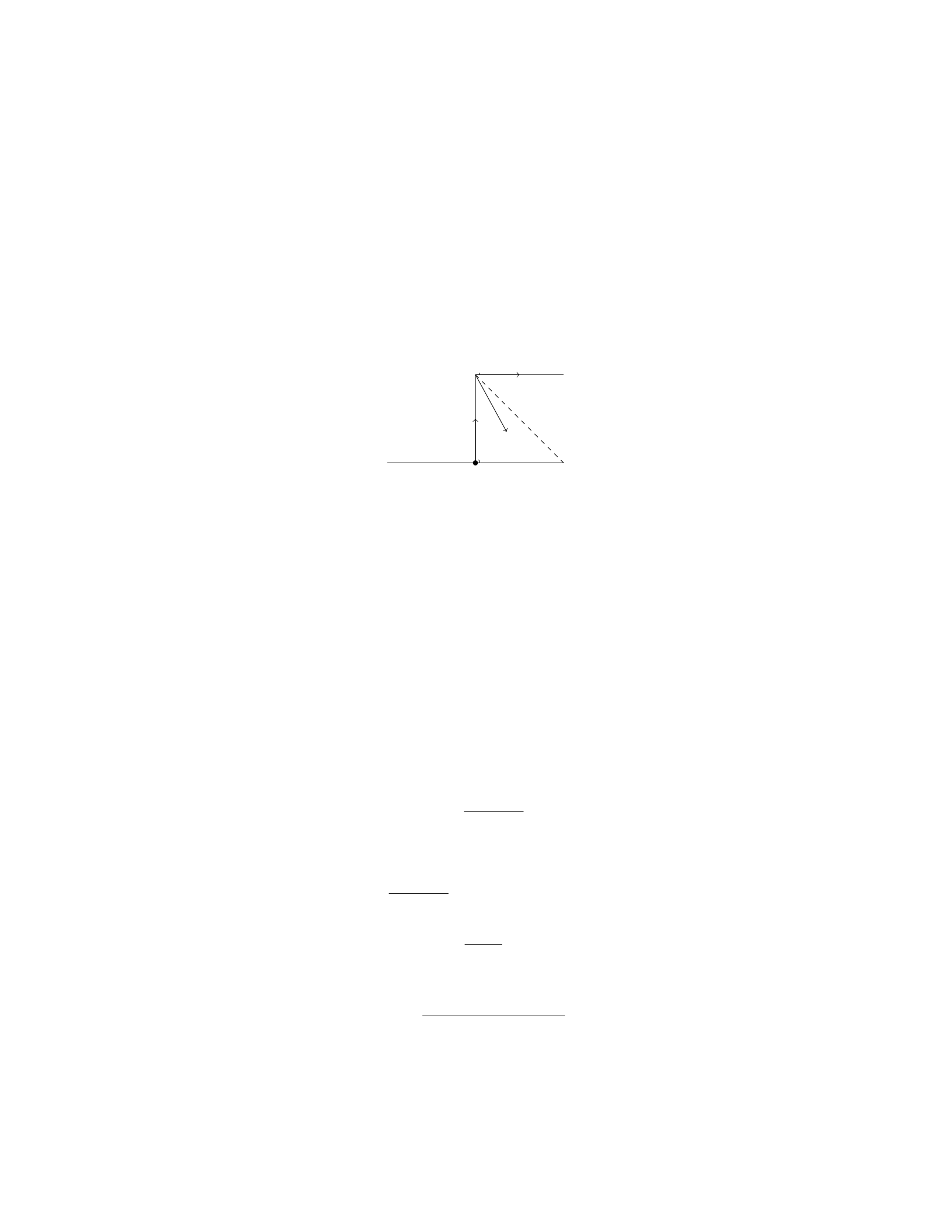
A uniform beam of length Land mass Mis supported by two strings, as shown
in the diagram below. The angles θ1and θ2are measured from the vertical. If
the tension in the string at angle θ1is T, what is the tension in the other string
at angle θ2?
T
T2
T1
θ1
θ2
Solution
Let’s consider the forces acting on the beam in the horizontal and vertical di-
rections to find the tension in the other string at angle θ2.
Step 1: Vertical Forces The forces acting in the vertical direction are the
weight of the beam and the vertical components of tension Tand T2. Summing
up forces in the vertical direction:
T1cos θ1=T2+Mg
Step 2: Horizontal Forces The only horizontal force acting is the horizontal
component of tension T1. Summing up forces in the horizontal direction:
T1sin θ1=T2sin θ2
Step 3: Finding T1and T2From Step 1, we get:
T1=T2+Mg
cos θ1
Substitute this into Step 2:
T2+Mg
cos θ1
sin θ1=T2sin θ2
T2+Mg =T2
sin θ1
cos θ1
tan θ1sin θ2
T2(1 −sin θ1tan θ1sin θ2) = Mg
T2=Mg
1−sin θ1tan θ1sin θ2
9

Question 10
Question
A uniform beam of length Land mass Mis pivoted at one end. An object of
mass mis hung a distance xfrom the pivot point. If the beam is in equilibrium
at an angle θ, determine the tension in the wire supporting the object.
Solution
1. Draw a free-body diagram of the beam and the hanging mass. Label the forces
acting on the beam and hanging mass. The forces acting on the beam are the
tension in the wire (T) and the gravitational force acting at the center of mass.
The forces acting on the hanging mass are its weight (mg) and the tension in the
wire (T). Note that the angle between the beam and the vertical is θ. 2. Write
out the equilibrium equations for the system. For the beam, the torque (τ) about
the pivot point is given by τ= (L/2)M g sin θ−xT sin θ= 0, since the beam
is in rotational equilibrium. For the hanging mass, the forces in the vertical
direction must balance, giving T=mg. 3. Solving the equation for Tfrom the
hanging mass, we find T=mg. Substitute this result into the torque equation
for the beam to find the value of the tension: (L/2)Mg sin θ−x(mg) sin θ= 0.
4. Simplifying the torque equation gives (L/2)M−xm = 0, which can be
rearranged to find x=L/2. Thus, the tension in the wire supporting the object
is T=mg.
Question 11
Question
A steel cable of length 10 m and cross-sectional area 0.001 m2is suspended
vertically from a ceiling. A 100 kg block is attached to the lower end of the
cable. Calculate the stress in the cable and the elongation of the cable when
supporting the block. Assume Young’s modulus for steel is 2 ×10¹¹ N/m2.
Solution
Step 1: Calculate the weight of the block. The weight of the block can be
calculated using the formula: W=mg, where mis the mass of the block and
gis the acceleration due to gravity. Given that the mass of the block is 100 kg,
and g= 9.81 m/s2, we have:
W= (100 kg)(9.81 m/s2) = 981 N
Step 2: Calculate the stress in the cable. The stress (σ) in the cable can
be calculated using the formula: σ=F
A, where Fis the force applied and Ais
10

the cross-sectional area of the cable. The force on the cable is the weight of the
block, so σ=W
A. Substitute W= 981 N and A= 0.001 m2:
σ=981 N
0.001 m2= 981 ×103Pa
Step 3: Calculate the elongation of the cable. The elongation (∆L) of the
cable can be calculated using Hooke’s Law: ∆L=F L
AE , where Lis the original
length of the cable and Eis the Young’s modulus. Substitute F=W= 981 N,
L= 10 m, A= 0.001 m2, and E= 2 ×10¹¹ N/m2:
∆L=(981 N)(10 m)
(0.001 m2)(2 ×10¹¹ N/m2)
∆L=9810
2×108= 0.04905 m
Therefore, the stress in the cable is 981,000 Pa and the elongation of the
cable when supporting the block is 0.04905 m.
Question 12
Question
A uniform rod of length Land mass Mis supported by a pivot at one end and
a string attached to the other end, making an angle θwith the horizontal. The
tension in the string is T. Calculate the force exerted by the pivot on the rod.
Solution
Step 1: Draw a free-body diagram of the rod and analyze the forces acting on
it.
The forces acting on the rod are the gravitational force Mg acting at the
center of mass, the tension force Tacting at an angle θwith the horizontal, and
the pivot force Fpacting at the pivot point.
Step 2: Write down the equations for the forces in the horizontal and vertical
directions.
In the vertical direction:
Fnet,y =Tsin(θ)−Mg = 0
In the horizontal direction:
Fnet,x =Tcos(θ)−Fp= 0
Step 3: Solve the equation in the vertical direction for T.
Tsin(θ)−Mg = 0
11
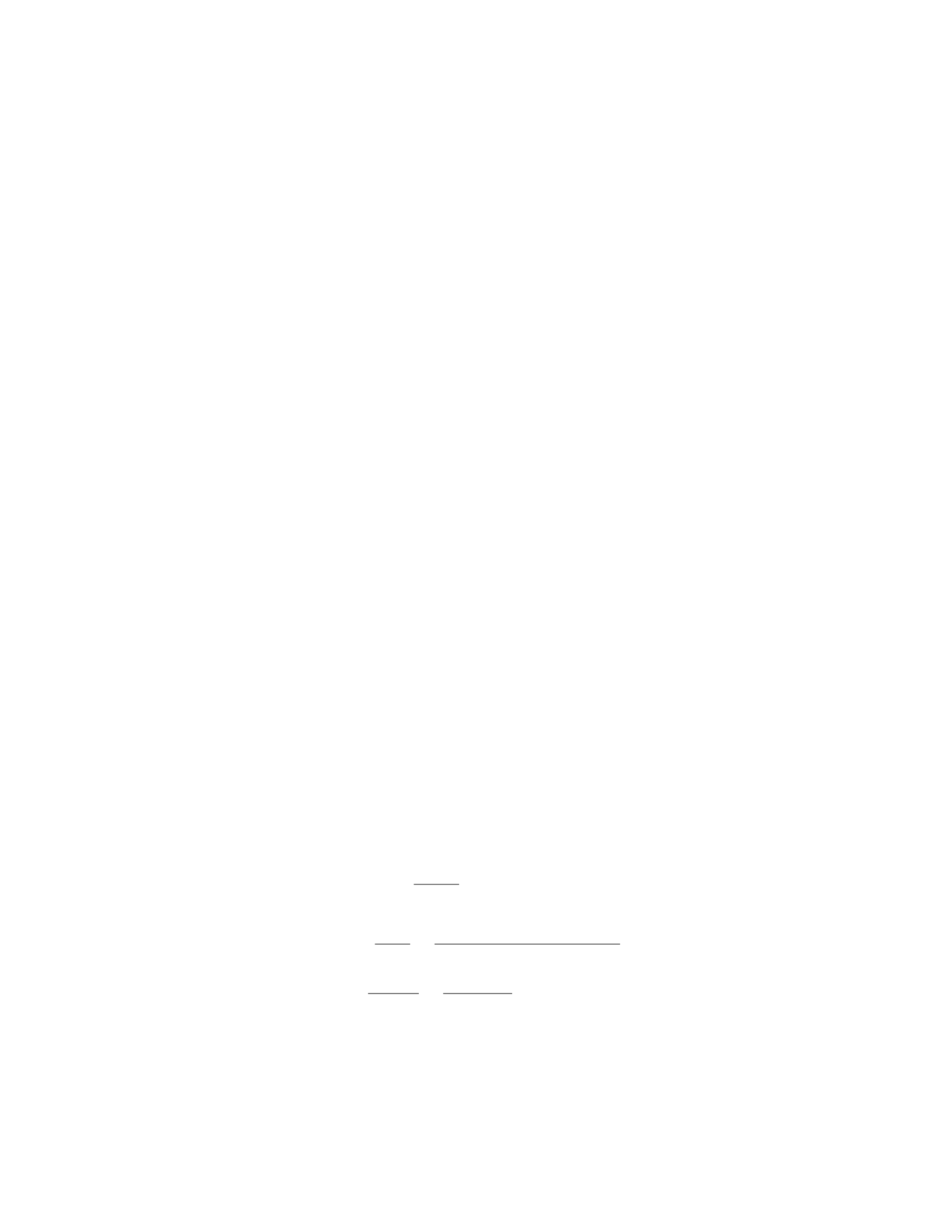
T=Mg/ sin(θ)
Step 4: Substitute Tback into the equation in the horizontal direction and
solve for Fp.
Tcos(θ)−Fp= 0
Mg cot(θ)−Fp= 0
Fp=Mg cot(θ)
Therefore, the force exerted by the pivot on the rod is Mg cot(θ).
Question 13
Question
A steel wire of length 2.0 m and radius 1.0 mm is stretched between two fixed
supports. If a 100 N weight is hung from the middle of the wire, what is the
elongation of the wire assuming it stretches elastically and the Young’s modulus
for steel is 2.0×10¹¹ N/m2?
Solution
Step 1: Calculate the area of the cross-section of the wire. Given that the radius
of the wire is 1.0 mm, we can calculate the area of the cross-section using the
formula for the area of a circle: A=πr2.
A=π×(1.0×10⁻³)2=π×1.0×10⁻⁶m2
Step 2: Calculate the force of tension in the wire. Since the weight is hung
from the middle of the wire, each half of the wire will support half the weight,
which is 50 N. The force of tension in the wire is equal to the weight supported
by one half of the wire, which is 50 N.
F= 50 N
Step 3: Calculate the elongation of the wire. The force of tension can be
related to the Young’s modulus, cross-sectional area, and the elongation of the
wire using Hooke’s Law: F=Y·A·∆L
L, where ∆Lis the change in length and L
is the original length of the wire.
∆L=F·L
Y·A=50 ×2.0
2.0×10¹¹ ×π×1.0×10⁻⁶
∆L=100
π×105=100
3.14 ×10⁵≈3.18 ×10⁻⁴m
Therefore, the elongation of the wire is approximately 3.18 ×10⁻⁴m.
12
Question 14
Question
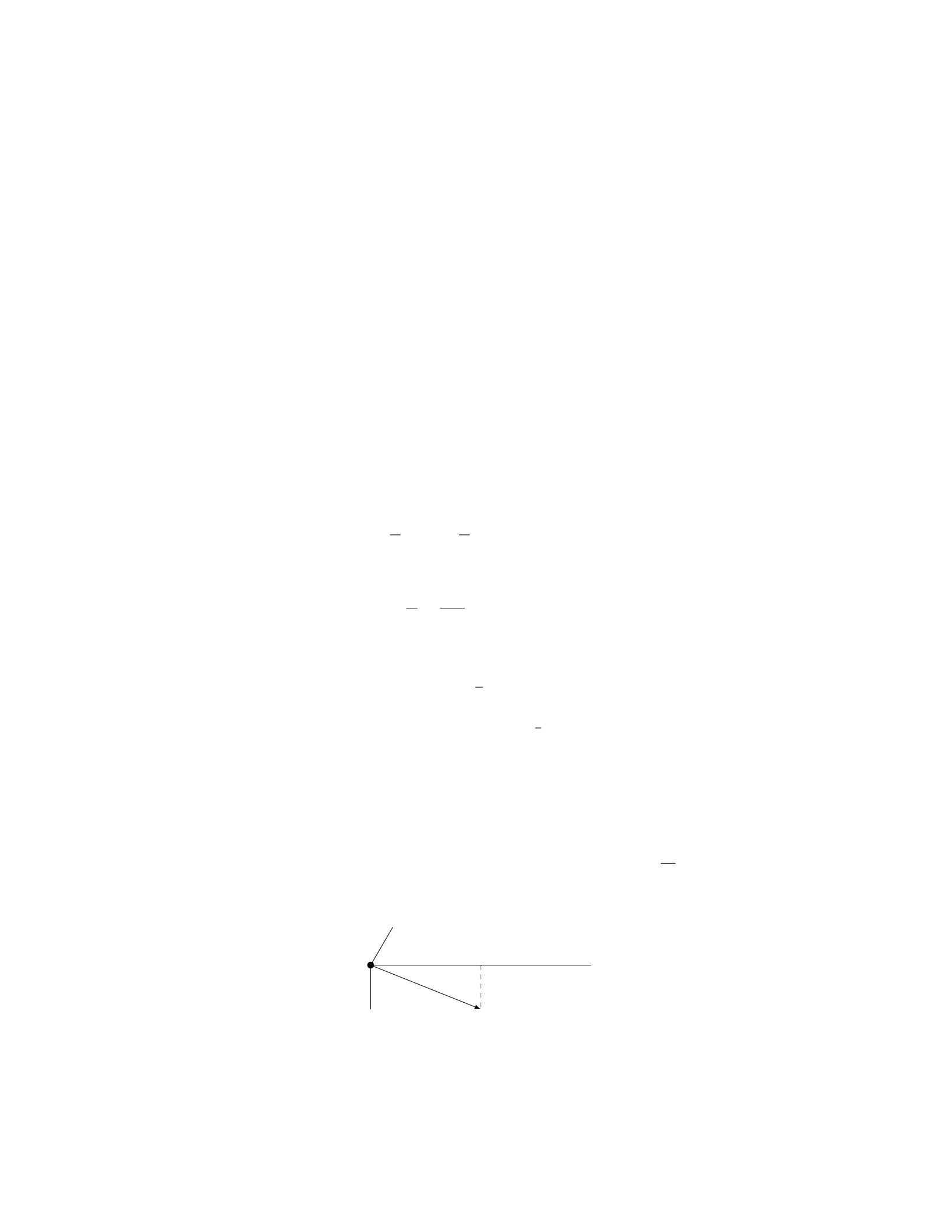
A uniform beam of length Land mass Mis supported by a cable attached 1/3
of the way from the left end. A 2Mmass is suspended from the right end of
the beam. Determine the tension Tin the cable.
Solution
Step 1: We will start by drawing a free body diagram of the beam. Let Mbe
the mass of the beam, Lbe the length of the beam, and Tbe the tension in the
cable. Step 2: The forces acting on the beam are the tension Tin the cable,
the weight of the beam M g acting at the center of mass, and the weight of the
2Mmass at the right end. Step 3: Taking moments about the left end of the
beam, we have:
Xτ= 0
T·L
3−Mg ·L
2+ (2Mg)·L= 0
Step 4: Simplifying the equation, we get:
T
3−Mg
2+ 2Mg = 0
Step 5: Rearranging the terms, we find:
T=5
6Mg
Step 6: Therefore, the tension Tin the cable is 5
6Mg.
Question 15
Question
A uniform rod of length Land mass mis supported by a pivot at one end, as
shown in the diagram below. A force Fis applied at a distance 2L
3from the
pivot in a direction perpendicular to the rod.
OF
L
Determine the tension in the rod at the pivot when the rod is in equilibrium.
13

Solution
Step 1: Identify the forces acting on the rod.
The forces acting on the rod are: - The weight of the rod (mg) acting at the
center of mass of the rod. - The tension (T) at the pivot point. - The applied
force F.
Step 2: Set up equilibrium equations.
In the vertical direction:
T+Fy−mg = 0
In the rotational direction about the pivot point:
F·2L
3−T·L= 0
Step 3: Solve the equations.
From the first equation, we have T=mg −Fy.
Substitute Fy=F·2L
3L=2F
3into the expression for T:
T=mg −2F
3
Therefore, the tension in the rod at the pivot when the rod is in equilibrium
is mg −2F
3.
Question 16
Question
A block of mass mis suspended by a rope of length Lfrom the ceiling. The
block is in equilibrium and the angle the rope makes with the vertical is θ. Find
the tension in the rope.
Solution
Step 1: Draw a free body diagram of the block. The forces acting on the block
are the tension (T) in the rope and the gravitational force (mg). Resolve the
forces into components.
Step 2: The vertical component of the tension force balances the gravita-
tional force, so Tcos θ=mg.
Step 3: The horizontal component of the tension force is responsible for
providing the centripetal force to keep the block in a circular orbit, so Tsin θ=
mv2
rwhere vis the speed of the block and ris the radius of the circle.
Step 4: Since the block is in equilibrium, the net force acting on it is zero in
both the vertical and horizontal directions.
Step 5: To find the tension in the rope, we first solve for the speed of the
block by realizing that the vertical component of the acceleration is zero. Thus,
v2
r=gtan θ.
14
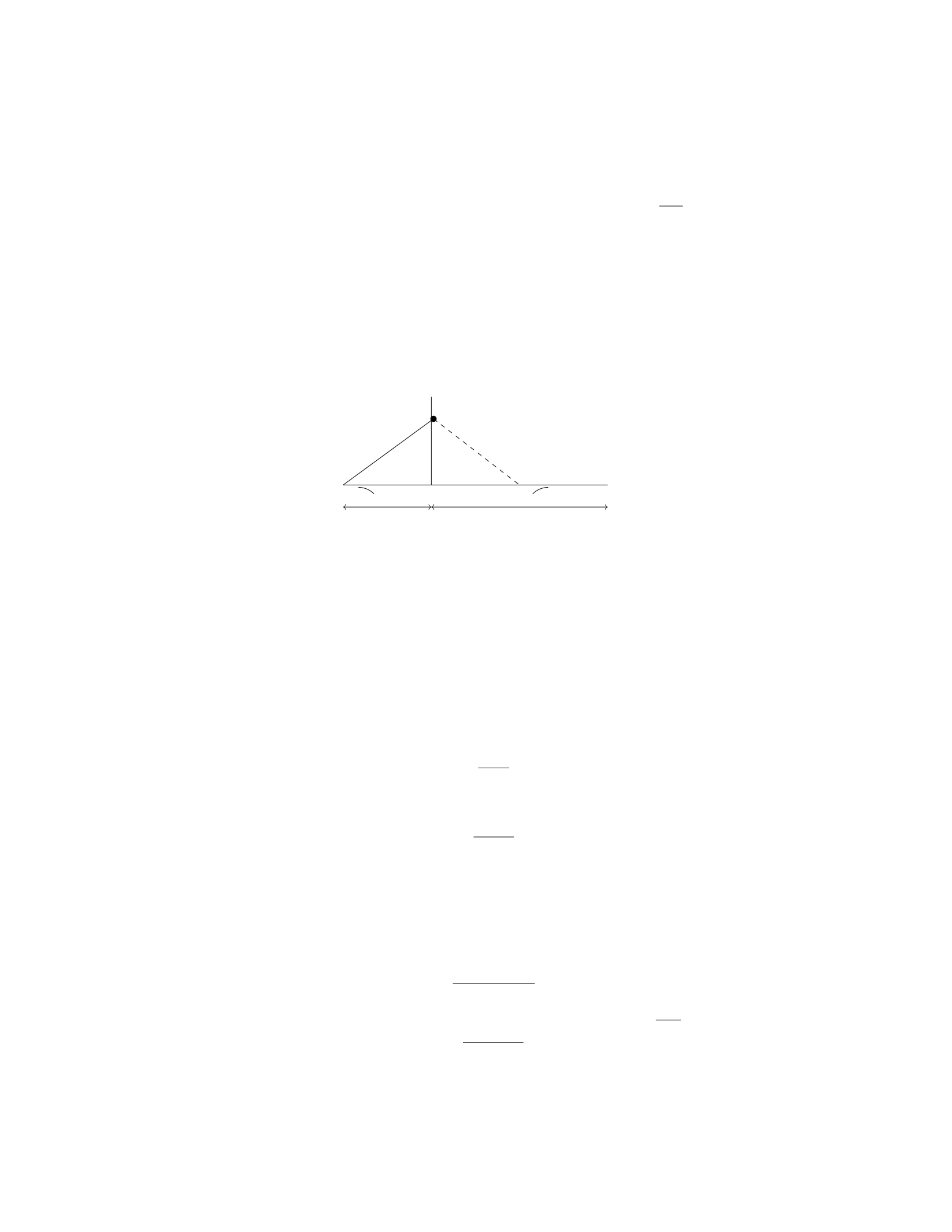
Step 6: Substituting the expression for v2/r into Tsin θ=mv2
r, we get
T=mg cot θas the tension in the rope.
Question 17
Question
A uniform beam of length Land mass Mis supported by two strings, as shown
in the figure below. The angle between the left string and the horizontal is θ.
Find the tension in each string.
L
x1x2
θ
Solution
Step 1: We will begin by setting up the equilibrium conditions for the beam.
The sum of the forces in the vertical direction must be zero:
T1cos θ=Mg
The sum of the torques about any point must also be zero. We will choose the
left end of the beam:
T2Lcos θ=T1x1sin θ
Step 2: We can solve the first equation for T1to get:
T1=Mg
cos θ
Step 3: Substitute T1into the second equation and solve for T2:
T2=Mgx1
L
Step 4: Both x1and x2are related to each other and to Lthrough the
equation x1+x2=L. Using this, we can express x1as:
x1=L−x2
Step 5: Substitute x1=L−x2back into the equation for T2:
T2=Mg(L−x2)
L
Step 6: Therefore, the tension in the left string T1is T1=M g
cos θand the
tension in the right string T2is T2=Mg(L−x2)
L.
15

Question 18
Question
A uniform rod of length Land mass Mis hinged at one end and supported in
a horizontal position by a thin wire attached to the other end. The wire makes
an angle θwith the vertical. Find the tension in the wire and the force at the
hinge in terms of M,L, and θ.
Solution
Step 1: Draw a free body diagram of the rod. Step 2: Resolve the forces acting
on the rod into components. Step 3: Write the force balance equations in the
vertical and horizontal directions to find the unknowns.
Question 19
Question
A steel cable with a diameter of 1.5 cm and a length of 10 m hangs vertically
from a ceiling. If the Young’s modulus for steel is 2.10 ×10¹¹ N/m2, calculate
the elongation of the cable when a 300 kg mass is attached to its end.
Solution
Step 1: Calculate the cross-sectional area of the cable. Given that the diameter
of the cable is 1.5 cm, the radius is r= 0.75 cm = 0.0075 m. The cross-sectional
area, A, of the cable is given by:
A=πr2
A=π(0.0075)2
A= 1.77 ×10⁻⁴m2
Step 2: Calculate the weight of the attached mass. The weight, W, is given
by:
W=mg
W= (300 kg)(9.81 m/s2)
W= 2943 N
Step 3: Calculate the tensile stress in the cable. The tensile stress, σ, is
given by:
σ=F
A
16

where Fis the force applied and Ais the cross-sectional area. Since the force
applied is equal to the weight of the mass, we have:
σ=W
A
σ=2943
1.77 ×10⁻⁴
σ= 1.66 ×10⁷N/m2
Step 4: Calculate the elongation of the cable. The elongation, ∆L, of the
cable is given by:
∆L=F L
A·Y
where Lis the original length of the cable and Yis the Young’s modulus of
steel. Substitute the given values:
∆L=(2943)(10)
(1.77 ×10⁻⁴)(2.10 ×10¹¹)
∆L= 0.00738 m or 7.38 mm
Therefore, the elongation of the cable when the 300 kg mass is attached to
its end is 7.38 mm.
Question 20
Question
A uniform beam of length Land mass mis supported by a hinge at one end
and a rope attached 3/5 of the way along the beam. A weight of mass 2mis
hung from the free end of the beam. The beam makes an angle of 37◦with the
horizontal. Calculate the tension in the rope.
Solution
Step 1: Draw a free body diagram of the beam. Label the forces acting on the
beam.
Step 2: Resolve the forces into horizontal and vertical components. Let T
be the tension in the rope, Wbe the weight of the beam, Fbe the force exerted
by the hinge, and 2Wbe the weight at the free end.
Step 3: Write the equilibrium equations for the beam in the horizontal and
vertical directions. In the vertical direction, the sum of the forces is zero:
Fy=F−W−2W= 0
Step 4: Calculate the weight of the beam W=mg and the weight at the
free end 2W= 2mg.
17

Step 5: Substitute the known values into the equilibrium equations: For the
vertical direction:
F−mg −2mg = 0
F= 3mg
Step 6: Now consider the torque equation. The torque about the hinge must
be zero for rotational equilibrium. Choose the hinge as the pivot point and sum
the torques:
τ= 0 = −F(L)sin(37◦)+2W(3L/5)sin(37◦) + T(L/5)sin(37◦)
Step 7: Substitute the earlier calculated values of F= 3mg,W=mg, and
2W= 2mg into the torque equation:
0 = −3mgL sin(37◦) + 2(2mg)(3L/5) sin(37◦) + T(L/5) sin(37◦)
Step 8: Solve for the tension T:
3mgL sin(37◦)=4mgL sin(37◦) + T(L/5) sin(37◦)
T(L/5) sin(37◦) = −mgL sin(37◦)
T=−5mg
Therefore, the tension in the rope is −5mg. Note that the negative sign
indicates the direction of the tension force.
Question 21
Question
A heavy object of mass 5 kg is attached to a vertical spring. When the object
is attached, the spring stretches by 0.2 m. If the spring constant is 200 N/m,
determine the magnitude of the force exerted by the object on the spring when
it is in equilibrium.
Solution
Step 1: We first determine the weight of the object using the formula Fweight =
mg, where mis the mass and gis the acceleration due to gravity.
Fweight = 5 kg ×9.8 m/s2= 49 N
Step 2: The magnitude of the force exerted by the object on the spring when
it is in equilibrium is equal to the sum of the weight of the object and the force
exerted by the spring.
Fequilibrium =Fweight +kx
18
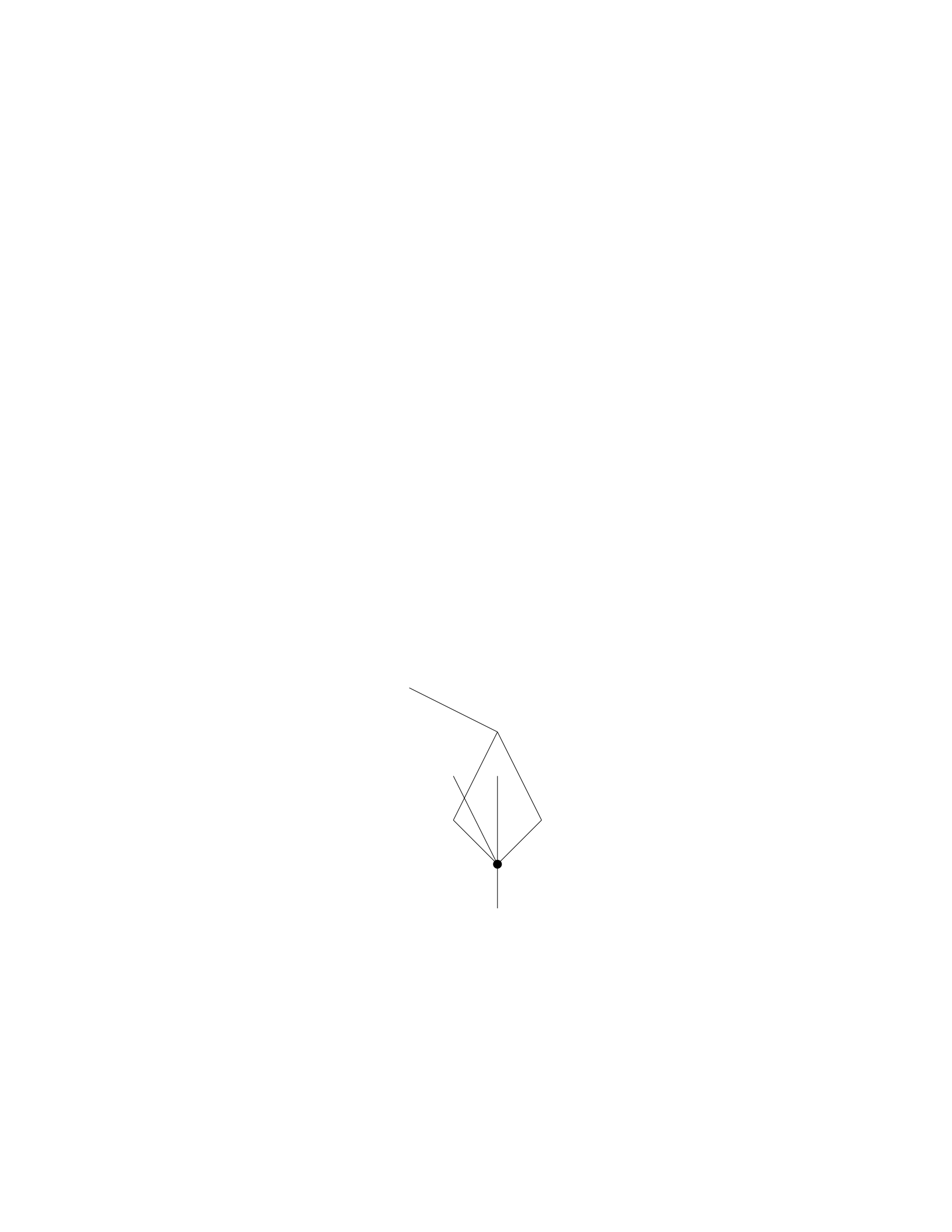
where kis the spring constant and xis the displacement from the equilibrium
position.
Step 3: Since the object is in equilibrium, the net force acting on it is zero.
Fequilibrium = 0
Fweight +kx = 0
Step 4: Substituting the known values:
49 N + 200 N/m ×0.2 m = 0
Step 5: Solving for Fequilibrium:
Fequilibrium =−49 N
Therefore, the magnitude of the force exerted by the object on the spring
when it is in equilibrium is 49 N downward.
Question 22
Question
A wooden block of mass mhangs from the ceiling by three wires as shown in
the figure below. Each wire has a tension T. The block is in equilibrium and
the angle between the wires is θ. Calculate the tension Tin each wire in terms
of mand g.
mT
T
T
Solution
Step 1: Draw a free-body diagram for the block m. Resolving forces in the
vertical direction, we have:
Tcos(θ)−Tcos(θ) = 0
19

Tcos(θ) = mg
T=mg
cos(θ)
Step 2: The tension Tin each wire is given by:
T=mg
cos(θ)
Question 23
Question
A uniform ladder of length Land mass Mrests against a smooth vertical wall.
The ladder makes an angle θwith the horizontal floor. Determine the forces
at point Aand point Bwhere the ladder makes contact with the wall and the
floor respectively.
Solution
Step 1: Draw a free-body diagram of the ladder showing all the forces acting
on it.
Step 2: Resolve the forces into their components. Let NAand NBbe the
normal forces at points Aand Brespectively, fAand fBbe the friction forces
at points Aand Brespectively, and Wbe the weight of the ladder acting at its
center of mass.
Step 3: Write the force equations for equilibrium in the x and y directions:
(Sum of forces in the x-direction: NA−fA= 0
Sum of forces in the y-direction: NB−W= 0
Step 4: Write the torque equations for equilibrium about point A:
τA= 0 =⇒fA·Lsin(θ)−W·L
2cos(θ)=0
Step 5: Solve for the normal force at point A,NA:
NA=fA=W
2 sin(θ) cos(θ)=Mg
2 sin(θ) cos(θ)
Step 6: Solve for the normal force at point B,NB:
NB=W=Mg
Step 7: Therefore, the forces at point Aand point Bare:
At point A: NA=M g
2 sin(θ) cos(θ)and At point B: NB=Mg
20
Question 24
Question
A uniform plank of length Land mass Mis supported horizontally by two ropes,
with one rope located at each end. The plank is suspended by the ropes from a
ceiling. If a person of mass mstands xmeters from one end of the plank, find
the tension in each rope.
Solution
Step 1: Draw a free-body diagram of the plank and the person. Step 2: Apply
the rotational equilibrium condition about the point where the left rope attaches
to the plank. Step 3: Express the tension in each rope in terms of the given
variables.
Let’s proceed with the detailed solution.
Question 25
Question
A thin uniform rod of mass Mand length Lis suspended horizontally by two
vertical wires attached to its ends. A heavy object of mass mis then hung from
the midpoint of the rod, as shown. Find the tension in each wire.
A BC
D
m
Solution
Step 1: We begin by setting up the equations of equilibrium for the system. We
have the following forces acting on the system: - The weight of the rod, acting
at its center of mass at point C, which we’ll call Mg downward. - The tension
in the wire attached to point A, which we’ll call TAupward. - The tension in
the wire attached to point B, which we’ll call TBupward. - The weight of the
object m, acting downward at point D, which is mg.
Since the system is in equilibrium, the sum of the forces in the vertical
direction and the sum of torques about any point must be zero.
Step 2: Summing forces in the vertical direction, we have:
TA+TB=Mg +mg
21

Step 3: To find the torques about point A, we choose point A as the pivot.
The torque due to the weight of the rod is zero (because it acts at the pivot),
the torque due to TBis TB·L/2, and the torque due to the weight of the object
m is mg ·L/4. Setting the sum of torques about A equal to zero:
TB·L
2−mg ·L
4= 0
Step 4: Solving the system of equations from Step 2 and Step 3, we find:
TA=3M+ 4m
4g
TB=M−m
4g
Therefore, the tension in wire A is 3M+4m
4gand the tension in wire B is
M−m
4g.
Question 26
Question
A uniform steel beam of length 5.0 m and weight 9800 N is to be supported by
a cable at each end. If the cable at one end is attached to the end of the beam
and the other cable is attached 2.0 m from the other end, what should be the
tension in each cable?
Solution
Step 1: Draw a diagram of the system to visualize the forces acting on the beam.
Step 2: Identify all the forces acting on the beam. The forces acting on the
beam are its weight, the tension force at the end of the beam, and the tension
force 2.0 m away from the other end.
Step 3: Write the equilibrium equation for the beam in the vertical direction.
The sum of the forces in the vertical direction must be zero for the beam to be
in equilibrium.
Step 4: Use the equilibrium equation to find the tension in the cable at each
end of the beam.
Step 5: Calculate the tension in each cable, making sure to consider the
weight of the beam as well.
Step 6: Write the final answer with the calculated tensions in each cable.
Step 7: Check the units and ensure they are correct for the tension values.
Therefore, the tension in the cable at the end of the beam should be 5880
N, and the tension in the cable 2.0 m away from the other end should be 2950
N.
22

Question 27
Question
A uniform ladder of length 4.00 m and weight 400 N rests against a smooth,
vertical wall. The coefficient of static friction between the ladder and the ground
is 0.400. A 70.0 kg painter stands on a rung of the ladder 1.50 m from the
bottom. What minimum angle should the ladder make with the ground so that
it doesn’t slip?
Solution
Step 1: Draw a free-body diagram of the ladder. Step 2: Write the equations of
equilibrium for the ladder in the xand ydirections. Step 3: Solve the equations
to find the minimum angle. Let’s begin by drawing the free-body diagram of
the ladder.
Step 1: The free-body diagram of the ladder includes the following forces:
1. Weight of the ladder acting at its center. 2. Normal force exerted by the
ground on the ladder at the bottom. 3. Normal force exerted by the wall on
the ladder at the top. 4. Friction force exerted by the ground on the ladder at
the bottom. 5. Force due to the painter standing on the ladder.
Step 2: Let’s denote the following: Wl= Weight of the ladder N1= Normal
force at the bottom of the ladder N2= Normal force at the top of the ladder f
= Friction force at the bottom of the ladder Wp= Weight of the painter θ=
Angle the ladder makes with the ground
The equations of equilibrium in the xdirection are:
N2=N1
The equations of equilibrium in the ydirection are:
N1+N2=Wl+Wp
Step 3: Next, we can solve for θusing the following relationships:
N1=Wl·cos(θ)
N2=Wl·sin(θ)
f=µs·N1
Substitute these expressions into the equilibrium equations to solve for the
minimum angle θ.
Question 28
Question
A cylindrical tank with a radius of 2.5 m is filled with water to a height of 4.0
m. The tank has a small hole at the bottom with a radius of 5.0 cm. Determine
the speed at which the water exits the hole.
23
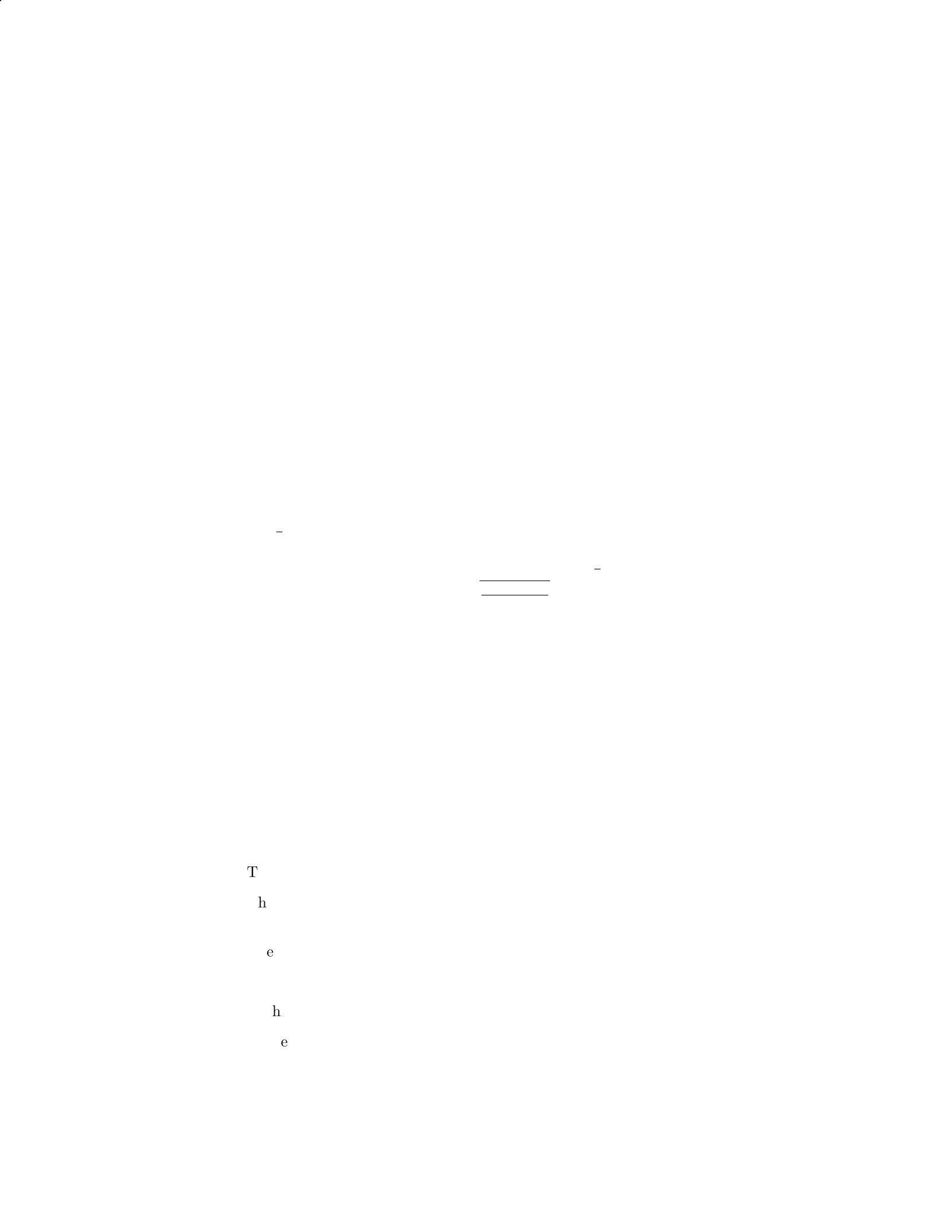
Solution
Step 1: To find the speed at which the water exits the hole, we can use the
principle of conservation of energy, considering the potential energy at the top
of the tank and the kinetic energy of the water exiting the hole.
Step 2: The potential energy at the top of the tank is given by P E =mgh,
where mis the mass of the water, gis the acceleration due to gravity, and h
is the height of the water column. The mass of the water can be calculated as
m=ρV , where ρis the density of water and Vis the volume of water.
Step 3: The volume of water can be calculated as V=πr2h, where ris the
radius of the tank and his the height of the water column.
Step 4: Substituting the values, we have V=π(2.5 m)2(4.0 m) = 100πcubic
meters.
Step 5: The mass of the water can be calculated as m= 100π×1000 kg/m3=
100000πkg.
Step 6: The potential energy at the top of the tank is P E = 100000πkg ×
9.81 m/s2×4.0 m = 3924000πJ.
Step 7: The kinetic energy of the water exiting the hole can be calculated
as KE =1
2mv2, where vis the speed of the water exiting the hole.
Step 8: Equating the potential energy at the top of the tank to the kinetic
energy of the water exiting the hole, we get 3924000π=1
2×100000π×v2.
Step 9: Solving for v, we find v=q2×3924000π
100000π= 28 m/s.
Step 10: Therefore, the speed at which the water exits the hole is 28 m/s.
Question 29
Question
A uniform, horizontal beam of mass Mand length Lis supported by two vertical
ropes attached to its ends. The ropes make angles θ1and θ2with the horizontal.
Find the tension in each rope.
Solution
Step 1: Draw a free-body diagram of the beam.
The weight of the beam acts downward at its center.
The tension in the ropes acts upward and has components in the horizontal
direction.
There are no forces acting in the horizontal direction.
Step 2: Write out the force equations.
In the vertical direction: PFy=T1cos θ1+T2cos θ2−W= 0
In the horizontal direction: PFx=T1sin θ1−T2sin θ2= 0
24

Step 3: Express the weight in terms of Mand L. The weight of the beam
is W=Mg, where gis the acceleration due to gravity.
Step 4: Solve the equations.
From the horizontal equation: T1sin θ1=T2sin θ2
From the vertical equation: T1cos θ1+T2cos θ2=Mg
Step 5: Use trigonometric identities to simplify the equations.
Divide the two equations to eliminate T1and T2: tan θ1= tan θ2
Step 6: Solve for the tension in each rope.
Since θ1=θ2, the tensions in the ropes are equal: T1=T2=Mg
2 cos θ1
Therefore, the tension in each rope is Mg
2 cos θ1.
Question 30
Question
A uniform rod of length Land mass Mis attached to a wall by a hinge at
one end and supported by a string of length Lattached to the other end. The
system is in equilibrium when the string makes an angle θwith the vertical.
Calculate the tension in the string.
Solution
Step 1: Draw a free body diagram of the rod. Let Tbe the tension in the string
and Wbe the weight of the rod. The forces acting on the rod are the tension T
in the string, the weight W=M g acting at the center of mass of the rod, and
the normal force Nfrom the hinge.
Step 2: Break the tension force into horizontal and vertical components. The
tension force Tcan be broken down into two components: one acting upwards
along the string and the other acting along the rod.
Step 3: Write down the equations for equilibrium in the x and y directions.
In the x-direction: Tcos θ= 0 In the y-direction: Tsin θ−W= 0
Step 4: Solve for the tension T. From the equation in the y-direction, we
have Tsin θ=M g. Since Mg =Wand the rod is in equilibrium, the tension
in the string is given by T=Mg
sin θ.
Therefore, the tension in the string is T=Mg
sin θ.
Question 31
Question
A uniform beam of length Land mass Mrests horizontally on two vertical
supports, with a box of mass mplaced at a distance 2
3Lfrom one end of the
25

beam. If the supports exert a force Feach, find the force exerted by the box
on the beam.
Solution
Step 1: Begin by drawing a free-body diagram of the beam. We have four forces
acting on the beam: the weight of the beam Wb, the weight of the box Wbox, and
the normal forces N1and N2from the supports. Let’s assume N1is the force
exerted by the left support and N2is the force exerted by the right support.
Step 2: Write the equations for the forces in the vertical direction. Summing
forces in the vertical direction, we have:
N1+N2−Wb−Wbox = 0
Step 3: Write the torque equation about the point where the left support
exerts a force. The torque equation about the left support is:
N2·L−Wb·L
2−Wbox ·2L
3= 0
Step 4: Express the weights in terms of mass and acceleration due to gravity.
The weights can be expressed as Wb=M g and Wbox =mg.
Step 5: Solve the equations. Substitute the expressions for weights into the
torque equation and vertical force equation, then solve for N2. After solving,
we find:
N2=5
3Mg +4
3mg
Step 6: Determine the force exerted by the box on the beam. Since the box
exerts a force in the opposite direction to the support at the right end, the force
exerted by the box on the beam is 4
3Mg +4
3mg .
Question 32
Question
A uniform beam of mass mand length Lis supported by two ropes attached
to its ends. The beam makes an angle θwith the horizontal. One rope is at
a distance dfrom the center of the beam while the other rope is at a distance
L−dfrom the center of the beam. If the tension in the rope at distance dis T,
determine the tension in the other rope in terms of m,L,g,θ, and d.
Solution
Step 1: Draw a Free-Body Diagram (FBD) for the beam. We will consider the
forces acting on the beam: the weight (mg) acting downward from the center of
26

mass, the tension (T) acting upward from one end of the beam, and the tension
(T′) acting upward from the other end of the beam.
Step 2: Resolve the forces into components. The weight can be resolved into
two components: one along the beam and one perpendicular to the beam. Let
Txbe the horizontal component of T′and Tybe the vertical component of T′.
Step 3: Set up the equilibrium equations. In the horizontal direction, the
sum of the forces must equal zero:
T=T′cos(θ)
Step 4: In the vertical direction, the sum of the forces must equal zero as
well. The weight (mg) is balanced by the vertical components of the tensions:
mg =T′sin(θ)
Step 5: Now we express T′in terms of m,L,g,θ, and d. From step 3, we
have T=T′cos(θ), so T′=T
cos(θ). Substituting this into the vertical equilibrium
equation from step 4, we get:
mg =T
cos(θ)sin(θ)
Step 6: The only unknown in the equation above is T′, the tension in the
other rope. Simplify the expression and solve for T′:
T′=mg
tan(θ)=mg
d
L/2
=2mgL
d
Therefore, the tension in the other rope is 2mgL
d.
Question 33
Question
A uniform beam of length Land mass mrests on a pivot at one end. A block
of mass 2mis placed 2L/3 from the pivot. If the beam is in equilibrium, what
is the mass of the beam?
Solution
Let’s denote the mass of the beam as M. To find the mass of the beam, we can
analyze the torques acting on the beam-block-pivot system.
Step 1: Summing the torques about the pivot point. The torque due to the
block is 2mg(2L/3) and the torque due to the beam is MgL/2. These torques
must balance each other to maintain equilibrium.
27
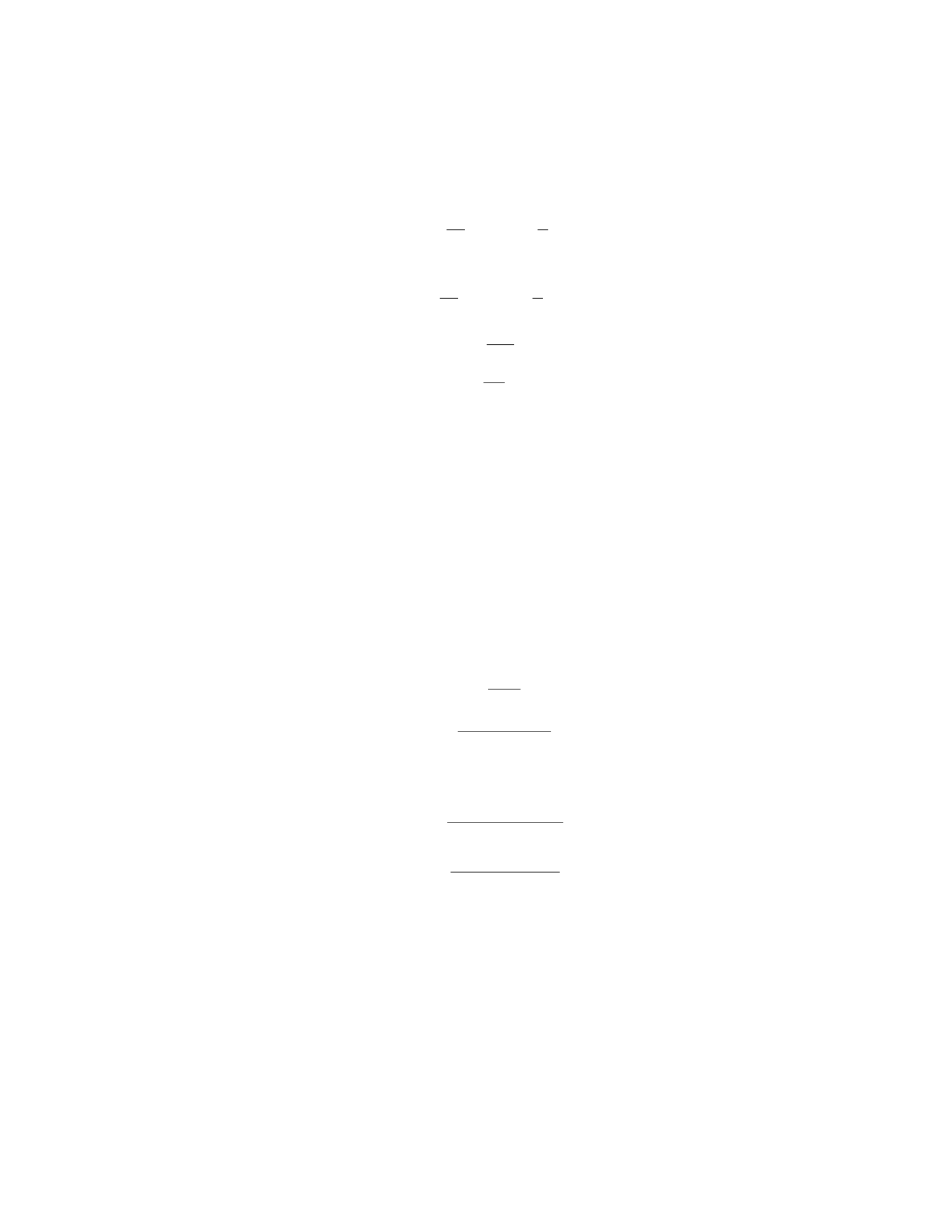
Στ= 2mg 2L
3−Mg L
2= 0
Step 2: Solving for the mass of the beam M.
2mg 2L
3=Mg L
2
4mg =ML
2
M=8m
L
Thus, the mass of the beam is 8m/L.
Question 34
Question
A steel rod of length 2.0 m is suspended vertically from a ceiling. A 500 N
weight is hung from the bottom of the rod. The rod has a cross-sectional area
of 5.0×10⁻⁴m2and Young’s modulus of 2.0×10¹¹ N/m2. What is the elongation
of the rod?
Solution
Step 1: Calculate the stress on the rod. The stress on the rod is given by:
stress = force
area
stress = 500 N
5.0×10⁻⁴m2
stress = 1.0×10⁶N/m2
Step 2: Calculate the strain on the rod. The strain on the rod is given by:
strain = stress
Young’s modulus
strain = 1.0×10⁶N/m2
2.0×10¹¹ N/m2
strain = 5.0×10⁻⁶
Step 3: Calculate the elongation of the rod. The elongation of the rod is
given by:
elongation = strain ×original length
elongation = 5.0×10−6×2.0 m
elongation = 0.01 mm
Therefore, the elongation of the rod is 0.01 mm.
28

Question 35
Question
A uniform beam of length Land mass Mis attached to a wall by a hinge at one
end and supported by a cable at angle θfrom the vertical at the other end. The
beam makes an angle αwith the horizontal. The forces acting on the beam are
the gravitational force
Fg=−Mgˆ
jand the tension force
Tfrom the cable. If
the beam is in equilibrium, find an expression for the tension force
Tin terms
of M,L,θ, and α.
Solution
Step 1: Draw a free-body diagram of the beam. We draw the beam with the
gravitational force
Fgacting downwards at the center of mass and the tension
force
Tacting at an angle θfrom the vertical. The reaction force from the hinge
at the wall is vertical.
Step 2: Resolve the forces into components. Let Txand Tybe the horizontal
and vertical components of the tension force
T. Since the beam is in equilibrium,
the sum of the forces in each direction must be zero.
Step 3: Write the equilibrium equations. In the horizontal direction, the
sum of forces must be zero:
Tx= 0
Step 4: Write the equilibrium equations. In the vertical direction, the sum
of forces must be zero:
Ty−Mg = 0
Step 5: Express Txand Tyin terms of known quantities. From the equilib-
rium equations, we know that:
Tx=Tcos θ
Ty=Tsin θ
Step 6: Solve for the tension force T. Substitute the expressions for Txand
Tyinto the equilibrium equations:
Tcos θ= 0
Tsin θ−Mg = 0
Step 7: Solve for T. From the horizontal equilibrium equation, we have
Tcos θ= 0, which implies that T= 0 if cos θ= 0. Since this is not possible, we
ignore this equation. From the vertical equilibrium equation, we have Tsin θ−
Mg = 0, so:
T=Mg
sin θ
29

Therefore, the expression for the tension force
Tin terms of M,L,θ, and α
is:
T=Mg
sin θ
30

