



PHYS 202 - GENERAL PHYSICS II -
Conservation of mechanical energy
Question Bank - Set 4
Liberty University
Question 1
Question
A 0.5 kg block is attached to a vertical spring with constant k= 200 N/m,
initially compressed by 10 cm from its equilibrium position. The block is released
from rest and the spring launches it vertically. Determine the maximum height
the block reaches.
Solution
Step 1: Find the initial potential energy stored in the spring when compressed
by 10 cm. The initial potential energy stored in the spring is given by the
formula:
Ui=1
2kx2
where kis the spring constant and xis the compression distance. Substitute
k= 200 N/m and x= 0.1 m:
Ui=1
2×200 ×(0.1)2
Ui= 1 J
Therefore, the initial potential energy stored in the spring is 1 J.
Step 2: Find the maximum height the block reaches. At the maximum
height, all of the initial potential energy stored in the spring will have been
converted to gravitational potential energy:
Ui=mghmax

where mis the mass of the block, gis the acceleration due to gravity, and hmax
is the maximum height. Rearranging the equation to solve for hmax:
hmax =Ui
mg
Substitute Ui= 1 J, m= 0.5 kg, and g= 9.81 m/s2:
hmax =1
0.5×9.81
hmax = 0.204 m
Therefore, the maximum height the block reaches is 0.204 m.
Question 2
Question
A 2 kg block is released from rest at a height of 5 m above the ground. The
block slides down a frictionless incline which makes an angle of 30 degrees with
the horizontal. What is the speed of the block just before it reaches the ground?
Solution
Step 1: Determine the initial gravitational potential energy of the block. The
initial gravitational potential energy of the block is given by:
P Ei=mgh
where mis the mass of the block (2 kg), gis the acceleration due to gravity (9.8
m/s2), and his the initial height (5 m).
P Ei= 2 ×9.8×5 = 98 J
Step 2: Determine the final kinetic energy of the block. When the block
reaches the ground, all of the initial potential energy will be converted into
kinetic energy. Therefore, the final kinetic energy of the block can be expressed
as:
KEf=1
2mv2
where vis the final velocity of the block just before it reaches the ground.
Step 3: Apply the conservation of mechanical energy. According to the
conservation of mechanical energy, the total mechanical energy of the block
(sum of kinetic and potential energy) remains constant throughout the motion.
Therefore, we can equate the initial potential energy to the final kinetic energy:
P Ei=KEf
2

98 = 1
2×2×v2
Step 4: Solve for the final velocity of the block.
98 = v2
v=√98 = 9.9 m/s
Therefore, the speed of the block just before it reaches the ground is 9.9
m/s.
Question 3
Question
A mass mis attached to a spring with spring constant k, initially at rest. The
mass is then released from a height habove the equilibrium position. Calculate
the speed of the mass when it passes through the equilibrium position.
Solution
Step 1: The total mechanical energy of the mass-spring system is conserved. At
the initial point (height habove equilibrium), the energy is all potential energy,
and at the equilibrium point, the energy is all kinetic energy.
Step 2: The initial potential energy is all converted to kinetic energy at the
equilibrium position. The potential energy at height his given by P Einitial =
mgh.
Step 3: At the equilibrium position, all the potential energy is converted to
kinetic energy, so the kinetic energy at this point is KE =1
2mv2.
Step 4: Using the conservation of mechanical energy, we can equate the
initial potential energy to the final kinetic energy:
P Einitial =KE
mgh =1
2mv2
Step 5: Canceling out the mass term from both sides of the equation, we
find:
gh =1
2v2
Step 6: Solving for the velocity v,
v=p2gh
Therefore, the speed of the mass when it passes through the equilibrium
position is √2gh.
3

Question 4
Question
A particle of mass mis released from rest at a height habove the ground on a
smooth frictionless incline of angle θ. Determine the speed of the particle just
as it leaves the incline and enters the horizontal surface.
Solution
Let’s consider the conservation of mechanical energy to solve this problem.
Step 1: Calculate the initial potential energy of the particle. The initial
potential energy of the particle at height his given by
Ui=mgh
Step 2: Calculate the initial kinetic energy of the particle. The initial
kinetic energy of the particle is zero since it is released from rest.
Ki= 0
Step 3: Determine the final potential energy of the particle when it just
leaves the incline and enters the horizontal surface. The final potential energy
of the particle can be broken down into two parts: 1. Potential energy due to
the change in height from the incline to the ground:
Uf1=mgh sin θ
2. Potential energy due to the remaining height on the horizontal surface:
Uf2=mgh
Thus, the total final potential energy is
Uf=mgh sin θ+mgh
Step 4: Apply conservation of mechanical energy. According to the conser-
vation of mechanical energy, the total mechanical energy of the system remains
constant.
Initial Mechanical Energy = Final Mechanical Energy
Ui+Ki=Uf+Kf
Since the particle is released from rest, Ki= 0, the equation simplifies to
Ui=Uf+Kf
Step 5: Solve for the final kinetic energy (Kf). Substitute the expressions
for Uiand Ufinto the conservation of energy equation and solve for Kf.
mgh =mgh sin θ+mgh +Kf
4
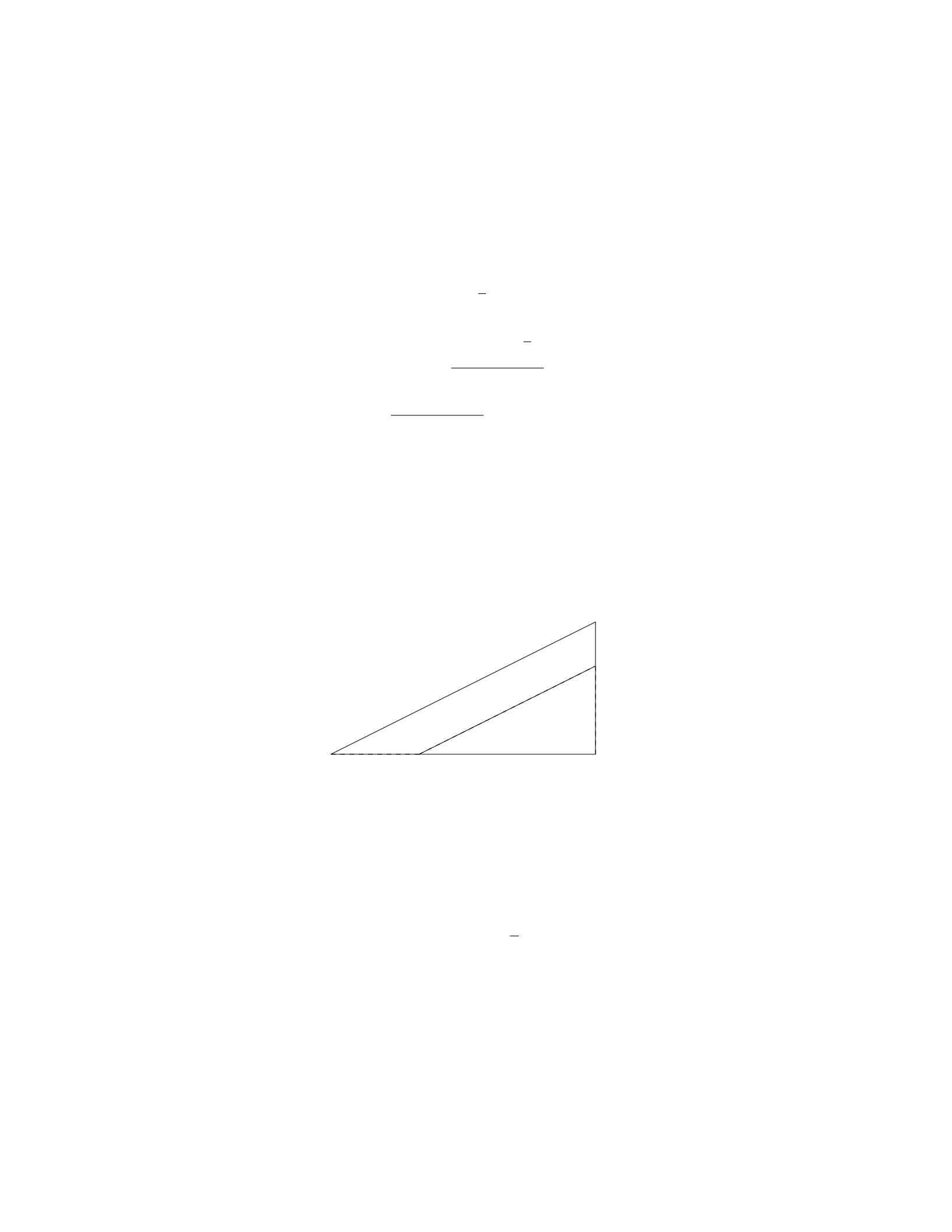
Kf=mgh −mgh sin θ
Step 6: Determine the final speed of the particle. The final kinetic energy
can be related to the final speed (v) of the particle:
Kf=1
2mv2
mgh −mgh sin θ=1
2mv2
v=p2gh(1 −sin θ)
Therefore, the speed of the particle just as it leaves the incline and enters
the horizontal surface is p2gh(1 −sin θ).
Question 5
Question
A 0.5 kg block is released from rest at point A, which is 2 meters above the
ground. The block slides down a frictionless incline as shown in the diagram
below. The incline makes an angle of 30 degrees with the horizontal. Calculate
the speed of the block when it reaches point B.
2m
xH
θ
µk= 0
m= 0.5kg
Solution
Step 1: Find the height Hof point B above the ground. To find the height H,
we can use trigonometry to find the vertical distance the block travels along the
incline. This distance, x, is the adjacent side of the right triangle formed by the
incline and the height difference.
tan(30◦) = x
2
x= 2 tan(30◦) = 1 m
This means that the height difference Hbetween A and B is given by:
H= 2 −x= 2 −1 = 1 m
5

Step 2: Calculate the speed of the block at point B using conservation
of mechanical energy. At point A, the block only has gravitational potential
energy:
P EA=mgh = (0.5 kg)(9.8 m/s2)(2 m) = 9.8 J
At point B, the block only has kinetic energy:
KEB=1
2mv2
According to the conservation of mechanical energy:
P EA=KEB
9.8 = 1
2(0.5)v2
Solving for v:
v=r2×9.8
0.5=√39.2≈6.26 m/s
Therefore, the speed of the block when it reaches point B is approximately
6.26 m/s.
Question 6
Question
A pendulum consists of a mass mattached to a string of length L. The mass
is pulled aside to an angle θ0from the vertical and released from rest. Assume
the motion of the pendulum occurs in a uniform gravitational field, neglect air
resistance, and use the small angle approximation if necessary. Determine the
period of oscillation of the pendulum in terms of m,L, and g.
Solution
Step 1: Find the potential energy of the pendulum. The potential energy of the
pendulum at an angle θfrom the vertical is given by:
U(θ) = mgh
where his the height of the mass above the lowest point of the swing, and thus
h=L(1 −cos θ). Hence,
U(θ) = mgL(1 −cos θ)
Step 2: Find the kinetic energy of the pendulum. The kinetic energy of the
pendulum is given by:
K=1
2mv2
6

where vis the speed of the mass. At the lowest point of the swing, the velocity
is at its maximum, and this occurs when the potential energy is at a minimum.
Thus, at the lowest point after the release, the potential energy is zero, which
means all the energy is in the form of kinetic energy, i.e., K=U=mgL(1 −
cos θ0). We can write the kinetic energy in terms of angular velocity ωusing
the relation v=Lω:
K=1
2m(Lω)2=1
2mL2ω2
Step 3: Apply the conservation of mechanical energy. By conservation of
mechanical energy, the total mechanical energy Eof the system remains con-
stant. Thus, the sum of the potential and kinetic energies at any point in the
swing is equal to the total mechanical energy:
E=U+K
At the initial position when the pendulum is released from rest, the only
energy in the system is gravitational potential energy:
E=U(θ0) = mgL(1 −cos θ0)
At the lowest point after the release, the total mechanical energy is all in
the form of kinetic energy:
E=K=1
2mL2ω2
Setting these two expressions for Eequal gives:
mgL(1 −cos θ0) = 1
2mL2ω2
Step 4: Find the angular velocity. Since cos θ0≈1−θ2
0
2for small angles,
mgL 1−1−θ2
0
2=1
2mL2ω2
1
2mLθ2
0=1
2mL2ω2
ω=θ0
Step 5: Determine the period of oscillation. The period of oscillation Tis
given by T=2π
ω:
T=2π
ω=2π
θ0
Therefore, the period of oscillation of the pendulum is T=2π
θ0
in terms of
m,L, and g.
7

Question 7
Question
A 0.5 kg block is attached to an ideal spring with force constant 200 N/m.
Initially, the spring is compressed by 10 cm and the block is released from rest.
Determine the maximum speed of the block as it oscillates back and forth.
Solution
Step 1: First, calculate the spring potential energy when the block is compressed
by 10 cm. The spring potential energy is given by the formula:
P Espring =1
2kx2
where: - kis the force constant of the spring (200 N/m), - xis the compression
of the spring (10 cm = 0.1 m).
Substitute the values into the formula:
P Espring =1
2×200 ×(0.1)2
P Espring = 1J
Step 2: Next, calculate the speed of the block at the equilibrium point. At
the equilibrium point, all the spring potential energy is converted into kinetic
energy. The potential energy at the equilibrium point is zero (as the spring is
not compressed or stretched). Therefore, the kinetic energy at the equilibrium
point is equal to the initial potential energy:
KE =P Espring = 1J
Using the formula for kinetic energy:
KE =1
2mv2
where: - mis the mass of the block (0.5 kg), - vis the speed of the block at the
equilibrium point.
Substitute the values into the formula:
1 = 1
2×0.5×v2
2 = v2
v=√2m/s
Therefore, the maximum speed of the block as it oscillates back and forth is
v=√2m/s.
8

Question 8
Question
A block of mass m= 2 kg is at rest on a frictionless incline that makes an angle
of θ= 30◦with the horizontal. The block is released from rest at the top of
the incline. What is the speed of the block when it reaches the bottom of the
incline? (Take g= 9.81 m/s2)
Solution
Step 1: Determine the change in gravitational potential energy as the block
moves from the top to the bottom of the incline.
∆P E =P Ef−P Ei
∆P E =mghf−mghi
∆P E =mg(hf−hi)
Here, hfis the height at the bottom of the incline, and hiis the height at the
top of the incline. We can find these heights using trigonometry:
hi=h+dsin(θ)
hf=dsin(θ)
where his the vertical height and dis the length of the incline:
h=dcos(θ)
Now we can substitute these expressions into ∆P E.
Step 2: The change in gravitational potential energy will be equal to the
change in kinetic energy according to the conservation of mechanical energy.
∆P E = ∆KE
mgh =1
2mv2
gh =1
2v2
Step 3: Solve for the final velocity v.
v=p2gh
v=p2×9.81 ×(dcos(θ))
v=p2×9.81 ×(dcos(30◦))
Now substitute the values d= 1 m and θ= 30◦into the equation to find the
final velocity v.
9

Question 9
Question
A block of mass mis released from rest at point Aon a frictionless track as
shown in the figure below. The block then slides down and passes through point
B, which is located a vertical distance hbelow point A. What is the speed of
the block at point B?
[Diagram: There is a block at point A on a track and point B below it.]
Solution
Step 1: We will start by using the conservation of mechanical energy to find the
speed of the block at point B. At point A, the block has gravitational potential
energy, which will be converted into kinetic energy at point B.
Step 2: The initial gravitational potential energy at point Ais given by
P EA=mgh
where mis the mass of the block, gis the acceleration due to gravity, and his
the vertical distance from point Ato point B.
Step 3: As the block slides down to point B, all of the initial potential
energy is converted into kinetic energy. Therefore, the kinetic energy at point
Bis equal to the initial potential energy at point A, so
KEB=P EA
Step 4: The kinetic energy at point Bis given by
KEB=1
2mv2
where vis the speed of the block at point B.
Step 5: Equating the kinetic energy and potential energy, we have
1
2mv2=mgh
Step 6: Solving for v, we get
v=p2gh
Therefore, the speed of the block at point Bis √2gh.
Question 10
Question
A block of mass mslides down a frictionless incline of height hand angle θ.
The block starts from rest at the top of the incline. What is the speed of the
block at the bottom of the incline?
10

Solution
Step 1: First, let’s calculate the potential energy at the top of the incline and
the kinetic energy at the bottom of the incline.
P Etop =mgh
KEbottom =1
2mv2
Step 2: Since we are dealing with a frictionless incline and assuming no
energy losses, we can apply the conservation of mechanical energy:
P Etop =KEbottom
Step 3: Substituting the expressions for potential and kinetic energy:
mgh =1
2mv2
gh =1
2v2
2gh =v2
v=p2gh
Therefore, the speed of the block at the bottom of the incline is v=√2gh.
Question 11
Question
A block of mass mslides along a frictionless track that has a shape of a quarter
circle of radius R, starting from rest at the top. What is the speed of the block
at the bottom of the track?
Solution
Step 1: Determine the potential and kinetic energy at the initial position. At
the top of the track, all of the block’s potential energy is converted into kinetic
energy. The potential energy at the initial position is mgh, where his the height
of the initial position from the bottom of the track. Given that the height of the
initial position is equal to the radius of the quarter circle, h=R. Therefore,
at the initial position: Potential energy, Ui=mgh =mgR, Kinetic energy,
Ki= 0.
Step 2: Determine the potential and kinetic energy at the final position.
At the bottom of the track, all of the block’s initial potential energy has been
converted into kinetic energy. There is no potential energy at the final position
(as we take the bottom of the track as the reference level). Therefore, at the
final position: Potential energy, Uf= 0, Kinetic energy, Kf=1
2mv2.
11

Step 3: Use the conservation of mechanical energy. According to the conser-
vation of mechanical energy, the total mechanical energy of the system remains
constant. Ui+Ki=Uf+Kf,mgR =1
2mv2.
Step 4: Solve for the speed of the block. Solving for vgives: v=√2gR.
Question 12
Question
A block of mass mslides down an inclined plane from a height habove the
ground. The block starts from rest and there is no friction between the block
and the inclined plane. What is the speed of the block at the bottom of the
incline?
Solution
We can solve this problem using the conservation of mechanical energy. We will
assume that the zero potential energy level is at the bottom of the incline.
Step 1: Calculate the initial potential energy of the block. The initial
potential energy of the block is given by:
P Einitial =mgh
Step 2: Calculate the final kinetic energy of the block. The final kinetic
energy of the block is given by:
KEfinal =1
2mv2
Since mechanical energy is conserved, we have:
P Einitial =KEfinal
Step 3: Equate the initial potential energy to the final kinetic energy and
solve for the velocity.
mgh =1
2mv2
Step 4: Solve for v.
v=p2gh
Therefore, the speed of the block at the bottom of the incline is √2gh.
Question 13
Question
A block of mass m= 2 kg is released from rest at a height h= 5 m above the
ground on a frictionless track. The block slides down the track and eventually
12

compresses a spring (with spring constant k= 200 N/m) by x= 0.2 m. What
is the maximum compression of the spring after the block is released from the
height h?
Solution
Step 1: The initial potential energy of the block is converted to kinetic energy
at the bottom of the track, and then both potential and kinetic energy are
converted to spring potential energy at the maximum compression point. Let’s
denote the maximum compression of the spring as xmax.
Step 2: The initial potential energy of the block at height his given by
P Ei=mgh.
Step 3: The kinetic energy of the block at the bottom of the track is given
by KEf=1
2mv2. Since the block starts from rest and the height h= 5 m,
the velocity at the bottom can be found using the conservation of mechanical
energy: P Ei=KEf⇒mgh =1
2mv2.
Step 4: Solving for v, we have v=√2gh.
Step 5: The total mechanical energy of the system is conserved, so at the
maximum compression point, the potential energy of the spring equals the initial
potential energy: 1
2kx2
max =mgh.
Step 6: Substituting known values into the equation, we get:
1
2(200)(0.2)2= 2 ·9.81 ·5.
Step 7: Solving for xmax, we find:
x2
max =2·9.81 ·5
200 ·0.22.
Step 8: Therefore, the maximum compression of the spring is xmax =
q2·9.81·5
200·0.22.
Question 14
Question
A block of mass mis released from rest at height habove the ground. The
block slides down a frictionless track and then onto a rough horizontal surface
with coefficient of kinetic friction µ. The block comes to rest after traveling a
distance dalong the rough surface. Calculate the coefficient of kinetic friction,
µ, if the block comes to rest at a distance d.
Solution
Step 1: First, let’s find the initial gravitational potential energy of the block at
height h:
Ui=mgh
13

Step 2: Next, the block’s final kinetic energy will be equal to the work done
by the gravitational force and the frictional force:
KEf=Ui−Wf
Step 3: The work done by the gravitational force is:
WG=mgh
Step 4: The work done by the frictional force is:
Wf=µmgd
Step 5: Substitute the expressions for WGand Wfinto the equation for
kinetic energy: 1
2mv2
f=mgh −µmgd
Step 6: Solve for vf, the final speed of the block right before it stops:
vf=p2gh −2µgd
Step 7: Since the block comes to rest, the final speed vfis zero:
0 = p2gh −2µgd
Step 8: Solve for µ:
µ=h
d
Question 15
Question
A 0.5 kg block is attached to an ideal spring with a spring constant of 200 N/m.
The block is pulled 5 cm to the right from its equilibrium position and released.
What is the maximum speed of the block as it oscillates on the spring?
Solution
Step 1: Find the potential energy of the system when the block is pulled back 5
cm. Let xbe the distance from the equilibrium position. The potential energy
stored in the spring can be calculated using the formula:
P E =1
2kx2
where kis the spring constant and xis the displacement from the equilibrium
position. Substitute k= 200 N/m and x= 0.05 m into the formula:
P E =1
2×200 ×(0.05)2= 0.25 J
14

Step 2: Find the maximum kinetic energy of the system when the block is
released. At its maximum displacement, all potential energy is converted to
kinetic energy. Therefore, the kinetic energy of the system at this point is equal
to the initial potential energy:
KE =P E = 0.25 J
Step 3: Calculate the maximum speed of the block. The kinetic energy can
also be expressed as:
KE =1
2mv2
where mis the mass of the block and vis its speed. Substitute m= 0.5 kg into
the formula and solve for v:
0.25 = 1
2×0.5×v2
v2=0.25 ×2
0.5= 1
v=√1 = 1 m/s
Therefore, the maximum speed of the block as it oscillates on the spring is
1 m/s.
Question 16
Question
A block of mass mis released from rest at a height habove a horizontal surface.
The block slides down a frictionless incline of angle θand comes to a stop after
traveling a distance dalong the incline. Calculate the coefficient of kinetic
friction between the block and the incline.
Solution
Step 1: The initial mechanical energy of the block is all in the form of gravi-
tational potential energy when it is released from rest. At the bottom of the
incline, the block comes to a stop, so all the initial gravitational potential energy
is converted into potential energy and kinetic energy.
Step 2: The gravitational potential energy with respect to the bottom of the
incline at the initial position is mgh. The final potential energy at the bottom
of the incline is 0, while the final kinetic energy is 0.5mv2, where vis the final
velocity of the block.
Step 3: The distance traveled by the block along the incline can be calculated
using the relation between the distance dand the height h:d=hsin(θ).
Step 4: Using the conservation of mechanical energy, we have: Initial energy
= Final energy mgh = 0.5mv2
15

Step 5: Solving for the final velocity vgives: v=√2gh
Step 6: The force of kinetic friction fkacting on the block can be expressed
as fk=µkmg cos(θ), where µkis the coefficient of kinetic friction.
Step 7: The work done by kinetic friction is equal to the frictional force
times the distance traveled: −fkd= ∆KE
Step 8: Substituting the expressions for fkand ∆KE gives: −µkmg cos(θ)hsin(θ) =
0.5mv2
Step 9: Substituting the expression for the final velocity vand solving for
the coefficient of kinetic friction µkgives: µk=2gh
dsin(θ) cos(θ)
Question 17
Question
A block of mass mis released from rest at a height habove a frictionless surface.
It slides down a frictionless incline of angle θand then onto a horizontal surface.
Assume the block is a distance dalong the incline from the point where it leaves
the incline to the point where it comes to rest.
Calculate the distance dalong the incline where the block comes to rest on
the horizontal surface in terms of h,θ, and g.
Solution
Step 1: The initial mechanical energy of the block at the top of the incline
consists of gravitational potential energy which is converted into kinetic energy
at the bottom of the incline when the block comes to rest. The conservation of
mechanical energy can be expressed as:
mgh =1
2mv2
Where: m= mass of the block, g= acceleration due to gravity, h= height of
the incline, v= velocity of the block at the bottom of the incline.
Step 2: The velocity of the block at the bottom of the incline is given by:
v=p2gh
Step 3: When the block comes to rest on the horizontal surface the total
mechanical energy is given as:
mgh =1
2mv2+mgh sin θ
Step 4: Substituting the value of vin the equation, we get:
mgh =1
2m(2gh) + mgh sin θ
16

Step 5: Simplifying the equation further, we obtain:
mgh =mgh +mgh sin θ
Step 6: Solving for d, the distance along the incline where the block comes
to rest on the horizontal surface, we get:
d=hsin θ
1−sin θ
Therefore, the distance dalong the incline where the block comes to rest on
the horizontal surface is hsin θ
1−sin θ.
Question 18
Question
A 2 kg block is released from rest at a height of 5 m above the ground. The
block slides down a frictionless incline and then onto a rough horizontal surface
with a coefficient of kinetic friction of 0.2. The block comes to a stop after
sliding a distance of 3 m on the horizontal surface. Determine the speed of the
block just before it reaches the rough surface.
Solution
Step 1: Determine the potential energy at the top of the incline. At the top
of the incline, all the initial energy of the block is in the form of gravitational
potential energy:
P E =mgh = 2 kg ·9.8 m/s2·5 m = 98 J
Step 2: Determine the kinetic energy of the block just before reaching the
rough surface. Since we are assuming no energy is lost due to friction on the
incline, the block’s potential energy is converted into kinetic energy. Therefore,
at the bottom of the incline:
KE =P E = 98 J
Step 3: Determine the work done by friction on the horizontal surface. The
work done by friction can be calculated using the formula:
Wfriction =fk·d
where fkis the kinetic frictional force and dis the distance traveled on the
rough surface. The kinetic frictional force can be found using:
fk=µk·N
17

where µkis the coefficient of kinetic friction and Nis the normal force. The
normal force is equal in magnitude to the weight of the block, mg. Therefore:
fk= 0.2·2 kg ·9.8 m/s2= 3.92 N
Wfriction = 3.92 N ·3 m = 11.76 J
Step 4: Determine the speed of the block just before it reaches the rough
surface. The total mechanical energy just before reaching the rough surface is
the initial kinetic energy minus the work done by friction:
KEfinal =KEinitial −Wfriction = 98 J −11.76 J = 86.24 J
Using the formula for kinetic energy:
KE =1
2mv2
we can solve for the final speed v:
v=r2·KEfinal
m=s2·86.24 J
2 kg =p86.24 m2/s2= 9.29 m/s
Therefore, the speed of the block just before it reaches the rough surface is
9.29 m/s.
Question 19
Question
A block of mass mis released from rest at height habove the ground on a
frictionless incline of angle θ. The block slides down the incline and comes to
rest after traveling a distance dalong the incline. What is the coefficient of
kinetic friction between the block and the incline?
Solution
Step 1: We will first calculate the height of the incline in terms of hand θ. The
height of the incline can be expressed as hincl =hsin(θ).
Step 2: Next, we will find the initial gravitational potential energy of the
block at a height h, which is given by P Einitial =mgh.
Step 3: The block will lose this potential energy as it slides down the incline.
At the bottom of the incline, the block will have zero kinetic and potential
energy. The total mechanical energy of the block remains constant, so we can
equate the initial potential energy to the final kinetic energy:
P Einitial =KEfinal
18

Step 4: The final kinetic energy of the block can be calculated as KEfinal =
1
2mv2. Since the block comes to rest after sliding, its final velocity vis 0.
Step 5: Substituting KEfinal = 0 into the energy conservation equation gives:
mgh = 0
Step 6: Solving for hyields the height of the block above the ground in terms
of dand θ. The height h=dsin(θ).
Step 7: The work done by friction as the block slides down the incline is
equal to the change in mechanical energy:
Wfriction = ∆E=mgh −µkmgd sin(θ)
Step 8: Since the block comes to rest, the work done by friction is equal to
the initial potential energy:
mgh =µkmgd sin(θ)
Step 9: Solving for µkgives the coefficient of kinetic friction:
µk=h
dsin(θ)=h
dcsc(θ)
Therefore, the coefficient of kinetic friction between the block and the incline
is µk=h
dcsc(θ).
Question 20
Question
A block of mass mslides down a frictionless inclined plane making an angle θ
with the horizontal. The block starts from rest at the top of the incline, which
is a height habove the ground. Calculate the speed of the block when it reaches
the bottom of the incline.
Solution
Step 1: First, we can calculate the gravitational potential energy of the block
at the top of the incline and the kinetic energy of the block at the bottom of
the incline.
At the top of the incline: The gravitational potential energy Uis given by:
U=mgh
where mis the mass of the block, gis the acceleration due to gravity, and his
the height of the incline.
At the bottom of the incline: The kinetic energy Kis given by:
K=1
2mv2
19

where vis the speed of the block at the bottom.
Step 2: According to the conservation of mechanical energy, the total me-
chanical energy of the block at the top of the incline is equal to the total me-
chanical energy of the block at the bottom of the incline. Therefore, we have:
Utop =Kbottom
mgh =1
2mv2
Step 3: Solving for v:
mgh =1
2mv2
2gh =v2
v=p2gh
Therefore, the speed of the block when it reaches the bottom of the incline
is v=√2gh.
Question 21
Question
A 0.5 kg block is attached to an ideal spring with spring constant 100 N/m. The
block is initially at rest at the equilibrium position of the spring. The block is
then pulled 0.1 meters to the right and released. What is the maximum speed
of the block as it oscillates back and forth on the spring?
Solution
Step 1: Find the potential energy stored in the spring at maximum compression.
The potential energy stored in a spring when compressed or stretched a distance
xfrom its equilibrium position is given by:
P Espring =1
2kx2
Where: k= spring constant = 100 N/m x= compression = 0.1 m
Substitute the given values into the formula:
P Espring =1
2×100 ×(0.1)2= 0.5 J
Step 2: Find the maximum kinetic energy of the block. At the maximum
compression, all of the potential energy stored in the spring will be converted
into kinetic energy. Therefore, the maximum kinetic energy of the block is equal
to the potential energy stored in the spring:
KEmax =P Espring = 0.5 J
20

Step 3: Find the maximum speed of the block. The kinetic energy of an
object is given by:
KE =1
2mv2
Where: m= mass of the block = 0.5 kg v= speed of the block
Set the kinetic energy equal to the maximum kinetic energy calculated earlier
and solve for the speed:
0.5 = 1
2×0.5×v2
1=0.25v2
v2= 4
v= 2 m/s
Therefore, the maximum speed of the block as it oscillates back and forth
on the spring is 2 m/s.
Question 22
Question
A block of mass mis released from rest at a height habove the ground on a
frictionless track. The block slides down the track and reaches a lower height of
h/2 above the ground, as shown in the diagram. What is the speed of the block
at this lower height?
h/2
h
m
Solution
Step 1: First, we calculate the potential energy of the block at the initial height
hand at the final height h/2. At h: The potential energy at height his given
by P E =mgh.
At h/2: The potential energy at height h/2 is given by P E =mg(h/2) =
mgh
2.
Step 2: According to the conservation of mechanical energy, the total me-
chanical energy of the block at the initial height his equal to the total mechanical
energy of the block at the final height h/2. This can be expressed as:
P Einitial +KEinitial =P Efinal +KEfinal
21

Step 3: At the initial height, the block is at rest, so the initial kinetic energy
KEinitial is zero.
Therefore, the equation simplifies to:
P Einitial =P Efinal +KEfinal
Step 4: Substituting the expressions for potential energy at the initial and
final heights:
mgh =mgh
2+1
2mv2
Step 5: Simplifying the equation:
2gh =gh +v2
Step 6: Solving for the speed v:
v=p2gh −gh =pgh
Hence, the speed of the block at the lower height h/2 above the ground is
√gh.
Question 23
Question
A 2 kg block is released from rest at a height of 5 m above the ground. It slides
down a frictionless ramp and then onto a rough horizontal surface. The block
eventually comes to rest after traveling a distance of 10 m along the rough
surface. The coefficient of kinetic friction between the block and the rough
surface is 0.2. What is the magnitude of the work done by friction as the block
slides along the rough surface?
Solution
Step 1: Calculate the initial potential energy of the block when it is released
from rest at a height of 5 m.
Initial potential energy = mgh
Initial potential energy = 2 ×9.8×5
Initial potential energy = 98 J
Step 2: Calculate the final kinetic energy of the block just before it comes
to rest.
Final kinetic energy = 1
2mv2
Since the block eventually comes to rest, its final velocity is 0. Therefore, the
final kinetic energy is 0 J.
22

Step 3: Calculate the work done by friction as the block slides along the
rough surface. Since there is a loss of kinetic energy, the work done by friction
is equal to the change in mechanical energy of the block.
Work done by friction = ∆mechanical energy
Work done by friction = Initial potential energy −Final kinetic energy
Work done by friction = 98 J −0 J
Work done by friction = 98 J
Therefore, the magnitude of the work done by friction as the block slides
along the rough surface is 98 J.
Question 24
Question
A block of mass mis released from rest at height habove the ground on a
frictionless incline of angle θ. The block slides down the incline and then onto
a horizontal surface. Calculate the speed of the block just before it reaches the
horizontal surface, in terms of m,h,g, and θ.
Solution
Step 1: Let’s first determine the height of the block above the horizontal surface
when it reaches the bottom of the incline. The vertical height the block descends
through is hsin(θ).
Step 2: The initial gravitational potential energy of the block (mgh) at the
top of the incline is converted into kinetic energy and gravitational potential
energy at the bottom. Therefore, we have:
mgh =1
2mv2+mgh sin(θ)
Step 3: Cancelling the mass mfrom both sides and rearranging, we get:
gh =1
2v2+gh sin(θ)
Step 4: Solving for the final speed v, we have:
v=p2gh −2gh sin(θ)
Step 5: Simplifying further:
v=p2gh(1 −sin(θ))
Therefore, the speed of the block just before it reaches the horizontal surface
is p2gh(1 −sin(θ)).
23

Question 25
Question
A satellite of mass mis in a circular orbit around a planet of mass M. The
radius of the orbit is R. What is the kinetic energy of the satellite in terms of
G,m,M, and R?
Solution
Step 1: Let’s start by finding the gravitational force between the satellite and
the planet. The gravitational force between the satellite and the planet is given
by Newton’s Law of Universal Gravitation:
F=G·m·M
R2
where: Gis the gravitational constant, mis the mass of the satellite, Mis the
mass of the planet, Ris the radius of the orbit.
Step 2: Since the satellite is moving in a circular orbit, the gravitational
force between the satellite and the planet provides the centripetal force needed
to keep the satellite in orbit. Therefore, we can equate the gravitational force
to the centripetal force in order to find the speed of the satellite.
Step 3: The centripetal force required to keep the satellite in orbit is given
by:
Fcentripetal =m·v2
R
where vis the speed of the satellite.
Step 4: Equating the gravitational force and the centripetal force, we have:
G·m·M
R2=m·v2
R
Step 5: Solving for v2, we get:
v2=G·M
R
Step 6: The kinetic energy of the satellite is given by:
KE =1
2·m·v2
Step 7: Substituting the expression for v2, we have:
KE =1
2·m·G·M
R=1
2·G·M·m
R
Therefore, the kinetic energy of the satellite in terms of G,m,M, and Ris
1
2·G·M·m
R.
24

Question 26
Question
A 0.5 kg block is released from rest at a height of 2 m on a frictionless incline
that makes an angle of 30 degrees with the horizontal. Find the speed of the
block just as it reaches the bottom of the incline.
Solution
Step 1: Determine the gravitational potential energy at the initial position. At
the initial position, the gravitational potential energy of the block is given by:
P Ei=mgh
where mis the mass of the block, gis the acceleration due to gravity, and his
the height from which the block is released. Plugging in the values, we get:
P Ei= (0.5 kg)(9.81 m/s2)(2 m) = 9.81 J
Step 2: Determine the kinetic energy at the final position. At the bottom
of the incline, the block has converted all of its potential energy into kinetic
energy. Therefore, the kinetic energy of the block at the bottom is given by:
KEf=1
2mv2
where vis the velocity of the block at the bottom of the incline.
Step 3: Apply the conservation of mechanical energy. According to the
conservation of mechanical energy, the total mechanical energy of the system
remains constant. Therefore, we have:
P Ei=KEf
mgh =1
2mv2
Step 4: Solve for the velocity, v. Substitute the known values into the
equation and solve for v:
(0.5 kg)(9.81 m/s2)(2 m) = 1
2(0.5 kg)v2
9.81 J = 0.25v2
v2=9.81 J
0.25
v=√39.24
v≈6.27 m/s
Therefore, the speed of the block just as it reaches the bottom of the incline
is approximately 6.27 m/s.
25

Question 27
Question
A 2 kg block is released from rest at a height of 5 m above the ground. The
block slides down a frictionless incline making an angle of 30 degrees with the
horizontal. What is the speed of the block just before it reaches the ground?
Solution
Step 1: Find the gravitational potential energy at the initial position.
P Ei=mgh = (2 kg)(9.81 m/s2)(5 m) = 98.1 J
Step 2: Determine the height of the incline where the block reaches the
ground. Use trigonometry to find the height h′.
h′= 5 m ×sin(30◦) = 2.5 m
Step 3: Calculate the final kinetic energy of the block just before it reaches
the ground.
KEf=1
2mv2
Step 4: Apply the conservation of mechanical energy,
P Ei=KEf
Step 5: Substitute the expressions for potential energy and kinetic energy
into the conservation of energy equation.
mgh =1
2mv2
Step 6: Solve for the final velocity, v.
v=p2gh′=q2×9.81 m/s2×2.5 m = √49.05 ≈7.0 m/s
Therefore, the speed of the block just before it reaches the ground is approx-
imately 7.0 m/s.
Question 28
Question
A 0.2 kg block is attached to a horizontal spring with spring constant 200 N/m.
The block is pulled 5 cm to the right of the equilibrium position and released
from rest. What is the speed of the block as it passes through the equilibrium
position?
26

Solution
Step 1: First, we need to find the potential energy stored in the spring when
the block is pulled 5 cm to the right of the equilibrium position.
Step 2: The potential energy stored in the spring is given by the equation:
P E =1
2kx2
where kis the spring constant and xis the displacement from the equilibrium
position.
Step 3: Substituting the values k= 200 N/m and x= 0.05 m into the
equation, we find:
P E =1
2×200 ×(0.05)2= 0.25 J
Step 4: At the equilibrium position, the total mechanical energy of the
system (kinetic energy + potential energy) is equal to the potential energy
stored in the spring.
Step 5: The total mechanical energy at the equilibrium position is given by
the equation:
ME =1
2mv2+P E
where mis the mass of the block and vis the speed of the block.
Step 6: Since the block is released from rest, the initial kinetic energy is
zero. Thus, the total mechanical energy at the equilibrium position is equal to
the potential energy stored in the spring:
1
2mv2= 0.25 J
Step 7: Substituting the values m= 0.2 kg into the equation, we can solve
for the speed v:1
2×0.2×v2= 0.25
v2=0.25
0.1= 2.5
Step 8: Taking the square root of both sides, we find:
v=√2.5=1.58 m/s
Therefore, the speed of the block as it passes through the equilibrium posi-
tion is 1.58 m/s.
Question 29
Question
A block with mass mslides down a frictionless incline of height hand angle
θ. At the bottom of the incline, the block collides with a horizontal spring of
27

spring constant kand is compressed by a distance x. The coefficient of kinetic
friction between the block and the surface is µk. If the block was released from
rest at the top of the incline, determine the compression distance xof the spring
when the block momentarily comes to rest.
Solution
Step 1: Calculate the potential energy (P E) at the top of the incline. At the
top of the incline, all energy is in the form of gravitational potential energy:
P E1=mgh
Step 2: Calculate the kinetic energy (KE) of the block at the bottom of
the incline. At the bottom of the incline, the block has converted its potential
energy to kinetic energy:
KE2=1
2mv2
Step 3: Set up the conservation of mechanical energy equation. The total
mechanical energy of the system is conserved, neglecting any energy lost to
friction. Therefore, at the bottom of the incline, the sum of the potential and
kinetic energies is equal to the potential and kinetic energies at the compressed
position:
P E1=KE2+1
2kx2
Step 4: Solve for the velocity of the block at the bottom of the incline. Since
the block is released from rest at the top of the incline, the velocity at the
bottom is related to the height hand angle θ:
v=p2gh sin θ
Step 5: Set up an expression for the work done by friction. The work done
by friction can be written as:
Wfriction =−fk·d
Step 6: Determine the distance over which friction acts. The distance over
which friction acts is related to the height hand angle θ:
d=hcos θ
Step 7: Substitute the expressions for potential energy, kinetic energy, and
work done by friction into the conservation of mechanical energy equation. Sub-
stitute KE2,P E1,v,d, and fkinto the conservation of mechanical energy
equation and solve for x.
28

Question 30
Question
A 0.2 kg ball is attached to a spring with a spring constant of 400 N/m and is
stretched 0.1 m from its equilibrium position. The ball is released and starts to
oscillate back and forth. Calculate the maximum speed of the ball as it passes
through the equilibrium position.
Solution
Step 1: Find the potential energy stored in the spring at maximum compression
or extension. The potential energy stored in the spring is given by:
P E =1
2kx2
where: - P E is the potential energy stored in the spring, - kis the spring
constant (400 N/m), - xis the distance from equilibrium position (0.1 m).
Substitute the given values into the equation:
P E =1
2×400 ×(0.1)2
P E = 2J
Step 2: Use conservation of mechanical energy to find the maximum velocity.
At the equilibrium position:
KEmax +P Emax =P Einitial
where: - KEmax is the maximum kinetic energy, - P Emax is the maximum
potential energy at the amplitude, - P Einitial is the initial potential energy
stored in the spring.
At maximum compression or extension, the potential energy is converted to
kinetic energy, so P Emax = 0. Therefore:
KEmax =P Einitial = 2J
Step 3: Find the maximum speed of the ball. The kinetic energy is given
by:
KE =1
2mv2
where: - KE is the kinetic energy, - mis the mass of the ball (0.2 kg), - vis the
velocity of the ball at maximum speed.
Substitute the given values into the equation:
2 = 1
2×0.2×v2
29

Solve for v:
v2= 20
v=√20 = 2√5 m/s
Therefore, the maximum speed of the ball as it passes through the equilib-
rium position is 2√5 m/s.
Question 31
Question
A block is initially at rest on a frictionless inclined plane with an angle of
elevation of 30◦. The block has a mass of 2 kg and the height of the incline is
3 meters. If the block is released from rest, determine the speed of the block at
the bottom of the incline. (Assume no energy losses)
Solution
Step 1: We will first calculate the gravitational potential energy at the top of the
incline and then use the conservation of mechanical energy to find the velocity
of the block at the bottom of the incline.
The gravitational potential energy at the top of the incline is given by:
P Einitial =mgh
where mis the mass of the block, gis the acceleration due to gravity, and his
the height of the incline.
Given m= 2 kg, g= 9.81 m/s2, and h= 3 m, we have:
P Einitial = 2 ×9.81 ×3 = 58.86 J
Step 2: At the bottom of the incline, the block will have both kinetic and
potential energy.
Using the conservation of mechanical energy, we can equate the initial po-
tential energy to the sum of the final kinetic and potential energies:
P Einitial =KEfinal +P Efinal
Since the incline is frictionless, there is no non-conservative work done.
Therefore, KEfinal =KEinitial = 0, as the block starts from rest.
Thus, we have:
P Einitial =P Efinal
mgh =1
2mv2
2×9.81 ×3 = 1
2×2×v2
30

Solving for v, we get:
v=p2gh =√2×9.81 ×3
v=√58.86
v≈7.68 m/s
Therefore, the speed of the block at the bottom of the incline is approxi-
mately 7.68 m/s.
Question 32
Question
A block of mass mis released from rest at a height habove the ground on a
frictionless incline of angle θ. The block slides down the incline and comes to
a stop after traveling a distance d. What is the coefficient of kinetic friction
between the block and the incline?
Solution
Step 1: The initial potential energy of the block is given by P Ei=mgh, where
mis the mass of the block, gis the acceleration due to gravity, and his the
initial height of the block.
Step 2: The final kinetic energy of the block is given by KEf=1
2mv2, where
mis the mass of the block and vis the final velocity of the block.
Step 3: The work done by friction on the block is equal to the change in
mechanical energy, which is the difference between the initial potential energy
and the final kinetic energy. This can be expressed as Wf riction =P Ei−KEf.
Step 4: The work done by friction is also equal to the frictional force multi-
plied by the distance d, so Wf riction =ff riction ·d, where ffriction is the frictional
force.
Step 5: The frictional force is given by ff riction =µk·N, where µkis the
coefficient of kinetic friction and Nis the normal force acting on the block.
Step 6: The normal force can be decomposed into components perpendicular
and parallel to the incline. The normal force perpendicular to the incline is equal
in magnitude to the component of the gravitational force perpendicular to the
incline, which is N=mg cos(θ).
Step 7: Substituting back into the previous equations, we find µk·mg cos(θ)·
d=mgh −1
2mv2.
Step 8: Since the block is on a frictionless incline, the distance dcan be
expressed in terms of the initial height hand the angle θas d=hsin(θ).
Step 9: Substituting this back into the equation, we find µk=gh−1
2v2
gcos(θ)hsin(θ).
31

Question 33
Question
A small block of mass mis released from rest at a height habove the ground
on a frictionless track which ends with a loop-the-loop of radius R. What is
the minimum value of hfor the block to successfully complete the loop-the-loop
without falling off?
Solution
Let’s denote the initial height of the block as h, the final height at the top of
the loop as h′, the radius of the loop as R, the speed of the block at the bottom
of the loop as v, and the acceleration due to gravity as g.
Step 1: Find the minimum height hfor the block to successfully complete the
loop-the-loop. At the top of the loop, the block just barely maintains contact
with the track, so the normal force goes to zero. Therefore, the net force at the
top of the loop is the sum of the gravitational force and the centripetal force.
mg =mv2
R
v=pgR
Step 2: Use the conservation of mechanical energy to relate the initial height
hto the speed vat the bottom of the loop. The total mechanical energy at the
top of the loop is equal to the total mechanical energy at the initial height.
mgh =1
2mv2
h=v2
2g=gR
2g=R
2
Therefore, the minimum height hfor the block to successfully complete the
loop-the-loop without falling off is R/2.
Question 34
Question
A 0.2 kg ball is attached to a 1.5 m long string and is swung in a vertical circle.
At the bottom of the swing, the tension in the string is 14 N. Calculate the
speed of the ball at the highest point of the circle.
32

Solution
Step 1: First, let’s find the potential energy of the ball at the bottom of the
swing. Given: Mass of the ball, m= 0.2 kg Acceleration due to gravity, g= 9.8
m/s2Height of the bottom point, h= 1.5 m Tension in the string, T= 14 N
The potential energy at the bottom is given by P Ebottom =mgh. Substitute
the values to find the potential energy: P Ebottom = (0.2 kg)(9.8 m/s2)(1.5 m).
Step 2: Next, let’s find the potential energy of the ball at the highest point
of the circle. The potential energy at the top is given by P Etop =mgh. At
the highest point, the tension balances the weight of the ball so T+mg =
0⇒T=−mg. Substitute the values to find the potential energy: P Etop =
(0.2 kg)(9.8 m/s2)(1.5 m).
Step 3: Conservation of mechanical energy states that the total mechani-
cal energy at any point of the circle is constant, i.e., KEbottom +P Ebottom =
KEtop +P Etop.
Since the speed is zero at the highest point, the kinetic energy at the top is
zero and at the bottom is 1
2mv2. Therefore, we can write 1
2mv2
bottom +mgh =
mgh + 0.
Step 4: Solve for vbottom to find the speed of the ball at the highest point.
vbottom =√2gh.
Substitute the values to find the speed of the ball at the highest point:
vbottom =q2(9.8 m/s2)(1.5 m).
Therefore, the speed of the ball at the highest point of the circle is approxi-
mately 7.67 m/s.
Question 35
Question
A block of mass mslides down a frictionless inclined plane starting from rest
at a height h. The block reaches the bottom of the incline with a speed v.
Determine the distance dalong the incline where the block comes to a stop.
Solution
Let’s consider the conservation of mechanical energy to solve this problem.
Step 1: The initial energy of the block is purely gravitational potential
energy, Ui=mgh, since it starts from rest. The final energy of the block is
purely kinetic energy at the bottom of the incline, Kf=1
2mv2.
Step 2: By conservation of mechanical energy, we can say that the initial
energy equals the final energy:
Ui=Kf
mgh =1
2mv2
33

where mis the mass of the block, gis the acceleration due to gravity, and hmax
is the maximum height. Rearranging the equation to solve for hmax:
hmax =Ui
mg
Substitute Ui= 1 J, m= 0.5 kg, and g= 9.81 m/s2:
hmax =1
0.5×9.81
hmax = 0.204 m
Therefore, the maximum height the block reaches is 0.204 m.
Question 2
Question
A 2 kg block is released from rest at a height of 5 m above the ground. The
block slides down a frictionless incline which makes an angle of 30 degrees with
the horizontal. What is the speed of the block just before it reaches the ground?
Solution
Step 1: Determine the initial gravitational potential energy of the block. The
initial gravitational potential energy of the block is given by:
P Ei=mgh
where mis the mass of the block (2 kg), gis the acceleration due to gravity (9.8
m/s2), and his the initial height (5 m).
P Ei= 2 ×9.8×5 = 98 J
Step 2: Determine the final kinetic energy of the block. When the block
reaches the ground, all of the initial potential energy will be converted into
kinetic energy. Therefore, the final kinetic energy of the block can be expressed
as:
KEf=1
2mv2
where vis the final velocity of the block just before it reaches the ground.
Step 3: Apply the conservation of mechanical energy. According to the
conservation of mechanical energy, the total mechanical energy of the block
(sum of kinetic and potential energy) remains constant throughout the motion.
Therefore, we can equate the initial potential energy to the final kinetic energy:
P Ei=KEf
2

98 = 1
2×2×v2
Step 4: Solve for the final velocity of the block.
98 = v2
v=√98 = 9.9 m/s
Therefore, the speed of the block just before it reaches the ground is 9.9
m/s.
Question 3
Question
A mass mis attached to a spring with spring constant k, initially at rest. The
mass is then released from a height habove the equilibrium position. Calculate
the speed of the mass when it passes through the equilibrium position.
Solution
Step 1: The total mechanical energy of the mass-spring system is conserved. At
the initial point (height habove equilibrium), the energy is all potential energy,
and at the equilibrium point, the energy is all kinetic energy.
Step 2: The initial potential energy is all converted to kinetic energy at the
equilibrium position. The potential energy at height his given by P Einitial =
mgh.
Step 3: At the equilibrium position, all the potential energy is converted to
kinetic energy, so the kinetic energy at this point is KE =1
2mv2.
Step 4: Using the conservation of mechanical energy, we can equate the
initial potential energy to the final kinetic energy:
P Einitial =KE
mgh =1
2mv2
Step 5: Canceling out the mass term from both sides of the equation, we
find:
gh =1
2v2
Step 6: Solving for the velocity v,
v=p2gh
Therefore, the speed of the mass when it passes through the equilibrium
position is √2gh.
3

Question 4
Question
A particle of mass mis released from rest at a height habove the ground on a
smooth frictionless incline of angle θ. Determine the speed of the particle just
as it leaves the incline and enters the horizontal surface.
Solution
Let’s consider the conservation of mechanical energy to solve this problem.
Step 1: Calculate the initial potential energy of the particle. The initial
potential energy of the particle at height his given by
Ui=mgh
Step 2: Calculate the initial kinetic energy of the particle. The initial
kinetic energy of the particle is zero since it is released from rest.
Ki= 0
Step 3: Determine the final potential energy of the particle when it just
leaves the incline and enters the horizontal surface. The final potential energy
of the particle can be broken down into two parts: 1. Potential energy due to
the change in height from the incline to the ground:
Uf1=mgh sin θ
2. Potential energy due to the remaining height on the horizontal surface:
Uf2=mgh
Thus, the total final potential energy is
Uf=mgh sin θ+mgh
Step 4: Apply conservation of mechanical energy. According to the conser-
vation of mechanical energy, the total mechanical energy of the system remains
constant.
Initial Mechanical Energy = Final Mechanical Energy
Ui+Ki=Uf+Kf
Since the particle is released from rest, Ki= 0, the equation simplifies to
Ui=Uf+Kf
Step 5: Solve for the final kinetic energy (Kf). Substitute the expressions
for Uiand Ufinto the conservation of energy equation and solve for Kf.
mgh =mgh sin θ+mgh +Kf
4
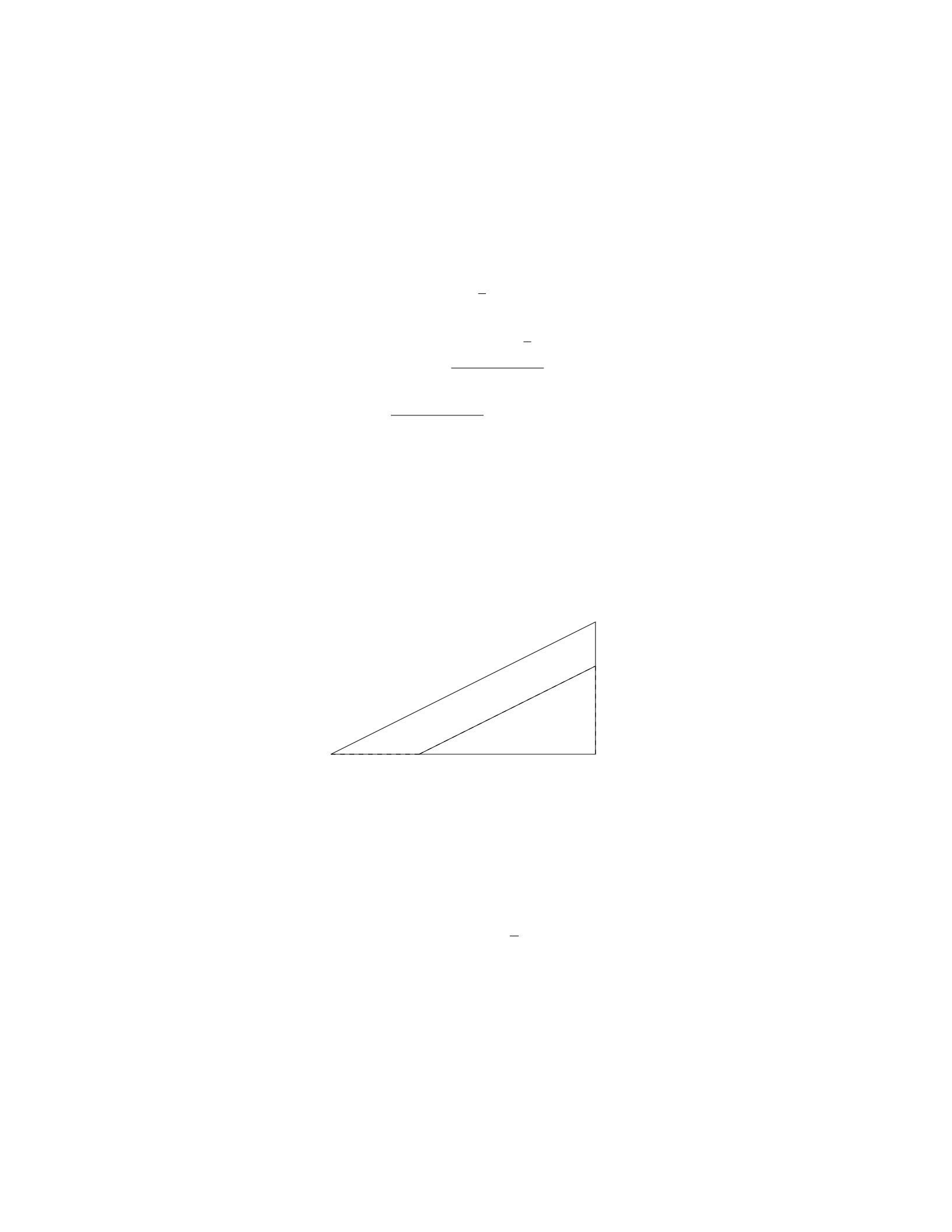
Kf=mgh −mgh sin θ
Step 6: Determine the final speed of the particle. The final kinetic energy
can be related to the final speed (v) of the particle:
Kf=1
2mv2
mgh −mgh sin θ=1
2mv2
v=p2gh(1 −sin θ)
Therefore, the speed of the particle just as it leaves the incline and enters
the horizontal surface is p2gh(1 −sin θ).
Question 5
Question
A 0.5 kg block is released from rest at point A, which is 2 meters above the
ground. The block slides down a frictionless incline as shown in the diagram
below. The incline makes an angle of 30 degrees with the horizontal. Calculate
the speed of the block when it reaches point B.
2m
xH
θ
µk= 0
m= 0.5kg
Solution
Step 1: Find the height Hof point B above the ground. To find the height H,
we can use trigonometry to find the vertical distance the block travels along the
incline. This distance, x, is the adjacent side of the right triangle formed by the
incline and the height difference.
tan(30◦) = x
2
x= 2 tan(30◦) = 1 m
This means that the height difference Hbetween A and B is given by:
H= 2 −x= 2 −1 = 1 m
5

Step 2: Calculate the speed of the block at point B using conservation
of mechanical energy. At point A, the block only has gravitational potential
energy:
P EA=mgh = (0.5 kg)(9.8 m/s2)(2 m) = 9.8 J
At point B, the block only has kinetic energy:
KEB=1
2mv2
According to the conservation of mechanical energy:
P EA=KEB
9.8 = 1
2(0.5)v2
Solving for v:
v=r2×9.8
0.5=√39.2≈6.26 m/s
Therefore, the speed of the block when it reaches point B is approximately
6.26 m/s.
Question 6
Question
A pendulum consists of a mass mattached to a string of length L. The mass
is pulled aside to an angle θ0from the vertical and released from rest. Assume
the motion of the pendulum occurs in a uniform gravitational field, neglect air
resistance, and use the small angle approximation if necessary. Determine the
period of oscillation of the pendulum in terms of m,L, and g.
Solution
Step 1: Find the potential energy of the pendulum. The potential energy of the
pendulum at an angle θfrom the vertical is given by:
U(θ) = mgh
where his the height of the mass above the lowest point of the swing, and thus
h=L(1 −cos θ). Hence,
U(θ) = mgL(1 −cos θ)
Step 2: Find the kinetic energy of the pendulum. The kinetic energy of the
pendulum is given by:
K=1
2mv2
6

where vis the speed of the mass. At the lowest point of the swing, the velocity
is at its maximum, and this occurs when the potential energy is at a minimum.
Thus, at the lowest point after the release, the potential energy is zero, which
means all the energy is in the form of kinetic energy, i.e., K=U=mgL(1 −
cos θ0). We can write the kinetic energy in terms of angular velocity ωusing
the relation v=Lω:
K=1
2m(Lω)2=1
2mL2ω2
Step 3: Apply the conservation of mechanical energy. By conservation of
mechanical energy, the total mechanical energy Eof the system remains con-
stant. Thus, the sum of the potential and kinetic energies at any point in the
swing is equal to the total mechanical energy:
E=U+K
At the initial position when the pendulum is released from rest, the only
energy in the system is gravitational potential energy:
E=U(θ0) = mgL(1 −cos θ0)
At the lowest point after the release, the total mechanical energy is all in
the form of kinetic energy:
E=K=1
2mL2ω2
Setting these two expressions for Eequal gives:
mgL(1 −cos θ0) = 1
2mL2ω2
Step 4: Find the angular velocity. Since cos θ0≈1−θ2
0
2for small angles,
mgL 1−1−θ2
0
2=1
2mL2ω2
1
2mLθ2
0=1
2mL2ω2
ω=θ0
Step 5: Determine the period of oscillation. The period of oscillation Tis
given by T=2π
ω:
T=2π
ω=2π
θ0
Therefore, the period of oscillation of the pendulum is T=2π
θ0
in terms of
m,L, and g.
7

Question 7
Question
A 0.5 kg block is attached to an ideal spring with force constant 200 N/m.
Initially, the spring is compressed by 10 cm and the block is released from rest.
Determine the maximum speed of the block as it oscillates back and forth.
Solution
Step 1: First, calculate the spring potential energy when the block is compressed
by 10 cm. The spring potential energy is given by the formula:
P Espring =1
2kx2
where: - kis the force constant of the spring (200 N/m), - xis the compression
of the spring (10 cm = 0.1 m).
Substitute the values into the formula:
P Espring =1
2×200 ×(0.1)2
P Espring = 1J
Step 2: Next, calculate the speed of the block at the equilibrium point. At
the equilibrium point, all the spring potential energy is converted into kinetic
energy. The potential energy at the equilibrium point is zero (as the spring is
not compressed or stretched). Therefore, the kinetic energy at the equilibrium
point is equal to the initial potential energy:
KE =P Espring = 1J
Using the formula for kinetic energy:
KE =1
2mv2
where: - mis the mass of the block (0.5 kg), - vis the speed of the block at the
equilibrium point.
Substitute the values into the formula:
1 = 1
2×0.5×v2
2 = v2
v=√2m/s
Therefore, the maximum speed of the block as it oscillates back and forth is
v=√2m/s.
8

Question 8
Question
A block of mass m= 2 kg is at rest on a frictionless incline that makes an angle
of θ= 30◦with the horizontal. The block is released from rest at the top of
the incline. What is the speed of the block when it reaches the bottom of the
incline? (Take g= 9.81 m/s2)
Solution
Step 1: Determine the change in gravitational potential energy as the block
moves from the top to the bottom of the incline.
∆P E =P Ef−P Ei
∆P E =mghf−mghi
∆P E =mg(hf−hi)
Here, hfis the height at the bottom of the incline, and hiis the height at the
top of the incline. We can find these heights using trigonometry:
hi=h+dsin(θ)
hf=dsin(θ)
where his the vertical height and dis the length of the incline:
h=dcos(θ)
Now we can substitute these expressions into ∆P E.
Step 2: The change in gravitational potential energy will be equal to the
change in kinetic energy according to the conservation of mechanical energy.
∆P E = ∆KE
mgh =1
2mv2
gh =1
2v2
Step 3: Solve for the final velocity v.
v=p2gh
v=p2×9.81 ×(dcos(θ))
v=p2×9.81 ×(dcos(30◦))
Now substitute the values d= 1 m and θ= 30◦into the equation to find the
final velocity v.
9

Question 9
Question
A block of mass mis released from rest at point Aon a frictionless track as
shown in the figure below. The block then slides down and passes through point
B, which is located a vertical distance hbelow point A. What is the speed of
the block at point B?
[Diagram: There is a block at point A on a track and point B below it.]
Solution
Step 1: We will start by using the conservation of mechanical energy to find the
speed of the block at point B. At point A, the block has gravitational potential
energy, which will be converted into kinetic energy at point B.
Step 2: The initial gravitational potential energy at point Ais given by
P EA=mgh
where mis the mass of the block, gis the acceleration due to gravity, and his
the vertical distance from point Ato point B.
Step 3: As the block slides down to point B, all of the initial potential
energy is converted into kinetic energy. Therefore, the kinetic energy at point
Bis equal to the initial potential energy at point A, so
KEB=P EA
Step 4: The kinetic energy at point Bis given by
KEB=1
2mv2
where vis the speed of the block at point B.
Step 5: Equating the kinetic energy and potential energy, we have
1
2mv2=mgh
Step 6: Solving for v, we get
v=p2gh
Therefore, the speed of the block at point Bis √2gh.
Question 10
Question
A block of mass mslides down a frictionless incline of height hand angle θ.
The block starts from rest at the top of the incline. What is the speed of the
block at the bottom of the incline?
10

Solution
Step 1: First, let’s calculate the potential energy at the top of the incline and
the kinetic energy at the bottom of the incline.
P Etop =mgh
KEbottom =1
2mv2
Step 2: Since we are dealing with a frictionless incline and assuming no
energy losses, we can apply the conservation of mechanical energy:
P Etop =KEbottom
Step 3: Substituting the expressions for potential and kinetic energy:
mgh =1
2mv2
gh =1
2v2
2gh =v2
v=p2gh
Therefore, the speed of the block at the bottom of the incline is v=√2gh.
Question 11
Question
A block of mass mslides along a frictionless track that has a shape of a quarter
circle of radius R, starting from rest at the top. What is the speed of the block
at the bottom of the track?
Solution
Step 1: Determine the potential and kinetic energy at the initial position. At
the top of the track, all of the block’s potential energy is converted into kinetic
energy. The potential energy at the initial position is mgh, where his the height
of the initial position from the bottom of the track. Given that the height of the
initial position is equal to the radius of the quarter circle, h=R. Therefore,
at the initial position: Potential energy, Ui=mgh =mgR, Kinetic energy,
Ki= 0.
Step 2: Determine the potential and kinetic energy at the final position.
At the bottom of the track, all of the block’s initial potential energy has been
converted into kinetic energy. There is no potential energy at the final position
(as we take the bottom of the track as the reference level). Therefore, at the
final position: Potential energy, Uf= 0, Kinetic energy, Kf=1
2mv2.
11

Step 3: Use the conservation of mechanical energy. According to the conser-
vation of mechanical energy, the total mechanical energy of the system remains
constant. Ui+Ki=Uf+Kf,mgR =1
2mv2.
Step 4: Solve for the speed of the block. Solving for vgives: v=√2gR.
Question 12
Question
A block of mass mslides down an inclined plane from a height habove the
ground. The block starts from rest and there is no friction between the block
and the inclined plane. What is the speed of the block at the bottom of the
incline?
Solution
We can solve this problem using the conservation of mechanical energy. We will
assume that the zero potential energy level is at the bottom of the incline.
Step 1: Calculate the initial potential energy of the block. The initial
potential energy of the block is given by:
P Einitial =mgh
Step 2: Calculate the final kinetic energy of the block. The final kinetic
energy of the block is given by:
KEfinal =1
2mv2
Since mechanical energy is conserved, we have:
P Einitial =KEfinal
Step 3: Equate the initial potential energy to the final kinetic energy and
solve for the velocity.
mgh =1
2mv2
Step 4: Solve for v.
v=p2gh
Therefore, the speed of the block at the bottom of the incline is √2gh.
Question 13
Question
A block of mass m= 2 kg is released from rest at a height h= 5 m above the
ground on a frictionless track. The block slides down the track and eventually
12

compresses a spring (with spring constant k= 200 N/m) by x= 0.2 m. What
is the maximum compression of the spring after the block is released from the
height h?
Solution
Step 1: The initial potential energy of the block is converted to kinetic energy
at the bottom of the track, and then both potential and kinetic energy are
converted to spring potential energy at the maximum compression point. Let’s
denote the maximum compression of the spring as xmax.
Step 2: The initial potential energy of the block at height his given by
P Ei=mgh.
Step 3: The kinetic energy of the block at the bottom of the track is given
by KEf=1
2mv2. Since the block starts from rest and the height h= 5 m,
the velocity at the bottom can be found using the conservation of mechanical
energy: P Ei=KEf⇒mgh =1
2mv2.
Step 4: Solving for v, we have v=√2gh.
Step 5: The total mechanical energy of the system is conserved, so at the
maximum compression point, the potential energy of the spring equals the initial
potential energy: 1
2kx2
max =mgh.
Step 6: Substituting known values into the equation, we get:
1
2(200)(0.2)2= 2 ·9.81 ·5.
Step 7: Solving for xmax, we find:
x2
max =2·9.81 ·5
200 ·0.22.
Step 8: Therefore, the maximum compression of the spring is xmax =
q2·9.81·5
200·0.22.
Question 14
Question
A block of mass mis released from rest at height habove the ground. The
block slides down a frictionless track and then onto a rough horizontal surface
with coefficient of kinetic friction µ. The block comes to rest after traveling a
distance dalong the rough surface. Calculate the coefficient of kinetic friction,
µ, if the block comes to rest at a distance d.
Solution
Step 1: First, let’s find the initial gravitational potential energy of the block at
height h:
Ui=mgh
13

Step 2: Next, the block’s final kinetic energy will be equal to the work done
by the gravitational force and the frictional force:
KEf=Ui−Wf
Step 3: The work done by the gravitational force is:
WG=mgh
Step 4: The work done by the frictional force is:
Wf=µmgd
Step 5: Substitute the expressions for WGand Wfinto the equation for
kinetic energy: 1
2mv2
f=mgh −µmgd
Step 6: Solve for vf, the final speed of the block right before it stops:
vf=p2gh −2µgd
Step 7: Since the block comes to rest, the final speed vfis zero:
0 = p2gh −2µgd
Step 8: Solve for µ:
µ=h
d
Question 15
Question
A 0.5 kg block is attached to an ideal spring with a spring constant of 200 N/m.
The block is pulled 5 cm to the right from its equilibrium position and released.
What is the maximum speed of the block as it oscillates on the spring?
Solution
Step 1: Find the potential energy of the system when the block is pulled back 5
cm. Let xbe the distance from the equilibrium position. The potential energy
stored in the spring can be calculated using the formula:
P E =1
2kx2
where kis the spring constant and xis the displacement from the equilibrium
position. Substitute k= 200 N/m and x= 0.05 m into the formula:
P E =1
2×200 ×(0.05)2= 0.25 J
14

Step 2: Find the maximum kinetic energy of the system when the block is
released. At its maximum displacement, all potential energy is converted to
kinetic energy. Therefore, the kinetic energy of the system at this point is equal
to the initial potential energy:
KE =P E = 0.25 J
Step 3: Calculate the maximum speed of the block. The kinetic energy can
also be expressed as:
KE =1
2mv2
where mis the mass of the block and vis its speed. Substitute m= 0.5 kg into
the formula and solve for v:
0.25 = 1
2×0.5×v2
v2=0.25 ×2
0.5= 1
v=√1 = 1 m/s
Therefore, the maximum speed of the block as it oscillates on the spring is
1 m/s.
Question 16
Question
A block of mass mis released from rest at a height habove a horizontal surface.
The block slides down a frictionless incline of angle θand comes to a stop after
traveling a distance dalong the incline. Calculate the coefficient of kinetic
friction between the block and the incline.
Solution
Step 1: The initial mechanical energy of the block is all in the form of gravi-
tational potential energy when it is released from rest. At the bottom of the
incline, the block comes to a stop, so all the initial gravitational potential energy
is converted into potential energy and kinetic energy.
Step 2: The gravitational potential energy with respect to the bottom of the
incline at the initial position is mgh. The final potential energy at the bottom
of the incline is 0, while the final kinetic energy is 0.5mv2, where vis the final
velocity of the block.
Step 3: The distance traveled by the block along the incline can be calculated
using the relation between the distance dand the height h:d=hsin(θ).
Step 4: Using the conservation of mechanical energy, we have: Initial energy
= Final energy mgh = 0.5mv2
15

Step 5: Solving for the final velocity vgives: v=√2gh
Step 6: The force of kinetic friction fkacting on the block can be expressed
as fk=µkmg cos(θ), where µkis the coefficient of kinetic friction.
Step 7: The work done by kinetic friction is equal to the frictional force
times the distance traveled: −fkd= ∆KE
Step 8: Substituting the expressions for fkand ∆KE gives: −µkmg cos(θ)hsin(θ) =
0.5mv2
Step 9: Substituting the expression for the final velocity vand solving for
the coefficient of kinetic friction µkgives: µk=2gh
dsin(θ) cos(θ)
Question 17
Question
A block of mass mis released from rest at a height habove a frictionless surface.
It slides down a frictionless incline of angle θand then onto a horizontal surface.
Assume the block is a distance dalong the incline from the point where it leaves
the incline to the point where it comes to rest.
Calculate the distance dalong the incline where the block comes to rest on
the horizontal surface in terms of h,θ, and g.
Solution
Step 1: The initial mechanical energy of the block at the top of the incline
consists of gravitational potential energy which is converted into kinetic energy
at the bottom of the incline when the block comes to rest. The conservation of
mechanical energy can be expressed as:
mgh =1
2mv2
Where: m= mass of the block, g= acceleration due to gravity, h= height of
the incline, v= velocity of the block at the bottom of the incline.
Step 2: The velocity of the block at the bottom of the incline is given by:
v=p2gh
Step 3: When the block comes to rest on the horizontal surface the total
mechanical energy is given as:
mgh =1
2mv2+mgh sin θ
Step 4: Substituting the value of vin the equation, we get:
mgh =1
2m(2gh) + mgh sin θ
16

Step 5: Simplifying the equation further, we obtain:
mgh =mgh +mgh sin θ
Step 6: Solving for d, the distance along the incline where the block comes
to rest on the horizontal surface, we get:
d=hsin θ
1−sin θ
Therefore, the distance dalong the incline where the block comes to rest on
the horizontal surface is hsin θ
1−sin θ.
Question 18
Question
A 2 kg block is released from rest at a height of 5 m above the ground. The
block slides down a frictionless incline and then onto a rough horizontal surface
with a coefficient of kinetic friction of 0.2. The block comes to a stop after
sliding a distance of 3 m on the horizontal surface. Determine the speed of the
block just before it reaches the rough surface.
Solution
Step 1: Determine the potential energy at the top of the incline. At the top
of the incline, all the initial energy of the block is in the form of gravitational
potential energy:
P E =mgh = 2 kg ·9.8 m/s2·5 m = 98 J
Step 2: Determine the kinetic energy of the block just before reaching the
rough surface. Since we are assuming no energy is lost due to friction on the
incline, the block’s potential energy is converted into kinetic energy. Therefore,
at the bottom of the incline:
KE =P E = 98 J
Step 3: Determine the work done by friction on the horizontal surface. The
work done by friction can be calculated using the formula:
Wfriction =fk·d
where fkis the kinetic frictional force and dis the distance traveled on the
rough surface. The kinetic frictional force can be found using:
fk=µk·N
17

where µkis the coefficient of kinetic friction and Nis the normal force. The
normal force is equal in magnitude to the weight of the block, mg. Therefore:
fk= 0.2·2 kg ·9.8 m/s2= 3.92 N
Wfriction = 3.92 N ·3 m = 11.76 J
Step 4: Determine the speed of the block just before it reaches the rough
surface. The total mechanical energy just before reaching the rough surface is
the initial kinetic energy minus the work done by friction:
KEfinal =KEinitial −Wfriction = 98 J −11.76 J = 86.24 J
Using the formula for kinetic energy:
KE =1
2mv2
we can solve for the final speed v:
v=r2·KEfinal
m=s2·86.24 J
2 kg =p86.24 m2/s2= 9.29 m/s
Therefore, the speed of the block just before it reaches the rough surface is
9.29 m/s.
Question 19
Question
A block of mass mis released from rest at height habove the ground on a
frictionless incline of angle θ. The block slides down the incline and comes to
rest after traveling a distance dalong the incline. What is the coefficient of
kinetic friction between the block and the incline?
Solution
Step 1: We will first calculate the height of the incline in terms of hand θ. The
height of the incline can be expressed as hincl =hsin(θ).
Step 2: Next, we will find the initial gravitational potential energy of the
block at a height h, which is given by P Einitial =mgh.
Step 3: The block will lose this potential energy as it slides down the incline.
At the bottom of the incline, the block will have zero kinetic and potential
energy. The total mechanical energy of the block remains constant, so we can
equate the initial potential energy to the final kinetic energy:
P Einitial =KEfinal
18

Step 4: The final kinetic energy of the block can be calculated as KEfinal =
1
2mv2. Since the block comes to rest after sliding, its final velocity vis 0.
Step 5: Substituting KEfinal = 0 into the energy conservation equation gives:
mgh = 0
Step 6: Solving for hyields the height of the block above the ground in terms
of dand θ. The height h=dsin(θ).
Step 7: The work done by friction as the block slides down the incline is
equal to the change in mechanical energy:
Wfriction = ∆E=mgh −µkmgd sin(θ)
Step 8: Since the block comes to rest, the work done by friction is equal to
the initial potential energy:
mgh =µkmgd sin(θ)
Step 9: Solving for µkgives the coefficient of kinetic friction:
µk=h
dsin(θ)=h
dcsc(θ)
Therefore, the coefficient of kinetic friction between the block and the incline
is µk=h
dcsc(θ).
Question 20
Question
A block of mass mslides down a frictionless inclined plane making an angle θ
with the horizontal. The block starts from rest at the top of the incline, which
is a height habove the ground. Calculate the speed of the block when it reaches
the bottom of the incline.
Solution
Step 1: First, we can calculate the gravitational potential energy of the block
at the top of the incline and the kinetic energy of the block at the bottom of
the incline.
At the top of the incline: The gravitational potential energy Uis given by:
U=mgh
where mis the mass of the block, gis the acceleration due to gravity, and his
the height of the incline.
At the bottom of the incline: The kinetic energy Kis given by:
K=1
2mv2
19

where vis the speed of the block at the bottom.
Step 2: According to the conservation of mechanical energy, the total me-
chanical energy of the block at the top of the incline is equal to the total me-
chanical energy of the block at the bottom of the incline. Therefore, we have:
Utop =Kbottom
mgh =1
2mv2
Step 3: Solving for v:
mgh =1
2mv2
2gh =v2
v=p2gh
Therefore, the speed of the block when it reaches the bottom of the incline
is v=√2gh.
Question 21
Question
A 0.5 kg block is attached to an ideal spring with spring constant 100 N/m. The
block is initially at rest at the equilibrium position of the spring. The block is
then pulled 0.1 meters to the right and released. What is the maximum speed
of the block as it oscillates back and forth on the spring?
Solution
Step 1: Find the potential energy stored in the spring at maximum compression.
The potential energy stored in a spring when compressed or stretched a distance
xfrom its equilibrium position is given by:
P Espring =1
2kx2
Where: k= spring constant = 100 N/m x= compression = 0.1 m
Substitute the given values into the formula:
P Espring =1
2×100 ×(0.1)2= 0.5 J
Step 2: Find the maximum kinetic energy of the block. At the maximum
compression, all of the potential energy stored in the spring will be converted
into kinetic energy. Therefore, the maximum kinetic energy of the block is equal
to the potential energy stored in the spring:
KEmax =P Espring = 0.5 J
20

Step 3: Find the maximum speed of the block. The kinetic energy of an
object is given by:
KE =1
2mv2
Where: m= mass of the block = 0.5 kg v= speed of the block
Set the kinetic energy equal to the maximum kinetic energy calculated earlier
and solve for the speed:
0.5 = 1
2×0.5×v2
1=0.25v2
v2= 4
v= 2 m/s
Therefore, the maximum speed of the block as it oscillates back and forth
on the spring is 2 m/s.
Question 22
Question
A block of mass mis released from rest at a height habove the ground on a
frictionless track. The block slides down the track and reaches a lower height of
h/2 above the ground, as shown in the diagram. What is the speed of the block
at this lower height?
h/2
h
m
Solution
Step 1: First, we calculate the potential energy of the block at the initial height
hand at the final height h/2. At h: The potential energy at height his given
by P E =mgh.
At h/2: The potential energy at height h/2 is given by P E =mg(h/2) =
mgh
2.
Step 2: According to the conservation of mechanical energy, the total me-
chanical energy of the block at the initial height his equal to the total mechanical
energy of the block at the final height h/2. This can be expressed as:
P Einitial +KEinitial =P Efinal +KEfinal
21

Step 3: At the initial height, the block is at rest, so the initial kinetic energy
KEinitial is zero.
Therefore, the equation simplifies to:
P Einitial =P Efinal +KEfinal
Step 4: Substituting the expressions for potential energy at the initial and
final heights:
mgh =mgh
2+1
2mv2
Step 5: Simplifying the equation:
2gh =gh +v2
Step 6: Solving for the speed v:
v=p2gh −gh =pgh
Hence, the speed of the block at the lower height h/2 above the ground is
√gh.
Question 23
Question
A 2 kg block is released from rest at a height of 5 m above the ground. It slides
down a frictionless ramp and then onto a rough horizontal surface. The block
eventually comes to rest after traveling a distance of 10 m along the rough
surface. The coefficient of kinetic friction between the block and the rough
surface is 0.2. What is the magnitude of the work done by friction as the block
slides along the rough surface?
Solution
Step 1: Calculate the initial potential energy of the block when it is released
from rest at a height of 5 m.
Initial potential energy = mgh
Initial potential energy = 2 ×9.8×5
Initial potential energy = 98 J
Step 2: Calculate the final kinetic energy of the block just before it comes
to rest.
Final kinetic energy = 1
2mv2
Since the block eventually comes to rest, its final velocity is 0. Therefore, the
final kinetic energy is 0 J.
22

Step 3: Calculate the work done by friction as the block slides along the
rough surface. Since there is a loss of kinetic energy, the work done by friction
is equal to the change in mechanical energy of the block.
Work done by friction = ∆mechanical energy
Work done by friction = Initial potential energy −Final kinetic energy
Work done by friction = 98 J −0 J
Work done by friction = 98 J
Therefore, the magnitude of the work done by friction as the block slides
along the rough surface is 98 J.
Question 24
Question
A block of mass mis released from rest at height habove the ground on a
frictionless incline of angle θ. The block slides down the incline and then onto
a horizontal surface. Calculate the speed of the block just before it reaches the
horizontal surface, in terms of m,h,g, and θ.
Solution
Step 1: Let’s first determine the height of the block above the horizontal surface
when it reaches the bottom of the incline. The vertical height the block descends
through is hsin(θ).
Step 2: The initial gravitational potential energy of the block (mgh) at the
top of the incline is converted into kinetic energy and gravitational potential
energy at the bottom. Therefore, we have:
mgh =1
2mv2+mgh sin(θ)
Step 3: Cancelling the mass mfrom both sides and rearranging, we get:
gh =1
2v2+gh sin(θ)
Step 4: Solving for the final speed v, we have:
v=p2gh −2gh sin(θ)
Step 5: Simplifying further:
v=p2gh(1 −sin(θ))
Therefore, the speed of the block just before it reaches the horizontal surface
is p2gh(1 −sin(θ)).
23

Question 25
Question
A satellite of mass mis in a circular orbit around a planet of mass M. The
radius of the orbit is R. What is the kinetic energy of the satellite in terms of
G,m,M, and R?
Solution
Step 1: Let’s start by finding the gravitational force between the satellite and
the planet. The gravitational force between the satellite and the planet is given
by Newton’s Law of Universal Gravitation:
F=G·m·M
R2
where: Gis the gravitational constant, mis the mass of the satellite, Mis the
mass of the planet, Ris the radius of the orbit.
Step 2: Since the satellite is moving in a circular orbit, the gravitational
force between the satellite and the planet provides the centripetal force needed
to keep the satellite in orbit. Therefore, we can equate the gravitational force
to the centripetal force in order to find the speed of the satellite.
Step 3: The centripetal force required to keep the satellite in orbit is given
by:
Fcentripetal =m·v2
R
where vis the speed of the satellite.
Step 4: Equating the gravitational force and the centripetal force, we have:
G·m·M
R2=m·v2
R
Step 5: Solving for v2, we get:
v2=G·M
R
Step 6: The kinetic energy of the satellite is given by:
KE =1
2·m·v2
Step 7: Substituting the expression for v2, we have:
KE =1
2·m·G·M
R=1
2·G·M·m
R
Therefore, the kinetic energy of the satellite in terms of G,m,M, and Ris
1
2·G·M·m
R.
24

Question 26
Question
A 0.5 kg block is released from rest at a height of 2 m on a frictionless incline
that makes an angle of 30 degrees with the horizontal. Find the speed of the
block just as it reaches the bottom of the incline.
Solution
Step 1: Determine the gravitational potential energy at the initial position. At
the initial position, the gravitational potential energy of the block is given by:
P Ei=mgh
where mis the mass of the block, gis the acceleration due to gravity, and his
the height from which the block is released. Plugging in the values, we get:
P Ei= (0.5 kg)(9.81 m/s2)(2 m) = 9.81 J
Step 2: Determine the kinetic energy at the final position. At the bottom
of the incline, the block has converted all of its potential energy into kinetic
energy. Therefore, the kinetic energy of the block at the bottom is given by:
KEf=1
2mv2
where vis the velocity of the block at the bottom of the incline.
Step 3: Apply the conservation of mechanical energy. According to the
conservation of mechanical energy, the total mechanical energy of the system
remains constant. Therefore, we have:
P Ei=KEf
mgh =1
2mv2
Step 4: Solve for the velocity, v. Substitute the known values into the
equation and solve for v:
(0.5 kg)(9.81 m/s2)(2 m) = 1
2(0.5 kg)v2
9.81 J = 0.25v2
v2=9.81 J
0.25
v=√39.24
v≈6.27 m/s
Therefore, the speed of the block just as it reaches the bottom of the incline
is approximately 6.27 m/s.
25

Question 27
Question
A 2 kg block is released from rest at a height of 5 m above the ground. The
block slides down a frictionless incline making an angle of 30 degrees with the
horizontal. What is the speed of the block just before it reaches the ground?
Solution
Step 1: Find the gravitational potential energy at the initial position.
P Ei=mgh = (2 kg)(9.81 m/s2)(5 m) = 98.1 J
Step 2: Determine the height of the incline where the block reaches the
ground. Use trigonometry to find the height h′.
h′= 5 m ×sin(30◦) = 2.5 m
Step 3: Calculate the final kinetic energy of the block just before it reaches
the ground.
KEf=1
2mv2
Step 4: Apply the conservation of mechanical energy,
P Ei=KEf
Step 5: Substitute the expressions for potential energy and kinetic energy
into the conservation of energy equation.
mgh =1
2mv2
Step 6: Solve for the final velocity, v.
v=p2gh′=q2×9.81 m/s2×2.5 m = √49.05 ≈7.0 m/s
Therefore, the speed of the block just before it reaches the ground is approx-
imately 7.0 m/s.
Question 28
Question
A 0.2 kg block is attached to a horizontal spring with spring constant 200 N/m.
The block is pulled 5 cm to the right of the equilibrium position and released
from rest. What is the speed of the block as it passes through the equilibrium
position?
26

Solution
Step 1: First, we need to find the potential energy stored in the spring when
the block is pulled 5 cm to the right of the equilibrium position.
Step 2: The potential energy stored in the spring is given by the equation:
P E =1
2kx2
where kis the spring constant and xis the displacement from the equilibrium
position.
Step 3: Substituting the values k= 200 N/m and x= 0.05 m into the
equation, we find:
P E =1
2×200 ×(0.05)2= 0.25 J
Step 4: At the equilibrium position, the total mechanical energy of the
system (kinetic energy + potential energy) is equal to the potential energy
stored in the spring.
Step 5: The total mechanical energy at the equilibrium position is given by
the equation:
ME =1
2mv2+P E
where mis the mass of the block and vis the speed of the block.
Step 6: Since the block is released from rest, the initial kinetic energy is
zero. Thus, the total mechanical energy at the equilibrium position is equal to
the potential energy stored in the spring:
1
2mv2= 0.25 J
Step 7: Substituting the values m= 0.2 kg into the equation, we can solve
for the speed v:1
2×0.2×v2= 0.25
v2=0.25
0.1= 2.5
Step 8: Taking the square root of both sides, we find:
v=√2.5=1.58 m/s
Therefore, the speed of the block as it passes through the equilibrium posi-
tion is 1.58 m/s.
Question 29
Question
A block with mass mslides down a frictionless incline of height hand angle
θ. At the bottom of the incline, the block collides with a horizontal spring of
27

spring constant kand is compressed by a distance x. The coefficient of kinetic
friction between the block and the surface is µk. If the block was released from
rest at the top of the incline, determine the compression distance xof the spring
when the block momentarily comes to rest.
Solution
Step 1: Calculate the potential energy (P E) at the top of the incline. At the
top of the incline, all energy is in the form of gravitational potential energy:
P E1=mgh
Step 2: Calculate the kinetic energy (KE) of the block at the bottom of
the incline. At the bottom of the incline, the block has converted its potential
energy to kinetic energy:
KE2=1
2mv2
Step 3: Set up the conservation of mechanical energy equation. The total
mechanical energy of the system is conserved, neglecting any energy lost to
friction. Therefore, at the bottom of the incline, the sum of the potential and
kinetic energies is equal to the potential and kinetic energies at the compressed
position:
P E1=KE2+1
2kx2
Step 4: Solve for the velocity of the block at the bottom of the incline. Since
the block is released from rest at the top of the incline, the velocity at the
bottom is related to the height hand angle θ:
v=p2gh sin θ
Step 5: Set up an expression for the work done by friction. The work done
by friction can be written as:
Wfriction =−fk·d
Step 6: Determine the distance over which friction acts. The distance over
which friction acts is related to the height hand angle θ:
d=hcos θ
Step 7: Substitute the expressions for potential energy, kinetic energy, and
work done by friction into the conservation of mechanical energy equation. Sub-
stitute KE2,P E1,v,d, and fkinto the conservation of mechanical energy
equation and solve for x.
28

Question 30
Question
A 0.2 kg ball is attached to a spring with a spring constant of 400 N/m and is
stretched 0.1 m from its equilibrium position. The ball is released and starts to
oscillate back and forth. Calculate the maximum speed of the ball as it passes
through the equilibrium position.
Solution
Step 1: Find the potential energy stored in the spring at maximum compression
or extension. The potential energy stored in the spring is given by:
P E =1
2kx2
where: - P E is the potential energy stored in the spring, - kis the spring
constant (400 N/m), - xis the distance from equilibrium position (0.1 m).
Substitute the given values into the equation:
P E =1
2×400 ×(0.1)2
P E = 2J
Step 2: Use conservation of mechanical energy to find the maximum velocity.
At the equilibrium position:
KEmax +P Emax =P Einitial
where: - KEmax is the maximum kinetic energy, - P Emax is the maximum
potential energy at the amplitude, - P Einitial is the initial potential energy
stored in the spring.
At maximum compression or extension, the potential energy is converted to
kinetic energy, so P Emax = 0. Therefore:
KEmax =P Einitial = 2J
Step 3: Find the maximum speed of the ball. The kinetic energy is given
by:
KE =1
2mv2
where: - KE is the kinetic energy, - mis the mass of the ball (0.2 kg), - vis the
velocity of the ball at maximum speed.
Substitute the given values into the equation:
2 = 1
2×0.2×v2
29

Solve for v:
v2= 20
v=√20 = 2√5 m/s
Therefore, the maximum speed of the ball as it passes through the equilib-
rium position is 2√5 m/s.
Question 31
Question
A block is initially at rest on a frictionless inclined plane with an angle of
elevation of 30◦. The block has a mass of 2 kg and the height of the incline is
3 meters. If the block is released from rest, determine the speed of the block at
the bottom of the incline. (Assume no energy losses)
Solution
Step 1: We will first calculate the gravitational potential energy at the top of the
incline and then use the conservation of mechanical energy to find the velocity
of the block at the bottom of the incline.
The gravitational potential energy at the top of the incline is given by:
P Einitial =mgh
where mis the mass of the block, gis the acceleration due to gravity, and his
the height of the incline.
Given m= 2 kg, g= 9.81 m/s2, and h= 3 m, we have:
P Einitial = 2 ×9.81 ×3 = 58.86 J
Step 2: At the bottom of the incline, the block will have both kinetic and
potential energy.
Using the conservation of mechanical energy, we can equate the initial po-
tential energy to the sum of the final kinetic and potential energies:
P Einitial =KEfinal +P Efinal
Since the incline is frictionless, there is no non-conservative work done.
Therefore, KEfinal =KEinitial = 0, as the block starts from rest.
Thus, we have:
P Einitial =P Efinal
mgh =1
2mv2
2×9.81 ×3 = 1
2×2×v2
30

Solving for v, we get:
v=p2gh =√2×9.81 ×3
v=√58.86
v≈7.68 m/s
Therefore, the speed of the block at the bottom of the incline is approxi-
mately 7.68 m/s.
Question 32
Question
A block of mass mis released from rest at a height habove the ground on a
frictionless incline of angle θ. The block slides down the incline and comes to
a stop after traveling a distance d. What is the coefficient of kinetic friction
between the block and the incline?
Solution
Step 1: The initial potential energy of the block is given by P Ei=mgh, where
mis the mass of the block, gis the acceleration due to gravity, and his the
initial height of the block.
Step 2: The final kinetic energy of the block is given by KEf=1
2mv2, where
mis the mass of the block and vis the final velocity of the block.
Step 3: The work done by friction on the block is equal to the change in
mechanical energy, which is the difference between the initial potential energy
and the final kinetic energy. This can be expressed as Wf riction =P Ei−KEf.
Step 4: The work done by friction is also equal to the frictional force multi-
plied by the distance d, so Wf riction =ff riction ·d, where ffriction is the frictional
force.
Step 5: The frictional force is given by ff riction =µk·N, where µkis the
coefficient of kinetic friction and Nis the normal force acting on the block.
Step 6: The normal force can be decomposed into components perpendicular
and parallel to the incline. The normal force perpendicular to the incline is equal
in magnitude to the component of the gravitational force perpendicular to the
incline, which is N=mg cos(θ).
Step 7: Substituting back into the previous equations, we find µk·mg cos(θ)·
d=mgh −1
2mv2.
Step 8: Since the block is on a frictionless incline, the distance dcan be
expressed in terms of the initial height hand the angle θas d=hsin(θ).
Step 9: Substituting this back into the equation, we find µk=gh−1
2v2
gcos(θ)hsin(θ).
31

Question 33
Question
A small block of mass mis released from rest at a height habove the ground
on a frictionless track which ends with a loop-the-loop of radius R. What is
the minimum value of hfor the block to successfully complete the loop-the-loop
without falling off?
Solution
Let’s denote the initial height of the block as h, the final height at the top of
the loop as h′, the radius of the loop as R, the speed of the block at the bottom
of the loop as v, and the acceleration due to gravity as g.
Step 1: Find the minimum height hfor the block to successfully complete the
loop-the-loop. At the top of the loop, the block just barely maintains contact
with the track, so the normal force goes to zero. Therefore, the net force at the
top of the loop is the sum of the gravitational force and the centripetal force.
mg =mv2
R
v=pgR
Step 2: Use the conservation of mechanical energy to relate the initial height
hto the speed vat the bottom of the loop. The total mechanical energy at the
top of the loop is equal to the total mechanical energy at the initial height.
mgh =1
2mv2
h=v2
2g=gR
2g=R
2
Therefore, the minimum height hfor the block to successfully complete the
loop-the-loop without falling off is R/2.
Question 34
Question
A 0.2 kg ball is attached to a 1.5 m long string and is swung in a vertical circle.
At the bottom of the swing, the tension in the string is 14 N. Calculate the
speed of the ball at the highest point of the circle.
32

Solution
Step 1: First, let’s find the potential energy of the ball at the bottom of the
swing. Given: Mass of the ball, m= 0.2 kg Acceleration due to gravity, g= 9.8
m/s2Height of the bottom point, h= 1.5 m Tension in the string, T= 14 N
The potential energy at the bottom is given by P Ebottom =mgh. Substitute
the values to find the potential energy: P Ebottom = (0.2 kg)(9.8 m/s2)(1.5 m).
Step 2: Next, let’s find the potential energy of the ball at the highest point
of the circle. The potential energy at the top is given by P Etop =mgh. At
the highest point, the tension balances the weight of the ball so T+mg =
0⇒T=−mg. Substitute the values to find the potential energy: P Etop =
(0.2 kg)(9.8 m/s2)(1.5 m).
Step 3: Conservation of mechanical energy states that the total mechani-
cal energy at any point of the circle is constant, i.e., KEbottom +P Ebottom =
KEtop +P Etop.
Since the speed is zero at the highest point, the kinetic energy at the top is
zero and at the bottom is 1
2mv2. Therefore, we can write 1
2mv2
bottom +mgh =
mgh + 0.
Step 4: Solve for vbottom to find the speed of the ball at the highest point.
vbottom =√2gh.
Substitute the values to find the speed of the ball at the highest point:
vbottom =q2(9.8 m/s2)(1.5 m).
Therefore, the speed of the ball at the highest point of the circle is approxi-
mately 7.67 m/s.
Question 35
Question
A block of mass mslides down a frictionless inclined plane starting from rest
at a height h. The block reaches the bottom of the incline with a speed v.
Determine the distance dalong the incline where the block comes to a stop.
Solution
Let’s consider the conservation of mechanical energy to solve this problem.
Step 1: The initial energy of the block is purely gravitational potential
energy, Ui=mgh, since it starts from rest. The final energy of the block is
purely kinetic energy at the bottom of the incline, Kf=1
2mv2.
Step 2: By conservation of mechanical energy, we can say that the initial
energy equals the final energy:
Ui=Kf
mgh =1
2mv2
33

Step 3: Solving for the final speed v:
v=p2gh
Step 4: The distance dwhere the block comes to a stop can be found using
the work-energy principle. The work done by gravity is equal to the change in
kinetic energy:
W= ∆K
mgd sin(θ) = 1
2mv2
Step 5: Substituting v=√2gh into the equation:
mgd sin(θ) = 1
2m(2gh)
mgd sin(θ) = mgh
Step 6: Solving for d:
d=h
sin(θ)
Therefore, the distance dalong the incline where the block comes to a stop
is h
sin(θ).
34

