



PHYS 202 - GENERAL PHYSICS II -
Conservation of mechanical energy
Question Bank - Set 1
Liberty University
Question 1
Question
A 0.5 kg block is released from rest at a height of 2 m above the ground on a
frictionless incline plane that makes an angle of 30 degrees with the horizontal.
What is the speed of the block just before it reaches the ground?
Solution
Step 1: Calculate the gravitational potential energy at the initial position. The
gravitational potential energy is given by:
P E =mgh
where m= 0.5 kg, g= 9.81 m/s2, and h= 2 m.
P E = (0.5)(9.81)(2) = 9.81 J
Step 2: Calculate the kinetic energy at the bottom of the incline. By conser-
vation of mechanical energy, the initial potential energy is converted into kinetic
energy at the bottom of the incline. At the bottom, the gravitational potential
energy is fully converted into kinetic energy:
KE =P E
Thus, the kinetic energy at the bottom of the incline is 9.81 J.
Step 3: Write the expression for kinetic energy at the bottom of the incline.
The kinetic energy is given by:
KE =1
2mv2

where m= 0.5 kg and vis the velocity of the block just before it reaches the
ground.
Step 4: Equate the expressions for kinetic energy. Setting the expressions
for kinetic energy at the bottom of the incline equal to each other:
1
2mv2= 9.81
Step 5: Solve for the velocity of the block. Plugging in the values, we have:
1
2(0.5)v2= 9.81
1
2(0.5)v2= 9.81
0.25v2= 9.81
v2=9.81
0.25
v2= 39.24
v≈√39.24
v≈6.27 m/s
Therefore, the speed of the block just before it reaches the ground is approx-
imately 6.27 m/s.
Question 2
Question
A 0.5 kg block is released from rest at a height of 2 m above a spring with a
spring constant of 200 N/m. The block compresses the spring by 0.1 m when
it comes to momentarily at rest. Determine the maximum compression of the
spring if the coefficient of friction between the block and the surface is 0.2.
Solution
Step 1: Calculate the initial gravitational potential energy of the block. Let -
m= 0.5 kg (mass of the block), - g= 9.81 m/s2(acceleration due to gravity),
and - h= 2 m (initial height).
The initial potential energy (Ui) is given by:
Ui=mgh
Substitute the given values:
Ui= 0.5×9.81 ×2=9.81 J
2

Step 2: Calculate the final spring potential energy of the block. At maxi-
mum compression, the spring potential energy (Uf) will be equal to the initial
potential energy.
Uf=1
2kx2
where - k= 200 N/m (spring constant), and - xis the maximum compression.
Substitute the values and set Ui=Uf:
9.81 = 1
2×200 ×x2
9.81 = 100x2
x2= 0.0981
x=√0.0981
x0.3135 m
Therefore, the maximum compression of the spring is approximately 0.3135
m.
Question 3
Question
A 0.5 kg block is released from the top of a 3 m high frictionless ramp. The
block starts from rest. It slides down the ramp and then compresses a spring
of spring constant 200 N/m by 0.05 m. Find the maximum compression of the
spring when the block reaches it. Given: g= 9.8 m/s2
Solution
Step 1: Find the velocity of the block at the bottom of the ramp using conserva-
tion of mechanical energy. The total mechanical energy at the top of the ramp
will equal the total mechanical energy at the bottom of the ramp. At the top of
the ramp, the block only has gravitational potential energy which is converted
into kinetic energy at the bottom of the ramp. Let h= 3 m be the height of the
ramp from the top to the bottom. At the top: P E =mgh = 0.5·9.8·3 = 14.7
J At the bottom: KE =1
2mv2By conservation of energy: P Etop =KEbottom
0.5·9.8·3 = 1
2·0.5·v214.7=0.25v2v2= 58.8v=√58.8=7.67 m/s
Step 2: Calculate the compression of the spring when the block reaches it.
The mechanical energy at the bottom of the ramp is converted into potential
energy of the spring when the block compresses it. The potential energy stored
in the compressed spring is given by 1
2kx2, where kis the spring constant and
xis the compression. Using conservation of mechanical energy: KEbottom =
3

P Espring 1
2mv2=1
2kx20.5·0.5·7.672= 0.5·200 ·x218.64 = 100x2x2= 0.1864
x=√0.1864 = 0.432 m
Therefore, the maximum compression of the spring when the block reaches
it is 0.432 m.
Question 4
Question
A block of mass m= 2 kg is released from rest at a height h= 5 m above the
ground on a frictionless incline plane which makes an angle of 30◦with the
horizontal. Calculate the speed of the block just before it reaches the bottom
of the incline.
Solution
Step 1: The potential energy of the block at the initial position is converted
into kinetic energy at the bottom of the incline since no non-conservative forces
are acting on the block. Therefore, we can use the conservation of mechanical
energy. Step 2: The total mechanical energy Eat the top (Etop) is equal to the
total mechanical energy at the bottom (Ebottom). This can be expressed as:
Etop =Ebottom
Step 3: At the top of the incline, the block has gravitational potential energy,
which is converted to both kinetic and gravitational potential energy at the
bottom. Step 4: The initial gravitational potential energy is given by P Etop =
mgh, where m= 2 kg, g= 9.81 m/s2, and h= 5 m. Thus, P Etop = 2×9.81×5 J.
Step 5: The final mechanical energy is the sum of final kinetic and potential
energy, Ebottom =KEbottom +P Ebottom. Step 6: Since the block comes to rest
at the bottom, the final kinetic energy is zero. Therefore, Ebottom =P Ebottom.
Step 7: The final potential energy at the bottom of the incline is entirely in
the form of gravitational potential energy, given by P Ebottom =mgh′, where h′
is the height at the bottom. Step 8: The height at the bottom can be found
by considering the geometry of the incline. We have h′=h−hsin θ. Step
9: Substitute the values into the equation to find the final potential energy
P Ebottom. Step 10: Equate the initial and final mechanical energies and solve
for the speed of the block at the bottom using the kinetic energy formula KE =
1
2mv2.
Question 5
Question
A block of mass mis initially at rest at the top of a frictionless incline of height
hat an angle θ. The block slides down the incline and goes over a frictionless
4

loop-the-loop of radius Rwithout slipping. Determine the minimum height h
from which the block must be released so that it can successfully complete the
loop-the-loop without falling off. Assume the loop-the-loop is a perfect circle
and ignore air resistance.
Solution
Step 1: We first need to determine the minimum speed the block must have at
the top of the loop-the-loop in order for it to successfully complete the loop with-
out falling off. At the top of the loop, the normal force provides the centripetal
force required for circular motion. The net force is given by the difference be-
tween the gravitational force and the normal force. At the top of the loop, the
normal force is equal to zero since the block is momentarily weightless. Thus,
the net force is solely the gravitational force mg.
Step 2: The centripetal force required for circular motion is mv2
R, where v
is the speed of the block at the top of the loop-the-loop and Ris the radius of
the loop-the-loop. Setting these two forces equal to each other:
mg =mv2
R
v=pRg
Step 3: Next, we determine the height hfrom which the block must be
released so that it has this speed vat the top of the loop-the-loop. The total
mechanical energy of the block at the top of the incline is equal to the total
mechanical energy of the block at the top of the loop-the-loop.
Step 4: The initial mechanical energy of the block at the top of the incline
is purely potential energy:
P Ei=mgh
Step 5: The final mechanical energy of the block at the top of the loop-the-
loop is the sum of its potential and kinetic energies:
P Ef+KEf=mgh +1
2mv2
Step 6: Equating the initial and final energies:
mgh =mgh +1
2m(pRg)2
Step 7: Solving for h:
h=1
2R
Therefore, the minimum height from which the block must be released is
h=1
2R.
5

Question 6
Question
A 0.5 kg block is released from rest at a height of 2 meters on a frictionless track.
The block slides down the track and reaches the bottom, where it collides with
a horizontal spring with spring constant 200 N/m. The block compresses the
spring by 0.3 meters before momentarily stopping. Calculate the maximum
compression of the spring if the track is inclined at an angle of 30 degrees with
respect to the horizontal.
Solution
Step 1: The initial potential energy of the block is converted into a combination
of kinetic energy and spring potential energy at its maximum compression point.
Step 2: The initial potential energy of the block is given by P Ei=mgh.
Substituting the given values, we have P Ei= (0.5 kg)(9.81 m/s2)(2 m) = 9.81 J.
Step 3: At the point of maximum compression, the block momentarily stops
and all the initial potential energy is converted into spring potential energy.
Therefore, the potential energy at maximum compression is equal to the initial
potential energy: P Ei=P Ef.
Step 4: The final potential energy of the block-spring system is given by
P Ef=1
2kx2, where kis the spring constant and xis the spring compression.
Substituting the given values, we have P Ef=1
2(200 N/m)(0.3 m)2= 9 J.
Step 5: Setting the initial potential energy equal to the final potential en-
ergy, we have 9.81 = 9. Solving for the maximum compression x, we get
x=q2×9.81
200 ≈0.31 m.
Therefore, the maximum compression of the spring is approximately 0.31
meters.
Question 7
Question
A 2 kg block slides with an initial speed of 4 m/s on a frictionless horizontal
surface. The block encounters a rough slope inclined at an angle of 30 degrees
to the horizontal. The coefficient of kinetic friction between the block and the
slope is 0.2. How far up the slope will the block move before coming to rest?
Solution
Step 1: Calculate the change in height the block will move up before coming to
rest.
Given data: - Mass of the block, m= 2 kg - Initial speed of the block,
v0= 4 m/s - Inclined angle of the slope, θ= 30◦- Coefficient of kinetic friction,
µk= 0.2 - Acceleration due to gravity, g= 9.8 m/s2
6

We will first calculate the work done by friction to bring the block to a stop.
This work will be equal to the change in mechanical energy of the block.
Step 2: Calculate the work done by friction, Wfriction.
The work done by friction can be calculated using the formula:
Wfriction =−fk·d
Where: - fkis the kinetic frictional force, which is given by fk=µk·N, where
Nis the normal force. - dis the distance the block moves up the slope.
Step 3: Calculate the normal force, N, acting on the block.
The normal force acting on the block perpendicular to the slope is equal
in magnitude but opposite in direction to the y-component of the gravitational
force.
N=mg cos(θ)
Step 4: Calculate the work done by friction by substituting the expressions
for fkand Ninto the Work formula.
Step 5: Equate the work done by friction to the change in mechanical energy
of the block.
The change in mechanical energy of the block is given by:
∆KE + ∆P E =Wfriction
Where: - ∆KE is the change in kinetic energy. - ∆P E is the change in potential
energy. - Wfriction is the work done by friction.
Step 6: Calculate the change in kinetic energy, ∆KE, and potential energy,
∆P E, of the block.
The change in kinetic energy is equal to the initial kinetic energy of the
block:
∆KE =1
2mv2
0
The change in potential energy is due to the block moving up the slope:
∆P E =mgh
Step 7: Put the expressions for ∆KE and ∆P E into the conservation of
energy equation.
Step 8: Solve for the height, h, the block moves up the slope before coming
to rest.
Question 8
Question
A block of mass m= 2 kg is attached to a spring with force constant k= 200
N/m. The block is released from rest when the spring is compressed by 0.1 m.
What is the maximum speed of the block as it oscillates back and forth?
7

Solution
Step 1: Find the spring potential energy when the block is released.
The spring potential energy stored in the spring when it is compressed by
0.1 m is given by:
P Espring =1
2kx2
where k= 200 N/m and x= 0.1 m. Therefore,
P Espring =1
2×200 ×(0.1)2= 1 J
Step 2: Find the maximum kinetic energy of the block.
At the maximum compression, all the spring potential energy has been con-
verted into kinetic energy. Therefore, the maximum kinetic energy of the block
is equal to the initial potential energy stored in the spring. Thus,
K.Emax =P Espring = 1 J
Step 3: Find the maximum speed of the block.
The kinetic energy of the block is given by:
KE =1
2mv2
where m= 2 kg. We know that when KE = 1 J, then
1 = 1
2×2×v2
v2=1
1
v= 1 m/s
Therefore, the maximum speed of the block as it oscillates back and forth is
1 m/s.
Question 9
Question
A 2 kg block is released from rest at a height of 5 m above the ground. The block
slides down a frictionless incline that makes an angle of 30◦with the horizontal.
Determine the speed of the block just before it reaches the ground.
8

Solution
Step 1: First, we need to determine the final height of the block above the
ground. Given: - Mass of the block, m= 2 kg - Initial height, hi= 5 m -
Inclined angle, θ= 30◦
The final height of the block above the ground can be found using trigonom-
etry:
hf=hi−dsin(θ)
hf= 5 −dsin(30◦)
hf= 5 −d×1
2
Step 2: Next, we can determine the distance the block slides down the incline.
Since the block slides without friction, the work done by the gravitational force
is equal to the change in mechanical energy:
mghi=1
2mv2+mghf
Solving for d:
mg ×5 = 1
2mv2+mg ×(5 −d×1
2)
5g=1
2v2+g×(5 −d
2)
Step 3: Finally, we can find the speed of the block just before it reaches the
ground. The block’s speed just before reaching the ground can be found using
the principle of conservation of mechanical energy:
1
2mv2=mghf
Solving for v:
v=p2ghf
Now, substitute the expression for hfinto the equation and solve for the
final speed.
Question 10
Question
A block of mass mis attached to a spring with spring constant kand is set into
oscillatory motion on a frictionless surface. At a certain moment, the block has
a maximum speed of v0when passing through the equilibrium position. What
is the amplitude of the oscillation in terms of v0,m, and k?
9

Solution
1. Let Abe the amplitude of the oscillation. At the equilibrium position, the
block will have its maximum kinetic energy and zero potential energy. The total
energy at this position is given by the sum of kinetic and potential energy:
Etotal =1
2mv2
0+1
2kA2=1
2kA2=1
2mv2
0
2. The amplitude of oscillation is then:
A=rmv2
0
k
Question 11
Question
A 0.5 kg block is released from rest at a height of 2 meters above the ground on
a frictionless incline plane that makes an angle of 30 degrees with the horizontal.
The block slides down the incline and reaches the bottom. What is the speed
of the block when it reaches the bottom of the incline?
Solution
Step 1: We will start the problem by calculating the gravitational potential
energy of the block at the initial position:
P Ei=mgh = (0.5 kg)(9.81 m/s2)(2 m)
P Ei= 9.81 J
Step 2: Next, we will calculate the kinetic energy of the block at the bottom
of the incline using conservation of mechanical energy:
KEi+P Ei=KEf+P Ef
Since the block starts from rest, its initial kinetic energy is 0. At the bottom,
all the potential energy is converted into kinetic energy:
P Ei=KEf
9.81 J = 1
2mv2
f
Step 3: Using the mass of the block and solving for the final velocity:
vf=r2×9.81
0.5
vf=√39.24
vf≈6.27 m/s
Therefore, the speed of the block when it reaches the bottom of the incline
is approximately 6.27 m/s.
10

Question 12
Question
A block of mass mis attached to a spring with spring constant kand is initially
stretched a distance Afrom the equilibrium position. The block is released
from rest and oscillates back and forth. At what distance from the equilibrium
position will the block have half its initial kinetic energy?
Solution
Step 1: We know that the total mechanical energy of the block-spring system
is conserved, so we can set the initial mechanical energy equal to the final
mechanical energy.
Step 2: The initial mechanical energy is the sum of the potential energy due
to the spring being stretched and the kinetic energy when the block is released
from rest:
Einitial =1
2kA2
Step 3: The final mechanical energy when the block has half its initial kinetic
energy is a combination of potential energy and kinetic energy. Let the block’s
displacement from the equilibrium position at this point be denoted as x.
Efinal =1
2kx2+1
2mv2
Step 4: Since the block will have half its initial kinetic energy at this point,
we can write: 1
2mv2=1
4mv2
initial =1
4(kA2)
Step 5: We can also relate the velocity of the block to its position using
conservation of mechanical energy:
Einitial =Efinal
1
2kA2=1
2kx2+1
4(kA2)
Step 6: Solving for x, we find:
x=r3
4A
Therefore, the block will have half its initial kinetic energy at a distance of
q3
4Afrom the equilibrium position.
11

Question 13
Question
A 0.1 kg block is attached to a spring with spring constant 100 N/m along a
horizontal, frictionless surface. The block is pulled 20 cm from its equilibrium
position and released from rest. Find the maximum speed of the block.
Solution
Step 1: Find the total mechanical energy of the block-spring system when the
block is released. Let xbe the displacement of the block from its equilibrium
position. The total mechanical energy of the block-spring system is the sum of
the kinetic energy (K) and the potential energy (U) at any point:
E=K+U
where
K=1
2mv2
and
U=1
2kx2
where mis the mass of the block, vis the velocity of the block, and kis the
spring constant.
Step 2: Calculate the potential energy at the maximum displacement (20
cm). When the block is pulled 20 cm from its equilibrium position, the potential
energy is at its maximum. Therefore, at x= 0.2 m,
U=1
2k(0.2)2
Step 3: Calculate the kinetic energy at the equilibrium position. When the
block is released from rest, the kinetic energy is zero. Therefore, at x= 0,
K=1
2m(0)2
Step 4: Find the total mechanical energy at the maximum displacement. At
the maximum displacement, the total mechanical energy is equal to the potential
energy. Therefore,
E=1
2k(0.2)2
Step 5: Calculate the maximum speed of the block. At the maximum dis-
placement, all of the potential energy has been converted to kinetic energy.
Therefore, at the maximum displacement,
E=K
K=1
2mv2
max
Solve this equation for vmax to find the maximum speed of the block.
12

Question 14
Question
A 2 kg block is attached to an ideal spring with a spring constant of 400 N/m.
The block is released from rest when the spring is compressed 20 cm. What
is the maximum speed of the block when the spring returns to its equilibrium
position? Neglect any friction or air resistance.
Solution
To find the maximum speed of the block, we can use the conservation of me-
chanical energy principle. When the block is released, the initial mechanical
energy is stored in the spring potential energy, and it will convert to kinetic
energy at the equilibrium position.
Step 1: Calculate the initial potential energy stored in the spring. The
potential energy stored in the spring when compressed is given by P E =1
2kx2,
where kis the spring constant (400 N/m) and xis the compression (0.20 m).
Thus,
P E =1
2×400 ×(0.20)2= 8 J
Step 2: Calculate the maximum kinetic energy of the block at the equi-
librium position. Since energy is conserved, the potential energy stored in the
spring will convert entirely into kinetic energy at the equilibrium position. Thus,
P E =KE.
Step 3: Calculate the maximum speed of the block at the equilibrium
position. The kinetic energy of the block is given by KE =1
2mv2, where m
is the mass of the block (2 kg) and vis the speed of the block. Equating the
potential energy at compression to the kinetic energy at equilibrium:
1
2kx2=1
2mv2
8 = 1
2×2×v2
v2= 8
v=√8≈2.83 m/s
Therefore, the maximum speed of the block when the spring returns to its
equilibrium position is approximately 2.83 m/s.
Question 15
Question
A 0.5 kg object is attached to a light spring with force constant 200 N/m and
undergoes simple harmonic motion along the x-axis. At the equilibrium position,
13

the object has a speed of 0.5 m/s. If the object is released from a position 0.1
m from the equilibrium position, determine the maximum speed of the object
during its motion.
Solution
Step 1: To find the maximum speed of the object during its motion, we will use
the conservation of mechanical energy.
Step 2: The total mechanical energy of the system is given by the sum of
the kinetic energy and potential energy:
E=KE +P E
Step 3: At the equilibrium position, the object has a speed of 0.5 m/s. Since
the object is at rest when it is 0.1 m from the equilibrium position, the total
mechanical energy at that position is solely potential energy:
E=P E =1
2kx2
Step 4: We can find the potential energy at the initial position by substitut-
ing the given values into the equation:
E=1
2×200 ×0.12= 1 J
Step 5: The maximum speed occurs when all the potential energy is con-
verted into kinetic energy. At this point, the potential energy is 0 and the total
mechanical energy is entirely kinetic energy:
E=KE =1
2mv2
Step 6: Equating the initial potential energy to the final kinetic energy and
solving for the maximum speed, we have:
1 = 1
2×0.5×v2
v2= 4
v= 2 m/s
Step 7: Therefore, the maximum speed of the object during its motion is 2
m/s.
Question 16
Question
A block of mass mis attached to a spring of spring constant kand is initially
compressed a distance xfrom the equilibrium position. The block is released
from rest and oscillates back and forth. At what distance from the equilibrium
position is the block’s speed maximum?
14

Solution
Let’s denote the equilibrium position as x= 0 and the position where the block’s
speed is maximum as x′.
Step 1: Determine the total mechanical energy of the system at the initial
position. The total mechanical energy of the system is the sum of the kinetic
energy and the potential energy:
E=K+U
At the initial position (x=x), the block has no kinetic energy as it is at rest.
The potential energy stored in the compressed spring is given by:
U=1
2kx2
Therefore, the total mechanical energy at the initial position is:
Einitial =U=1
2kx2
Step 2: Determine the total mechanical energy of the system at the position
x′where the speed of the block is maximum. At the position x′, the block will
have purely kinetic energy and no potential energy since it has moved away from
the spring’s equilibrium position. The total mechanical energy here is:
Eposition x′=K=1
2mv2
where vis the speed of the block at position x′.
Step 3: Apply the conservation of mechanical energy to find the position
x′where the block’s speed is maximum. Since mechanical energy is conserved
in the absence of non-conservative forces, we have:
Einitial =Eposition x′
1
2kx2=1
2mv2
kx2=mv2
Step 4: Find the position x′where the block’s speed is maximum. The
speed of the block at position x′can be expressed in terms of xby using the
fact that the total mechanical energy is conserved:
v2=kx2
m
v=rkx2
m
15

Since the speed is maximum at x′, this is when the block has moved the furthest
away from the equilibrium position. Therefore, the block’s speed is maximum
at:
x′=rmv2
k=rmkx2
k2=mx
k
So, the block’s speed is maximum at a distance x′=mx
kfrom the equilibrium
position.
Question 17
Question
A block of mass mslides down a frictionless incline of height h. At the bottom
of the incline, the block slides onto a horizontal surface and comes to a stop after
traveling a distance d. Determine the coefficient of kinetic friction between the
block and the horizontal surface.
Solution
Step 1: Find the speed of the block at the bottom of the incline using conserva-
tion of mechanical energy. The initial mechanical energy of the block at the top
of the incline is converted to kinetic energy and gravitational potential energy
at the bottom. At the top, the block has only potential energy:
P Etop =mgh
At the bottom, the block has kinetic energy and potential energy:
KEbottom =1
2mv2
P Ebottom = 0
By conservation of mechanical energy:
P Etop =KEbottom +P Ebottom
mgh =1
2mv2
v=p2gh
Step 2: Calculate the work done by friction as the block slides along the
horizontal surface. The work done by friction is given by:
Wfriction =µkNd
where µkis the coefficient of kinetic friction and Nis the normal force. The
normal force is equal in magnitude to the gravitational force acting on the block:
N=mg
16

Step 3: Apply the work-energy principle to find the coefficient of kinetic
friction. The work done by friction is equal to the change in kinetic energy of
the block:
Wfriction =KEfinal −KEinitial
µkmgd = 0 −1
2mv2
Plugging in the expression for v:
µkmgd =−1
2m(2gh)
µk=−gh
2gd
µk=−h
2d
Therefore, the coefficient of kinetic friction between the block and the hori-
zontal surface is h
2d.
Question 18
Question
A 2 kg block is at rest on a frictionless horizontal surface. A spring with a
spring constant of 400 N/m is attached to the block. The spring is compressed
by 0.1 m and then released. What is the maximum speed of the block after the
spring is released?
Solution
Step 1: Find the potential energy stored in the spring when it is compressed
by 0.1 m. Step 2: Use conservation of mechanical energy to find the maximum
speed of the block after the spring is released.
Step 1: The potential energy stored in the spring is given by the formula:
P E =1
2kx2
where: k= 400 N/m (spring constant) and x= 0.1 m (compression of the
spring).
Substitute the values into the formula:
P E =1
2×400 N/m ×(0.1 m)2
P E =1
2×400 N/m ×0.01 m2
P E = 2 J
17

The potential energy stored in the spring is 2 Joules.
Step 2: At the maximum speed of the block, all the potential energy stored
in the spring will be converted into kinetic energy. Therefore, we can set the
initial potential energy equal to the final kinetic energy:
P E =KE
The kinetic energy of the block is given by:
KE =1
2mv2
where: m= 2 kg (mass of the block) and vis the maximum speed of the block.
Equating PE to KE:
2 J = 1
2×2 kg ×v2
2 J = v2
v=√2 m/s
Therefore, the maximum speed of the block after the spring is released is
√2 m/s or approximately 1.41 m/s.
Question 19
Question
A block of mass mis attached to a spring with force constant kon a frictionless
horizontal surface. Initially, the spring is compressed a distance x0and the
block is released from rest. What is the maximum distance the block will travel
to the right before coming to rest?
Solution
Step 1: We can begin by finding the initial potential energy stored in the spring
when it is compressed a distance x0.
Uspring =1
2kx2
0
Step 2: At the block’s maximum displacement xmax, all of the spring’s po-
tential energy has been converted into kinetic energy.
Kmax =Uspring
1
2mv2
max =1
2kx2
0
18

Step 3: We can express the final velocity of the block when it reaches xmax
using conservation of mechanical energy.
1
2mv2
max =1
2kx2
0
1
2mv2
max =1
2kx2
max
Step 4: Since the block comes to rest at xmax, the kinetic energy at this
point is zero.
Kmax =0=1
2mv2
max
Step 5: Solving the previous equations, we find the maximum distance the
block will travel to the right.
xmax =x0
Question 20
Question
A 2 kg block is released from rest at a height of 5 m above the ground. The
block slides down a frictionless incline that makes an angle of 30 degrees with
the horizontal. What is the speed of the block just before it reaches the ground?
Solution
Step 1: Find the gravitational potential energy at the initial position. The
gravitational potential energy at the initial position is given by:
P Einitial =mgh
where mis the mass of the block, gis the acceleration due to gravity, and his
the initial height. Given that m= 2 kg, g= 9.81 m/s2, and h= 5 m, we have:
P Einitial = 2 ×9.81 ×5 = 98.1 J
Step 2: Find the kinetic energy at the final position. As the block slides down
the incline, the gravitational potential energy is converted to kinetic energy just
before reaching the ground. The total mechanical energy is conserved, so the
sum of the kinetic and potential energies at the final position is equal to the
initial potential energy. Therefore, the kinetic energy just before reaching the
ground is:
KEf inal =P Einitial
KEf inal = 98.1 J
19

Step 3: Find the speed of the block just before it reaches the ground. The
kinetic energy at the final position is given by:
KEf inal =1
2mv2
Solving for v:
98.1 = 1
2×2×v2
98.1 = v2
v=√98.1≈9.91 m/s
Therefore, the speed of the block just before it reaches the ground is approx-
imately 9.91 m/s.
Question 21
Question
A block of mass mis released from rest at a height habove the ground on a
frictionless incline of angle θwith the horizontal. The block reaches the bottom
of the incline and then slides on a rough horizontal surface with coefficient of
kinetic friction µk. What is the distance the block travels on the horizontal
surface before coming to rest?
Solution
Step 1: Let’s first calculate the speed of the block at the bottom of the incline
using conservation of mechanical energy. The potential energy at the initial
position (at height h) is converted to kinetic energy at the bottom of the incline.
The potential energy at height his given by mgh, where gis the acceleration due
to gravity. The kinetic energy at the bottom of the incline is given by 1
2mv2.
Therefore, we have mgh =1
2mv2. Canceling out mfrom both sides, we get
gh =1
2v2. So, the speed of the block at the bottom of the incline is v=√2gh.
Step 2: Next, we need to calculate the distance the block travels on the
horizontal surface before coming to rest. The work done by friction on the
block is equal to the initial mechanical energy (potential energy) of the block.
The work done by friction is given by −µkmgd, where dis the distance traveled
on the horizontal surface. Setting the work done by friction equal to the initial
potential energy:
−µkmgd =mgh
Solving for d, we get:
d=gh
µkg=h
µk
20

Therefore, the distance the block travels on the horizontal surface before
coming to rest is h
µk.
Question 22
Question
A 0.5 kg block is released from rest at a height of 2 meters above the ground.
The block slides down a frictionless incline that makes an angle of 30 degrees
with the horizontal. What is the speed of the block just before it reaches the
ground? (Assume g = 9.81 m/s2)
Solution
Step 1: Calculate the initial potential energy of the block.
P Ei=mgh
P Ei= (0.5 kg)(9.81 m/s2)(2 m)
P Ei= 9.81 J
Step 2: Calculate the final kinetic energy of the block just before reaching
the ground.
KEf=1
2mv2
Step 3: Calculate the final potential energy of the block.
P Ef= 0
Since the block is at ground level.
Step 4: Since no non-conservative forces are doing work on the block, the
total mechanical energy of the block is conserved.
P Ei+KEi=P Ef+KEf
mgh =1
2mv2
gh =1
2v2
v=p2gh
Step 5: Substitute the values and calculate the speed.
v=q2(9.81 m/s2)(2 m)
v=p39.24 m2/s2
v≈6.27 m/s
21

Question 23
Question
A 0.5 kg block is released from rest at a height of 2 m above the ground on a
frictionless track. The block slides down the track and reaches the bottom of
the incline. What will be the speed of the block at the bottom of the incline?
Solution
Step 1: Determine the initial potential energy of the block. At the initial height
h= 2 m, the potential energy of the block is given by:
P Ei=mgh
where mis the mass of the block, gis the acceleration due to gravity
(9.81 m/s2), and his the initial height.
Plugging in the values, we get:
P Ei= 0.5×9.81 ×2
P Ei= 9.81 J
Step 2: Determine the final kinetic energy of the block. At the bottom
of the incline, all of the initial potential energy is converted to kinetic energy.
Therefore, the final kinetic energy of the block can be calculated as:
KEf=P Ei
KEf= 9.81 J
Step 3: Calculate the speed of the block at the bottom of the incline. The
kinetic energy of an object is given by:
KE =1
2mv2
where mis the mass of the object and vis its speed.
Setting the final kinetic energy equal to the kinetic energy equation, we have:
9.81 = 1
2×0.5×v2
Solving for v, we get:
v=r2×9.81
0.5
v≈√39.24
v≈6.27 m/s
Therefore, the speed of the block at the bottom of the incline is approxi-
mately 6.27 m/s.
22

Question 24
Question
A block of mass mis placed on a frictionless incline that makes an angle θwith
the horizontal. The block is released from rest at a height habove the base of
the incline. What is the speed of the block at the bottom of the incline? You
may assume the block is a distance dfrom the base of the incline at this point.
Solution
Step 1: To find the speed of the block at the bottom of the incline, we can
use the conservation of mechanical energy. The total mechanical energy of the
block at the initial position is equal to the total mechanical energy at the final
position. This can be written as:
Ki+Ui=Kf+Uf
Where Kiand Kfare the initial and final kinetic energies of the block, and
Uiand Ufare the initial and final gravitational potential energies of the block.
Step 2: At the initial position, all of the energy is in the form of gravitational
potential energy. The initial gravitational potential energy (Ui) is given by:
Ui=mgh
At the final position, the block has both kinetic and potential energy. The
final gravitational potential energy (Uf) is given by:
Uf=mgh cos θ
Step 3: The final kinetic energy (Kf) can be written in terms of the speed
of the block vas:
Kf=1
2mv2
The initial kinetic energy (Ki) is zero since the block is released from rest.
Step 4: Substituting these expressions into the conservation of mechanical
energy equation gives:
mgh =1
2mv2+mgh cos θ
Solving for vgives:
v=p2gh(1 −cos θ)
So, the speed of the block at the bottom of the incline is p2gh(1 −cos θ).
23

Question 25
Question
A block of mass mis released from rest at a height habove the ground on a
frictionless inclined plane that makes an angle θwith the horizontal. The block
slides down the incline and then compresses a spring of spring constant kat
the bottom of the incline. The compression of the spring is ∆x. What is the
maximum compression of the spring in terms of m,h,k, and g?
Solution
Step 1: Determine the velocity of the block when it reaches the spring. The
block starts from rest at a height habove the ground, so its initial potential
energy is Uinitial =mgh and its initial kinetic energy is Kinitial = 0. When the
block reaches the spring, its height above the ground is 0, so its final potential
energy is Ufinal = 0. Let the maximum compression of the spring be xmax.
The final kinetic energy of the block is given by Kfinal =1
2mv2, where vis the
velocity of the block when it reaches the spring.
Using the conservation of mechanical energy,
Uinitial +Kinitial =Ufinal +Kfinal
mgh =1
2mv2
v=p2gh
Step 2: Calculate the compression of the spring. The work done by the
spring is equal to the decrease in the potential and kinetic energy of the block.
Therefore, 1
2kx2=mgh −1
2mv2
1
2kx2
max =mgh −1
2m(2gh)
1
2kx2
max =mgh
Therefore, the maximum compression of the spring is given by
xmax =r2mgh
k
Question 26
Question
A 0.5 kg block is released from rest at a height of 3 m on a frictionless track.
The block slides down the track until it reaches the bottom and continues on a
24

rough horizontal surface. If the coefficient of kinetic friction between the block
and the surface is 0.2, determine the distance traveled by the block on the rough
surface before coming to rest.
Solution
Step 1: Find the speed of the block at the bottom of the ramp.
The initial potential energy of the block is converted to kinetic energy at the
bottom of the ramp.
mgh =1
2mv2
Where: - m= 0.5 kg (mass of the block) - g= 9.81 m/s2(acceleration due
to gravity) - h= 3 m (height of the ramp) - vis the speed of the block at the
bottom
0.5×9.81 ×3 = 1
2×0.5×v2
14.715 = 0.25v2
v2= 58.86
v≈7.67 m/s
Step 2: Find the distance traveled on the rough surface.
The friction force will act in the opposite direction of motion. The work
done by friction is equal to the change in mechanical energy of the block.
−Wfriction = ∆KE
−µmgd =1
2mv2
−0.2×0.5×9.81 ×d=1
2×0.5×(7.67)2
−4.905d= 14.715
d=14.715
4.905
d≈3 m
Therefore, the block travels 3 meters on the rough surface before coming to
rest.
Question 27
Question
A 2 kg block is attached to a horizontal spring with a spring constant of 200 N/m.
The block is initially at its equilibrium position. The spring is compressed by
0.1 m and released, causing the block to start oscillating back and forth. What
is the maximum speed of the block during its oscillation?
25

Solution
Step 1: First, we need to find the maximum potential energy stored in the spring
when it is compressed by 0.1 m. The potential energy stored in a spring is given
by:
P E =1
2kx2
where kis the spring constant and xis the compression (0.1 m in this case).
Step 2: Substitute the given values into the formula:
P E =1
2×200 N/m ×(0.1 m)2= 1 J
Step 3: By the conservation of mechanical energy, at the maximum com-
pression, all the potential energy is converted into kinetic energy. Therefore,
the maximum kinetic energy of the block is equal to the maximum potential
energy stored in the spring.
Step 4: The kinetic energy of an object is given by:
KE =1
2mv2
where mis the mass of the block and vis the velocity.
Step 5: Equate the kinetic energy to the potential energy:
1
2mv2= 1 J
Step 6: Substitute the mass of the block (m= 2 kg) into the equation:
1
2×2 kg ×v2= 1 J
Step 7: Solve for the velocity v:
v2=1 J
1 kg = 0.5 m2/s2
v=√0.5 m/s ≈0.71 m/s
Therefore, the maximum speed of the block during its oscillation is approx-
imately 0.71 m/s.
Question 28
Question
A block of mass mis placed on a frictionless incline with an angle θ. The block
is released from rest at a height habove the ground. Find the velocity of the
block just before it reaches the ground.
26

Solution
Let’s denote the initial gravitational potential energy of the block at height h
as Ui, and the kinetic energy of the block just before it reaches the ground as
Kf. Due to conservation of mechanical energy, we have Ui=Kf.
Step 1: Determine the initial gravitational potential energy Ui. The initial
height of the block is h, so the initial gravitational potential energy is given by
Ui=mgh
Step 2: Determine the final kinetic energy Kf. The final kinetic energy of
the block is given by
Kf=1
2mv2
Step 3: Set up the conservation of mechanical energy equation. Since
mechanical energy is conserved, we have
Ui=Kf
mgh =1
2mv2
Step 4: Solve for the final velocity v. Canceling out the mass mand
rearranging the equation, we get
gh =1
2v2
v2= 2gh
v=p2gh
Therefore, the velocity of the block just before it reaches the ground is √2gh.
Question 29
Question
A 0.5 kg block is released from rest at a height of 2 meters above the ground
on a frictionless incline that makes an angle of 30◦with the horizontal. What
is the speed of the block just before it reaches the ground?
Solution
Step 1: First, we will calculate the potential energy of the block when it is at
the initial height. The gravitational potential energy is given by the formula:
P E =mgh
27

where mis the mass of the block, gis the acceleration due to gravity, and his
the height. Given that m= 0.5 kg, g= 9.8 m/s2, and h= 2 m, we have:
P E = (0.5 kg)(9.8 m/s2)(2 m) = 9.8 J
Step 2: Next, we will calculate the kinetic energy of the block just before
it reaches the ground. Since there is no friction, the mechanical energy of the
block is conserved. The total mechanical energy at the initial height is equal
to the total mechanical energy just before it reaches the ground. The total
mechanical energy at the initial height is the sum of the potential energy and
the initial kinetic energy, which is zero. When the block reaches the ground,
all the potential energy has been converted to kinetic energy. Therefore, the
kinetic energy just before it reaches the ground is equal to the initial potential
energy:
KE = 9.8 J
Step 3: We will use the formula for kinetic energy to find the speed of the
block. The kinetic energy of an object is given by the formula:
KE =1
2mv2
where mis the mass of the object and vis its speed. Given that KE = 9.8 J
and m= 0.5 kg, we can solve for v:
9.8 = 1
2(0.5)v2
v2=9.8×2
0.5
v2= 39.2
v=√39.2
v≈6.26 m/s
Therefore, the speed of the block just before it reaches the ground is approx-
imately 6.26 m/s.
Question 30
Question
A mass mis attached to a spring with spring constant kand is initially com-
pressed a distance x0from the equilibrium position. The mass is released from
rest and oscillates back and forth.
At what point in the oscillation does the kinetic energy equal three times
the potential energy?
28

Solution
Let’s denote the equilibrium position as x= 0. The total mechanical energy
of the mass-spring system is conserved and given by the sum of its kinetic and
potential energies:
E=1
2kx2+1
2mv2
where xis the displacement from equilibrium and vis the velocity of the
mass.
At any point in the oscillation, the total mechanical energy Eis constant
and can be written in terms of the initial conditions:
E=1
2kx2
0=1
2mdx
dt 2
Now, we can express the kinetic energy Kand potential energy Uin terms
of xby using the equation for total mechanical energy:
K=1
2mdx
dt 2
and U=1
2kx2
We are looking for the point at which the kinetic energy is three times the
potential energy:
K= 3U=⇒1
2mdx
dt 2
= 3 1
2kx2
This can be rewritten as:
dx
dt 2
= 6 k
mx2
Now, we can solve this differential equation to find the relationship between
xand tfor the point where kinetic energy equals three times the potential
energy.
Question 31
Question
A 0.2 kg ball is tied to a string and is swung in a vertical circle with a radius of
1.5 m. At the top of its path, the tension in the string is 12 N. Find the speed
of the ball at the top and at the bottom of the circle.
29

Solution
Step 1: Find the speed of the ball at the top of the circle.
The forces acting on the ball at the top of the circle are the tension (T) and
the weight (mg). The net force towards the center of the circle is given by:
XFnet =T−mg.
At the top of the circle, the net force provides the centripetal force:
T−mg =mv2
top
r,
where vtop is the speed of the ball at the top and ris the radius of the circle.
Given that T= 12 N, m= 0.2 kg, g= 9.8 m/s2, and r= 1.5 m, we can
solve for vtop:
12 −(0.2)(9.8) = (0.2)v2
top
1.5,
2.04 = 0.2v2
top
1.5,
v2
top = 15.3,
vtop ≈3.9 m/s.
Therefore, the speed of the ball at the top of the circle is approximately
3.9 m/s.
Step 2: Find the speed of the ball at the bottom of the circle.
At the bottom of the circle, the tension and weight still act on the ball. The
net force towards the center of the circle is given by:
XFnet =T+mg =mv2
bottom
r.
Substituting the known values, we have:
12 + (0.2)(9.8) = (0.2)(vbottom)2
1.5,
12 + 1.96 = 0.2(vbottom)2
1.5,
13.96 = 0.2(vbottom)2
1.5,
(vbottom)2≈139.6,
vbottom ≈11.8 m/s.
Therefore, the speed of the ball at the bottom of the circle is approximately
11.8 m/s.
30

Question 32
Question
A block of mass mis released from rest at a height hon a frictionless incline plane
inclined at an angle θwith the horizontal. The block slides down the incline
and reaches a height of h/2 below its initial position. What is the coefficient of
kinetic friction between the block and the incline?
Solution
Step 1: We can start by analyzing the initial and final potential energies of the
block. The initial potential energy is given by P Ei=mgh where his the initial
height, while the final potential energy is P Ef=mgh/2.
Step 2: The initial kinetic energy of the block is zero since it is released from
rest. The final kinetic energy can be expressed as KEf=1
2mv2, where vis the
velocity of the block when it reaches a height of h/2.
Step 3: The work done by all forces acting on the block can be expressed as
W=KEf−KEi. Since the block is sliding on a frictionless incline plane, the
only force doing work is the force of kinetic friction.
Step 4: The work done by the force of kinetic friction is given by the formula
fk·d·cos(θ), where fkis the force of kinetic friction, dis the distance traveled
by the block, and θis the angle of the incline.
Step 5: By applying the conservation of mechanical energy, we can equate
the work done by the force of kinetic friction to the change in kinetic energy.
This gives us fk·d·cos(θ) = 1
2mv2.
Step 6: Since the incline is frictionless, the normal force Nis equal in magni-
tude to the component of the block’s weight perpendicular to the incline. This
can be expressed as N=mg cos(θ).
Step 7: The force of kinetic friction can be expressed as fk=µkN, where
µkis the coefficient of kinetic friction. Substituting this into the work equation,
we get µkmgd cos(θ) = 1
2mv2.
Step 8: We can rewrite the distance das h−h/2 = h/2, the height difference
between the start and end points. Substituting this into the equation, we get
µkmg(h/2) cos(θ) = 1
2mv2.
Step 9: Simplifying the equation, we find µk=v2
2g(h/2) cos(θ). We can solve
for vusing kinematic equations of motion.
Step 10: At the final height of h/2 below the initial position, the gravitational
potential energy is completely converted to kinetic energy. Thus, mgh/2 =
1
2mv2.
Step 11: Solving for vgives v=√gh. Substituting this back into the
equation for µk, we get µk=(gh)2
2gh(h/2) cos(θ).
Step 12: Finally, we simplify the expression to find µk=h
2 cos(θ). Therefore,
the coefficient of kinetic friction between the block and the incline is h
2 cos(θ).
31
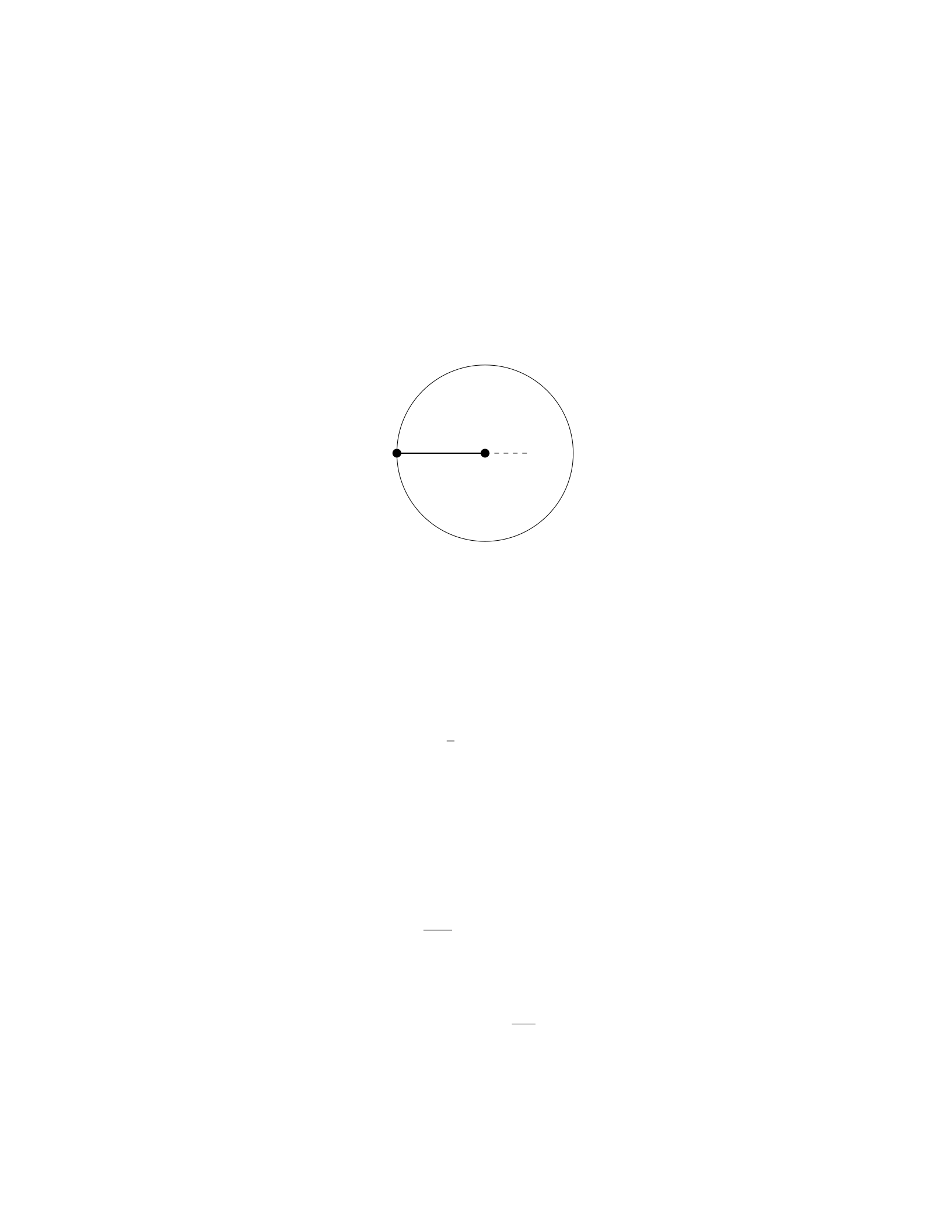
Question 33
Question
A block of mass mis released from rest at a height habove the ground on a
frictionless track that forms a loop-the-loop of radius R, as shown in the figure.
What is the minimum value of hsuch that the block will make it through the
loop without falling off, assuming the block remains in contact with the track
at all times?
h R
Solution
1. The minimum height hcan be found by setting the total mechanical energy
at the initial position equal to the total mechanical energy at the top of the loop.
At the initial position, the block has gravitational potential energy mgh, and
at the top of the loop, the block has kinetic energy and gravitational potential
energy. Since the track is frictionless, no non-conservative work is done.
Step 1: Write the conservation of mechanical energy equation:
mgh =1
2mv2+mg(2R)
where vis the velocity of the block at the top of the loop.
2. Using the conservation of mechanical energy equation, we can solve for
the velocity vof the block at the top of the loop. The velocity vmust be such
that the block does not lose contact with the track, meaning the normal force
must be sufficient to provide the centripetal force required to keep the block
moving in a circle of radius Rwith velocity v.
Step 2: Equate the centripetal force and the normal force:
mv2
R=mg +N
where Nis the normal force acting on the block at the top of the loop.
3. The normal force Ncan be found by considering the forces acting on the
block at the top of the loop. The forces include the force of gravity, mg, the
normal force, N, and the centripetal force, mv2
R. Then, write the equation of
motion perpendicular to the track at the top of the loop:
32

Step 3: Equate the forces perpendicular to the track at the top of the loop:
N−mg =mv2
R
4. Substitute the expression for Nfrom Step 2 into the equation from Step
3. Then solve for vand substitute back into the conservation of mechanical
energy equation from Step 1 to solve for h.
This will give the minimum height hneeded for the block to complete the
loop without falling off.
Question 34
Question
A 0.2 kg block is released from rest at the top of a frictionless incline that makes
an angle of 30 degrees with the horizontal. The block slides down the incline
and then comes to a stop after sliding a distance of 2.0 m on a rough horizontal
surface with a coefficient of kinetic friction of 0.1. What is the frictional force
acting on the block while it is sliding on the horizontal surface?
Solution
Step 1: First, we need to determine the speed of the block when it reaches
the bottom of the incline using conservation of mechanical energy. The total
mechanical energy at the top of the incline equals the total mechanical energy at
the bottom, neglecting any energy losses due to friction. The potential energy
at the top is converted to kinetic energy at the bottom. The equation for
conservation of mechanical energy is given by:
P Etop +KEtop =P Ebottom +KEbottom
At the top: P Etop =mgh = 0.2×9.81 ×2×sin 30 At the top: KEtop = 0
At the bottom: P Ebottom = 0 At the bottom: KEbottom =1
2mv2Setting the
potential energy at the top equal to the kinetic energy at the bottom:
mgh =1
2mv2
0.2×9.81 ×2×sin 30 = 1
2×0.2×v2
v=p(2 ×9.81 ×sin 30)
Step 2: Next, we calculate the frictional force acting on the block while it
is sliding on the horizontal surface. The frictional force can be calculated using
the formula:
ffriction =µk·N
33

where ffriction is the frictional force, µkis the coefficient of kinetic friction, and
Nis the normal force. The normal force Ncan be calculated by considering
forces in the vertical direction. Since the block is not accelerating in the vertical
direction, the normal force Nis equal in magnitude but opposite in direction
to the component of the gravitational force perpendicular to the incline.
N=mg cos 30
Step 3: Now, we calculate the frictional force:
ffriction = 0.1×mg cos 30
Question 35
Question
A 0.5 kg block is released from rest at a height of 2 m on a frictionless incline
that makes an angle of 30 degrees with the horizontal. Calculate the speed of
the block when it reaches the bottom of the incline.
Solution
Step 1: Identify the potential and kinetic energy at the initial and final points.
The initial point is when the block is at height h= 2 m, and the final point is
when the block is at the bottom of the incline. At the initial point: - Potential
energy: P Ei=mgh - Kinetic energy: KEi= 0 (the block is released from
rest) At the final point: - Potential energy: P Ef= 0 (at the bottom) - Kinetic
energy: KEf=1
2mv2(where vis the final velocity)
Step 2: Apply the conservation of mechanical energy.
According to the conservation of mechanical energy, the total mechanical energy
at the initial point is equal to the total mechanical energy at the final point.
P Ei+KEi=P Ef+KEf
mgh =1
2mv2
Step 3: Solve for the final velocity v.
Cancel out the mass mfrom both sides of the equation: gh =1
2v2
v2= 2gh
v=√2gh
Step 4: Substitute the given values and calculate the final velocity v.
Given: m= 0.5 kg, h= 2 m, g= 9.81 m/s2
v=√2×0.5×9.81 ×2
v=√19.62
v≈4.43 m/s
Therefore, the speed of the block when it reaches the bottom of the incline
is approximately 4.43 m/s.
34

where m= 0.5 kg and vis the velocity of the block just before it reaches the
ground.
Step 4: Equate the expressions for kinetic energy. Setting the expressions
for kinetic energy at the bottom of the incline equal to each other:
1
2mv2= 9.81
Step 5: Solve for the velocity of the block. Plugging in the values, we have:
1
2(0.5)v2= 9.81
1
2(0.5)v2= 9.81
0.25v2= 9.81
v2=9.81
0.25
v2= 39.24
v≈√39.24
v≈6.27 m/s
Therefore, the speed of the block just before it reaches the ground is approx-
imately 6.27 m/s.
Question 2
Question
A 0.5 kg block is released from rest at a height of 2 m above a spring with a
spring constant of 200 N/m. The block compresses the spring by 0.1 m when
it comes to momentarily at rest. Determine the maximum compression of the
spring if the coefficient of friction between the block and the surface is 0.2.
Solution
Step 1: Calculate the initial gravitational potential energy of the block. Let -
m= 0.5 kg (mass of the block), - g= 9.81 m/s2(acceleration due to gravity),
and - h= 2 m (initial height).
The initial potential energy (Ui) is given by:
Ui=mgh
Substitute the given values:
Ui= 0.5×9.81 ×2=9.81 J
2

Step 2: Calculate the final spring potential energy of the block. At maxi-
mum compression, the spring potential energy (Uf) will be equal to the initial
potential energy.
Uf=1
2kx2
where - k= 200 N/m (spring constant), and - xis the maximum compression.
Substitute the values and set Ui=Uf:
9.81 = 1
2×200 ×x2
9.81 = 100x2
x2= 0.0981
x=√0.0981
x0.3135 m
Therefore, the maximum compression of the spring is approximately 0.3135
m.
Question 3
Question
A 0.5 kg block is released from the top of a 3 m high frictionless ramp. The
block starts from rest. It slides down the ramp and then compresses a spring
of spring constant 200 N/m by 0.05 m. Find the maximum compression of the
spring when the block reaches it. Given: g= 9.8 m/s2
Solution
Step 1: Find the velocity of the block at the bottom of the ramp using conserva-
tion of mechanical energy. The total mechanical energy at the top of the ramp
will equal the total mechanical energy at the bottom of the ramp. At the top of
the ramp, the block only has gravitational potential energy which is converted
into kinetic energy at the bottom of the ramp. Let h= 3 m be the height of the
ramp from the top to the bottom. At the top: P E =mgh = 0.5·9.8·3 = 14.7
J At the bottom: KE =1
2mv2By conservation of energy: P Etop =KEbottom
0.5·9.8·3 = 1
2·0.5·v214.7=0.25v2v2= 58.8v=√58.8=7.67 m/s
Step 2: Calculate the compression of the spring when the block reaches it.
The mechanical energy at the bottom of the ramp is converted into potential
energy of the spring when the block compresses it. The potential energy stored
in the compressed spring is given by 1
2kx2, where kis the spring constant and
xis the compression. Using conservation of mechanical energy: KEbottom =
3

P Espring 1
2mv2=1
2kx20.5·0.5·7.672= 0.5·200 ·x218.64 = 100x2x2= 0.1864
x=√0.1864 = 0.432 m
Therefore, the maximum compression of the spring when the block reaches
it is 0.432 m.
Question 4
Question
A block of mass m= 2 kg is released from rest at a height h= 5 m above the
ground on a frictionless incline plane which makes an angle of 30◦with the
horizontal. Calculate the speed of the block just before it reaches the bottom
of the incline.
Solution
Step 1: The potential energy of the block at the initial position is converted
into kinetic energy at the bottom of the incline since no non-conservative forces
are acting on the block. Therefore, we can use the conservation of mechanical
energy. Step 2: The total mechanical energy Eat the top (Etop) is equal to the
total mechanical energy at the bottom (Ebottom). This can be expressed as:
Etop =Ebottom
Step 3: At the top of the incline, the block has gravitational potential energy,
which is converted to both kinetic and gravitational potential energy at the
bottom. Step 4: The initial gravitational potential energy is given by P Etop =
mgh, where m= 2 kg, g= 9.81 m/s2, and h= 5 m. Thus, P Etop = 2×9.81×5 J.
Step 5: The final mechanical energy is the sum of final kinetic and potential
energy, Ebottom =KEbottom +P Ebottom. Step 6: Since the block comes to rest
at the bottom, the final kinetic energy is zero. Therefore, Ebottom =P Ebottom.
Step 7: The final potential energy at the bottom of the incline is entirely in
the form of gravitational potential energy, given by P Ebottom =mgh′, where h′
is the height at the bottom. Step 8: The height at the bottom can be found
by considering the geometry of the incline. We have h′=h−hsin θ. Step
9: Substitute the values into the equation to find the final potential energy
P Ebottom. Step 10: Equate the initial and final mechanical energies and solve
for the speed of the block at the bottom using the kinetic energy formula KE =
1
2mv2.
Question 5
Question
A block of mass mis initially at rest at the top of a frictionless incline of height
hat an angle θ. The block slides down the incline and goes over a frictionless
4

loop-the-loop of radius Rwithout slipping. Determine the minimum height h
from which the block must be released so that it can successfully complete the
loop-the-loop without falling off. Assume the loop-the-loop is a perfect circle
and ignore air resistance.
Solution
Step 1: We first need to determine the minimum speed the block must have at
the top of the loop-the-loop in order for it to successfully complete the loop with-
out falling off. At the top of the loop, the normal force provides the centripetal
force required for circular motion. The net force is given by the difference be-
tween the gravitational force and the normal force. At the top of the loop, the
normal force is equal to zero since the block is momentarily weightless. Thus,
the net force is solely the gravitational force mg.
Step 2: The centripetal force required for circular motion is mv2
R, where v
is the speed of the block at the top of the loop-the-loop and Ris the radius of
the loop-the-loop. Setting these two forces equal to each other:
mg =mv2
R
v=pRg
Step 3: Next, we determine the height hfrom which the block must be
released so that it has this speed vat the top of the loop-the-loop. The total
mechanical energy of the block at the top of the incline is equal to the total
mechanical energy of the block at the top of the loop-the-loop.
Step 4: The initial mechanical energy of the block at the top of the incline
is purely potential energy:
P Ei=mgh
Step 5: The final mechanical energy of the block at the top of the loop-the-
loop is the sum of its potential and kinetic energies:
P Ef+KEf=mgh +1
2mv2
Step 6: Equating the initial and final energies:
mgh =mgh +1
2m(pRg)2
Step 7: Solving for h:
h=1
2R
Therefore, the minimum height from which the block must be released is
h=1
2R.
5

Question 6
Question
A 0.5 kg block is released from rest at a height of 2 meters on a frictionless track.
The block slides down the track and reaches the bottom, where it collides with
a horizontal spring with spring constant 200 N/m. The block compresses the
spring by 0.3 meters before momentarily stopping. Calculate the maximum
compression of the spring if the track is inclined at an angle of 30 degrees with
respect to the horizontal.
Solution
Step 1: The initial potential energy of the block is converted into a combination
of kinetic energy and spring potential energy at its maximum compression point.
Step 2: The initial potential energy of the block is given by P Ei=mgh.
Substituting the given values, we have P Ei= (0.5 kg)(9.81 m/s2)(2 m) = 9.81 J.
Step 3: At the point of maximum compression, the block momentarily stops
and all the initial potential energy is converted into spring potential energy.
Therefore, the potential energy at maximum compression is equal to the initial
potential energy: P Ei=P Ef.
Step 4: The final potential energy of the block-spring system is given by
P Ef=1
2kx2, where kis the spring constant and xis the spring compression.
Substituting the given values, we have P Ef=1
2(200 N/m)(0.3 m)2= 9 J.
Step 5: Setting the initial potential energy equal to the final potential en-
ergy, we have 9.81 = 9. Solving for the maximum compression x, we get
x=q2×9.81
200 ≈0.31 m.
Therefore, the maximum compression of the spring is approximately 0.31
meters.
Question 7
Question
A 2 kg block slides with an initial speed of 4 m/s on a frictionless horizontal
surface. The block encounters a rough slope inclined at an angle of 30 degrees
to the horizontal. The coefficient of kinetic friction between the block and the
slope is 0.2. How far up the slope will the block move before coming to rest?
Solution
Step 1: Calculate the change in height the block will move up before coming to
rest.
Given data: - Mass of the block, m= 2 kg - Initial speed of the block,
v0= 4 m/s - Inclined angle of the slope, θ= 30◦- Coefficient of kinetic friction,
µk= 0.2 - Acceleration due to gravity, g= 9.8 m/s2
6

We will first calculate the work done by friction to bring the block to a stop.
This work will be equal to the change in mechanical energy of the block.
Step 2: Calculate the work done by friction, Wfriction.
The work done by friction can be calculated using the formula:
Wfriction =−fk·d
Where: - fkis the kinetic frictional force, which is given by fk=µk·N, where
Nis the normal force. - dis the distance the block moves up the slope.
Step 3: Calculate the normal force, N, acting on the block.
The normal force acting on the block perpendicular to the slope is equal
in magnitude but opposite in direction to the y-component of the gravitational
force.
N=mg cos(θ)
Step 4: Calculate the work done by friction by substituting the expressions
for fkand Ninto the Work formula.
Step 5: Equate the work done by friction to the change in mechanical energy
of the block.
The change in mechanical energy of the block is given by:
∆KE + ∆P E =Wfriction
Where: - ∆KE is the change in kinetic energy. - ∆P E is the change in potential
energy. - Wfriction is the work done by friction.
Step 6: Calculate the change in kinetic energy, ∆KE, and potential energy,
∆P E, of the block.
The change in kinetic energy is equal to the initial kinetic energy of the
block:
∆KE =1
2mv2
0
The change in potential energy is due to the block moving up the slope:
∆P E =mgh
Step 7: Put the expressions for ∆KE and ∆P E into the conservation of
energy equation.
Step 8: Solve for the height, h, the block moves up the slope before coming
to rest.
Question 8
Question
A block of mass m= 2 kg is attached to a spring with force constant k= 200
N/m. The block is released from rest when the spring is compressed by 0.1 m.
What is the maximum speed of the block as it oscillates back and forth?
7

Solution
Step 1: Find the spring potential energy when the block is released.
The spring potential energy stored in the spring when it is compressed by
0.1 m is given by:
P Espring =1
2kx2
where k= 200 N/m and x= 0.1 m. Therefore,
P Espring =1
2×200 ×(0.1)2= 1 J
Step 2: Find the maximum kinetic energy of the block.
At the maximum compression, all the spring potential energy has been con-
verted into kinetic energy. Therefore, the maximum kinetic energy of the block
is equal to the initial potential energy stored in the spring. Thus,
K.Emax =P Espring = 1 J
Step 3: Find the maximum speed of the block.
The kinetic energy of the block is given by:
KE =1
2mv2
where m= 2 kg. We know that when KE = 1 J, then
1 = 1
2×2×v2
v2=1
1
v= 1 m/s
Therefore, the maximum speed of the block as it oscillates back and forth is
1 m/s.
Question 9
Question
A 2 kg block is released from rest at a height of 5 m above the ground. The block
slides down a frictionless incline that makes an angle of 30◦with the horizontal.
Determine the speed of the block just before it reaches the ground.
8

Solution
Step 1: First, we need to determine the final height of the block above the
ground. Given: - Mass of the block, m= 2 kg - Initial height, hi= 5 m -
Inclined angle, θ= 30◦
The final height of the block above the ground can be found using trigonom-
etry:
hf=hi−dsin(θ)
hf= 5 −dsin(30◦)
hf= 5 −d×1
2
Step 2: Next, we can determine the distance the block slides down the incline.
Since the block slides without friction, the work done by the gravitational force
is equal to the change in mechanical energy:
mghi=1
2mv2+mghf
Solving for d:
mg ×5 = 1
2mv2+mg ×(5 −d×1
2)
5g=1
2v2+g×(5 −d
2)
Step 3: Finally, we can find the speed of the block just before it reaches the
ground. The block’s speed just before reaching the ground can be found using
the principle of conservation of mechanical energy:
1
2mv2=mghf
Solving for v:
v=p2ghf
Now, substitute the expression for hfinto the equation and solve for the
final speed.
Question 10
Question
A block of mass mis attached to a spring with spring constant kand is set into
oscillatory motion on a frictionless surface. At a certain moment, the block has
a maximum speed of v0when passing through the equilibrium position. What
is the amplitude of the oscillation in terms of v0,m, and k?
9

Solution
1. Let Abe the amplitude of the oscillation. At the equilibrium position, the
block will have its maximum kinetic energy and zero potential energy. The total
energy at this position is given by the sum of kinetic and potential energy:
Etotal =1
2mv2
0+1
2kA2=1
2kA2=1
2mv2
0
2. The amplitude of oscillation is then:
A=rmv2
0
k
Question 11
Question
A 0.5 kg block is released from rest at a height of 2 meters above the ground on
a frictionless incline plane that makes an angle of 30 degrees with the horizontal.
The block slides down the incline and reaches the bottom. What is the speed
of the block when it reaches the bottom of the incline?
Solution
Step 1: We will start the problem by calculating the gravitational potential
energy of the block at the initial position:
P Ei=mgh = (0.5 kg)(9.81 m/s2)(2 m)
P Ei= 9.81 J
Step 2: Next, we will calculate the kinetic energy of the block at the bottom
of the incline using conservation of mechanical energy:
KEi+P Ei=KEf+P Ef
Since the block starts from rest, its initial kinetic energy is 0. At the bottom,
all the potential energy is converted into kinetic energy:
P Ei=KEf
9.81 J = 1
2mv2
f
Step 3: Using the mass of the block and solving for the final velocity:
vf=r2×9.81
0.5
vf=√39.24
vf≈6.27 m/s
Therefore, the speed of the block when it reaches the bottom of the incline
is approximately 6.27 m/s.
10

Question 12
Question
A block of mass mis attached to a spring with spring constant kand is initially
stretched a distance Afrom the equilibrium position. The block is released
from rest and oscillates back and forth. At what distance from the equilibrium
position will the block have half its initial kinetic energy?
Solution
Step 1: We know that the total mechanical energy of the block-spring system
is conserved, so we can set the initial mechanical energy equal to the final
mechanical energy.
Step 2: The initial mechanical energy is the sum of the potential energy due
to the spring being stretched and the kinetic energy when the block is released
from rest:
Einitial =1
2kA2
Step 3: The final mechanical energy when the block has half its initial kinetic
energy is a combination of potential energy and kinetic energy. Let the block’s
displacement from the equilibrium position at this point be denoted as x.
Efinal =1
2kx2+1
2mv2
Step 4: Since the block will have half its initial kinetic energy at this point,
we can write: 1
2mv2=1
4mv2
initial =1
4(kA2)
Step 5: We can also relate the velocity of the block to its position using
conservation of mechanical energy:
Einitial =Efinal
1
2kA2=1
2kx2+1
4(kA2)
Step 6: Solving for x, we find:
x=r3
4A
Therefore, the block will have half its initial kinetic energy at a distance of
q3
4Afrom the equilibrium position.
11

Question 13
Question
A 0.1 kg block is attached to a spring with spring constant 100 N/m along a
horizontal, frictionless surface. The block is pulled 20 cm from its equilibrium
position and released from rest. Find the maximum speed of the block.
Solution
Step 1: Find the total mechanical energy of the block-spring system when the
block is released. Let xbe the displacement of the block from its equilibrium
position. The total mechanical energy of the block-spring system is the sum of
the kinetic energy (K) and the potential energy (U) at any point:
E=K+U
where
K=1
2mv2
and
U=1
2kx2
where mis the mass of the block, vis the velocity of the block, and kis the
spring constant.
Step 2: Calculate the potential energy at the maximum displacement (20
cm). When the block is pulled 20 cm from its equilibrium position, the potential
energy is at its maximum. Therefore, at x= 0.2 m,
U=1
2k(0.2)2
Step 3: Calculate the kinetic energy at the equilibrium position. When the
block is released from rest, the kinetic energy is zero. Therefore, at x= 0,
K=1
2m(0)2
Step 4: Find the total mechanical energy at the maximum displacement. At
the maximum displacement, the total mechanical energy is equal to the potential
energy. Therefore,
E=1
2k(0.2)2
Step 5: Calculate the maximum speed of the block. At the maximum dis-
placement, all of the potential energy has been converted to kinetic energy.
Therefore, at the maximum displacement,
E=K
K=1
2mv2
max
Solve this equation for vmax to find the maximum speed of the block.
12

Question 14
Question
A 2 kg block is attached to an ideal spring with a spring constant of 400 N/m.
The block is released from rest when the spring is compressed 20 cm. What
is the maximum speed of the block when the spring returns to its equilibrium
position? Neglect any friction or air resistance.
Solution
To find the maximum speed of the block, we can use the conservation of me-
chanical energy principle. When the block is released, the initial mechanical
energy is stored in the spring potential energy, and it will convert to kinetic
energy at the equilibrium position.
Step 1: Calculate the initial potential energy stored in the spring. The
potential energy stored in the spring when compressed is given by P E =1
2kx2,
where kis the spring constant (400 N/m) and xis the compression (0.20 m).
Thus,
P E =1
2×400 ×(0.20)2= 8 J
Step 2: Calculate the maximum kinetic energy of the block at the equi-
librium position. Since energy is conserved, the potential energy stored in the
spring will convert entirely into kinetic energy at the equilibrium position. Thus,
P E =KE.
Step 3: Calculate the maximum speed of the block at the equilibrium
position. The kinetic energy of the block is given by KE =1
2mv2, where m
is the mass of the block (2 kg) and vis the speed of the block. Equating the
potential energy at compression to the kinetic energy at equilibrium:
1
2kx2=1
2mv2
8 = 1
2×2×v2
v2= 8
v=√8≈2.83 m/s
Therefore, the maximum speed of the block when the spring returns to its
equilibrium position is approximately 2.83 m/s.
Question 15
Question
A 0.5 kg object is attached to a light spring with force constant 200 N/m and
undergoes simple harmonic motion along the x-axis. At the equilibrium position,
13

the object has a speed of 0.5 m/s. If the object is released from a position 0.1
m from the equilibrium position, determine the maximum speed of the object
during its motion.
Solution
Step 1: To find the maximum speed of the object during its motion, we will use
the conservation of mechanical energy.
Step 2: The total mechanical energy of the system is given by the sum of
the kinetic energy and potential energy:
E=KE +P E
Step 3: At the equilibrium position, the object has a speed of 0.5 m/s. Since
the object is at rest when it is 0.1 m from the equilibrium position, the total
mechanical energy at that position is solely potential energy:
E=P E =1
2kx2
Step 4: We can find the potential energy at the initial position by substitut-
ing the given values into the equation:
E=1
2×200 ×0.12= 1 J
Step 5: The maximum speed occurs when all the potential energy is con-
verted into kinetic energy. At this point, the potential energy is 0 and the total
mechanical energy is entirely kinetic energy:
E=KE =1
2mv2
Step 6: Equating the initial potential energy to the final kinetic energy and
solving for the maximum speed, we have:
1 = 1
2×0.5×v2
v2= 4
v= 2 m/s
Step 7: Therefore, the maximum speed of the object during its motion is 2
m/s.
Question 16
Question
A block of mass mis attached to a spring of spring constant kand is initially
compressed a distance xfrom the equilibrium position. The block is released
from rest and oscillates back and forth. At what distance from the equilibrium
position is the block’s speed maximum?
14

Solution
Let’s denote the equilibrium position as x= 0 and the position where the block’s
speed is maximum as x′.
Step 1: Determine the total mechanical energy of the system at the initial
position. The total mechanical energy of the system is the sum of the kinetic
energy and the potential energy:
E=K+U
At the initial position (x=x), the block has no kinetic energy as it is at rest.
The potential energy stored in the compressed spring is given by:
U=1
2kx2
Therefore, the total mechanical energy at the initial position is:
Einitial =U=1
2kx2
Step 2: Determine the total mechanical energy of the system at the position
x′where the speed of the block is maximum. At the position x′, the block will
have purely kinetic energy and no potential energy since it has moved away from
the spring’s equilibrium position. The total mechanical energy here is:
Eposition x′=K=1
2mv2
where vis the speed of the block at position x′.
Step 3: Apply the conservation of mechanical energy to find the position
x′where the block’s speed is maximum. Since mechanical energy is conserved
in the absence of non-conservative forces, we have:
Einitial =Eposition x′
1
2kx2=1
2mv2
kx2=mv2
Step 4: Find the position x′where the block’s speed is maximum. The
speed of the block at position x′can be expressed in terms of xby using the
fact that the total mechanical energy is conserved:
v2=kx2
m
v=rkx2
m
15

Since the speed is maximum at x′, this is when the block has moved the furthest
away from the equilibrium position. Therefore, the block’s speed is maximum
at:
x′=rmv2
k=rmkx2
k2=mx
k
So, the block’s speed is maximum at a distance x′=mx
kfrom the equilibrium
position.
Question 17
Question
A block of mass mslides down a frictionless incline of height h. At the bottom
of the incline, the block slides onto a horizontal surface and comes to a stop after
traveling a distance d. Determine the coefficient of kinetic friction between the
block and the horizontal surface.
Solution
Step 1: Find the speed of the block at the bottom of the incline using conserva-
tion of mechanical energy. The initial mechanical energy of the block at the top
of the incline is converted to kinetic energy and gravitational potential energy
at the bottom. At the top, the block has only potential energy:
P Etop =mgh
At the bottom, the block has kinetic energy and potential energy:
KEbottom =1
2mv2
P Ebottom = 0
By conservation of mechanical energy:
P Etop =KEbottom +P Ebottom
mgh =1
2mv2
v=p2gh
Step 2: Calculate the work done by friction as the block slides along the
horizontal surface. The work done by friction is given by:
Wfriction =µkNd
where µkis the coefficient of kinetic friction and Nis the normal force. The
normal force is equal in magnitude to the gravitational force acting on the block:
N=mg
16

Step 3: Apply the work-energy principle to find the coefficient of kinetic
friction. The work done by friction is equal to the change in kinetic energy of
the block:
Wfriction =KEfinal −KEinitial
µkmgd = 0 −1
2mv2
Plugging in the expression for v:
µkmgd =−1
2m(2gh)
µk=−gh
2gd
µk=−h
2d
Therefore, the coefficient of kinetic friction between the block and the hori-
zontal surface is h
2d.
Question 18
Question
A 2 kg block is at rest on a frictionless horizontal surface. A spring with a
spring constant of 400 N/m is attached to the block. The spring is compressed
by 0.1 m and then released. What is the maximum speed of the block after the
spring is released?
Solution
Step 1: Find the potential energy stored in the spring when it is compressed
by 0.1 m. Step 2: Use conservation of mechanical energy to find the maximum
speed of the block after the spring is released.
Step 1: The potential energy stored in the spring is given by the formula:
P E =1
2kx2
where: k= 400 N/m (spring constant) and x= 0.1 m (compression of the
spring).
Substitute the values into the formula:
P E =1
2×400 N/m ×(0.1 m)2
P E =1
2×400 N/m ×0.01 m2
P E = 2 J
17

The potential energy stored in the spring is 2 Joules.
Step 2: At the maximum speed of the block, all the potential energy stored
in the spring will be converted into kinetic energy. Therefore, we can set the
initial potential energy equal to the final kinetic energy:
P E =KE
The kinetic energy of the block is given by:
KE =1
2mv2
where: m= 2 kg (mass of the block) and vis the maximum speed of the block.
Equating PE to KE:
2 J = 1
2×2 kg ×v2
2 J = v2
v=√2 m/s
Therefore, the maximum speed of the block after the spring is released is
√2 m/s or approximately 1.41 m/s.
Question 19
Question
A block of mass mis attached to a spring with force constant kon a frictionless
horizontal surface. Initially, the spring is compressed a distance x0and the
block is released from rest. What is the maximum distance the block will travel
to the right before coming to rest?
Solution
Step 1: We can begin by finding the initial potential energy stored in the spring
when it is compressed a distance x0.
Uspring =1
2kx2
0
Step 2: At the block’s maximum displacement xmax, all of the spring’s po-
tential energy has been converted into kinetic energy.
Kmax =Uspring
1
2mv2
max =1
2kx2
0
18

Step 3: We can express the final velocity of the block when it reaches xmax
using conservation of mechanical energy.
1
2mv2
max =1
2kx2
0
1
2mv2
max =1
2kx2
max
Step 4: Since the block comes to rest at xmax, the kinetic energy at this
point is zero.
Kmax =0=1
2mv2
max
Step 5: Solving the previous equations, we find the maximum distance the
block will travel to the right.
xmax =x0
Question 20
Question
A 2 kg block is released from rest at a height of 5 m above the ground. The
block slides down a frictionless incline that makes an angle of 30 degrees with
the horizontal. What is the speed of the block just before it reaches the ground?
Solution
Step 1: Find the gravitational potential energy at the initial position. The
gravitational potential energy at the initial position is given by:
P Einitial =mgh
where mis the mass of the block, gis the acceleration due to gravity, and his
the initial height. Given that m= 2 kg, g= 9.81 m/s2, and h= 5 m, we have:
P Einitial = 2 ×9.81 ×5 = 98.1 J
Step 2: Find the kinetic energy at the final position. As the block slides down
the incline, the gravitational potential energy is converted to kinetic energy just
before reaching the ground. The total mechanical energy is conserved, so the
sum of the kinetic and potential energies at the final position is equal to the
initial potential energy. Therefore, the kinetic energy just before reaching the
ground is:
KEf inal =P Einitial
KEf inal = 98.1 J
19

Step 3: Find the speed of the block just before it reaches the ground. The
kinetic energy at the final position is given by:
KEf inal =1
2mv2
Solving for v:
98.1 = 1
2×2×v2
98.1 = v2
v=√98.1≈9.91 m/s
Therefore, the speed of the block just before it reaches the ground is approx-
imately 9.91 m/s.
Question 21
Question
A block of mass mis released from rest at a height habove the ground on a
frictionless incline of angle θwith the horizontal. The block reaches the bottom
of the incline and then slides on a rough horizontal surface with coefficient of
kinetic friction µk. What is the distance the block travels on the horizontal
surface before coming to rest?
Solution
Step 1: Let’s first calculate the speed of the block at the bottom of the incline
using conservation of mechanical energy. The potential energy at the initial
position (at height h) is converted to kinetic energy at the bottom of the incline.
The potential energy at height his given by mgh, where gis the acceleration due
to gravity. The kinetic energy at the bottom of the incline is given by 1
2mv2.
Therefore, we have mgh =1
2mv2. Canceling out mfrom both sides, we get
gh =1
2v2. So, the speed of the block at the bottom of the incline is v=√2gh.
Step 2: Next, we need to calculate the distance the block travels on the
horizontal surface before coming to rest. The work done by friction on the
block is equal to the initial mechanical energy (potential energy) of the block.
The work done by friction is given by −µkmgd, where dis the distance traveled
on the horizontal surface. Setting the work done by friction equal to the initial
potential energy:
−µkmgd =mgh
Solving for d, we get:
d=gh
µkg=h
µk
20

Therefore, the distance the block travels on the horizontal surface before
coming to rest is h
µk.
Question 22
Question
A 0.5 kg block is released from rest at a height of 2 meters above the ground.
The block slides down a frictionless incline that makes an angle of 30 degrees
with the horizontal. What is the speed of the block just before it reaches the
ground? (Assume g = 9.81 m/s2)
Solution
Step 1: Calculate the initial potential energy of the block.
P Ei=mgh
P Ei= (0.5 kg)(9.81 m/s2)(2 m)
P Ei= 9.81 J
Step 2: Calculate the final kinetic energy of the block just before reaching
the ground.
KEf=1
2mv2
Step 3: Calculate the final potential energy of the block.
P Ef= 0
Since the block is at ground level.
Step 4: Since no non-conservative forces are doing work on the block, the
total mechanical energy of the block is conserved.
P Ei+KEi=P Ef+KEf
mgh =1
2mv2
gh =1
2v2
v=p2gh
Step 5: Substitute the values and calculate the speed.
v=q2(9.81 m/s2)(2 m)
v=p39.24 m2/s2
v≈6.27 m/s
21

Question 23
Question
A 0.5 kg block is released from rest at a height of 2 m above the ground on a
frictionless track. The block slides down the track and reaches the bottom of
the incline. What will be the speed of the block at the bottom of the incline?
Solution
Step 1: Determine the initial potential energy of the block. At the initial height
h= 2 m, the potential energy of the block is given by:
P Ei=mgh
where mis the mass of the block, gis the acceleration due to gravity
(9.81 m/s2), and his the initial height.
Plugging in the values, we get:
P Ei= 0.5×9.81 ×2
P Ei= 9.81 J
Step 2: Determine the final kinetic energy of the block. At the bottom
of the incline, all of the initial potential energy is converted to kinetic energy.
Therefore, the final kinetic energy of the block can be calculated as:
KEf=P Ei
KEf= 9.81 J
Step 3: Calculate the speed of the block at the bottom of the incline. The
kinetic energy of an object is given by:
KE =1
2mv2
where mis the mass of the object and vis its speed.
Setting the final kinetic energy equal to the kinetic energy equation, we have:
9.81 = 1
2×0.5×v2
Solving for v, we get:
v=r2×9.81
0.5
v≈√39.24
v≈6.27 m/s
Therefore, the speed of the block at the bottom of the incline is approxi-
mately 6.27 m/s.
22

Question 24
Question
A block of mass mis placed on a frictionless incline that makes an angle θwith
the horizontal. The block is released from rest at a height habove the base of
the incline. What is the speed of the block at the bottom of the incline? You
may assume the block is a distance dfrom the base of the incline at this point.
Solution
Step 1: To find the speed of the block at the bottom of the incline, we can
use the conservation of mechanical energy. The total mechanical energy of the
block at the initial position is equal to the total mechanical energy at the final
position. This can be written as:
Ki+Ui=Kf+Uf
Where Kiand Kfare the initial and final kinetic energies of the block, and
Uiand Ufare the initial and final gravitational potential energies of the block.
Step 2: At the initial position, all of the energy is in the form of gravitational
potential energy. The initial gravitational potential energy (Ui) is given by:
Ui=mgh
At the final position, the block has both kinetic and potential energy. The
final gravitational potential energy (Uf) is given by:
Uf=mgh cos θ
Step 3: The final kinetic energy (Kf) can be written in terms of the speed
of the block vas:
Kf=1
2mv2
The initial kinetic energy (Ki) is zero since the block is released from rest.
Step 4: Substituting these expressions into the conservation of mechanical
energy equation gives:
mgh =1
2mv2+mgh cos θ
Solving for vgives:
v=p2gh(1 −cos θ)
So, the speed of the block at the bottom of the incline is p2gh(1 −cos θ).
23

Question 25
Question
A block of mass mis released from rest at a height habove the ground on a
frictionless inclined plane that makes an angle θwith the horizontal. The block
slides down the incline and then compresses a spring of spring constant kat
the bottom of the incline. The compression of the spring is ∆x. What is the
maximum compression of the spring in terms of m,h,k, and g?
Solution
Step 1: Determine the velocity of the block when it reaches the spring. The
block starts from rest at a height habove the ground, so its initial potential
energy is Uinitial =mgh and its initial kinetic energy is Kinitial = 0. When the
block reaches the spring, its height above the ground is 0, so its final potential
energy is Ufinal = 0. Let the maximum compression of the spring be xmax.
The final kinetic energy of the block is given by Kfinal =1
2mv2, where vis the
velocity of the block when it reaches the spring.
Using the conservation of mechanical energy,
Uinitial +Kinitial =Ufinal +Kfinal
mgh =1
2mv2
v=p2gh
Step 2: Calculate the compression of the spring. The work done by the
spring is equal to the decrease in the potential and kinetic energy of the block.
Therefore, 1
2kx2=mgh −1
2mv2
1
2kx2
max =mgh −1
2m(2gh)
1
2kx2
max =mgh
Therefore, the maximum compression of the spring is given by
xmax =r2mgh
k
Question 26
Question
A 0.5 kg block is released from rest at a height of 3 m on a frictionless track.
The block slides down the track until it reaches the bottom and continues on a
24

rough horizontal surface. If the coefficient of kinetic friction between the block
and the surface is 0.2, determine the distance traveled by the block on the rough
surface before coming to rest.
Solution
Step 1: Find the speed of the block at the bottom of the ramp.
The initial potential energy of the block is converted to kinetic energy at the
bottom of the ramp.
mgh =1
2mv2
Where: - m= 0.5 kg (mass of the block) - g= 9.81 m/s2(acceleration due
to gravity) - h= 3 m (height of the ramp) - vis the speed of the block at the
bottom
0.5×9.81 ×3 = 1
2×0.5×v2
14.715 = 0.25v2
v2= 58.86
v≈7.67 m/s
Step 2: Find the distance traveled on the rough surface.
The friction force will act in the opposite direction of motion. The work
done by friction is equal to the change in mechanical energy of the block.
−Wfriction = ∆KE
−µmgd =1
2mv2
−0.2×0.5×9.81 ×d=1
2×0.5×(7.67)2
−4.905d= 14.715
d=14.715
4.905
d≈3 m
Therefore, the block travels 3 meters on the rough surface before coming to
rest.
Question 27
Question
A 2 kg block is attached to a horizontal spring with a spring constant of 200 N/m.
The block is initially at its equilibrium position. The spring is compressed by
0.1 m and released, causing the block to start oscillating back and forth. What
is the maximum speed of the block during its oscillation?
25

Solution
Step 1: First, we need to find the maximum potential energy stored in the spring
when it is compressed by 0.1 m. The potential energy stored in a spring is given
by:
P E =1
2kx2
where kis the spring constant and xis the compression (0.1 m in this case).
Step 2: Substitute the given values into the formula:
P E =1
2×200 N/m ×(0.1 m)2= 1 J
Step 3: By the conservation of mechanical energy, at the maximum com-
pression, all the potential energy is converted into kinetic energy. Therefore,
the maximum kinetic energy of the block is equal to the maximum potential
energy stored in the spring.
Step 4: The kinetic energy of an object is given by:
KE =1
2mv2
where mis the mass of the block and vis the velocity.
Step 5: Equate the kinetic energy to the potential energy:
1
2mv2= 1 J
Step 6: Substitute the mass of the block (m= 2 kg) into the equation:
1
2×2 kg ×v2= 1 J
Step 7: Solve for the velocity v:
v2=1 J
1 kg = 0.5 m2/s2
v=√0.5 m/s ≈0.71 m/s
Therefore, the maximum speed of the block during its oscillation is approx-
imately 0.71 m/s.
Question 28
Question
A block of mass mis placed on a frictionless incline with an angle θ. The block
is released from rest at a height habove the ground. Find the velocity of the
block just before it reaches the ground.
26

Solution
Let’s denote the initial gravitational potential energy of the block at height h
as Ui, and the kinetic energy of the block just before it reaches the ground as
Kf. Due to conservation of mechanical energy, we have Ui=Kf.
Step 1: Determine the initial gravitational potential energy Ui. The initial
height of the block is h, so the initial gravitational potential energy is given by
Ui=mgh
Step 2: Determine the final kinetic energy Kf. The final kinetic energy of
the block is given by
Kf=1
2mv2
Step 3: Set up the conservation of mechanical energy equation. Since
mechanical energy is conserved, we have
Ui=Kf
mgh =1
2mv2
Step 4: Solve for the final velocity v. Canceling out the mass mand
rearranging the equation, we get
gh =1
2v2
v2= 2gh
v=p2gh
Therefore, the velocity of the block just before it reaches the ground is √2gh.
Question 29
Question
A 0.5 kg block is released from rest at a height of 2 meters above the ground
on a frictionless incline that makes an angle of 30◦with the horizontal. What
is the speed of the block just before it reaches the ground?
Solution
Step 1: First, we will calculate the potential energy of the block when it is at
the initial height. The gravitational potential energy is given by the formula:
P E =mgh
27

where mis the mass of the block, gis the acceleration due to gravity, and his
the height. Given that m= 0.5 kg, g= 9.8 m/s2, and h= 2 m, we have:
P E = (0.5 kg)(9.8 m/s2)(2 m) = 9.8 J
Step 2: Next, we will calculate the kinetic energy of the block just before
it reaches the ground. Since there is no friction, the mechanical energy of the
block is conserved. The total mechanical energy at the initial height is equal
to the total mechanical energy just before it reaches the ground. The total
mechanical energy at the initial height is the sum of the potential energy and
the initial kinetic energy, which is zero. When the block reaches the ground,
all the potential energy has been converted to kinetic energy. Therefore, the
kinetic energy just before it reaches the ground is equal to the initial potential
energy:
KE = 9.8 J
Step 3: We will use the formula for kinetic energy to find the speed of the
block. The kinetic energy of an object is given by the formula:
KE =1
2mv2
where mis the mass of the object and vis its speed. Given that KE = 9.8 J
and m= 0.5 kg, we can solve for v:
9.8 = 1
2(0.5)v2
v2=9.8×2
0.5
v2= 39.2
v=√39.2
v≈6.26 m/s
Therefore, the speed of the block just before it reaches the ground is approx-
imately 6.26 m/s.
Question 30
Question
A mass mis attached to a spring with spring constant kand is initially com-
pressed a distance x0from the equilibrium position. The mass is released from
rest and oscillates back and forth.
At what point in the oscillation does the kinetic energy equal three times
the potential energy?
28

Solution
Let’s denote the equilibrium position as x= 0. The total mechanical energy
of the mass-spring system is conserved and given by the sum of its kinetic and
potential energies:
E=1
2kx2+1
2mv2
where xis the displacement from equilibrium and vis the velocity of the
mass.
At any point in the oscillation, the total mechanical energy Eis constant
and can be written in terms of the initial conditions:
E=1
2kx2
0=1
2mdx
dt 2
Now, we can express the kinetic energy Kand potential energy Uin terms
of xby using the equation for total mechanical energy:
K=1
2mdx
dt 2
and U=1
2kx2
We are looking for the point at which the kinetic energy is three times the
potential energy:
K= 3U=⇒1
2mdx
dt 2
= 3 1
2kx2
This can be rewritten as:
dx
dt 2
= 6 k
mx2
Now, we can solve this differential equation to find the relationship between
xand tfor the point where kinetic energy equals three times the potential
energy.
Question 31
Question
A 0.2 kg ball is tied to a string and is swung in a vertical circle with a radius of
1.5 m. At the top of its path, the tension in the string is 12 N. Find the speed
of the ball at the top and at the bottom of the circle.
29

Solution
Step 1: Find the speed of the ball at the top of the circle.
The forces acting on the ball at the top of the circle are the tension (T) and
the weight (mg). The net force towards the center of the circle is given by:
XFnet =T−mg.
At the top of the circle, the net force provides the centripetal force:
T−mg =mv2
top
r,
where vtop is the speed of the ball at the top and ris the radius of the circle.
Given that T= 12 N, m= 0.2 kg, g= 9.8 m/s2, and r= 1.5 m, we can
solve for vtop:
12 −(0.2)(9.8) = (0.2)v2
top
1.5,
2.04 = 0.2v2
top
1.5,
v2
top = 15.3,
vtop ≈3.9 m/s.
Therefore, the speed of the ball at the top of the circle is approximately
3.9 m/s.
Step 2: Find the speed of the ball at the bottom of the circle.
At the bottom of the circle, the tension and weight still act on the ball. The
net force towards the center of the circle is given by:
XFnet =T+mg =mv2
bottom
r.
Substituting the known values, we have:
12 + (0.2)(9.8) = (0.2)(vbottom)2
1.5,
12 + 1.96 = 0.2(vbottom)2
1.5,
13.96 = 0.2(vbottom)2
1.5,
(vbottom)2≈139.6,
vbottom ≈11.8 m/s.
Therefore, the speed of the ball at the bottom of the circle is approximately
11.8 m/s.
30

Question 32
Question
A block of mass mis released from rest at a height hon a frictionless incline plane
inclined at an angle θwith the horizontal. The block slides down the incline
and reaches a height of h/2 below its initial position. What is the coefficient of
kinetic friction between the block and the incline?
Solution
Step 1: We can start by analyzing the initial and final potential energies of the
block. The initial potential energy is given by P Ei=mgh where his the initial
height, while the final potential energy is P Ef=mgh/2.
Step 2: The initial kinetic energy of the block is zero since it is released from
rest. The final kinetic energy can be expressed as KEf=1
2mv2, where vis the
velocity of the block when it reaches a height of h/2.
Step 3: The work done by all forces acting on the block can be expressed as
W=KEf−KEi. Since the block is sliding on a frictionless incline plane, the
only force doing work is the force of kinetic friction.
Step 4: The work done by the force of kinetic friction is given by the formula
fk·d·cos(θ), where fkis the force of kinetic friction, dis the distance traveled
by the block, and θis the angle of the incline.
Step 5: By applying the conservation of mechanical energy, we can equate
the work done by the force of kinetic friction to the change in kinetic energy.
This gives us fk·d·cos(θ) = 1
2mv2.
Step 6: Since the incline is frictionless, the normal force Nis equal in magni-
tude to the component of the block’s weight perpendicular to the incline. This
can be expressed as N=mg cos(θ).
Step 7: The force of kinetic friction can be expressed as fk=µkN, where
µkis the coefficient of kinetic friction. Substituting this into the work equation,
we get µkmgd cos(θ) = 1
2mv2.
Step 8: We can rewrite the distance das h−h/2 = h/2, the height difference
between the start and end points. Substituting this into the equation, we get
µkmg(h/2) cos(θ) = 1
2mv2.
Step 9: Simplifying the equation, we find µk=v2
2g(h/2) cos(θ). We can solve
for vusing kinematic equations of motion.
Step 10: At the final height of h/2 below the initial position, the gravitational
potential energy is completely converted to kinetic energy. Thus, mgh/2 =
1
2mv2.
Step 11: Solving for vgives v=√gh. Substituting this back into the
equation for µk, we get µk=(gh)2
2gh(h/2) cos(θ).
Step 12: Finally, we simplify the expression to find µk=h
2 cos(θ). Therefore,
the coefficient of kinetic friction between the block and the incline is h
2 cos(θ).
31
Question 33
Question
A block of mass mis released from rest at a height habove the ground on a
frictionless track that forms a loop-the-loop of radius R, as shown in the figure.
What is the minimum value of hsuch that the block will make it through the
loop without falling off, assuming the block remains in contact with the track
at all times?
h R
Solution
1. The minimum height hcan be found by setting the total mechanical energy
at the initial position equal to the total mechanical energy at the top of the loop.
At the initial position, the block has gravitational potential energy mgh, and
at the top of the loop, the block has kinetic energy and gravitational potential
energy. Since the track is frictionless, no non-conservative work is done.
Step 1: Write the conservation of mechanical energy equation:
mgh =1
2mv2+mg(2R)
where vis the velocity of the block at the top of the loop.
2. Using the conservation of mechanical energy equation, we can solve for
the velocity vof the block at the top of the loop. The velocity vmust be such
that the block does not lose contact with the track, meaning the normal force
must be sufficient to provide the centripetal force required to keep the block
moving in a circle of radius Rwith velocity v.
Step 2: Equate the centripetal force and the normal force:
mv2
R=mg +N
where Nis the normal force acting on the block at the top of the loop.
3. The normal force Ncan be found by considering the forces acting on the
block at the top of the loop. The forces include the force of gravity, mg, the
normal force, N, and the centripetal force, mv2
R. Then, write the equation of
motion perpendicular to the track at the top of the loop:
32

Step 3: Equate the forces perpendicular to the track at the top of the loop:
N−mg =mv2
R
4. Substitute the expression for Nfrom Step 2 into the equation from Step
3. Then solve for vand substitute back into the conservation of mechanical
energy equation from Step 1 to solve for h.
This will give the minimum height hneeded for the block to complete the
loop without falling off.
Question 34
Question
A 0.2 kg block is released from rest at the top of a frictionless incline that makes
an angle of 30 degrees with the horizontal. The block slides down the incline
and then comes to a stop after sliding a distance of 2.0 m on a rough horizontal
surface with a coefficient of kinetic friction of 0.1. What is the frictional force
acting on the block while it is sliding on the horizontal surface?
Solution
Step 1: First, we need to determine the speed of the block when it reaches
the bottom of the incline using conservation of mechanical energy. The total
mechanical energy at the top of the incline equals the total mechanical energy at
the bottom, neglecting any energy losses due to friction. The potential energy
at the top is converted to kinetic energy at the bottom. The equation for
conservation of mechanical energy is given by:
P Etop +KEtop =P Ebottom +KEbottom
At the top: P Etop =mgh = 0.2×9.81 ×2×sin 30 At the top: KEtop = 0
At the bottom: P Ebottom = 0 At the bottom: KEbottom =1
2mv2Setting the
potential energy at the top equal to the kinetic energy at the bottom:
mgh =1
2mv2
0.2×9.81 ×2×sin 30 = 1
2×0.2×v2
v=p(2 ×9.81 ×sin 30)
Step 2: Next, we calculate the frictional force acting on the block while it
is sliding on the horizontal surface. The frictional force can be calculated using
the formula:
ffriction =µk·N
33

where ffriction is the frictional force, µkis the coefficient of kinetic friction, and
Nis the normal force. The normal force Ncan be calculated by considering
forces in the vertical direction. Since the block is not accelerating in the vertical
direction, the normal force Nis equal in magnitude but opposite in direction
to the component of the gravitational force perpendicular to the incline.
N=mg cos 30
Step 3: Now, we calculate the frictional force:
ffriction = 0.1×mg cos 30
Question 35
Question
A 0.5 kg block is released from rest at a height of 2 m on a frictionless incline
that makes an angle of 30 degrees with the horizontal. Calculate the speed of
the block when it reaches the bottom of the incline.
Solution
Step 1: Identify the potential and kinetic energy at the initial and final points.
The initial point is when the block is at height h= 2 m, and the final point is
when the block is at the bottom of the incline. At the initial point: - Potential
energy: P Ei=mgh - Kinetic energy: KEi= 0 (the block is released from
rest) At the final point: - Potential energy: P Ef= 0 (at the bottom) - Kinetic
energy: KEf=1
2mv2(where vis the final velocity)
Step 2: Apply the conservation of mechanical energy.
According to the conservation of mechanical energy, the total mechanical energy
at the initial point is equal to the total mechanical energy at the final point.
P Ei+KEi=P Ef+KEf
mgh =1
2mv2
Step 3: Solve for the final velocity v.
Cancel out the mass mfrom both sides of the equation: gh =1
2v2
v2= 2gh
v=√2gh
Step 4: Substitute the given values and calculate the final velocity v.
Given: m= 0.5 kg, h= 2 m, g= 9.81 m/s2
v=√2×0.5×9.81 ×2
v=√19.62
v≈4.43 m/s
Therefore, the speed of the block when it reaches the bottom of the incline
is approximately 4.43 m/s.
34

