



PHYS 201 - GENERAL PHYSICS I -
Gyroscopic Motion and Stability
Question Bank - Set 2
Liberty University
Question 1
Question
A uniform thin hoop of radius Rand mass Mis initially at rest on a horizontal
surface. A small pebble is placed on the inner rim of the hoop and released from
rest. The pebble moves along the hoop under the influence of gravity. Calculate
the speed of the pebble when it reaches the bottom of the hoop.
Solution
We can solve this problem by using the principle of conservation of energy.
Step 1: Find the initial potential energy of the system when the hoop is at
rest and the pebble is at the top of the hoop. The initial potential energy Uiis
given by:
Ui=mgh
where mis the mass of the pebble, gis the acceleration due to gravity, and his
the height of the pebble above the ground. Since the hoop is at rest, the pebble
is at a height of 2Rabove the ground.
Ui=mgh =mg(2R) = 2mgR
Step 2: Find the final kinetic energy of the system when the pebble reaches
the bottom of the hoop. The final kinetic energy Kfis given by:
Kf=1
2mv2
where vis the speed of the pebble at the bottom of the hoop.

Step 3: Apply the conservation of energy principle, where the initial poten-
tial energy equals the final kinetic energy.
Ui=Kf
2mgR =1
2mv2
4gR =v2
v=√4gR = 2√gR
Therefore, the speed of the pebble when it reaches the bottom of the hoop
is 2√gR.
Question 2
Question
A thin rod of length L, mass M, and negligible cross-sectional area is hinged
at one end and driven in the vertical plane about a horizontal axis through
the hinge with a constant angular velocity ω. Determine the expression for the
kinetic energy of the rotating rod.
Solution
To find the expression for the kinetic energy of the rotating rod, we need to
consider both the translational and rotational kinetic energies of the rod.
Step 1: Find the rotational kinetic energy of the rod.
The rotational kinetic energy of the rod can be calculated using the formula:
KErot =1
2Iω2
where Iis the moment of inertia of the rod and ωis the angular velocity.
Step 2: Find the moment of inertia, I, of the rod.
For a thin rod rotating about an axis perpendicular to its length at one end
(hinged end), the moment of inertia can be calculated as:
I=1
3ML2
Substitute this into the rotational kinetic energy formula:
KErot =1
2(1
3ML2)ω2=1
6ML2ω2
Step 3: Find the translational kinetic energy of the rod.
The translational kinetic energy of the rod is given by:
KEtrans =1
2Mv2
2

where vis the linear speed of the end of the rod.
Step 4: Find the linear speed, v, of the end of the rod.
Consider a point on the rod a distance xfrom the hinge. The linear speed vat
that point is given by:
v=xω
For the end of the rod (where x=L), the linear speed is:
v=Lω
Step 5: Calculate the total kinetic energy of the rod.
Substitute the values of rotational and translational kinetic energies into the
total kinetic energy formula:
KEtotal =KErot +KEtrans =1
6ML2ω2+1
2M(Lω)2
KEtotal =1
6ML2ω2+1
2ML2ω2=2
3ML2ω2
Therefore, the expression for the kinetic energy of the rotating rod is 2
3ML2ω2.
Question 3
Question
A solid cylinder of mass mand radius ris rolling without slipping along a
horizontal surface. The cylinder has a small flywheel attached to its axis of
rotation, adding an extra moment of inertia Ito the system. The cylinder is
released from rest at the top of an incline of angle θ. What is the minimum
coefficient of static friction between the cylinder and the surface required to
prevent slipping?
Solution
Step 1: Identify the forces acting on the cylinder. The forces acting on the
cylinder are the gravitational force pulling it down the incline (mg sin θ) and
the normal force acting perpendicular to the incline. Additionally, there is
static friction acting up the incline to prevent slipping.
Step 2: Write the equations of motion. The net force equation along the
incline is:
ma =mg sin θ−fs
where ais the acceleration of the cylinder and fsis the force of static friction.
The torque equation about the center of mass is:
τ=Iα
where τis the torque due to the gravitational force and Iis the moment of
inertia of the system.
3

Step 3: Determine the torque and acceleration. The torque causing the
cylinder to rotate is due to its gravitational potential energy:
τ=mgr sin θ
The angular acceleration αis related to the linear acceleration aby α=a
r.
Step 4: Relate linear acceleration to angular acceleration. From the pure
rolling condition, we have a=Rα, where Ris the radius of the cylinder. Sub-
stituting α=a
rinto this equation gives:
a=r
Ra
a=r
R(gsin θ−fs
m)
Step 5: Determine the condition for no slipping. For no slipping to occur, the
maximum possible static friction must be equal to the force needed to prevent
slipping. This occurs at the point of impending motion:
fs=µsN
where µsis the coefficient of static friction and Nis the normal force.
Step 6: Substituting equations. Substitute fs=µsNand the expression for
acceleration into the net force equation:
mg sin θ−µsmg cos θ=m(r
R)(gsin θ−µs
m)
µs=m2gsin θ−mr2gsin θ
m2gcos θ+mr2gcos θ
µs=m−r
m+rtan θ
Therefore, the minimum coefficient of static friction needed to prevent slip-
ping is µs=m−r
m+rtan θ.
Question 4
Question
A wheel of radius 0.5 m and moment of inertia 0.1 kg ·m2rotates with an
angular speed of 10 rad/s. A torque of 5 N/m is applied to the wheel for 2
seconds in the same direction as the rotation. Find the angular speed of the
wheel after the torque is applied.
4

Solution
Step 1: We can first calculate the initial angular momentum of the wheel before
the torque is applied using the formula:
Linitial =Iω
where Linitial is the initial angular momentum, Iis the moment of inertia, and
ωis the initial angular speed. Substitute the given values:
Linitial = 0.1kg ·m2×10 rad/s = 1 kg ·m2/s
Step 2: Next, we can calculate the angular impulse applied to the wheel by
the torque using the formula:
Impulse =τ∆t
where τis the torque and ∆tis the time duration. Substitute the given values:
Impulse = 5 N/m ×2s= 10 N·s
Step 3: The change in angular momentum due to the torque can be calcu-
lated using the formula:
∆L=Impulse
∆L= 10 N·s
Step 4: The final angular momentum of the wheel after the torque is applied
can be calculated by adding the change in angular momentum to the initial
angular momentum:
Lfinal =Linitial + ∆L
Lfinal = 1 kg ·m2/s+ 10 N·s= 11 kg ·m2/s
Step 5: Finally, we can find the final angular speed of the wheel by dividing
the final angular momentum by the moment of inertia:
ωfinal =Lfinal
I
ωfinal =11 kg ·m2/s
0.1kg ·m2= 110 rad/s
Therefore, the angular speed of the wheel after the torque is applied is 110
rad/s.
Question 5
Question
A uniform solid cylinder of radius Rand mass Mis placed on a rough horizontal
surface. The cylinder initially rotates about a vertical axis through its center at
angular velocity ω. A horizontal impulse is applied to the top of the cylinder at
an angle θabove the horizontal, imparting an angular impulse τto the cylinder.
Determine the angular velocity of the cylinder immediately after the impulse is
applied.
5

Solution
Step 1: The angular impulse τcan be written as τ=rF⊥, where ris the radius
of the cylinder and F⊥is the component of the force perpendicular to the radius
of the cylinder. Let’s denote F⊥as F.
Step 2: The impulse vector can be resolved into horizontal and vertical
components. The vertical component does not contribute to the rotation of the
cylinder about the vertical axis. The horizontal component contributes to the
rotation, and its moment arm is Rsin θ. Therefore, τ=F R sin θ.
Step 3: Applying Newton’s second law for rotation, τ=Iα, where Iis
the moment of inertia of the cylinder and αis the angular acceleration. For a
cylinder rotating about a vertical axis through its center, I=1
2MR2.
Step 4: Combining the previous steps, we have F R sin θ=1
2MR2α. Simpli-
fying this equation gives F=1
2MRα csc θ.
Step 5: The torque F R also equals R·rF⊥=R·rF , where Ris the radius of
the cylinder and ris the perpendicular distance of the impulse from the center.
Thus, R·rF =1
2MR2α. Substituting Rr sin θfor rgives (R2sin θ)F=1
2MR2α.
Step 6: After simplifying, we obtain F=1
2Mα. Equating the two expres-
sions for F, we find 1
2Mα =1
2MRα csc θ.
Step 7: Solving for αgives α=csc θ
R. Therefore, the angular acceleration of
the cylinder is csc θ
R.
Step 8: Finally, the angular velocity of the cylinder immediately after the
impulse is applied is given by ω′=ω+αt, where ωis the initial angular velocity.
Since the angular acceleration is constant, we can directly substitute α=csc θ
R
to find ω′=ω+csc θ
Rt.
Question 6
Question
A solid sphere of radius Rand mass Mis rolling without slipping along a
horizontal surface with a speed v. It then rolls up a ramp inclined at an angle
θto the horizontal. Determine the minimum initial speed vnecessary for the
sphere to reach the top of the ramp.
Solution
Let’s denote the initial kinetic energy of the sphere as KEiand the final poten-
tial energy at the top of the ramp as P Ef.
Step 1: Find the initial kinetic energy KEi. The initial kinetic energy is the
sum of translational kinetic energy and rotational kinetic energy:
KEi=1
2Mv2+1
2Iω2
6

For a solid sphere rolling without slipping, the moment of inertia is I=2
5MR2
and the angular velocity is related to the linear velocity by ω=v
R:
KEi=1
2Mv2+1
2(2
5MR2)(v
R)2
Simplify the expression for KEi.
Step 2: Find the final potential energy P Ef. At the top of the ramp, all the
initial kinetic energy is converted to potential energy:
P Ef=Mgh
where his the vertical height the sphere rises. This height can be expressed in
terms of the ramp angle θas h=Rsin(θ).
Step 3: Set up the energy conservation equation. Since energy is conserved,
we have:
KEi=P Ef
Substitute the expressions for KEiand P Efand solve for v.
Step 4: Solve for the minimum initial speed v. After substituting and sim-
plifying, you will get an equation in terms of vand θ. To find the minimum
initial speed v, take the derivative of this expression with respect to θ, set it
equal to 0, and solve for v.
Question 7
Question
A uniform solid cylinder of mass Mand radius Ris initially at rest on a hori-
zontal frictionless surface. A small object of mass mand velocity vcollides with
the cylinder at a point on its edge and sticks to it. The cylinder begins to roll
without slipping. Find the angular velocity of the cylinder after the collision.
Solution
Step 1: Calculate the initial angular momentum The initial angular momentum
of the system is given by the formula:
Linitial =Iω
where Iis the moment of inertia of the cylinder and ωis the initial angular
velocity of the cylinder (which is initially at rest). The moment of inertia of a
solid cylinder about its central axis is I=1
2MR2.
Step 2: Calculate the linear momentum of the system after the collision Since
momentum is conserved in collisions, we can calculate the linear momentum of
the system after the collision by considering the momentum of the small object
7

before and after the collision. The linear momentum after the collision is given
by:
pafter = (M+m)v′
where v′is the velocity of the cylinder-object system after the collision.
Step 3: Calculate the final angular velocity The final angular velocity of the
cylinder-object system is given by:
ω′=v′R
(I+mR2)
where Iis the moment of inertia of the cylinder and mR2is the moment of
inertia of the small object about the edge point of the cylinder.
Step 4: Substitute values and solve Substitute the values of I,m,v, and v′
into the equation for angular velocity to solve for ω′.
Question 8
Question
A thin ring of mass Mand radius Ris rotating about an axis through its center
perpendicular to its plane with an angular velocity ω. Determine the angular
momentum and kinetic energy of the ring.
Solution
Step 1: The angular momentum of the ring is given by the formula L=Iω,
where Iis the moment of inertia of the ring about its axis of rotation. Step 2:
The moment of inertia of a thin ring rotating about an axis through its center
perpendicular to its plane is I=MR2. Step 3: Substituting I=MR2into
the formula for angular momentum, we get L=M R2ω. Step 4: Therefore, the
angular momentum of the ring is L=M R2ω. Step 5: The kinetic energy of the
ring is given by the formula KE =1
2Iω2. Step 6: Substituting I=MR2into
the formula for kinetic energy, we get KE =1
2MR2ω2. Step 7: Therefore, the
kinetic energy of the ring is KE =1
2MR2ω2.
Question 9
Question
A uniform disk of radius Rand mass Mis rotating with angular speed ωabout
a vertical axis passing through its center. It is then pushed over so that the axis
of rotation makes an angle θwith the vertical. Determine the angular frequency
of precession of the disk. Assume there is no friction or air resistance.
8

Solution
Step 1: Draw a Free Body Diagram (FBD) of the disk. Step 2: Identify the
external forces and torques acting on the disk. Step 3: Write down the equations
of motion for the system. Step 4: Solve the equations of motion to find the
angular frequency of precession.
Question 10
Question
A gyroscope consists of a solid disk of mass Mand radius Rspinning at an
angular velocity ω. The gyroscope is mounted on a frictionless axle with one
end attached to a stand. Initially, the axle is held at an angle θwith the
vertical. The gyroscope is released from rest in this position. Determine the
angular speed of the gyroscope as it reaches the vertical position.
Solution
Step 1: Find the moment of inertia of the gyroscope. The moment of inertia of
a solid disk rotating around its central axis is given by I=1
2MR2.
Step 2: Use conservation of angular momentum. We can use the conser-
vation of angular momentum about the point of rotation (the axle) to analyze
the motion of the gyroscope. In this problem, we can set the initial angular
momentum equal to the final angular momentum:
Iinitialωinitial =Ifinalωfinal
Step 3: Calculate the initial and final angular momenta. At the initial
position, the gyroscope is at an angle θwith the vertical. The initial angular
velocity is ωinitial = 0. Thus, the initial angular momentum Linitial =Iωinitial =
0.
At the final position (vertical), the gyroscope has rotated to an angle of 0
with the vertical. Let ωfinal be the final angular velocity we want to find. The
final angular momentum Lfinal =Iωfinal.
Step 4: Set up the conservation of angular momentum equation. Since
angular momentum is conserved, we have:
Linitial =Lfinal
0 = Iωfinal
Step 5: Solve for the final angular velocity. Substitute the moment of inertia
of the disk into the conservation equation:
0 = 1
2MR2·ωfinal
Since 1
2MR2and ωfinal are both non-zero, we must have ωfinal = 0, meaning the
gyroscope stops spinning when it reaches the vertical position.
9

Question 11
Question
A flywheel with a radius of 25 cm is rotating at 1200 rpm. If a torque of 8Nm
is applied against its rotation, how long will it take for the flywheel to come to
a stop? The moment of inertia of the flywheel is 0.4kg ·m2.
Solution
Step 1: Convert the angular velocity to radians per second: Given that the
flywheel is rotating at 1200 rpm, we first convert this angular velocity to radians
per second using the formula:
angular velocity in rad/s =angular velocity in rpm ×2π
60
So, the angular velocity in rad/s is:
ω= 1200 ×2π
60 = 40πrad/s
Step 2: Calculate the initial angular momentum: The initial angular mo-
mentum of the flywheel is given by:
L0=Iω
where Iis the moment of inertia and ωis the angular velocity. Substituting the
given values:
L0= 0.4×40π= 16πkg m2/s
Step 3: Calculate the final angular momentum: When the torque is applied
to the flywheel, it will decelerate until it reaches a stop. The final angular
momentum will be 0:
Lf= 0
Step 4: Use the torque formula to find the angular acceleration: The torque
on the flywheel is given as 8Nm, and the formula relating torque, moment of
inertia, and angular acceleration is:
τ=Iα
Where τis the torque, Iis the moment of inertia, and αis the angular acceler-
ation. Solving for α:
α=τ
I=8
0.4= 20 rad/s2
Step 5: Find the time it takes for the flywheel to stop: We can use the
formula below to find the time it takes for the flywheel to come to a stop from
an initial angular velocity:
ωf=ω0+αt
10

Where ω0is the initial angular velocity, ωfis the final angular velocity, αis the
angular acceleration, and tis the time. Substituting the known values:
0 = 40π+ (−20)t
Solving for t:
t=40π
20 = 2πs≈6.28 s
Therefore, it will take approximately 6.28 seconds for the flywheel to come
to a stop.
Question 12
Question
A wheel has a radius of 0.5 m and a mass of 30 kg. It is rotating at an angular
speed of 8 rad/s. The wheel is initially vertical and free to rotate about a fixed
axis through its center. Calculate the angular momentum of the wheel when it
is horizontal.
Solution
Step 1: We can calculate the initial angular momentum of the wheel using the
formula:
Li=I·ω
where Liis the initial angular momentum, Iis the moment of inertia of the
wheel, and ωis the angular speed.
Step 2: The moment of inertia of a disk rotating about an axis perpendicular
to its face and passing through its center is given by I=1
2mr2, where mis the
mass of the wheel and ris the radius.
Substitute the given values into the formula:
I=1
2·30 ·(0.5)2= 3.75 kg m2
Step 3: Calculate the initial angular momentum:
Li= 3.75 ·8 = 30 kg m2/s
Step 4: When the wheel is horizontal, the axis of rotation is vertical, and
the new angular momentum will also be vertical, and hence the magnitude of
the angular momentum remains the same.
Therefore, the angular momentum of the wheel when it is horizontal is 30
kg m2/s.
11

Question 13
Question
A thin circular hoop of mass Mand radius Ris rotating about a vertical diam-
eter with an angular velocity ω. A small particle of mass msticks to the top
of the hoop in an elastic collision. The particle remains stuck to the hoop and
the system rotates about the vertical diameter at a constant angular velocity.
Determine the new angular velocity of the system.
Solution
Step 1: Conservation of Angular Momentum
Initially, the hoop has an angular momentum Linitial =Iω =MR2ωwhere
I=MR2is the moment of inertia of the hoop about the vertical diameter.
After the collision, the system (hoop plus particle) has a new angular momen-
tum. Let the new angular velocity of the system be ωf. The moment of inertia
of the system about the vertical diameter is Itotal =MR2+mR2= (M+m)R2.
By the conservation of angular momentum, the initial angular momentum
is equal to the final angular momentum:
Iω =Itotalωf
MR2ω= (M+m)R2ωf
ωf=MR2ω
(M+m)R2=Mω
M+m
Therefore, the new angular velocity of the system after the collision is Mω
M+m.
Question 14
Question
A uniform solid cylinder of radius Rand mass Mrolls without slipping up a
ramp inclined at an angle θwith the horizontal. If the cylinder starts from
rest at the bottom of the ramp, determine the angle at which the cylinder loses
contact with the ramp. Assume the ramp is frictionless.
Solution
Step 1: The forces acting on the cylinder at any point on the ramp are the
gravitational force Mg sin(θ)down the incline, the normal force Nperpendicular
to the incline, and the frictional force fsup the incline.
Step 2: Using Newton’s second law in the xdirection, we have:
Mg sin(θ)−fs=Ma
12

where ais the acceleration of the cylinder along the ramp.
Step 3: Using Newton’s second law in the ydirection, we have:
N−Mg cos(θ) = 0
which implies N=Mg cos(θ).
Step 4: The frictional force fscan be written in terms of the normal force:
fs=µsN=µsMg cos(θ)
where µsis the coefficient of static friction.
Step 5: The condition for the cylinder to lose contact with the ramp is when
the normal force Nbecomes zero. This happens when the component of Mg
perpendicular to the incline equals the centripetal force required to keep the
cylinder from slipping:
Mg cos(θ) = Mv2
R
where vis the velocity of the cylinder.
Step 6: Since the cylinder is rolling without slipping, the linear velocity vis
related to the angular velocity ωby v=Rω. Substituting this relationship into
the previous equation, we have:
gcos(θ) = Rω2
Step 7: The angular velocity ωcan also be related to the linear acceleration
aand the radius of the cylinder Rby ω=a
R. Substituting this into the previous
equation gives:
gcos(θ) = a
Step 8: The acceleration acan be related to the angle θusing the component
of the gravitational force along the incline:
a=gsin(θ)
Step 9: Combining the previous two equations, we have:
gcos(θ) = gsin(θ)
This equation gives the angle at which the cylinder loses contact with the ramp:
cos(θ) = sin(θ)
tan(θ) = 1
θ= arctan(1)
θ=π
4radians
Step 10: Therefore, the cylinder loses contact with the ramp when the angle
θis π
4or 45◦.
13

Question 15
Question
A uniform disc of mass Mand radius Ris rotating with an angular velocity ω
about a fixed axis perpendicular to the plane of the disc through its center. The
disc is placed on a smooth horizontal surface and a small mass mis attached
to a string wound around the disc’s edge. The string is then pulled horizontally
until the mass mis a distance raway from the center of the disc. Calculate the
tension in the string and the acceleration of the mass mat this instant.
Given:
• Mass of the disc, M= 2 kg
• Radius of the disc, R= 0.5m
• Angular velocity of the disc, ω= 4 rad/s
• Mass attached to the string, m= 0.1kg
• Distance of mass mfrom the center of the disc, r= 0.3m
Solution
Step 1: To find the tension in the string, we will first calculate the angular
acceleration of the disc using the torque equation.
The net torque on the disc can be given as:
τ=Iα
Where τis the net torque, Iis the moment of inertia of the disc, and αis the
angular acceleration of the disc.
The moment of inertia of a disc about its center is I=1
2MR2.
Since the torque from the tension in the string (T) causes the angular accel-
eration of the disc, we have:
τ=T r
Combining the torque equations, we get:
T r =1
2MR2α
T=1
2MRα
Step 2: Now we calculate the angular acceleration of the disc. The linear
acceleration of the mass mis given by:
a=rα
14

Given that a=rα, and ais the linear acceleration of the mass, we have:
a=rα
α=a
r
Step 3: Substituting α=a
rback into T=1
2MRα, we get:
T=1
2Ma
Step 4: To find the acceleration of the mass, we use Newton’s second law in
the radial direction. The net radial force acting on the mass mis given by:
Fradial =T−mω2r
where Fradial is the net radial force, Tis the tension in the string, mis the mass
of the object, ωis the angular velocity of the disc, and ris the distance of mass
mfrom the center of the disc.
Applying Newton’s second law:
ma =T−mω2r
Substitute T=1
2Ma:
ma =1
2Ma −mω2r
Solving for agives the acceleration of the mass:
a=2ω2r
3
Step 5: Now we can find the tension Tby substituting the values of M,m,
r, and ωinto the equation T=1
2Ma:
T=1
2(2)(2(0.3)2
3) = 0.6N
Therefore, the tension in the string is 0.6 N and the acceleration of the mass
mis 2(4)2(0.3)
3= 6.4m/s2.
Question 16
Question
A thin uniform rod of length Land mass Mis hinged at one end and rotates
about a vertical axis with an angular velocity ω. Suddenly, the rod is acted
upon by a torque τabout the hinged end in a direction perpendicular to the
plane of rotation. Determine the angular acceleration of the rod just after the
torque is applied.
15

Solution
1. The moment of inertia of a thin rod rotated about one end is given by:
I=1
3ML2.
2. The torque τproduces an angular acceleration αgiven by the equation
τ=Iα.
3. Substituting I=1
3ML2into τ=Iα, we get τ=1
3ML2α.
4. Solving for α, we find that α=3τ
ML2.
5. Therefore, the angular acceleration of the rod just after the torque is
applied is α=3τ
ML2.
Question 17
Question
A thin uniform rod of mass mand length Lis pivoted at one end and allowed
to rotate in a horizontal plane about the pivot with an angular velocity ω. The
rod is perpendicular to the x-axis. Determine the magnitude of the angular
momentum of the rod about the pivot point.
Solution
Step 1: The angular momentum of an object is defined as the product of its
moment of inertia and angular velocity. The moment of inertia of a thin rod
rotating about its end is given by I=1
3mL2. Thus, the angular momentum L
of the rod about the pivot point is:
L=Iω =1
3mL2ω
Step 2: Substitute the given angular velocity ωinto the equation:
L=1
3mL2ω
Therefore, the magnitude of the angular momentum of the rod about the pivot
point is 1
3mL2ω.
Question 18
Question
A solid sphere of radius Rand mass Mis rolling without slipping down a
frictionless incline at an angle of θ. The sphere starts from rest at the top of
the incline which is a height habove the ground. Calculate the angular speed
of the sphere when it reaches the bottom of the incline in terms of R,M,h,
and g(acceleration due to gravity).
16

Solution
Step 1: Calculate the potential energy of the sphere at the top of the incline.
The potential energy Uat the top is equal to the potential energy at the bottom.
Utop =Ubottom
Mgh =1
2Iω2
Step 2: Calculate the moment of inertia of the rolling sphere. For a solid
sphere rolling without slipping, the moment of inertia is I=2
5MR2.
Step 3: Substituting the moment of inertia into the potential energy equa-
tion.
Mgh =1
2(2
5MR2)ω2
Mgh =1
5MR2ω2
Step 4: Solve for angular speed ω.
ω2=5gh
R
ω=√5gh
R
Therefore, the angular speed of the sphere when it reaches the bottom of
the incline is ω=√5gh
R.
Question 19
Question
A thin uniform rod of mass mand length lis hinged about an axis perpen-
dicular to the rod, passing through one end. The rod is set into a horizontal
circular motion about this axis with angular velocity ω. Determine the angular
momentum of the rod about the hinge axis.
Solution
Step 1: Determine the moment of inertia of the rod about the hinge axis.
The moment of inertia of a thin rod of mass mand length labout an axis
perpendicular to the rod and passing through one end is I=1
3ml2.
Step 2: Calculate the angular momentum of the rod. The angular momen-
tum of the rod about the hinge axis is given by the formula L=Iω. Substitute
the values of Iand ωinto the formula: L=1
3ml2·ω.
Therefore, the angular momentum of the rod about the hinge axis is 1
3ml2ω.
17

Question 20
Question
A wheel of radius Ris spinning with an angular velocity ωabout its axis. A
small bead is placed on the wheel at a distance rfrom the center. Find an
expression for the angular velocity of the bead when it is at the topmost point
of the wheel.
Solution
Step 1: First, we need to consider the forces acting on the bead at the topmost
point of the wheel. At this point, the normal force from the wheel provides the
necessary centripetal force to keep the bead moving in a circular path.
Step 2: The gravitational force acting on the bead can be decomposed into
two components: one parallel to the surface of the wheel and one perpendicular
to it. The force parallel to the surface does no work as it does not affect the
motion of the bead.
Step 3: Since the only force doing work on the bead is the tension in the
string, which is providing the centripetal force, we can use the work-energy
principle to relate the change in kinetic energy of the bead to the work done by
the tension.
Step 4: At the topmost point, the bead has its greatest potential energy (due
to its height) and lowest kinetic energy. Therefore, the work-energy principle
gives us:
∆K=Wtension
Step 5: The change in kinetic energy is equal to the final kinetic energy
minus the initial kinetic energy, which can be expressed as −1
2mω2r2.
Step 6: The work done by the tension is equal to the tension force (T)
times the distance the bead travels (2r), which is 2rT . Since the tension is
providing the centripetal force needed to keep the bead moving in a circular
path, T=mω2r. Thus, the work done by the tension is 2mω2r2.
Step 7: Setting the change in kinetic energy equal to the work done by the
tension, we get:
−1
2mω2r2= 2mω2r2
Step 8: Solving for ω, we find that:
ω=1
√6√g
R
18

Question 21
Question
A solid cylindrical gyroscope of mass mand radius rrolls without slipping on a
horizontal surface with an angular speed ω0. The gyroscope is perturbed slightly
so that its axis starts precessing about the vertical with a constant angular speed
Ω. Calculate the magnitude of the angular momentum of the gyroscope about
the vertical axis.
Solution
Step 1: The angular momentum of the gyroscope about the vertical axis can
be calculated as the sum of the angular momentum of the gyroscope due to its
spinning (i.e., with respect to its own axis) and the angular momentum due to
its precession motion.
Step 2: The angular momentum of the gyroscope due to spinning is given
by the expression Lspin =Iω, where I=1
2mr2is the moment of inertia of a
solid cylinder about its central axis. Thus, Lspin =1
2mr2ω0.
Step 3: The angular momentum of the precessing gyroscope about the ver-
tical axis is given by Lprecession =IΩ, where I=1
2mr2remains the moment of
inertia of the gyroscope. Therefore, Lprecession =1
2mr2Ω.
Step 4: The total angular momentum of the gyroscope about the vertical
axis is the sum of the spinning angular momentum and the precessional angular
momentum, thus
Ltotal =Lspin +Lprecession =1
2mr2ω0+1
2mr2Ω.
Question 22
Question
A wheel of radius 0.2 m and mass 4 kg is rotating at 800 rpm. The moment of
inertia of the wheel about its axis of rotation can be approximated as that of
a solid disk. If a force of 20 N is applied tangentially to the rim of the wheel,
what is the resulting angular acceleration of the wheel?
Solution
Step 1: Find the initial angular velocity of the wheel. Given: Radius r= 0.2
m, mass m= 4 kg, angular velocity ω= 800 rpm.
Convert the angular velocity from rpm to rad/s:
ω= 800 rpm ×2π
60 rad/s ≈83.78 rad/s
19

Step 2: Calculate the moment of inertia of the wheel. The moment of inertia
Iof a solid disk about its axis of rotation is given by:
I=1
2mr2
Substitute m= 4 kg and r= 0.2m into the equation to find I:
I=1
2×4×0.22= 0.08 kg ·m2
Step 3: Find the torque applied to the wheel. The torque τapplied to the
wheel is given by:
τ=rF sin(θ)
Given that the force F= 20 N and θ= 0 (since the force is tangential), we
have:
τ= 0.2×20 ×sin(0) = 0
Step 4: Calculate the angular acceleration. The net torque applied to the
wheel is equal to the moment of inertia times the angular acceleration:
τ=Iα
Since τ= 0 and I= 0.08 kg·m2, we can solve for α:
0 = 0.08 ×α=⇒α= 0 rad/s2
Therefore, the resulting angular acceleration of the wheel is 0rad/s2.
Question 23
Question
A gyroscope consists of a disk of radius 10 cm and mass 2 kg mounted on
a vertical axis. The gyroscope is rotated to an angular speed of 120 rad/s.
Calculate: a) The kinetic energy of the gyroscope. b) The angular momentum
of the gyroscope about its axis of rotation. c) The precessional angular speed of
the gyroscope when a torque of 0.5 Nm is applied parallel to the axis of rotation.
Solution
a) The kinetic energy of the gyroscope is given by the formula
K=1
2Iω2
where Iis the moment of inertia and ωis the angular speed.
20

Step 1: Calculate the moment of inertia I. The moment of inertia of a disk
rotating about its axis is given by
I=1
2mr2
where mis the mass of the disk and ris the radius.
Substituting m= 2 kg and r= 0.1m into the formula, we get
I=1
2×2×(0.1)2= 0.01 kg m2
Step 2: Calculate the kinetic energy K. Substitute I= 0.01 kg m2and
ω= 120 rad/s into the formula for kinetic energy:
K=1
2×0.01 ×(120)2= 72 J
Therefore, the kinetic energy of the gyroscope is 72 Joules.
b) The angular momentum Lof the gyroscope about its axis of rotation is
given by
L=Iω
Substitute I= 0.01 kg m2and ω= 120 rad/s into the formula:
L= 0.01 ×120 = 1.2kg m2/s
Therefore, the angular momentum of the gyroscope is 1.2 kg m2/s.
c) The precessional angular speed Ωis given by
τ=IΩω
where τis the torque applied.
Substitute τ= 0.5Nm, I= 0.01 kg m2, and ω= 120 rad/s into the formula:
0.5 = 0.01 ×Ω×120
Solving for Ω:
Ω = 0.5
0.01 ×120 =0.5
1.2= 0.4167 rad/s
Therefore, the precessional angular speed of the gyroscope is 0.4167 rad/s.
Question 24
Question
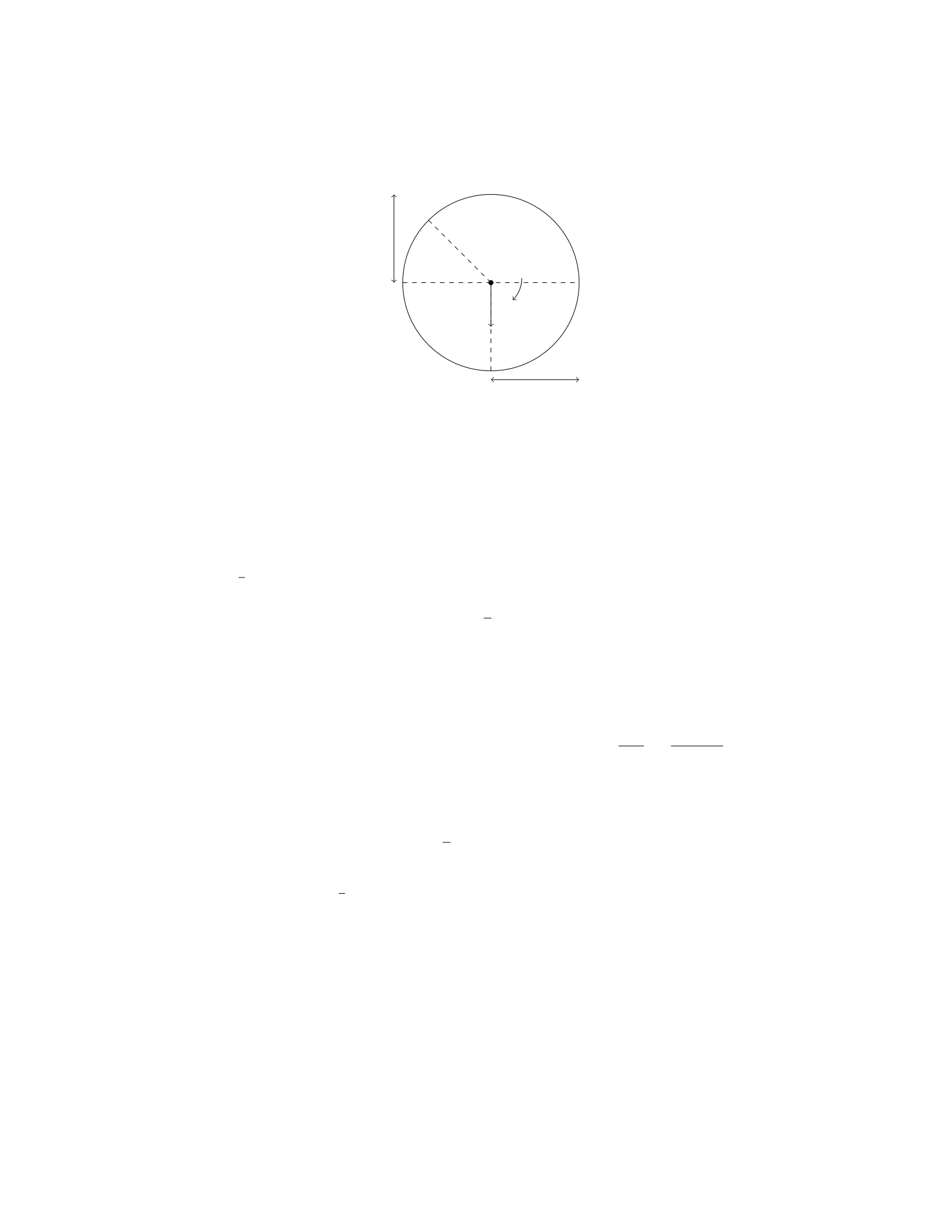
A uniform disk of radius Rand mass Mis rotating about a vertical axis with an
angular velocity ω. The disk is free to rotate about the vertical axis as shown
in the figure below.
21
R
R
ω
θ
Calculate the angular momentum of the disk when it makes an angle θwith
the vertical axis.
Solution
Step 1: The angular momentum of the disk can be calculated as the product
of the moment of inertia and the angular velocity. The moment of inertia of a
disk about an axis perpendicular to its plane and passing through its center is
I=1
2MR2. Therefore, the angular momentum is given by
L=Iω =1
2MR2ω
Step 2: To express the angular velocity ωin terms of the angle θ, we use the
relationship between the linear velocity of a point on the disk and its angular
velocity. The linear velocity vof a point on the disk is given by v=Rω.
Step 3: For the disk making an angle θwith the vertical axis, the component
of the linear velocity along the vertical axis is vvert =Rω cos(θ).
Step 4: The angular velocity in terms of θis then ω=vvert
R=Rω cos(θ)
R=
ωcos(θ).
Step 5: Substituting this expression for ωback into the equation for angular
momentum, we have
L=1
2MR2ωcos(θ)
Therefore, the angular momentum of the disk when it makes an angle θwith
the vertical axis is 1
2MR2ωcos(θ).
Question 25
Question
A solid cylindrical wheel of radius Rand mass Mis initially spinning at an
angular velocity ω0about a horizontal axis through its center. The wheel is
22

mounted on a frictionless axle, which is then suddenly tilted at an angle θwith
the vertical. What is the precessional angular velocity of the wheel immediately
after it is tilted?
Solution
To find the precessional angular velocity of the wheel immediately after it is
tilted, we can use conservation of angular momentum. The angular momentum
of the wheel about a horizontal axis through its center is given by L=Iω,
where Iis the moment of inertia of the wheel and ωis the angular velocity.
Step 1: Find the initial angular momentum. The initial angular
momentum of the wheel about the initial horizontal axis is L0=Iω0, where
I=1
2MR2is the moment of inertia of a solid cylinder about its center.
Step 2: Find the final angular momentum. Immediately after the axle
is tilted, the angular momentum of the wheel is still conserved. The wheel now
precesses about the vertical, so its moment of inertia becomes I′=M R2. The
angular velocity of precession is denoted as Ω.
At this point, the total angular momentum of the system is the sum of
the angular momentum about the new (tilted) horizontal axis and the angular
momentum due to precession:
L=I′Ω + I′ω′
where ω′is the angular velocity of the wheel about the tilted axis.
Step 3: Apply conservation of angular momentum. Since angular
momentum is conserved, we have:
L0=L
Iω0= (I′Ω + I′ω′)
Substitute the expressions for I,I′, and L0:
1
2MR2ω0=MR2Ω + M R2ω′
Step 4: Solve for the precessional angular velocity. Solving for Ω
(the precessional angular velocity), we get:
Ω = 1
2ω0−ω′
Hence, the precessional angular velocity of the wheel immediately after it is
tilted is 1
2ω0−ω′.
23

