


PHYS 101 - ELEMENTS OF PHYSICS
- Buoyant forces and Archimedes’
principle
Question Bank - Set 3
Liberty University
Question 1
Question
A cylindrical object with a radius of 5 cm and a height of 10 cm is submerged
in water. The density of the object is 2000 kg/m3and the density of water is
1000 kg/m3. Calculate the buoyant force acting on the object.
Solution
Step 1: First, calculate the volume of the cylindrical object: The volume of
a cylinder is given by V=πr2h, where ris the radius and his the height.
Substituting r= 5 cm and h= 10 cm (or 0.1 m), we get:
V=π×(0.05 m)2×0.1 m
V=π×0.0025 m2×0.1 m
V= 0.000785 m3
Step 2: Calculate the weight of the object: The weight of the object is
equal to the volume times the density times the acceleration due to gravity
(g= 9.81 m/s2). Substituting density = 2000 kg/m3:
W= 2000 kg/m3×0.000785 m3×9.81 m/s2
W= 2000 ×0.000785 ×9.81 kg
W= 15.5073 N
Step 3: Calculate the weight of the water displaced: The weight of the water
displaced is given by the volume of water displaced times the density of water

times the acceleration due to gravity. The volume of water displaced is the same
as the volume of the cylinder, since it is fully submerged.
Wwater = 1000 kg/m3×0.000785 m3×9.81 m/s2
Wwater = 1000 ×0.000785 ×9.81 N
Wwater = 7.737 N
Step 4: Calculate the buoyant force: The buoyant force is equal to the
weight of the water displaced. Therefore, the buoyant force acting on the object
is 7.737 N .
Question 2
Question
A cube of wood with a density of 0.7 g/cm3and side length of 4 cm is floating
in water. What is the mass of the cube and what fraction of the cube’s volume
is submerged in the water?
Solution
Step 1: Determine the mass of the cube.
The density of the cube is given as 0.7 g/cm3and the side length is 4 cm. The
volume of the cube can be calculated as V=l3, where lis the side length.
Therefore,
V= 43= 64 cm3.
To find the mass, we can use the formula m=ρV , where ρis the density.
Substituting in our values,
m= 0.7×64 = 44.8 g.
Step 2: Determine the fraction of the cube’s volume submerged.
Let the volume submerged be Vs. Since the cube is floating, the buoyant force
Fbacting on the cube is equal to the weight of the cube Fg. Using Archimedes’
principle, Fb=ρwaterVsg, where ρwater is the density of water and gis the
acceleration due to gravity. The weight of the cube is mcubeg. Equating these,
we get
ρwaterVsg=mcubeg.
Substitute the values we found earlier:
1×Vs×9.81 = 44.8×9.81.
Solving for Vs:
Vs=44.8×9.81
9.81 = 44.8 cm3.
Thus, the fraction of the cube’s volume submerged in water is Vs/V =
44.8/64 = 0.7, or 70
2

Question 3
Question
A cylindrical metal object with a density of 8000 kg/m3and a volume of 0.04
m3is submerged in a container of water. If the metal object is suspended by a
rope and completely submerged in water, calculate the tension in the rope.
Solution
Step 1: First, we need to determine the weight of the metal object. The weight
of an object can be calculated using the formula W=mg, where mis the mass
of the object and gis the acceleration due to gravity (approximately 9.81 m/s2).
Given that the density of the metal object is 8000 kg/m3and its volume is 0.04
m3, we can calculate the mass of the object as follows:
m= Density ×Volume = 8000 kg/m3×0.04 m3= 320 kg
Therefore, the weight of the metal object is:
W=mg = 320 kg ×9.81 m/s2= 3139.2 N
Step 2: Now, we can determine the buoyant force acting on the metal object.
The buoyant force is equal to the weight of the fluid displaced by the object,
which can be calculated using the formula Fbuoyant =ρ·V·g, where ρis the
density of the fluid (1000 kg/m3for water), Vis the volume of the object, and
gis the acceleration due to gravity:
Fbuoyant = 1000 kg/m3×0.04 m3×9.81 m/s2= 392.4 N
Step 3: Since the metal object is suspended by a rope and completely sub-
merged in water, the tension in the rope is equal to the difference between the
weight of the object and the buoyant force:
Tension = W−Fbuoyant = 3139.2 N −392.4 N = 2746.8 N
Therefore, the tension in the rope when the metal object is completely sub-
merged in water is 2746.8 N.
Question 4
Question
A metal block of mass 500 kg and volume 0.5 m3is submerged in a container of
water. Calculate the buoyant force acting on the block and determine if it will
float or sink.
3

Solution
Step 1: Calculate the weight of the block. Given that the mass of the block is
500 kg and the acceleration due to gravity is 9.81 m/s2, the weight Wcan be
calculated using the formula W=m·g, where mis the mass of the block and
gis the acceleration due to gravity.
W= 500 kg ×9.81 m/s2
W= 4905 N
Step 2: Calculate the buoyant force. The buoyant force Fbacting on an
object submerged in a fluid is equal to the weight of the fluid displaced by the
object. The volume of water displaced by the block is equal to the volume of
the block. Since the density of water is 1000 kg/m3, the buoyant force can be
calculated as:
Fb= density of water ×volume of water displaced ×g
Fb= 1000 kg/m3×0.5 m3×9.81 m/s2
Fb= 4905 N
Step 3: Determine if the block will float or sink. The block will float if the
buoyant force is greater than or equal to the weight of the block. In this case,
since 4905 N = 4905 N, the buoyant force is equal to the weight of the block.
Therefore, the block will remain submerged in the water.
Question 5
Question
A cube of wood with a side length of 0.1 m and a density of 800 kg/m3is floating
in water. Calculate the depth to which the cube is submerged in water, given
that the density of water is 1000 kg/m3.
Solution
Step 1: Let’s first determine the volume of the cube. The volume of a cube is
given by the formula V=s3, where sis the side length. So, for the cube in this
problem:
V= (0.1 m)3= 0.001 m3
Step 2: Next, we can calculate the mass of the cube. The mass of the cube is
given by the formula m=ρV , where ρis the density of the cube. Substituting
the values:
m= 800 kg/m3×0.001 m3= 0.8 kg
Step 3: Using Archimedes’ principle, the buoyant force acting on the cube
is equal to the weight of the water displaced by the cube. The buoyant force is
4

given by Fb=ρwaterVsubmergedg, where ρwater is the density of water, Vsubmerged
is the volume submerged by the cube, and gis the acceleration due to gravity.
Since the cube is in equilibrium, the weight of the cube is balanced by the
buoyant force:
mcubeg=ρwaterVsubmergedg
Step 4: We can now solve for the volume submerged by the cube.
Vsubmerged =mcube
ρwater
=0.8 kg
1000 kg/m3= 0.0008 m3
Step 5: Finally, we can calculate the depth to which the cube is submerged
in water. Since the cube is floating, the volume submerged is equal to the cross-
sectional area of the cube multiplied by the depth of submersion. Therefore:
Area ×depth = 0.0008 m3
0.1 m ×depth = 0.0008 m3
depth = 0.0008 m3
0.1 m = 0.008 m = 8 mm
Thus, the cube is submerged to a depth of 8 mm in water.
Question 6
Question
A cube of wood with a density of 0.8 g/cm3and side length of 10 cm is floating
in water. If 60
Solution
Step 1: Calculate the volume of the cube submerged in water. Step 2: Use the
volume of water displaced to find the density of water.
Step 1: Calculate the volume of the cube submerged in water. The volume
of the cube is given by Vcube = side length3= (10 cm)3= 1000 cm3. Since 60
Step 2: Use the volume of water displaced to find the density of water. Let
Vwater be the volume of water displaced. According to Archimedes’ principle,
the buoyant force (Fbuoyant) is equal to the weight of the water displaced. The
density of the cube is given as 0.8 g/cm3. Let mcube be the mass of the cube. We
know that mcube = density ×Vcube. The weight of the cube is Wcube =mcubeg,
where gis the acceleration due to gravity. Since the cube is floating, the buoyant
force Fbuoyant is equal to the weight of the cube. Therefore, Fbuoyant =mcubeg.
The density of water (ρwater) can be found using Fbuoyant =ρwater×g×Vwater.
Substitute mcubegfor Fbuoyant:mcubeg=ρwater ×g×Vwater. Thus, density of
water, ρwater =mcube
Vwater =density of cube×Vcube
Vwater . Substitute the values: ρwater =
0.8 g/cm3×1000 cm3
600 cm3=800
600 = 1.33 g/cm3.
Therefore, the density of water is 1.33 g/cm3.
5

Question 7
Question
A cylindrical object of height h, radius r, and density ρois floating vertically in
a container filled with a liquid of density ρl. The top of the cylinder is xunits
above the liquid surface. Determine the expression for the buoyant force acting
on the object when it is partially submerged in the liquid.
Solution
Step 1: First, calculate the volume of the cylinder that is submerged in the
liquid. This volume can be expressed as Vsubmerged =πr2x.
Step 2: The weight of the object is given by Wobject =ρo·Vtotal ·g, where
Vtotal is the total volume of the cylinder.
Step 3: The buoyant force Fbuoyant acting on the object is equal to the weight
of the liquid displaced, which is given by Fbuoyant =ρl·Vsubmerged ·g.
Step 4: Equate the weight of the object and the buoyant force to find the
expression for the buoyant force:
ρo·πr2h·g=ρl·πr2x·g
Step 5: Solve for xto obtain the expression for the buoyant force:
x=ρo·h
ρl
Therefore, the buoyant force acting on the object when it is partially sub-
merged in the liquid is ρo·πr2·ρo·h
ρl
·g.
Question 8
Question
A cube of aluminum with a side length of 10 cm and a density of 2.7 g/cm3
is floating in a container of water. Determine the depth to which the cube is
submerged in the water.
Solution
Step 1: The buoyant force acting on the aluminum cube is equal to the weight
of the water displaced by the cube. We can find the volume of the submerged
cube using Archimedes’ principle.
Step 2: The weight of the cube is equal to its mass multiplied by the accel-
eration due to gravity (w=m·g).
6

Step 3: The volume of the cube can be calculated using the formula V=l3,
where lis the side length of the cube.
Step 4: Set up an equation for the buoyant force (Fb) using the volume of
the cube, the density of water (ρw= 1 g/cm3), and the acceleration due to
gravity (g= 9.81 m/s2).
Step 5: Use the equation for density (ρ=m
V) to find the mass of the cube.
Step 6: The weight of the water displaced by the cube is equal to the weight
of the cube.
Step 7: The depth to which the cube is submerged can be calculated by
dividing the volume of the submerged cube by the surface area of the cube in
contact with the water.
Step 8: Calculate the depth to which the cube is submerged in the water.
Question 9
Question
A cylindrical object of radius Rand height his floating in a container of water.
The density of the object is ρo, and the density of water is ρw. Determine the
fraction of the object’s volume that is submerged in the water.
Solution
Let’s denote the fraction of the object’s volume that is submerged in the water
as f. To find f, we need to consider the forces acting on the object.
Step 1: Determine the volume of the object submerged in water. Assume the
object is fully submerged, then the volume of water displaced would be equal
to the volume of the cylinder:
Vdisplaced =πR2h
Step 2: Write the equation for the buoyant force. The buoyant force (Fb) is
given by Archimedes’ principle, which states that the buoyant force is equal to
the weight of the fluid displaced:
Fb=ρw·g·Vdisplaced
Step 3: Calculate the weight of the object. The weight of the object is given
by:
Wobject =ρo·g·Vtotal
where Vtotal =πR2his the total volume of the object.
Step 4: Set up the equilibrium condition. For the object to be floating, the
buoyant force must be equal to the weight of the object:
Fb=Wobject
7

Step 5: Substitute the equations and solve for f.
ρw·g·πR2h=ρo·g·πR2h·f
f=ρw
ρo
Therefore, the fraction of the object’s volume submerged in water is ρw
ρo.
Question 10
Question
A cube of wood with side length 10 cm and density 0.8 g/cm3is floating in
water. What is the minimum distance from the bottom of the cube to the water
surface?
Solution
Step 1: We first find the mass of the wood cube. The mass of the cube is given
by the density formula:
mass = density ×volume
mass = 0.8 g/cm3×(10 cm)3
mass = 0.8×1000 g
mass = 800 g
Step 2: Next, we find the volume of water displaced by the cube. The volume
of water displaced is equal to the volume of the cube submerged in water. Since
the cube is floating, the weight of the wood cube equals the buoyant force. The
volume of water displaced is:
V= side2×distance from bottom to water surface
V= (10 cm)2×h
V= 100 cm2×h
Step 3: The buoyant force is given by the formula:
Buoyant force = density of water ×acceleration due to gravity ×V
Buoyant force = 1 g/cm3×9.8 m/s2×100 cm2×h
Step 4: The weight of the wood cube is equal to the buoyant force:
Weight of cube = Buoyant force
mass of cube×acceleration due to gravity = density of water×acceleration due to gravity×V
8

800 g ×9.8 m/s2= 1 g/cm3×9.8 m/s2×100 cm2×h
Step 5: Solve for h, the distance from the bottom of the cube to the water
surface:
h=800 ×9.8
1×100 cm
h= 78 cm
Therefore, the minimum distance from the bottom of the cube to the water
surface is 78 cm.
Question 11
Question
A rectangular block of wood with dimensions 10 cm ×5 cm ×3 cm is floating in
water. Calculate the density of the wood if the block is immersed in water up
to a depth of 2 cm. The density of water is 1000 kg/m3.
Solution
Step 1: First, we need to calculate the volume of the wooden block. The volume
of the wooden block is given by:
V=l×w×h
where l,w, and hare the length, width, and height of the block, respectively.
Plugging in the values, we get:
V= 10 cm ×5 cm ×3 cm = 150 cm3
Step 2: Next, we need to calculate the volume of water displaced by the
block. When the block is submerged in water, it displaces its own weight in
water. The volume of water displaced is equal to the volume of the block
submerged. The volume of water displaced is given by:
Vdisplaced =l×w×d
where dis the depth to which the block is immersed in water. Plugging in the
values, we get:
Vdisplaced = 10 cm ×5 cm ×2 cm = 100 cm3
Step 3: We know that the density of water is 1000 kg/m3. The mass of the
volume of water displaced by the block is given by:
mwater =ρwater ×Vdisplaced
9

Plugging in the values, we get:
mwater = 1000 kg/m3×100 cm3
1000000 cm3/m3= 0.1 kg
Step 4: The buoyant force acting on the block is due to the weight of the
water displaced. The buoyant force is given by:
Fbuoyant =mwater ×g
where gis the acceleration due to gravity (9.81 m/s2). Plugging in the values,
we get:
Fbuoyant = 0.1 kg ×9.81 m/s2= 0.981 N
Step 5: The weight of the block is balanced by the buoyant force and the
weight of the block. The weight of the block is calculated using the equation:
Fblock =mblock ×g
The weight of the block is equal to the weight of water displaced since the block
is floating. Plugging in the values, we get:
Fblock = 0.1 kg ×10 = 0.981 N
Step 6: From Step 5, we see that the weight of the block is equal to the
buoyant force. This means that the density of the block is equal to the density
of water, which is 1000 kg/m3.
Question 12
Question
A cube of wood with side length 10 cm and density 0.8 g/cm3is placed in a
container of water. Determine the depth to which the cube sinks in the water.
The density of water is 1 g/cm3.
Solution
Step 1: First, we need to find the weight of the cube. Given that the density of
wood is 0.8 g/cm3and the volume of the cube is (10 cm)3= 1000 cm3, we can
find the mass of the cube as follows:
Mass of cube = Density ×Volume = 0.8 g/cm3×1000 cm3= 800 g
The weight of the cube can be found by multiplying its mass by the acceleration
due to gravity, g= 9.8 m/s2:
Weight of cube = 800 g ×9.8 m/s2= 7840 N
10

Step 2: Next, we need to determine the buoyant force acting on the cube.
The buoyant force is equal to the weight of the water displaced by the cube.
Since the cube is submerged, the volume of water displaced is equal to the
volume of the cube. Therefore, the buoyant force can be calculated as follows:
Buoyant force = Density of water×Volume of cube×g= 1 g/cm3×1000 cm3×9.8 m/s2= 9800 N
Step 3: The depth to which the cube sinks can be determined by considering
the equilibrium of forces. When the cube is at rest in the water, the weight of
the cube is balanced by the buoyant force:
Weight of cube = Buoyant force
7840 N = 9800 N
Since the weight of the cube is less than the buoyant force, the cube will sink
until the upward buoyant force equals the weight of the cube. Therefore, the
cube will sink to a depth such that the weight of the water displaced by the
volume submerged is equal to the weight of the cube. Let dbe the depth to
which the cube sinks. The volume of water displaced is 1000 cm3×d.
Weight of water displaced = Density of water×Volume of water displaced×g= 1 g/cm3×1000 cm3×d×9.8 m/s2= 9800dN
Setting the weight of water displaced equal to the weight of the cube:
9800d= 7840
d=7840
9800 = 0.8 m
Therefore, the cube will sink to a depth of 0.8 meters in the water.
Question 13
Question
A cube of wood with sides measuring 6 cm is floating in a tub of water. The
density of water is 1000 kg/m3and the density of wood is 700 kg/m3. Determine
the depth to which the cube is submerged in the water.
Solution
Step 1: Start by determining the volume of the cube. The volume of the cube is
given by the formula: Vcube =s3, where sis the length of each side of the cube.
Given that s= 6 cm, convert this to meters before calculating the volume.
Vcube = (0.06 m)3= 0.000216 m3
Step 2: Calculate the weight of the wooden cube. The weight of the wooden
cube is given by the formula: Wcube =mcube ·g, where mcube is the mass of
11

the cube and gis the acceleration due to gravity. The mass of the cube can be
calculated using the formula mcube =ρwood ·Vcube.
mcube = 700 kg/m3×0.000216 m3= 0.1512 kg
Wcube = 0.1512 kg ×9.81 m/s2= 1.48 N
Step 3: Calculate the buoyant force acting on the cube. The buoyant force
is given by the formula: Fbuoyant =ρwater ·Vsubmerged ·g, where ρwater is the
density of water, Vsubmerged is the volume of water displaced by the submerged
part of the cube, and gis the acceleration due to gravity. Because the cube is
floating, the weight of the cube is equal to the buoyant force.
Fbuoyant = 1.48 N
Step 4: Find the volume of water displaced (submerged volume). Using
Archimedes’ principle, the volume of water displaced is equal to the volume of
the cube that is submerged. Let the depth to which the cube is submerged be
d, then Vsubmerged =s2·d.
Vsubmerged = 0.062m×d= 0.0036 dm3
Step 5: Equate the weight of the cube to the buoyant force and solve for d.
1.48 N = 1000 kg/m3×0.0036 dm3×9.81 m/s2
d=1.48
1000 ×0.0036 ×9.81 = 0.043 m = 4.3 cm
Therefore, the cube is submerged to a depth of 4.3 cm in the water.
Question 14
Question
A uniform solid sphere of radius 10 cm and mass 3 kg is placed in a container
filled with water. The sphere is released and floats at a certain depth. Calculate
the depth at which the sphere floats in the water, given that the density of water
is 1000 kg/m3and the acceleration due to gravity is 9.8 m/s2.
Solution
Step 1: First, let’s calculate the buoyant force acting on the sphere. The buoyant
force Fbuoyant is given by the formula
Fbuoyant =ρ·Vdisplaced ·g,
where ρis the density of the fluid, Vdisplaced is the volume of the fluid displaced
by the object, and gis the acceleration due to gravity.
12

Step 2: The volume of the water displaced by the sphere is equal to the
volume of the sphere submerged in the water. Since the sphere floats, the
buoyant force will exactly balance the weight of the sphere. The weight of the
sphere Wis given by
W=m·g,
where mis the mass of the sphere and gis the acceleration due to gravity.
Step 3: The volume of the sphere Vsphere is given by
Vsphere =4
3πr3,
where ris the radius of the sphere.
Step 4: The mass of the water displaced mdisplaced can be calculated using
the density of water and the volume of the sphere submerged in water.
mdisplaced =ρ·Vsphere.
Step 5: Since the sphere floats, the weight of the displaced water must be
equal to the weight of the sphere. This gives us the equation
ρ·Vsphere ·g=m·g.
Step 6: Substituting the expressions for Vsphere and mdisplaced into the equa-
tion and solving for the depth dat which the sphere floats, we get
4
3πr3·ρ·g=m·g.
4
3π(0.1)3·ρ·g·d=m·g.
Step 7: Solving for d, we find
d=m
4
3πr3·ρ.
Step 8: Substituting the given values m= 3 kg, r= 0.1 m, and ρ=
1000 kg/m3into the formula, we can calculate the depth at which the sphere
floats in the water.
d=3
4
3π(0.1)3·1000.
Step 9: Calculating the depth d, we get
d=3
4
3π·0.001 ·1000 =3
4π≈0.238 m.
Therefore, the sphere floats at a depth of approximately 0.238 meters in the
water.
13
Question 15
Question
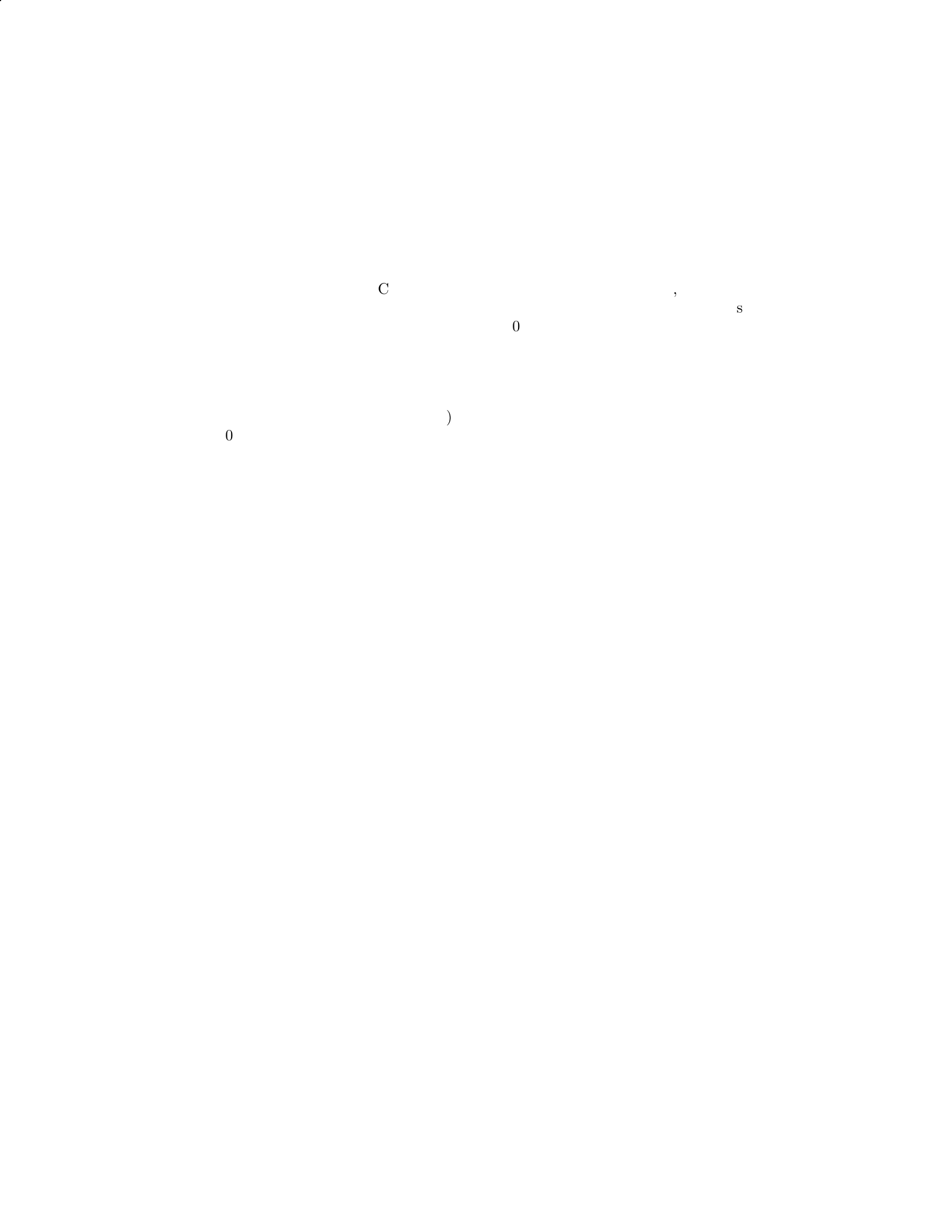
A hot air balloon has a volume of 3000 m3. The air inside the balloon is heated
to a temperature of 150
°
C. If the air outside the balloon is at 20
°
C, calculate
the buoyant force acting on the balloon. Assume the density of air at 20
°
C is
1.2 kg/m3and the density of air at 150
°
C is 0.8 kg/m3.
Solution
Step 1: Calculate the difference in air densities inside and outside the balloon.
Given: - Density of air at 20
°
C (ρ0) = 1.2 kg/m3- Density of air at 150
°
C (ρ)
= 0.8 kg/m3
The difference in densities is:
∆ρ=ρ0−ρ= 1.2 kg/m3−0.8 kg/m3= 0.4 kg/m3
Step 2: Calculate the mass of air displaced by the balloon. The mass of air
displaced is equal to the difference in densities times the volume of the balloon:
m= ∆ρ×V= 0.4 kg/m3×3000 m3= 1200 kg
Step 3: Calculate the weight of the displaced air. The weight of the displaced
air is:
Wdisplaced =m×g= 1200 kg ×9.81 m/s2= 11772 N
Step 4: Calculate the buoyant force acting on the balloon. The buoyant
force acting on the balloon is equal to the weight of the displaced air:
Fbuoyant = 11772 N
Therefore, the buoyant force acting on the hot air balloon is 11772 N.
Question 16
Question
A cube of side length Land density ρcube is floating in a liquid of density ρliquid.
The cube is initially floating with a fraction fof its volume submerged beneath
the liquid. Find an expression for the density ρcube of the cube in terms of f,
ρliquid, and L.
Solution
Step 1: First, let’s write the equilibrium condition for the cube as it floats in
the liquid. The buoyant force must be equal to the weight of the submerged
portion of the cube. Step 2: The volume of the cube is V=L3and the
14
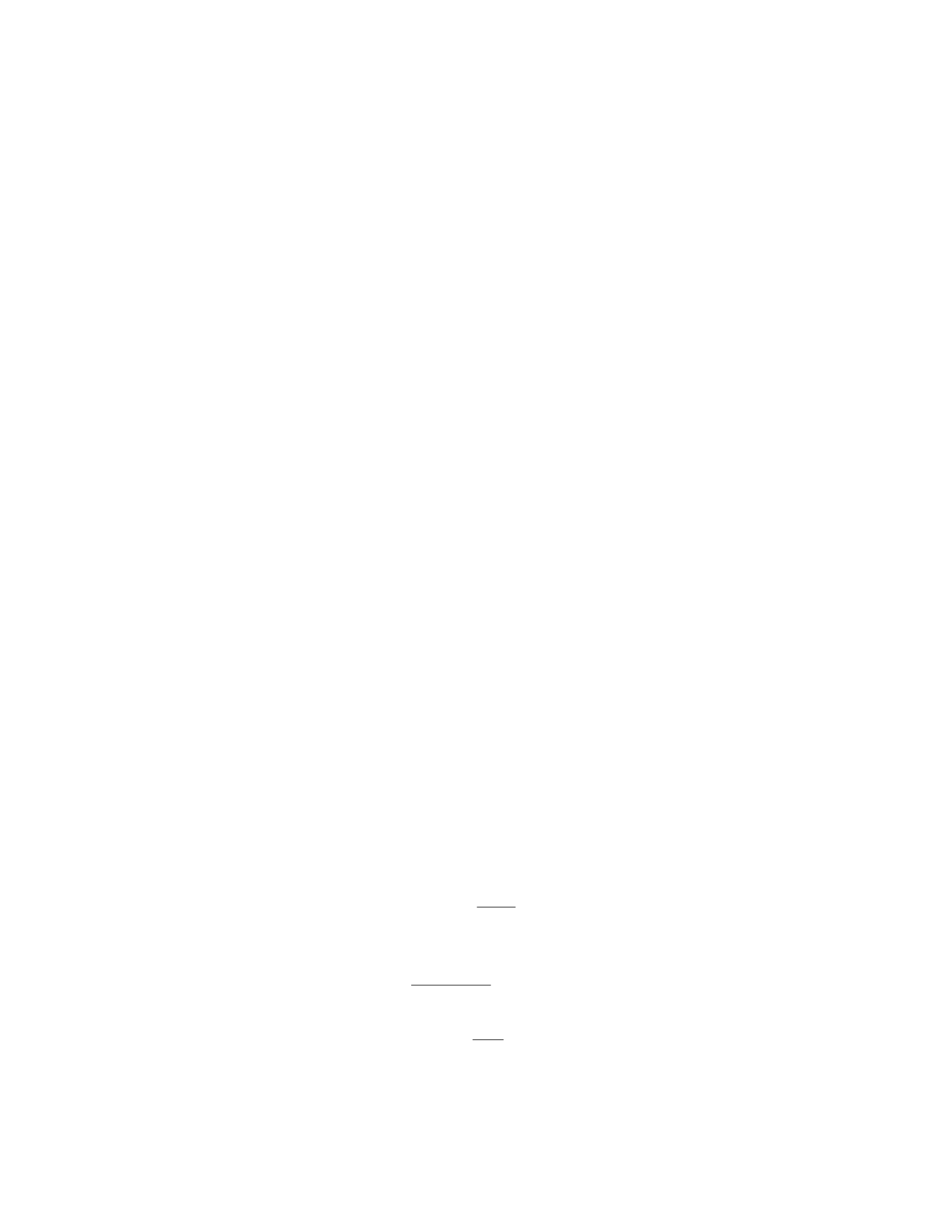
fraction submerged is f, so the volume submerged is Vsubmerged =fV . Step
3: The weight of the cube is given by Wcube =ρcubeV g, and the weight of
the submerged portion of the cube is Wsubmerged =ρliquidVsubmergedg. Step
4: Using the equilibrium condition, we have ρcubeV g =ρliquidfV g. Step 5:
Substituting the expressions for Vand Vsubmerged into the equation, we get
ρcubeL3=ρliquidfL3. Step 6: Finally, solving for ρcube, we find that ρcube =
ρliquidf.
Question 17
Question
A cylindrical ship with a radius of 10 meters and a length of 100 meters floats
in seawater (density of 1025 kg/m3). The ship’s average density is 900 kg/m3.
Determine the fraction of the ship’s volume that is beneath the waterline.
Solution
Step 1: Calculate the volume of the ship submerged in water.
The buoyant force Fbacting on the ship is equal to the weight of the water
displaced by the ship. This can be calculated using Archimedes’ principle:
Fb=ρwater ·Vsubmerged ·g
where ρwater = density of water = 1025 kg/m3,Vsubmerged = volume of the ship
submerged in water, g= acceleration due to gravity = 9.81 m/s2.
The weight of the ship Wcan be calculated as:
W=ρavg ·Vtotal ·g
where ρavg = average density of the ship = 900 kg/m3,Vtotal = total volume of
the ship.
Since the ship is floating, the buoyant force Fbis equal to the weight of the
ship W. Therefore,
Fb=W
ρwater ·Vsubmerged ·g=ρavg ·Vtotal ·g
ρwater ·Vsubmerged =ρavg ·Vtotal
Vsubmerged =ρavg
ρwater
·Vtotal
Substitute the given values to find the volume submerged:
Vsubmerged =900 kg/m3
1025 kg/m3·π·(10 m)2·100 m
Vsubmerged =900
1025 ·π·1000
15

Vsubmerged ≈876.71 m3
Therefore, the volume of the ship submerged in water is approximately
876.71 m3.
Step 2: Calculate the fraction of the ship’s volume beneath the waterline.
The total volume of the ship Vtotal can be calculated as:
Vtotal =π·(10 m)2·100 m
Vtotal =π·1000
Vtotal = 3141.59 m3
The fraction of the ship’s volume beneath the waterline is:
Vsubmerged
Vtotal
=876.71 m3
3141.59 m3
Vsubmerged
Vtotal
≈0.279
Therefore, approximately 27.9
Question 18
Question
A cube of aluminum with sides of length 10 cm and a density of 2700 kg/m3is
submerged in water. Calculate the buoyant force acting on the cube.
Solution
Step 1: Calculate the volume of the aluminum cube.
Volume of cube = side length3= (0.10 m)3= 0.001 m3
Step 2: Calculate the weight of the aluminum cube.
Weight = Mass ×Acceleration due to gravity
Mass = Volume ×Density = 0.001 m3×2700 kg/m3= 2.7 kg
Weight = 2.7 kg ×9.81 m/s2= 26.487 N
Step 3: Calculate the buoyant force acting on the cube. According to
Archimedes’ principle, the buoyant force is equal to the weight of the fluid
displaced.
Buoyant Force = Weight of water displaced
16

Volume of water displaced = Volume of cube = 0.001 m3
Density of water = 1000 kg/m3
Weight of water displaced = Volume of water displaced×Density of water×Acceleration due to gravity
Weight of water displaced = 0.001 m3×1000 kg/m3×9.81 m/s2= 9.81 N
Buoyant Force = 9.81 N
Therefore, the buoyant force acting on the aluminum cube is 9.81 N.
Question 19
Question
A metal object of volume 500 cm3and density 2000 kg/m3is immersed in water.
Calculate the buoyant force acting on the object and determine if the object
will float or sink in the water.
Solution
Step 1: Convert the volume of the object to m3: Given that the volume of the
object is 500 cm3, we need to convert this to m3. Since 1 cm3= 1 ×10⁻⁶m3,
the volume of the object in m3is:
500 cm3×1×10−6m3/cm3= 0.0005 m3
Step 2: Calculate the mass of the object: The mass of the object can be
calculated using the formula: mass = density ×volume. Substituting the given
values: mass = 2000 kg/m3×0.0005 m3= 1 kg
Step 3: Calculate the buoyant force: The buoyant force is given by the
formula: Buoyant force = Density of fluid ×Volume submerged ×Acceleration
due to gravity. The density of water is 1000 kg/m3, and the acceleration due to
gravity is 9.81 m/s2.
Since the object is completely immersed in water, the volume submerged is
equal to its total volume, which is 0.0005 m3. Substituting the values: Buoyant
force = 1000 kg/m3×0.0005 m3×9.81 m/s2= 4.905 N
Step 4: Determine if the object will float or sink: The object will float if the
buoyant force is greater than or equal to the weight of the object, and it will
sink if the buoyant force is less than the weight of the object.
Since the mass of the object is 1 kg, its weight is given by: Weight = mass
×gravity = 1 kg ×9.81 m/s2= 9.81 N
Since the buoyant force (4.905 N) is less than the weight of the object (9.81
N), the object will sink in water.
17

Question 20
Question
A cube of wood with a density of 0.6 g/cm3and side length 10 cm is floating in
a liquid with a density of 1.2 g/cm3. What is the depth of the cube below the
surface of the liquid?
Solution
Step 1: Find the density of water (liquid) using the given density. Step 2: Apply
Archimedes’ principle to find the volume of wood submerged in the liquid. Step
3: Use the volume to calculate the depth below the surface of the liquid.
Step 1: The density of water is 1.2 g/cm3.
Step 2: Let Vbe the volume of wood submerged in the liquid. The buoyant
force Fbacting on the wood is given by:
Fb=ρf·g·V
where ρfis the density of the liquid and gis the acceleration due to gravity.
The weight of the wood is balanced by the buoyant force, so:
Fb=m·g
where mis the mass of the wood. The mass of the wood can be calculated using
its density ρwand volume. Since the wood is submerged, the volume is V. The
mass mis given by:
m=ρw·V
Equating the expressions for Fb, we get:
ρf·g·V=ρw·V
Solving for V:
V=ρw
ρf
·V
Step 3: The depth of the cube below the surface of the liquid can be calcu-
lated by dividing the volume of the cube submerged by the area of the cube’s
face. Let hbe the depth of submersion. The volume of wood submerged is
equivalent to the volume of the submerged part of the cube:
V=A·h
where Ais the area of the cube’s face. Solving for h:
h=V
A
Substitute the calculated value of Vinto the above equation to find the
depth of the cube below the surface of the liquid.
18

Question 21
Question
A cylindrical tank has a diameter of 4 meters and a height of 6 meters. If the
tank is filled with water, calculate the buoyant force acting on the tank.
Solution
Step 1: Determine the volume of the cylindrical tank. The volume of a cylinder
is given by the formula V=πr2h, where ris the radius of the cylinder and h
is the height. Given that the diameter of the tank is 4 meters, the radius ris
half of the diameter, so r= 2 meters. The height his 6 meters. Therefore, the
volume of the tank is:
V=π×(2)2×6 = 24πm3
Step 2: Calculate the weight of water in the tank. The weight of water in
the tank is equal to the mass of the water times the acceleration due to gravity,
g= 9.8 m/s2. The density of water is approximately 1000 kg/m3. Therefore,
the mass of the water is:
mass = density ×volume = 1000 ×24π= 24000πkg
And the weight of the water is:
weight = mass ×g= 24000π×9.8 N
Step 3: Calculate the weight of the tank. The weight of the tank is equal
to the mass of the tank times the acceleration due to gravity. To simplify the
calculation, let’s assume the density of the tank material is 8000 kg/m3. The
volume of the tank is 24πm3, so the mass of the tank is:
mass = density ×volume = 8000 ×24π= 192000πkg
And the weight of the tank is:
weight = mass ×g= 192000π×9.8 N
Step 4: Calculate the buoyant force. The buoyant force is equal to the weight
of the water displaced by the tank, which is equal to the weight of the water in
the tank. Therefore, the buoyant force acting on the tank is:
Buoyant force = weight of water = 24000π×9.8 N
Question 22
Question
A cylindrical tank filled with water has a radius of 2 meters and a height of 3
meters. A solid sphere with a radius of 0.5 meters and a density of 800 kg/m3is
19

submerged in the water. Calculate the buoyant force acting on the sphere and
determine whether the sphere will sink or float.
Given: Density of water = 1000 kg/m3, Acceleration due to gravity, g=
9.81 m/s2.
Solution
Step 1: Calculate the volume of the sphere. The volume of a sphere is given by
the formula:
V=4
3πr3
Substitute r= 0.5 meters into the formula to find the volume of the sphere:
V=4
3π(0.5)3=4
3π(0.125) = 1
6πm3
Step 2: Calculate the mass of the sphere. The mass of the sphere can be
found using the formula:
mass = density ×volume
Given that the density of the sphere is 800 kg/m3, substitute the values of
density and volume into the formula:
mass = 800 ×1
6π=400
3πkg
Step 3: Calculate the weight of the sphere. The weight of the sphere is given
by the formula:
weight = mass ×g
Substitute the mass of the sphere and the acceleration due to gravity into the
formula:
weight = 400
3π×9.81 = 3920
3πN
Step 4: Calculate the weight of the water displaced by the sphere (buoyant
force). The weight of the water displaced is equal to the weight of the sphere
when it is fully submerged. The volume of water displaced is equal to the volume
of the sphere.
Weight of water displaced = 400
3π×9.81 = 3920
3πN
Step 5: Determine whether the sphere will sink or float. Since the weight of
the water displaced is equal to the weight of the sphere, the sphere will float in
the water.
20
Question 23
Question
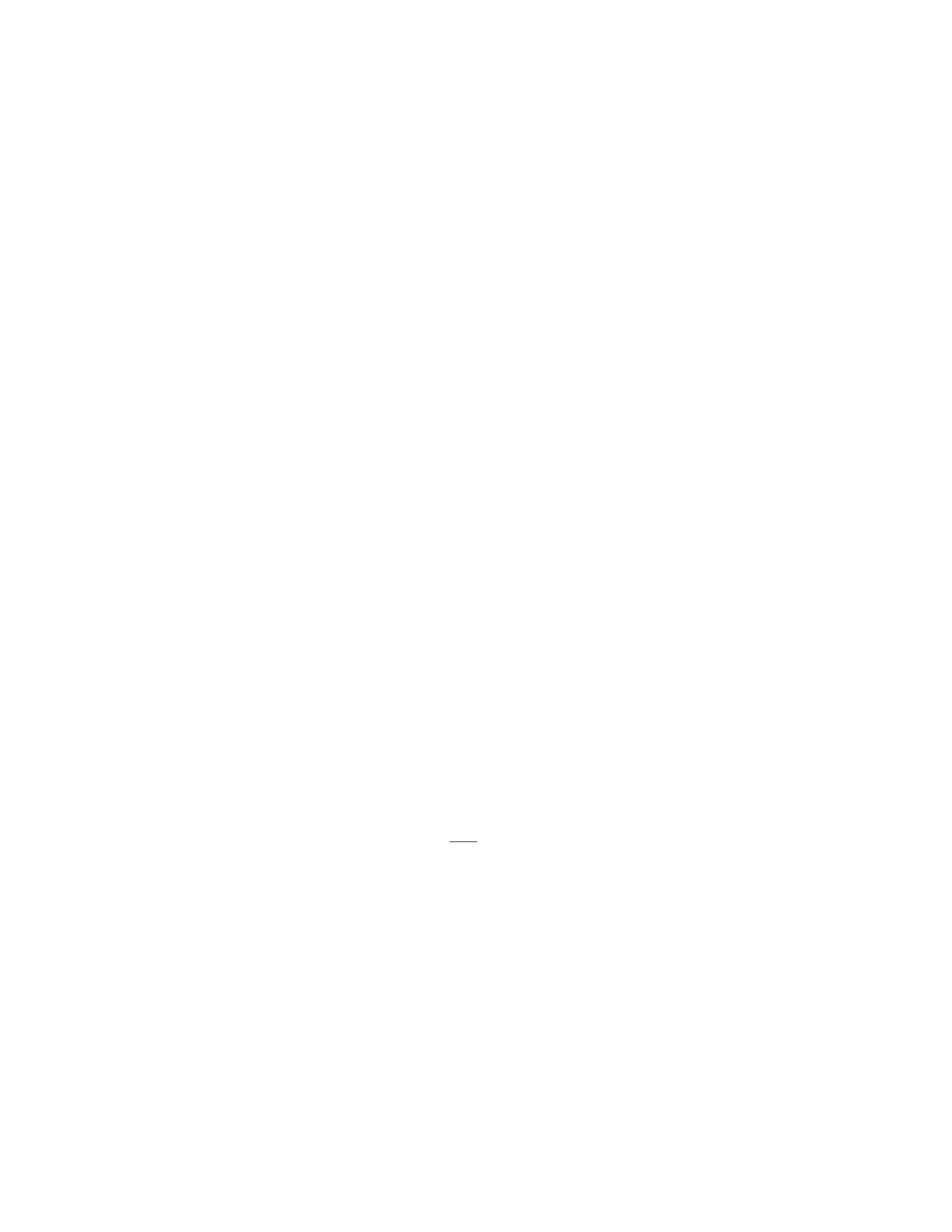
A rectangular block of wood with a density of 0.6 g/cm3and dimensions 10 cm
x 5 cm x 3 cm is floating in water. What is the minimum mass of lead that
needs to be placed on top of the block so that it sinks completely in water? The
density of lead is 11.3 g/cm3.
Solution
Step 1: Calculate the volume of the wood block.
The volume of the wood block is given by:
Vwood = length ×width ×height
Vwood = 10 cm ×5 cm ×3 cm = 150 cm3
Step 2: Determine the volume of water displaced by the wood block when
it is floating.
Since the block is floating, the weight of the water displaced by the block is
equal to the weight of the block. The weight of the block can be calculated
using its volume and density:
Weight of wood block = Vwood ×density of wood
Weight of wood block = 150 cm3×0.6 g/cm3= 90 g
Step 3: Calculate the minimum mass of lead required to sink the wood block
completely.
To sink the wood block completely, the total weight of the system (wood block
+ lead) must be greater than the weight of the water displaced by the wood
block. Let m be the mass of the lead needed.
m×density of lead = Weight of wood block + m×1 g/cm3
m×11.3 = 90 + m
10.3m= 90
m=90
10.3≈8.74 g
Therefore, the minimum mass of lead that needs to be placed on top of the
block so that it sinks completely in water is approximately 8.74 g.
Question 24
Question
A cylindrical object with a height of 12 cm and a radius of 3 cm is placed in a
container of water. The object floats with 4 cm of its height above the water
surface. Calculate the density of the cylindrical object.
21

Solution
Step 1: First, let’s determine the volume of the cylindrical object submerged in
water. The total volume of the cylinder can be calculated using the formula for
the volume of a cylinder: Vcylinder =πr2h, where ris the radius and his the
height. Given r= 3 cm and h= 12 cm, we have:
Vcylinder =π×(3 cm)2×12 cm
Vcylinder = 108πcm3
Step 2: Since 4 cm of the cylinder is above the water surface, the submerged
volume can be calculated as Vsubmerged =πr2×submerged height. Given the
submerged height is 8 cm, we have:
Vsubmerged =π×(3 cm)2×8 cm
Vsubmerged = 72πcm3
Step 3: The buoyant force acting on the cylinder is equal to the weight
of the water displaced by the submerged volume of the cylinder. This can be
calculated using Archimedes’ principle, Fbuoyant =ρ×Vsubmerged ×g, where ρ
is the density of water and gis the acceleration due to gravity. The weight of
the cylinder can be calculated using its density ρcylinder, volume Vcylinder, and
acceleration due to gravity g, as Wcylinder =ρcylinder ×Vcylinder ×g.
Step 4: Since the cylinder is floating, the buoyant force Fbuoyant must equal
the weight of the cylinder Wcylinder.T hisgivesustheequation :ρ×Vsubmerged ×g=
ρcylinder ×Vcylinder ×g.
Step 5: Substitute the known values into the equation:
ρ×72π×g=ρcylinder ×108π×g
Step 6: Simplify the equation by canceling out gand π:
72ρ= 108ρcylinder
Step 7: Solve for the density of the cylinder, ρcylinder:
ρcylinder =72ρ
108
ρcylinder =2
3ρ
Therefore, the density of the cylindrical object is 2
3times the density of
water.
22
Question 25
Question
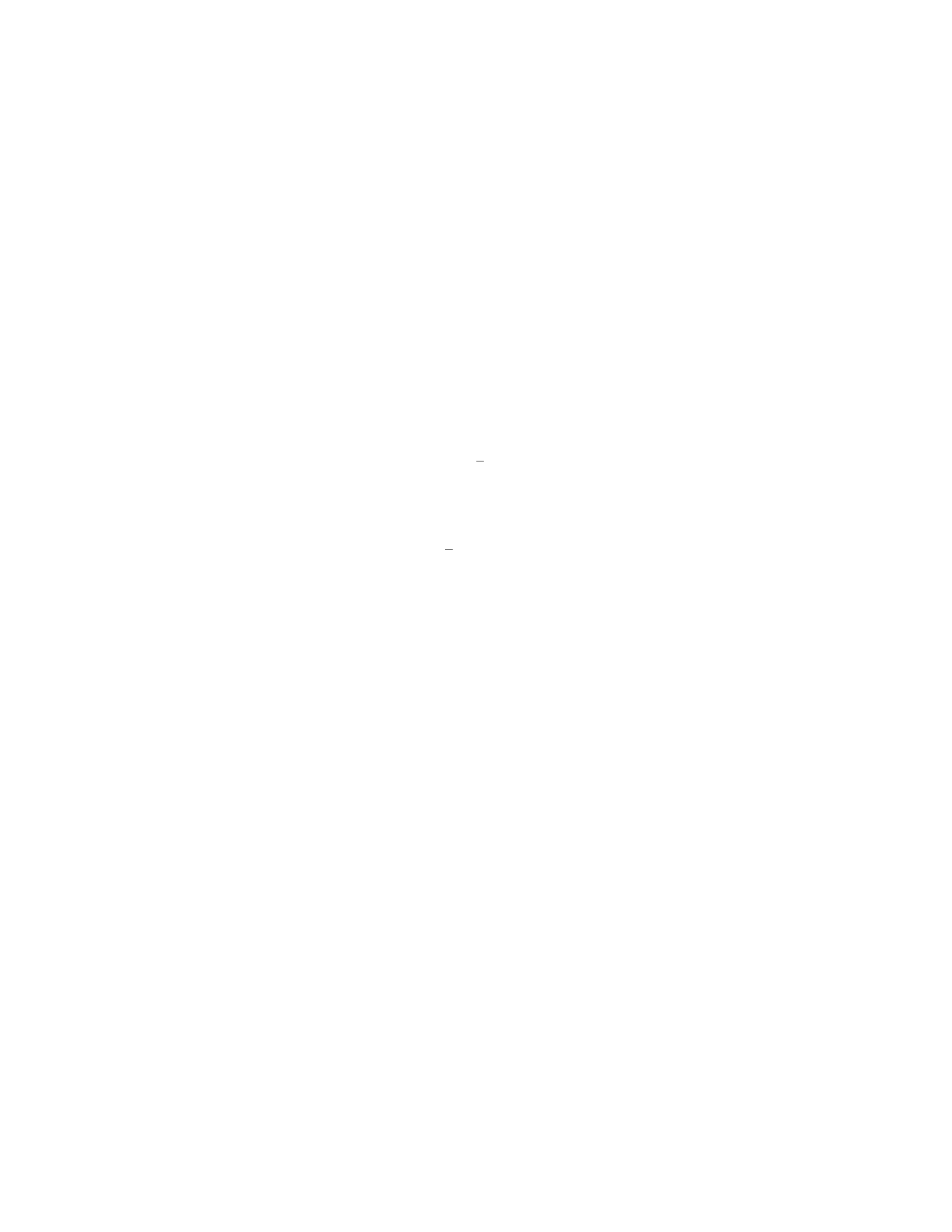
A cylindrical container is filled with water up to a height of 4 meters. Inside the
container, there is a solid aluminum sphere with a radius of 0.2 meters. If the
aluminum sphere is completely submerged in the water, what is the buoyant
force acting on the sphere? (Density of aluminum = 2700 kg/m3, density of
water = 1000 kg/m3, acceleration due to gravity = 9.81 m/s2)
Solution
Step 1: Calculate the volume of the aluminum sphere using the formula for the
volume of a sphere:
V=4
3πr3
where r= 0.2 m.
Step 2: Substitute the radius into the formula to find the volume:
V=4
3×π×(0.2)3
Step 3: Calculate the volume:
V≈0.03351 m3
Step 4: Determine the mass of the aluminum sphere using the formula:
mass = density ×volume
The density of aluminum is 2700 kg/m3.
Step 5: Substitute the density and volume to find the mass of the aluminum
sphere:
mass = 2700 ×0.03351
Step 6: Calculate the mass of the aluminum sphere:
mass ≈90.327 kg
Step 7: Determine the weight of the aluminum sphere using the formula:
weight = mass ×acceleration due to gravity
Given that the acceleration due to gravity is 9.81 m/s2.
Step 8: Substitute the mass to find the weight of the aluminum sphere:
weight = 90.327 ×9.81
Step 9: Calculate the weight of the aluminum sphere:
weight ≈886.91 N
23

The weight of the aluminum sphere is 886.91 N.
Step 10: Determine the buoyant force acting on the sphere using Archimedes’
principle, which states that the buoyant force is equal to the weight of the fluid
displaced by the object. The buoyant force can be calculated using the formula:
buoyant force = weight of water displaced
Step 11: Calculate the weight of the water displaced by the aluminum sphere
when submerged completely. The volume of water displaced is equal to the
volume of the aluminum sphere.
Step 12: Determine the weight of the water displaced using the formula:
weight of water displaced = density of water ×volume of water displaced
The density of water is 1000 kg/m3.
Step 13: Substitute the density of water and volume of water displaced:
weight of water displaced = 1000 ×0.03351
Step 14: Calculate the weight of the water displaced:
weight of water displaced = 33.51 N
Step 15: Hence, the buoyant force acting on the aluminum sphere is equal
to the weight of the water displaced:
buoyant force = 33.51 N
Question 26
Question
A spherical balloon with a radius of 2 meters is filled with helium gas. The
density of helium gas is 0.178 kg/m3, while the density of air is 1.29 kg/m3.
Determine the maximum mass that the balloon can carry without sinking.
Solution
Step 1: Let’s calculate the volume of the spherical balloon using the formula for
the volume of a sphere: V=4
3πr3, where ris the radius. Given that the radius
of the balloon is 2 meters, we have:
V=4
3π(2 m)3=32
3πm3
Step 2: Now, let’s calculate the weight of the air displaced by the balloon.
The weight of the displaced air is equal to the buoyant force acting on the bal-
loon. Buoyant force, Fb= Weight of the displaced air = Volume of air displaced×
Density of air ×g
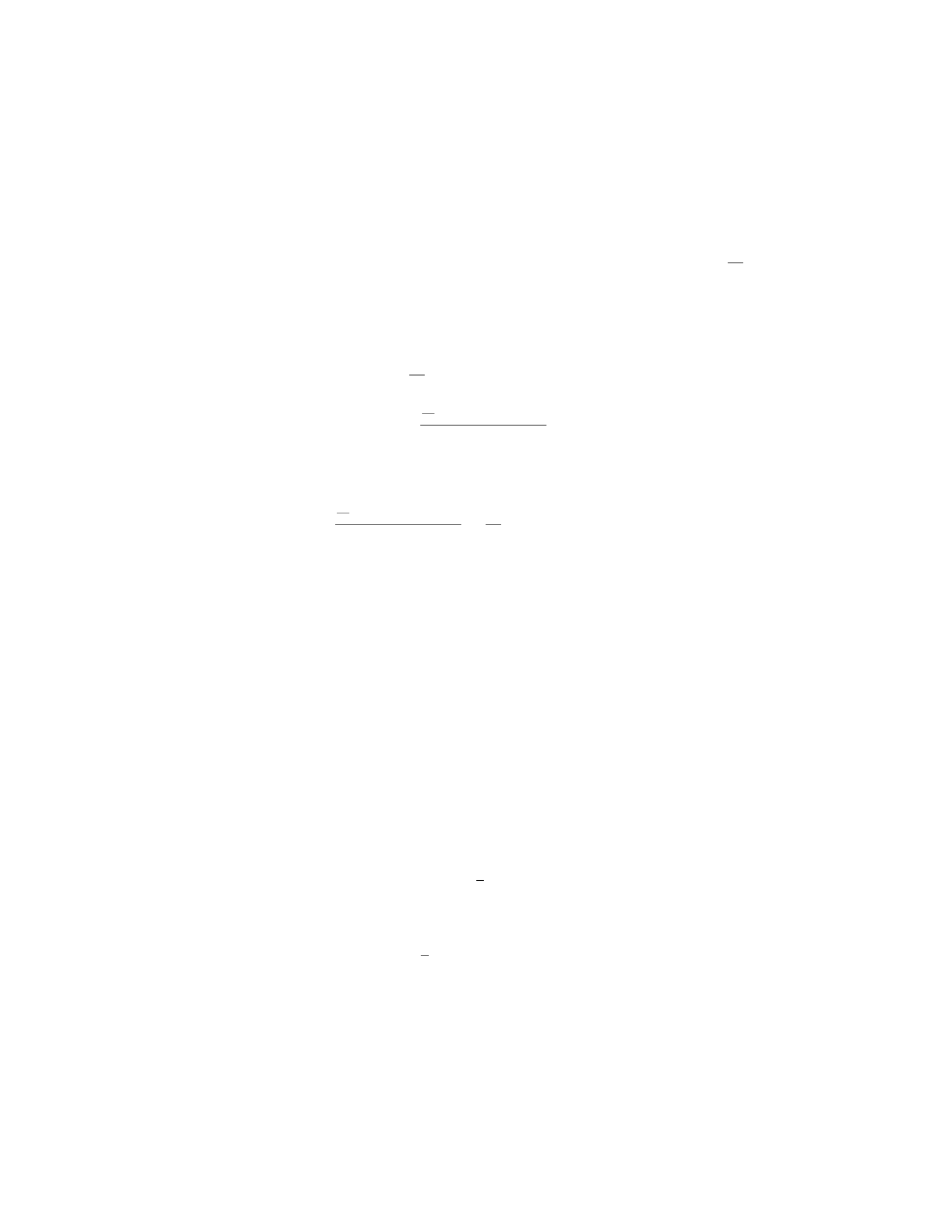
Fb=V×Density of air ×g=32
3πm3×1.29 kg/m3×9.81 m/s2
24
Step 3: Next, let’s calculate the buoyant force acting on the balloon. The
buoyant force is also equal to the weight of the air that the balloon displaces.
Fb= Volume of balloon×Density of helium×g=V×Density of helium×g=32
3πm3×0.178 kg/m3×9.81 m/s2
Step 4: The maximum mass that the balloon can carry without sinking is
when the buoyant force equals the weight of the load. Let mbe the maximum
mass the balloon can carry.
m×g=Fb=32
3πm3×0.178 kg/m3×9.81 m/s2
m=
32
3π×0.178 ×9.81
gkg
Step 5: Substituting the value of g= 9.81 m/s2and evaluating the expression
gives us the maximum mass that the balloon can carry.
m=
32
3π×0.178 ×9.81
9.81 =32
3π×0.178 kg ≈5.96 kg
Therefore, the maximum mass that the balloon can carry without
sinking is approximately 5.96 kg.
Question 27
Question
A cylindrical container with a radius of 0.5 m and a height of 1.0 m is filled
with oil. The density of oil is 800 kg/m3. A solid sphere with a radius of 0.3
m and a density of 1200 kg/m3is carefully lowered into the oil until it is fully
submerged and at rest. Calculate the buoyant force acting on the sphere.
Solution
Step 1: First, let’s calculate the volume of the submerged sphere. The volume
of a sphere is given by the formula:
V=4
3πr3
where ris the radius of the sphere. Substituting r= 0.3 m, we get:
V=4
3π(0.3)3= 0.1131 m3
Step 2: The buoyant force exerted on the sphere is equal to the weight of
the fluid displaced by the sphere. The weight of the fluid displaced is given by:
Weight = density ×volume ×acceleration due to gravity
25

Step 3: The weight of the fluid displaced by the submerged sphere is equal
to the weight of the oil that would occupy the volume of the sphere when it is
removed. The density of the oil is 800 kg/m3, so the weight of the displaced oil
is:
Weight = 800 ×0.1131 ×9.81 = 885.67 N
Step 4: The weight of the sphere in the oil is equal to the weight of the
sphere in the air minus the buoyant force acting on it. The weight of the sphere
in the air is given by:
Weightsphere = densitysphere ×volumesphere ×acceleration due to gravity
Weightsphere = 1200 ×4
3π(0.3)3×9.81 = 1065.5 N
Step 5: Finally, the buoyant force acting on the sphere is the weight of the
oil displaced, which is equal to:
Buoyant force = Weightsphere−Weight of displaced oil = 1065.5−885.67 = 179.83 N
Thus, the buoyant force acting on the sphere is 179.83 N.
Question 28
Question
A metal block with a volume of 0.05 m3and a density of 8000 kg/m3is immersed
in water. Calculate the buoyant force acting on the block and determine if it
will sink or float.
Solution
Step 1: Calculate the weight of the block The weight of the block is given by the
formula: W=m·g, where mis the mass of the block and gis the acceleration
due to gravity. Since density ρ=m
V, we can solve for mto find the mass of the
block.
m=ρ·V= 8000 kg/m3×0.05 m3= 400 kg
Therefore, the weight of the block is:
W=m·g= 400 kg ×9.81 m/s2= 3924 N
Step 2: Calculate the buoyant force The buoyant force acting on an object
immersed in a fluid is equal to the weight of the fluid displaced by the object.
The density of water is 1000 kg/m3. Since the volume of the block is 0.05 m3,
the weight of the water displaced by the block is:
Weight of displaced water = density of water ×volume of block ×g
26
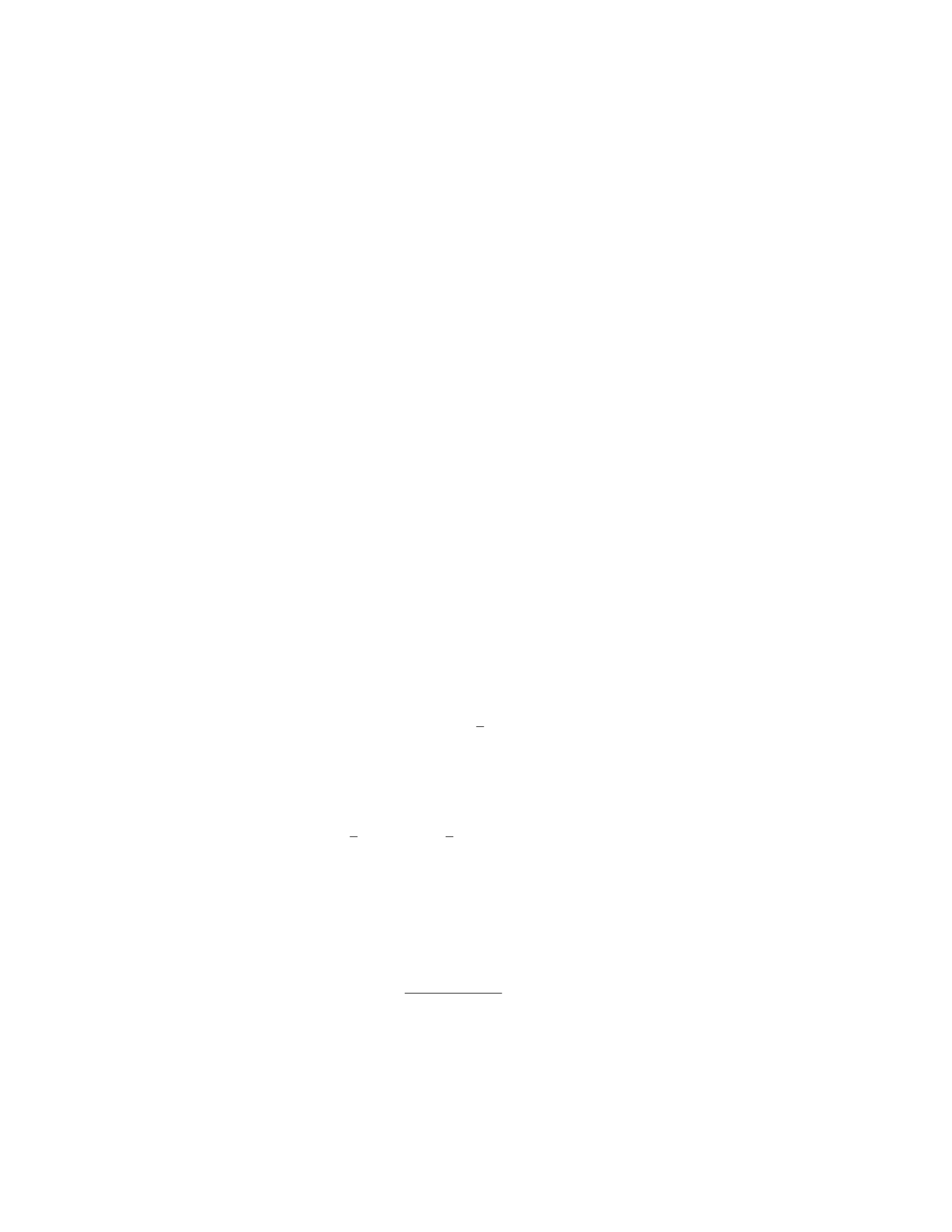
= 1000 kg/m3×0.05 m3×9.81 m/s2= 490.5 N
Therefore, the buoyant force acting on the block is 490.5 N.
Step 3: Analyze the forces Since the weight of the block is 3924 N and the
buoyant force is 490.5 N, the net force acting on the block is:
3924 N −490.5 N = 3433.5 N
The net force is greater than zero, so the block will sink in water.
Question 29
Question
A spherical metal ball with a radius of 10 cm and a density of 8000 kg/m3is
submerged in a liquid that exerts an upwards buoyant force of 200 N on the
ball. Determine the density of the liquid.
Solution
Step 1: Recall that the buoyant force (Fbuoyant) acting on an object submerged
in a fluid is given by the formula:
Fbuoyant =ρfluid ·Vsubmerged ·g
where: - ρfluid is the density of the fluid, - Vsubmerged is the volume of the
object submerged in the fluid, and - gis the acceleration due to gravity.
Step 2: The volume of a sphere is given by the formula:
V=4
3πr3
where ris the radius of the sphere.
Step 3: Substitute the given information into the equations. The volume of
the spherical ball can be calculated as:
V=4
3π(0.1 m)3=4
3π(0.001 m3) = 0.004189 m3
Step 4: Since the entire ball is submerged, Vsubmerged =V. The buoyant
force is given as 200 N.
200 = ρfluid ·0.004189 ·9.81
Step 5: Solve for ρfluid:
ρfluid =200
0.004189 ·9.81 ≈4792 kg/m3
Therefore, the density of the liquid is approximately 4792 kg/m3.
27

Question 30
Question
A cube of side length sand density ρis floating in a liquid of density σ. If the
cube is submerged to a depth h, determine the expression for the buoyant force
acting on the cube.
Solution
Step 1: Find the volume of the cube submerged in the liquid.
The volume of the cube is V=s3. The volume of the cube submerged in the
liquid is Vsubmerged =A·h, where Ais the area of the cube face in contact with
the liquid. Since the cube is floating, the submerged volume must be equal to
the volume of liquid displaced. Therefore, Vsubmerged =σAh.
Step 2: Determine the mass of the cube and the mass of the liquid displaced.
The mass of the cube is mcube =ρV , and the mass of the liquid displaced is
mliquid =σVsubmerged. Substituting the expressions for Vand Vsubmerged, we
have mcube =ρs3and mliquid =σσAh.
Step 3: Apply Archimedes’ principle to find the buoyant force.
Archimedes’ principle states that the buoyant force acting on a submerged object
is equal to the weight of the liquid displaced. Therefore, the buoyant force
Fbuoyant is given by the difference in the weight of the liquid before and after
the cube was submerged:
Fbuoyant = (σAh)g−(ρs3)g
Fbuoyant =σAhg −ρs3g
Therefore, the expression for the buoyant force acting on the cube floating
in the liquid to a depth his Fbuoyant =σAhg −ρs3g.
Question 31
Question
A solid cube of side length 20 cm and density 800 kg/m3is floating in a liquid
of density 1000 kg/m3. What is the volume of the cube that is submerged in
the liquid?
Solution
Step 1: Determine the volume of the cube.
Volume of cube = side length3
= (0.20 m)3
= 0.008 m3
28
Step 2: Calculate the weight of the cube.
Weight of cube = Volume ×Density ×Acceleration due to gravity
= 0.008 m3×800 kg/m3×9.81 m/s2
≈62.79 N
Step 3: Determine the buoyant force acting on the cube.
Buoyant force = Weight of displaced liquid
= Volume submerged ×Density of liquid ×Acceleration due to gravity
Step 4: Use Archimedes’ principle to find the volume submerged.
Buoyant force = Weight of cube
Volume submerged ×1000 kg/m3×9.81 m/s2= 62.79 N
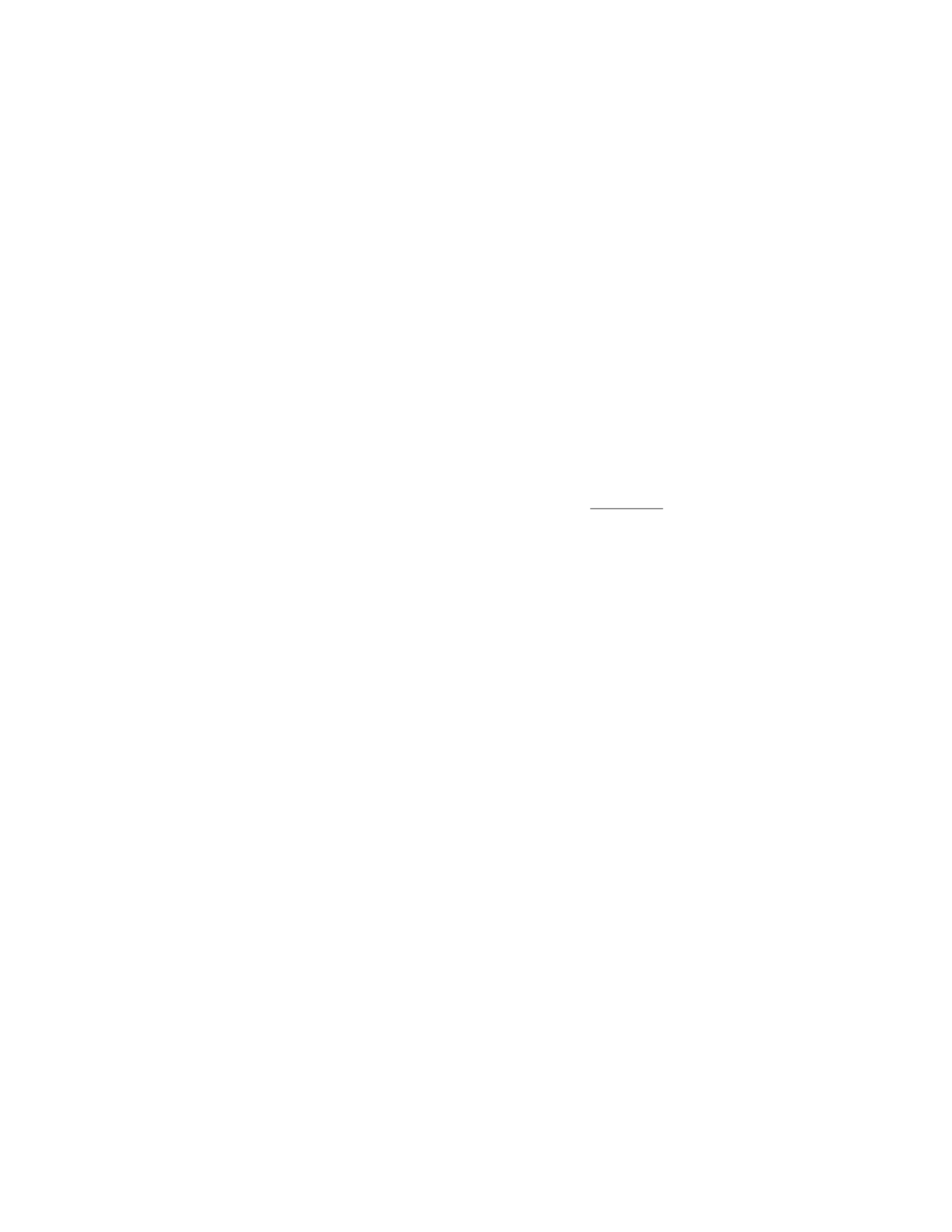
Volume submerged = 62.79 N
9810 N/m3
≈0.0064 m3
Therefore, the volume of the cube that is submerged in the liquid is approx-
imately 0.0064 m3.
Question 32
Question
A solid cube of side length 0.5 m and density 800 kg/m3is floating in a liquid
of density 1000 kg/m3. What fraction of the cube’s volume is submerged in the
liquid?
Solution
Step 1: Determine the buoyant force acting on the cube. The buoyant force is
given by the formula Fb=ρfluid ·Vsub ·g, where: - ρfluid is the density of the fluid,
-Vsub is the volume of the cube submerged in the fluid, - gis the acceleration
due to gravity.
Step 2: Calculate the weight of the cube. The weight of the cube can be
calculated using the formula W=m·g, where: - mis the mass of the cube, -
gis the acceleration due to gravity.
Step 3: Set up an equilibrium condition. For an object to float, the weight
of the object must be equal to the buoyant force acting on it. Therefore, we can
write: W=Fb
Step 4: Express the weight and buoyant force in terms of the volume sub-
merged. - The weight of the cube is W=ρcube ·Vcube ·g, where ρcube is the
29
density of the cube. - The volume of the cube is Vcube =a3, where ais the side
length of the cube.
Step 5: Calculate the fraction of the cube’s volume submerged. Since the
cube is floating, the weight of the cube is equal to the buoyant force: ρcube ·
Vcube ·g=ρfluid ·Vsub ·g
Solving for Vsub, we get: Vsub =ρcube
ρfluid
·Vcube
The fraction of the cube’s volume submerged is then given by: f=Vsub
Vcube =
ρcube
ρfluid
Substitute the values of ρcube and ρfluid to find the answer.
Question 33
Question
A metal block of density ρband volume Vis floating in a container filled with
water. The block is connected to a spring scale as shown in the figure. The
scale reads T0when the block is completely submerged.
If the block is slowly pulled out of the water and partially hangs out, what
will be the reading on the scale? Justify your answer.
images/buoyant_forces.png
Solution
1. When the block is completely submerged in water, the buoyant force acting
on the block is equal to the weight of the water displaced by the block. We
know that the weight of the water displaced is given by mg, where mis the
mass of the water displaced and gis the acceleration due to gravity. So, the
buoyant force Fbcan be expressed as:
Fb=mg
2. When the block is partially out of the water, the buoyant force F′
bacting
on the block is still equal to the weight of the water displaced. Since the block
is partially submerged, the weight of the water displaced is equal to the weight
of the volume of water equal to the volume of the submerged part of the block.
Let the volume of the submerged part of the block be V′. Then the weight of
the water displaced is given by ρwgV ′.
3. The weight of the block when it is partially submerged is given by ρbgV .
The apparent weight, which is the difference between the actual weight of the
block and the buoyant force, is then:
T=ρbgV −ρwgV ′
30

4. From Archimedes’ principle, the buoyant force is equal to the weight of
the fluid displaced, so F′
b=ρwgV ′. Therefore, the reading on the scale when
the block is partially submerged is:
T=ρbgV −ρwgV ′
5. Since ρbV=ρwV′(because the block is floating), the term ρbV−ρwV′
evaluates to zero and the scale simply reads the weight of the block T0. There-
fore, the reading on the scale remains T0when the block is pulled out of the
water and partially hangs out.
Question 34
Question
A cube of wood with a density of 600 kg/m3and dimensions 0.2 m ×0.2 m ×
0.2 m is floating in a liquid with a density of 800 kg/m3. Calculate the depth
to which the cube is submerged in the liquid.
Solution
Step 1: First, let’s find the weight of the cube. The weight of the cube can be
calculated using the formula:
Weight = Volume ×Density ×Acceleration due to gravity
Given that the density of the cube is 600 kg/m3, dimensions of the cube are 0.2
m×0.2 m ×0.2 m, and the acceleration due to gravity is 9.81 m/s2:
Volume = Side length3= 0.23= 0.008 m3
Weight = 0.008 m3×600 kg/m3×9.81 m/s2= 47.04 N
Step 2: Next, let’s find the buoyant force acting on the cube. The buoy-
ant force can be calculated using Archimedes’ principle which states that the
buoyant force is equal to the weight of the liquid displaced by the object:
Buoyant force = Volume submerged×Density of liquid×Acceleration due to gravity
Let hbe the depth to which the cube is submerged. The volume submerged is
the area of the base of the cube (0.2 m ×0.2 m) times h:
Volume submerged = 0.2×0.2×hm3= 0.04hm3
Given that the density of the liquid is 800 kg/m3and the acceleration due to
gravity is 9.81 m/s2:
Buoyant force = 0.04h×800 ×9.81 = 313.6hN
31

Step 3: Since the cube is floating, the weight of the cube is equal to the
buoyant force.
47.04 N = 313.6hN
Solving for h:
h=47.04
313.6= 0.15 m
Therefore, the cube is submerged to a depth of 0.15 meters in the liquid.
Question 35
Question
A metal cube of side length 10 cm and density 8000 kg/m3is floating in water.
What is the depth of the cube under the water surface? (Density of water =
1000 kg/m3, acceleration due to gravity = 9.81 m/s2)
Solution
Step 1: First, we need to determine the fraction of the cube’s volume submerged
in water.
Density of cube = 8000 kg/m3
Density of water = 1000 kg/m3
Since the cube is floating, the buoyant force must be equal to the weight of the
cube:
Weight of cube = Buoyant force
Vcube ×Density of water ×g=Vsubmerged ×Density of cube ×g
where Vcube is the total volume of the cube, and Vsubmerged is the volume sub-
merged in water.
Step 2: Since the cube is a cube, the volume of the cube is given by Vcube =
(side length)3= (0.10 m)3= 0.001 m3. Let DV be the depth of the cube under
the water surface. Then Vsubmerged = 0.10 m ×0.10 m ×DV . Plugging in the
values into the equation above:
0.001 m3×1000 kg/m3= 0.01 m2×DV ×8000 kg/m3
Step 3: Solve for the depth DV :
DV =0.001 m3×1000 kg/m3
0.01 m2×8000 kg/m3= 0.000125 m = 0.125 mm
Therefore, the depth of the cube under the water surface is 0.125 mm.
32

Question 3
Question
A cylindrical metal object with a density of 8000 kg/m3and a volume of 0.04
m3is submerged in a container of water. If the metal object is suspended by a
rope and completely submerged in water, calculate the tension in the rope.
Solution
Step 1: First, we need to determine the weight of the metal object. The weight
of an object can be calculated using the formula W=mg, where mis the mass
of the object and gis the acceleration due to gravity (approximately 9.81 m/s2).
Given that the density of the metal object is 8000 kg/m3and its volume is 0.04
m3, we can calculate the mass of the object as follows:
m= Density ×Volume = 8000 kg/m3×0.04 m3= 320 kg
Therefore, the weight of the metal object is:
W=mg = 320 kg ×9.81 m/s2= 3139.2 N
Step 2: Now, we can determine the buoyant force acting on the metal object.
The buoyant force is equal to the weight of the fluid displaced by the object,
which can be calculated using the formula Fbuoyant =ρ·V·g, where ρis the
density of the fluid (1000 kg/m3for water), Vis the volume of the object, and
gis the acceleration due to gravity:
Fbuoyant = 1000 kg/m3×0.04 m3×9.81 m/s2= 392.4 N
Step 3: Since the metal object is suspended by a rope and completely sub-
merged in water, the tension in the rope is equal to the difference between the
weight of the object and the buoyant force:
Tension = W−Fbuoyant = 3139.2 N −392.4 N = 2746.8 N
Therefore, the tension in the rope when the metal object is completely sub-
merged in water is 2746.8 N.
Question 4
Question
A metal block of mass 500 kg and volume 0.5 m3is submerged in a container of
water. Calculate the buoyant force acting on the block and determine if it will
float or sink.
3

Solution
Step 1: Calculate the weight of the block. Given that the mass of the block is
500 kg and the acceleration due to gravity is 9.81 m/s2, the weight Wcan be
calculated using the formula W=m·g, where mis the mass of the block and
gis the acceleration due to gravity.
W= 500 kg ×9.81 m/s2
W= 4905 N
Step 2: Calculate the buoyant force. The buoyant force Fbacting on an
object submerged in a fluid is equal to the weight of the fluid displaced by the
object. The volume of water displaced by the block is equal to the volume of
the block. Since the density of water is 1000 kg/m3, the buoyant force can be
calculated as:
Fb= density of water ×volume of water displaced ×g
Fb= 1000 kg/m3×0.5 m3×9.81 m/s2
Fb= 4905 N
Step 3: Determine if the block will float or sink. The block will float if the
buoyant force is greater than or equal to the weight of the block. In this case,
since 4905 N = 4905 N, the buoyant force is equal to the weight of the block.
Therefore, the block will remain submerged in the water.
Question 5
Question
A cube of wood with a side length of 0.1 m and a density of 800 kg/m3is floating
in water. Calculate the depth to which the cube is submerged in water, given
that the density of water is 1000 kg/m3.
Solution
Step 1: Let’s first determine the volume of the cube. The volume of a cube is
given by the formula V=s3, where sis the side length. So, for the cube in this
problem:
V= (0.1 m)3= 0.001 m3
Step 2: Next, we can calculate the mass of the cube. The mass of the cube is
given by the formula m=ρV , where ρis the density of the cube. Substituting
the values:
m= 800 kg/m3×0.001 m3= 0.8 kg
Step 3: Using Archimedes’ principle, the buoyant force acting on the cube
is equal to the weight of the water displaced by the cube. The buoyant force is
4

given by Fb=ρwaterVsubmergedg, where ρwater is the density of water, Vsubmerged
is the volume submerged by the cube, and gis the acceleration due to gravity.
Since the cube is in equilibrium, the weight of the cube is balanced by the
buoyant force:
mcubeg=ρwaterVsubmergedg
Step 4: We can now solve for the volume submerged by the cube.
Vsubmerged =mcube
ρwater
=0.8 kg
1000 kg/m3= 0.0008 m3
Step 5: Finally, we can calculate the depth to which the cube is submerged
in water. Since the cube is floating, the volume submerged is equal to the cross-
sectional area of the cube multiplied by the depth of submersion. Therefore:
Area ×depth = 0.0008 m3
0.1 m ×depth = 0.0008 m3
depth = 0.0008 m3
0.1 m = 0.008 m = 8 mm
Thus, the cube is submerged to a depth of 8 mm in water.
Question 6
Question
A cube of wood with a density of 0.8 g/cm3and side length of 10 cm is floating
in water. If 60
Solution
Step 1: Calculate the volume of the cube submerged in water. Step 2: Use the
volume of water displaced to find the density of water.
Step 1: Calculate the volume of the cube submerged in water. The volume
of the cube is given by Vcube = side length3= (10 cm)3= 1000 cm3. Since 60
Step 2: Use the volume of water displaced to find the density of water. Let
Vwater be the volume of water displaced. According to Archimedes’ principle,
the buoyant force (Fbuoyant) is equal to the weight of the water displaced. The
density of the cube is given as 0.8 g/cm3. Let mcube be the mass of the cube. We
know that mcube = density ×Vcube. The weight of the cube is Wcube =mcubeg,
where gis the acceleration due to gravity. Since the cube is floating, the buoyant
force Fbuoyant is equal to the weight of the cube. Therefore, Fbuoyant =mcubeg.
The density of water (ρwater) can be found using Fbuoyant =ρwater×g×Vwater.
Substitute mcubegfor Fbuoyant:mcubeg=ρwater ×g×Vwater. Thus, density of
water, ρwater =mcube
Vwater =density of cube×Vcube
Vwater . Substitute the values: ρwater =
0.8 g/cm3×1000 cm3
600 cm3=800
600 = 1.33 g/cm3.
Therefore, the density of water is 1.33 g/cm3.
5

Question 7
Question
A cylindrical object of height h, radius r, and density ρois floating vertically in
a container filled with a liquid of density ρl. The top of the cylinder is xunits
above the liquid surface. Determine the expression for the buoyant force acting
on the object when it is partially submerged in the liquid.
Solution
Step 1: First, calculate the volume of the cylinder that is submerged in the
liquid. This volume can be expressed as Vsubmerged =πr2x.
Step 2: The weight of the object is given by Wobject =ρo·Vtotal ·g, where
Vtotal is the total volume of the cylinder.
Step 3: The buoyant force Fbuoyant acting on the object is equal to the weight
of the liquid displaced, which is given by Fbuoyant =ρl·Vsubmerged ·g.
Step 4: Equate the weight of the object and the buoyant force to find the
expression for the buoyant force:
ρo·πr2h·g=ρl·πr2x·g
Step 5: Solve for xto obtain the expression for the buoyant force:
x=ρo·h
ρl
Therefore, the buoyant force acting on the object when it is partially sub-
merged in the liquid is ρo·πr2·ρo·h
ρl
·g.
Question 8
Question
A cube of aluminum with a side length of 10 cm and a density of 2.7 g/cm3
is floating in a container of water. Determine the depth to which the cube is
submerged in the water.
Solution
Step 1: The buoyant force acting on the aluminum cube is equal to the weight
of the water displaced by the cube. We can find the volume of the submerged
cube using Archimedes’ principle.
Step 2: The weight of the cube is equal to its mass multiplied by the accel-
eration due to gravity (w=m·g).
6

Step 3: The volume of the cube can be calculated using the formula V=l3,
where lis the side length of the cube.
Step 4: Set up an equation for the buoyant force (Fb) using the volume of
the cube, the density of water (ρw= 1 g/cm3), and the acceleration due to
gravity (g= 9.81 m/s2).
Step 5: Use the equation for density (ρ=m
V) to find the mass of the cube.
Step 6: The weight of the water displaced by the cube is equal to the weight
of the cube.
Step 7: The depth to which the cube is submerged can be calculated by
dividing the volume of the submerged cube by the surface area of the cube in
contact with the water.
Step 8: Calculate the depth to which the cube is submerged in the water.
Question 9
Question
A cylindrical object of radius Rand height his floating in a container of water.
The density of the object is ρo, and the density of water is ρw. Determine the
fraction of the object’s volume that is submerged in the water.
Solution
Let’s denote the fraction of the object’s volume that is submerged in the water
as f. To find f, we need to consider the forces acting on the object.
Step 1: Determine the volume of the object submerged in water. Assume the
object is fully submerged, then the volume of water displaced would be equal
to the volume of the cylinder:
Vdisplaced =πR2h
Step 2: Write the equation for the buoyant force. The buoyant force (Fb) is
given by Archimedes’ principle, which states that the buoyant force is equal to
the weight of the fluid displaced:
Fb=ρw·g·Vdisplaced
Step 3: Calculate the weight of the object. The weight of the object is given
by:
Wobject =ρo·g·Vtotal
where Vtotal =πR2his the total volume of the object.
Step 4: Set up the equilibrium condition. For the object to be floating, the
buoyant force must be equal to the weight of the object:
Fb=Wobject
7

Step 5: Substitute the equations and solve for f.
ρw·g·πR2h=ρo·g·πR2h·f
f=ρw
ρo
Therefore, the fraction of the object’s volume submerged in water is ρw
ρo.
Question 10
Question
A cube of wood with side length 10 cm and density 0.8 g/cm3is floating in
water. What is the minimum distance from the bottom of the cube to the water
surface?
Solution
Step 1: We first find the mass of the wood cube. The mass of the cube is given
by the density formula:
mass = density ×volume
mass = 0.8 g/cm3×(10 cm)3
mass = 0.8×1000 g
mass = 800 g
Step 2: Next, we find the volume of water displaced by the cube. The volume
of water displaced is equal to the volume of the cube submerged in water. Since
the cube is floating, the weight of the wood cube equals the buoyant force. The
volume of water displaced is:
V= side2×distance from bottom to water surface
V= (10 cm)2×h
V= 100 cm2×h
Step 3: The buoyant force is given by the formula:
Buoyant force = density of water ×acceleration due to gravity ×V
Buoyant force = 1 g/cm3×9.8 m/s2×100 cm2×h
Step 4: The weight of the wood cube is equal to the buoyant force:
Weight of cube = Buoyant force
mass of cube×acceleration due to gravity = density of water×acceleration due to gravity×V
8

800 g ×9.8 m/s2= 1 g/cm3×9.8 m/s2×100 cm2×h
Step 5: Solve for h, the distance from the bottom of the cube to the water
surface:
h=800 ×9.8
1×100 cm
h= 78 cm
Therefore, the minimum distance from the bottom of the cube to the water
surface is 78 cm.
Question 11
Question
A rectangular block of wood with dimensions 10 cm ×5 cm ×3 cm is floating in
water. Calculate the density of the wood if the block is immersed in water up
to a depth of 2 cm. The density of water is 1000 kg/m3.
Solution
Step 1: First, we need to calculate the volume of the wooden block. The volume
of the wooden block is given by:
V=l×w×h
where l,w, and hare the length, width, and height of the block, respectively.
Plugging in the values, we get:
V= 10 cm ×5 cm ×3 cm = 150 cm3
Step 2: Next, we need to calculate the volume of water displaced by the
block. When the block is submerged in water, it displaces its own weight in
water. The volume of water displaced is equal to the volume of the block
submerged. The volume of water displaced is given by:
Vdisplaced =l×w×d
where dis the depth to which the block is immersed in water. Plugging in the
values, we get:
Vdisplaced = 10 cm ×5 cm ×2 cm = 100 cm3
Step 3: We know that the density of water is 1000 kg/m3. The mass of the
volume of water displaced by the block is given by:
mwater =ρwater ×Vdisplaced
9

Plugging in the values, we get:
mwater = 1000 kg/m3×100 cm3
1000000 cm3/m3= 0.1 kg
Step 4: The buoyant force acting on the block is due to the weight of the
water displaced. The buoyant force is given by:
Fbuoyant =mwater ×g
where gis the acceleration due to gravity (9.81 m/s2). Plugging in the values,
we get:
Fbuoyant = 0.1 kg ×9.81 m/s2= 0.981 N
Step 5: The weight of the block is balanced by the buoyant force and the
weight of the block. The weight of the block is calculated using the equation:
Fblock =mblock ×g
The weight of the block is equal to the weight of water displaced since the block
is floating. Plugging in the values, we get:
Fblock = 0.1 kg ×10 = 0.981 N
Step 6: From Step 5, we see that the weight of the block is equal to the
buoyant force. This means that the density of the block is equal to the density
of water, which is 1000 kg/m3.
Question 12
Question
A cube of wood with side length 10 cm and density 0.8 g/cm3is placed in a
container of water. Determine the depth to which the cube sinks in the water.
The density of water is 1 g/cm3.
Solution
Step 1: First, we need to find the weight of the cube. Given that the density of
wood is 0.8 g/cm3and the volume of the cube is (10 cm)3= 1000 cm3, we can
find the mass of the cube as follows:
Mass of cube = Density ×Volume = 0.8 g/cm3×1000 cm3= 800 g
The weight of the cube can be found by multiplying its mass by the acceleration
due to gravity, g= 9.8 m/s2:
Weight of cube = 800 g ×9.8 m/s2= 7840 N
10

Step 2: Next, we need to determine the buoyant force acting on the cube.
The buoyant force is equal to the weight of the water displaced by the cube.
Since the cube is submerged, the volume of water displaced is equal to the
volume of the cube. Therefore, the buoyant force can be calculated as follows:
Buoyant force = Density of water×Volume of cube×g= 1 g/cm3×1000 cm3×9.8 m/s2= 9800 N
Step 3: The depth to which the cube sinks can be determined by considering
the equilibrium of forces. When the cube is at rest in the water, the weight of
the cube is balanced by the buoyant force:
Weight of cube = Buoyant force
7840 N = 9800 N
Since the weight of the cube is less than the buoyant force, the cube will sink
until the upward buoyant force equals the weight of the cube. Therefore, the
cube will sink to a depth such that the weight of the water displaced by the
volume submerged is equal to the weight of the cube. Let dbe the depth to
which the cube sinks. The volume of water displaced is 1000 cm3×d.
Weight of water displaced = Density of water×Volume of water displaced×g= 1 g/cm3×1000 cm3×d×9.8 m/s2= 9800dN
Setting the weight of water displaced equal to the weight of the cube:
9800d= 7840
d=7840
9800 = 0.8 m
Therefore, the cube will sink to a depth of 0.8 meters in the water.
Question 13
Question
A cube of wood with sides measuring 6 cm is floating in a tub of water. The
density of water is 1000 kg/m3and the density of wood is 700 kg/m3. Determine
the depth to which the cube is submerged in the water.
Solution
Step 1: Start by determining the volume of the cube. The volume of the cube is
given by the formula: Vcube =s3, where sis the length of each side of the cube.
Given that s= 6 cm, convert this to meters before calculating the volume.
Vcube = (0.06 m)3= 0.000216 m3
Step 2: Calculate the weight of the wooden cube. The weight of the wooden
cube is given by the formula: Wcube =mcube ·g, where mcube is the mass of
11

the cube and gis the acceleration due to gravity. The mass of the cube can be
calculated using the formula mcube =ρwood ·Vcube.
mcube = 700 kg/m3×0.000216 m3= 0.1512 kg
Wcube = 0.1512 kg ×9.81 m/s2= 1.48 N
Step 3: Calculate the buoyant force acting on the cube. The buoyant force
is given by the formula: Fbuoyant =ρwater ·Vsubmerged ·g, where ρwater is the
density of water, Vsubmerged is the volume of water displaced by the submerged
part of the cube, and gis the acceleration due to gravity. Because the cube is
floating, the weight of the cube is equal to the buoyant force.
Fbuoyant = 1.48 N
Step 4: Find the volume of water displaced (submerged volume). Using
Archimedes’ principle, the volume of water displaced is equal to the volume of
the cube that is submerged. Let the depth to which the cube is submerged be
d, then Vsubmerged =s2·d.
Vsubmerged = 0.062m×d= 0.0036 dm3
Step 5: Equate the weight of the cube to the buoyant force and solve for d.
1.48 N = 1000 kg/m3×0.0036 dm3×9.81 m/s2
d=1.48
1000 ×0.0036 ×9.81 = 0.043 m = 4.3 cm
Therefore, the cube is submerged to a depth of 4.3 cm in the water.
Question 14
Question
A uniform solid sphere of radius 10 cm and mass 3 kg is placed in a container
filled with water. The sphere is released and floats at a certain depth. Calculate
the depth at which the sphere floats in the water, given that the density of water
is 1000 kg/m3and the acceleration due to gravity is 9.8 m/s2.
Solution
Step 1: First, let’s calculate the buoyant force acting on the sphere. The buoyant
force Fbuoyant is given by the formula
Fbuoyant =ρ·Vdisplaced ·g,
where ρis the density of the fluid, Vdisplaced is the volume of the fluid displaced
by the object, and gis the acceleration due to gravity.
12

Step 2: The volume of the water displaced by the sphere is equal to the
volume of the sphere submerged in the water. Since the sphere floats, the
buoyant force will exactly balance the weight of the sphere. The weight of the
sphere Wis given by
W=m·g,
where mis the mass of the sphere and gis the acceleration due to gravity.
Step 3: The volume of the sphere Vsphere is given by
Vsphere =4
3πr3,
where ris the radius of the sphere.
Step 4: The mass of the water displaced mdisplaced can be calculated using
the density of water and the volume of the sphere submerged in water.
mdisplaced =ρ·Vsphere.
Step 5: Since the sphere floats, the weight of the displaced water must be
equal to the weight of the sphere. This gives us the equation
ρ·Vsphere ·g=m·g.
Step 6: Substituting the expressions for Vsphere and mdisplaced into the equa-
tion and solving for the depth dat which the sphere floats, we get
4
3πr3·ρ·g=m·g.
4
3π(0.1)3·ρ·g·d=m·g.
Step 7: Solving for d, we find
d=m
4
3πr3·ρ.
Step 8: Substituting the given values m= 3 kg, r= 0.1 m, and ρ=
1000 kg/m3into the formula, we can calculate the depth at which the sphere
floats in the water.
d=3
4
3π(0.1)3·1000.
Step 9: Calculating the depth d, we get
d=3
4
3π·0.001 ·1000 =3
4π≈0.238 m.
Therefore, the sphere floats at a depth of approximately 0.238 meters in the
water.
13
Question 15
Question
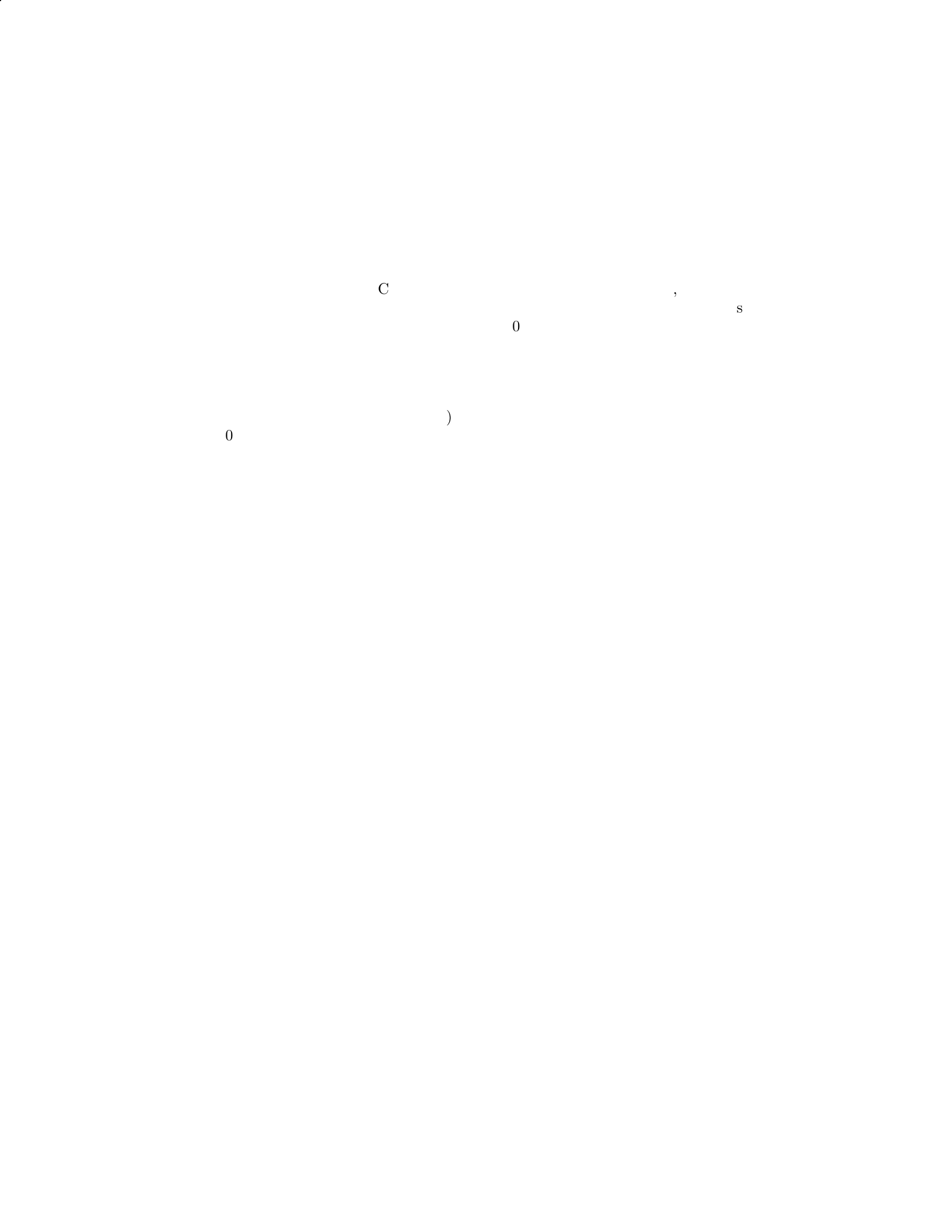
A hot air balloon has a volume of 3000 m3. The air inside the balloon is heated
to a temperature of 150
°
C. If the air outside the balloon is at 20
°
C, calculate
the buoyant force acting on the balloon. Assume the density of air at 20
°
C is
1.2 kg/m3and the density of air at 150
°
C is 0.8 kg/m3.
Solution
Step 1: Calculate the difference in air densities inside and outside the balloon.
Given: - Density of air at 20
°
C (ρ0) = 1.2 kg/m3- Density of air at 150
°
C (ρ)
= 0.8 kg/m3
The difference in densities is:
∆ρ=ρ0−ρ= 1.2 kg/m3−0.8 kg/m3= 0.4 kg/m3
Step 2: Calculate the mass of air displaced by the balloon. The mass of air
displaced is equal to the difference in densities times the volume of the balloon:
m= ∆ρ×V= 0.4 kg/m3×3000 m3= 1200 kg
Step 3: Calculate the weight of the displaced air. The weight of the displaced
air is:
Wdisplaced =m×g= 1200 kg ×9.81 m/s2= 11772 N
Step 4: Calculate the buoyant force acting on the balloon. The buoyant
force acting on the balloon is equal to the weight of the displaced air:
Fbuoyant = 11772 N
Therefore, the buoyant force acting on the hot air balloon is 11772 N.
Question 16
Question
A cube of side length Land density ρcube is floating in a liquid of density ρliquid.
The cube is initially floating with a fraction fof its volume submerged beneath
the liquid. Find an expression for the density ρcube of the cube in terms of f,
ρliquid, and L.
Solution
Step 1: First, let’s write the equilibrium condition for the cube as it floats in
the liquid. The buoyant force must be equal to the weight of the submerged
portion of the cube. Step 2: The volume of the cube is V=L3and the
14
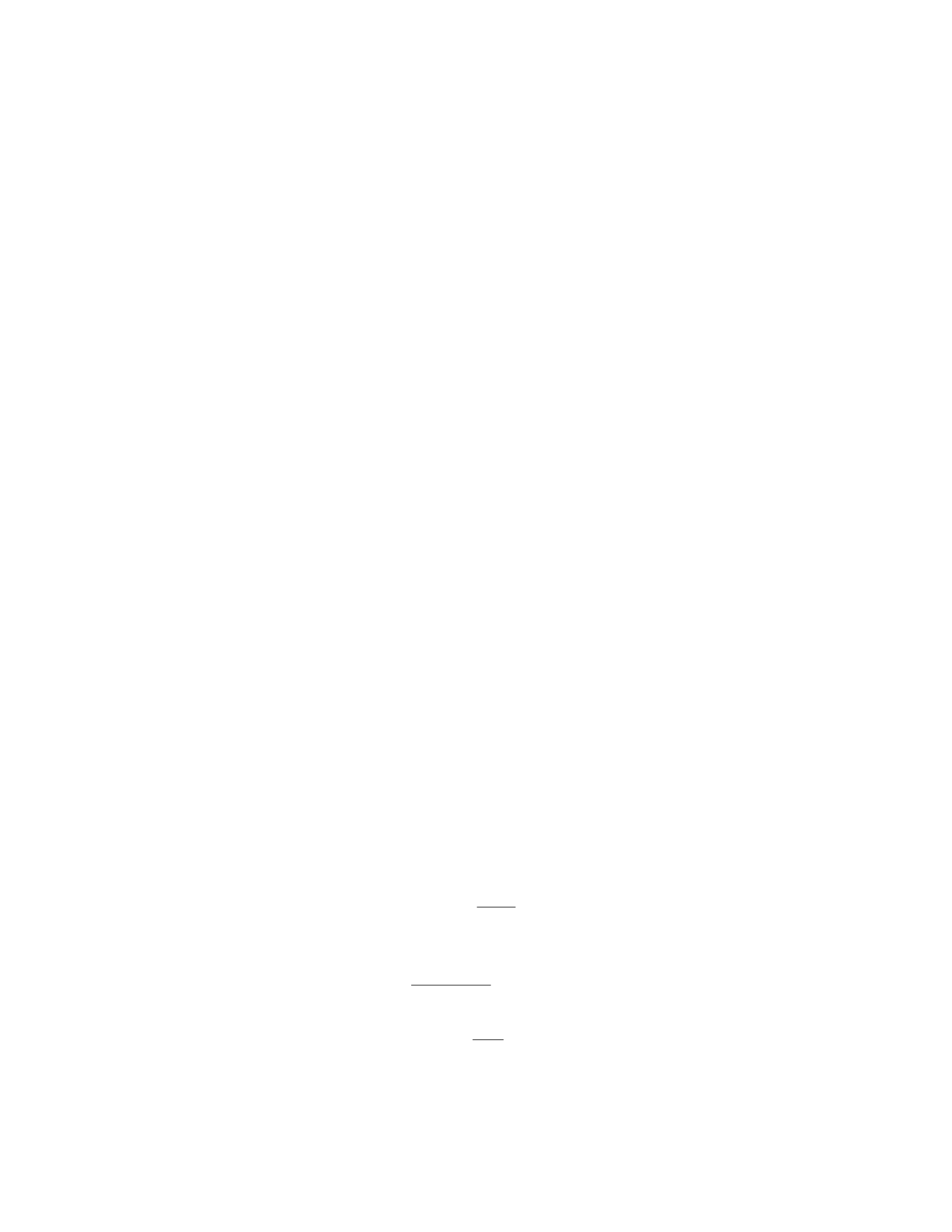
fraction submerged is f, so the volume submerged is Vsubmerged =fV . Step
3: The weight of the cube is given by Wcube =ρcubeV g, and the weight of
the submerged portion of the cube is Wsubmerged =ρliquidVsubmergedg. Step
4: Using the equilibrium condition, we have ρcubeV g =ρliquidfV g. Step 5:
Substituting the expressions for Vand Vsubmerged into the equation, we get
ρcubeL3=ρliquidfL3. Step 6: Finally, solving for ρcube, we find that ρcube =
ρliquidf.
Question 17
Question
A cylindrical ship with a radius of 10 meters and a length of 100 meters floats
in seawater (density of 1025 kg/m3). The ship’s average density is 900 kg/m3.
Determine the fraction of the ship’s volume that is beneath the waterline.
Solution
Step 1: Calculate the volume of the ship submerged in water.
The buoyant force Fbacting on the ship is equal to the weight of the water
displaced by the ship. This can be calculated using Archimedes’ principle:
Fb=ρwater ·Vsubmerged ·g
where ρwater = density of water = 1025 kg/m3,Vsubmerged = volume of the ship
submerged in water, g= acceleration due to gravity = 9.81 m/s2.
The weight of the ship Wcan be calculated as:
W=ρavg ·Vtotal ·g
where ρavg = average density of the ship = 900 kg/m3,Vtotal = total volume of
the ship.
Since the ship is floating, the buoyant force Fbis equal to the weight of the
ship W. Therefore,
Fb=W
ρwater ·Vsubmerged ·g=ρavg ·Vtotal ·g
ρwater ·Vsubmerged =ρavg ·Vtotal
Vsubmerged =ρavg
ρwater
·Vtotal
Substitute the given values to find the volume submerged:
Vsubmerged =900 kg/m3
1025 kg/m3·π·(10 m)2·100 m
Vsubmerged =900
1025 ·π·1000
15

Vsubmerged ≈876.71 m3
Therefore, the volume of the ship submerged in water is approximately
876.71 m3.
Step 2: Calculate the fraction of the ship’s volume beneath the waterline.
The total volume of the ship Vtotal can be calculated as:
Vtotal =π·(10 m)2·100 m
Vtotal =π·1000
Vtotal = 3141.59 m3
The fraction of the ship’s volume beneath the waterline is:
Vsubmerged
Vtotal
=876.71 m3
3141.59 m3
Vsubmerged
Vtotal
≈0.279
Therefore, approximately 27.9
Question 18
Question
A cube of aluminum with sides of length 10 cm and a density of 2700 kg/m3is
submerged in water. Calculate the buoyant force acting on the cube.
Solution
Step 1: Calculate the volume of the aluminum cube.
Volume of cube = side length3= (0.10 m)3= 0.001 m3
Step 2: Calculate the weight of the aluminum cube.
Weight = Mass ×Acceleration due to gravity
Mass = Volume ×Density = 0.001 m3×2700 kg/m3= 2.7 kg
Weight = 2.7 kg ×9.81 m/s2= 26.487 N
Step 3: Calculate the buoyant force acting on the cube. According to
Archimedes’ principle, the buoyant force is equal to the weight of the fluid
displaced.
Buoyant Force = Weight of water displaced
16

Volume of water displaced = Volume of cube = 0.001 m3
Density of water = 1000 kg/m3
Weight of water displaced = Volume of water displaced×Density of water×Acceleration due to gravity
Weight of water displaced = 0.001 m3×1000 kg/m3×9.81 m/s2= 9.81 N
Buoyant Force = 9.81 N
Therefore, the buoyant force acting on the aluminum cube is 9.81 N.
Question 19
Question
A metal object of volume 500 cm3and density 2000 kg/m3is immersed in water.
Calculate the buoyant force acting on the object and determine if the object
will float or sink in the water.
Solution
Step 1: Convert the volume of the object to m3: Given that the volume of the
object is 500 cm3, we need to convert this to m3. Since 1 cm3= 1 ×10⁻⁶m3,
the volume of the object in m3is:
500 cm3×1×10−6m3/cm3= 0.0005 m3
Step 2: Calculate the mass of the object: The mass of the object can be
calculated using the formula: mass = density ×volume. Substituting the given
values: mass = 2000 kg/m3×0.0005 m3= 1 kg
Step 3: Calculate the buoyant force: The buoyant force is given by the
formula: Buoyant force = Density of fluid ×Volume submerged ×Acceleration
due to gravity. The density of water is 1000 kg/m3, and the acceleration due to
gravity is 9.81 m/s2.
Since the object is completely immersed in water, the volume submerged is
equal to its total volume, which is 0.0005 m3. Substituting the values: Buoyant
force = 1000 kg/m3×0.0005 m3×9.81 m/s2= 4.905 N
Step 4: Determine if the object will float or sink: The object will float if the
buoyant force is greater than or equal to the weight of the object, and it will
sink if the buoyant force is less than the weight of the object.
Since the mass of the object is 1 kg, its weight is given by: Weight = mass
×gravity = 1 kg ×9.81 m/s2= 9.81 N
Since the buoyant force (4.905 N) is less than the weight of the object (9.81
N), the object will sink in water.
17

Question 20
Question
A cube of wood with a density of 0.6 g/cm3and side length 10 cm is floating in
a liquid with a density of 1.2 g/cm3. What is the depth of the cube below the
surface of the liquid?
Solution
Step 1: Find the density of water (liquid) using the given density. Step 2: Apply
Archimedes’ principle to find the volume of wood submerged in the liquid. Step
3: Use the volume to calculate the depth below the surface of the liquid.
Step 1: The density of water is 1.2 g/cm3.
Step 2: Let Vbe the volume of wood submerged in the liquid. The buoyant
force Fbacting on the wood is given by:
Fb=ρf·g·V
where ρfis the density of the liquid and gis the acceleration due to gravity.
The weight of the wood is balanced by the buoyant force, so:
Fb=m·g
where mis the mass of the wood. The mass of the wood can be calculated using
its density ρwand volume. Since the wood is submerged, the volume is V. The
mass mis given by:
m=ρw·V
Equating the expressions for Fb, we get:
ρf·g·V=ρw·V
Solving for V:
V=ρw
ρf
·V
Step 3: The depth of the cube below the surface of the liquid can be calcu-
lated by dividing the volume of the cube submerged by the area of the cube’s
face. Let hbe the depth of submersion. The volume of wood submerged is
equivalent to the volume of the submerged part of the cube:
V=A·h
where Ais the area of the cube’s face. Solving for h:
h=V
A
Substitute the calculated value of Vinto the above equation to find the
depth of the cube below the surface of the liquid.
18

Question 21
Question
A cylindrical tank has a diameter of 4 meters and a height of 6 meters. If the
tank is filled with water, calculate the buoyant force acting on the tank.
Solution
Step 1: Determine the volume of the cylindrical tank. The volume of a cylinder
is given by the formula V=πr2h, where ris the radius of the cylinder and h
is the height. Given that the diameter of the tank is 4 meters, the radius ris
half of the diameter, so r= 2 meters. The height his 6 meters. Therefore, the
volume of the tank is:
V=π×(2)2×6 = 24πm3
Step 2: Calculate the weight of water in the tank. The weight of water in
the tank is equal to the mass of the water times the acceleration due to gravity,
g= 9.8 m/s2. The density of water is approximately 1000 kg/m3. Therefore,
the mass of the water is:
mass = density ×volume = 1000 ×24π= 24000πkg
And the weight of the water is:
weight = mass ×g= 24000π×9.8 N
Step 3: Calculate the weight of the tank. The weight of the tank is equal
to the mass of the tank times the acceleration due to gravity. To simplify the
calculation, let’s assume the density of the tank material is 8000 kg/m3. The
volume of the tank is 24πm3, so the mass of the tank is:
mass = density ×volume = 8000 ×24π= 192000πkg
And the weight of the tank is:
weight = mass ×g= 192000π×9.8 N
Step 4: Calculate the buoyant force. The buoyant force is equal to the weight
of the water displaced by the tank, which is equal to the weight of the water in
the tank. Therefore, the buoyant force acting on the tank is:
Buoyant force = weight of water = 24000π×9.8 N
Question 22
Question
A cylindrical tank filled with water has a radius of 2 meters and a height of 3
meters. A solid sphere with a radius of 0.5 meters and a density of 800 kg/m3is
19

submerged in the water. Calculate the buoyant force acting on the sphere and
determine whether the sphere will sink or float.
Given: Density of water = 1000 kg/m3, Acceleration due to gravity, g=
9.81 m/s2.
Solution
Step 1: Calculate the volume of the sphere. The volume of a sphere is given by
the formula:
V=4
3πr3
Substitute r= 0.5 meters into the formula to find the volume of the sphere:
V=4
3π(0.5)3=4
3π(0.125) = 1
6πm3
Step 2: Calculate the mass of the sphere. The mass of the sphere can be
found using the formula:
mass = density ×volume
Given that the density of the sphere is 800 kg/m3, substitute the values of
density and volume into the formula:
mass = 800 ×1
6π=400
3πkg
Step 3: Calculate the weight of the sphere. The weight of the sphere is given
by the formula:
weight = mass ×g
Substitute the mass of the sphere and the acceleration due to gravity into the
formula:
weight = 400
3π×9.81 = 3920
3πN
Step 4: Calculate the weight of the water displaced by the sphere (buoyant
force). The weight of the water displaced is equal to the weight of the sphere
when it is fully submerged. The volume of water displaced is equal to the volume
of the sphere.
Weight of water displaced = 400
3π×9.81 = 3920
3πN
Step 5: Determine whether the sphere will sink or float. Since the weight of
the water displaced is equal to the weight of the sphere, the sphere will float in
the water.
20
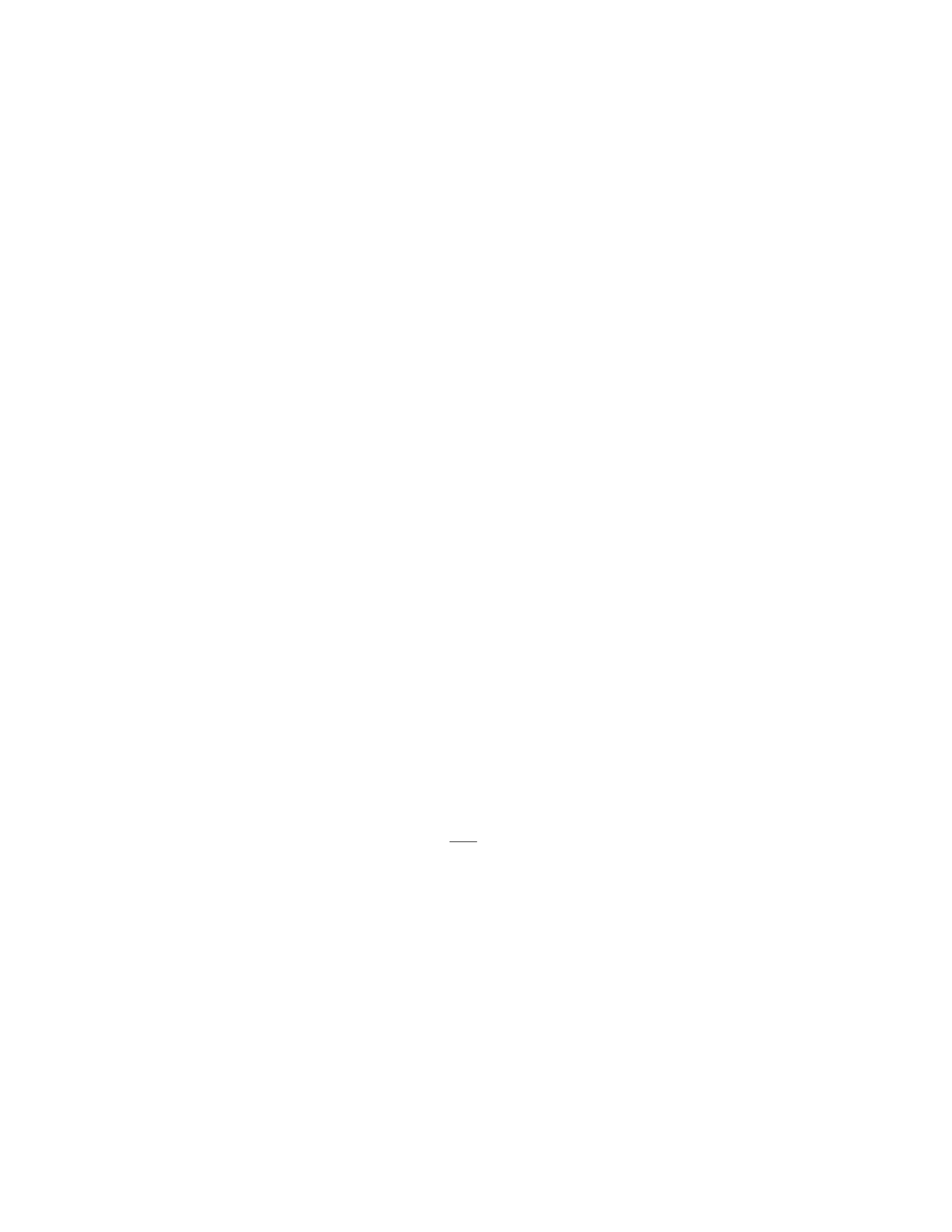
Question 23
Question
A rectangular block of wood with a density of 0.6 g/cm3and dimensions 10 cm
x 5 cm x 3 cm is floating in water. What is the minimum mass of lead that
needs to be placed on top of the block so that it sinks completely in water? The
density of lead is 11.3 g/cm3.
Solution
Step 1: Calculate the volume of the wood block.
The volume of the wood block is given by:
Vwood = length ×width ×height
Vwood = 10 cm ×5 cm ×3 cm = 150 cm3
Step 2: Determine the volume of water displaced by the wood block when
it is floating.
Since the block is floating, the weight of the water displaced by the block is
equal to the weight of the block. The weight of the block can be calculated
using its volume and density:
Weight of wood block = Vwood ×density of wood
Weight of wood block = 150 cm3×0.6 g/cm3= 90 g
Step 3: Calculate the minimum mass of lead required to sink the wood block
completely.
To sink the wood block completely, the total weight of the system (wood block
+ lead) must be greater than the weight of the water displaced by the wood
block. Let m be the mass of the lead needed.
m×density of lead = Weight of wood block + m×1 g/cm3
m×11.3 = 90 + m
10.3m= 90
m=90
10.3≈8.74 g
Therefore, the minimum mass of lead that needs to be placed on top of the
block so that it sinks completely in water is approximately 8.74 g.
Question 24
Question
A cylindrical object with a height of 12 cm and a radius of 3 cm is placed in a
container of water. The object floats with 4 cm of its height above the water
surface. Calculate the density of the cylindrical object.
21

Solution
Step 1: First, let’s determine the volume of the cylindrical object submerged in
water. The total volume of the cylinder can be calculated using the formula for
the volume of a cylinder: Vcylinder =πr2h, where ris the radius and his the
height. Given r= 3 cm and h= 12 cm, we have:
Vcylinder =π×(3 cm)2×12 cm
Vcylinder = 108πcm3
Step 2: Since 4 cm of the cylinder is above the water surface, the submerged
volume can be calculated as Vsubmerged =πr2×submerged height. Given the
submerged height is 8 cm, we have:
Vsubmerged =π×(3 cm)2×8 cm
Vsubmerged = 72πcm3
Step 3: The buoyant force acting on the cylinder is equal to the weight
of the water displaced by the submerged volume of the cylinder. This can be
calculated using Archimedes’ principle, Fbuoyant =ρ×Vsubmerged ×g, where ρ
is the density of water and gis the acceleration due to gravity. The weight of
the cylinder can be calculated using its density ρcylinder, volume Vcylinder, and
acceleration due to gravity g, as Wcylinder =ρcylinder ×Vcylinder ×g.
Step 4: Since the cylinder is floating, the buoyant force Fbuoyant must equal
the weight of the cylinder Wcylinder.T hisgivesustheequation :ρ×Vsubmerged ×g=
ρcylinder ×Vcylinder ×g.
Step 5: Substitute the known values into the equation:
ρ×72π×g=ρcylinder ×108π×g
Step 6: Simplify the equation by canceling out gand π:
72ρ= 108ρcylinder
Step 7: Solve for the density of the cylinder, ρcylinder:
ρcylinder =72ρ
108
ρcylinder =2
3ρ
Therefore, the density of the cylindrical object is 2
3times the density of
water.
22
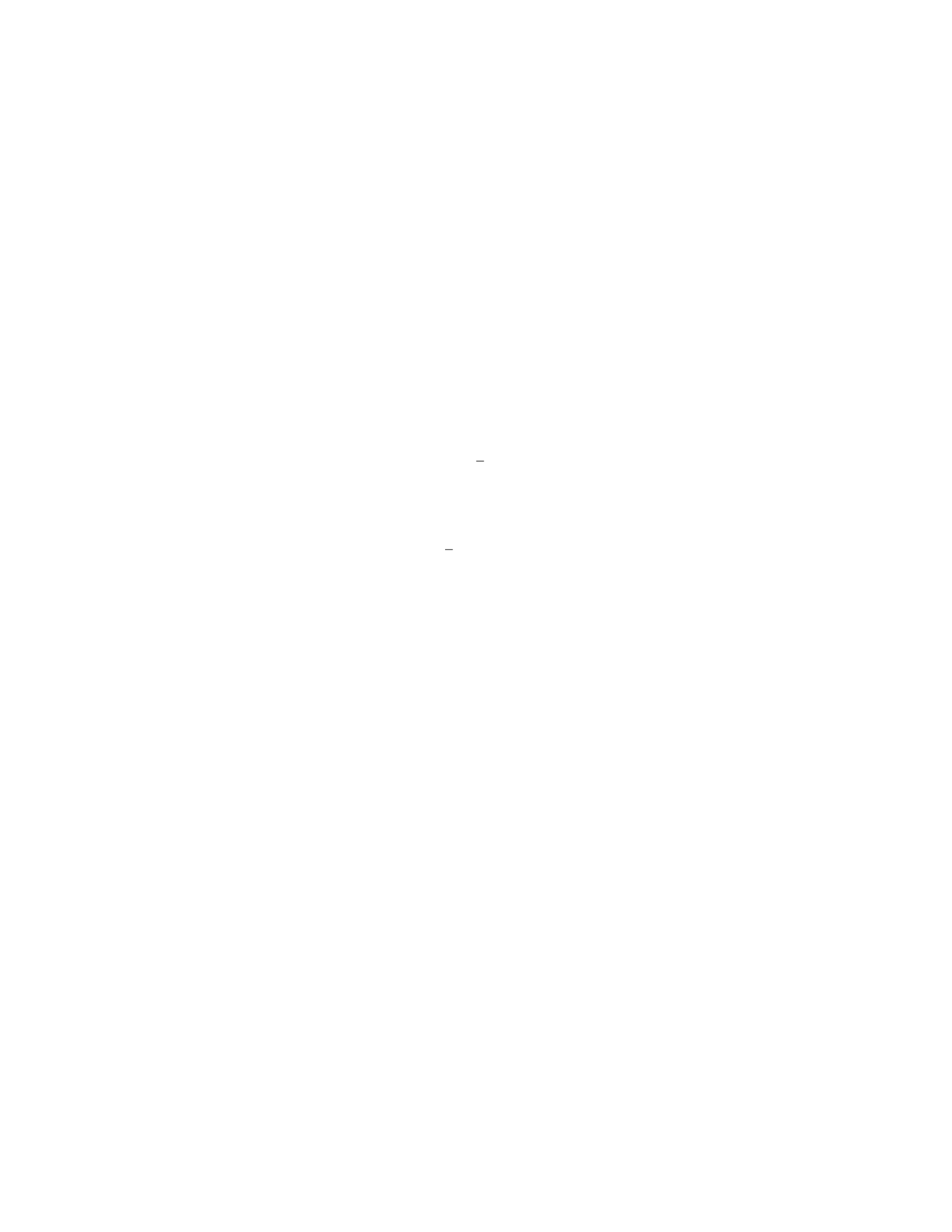
Question 25
Question
A cylindrical container is filled with water up to a height of 4 meters. Inside the
container, there is a solid aluminum sphere with a radius of 0.2 meters. If the
aluminum sphere is completely submerged in the water, what is the buoyant
force acting on the sphere? (Density of aluminum = 2700 kg/m3, density of
water = 1000 kg/m3, acceleration due to gravity = 9.81 m/s2)
Solution
Step 1: Calculate the volume of the aluminum sphere using the formula for the
volume of a sphere:
V=4
3πr3
where r= 0.2 m.
Step 2: Substitute the radius into the formula to find the volume:
V=4
3×π×(0.2)3
Step 3: Calculate the volume:
V≈0.03351 m3
Step 4: Determine the mass of the aluminum sphere using the formula:
mass = density ×volume
The density of aluminum is 2700 kg/m3.
Step 5: Substitute the density and volume to find the mass of the aluminum
sphere:
mass = 2700 ×0.03351
Step 6: Calculate the mass of the aluminum sphere:
mass ≈90.327 kg
Step 7: Determine the weight of the aluminum sphere using the formula:
weight = mass ×acceleration due to gravity
Given that the acceleration due to gravity is 9.81 m/s2.
Step 8: Substitute the mass to find the weight of the aluminum sphere:
weight = 90.327 ×9.81
Step 9: Calculate the weight of the aluminum sphere:
weight ≈886.91 N
23

The weight of the aluminum sphere is 886.91 N.
Step 10: Determine the buoyant force acting on the sphere using Archimedes’
principle, which states that the buoyant force is equal to the weight of the fluid
displaced by the object. The buoyant force can be calculated using the formula:
buoyant force = weight of water displaced
Step 11: Calculate the weight of the water displaced by the aluminum sphere
when submerged completely. The volume of water displaced is equal to the
volume of the aluminum sphere.
Step 12: Determine the weight of the water displaced using the formula:
weight of water displaced = density of water ×volume of water displaced
The density of water is 1000 kg/m3.
Step 13: Substitute the density of water and volume of water displaced:
weight of water displaced = 1000 ×0.03351
Step 14: Calculate the weight of the water displaced:
weight of water displaced = 33.51 N
Step 15: Hence, the buoyant force acting on the aluminum sphere is equal
to the weight of the water displaced:
buoyant force = 33.51 N
Question 26
Question
A spherical balloon with a radius of 2 meters is filled with helium gas. The
density of helium gas is 0.178 kg/m3, while the density of air is 1.29 kg/m3.
Determine the maximum mass that the balloon can carry without sinking.
Solution
Step 1: Let’s calculate the volume of the spherical balloon using the formula for
the volume of a sphere: V=4
3πr3, where ris the radius. Given that the radius
of the balloon is 2 meters, we have:
V=4
3π(2 m)3=32
3πm3
Step 2: Now, let’s calculate the weight of the air displaced by the balloon.
The weight of the displaced air is equal to the buoyant force acting on the bal-
loon. Buoyant force, Fb= Weight of the displaced air = Volume of air displaced×
Density of air ×g
Fb=V×Density of air ×g=32
3πm3×1.29 kg/m3×9.81 m/s2
24
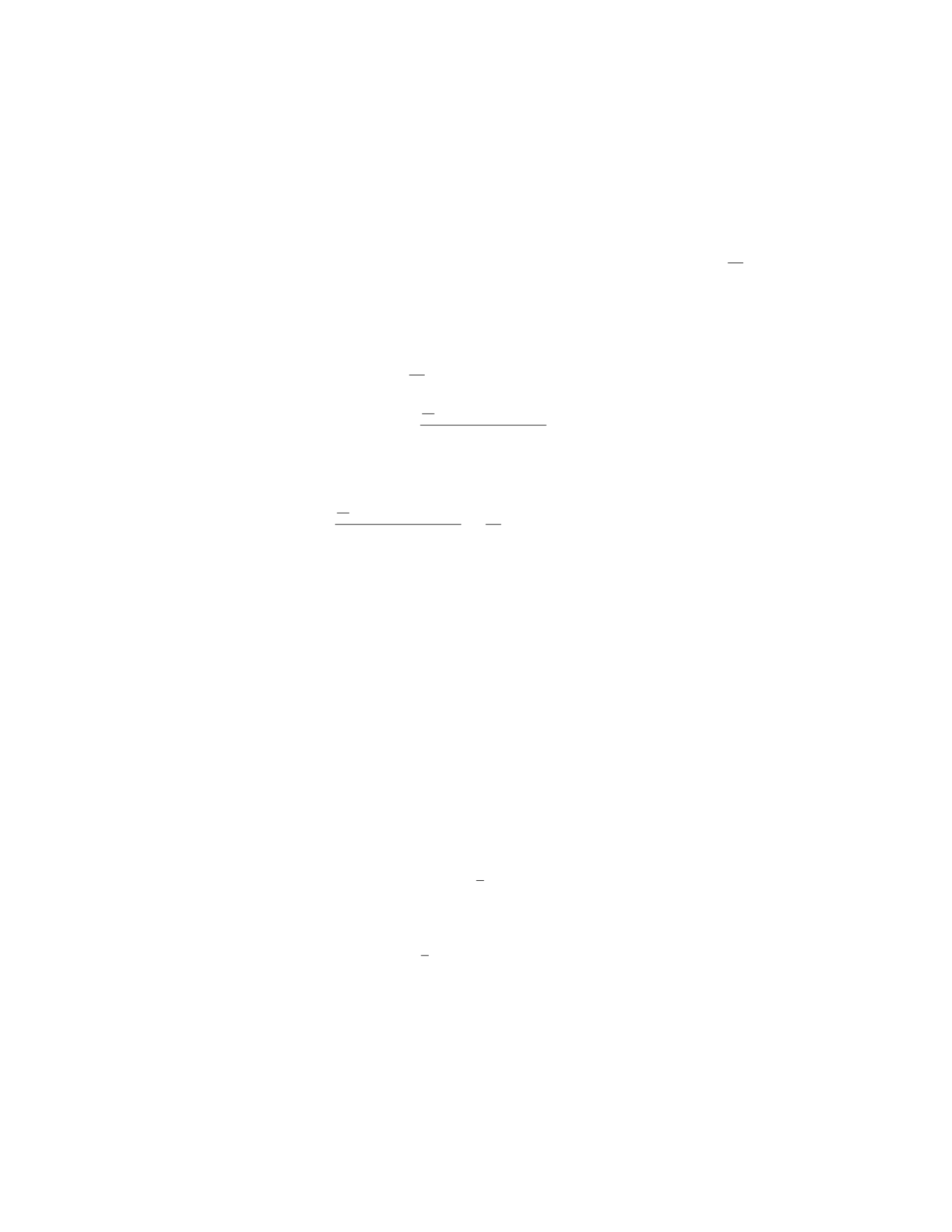
Step 3: Next, let’s calculate the buoyant force acting on the balloon. The
buoyant force is also equal to the weight of the air that the balloon displaces.
Fb= Volume of balloon×Density of helium×g=V×Density of helium×g=32
3πm3×0.178 kg/m3×9.81 m/s2
Step 4: The maximum mass that the balloon can carry without sinking is
when the buoyant force equals the weight of the load. Let mbe the maximum
mass the balloon can carry.
m×g=Fb=32
3πm3×0.178 kg/m3×9.81 m/s2
m=
32
3π×0.178 ×9.81
gkg
Step 5: Substituting the value of g= 9.81 m/s2and evaluating the expression
gives us the maximum mass that the balloon can carry.
m=
32
3π×0.178 ×9.81
9.81 =32
3π×0.178 kg ≈5.96 kg
Therefore, the maximum mass that the balloon can carry without
sinking is approximately 5.96 kg.
Question 27
Question
A cylindrical container with a radius of 0.5 m and a height of 1.0 m is filled
with oil. The density of oil is 800 kg/m3. A solid sphere with a radius of 0.3
m and a density of 1200 kg/m3is carefully lowered into the oil until it is fully
submerged and at rest. Calculate the buoyant force acting on the sphere.
Solution
Step 1: First, let’s calculate the volume of the submerged sphere. The volume
of a sphere is given by the formula:
V=4
3πr3
where ris the radius of the sphere. Substituting r= 0.3 m, we get:
V=4
3π(0.3)3= 0.1131 m3
Step 2: The buoyant force exerted on the sphere is equal to the weight of
the fluid displaced by the sphere. The weight of the fluid displaced is given by:
Weight = density ×volume ×acceleration due to gravity
25

Step 3: The weight of the fluid displaced by the submerged sphere is equal
to the weight of the oil that would occupy the volume of the sphere when it is
removed. The density of the oil is 800 kg/m3, so the weight of the displaced oil
is:
Weight = 800 ×0.1131 ×9.81 = 885.67 N
Step 4: The weight of the sphere in the oil is equal to the weight of the
sphere in the air minus the buoyant force acting on it. The weight of the sphere
in the air is given by:
Weightsphere = densitysphere ×volumesphere ×acceleration due to gravity
Weightsphere = 1200 ×4
3π(0.3)3×9.81 = 1065.5 N
Step 5: Finally, the buoyant force acting on the sphere is the weight of the
oil displaced, which is equal to:
Buoyant force = Weightsphere−Weight of displaced oil = 1065.5−885.67 = 179.83 N
Thus, the buoyant force acting on the sphere is 179.83 N.
Question 28
Question
A metal block with a volume of 0.05 m3and a density of 8000 kg/m3is immersed
in water. Calculate the buoyant force acting on the block and determine if it
will sink or float.
Solution
Step 1: Calculate the weight of the block The weight of the block is given by the
formula: W=m·g, where mis the mass of the block and gis the acceleration
due to gravity. Since density ρ=m
V, we can solve for mto find the mass of the
block.
m=ρ·V= 8000 kg/m3×0.05 m3= 400 kg
Therefore, the weight of the block is:
W=m·g= 400 kg ×9.81 m/s2= 3924 N
Step 2: Calculate the buoyant force The buoyant force acting on an object
immersed in a fluid is equal to the weight of the fluid displaced by the object.
The density of water is 1000 kg/m3. Since the volume of the block is 0.05 m3,
the weight of the water displaced by the block is:
Weight of displaced water = density of water ×volume of block ×g
26
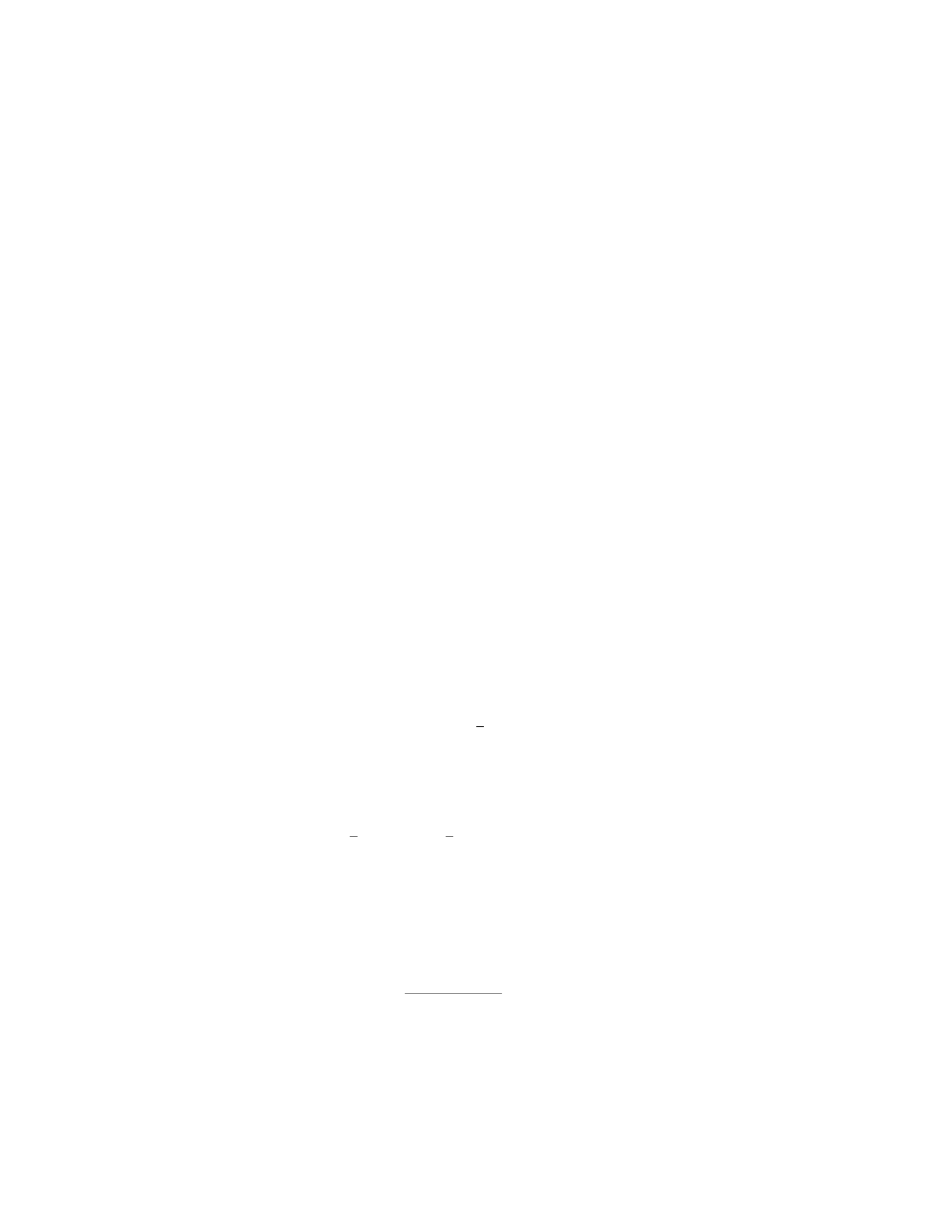
= 1000 kg/m3×0.05 m3×9.81 m/s2= 490.5 N
Therefore, the buoyant force acting on the block is 490.5 N.
Step 3: Analyze the forces Since the weight of the block is 3924 N and the
buoyant force is 490.5 N, the net force acting on the block is:
3924 N −490.5 N = 3433.5 N
The net force is greater than zero, so the block will sink in water.
Question 29
Question
A spherical metal ball with a radius of 10 cm and a density of 8000 kg/m3is
submerged in a liquid that exerts an upwards buoyant force of 200 N on the
ball. Determine the density of the liquid.
Solution
Step 1: Recall that the buoyant force (Fbuoyant) acting on an object submerged
in a fluid is given by the formula:
Fbuoyant =ρfluid ·Vsubmerged ·g
where: - ρfluid is the density of the fluid, - Vsubmerged is the volume of the
object submerged in the fluid, and - gis the acceleration due to gravity.
Step 2: The volume of a sphere is given by the formula:
V=4
3πr3
where ris the radius of the sphere.
Step 3: Substitute the given information into the equations. The volume of
the spherical ball can be calculated as:
V=4
3π(0.1 m)3=4
3π(0.001 m3) = 0.004189 m3
Step 4: Since the entire ball is submerged, Vsubmerged =V. The buoyant
force is given as 200 N.
200 = ρfluid ·0.004189 ·9.81
Step 5: Solve for ρfluid:
ρfluid =200
0.004189 ·9.81 ≈4792 kg/m3
Therefore, the density of the liquid is approximately 4792 kg/m3.
27

Question 30
Question
A cube of side length sand density ρis floating in a liquid of density σ. If the
cube is submerged to a depth h, determine the expression for the buoyant force
acting on the cube.
Solution
Step 1: Find the volume of the cube submerged in the liquid.
The volume of the cube is V=s3. The volume of the cube submerged in the
liquid is Vsubmerged =A·h, where Ais the area of the cube face in contact with
the liquid. Since the cube is floating, the submerged volume must be equal to
the volume of liquid displaced. Therefore, Vsubmerged =σAh.
Step 2: Determine the mass of the cube and the mass of the liquid displaced.
The mass of the cube is mcube =ρV , and the mass of the liquid displaced is
mliquid =σVsubmerged. Substituting the expressions for Vand Vsubmerged, we
have mcube =ρs3and mliquid =σσAh.
Step 3: Apply Archimedes’ principle to find the buoyant force.
Archimedes’ principle states that the buoyant force acting on a submerged object
is equal to the weight of the liquid displaced. Therefore, the buoyant force
Fbuoyant is given by the difference in the weight of the liquid before and after
the cube was submerged:
Fbuoyant = (σAh)g−(ρs3)g
Fbuoyant =σAhg −ρs3g
Therefore, the expression for the buoyant force acting on the cube floating
in the liquid to a depth his Fbuoyant =σAhg −ρs3g.
Question 31
Question
A solid cube of side length 20 cm and density 800 kg/m3is floating in a liquid
of density 1000 kg/m3. What is the volume of the cube that is submerged in
the liquid?
Solution
Step 1: Determine the volume of the cube.
Volume of cube = side length3
= (0.20 m)3
= 0.008 m3
28
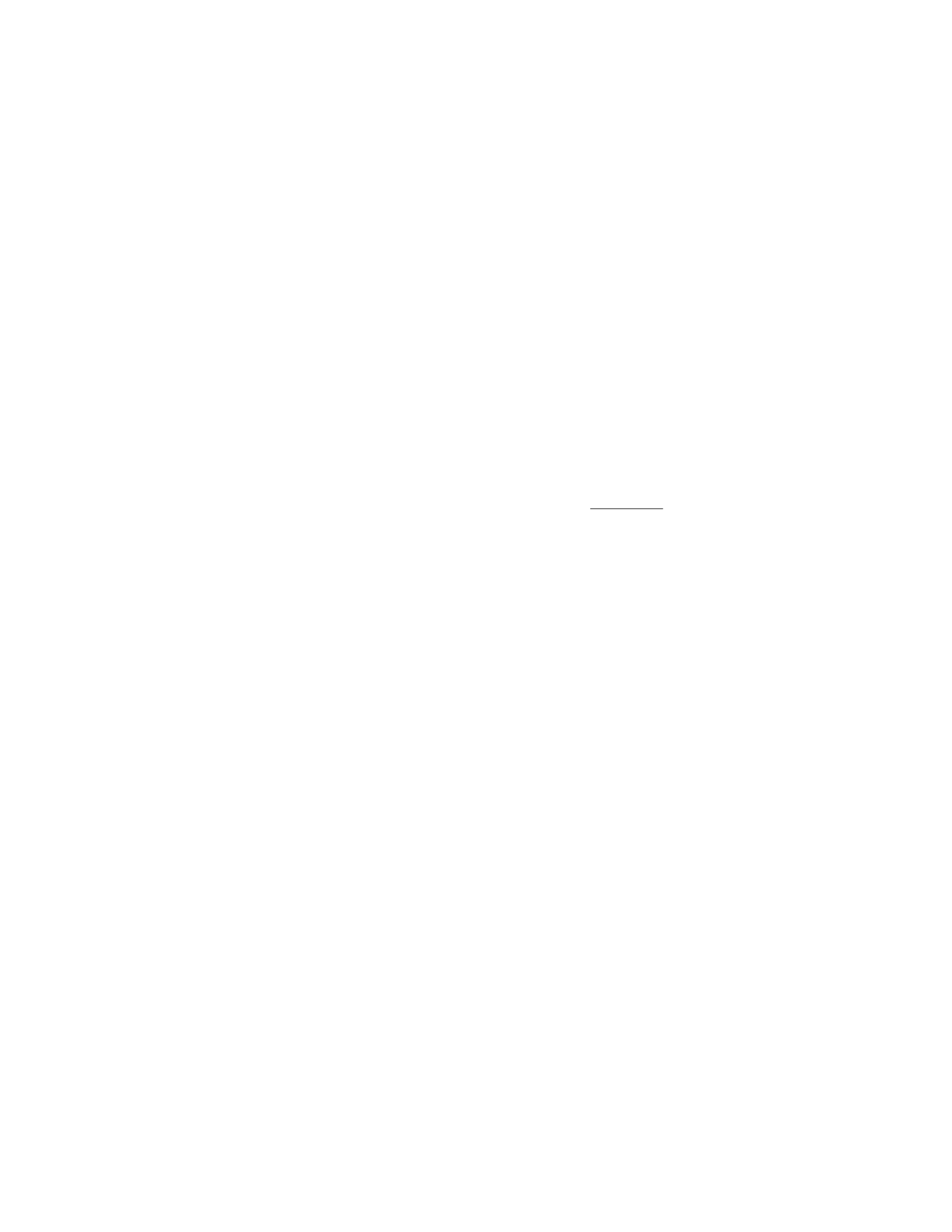
Step 2: Calculate the weight of the cube.
Weight of cube = Volume ×Density ×Acceleration due to gravity
= 0.008 m3×800 kg/m3×9.81 m/s2
≈62.79 N
Step 3: Determine the buoyant force acting on the cube.
Buoyant force = Weight of displaced liquid
= Volume submerged ×Density of liquid ×Acceleration due to gravity
Step 4: Use Archimedes’ principle to find the volume submerged.
Buoyant force = Weight of cube
Volume submerged ×1000 kg/m3×9.81 m/s2= 62.79 N
Volume submerged = 62.79 N
9810 N/m3
≈0.0064 m3
Therefore, the volume of the cube that is submerged in the liquid is approx-
imately 0.0064 m3.
Question 32
Question
A solid cube of side length 0.5 m and density 800 kg/m3is floating in a liquid
of density 1000 kg/m3. What fraction of the cube’s volume is submerged in the
liquid?
Solution
Step 1: Determine the buoyant force acting on the cube. The buoyant force is
given by the formula Fb=ρfluid ·Vsub ·g, where: - ρfluid is the density of the fluid,
-Vsub is the volume of the cube submerged in the fluid, - gis the acceleration
due to gravity.
Step 2: Calculate the weight of the cube. The weight of the cube can be
calculated using the formula W=m·g, where: - mis the mass of the cube, -
gis the acceleration due to gravity.
Step 3: Set up an equilibrium condition. For an object to float, the weight
of the object must be equal to the buoyant force acting on it. Therefore, we can
write: W=Fb
Step 4: Express the weight and buoyant force in terms of the volume sub-
merged. - The weight of the cube is W=ρcube ·Vcube ·g, where ρcube is the
29
density of the cube. - The volume of the cube is Vcube =a3, where ais the side
length of the cube.
Step 5: Calculate the fraction of the cube’s volume submerged. Since the
cube is floating, the weight of the cube is equal to the buoyant force: ρcube ·
Vcube ·g=ρfluid ·Vsub ·g
Solving for Vsub, we get: Vsub =ρcube
ρfluid
·Vcube
The fraction of the cube’s volume submerged is then given by: f=Vsub
Vcube =
ρcube
ρfluid
Substitute the values of ρcube and ρfluid to find the answer.
Question 33
Question
A metal block of density ρband volume Vis floating in a container filled with
water. The block is connected to a spring scale as shown in the figure. The
scale reads T0when the block is completely submerged.
If the block is slowly pulled out of the water and partially hangs out, what
will be the reading on the scale? Justify your answer.
images/buoyant_forces.png
Solution
1. When the block is completely submerged in water, the buoyant force acting
on the block is equal to the weight of the water displaced by the block. We
know that the weight of the water displaced is given by mg, where mis the
mass of the water displaced and gis the acceleration due to gravity. So, the
buoyant force Fbcan be expressed as:
Fb=mg
2. When the block is partially out of the water, the buoyant force F′
bacting
on the block is still equal to the weight of the water displaced. Since the block
is partially submerged, the weight of the water displaced is equal to the weight
of the volume of water equal to the volume of the submerged part of the block.
Let the volume of the submerged part of the block be V′. Then the weight of
the water displaced is given by ρwgV ′.
3. The weight of the block when it is partially submerged is given by ρbgV .
The apparent weight, which is the difference between the actual weight of the
block and the buoyant force, is then:
T=ρbgV −ρwgV ′
30

4. From Archimedes’ principle, the buoyant force is equal to the weight of
the fluid displaced, so F′
b=ρwgV ′. Therefore, the reading on the scale when
the block is partially submerged is:
T=ρbgV −ρwgV ′
5. Since ρbV=ρwV′(because the block is floating), the term ρbV−ρwV′
evaluates to zero and the scale simply reads the weight of the block T0. There-
fore, the reading on the scale remains T0when the block is pulled out of the
water and partially hangs out.
Question 34
Question
A cube of wood with a density of 600 kg/m3and dimensions 0.2 m ×0.2 m ×
0.2 m is floating in a liquid with a density of 800 kg/m3. Calculate the depth
to which the cube is submerged in the liquid.
Solution
Step 1: First, let’s find the weight of the cube. The weight of the cube can be
calculated using the formula:
Weight = Volume ×Density ×Acceleration due to gravity
Given that the density of the cube is 600 kg/m3, dimensions of the cube are 0.2
m×0.2 m ×0.2 m, and the acceleration due to gravity is 9.81 m/s2:
Volume = Side length3= 0.23= 0.008 m3
Weight = 0.008 m3×600 kg/m3×9.81 m/s2= 47.04 N
Step 2: Next, let’s find the buoyant force acting on the cube. The buoy-
ant force can be calculated using Archimedes’ principle which states that the
buoyant force is equal to the weight of the liquid displaced by the object:
Buoyant force = Volume submerged×Density of liquid×Acceleration due to gravity
Let hbe the depth to which the cube is submerged. The volume submerged is
the area of the base of the cube (0.2 m ×0.2 m) times h:
Volume submerged = 0.2×0.2×hm3= 0.04hm3
Given that the density of the liquid is 800 kg/m3and the acceleration due to
gravity is 9.81 m/s2:
Buoyant force = 0.04h×800 ×9.81 = 313.6hN
31

Step 3: Since the cube is floating, the weight of the cube is equal to the
buoyant force.
47.04 N = 313.6hN
Solving for h:
h=47.04
313.6= 0.15 m
Therefore, the cube is submerged to a depth of 0.15 meters in the liquid.
Question 35
Question
A metal cube of side length 10 cm and density 8000 kg/m3is floating in water.
What is the depth of the cube under the water surface? (Density of water =
1000 kg/m3, acceleration due to gravity = 9.81 m/s2)
Solution
Step 1: First, we need to determine the fraction of the cube’s volume submerged
in water.
Density of cube = 8000 kg/m3
Density of water = 1000 kg/m3
Since the cube is floating, the buoyant force must be equal to the weight of the
cube:
Weight of cube = Buoyant force
Vcube ×Density of water ×g=Vsubmerged ×Density of cube ×g
where Vcube is the total volume of the cube, and Vsubmerged is the volume sub-
merged in water.
Step 2: Since the cube is a cube, the volume of the cube is given by Vcube =
(side length)3= (0.10 m)3= 0.001 m3. Let DV be the depth of the cube under
the water surface. Then Vsubmerged = 0.10 m ×0.10 m ×DV . Plugging in the
values into the equation above:
0.001 m3×1000 kg/m3= 0.01 m2×DV ×8000 kg/m3
Step 3: Solve for the depth DV :
DV =0.001 m3×1000 kg/m3
0.01 m2×8000 kg/m3= 0.000125 m = 0.125 mm
Therefore, the depth of the cube under the water surface is 0.125 mm.
32

