


Classical Organizational Theory 2
Abstract
Management theory over the last century or abouts has shifted from the old model, management
and leadership is no longer just about expecting your employees to show up, do their task and not
have any impute or benefit from it. All this can be attributed to many organizational theories, but
the three that are written about in the following essay are: Henri Fayol, Federick Taylor and Max
Weber. Fayol and Taylor certainly offer a more employee friendly approach while Weber still
centers his theory around the manager having full on control and things being conducted by the
book. Weber's approach however, which will be discussed in the paper, is still different from the
classical approach and falls along the lines of Faylo and Taylor. All three have had a
tremendously role in shifting the landscape of leadership in management for the better.
Classical Organizational Theory 3
Classical Organizational Theory is broken down into many different components in an
attempt to study and figure out which of the theories are the best way for business structures to
lead. Some of these theories include the Classical Organizational theory, human relations,
neo-classical theory, contingency and decision theory, last but not least modern systems theory.
All these theories at least to a certain extent have changed the idea of how businesses and
leadership operate. Three men deserve credit mainly for this shift and they are Henri Fayol,
Federick Taylor and Max Weber.
It is without a doubt fair to say that these men have softened the leadership approach that
was classically taken by individuals in power. Leadership was a show up, shut up and work with
what is given to you through guidelines. The guidelines usually had no flexibility, no interest in
personal growth of the employee (Contributor, C. (2021, April 28). This eventually led to high
turnover rates, inefficient working rates and the company not being successful in their goals.
This soon however, as indicated with several modern theories coming and authoring many
theories that would change the landscape of leadership in companies.
Beginning with Henry Fayol, Fayol is recognized as the founder, forerunner of modern
management. “His management theories, mostly developed and published in the early 1900s,
were a major influence on the development of industrial management practice throughout the
twentieth century” (Ward, P. (2021, May 22). While Fayol was not alone during this time period
in revolutionizing leadership modules, he stood differently than those of Mayo’s scientific
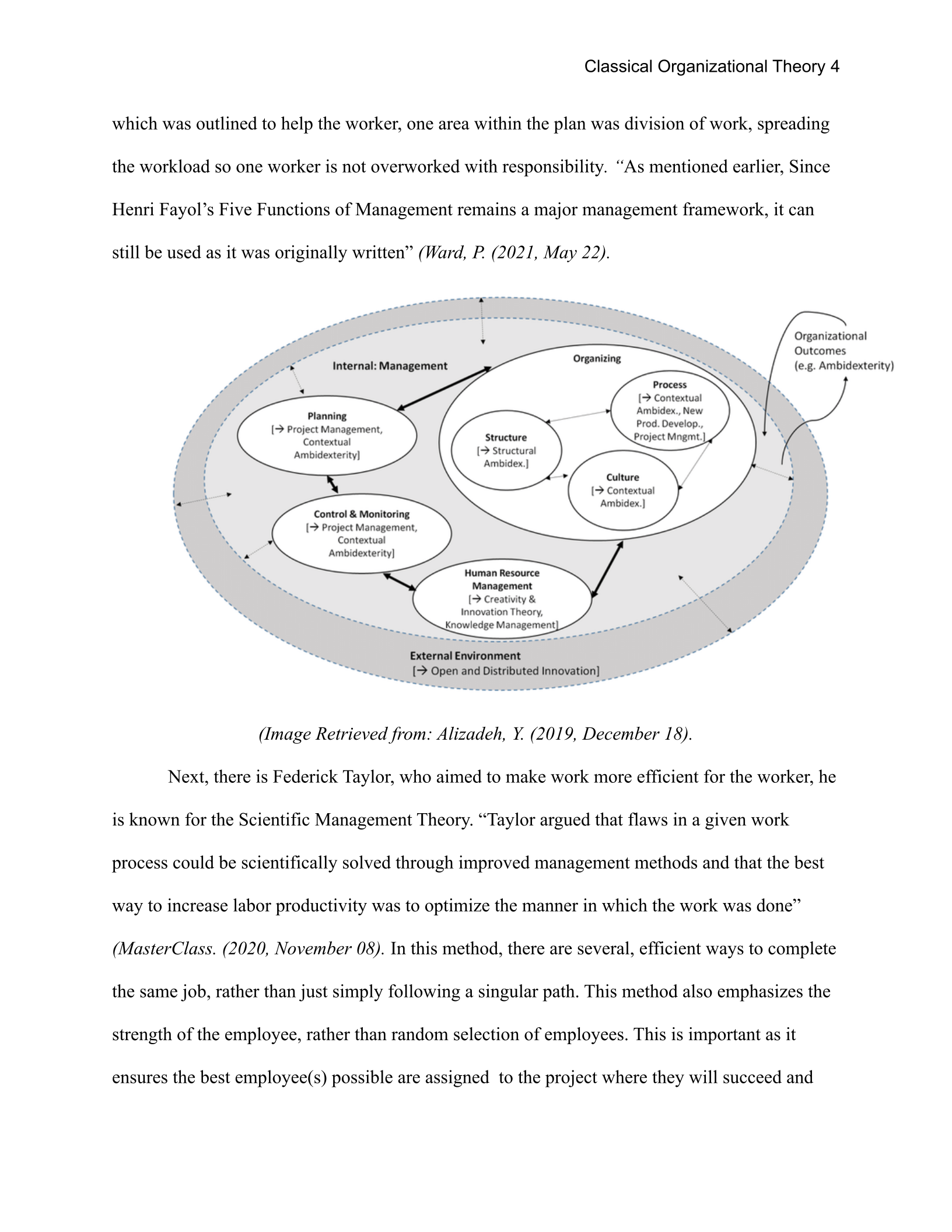
management theory. His theories (of many) are The Five Functions of Management; Planning,
Organizing, Command, Coordination and control. This plan outlines the best way for a company
to execute the goal that it is trying to achieve. He also has the 14 Principles of Management tool
Classical Organizational Theory 4
which was outlined to help the worker, one area within the plan was division of work, spreading
the workload so one worker is not overworked with responsibility. “As mentioned earlier, Since
Henri Fayol’s Five Functions of Management remains a major management framework, it can
still be used as it was originally written” (Ward, P. (2021, May 22).
(Image Retrieved from: Alizadeh, Y. (2019, December 18).
Next, there is Federick Taylor, who aimed to make work more efficient for the worker, he
is known for the Scientific Management Theory. “Taylor argued that flaws in a given work
process could be scientifically solved through improved management methods and that the best
way to increase labor productivity was to optimize the manner in which the work was done”
(MasterClass. (2020, November 08). In this method, there are several, efficient ways to complete
the same job, rather than just simply following a singular path. This method also emphasizes the
strength of the employee, rather than random selection of employees. This is important as it
ensures the best employee(s) possible are assigned to the project where they will succeed and
Classical Organizational Theory 5
the company will succeed. Which is the heart of what Taylor emphasized, mutual beneficiary of
both businesses and employees.
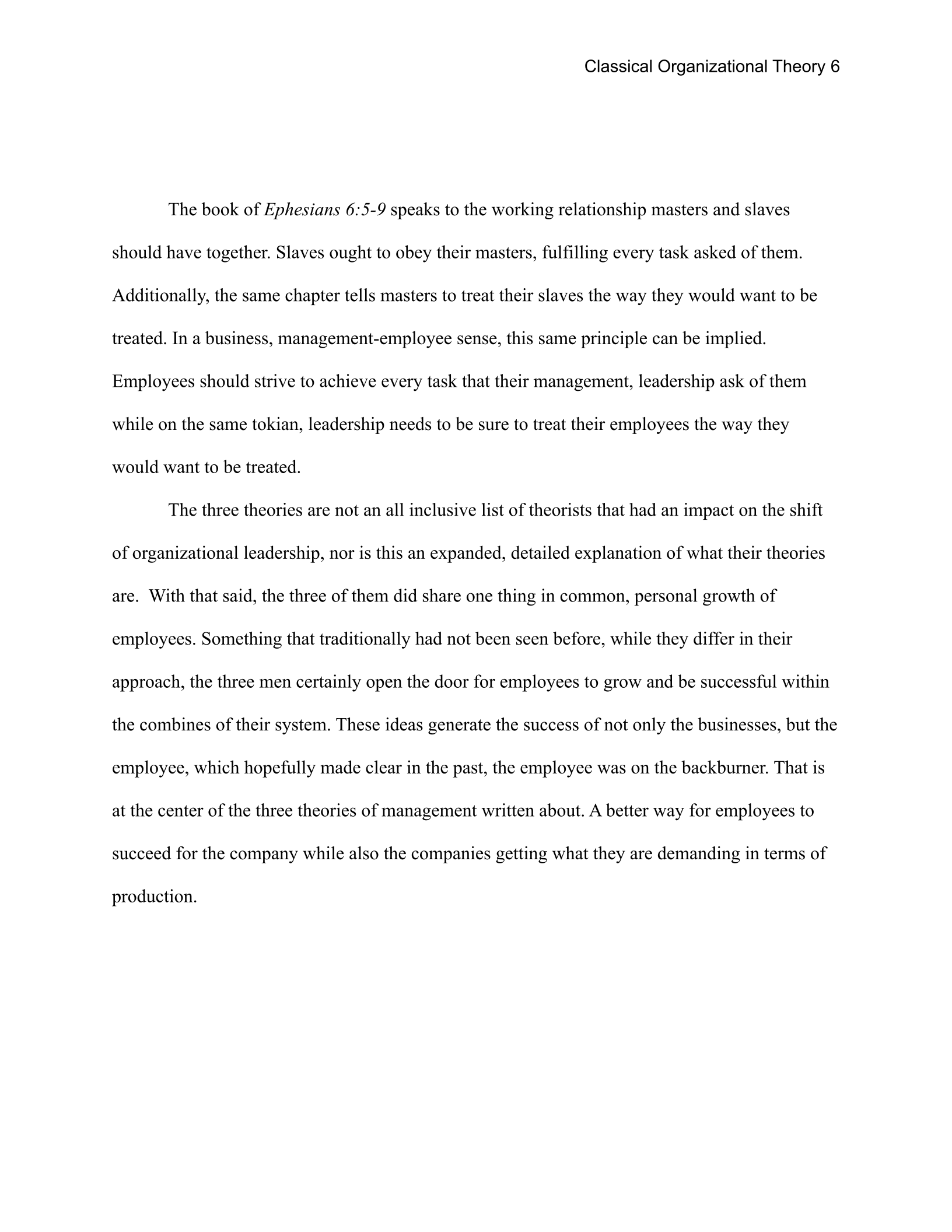
Finally, but certainly not least is the Theory of Max Weber who had in his own right a
significant role in the management of bureaucratic theory. “Max Weber was a German
sociologist who argued bureaucracy was the most efficient and rational model private businesses
and public offices could operate in” (The Management Theory of Max Weber. (n.d.). Weber
however, is different from Fayol and Taylor as he did not emphasize new ideas or the willingness
of managers to be flexible with their employees. Rather, Weber was not a supporter of creativity,
flexibility and risk, he was certainly by the book's type of guy. However, the Weber working
environment is not the same in the traditional sense of organizational structure. He believed in
the work being divided, every treated fairly and the same and emphasized that a well planned
hierarchical management subsystem would fall in line with this.
(n.d.). Retrieved from
https://kullabs.com/class-12/business-studies-1/principles-of-management/max-webers-bureaucr
acy-theory-concept-and-principles).
Classical Organizational Theory 6
The book of Ephesians 6:5-9 speaks to the working relationship masters and slaves
should have together. Slaves ought to obey their masters, fulfilling every task asked of them.
Additionally, the same chapter tells masters to treat their slaves the way they would want to be
treated. In a business, management-employee sense, this same principle can be implied.
Employees should strive to achieve every task that their management, leadership ask of them
while on the same tokian, leadership needs to be sure to treat their employees the way they
would want to be treated.
The three theories are not an all inclusive list of theorists that had an impact on the shift
of organizational leadership, nor is this an expanded, detailed explanation of what their theories
are. With that said, the three of them did share one thing in common, personal growth of
employees. Something that traditionally had not been seen before, while they differ in their
approach, the three men certainly open the door for employees to grow and be successful within
the combines of their system. These ideas generate the success of not only the businesses, but the
employee, which hopefully made clear in the past, the employee was on the backburner. That is
at the center of the three theories of management written about. A better way for employees to
succeed for the company while also the companies getting what they are demanding in terms of
production.
Classical Organizational Theory 7
References
(n.d.). Retrieved from
https://www.biblegateway.com/passage/?search=Ephesians+6:5-9&version=ESV
Alizadeh, Y. (2019, December 18). Figure 1-A framework based on Henry Fayol's (1916)
functions of... Retrieved from
https://www.researchgate.net/figure/A-framework-based-on-Henry-Fayols-1916-functions-
of-management-theory-It-is-inspired_fig1_318929264
Contributor, C. (2021, April 28). Principles of Organizational Theory. Retrieved from
https://smallbusiness.chron.com/principles-organizational-theory-75374.html
The Management Theory of Max Weber. (n.d.). Retrieved from
https://www.business.com/articles/management-theory-of-max-weber/
MasterClass. (2020, November 08). Understanding Taylorism: The History of Scientific
Management Theory - 2021. Retrieved from
https://www.masterclass.com/articles/understanding-taylorism-the-history-of-scientific-ma
nagement-theory#what-is-scientific-management
Max Weber is a German sociologist, who was a pioneer in the field of Bureaucracy Theory of
Management. Seven principles of Bureaucracy theory are formal hierarchy structure,
formal rules and norms, specialization, equality, recruitment based on abilities and
qualification, an "up-focused" or "in-focused" mission and systematic filling. Its criticisms
are: Discourages creative and innovative ideas, formal recording wastes money and effort,
misuse of power, rigidity and inflexible in its ways, delay in the decision-making process
and one-way Communication. (n.d.). Retrieved from
Classical Organizational Theory 8
https://kullabs.com/class-12/business-studies-1/principles-of-management/max-webers-bur
eaucracy-theory-concept-and-principles
Ward, P. (2021, May 22). Management Theory of Henri Fayol: Summary, Examples. Retrieved
from https://nanoglobals.com/glossary/henri-fayol-management-theory/
Powered by TCPDF (www.tcpdf.org)

