


Score for this attempt: 64 out of 80 *
Submitted Feb 26 at 12:29pm
This attempt took 90 minutes.
Question 1
0 / 2 pts
How many photons of light must be absorbed by photosystem II to produce one
molecule of oxygen?
Y A
8
16
Correct Answer
4
2
1
Question 2
0 / 2 pts
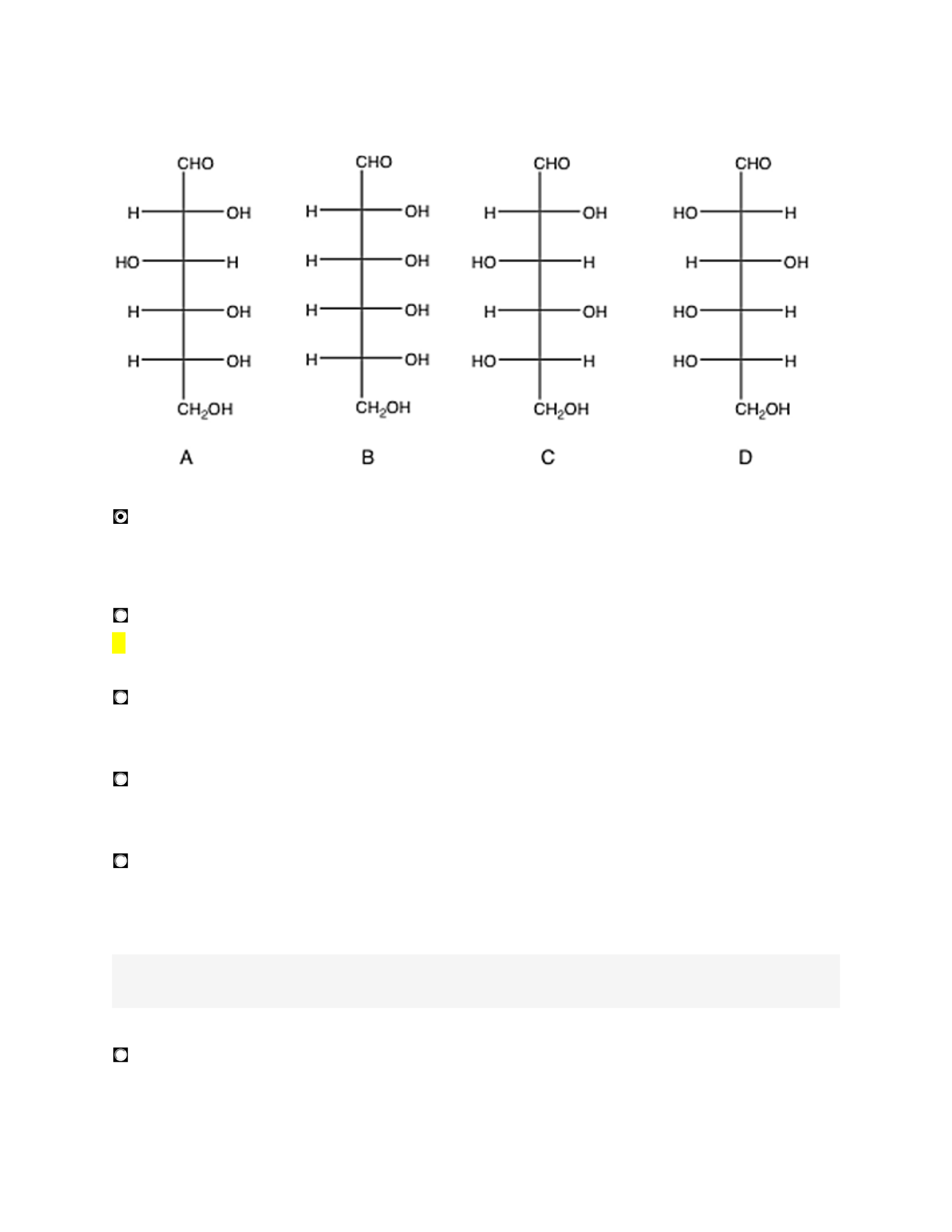
Which monosaccharide(s) seen below is(are) the enantiomer(s) of A?
Y A
C
Correct Answer
D
B
B and C
C and D
Question 3
2 / 2 pts
Which of the following would be positively charged at physiological pH?
glucuronic acid

fructose-6-phosphate
C !
glucosamine
xylitol
all of the above
Question 4
2 / 2 pts
Which of the following describes glycosaminoglycans?
associated with the cytoskeleton
bound to other proteins to minimize interactions with water
homopolymer composed of only one type of monosaccharide
C !
found in extracellular space
none of the above
Question 5
2 / 2 pts
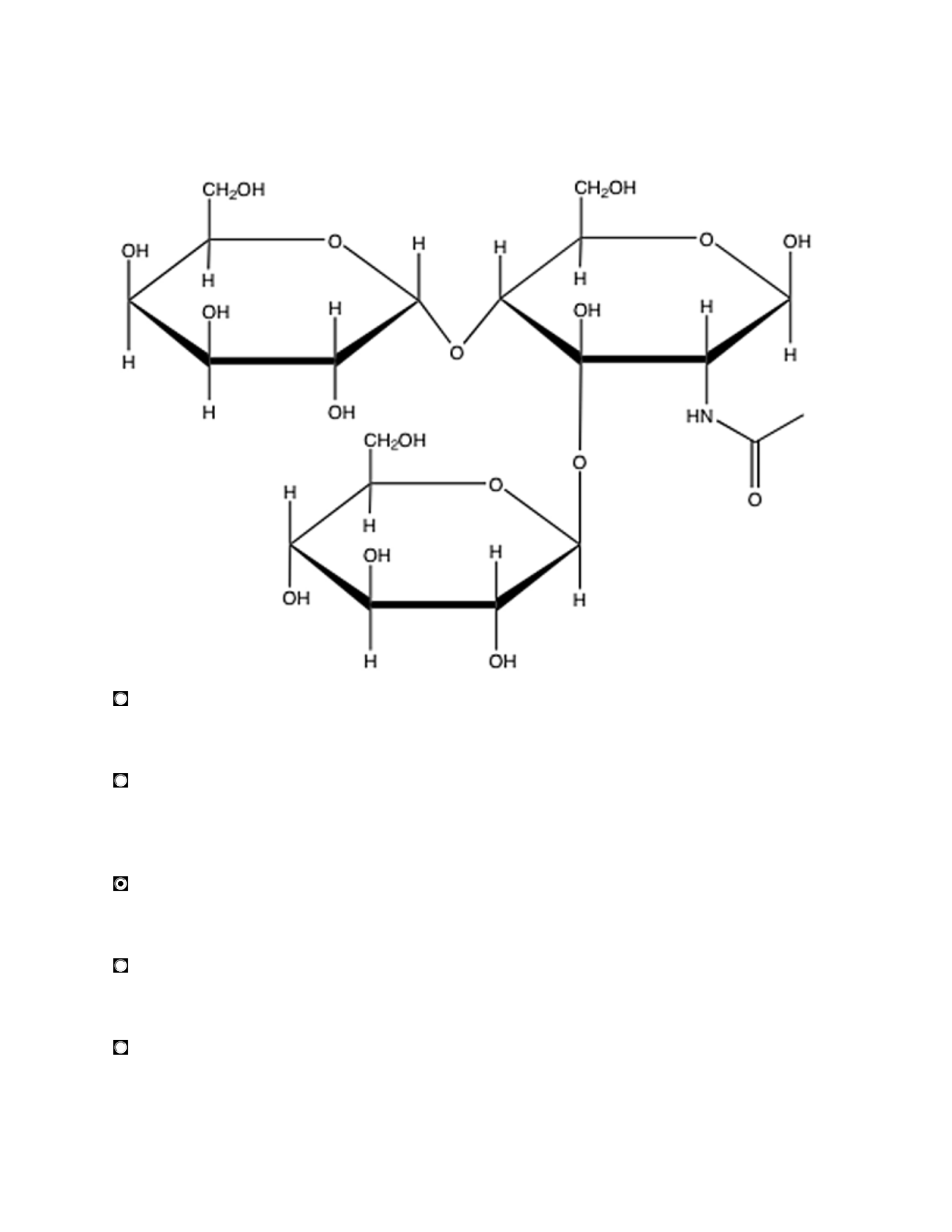
What glycosidic bonds are seen in the following portion of an N-linked oligosaccharide?
Abbreviations: galactose: Gal; glucose: Glu; N-acetylglucosamine: NAG
α(1→4) between Gal and NAG; β(1→6) between Glu and NAG
β(1→3) between Gal and NAG; α(1→4) between Glu and NAG
C !
α(1→4) between Gal and NAG; β(1→3) between Glu and NAG
β(1→4) between Gal and NAG; β(1→3) between Glu and NAG
β(1→4) between Gal and NAG; α(1→3) between Glu and NAG

Question 6
2 / 2 pts
Regeneration of the rubisco substrate, ribulose-1,5-bisphosphate involves which of the
following sugars?
a tetrose-phosphate
a pentose-phosphate
a heptose-phosphate
a hexose-phosphate
C !
all of the above
Question 7
2 / 2 pts
Light dependent ATP production is called ________ and occurs in the ________ of
chloroplasts.
C !
photophosphorylation; thylakoid membrane
non-oxidative phosphorylation; inner membrane
non-oxidative phosphorylation; thylakoid membrane
chloroplast-associated phosphorylation; thylakoid membrane
photophosphorylation; inner membrane
Question 8
2 / 2 pts
In the rubisco mechanism, what performs the nucleophilic attack on carbon dioxide?
C !
enediolate intermediate
a carboxylate
enol intermediate
water
none of the above
Question 9
2 / 2 pts
What causes carboxylation of a critical lysine residue that coordinates Mg2+ in the
rubisco active site to occur?
C !
when pH is high due to high activity of the light reactions
when ATP levels are high due to high activity of the light reactions
when NADPH level are high due to high activity of the light reactions
when pH is low due to low activity of the light reactions
when reduced ferredoxin is high due to high activity of the light reactions
Question 10
2 / 2 pts
In C4 plants, ________ is found in the mesophyll cells to capture CO2 while ________ is
found in the bundle sheath cells to release CO2.
pyruvate carboxylase; α-ketoglutarate dehydrogenase
pyruvate carboxylase; malic enzyme
C !
phosphoenolpyruvate carboxylase; malic enzyme
pyruvate kinase; pyruvate dehydrogenase
none of the above
Question 11
2 / 2 pts
Which of the following describes glycosaminoglycans?
homopolymer composed of only one type of monosaccharide
associated with the cytoskeleton
bound to other proteins to minimize interactions with water
C !
found in extracellular space
none of the above
Question 12
2 / 2 pts
What were the first organisms that had the ability to oxidize water to oxygen?
purple bacteria
ferns
green sulfur bacteria
C !
cyanobacteria
green plants
Question 13
2 / 2 pts
The reaction between an alcohol and an anomeric carbon of a carbohydrate forms a
________ bond.
hemiacetal
ester
anomeric
C !
glycosidic
ether
Question 14
2 / 2 pts
In C4 plants, CO2 (as bicarbonate) is condensed with ________ to yield ________ in the
mesophyll cells.
lactate; fumarate
oxaloacetate; α-ketoglutarate
pyruvate; oxaloacetate
3-phosphoglycerate; malate
C !
phosphoenolpyruvate; oxaloacetate
Question 15
2 / 2 pts
Which of the following can happen when a photosynthetic pigment absorbs light?
photooxidation
energy given off by fluorescence
energy lost as heat
exciton transfer
C !
all of the above
Question 16
2 / 2 pts
At equilibrium in solution, D-glucose consists of a mixture of its anomers. Which
statement most accurately describes the solution?
straight-chain form is present in high concentration
the α-anomer is more stable and is slightly preferred over the β-anomer
C !
the β-anomer predominates over the α-anomer by a ratio of approximately 2:1
consists of approximately equal amounts of the α- and β-anomers
none of the above
Question 17
2 / 2 pts
The carbon fixing reactions occur in the ________.
space between inner and outer chloroplast membrane
C !
stroma
cytosol
thylakoid membrane
thylakoid lumen
Question 18
2 / 2 pts
In the ABO blood type system, how many monosaccharides are found in each of the
oligosaccharides for the various blood types?
A: 6, B: 6, O: 5
C !
A: 5, B: 5, O: 4
A: 4, B: 5, O: 4
A: 6, B: 5, O: 5
A: 3, B: 4, O: 3
Question 19
2 / 2 pts
Which of the following is the major difference between glycogen and amylopectin?
glycogen is branched, amylopectin is linear
glycogen contains a reducing end, amylopectin does not
glycogen is found in plants, amylopectin is found in animals
C !
glycogen contains about twice the number of branch points as amylopectin
glycogen contains α-glycosidic bonds, amylopectin contains β-glycosidic bonds
Question 20
2 / 2 pts
Which of the following is a major difference between cellulose and chitin?
chitin is a branched polymer, cellulose is linear
chitin contains β(1→6) glycosidic bonds, cellulose contains β(1→4) glycosidic bonds
chitin contains glucose and glucosamine, cellulose contains only glucose
C !
chitin is produced by insects, cellulose is produced by plants
none of the above
Question 21
2 / 2 pts
The following is a(n) ________ disaccharide with a(n) ________ glycosidic bond.
C !
β; α(1→4)
α; β(1→4)
β; α(1→1)
α; β(1→1)
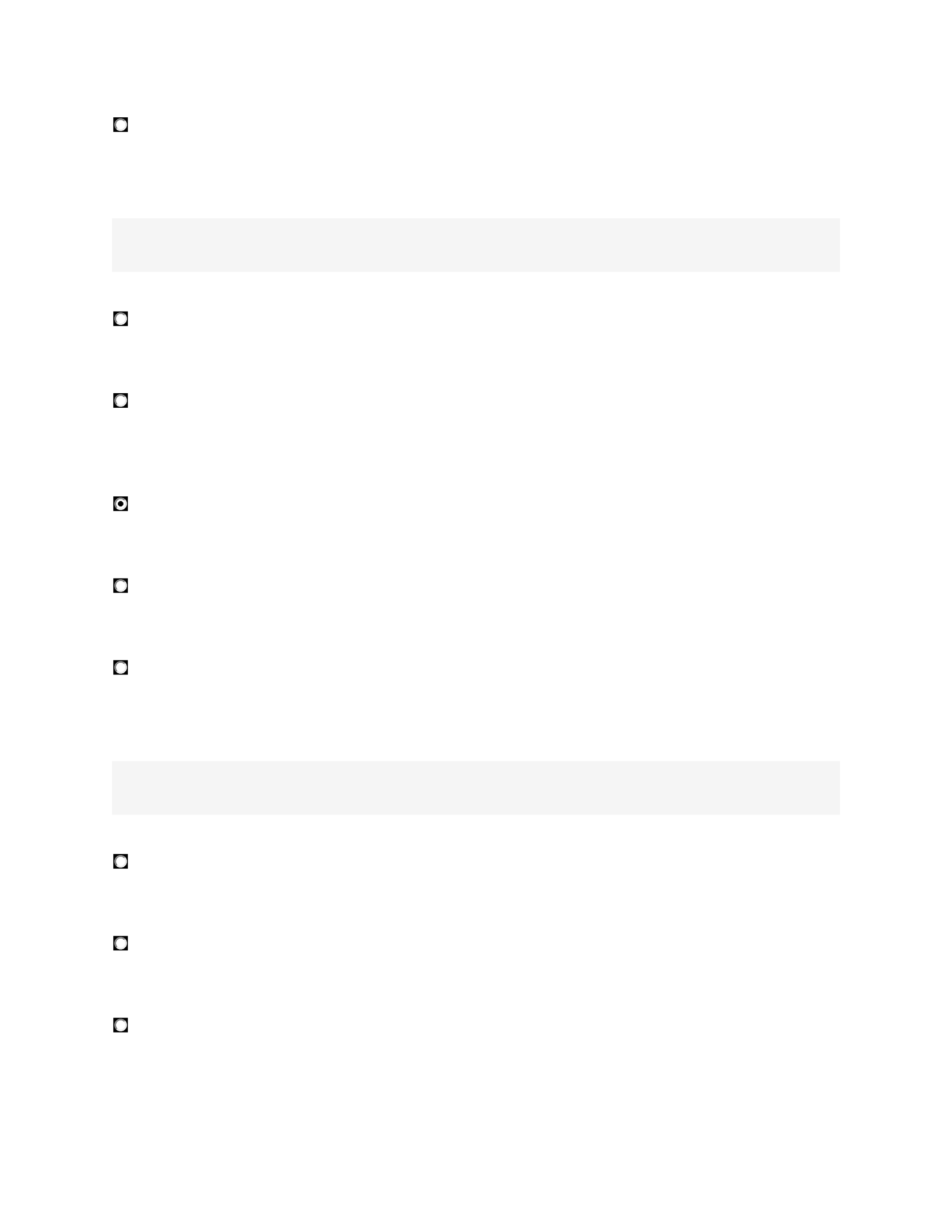
β; β(1→4)
Question 22
2 / 2 pts
What two substrates are needed to produce sucrose in plants?
UDP-glucose and fructose-1,6-bisphosphate
UDP-fructose and glucose-6-phosphate
C !
UDP-glucose and fructose-6-phosphate
glucose and fructose-1,6-bisphosphate
UDP-glucose-6-phosphate and fructose
Question 23
2 / 2 pts
The P680 of photosystem II is composed of ________.
one chlorophyll and one carotenoid
one carotenoid and one phycocyanin
two carotenoids
one chlorophyll and one phycocyanin
C !
two chlorophylls
Question 24
2 / 2 pts
Which of the following disaccharides has both anomeric carbons involved in the
glycosidic bond?
maltose
C !
sucrose
lactose
chitin
amylose
Question 25
2 / 2 pts
Which of the following are characteristic of cellulose?
highly extended fibers
extensive hydrogen bonding between individual molecules

unbranched polymer
β(1→4) glycosidic bonds
C !
all of the above
Question 26
2 / 2 pts
What is an assembly of antenna pigments?
granum
thylakoid
lamella
C !
light-harvesting complex
reaction center
Question 27
2 / 2 pts
Lactase, the enzyme responsible for breaking lactose into its monomers, is a(n)
________ enzyme.
α-glycosidase
C !
β-galactosidase
β-glycosyltransferase
α-amylase
none of the above
Question 28
2 / 2 pts
Bacterial cell walls are made of ________.
C !
peptidoglycans
pectin
chondroitin sulfate
keratin sulfate
heparin
Question 29
2 / 2 pts
Processing of N-glycosylated proteins within the Golgi apparatus involves the removal
of monosaccharides by ________ and addition of new monosaccharides by ________.
glycosyltransferases; N-amidases
epimerases; glycosidases
proteases; glycosylases
C !
glycosidases; glycosyltransferases
cellulases; lactases
Question 30
2 / 2 pts
Conversion of galactose to glucose ________,
I. may require an epimerase
II. requires uridine diphosphate
III. requires a transferase
IV. requires an isomerase
II, III
I, III
C !
I, II, III
I, II, III, IV
II, III, IV
Question 31
0 / 2 pts
In a ________, the carbohydrate is responsible for most of the mass; in a ________,
the protein is responsible for most of the mass.
glycoprotein; proteoglycan
Correct Answer
proteoglycan; glycoprotein
O-linked glycoprotein; N-linked glycoprotein
N-linked proteoglycan; O-linked glycoprotein proteoglycan
Y A
N-linked glycoprotein; O-linked glycoprotein
Question 32
2 / 2 pts
The transformation of a monosaccharide into its ________ occurs easily and does not
require the assistance of a catalyst.
epimer
diastereomer
sugar alcohol
C !
anomer
none of the above
Question 33
2 / 2 pts
Glucose and galactose are ________ of each other.
enantiomers
anomers
C !
epimers
diastereomers
none of the above
Question 34
2 / 2 pts
Unlike proteins and oligonucleotides, polysaccharides ________.
are achiral
are components of every known living organism

are readily metabolized in the absence of specialized enzymes
C !
often have branched structures
are always completely water soluble
Question 35
2 / 2 pts
N-linked oligosaccharides can be covalently linked to proteins at the amino acid
________.
Lys
C !
Asn
Pro
Arg
Gln
Question 36
Not yet graded / 5 pts
Is the following statement true or false. Explain your answer. “Milk contains many
oligosaccharides that cannot be digested by mammalian enzymes but instead are
thought to serve as a source of nutriment for intestinal bacteria.”
Your Answer:

This is true because lactose is a major food for newborn mammals, including humans,
and most adult mammals produce a very small amount of lactase, beta-galactosidase,
which is the enzyme that breaks the glycosidic bond of lactose, which cannot be
effectively digested. The oligosaccharides in milk cannot be used as food; instead, the
carbohydrates help sustain certain types of bacteria that are essential for establishing a
healthy microbial community in a newborn's intestines.
Question 37
Not yet graded / 5 pts
What are the names of the two monosaccharides that form sucrose? Is sucrose a
reducing sugar?
Explain your answer in one sentence.
Your Answer:
Two monosaccharides that form sucrose are glucose and fructose. Sucrose is a non-
reducing sugar because a glycosidic linkage holds glucose and fructose together.

