



Question 1
2 / 2 pts
Which statement is TRUE of the pentoses found in nucleic acids?
C-5 and C-1 of the pentose are joined to phosphate groups.
The pentoses are in a planar configuration.
The bond that joins nitrogenous bases to pentoses is an O-glycosidic bond.
C !
The pentoses are always in the B-furanose forms.
The straight-chain and ring forms undergo constant interconversion
Question 2
2 / 2 pts
A major component of RNA and not DNA is
adenine
cytosine
guanine
thymine
C !
uracil

Question 3
2 / 2 pts
The two purines found in DNA are ______and_________.
C !
adenine and guanine
cytosine and thymine
uracil and guanine
adenine and cytosine
none of the above
Question 4
2 / 2 pts
Bacteria and archaea typically have fewer than ________ genes while plants and
animals typically have greater than ________ genes.
10,000; 100,000
200; 1,000
C !
5,000; 10,000

1,000; 5,000
500; 2,500
Question 5
2 / 2 pts
Which of the following non-covalent interactions is the most important in maintaining the
structure of the double helix?
ionic interactions
C !
van der Waals interactions
hydrogen bonds
London dispersion forces
phosphodiester bonds
Question 6
2 / 2 pts
In humans, approximately ________% of the genome encodes proteins.
33
45
C !

1.5
11
78
Question 7
2 / 2 pts
What type of bond is made between nucleotides?
phosphate ester
C !
phosphodiester
ester
glycosidic
none of the above
Question 8
2 / 2 pts
The pyrimidine found in both DNA and RNA is _____. The pyrimidine found only in DNA
is _____ while the pyrimidine found only in RNA is _____
guanine, adenine, uracil

C !
cytosine, thymine, uracil
thymine, uracil, adenine
adenine, thymine, cytosine
Question 9
2 / 2 pts
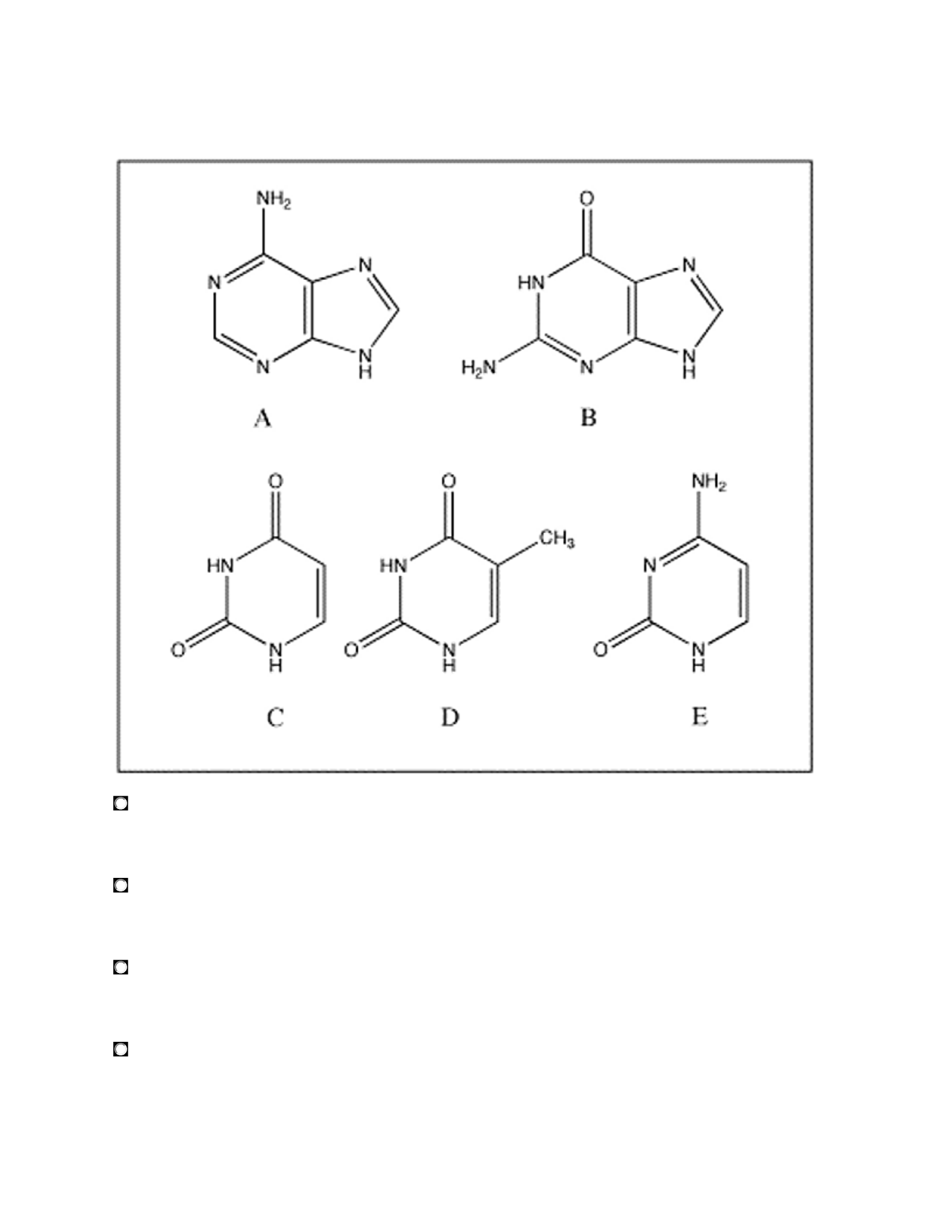
Which of the following bases pairs with guanine?
A
B
C
D

C !
E
Question 10
2 / 2 pts
The compound that consists of ribose linked by and N-glycosidic bond to N-9 adenine is
a deoxyribonucleoside
a purine nucleotide
a pyrimidine nucleotide
adenosine monophosphate
C !
adenosine
Question 11
2 / 2 pts
A base found exclusively in DNA is ________ while ________ is found only in RNA.
adenine; cytosine
uracil; adenine
guanine; thymine

C !
thymine; uracil
cytosine; guanine
Question 12
2 / 2 pts
DNA is ________, resulting in the production of ________.
transcribed; protein
translated; rRNA
translated; protein
C !
transcribed; mRNA
translated; tRNA
Question 13
2 / 2 pts
The biochemical activity of a protein, such as its enzymatic activity, is called its _____
function
phenotypic
genotypic

cellular
C !
molecular
organismal
Question 14
2 / 2 pts
Nucleotides play a central role in living organisms because ________.
they mediate transport of energy within the cell
they are involved in intracellular signaling
they function as building blocks for nucleic acids
they are involved in oxidation-reduction reactions
C !
all of the above
Question 15
2 / 2 pts
Which of the following represents a DNA mutation in the template strand that would
convert serine to cysteine?
C !

5′-GCT-3′ to 5′-GCA-3′
5′-AGC-3′ to 5′-UGC-3′
5′-AGC-3′ to 5′-TGC-3′
5′-AGU-3′ to 5′-UGU-3′
5′-TCG-3′ to 5′-TCC-3′
Question 16
2 / 2 pts
What group is attached to the pyrimidine ring in thymine and is not present in uracil?
−NH2
deoxyribose
ribose
C !
−CH3
none of the above
Question 17

2 / 2 pts
What term is used to describe short segments of DNA that are copied many times and
inserted randomly in chromosomes?
spliced sequences
C !
transposable elements
moderately repetitive sequences
highly repetitive sequences
none of the above
Question 18
2 / 2 pts
The most common base pairs in DNA are ________ and ________.
C !
C-G; T-A
T-A; A-U
G-C; C-A
A-T; A-G

G-U; A-T
Question 19
2 / 2 pts
The purines found in nucleic acids are ________ and ________.
C !
adenine; guanine
thymine; uracil
guanine; thymine
adenine; cytosine
uracil; adenine
Question 20
2 / 2 pts
An A-T base pair consists of ________ H-bond(s); a C-G base pair consists of
________ H-bond(s).
2; 1
C !
2; 3
3; 2

2; 2
1; 2
Question 21
2 / 2 pts
Differences in structure between a DNA helix and an RNA helix can predominantly be
attributed to the presence of ________ in RNA.
C !
2′ hydroxyl group
3′ hydroxyl group
smaller sizes of RNA molecules
uracil
none of the above
Question 22
2 / 2 pts
In DNA, the ribose derivative lacks an ________ on carbon ________.
amine; 3
alcohol; 3

C !
alcohol; 2
amine; 2
none of the above
Question 23
2 / 2 pts
In a double-stranded nucleic acid, cytosine typically base-pairs with:
adenosine
C !
guanine
inosine
thymine
uracil
Question 24
2 / 2 pts
The "energy carrier" ATP is an example of a(n)
deoxyribonucleoside triphosphate

dinucleotide
peptide
ribonucleotide
C !
ribonucleoside triphosphate
Question 25
2 / 2 pts
Nucleoside triphosphates carry energy in the form of ________.
amide linkages
glycosidic bonds
hydrogen bonds
phosphoester bonds
C !
phosphoanhydride bonds
Question 26
2 / 2 pts

What term describes the process of converting the information found in DNA into the
sequence of a protein?
replication
translation
transcription
C !
expression
none of the above
Question 27
2 / 2 pts
The covalent backbone of DNA and RNA consists of
alternating phosphate groups and nitrogenous bases
C !
alternating phosphate groups and pentose residues
alternating pentose residues and nitrogenous bases
alternating pentose residues and cyclic nucleosides
None of the answers is correct

Question 28
2 / 2 pts
The coenzymes known as NAD+, FAD and coenzyme A all contain a derivative of
________.
uridine
C !
adenosine
cytidine
guanosine
thymidine
Question 29
2 / 2 pts
In living cells, nucleotides and their derivatives can serve as
carriers of metabolic energy
enzyme cofactors
intracellular signals
precursors for nucleic acid synthesis

C !
All of the answers are correct
Question 30
2 / 2 pts
The replication of DNA is made possible by the presence of ________ strands in the
double helix of DNA.
antiparallel
C !
complementary
hydrogen bonded
genomic
none of the above
Question 31
2 / 2 pts
Which of the following is correctly paired with its nucleoside?
uridine: uridine triphosphate
cytosine: cytidine diphosphate

adenine: adenylate
thymine: thymidylate
C !
guanine: guanosine
Question 32
2 / 2 pts
An A-T base pair consists of ________ H-bond(s); a C-G base pair consists of
________ H-bond(s).
2; 1
1; 2
C !
2; 3
2; 2
3; 2
Question 33
2 / 2 pts
The 5′ end of a polynucleotide contains ________ while the 3′ end contains ________.
C !
a phosphate group; a hydroxyl group

a phosphate group; a phosphate group
a hydroxyl group; a hydroxyl group
a hydroxyl group; a phosphate group
none of the above
Question 34
2 / 2 pts
The difference between thymine and uracil is
one methylene group on the pyrimidine ring
C !
one methyl group on the pyrimidine ring
one hydroxyl group on the ribose ring
one methyl group on the purine ring
one amine group on the pyrimidine ring
Question 35
2 / 2 pts
Which of the following is a characteristic of Chargaff's rules?

all organisms have identical amounts of all four nucleotides
A + T = C + G
C !
A + G = C + T
A + G = C + U
none of the above
Question 36
2 / 2 pts
The triplet code allows many amino acids to be specified by more than one codon. Such
a code is said to be ________.
conclusive
C !
degenerate
elusive
recursive
replicative

Question 37
2 / 2 pts
Which of the following correctly describes the B-DNA double helix?
one helical rotation has a rise of 3.4 nm
right-handed helix
antiparallel strands
base pairs are located in the center of the helix
C !
all of the above
Question 38
2 / 2 pts
DNA encodes proteins undergoes the process of ________ to produce ________.
C !
transcription; mRNA
translation; proteins
transcription; proteins
transcription; tRNA

translation; rRNA
Question 39
2 / 2 pts
Nucleotides contain one or more phosphate groups that are usually attached to the
________.
C-3 or C-3 atomsꞌ
C !
C-3 or C-5 atomsꞌ ꞌ
C-5 or N-3 atoms
C-1 or N-3 atomsꞌ
none of the above
Question 40
2 / 2 pts
Approximately how much of the human genome encodes the exons of protein-coding
sequences?
C !
1.5%
5%

30%
100%
80%

