


Contents
Introduction………………………..…..………………………………….……….3
Being Dead in Our Trespasses and Sins (Ephesians 2:1-3)………...…….….….4
Being Rich in Mercy and Grace (Ephesians 2:4-7)………………………...……6
The Tender Loving Mercies of God (Ephesians 2:8-10)…………………….…..7
Conclusion………………………………………………………………………….7
Bibliography………………………………………………………………………..9
ii
Introduction
The Apostle Paul’s letter to the Ephesians offers a broad statement about how the Christian
community is united through the redemptive nature of Jesus Christ, impacting every facet of life,
including the interactions and connections among believers and the world around us. As we look
at Ephesians 2:1-10, the Apostle Paul lays out the thinking behind this broad statement. The
main purpose of God’s transformative work is to create a unique identity that stands out in
contrast to the identity of the person before they accepted Jesus into their heart to be their Lord
and personal Savior.1 This transformative work ultimately brings the believer closer to Jesus
Christ, preparing them for the destined role of living for God.
Mankind’s sinful actions, their commitment to worldly living, and their obedience to the ruler
of the heavens has ultimately led to their death (vs. 1-3), yet God’s amazing grace, which is only
obtained through faith in Jesus Christ, has brought them back to life in Christ. As verses 4-5
mention, this is a result of His affection. Ephesians 2:1-10 can be broken down into three main
parts, each reflecting a different main idea, as shown by its grammatical structure.2 In the first
part, from Ephesians 2:1-3, the Apostle Paul outlines the unfortunate and severe circumstances
of his readers, which is because of the wrath of God. In the second part, from Ephesians 2:4-7,
the Apostle Paul explains how that God saved his readers from eternal judgment by granting
them the same power that brought Jesus back from the dead, when He died sacrificially on the
Cross for the sin of mankind, by placing them in a position of victory over sin and evil forces up
in “heavenly places”. The third part, from Ephesians 2:8-10, show the tender loving mercies of
1 Jonathan M. Platter and Jacob Lett, “‘Christ Who Is Our Peace’: Ephesians 2 and a
Theological Ontology of Place,” Journal of Theological Interpretation 16, no. 1 (June 1, 2022):
74–89, https://doi.org/10.5325/jtheointe.16.1.0074.
2 Frank Thielman, Robert Yarbrough, and Robert Stein, Ephesians (Baker Exegetical
Commentary on the New Testament) (Grand Rapids, MI: Baker Books, 2010), 104.
3
God, and explains that Salvation is nothing more than a gift from God. You cannot work for it;
You cannot earn it; You cannot buy it. This gift of Salvation from God must be chosen and
accepted before you can live a changed life for the glory of God!
Being Dead in Our Trespasses and Sins (Ephesians 2:1-3)
In Ephesians 2:1, the Apostle Paul draws a comparison between the catastrophic pre-
conversion circumstances that his readers were in (καὶ ὑμᾶς ὄντας νεκροὺς τοῖς παραπτώμασιν
καὶ ταῖς ἁμαρτίαις ὑμῶν,).3 Authors Thielman, Yarbrough and Stein state, in their Exegetical
Commentary on Ephesians, that “Paul starts the new section with an adverbial clause that he
does not finish with a main verb until Ephesians 2:5 when he says συνεζωοποίησεν, or
syzōopoiéō, which the Greek defines as meaning “I make alive together with”.4 Paul begins
Ephesians 2 by informing his readers in Verse 1 that, “And you were dead in the trespasses and
sins”, καὶ ὑμᾶς ὄντας νεκροὺς τοῖς παραπτώμασιν καὶ ταῖς ἁμαρτίαις ὑμῶν.5 The adjective
νεκρός, or nekrós, means “dead, a corpse”, and highlights the relationship between the reader
and God and conveys both a spiritual and physical meaning.6 In verses 2 and 3, the Apostle Paul
uses prepositions to speak of the link between the readers’ previous worldly, fleshly desires
when he says, “in which you once walked, following the course of this world, following the
prince of the power of the air, (ἐν αἷς ποτε περιεπατήσατε, κατὰ τὸν αἰῶνα τοῦ κόσμου τούτου,).7
Finally, the Apostle Paul does a good job by using relative pronouns and prepositions to
introduce dependent clauses that disclose the extent of the believers’ oppression when he says,
3 James Strong, The New Strong’s Expanded Exhaustive Concordance of the Bible (Nashville,
TN: Thomas Nelson, 2010), 68.
4 Frank Thielman, Robert Yarbrough, and Robert Stein, Ephesians (Baker Exegetical
Commentary on the New Testament) (Grand Rapids, MI: Baker Books, 2010), 121.
5 Clinton E Arnold, Ephesians: Zondervan Exegetical Commentary on the New Testament
(Grand Rapids, MI: Zondervan, 2010), 122.
6 William W Klein, “A Critical and Exegetical Commentary on Ephesians,” Journal of the
Evangelical Theological Society 44, no. 2 (June 1, 2001): 353.
7 Ibid., 353.
4
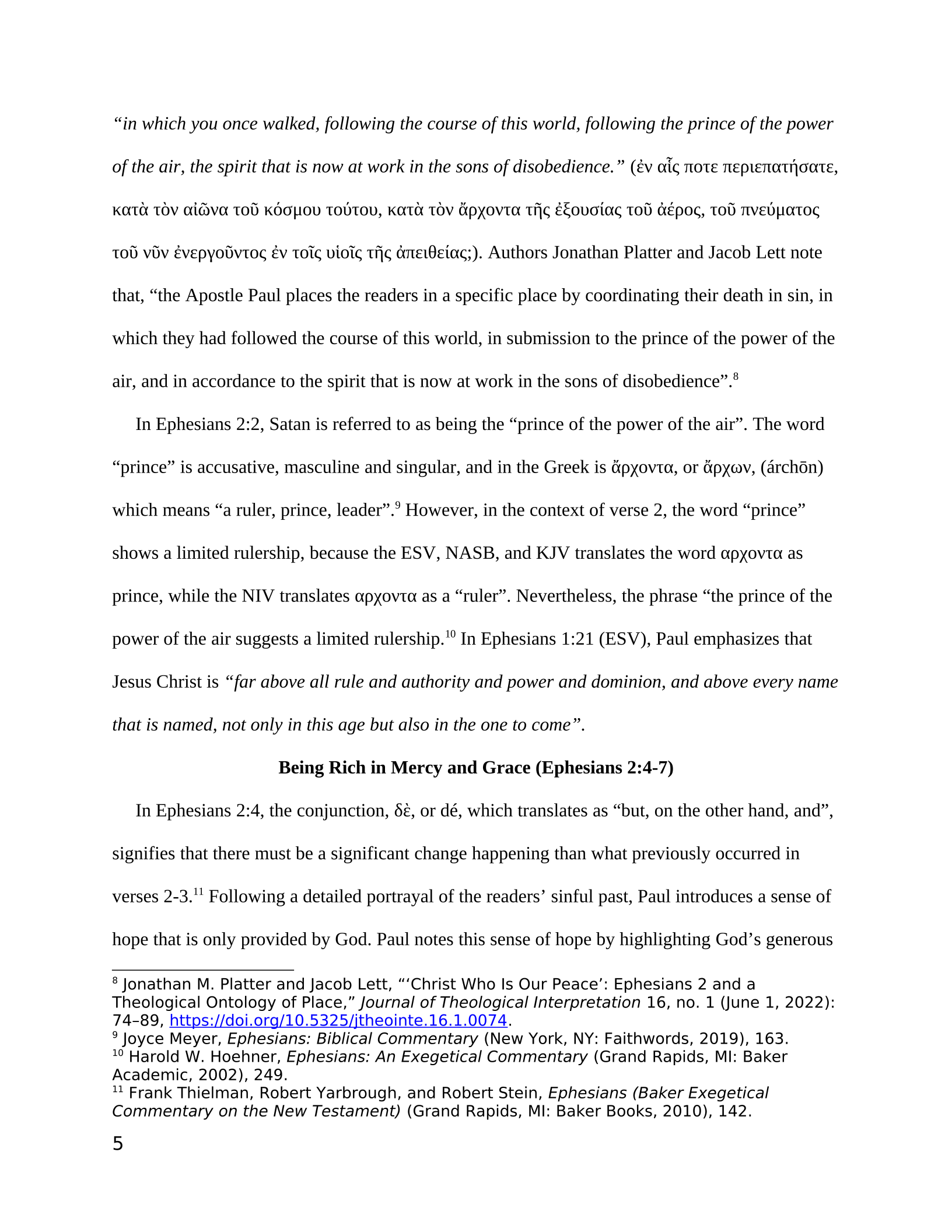
“in which you once walked, following the course of this world, following the prince of the power
of the air, the spirit that is now at work in the sons of disobedience.” (ἐν αἷς ποτε περιεπατήσατε,
κατὰ τὸν αἰῶνα τοῦ κόσμου τούτου, κατὰ τὸν ἄρχοντα τῆς ἐξουσίας τοῦ ἀέρος, τοῦ πνεύματος
τοῦ νῦν ἐνεργοῦντος ἐν τοῖς υἱοῖς τῆς ἀπειθείας;). Authors Jonathan Platter and Jacob Lett note
that, “the Apostle Paul places the readers in a specific place by coordinating their death in sin, in
which they had followed the course of this world, in submission to the prince of the power of the
air, and in accordance to the spirit that is now at work in the sons of disobedience”.8
In Ephesians 2:2, Satan is referred to as being the “prince of the power of the air”. The word
“prince” is accusative, masculine and singular, and in the Greek is ἄρχοντα, or ἄρχων, (árchōn)
which means “a ruler, prince, leader”.9 However, in the context of verse 2, the word “prince”
shows a limited rulership, because the ESV, NASB, and KJV translates the word αρχοντα as
prince, while the NIV translates αρχοντα as a “ruler”. Nevertheless, the phrase “the prince of the
power of the air suggests a limited rulership.10 In Ephesians 1:21 (ESV), Paul emphasizes that
Jesus Christ is “far above all rule and authority and power and dominion, and above every name
that is named, not only in this age but also in the one to come”.
Being Rich in Mercy and Grace (Ephesians 2:4-7)
In Ephesians 2:4, the conjunction, δὲ, or dé, which translates as “but, on the other hand, and”,
signifies that there must be a significant change happening than what previously occurred in
verses 2-3.11 Following a detailed portrayal of the readers’ sinful past, Paul introduces a sense of
hope that is only provided by God. Paul notes this sense of hope by highlighting God’s generous
8 Jonathan M. Platter and Jacob Lett, “‘Christ Who Is Our Peace’: Ephesians 2 and a
Theological Ontology of Place,” Journal of Theological Interpretation 16, no. 1 (June 1, 2022):
74–89, https://doi.org/10.5325/jtheointe.16.1.0074.
9 Joyce Meyer, Ephesians: Biblical Commentary (New York, NY: Faithwords, 2019), 163.
10 Harold W. Hoehner, Ephesians: An Exegetical Commentary (Grand Rapids, MI: Baker
Academic, 2002), 249.
11 Frank Thielman, Robert Yarbrough, and Robert Stein, Ephesians (Baker Exegetical
Commentary on the New Testament) (Grand Rapids, MI: Baker Books, 2010), 142.
5
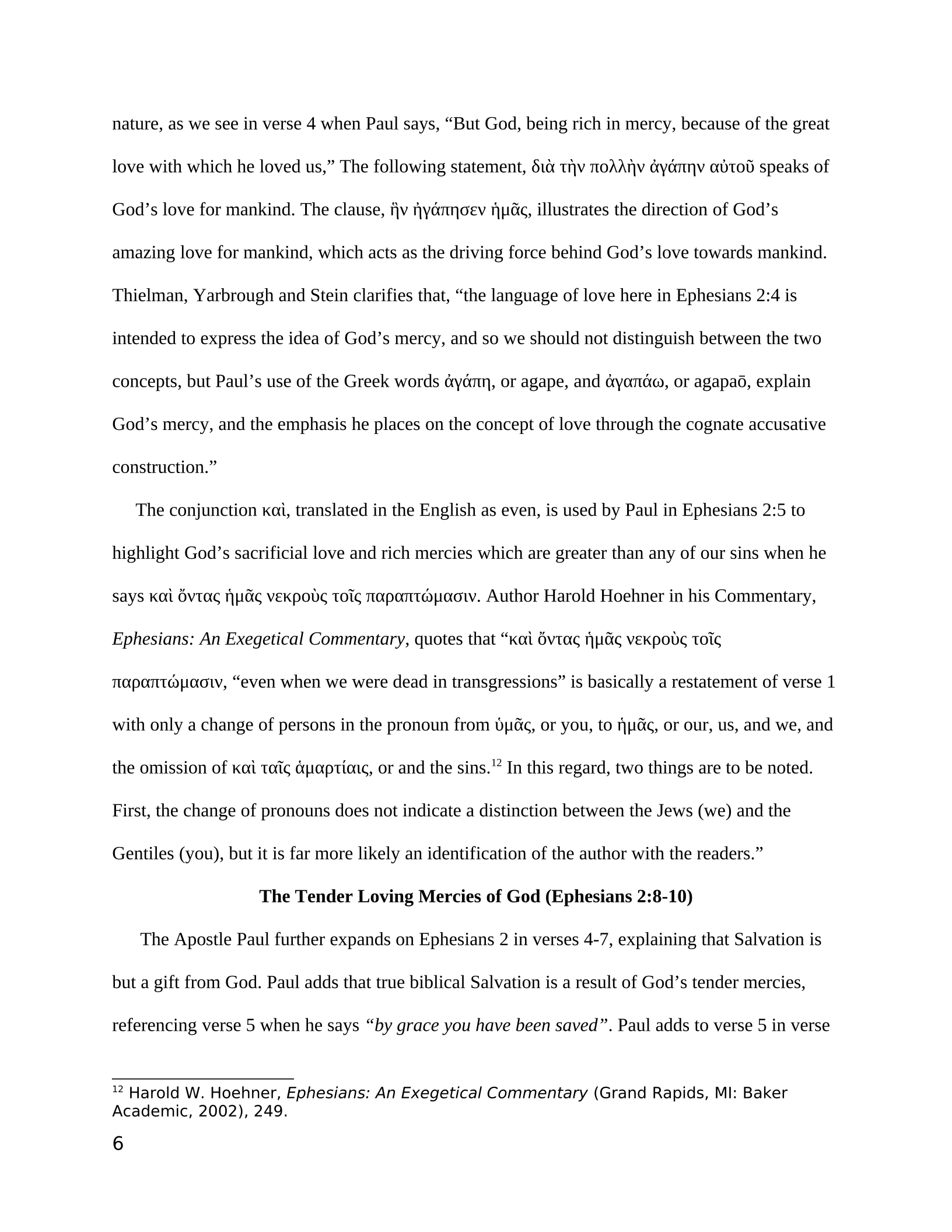
nature, as we see in verse 4 when Paul says, “But God, being rich in mercy, because of the great
love with which he loved us,” The following statement, διὰ τὴν πολλὴν ἀγάπην αὐτοῦ speaks of
God’s love for mankind. The clause, ἣν ἠγάπησεν ἡμᾶς, illustrates the direction of God’s
amazing love for mankind, which acts as the driving force behind God’s love towards mankind.
Thielman, Yarbrough and Stein clarifies that, “the language of love here in Ephesians 2:4 is
intended to express the idea of God’s mercy, and so we should not distinguish between the two
concepts, but Paul’s use of the Greek words ἀγάπη, or agape, and ἀγαπάω, or agapaō, explain
God’s mercy, and the emphasis he places on the concept of love through the cognate accusative
construction.”
The conjunction καὶ, translated in the English as even, is used by Paul in Ephesians 2:5 to
highlight God’s sacrificial love and rich mercies which are greater than any of our sins when he
says καὶ ὄντας ἡμᾶς νεκροὺς τοῖς παραπτώμασιν. Author Harold Hoehner in his Commentary,
Ephesians: An Exegetical Commentary, quotes that “καὶ ὄντας ἡμᾶς νεκροὺς τοῖς
παραπτώμασιν, “even when we were dead in transgressions” is basically a restatement of verse 1
with only a change of persons in the pronoun from ὑμᾶς, or you, to ἡμᾶς, or our, us, and we, and
the omission of καὶ ταῖς ἁμαρτίαις, or and the sins.12 In this regard, two things are to be noted.
First, the change of pronouns does not indicate a distinction between the Jews (we) and the
Gentiles (you), but it is far more likely an identification of the author with the readers.”
The Tender Loving Mercies of God (Ephesians 2:8-10)
The Apostle Paul further expands on Ephesians 2 in verses 4-7, explaining that Salvation is
but a gift from God. Paul adds that true biblical Salvation is a result of God’s tender mercies,
referencing verse 5 when he says “by grace you have been saved”. Paul adds to verse 5 in verse
12 Harold W. Hoehner, Ephesians: An Exegetical Commentary (Grand Rapids, MI: Baker
Academic, 2002), 249.
6
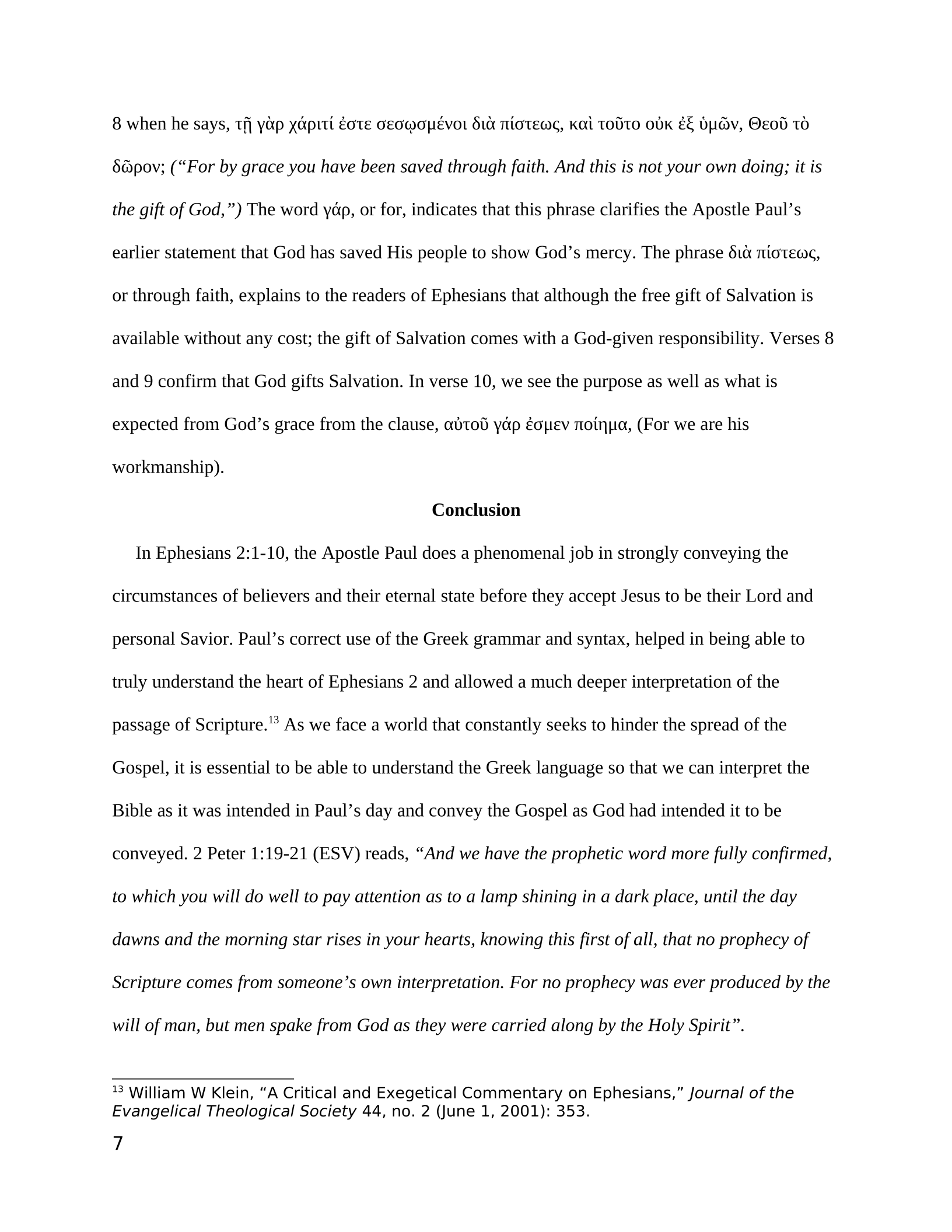
8 when he says, τῇ γὰρ χάριτί ἐστε σεσῳσμένοι διὰ πίστεως, καὶ τοῦτο οὐκ ἐξ ὑμῶν, Θεοῦ τὸ
δῶρον; (“For by grace you have been saved through faith. And this is not your own doing; it is
the gift of God,”) The word γάρ, or for, indicates that this phrase clarifies the Apostle Paul’s
earlier statement that God has saved His people to show God’s mercy. The phrase διὰ πίστεως,
or through faith, explains to the readers of Ephesians that although the free gift of Salvation is
available without any cost; the gift of Salvation comes with a God-given responsibility. Verses 8
and 9 confirm that God gifts Salvation. In verse 10, we see the purpose as well as what is
expected from God’s grace from the clause, αὐτοῦ γάρ ἐσμεν ποίημα, (For we are his
workmanship).
Conclusion
In Ephesians 2:1-10, the Apostle Paul does a phenomenal job in strongly conveying the
circumstances of believers and their eternal state before they accept Jesus to be their Lord and
personal Savior. Paul’s correct use of the Greek grammar and syntax, helped in being able to
truly understand the heart of Ephesians 2 and allowed a much deeper interpretation of the
passage of Scripture.13 As we face a world that constantly seeks to hinder the spread of the
Gospel, it is essential to be able to understand the Greek language so that we can interpret the
Bible as it was intended in Paul’s day and convey the Gospel as God had intended it to be
conveyed. 2 Peter 1:19-21 (ESV) reads, “And we have the prophetic word more fully confirmed,
to which you will do well to pay attention as to a lamp shining in a dark place, until the day
dawns and the morning star rises in your hearts, knowing this first of all, that no prophecy of
Scripture comes from someone’s own interpretation. For no prophecy was ever produced by the
will of man, but men spake from God as they were carried along by the Holy Spirit”.
13 William W Klein, “A Critical and Exegetical Commentary on Ephesians,” Journal of the
Evangelical Theological Society 44, no. 2 (June 1, 2001): 353.
7
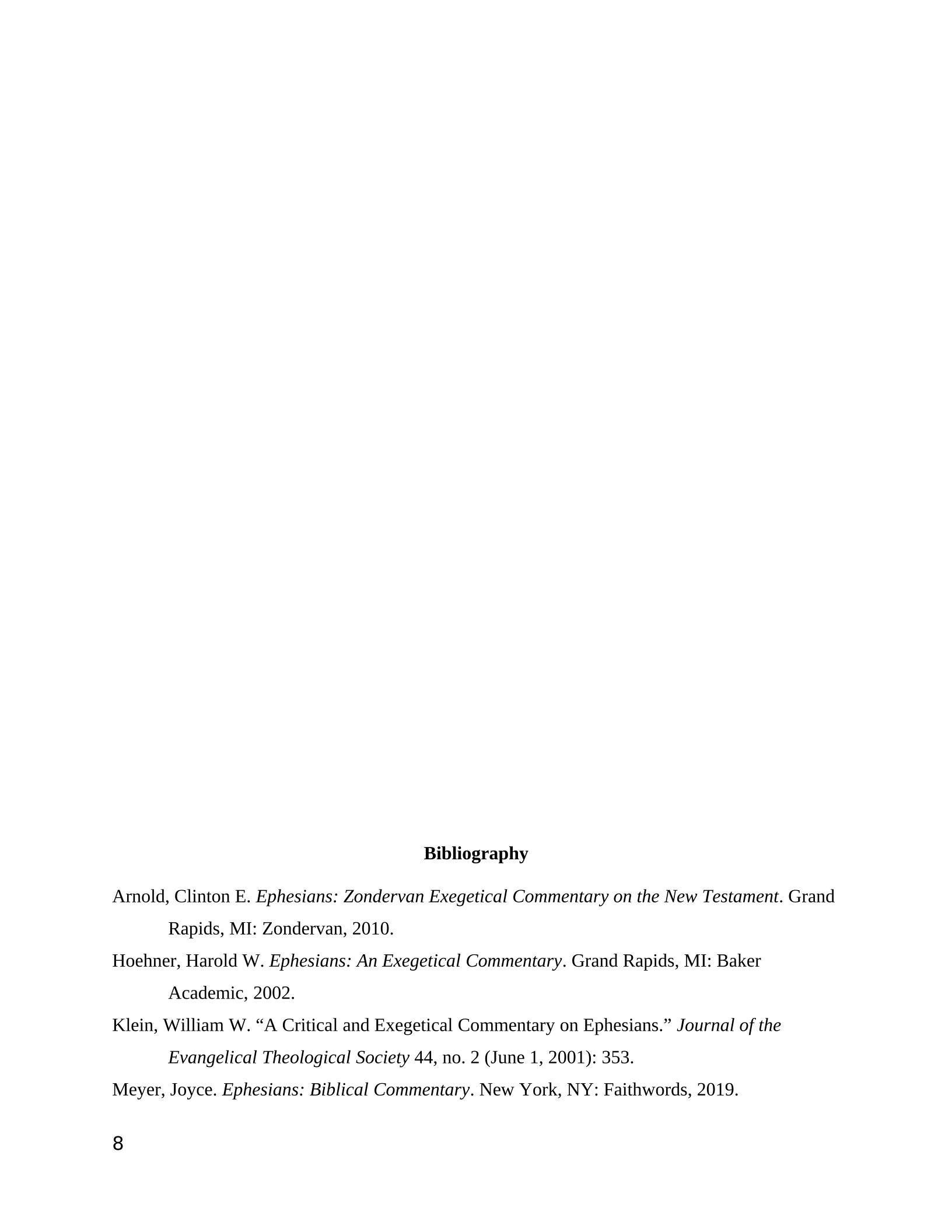
Bibliography
Arnold, Clinton E. Ephesians: Zondervan Exegetical Commentary on the New Testament. Grand
Rapids, MI: Zondervan, 2010.
Hoehner, Harold W. Ephesians: An Exegetical Commentary. Grand Rapids, MI: Baker
Academic, 2002.
Klein, William W. “A Critical and Exegetical Commentary on Ephesians.” Journal of the
Evangelical Theological Society 44, no. 2 (June 1, 2001): 353.
Meyer, Joyce. Ephesians: Biblical Commentary. New York, NY: Faithwords, 2019.
8
Platter, Jonathan M., and Jacob Lett. “‘Christ Who Is Our Peace’: Ephesians 2 and a Theological
Ontology of Place.” Journal of Theological Interpretation 16, no. 1 (June 1, 2022): 74–
89. https://doi.org/10.5325/jtheointe.16.1.0074.
Simpson, Benjamin I, and Herbert W Bateman. Ephesians: An Exegetical Guide for Preaching
and Teaching. Grand Rapids, MI: Kregel Academic, 2020.
Strong, James. The New Strong’s Expanded Exhaustive Concordance of the Bible. Nashville,
TN: Thomas Nelson, 2010.
Thielman, Frank, Robert Yarbrough, and Robert Stein. Ephesians (Baker Exegetical
Commentary on the New Testament). Grand Rapids, MI: Baker Books, 2010.
9
Powered by TCPDF (www.tcpdf.org)

