


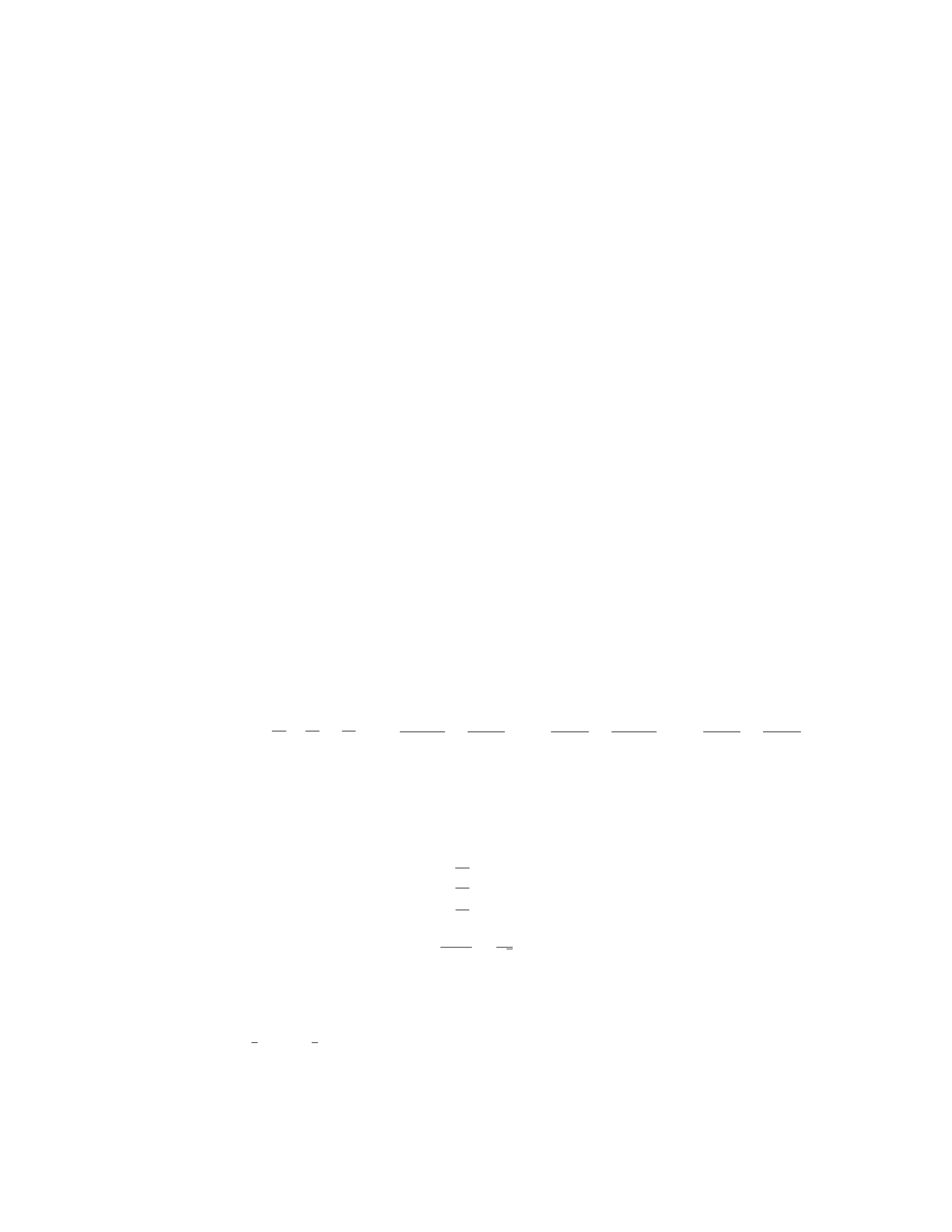
MATH 332 - ADVANCED CALCULUS
- Stokes’ Theorem
Question Bank - Set 5
Liberty University
Question 1
Question
Let Sbe the part of the plane z= 1 + x+ 2ythat lies within the cylinder
x2+y2= 1 and above the xy-plane. Use Stokes’ Theorem to evaluate the
surface integral RRS(∇ × F)·dS, where F(x, y, z) = (xz, yz, x2y).
Solution
Step 1: First, we need to find the curl of the vector field F:∇ × F.
∇×F=
i j k
∂
∂x
∂
∂y
∂
∂z
xz yz x2y
=∂(x2y)
∂y −∂(yz)
∂z i−∂(xz)
∂x −∂(x2y)
∂z j+∂(yz)
∂x −∂(xz)
∂y k
= (x2−z)i−xj+yk
Step 2: Next, we find the unit normal vector to the surface S,n, by com-
puting the gradient of the scalar function g(x, y, z) = z−(1 + x+ 2y).
∇g=
∂g
∂x
∂g
∂y
∂g
∂z
=
−1
−2
1
So, the unit normal vector is n=∇g
||∇g|| =1
√6(−1,−2,1).
Step 3: Now, we find the parameterization of the curve of intersection of the
plane and the cylinder. The intersection curve lies in the xy-plane, so we have
z= 0. Simplifying the equation of the plane gives y=−1−x, and substituting
z= 0 in the equation of the cylinder gives x2+ (−1−x)2= 1. Solving, we get
x=−1
2,y=−1
2.

Step 4: Stokes’ Theorem states that
ZZS
(∇ × F)·dS=IC
F·dr
We can evaluate the right hand side by parametrizing the curve Cas r(t) =
(−cos t, −sin t, 0) with 0≤t≤2π.
Step 5: Calculate F(r(t)) and dr
dt then compute the line integral HCF·dr.
Step 6: Evaluate the line integral to find the final answer.
Question 2
Question
Let Sbe the part of the plane z= 4 −x−ythat lies above the region in the
xy-plane bounded by the circle x2+y2= 4. Use Stokes’ Theorem to calculate
the flux of the curl of the vector field F=⟨−y, x, z⟩across the surface S.
Solution
Step 1: Find the normal vector to the surface S. The normal vector to the
surface Sis given by n=curl(F), where
curl(F) = ∇ × F=
i j k
∂
∂x
∂
∂y
∂
∂z
−y x z
=⟨1,1,1⟩.
Therefore, the normal vector to the surface Sis n=⟨1,1,1⟩.
Step 2: Find the parametrization of the surface S. We can parametrize the
surface Susing S(x, y) = ⟨x, y, 4−x−y⟩, where (x, y)lies in the region bounded
by the circle x2+y2= 4. We can use polar coordinates, where x= 2 cos(θ)and
y= 2 sin(θ).
Thus, S(θ) = ⟨2 cos(θ),2 sin(θ),4−2 cos(θ)−2 sin(θ)⟩.
Step 3: Calculate the line integral over the boundary curve. The boundary
curve of the surface Sis the circle x2+y2= 4. We can parametrize this circle
as C(t) = ⟨2 cos(t),2 sin(t)⟩, where 0≤t≤2π.
Using Stokes’ Theorem, the line integral over the boundary curve is given as
ZC
F·dr=ZZS
(∇ × F)·dS.
Step 4: Calculate the flux across the surface S. Substitute n=⟨1,1,1⟩and
S(θ) = ⟨2 cos(θ),2 sin(θ),4−2 cos(θ)−2 sin(θ)⟩into the surface integral. After
simplification, you should get the final answer.
2

Question 3
Question
Let Cbe the curve defined by the intersection of the plane z= 5 and the
cylinder x2+y2= 4, oriented counterclockwise when viewed from the positive z-
axis. Given the vector field F(x, y, z) = (2x2y, −x2z, 3y2), calculate the surface
integral of curl(F)over the surface Sthat lies above the curve Cand below the
plane z= 6.
Solution
Step 1: First, we need to parameterize the curve C.
The curve Cis the intersection of z= 5 and the cylinder x2+y2= 4. We
can parametrize Cas r(t) = (2 cos t, 2 sin t, 5) for 0≤t < 2π.
Step 2: Next, we calculate the normal vector to the surface S.
The normal vector to the surface Sis given by N=∇g
∥∇g∥, where g(x, y, z) =
z−6. Therefore, ∇g= (0,0,1), and hence ∥∇g∥= 1.
Step 3: Calculate the curl of the vector field F.
The curl of Fis given by:
curl(F) =
i j k
∂
∂x
∂
∂y
∂
∂z
2x2y−x2z3y2
=3x2,0,−2x
Step 4: Calculate the surface integral.
Using Stokes’ Theorem, the surface integral of curl(F)over the surface Sis
equal to the line integral of Fover the curve C.
ZZS
curl(F)·dS=IC
F·dr
=IC
2x2y dx −x2z dy + 3y2dz
Step 5: Parametrize the curve Cand compute the line integral.
Since r(t) = (2 cos t, 2 sin t, 5), we have dx =−2 sin t dt,dy = 2 cos t dt, and
dz = 0.
Substitute these into the line integral and parameterize Cgives:
IC
2x2y dx −x2z dy + 3y2dz =Z2π
0
40 sin t−25 cos t dt =−50π
Therefore, the surface integral of curl(F)over the surface Sis −50π.
3
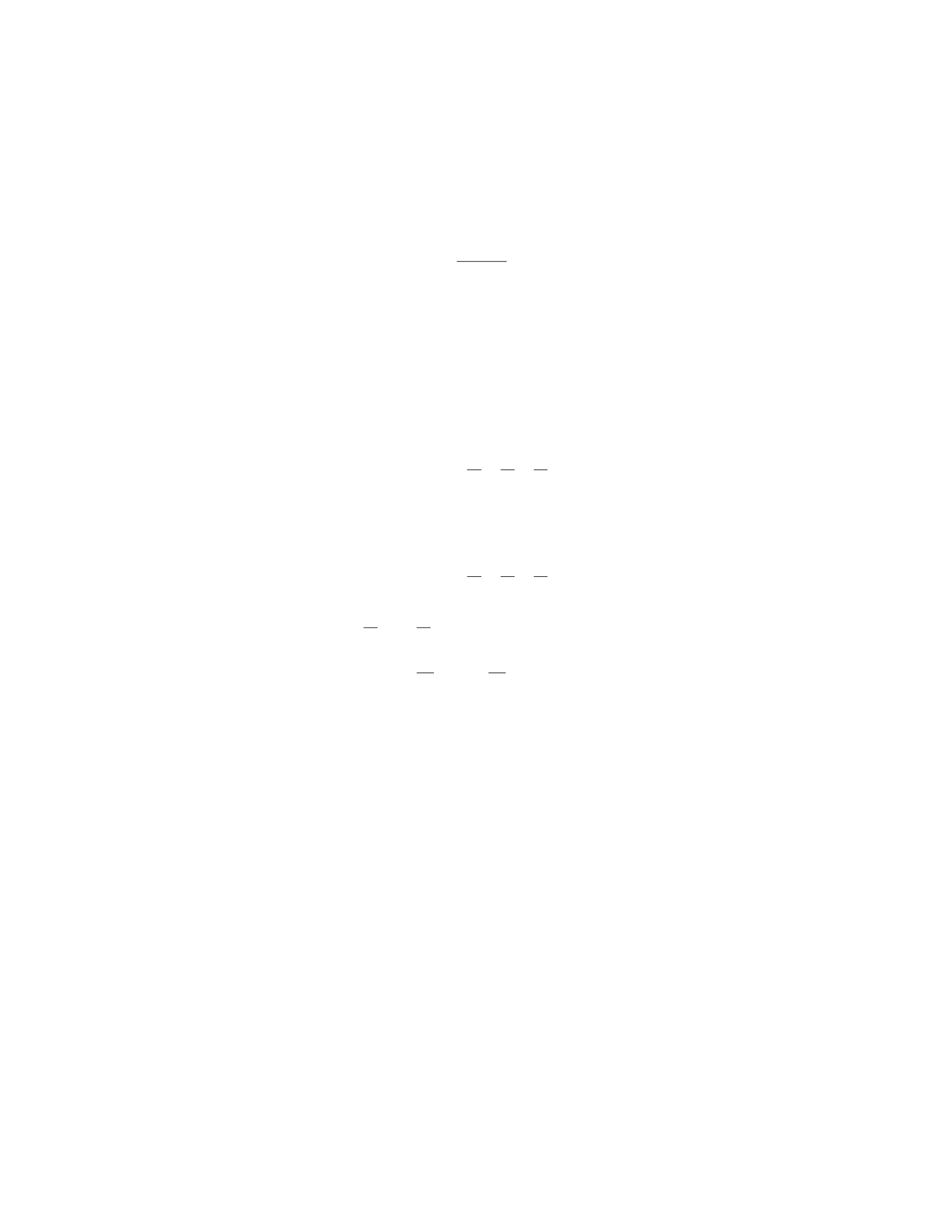
Question 4
Question
Let Sbe the part of the cone z=px2+y2that lies between the planes z= 0
and z= 1, oriented with outward normal. Use Stokes’ Theorem to evaluate
RRSF·dS, where F(x, y, z) = xi+yj+zk.
Solution
To apply Stokes’ Theorem, we first need to find the curl of the vector field F:
∇×F. The curl of a vector field F=Pi+Qj+Rkis given by the determinant
of the following matrix:
∇ × F=
i j k
∂
∂x
∂
∂y
∂
∂z
P Q R
In this case, F(x, y, z) = xi+yj+zk, so P=x,Q=y, and R=z. Therefore,
the curl of Fis:
∇ × F=
i j k
∂
∂x
∂
∂y
∂
∂z
x y z
Step 1: Calculate ∂z
∂y and ∂y
∂z :
∂z
∂y = 0,∂y
∂z = 1
Step 2: Compute the curl:
∇ × F=
i j k
1 0 0
x y z
=i(0 −0) −j(0 −0) + k(y−x) = k(y−x)
Now, we can use Stokes’ Theorem which states that for a surface Swith
boundary curve C, oriented positively, we have:
ZZS∇ × F·dS=IC
F·dr
Step 3: The boundary curve Cof Sis the intersection of the cone and the
planes z= 0 and z= 1. This is a circle with radius 1 centered at the origin
in the xy-plane. We will parameterize this circle as r(t) = cos ti+ sin tjfor
0≤t≤2π.
Step 4: Calculate the line integral:
IC
F·dr=Z2π
0
F(r(t)) ·r′(t)dt
4

Step 5: Substitute r(t)and calculate the dot product:
IC
F·dr=Z2π
0
(cos ti+ sin tj)·(−sin ti+ cos tj)dt
Step 6: Evaluate the dot product and integrate over the interval
Question 6
Question
Let Sbe the part of the plane z= 4−x−ythat lies inside the cylinder x2+y2=
36. Use Stokes’ Theorem to evaluate the surface integral RRS(∇×F)·dS, where
F=−yi+xj+zk.
Solution
Step 1: Find the curl of F. The curl of F=−yi+xj+zkcan be found as
follows:
∇ × F=
i j k
∂
∂x
∂
∂y
∂
∂z
−y x z
=∂z
∂y −∂y
∂z i−∂z
∂x −∂x
∂z j+∂y
∂x −∂x
∂y k
=i+j+k
Step 2: Parameterize the surface S. We can parameterize the surface S
using x=rcos θ,y=rsin θ, and z= 4 −rcos θ−rsin θwhere 0≤r≤6
and 0≤θ≤2π. The outward normal vector to the surface Sis given by
n=∂z
∂r ,−∂z
∂θ ,−1.
Step 3: Calculate ∇ × F·dS. Since ∇ × F=i+j+k, we have
∇ × F·dS=i·dS+j·dS+k·dS
=dydz +dzdx +dxdy
Step 4: Compute the surface integral using the parameterization. Using the
parameterization, we can express dydz,dzdx, and dxdy in terms of rand θ:
dydz =
∂(y, z)
∂(r, θ)
drdθ =rdrdθ
dzdx =
∂(z, x)
∂(r, θ)
drdθ =rdrdθ
dxdy =
∂(x, y)
∂(r, θ)
drdθ =rdrdθ
5
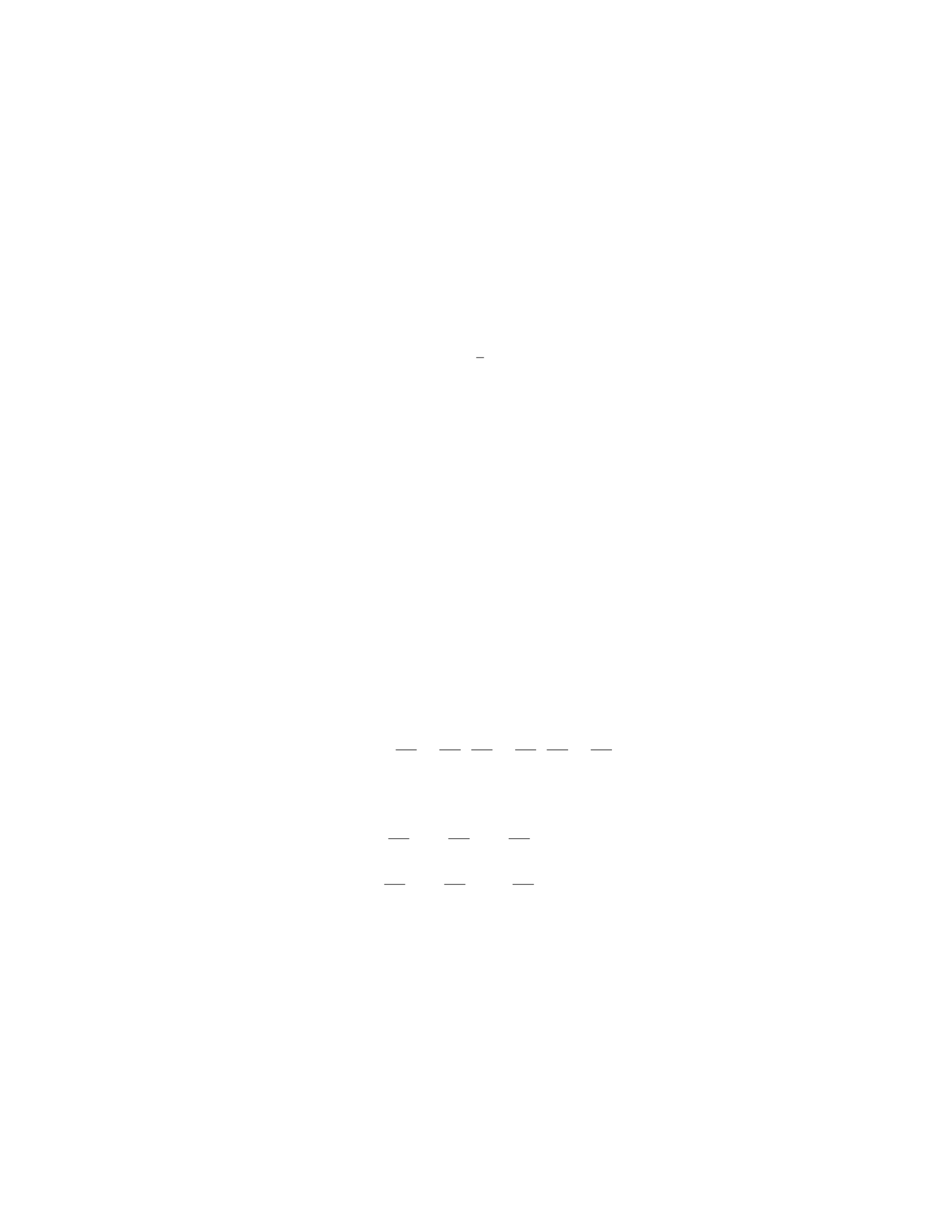
Therefore, the surface integral reduces to:
ZZS
(∇ × F)·dS=ZZS
dS=ZZS
rdrdθ
=Z2π
0Z6
0
rdrdθ
=Z2π
01
2r26
0
dθ
=Z2π
0
18dθ
= 36π
Question 7
Question
Let Sbe the surface of the part of the paraboloid z= 9−x2−y2that lies above
the xy-plane in the first octant. Let F= (y2, z, x)be a vector field. Calculate
the surface integral RRS(∇×F)·dSusing Stokes’ Theorem, where ∇×Fdenotes
the curl of F.
Solution
Step 1: First, we need to find the curl of F, denoted by ∇ × F. The curl of a
vector field F= (P, Q, R)is given by the following formula:
∇ × F=∂R
∂y −∂Q
∂z ,∂P
∂z −∂R
∂x ,∂Q
∂x −∂P
∂y .
For F= (y2, z, x), we have P=y2,Q=z, and R=x. Calculating the
partial derivatives:
∂R
∂y = 0,∂Q
∂z = 1,∂P
∂z = 0,
∂R
∂x = 1,∂P
∂y = 2y, ∂Q
∂x = 0.
Therefore, the curl of F, denoted by ∇×F, is given by (0 −1,0−0,0−2y) =
(−1,0,−2y).
Step 2: We will now find the surface integral by using Stokes’ Theorem,
which relates a surface integral to a line integral around its boundary curve.
Stokes’ Theorem states:
ZZS
(∇ × F)·dS=IC
F·dr,
6

where Cis the boundary curve of the surface S, oriented positively.
Step 3: The boundary curve Cof the surface Sin the first octant is the
intersection of the paraboloid with the xy-plane. This boundary curve is a
circle in the xy-plane defined by z= 0, which corresponds to 9 = x2+y2.
Step 4: Parameterize the boundary curve Cin the xy-plane using polar
coordinates: x=rcos(θ),y=rsin(θ), with 0≤r≤3and 0≤θ≤2π.
Step 5: Calculate the line integral HCF·drover the boundary curve Cusing
the parameterization and the given vector field F:
IC
F·dr=Z2π
0(rsin(θ))2,0, r cos(θ)·(−rsin(θ), r cos(θ)) dθ.
Step 6: Simplify and calculate the line integral to find the surface integral
value.
Question 8
Question
Let F= (z, x, y)be a vector field in R3. Consider the surface S, given by
z= 9 −x2−y2, oriented with outward-pointing unit normal. Calculate the flux
of Facross Susing Stokes’ Theorem.
Solution
Step 1: Determine the boundary curve Cof the surface S. The boundary curve
Cis the intersection of the surface S:z= 9 −x2−y2and the plane z= 0.
Substituting z= 0 into the equation of the surface, we get:
0 = 9 −x2−y2
x2+y2= 9
This represents a circle of radius 3 centered at the origin in the xy-plane.
Step 2: Parameterize the boundary curve C. The boundary curve Ccan be
parameterized by x(t) = 3 cos tand y(t) = 3 sin t, where 0≤t≤2π.
Step 3: Find the tangent vector to the boundary curve C. The tangent vector
to the boundary curve Cis given by r′(t) = ⟨x′(t), y′(t),0⟩=⟨−3 sin t, 3 cos t, 0⟩.
Step 4: Compute the curl of F. The curl of Fis given by:
∇ × F=
i j k
∂
∂x
∂
∂y
∂
∂z
z x y
=∂y
∂y −∂x
∂z i−∂y
∂z −∂z
∂x j+∂x
∂x −∂y
∂y k
=i−j−k
Step 5: Calculate the line integral of ∇ × Faround the boundary curve C.
We have:
ZC∇ × F·dr =Z2π
0
(∇ × F)·r′(t)dt
7
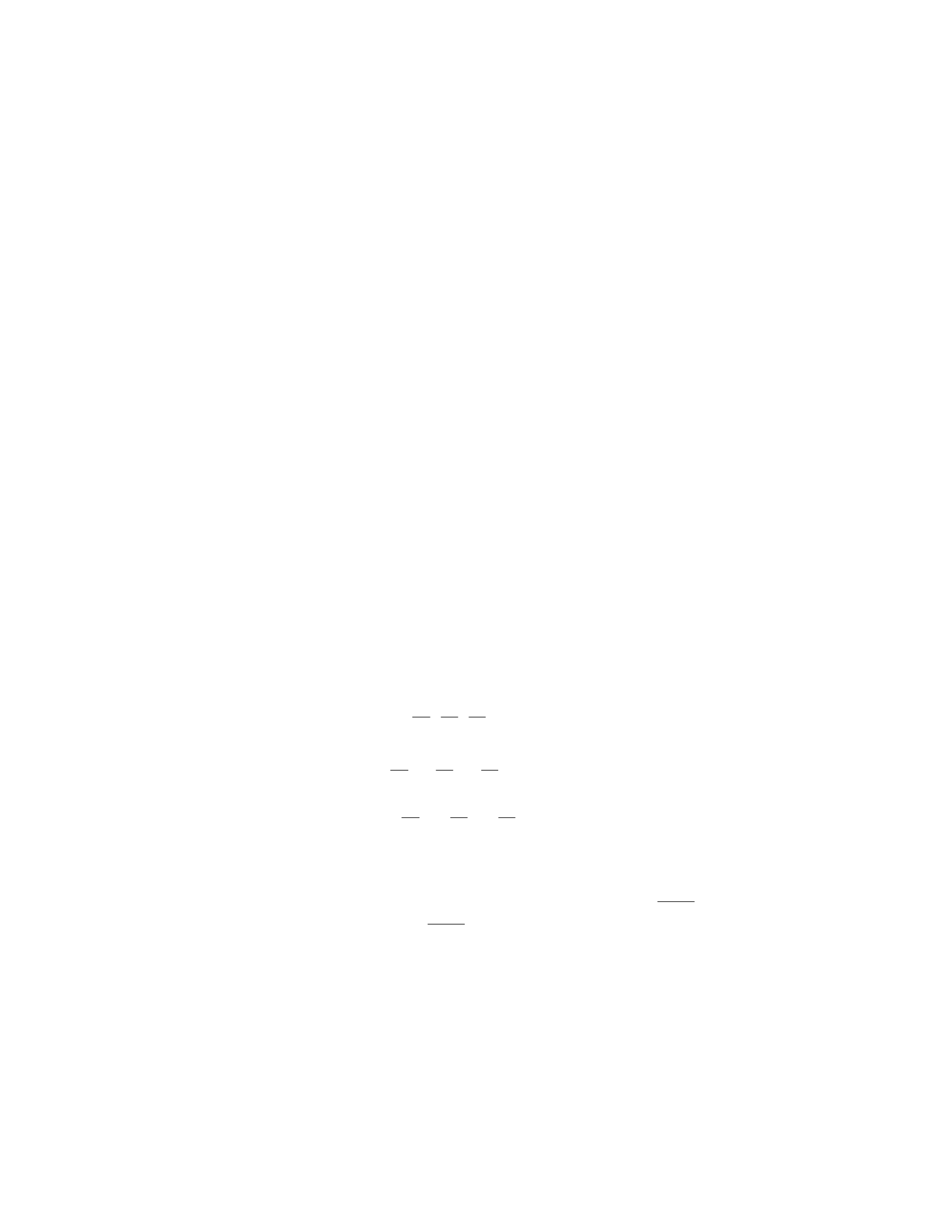
=Z2π
0
(−3 sin t+ 3 cos t−0)dt
=Z2π
0
3(cos t−sin t)dt
= 3 [sin t+ cos t]
2π
0
= 3(0) = 0
Step 6: Apply Stokes’ Theorem. Stokes’ Theorem states that the flux of F
across Sis equal to the line integral of ∇ × Faround the boundary curve C:
ZZS
(∇ × F)·dS=ZC∇ × F·dr = 0
Therefore, the flux of Facross the surface Sis 0.
Question 9
Question
Let Sbe the surface of the hemisphere x2+y2+z2= 4,z≥0. Use Stokes’
Theorem to evaluate the surface integral RRSF·dS, where F= (−y2, x +z, y),
and Sis oriented with the outward-pointing normal.
Solution
Step 1: Find the curl of F. The curl of Fis given by:
curl F=∂
∂x ,∂
∂y ,∂
∂z ×(−y2, x +z, y)
curl F=∂
∂x i+∂
∂y j+∂
∂z k×(−y2, x +z, y)
curl F=∂
∂x (y),∂
∂y (y),∂
∂z (−y2, x +z, y)
curl F= (0,1,−2y)
Step 2: Find the normal vector to S. The surface Sis the hemisphere
x2+y2+z2= 4,z≥0. The outward-pointing normal to Sis n=(x,y,z)
2. Since
z≥0, the normal vector is n=(x,y,z)
2.
Step 3: Apply Stokes’ Theorem. Stokes’ Theorem states that for a vector
field Fand a surface Swith outward-pointing normal n,
ZZS
F·dS=ZZD
(curl F)·ndA
where Dis the region in the xy-plane enclosed by the boundary curve of S.
8
Step 4: Find the region D. The boundary of the hemisphere can be param-
eterized by r(t) = (2 cos t, 2 sin t, 0), where 0≤t≤2π. Therefore, Dis the unit
disc in the xy-plane.
Step 5: Evaluate the surface integral.
ZZD
curl F·ndA =ZZD
(0,1,−2y)·x
2,y
2,z
2dA
ZZD
curl F·ndA =ZZD−y
2dA
Since Dis the unit disc, we can use polar coordinates to evaluate the double
integral:
ZZD−y
2dA =−Z2π
0Z1
0−rsin θ
2dr dθ
ZZD−y
2dA =−Z2π
0−1
4dθ
ZZD−y
2dA =1
4·2π=π
2
Therefore, RRSF·dS=π
2.
Question 10
Question
Let Sbe the part of the plane z= 4 −x−2ythat lies above the triangle with
vertices at (0,0,0),(0,2,0), and (2,0,0). Let F= (x2, y2, z2)be a vector field.
Use Stokes’ Thejsonreorem to evaluate RRS(∇×F)·ndS, where nis the outward
unit normal vector to S.
Solution
Step 1: Find the curl of F. The curl of Fis given by:
∇ × F=
i j k
∂
∂x
∂
∂y
∂
∂z
x2y2z2
=∂(z2)
∂y −∂(y2)
∂z i−∂(z2)
∂x −∂(x2)
∂z j+∂(y2)
∂x −∂(x2)
∂y k
= 0i−0j+ 0k=0
Step 2: Find the outward unit normal vector to S. Given that z= 4−x−2y,
the gradient of zis ∇z= (−1,−2,1). Normalizing ∇zgives the outward unit
normal vector to Sas:
n=∇z
||∇z|| =−1
√6,−2
√6,1
√6
9

Step 3: Evaluate the surface integral using Stokes’ Theorem. Stokes’ The-
orem states that RRS(∇ × F)·ndS =HcF·dr, where cis the boundary of the
surface S. Since the given vector field Fis zero on S(as shown in Step 1), the
surface integral is also zero:
ZZS
(∇ × F)·ndS = 0
Question 11
Question
Let Sbe the part of the plane z= 7 −x−2ythat lies above the rectangle in the
xy-plane with vertices at (0,0),(2,0),(2,1), and (0,1). Use Stokes’ theorem
to evaluate the surface integral RSF·dSwhere F= (x2, y2, z)and dSis the
outwardly oriented unit normal to S.
Solution
Step 1: First, we need to parameterize the boundary curve Cof the surface S.
The boundary curve Cconsists of four line segments connecting the vertices of
the rectangle in the xy-plane. We can parameterize the boundary curve Cas
follows:
For the line segment from (0,0) to (2,0), we have r1(t) = (t, 0,7−t)for
0≤t≤2.
For the line segment from (2,0) to (2,1), we have r2(t) = (2, t, 7−2−t)for
0≤t≤1.
For the line segment from (2,1) to (0,1), we have r3(t) = (2 −t, 1,7−2 + t)
for 0≤t≤2.
For the line segment from (0,1) to (0,0), we have r4(t) = (0,1−t, 7−t)for
0≤t≤1.
Step 2: Next, we compute the curl of F= (x2, y2, z)which is given by:
∇ × F=
i j k
∂
∂x
∂
∂y
∂
∂z
x2y2z
= (0,0,2−x−2y)
Step 3: Now, we can apply Stokes’ theorem which states that:
ZS∇ × F·dS=IC
F·dr
Since ∇ × F= (0,0,2−x−2y), the surface integral simplifies to:
ZS
(0,0,2−x−2y)·dS=IC
F·dr
10

Step 4: Lastly, we evaluate the line integral HCF·drby summing the line
integrals over each segment of the boundary curve C:
IC
F·dr=Z2
0
F(r1(t))·r′
1(t)dt+Z1
0
F(r2(t))·r′
2(t)dt+Z2
0
F(r3(t))·r′
3(t)dt+Z1
0
F(r4(t))·r′
4(t)dt
This completes the solution.
Question 12
Question
Let Sbe the surface given by z=x2+y2for 0≤z≤9. Use Stokes’ Theorem
to evaluate the surface integral
ZZ
S
(∇ × F)·dS,
where F=⟨x2, y2, z2⟩.
Solution
Step 1: Calculate the curl of F.
∇ × F=
i j k
∂
∂x
∂
∂y
∂
∂z
x2y2z2
=∂z2
∂y −∂y2
∂z i−∂z2
∂x −∂x2
∂z j+∂y2
∂x −∂x2
∂y k
= 2zi−2zj−2yk
Step 2: Determine the unit normal vector to the surface. Since Sis the part
of the paraboloid z=x2+y2above the xy-plane, the unit normal vector to the
surface is N=−∂z
∂x ,−∂z
∂y ,1=⟨−2x, −2y, 1⟩.
Step 3: Calculate the dot product of (∇ × F)with N.
(∇ × F)·N= (−2z)(−2x)+(−2z)(−2y)−2y
= 4zx + 4zy −2y
Step 4: Calculate the magnitude of the cross product of the partial deriva-
tives of (x2, y2, x2+y2).
dS=
∂(x, y, x2+y2)
∂(x, y)
dA
11

=
1 0
0 1
2x2y
dA =p1+0+4x2+ 4y2dA =p4(x2+y2)dA = 2r dr dθ
Step 5: Compute the surface integral using Stokes’ theorem.
ZZ
S
∇ × F·dS=ZZ
D
(∇ × F)·NdA
=ZZ
D
(4zx + 4zy −2y)·2r dr dθ
=Z2π
0Z3
0
(8r2cos θ+ 8r2sin θ−2rsin θ)·2r dr dθ
=Z2π
0Z3
0
(16r3cos θ+ 16r3sin θ−4rsin θ)dr dθ
=Z2π
04r4cos θ+ 4r4sin θ−2r2sin
Question 13
Question
Let F(x, y, z) = (2y+z, x +z, 3x+ 2y)be a vector field, and let Sbe the part of
the cone z=px2+y2that lies below the plane z= 1. Use Stokes’ Theorem to
calculate the flux of Facross the boundary curve of Soriented counterclockwise.
Solution
Step 1: We begin by parameterizing the boundary curve Cof Swhere z=
px2+y2and z= 1.
Let C1be the curve where z=px2+y2and C2be the curve where z= 1.
We can parameterize C1as r1(t)=(tcos t, t sin t, t)for 0≤t≤1and C2as
r2(t) = (cos t, sin t, 1) for 0≤t≤2π.
Step 2: Next, we calculate the curl of F, given by ∇×F=
i j k
∂
∂x
∂
∂y
∂
∂z
2y+z x +z3x+ 2y
.
Expanding this determinant, we get ∇ × F= (1,−1,−1).
Step 3: Using Stokes’ Theorem, the flux of Facross Cis equal to the circu-
lation of ∇ × Faround C. Thus, we have
12

Flux =ZC
F·dr
=ZC1
F·dr+ZC2
F·dr
=Z1
0
F(r1(t)) ·r′
1(t)dt +Z2π
0
F(r2(t)) ·r′
2(t)dt.
Step 4: The first integral can be calculated as follows:
Z1
0
F(r1(t)) ·r′
1(t)dt =Z1
0
(2tsin t+t, t cos t+t, 3tcos t+ 2tsin t)·(−tsin t, t cos t, 1) dt
=Z1
0−2t2sin2t−t2cos t+ 3tcos t+ 2t2sin t dt
=2
3.
Step 5: The second integral can be calculated similarly:
Z2π
0
F(r2(t)) ·r′
2(t)dt =Z2π
0
(2 sin t+ 1,cos t+ 1,3 cos t+ 2 sin t)·(−sin t, cos t, 0) dt
=Z2π
0−2 sin tcos t−cos t+ 3 cos t dt
=π.
Step 6: Therefore, the total flux of
Question 15
Question
Let Sbe the surface defined by the part of the paraboloid z= 4 −x2−y2
that lies above the xy-plane in the first octant. Calculate the surface integral
RRSF·dS, where F=xi+yj+zk, using Stokes’ Theorem.
Solution
Step 1: First, we need to find the normal vector Nto the surface S. The normal
vector is given by the gradient of the scalar function that defines the surface,
which is ∇f= (−2x, −2y, 1).
Step 2: Calculate the curl of the vector field F:
∇ × F=
i j k
∂
∂x
∂
∂y
∂
∂z
x y z
= ( ∂z
∂y −∂y
∂z )i−(∂z
∂x −∂x
∂z )j+ ( ∂y
∂x −∂x
∂y )k=i−j+k
13

Step 3: Now, apply Stokes’ Theorem which states that the surface integral
of the normal component of ∇×Fover a surface Sis equal to the line integral
of Faround the boundary of S. Since the boundary of Slies in the xy-plane in
the first octant, it consists of the curve where z= 0 and x2+y2= 4.
Step 4: Parameterize the boundary curve Cas r(t) = (2 cos t, 2 sin t, 0) where
0≤t≤2π. Then, calculate the line integral RCF·dr:
ZC
F·dr=Z2π
0
(2 cos t, 2 sin t, 0) ·(−2 sin t, 2 cos t, 0)dt =Z2π
0
0dt = 0
Step 5: Since the line integral is 0, the surface integral RRSF·dSis also 0
by Stokes’ Theorem.
Question 16
Question
Let Sbe the part of the plane z= 4 −x−ythat lies inside the cylinder
x2+y2= 4. Given the vector field F(x, y, z) = (2y+z, x +z, x +y), compute
the flux of Facross the surface Sin the direction of the outward unit normal.
Solution
Step 1: Find the normal vector to the surface S. The normal vector to the
surface Sis given by n=∇g, where g(x, y, z) = 4−x−y. Thus, n= (−1,−1,1).
Step 2: Parametrize the surface S. Since Sis the part of the plane z=
4−x−ythat lies inside the cylinder x2+y2= 4, we can parameterize S
as r(u, v) = (2 cos(u) cos(v),2 sin(u) cos(v),4−2 cos(u) cos(v)−2 sin(u) cos(v))
where 0≤u≤2πand 0≤v≤π
2.
Step 3: Calculate the cross product of the partial derivatives. Calculate ∂r
∂u =
(−2 sin(u) cos(v),2 cos(u) cos(v),2 sin(u) cos(v)) and ∂r
∂v = (−2 cos(u) sin(v),−2 sin(u) sin(v),2 sin(u) sin(v)).
Then, calculate the cross product ∂r
∂u ×∂r
∂v = (−4 cos(u),4 sin(u),4).
Step 4: Evaluate the surface integral. The flux of Facross Sis given by
RRSF·ndS. Since F(x, y, z) = (2y+z, x +z, x +y)and n= (−1,−1,1), we
have F·n=−2y−z+x+z+x+y= 2x+y−2y= 2x−y.
Hence, the flux of Facross Sis RRS(2x−y)dS =R2π
0Rπ
2
0(8 cos(u)−2 sin(u))·
4dv du.
Question 17
Question
Let Sbe the surface of the cone z=px2+y2bounded by the plane z= 3.
Let Fbe the vector field defined by F(x, y, z) = (y2, x2, z). Calculate the flux
of Fthrough Susing Stokes’ Theorem.
14
Solution
Step 1: Firstly, we need to determine the boundary curve Cof the surface S.
The boundary curve is the intersection of the cone z=px2+y2and the plane
z= 3. We set z=px2+y2= 3 and solve for xand yto find C.
px2+y2= 3
x2+y2= 9
This represents a circle with radius 3 centered at the origin in the xy-plane.
Step 2: Next, we parameterize the boundary curve C. We can use polar
coordinates (x, y) = (3 cos t, 3 sin t)to parameterize the circle.
Step 3: Now, we calculate the curl of F.
∇ × F=
i j k
∂
∂x
∂
∂y
∂
∂z
y2x2z
= (2x−2y, −2x, 0)
Step 4: Compute the line integral of ∇ × Fover the boundary curve C:
IC∇ × F·dr=Z2π
0
(2(3 cos t)−2(3 sin t))(−3 sin t)+(−2(3 cos t))(3 cos t)dt
Step 5: Simplify the line integral and calculate the flux through Susing
Stokes’ Theorem:
Flux =ZZS
(∇ × F)·dS=IC
F·dr
Question 18
Question
Let Sbe the part of the plane z=x+ythat lies above the region in the
xy-plane bounded by the parabola y=x2and the y-axis. Calculate the flux of
the curl of F= (xz, −xy, z2)across Sin the direction pointing outward from
the z-axis.
Solution
Step 1: Find the normal vector to the surface Susing the gradient of z.
The surface is given by z=x+y, so the gradient of zis ∇z=⟨1,1,−1⟩.
Since the normal vector points outward from the z-axis, the normal vector
is n=∇z
∥∇z∥=⟨1,1,−1⟩
√12+12+(−1)2=⟨1,1,−1⟩
√3.
Step 2: Calculate the curl of F.
The curl of Fis ∇ × F=
i j k
∂
∂x
∂
∂y
∂
∂z
xz −xy z2
=⟨z−0, z −0, x −x⟩=⟨z, z, 0⟩.
15
Step 3: Calculate the flux of the curl of Facross S.
The flux of the vector field G=∇×Fover Sis given by the surface integral
RRSG·dS.
Since G=⟨z, z, 0⟩and n=⟨1,1,−1⟩
√3, the flux integral becomes RRS(z, z, 0) ·
⟨1,1,−1⟩
√3dS.
Step 4: Parameterize the surface S.
Let Dbe the region in the xy-plane bounded by the parabola y=x2and
the y-axis. We can parameterize the surface Sas r(x, y) = ⟨x, y, x +y⟩where
(x, y)∈D.
Step 5: Evaluate the flux integral.
The flux integral becomes RRDG·n
∂r
∂x ×∂r
∂y
dA.
Substitute G,n, and ∂r
∂x ×∂r
∂y into the integral and evaluate.
This completes the calculation of the flux of the curl of Facross the surface
S.
Question 19
Question
Let Sbe the part of the plane 2x+y+ 3z= 6 that lies in the first octant. Let
Shave surface density δ(x, y, z) = x+y+z. Use Stokes’ Theorem to calculate
the flux of the curl of the vector field F(x, y, z) = ⟨x2, y2, z2⟩across S.
Solution
Step 1: Find the normal vector to the surface S. The equation of the plane is
2x+y+ 3z= 6. We can rewrite this as 2x+y+ 3z−6 = 0. The coefficients of
x,y, and zin this equation give the components of the normal vector. So, the
normal vector to the surface Sis n=⟨2,1,3⟩.
Step 2: Parameterize the curve that bounds the surface Sin the first octant.
Let Cbe the curve of intersection of the plane 2x+y+3z= 6 with the coordinate
planes. We can parameterize this curve as r(t) = ⟨t, 0,0⟩for 0≤t≤3.
Step 3: Calculate curl(F). The curl of F(x, y, z) = ⟨x2, y2, z2⟩is given by
curl(F) = ∇ × F=
i j k
∂
∂x
∂
∂y
∂
∂z
x2y2z2
=⟨0,0,2y−2z⟩.
Step 4: Calculate the line integral of curl(F)over C. Using Stokes’ Theorem,
the flux of curl(F)across Sis given by
ZZS
(∇ × F)·dS=IC
F·dr=Z3
0⟨0,0,2(0) −2(0)⟩·⟨1,0,0⟩dt =Z3
0
0dt = 0.
Therefore, the flux of the curl of Facross Sis 0.
16

Question 20
Question
Let Sbe the part of the plane z= 4 −x−2ythat lies above the square Rin the
xy-plane centered at the origin with sides of length 4. Orient Supward, and let
F(x, y, z) = (y2, z2, x2).
Calculate the flux of Facross the surface Susing Stokes’ Theorem.
Solution
Step 1: Find the normal vector to the surface S. The normal vector to the
surface Sabove the square Ris given by n=∇g(x, y, z), where g(x, y, z) =
z−(4 −x−2y). Thus, n=∇g(x, y, z) = ∂g
∂x ,∂g
∂y ,∂g
∂z = (1,2,−1).
Step 2: Find the curl of F. The curl of Fis given by ∇×F=∂
∂x ,∂
∂y ,∂
∂z ×
(y2, z2, x2) = ∂x2
∂y −∂z2
∂x ,∂y2
∂x −∂x2
∂z ,∂z2
∂z −∂y2
∂y = (−2x, 2z, 2y).
Step 3: Calculate the flux of Facross the surface using Stokes’ Theorem.
The flux of Facross Sis given by the surface integral RRS(∇×F)·dS. By Stokes’
Theorem, this is equivalent to the line integral of Faround the boundary of R
oriented counterclockwise.
Step 4: Calculate the line integral of Faround the boundary of R. The
boundary of the square Ris parameterized by r(t) = (2 cos t, 2 sin t, 0) for 0≤
t≤2π. Since F(x, y, z) = (y2, z2, x2), we have F(r(t)) = (4 sin2t, 0,4 cos2t).
Thus, the line integral becomes
Z2π
0
F(r(t)) ·r′(t)dt
=Z2π
0
(4 sin2t, 0,4 cos2t)·(−2 sin t, 2 cos t, 0) dt
=Z2π
0−8 sin3t+ 8 cos3t dt
= 16π
Therefore, the flux of Facross the surface Sis 16π.
Question 21
Question
Let Sbe the part of the plane z= 3 −x−ythat lies above the region in the
xy-plane that is enclosed by the circle x2+y2= 1. Use Stokes’ Theorem to
evaluate the surface integral RRS(∇ × F)·dS, where F(x, y, z) = (y2, z, x).
17

Solution
Step 1: Find the curl of F. The curl of Fis given by:
∇ × F=
i j k
∂
∂x
∂
∂y
∂
∂z
y2z x
= (1,−2,1)
Step 2: Find the unit normal vector to the surface S. Since Sis the part of
the plane z= 3 −x−ythat lies above the unit circle in the xy-plane, the unit
normal vector to the surface Sis given by:
n=∂z
∂x ,∂z
∂y ,−1= (−1,−1,−1)
Step 3: Calculate the normal vector to the circle in the xy-plane. Since Sis
above the unit circle in the xy-plane, the normal vector to this circle is k.
Step 4: Find the unit normal vector to the curve in three dimensions. Since
the unit circle in the xy-plane projects to the unit circle in the xz-plane, the
unit normal vector to the curve is given by:
N=−x
√1 + x2,0,−z
√1 + x2
Step 5: Compute the flux integral. Now, we can use Stokes’ Theorem to
evaluate the surface integral:
ZZS
(∇ × F)·dS=IC
F·dr,
where Cis the boundary of S.
Step 6: Calculate the line integral. The boundary Cof Sis the unit circle
in the xy-plane. The line integral is given by:
IC
F·dr=Z2π
0
F(cos t, sin t, 3−cos t−sin t)·(−sin t, cos t, 0)dt
Step 7: Simplify the line integral and compute it numerically to find the
final answer.
Question 22
Question
Let F(x, y, z) = (x2, y2, z2)be a vector field defined in R3. The surface Sis the
part of the cone z=px2+y2that lies between the planes z= 1 and z= 3.
Use Stokes’ Theorem to evaluate the surface integral R RS(∇ × F)·dS.
18

Solution
Step 1: We start by calculating the curl of F(x, y, z):
∇ × F=
i j k
∂
∂x
∂
∂y
∂
∂z
x2y2z2
=∂(z2)
∂y −∂(y2)
∂z i−∂(z2)
∂x −∂(x2)
∂z j+∂(y2)
∂x −∂(x2)
∂y k
= 0 −0i−0j+ 0k=0
Step 2: Since the curl of Fis 0, the surface integral reduces to R RS0·dS= 0.
Therefore, the value of the surface integral R RS(∇ × F)·dSusing Stokes’
Theorem is 0.
Question 23
Question
Let Sbe the part of the plane x+ 2y+ 3z= 6 that lies inside the cylinder
x2+y2= 4, with outward orientation. Use Stokes’ Theorem to evaluate
IC
F·dr
where F=⟨z, x, y⟩and Cis the boundary curve of S, oriented counterclockwise
when viewed from above.
Solution
Step 1: Find the boundary curve Cof surface S.
The boundary curve Ccorresponds to the intersection of the plane and
the cylinder. Since x2+y2= 4, we can rewrite the equation of the plane as
x+ 2y+ 3z= 6 as x+ 2y+ 3(6 −x−2y) = 6, which simplifies to x+ 2y−3 = 0.
Thus, the boundary curve Cis the circle given by x2+y2= 4 and x+2y−3 =
0.
Step 2: Parametrize the boundary curve C.
We can parametrize the circle x2+y2= 4 as x= 2 cos(t)and y= 2 sin(t)
for 0≤t≤2π.
Substitute these into the equation x+ 2y−3 = 0 to find the parametric
equations for the boundary curve C:
2 cos(t)+4 sin(t)−3 = 0 =⇒x= 2 cos(t), y = 2 sin(t), z =3−2 cos(t)−4 sin(t)
3
Step 3: Compute curl(F).
19

The curl of F=⟨z, x, y⟩is given by
curl(F) = ∂y
∂z −∂z
∂y ,∂z
∂x −∂x
∂z ,∂x
∂y −∂y
∂x =⟨1,1,1⟩
Step 4: Apply Stokes’ Theorem.
Stokes’ Theorem states that
IC
F·dr =ZZS
curl(F)·dS
Since the unit normal vector to the plane x+ 2y+ 3z= 6 is ⟨1,2,3⟩, we have
dS =⟨1,2,3⟩ · dA = 3dA.
Therefore, the line integral becomes the surface integral:
IC
F·dr =ZZS
curl(F)·dS =ZZS⟨1,1,1⟩ · 3dA = 3 ZZS
dA
Step 5: Calculate the surface area of S.
The surface Srepresents a portion of the plane enclosed by the cylinder,
which lies in the xy-plane. The projection of this region onto the xy-plane is a
circle of radius 2. Hence, the surface area of Sis π(22) = 4π.
Step 6: Final computation.
Substitute the surface area of Sinto the surface integral:
3ZZS
dA = 3(4π) = 12π
Therefore, the value of the line integral over the boundary curve Cusing
Stokes’ Theorem is 12π.
Question 24
Question
Let Sbe the part of the plane z=x+ 2ythat lies above the triangle with
vertices at (0,0,0),(1,0,0), and (0,1,0). Let F(x, y, z) = (y2, z2, x2). Compute
the surface integral RRScurl F·dSusing Stokes’ Theorem.
Solution
Step 1: Determine the boundary of S, denoted by C. Since Slies on the plane
z=x+2y, the boundary Cwill be the triangular curve that lies in the xy-plane
with vertices at (0,0),(1,0), and (0,1).
Step 2: Calculate the curl of F= (y2, z2, x2). The curl of Fis given by
curl F=∂f3
∂y −∂f2
∂z ,∂f1
∂z −∂f3
∂x ,∂f2
∂x −∂f1
∂y .
20
Substitute f1=y2,f2=z2, and f3=x2into the formula above and simplify.
Step 3: Using Stokes’ Theorem, we have
ZZS
curl F·dS=IC
F·dr,
where HCdenotes the line integral over the curve Cin the xy-plane.
Step 4: Parameterize the triangular curve Cin the xy-plane. Let C1be the
line segment from (0,0) to (1,0),C2be the line segment from (1,0) to (0,1),
and C3be the line segment from (0,1) to (0,0).
Step 5: Calculate Falong each segment Ci. Compute F·drfor each segment.
Step 6: Compute the total line integral HCF·drby summing the line integrals
over each segment Ci. This will give the value of the surface integral RRScurl F·
dS.
Question 25
Question
Let Sbe the part of the plane z= 4 −x−yin the first octant with outward
unit normal, and let F(x, y, z)=(xz, yz, xy). Calculate the flux of Facross S
using Stokes’ Theorem.
Solution
Step 1: First, we calculate the curl of F:
∇ × F=
i j k
∂
∂x
∂
∂y
∂
∂z
xz yz xy
=∂(xy)
∂y −∂(yz)
∂z i−∂(xz)
∂x −∂(xy)
∂z j+∂(xz)
∂x −∂(yz)
∂y k
=yi−xj+zk
Step 2: Next, we calculate the outward unit normal to S: Since z= 4−x−y
in the first octant, the normal vector is ˆ
n=−∂z
∂x ,−∂z
∂y ,1= (1,1,1). The unit
normal vector is then ˆ
n=(1,1,1)
√3=1
√3,1
√3,1
√3.
Step 3: Now, we can apply Stokes’ Theorem: The flux of Facross Sis given
by:
ZZS
(∇ × F)·ˆ
ndS
=ZZS
(y, −x, z)·1
√3,1
√3,1
√3dS
21

=ZZS
y−x+z
√3dS
Step 4: Since the surface is given by z= 4 −x−y, the flux integral becomes:
ZZS
4
√3dA
=4
√3ZZS
dA
=4
√3·Area(S)
Step 5: To find the area of the surface S, we integrate over the projection
onto the xy-plane:
Area(S) = ZZD
∂(x, y)
∂(u, v)
dudv
Where Dis the projection of Sonto the xy-plane defined by z= 0.
Step 6: The projection can be found by setting z= 0 in the equation of the
surface z= 4 −x−y, giving 4−x−y= 0, which is the line y= 4 −x. Thus,
the limits of integration for xare 0≤x≤4and 0≤y≤4−x.
Step 7: The Jacobian determinant for the transformation from xy to uv is
1, so
Area(S) = Z4
0Z4−x
0
1dy dx =Z4
0
(4 −x)dx
Step 8: Solving the integral gives:
Area(S) = Z4
0
4−x dx =4x−x2
24
0
= 8
Step 9: Substituting the area
22

Step 4: Stokes’ Theorem states that
ZZS
(∇ × F)·dS=IC
F·dr
We can evaluate the right hand side by parametrizing the curve Cas r(t) =
(−cos t, −sin t, 0) with 0≤t≤2π.
Step 5: Calculate F(r(t)) and dr
dt then compute the line integral HCF·dr.
Step 6: Evaluate the line integral to find the final answer.
Question 2
Question
Let Sbe the part of the plane z= 4 −x−ythat lies above the region in the
xy-plane bounded by the circle x2+y2= 4. Use Stokes’ Theorem to calculate
the flux of the curl of the vector field F=⟨−y, x, z⟩across the surface S.
Solution
Step 1: Find the normal vector to the surface S. The normal vector to the
surface Sis given by n=curl(F), where
curl(F) = ∇ × F=
i j k
∂
∂x
∂
∂y
∂
∂z
−y x z
=⟨1,1,1⟩.
Therefore, the normal vector to the surface Sis n=⟨1,1,1⟩.
Step 2: Find the parametrization of the surface S. We can parametrize the
surface Susing S(x, y) = ⟨x, y, 4−x−y⟩, where (x, y)lies in the region bounded
by the circle x2+y2= 4. We can use polar coordinates, where x= 2 cos(θ)and
y= 2 sin(θ).
Thus, S(θ) = ⟨2 cos(θ),2 sin(θ),4−2 cos(θ)−2 sin(θ)⟩.
Step 3: Calculate the line integral over the boundary curve. The boundary
curve of the surface Sis the circle x2+y2= 4. We can parametrize this circle
as C(t) = ⟨2 cos(t),2 sin(t)⟩, where 0≤t≤2π.
Using Stokes’ Theorem, the line integral over the boundary curve is given as
ZC
F·dr=ZZS
(∇ × F)·dS.
Step 4: Calculate the flux across the surface S. Substitute n=⟨1,1,1⟩and
S(θ) = ⟨2 cos(θ),2 sin(θ),4−2 cos(θ)−2 sin(θ)⟩into the surface integral. After
simplification, you should get the final answer.
2

Question 3
Question
Let Cbe the curve defined by the intersection of the plane z= 5 and the
cylinder x2+y2= 4, oriented counterclockwise when viewed from the positive z-
axis. Given the vector field F(x, y, z) = (2x2y, −x2z, 3y2), calculate the surface
integral of curl(F)over the surface Sthat lies above the curve Cand below the
plane z= 6.
Solution
Step 1: First, we need to parameterize the curve C.
The curve Cis the intersection of z= 5 and the cylinder x2+y2= 4. We
can parametrize Cas r(t) = (2 cos t, 2 sin t, 5) for 0≤t < 2π.
Step 2: Next, we calculate the normal vector to the surface S.
The normal vector to the surface Sis given by N=∇g
∥∇g∥, where g(x, y, z) =
z−6. Therefore, ∇g= (0,0,1), and hence ∥∇g∥= 1.
Step 3: Calculate the curl of the vector field F.
The curl of Fis given by:
curl(F) =
i j k
∂
∂x
∂
∂y
∂
∂z
2x2y−x2z3y2
=3x2,0,−2x
Step 4: Calculate the surface integral.
Using Stokes’ Theorem, the surface integral of curl(F)over the surface Sis
equal to the line integral of Fover the curve C.
ZZS
curl(F)·dS=IC
F·dr
=IC
2x2y dx −x2z dy + 3y2dz
Step 5: Parametrize the curve Cand compute the line integral.
Since r(t) = (2 cos t, 2 sin t, 5), we have dx =−2 sin t dt,dy = 2 cos t dt, and
dz = 0.
Substitute these into the line integral and parameterize Cgives:
IC
2x2y dx −x2z dy + 3y2dz =Z2π
0
40 sin t−25 cos t dt =−50π
Therefore, the surface integral of curl(F)over the surface Sis −50π.
3
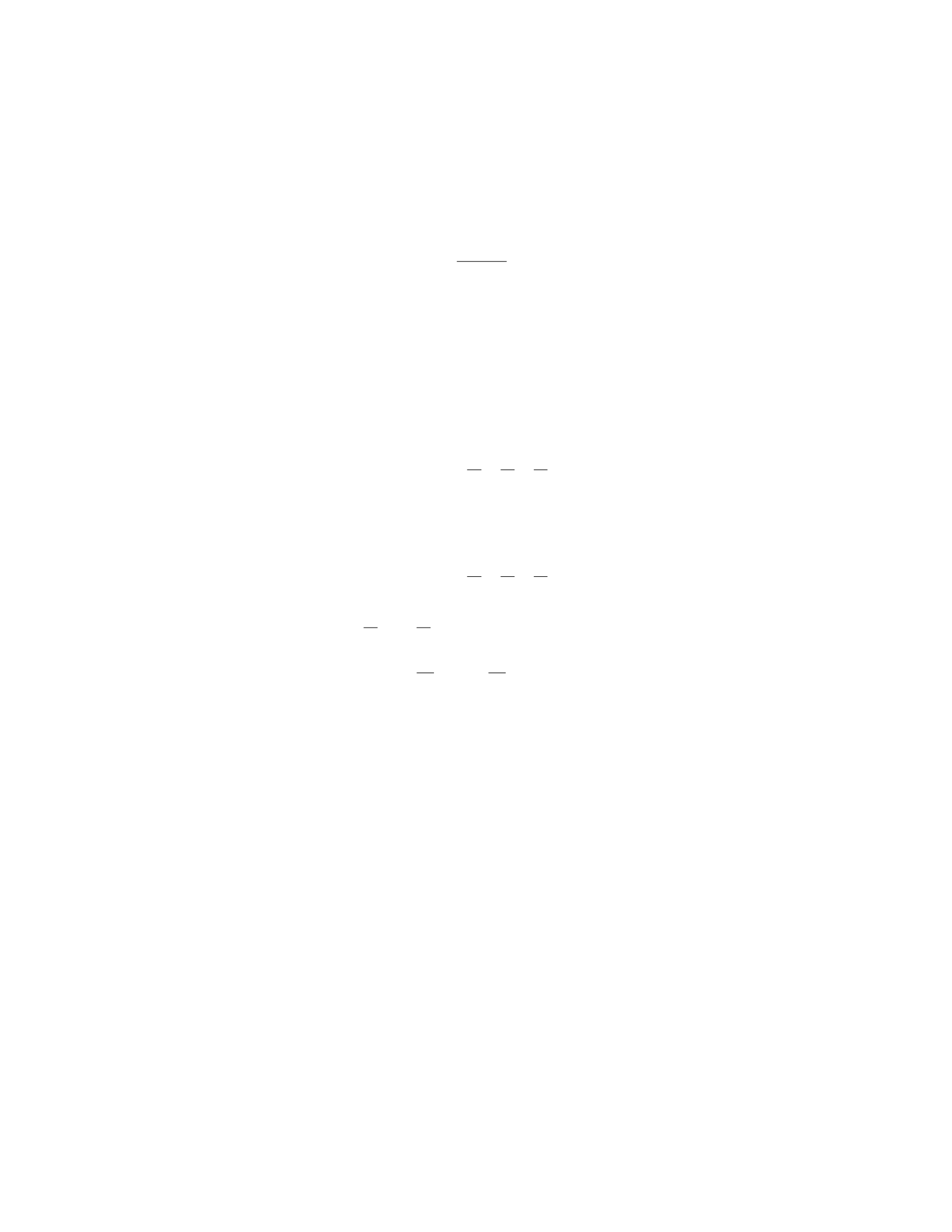
Question 4
Question
Let Sbe the part of the cone z=px2+y2that lies between the planes z= 0
and z= 1, oriented with outward normal. Use Stokes’ Theorem to evaluate
RRSF·dS, where F(x, y, z) = xi+yj+zk.
Solution
To apply Stokes’ Theorem, we first need to find the curl of the vector field F:
∇×F. The curl of a vector field F=Pi+Qj+Rkis given by the determinant
of the following matrix:
∇ × F=
i j k
∂
∂x
∂
∂y
∂
∂z
P Q R
In this case, F(x, y, z) = xi+yj+zk, so P=x,Q=y, and R=z. Therefore,
the curl of Fis:
∇ × F=
i j k
∂
∂x
∂
∂y
∂
∂z
x y z
Step 1: Calculate ∂z
∂y and ∂y
∂z :
∂z
∂y = 0,∂y
∂z = 1
Step 2: Compute the curl:
∇ × F=
i j k
1 0 0
x y z
=i(0 −0) −j(0 −0) + k(y−x) = k(y−x)
Now, we can use Stokes’ Theorem which states that for a surface Swith
boundary curve C, oriented positively, we have:
ZZS∇ × F·dS=IC
F·dr
Step 3: The boundary curve Cof Sis the intersection of the cone and the
planes z= 0 and z= 1. This is a circle with radius 1 centered at the origin
in the xy-plane. We will parameterize this circle as r(t) = cos ti+ sin tjfor
0≤t≤2π.
Step 4: Calculate the line integral:
IC
F·dr=Z2π
0
F(r(t)) ·r′(t)dt
4

Step 5: Substitute r(t)and calculate the dot product:
IC
F·dr=Z2π
0
(cos ti+ sin tj)·(−sin ti+ cos tj)dt
Step 6: Evaluate the dot product and integrate over the interval
Question 6
Question
Let Sbe the part of the plane z= 4−x−ythat lies inside the cylinder x2+y2=
36. Use Stokes’ Theorem to evaluate the surface integral RRS(∇×F)·dS, where
F=−yi+xj+zk.
Solution
Step 1: Find the curl of F. The curl of F=−yi+xj+zkcan be found as
follows:
∇ × F=
i j k
∂
∂x
∂
∂y
∂
∂z
−y x z
=∂z
∂y −∂y
∂z i−∂z
∂x −∂x
∂z j+∂y
∂x −∂x
∂y k
=i+j+k
Step 2: Parameterize the surface S. We can parameterize the surface S
using x=rcos θ,y=rsin θ, and z= 4 −rcos θ−rsin θwhere 0≤r≤6
and 0≤θ≤2π. The outward normal vector to the surface Sis given by
n=∂z
∂r ,−∂z
∂θ ,−1.
Step 3: Calculate ∇ × F·dS. Since ∇ × F=i+j+k, we have
∇ × F·dS=i·dS+j·dS+k·dS
=dydz +dzdx +dxdy
Step 4: Compute the surface integral using the parameterization. Using the
parameterization, we can express dydz,dzdx, and dxdy in terms of rand θ:
dydz =
∂(y, z)
∂(r, θ)
drdθ =rdrdθ
dzdx =
∂(z, x)
∂(r, θ)
drdθ =rdrdθ
dxdy =
∂(x, y)
∂(r, θ)
drdθ =rdrdθ
5
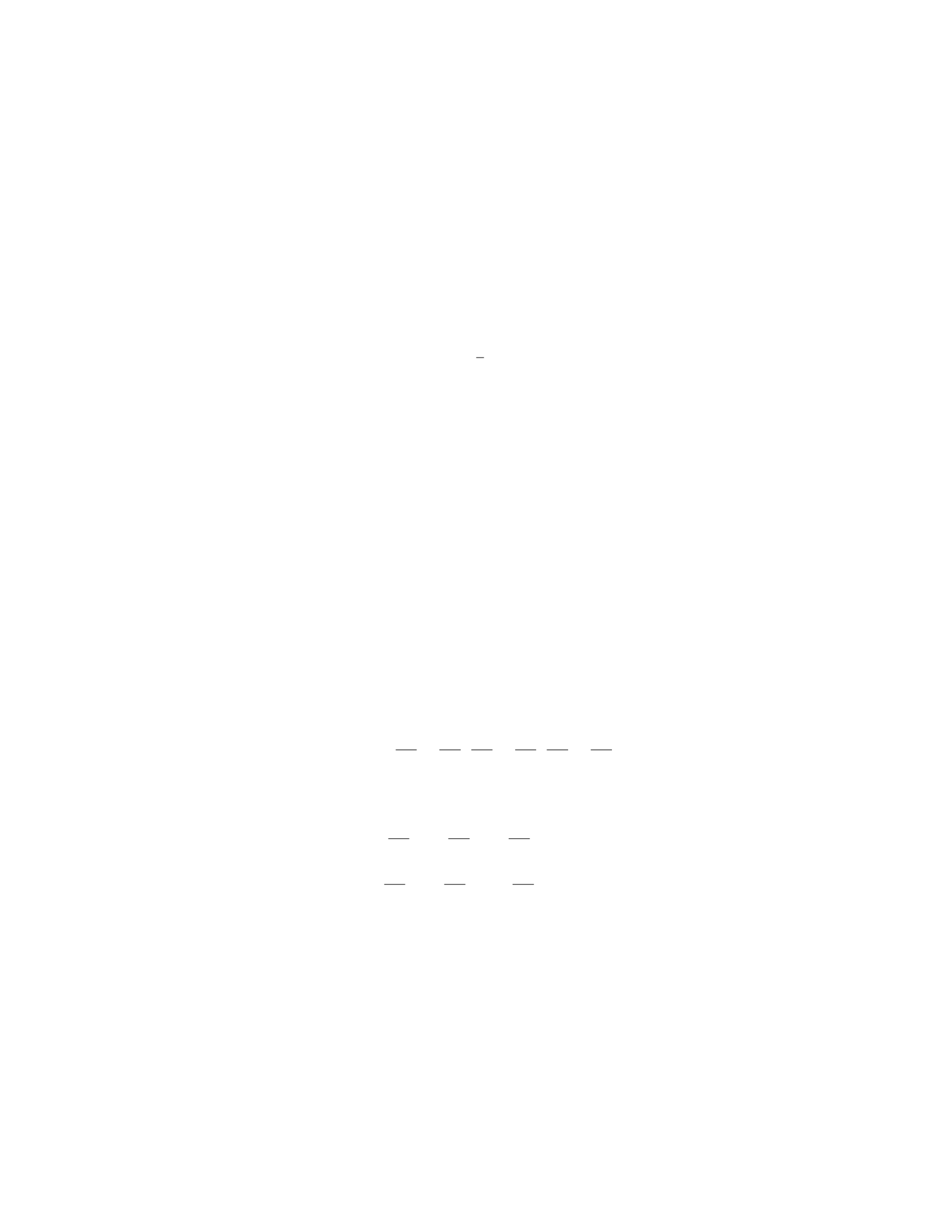
Therefore, the surface integral reduces to:
ZZS
(∇ × F)·dS=ZZS
dS=ZZS
rdrdθ
=Z2π
0Z6
0
rdrdθ
=Z2π
01
2r26
0
dθ
=Z2π
0
18dθ
= 36π
Question 7
Question
Let Sbe the surface of the part of the paraboloid z= 9−x2−y2that lies above
the xy-plane in the first octant. Let F= (y2, z, x)be a vector field. Calculate
the surface integral RRS(∇×F)·dSusing Stokes’ Theorem, where ∇×Fdenotes
the curl of F.
Solution
Step 1: First, we need to find the curl of F, denoted by ∇ × F. The curl of a
vector field F= (P, Q, R)is given by the following formula:
∇ × F=∂R
∂y −∂Q
∂z ,∂P
∂z −∂R
∂x ,∂Q
∂x −∂P
∂y .
For F= (y2, z, x), we have P=y2,Q=z, and R=x. Calculating the
partial derivatives:
∂R
∂y = 0,∂Q
∂z = 1,∂P
∂z = 0,
∂R
∂x = 1,∂P
∂y = 2y, ∂Q
∂x = 0.
Therefore, the curl of F, denoted by ∇×F, is given by (0 −1,0−0,0−2y) =
(−1,0,−2y).
Step 2: We will now find the surface integral by using Stokes’ Theorem,
which relates a surface integral to a line integral around its boundary curve.
Stokes’ Theorem states:
ZZS
(∇ × F)·dS=IC
F·dr,
6

where Cis the boundary curve of the surface S, oriented positively.
Step 3: The boundary curve Cof the surface Sin the first octant is the
intersection of the paraboloid with the xy-plane. This boundary curve is a
circle in the xy-plane defined by z= 0, which corresponds to 9 = x2+y2.
Step 4: Parameterize the boundary curve Cin the xy-plane using polar
coordinates: x=rcos(θ),y=rsin(θ), with 0≤r≤3and 0≤θ≤2π.
Step 5: Calculate the line integral HCF·drover the boundary curve Cusing
the parameterization and the given vector field F:
IC
F·dr=Z2π
0(rsin(θ))2,0, r cos(θ)·(−rsin(θ), r cos(θ)) dθ.
Step 6: Simplify and calculate the line integral to find the surface integral
value.
Question 8
Question
Let F= (z, x, y)be a vector field in R3. Consider the surface S, given by
z= 9 −x2−y2, oriented with outward-pointing unit normal. Calculate the flux
of Facross Susing Stokes’ Theorem.
Solution
Step 1: Determine the boundary curve Cof the surface S. The boundary curve
Cis the intersection of the surface S:z= 9 −x2−y2and the plane z= 0.
Substituting z= 0 into the equation of the surface, we get:
0 = 9 −x2−y2
x2+y2= 9
This represents a circle of radius 3 centered at the origin in the xy-plane.
Step 2: Parameterize the boundary curve C. The boundary curve Ccan be
parameterized by x(t) = 3 cos tand y(t) = 3 sin t, where 0≤t≤2π.
Step 3: Find the tangent vector to the boundary curve C. The tangent vector
to the boundary curve Cis given by r′(t) = ⟨x′(t), y′(t),0⟩=⟨−3 sin t, 3 cos t, 0⟩.
Step 4: Compute the curl of F. The curl of Fis given by:
∇ × F=
i j k
∂
∂x
∂
∂y
∂
∂z
z x y
=∂y
∂y −∂x
∂z i−∂y
∂z −∂z
∂x j+∂x
∂x −∂y
∂y k
=i−j−k
Step 5: Calculate the line integral of ∇ × Faround the boundary curve C.
We have:
ZC∇ × F·dr =Z2π
0
(∇ × F)·r′(t)dt
7
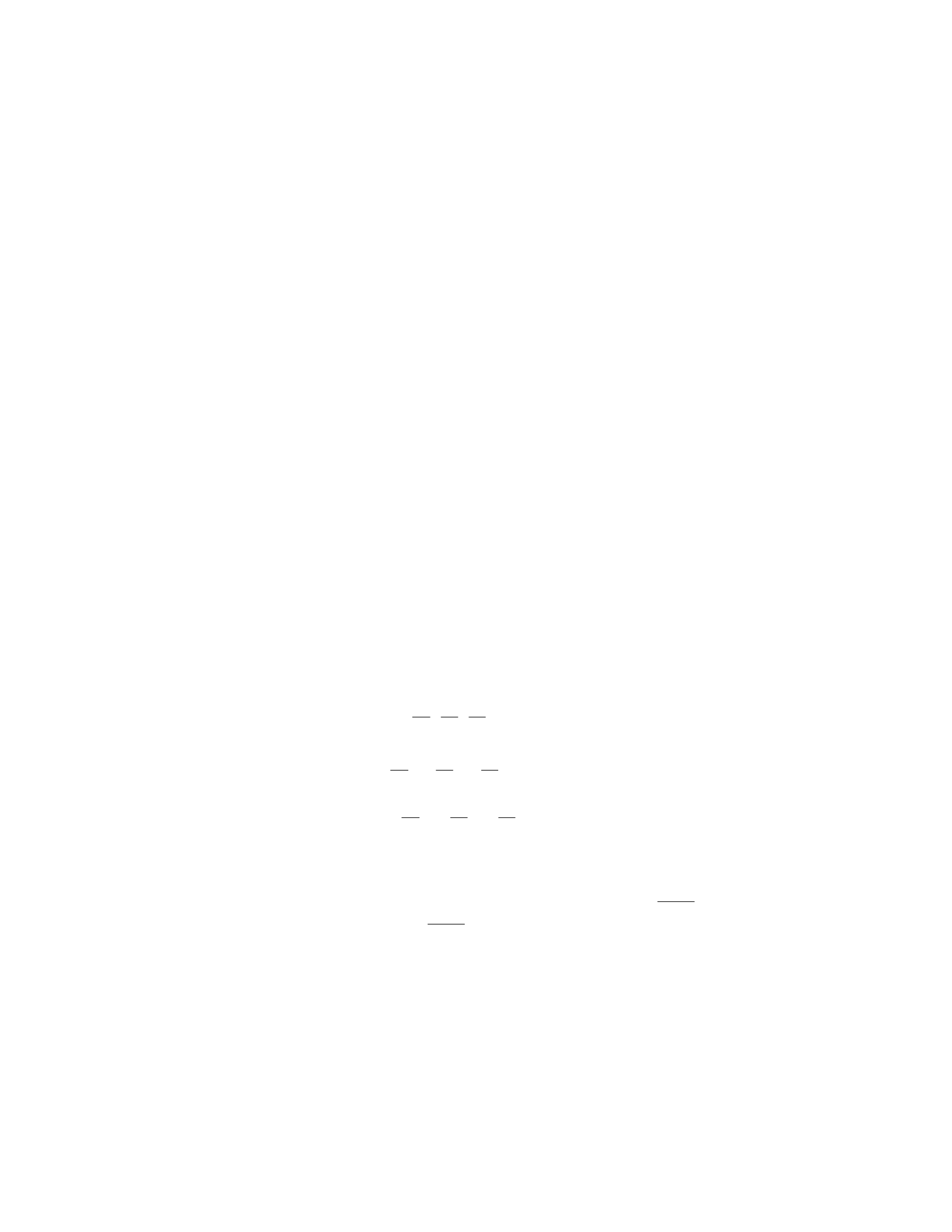
=Z2π
0
(−3 sin t+ 3 cos t−0)dt
=Z2π
0
3(cos t−sin t)dt
= 3 [sin t+ cos t]
2π
0
= 3(0) = 0
Step 6: Apply Stokes’ Theorem. Stokes’ Theorem states that the flux of F
across Sis equal to the line integral of ∇ × Faround the boundary curve C:
ZZS
(∇ × F)·dS=ZC∇ × F·dr = 0
Therefore, the flux of Facross the surface Sis 0.
Question 9
Question
Let Sbe the surface of the hemisphere x2+y2+z2= 4,z≥0. Use Stokes’
Theorem to evaluate the surface integral RRSF·dS, where F= (−y2, x +z, y),
and Sis oriented with the outward-pointing normal.
Solution
Step 1: Find the curl of F. The curl of Fis given by:
curl F=∂
∂x ,∂
∂y ,∂
∂z ×(−y2, x +z, y)
curl F=∂
∂x i+∂
∂y j+∂
∂z k×(−y2, x +z, y)
curl F=∂
∂x (y),∂
∂y (y),∂
∂z (−y2, x +z, y)
curl F= (0,1,−2y)
Step 2: Find the normal vector to S. The surface Sis the hemisphere
x2+y2+z2= 4,z≥0. The outward-pointing normal to Sis n=(x,y,z)
2. Since
z≥0, the normal vector is n=(x,y,z)
2.
Step 3: Apply Stokes’ Theorem. Stokes’ Theorem states that for a vector
field Fand a surface Swith outward-pointing normal n,
ZZS
F·dS=ZZD
(curl F)·ndA
where Dis the region in the xy-plane enclosed by the boundary curve of S.
8
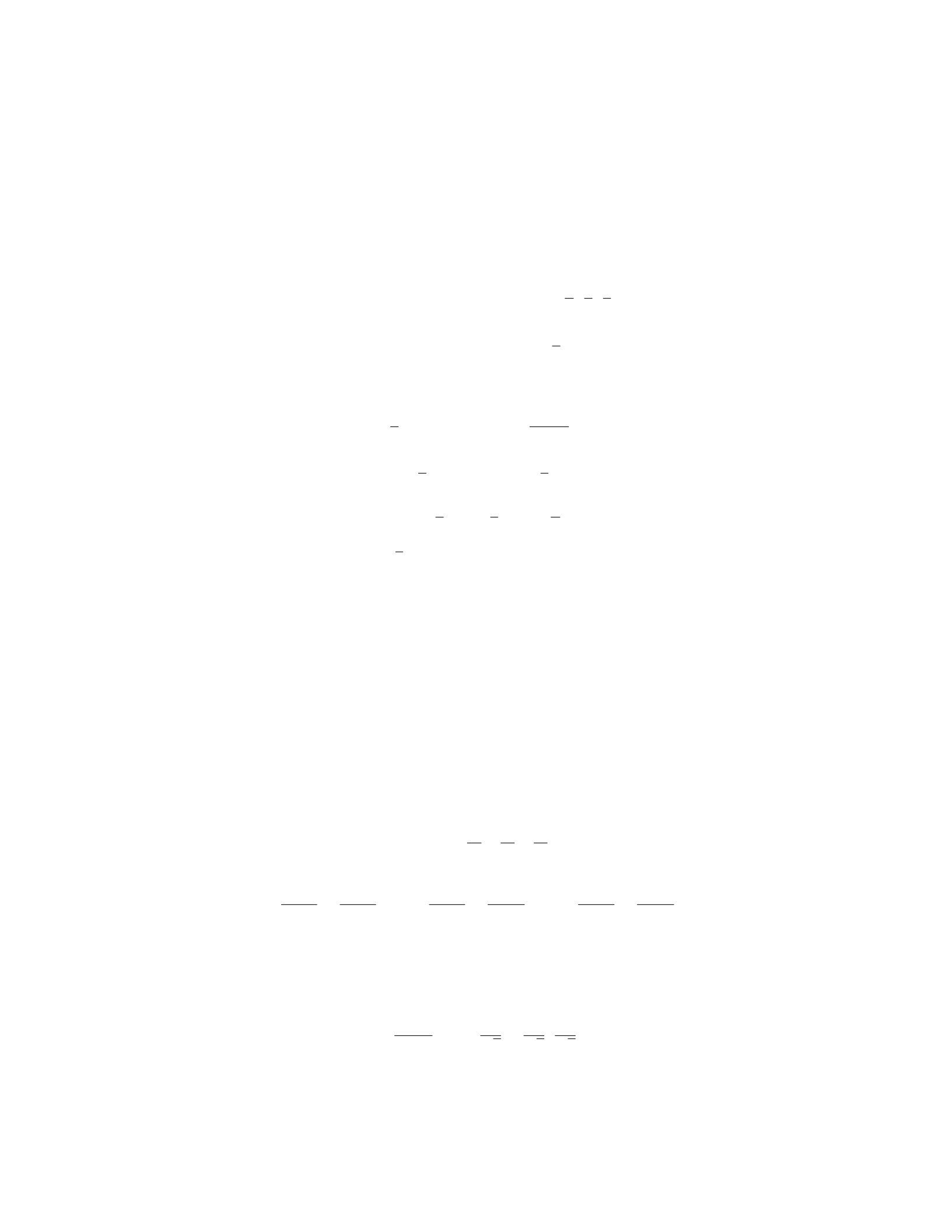
Step 4: Find the region D. The boundary of the hemisphere can be param-
eterized by r(t) = (2 cos t, 2 sin t, 0), where 0≤t≤2π. Therefore, Dis the unit
disc in the xy-plane.
Step 5: Evaluate the surface integral.
ZZD
curl F·ndA =ZZD
(0,1,−2y)·x
2,y
2,z
2dA
ZZD
curl F·ndA =ZZD−y
2dA
Since Dis the unit disc, we can use polar coordinates to evaluate the double
integral:
ZZD−y
2dA =−Z2π
0Z1
0−rsin θ
2dr dθ
ZZD−y
2dA =−Z2π
0−1
4dθ
ZZD−y
2dA =1
4·2π=π
2
Therefore, RRSF·dS=π
2.
Question 10
Question
Let Sbe the part of the plane z= 4 −x−2ythat lies above the triangle with
vertices at (0,0,0),(0,2,0), and (2,0,0). Let F= (x2, y2, z2)be a vector field.
Use Stokes’ Thejsonreorem to evaluate RRS(∇×F)·ndS, where nis the outward
unit normal vector to S.
Solution
Step 1: Find the curl of F. The curl of Fis given by:
∇ × F=
i j k
∂
∂x
∂
∂y
∂
∂z
x2y2z2
=∂(z2)
∂y −∂(y2)
∂z i−∂(z2)
∂x −∂(x2)
∂z j+∂(y2)
∂x −∂(x2)
∂y k
= 0i−0j+ 0k=0
Step 2: Find the outward unit normal vector to S. Given that z= 4−x−2y,
the gradient of zis ∇z= (−1,−2,1). Normalizing ∇zgives the outward unit
normal vector to Sas:
n=∇z
||∇z|| =−1
√6,−2
√6,1
√6
9

Step 3: Evaluate the surface integral using Stokes’ Theorem. Stokes’ The-
orem states that RRS(∇ × F)·ndS =HcF·dr, where cis the boundary of the
surface S. Since the given vector field Fis zero on S(as shown in Step 1), the
surface integral is also zero:
ZZS
(∇ × F)·ndS = 0
Question 11
Question
Let Sbe the part of the plane z= 7 −x−2ythat lies above the rectangle in the
xy-plane with vertices at (0,0),(2,0),(2,1), and (0,1). Use Stokes’ theorem
to evaluate the surface integral RSF·dSwhere F= (x2, y2, z)and dSis the
outwardly oriented unit normal to S.
Solution
Step 1: First, we need to parameterize the boundary curve Cof the surface S.
The boundary curve Cconsists of four line segments connecting the vertices of
the rectangle in the xy-plane. We can parameterize the boundary curve Cas
follows:
For the line segment from (0,0) to (2,0), we have r1(t) = (t, 0,7−t)for
0≤t≤2.
For the line segment from (2,0) to (2,1), we have r2(t) = (2, t, 7−2−t)for
0≤t≤1.
For the line segment from (2,1) to (0,1), we have r3(t) = (2 −t, 1,7−2 + t)
for 0≤t≤2.
For the line segment from (0,1) to (0,0), we have r4(t) = (0,1−t, 7−t)for
0≤t≤1.
Step 2: Next, we compute the curl of F= (x2, y2, z)which is given by:
∇ × F=
i j k
∂
∂x
∂
∂y
∂
∂z
x2y2z
= (0,0,2−x−2y)
Step 3: Now, we can apply Stokes’ theorem which states that:
ZS∇ × F·dS=IC
F·dr
Since ∇ × F= (0,0,2−x−2y), the surface integral simplifies to:
ZS
(0,0,2−x−2y)·dS=IC
F·dr
10

Step 4: Lastly, we evaluate the line integral HCF·drby summing the line
integrals over each segment of the boundary curve C:
IC
F·dr=Z2
0
F(r1(t))·r′
1(t)dt+Z1
0
F(r2(t))·r′
2(t)dt+Z2
0
F(r3(t))·r′
3(t)dt+Z1
0
F(r4(t))·r′
4(t)dt
This completes the solution.
Question 12
Question
Let Sbe the surface given by z=x2+y2for 0≤z≤9. Use Stokes’ Theorem
to evaluate the surface integral
ZZ
S
(∇ × F)·dS,
where F=⟨x2, y2, z2⟩.
Solution
Step 1: Calculate the curl of F.
∇ × F=
i j k
∂
∂x
∂
∂y
∂
∂z
x2y2z2
=∂z2
∂y −∂y2
∂z i−∂z2
∂x −∂x2
∂z j+∂y2
∂x −∂x2
∂y k
= 2zi−2zj−2yk
Step 2: Determine the unit normal vector to the surface. Since Sis the part
of the paraboloid z=x2+y2above the xy-plane, the unit normal vector to the
surface is N=−∂z
∂x ,−∂z
∂y ,1=⟨−2x, −2y, 1⟩.
Step 3: Calculate the dot product of (∇ × F)with N.
(∇ × F)·N= (−2z)(−2x)+(−2z)(−2y)−2y
= 4zx + 4zy −2y
Step 4: Calculate the magnitude of the cross product of the partial deriva-
tives of (x2, y2, x2+y2).
dS=
∂(x, y, x2+y2)
∂(x, y)
dA
11

=
1 0
0 1
2x2y
dA =p1+0+4x2+ 4y2dA =p4(x2+y2)dA = 2r dr dθ
Step 5: Compute the surface integral using Stokes’ theorem.
ZZ
S
∇ × F·dS=ZZ
D
(∇ × F)·NdA
=ZZ
D
(4zx + 4zy −2y)·2r dr dθ
=Z2π
0Z3
0
(8r2cos θ+ 8r2sin θ−2rsin θ)·2r dr dθ
=Z2π
0Z3
0
(16r3cos θ+ 16r3sin θ−4rsin θ)dr dθ
=Z2π
04r4cos θ+ 4r4sin θ−2r2sin
Question 13
Question
Let F(x, y, z) = (2y+z, x +z, 3x+ 2y)be a vector field, and let Sbe the part of
the cone z=px2+y2that lies below the plane z= 1. Use Stokes’ Theorem to
calculate the flux of Facross the boundary curve of Soriented counterclockwise.
Solution
Step 1: We begin by parameterizing the boundary curve Cof Swhere z=
px2+y2and z= 1.
Let C1be the curve where z=px2+y2and C2be the curve where z= 1.
We can parameterize C1as r1(t)=(tcos t, t sin t, t)for 0≤t≤1and C2as
r2(t) = (cos t, sin t, 1) for 0≤t≤2π.
Step 2: Next, we calculate the curl of F, given by ∇×F=
i j k
∂
∂x
∂
∂y
∂
∂z
2y+z x +z3x+ 2y
.
Expanding this determinant, we get ∇ × F= (1,−1,−1).
Step 3: Using Stokes’ Theorem, the flux of Facross Cis equal to the circu-
lation of ∇ × Faround C. Thus, we have
12

Flux =ZC
F·dr
=ZC1
F·dr+ZC2
F·dr
=Z1
0
F(r1(t)) ·r′
1(t)dt +Z2π
0
F(r2(t)) ·r′
2(t)dt.
Step 4: The first integral can be calculated as follows:
Z1
0
F(r1(t)) ·r′
1(t)dt =Z1
0
(2tsin t+t, t cos t+t, 3tcos t+ 2tsin t)·(−tsin t, t cos t, 1) dt
=Z1
0−2t2sin2t−t2cos t+ 3tcos t+ 2t2sin t dt
=2
3.
Step 5: The second integral can be calculated similarly:
Z2π
0
F(r2(t)) ·r′
2(t)dt =Z2π
0
(2 sin t+ 1,cos t+ 1,3 cos t+ 2 sin t)·(−sin t, cos t, 0) dt
=Z2π
0−2 sin tcos t−cos t+ 3 cos t dt
=π.
Step 6: Therefore, the total flux of
Question 15
Question
Let Sbe the surface defined by the part of the paraboloid z= 4 −x2−y2
that lies above the xy-plane in the first octant. Calculate the surface integral
RRSF·dS, where F=xi+yj+zk, using Stokes’ Theorem.
Solution
Step 1: First, we need to find the normal vector Nto the surface S. The normal
vector is given by the gradient of the scalar function that defines the surface,
which is ∇f= (−2x, −2y, 1).
Step 2: Calculate the curl of the vector field F:
∇ × F=
i j k
∂
∂x
∂
∂y
∂
∂z
x y z
= ( ∂z
∂y −∂y
∂z )i−(∂z
∂x −∂x
∂z )j+ ( ∂y
∂x −∂x
∂y )k=i−j+k
13

Step 3: Now, apply Stokes’ Theorem which states that the surface integral
of the normal component of ∇×Fover a surface Sis equal to the line integral
of Faround the boundary of S. Since the boundary of Slies in the xy-plane in
the first octant, it consists of the curve where z= 0 and x2+y2= 4.
Step 4: Parameterize the boundary curve Cas r(t) = (2 cos t, 2 sin t, 0) where
0≤t≤2π. Then, calculate the line integral RCF·dr:
ZC
F·dr=Z2π
0
(2 cos t, 2 sin t, 0) ·(−2 sin t, 2 cos t, 0)dt =Z2π
0
0dt = 0
Step 5: Since the line integral is 0, the surface integral RRSF·dSis also 0
by Stokes’ Theorem.
Question 16
Question
Let Sbe the part of the plane z= 4 −x−ythat lies inside the cylinder
x2+y2= 4. Given the vector field F(x, y, z) = (2y+z, x +z, x +y), compute
the flux of Facross the surface Sin the direction of the outward unit normal.
Solution
Step 1: Find the normal vector to the surface S. The normal vector to the
surface Sis given by n=∇g, where g(x, y, z) = 4−x−y. Thus, n= (−1,−1,1).
Step 2: Parametrize the surface S. Since Sis the part of the plane z=
4−x−ythat lies inside the cylinder x2+y2= 4, we can parameterize S
as r(u, v) = (2 cos(u) cos(v),2 sin(u) cos(v),4−2 cos(u) cos(v)−2 sin(u) cos(v))
where 0≤u≤2πand 0≤v≤π
2.
Step 3: Calculate the cross product of the partial derivatives. Calculate ∂r
∂u =
(−2 sin(u) cos(v),2 cos(u) cos(v),2 sin(u) cos(v)) and ∂r
∂v = (−2 cos(u) sin(v),−2 sin(u) sin(v),2 sin(u) sin(v)).
Then, calculate the cross product ∂r
∂u ×∂r
∂v = (−4 cos(u),4 sin(u),4).
Step 4: Evaluate the surface integral. The flux of Facross Sis given by
RRSF·ndS. Since F(x, y, z) = (2y+z, x +z, x +y)and n= (−1,−1,1), we
have F·n=−2y−z+x+z+x+y= 2x+y−2y= 2x−y.
Hence, the flux of Facross Sis RRS(2x−y)dS =R2π
0Rπ
2
0(8 cos(u)−2 sin(u))·
4dv du.
Question 17
Question
Let Sbe the surface of the cone z=px2+y2bounded by the plane z= 3.
Let Fbe the vector field defined by F(x, y, z) = (y2, x2, z). Calculate the flux
of Fthrough Susing Stokes’ Theorem.
14
Solution
Step 1: Firstly, we need to determine the boundary curve Cof the surface S.
The boundary curve is the intersection of the cone z=px2+y2and the plane
z= 3. We set z=px2+y2= 3 and solve for xand yto find C.
px2+y2= 3
x2+y2= 9
This represents a circle with radius 3 centered at the origin in the xy-plane.
Step 2: Next, we parameterize the boundary curve C. We can use polar
coordinates (x, y) = (3 cos t, 3 sin t)to parameterize the circle.
Step 3: Now, we calculate the curl of F.
∇ × F=
i j k
∂
∂x
∂
∂y
∂
∂z
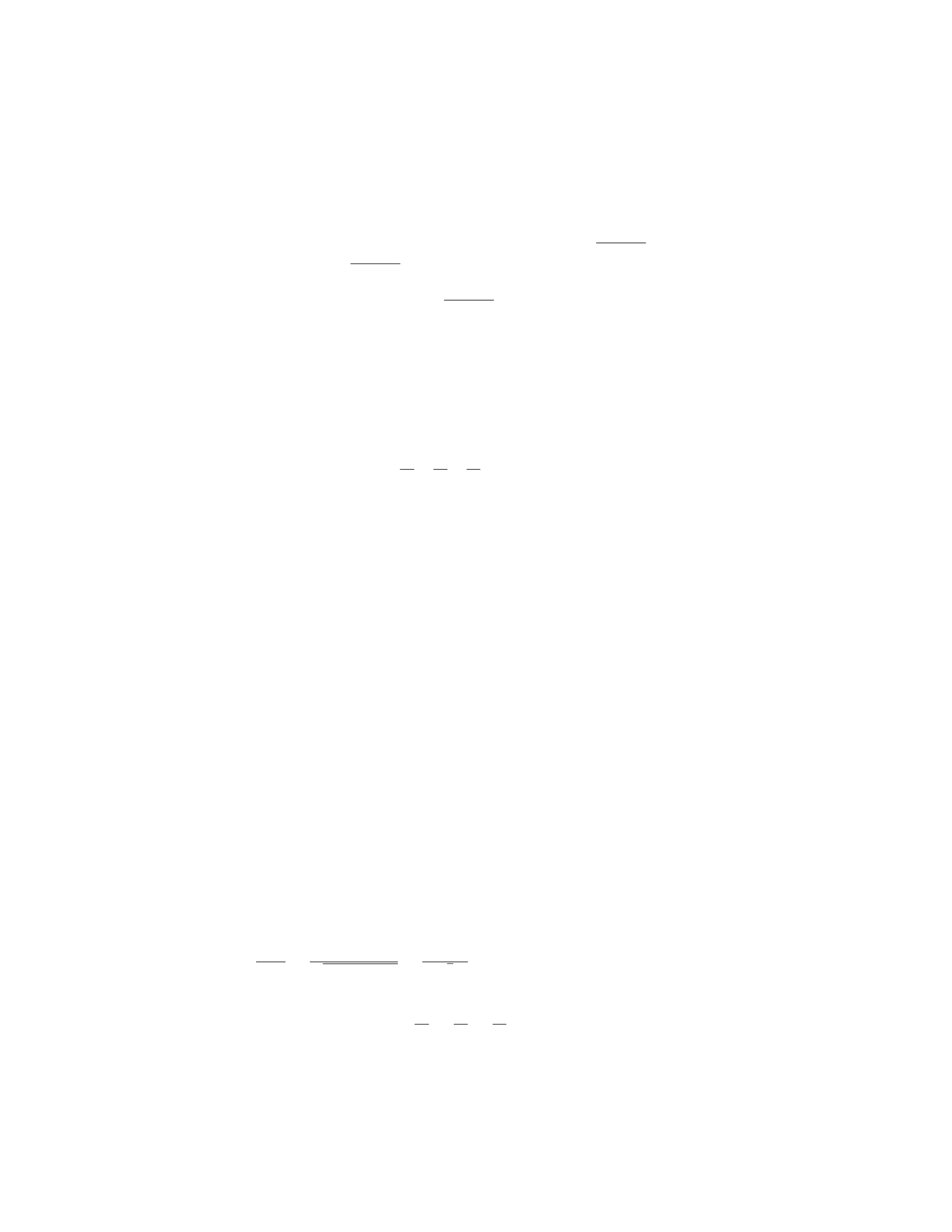
y2x2z
= (2x−2y, −2x, 0)
Step 4: Compute the line integral of ∇ × Fover the boundary curve C:
IC∇ × F·dr=Z2π
0
(2(3 cos t)−2(3 sin t))(−3 sin t)+(−2(3 cos t))(3 cos t)dt
Step 5: Simplify the line integral and calculate the flux through Susing
Stokes’ Theorem:
Flux =ZZS
(∇ × F)·dS=IC
F·dr
Question 18
Question
Let Sbe the part of the plane z=x+ythat lies above the region in the
xy-plane bounded by the parabola y=x2and the y-axis. Calculate the flux of
the curl of F= (xz, −xy, z2)across Sin the direction pointing outward from
the z-axis.
Solution
Step 1: Find the normal vector to the surface Susing the gradient of z.
The surface is given by z=x+y, so the gradient of zis ∇z=⟨1,1,−1⟩.
Since the normal vector points outward from the z-axis, the normal vector
is n=∇z
∥∇z∥=⟨1,1,−1⟩
√12+12+(−1)2=⟨1,1,−1⟩
√3.
Step 2: Calculate the curl of F.
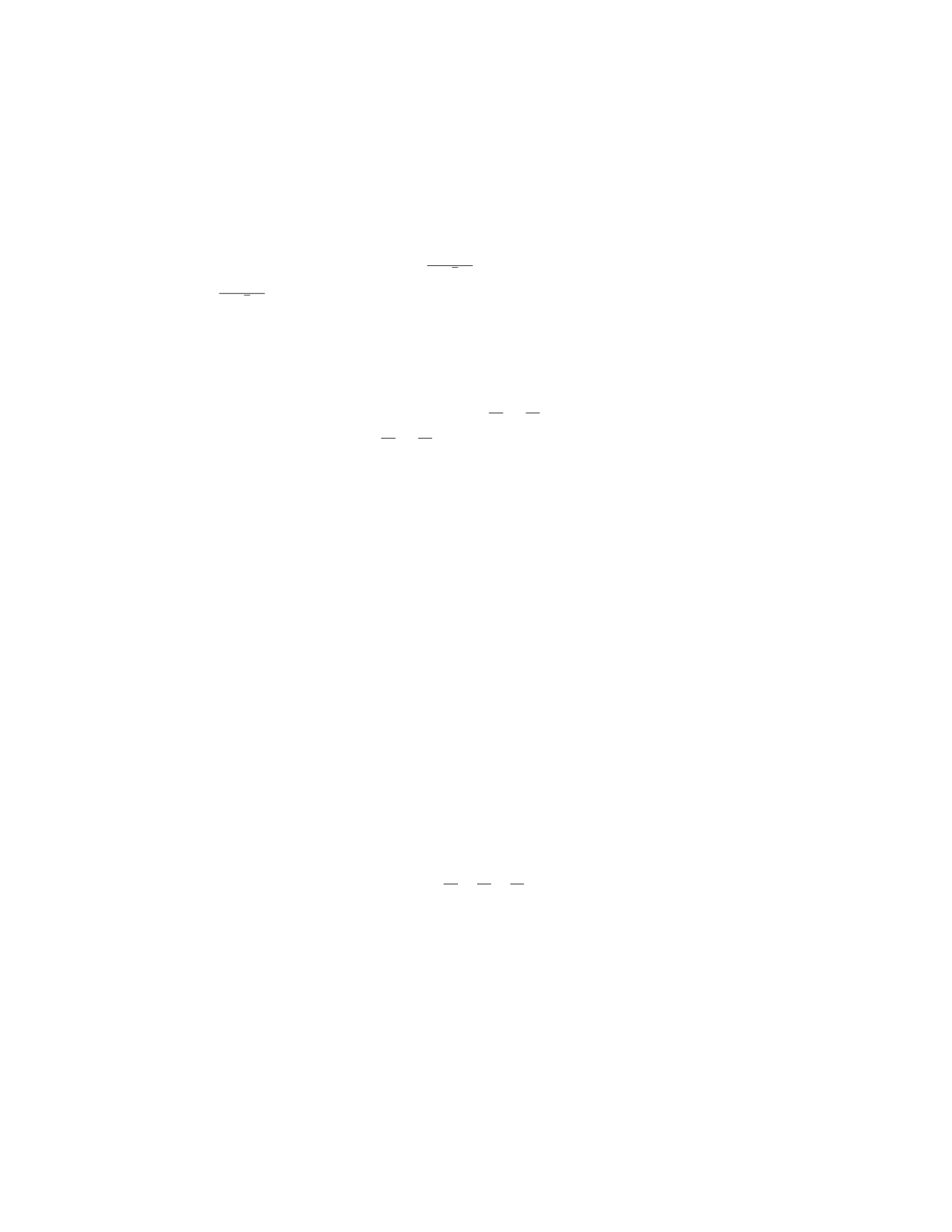
The curl of Fis ∇ × F=
i j k
∂
∂x
∂
∂y
∂
∂z
xz −xy z2
=⟨z−0, z −0, x −x⟩=⟨z, z, 0⟩.
15
Step 3: Calculate the flux of the curl of Facross S.
The flux of the vector field G=∇×Fover Sis given by the surface integral
RRSG·dS.
Since G=⟨z, z, 0⟩and n=⟨1,1,−1⟩
√3, the flux integral becomes RRS(z, z, 0) ·
⟨1,1,−1⟩
√3dS.
Step 4: Parameterize the surface S.
Let Dbe the region in the xy-plane bounded by the parabola y=x2and
the y-axis. We can parameterize the surface Sas r(x, y) = ⟨x, y, x +y⟩where
(x, y)∈D.
Step 5: Evaluate the flux integral.
The flux integral becomes RRDG·n
∂r
∂x ×∂r
∂y
dA.
Substitute G,n, and ∂r
∂x ×∂r
∂y into the integral and evaluate.
This completes the calculation of the flux of the curl of Facross the surface
S.
Question 19
Question
Let Sbe the part of the plane 2x+y+ 3z= 6 that lies in the first octant. Let
Shave surface density δ(x, y, z) = x+y+z. Use Stokes’ Theorem to calculate
the flux of the curl of the vector field F(x, y, z) = ⟨x2, y2, z2⟩across S.
Solution
Step 1: Find the normal vector to the surface S. The equation of the plane is
2x+y+ 3z= 6. We can rewrite this as 2x+y+ 3z−6 = 0. The coefficients of
x,y, and zin this equation give the components of the normal vector. So, the
normal vector to the surface Sis n=⟨2,1,3⟩.
Step 2: Parameterize the curve that bounds the surface Sin the first octant.
Let Cbe the curve of intersection of the plane 2x+y+3z= 6 with the coordinate
planes. We can parameterize this curve as r(t) = ⟨t, 0,0⟩for 0≤t≤3.
Step 3: Calculate curl(F). The curl of F(x, y, z) = ⟨x2, y2, z2⟩is given by
curl(F) = ∇ × F=
i j k
∂
∂x
∂
∂y
∂
∂z
x2y2z2
=⟨0,0,2y−2z⟩.
Step 4: Calculate the line integral of curl(F)over C. Using Stokes’ Theorem,
the flux of curl(F)across Sis given by
ZZS
(∇ × F)·dS=IC
F·dr=Z3
0⟨0,0,2(0) −2(0)⟩·⟨1,0,0⟩dt =Z3
0
0dt = 0.
Therefore, the flux of the curl of Facross Sis 0.
16

Question 20
Question
Let Sbe the part of the plane z= 4 −x−2ythat lies above the square Rin the
xy-plane centered at the origin with sides of length 4. Orient Supward, and let
F(x, y, z) = (y2, z2, x2).
Calculate the flux of Facross the surface Susing Stokes’ Theorem.
Solution
Step 1: Find the normal vector to the surface S. The normal vector to the
surface Sabove the square Ris given by n=∇g(x, y, z), where g(x, y, z) =
z−(4 −x−2y). Thus, n=∇g(x, y, z) = ∂g
∂x ,∂g
∂y ,∂g
∂z = (1,2,−1).
Step 2: Find the curl of F. The curl of Fis given by ∇×F=∂
∂x ,∂
∂y ,∂
∂z ×
(y2, z2, x2) = ∂x2
∂y −∂z2
∂x ,∂y2
∂x −∂x2
∂z ,∂z2
∂z −∂y2
∂y = (−2x, 2z, 2y).
Step 3: Calculate the flux of Facross the surface using Stokes’ Theorem.
The flux of Facross Sis given by the surface integral RRS(∇×F)·dS. By Stokes’
Theorem, this is equivalent to the line integral of Faround the boundary of R
oriented counterclockwise.
Step 4: Calculate the line integral of Faround the boundary of R. The
boundary of the square Ris parameterized by r(t) = (2 cos t, 2 sin t, 0) for 0≤
t≤2π. Since F(x, y, z) = (y2, z2, x2), we have F(r(t)) = (4 sin2t, 0,4 cos2t).
Thus, the line integral becomes
Z2π
0
F(r(t)) ·r′(t)dt
=Z2π
0
(4 sin2t, 0,4 cos2t)·(−2 sin t, 2 cos t, 0) dt
=Z2π
0−8 sin3t+ 8 cos3t dt
= 16π
Therefore, the flux of Facross the surface Sis 16π.
Question 21
Question
Let Sbe the part of the plane z= 3 −x−ythat lies above the region in the
xy-plane that is enclosed by the circle x2+y2= 1. Use Stokes’ Theorem to
evaluate the surface integral RRS(∇ × F)·dS, where F(x, y, z) = (y2, z, x).
17

Solution
Step 1: Find the curl of F. The curl of Fis given by:
∇ × F=
i j k
∂
∂x
∂
∂y
∂
∂z
y2z x
= (1,−2,1)
Step 2: Find the unit normal vector to the surface S. Since Sis the part of
the plane z= 3 −x−ythat lies above the unit circle in the xy-plane, the unit
normal vector to the surface Sis given by:
n=∂z
∂x ,∂z
∂y ,−1= (−1,−1,−1)
Step 3: Calculate the normal vector to the circle in the xy-plane. Since Sis
above the unit circle in the xy-plane, the normal vector to this circle is k.
Step 4: Find the unit normal vector to the curve in three dimensions. Since
the unit circle in the xy-plane projects to the unit circle in the xz-plane, the
unit normal vector to the curve is given by:
N=−x
√1 + x2,0,−z
√1 + x2
Step 5: Compute the flux integral. Now, we can use Stokes’ Theorem to
evaluate the surface integral:
ZZS
(∇ × F)·dS=IC
F·dr,
where Cis the boundary of S.
Step 6: Calculate the line integral. The boundary Cof Sis the unit circle
in the xy-plane. The line integral is given by:
IC
F·dr=Z2π
0
F(cos t, sin t, 3−cos t−sin t)·(−sin t, cos t, 0)dt
Step 7: Simplify the line integral and compute it numerically to find the
final answer.
Question 22
Question
Let F(x, y, z) = (x2, y2, z2)be a vector field defined in R3. The surface Sis the
part of the cone z=px2+y2that lies between the planes z= 1 and z= 3.
Use Stokes’ Theorem to evaluate the surface integral R RS(∇ × F)·dS.
18

Solution
Step 1: We start by calculating the curl of F(x, y, z):
∇ × F=
i j k
∂
∂x
∂
∂y
∂
∂z
x2y2z2
=∂(z2)
∂y −∂(y2)
∂z i−∂(z2)
∂x −∂(x2)
∂z j+∂(y2)
∂x −∂(x2)
∂y k
= 0 −0i−0j+ 0k=0
Step 2: Since the curl of Fis 0, the surface integral reduces to R RS0·dS= 0.
Therefore, the value of the surface integral R RS(∇ × F)·dSusing Stokes’
Theorem is 0.
Question 23
Question
Let Sbe the part of the plane x+ 2y+ 3z= 6 that lies inside the cylinder
x2+y2= 4, with outward orientation. Use Stokes’ Theorem to evaluate
IC
F·dr
where F=⟨z, x, y⟩and Cis the boundary curve of S, oriented counterclockwise
when viewed from above.
Solution
Step 1: Find the boundary curve Cof surface S.
The boundary curve Ccorresponds to the intersection of the plane and
the cylinder. Since x2+y2= 4, we can rewrite the equation of the plane as
x+ 2y+ 3z= 6 as x+ 2y+ 3(6 −x−2y) = 6, which simplifies to x+ 2y−3 = 0.
Thus, the boundary curve Cis the circle given by x2+y2= 4 and x+2y−3 =
0.
Step 2: Parametrize the boundary curve C.
We can parametrize the circle x2+y2= 4 as x= 2 cos(t)and y= 2 sin(t)
for 0≤t≤2π.
Substitute these into the equation x+ 2y−3 = 0 to find the parametric
equations for the boundary curve C:
2 cos(t)+4 sin(t)−3 = 0 =⇒x= 2 cos(t), y = 2 sin(t), z =3−2 cos(t)−4 sin(t)
3
Step 3: Compute curl(F).
19

The curl of F=⟨z, x, y⟩is given by
curl(F) = ∂y
∂z −∂z
∂y ,∂z
∂x −∂x
∂z ,∂x
∂y −∂y
∂x =⟨1,1,1⟩
Step 4: Apply Stokes’ Theorem.
Stokes’ Theorem states that
IC
F·dr =ZZS
curl(F)·dS
Since the unit normal vector to the plane x+ 2y+ 3z= 6 is ⟨1,2,3⟩, we have
dS =⟨1,2,3⟩ · dA = 3dA.
Therefore, the line integral becomes the surface integral:
IC
F·dr =ZZS
curl(F)·dS =ZZS⟨1,1,1⟩ · 3dA = 3 ZZS
dA
Step 5: Calculate the surface area of S.
The surface Srepresents a portion of the plane enclosed by the cylinder,
which lies in the xy-plane. The projection of this region onto the xy-plane is a
circle of radius 2. Hence, the surface area of Sis π(22) = 4π.
Step 6: Final computation.
Substitute the surface area of Sinto the surface integral:
3ZZS
dA = 3(4π) = 12π
Therefore, the value of the line integral over the boundary curve Cusing
Stokes’ Theorem is 12π.
Question 24
Question
Let Sbe the part of the plane z=x+ 2ythat lies above the triangle with
vertices at (0,0,0),(1,0,0), and (0,1,0). Let F(x, y, z) = (y2, z2, x2). Compute
the surface integral RRScurl F·dSusing Stokes’ Theorem.
Solution
Step 1: Determine the boundary of S, denoted by C. Since Slies on the plane
z=x+2y, the boundary Cwill be the triangular curve that lies in the xy-plane
with vertices at (0,0),(1,0), and (0,1).
Step 2: Calculate the curl of F= (y2, z2, x2). The curl of Fis given by
curl F=∂f3
∂y −∂f2
∂z ,∂f1
∂z −∂f3
∂x ,∂f2
∂x −∂f1
∂y .
20
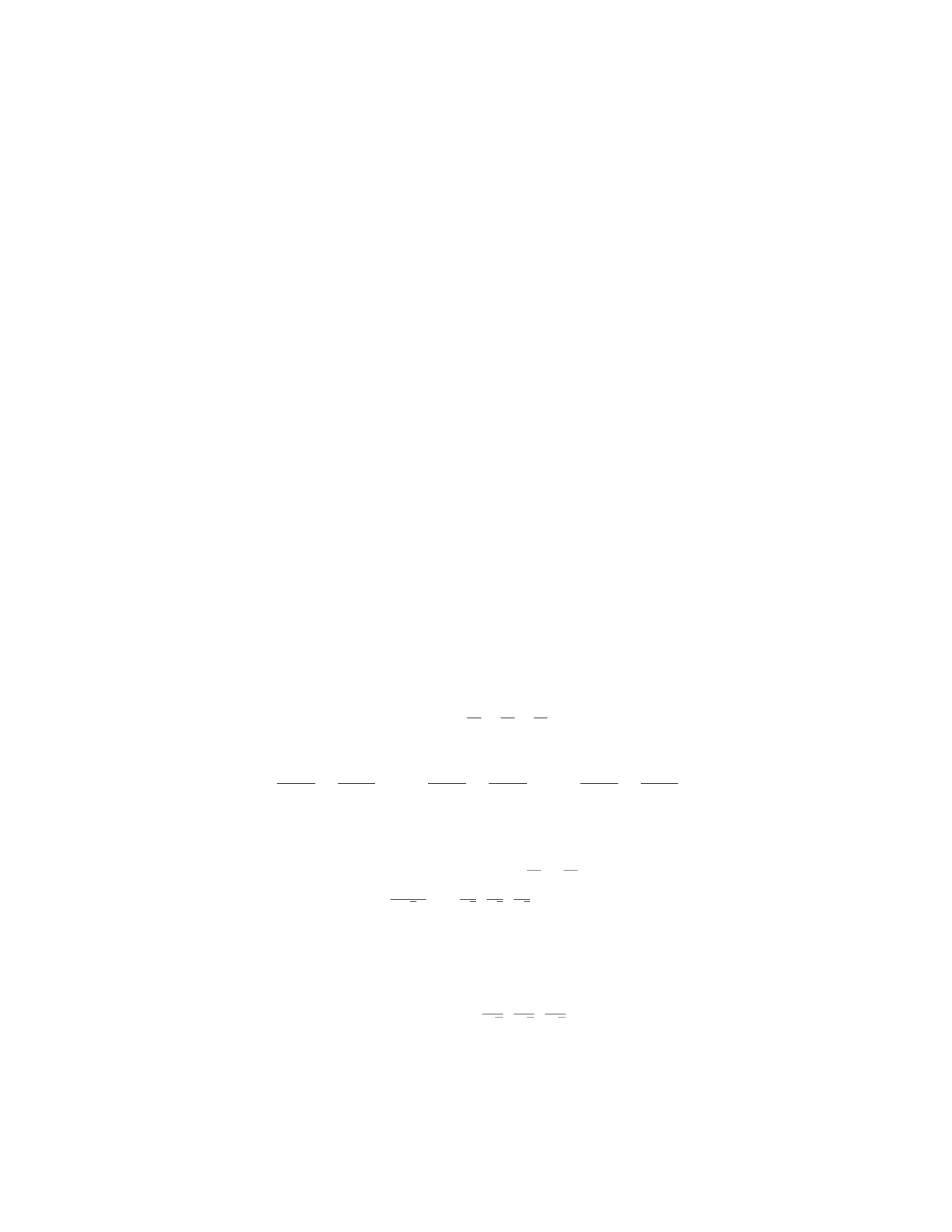
Substitute f1=y2,f2=z2, and f3=x2into the formula above and simplify.
Step 3: Using Stokes’ Theorem, we have
ZZS
curl F·dS=IC
F·dr,
where HCdenotes the line integral over the curve Cin the xy-plane.
Step 4: Parameterize the triangular curve Cin the xy-plane. Let C1be the
line segment from (0,0) to (1,0),C2be the line segment from (1,0) to (0,1),
and C3be the line segment from (0,1) to (0,0).
Step 5: Calculate Falong each segment Ci. Compute F·drfor each segment.
Step 6: Compute the total line integral HCF·drby summing the line integrals
over each segment Ci. This will give the value of the surface integral RRScurl F·
dS.
Question 25
Question
Let Sbe the part of the plane z= 4 −x−yin the first octant with outward
unit normal, and let F(x, y, z)=(xz, yz, xy). Calculate the flux of Facross S
using Stokes’ Theorem.
Solution
Step 1: First, we calculate the curl of F:
∇ × F=
i j k
∂
∂x
∂
∂y
∂
∂z
xz yz xy
=∂(xy)
∂y −∂(yz)
∂z i−∂(xz)
∂x −∂(xy)
∂z j+∂(xz)
∂x −∂(yz)
∂y k
=yi−xj+zk
Step 2: Next, we calculate the outward unit normal to S: Since z= 4−x−y
in the first octant, the normal vector is ˆ
n=−∂z
∂x ,−∂z
∂y ,1= (1,1,1). The unit
normal vector is then ˆ
n=(1,1,1)
√3=1
√3,1
√3,1
√3.
Step 3: Now, we can apply Stokes’ Theorem: The flux of Facross Sis given
by:
ZZS
(∇ × F)·ˆ
ndS
=ZZS
(y, −x, z)·1
√3,1
√3,1
√3dS
21

=ZZS
y−x+z
√3dS
Step 4: Since the surface is given by z= 4 −x−y, the flux integral becomes:
ZZS
4
√3dA
=4
√3ZZS
dA
=4
√3·Area(S)
Step 5: To find the area of the surface S, we integrate over the projection
onto the xy-plane:
Area(S) = ZZD
∂(x, y)
∂(u, v)
dudv
Where Dis the projection of Sonto the xy-plane defined by z= 0.
Step 6: The projection can be found by setting z= 0 in the equation of the
surface z= 4 −x−y, giving 4−x−y= 0, which is the line y= 4 −x. Thus,
the limits of integration for xare 0≤x≤4and 0≤y≤4−x.
Step 7: The Jacobian determinant for the transformation from xy to uv is
1, so
Area(S) = Z4
0Z4−x
0
1dy dx =Z4
0
(4 −x)dx
Step 8: Solving the integral gives:
Area(S) = Z4
0
4−x dx =4x−x2
24
0
= 8
Step 9: Substituting the area
22

Step 4: Stokes’ Theorem states that
ZZS
(∇ × F)·dS=IC
F·dr
We can evaluate the right hand side by parametrizing the curve Cas r(t) =
(−cos t, −sin t, 0) with 0≤t≤2π.
Step 5: Calculate F(r(t)) and dr
dt then compute the line integral HCF·dr.
Step 6: Evaluate the line integral to find the final answer.
Question 2
Question
Let Sbe the part of the plane z= 4 −x−ythat lies above the region in the
xy-plane bounded by the circle x2+y2= 4. Use Stokes’ Theorem to calculate
the flux of the curl of the vector field F=⟨−y, x, z⟩across the surface S.
Solution
Step 1: Find the normal vector to the surface S. The normal vector to the
surface Sis given by n=curl(F), where
curl(F) = ∇ × F=
i j k
∂
∂x
∂
∂y
∂
∂z
−y x z
=⟨1,1,1⟩.
Therefore, the normal vector to the surface Sis n=⟨1,1,1⟩.
Step 2: Find the parametrization of the surface S. We can parametrize the
surface Susing S(x, y) = ⟨x, y, 4−x−y⟩, where (x, y)lies in the region bounded
by the circle x2+y2= 4. We can use polar coordinates, where x= 2 cos(θ)and
y= 2 sin(θ).
Thus, S(θ) = ⟨2 cos(θ),2 sin(θ),4−2 cos(θ)−2 sin(θ)⟩.
Step 3: Calculate the line integral over the boundary curve. The boundary
curve of the surface Sis the circle x2+y2= 4. We can parametrize this circle
as C(t) = ⟨2 cos(t),2 sin(t)⟩, where 0≤t≤2π.
Using Stokes’ Theorem, the line integral over the boundary curve is given as
ZC
F·dr=ZZS
(∇ × F)·dS.
Step 4: Calculate the flux across the surface S. Substitute n=⟨1,1,1⟩and
S(θ) = ⟨2 cos(θ),2 sin(θ),4−2 cos(θ)−2 sin(θ)⟩into the surface integral. After
simplification, you should get the final answer.
2

Question 3
Question
Let Cbe the curve defined by the intersection of the plane z= 5 and the
cylinder x2+y2= 4, oriented counterclockwise when viewed from the positive z-
axis. Given the vector field F(x, y, z) = (2x2y, −x2z, 3y2), calculate the surface
integral of curl(F)over the surface Sthat lies above the curve Cand below the
plane z= 6.
Solution
Step 1: First, we need to parameterize the curve C.
The curve Cis the intersection of z= 5 and the cylinder x2+y2= 4. We
can parametrize Cas r(t) = (2 cos t, 2 sin t, 5) for 0≤t < 2π.
Step 2: Next, we calculate the normal vector to the surface S.
The normal vector to the surface Sis given by N=∇g
∥∇g∥, where g(x, y, z) =
z−6. Therefore, ∇g= (0,0,1), and hence ∥∇g∥= 1.
Step 3: Calculate the curl of the vector field F.
The curl of Fis given by:
curl(F) =
i j k
∂
∂x
∂
∂y
∂
∂z
2x2y−x2z3y2
=3x2,0,−2x
Step 4: Calculate the surface integral.
Using Stokes’ Theorem, the surface integral of curl(F)over the surface Sis
equal to the line integral of Fover the curve C.
ZZS
curl(F)·dS=IC
F·dr
=IC
2x2y dx −x2z dy + 3y2dz
Step 5: Parametrize the curve Cand compute the line integral.
Since r(t) = (2 cos t, 2 sin t, 5), we have dx =−2 sin t dt,dy = 2 cos t dt, and
dz = 0.
Substitute these into the line integral and parameterize Cgives:
IC
2x2y dx −x2z dy + 3y2dz =Z2π
0
40 sin t−25 cos t dt =−50π
Therefore, the surface integral of curl(F)over the surface Sis −50π.
3
Question 4
Question
Let Sbe the part of the cone z=px2+y2that lies between the planes z= 0
and z= 1, oriented with outward normal. Use Stokes’ Theorem to evaluate
RRSF·dS, where F(x, y, z) = xi+yj+zk.
Solution
To apply Stokes’ Theorem, we first need to find the curl of the vector field F:
∇×F. The curl of a vector field F=Pi+Qj+Rkis given by the determinant
of the following matrix:
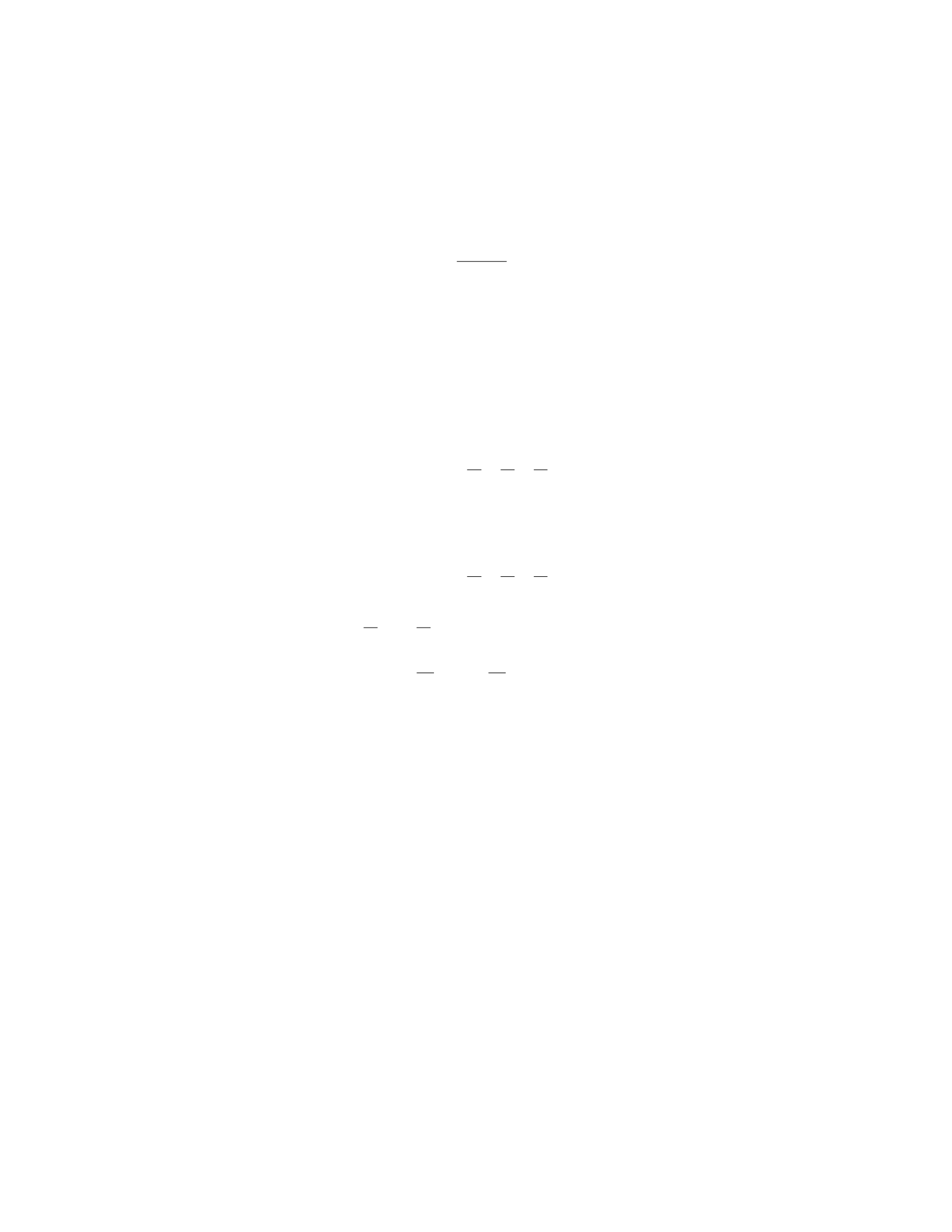
∇ × F=
i j k
∂
∂x
∂
∂y
∂
∂z
P Q R
In this case, F(x, y, z) = xi+yj+zk, so P=x,Q=y, and R=z. Therefore,
the curl of Fis:
∇ × F=
i j k
∂
∂x
∂
∂y
∂
∂z
x y z
Step 1: Calculate ∂z
∂y and ∂y
∂z :
∂z
∂y = 0,∂y
∂z = 1
Step 2: Compute the curl:
∇ × F=
i j k
1 0 0
x y z
=i(0 −0) −j(0 −0) + k(y−x) = k(y−x)
Now, we can use Stokes’ Theorem which states that for a surface Swith
boundary curve C, oriented positively, we have:
ZZS∇ × F·dS=IC
F·dr
Step 3: The boundary curve Cof Sis the intersection of the cone and the
planes z= 0 and z= 1. This is a circle with radius 1 centered at the origin
in the xy-plane. We will parameterize this circle as r(t) = cos ti+ sin tjfor
0≤t≤2π.
Step 4: Calculate the line integral:
IC
F·dr=Z2π
0
F(r(t)) ·r′(t)dt
4

Step 5: Substitute r(t)and calculate the dot product:
IC
F·dr=Z2π
0
(cos ti+ sin tj)·(−sin ti+ cos tj)dt
Step 6: Evaluate the dot product and integrate over the interval
Question 6
Question
Let Sbe the part of the plane z= 4−x−ythat lies inside the cylinder x2+y2=
36. Use Stokes’ Theorem to evaluate the surface integral RRS(∇×F)·dS, where
F=−yi+xj+zk.
Solution
Step 1: Find the curl of F. The curl of F=−yi+xj+zkcan be found as
follows:
∇ × F=
i j k
∂
∂x
∂
∂y
∂
∂z
−y x z
=∂z
∂y −∂y
∂z i−∂z
∂x −∂x
∂z j+∂y
∂x −∂x
∂y k
=i+j+k
Step 2: Parameterize the surface S. We can parameterize the surface S
using x=rcos θ,y=rsin θ, and z= 4 −rcos θ−rsin θwhere 0≤r≤6
and 0≤θ≤2π. The outward normal vector to the surface Sis given by
n=∂z
∂r ,−∂z
∂θ ,−1.
Step 3: Calculate ∇ × F·dS. Since ∇ × F=i+j+k, we have
∇ × F·dS=i·dS+j·dS+k·dS
=dydz +dzdx +dxdy
Step 4: Compute the surface integral using the parameterization. Using the
parameterization, we can express dydz,dzdx, and dxdy in terms of rand θ:
dydz =
∂(y, z)
∂(r, θ)
drdθ =rdrdθ
dzdx =
∂(z, x)
∂(r, θ)
drdθ =rdrdθ
dxdy =
∂(x, y)
∂(r, θ)
drdθ =rdrdθ
5
Therefore, the surface integral reduces to:
ZZS
(∇ × F)·dS=ZZS
dS=ZZS
rdrdθ
=Z2π
0Z6
0
rdrdθ
=Z2π
01
2r26
0
dθ
=Z2π
0
18dθ
= 36π
Question 7
Question
Let Sbe the surface of the part of the paraboloid z= 9−x2−y2that lies above
the xy-plane in the first octant. Let F= (y2, z, x)be a vector field. Calculate
the surface integral RRS(∇×F)·dSusing Stokes’ Theorem, where ∇×Fdenotes
the curl of F.
Solution
Step 1: First, we need to find the curl of F, denoted by ∇ × F. The curl of a
vector field F= (P, Q, R)is given by the following formula:
∇ × F=∂R
∂y −∂Q
∂z ,∂P
∂z −∂R
∂x ,∂Q
∂x −∂P
∂y .
For F= (y2, z, x), we have P=y2,Q=z, and R=x. Calculating the
partial derivatives:
∂R
∂y = 0,∂Q
∂z = 1,∂P
∂z = 0,
∂R
∂x = 1,∂P
∂y = 2y, ∂Q
∂x = 0.
Therefore, the curl of F, denoted by ∇×F, is given by (0 −1,0−0,0−2y) =
(−1,0,−2y).
Step 2: We will now find the surface integral by using Stokes’ Theorem,
which relates a surface integral to a line integral around its boundary curve.
Stokes’ Theorem states:
ZZS
(∇ × F)·dS=IC
F·dr,
6

where Cis the boundary curve of the surface S, oriented positively.
Step 3: The boundary curve Cof the surface Sin the first octant is the
intersection of the paraboloid with the xy-plane. This boundary curve is a
circle in the xy-plane defined by z= 0, which corresponds to 9 = x2+y2.
Step 4: Parameterize the boundary curve Cin the xy-plane using polar
coordinates: x=rcos(θ),y=rsin(θ), with 0≤r≤3and 0≤θ≤2π.
Step 5: Calculate the line integral HCF·drover the boundary curve Cusing
the parameterization and the given vector field F:
IC
F·dr=Z2π
0(rsin(θ))2,0, r cos(θ)·(−rsin(θ), r cos(θ)) dθ.
Step 6: Simplify and calculate the line integral to find the surface integral
value.
Question 8
Question
Let F= (z, x, y)be a vector field in R3. Consider the surface S, given by
z= 9 −x2−y2, oriented with outward-pointing unit normal. Calculate the flux
of Facross Susing Stokes’ Theorem.
Solution
Step 1: Determine the boundary curve Cof the surface S. The boundary curve
Cis the intersection of the surface S:z= 9 −x2−y2and the plane z= 0.
Substituting z= 0 into the equation of the surface, we get:
0 = 9 −x2−y2
x2+y2= 9
This represents a circle of radius 3 centered at the origin in the xy-plane.
Step 2: Parameterize the boundary curve C. The boundary curve Ccan be
parameterized by x(t) = 3 cos tand y(t) = 3 sin t, where 0≤t≤2π.
Step 3: Find the tangent vector to the boundary curve C. The tangent vector
to the boundary curve Cis given by r′(t) = ⟨x′(t), y′(t),0⟩=⟨−3 sin t, 3 cos t, 0⟩.
Step 4: Compute the curl of F. The curl of Fis given by:
∇ × F=
i j k
∂
∂x
∂
∂y
∂
∂z
z x y
=∂y
∂y −∂x
∂z i−∂y
∂z −∂z
∂x j+∂x
∂x −∂y
∂y k
=i−j−k
Step 5: Calculate the line integral of ∇ × Faround the boundary curve C.
We have:
ZC∇ × F·dr =Z2π
0
(∇ × F)·r′(t)dt
7
=Z2π
0
(−3 sin t+ 3 cos t−0)dt
=Z2π
0
3(cos t−sin t)dt
= 3 [sin t+ cos t]
2π
0
= 3(0) = 0
Step 6: Apply Stokes’ Theorem. Stokes’ Theorem states that the flux of F
across Sis equal to the line integral of ∇ × Faround the boundary curve C:
ZZS
(∇ × F)·dS=ZC∇ × F·dr = 0
Therefore, the flux of Facross the surface Sis 0.
Question 9
Question
Let Sbe the surface of the hemisphere x2+y2+z2= 4,z≥0. Use Stokes’
Theorem to evaluate the surface integral RRSF·dS, where F= (−y2, x +z, y),
and Sis oriented with the outward-pointing normal.
Solution
Step 1: Find the curl of F. The curl of Fis given by:
curl F=∂
∂x ,∂
∂y ,∂
∂z ×(−y2, x +z, y)
curl F=∂
∂x i+∂
∂y j+∂
∂z k×(−y2, x +z, y)
curl F=∂
∂x (y),∂
∂y (y),∂
∂z (−y2, x +z, y)
curl F= (0,1,−2y)
Step 2: Find the normal vector to S. The surface Sis the hemisphere
x2+y2+z2= 4,z≥0. The outward-pointing normal to Sis n=(x,y,z)
2. Since
z≥0, the normal vector is n=(x,y,z)
2.
Step 3: Apply Stokes’ Theorem. Stokes’ Theorem states that for a vector
field Fand a surface Swith outward-pointing normal n,
ZZS
F·dS=ZZD
(curl F)·ndA
where Dis the region in the xy-plane enclosed by the boundary curve of S.
8
Step 4: Find the region D. The boundary of the hemisphere can be param-
eterized by r(t) = (2 cos t, 2 sin t, 0), where 0≤t≤2π. Therefore, Dis the unit
disc in the xy-plane.
Step 5: Evaluate the surface integral.
ZZD
curl F·ndA =ZZD
(0,1,−2y)·x
2,y
2,z
2dA
ZZD
curl F·ndA =ZZD−y
2dA
Since Dis the unit disc, we can use polar coordinates to evaluate the double
integral:
ZZD−y
2dA =−Z2π
0Z1
0−rsin θ
2dr dθ
ZZD−y
2dA =−Z2π
0−1
4dθ
ZZD−y
2dA =1
4·2π=π
2
Therefore, RRSF·dS=π
2.
Question 10
Question
Let Sbe the part of the plane z= 4 −x−2ythat lies above the triangle with
vertices at (0,0,0),(0,2,0), and (2,0,0). Let F= (x2, y2, z2)be a vector field.
Use Stokes’ Thejsonreorem to evaluate RRS(∇×F)·ndS, where nis the outward
unit normal vector to S.
Solution
Step 1: Find the curl of F. The curl of Fis given by:
∇ × F=
i j k
∂
∂x
∂
∂y
∂
∂z
x2y2z2
=∂(z2)
∂y −∂(y2)
∂z i−∂(z2)
∂x −∂(x2)
∂z j+∂(y2)
∂x −∂(x2)
∂y k
= 0i−0j+ 0k=0
Step 2: Find the outward unit normal vector to S. Given that z= 4−x−2y,
the gradient of zis ∇z= (−1,−2,1). Normalizing ∇zgives the outward unit
normal vector to Sas:
n=∇z
||∇z|| =−1
√6,−2
√6,1
√6
9

Step 3: Evaluate the surface integral using Stokes’ Theorem. Stokes’ The-
orem states that RRS(∇ × F)·ndS =HcF·dr, where cis the boundary of the
surface S. Since the given vector field Fis zero on S(as shown in Step 1), the
surface integral is also zero:
ZZS
(∇ × F)·ndS = 0
Question 11
Question
Let Sbe the part of the plane z= 7 −x−2ythat lies above the rectangle in the
xy-plane with vertices at (0,0),(2,0),(2,1), and (0,1). Use Stokes’ theorem
to evaluate the surface integral RSF·dSwhere F= (x2, y2, z)and dSis the
outwardly oriented unit normal to S.
Solution
Step 1: First, we need to parameterize the boundary curve Cof the surface S.
The boundary curve Cconsists of four line segments connecting the vertices of
the rectangle in the xy-plane. We can parameterize the boundary curve Cas
follows:
For the line segment from (0,0) to (2,0), we have r1(t) = (t, 0,7−t)for
0≤t≤2.
For the line segment from (2,0) to (2,1), we have r2(t) = (2, t, 7−2−t)for
0≤t≤1.
For the line segment from (2,1) to (0,1), we have r3(t) = (2 −t, 1,7−2 + t)
for 0≤t≤2.
For the line segment from (0,1) to (0,0), we have r4(t) = (0,1−t, 7−t)for
0≤t≤1.
Step 2: Next, we compute the curl of F= (x2, y2, z)which is given by:
∇ × F=
i j k
∂
∂x
∂
∂y
∂
∂z
x2y2z
= (0,0,2−x−2y)
Step 3: Now, we can apply Stokes’ theorem which states that:
ZS∇ × F·dS=IC
F·dr
Since ∇ × F= (0,0,2−x−2y), the surface integral simplifies to:
ZS
(0,0,2−x−2y)·dS=IC
F·dr
10

Step 4: Lastly, we evaluate the line integral HCF·drby summing the line
integrals over each segment of the boundary curve C:
IC
F·dr=Z2
0
F(r1(t))·r′
1(t)dt+Z1
0
F(r2(t))·r′
2(t)dt+Z2
0
F(r3(t))·r′
3(t)dt+Z1
0
F(r4(t))·r′
4(t)dt
This completes the solution.
Question 12
Question
Let Sbe the surface given by z=x2+y2for 0≤z≤9. Use Stokes’ Theorem
to evaluate the surface integral
ZZ
S
(∇ × F)·dS,
where F=⟨x2, y2, z2⟩.
Solution
Step 1: Calculate the curl of F.
∇ × F=
i j k
∂
∂x
∂
∂y
∂
∂z
x2y2z2
=∂z2
∂y −∂y2
∂z i−∂z2
∂x −∂x2
∂z j+∂y2
∂x −∂x2
∂y k
= 2zi−2zj−2yk
Step 2: Determine the unit normal vector to the surface. Since Sis the part
of the paraboloid z=x2+y2above the xy-plane, the unit normal vector to the
surface is N=−∂z
∂x ,−∂z
∂y ,1=⟨−2x, −2y, 1⟩.
Step 3: Calculate the dot product of (∇ × F)with N.
(∇ × F)·N= (−2z)(−2x)+(−2z)(−2y)−2y
= 4zx + 4zy −2y
Step 4: Calculate the magnitude of the cross product of the partial deriva-
tives of (x2, y2, x2+y2).
dS=
∂(x, y, x2+y2)
∂(x, y)
dA
11

=
1 0
0 1
2x2y
dA =p1+0+4x2+ 4y2dA =p4(x2+y2)dA = 2r dr dθ
Step 5: Compute the surface integral using Stokes’ theorem.
ZZ
S
∇ × F·dS=ZZ
D
(∇ × F)·NdA
=ZZ
D
(4zx + 4zy −2y)·2r dr dθ
=Z2π
0Z3
0
(8r2cos θ+ 8r2sin θ−2rsin θ)·2r dr dθ
=Z2π
0Z3
0
(16r3cos θ+ 16r3sin θ−4rsin θ)dr dθ
=Z2π
04r4cos θ+ 4r4sin θ−2r2sin
Question 13
Question
Let F(x, y, z) = (2y+z, x +z, 3x+ 2y)be a vector field, and let Sbe the part of
the cone z=px2+y2that lies below the plane z= 1. Use Stokes’ Theorem to
calculate the flux of Facross the boundary curve of Soriented counterclockwise.
Solution
Step 1: We begin by parameterizing the boundary curve Cof Swhere z=
px2+y2and z= 1.
Let C1be the curve where z=px2+y2and C2be the curve where z= 1.
We can parameterize C1as r1(t)=(tcos t, t sin t, t)for 0≤t≤1and C2as
r2(t) = (cos t, sin t, 1) for 0≤t≤2π.
Step 2: Next, we calculate the curl of F, given by ∇×F=
i j k
∂
∂x
∂
∂y
∂
∂z
2y+z x +z3x+ 2y
.
Expanding this determinant, we get ∇ × F= (1,−1,−1).
Step 3: Using Stokes’ Theorem, the flux of Facross Cis equal to the circu-
lation of ∇ × Faround C. Thus, we have
12

Flux =ZC
F·dr
=ZC1
F·dr+ZC2
F·dr
=Z1
0
F(r1(t)) ·r′
1(t)dt +Z2π
0
F(r2(t)) ·r′
2(t)dt.
Step 4: The first integral can be calculated as follows:
Z1
0
F(r1(t)) ·r′
1(t)dt =Z1
0
(2tsin t+t, t cos t+t, 3tcos t+ 2tsin t)·(−tsin t, t cos t, 1) dt
=Z1
0−2t2sin2t−t2cos t+ 3tcos t+ 2t2sin t dt
=2
3.
Step 5: The second integral can be calculated similarly:
Z2π
0
F(r2(t)) ·r′
2(t)dt =Z2π
0
(2 sin t+ 1,cos t+ 1,3 cos t+ 2 sin t)·(−sin t, cos t, 0) dt
=Z2π
0−2 sin tcos t−cos t+ 3 cos t dt
=π.
Step 6: Therefore, the total flux of
Question 15
Question
Let Sbe the surface defined by the part of the paraboloid z= 4 −x2−y2
that lies above the xy-plane in the first octant. Calculate the surface integral
RRSF·dS, where F=xi+yj+zk, using Stokes’ Theorem.
Solution
Step 1: First, we need to find the normal vector Nto the surface S. The normal
vector is given by the gradient of the scalar function that defines the surface,
which is ∇f= (−2x, −2y, 1).
Step 2: Calculate the curl of the vector field F:
∇ × F=
i j k
∂
∂x
∂
∂y
∂
∂z
x y z
= ( ∂z
∂y −∂y
∂z )i−(∂z
∂x −∂x
∂z )j+ ( ∂y
∂x −∂x
∂y )k=i−j+k
13

Step 3: Now, apply Stokes’ Theorem which states that the surface integral
of the normal component of ∇×Fover a surface Sis equal to the line integral
of Faround the boundary of S. Since the boundary of Slies in the xy-plane in
the first octant, it consists of the curve where z= 0 and x2+y2= 4.
Step 4: Parameterize the boundary curve Cas r(t) = (2 cos t, 2 sin t, 0) where
0≤t≤2π. Then, calculate the line integral RCF·dr:
ZC
F·dr=Z2π
0
(2 cos t, 2 sin t, 0) ·(−2 sin t, 2 cos t, 0)dt =Z2π
0
0dt = 0
Step 5: Since the line integral is 0, the surface integral RRSF·dSis also 0
by Stokes’ Theorem.
Question 16
Question
Let Sbe the part of the plane z= 4 −x−ythat lies inside the cylinder
x2+y2= 4. Given the vector field F(x, y, z) = (2y+z, x +z, x +y), compute
the flux of Facross the surface Sin the direction of the outward unit normal.
Solution
Step 1: Find the normal vector to the surface S. The normal vector to the
surface Sis given by n=∇g, where g(x, y, z) = 4−x−y. Thus, n= (−1,−1,1).
Step 2: Parametrize the surface S. Since Sis the part of the plane z=
4−x−ythat lies inside the cylinder x2+y2= 4, we can parameterize S
as r(u, v) = (2 cos(u) cos(v),2 sin(u) cos(v),4−2 cos(u) cos(v)−2 sin(u) cos(v))
where 0≤u≤2πand 0≤v≤π
2.
Step 3: Calculate the cross product of the partial derivatives. Calculate ∂r
∂u =
(−2 sin(u) cos(v),2 cos(u) cos(v),2 sin(u) cos(v)) and ∂r
∂v = (−2 cos(u) sin(v),−2 sin(u) sin(v),2 sin(u) sin(v)).
Then, calculate the cross product ∂r
∂u ×∂r
∂v = (−4 cos(u),4 sin(u),4).
Step 4: Evaluate the surface integral. The flux of Facross Sis given by
RRSF·ndS. Since F(x, y, z) = (2y+z, x +z, x +y)and n= (−1,−1,1), we
have F·n=−2y−z+x+z+x+y= 2x+y−2y= 2x−y.
Hence, the flux of Facross Sis RRS(2x−y)dS =R2π
0Rπ
2
0(8 cos(u)−2 sin(u))·
4dv du.
Question 17
Question
Let Sbe the surface of the cone z=px2+y2bounded by the plane z= 3.
Let Fbe the vector field defined by F(x, y, z) = (y2, x2, z). Calculate the flux
of Fthrough Susing Stokes’ Theorem.
14
Solution
Step 1: Firstly, we need to determine the boundary curve Cof the surface S.
The boundary curve is the intersection of the cone z=px2+y2and the plane
z= 3. We set z=px2+y2= 3 and solve for xand yto find C.
px2+y2= 3
x2+y2= 9
This represents a circle with radius 3 centered at the origin in the xy-plane.
Step 2: Next, we parameterize the boundary curve C. We can use polar
coordinates (x, y) = (3 cos t, 3 sin t)to parameterize the circle.
Step 3: Now, we calculate the curl of F.
∇ × F=
i j k
∂
∂x
∂
∂y
∂
∂z
y2x2z
= (2x−2y, −2x, 0)
Step 4: Compute the line integral of ∇ × Fover the boundary curve C:
IC∇ × F·dr=Z2π
0
(2(3 cos t)−2(3 sin t))(−3 sin t)+(−2(3 cos t))(3 cos t)dt
Step 5: Simplify the line integral and calculate the flux through Susing
Stokes’ Theorem:
Flux =ZZS
(∇ × F)·dS=IC
F·dr
Question 18
Question
Let Sbe the part of the plane z=x+ythat lies above the region in the
xy-plane bounded by the parabola y=x2and the y-axis. Calculate the flux of
the curl of F= (xz, −xy, z2)across Sin the direction pointing outward from
the z-axis.
Solution
Step 1: Find the normal vector to the surface Susing the gradient of z.
The surface is given by z=x+y, so the gradient of zis ∇z=⟨1,1,−1⟩.
Since the normal vector points outward from the z-axis, the normal vector
is n=∇z
∥∇z∥=⟨1,1,−1⟩
√12+12+(−1)2=⟨1,1,−1⟩
√3.
Step 2: Calculate the curl of F.
The curl of Fis ∇ × F=
i j k
∂
∂x
∂
∂y
∂
∂z
xz −xy z2
=⟨z−0, z −0, x −x⟩=⟨z, z, 0⟩.
15
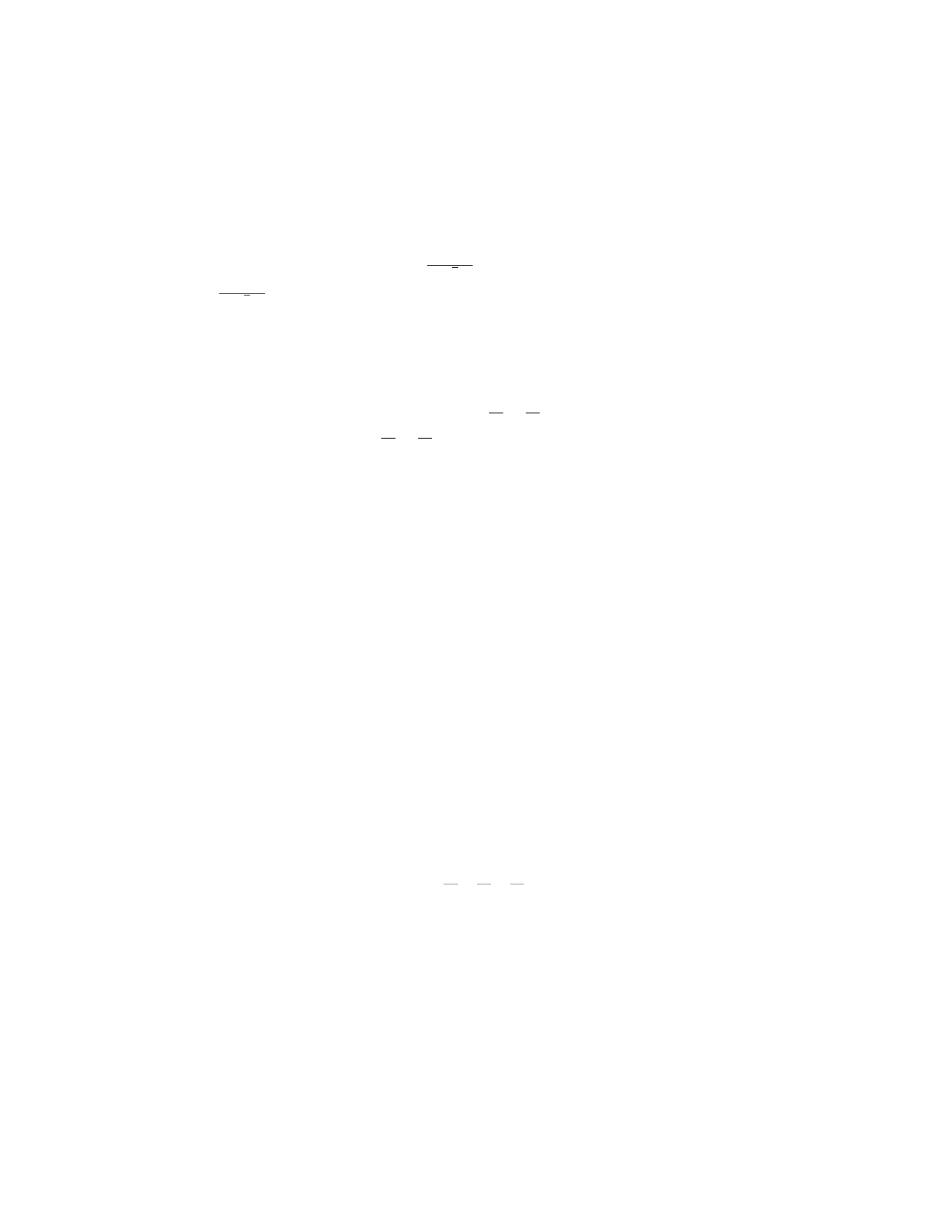
Step 3: Calculate the flux of the curl of Facross S.
The flux of the vector field G=∇×Fover Sis given by the surface integral
RRSG·dS.
Since G=⟨z, z, 0⟩and n=⟨1,1,−1⟩
√3, the flux integral becomes RRS(z, z, 0) ·
⟨1,1,−1⟩
√3dS.
Step 4: Parameterize the surface S.
Let Dbe the region in the xy-plane bounded by the parabola y=x2and
the y-axis. We can parameterize the surface Sas r(x, y) = ⟨x, y, x +y⟩where
(x, y)∈D.
Step 5: Evaluate the flux integral.
The flux integral becomes RRDG·n
∂r
∂x ×∂r
∂y
dA.
Substitute G,n, and ∂r
∂x ×∂r
∂y into the integral and evaluate.
This completes the calculation of the flux of the curl of Facross the surface
S.
Question 19
Question
Let Sbe the part of the plane 2x+y+ 3z= 6 that lies in the first octant. Let
Shave surface density δ(x, y, z) = x+y+z. Use Stokes’ Theorem to calculate
the flux of the curl of the vector field F(x, y, z) = ⟨x2, y2, z2⟩across S.
Solution
Step 1: Find the normal vector to the surface S. The equation of the plane is
2x+y+ 3z= 6. We can rewrite this as 2x+y+ 3z−6 = 0. The coefficients of
x,y, and zin this equation give the components of the normal vector. So, the
normal vector to the surface Sis n=⟨2,1,3⟩.
Step 2: Parameterize the curve that bounds the surface Sin the first octant.
Let Cbe the curve of intersection of the plane 2x+y+3z= 6 with the coordinate
planes. We can parameterize this curve as r(t) = ⟨t, 0,0⟩for 0≤t≤3.
Step 3: Calculate curl(F). The curl of F(x, y, z) = ⟨x2, y2, z2⟩is given by
curl(F) = ∇ × F=
i j k
∂
∂x
∂
∂y
∂
∂z
x2y2z2
=⟨0,0,2y−2z⟩.
Step 4: Calculate the line integral of curl(F)over C. Using Stokes’ Theorem,
the flux of curl(F)across Sis given by
ZZS
(∇ × F)·dS=IC
F·dr=Z3
0⟨0,0,2(0) −2(0)⟩·⟨1,0,0⟩dt =Z3
0
0dt = 0.
Therefore, the flux of the curl of Facross Sis 0.
16

Question 20
Question
Let Sbe the part of the plane z= 4 −x−2ythat lies above the square Rin the
xy-plane centered at the origin with sides of length 4. Orient Supward, and let
F(x, y, z) = (y2, z2, x2).
Calculate the flux of Facross the surface Susing Stokes’ Theorem.
Solution
Step 1: Find the normal vector to the surface S. The normal vector to the
surface Sabove the square Ris given by n=∇g(x, y, z), where g(x, y, z) =
z−(4 −x−2y). Thus, n=∇g(x, y, z) = ∂g
∂x ,∂g
∂y ,∂g
∂z = (1,2,−1).
Step 2: Find the curl of F. The curl of Fis given by ∇×F=∂
∂x ,∂
∂y ,∂
∂z ×
(y2, z2, x2) = ∂x2
∂y −∂z2
∂x ,∂y2
∂x −∂x2
∂z ,∂z2
∂z −∂y2
∂y = (−2x, 2z, 2y).
Step 3: Calculate the flux of Facross the surface using Stokes’ Theorem.
The flux of Facross Sis given by the surface integral RRS(∇×F)·dS. By Stokes’
Theorem, this is equivalent to the line integral of Faround the boundary of R
oriented counterclockwise.
Step 4: Calculate the line integral of Faround the boundary of R. The
boundary of the square Ris parameterized by r(t) = (2 cos t, 2 sin t, 0) for 0≤
t≤2π. Since F(x, y, z) = (y2, z2, x2), we have F(r(t)) = (4 sin2t, 0,4 cos2t).
Thus, the line integral becomes
Z2π
0
F(r(t)) ·r′(t)dt
=Z2π
0
(4 sin2t, 0,4 cos2t)·(−2 sin t, 2 cos t, 0) dt
=Z2π
0−8 sin3t+ 8 cos3t dt
= 16π
Therefore, the flux of Facross the surface Sis 16π.
Question 21
Question
Let Sbe the part of the plane z= 3 −x−ythat lies above the region in the
xy-plane that is enclosed by the circle x2+y2= 1. Use Stokes’ Theorem to
evaluate the surface integral RRS(∇ × F)·dS, where F(x, y, z) = (y2, z, x).
17

Solution
Step 1: Find the curl of F. The curl of Fis given by:
∇ × F=
i j k
∂
∂x
∂
∂y
∂
∂z
y2z x
= (1,−2,1)
Step 2: Find the unit normal vector to the surface S. Since Sis the part of
the plane z= 3 −x−ythat lies above the unit circle in the xy-plane, the unit
normal vector to the surface Sis given by:
n=∂z
∂x ,∂z
∂y ,−1= (−1,−1,−1)
Step 3: Calculate the normal vector to the circle in the xy-plane. Since Sis
above the unit circle in the xy-plane, the normal vector to this circle is k.
Step 4: Find the unit normal vector to the curve in three dimensions. Since
the unit circle in the xy-plane projects to the unit circle in the xz-plane, the
unit normal vector to the curve is given by:
N=−x
√1 + x2,0,−z
√1 + x2
Step 5: Compute the flux integral. Now, we can use Stokes’ Theorem to
evaluate the surface integral:
ZZS
(∇ × F)·dS=IC
F·dr,
where Cis the boundary of S.
Step 6: Calculate the line integral. The boundary Cof Sis the unit circle
in the xy-plane. The line integral is given by:
IC
F·dr=Z2π
0
F(cos t, sin t, 3−cos t−sin t)·(−sin t, cos t, 0)dt
Step 7: Simplify the line integral and compute it numerically to find the
final answer.
Question 22
Question
Let F(x, y, z) = (x2, y2, z2)be a vector field defined in R3. The surface Sis the
part of the cone z=px2+y2that lies between the planes z= 1 and z= 3.
Use Stokes’ Theorem to evaluate the surface integral R RS(∇ × F)·dS.
18

Solution
Step 1: We start by calculating the curl of F(x, y, z):
∇ × F=
i j k
∂
∂x
∂
∂y
∂
∂z
x2y2z2
=∂(z2)
∂y −∂(y2)
∂z i−∂(z2)
∂x −∂(x2)
∂z j+∂(y2)
∂x −∂(x2)
∂y k
= 0 −0i−0j+ 0k=0
Step 2: Since the curl of Fis 0, the surface integral reduces to R RS0·dS= 0.
Therefore, the value of the surface integral R RS(∇ × F)·dSusing Stokes’
Theorem is 0.
Question 23
Question
Let Sbe the part of the plane x+ 2y+ 3z= 6 that lies inside the cylinder
x2+y2= 4, with outward orientation. Use Stokes’ Theorem to evaluate
IC
F·dr
where F=⟨z, x, y⟩and Cis the boundary curve of S, oriented counterclockwise
when viewed from above.
Solution
Step 1: Find the boundary curve Cof surface S.
The boundary curve Ccorresponds to the intersection of the plane and
the cylinder. Since x2+y2= 4, we can rewrite the equation of the plane as
x+ 2y+ 3z= 6 as x+ 2y+ 3(6 −x−2y) = 6, which simplifies to x+ 2y−3 = 0.
Thus, the boundary curve Cis the circle given by x2+y2= 4 and x+2y−3 =
0.
Step 2: Parametrize the boundary curve C.
We can parametrize the circle x2+y2= 4 as x= 2 cos(t)and y= 2 sin(t)
for 0≤t≤2π.
Substitute these into the equation x+ 2y−3 = 0 to find the parametric
equations for the boundary curve C:
2 cos(t)+4 sin(t)−3 = 0 =⇒x= 2 cos(t), y = 2 sin(t), z =3−2 cos(t)−4 sin(t)
3
Step 3: Compute curl(F).
19

The curl of F=⟨z, x, y⟩is given by
curl(F) = ∂y
∂z −∂z
∂y ,∂z
∂x −∂x
∂z ,∂x
∂y −∂y
∂x =⟨1,1,1⟩
Step 4: Apply Stokes’ Theorem.
Stokes’ Theorem states that
IC
F·dr =ZZS
curl(F)·dS
Since the unit normal vector to the plane x+ 2y+ 3z= 6 is ⟨1,2,3⟩, we have
dS =⟨1,2,3⟩ · dA = 3dA.
Therefore, the line integral becomes the surface integral:
IC
F·dr =ZZS
curl(F)·dS =ZZS⟨1,1,1⟩ · 3dA = 3 ZZS
dA
Step 5: Calculate the surface area of S.
The surface Srepresents a portion of the plane enclosed by the cylinder,
which lies in the xy-plane. The projection of this region onto the xy-plane is a
circle of radius 2. Hence, the surface area of Sis π(22) = 4π.
Step 6: Final computation.
Substitute the surface area of Sinto the surface integral:
3ZZS
dA = 3(4π) = 12π
Therefore, the value of the line integral over the boundary curve Cusing
Stokes’ Theorem is 12π.
Question 24
Question
Let Sbe the part of the plane z=x+ 2ythat lies above the triangle with
vertices at (0,0,0),(1,0,0), and (0,1,0). Let F(x, y, z) = (y2, z2, x2). Compute
the surface integral RRScurl F·dSusing Stokes’ Theorem.
Solution
Step 1: Determine the boundary of S, denoted by C. Since Slies on the plane
z=x+2y, the boundary Cwill be the triangular curve that lies in the xy-plane
with vertices at (0,0),(1,0), and (0,1).
Step 2: Calculate the curl of F= (y2, z2, x2). The curl of Fis given by
curl F=∂f3
∂y −∂f2
∂z ,∂f1
∂z −∂f3
∂x ,∂f2
∂x −∂f1
∂y .
20
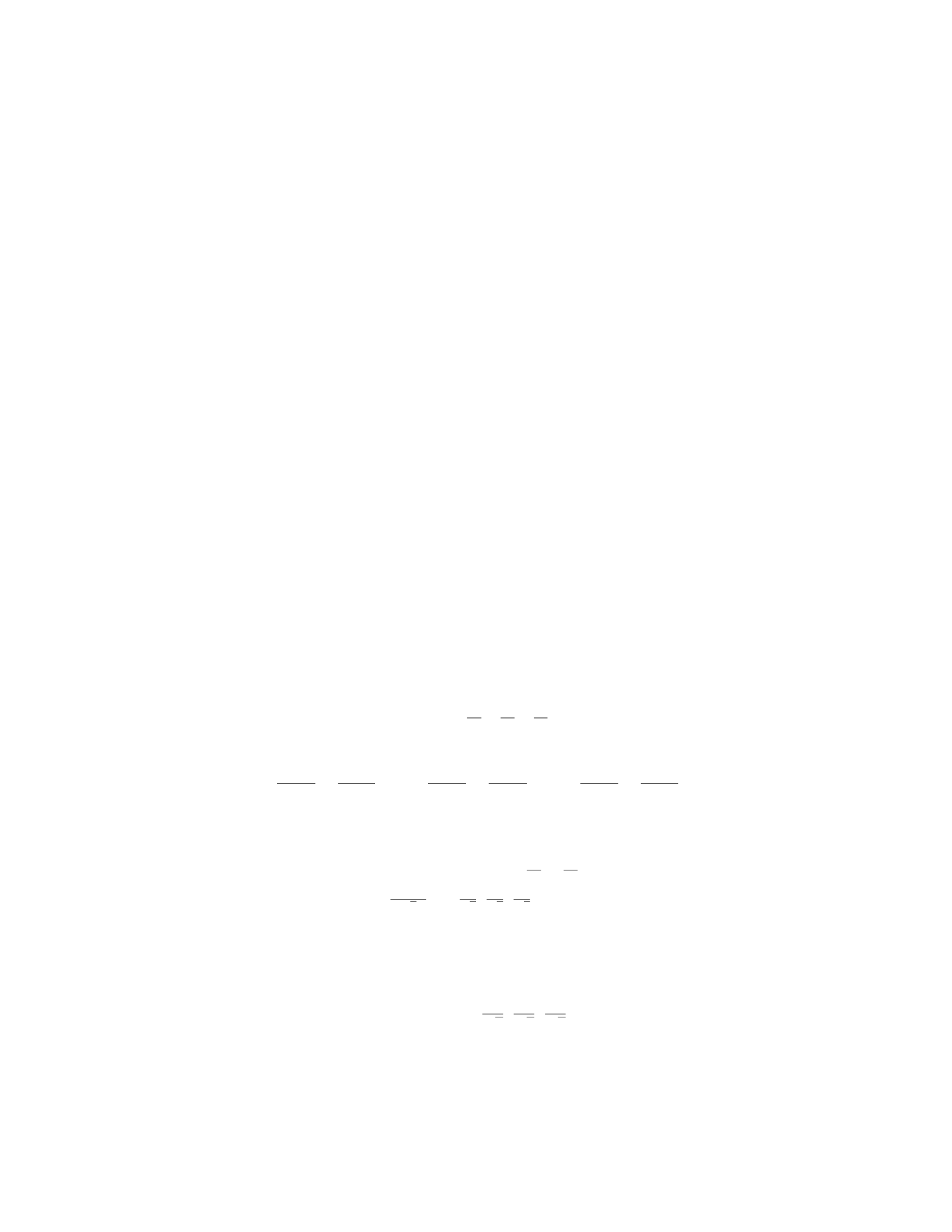
Substitute f1=y2,f2=z2, and f3=x2into the formula above and simplify.
Step 3: Using Stokes’ Theorem, we have
ZZS
curl F·dS=IC
F·dr,
where HCdenotes the line integral over the curve Cin the xy-plane.
Step 4: Parameterize the triangular curve Cin the xy-plane. Let C1be the
line segment from (0,0) to (1,0),C2be the line segment from (1,0) to (0,1),
and C3be the line segment from (0,1) to (0,0).
Step 5: Calculate Falong each segment Ci. Compute F·drfor each segment.
Step 6: Compute the total line integral HCF·drby summing the line integrals
over each segment Ci. This will give the value of the surface integral RRScurl F·
dS.
Question 25
Question
Let Sbe the part of the plane z= 4 −x−yin the first octant with outward
unit normal, and let F(x, y, z)=(xz, yz, xy). Calculate the flux of Facross S
using Stokes’ Theorem.
Solution
Step 1: First, we calculate the curl of F:
∇ × F=
i j k
∂
∂x
∂
∂y
∂
∂z
xz yz xy
=∂(xy)
∂y −∂(yz)
∂z i−∂(xz)
∂x −∂(xy)
∂z j+∂(xz)
∂x −∂(yz)
∂y k
=yi−xj+zk
Step 2: Next, we calculate the outward unit normal to S: Since z= 4−x−y
in the first octant, the normal vector is ˆ
n=−∂z
∂x ,−∂z
∂y ,1= (1,1,1). The unit
normal vector is then ˆ
n=(1,1,1)
√3=1
√3,1
√3,1
√3.
Step 3: Now, we can apply Stokes’ Theorem: The flux of Facross Sis given
by:
ZZS
(∇ × F)·ˆ
ndS
=ZZS
(y, −x, z)·1
√3,1
√3,1
√3dS
21

=ZZS
y−x+z
√3dS
Step 4: Since the surface is given by z= 4 −x−y, the flux integral becomes:
ZZS
4
√3dA
=4
√3ZZS
dA
=4
√3·Area(S)
Step 5: To find the area of the surface S, we integrate over the projection
onto the xy-plane:
Area(S) = ZZD
∂(x, y)
∂(u, v)
dudv
Where Dis the projection of Sonto the xy-plane defined by z= 0.
Step 6: The projection can be found by setting z= 0 in the equation of the
surface z= 4 −x−y, giving 4−x−y= 0, which is the line y= 4 −x. Thus,
the limits of integration for xare 0≤x≤4and 0≤y≤4−x.
Step 7: The Jacobian determinant for the transformation from xy to uv is
1, so
Area(S) = Z4
0Z4−x
0
1dy dx =Z4
0
(4 −x)dx
Step 8: Solving the integral gives:
Area(S) = Z4
0
4−x dx =4x−x2
24
0
= 8
Step 9: Substituting the area
22

