



MATH 332 - ADVANCED CALCULUS
- Stokes’ Theorem
Question Bank - Set 4
Liberty University
Question 1
Question
Let Sbe the part of the plane z= 4 −x−2ythat lies above the triangle with
vertices (0, 0, 0), (2, 0, 0), and (0, 1, 0) oriented counterclockwise when viewed
from above. Let F= (x2+ 2y, y2, z2)be a vector field. Calculate the surface
integral RRS∇ × F·dSusing Stokes’ Theorem.
Solution
Step 1: Find the normal vector to the surface S.
The normal vector to the surface Sis given by n=∇h(x, y, z), where h(x, y, z) =
4−x−2yis the height function for the plane z= 4 −x−2y. Thus, we have
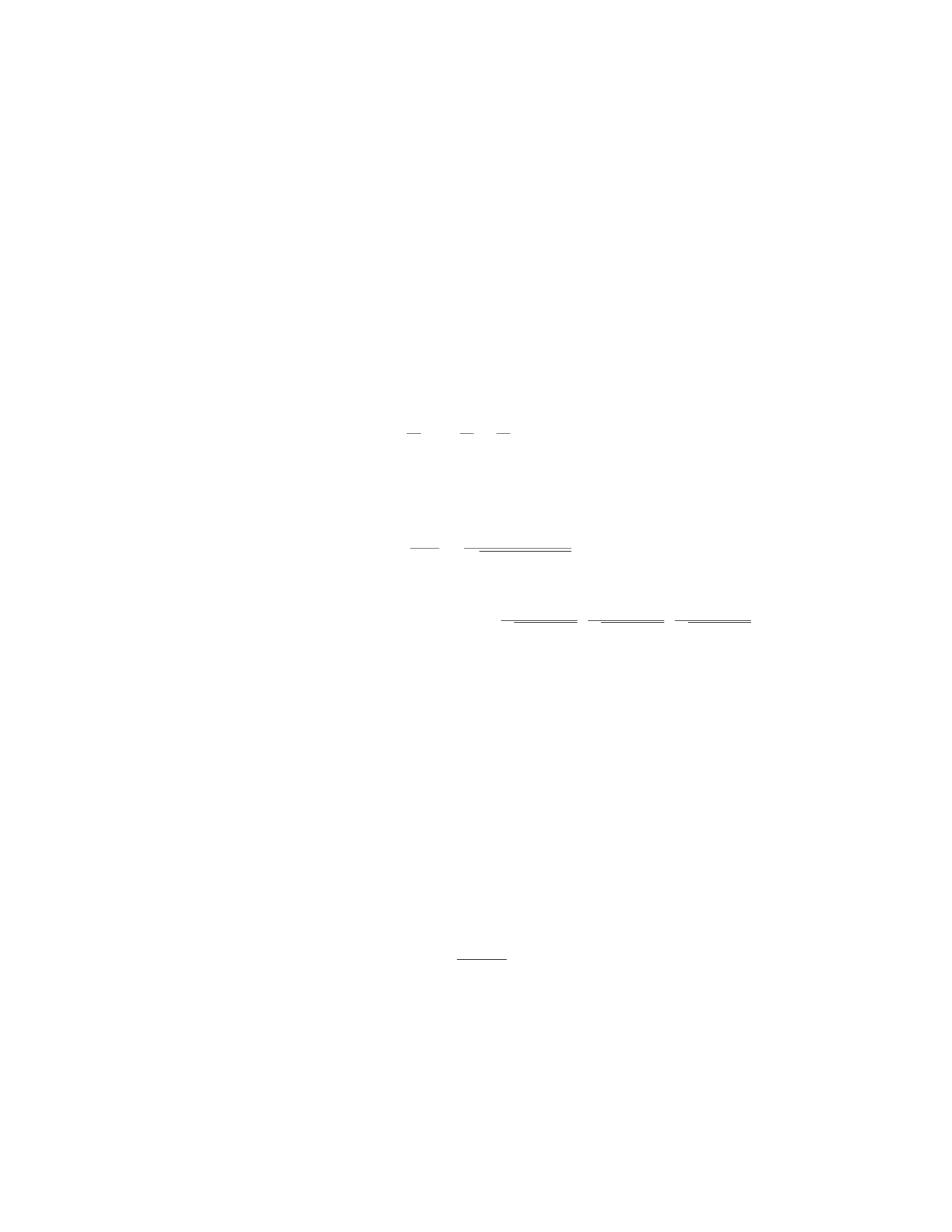
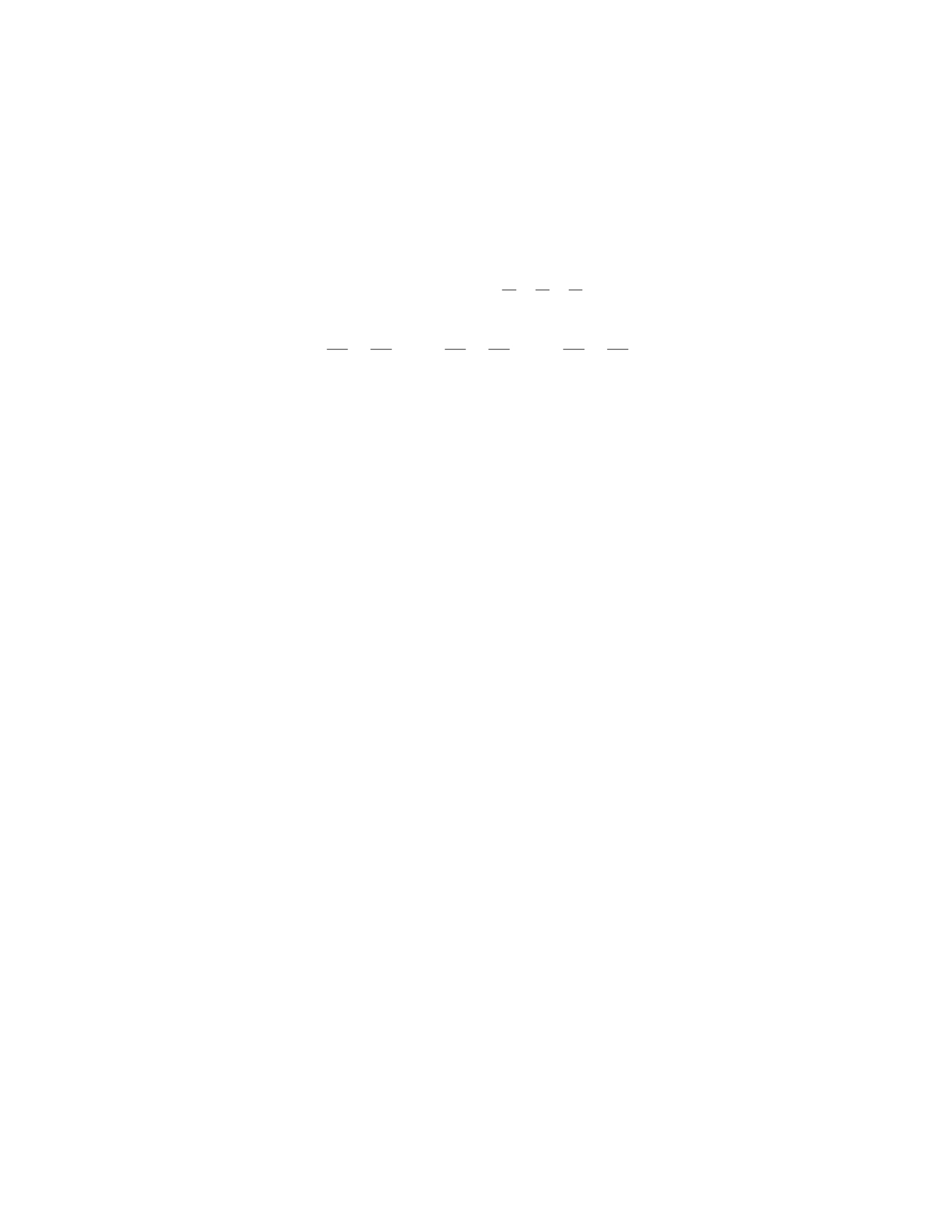
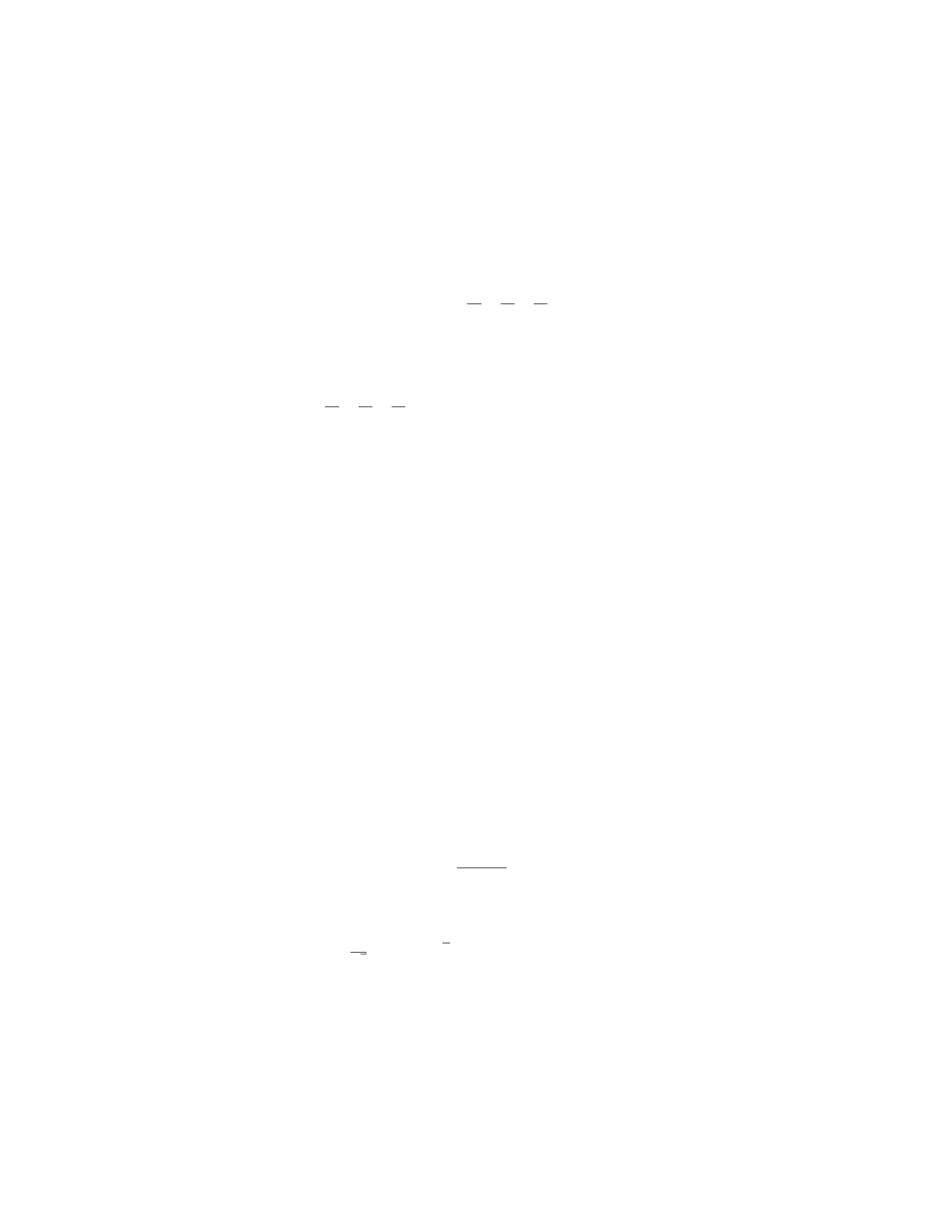
∇h(x, y, z) = (−∂h
∂x,−∂h
∂y ,1) = (−1,−2,1).
Step 2: Calculate ∇ × F.
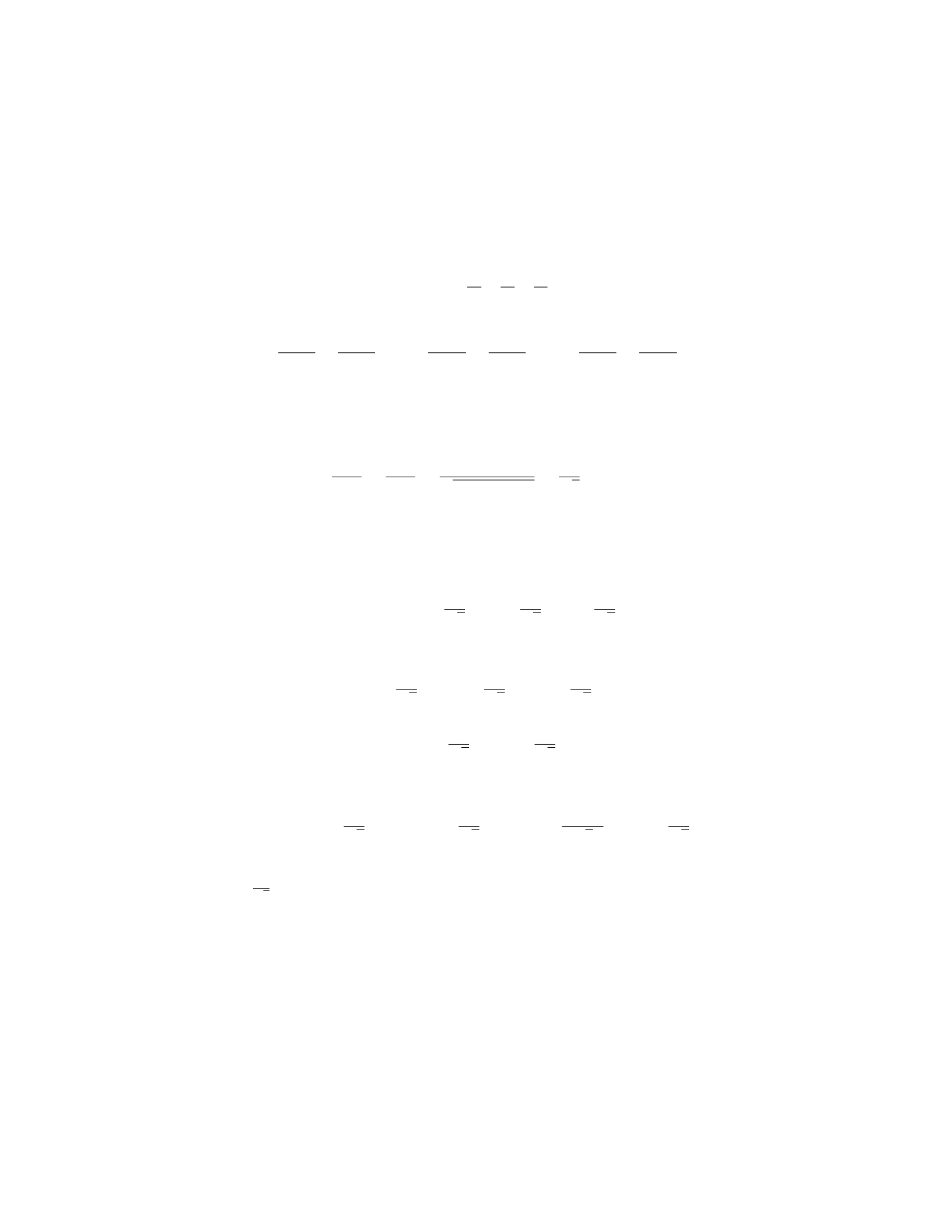
We have ∇ × F=
i j k
∂
∂x
∂
∂y
∂
∂z
x2+ 2y y2z2
=∂(z2)
∂y −∂(y2)
∂z i−∂(z2)
∂x −∂(x2+2y)
∂z j+∂(y2)
∂x −∂(x2+2y)
∂y k
= (0 −0)i−(0 −0)j+ (0 −1)k=−k.
Step 3: Calculate the boundary of the surface S.
The boundary of the surface Sis the triangle in the xy-plane with vertices (0,
0), (2, 0), and (0, 1). Let Cbe the curve representing the boundary where C1
is the line segment from (0, 0) to (2, 0), C2is the line segment from (2, 0) to
(0, 1), and C3is the line segment from (0, 1) to (0, 0).

Step 4: Calculate the circulation of ∇ × Faround the boundary of S.
The circulation of ∇ × Faround the boundary Cis given by
IC∇ × F·dr=ZZS∇ × F·dS
=IC1∇ × F·dr+IC2∇ × F·dr+IC3∇ × F·dr
=Z2
0
F(x, 0) ·T1dx +Z1
0
F(2, y)·T2dy +Z0
1
F(x, 1) ·T3dx
=Z2
0
(x2,0,(4
Question 2
Question
Let Sbe the part of the plane z=x+ythat lies above the square 0≤x≤
1,0≤y≤1. Use Stokes’ Theorem to evaluate the surface integral
ZZS
(∇ × F)·dS
where F(x, y, z) = (z2, y2, x2).
Solution
Step 1: To apply Stokes’ Theorem, we first need to compute the curl of F.
∇×F=
i j k
∂
∂x
∂
∂y
∂
∂z
z2y2x2
=∂
∂y (x2)−∂
∂z (y2),∂
∂z (z2)−∂
∂x(x2),∂
∂x(y2)−∂
∂y (z2)
= (−2y, 2z, 2x)
Step 2: The outward unit normal vector to the surface Scan be calculated
as n= ( ∂z
∂x ,∂z
∂y ,−1) = (1,1,−1).
Step 3: The surface integral can be rewritten as
ZZS
(∇ × F)·dS=ZZD
(∇ × F)·ndA
where Dis the projection of Sonto the xy-plane, that is, the square 0≤x≤
1,0≤y≤1.
Step 4: Substituting the values of ∇×Fand n, the surface integral becomes
ZZD
((−2y, 2z, 2x)) ·(1,1,−1) dA =ZZD
(−2y+ 2z−2x)dA
2

Step 5: Now, we evaluate the double integral over the square D:
ZZD
(−2y+ 2z−2x)dA =Z1
0Z1
0
(−2y+ 2(x+y)−2x)dy dx
=Z1
0−2Z1
0
y dy + 2 Z1
0
(x+y)dy −2Z1
0
x dydx
Step 6: Solving the inner integrals and simplifying gives:
=Z1
0
(−1 + 2(x+1
2)−2x)dx =Z1
0
(1 −2x)dx =x−x21
0= 1 −1 = 0
Therefore, the value of the surface integral RRS(∇ × F)·dSis 0.
Question 3
Question
Let Cbe the curve defined by x=t2,y=t3,z=t4for 0≤t≤1. Let Sbe the
surface bounded by Cand the plane z= 1. Use Stokes’ Theorem to evaluate
HCF·dr, where F(x, y, z) = (y+z, x +z, x +y).
Solution
1. First, parameterize the curve C:
The parameterization of Cis given by r(t) = (t2, t3, t4)for 0≤t≤1.
2. Calculate the derivative of r(t):
r′(t) = (2t, 3t2,4t3).
3. Compute the curl of F:
The curl of Fis given by ∇ × F=
i j k
∂
∂x
∂
∂y
∂
∂z
y+z x +z x +y
.
Simplifying, we get ∇ × F= (−1,−1,−1).
4. Calculate the line integral using Stokes’ Theorem:
By Stokes’ Theorem, HCF·dr=RRS(∇ × F)·dS, where Sis the surface
bounded by Cand z= 1.
Since ∇ × F= (−1,−1,−1), the line integral simplifies to HCF·dr=
RRS(−1,−1,−1) ·ndS, where nis the normal vector to the surface S.
5. Determine the normal vector to the surface S:
The normal vector to the surface Sis n=±(−∂z
∂x ,−∂z
∂y ,1) = ±(0,0,1).
As the normal vector should point outward from the bounded region, we
choose n= (0,0,1).
3

6. Compute the surface integral:
RRS(−1,−1,−1) ·(0,0,1) dS =−RRSdS =−RRR||ru×rv||dA, where R
is the parameterization region of the surface S.
As r(u, v) = (u, v, 1) and ∂r
∂u ×∂r
∂v = (−1,0,0), the surface integral simpli-
fies to −RRR1dA.
It follows that HCF·dr=−A, where Ais the area of the region R.
Question 4
Question
Let Sbe the part of the paraboloid z=x2+y2that lies below the plane
z= 1. Use Stokes’ Theorem to evaluate the circulation of the vector field
F=⟨yez, zex, xey⟩around the boundary curve of S, oriented counterclockwise
when viewed from above.
Solution
Step 1: First, let’s find the curl of F. The curl of a vector field F=⟨P, Q, R⟩
is defined as ∇ × F=∂R
∂y −∂Q
∂z i+∂P
∂z −∂R
∂x j+∂Q
∂x −∂P
∂y k. So, for our
vector field F=⟨yez, zex, xey⟩, we have:
∇×F=∂(xey)
∂y −∂(zex)
∂z i+∂(yez)
∂z −∂(xey)
∂x j+∂(zex)
∂x −∂(yez)
∂y k
= (xey−zex)i+ (yez−xey)j+ (zex−yez)k
Step 2: Next, we will find the outward unit normal vector to the surface S.
Since Sis the part of the paraboloid z=x2+y2below the plane z= 1, the unit
normal vector on Sis given by N=∇(z−x2−y2)
||∇(z−x2−y2)|| =−2xi
−2yj+kp1+4x2+ 4y2.
Step 3: Now, we can apply Stokes’ Theorem, which states that HCF·dr=
RRS(∇ × F)·NdS. Let’s first calculate RRS(∇ × F)·NdS:
ZZS
(∇×F)·NdS =ZZS
((xey−zex)i+(yez−xey)j+(zex−yez)k)·−2xi
−2yj+kp1+4x2+ 4y2dS
Step 4: To evaluate the surface integral, we need to find a parameterization
of S. Let’s use the parameterization r(u, v) = ⟨u, v, u2+v2⟩for 0≤u≤1and
−√1−u2≤v≤√1−u2. The normal vector to the surface can be calculated
as the cross product of ruand rv.
Step 5: After parameterizing S, we can compute the surface integral over S
using the parameterization. Finally, we substitute the results back into Stokes’
Theorem to find the circulation of Faround the boundary curve of S.
4
Question 5
Question
Let Sbe the surface given by z=x2+y2for 0≤z≤1oriented with outward
normal. Use Stokes’ Theorem to evaluate the surface integral RRS(∇ × F)·dS,
where F(x, y, z) = (x2+y2,2xy, z).
Solution
Step 1: Calculate the curl of F. The curl of Fis given by:
∇ × F=
i j k
∂
∂x
∂
∂y
∂
∂z
x2+y22xy z
= (0,0,2y−2x)
Step 2: Determine the unit normal vector nto the surface S. Since Sis
given by z=x2+y2, the normal vector can be written as:
n=∇z
|∇z|=⟨−2x, −2y, 1⟩
p1+4x2+ 4y2
Step 3: Calculate the outward unit normal vector dS. The outward unit
normal vector dSis given by dS=ndS =−2x
√1+4x2+4y2,−2y
√1+4x2+4y2,1
√1+4x2+4y2dA
Step 4: Setup the surface integral using Stokes’ Theorem. Stokes’ Theorem
states that the surface integral of ∇ × Fover Sis equal to the line integral of
Falong the boundary of S, which in this case is the circle x2+y2= 1 in the
xy-plane.
Therefore, the surface integral RRS(∇ × F)·dScan be rewritten as the line
integral HCF·draround the boundary curve Cof S.
Step 5: Parameterize the curve C. Parameterize the circle Cin the xy-plane
with x= cos t,y= sin t,0≤t≤2π.
Step 6: Evaluate the line integral. Substitute the parameterization of the
curve into Fand the differential dr, then calculate F·dr.
Step 7: Compute the final result. Calculate the line integral over Cto find
the value of the surface integral using Stokes’ Theorem.
Question 6
Question
Let Sbe the part of the cone z=px2+y2that lies between the planes z= 1
and z= 3. Use Stokes’ Theorem to calculate the flux of the curl of the vector
field F(x, y, z) = (xz, yz, x2)across the surface S, where the direction of positive
orientation is the outward normal.
5
Solution
1. First, we calculate the curl of the vector field F(x, y, z):
∇ × F=
i j k
∂
∂x
∂
∂y
∂
∂z
xz yz x2
=∂(x2)
∂y −∂(yz)
∂z i−∂(xz)
∂x −∂(x2)
∂z j+∂(yz)
∂x −∂(xz)
∂y k
= (0 −y)i−(z−0)j+ (z−z)k=−yi−zj
2. Then, we calculate the outward unit normal vector to the surface S, which
is given by
n=∇g
|∇g|=∇z
|∇z|=i+j+k
√12+ 12+ 12=1
√3(i+j+k)
3. The surface integral of the curl of Fover Scan be calculated using Stokes’
Theorem: ZZS
(∇ × F)·dS=IC
F·dr
=Z3
1Z2π
0
(−y, −z)·(1
√3cos(ϕ),1
√3sin(ϕ),1
√3)dϕdz
4. Performing the dot product and integrating, we get:
Z3
1Z2π
0−y
√3cos(ϕ)−z
√3sin(ϕ) + 1
√3dzdϕ
=Z3
1Z2π
0−z
√3sin(ϕ) + 1
√3dzdϕ
5. Further evaluating the integral, we obtain:
=Z3
1−2πz
√3dz =−2πz2
√33
1
=−2π32−1
√3=−2π8
√3
Therefore, the flux of the curl of the vector field F(x, y, z)across the surface
Sis −8π
√3.
Question 8
Question
Let Sbe the portion of the plane z=x+ythat lies inside the cylinder x2+y2=
1oriented with outward-pointing normal. Use Stokes’ Theorem to evaluate
RRSF·dS, where F=yzi+xzj+xyk.
6
Solution
Step 1: First, find the curl of F: Let F=Pi+Qj+Rk. Then, the curl of Fis
given by
curl(F) = ∇ × F=
i j k
∂
∂x
∂
∂y
∂
∂z
P Q R
=∂R
∂y −∂Q
∂z i−∂R
∂x −∂P
∂z j+∂Q
∂x −∂P
∂y k
For F=yzi+xzj+xyk, we have P=yz,Q=xz,R=xy. Thus, the curl of
Fis
curl(F) = (z−z)i−(y−y)j+ (x−x)k=0
Step 2: By Stokes’ Theorem, we have
ZZS
F·dS=ZZ∂S
F·dr
Since the curl of Fis 0, the line integral vanishes. Therefore, RRSF·dS= 0.
Question 9
Question
Let Sbe the part of the paraboloid z= 4−x2−y2that lies above the plane z= 1.
Orient Swith outward normal. Use Stokes’ Theorem to evaluate HCF·drwhere
F(x, y, z) = xi+yj+zkand Cis the boundary of Soriented counterclockwise
when viewed from above.
Solution
Step 1: Find the curl of F. Step 2: Compute the surface integral of the curl
of Fover the region Sto apply Stokes’ Theorem. Step 3: Parameterize the
boundary curve Cand compute the line integral of Fover C.
Let’s start with these steps.
Question 10
Question
Let F=x2i+y2j+z2kbe a vector field, and let Sbe the surface enclosed by
the cylinder x2+y2= 1 and the planes z= 0 and z= 2. Use Stokes’ Theorem
to evaluate the line integral HCF·draround the boundary curve Cof S.
7

Solution
Step 1: First, we need to parameterize the boundary curve C, which consists of
the circle x2+y2= 1 on the plane z= 0 and the same circle on the plane z= 2.
We will parameterize the circle on the plane z= 0 as r1(t) = cos(t)i+ sin(t)j
for 0≤t≤2π. The circle on the plane z= 2 can be parameterized similarly as
r2(t) = cos(t)i+ sin(t)j+ 2k.
Step 2: Next, we compute the curl of the vector field F:
∇ × F=
i j k
∂
∂x
∂
∂y
∂
∂z
x2y2z2
= (2z−2y)i−(2z−2x)j+ 0k= 2(z−y)i−2(z−x)j
Step 3: We can now apply Stokes’ Theorem to relate the line integral over
Cto the surface integral over S. Using Stokes’ Theorem, we have:
IC
F·dr=ZZS
(∇ × F)·ndS
where nis the outward unit normal to S. Since the surface Sis bounded by
C, the outward unit normal npoints outward from the cylinder.
Step 4: We will calculate the surface integral over S:
ZZS
(∇ × F)·ndS =ZZS
(2(z−y)i−2(z−x)j)·kdS
Since the normal vector nis in the kdirection, the dot product simplifies
to −2(z−x). To find the limits of integration, we note that the projection of
Sonto the xy-plane is the circle x2+y2= 1. Thus, the limits for xand yare
x2+y2≤1, and for z, the limits are 0≤z≤2.
Step 5: We can now evaluate the surface integral:
ZZS
(∇ × F)·ndS
=Z2π
0Z1
0−2(2 −cos(t)) dr dθ
=−4Z2π
0
(2 −rcos(t))
1
0dθ
=−4Z2π
0
(2 −cos(t)−0) dθ
=−4·2π(2)
=−16π
Therefore, the line integral HCF·draround the boundary curve Cof Sis
−16π.
8

Question 11
Question
Let F(x, y, z) = (y2−z)i+ (z2−x)j+ (x2−y)kand let Sbe the portion of
the cone z=px2+y2that lies between the planes z= 1 and z= 3. Use
Stokes’ Theorem to evaluate HCF·dr, where Cis the counterclockwise-oriented
boundary curve of surface S.
Solution
Step 1: First, let’s parameterize the boundary curve Cof the surface S. The
boundary curve consists of two parts: the circle x2+y2= 1 at z= 1 and the
circle x2+y2= 9 at z= 3. We can parameterize these circles as follows: For
z= 1, we have the circle C1:x2+y2= 1. Parameterizing this circle gives us:
r1(t) = ⟨cos(t),sin(t),1⟩,where 0≤t≤2π.
For z= 3, we have the circle C2:x2+y2= 9. Parameterizing this circle gives
us:
r2(t) = ⟨3 cos(t),3 sin(t),3⟩,where 0≤t≤2π.
Step 2: Now, we need to compute the curl of F:
∇ × F=
i j k
∂
∂x
∂
∂y
∂
∂z
y2−z z2−x x2−y
= (2y+ 1)i−(2z+ 1)j+ (2x+ 1)k.
Step 3: By Stokes’ Theorem, we have
IC
F·dr=ZZS
(∇ × F)·ndS,
where nis the unit normal to S.
Step 4: To find the unit normal to S, we compute the gradient of z=
px2+y2as ∇z=⟨x
√x2+y2,y
√x2+y2,−1⟩.
Step 5: The unit normal to Sis then ˆ
n=∇z
||∇z|| =⟨x,y,−√x2+y2⟩
√x2+y2+1 .
Step 6: We can now evaluate the surface integral RRS(∇×F)·ndS using the
parameterizations of C1and C2from Step 1.
Question 12
Question
Let Sbe the surface of the portion of the plane z= 4 −x−2ythat lies above
the square 0≤x≤1,0≤y≤1, oriented upward. Calculate the flux of the
curl of the vector field F= 2xi+yj+zkacross S.
9
Solution
Step 1: Find the curl of the vector field F. The curl of a vector field F=
Pi+Qj+Rkis given by:
∇ × F=
i j k
∂
∂x
∂
∂y
∂
∂z
P Q R
In this case, F= 2xi+yj+zk, so:
∇ × F=
i j k
∂
∂x
∂
∂y
∂
∂z
2x y z
= (0 −0)i−(0 −1)j+ (1 −2)k=−j−k
Step 2: Use Stokes’ Theorem to find the flux of the curl of Facross S.
Stokes’ Theorem states:
ZZS
(∇ × F)·dS=IC
F·dr
where Cis the boundary of the surface S.
Step 3: Find the boundary curve Cof the surface S. The boundary curve
Cof the surface Sis the square where 0≤x≤1,0≤y≤1. It consists of four
line segments: 1. y= 0,0≤x≤12. x= 1,0≤y≤13. y= 1,0≤x≤14.
x= 0,0≤y≤1
Step 4: Parameterize and calculate the line integral HCF·dr. We will
integrate over each of the four line segments of the boundary: 1. y= 0,0≤
x≤1:r(t) = ti,0≤t≤12. x= 1,0≤y≤1:r(t) = i+tj,0≤t≤13.
y= 1,0≤x≤1:r(t) = (1 −t)i+j,0≤t≤14. x= 0,0≤y≤1:r(t) = tj,
0≤t≤1
Step 5: Substitute the parameterization into Fand calculate the dot product
with dr. For each line segment, calculate: 1. HCF·dr=R1
0(2t, 0,4−t)·(1,0,0)dt
Question 13
Question
Let Sbe the part of the cone z=px2+y2that lies between the planes z= 1
and z= 4. Use Stokes’ Theorem to evaluate the surface integral RRSF·dS,
where F(x, y, z) = (z, x, y).
(Note: You may assume that a positively oriented unit normal vector to S
at each point is n=1
√2(−x, −y, √2).)
Solution
Step 1: Find the boundary curve Cof Swhere the orientation is consistent with
the orientation of Sgiven by the positively oriented unit normal vector n.
10
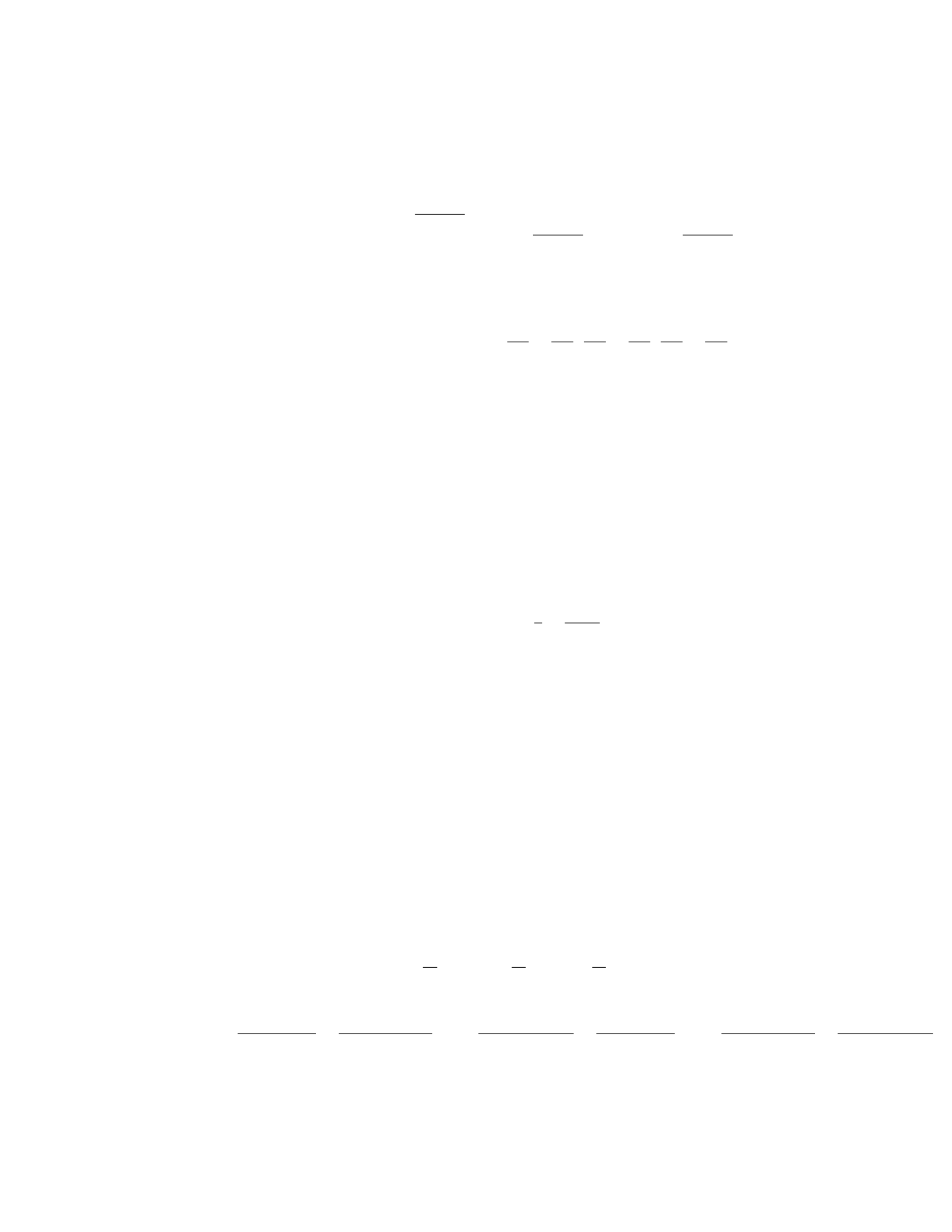
Since Slies between z= 1 and z= 4, the boundary curve Cconsists of the
intersection of the cone z=px2+y2and the planes z= 1 and z= 4. Solving
these equations, we get z= 1 and z= 4:1 = px2+y2and 4 = px2+y2.
Thus, the boundary curve Cis the circle x2+y2= 1.
Step 2: Parameterize the boundary curve C.
Let Cbe parameterized by r(t) = (cos t, sin t, 1) where 0≤t≤2π.
Step 3: Find the curl of F.
The curl of Fis given by ∇ × F=∂Fz
∂y −∂Fy
∂z ,∂Fx
∂z −∂Fz
∂x ,∂Fy
∂x −∂Fx
∂y .
Calculating the components of the curl, we have: ∇×F= (0 −1,1−0,1−0) =
(−1,1,1).
Step 4: Evaluate the line integral HCF·dr.
Using Stokes’ Theorem, we have: RRSF·dS=HCF·dr.
IC
F·dr=Z2π
0
F(r(t)) ·r′(t)dt
Z2π
0
F(r(t)) ·r′(t)dt =Z2π
0
(1,cos t, sin t)·(−sin t, cos t, 0)dt
Z2π
0
(1,cos t, sin t)·(−sin t, cos t, 0)dt =Z2π
0−sin t+ cos2tdt
Z2π
0−sin t+ cos2tdt =−cos t+t
2+sin 2t
42π
0
= 0
.
Therefore, the surface integral RRSF·dSis 0.
Question 14
Question
Let Fbe a vector field defined by F(x, y, z) = (y2z+ cos x)i+ (xz2+ sin y)j+
(xy2+ez)k. Calculate the surface integral RRScurl(F)·dS, where Sis the
portion of the plane z= 4 −x−2ythat lies above the triangle in the xy-plane
with vertices at (0,0),(1,0), and (0,2).
Solution
Step 1: Calculate curl(F).
curl(F) =
i j k
∂
∂x
∂
∂y
∂
∂z
y2z+ cos x xz2+ sin y xy2+ez
=∂(xy2+ez)
∂y −∂(xz2+ sin y)
∂z i−∂(y2z+ cos x)
∂x −∂(xy2+ez)
∂z j+∂(xz2+ sin y)
∂x −∂(y2z+ cos x)
∂y k
11
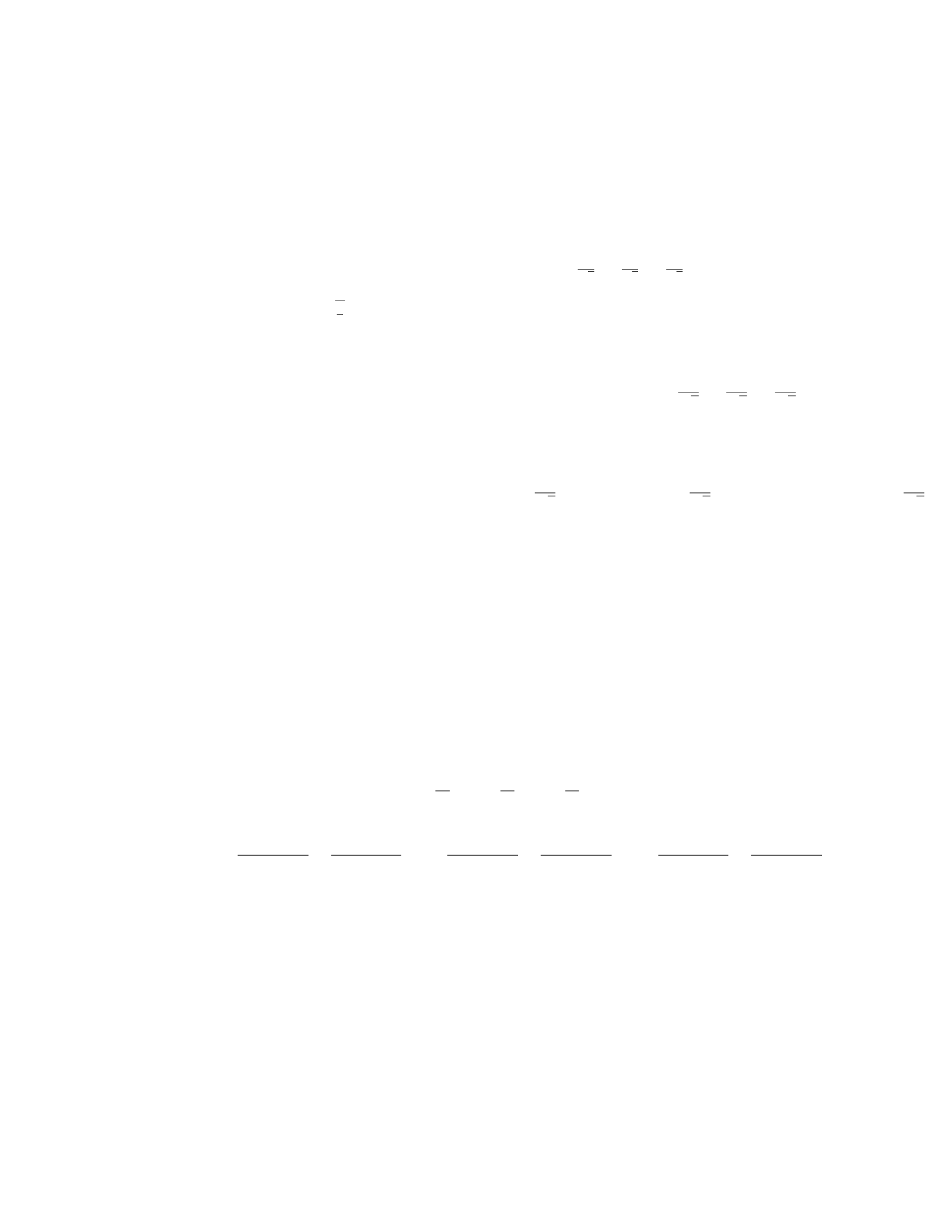
= (2xy −z2)i−(sin x−2xy)j+ (2xz −y2)k
Step 2: Calculate the unit normal vector to the surface S. The surface S
is defined by z= 4 −x−2y. The normal vector to this surface is n=∇z=
−i−2j+k. Therefore, the unit normal vector is n=−1
√6i−2
√6j+1
√6k.
Step 3: Calculate the magnitude of dS. The magnitude of dSis given by
dS =|n|dxdy =q6
6dxdy =dxdy.
Step 4: Calculate the surface integral. The surface integral can be calculated
as:
ZZS
curl(F)·dS=ZZS(2xy −z2)i−(sin x−2xy)j+ (2xz −y2)k·−1
√6i−2
√6j+1
√6kdxdy
Now, we substitute z= 4 −x−2yinto the expression above and integrate over
the region in the xy-plane:
ZZS
curl(F)·dS=ZZR(2xy −(4 −x−2y)2)−1
√6−(sin x−2xy)2
√6+ (2x(4 −x−2y)−y2)1
√6dxdy
where Ris the triangle in the xy-plane
Question 15
Question
Let Sbe the hemisphere x2+y2+z2= 1, z ≥0, and let F= (x2+y2, y2+
z2, z2+x2). Calculate the flux of Facross Susing Stokes’ Theorem.
Solution
Step 1: Calculate the curl of F.
∇ × F=
i j k
∂
∂x
∂
∂y
∂
∂z
x2+y2y2+z2z2+x2
=∂(z2+x2)
∂y −∂(y2+z2)
∂z i−∂(z2+x2)
∂x −∂(x2+y2)
∂z j+∂(y2+z2)
∂x −∂(x2+y2)
∂y k
= (0 −2z)i−(2x−0)j+ (2y−0)k=−2zi−2xj+ 2yk
Step 2: Calculate the surface integral of Fover Susing Stokes’ Theorem.
ZZ
S
(∇ × F)·dS=I
∂S
F·dr
Step 3: The boundary of Sis the circle x2+y2= 1, z = 0.
r(t) = cos(t)i+ sin(t)j,0≤t≤2π
12

Step 4: Parameterize the curve C.
r′(t) = −sin(t)i+ cos(t)j
r′(t)×k=−cos(t)k
Step 5: Calculate the line integral.
I
∂S
F·dr=Z2π
0
F(r(t)) ·r′(t)×kdt
=Z2π
0
(−sin(t))2+ cos(t)2+ (−sin(t))2dt =Z2π
0
2dt = 4π
Therefore, the flux of Facross Sis 4π.
Question 16
Question
Let Sbe the part of the plane x+ 2y+ 3z= 6 that lies inside the cylinder
x2+y2= 4. Use Stokes’ Theorem to evaluate
IC
F·dr,
where F=⟨y, x, z⟩and Cis the boundary of Soriented counterclockwise as
viewed from above.
Solution
Step 1: Find the boundary curve Cof the surface S. This is the intersection of
the plane and the cylinder, so we have
x+ 2y+ 3z= 6
x2+y2= 4.
Solving these equations, we find that the boundary curve Cis the circle x2+y2=
4, which is the circle of radius 2 centered at the origin.
Step 2: Parameterize the boundary curve C. Let x= 2 cos t,y= 2 sin t,
where 0≤t≤2π. Then dr=⟨−2 sin t, 2 cos t, 0⟩dt.
Step 3: Compute F(r(t)).
F(r(t)) = ⟨2 sin t, 2 cos t, 2 sin t⟩.
Step 4: Compute ∇ × F.
∇ × F=
i j k
∂
∂x
∂
∂y
∂
∂z
y x z
=⟨1,1,−2⟩.
13

Step 5: Compute the line integral using Stokes’ Theorem.
IC
F·dr=ZZS
(∇ × F)·ndS,
where nis the outward unit normal to S. Since the outward normal for the
plane x+ 2y+ 3z= 6 is n=⟨1,2,3⟩/√12+ 22+ 32=⟨1/√14,2/√14,3/√14⟩,
we have IC
F·dr=ZZS
(∇ × F)·ndS
=ZZS⟨1,1,−2⟩ · 1
√14⟨1,2,3⟩dS
=1
√14 ZZS
(1 + 2 −6) dS
=−3
√14 ZZS
dS
=−3
√14 ·Area(S).
Step 6: Find the area of the region S. This can be done by finding the
projection of Sonto the xy-plane and calculating the double integral over this
region.
Step 7: Calculate the final answer for the line integral.
Question 17
Question
Let Sbe the part of the plane z= 3 −x−ythat lies above the triangle with
vertices (0,0,0),(1,0,0), and (0,1,0), oriented counterclockwise when viewed
from above. Let Fbe the vector field F= (x2+y2, z, 2x−z). Calculate the
surface integral R RSF·dSusing Stokes’ Theorem.
Solution
Step 1: Calculate the curl of F. The curl of Fis given by:
curl(F) = ∂(2x−z)
∂y −∂(z)
∂z ,∂(x2+y2)
∂z −∂(2x−z)
∂x ,∂(z)
∂x −∂(x2+y2)
∂y
= (−1−0,0−2,0−2) = (−1,−2,−2).
Step 2: Calculate the normal vector to the surface S. The normal vector to
the plane z= 3 −x−yis n= (−∂z
∂x ,−∂z
∂y ,1) = (−(−1),−(−1),1) = (1,1,1).
Step 3: Normalize the normal vector. The unit normal vector is n0=
|n| = (1, 1, 1)√12+12+12=(1
√3,1
√3,1
√3).
14

Step 4: Calculate the surface integral using Stokes’ Theorem. Stokes’ Theo-
rem states that R RSF·dS=RRRVcurl(F)·ndV , where Vis the region enclosed
by S. Since Sis the part of the plane z= 3 −x−ythat lies above the given
triangle, the region Vis the triangle 0≤x≤1,0≤y≤1−x, 0≤z≤3−x−y.
The surface integral becomes:
Z ZS
F·dS=ZZZV
(−1,−2,−2) ·(1,1,1) dV
=ZZZV−5dV.
Step 5: Calculate the triple integral over region V. We have 0≤x≤1,0≤
y≤1−x, 0≤z≤3−x−y. Therefore, the triple integral becomes:
Z1
0Z1−x
0Z3−x−y
0−5dz dy dx
=Z1
0Z1−x
0
[−5z]3−x−y
0dy dx
=Z1
0Z1−x
0−5(3 −x−y)dy dx
=Z1
0
[−5(3y−xy −y2
2)]1−x
0dx
=Z1
0−53(1 −x)−x(1 −x)−(1 −x)2
2dx
=Z1
0−17
2x2+ 14x−15 dx
Question 18
Question
Let Sbe the part of the plane x+y+z= 1 that lies in the first octant.
Let F(x, y, z) = ⟨2xz, y2, x +z⟩. Use Stokes’ Theorem to evaluate the surface
integral
ZZS
curl F ·ndS
where nis the outward unit normal to S.
15

Solution
Step 1: First, we need to find the curl of F.
curl F=
i j k
∂
∂x
∂
∂y
∂
∂z
2xz y2x+z
=∂
∂y (x+z)−∂
∂z (y2),∂
∂z (2xz)−∂
∂x(x+z),∂
∂x(y2)−∂
∂y (2xz)
= (1 −0,2x−1,2z)
= (1,2x−1,2z)
Step 2: Parameterize the surface S. Since Sis the part of the plane x+y+z=
1in the first octant, we can parameterize Sas:
r(u, v) = ⟨u, v, 1−u−v⟩,0≤u≤1,0≤v≤1−u
Step 3: Calculate the normal vector n. The normal vector can be found by
taking the cross product of the partial derivatives of rwith respect to uand v.
∂u =⟨1,0,−1⟩,
∂v =⟨0,1,−1⟩So, n=
∂u×
∂v =⟨1,1,1⟩
Step 4: Evaluate the surface integral. Using Stokes’ Theorem, we have:
ZZS
curl F·ndS =ZZD
(curl F)·(ru×rv)dA
where Dis the region in the uv-plane corresponding to the surface S.
=ZZD
(1,2u−1,2(1 −u−v)) ·(1,1,1) dA
=ZZD
(1 + 2u−1−2v)dA
=ZZD
(2u−2v)dA
=Z1
0Z1−u
0
(2u−2v)dv du
=Z1
02uv −v2v=1−u
v=0 du
16

=Z1
0
(2u−(1 −u)2)du
=Z1
0
(3u2−2u+ 1) du
=u3−u2+u1
0
= 1 −1+1
= 1
Therefore, the surface integral is equal to 1.
Question 20
Question
Let Sbe the part of the plane z= 4 −x−2ythat lies above the region in the
xy-plane bounded by the rectangle with vertices (0,0),(4,0),(4,3), and (0,3).
Use Stokes’ Theorem to evaluate the surface integral
ZZS
F·dS
where F= (y−z, x +z, x +y).
Solution
Step 1: Calculate the curl of F. The curl of Fis given by
∇ × F=
i j k
∂
∂x
∂
∂y
∂
∂z
y−z x +z x +y
=∂
∂y (x+y)−∂
∂z (x+z)i−∂
∂x(y−z)−∂
∂z (y+z)j+∂
∂x(x+z)−∂
∂y (y+z)k
=i−j−k
Step 2: Determine the unit normal vector nto the surface S. Given that
Sis the plane z= 4 −x−2y, the unit normal vector to the surface Sis
n=∇z
|∇z|=D−∂z
∂x ,−∂z
∂y ,1E=⟨−(−1),−(−2),1⟩=⟨1,2,1⟩.
Step 3: Calculate the curl of F·n. The curl of F·nis ∇ × (F·n) =
∇ × (x−y−z) = ∇ × (−3) = 0.
Step 4: Apply Stokes’ Theorem. Stokes’ Theorem states that
ZZS
F·dS=ZC
F·dr
17

where Cis the boundary of the surface Soriented counterclockwise when viewed
from above.
The boundary of the region in the xy-plane is the rectangle with vertices
(0,0),(4,0),(4,3), and (0,3). Parameterize this rectangle using r(u, v) =
⟨u, v, 4−u−2v⟩where 0≤u≤4and 0≤v≤3.
The line integral RCF·drbecomes
Z3
0
(0 −2(4) + 4)dv +Z4
0
(3 + 4)du =−20 + 12 = −8
Therefore, the surface integral evaluates to −8.
Question 21
Question
Let Cbe the curve of intersection of the plane z= 0 and the cylinder x2+y2= 1
oriented counterclockwise when viewed from above. Let F= (y+z, x +z, x +y)
be a vector field. Calculate the flux of Facross the curve Cusing Stokes’
Theorem.
Solution
Step 1: Parameterize the curve C.
The curve Cis simply the circle x2+y2= 1 in the xy-plane. We can
parameterize this curve by r(t) = (cos t, sin t, 0) for 0≤t≤2π.
Step 2: Find the curl of F.
The curl of Fis given by ∇ × F=
ˆ
iˆ
jˆ
k
∂
∂x
∂
∂y
∂
∂z
y+z x +z x +y
= (1,1,1).
Step 3: Calculate the line integral of Fover C.
By Stokes’ Theorem, the flux of Facross Cis equal to the line integral of F
over the curve C, which is given by
ZC
F·dr=Z2π
0
F(r(t))·r′(t)dt =Z2π
0
(0,0,1)·(−sin t, cos t, 0)dt =Z2π
0
0dt = 0.
Therefore, the flux of Facross the curve Cis 0.
Question 22
Question
Let Sbe the surface given by z=x2−y2for 0≤x≤2and 0≤y≤2. Use
Stokes’ Theorem to evaluate the line integral
18
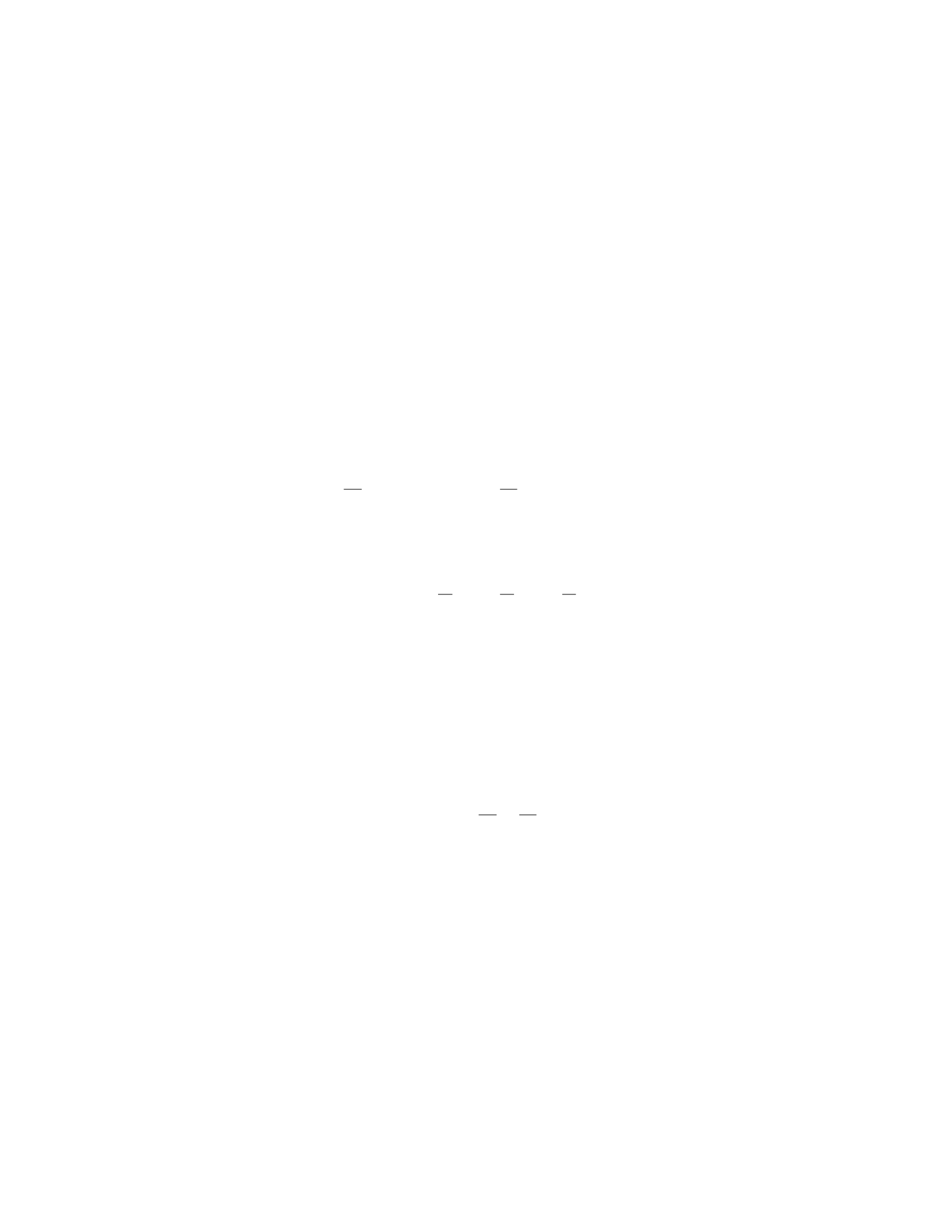
ZC
(x2+ 2y)dx + (z2−y)dy + (2x−2z)dz
where Cis the boundary curve of Swith counterclockwise orientation when
viewed from above.
Solution
Step 1: First, we need to parameterize the surface S.
The surface Sis given by z=x2−y2,0≤x≤2, and 0≤y≤2.
Let’s define the parameterization r(u, v) = ⟨u, v, u2−v2⟩, where (u, v)∈
D={(u, v)|0≤u≤2,0≤v≤2}.
Step 2: Next, we need to calculate the partial derivatives of rwith respect
to uand v.
∂r
∂u =⟨1,0,2u⟩and ∂r
∂v =⟨0,1,−2v⟩
Step 3: Now, we calculate the curl of the vector field F=⟨x2+ 2y, z2−
y, 2x−2z⟩.
∇ × F=
i j k
∂
∂x
∂
∂y
∂
∂z
x2+ 2y z2−y2x−2z
=⟨−1,0,2+2⟩=⟨−1,0,4⟩
Step 4: Using Stokes’ Theorem, we have
ZC
F·dr=ZZS
(∇ × F)·ndS
where nis the unit normal vector to the surface S.
Step 5: The surface integral RRS(∇ × F)·ndS simplifies to
ZZD⟨−1,0,4⟩ · ∂r
∂u ×∂r
∂v du dv
=ZZD
1 0 2u
0 1 −2v
−1 0 4
du dv
Step 6: Computing the determinant and performing the dot product gives
=ZZD
(4 + 4u)du dv
Step 7: Evaluating the double integral over the region D= [0,2]×[0,2] gives
the final answer.
19

Question 23
Question
Let Sbe the part of the cone z2=x2+y2that lies between the planes z= 1
and z= 3. Use Stokes’ Theorem to evaluate the surface integral RRS(∇×F)·dS,
where F(x, y, z) = (x2+y2)i+ (y2−z2)j+ (x2−y2)k.
Solution
To apply Stokes’ Theorem, we need to compute the curl of Fand the normal
vector nto the surface S.
Step 1: Compute ∇ × F.
∇ × F=
i j k
∂
∂x
∂
∂y
∂
∂z
x2+y2y2−z2x2−y2
=∂(x2−y2)
∂y −∂(y2−z2)
∂z i−∂(x2+y2)
∂x −∂(x2−y2)
∂z j+∂(x2+y2)
∂y −∂(y2−z2)
∂x k
=−2yi−2xj+ 2zk
Step 2: Find the unit normal vector n.The unit normal vector to the
surface Sis n=1
√2(−i−j+k)since the normal vector points outward.
Step 3: Evaluate the surface integral using Stokes’ Theorem. Stokes’
Theorem states that ZZS
(∇ × F)·dS=IC
F·dr
where Cis the boundary curve of S.
The boundary curve Cof Sis a circle in the xy-plane with radius 3parametrized
by r(t) = 3 cos(t)i+ 3 sin(t)jfor 0≤t≤2π.
Therefore, we have
IC
F·dr=Z2π
0
F(r(t)) ·r′(t)dt
=Z2π
0
((9 cos2(t) + 9 sin2(t))(−3 sin(t)) + (9 sin2(t)−9 cos2(t))(3 cos(t))) dt
=Z2π
0
(−27 sin(t) cos(t) + 27 sin(t) cos(t)) dt
=Z2π
0
0dt = 0
Hence, the value of the surface integral RRS(∇ × F)·dSis 0.
20

Question 24
Question
Let Sbe the surface of the cone z=px2+y2bounded by the plane z= 3.
Use Stokes’ Theorem to evaluate the surface integral RRS(∇ × F)·dS, where
F(x, y, z) = xi+yj+zk.
Solution
Step 1: Calculate the curl of F: The curl of Fis given by:
∇ × F=
i j k
∂
∂x
∂
∂y
∂
∂z
x y z
=∂z
∂y −∂y
∂z i−∂z
∂x −∂x
∂z j+∂y
∂x −∂x
∂y k
=i+j+k
Step 2: Find the unit normal vector to the surface S: The unit normal vector
to the surface Sis given by n=(−x,−y,√x2+y2)
√x2+y2+1 .
Step 3: Calculate the outward unit normal vector: Since the cone is upward-
facing, the outward unit normal vector is the negation of the unit normal vector
calculated in Step 2. Therefore, n=(x,y,−√x2+y2)
√x2+y2+1 .
Step 4: Calculate dS: The surface element dSis given by dS=ndS, where
dS =q1+(∂z
∂x )2+ ( ∂z
∂y )2dA =√2dA.
Step 5: Evaluate the surface integral:
ZZS
(∇ × F)·dS=ZZD
(∇ × F)·n√2dA
=ZZD
(i+j+k)·(x, y, −px2+y2)
px2+y2+ 1
√2dA
=ZZD
(−z)√2dA
=−√2ZZD
zdA
The integral RRDzdA represents the flux of zthrough the region D, which
in this case is the projection of Sonto the xy-plane. However, the surface of
the cone Sdoes not intersect the xy-plane, making the flux integral through D
equal to zero. Hence, the surface integral RRS(∇ × F)·dSis also equal to 0.
21

Question 25
Question
Let Sbe the part of the plane z= 4 −x−ythat lies above the region in the
xy-plane bounded by the curve x2+y2= 1. Calculate the flux of the vector
field F(x, y, z) = ⟨yz, xz, xy⟩across the surface S.
Solution
Step 1: First, we find the unit normal vector to the surface S, which is given by
n=∂z
∂x ,∂z
∂y ,−1.
In this case, ∂z
∂x =−1,∂z
∂y =−1, so n=⟨−1,−1,−1⟩.
Step 2: Next, we compute the curl of the vector field F:
∇ × F=
i j k
∂
∂x
∂
∂y
∂
∂z
yz xz xy
=⟨z−x, −z, y⟩.
Step 3: Now, we can apply Stokes’ theorem, which states:
ZZS
(∇ × F)·dS=IC
F·dr,
where Cis the boundary curve of the surface Sand dSis the outward-pointing
normal vector on S.
Step 4: Since Slies above the unit circle in the xy-plane, the boundary
curve Cis simply the unit circle x2+y2= 1. Therefore, we can parameterize
the curve Cas r(t) = ⟨cos t, sin t, 4−cos t−sin t⟩for 0≤t≤2π.
Step 5: Calculating the line integral HCF·dr, we have
IC
F·dr=Z2π
0
F(r(t)) ·r′(t)dt
=Z2π
0⟨sin t(4 −cos t−sin t),cos t(4 −cos t−sin t),cos tsin t⟩ · ⟨−sin t, cos t, −sin t−cos t⟩dt
=Z2π
0
(−sin2t(4 −cos t−sin t)−cos2t(4 −cos t−sin t) + cos tsin t(sin t+ cos t)) dt
=Z2π
0
(−4 + 5 sin t+ 5 cos t)dt
= 0.
Step 6: Therefore, the flux of the vector field Facross the surface Sis zero.
22

Step 4: Calculate the circulation of ∇ × Faround the boundary of S.
The circulation of ∇ × Faround the boundary Cis given by
IC∇ × F·dr=ZZS∇ × F·dS
=IC1∇ × F·dr+IC2∇ × F·dr+IC3∇ × F·dr
=Z2
0
F(x, 0) ·T1dx +Z1
0
F(2, y)·T2dy +Z0
1
F(x, 1) ·T3dx
=Z2
0
(x2,0,(4
Question 2
Question
Let Sbe the part of the plane z=x+ythat lies above the square 0≤x≤
1,0≤y≤1. Use Stokes’ Theorem to evaluate the surface integral
ZZS
(∇ × F)·dS
where F(x, y, z) = (z2, y2, x2).
Solution
Step 1: To apply Stokes’ Theorem, we first need to compute the curl of F.
∇×F=
i j k
∂
∂x
∂
∂y
∂
∂z
z2y2x2
=∂
∂y (x2)−∂
∂z (y2),∂
∂z (z2)−∂
∂x(x2),∂
∂x(y2)−∂
∂y (z2)
= (−2y, 2z, 2x)
Step 2: The outward unit normal vector to the surface Scan be calculated
as n= ( ∂z
∂x ,∂z
∂y ,−1) = (1,1,−1).
Step 3: The surface integral can be rewritten as
ZZS
(∇ × F)·dS=ZZD
(∇ × F)·ndA
where Dis the projection of Sonto the xy-plane, that is, the square 0≤x≤
1,0≤y≤1.
Step 4: Substituting the values of ∇×Fand n, the surface integral becomes
ZZD
((−2y, 2z, 2x)) ·(1,1,−1) dA =ZZD
(−2y+ 2z−2x)dA
2

Step 5: Now, we evaluate the double integral over the square D:
ZZD
(−2y+ 2z−2x)dA =Z1
0Z1
0
(−2y+ 2(x+y)−2x)dy dx
=Z1
0−2Z1
0
y dy + 2 Z1
0
(x+y)dy −2Z1
0
x dydx
Step 6: Solving the inner integrals and simplifying gives:
=Z1
0
(−1 + 2(x+1
2)−2x)dx =Z1
0
(1 −2x)dx =x−x21
0= 1 −1 = 0
Therefore, the value of the surface integral RRS(∇ × F)·dSis 0.
Question 3
Question
Let Cbe the curve defined by x=t2,y=t3,z=t4for 0≤t≤1. Let Sbe the
surface bounded by Cand the plane z= 1. Use Stokes’ Theorem to evaluate
HCF·dr, where F(x, y, z) = (y+z, x +z, x +y).
Solution
1. First, parameterize the curve C:
The parameterization of Cis given by r(t) = (t2, t3, t4)for 0≤t≤1.
2. Calculate the derivative of r(t):
r′(t) = (2t, 3t2,4t3).
3. Compute the curl of F:
The curl of Fis given by ∇ × F=
i j k
∂
∂x
∂
∂y
∂
∂z
y+z x +z x +y
.
Simplifying, we get ∇ × F= (−1,−1,−1).
4. Calculate the line integral using Stokes’ Theorem:
By Stokes’ Theorem, HCF·dr=RRS(∇ × F)·dS, where Sis the surface
bounded by Cand z= 1.
Since ∇ × F= (−1,−1,−1), the line integral simplifies to HCF·dr=
RRS(−1,−1,−1) ·ndS, where nis the normal vector to the surface S.
5. Determine the normal vector to the surface S:
The normal vector to the surface Sis n=±(−∂z
∂x ,−∂z
∂y ,1) = ±(0,0,1).
As the normal vector should point outward from the bounded region, we
choose n= (0,0,1).
3

6. Compute the surface integral:
RRS(−1,−1,−1) ·(0,0,1) dS =−RRSdS =−RRR||ru×rv||dA, where R
is the parameterization region of the surface S.
As r(u, v) = (u, v, 1) and ∂r
∂u ×∂r
∂v = (−1,0,0), the surface integral simpli-
fies to −RRR1dA.
It follows that HCF·dr=−A, where Ais the area of the region R.
Question 4
Question
Let Sbe the part of the paraboloid z=x2+y2that lies below the plane
z= 1. Use Stokes’ Theorem to evaluate the circulation of the vector field
F=⟨yez, zex, xey⟩around the boundary curve of S, oriented counterclockwise
when viewed from above.
Solution
Step 1: First, let’s find the curl of F. The curl of a vector field F=⟨P, Q, R⟩
is defined as ∇ × F=∂R
∂y −∂Q
∂z i+∂P
∂z −∂R
∂x j+∂Q
∂x −∂P
∂y k. So, for our
vector field F=⟨yez, zex, xey⟩, we have:
∇×F=∂(xey)
∂y −∂(zex)
∂z i+∂(yez)
∂z −∂(xey)
∂x j+∂(zex)
∂x −∂(yez)
∂y k
= (xey−zex)i+ (yez−xey)j+ (zex−yez)k
Step 2: Next, we will find the outward unit normal vector to the surface S.
Since Sis the part of the paraboloid z=x2+y2below the plane z= 1, the unit
normal vector on Sis given by N=∇(z−x2−y2)
||∇(z−x2−y2)|| =−2xi
−2yj+kp1+4x2+ 4y2.
Step 3: Now, we can apply Stokes’ Theorem, which states that HCF·dr=
RRS(∇ × F)·NdS. Let’s first calculate RRS(∇ × F)·NdS:
ZZS
(∇×F)·NdS =ZZS
((xey−zex)i+(yez−xey)j+(zex−yez)k)·−2xi
−2yj+kp1+4x2+ 4y2dS
Step 4: To evaluate the surface integral, we need to find a parameterization
of S. Let’s use the parameterization r(u, v) = ⟨u, v, u2+v2⟩for 0≤u≤1and
−√1−u2≤v≤√1−u2. The normal vector to the surface can be calculated
as the cross product of ruand rv.
Step 5: After parameterizing S, we can compute the surface integral over S
using the parameterization. Finally, we substitute the results back into Stokes’
Theorem to find the circulation of Faround the boundary curve of S.
4
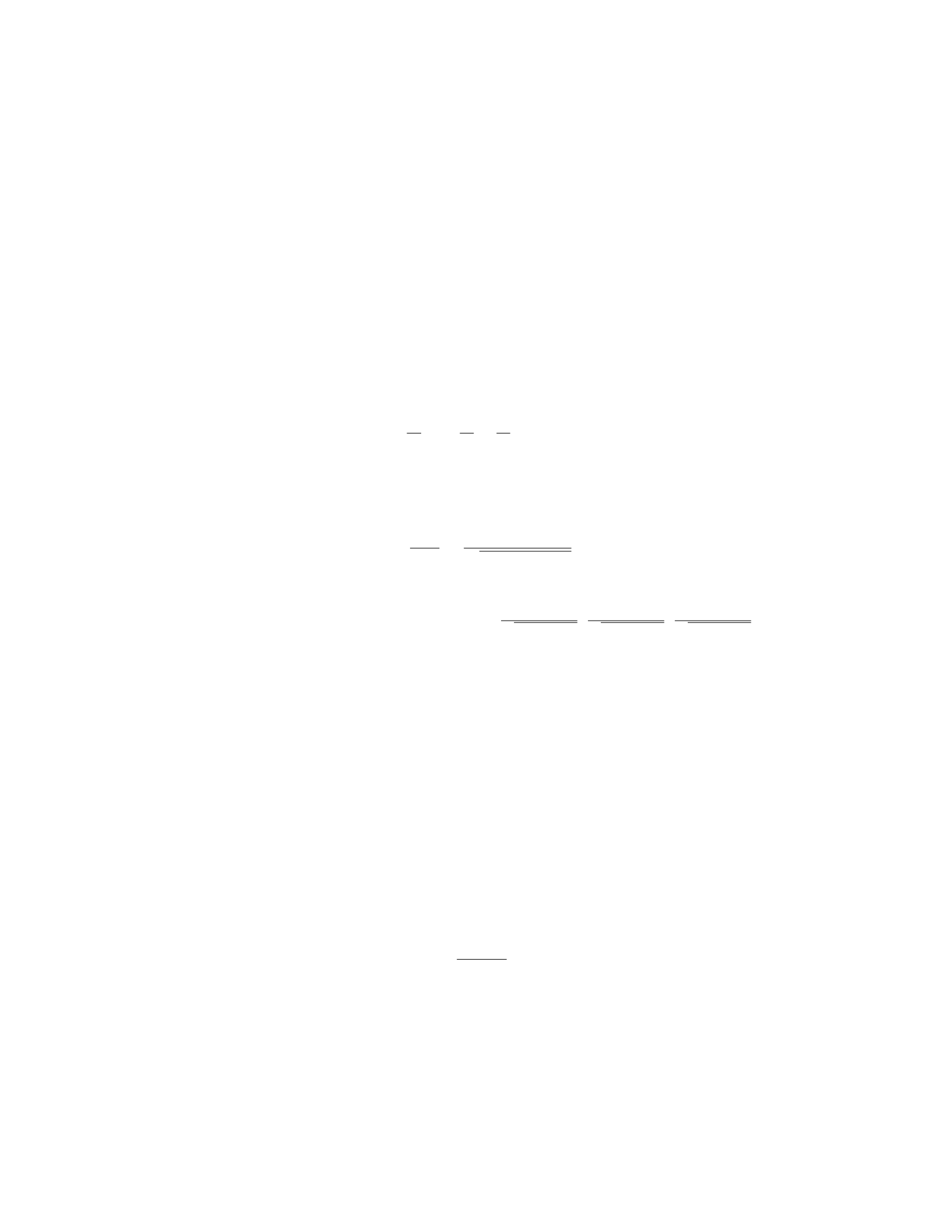
Question 5
Question
Let Sbe the surface given by z=x2+y2for 0≤z≤1oriented with outward
normal. Use Stokes’ Theorem to evaluate the surface integral RRS(∇ × F)·dS,
where F(x, y, z) = (x2+y2,2xy, z).
Solution
Step 1: Calculate the curl of F. The curl of Fis given by:
∇ × F=
i j k
∂
∂x
∂
∂y
∂
∂z
x2+y22xy z
= (0,0,2y−2x)
Step 2: Determine the unit normal vector nto the surface S. Since Sis
given by z=x2+y2, the normal vector can be written as:
n=∇z
|∇z|=⟨−2x, −2y, 1⟩
p1+4x2+ 4y2
Step 3: Calculate the outward unit normal vector dS. The outward unit
normal vector dSis given by dS=ndS =−2x
√1+4x2+4y2,−2y
√1+4x2+4y2,1
√1+4x2+4y2dA
Step 4: Setup the surface integral using Stokes’ Theorem. Stokes’ Theorem
states that the surface integral of ∇ × Fover Sis equal to the line integral of
Falong the boundary of S, which in this case is the circle x2+y2= 1 in the
xy-plane.
Therefore, the surface integral RRS(∇ × F)·dScan be rewritten as the line
integral HCF·draround the boundary curve Cof S.
Step 5: Parameterize the curve C. Parameterize the circle Cin the xy-plane
with x= cos t,y= sin t,0≤t≤2π.
Step 6: Evaluate the line integral. Substitute the parameterization of the
curve into Fand the differential dr, then calculate F·dr.
Step 7: Compute the final result. Calculate the line integral over Cto find
the value of the surface integral using Stokes’ Theorem.
Question 6
Question
Let Sbe the part of the cone z=px2+y2that lies between the planes z= 1
and z= 3. Use Stokes’ Theorem to calculate the flux of the curl of the vector
field F(x, y, z) = (xz, yz, x2)across the surface S, where the direction of positive
orientation is the outward normal.
5
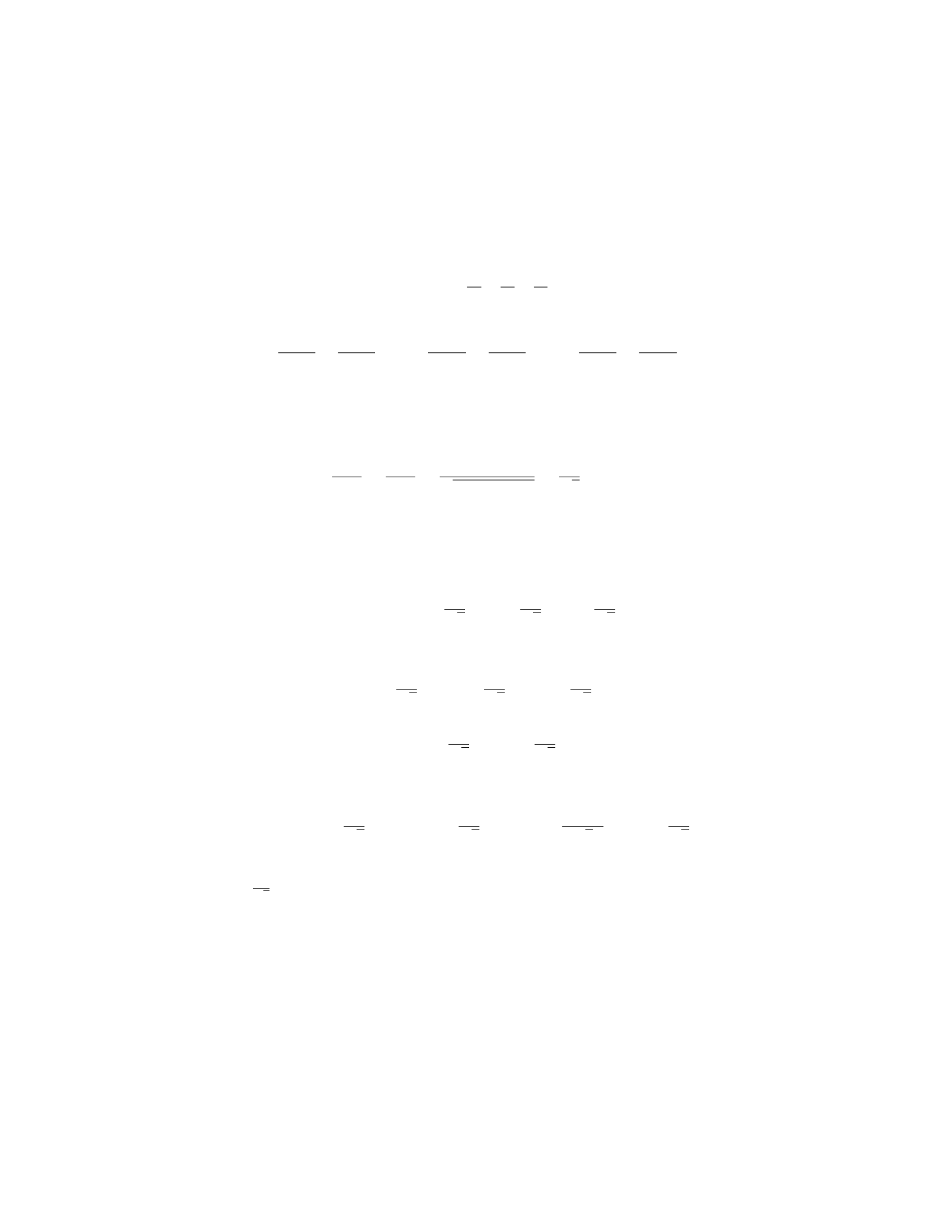
Solution
1. First, we calculate the curl of the vector field F(x, y, z):
∇ × F=
i j k
∂
∂x
∂
∂y
∂
∂z
xz yz x2
=∂(x2)
∂y −∂(yz)
∂z i−∂(xz)
∂x −∂(x2)
∂z j+∂(yz)
∂x −∂(xz)
∂y k
= (0 −y)i−(z−0)j+ (z−z)k=−yi−zj
2. Then, we calculate the outward unit normal vector to the surface S, which
is given by
n=∇g
|∇g|=∇z
|∇z|=i+j+k
√12+ 12+ 12=1
√3(i+j+k)
3. The surface integral of the curl of Fover Scan be calculated using Stokes’
Theorem: ZZS
(∇ × F)·dS=IC
F·dr
=Z3
1Z2π
0
(−y, −z)·(1
√3cos(ϕ),1
√3sin(ϕ),1
√3)dϕdz
4. Performing the dot product and integrating, we get:
Z3
1Z2π
0−y
√3cos(ϕ)−z
√3sin(ϕ) + 1
√3dzdϕ
=Z3
1Z2π
0−z
√3sin(ϕ) + 1
√3dzdϕ
5. Further evaluating the integral, we obtain:
=Z3
1−2πz
√3dz =−2πz2
√33
1
=−2π32−1
√3=−2π8
√3
Therefore, the flux of the curl of the vector field F(x, y, z)across the surface
Sis −8π
√3.
Question 8
Question
Let Sbe the portion of the plane z=x+ythat lies inside the cylinder x2+y2=
1oriented with outward-pointing normal. Use Stokes’ Theorem to evaluate
RRSF·dS, where F=yzi+xzj+xyk.
6
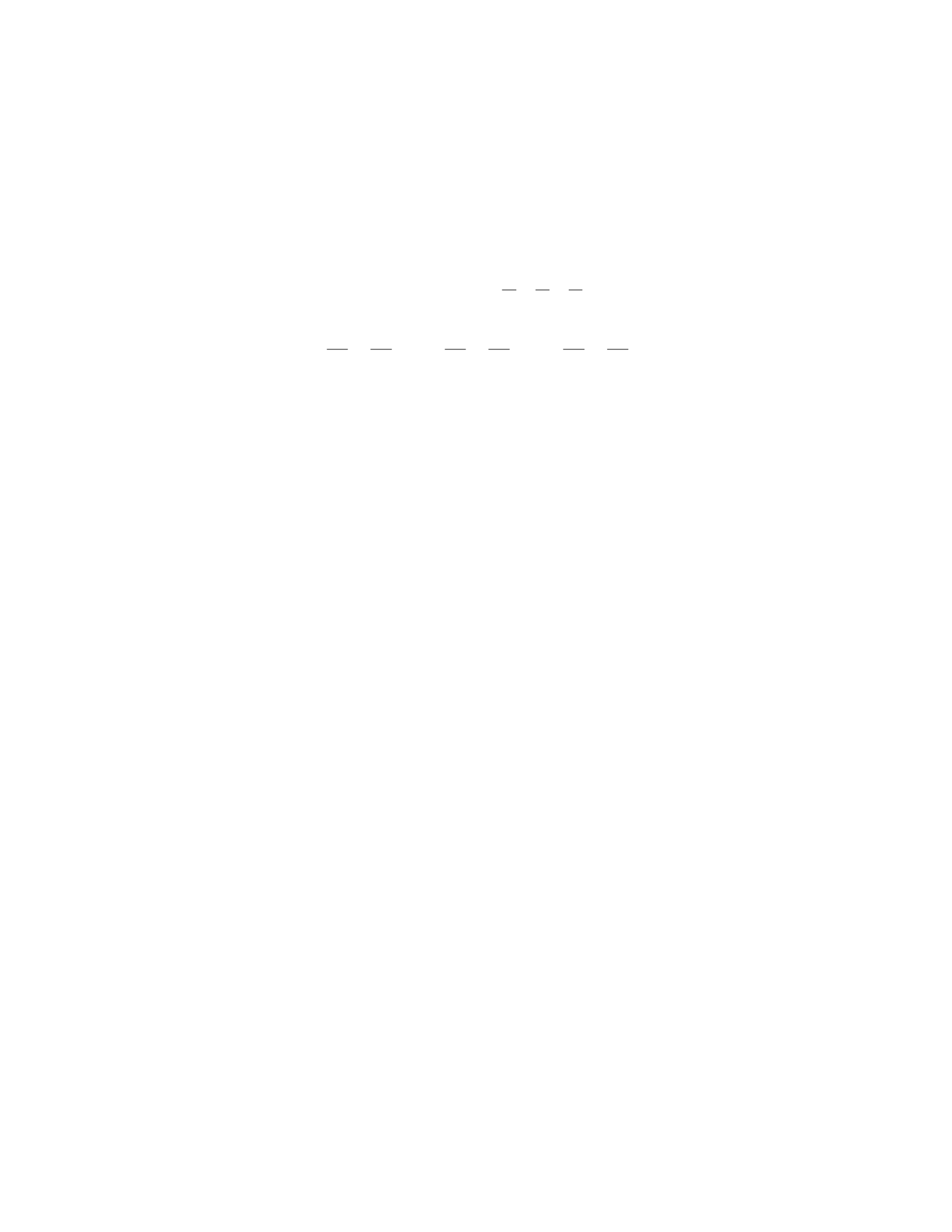
Solution
Step 1: First, find the curl of F: Let F=Pi+Qj+Rk. Then, the curl of Fis
given by
curl(F) = ∇ × F=
i j k
∂
∂x
∂
∂y
∂
∂z
P Q R
=∂R
∂y −∂Q
∂z i−∂R
∂x −∂P
∂z j+∂Q
∂x −∂P
∂y k
For F=yzi+xzj+xyk, we have P=yz,Q=xz,R=xy. Thus, the curl of
Fis
curl(F) = (z−z)i−(y−y)j+ (x−x)k=0
Step 2: By Stokes’ Theorem, we have
ZZS
F·dS=ZZ∂S
F·dr
Since the curl of Fis 0, the line integral vanishes. Therefore, RRSF·dS= 0.
Question 9
Question
Let Sbe the part of the paraboloid z= 4−x2−y2that lies above the plane z= 1.
Orient Swith outward normal. Use Stokes’ Theorem to evaluate HCF·drwhere
F(x, y, z) = xi+yj+zkand Cis the boundary of Soriented counterclockwise
when viewed from above.
Solution
Step 1: Find the curl of F. Step 2: Compute the surface integral of the curl
of Fover the region Sto apply Stokes’ Theorem. Step 3: Parameterize the
boundary curve Cand compute the line integral of Fover C.
Let’s start with these steps.
Question 10
Question
Let F=x2i+y2j+z2kbe a vector field, and let Sbe the surface enclosed by
the cylinder x2+y2= 1 and the planes z= 0 and z= 2. Use Stokes’ Theorem
to evaluate the line integral HCF·draround the boundary curve Cof S.
7

Solution
Step 1: First, we need to parameterize the boundary curve C, which consists of
the circle x2+y2= 1 on the plane z= 0 and the same circle on the plane z= 2.
We will parameterize the circle on the plane z= 0 as r1(t) = cos(t)i+ sin(t)j
for 0≤t≤2π. The circle on the plane z= 2 can be parameterized similarly as
r2(t) = cos(t)i+ sin(t)j+ 2k.
Step 2: Next, we compute the curl of the vector field F:
∇ × F=
i j k
∂
∂x
∂
∂y
∂
∂z
x2y2z2
= (2z−2y)i−(2z−2x)j+ 0k= 2(z−y)i−2(z−x)j
Step 3: We can now apply Stokes’ Theorem to relate the line integral over
Cto the surface integral over S. Using Stokes’ Theorem, we have:
IC
F·dr=ZZS
(∇ × F)·ndS
where nis the outward unit normal to S. Since the surface Sis bounded by
C, the outward unit normal npoints outward from the cylinder.
Step 4: We will calculate the surface integral over S:
ZZS
(∇ × F)·ndS =ZZS
(2(z−y)i−2(z−x)j)·kdS
Since the normal vector nis in the kdirection, the dot product simplifies
to −2(z−x). To find the limits of integration, we note that the projection of
Sonto the xy-plane is the circle x2+y2= 1. Thus, the limits for xand yare
x2+y2≤1, and for z, the limits are 0≤z≤2.
Step 5: We can now evaluate the surface integral:
ZZS
(∇ × F)·ndS
=Z2π
0Z1
0−2(2 −cos(t)) dr dθ
=−4Z2π
0
(2 −rcos(t))
1
0dθ
=−4Z2π
0
(2 −cos(t)−0) dθ
=−4·2π(2)
=−16π
Therefore, the line integral HCF·draround the boundary curve Cof Sis
−16π.
8

Question 11
Question
Let F(x, y, z) = (y2−z)i+ (z2−x)j+ (x2−y)kand let Sbe the portion of
the cone z=px2+y2that lies between the planes z= 1 and z= 3. Use
Stokes’ Theorem to evaluate HCF·dr, where Cis the counterclockwise-oriented
boundary curve of surface S.
Solution
Step 1: First, let’s parameterize the boundary curve Cof the surface S. The
boundary curve consists of two parts: the circle x2+y2= 1 at z= 1 and the
circle x2+y2= 9 at z= 3. We can parameterize these circles as follows: For
z= 1, we have the circle C1:x2+y2= 1. Parameterizing this circle gives us:
r1(t) = ⟨cos(t),sin(t),1⟩,where 0≤t≤2π.
For z= 3, we have the circle C2:x2+y2= 9. Parameterizing this circle gives
us:
r2(t) = ⟨3 cos(t),3 sin(t),3⟩,where 0≤t≤2π.
Step 2: Now, we need to compute the curl of F:
∇ × F=
i j k
∂
∂x
∂
∂y
∂
∂z
y2−z z2−x x2−y
= (2y+ 1)i−(2z+ 1)j+ (2x+ 1)k.
Step 3: By Stokes’ Theorem, we have
IC
F·dr=ZZS
(∇ × F)·ndS,
where nis the unit normal to S.
Step 4: To find the unit normal to S, we compute the gradient of z=
px2+y2as ∇z=⟨x
√x2+y2,y
√x2+y2,−1⟩.
Step 5: The unit normal to Sis then ˆ
n=∇z
||∇z|| =⟨x,y,−√x2+y2⟩
√x2+y2+1 .
Step 6: We can now evaluate the surface integral RRS(∇×F)·ndS using the
parameterizations of C1and C2from Step 1.
Question 12
Question
Let Sbe the surface of the portion of the plane z= 4 −x−2ythat lies above
the square 0≤x≤1,0≤y≤1, oriented upward. Calculate the flux of the
curl of the vector field F= 2xi+yj+zkacross S.
9
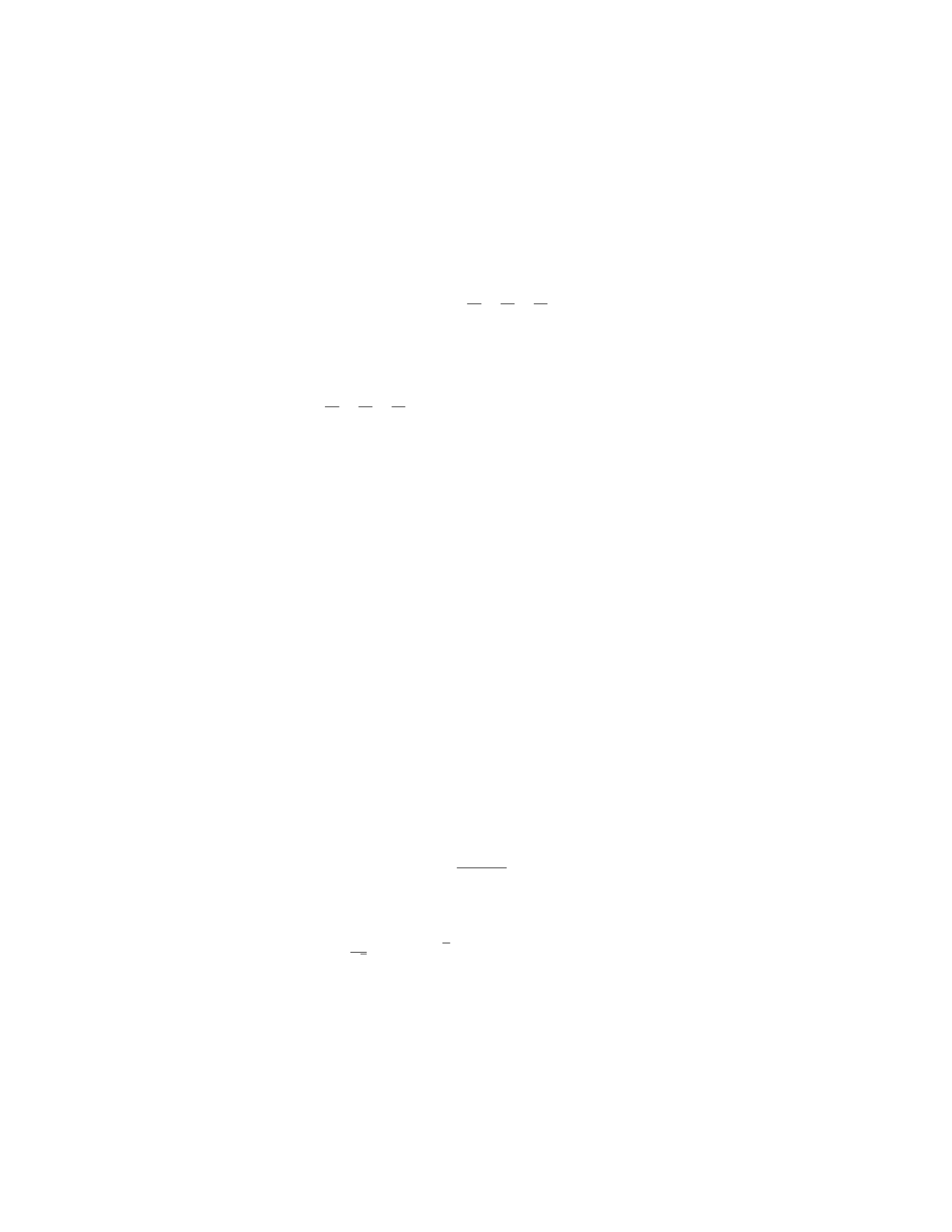
Solution
Step 1: Find the curl of the vector field F. The curl of a vector field F=
Pi+Qj+Rkis given by:
∇ × F=
i j k
∂
∂x
∂
∂y
∂
∂z
P Q R
In this case, F= 2xi+yj+zk, so:
∇ × F=
i j k
∂
∂x
∂
∂y
∂
∂z
2x y z
= (0 −0)i−(0 −1)j+ (1 −2)k=−j−k
Step 2: Use Stokes’ Theorem to find the flux of the curl of Facross S.
Stokes’ Theorem states:
ZZS
(∇ × F)·dS=IC
F·dr
where Cis the boundary of the surface S.
Step 3: Find the boundary curve Cof the surface S. The boundary curve
Cof the surface Sis the square where 0≤x≤1,0≤y≤1. It consists of four
line segments: 1. y= 0,0≤x≤12. x= 1,0≤y≤13. y= 1,0≤x≤14.
x= 0,0≤y≤1
Step 4: Parameterize and calculate the line integral HCF·dr. We will
integrate over each of the four line segments of the boundary: 1. y= 0,0≤
x≤1:r(t) = ti,0≤t≤12. x= 1,0≤y≤1:r(t) = i+tj,0≤t≤13.
y= 1,0≤x≤1:r(t) = (1 −t)i+j,0≤t≤14. x= 0,0≤y≤1:r(t) = tj,
0≤t≤1
Step 5: Substitute the parameterization into Fand calculate the dot product
with dr. For each line segment, calculate: 1. HCF·dr=R1
0(2t, 0,4−t)·(1,0,0)dt
Question 13
Question
Let Sbe the part of the cone z=px2+y2that lies between the planes z= 1
and z= 4. Use Stokes’ Theorem to evaluate the surface integral RRSF·dS,
where F(x, y, z) = (z, x, y).
(Note: You may assume that a positively oriented unit normal vector to S
at each point is n=1
√2(−x, −y, √2).)
Solution
Step 1: Find the boundary curve Cof Swhere the orientation is consistent with
the orientation of Sgiven by the positively oriented unit normal vector n.
10
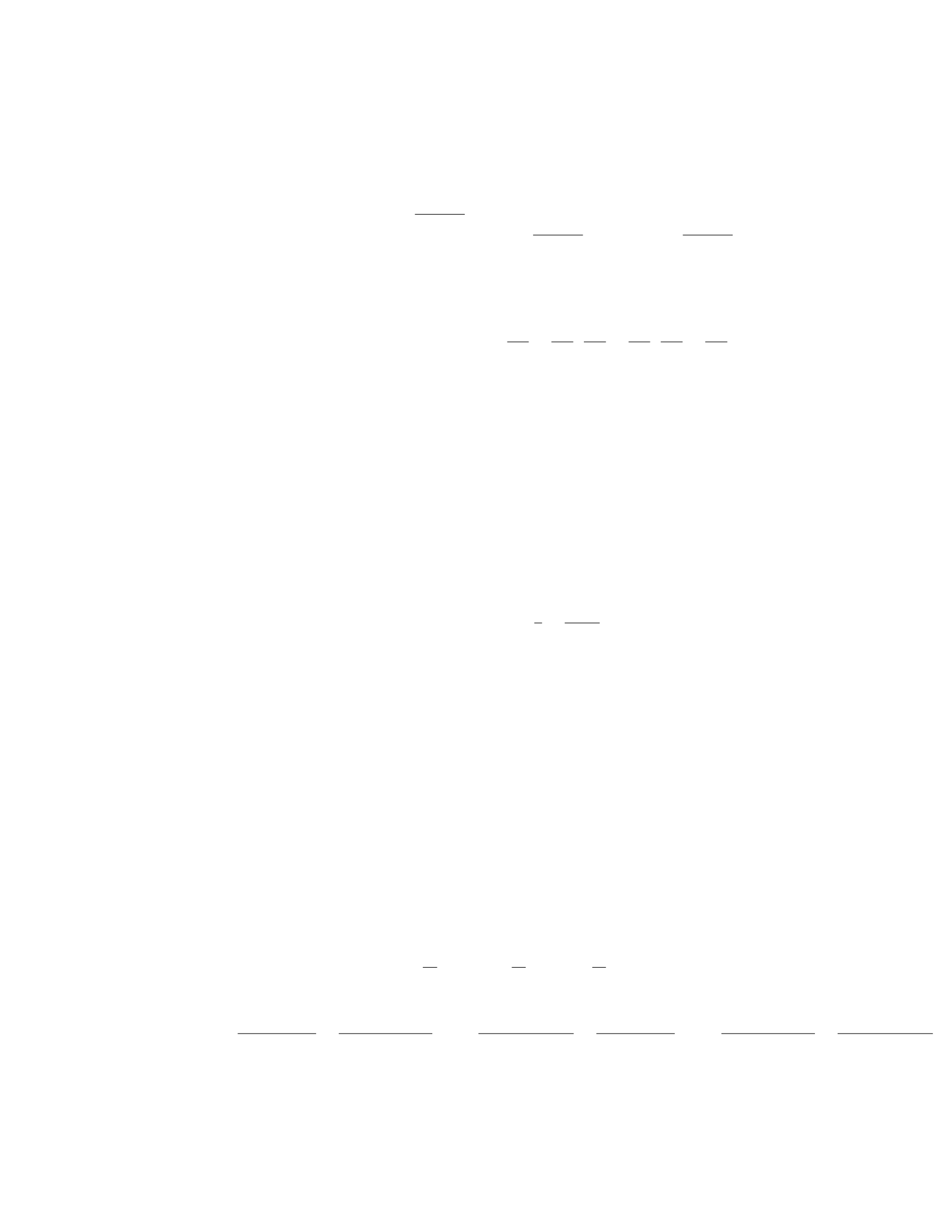
Since Slies between z= 1 and z= 4, the boundary curve Cconsists of the
intersection of the cone z=px2+y2and the planes z= 1 and z= 4. Solving
these equations, we get z= 1 and z= 4:1 = px2+y2and 4 = px2+y2.
Thus, the boundary curve Cis the circle x2+y2= 1.
Step 2: Parameterize the boundary curve C.
Let Cbe parameterized by r(t) = (cos t, sin t, 1) where 0≤t≤2π.
Step 3: Find the curl of F.
The curl of Fis given by ∇ × F=∂Fz
∂y −∂Fy
∂z ,∂Fx
∂z −∂Fz
∂x ,∂Fy
∂x −∂Fx
∂y .
Calculating the components of the curl, we have: ∇×F= (0 −1,1−0,1−0) =
(−1,1,1).
Step 4: Evaluate the line integral HCF·dr.
Using Stokes’ Theorem, we have: RRSF·dS=HCF·dr.
IC
F·dr=Z2π
0
F(r(t)) ·r′(t)dt
Z2π
0
F(r(t)) ·r′(t)dt =Z2π
0
(1,cos t, sin t)·(−sin t, cos t, 0)dt
Z2π
0
(1,cos t, sin t)·(−sin t, cos t, 0)dt =Z2π
0−sin t+ cos2tdt
Z2π
0−sin t+ cos2tdt =−cos t+t
2+sin 2t
42π
0
= 0
.
Therefore, the surface integral RRSF·dSis 0.
Question 14
Question
Let Fbe a vector field defined by F(x, y, z) = (y2z+ cos x)i+ (xz2+ sin y)j+
(xy2+ez)k. Calculate the surface integral RRScurl(F)·dS, where Sis the
portion of the plane z= 4 −x−2ythat lies above the triangle in the xy-plane
with vertices at (0,0),(1,0), and (0,2).
Solution
Step 1: Calculate curl(F).
curl(F) =
i j k
∂
∂x
∂
∂y
∂
∂z
y2z+ cos x xz2+ sin y xy2+ez
=∂(xy2+ez)
∂y −∂(xz2+ sin y)
∂z i−∂(y2z+ cos x)
∂x −∂(xy2+ez)
∂z j+∂(xz2+ sin y)
∂x −∂(y2z+ cos x)
∂y k
11
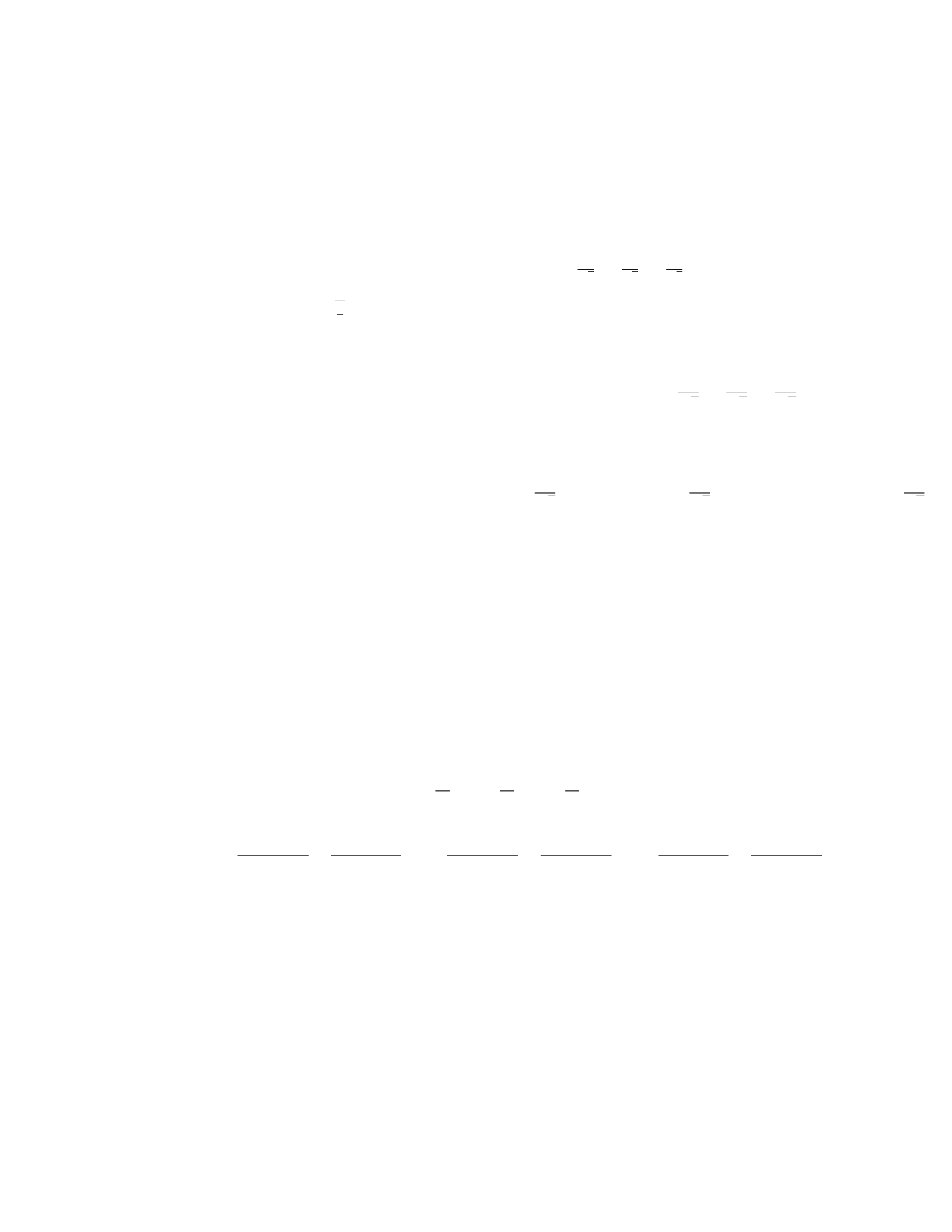
= (2xy −z2)i−(sin x−2xy)j+ (2xz −y2)k
Step 2: Calculate the unit normal vector to the surface S. The surface S
is defined by z= 4 −x−2y. The normal vector to this surface is n=∇z=
−i−2j+k. Therefore, the unit normal vector is n=−1
√6i−2
√6j+1
√6k.
Step 3: Calculate the magnitude of dS. The magnitude of dSis given by
dS =|n|dxdy =q6
6dxdy =dxdy.
Step 4: Calculate the surface integral. The surface integral can be calculated
as:
ZZS
curl(F)·dS=ZZS(2xy −z2)i−(sin x−2xy)j+ (2xz −y2)k·−1
√6i−2
√6j+1
√6kdxdy
Now, we substitute z= 4 −x−2yinto the expression above and integrate over
the region in the xy-plane:
ZZS
curl(F)·dS=ZZR(2xy −(4 −x−2y)2)−1
√6−(sin x−2xy)2
√6+ (2x(4 −x−2y)−y2)1
√6dxdy
where Ris the triangle in the xy-plane
Question 15
Question
Let Sbe the hemisphere x2+y2+z2= 1, z ≥0, and let F= (x2+y2, y2+
z2, z2+x2). Calculate the flux of Facross Susing Stokes’ Theorem.
Solution
Step 1: Calculate the curl of F.
∇ × F=
i j k
∂
∂x
∂
∂y
∂
∂z
x2+y2y2+z2z2+x2
=∂(z2+x2)
∂y −∂(y2+z2)
∂z i−∂(z2+x2)
∂x −∂(x2+y2)
∂z j+∂(y2+z2)
∂x −∂(x2+y2)
∂y k
= (0 −2z)i−(2x−0)j+ (2y−0)k=−2zi−2xj+ 2yk
Step 2: Calculate the surface integral of Fover Susing Stokes’ Theorem.
ZZ
S
(∇ × F)·dS=I
∂S
F·dr
Step 3: The boundary of Sis the circle x2+y2= 1, z = 0.
r(t) = cos(t)i+ sin(t)j,0≤t≤2π
12

Step 4: Parameterize the curve C.
r′(t) = −sin(t)i+ cos(t)j
r′(t)×k=−cos(t)k
Step 5: Calculate the line integral.
I
∂S
F·dr=Z2π
0
F(r(t)) ·r′(t)×kdt
=Z2π
0
(−sin(t))2+ cos(t)2+ (−sin(t))2dt =Z2π
0
2dt = 4π
Therefore, the flux of Facross Sis 4π.
Question 16
Question
Let Sbe the part of the plane x+ 2y+ 3z= 6 that lies inside the cylinder
x2+y2= 4. Use Stokes’ Theorem to evaluate
IC
F·dr,
where F=⟨y, x, z⟩and Cis the boundary of Soriented counterclockwise as
viewed from above.
Solution
Step 1: Find the boundary curve Cof the surface S. This is the intersection of
the plane and the cylinder, so we have
x+ 2y+ 3z= 6
x2+y2= 4.
Solving these equations, we find that the boundary curve Cis the circle x2+y2=
4, which is the circle of radius 2 centered at the origin.
Step 2: Parameterize the boundary curve C. Let x= 2 cos t,y= 2 sin t,
where 0≤t≤2π. Then dr=⟨−2 sin t, 2 cos t, 0⟩dt.
Step 3: Compute F(r(t)).
F(r(t)) = ⟨2 sin t, 2 cos t, 2 sin t⟩.
Step 4: Compute ∇ × F.
∇ × F=
i j k
∂
∂x
∂
∂y
∂
∂z
y x z
=⟨1,1,−2⟩.
13

Step 5: Compute the line integral using Stokes’ Theorem.
IC
F·dr=ZZS
(∇ × F)·ndS,
where nis the outward unit normal to S. Since the outward normal for the
plane x+ 2y+ 3z= 6 is n=⟨1,2,3⟩/√12+ 22+ 32=⟨1/√14,2/√14,3/√14⟩,
we have IC
F·dr=ZZS
(∇ × F)·ndS
=ZZS⟨1,1,−2⟩ · 1
√14⟨1,2,3⟩dS
=1
√14 ZZS
(1 + 2 −6) dS
=−3
√14 ZZS
dS
=−3
√14 ·Area(S).
Step 6: Find the area of the region S. This can be done by finding the
projection of Sonto the xy-plane and calculating the double integral over this
region.
Step 7: Calculate the final answer for the line integral.
Question 17
Question
Let Sbe the part of the plane z= 3 −x−ythat lies above the triangle with
vertices (0,0,0),(1,0,0), and (0,1,0), oriented counterclockwise when viewed
from above. Let Fbe the vector field F= (x2+y2, z, 2x−z). Calculate the
surface integral R RSF·dSusing Stokes’ Theorem.
Solution
Step 1: Calculate the curl of F. The curl of Fis given by:
curl(F) = ∂(2x−z)
∂y −∂(z)
∂z ,∂(x2+y2)
∂z −∂(2x−z)
∂x ,∂(z)
∂x −∂(x2+y2)
∂y
= (−1−0,0−2,0−2) = (−1,−2,−2).
Step 2: Calculate the normal vector to the surface S. The normal vector to
the plane z= 3 −x−yis n= (−∂z
∂x ,−∂z
∂y ,1) = (−(−1),−(−1),1) = (1,1,1).
Step 3: Normalize the normal vector. The unit normal vector is n0=
|n| = (1, 1, 1)√12+12+12=(1
√3,1
√3,1
√3).
14

Step 4: Calculate the surface integral using Stokes’ Theorem. Stokes’ Theo-
rem states that R RSF·dS=RRRVcurl(F)·ndV , where Vis the region enclosed
by S. Since Sis the part of the plane z= 3 −x−ythat lies above the given
triangle, the region Vis the triangle 0≤x≤1,0≤y≤1−x, 0≤z≤3−x−y.
The surface integral becomes:
Z ZS
F·dS=ZZZV
(−1,−2,−2) ·(1,1,1) dV
=ZZZV−5dV.
Step 5: Calculate the triple integral over region V. We have 0≤x≤1,0≤
y≤1−x, 0≤z≤3−x−y. Therefore, the triple integral becomes:
Z1
0Z1−x
0Z3−x−y
0−5dz dy dx
=Z1
0Z1−x
0
[−5z]3−x−y
0dy dx
=Z1
0Z1−x
0−5(3 −x−y)dy dx
=Z1
0
[−5(3y−xy −y2
2)]1−x
0dx
=Z1
0−53(1 −x)−x(1 −x)−(1 −x)2
2dx
=Z1
0−17
2x2+ 14x−15 dx
Question 18
Question
Let Sbe the part of the plane x+y+z= 1 that lies in the first octant.
Let F(x, y, z) = ⟨2xz, y2, x +z⟩. Use Stokes’ Theorem to evaluate the surface
integral
ZZS
curl F ·ndS
where nis the outward unit normal to S.
15

Solution
Step 1: First, we need to find the curl of F.
curl F=
i j k
∂
∂x
∂
∂y
∂
∂z
2xz y2x+z
=∂
∂y (x+z)−∂
∂z (y2),∂
∂z (2xz)−∂
∂x(x+z),∂
∂x(y2)−∂
∂y (2xz)
= (1 −0,2x−1,2z)
= (1,2x−1,2z)
Step 2: Parameterize the surface S. Since Sis the part of the plane x+y+z=
1in the first octant, we can parameterize Sas:
r(u, v) = ⟨u, v, 1−u−v⟩,0≤u≤1,0≤v≤1−u
Step 3: Calculate the normal vector n. The normal vector can be found by
taking the cross product of the partial derivatives of rwith respect to uand v.
∂u =⟨1,0,−1⟩,
∂v =⟨0,1,−1⟩So, n=
∂u×
∂v =⟨1,1,1⟩
Step 4: Evaluate the surface integral. Using Stokes’ Theorem, we have:
ZZS
curl F·ndS =ZZD
(curl F)·(ru×rv)dA
where Dis the region in the uv-plane corresponding to the surface S.
=ZZD
(1,2u−1,2(1 −u−v)) ·(1,1,1) dA
=ZZD
(1 + 2u−1−2v)dA
=ZZD
(2u−2v)dA
=Z1
0Z1−u
0
(2u−2v)dv du
=Z1
02uv −v2v=1−u
v=0 du
16

=Z1
0
(2u−(1 −u)2)du
=Z1
0
(3u2−2u+ 1) du
=u3−u2+u1
0
= 1 −1+1
= 1
Therefore, the surface integral is equal to 1.
Question 20
Question
Let Sbe the part of the plane z= 4 −x−2ythat lies above the region in the
xy-plane bounded by the rectangle with vertices (0,0),(4,0),(4,3), and (0,3).
Use Stokes’ Theorem to evaluate the surface integral
ZZS
F·dS
where F= (y−z, x +z, x +y).
Solution
Step 1: Calculate the curl of F. The curl of Fis given by
∇ × F=
i j k
∂
∂x
∂
∂y
∂
∂z
y−z x +z x +y
=∂
∂y (x+y)−∂
∂z (x+z)i−∂
∂x(y−z)−∂
∂z (y+z)j+∂
∂x(x+z)−∂
∂y (y+z)k
=i−j−k
Step 2: Determine the unit normal vector nto the surface S. Given that
Sis the plane z= 4 −x−2y, the unit normal vector to the surface Sis
n=∇z
|∇z|=D−∂z
∂x ,−∂z
∂y ,1E=⟨−(−1),−(−2),1⟩=⟨1,2,1⟩.
Step 3: Calculate the curl of F·n. The curl of F·nis ∇ × (F·n) =
∇ × (x−y−z) = ∇ × (−3) = 0.
Step 4: Apply Stokes’ Theorem. Stokes’ Theorem states that
ZZS
F·dS=ZC
F·dr
17

where Cis the boundary of the surface Soriented counterclockwise when viewed
from above.
The boundary of the region in the xy-plane is the rectangle with vertices
(0,0),(4,0),(4,3), and (0,3). Parameterize this rectangle using r(u, v) =
⟨u, v, 4−u−2v⟩where 0≤u≤4and 0≤v≤3.
The line integral RCF·drbecomes
Z3
0
(0 −2(4) + 4)dv +Z4
0
(3 + 4)du =−20 + 12 = −8
Therefore, the surface integral evaluates to −8.
Question 21
Question
Let Cbe the curve of intersection of the plane z= 0 and the cylinder x2+y2= 1
oriented counterclockwise when viewed from above. Let F= (y+z, x +z, x +y)
be a vector field. Calculate the flux of Facross the curve Cusing Stokes’
Theorem.
Solution
Step 1: Parameterize the curve C.
The curve Cis simply the circle x2+y2= 1 in the xy-plane. We can
parameterize this curve by r(t) = (cos t, sin t, 0) for 0≤t≤2π.
Step 2: Find the curl of F.
The curl of Fis given by ∇ × F=
ˆ
iˆ
jˆ
k
∂
∂x
∂
∂y
∂
∂z
y+z x +z x +y
= (1,1,1).
Step 3: Calculate the line integral of Fover C.
By Stokes’ Theorem, the flux of Facross Cis equal to the line integral of F
over the curve C, which is given by
ZC
F·dr=Z2π
0
F(r(t))·r′(t)dt =Z2π
0
(0,0,1)·(−sin t, cos t, 0)dt =Z2π
0
0dt = 0.
Therefore, the flux of Facross the curve Cis 0.
Question 22
Question
Let Sbe the surface given by z=x2−y2for 0≤x≤2and 0≤y≤2. Use
Stokes’ Theorem to evaluate the line integral
18
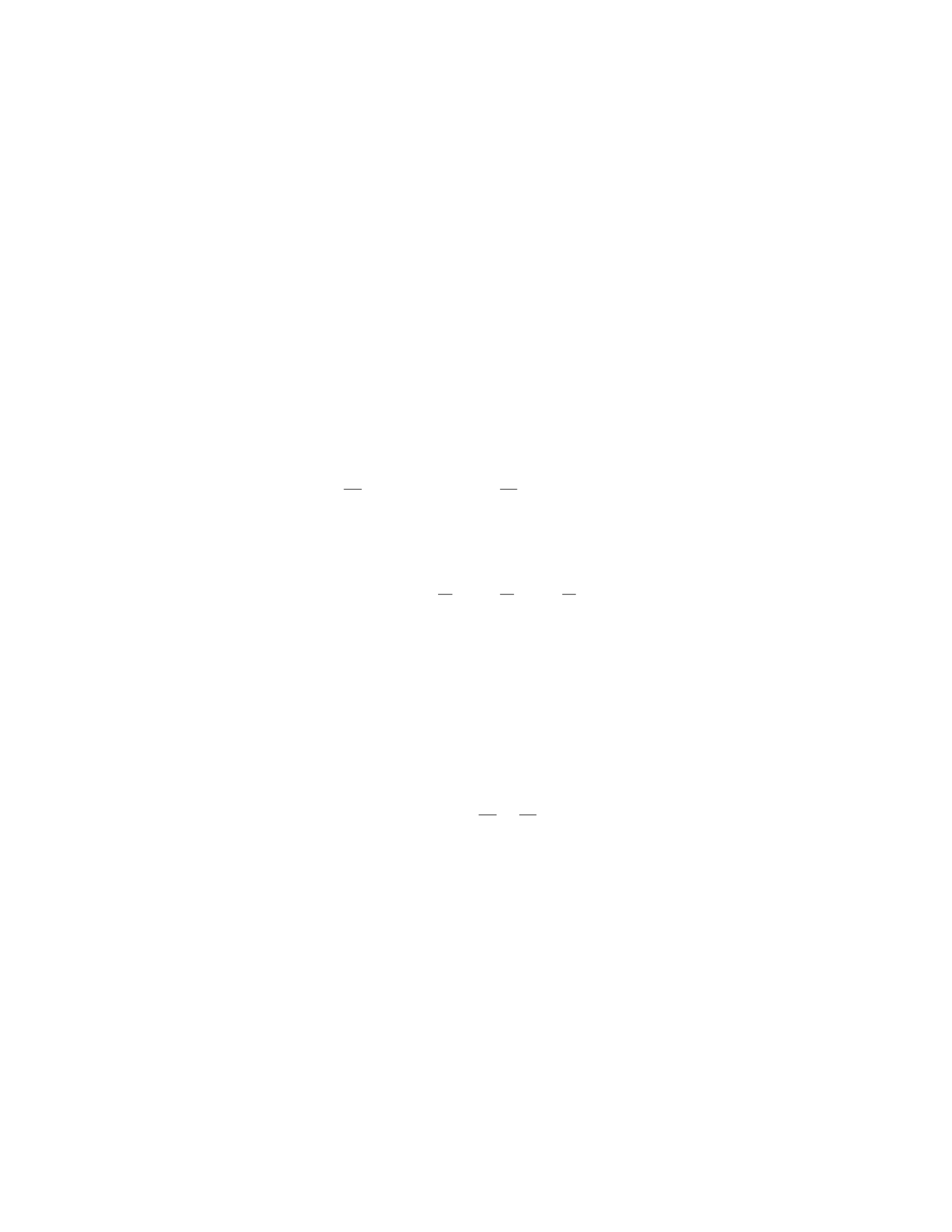
ZC
(x2+ 2y)dx + (z2−y)dy + (2x−2z)dz
where Cis the boundary curve of Swith counterclockwise orientation when
viewed from above.
Solution
Step 1: First, we need to parameterize the surface S.
The surface Sis given by z=x2−y2,0≤x≤2, and 0≤y≤2.
Let’s define the parameterization r(u, v) = ⟨u, v, u2−v2⟩, where (u, v)∈
D={(u, v)|0≤u≤2,0≤v≤2}.
Step 2: Next, we need to calculate the partial derivatives of rwith respect
to uand v.
∂r
∂u =⟨1,0,2u⟩and ∂r
∂v =⟨0,1,−2v⟩
Step 3: Now, we calculate the curl of the vector field F=⟨x2+ 2y, z2−
y, 2x−2z⟩.
∇ × F=
i j k
∂
∂x
∂
∂y
∂
∂z
x2+ 2y z2−y2x−2z
=⟨−1,0,2+2⟩=⟨−1,0,4⟩
Step 4: Using Stokes’ Theorem, we have
ZC
F·dr=ZZS
(∇ × F)·ndS
where nis the unit normal vector to the surface S.
Step 5: The surface integral RRS(∇ × F)·ndS simplifies to
ZZD⟨−1,0,4⟩ · ∂r
∂u ×∂r
∂v du dv
=ZZD
1 0 2u
0 1 −2v
−1 0 4
du dv
Step 6: Computing the determinant and performing the dot product gives
=ZZD
(4 + 4u)du dv
Step 7: Evaluating the double integral over the region D= [0,2]×[0,2] gives
the final answer.
19

Question 23
Question
Let Sbe the part of the cone z2=x2+y2that lies between the planes z= 1
and z= 3. Use Stokes’ Theorem to evaluate the surface integral RRS(∇×F)·dS,
where F(x, y, z) = (x2+y2)i+ (y2−z2)j+ (x2−y2)k.
Solution
To apply Stokes’ Theorem, we need to compute the curl of Fand the normal
vector nto the surface S.
Step 1: Compute ∇ × F.
∇ × F=
i j k
∂
∂x
∂
∂y
∂
∂z
x2+y2y2−z2x2−y2
=∂(x2−y2)
∂y −∂(y2−z2)
∂z i−∂(x2+y2)
∂x −∂(x2−y2)
∂z j+∂(x2+y2)
∂y −∂(y2−z2)
∂x k
=−2yi−2xj+ 2zk
Step 2: Find the unit normal vector n.The unit normal vector to the
surface Sis n=1
√2(−i−j+k)since the normal vector points outward.
Step 3: Evaluate the surface integral using Stokes’ Theorem. Stokes’
Theorem states that ZZS
(∇ × F)·dS=IC
F·dr
where Cis the boundary curve of S.
The boundary curve Cof Sis a circle in the xy-plane with radius 3parametrized
by r(t) = 3 cos(t)i+ 3 sin(t)jfor 0≤t≤2π.
Therefore, we have
IC
F·dr=Z2π
0
F(r(t)) ·r′(t)dt
=Z2π
0
((9 cos2(t) + 9 sin2(t))(−3 sin(t)) + (9 sin2(t)−9 cos2(t))(3 cos(t))) dt
=Z2π
0
(−27 sin(t) cos(t) + 27 sin(t) cos(t)) dt
=Z2π
0
0dt = 0
Hence, the value of the surface integral RRS(∇ × F)·dSis 0.
20

Question 24
Question
Let Sbe the surface of the cone z=px2+y2bounded by the plane z= 3.
Use Stokes’ Theorem to evaluate the surface integral RRS(∇ × F)·dS, where
F(x, y, z) = xi+yj+zk.
Solution
Step 1: Calculate the curl of F: The curl of Fis given by:
∇ × F=
i j k
∂
∂x
∂
∂y
∂
∂z
x y z
=∂z
∂y −∂y
∂z i−∂z
∂x −∂x
∂z j+∂y
∂x −∂x
∂y k
=i+j+k
Step 2: Find the unit normal vector to the surface S: The unit normal vector
to the surface Sis given by n=(−x,−y,√x2+y2)
√x2+y2+1 .
Step 3: Calculate the outward unit normal vector: Since the cone is upward-
facing, the outward unit normal vector is the negation of the unit normal vector
calculated in Step 2. Therefore, n=(x,y,−√x2+y2)
√x2+y2+1 .
Step 4: Calculate dS: The surface element dSis given by dS=ndS, where
dS =q1+(∂z
∂x )2+ ( ∂z
∂y )2dA =√2dA.
Step 5: Evaluate the surface integral:
ZZS
(∇ × F)·dS=ZZD
(∇ × F)·n√2dA
=ZZD
(i+j+k)·(x, y, −px2+y2)
px2+y2+ 1
√2dA
=ZZD
(−z)√2dA
=−√2ZZD
zdA
The integral RRDzdA represents the flux of zthrough the region D, which
in this case is the projection of Sonto the xy-plane. However, the surface of
the cone Sdoes not intersect the xy-plane, making the flux integral through D
equal to zero. Hence, the surface integral RRS(∇ × F)·dSis also equal to 0.
21

Question 25
Question
Let Sbe the part of the plane z= 4 −x−ythat lies above the region in the
xy-plane bounded by the curve x2+y2= 1. Calculate the flux of the vector
field F(x, y, z) = ⟨yz, xz, xy⟩across the surface S.
Solution
Step 1: First, we find the unit normal vector to the surface S, which is given by
n=∂z
∂x ,∂z
∂y ,−1.
In this case, ∂z
∂x =−1,∂z
∂y =−1, so n=⟨−1,−1,−1⟩.
Step 2: Next, we compute the curl of the vector field F:
∇ × F=
i j k
∂
∂x
∂
∂y
∂
∂z
yz xz xy
=⟨z−x, −z, y⟩.
Step 3: Now, we can apply Stokes’ theorem, which states:
ZZS
(∇ × F)·dS=IC
F·dr,
where Cis the boundary curve of the surface Sand dSis the outward-pointing
normal vector on S.
Step 4: Since Slies above the unit circle in the xy-plane, the boundary
curve Cis simply the unit circle x2+y2= 1. Therefore, we can parameterize
the curve Cas r(t) = ⟨cos t, sin t, 4−cos t−sin t⟩for 0≤t≤2π.
Step 5: Calculating the line integral HCF·dr, we have
IC
F·dr=Z2π
0
F(r(t)) ·r′(t)dt
=Z2π
0⟨sin t(4 −cos t−sin t),cos t(4 −cos t−sin t),cos tsin t⟩ · ⟨−sin t, cos t, −sin t−cos t⟩dt
=Z2π
0
(−sin2t(4 −cos t−sin t)−cos2t(4 −cos t−sin t) + cos tsin t(sin t+ cos t)) dt
=Z2π
0
(−4 + 5 sin t+ 5 cos t)dt
= 0.
Step 6: Therefore, the flux of the vector field Facross the surface Sis zero.
22

Step 4: Calculate the circulation of ∇ × Faround the boundary of S.
The circulation of ∇ × Faround the boundary Cis given by
IC∇ × F·dr=ZZS∇ × F·dS
=IC1∇ × F·dr+IC2∇ × F·dr+IC3∇ × F·dr
=Z2
0
F(x, 0) ·T1dx +Z1
0
F(2, y)·T2dy +Z0
1
F(x, 1) ·T3dx
=Z2
0
(x2,0,(4
Question 2
Question
Let Sbe the part of the plane z=x+ythat lies above the square 0≤x≤
1,0≤y≤1. Use Stokes’ Theorem to evaluate the surface integral
ZZS
(∇ × F)·dS
where F(x, y, z) = (z2, y2, x2).
Solution
Step 1: To apply Stokes’ Theorem, we first need to compute the curl of F.
∇×F=
i j k
∂
∂x
∂
∂y
∂
∂z
z2y2x2
=∂
∂y (x2)−∂
∂z (y2),∂
∂z (z2)−∂
∂x(x2),∂
∂x(y2)−∂
∂y (z2)
= (−2y, 2z, 2x)
Step 2: The outward unit normal vector to the surface Scan be calculated
as n= ( ∂z
∂x ,∂z
∂y ,−1) = (1,1,−1).
Step 3: The surface integral can be rewritten as
ZZS
(∇ × F)·dS=ZZD
(∇ × F)·ndA
where Dis the projection of Sonto the xy-plane, that is, the square 0≤x≤
1,0≤y≤1.
Step 4: Substituting the values of ∇×Fand n, the surface integral becomes
ZZD
((−2y, 2z, 2x)) ·(1,1,−1) dA =ZZD
(−2y+ 2z−2x)dA
2

Step 5: Now, we evaluate the double integral over the square D:
ZZD
(−2y+ 2z−2x)dA =Z1
0Z1
0
(−2y+ 2(x+y)−2x)dy dx
=Z1
0−2Z1
0
y dy + 2 Z1
0
(x+y)dy −2Z1
0
x dydx
Step 6: Solving the inner integrals and simplifying gives:
=Z1
0
(−1 + 2(x+1
2)−2x)dx =Z1
0
(1 −2x)dx =x−x21
0= 1 −1 = 0
Therefore, the value of the surface integral RRS(∇ × F)·dSis 0.
Question 3
Question
Let Cbe the curve defined by x=t2,y=t3,z=t4for 0≤t≤1. Let Sbe the
surface bounded by Cand the plane z= 1. Use Stokes’ Theorem to evaluate
HCF·dr, where F(x, y, z) = (y+z, x +z, x +y).
Solution
1. First, parameterize the curve C:
The parameterization of Cis given by r(t) = (t2, t3, t4)for 0≤t≤1.
2. Calculate the derivative of r(t):
r′(t) = (2t, 3t2,4t3).
3. Compute the curl of F:
The curl of Fis given by ∇ × F=
i j k
∂
∂x
∂
∂y
∂
∂z
y+z x +z x +y
.
Simplifying, we get ∇ × F= (−1,−1,−1).
4. Calculate the line integral using Stokes’ Theorem:
By Stokes’ Theorem, HCF·dr=RRS(∇ × F)·dS, where Sis the surface
bounded by Cand z= 1.
Since ∇ × F= (−1,−1,−1), the line integral simplifies to HCF·dr=
RRS(−1,−1,−1) ·ndS, where nis the normal vector to the surface S.
5. Determine the normal vector to the surface S:
The normal vector to the surface Sis n=±(−∂z
∂x ,−∂z
∂y ,1) = ±(0,0,1).
As the normal vector should point outward from the bounded region, we
choose n= (0,0,1).
3

6. Compute the surface integral:
RRS(−1,−1,−1) ·(0,0,1) dS =−RRSdS =−RRR||ru×rv||dA, where R
is the parameterization region of the surface S.
As r(u, v) = (u, v, 1) and ∂r
∂u ×∂r
∂v = (−1,0,0), the surface integral simpli-
fies to −RRR1dA.
It follows that HCF·dr=−A, where Ais the area of the region R.
Question 4
Question
Let Sbe the part of the paraboloid z=x2+y2that lies below the plane
z= 1. Use Stokes’ Theorem to evaluate the circulation of the vector field
F=⟨yez, zex, xey⟩around the boundary curve of S, oriented counterclockwise
when viewed from above.
Solution
Step 1: First, let’s find the curl of F. The curl of a vector field F=⟨P, Q, R⟩
is defined as ∇ × F=∂R
∂y −∂Q
∂z i+∂P
∂z −∂R
∂x j+∂Q
∂x −∂P
∂y k. So, for our
vector field F=⟨yez, zex, xey⟩, we have:
∇×F=∂(xey)
∂y −∂(zex)
∂z i+∂(yez)
∂z −∂(xey)
∂x j+∂(zex)
∂x −∂(yez)
∂y k
= (xey−zex)i+ (yez−xey)j+ (zex−yez)k
Step 2: Next, we will find the outward unit normal vector to the surface S.
Since Sis the part of the paraboloid z=x2+y2below the plane z= 1, the unit
normal vector on Sis given by N=∇(z−x2−y2)
||∇(z−x2−y2)|| =−2xi
−2yj+kp1+4x2+ 4y2.
Step 3: Now, we can apply Stokes’ Theorem, which states that HCF·dr=
RRS(∇ × F)·NdS. Let’s first calculate RRS(∇ × F)·NdS:
ZZS
(∇×F)·NdS =ZZS
((xey−zex)i+(yez−xey)j+(zex−yez)k)·−2xi
−2yj+kp1+4x2+ 4y2dS
Step 4: To evaluate the surface integral, we need to find a parameterization
of S. Let’s use the parameterization r(u, v) = ⟨u, v, u2+v2⟩for 0≤u≤1and
−√1−u2≤v≤√1−u2. The normal vector to the surface can be calculated
as the cross product of ruand rv.
Step 5: After parameterizing S, we can compute the surface integral over S
using the parameterization. Finally, we substitute the results back into Stokes’
Theorem to find the circulation of Faround the boundary curve of S.
4
Question 5
Question
Let Sbe the surface given by z=x2+y2for 0≤z≤1oriented with outward
normal. Use Stokes’ Theorem to evaluate the surface integral RRS(∇ × F)·dS,
where F(x, y, z) = (x2+y2,2xy, z).
Solution
Step 1: Calculate the curl of F. The curl of Fis given by:
∇ × F=
i j k
∂
∂x
∂
∂y
∂
∂z
x2+y22xy z
= (0,0,2y−2x)
Step 2: Determine the unit normal vector nto the surface S. Since Sis
given by z=x2+y2, the normal vector can be written as:
n=∇z
|∇z|=⟨−2x, −2y, 1⟩
p1+4x2+ 4y2
Step 3: Calculate the outward unit normal vector dS. The outward unit
normal vector dSis given by dS=ndS =−2x
√1+4x2+4y2,−2y
√1+4x2+4y2,1
√1+4x2+4y2dA
Step 4: Setup the surface integral using Stokes’ Theorem. Stokes’ Theorem
states that the surface integral of ∇ × Fover Sis equal to the line integral of
Falong the boundary of S, which in this case is the circle x2+y2= 1 in the
xy-plane.
Therefore, the surface integral RRS(∇ × F)·dScan be rewritten as the line
integral HCF·draround the boundary curve Cof S.
Step 5: Parameterize the curve C. Parameterize the circle Cin the xy-plane
with x= cos t,y= sin t,0≤t≤2π.
Step 6: Evaluate the line integral. Substitute the parameterization of the
curve into Fand the differential dr, then calculate F·dr.
Step 7: Compute the final result. Calculate the line integral over Cto find
the value of the surface integral using Stokes’ Theorem.
Question 6
Question
Let Sbe the part of the cone z=px2+y2that lies between the planes z= 1
and z= 3. Use Stokes’ Theorem to calculate the flux of the curl of the vector
field F(x, y, z) = (xz, yz, x2)across the surface S, where the direction of positive
orientation is the outward normal.
5
Solution
1. First, we calculate the curl of the vector field F(x, y, z):
∇ × F=
i j k
∂
∂x
∂
∂y
∂
∂z
xz yz x2
=∂(x2)
∂y −∂(yz)
∂z i−∂(xz)
∂x −∂(x2)
∂z j+∂(yz)
∂x −∂(xz)
∂y k
= (0 −y)i−(z−0)j+ (z−z)k=−yi−zj
2. Then, we calculate the outward unit normal vector to the surface S, which
is given by
n=∇g
|∇g|=∇z
|∇z|=i+j+k
√12+ 12+ 12=1
√3(i+j+k)
3. The surface integral of the curl of Fover Scan be calculated using Stokes’
Theorem: ZZS
(∇ × F)·dS=IC
F·dr
=Z3
1Z2π
0
(−y, −z)·(1
√3cos(ϕ),1
√3sin(ϕ),1
√3)dϕdz
4. Performing the dot product and integrating, we get:
Z3
1Z2π
0−y
√3cos(ϕ)−z
√3sin(ϕ) + 1
√3dzdϕ
=Z3
1Z2π
0−z
√3sin(ϕ) + 1
√3dzdϕ
5. Further evaluating the integral, we obtain:
=Z3
1−2πz
√3dz =−2πz2
√33
1
=−2π32−1
√3=−2π8
√3
Therefore, the flux of the curl of the vector field F(x, y, z)across the surface
Sis −8π
√3.
Question 8
Question
Let Sbe the portion of the plane z=x+ythat lies inside the cylinder x2+y2=
1oriented with outward-pointing normal. Use Stokes’ Theorem to evaluate
RRSF·dS, where F=yzi+xzj+xyk.
6
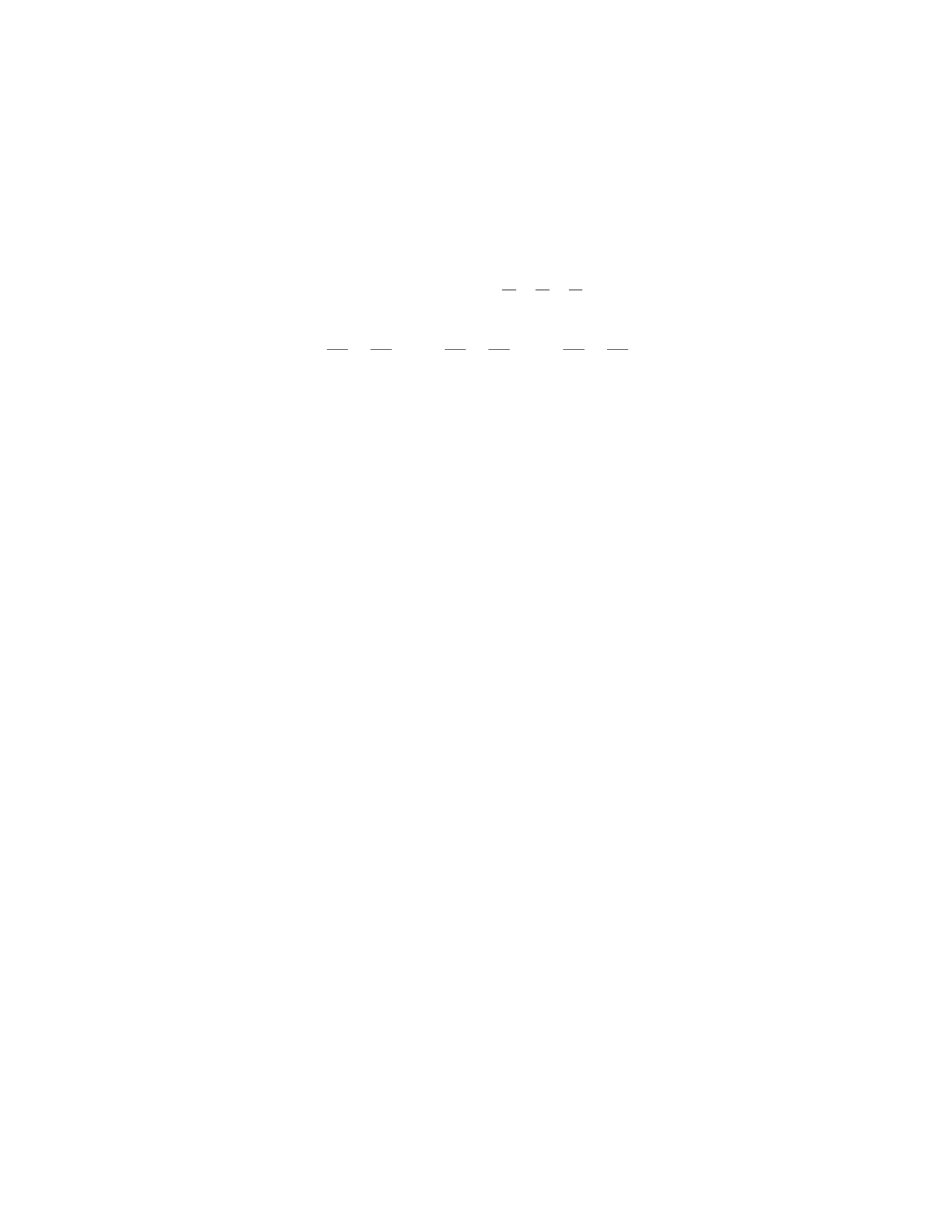
Solution
Step 1: First, find the curl of F: Let F=Pi+Qj+Rk. Then, the curl of Fis
given by
curl(F) = ∇ × F=
i j k
∂
∂x
∂
∂y
∂
∂z
P Q R
=∂R
∂y −∂Q
∂z i−∂R
∂x −∂P
∂z j+∂Q
∂x −∂P
∂y k
For F=yzi+xzj+xyk, we have P=yz,Q=xz,R=xy. Thus, the curl of
Fis
curl(F) = (z−z)i−(y−y)j+ (x−x)k=0
Step 2: By Stokes’ Theorem, we have
ZZS
F·dS=ZZ∂S
F·dr
Since the curl of Fis 0, the line integral vanishes. Therefore, RRSF·dS= 0.
Question 9
Question
Let Sbe the part of the paraboloid z= 4−x2−y2that lies above the plane z= 1.
Orient Swith outward normal. Use Stokes’ Theorem to evaluate HCF·drwhere
F(x, y, z) = xi+yj+zkand Cis the boundary of Soriented counterclockwise
when viewed from above.
Solution
Step 1: Find the curl of F. Step 2: Compute the surface integral of the curl
of Fover the region Sto apply Stokes’ Theorem. Step 3: Parameterize the
boundary curve Cand compute the line integral of Fover C.
Let’s start with these steps.
Question 10
Question
Let F=x2i+y2j+z2kbe a vector field, and let Sbe the surface enclosed by
the cylinder x2+y2= 1 and the planes z= 0 and z= 2. Use Stokes’ Theorem
to evaluate the line integral HCF·draround the boundary curve Cof S.
7

Solution
Step 1: First, we need to parameterize the boundary curve C, which consists of
the circle x2+y2= 1 on the plane z= 0 and the same circle on the plane z= 2.
We will parameterize the circle on the plane z= 0 as r1(t) = cos(t)i+ sin(t)j
for 0≤t≤2π. The circle on the plane z= 2 can be parameterized similarly as
r2(t) = cos(t)i+ sin(t)j+ 2k.
Step 2: Next, we compute the curl of the vector field F:
∇ × F=
i j k
∂
∂x
∂
∂y
∂
∂z
x2y2z2
= (2z−2y)i−(2z−2x)j+ 0k= 2(z−y)i−2(z−x)j
Step 3: We can now apply Stokes’ Theorem to relate the line integral over
Cto the surface integral over S. Using Stokes’ Theorem, we have:
IC
F·dr=ZZS
(∇ × F)·ndS
where nis the outward unit normal to S. Since the surface Sis bounded by
C, the outward unit normal npoints outward from the cylinder.
Step 4: We will calculate the surface integral over S:
ZZS
(∇ × F)·ndS =ZZS
(2(z−y)i−2(z−x)j)·kdS
Since the normal vector nis in the kdirection, the dot product simplifies
to −2(z−x). To find the limits of integration, we note that the projection of
Sonto the xy-plane is the circle x2+y2= 1. Thus, the limits for xand yare
x2+y2≤1, and for z, the limits are 0≤z≤2.
Step 5: We can now evaluate the surface integral:
ZZS
(∇ × F)·ndS
=Z2π
0Z1
0−2(2 −cos(t)) dr dθ
=−4Z2π
0
(2 −rcos(t))
1
0dθ
=−4Z2π
0
(2 −cos(t)−0) dθ
=−4·2π(2)
=−16π
Therefore, the line integral HCF·draround the boundary curve Cof Sis
−16π.
8

Question 11
Question
Let F(x, y, z) = (y2−z)i+ (z2−x)j+ (x2−y)kand let Sbe the portion of
the cone z=px2+y2that lies between the planes z= 1 and z= 3. Use
Stokes’ Theorem to evaluate HCF·dr, where Cis the counterclockwise-oriented
boundary curve of surface S.
Solution
Step 1: First, let’s parameterize the boundary curve Cof the surface S. The
boundary curve consists of two parts: the circle x2+y2= 1 at z= 1 and the
circle x2+y2= 9 at z= 3. We can parameterize these circles as follows: For
z= 1, we have the circle C1:x2+y2= 1. Parameterizing this circle gives us:
r1(t) = ⟨cos(t),sin(t),1⟩,where 0≤t≤2π.
For z= 3, we have the circle C2:x2+y2= 9. Parameterizing this circle gives
us:
r2(t) = ⟨3 cos(t),3 sin(t),3⟩,where 0≤t≤2π.
Step 2: Now, we need to compute the curl of F:
∇ × F=
i j k
∂
∂x
∂
∂y
∂
∂z
y2−z z2−x x2−y
= (2y+ 1)i−(2z+ 1)j+ (2x+ 1)k.
Step 3: By Stokes’ Theorem, we have
IC
F·dr=ZZS
(∇ × F)·ndS,
where nis the unit normal to S.
Step 4: To find the unit normal to S, we compute the gradient of z=
px2+y2as ∇z=⟨x
√x2+y2,y
√x2+y2,−1⟩.
Step 5: The unit normal to Sis then ˆ
n=∇z
||∇z|| =⟨x,y,−√x2+y2⟩
√x2+y2+1 .
Step 6: We can now evaluate the surface integral RRS(∇×F)·ndS using the
parameterizations of C1and C2from Step 1.
Question 12
Question
Let Sbe the surface of the portion of the plane z= 4 −x−2ythat lies above
the square 0≤x≤1,0≤y≤1, oriented upward. Calculate the flux of the
curl of the vector field F= 2xi+yj+zkacross S.
9
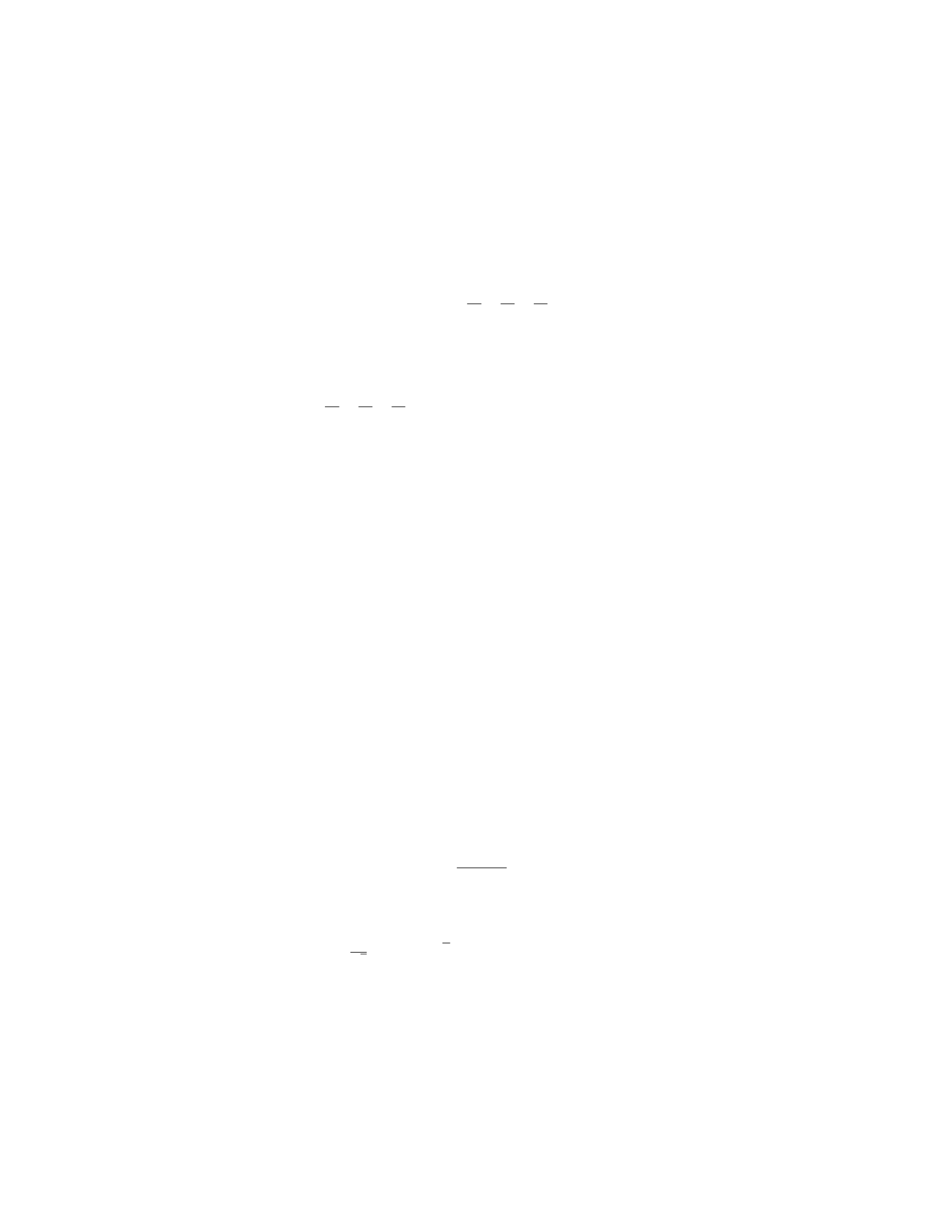
Solution
Step 1: Find the curl of the vector field F. The curl of a vector field F=
Pi+Qj+Rkis given by:
∇ × F=
i j k
∂
∂x
∂
∂y
∂
∂z
P Q R
In this case, F= 2xi+yj+zk, so:
∇ × F=
i j k
∂
∂x
∂
∂y
∂
∂z
2x y z
= (0 −0)i−(0 −1)j+ (1 −2)k=−j−k
Step 2: Use Stokes’ Theorem to find the flux of the curl of Facross S.
Stokes’ Theorem states:
ZZS
(∇ × F)·dS=IC
F·dr
where Cis the boundary of the surface S.
Step 3: Find the boundary curve Cof the surface S. The boundary curve
Cof the surface Sis the square where 0≤x≤1,0≤y≤1. It consists of four
line segments: 1. y= 0,0≤x≤12. x= 1,0≤y≤13. y= 1,0≤x≤14.
x= 0,0≤y≤1
Step 4: Parameterize and calculate the line integral HCF·dr. We will
integrate over each of the four line segments of the boundary: 1. y= 0,0≤
x≤1:r(t) = ti,0≤t≤12. x= 1,0≤y≤1:r(t) = i+tj,0≤t≤13.
y= 1,0≤x≤1:r(t) = (1 −t)i+j,0≤t≤14. x= 0,0≤y≤1:r(t) = tj,
0≤t≤1
Step 5: Substitute the parameterization into Fand calculate the dot product
with dr. For each line segment, calculate: 1. HCF·dr=R1
0(2t, 0,4−t)·(1,0,0)dt
Question 13
Question
Let Sbe the part of the cone z=px2+y2that lies between the planes z= 1
and z= 4. Use Stokes’ Theorem to evaluate the surface integral RRSF·dS,
where F(x, y, z) = (z, x, y).
(Note: You may assume that a positively oriented unit normal vector to S
at each point is n=1
√2(−x, −y, √2).)
Solution
Step 1: Find the boundary curve Cof Swhere the orientation is consistent with
the orientation of Sgiven by the positively oriented unit normal vector n.
10
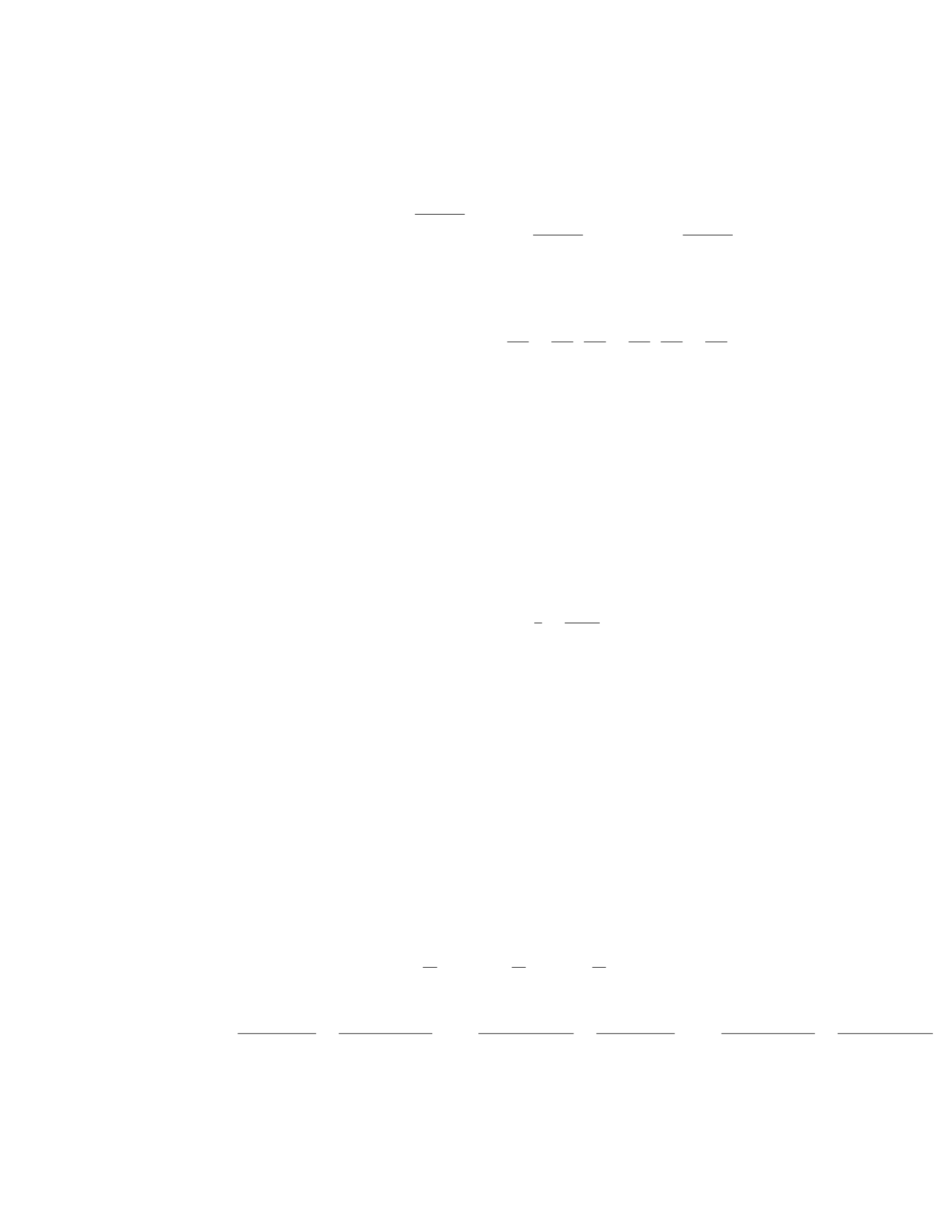
Since Slies between z= 1 and z= 4, the boundary curve Cconsists of the
intersection of the cone z=px2+y2and the planes z= 1 and z= 4. Solving
these equations, we get z= 1 and z= 4:1 = px2+y2and 4 = px2+y2.
Thus, the boundary curve Cis the circle x2+y2= 1.
Step 2: Parameterize the boundary curve C.
Let Cbe parameterized by r(t) = (cos t, sin t, 1) where 0≤t≤2π.
Step 3: Find the curl of F.
The curl of Fis given by ∇ × F=∂Fz
∂y −∂Fy
∂z ,∂Fx
∂z −∂Fz
∂x ,∂Fy
∂x −∂Fx
∂y .
Calculating the components of the curl, we have: ∇×F= (0 −1,1−0,1−0) =
(−1,1,1).
Step 4: Evaluate the line integral HCF·dr.
Using Stokes’ Theorem, we have: RRSF·dS=HCF·dr.
IC
F·dr=Z2π
0
F(r(t)) ·r′(t)dt
Z2π
0
F(r(t)) ·r′(t)dt =Z2π
0
(1,cos t, sin t)·(−sin t, cos t, 0)dt
Z2π
0
(1,cos t, sin t)·(−sin t, cos t, 0)dt =Z2π
0−sin t+ cos2tdt
Z2π
0−sin t+ cos2tdt =−cos t+t
2+sin 2t
42π
0
= 0
.
Therefore, the surface integral RRSF·dSis 0.
Question 14
Question
Let Fbe a vector field defined by F(x, y, z) = (y2z+ cos x)i+ (xz2+ sin y)j+
(xy2+ez)k. Calculate the surface integral RRScurl(F)·dS, where Sis the
portion of the plane z= 4 −x−2ythat lies above the triangle in the xy-plane
with vertices at (0,0),(1,0), and (0,2).
Solution
Step 1: Calculate curl(F).
curl(F) =
i j k
∂
∂x
∂
∂y
∂
∂z
y2z+ cos x xz2+ sin y xy2+ez
=∂(xy2+ez)
∂y −∂(xz2+ sin y)
∂z i−∂(y2z+ cos x)
∂x −∂(xy2+ez)
∂z j+∂(xz2+ sin y)
∂x −∂(y2z+ cos x)
∂y k
11
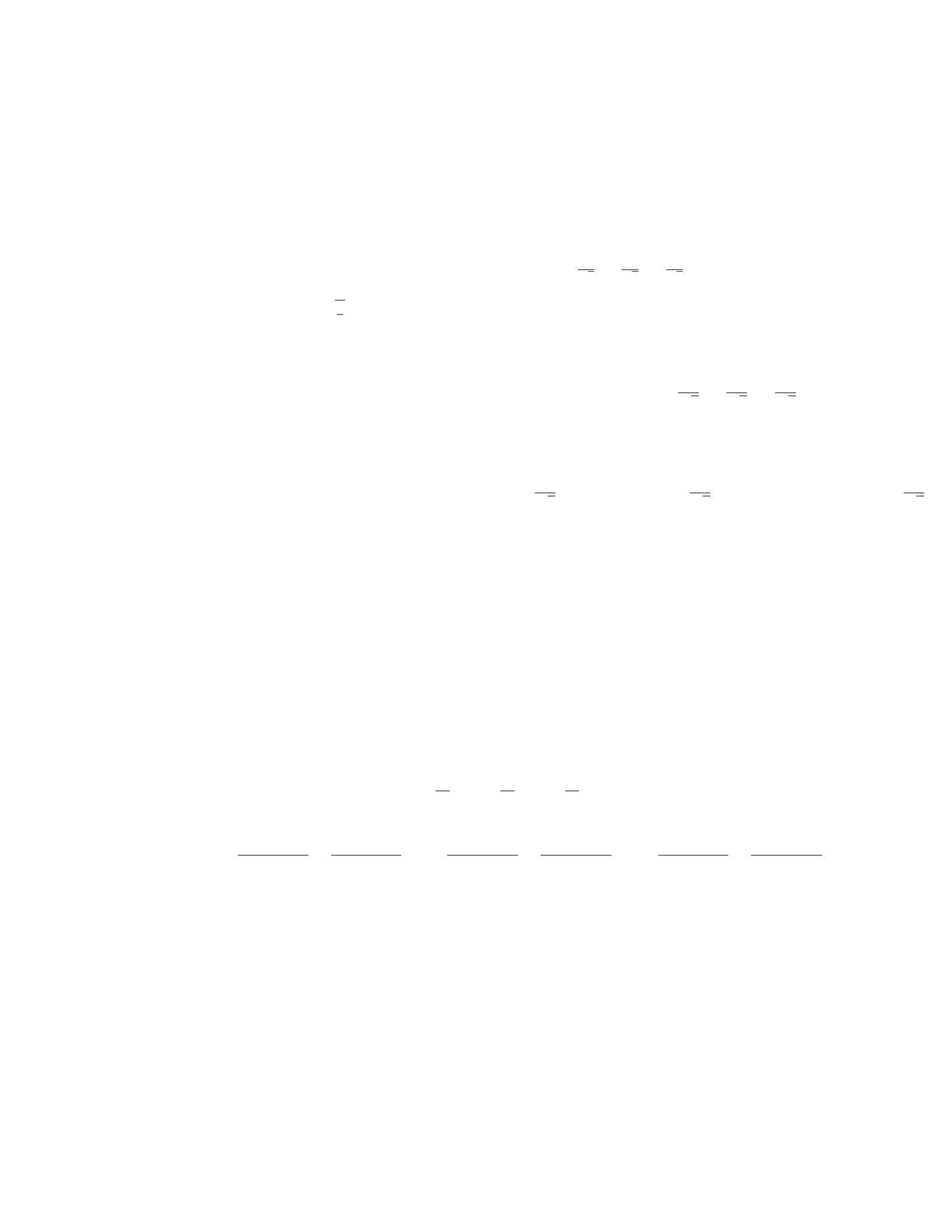
= (2xy −z2)i−(sin x−2xy)j+ (2xz −y2)k
Step 2: Calculate the unit normal vector to the surface S. The surface S
is defined by z= 4 −x−2y. The normal vector to this surface is n=∇z=
−i−2j+k. Therefore, the unit normal vector is n=−1
√6i−2
√6j+1
√6k.
Step 3: Calculate the magnitude of dS. The magnitude of dSis given by
dS =|n|dxdy =q6
6dxdy =dxdy.
Step 4: Calculate the surface integral. The surface integral can be calculated
as:
ZZS
curl(F)·dS=ZZS(2xy −z2)i−(sin x−2xy)j+ (2xz −y2)k·−1
√6i−2
√6j+1
√6kdxdy
Now, we substitute z= 4 −x−2yinto the expression above and integrate over
the region in the xy-plane:
ZZS
curl(F)·dS=ZZR(2xy −(4 −x−2y)2)−1
√6−(sin x−2xy)2
√6+ (2x(4 −x−2y)−y2)1
√6dxdy
where Ris the triangle in the xy-plane
Question 15
Question
Let Sbe the hemisphere x2+y2+z2= 1, z ≥0, and let F= (x2+y2, y2+
z2, z2+x2). Calculate the flux of Facross Susing Stokes’ Theorem.
Solution
Step 1: Calculate the curl of F.
∇ × F=
i j k
∂
∂x
∂
∂y
∂
∂z
x2+y2y2+z2z2+x2
=∂(z2+x2)
∂y −∂(y2+z2)
∂z i−∂(z2+x2)
∂x −∂(x2+y2)
∂z j+∂(y2+z2)
∂x −∂(x2+y2)
∂y k
= (0 −2z)i−(2x−0)j+ (2y−0)k=−2zi−2xj+ 2yk
Step 2: Calculate the surface integral of Fover Susing Stokes’ Theorem.
ZZ
S
(∇ × F)·dS=I
∂S
F·dr
Step 3: The boundary of Sis the circle x2+y2= 1, z = 0.
r(t) = cos(t)i+ sin(t)j,0≤t≤2π
12

Step 4: Parameterize the curve C.
r′(t) = −sin(t)i+ cos(t)j
r′(t)×k=−cos(t)k
Step 5: Calculate the line integral.
I
∂S
F·dr=Z2π
0
F(r(t)) ·r′(t)×kdt
=Z2π
0
(−sin(t))2+ cos(t)2+ (−sin(t))2dt =Z2π
0
2dt = 4π
Therefore, the flux of Facross Sis 4π.
Question 16
Question
Let Sbe the part of the plane x+ 2y+ 3z= 6 that lies inside the cylinder
x2+y2= 4. Use Stokes’ Theorem to evaluate
IC
F·dr,
where F=⟨y, x, z⟩and Cis the boundary of Soriented counterclockwise as
viewed from above.
Solution
Step 1: Find the boundary curve Cof the surface S. This is the intersection of
the plane and the cylinder, so we have
x+ 2y+ 3z= 6
x2+y2= 4.
Solving these equations, we find that the boundary curve Cis the circle x2+y2=
4, which is the circle of radius 2 centered at the origin.
Step 2: Parameterize the boundary curve C. Let x= 2 cos t,y= 2 sin t,
where 0≤t≤2π. Then dr=⟨−2 sin t, 2 cos t, 0⟩dt.
Step 3: Compute F(r(t)).
F(r(t)) = ⟨2 sin t, 2 cos t, 2 sin t⟩.
Step 4: Compute ∇ × F.
∇ × F=
i j k
∂
∂x
∂
∂y
∂
∂z
y x z
=⟨1,1,−2⟩.
13

Step 5: Compute the line integral using Stokes’ Theorem.
IC
F·dr=ZZS
(∇ × F)·ndS,
where nis the outward unit normal to S. Since the outward normal for the
plane x+ 2y+ 3z= 6 is n=⟨1,2,3⟩/√12+ 22+ 32=⟨1/√14,2/√14,3/√14⟩,
we have IC
F·dr=ZZS
(∇ × F)·ndS
=ZZS⟨1,1,−2⟩ · 1
√14⟨1,2,3⟩dS
=1
√14 ZZS
(1 + 2 −6) dS
=−3
√14 ZZS
dS
=−3
√14 ·Area(S).
Step 6: Find the area of the region S. This can be done by finding the
projection of Sonto the xy-plane and calculating the double integral over this
region.
Step 7: Calculate the final answer for the line integral.
Question 17
Question
Let Sbe the part of the plane z= 3 −x−ythat lies above the triangle with
vertices (0,0,0),(1,0,0), and (0,1,0), oriented counterclockwise when viewed
from above. Let Fbe the vector field F= (x2+y2, z, 2x−z). Calculate the
surface integral R RSF·dSusing Stokes’ Theorem.
Solution
Step 1: Calculate the curl of F. The curl of Fis given by:
curl(F) = ∂(2x−z)
∂y −∂(z)
∂z ,∂(x2+y2)
∂z −∂(2x−z)
∂x ,∂(z)
∂x −∂(x2+y2)
∂y
= (−1−0,0−2,0−2) = (−1,−2,−2).
Step 2: Calculate the normal vector to the surface S. The normal vector to
the plane z= 3 −x−yis n= (−∂z
∂x ,−∂z
∂y ,1) = (−(−1),−(−1),1) = (1,1,1).
Step 3: Normalize the normal vector. The unit normal vector is n0=
|n| = (1, 1, 1)√12+12+12=(1
√3,1
√3,1
√3).
14

Step 4: Calculate the surface integral using Stokes’ Theorem. Stokes’ Theo-
rem states that R RSF·dS=RRRVcurl(F)·ndV , where Vis the region enclosed
by S. Since Sis the part of the plane z= 3 −x−ythat lies above the given
triangle, the region Vis the triangle 0≤x≤1,0≤y≤1−x, 0≤z≤3−x−y.
The surface integral becomes:
Z ZS
F·dS=ZZZV
(−1,−2,−2) ·(1,1,1) dV
=ZZZV−5dV.
Step 5: Calculate the triple integral over region V. We have 0≤x≤1,0≤
y≤1−x, 0≤z≤3−x−y. Therefore, the triple integral becomes:
Z1
0Z1−x
0Z3−x−y
0−5dz dy dx
=Z1
0Z1−x
0
[−5z]3−x−y
0dy dx
=Z1
0Z1−x
0−5(3 −x−y)dy dx
=Z1
0
[−5(3y−xy −y2
2)]1−x
0dx
=Z1
0−53(1 −x)−x(1 −x)−(1 −x)2
2dx
=Z1
0−17
2x2+ 14x−15 dx
Question 18
Question
Let Sbe the part of the plane x+y+z= 1 that lies in the first octant.
Let F(x, y, z) = ⟨2xz, y2, x +z⟩. Use Stokes’ Theorem to evaluate the surface
integral
ZZS
curl F ·ndS
where nis the outward unit normal to S.
15

Solution
Step 1: First, we need to find the curl of F.
curl F=
i j k
∂
∂x
∂
∂y
∂
∂z
2xz y2x+z
=∂
∂y (x+z)−∂
∂z (y2),∂
∂z (2xz)−∂
∂x(x+z),∂
∂x(y2)−∂
∂y (2xz)
= (1 −0,2x−1,2z)
= (1,2x−1,2z)
Step 2: Parameterize the surface S. Since Sis the part of the plane x+y+z=
1in the first octant, we can parameterize Sas:
r(u, v) = ⟨u, v, 1−u−v⟩,0≤u≤1,0≤v≤1−u
Step 3: Calculate the normal vector n. The normal vector can be found by
taking the cross product of the partial derivatives of rwith respect to uand v.
∂u =⟨1,0,−1⟩,
∂v =⟨0,1,−1⟩So, n=
∂u×
∂v =⟨1,1,1⟩
Step 4: Evaluate the surface integral. Using Stokes’ Theorem, we have:
ZZS
curl F·ndS =ZZD
(curl F)·(ru×rv)dA
where Dis the region in the uv-plane corresponding to the surface S.
=ZZD
(1,2u−1,2(1 −u−v)) ·(1,1,1) dA
=ZZD
(1 + 2u−1−2v)dA
=ZZD
(2u−2v)dA
=Z1
0Z1−u
0
(2u−2v)dv du
=Z1
02uv −v2v=1−u
v=0 du
16

=Z1
0
(2u−(1 −u)2)du
=Z1
0
(3u2−2u+ 1) du
=u3−u2+u1
0
= 1 −1+1
= 1
Therefore, the surface integral is equal to 1.
Question 20
Question
Let Sbe the part of the plane z= 4 −x−2ythat lies above the region in the
xy-plane bounded by the rectangle with vertices (0,0),(4,0),(4,3), and (0,3).
Use Stokes’ Theorem to evaluate the surface integral
ZZS
F·dS
where F= (y−z, x +z, x +y).
Solution
Step 1: Calculate the curl of F. The curl of Fis given by
∇ × F=
i j k
∂
∂x
∂
∂y
∂
∂z
y−z x +z x +y
=∂
∂y (x+y)−∂
∂z (x+z)i−∂
∂x(y−z)−∂
∂z (y+z)j+∂
∂x(x+z)−∂
∂y (y+z)k
=i−j−k
Step 2: Determine the unit normal vector nto the surface S. Given that
Sis the plane z= 4 −x−2y, the unit normal vector to the surface Sis
n=∇z
|∇z|=D−∂z
∂x ,−∂z
∂y ,1E=⟨−(−1),−(−2),1⟩=⟨1,2,1⟩.
Step 3: Calculate the curl of F·n. The curl of F·nis ∇ × (F·n) =
∇ × (x−y−z) = ∇ × (−3) = 0.
Step 4: Apply Stokes’ Theorem. Stokes’ Theorem states that
ZZS
F·dS=ZC
F·dr
17

where Cis the boundary of the surface Soriented counterclockwise when viewed
from above.
The boundary of the region in the xy-plane is the rectangle with vertices
(0,0),(4,0),(4,3), and (0,3). Parameterize this rectangle using r(u, v) =
⟨u, v, 4−u−2v⟩where 0≤u≤4and 0≤v≤3.
The line integral RCF·drbecomes
Z3
0
(0 −2(4) + 4)dv +Z4
0
(3 + 4)du =−20 + 12 = −8
Therefore, the surface integral evaluates to −8.
Question 21
Question
Let Cbe the curve of intersection of the plane z= 0 and the cylinder x2+y2= 1
oriented counterclockwise when viewed from above. Let F= (y+z, x +z, x +y)
be a vector field. Calculate the flux of Facross the curve Cusing Stokes’
Theorem.
Solution
Step 1: Parameterize the curve C.
The curve Cis simply the circle x2+y2= 1 in the xy-plane. We can
parameterize this curve by r(t) = (cos t, sin t, 0) for 0≤t≤2π.
Step 2: Find the curl of F.
The curl of Fis given by ∇ × F=
ˆ
iˆ
jˆ
k
∂
∂x
∂
∂y
∂
∂z
y+z x +z x +y
= (1,1,1).
Step 3: Calculate the line integral of Fover C.
By Stokes’ Theorem, the flux of Facross Cis equal to the line integral of F
over the curve C, which is given by
ZC
F·dr=Z2π
0
F(r(t))·r′(t)dt =Z2π
0
(0,0,1)·(−sin t, cos t, 0)dt =Z2π
0
0dt = 0.
Therefore, the flux of Facross the curve Cis 0.
Question 22
Question
Let Sbe the surface given by z=x2−y2for 0≤x≤2and 0≤y≤2. Use
Stokes’ Theorem to evaluate the line integral
18
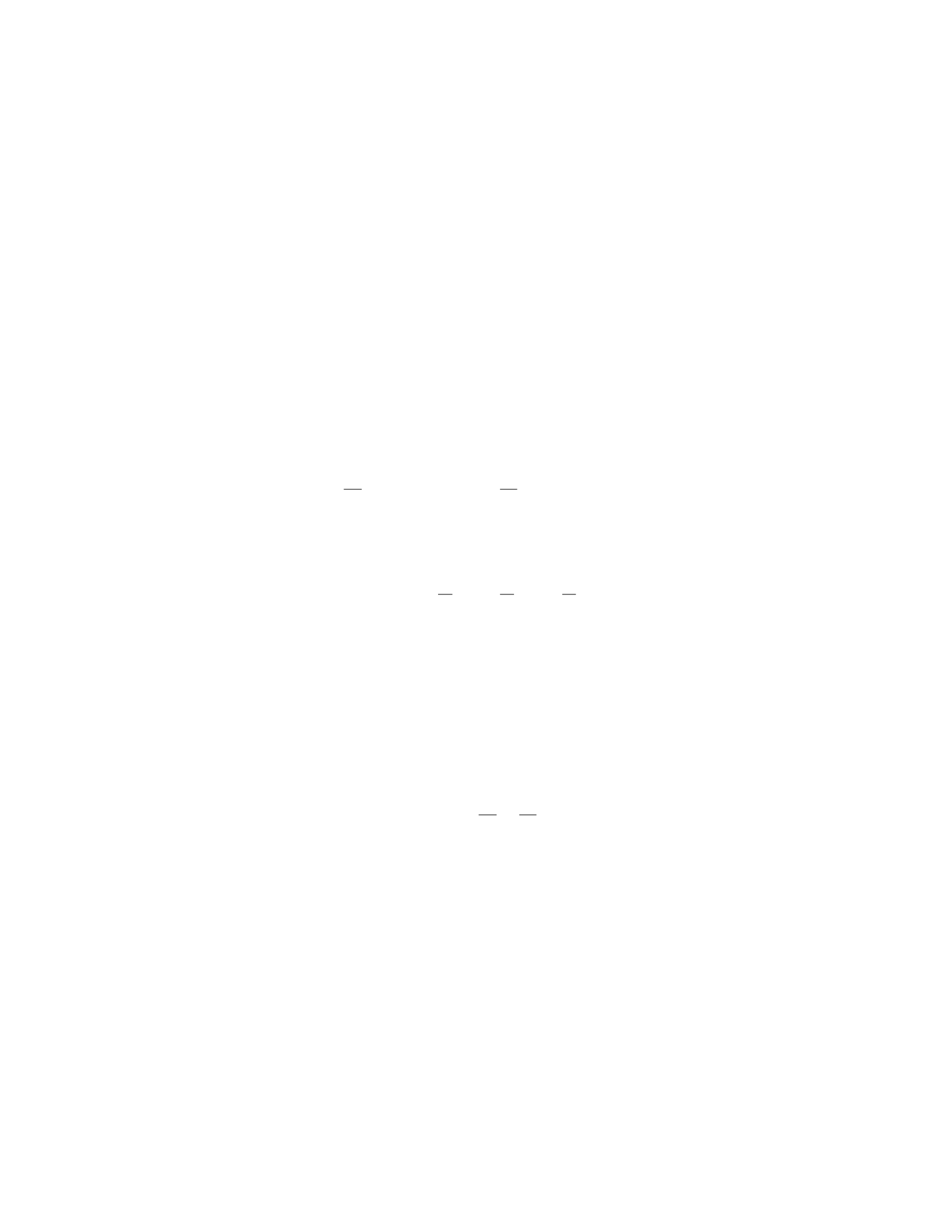
ZC
(x2+ 2y)dx + (z2−y)dy + (2x−2z)dz
where Cis the boundary curve of Swith counterclockwise orientation when
viewed from above.
Solution
Step 1: First, we need to parameterize the surface S.
The surface Sis given by z=x2−y2,0≤x≤2, and 0≤y≤2.
Let’s define the parameterization r(u, v) = ⟨u, v, u2−v2⟩, where (u, v)∈
D={(u, v)|0≤u≤2,0≤v≤2}.
Step 2: Next, we need to calculate the partial derivatives of rwith respect
to uand v.
∂r
∂u =⟨1,0,2u⟩and ∂r
∂v =⟨0,1,−2v⟩
Step 3: Now, we calculate the curl of the vector field F=⟨x2+ 2y, z2−
y, 2x−2z⟩.
∇ × F=
i j k
∂
∂x
∂
∂y
∂
∂z
x2+ 2y z2−y2x−2z
=⟨−1,0,2+2⟩=⟨−1,0,4⟩
Step 4: Using Stokes’ Theorem, we have
ZC
F·dr=ZZS
(∇ × F)·ndS
where nis the unit normal vector to the surface S.
Step 5: The surface integral RRS(∇ × F)·ndS simplifies to
ZZD⟨−1,0,4⟩ · ∂r
∂u ×∂r
∂v du dv
=ZZD
1 0 2u
0 1 −2v
−1 0 4
du dv
Step 6: Computing the determinant and performing the dot product gives
=ZZD
(4 + 4u)du dv
Step 7: Evaluating the double integral over the region D= [0,2]×[0,2] gives
the final answer.
19

Question 23
Question
Let Sbe the part of the cone z2=x2+y2that lies between the planes z= 1
and z= 3. Use Stokes’ Theorem to evaluate the surface integral RRS(∇×F)·dS,
where F(x, y, z) = (x2+y2)i+ (y2−z2)j+ (x2−y2)k.
Solution
To apply Stokes’ Theorem, we need to compute the curl of Fand the normal
vector nto the surface S.
Step 1: Compute ∇ × F.
∇ × F=
i j k
∂
∂x
∂
∂y
∂
∂z
x2+y2y2−z2x2−y2
=∂(x2−y2)
∂y −∂(y2−z2)
∂z i−∂(x2+y2)
∂x −∂(x2−y2)
∂z j+∂(x2+y2)
∂y −∂(y2−z2)
∂x k
=−2yi−2xj+ 2zk
Step 2: Find the unit normal vector n.The unit normal vector to the
surface Sis n=1
√2(−i−j+k)since the normal vector points outward.
Step 3: Evaluate the surface integral using Stokes’ Theorem. Stokes’
Theorem states that ZZS
(∇ × F)·dS=IC
F·dr
where Cis the boundary curve of S.
The boundary curve Cof Sis a circle in the xy-plane with radius 3parametrized
by r(t) = 3 cos(t)i+ 3 sin(t)jfor 0≤t≤2π.
Therefore, we have
IC
F·dr=Z2π
0
F(r(t)) ·r′(t)dt
=Z2π
0
((9 cos2(t) + 9 sin2(t))(−3 sin(t)) + (9 sin2(t)−9 cos2(t))(3 cos(t))) dt
=Z2π
0
(−27 sin(t) cos(t) + 27 sin(t) cos(t)) dt
=Z2π
0
0dt = 0
Hence, the value of the surface integral RRS(∇ × F)·dSis 0.
20

Question 24
Question
Let Sbe the surface of the cone z=px2+y2bounded by the plane z= 3.
Use Stokes’ Theorem to evaluate the surface integral RRS(∇ × F)·dS, where
F(x, y, z) = xi+yj+zk.
Solution
Step 1: Calculate the curl of F: The curl of Fis given by:
∇ × F=
i j k
∂
∂x
∂
∂y
∂
∂z
x y z
=∂z
∂y −∂y
∂z i−∂z
∂x −∂x
∂z j+∂y
∂x −∂x
∂y k
=i+j+k
Step 2: Find the unit normal vector to the surface S: The unit normal vector
to the surface Sis given by n=(−x,−y,√x2+y2)
√x2+y2+1 .
Step 3: Calculate the outward unit normal vector: Since the cone is upward-
facing, the outward unit normal vector is the negation of the unit normal vector
calculated in Step 2. Therefore, n=(x,y,−√x2+y2)
√x2+y2+1 .
Step 4: Calculate dS: The surface element dSis given by dS=ndS, where
dS =q1+(∂z
∂x )2+ ( ∂z
∂y )2dA =√2dA.
Step 5: Evaluate the surface integral:
ZZS
(∇ × F)·dS=ZZD
(∇ × F)·n√2dA
=ZZD
(i+j+k)·(x, y, −px2+y2)
px2+y2+ 1
√2dA
=ZZD
(−z)√2dA
=−√2ZZD
zdA
The integral RRDzdA represents the flux of zthrough the region D, which
in this case is the projection of Sonto the xy-plane. However, the surface of
the cone Sdoes not intersect the xy-plane, making the flux integral through D
equal to zero. Hence, the surface integral RRS(∇ × F)·dSis also equal to 0.
21

Question 25
Question
Let Sbe the part of the plane z= 4 −x−ythat lies above the region in the
xy-plane bounded by the curve x2+y2= 1. Calculate the flux of the vector
field F(x, y, z) = ⟨yz, xz, xy⟩across the surface S.
Solution
Step 1: First, we find the unit normal vector to the surface S, which is given by
n=∂z
∂x ,∂z
∂y ,−1.
In this case, ∂z
∂x =−1,∂z
∂y =−1, so n=⟨−1,−1,−1⟩.
Step 2: Next, we compute the curl of the vector field F:
∇ × F=
i j k
∂
∂x
∂
∂y
∂
∂z
yz xz xy
=⟨z−x, −z, y⟩.
Step 3: Now, we can apply Stokes’ theorem, which states:
ZZS
(∇ × F)·dS=IC
F·dr,
where Cis the boundary curve of the surface Sand dSis the outward-pointing
normal vector on S.
Step 4: Since Slies above the unit circle in the xy-plane, the boundary
curve Cis simply the unit circle x2+y2= 1. Therefore, we can parameterize
the curve Cas r(t) = ⟨cos t, sin t, 4−cos t−sin t⟩for 0≤t≤2π.
Step 5: Calculating the line integral HCF·dr, we have
IC
F·dr=Z2π
0
F(r(t)) ·r′(t)dt
=Z2π
0⟨sin t(4 −cos t−sin t),cos t(4 −cos t−sin t),cos tsin t⟩ · ⟨−sin t, cos t, −sin t−cos t⟩dt
=Z2π
0
(−sin2t(4 −cos t−sin t)−cos2t(4 −cos t−sin t) + cos tsin t(sin t+ cos t)) dt
=Z2π
0
(−4 + 5 sin t+ 5 cos t)dt
= 0.
Step 6: Therefore, the flux of the vector field Facross the surface Sis zero.
22

