


MATH 332 - ADVANCED CALCULUS
- Stokes’ Theorem
Question Bank - Set 3
Liberty University
Question 1
Question
Let Sbe the part of the surface z=x2+y2that lies above the disk x2+y2≤1
in the xy-plane, oriented upward. Let
F(x, y, z) = (y+z, x+z, x+y). Calculate
the flux of
Facross Susing Stokes’ Theorem.
Solution
Step 1: Compute the curl of
F.
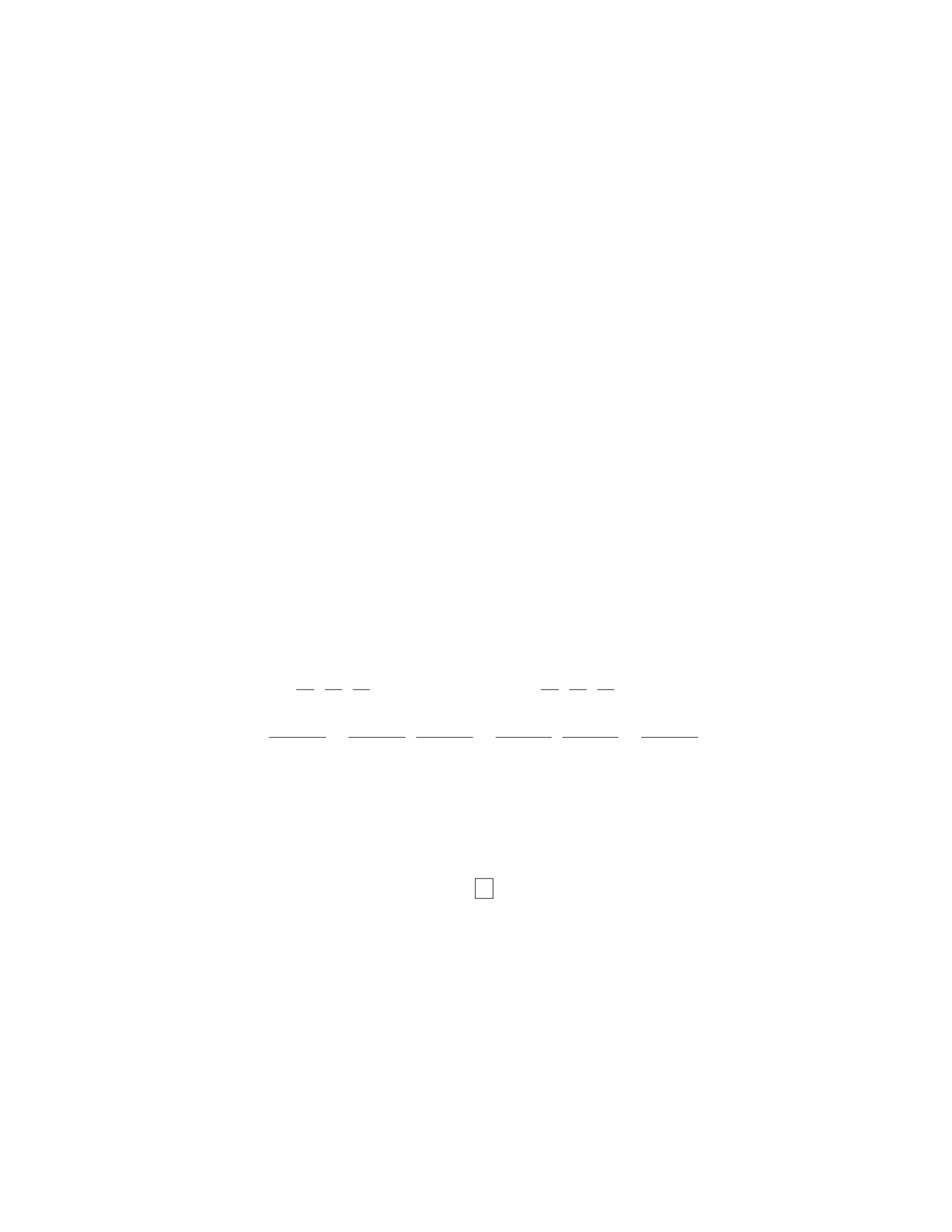
Curl(
F) = ∂
∂x ,∂
∂y ,∂
∂z ×(y+z, x+z, x+y) = ∂
∂x ,∂
∂y ,∂
∂z ×(y+z, x+z, x+y)
=∂(x+y)
∂y −∂(x+z)
∂z ,∂(x+z)
∂x −∂(y+z)
∂z ,∂(y+z)
∂x −∂(x+y)
∂y
= (1 −1,1−1,1−1) = (0,0,0)
Step 2: Calculate the surface integral of the curl of
Fover S. Since the curl
of
Fis zero, the surface integral over Swill be zero as well.
Step 3: Apply Stokes’ Theorem. Stokes’ Theorem states that the circulation
of
Faround the boundary of Sis equal to the surface integral of the curl of
F
over S. Since the surface integral is zero, the flux of
Facross Sis also zero.
Therefore, the flux of
Facross Sis 0.
Question 2
Question
Let Sbe the surface of the hemisphere x2+y2+z2= 4,z≥0, oriented with
outward-pointing normal vector. Let F=⟨x2, xy, y2⟩. Calculate the surface
integral of Fover Susing Stokes’ Theorem.
Solution
Step 1: Compute the curl of F:
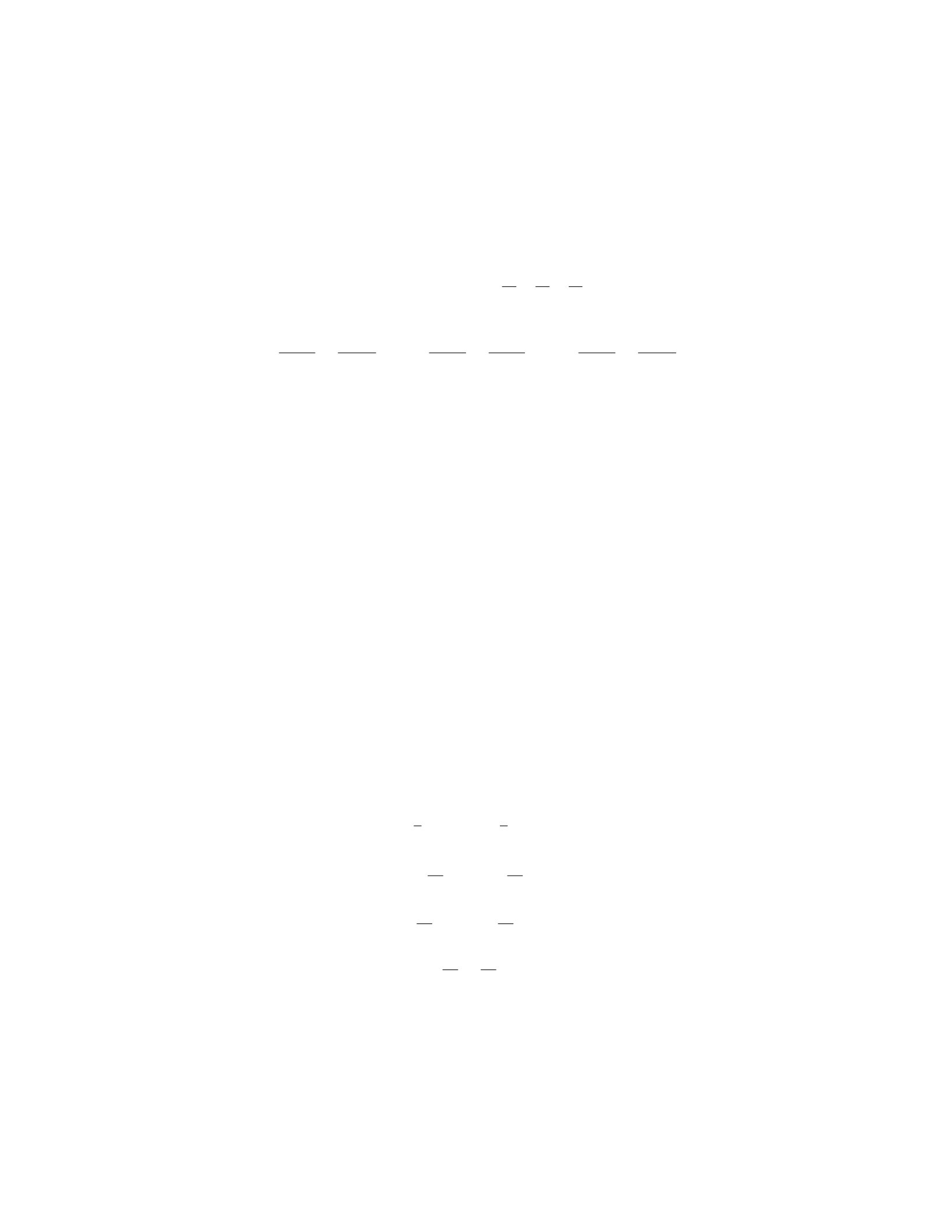
curl(F) = ∇ × F=
i j k
∂
∂x
∂
∂y
∂
∂z
x2xy y2
=∂(y2)
∂y −∂(xy)
∂z i−∂(x2)
∂x −∂(y2)
∂z j+∂(x2)
∂y −∂(xy)
∂x k
= 2yi+ 2xj+ 0k= 2yi+ 2xj
Step 2: Calculate the surface integral of Fover Susing Stokes’ Theorem:
ZZS
(curl(F)·n)dS =ZZD
(curl(F)·N)dA
where Dis the projection of Sonto the xy-plane, Nis the normal vector to D,
and dA is the area element in the xy-plane.
Step 3: Find the normal vector and area element: The normal vector to D
is N=−k. The area element is dA =dx dy.
Step 4: Parametrize the region D: The projection of the hemisphere onto
the xy-plane is the disk x2+y2≤4. This region can be parametrized by
x=rcos(θ),y=rsin(θ)where 0≤r≤2and 0≤θ≤2π.
Step 5: Calculate the dot product and the surface integral:
ZZD
(curl(F)·N)dA =ZZD−(2rsin(θ)+2rcos(θ)) dA
=−Z2π
0Z2
0
(2rsin(θ)+2rcos(θ))r dr dθ
=−Z2π
0Z2
0
(2r2sin(θ)+2r2cos(θ)) dr dθ
=−Z2π
02
3r3sin(θ) + 2
3r3cos(θ)
2
0dθ
=−Z2π
016
3sin(θ) + 16
3cos(θ)dθ
=−−16
3cos(θ) + 16
3sin(θ)
2π
0
=32
3−32
3= 0
Therefore, the surface integral of Fover S
2

Question 3
Question
Let Sbe the portion of the plane z= 4 −x−2ythat lies inside the cylinder
x2+y2= 1 and above the xy-plane. Use Stokes’ Theorem to evaluate the
circulation of the vector field F(x, y, z) = (z−3y)i+ (x−z)j+ (y−x)karound
the curve Cthat is the intersection of Swith the plane x+y= 1.
Solution
To apply Stokes’ Theorem, we need to calculate the curl of Fand find its surface
integral over the surface S.
Step 1: Find the Curl of FThe curl of Fis given by:
∇ × F=
i j k
∂
∂x
∂
∂y
∂
∂z
z−3y x −z y −x
=∂(y−x)
∂y −∂(x−z)
∂z i−∂(z−3y)
∂z −∂(y−x)
∂x j+∂(x−z)
∂x −∂(z−3y)
∂y k
= (−1−(−1))i−(1 −(−1))j+ (1 −(−3))k
= 0i−2j+ 4k=−2j+ 4k
Step 2: Parameterize the Surface and Find the Normal Vector The
surface Sis the portion of the plane z= 4 −x−2ythat lies inside the cylinder
x2+y2= 1. We can parameterize Sas r(u, v) = ui+vj+ (4 −u−2v)kfor
(u, v)∈D, where Dis the unit disk in the xy-plane.
The normal vector Nto Sis given by the cross product of the partial deriva-
tives of rwith respect to uand v:
N=∂r
∂u ×∂r
∂v
∂r
∂u =i−k,∂r
∂v =j−2k
N=
i j k
1 0 −1
0 1 −2
= (−1)i−(−2)j−(−1)k=−i+ 2j−k
Step 3: Evaluate the Surface Integral Applying Stokes’ Theorem, the
circulation of Faround Cis equal to the surface integral of ∇ × Fover S:
ZZS
(∇ × F)·NdS
=ZZD
(−2j+ 4k)·(−i+ 2j−k)dA
3

=ZZD
(−8) dA
=−8
Question 4
Question
Let Sbe the surface of the cone z=px2+y2that lies above the disk x2+y2≤1
in the xy-plane, oriented upward. Use Stokes’ Theorem to evaluate the surface
integral
ZZ
S
(∇ × F)·ndS,
where F(x, y, z) = ⟨x2, y2, z2⟩and nis the outward-pointing unit normal vector
to S.
Solution
Step 1: Compute ∇ × F. The curl of a vector field F(x, y, z) = ⟨M, N, P ⟩is
given by
∇ × F=∂P
∂y −∂N
∂z i+∂M
∂z −∂P
∂x j+∂N
∂x −∂M
∂y k.
In this case, F(x, y, z) = ⟨x2, y2, z2⟩, so
∇ × F= (0 −0) i+ (2z−0) j+ (0 −0) k= 2zj.
Step 2: Find the unit normal vector n. The surface Sis the cone z=
px2+y2above the disk x2+y2≤1. The outward-pointing unit normal vector
to Sis given by
n=∇g
∥∇g∥,
where g(x, y, z) = z−px2+y2is a scalar function defining S. The gradient of
gis
∇g=⟨− x
px2+y2,−y
px2+y2,1⟩,
so the unit normal vector is
n=⟨− x
√x2+y2,−y
√x2+y2,1⟩
sx
√x2+y22
+y
√x2+y22
+ 12
.
4

Step 3: Evaluate the surface integral using Stokes’ Theorem. Stokes’ The-
orem states that for a surface Swith boundary curve Coriented positively
(counterclockwise when viewed from above), we have
ZZ
S
(∇ × F)·ndS =IC
F·dr,
where dris the differential arc length along the boundary curve C. Since the
boundary of Sis the circle x2+y2= 1 in the xy-plane, we can parameterize
this circle as r(t) = ⟨cos t, sin t, 0⟩for 0≤t≤2π.
Then the line integral can be computed as
IC
F·dr=Z2π
0
F(r(t)) ·r′(t
Question 5
Question
Let Sbe the part of the surface z=x2+y2that lies below the plane z= 4. Use
Stokes’ Theorem to evaluate the surface integral RRSF·dS, where F(x, y, z) =
(y+z, x +z, x +y).
Solution
Step 1: Find the curl of F. The curl of Fis given by
∇×F=
i j k
∂
∂x
∂
∂y
∂
∂z
y+z x +z x +y
=∂
∂y (x+y)−∂
∂z (x+z),∂
∂z (y+z)−∂
∂x (x+y),∂
∂x (x+z)−∂
∂y (y+z)
= (1 −1,1−1,1−1) = (0,0,0).
Step 2: Calculate the surface integral using Stokes’ Theorem. By Stokes’
Theorem, ZZS
F·dS=Z Z∂S
F·dr,
where ∂S is the boundary of Swith outward orientation.
Step 3: Find the boundary curve of S. The surface z=x2+y2intersects
z= 4 when x2+y2= 4. This gives us the circle Cof radius 2centered at
the origin in the xy-plane. The parametric equations for Care x= 2 cos t,
y= 2 sin t,z= 4 with 0≤t≤2π.
Step 4: Parameterize the boundary curve. For C, the unit normal vector
pointing outwards is N=(x,y,−4)
√x2+y2+16 =(2 cos t,2 sin t,−4)
4= (cos t, sin t, −1).
Step 5: Evaluate the line integral. Now, we compute
ZC
F·dr=Z2π
0
F(2 cos t, 2 sin t, 4) ·(−2 sin t, 2 cos t, 0)dt.
5

Step 6: Simplify and solve the line integral. We have
F(2 cos t, 2 sin t, 4) = (2 sin t+ 4,2 cos t+ 4,2 cos t+ 2 sin t),
and
F(2 cos t, 2 sin t, 4) ·(−2 sin t, 2 cos t, 0) = 12.
Therefore, the surface integral of Fover Sis 12 .
Question 6
Question
Let
F(x, y, z) = (x2y, z, exyz )be a vector field. Let Sbe the part of the plane
z= 4 −x−2ythat lies above the region in the xy-plane bounded by the
curves y=x2and y=x. Use Stokes’ Theorem to evaluate the surface integral
RRS∇ ×
F·d
S.
Solution
Step 1: Determine the boundary curve Cin the xy-plane. This boundary is the
curve where y=x2and y=xintersect. We find their intersection by setting
x2=x:
x2=x
x2−x= 0
x(x−1) = 0
x= 0 or x= 1
So the boundary curve Cis the line segment from (0,0) to (1,1).
Step 2: Calculate the curl of
F:∇ ×
F=∂P
∂y −∂N
∂z ,∂M
∂z −∂P
∂x ,∂N
∂x −∂M
∂y
Here,
F(x, y, z) = (x2y, z, exyz ).
Calculating the curl, we get:
∇ ×
F= (0 −0,0−2xy, xyexyz −0)
∇ ×
F= (−2xy, 0, xyexyz )
Step 3: Use Stokes’ Theorem to evaluate the surface integral. Stokes’ The-
orem states: ZZS∇ ×
F·d
S=IC
F·dr
Since ∇ ×
F= (−2xy, 0, xyexyz ), the surface integral simplifies to:
ZZS
(−2xy, 0, xyexyz )·d
S
Therefore, our final task is to evaluate the line integral over the boundary
curve C.
6

Question 7
Question
Let F(x, y, z) = ⟨−y2, x2, z⟩be a vector field, and let Sbe the part of the plane
z=x+ythat lies above the triangle with vertices at (0,0,0),(1,0,1), and
(0,1,1). Calculate the flux of Facross Susing Stokes’ Theorem.
Solution
Step 1: First, we compute the curl of F:
curl(F) = ∇ × F=
i j k
∂
∂x
∂
∂y
∂
∂z
−y2x2z
=⟨0,0,2x+ 2y⟩
Step 2: Now, we find the normal vector to the surface S. The normal vector
is given by n=∇g
|∇g|where g(x, y, z) = z−x−yis the function defining the
plane z=x+y. We have ∇g=⟨−1,−1,1⟩and |∇g|=√12+ 12+ 12=√3,
so n=1
√3⟨−1,−1,1⟩.
Step 3: The flux of Facross Sis given by the surface integral RRScurl(F)·
ndS. Since the normal vector points upwards, we need to use −nin the dot
product.
Step 4: We parameterize the triangle Tin the xy-plane by r(u, v) = ui+vj
with 0≤u≤1and 0≤v≤1−u. The position vector on the surface Sis then
r(u, v) = ⟨u, v, u +v⟩.
Step 5: The normal vector to the triangle Tis n=ksince the triangle lies
in the xy-plane. Therefore, n·curl(F) = (2u+ 2v)·1 = 2u+ 2v.
Step 6: The flux of Facross Sis then given by the surface integral:
ZZS
curl(F)·ndS =ZZT
(2u+ 2v)dA
Step 7: We evaluate the integral over the region Tin the uv-plane:
Z1
0Z1−u
0
(2u+ 2v)dv du
=Z1
0
[2uv +v2]v=1−u
v=0 du
=Z1
0
(2u(1 −u) + (1 −u)2)du
=Z1
0
(2u−2u2+ 1 −2u+u2)du
=Z1
0
(1 −u−u2)du
7

= [u−u2
2−u3
3]1
0
= 1 −1
2−1
3=1
6
Therefore, the flux of Facross Sis 1
6.
Question 8
Question
Let Sbe the surface of the solid bounded by the cylinder x2+y2= 1 and the
planes z= 0 and z= 4. Find the flux of the vector field F= (x2, y2, z2)across
Susing Stokes’ Theorem.
Solution
Step 1: Calculate the curl of the vector field F:
curl(F) =
i j k
∂
∂x
∂
∂y
∂
∂z
x2y2z2
= (0,0,2z−2y)
Step 2: Use Stokes’ Theorem to find the flux of Facross S: The flux of
curl(F)across Sis equal to the line integral of Fover the boundary of S.
ZZS
curl(F)·dS=IC
F·dr
where Cis the boundary curve of S.
Step 3: Parameterize the boundary curve C: From the equations x2+y2= 1
and z= 0, we have x= cos(t),y= sin(t), and z= 0. Thus, Cis parameterized
by r(t) = (cos(t),sin(t),0). For 0≤t≤2π.
Step 4: Calculate the line integral over C:
IC
F·dr=Z2π
0
F(r(t)) ·r′(t)dt =Z2π
0
(cos2(t),sin2(t),0) ·(−sin(t),cos(t),0)dt
=Z2π
0
(−cos(t) sin(t) + sin(t) cos(t))dt =Z2π
0
0dt = 0
Step 5: Conclusion: Since the line integral over Cis 0, by Stokes’ Theorem,
the flux of Facross Sis also 0.
8

Question 9
Question
Let F(x, y, z) = (xz, yz, xy)be a vector field. Consider the surface Sdefined by
z= 1 −x2−y2for 0≤z≤1. Calculate the flux of Facross Susing Stokes’
Theorem.
Solution
Step 1: First, we need to find the curl of F. The curl of a vector field F(x, y, z) =
(P(x, y, z), Q(x, y, z), R(x, y, z)) is defined as:
curl(F) = ∂R
∂y −∂Q
∂z ,∂P
∂z −∂R
∂x ,∂Q
∂x −∂P
∂y
In our case, F(x, y, z)=(xz, yz, xy), so P(x, y, z) = xz,Q(x, y, z) = yz, and
R(x, y, z) = xy. Calculating the partial derivatives, we get:
∂R
∂y =x, ∂Q
∂z =y, ∂P
∂z =x, ∂R
∂x =y, ∂Q
∂x = 0,∂P
∂y = 0
Therefore, the curl of Fis:
curl(F) = (x−y, y −x, 0)
Step 2: Next, we need to find the unit normal vector to the surface S. The
surface Sis defined implicitly by F(x, y, z) = z−1 + x2+y2= 0. The gradient
of Fgives the normal vector to the surface. The gradient of Fis:
∇F=∂F
∂x ,∂F
∂y ,∂F
∂z = (2x, 2y, 1)
To find the unit normal vector, we normalize ∇Fby dividing it by its magnitude:
∥∇F∥=p4x2+ 4y2+ 1
So, the unit normal vector is:
n=1
p4x2+ 4y2+ 1(2x, 2y, 1)
Step 3: Stokes’ Theorem states that the flux of Facross Sis equal to the
surface integral of the dot product of Fand the curl of Fover the surface S.
Let’s denote the region in the xy-plane bounded by z= 1 −x2−y2as D. Then,
we can parameterize Sas r(x, y) = (x, y, 1−x2−y2)for (x, y)∈D. Now, the
flux of Facross Sis:
ZZS
(curl(F)•n)dS =ZZD
curl(F)•(
∂x×
∂ydA
We can now proceed to compute this surface integral to find the flux of F
across S.
9

Question 10
Question
Let F= (x2+y2)i+ (y2+z2)j+ (z2+x2)kbe a vector field, and let Sbe
the surface of the cone z=px2+y2for 0≤z≤2. Use Stokes’ Theorem to
evaluate the surface integral RRS(∇ × F)·ndS, where nis the outward unit
normal to S.
Solution
Step 1: First, we calculate the curl of F:
∇ × F=
i j k
∂
∂x
∂
∂y
∂
∂z
x2+y2y2+z2z2+x2
∇ × F= (2y−2z)i+ (2z−2x)j+ (2x−2y)k
Step 2: The unit normal vector to the cone z=px2+y2is given by
n=1
√2(x, y, −√2). So, we have n=1
√2(x, y, −px2+y2).
Step 3: Now, we need to find the projection of curl(F) onto n, i.e., (∇×F)·n.
(∇ × F)·n= (2y−2z)x
√2+ (2z−2x)y
√2+ (2x−2y)(−rx2+y2
2)
Step 4: We can simplify this expression further.
(∇ × F)·n=1
√2(2xy −2xz + 2yz −2xy −2xpx2+y2+ 2ypx2+y2)
Step 5: Considering the symmetry of the terms, most of them cancel out,
and we are left with:
(∇ × F)·n= 2ypx2+y2−2xpx2+y2
Step 6: The surface integral we are trying to evaluate is now:
ZZS
(∇ × F)·ndS =ZZS
(2ypx2+y2−2xpx2+y2)dS
Step 7: Since we have already expressed everything in terms of xand y, we
can convert dS into dA =r dr dθ in polar coordinates.
Step 8: The bounds of rare from 0to 2and the bounds of θare from 0to
2πas we are integrating over the entire cone surface.
Step 9: Finally, we evaluate the integral:
ZZS
(∇ × F)·ndS =Z2π
0Z2
0
(2rsin θ)·r dr dθ
Step 10: Solving the double integral gives us the final answer.
10

Question 11
Question
Let Sbe the portion of the plane z= 16 −x−ythat lies inside the cylinder
x2+y2= 16, oriented so that its unit normal points downward, and let F=
(y2, z, x)be a vector field. Calculate the surface integral RRS(∇ × F)·dSover
the surface Susing Stokes’ Theorem.
Solution
Step 1: Find the curl of F,∇ × F. The curl of a vector field F= (P, Q, R)is
given by
∇ × F=∂R
∂y −∂Q
∂z ,∂P
∂z −∂R
∂x ,∂Q
∂x −∂P
∂y .
For F= (y2, z, x), we have P=y2, Q =z, R =x. Therefore,
∇ × F= (0 −1,0−0,2y−0) = (−1,0,2y).
Step 2: Find the unit normal vector nto the surface S. Since the surface Sis
the portion of the plane z= 16 −x−ythat lies inside the cylinder x2+y2= 16,
we have n=1
√1+1+1 (−1,−1,−1) = −1
√3(1,1,1).
Step 3: Calculate the surface integral using Stokes’ Theorem. Stokes’ The-
orem states that ZZS
(∇ × F)·dS=IC
F·dr,
where Cis the boundary of S. The boundary Cof Sis the intersection of the
plane z= 16 −x−yand the cylinder x2+y2= 16. We can parameterize Cby
r(t) = (4 cos t, 4 sin t, 0) for 0≤t≤2π.
Step 4: Calculate the line integral
IC
F·dr=Z2π
0
F(r(t)) ·r′(t)dt.
We have F(r(t)) = (16 sin2t, 0,4 cos t)and r′(t) = (−4 sin t, 4 cos t, 0). Thus,
F(r(t)) ·r′(t) = 16 sin2t·(−4 sin t) + 0 + 4 cos t·4 cos t=−64 sin3t+ 16 cos2t.
Step 5: Calculate the integral
IC
F·dr=Z2π
0
(−64 sin3t+ 16 cos2t)dt = 0.
Therefore, the surface integral RRS(∇ × F)·dSover the surface Sis 0.
11

Question 12
Question
Let Sbe the part of the plane z= 5 −x−ythat lies above the square 0≤
x≤2,0≤y≤2. Use Stokes’ Theorem to evaluate RRS(∇ × F)·ndS, where
F(x, y, z) = zi+xj+ykand nis the outward unit normal vector to S.
Solution
Step 1: Find the curl of F.
∇ × F=
i j k
∂
∂x
∂
∂y
∂
∂z
z x y
=∂y
∂y −∂z
∂z i−∂x
∂x −∂z
∂z j+∂x
∂y −∂y
∂x k
=i+j+k
Step 2: Find the outward unit normal vector nto S. Since the unit normal
vector points in the direction of increasing z, we have n=k.
Step 3: Parameterize the surface Susing xand y. Let r(x, y) = xi+yj+
(5 −x−y)k.
Step 4: Calculate the curl of Fdot n.
∇ × F·n= (i+j+k)·k= 1
Step 5: Calculate the surface integral.
ZZS
(∇ × F)·ndS =ZZD
1dA
where Dis the region in the xy-plane corresponding to S, which is the square
0≤x≤2,0≤y≤2. The surface integral simplifies to
ZZD
1dA =Z2
0Z2
0
1dy dx =Z2
0
y
2
0
dx =Z2
0
2dx = 2 ·2 = 4
Therefore, ZZS
(∇ × F)·ndS = 4.
Question 13
Question
Let Sbe the part of the paraboloid z= 4 −x2−y2which lies above the square
0≤x≤2,0≤y≤2. Evaluate the surface integral RRS(∇ × F)·ˆndS, where
F(x, y, z) = ⟨y2, xz, z2⟩and ˆnis the outward unit normal to S.
12

Solution
Step 1: Find the curl of F. The curl of a vector field F(x, y, z) = ⟨M, N, P ⟩is
given by:
∇ × F=∂P
∂y −∂N
∂z i+∂M
∂z −∂P
∂x j+∂N
∂x −∂M
∂y k
In this case, F(x, y, z) = ⟨y2, xz, z2⟩, so:
∇ × F=∂(z2)
∂y −∂(xz)
∂z i+∂(y2)
∂z −∂(z2)
∂x j+∂(xz)
∂x −∂(y2)
∂y k
∇ × F= 0i+zj+xk=zj+xk
Step 2: Evaluate the surface integral. By Stokes’ Theorem, the surface
integral can be evaluated as the line integral around the boundary curve of S.
The boundary curve is the square 0≤x≤2,0≤y≤2. Parameterize the
boundary curve: For the line segment from (0,0, f(0,0)) to (2,0, f(2,0)) where
f(x, y) = 4 −x2−y2, we have: r(t) = ⟨t, 0,4−t2⟩for 0≤t≤2.
Similarly, parameterize the line segments from (2,0, f(2,0)) to (2,2, f(2,2)),
(2,2, f(2,2)) to (0,2, f(0,2)), and (0,2, f(0,2)) to (0,0, f(0,0)), then calculate
the line integrals along these curves.
Work through the calculations to find the required surface integral.
Question 14
Question
Let Sbe the part of the plane z= 4−x−ythat lies inside the cylinder x2+y2= 1
and above the xy-plane. Use Stokes’ Theorem to evaluate the surface integral
RRS(∇ × F)·dS, where F(x, y, z) = (y+z)i+ (x+z)j+ (x+y)k.
Solution
Step 1: We first compute the curl of F:
∇ × F=
i j k
∂
∂x
∂
∂y
∂
∂z
y+z x +z x +y
= (1 −1)i−(1 −1)j+ (1 −1)k=0
Step 2: Since the curl of Fis 0, the surface integral RRS(∇×F)·dSis equal
to 0.
Therefore, RRS(∇ × F)·dS= 0.
13
Question 15
Question
Let Sbe the part of the plane z= 4 −x−ythat lies above the rectangle in the
xy-plane with vertices at (0,0),(2,0),(2,1), and (0,1). Use Stokes’ Theorem
to evaluate the surface integral RRS(∇×F)·dS, where F(x, y, z) = ⟨yz, xz, xy⟩.
Solution
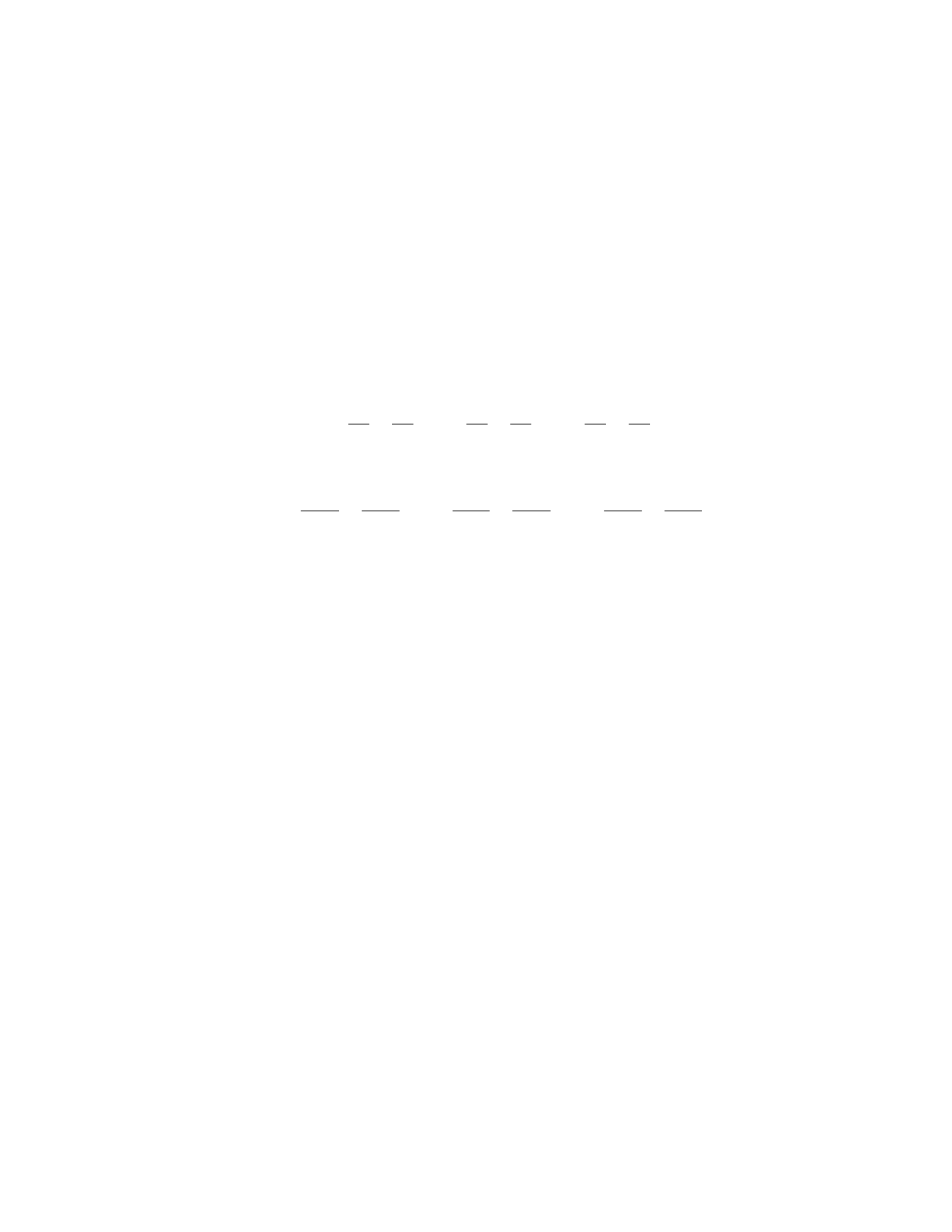
Step 1: Compute ∇ × F. The curl of a vector field F=⟨P, Q, R⟩is given by
∇ × F=∂R
∂y −∂Q
∂z i+∂P
∂z −∂R
∂x j+∂Q
∂x −∂P
∂y k.
Here, F(x, y, z) = ⟨yz, xz, xy⟩, so P=yz,Q=xz, and R=xy. Then we have:
∇ × F=∂(xy)
∂y −∂(xz)
∂z i+∂(yz)
∂z −∂(xy)
∂x j+∂(xz)
∂x −∂(yz)
∂y k
= (x−x)i+ (z−y)j+ (z−z)k
= 0i+ (z−y)j+ 0k
= (z−y)j.
Step 2: Evaluate the surface integral using Stokes’ Theorem. Stokes’ The-
orem states that for a vector field Fsmooth on an open region that contains
a piecewise-smooth, oriented surface Swith unit normal vector n, the surface
integral of the curl of Fover Sis equal to the line integral of Faround the
boundary curve of S:
ZZS
(∇ × F)·dS=IC
F·dr.
The closed curve Cis the boundary of Soriented counterclockwise. Here,
n=k=⟨0,0,1⟩. The curve Cconsists of four line segments: from (0,0,0)
to (2,0,0), from (2,0,0) to (2,1,0), from (2,1,0) to (0,1,0), and from (0,1,0)
back to (0,0,0). We have F·dr=yzdx +xzdy +xydz. Using the curve
parameterization along the edges of the rectangle, we get the line integral to be
Z2
0
(0)(0)+x(0)+0(0)dx+Z1
0
y(2)+(1)(0)+0dy+Z0
2
(1)(0)+y(0)+(1)(0)dx+Z0
1
(0)(2)+x(1)+x(0)dy
=Z1
0
2ydy +Z2
0
2xdx = [y2]1
0+ [x2]0
14

Question 16
Question
Let Sbe the part of the plane z= 1 + x+ 2ythat lies inside the cylinder
x2+y2= 1. Use Stokes’ Theorem to evaluate the surface integral RRS∇×F·dS,
where F(x, y, z) = (z, 3x, y).
Solution
Step 1: Find the unit normal vector nto the surface S. Since the surface is
defined by z= 1 + x+ 2y, a normal vector to Sis given by n=⟨∂
∂x (1 + x+
2y),∂
∂y (1 + x+ 2y),−1⟩=⟨1,2,−1⟩.
Step 2: Calculate ∇ × F. The curl of Fis given by
∇ × F=
i j k
∂
∂x
∂
∂y
∂
∂z
z3x y
=⟨−1,−1,3⟩.
Step 3: Calculate the surface integral using Stokes’ Theorem. By Stokes’
Theorem, we have
ZZS∇ × F·dS=Z ZR
(∇ × F)·ndA,
where Ris the region in the xy-plane projected onto the xy-plane. Since S
lies inside the cylinder x2+y2= 1,Ris the unit circle centered at the origin:
0≤r≤1,0≤θ≤2π.
Step 4: Evaluate the surface integral.
·dS=R2π
0R1
0⟨−1,−1,3⟩·⟨1,2,−1⟩rdrdθ
=R2π
0R1
0(r−2r+ 3)rdrdθ
=R2π
0R1
0(r2−2r2+ 3r)drdθ
=R2π
0(1
3−2
3+3
2)dθ
=R2π
0
7
6dθ
=7
6·2π
=7π
3.
Question 17
Question
Let Sbe the portion of the plane z= 4 −x−2ythat lies above the triangle
with vertices (1,0,0),(0,1,0), and (0,0,1). Use Stokes’ Theorem to evaluate
the circulation of the vector field F=xi+yj+zkcounterclockwise around the
boundary curve of S.
15

Solution
Step 1: First, we need to parametrize the boundary curve of S. The boundary of
the triangle is formed by the three line segments connecting the vertices. Let’s
find the parametric equations for these line segments.
The line segment connecting (1,0,0) to (0,1,0): Let r1(t) = (1 −t)
1
0
0
+
t
0
1
0
for 0≤t≤1. Then,
r1(t) = (1 −t, t, 0)
The line segment connecting (0,1,0) to (0,0,1): Let r2(t) = (1 −t)
0
1
0
+
t
0
0
1
for 0≤t≤1. Then,
r2(t) = (0,1−t, t)
The line segment connecting (0,0,1) to (1,0,0): Let r3(t) = (1 −t)
0
0
1
+
t
1
0
0
for 0≤t≤1. Then,
r3(t) = (t, 0,1−t)
Step 2: Now, we calculate the line integrals of Fover each of these line
segments:
Zr
1F·dr1=Z1
0
((1 −t)dt +t(0) + 0) = 1
2
Zr
2F·dr2=Z1
0
(0 + (1 −t)dt +t(1)) = 1
2
Zr
3F·dr3=Z1
0
(tdt) = 1
2
Step 3: By Stokes’ Theorem, the circulation of Faround the boundary curve
of Sis equal to the double integral of the curl of Fover the region S:
Circulation of F=ZZS
(∇ × F)·dS
16

Step 4: Notice that ∇ × F=
−1
−1
2
. Thus, the circulation is:
Circulation of F=ZZS
(−1,−1,2) ·dS
Step 5: The boundary of Scorresponds to the three line segments we
parametrized earlier. Thus, we can rewrite the circulation as the sum of the
line integrals over these three line segments:
Circulation of F=1
2+1
2−1
2= 0
Therefore, the circulation of the vector field Fcounterclockwise around the
boundary curve of Sis 0.
Question 18
Question
Let Sbe the part of the plane z= 1 −x−yin the first octant (x≥0,y≥0,
z≥0) and let F= (x2+y2, z2, xy)be a vector field. Calculate the flux of F
across the boundary of Sin the positive z-direction using Stokes’ Theorem.
Solution
Step 1: Find the boundary curve of Sby determining the intersection of the
plane z= 0 with z= 1 −x−y.
Setting z= 0 in z= 1 −x−y, we get 0 = 1 −x−y, which implies x+y= 1.
Thus, the boundary curve of Sin the xy-plane is the line x+y= 1.
Step 2: Parametrize the boundary curve Cas a curve in the xy-plane.
Let x=t, then y= 1 −tfor 0≤t≤1. The boundary curve Ccan be
parametrized as r(t) = (t, 1−t, 0) for 0≤t≤1.
Step 3: Calculate the curl of the vector field F.
The curl of Fis given by
∇×F=
ˆ
iˆ
jˆ
k
∂
∂x
∂
∂y
∂
∂z
x2+y2z2xy
= (∂(xy)
∂y −∂(z2)
∂z )ˆ
i−(∂(x2+y2)
∂x −∂(xy)
∂z )ˆ
j+(∂(x2+y2)
∂y −∂(xy)
∂x )ˆ
k
=xˆ
i+ 2zˆ
j−yˆ
k.
Step 4: Compute the line integral of ∇ × Fover the boundary curve C.
ZC
(∇ × F)·dr=Z1
0
r(t)·(r′(t)×(∇ × F))dt
17
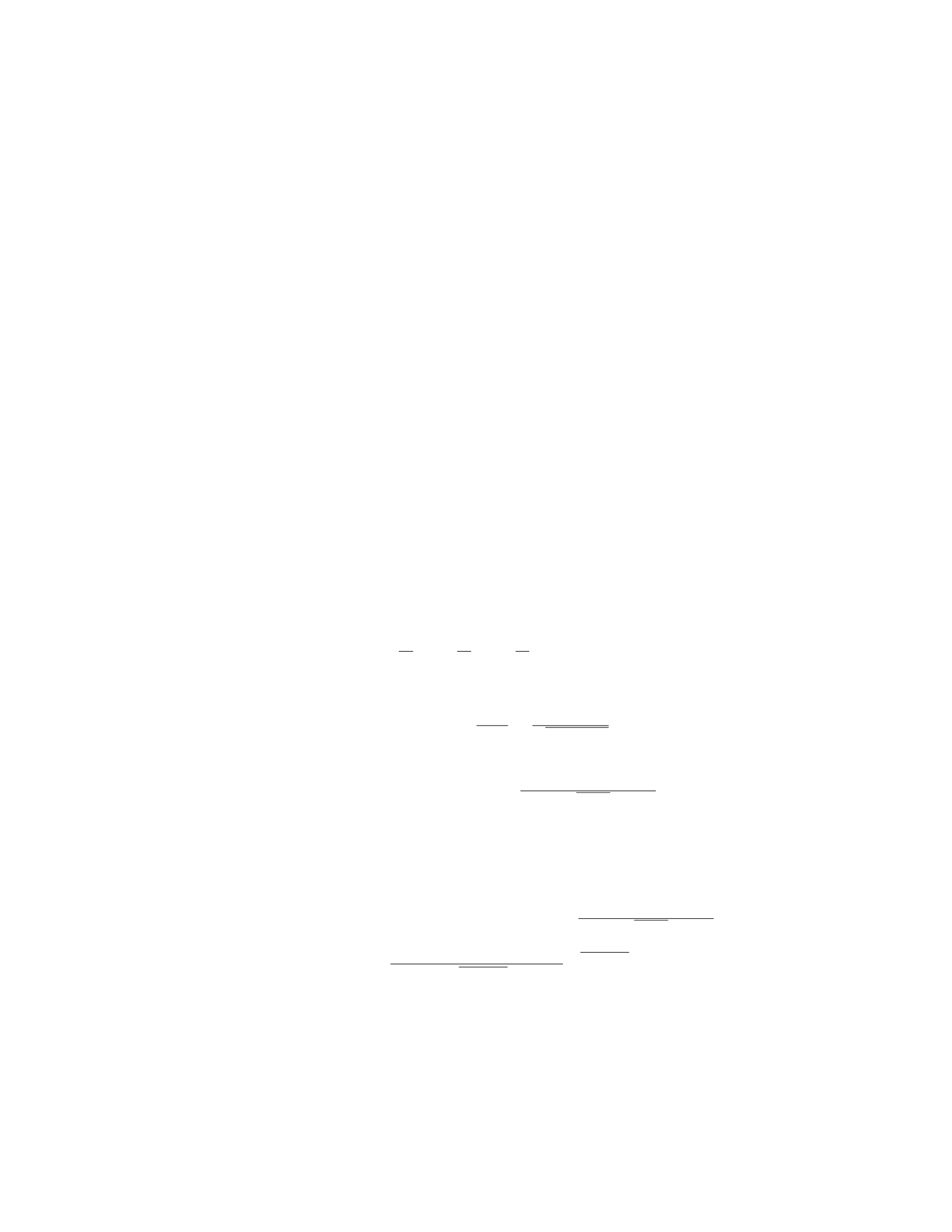
=Z1
0
(t, 1−t, 0) ·(1,−1,0)dt =Z1
0
t−(1 −t)dt =Z1
0
2t−1dt = [t2−t]1
0= 0.
Step 5: Apply Stokes’ Theorem.
By Stokes’ Theorem, the flux of Facross the boundary of Sin the positive
z-direction is equal to the line integral calculated in Step 4. Therefore, the flux
equals 0.
Question 19
Question
Let Sbe the part of the paraboloid z=x2+y2that lies above the disk x2+y2≤
4, oriented upward. Use Stokes’ Theorem to evaluate the surface integral
ZZS
(∇ × F)·dS,
where F(x, y, z) = (2y+z2, x +z, x2+y2).
Solution
Step 1: Find ∇ × F. We have that
∇ × F=
i j k
∂
∂x
∂
∂y
∂
∂z
2y+z2x+z x2+y2
= (2,−2,1).
Step 2: Determine the unit normal vector nto S. Since Sis oriented upward,
the unit normal vector is given by n=∇z
||∇z|| =⟨−2x,−2y,1⟩
√1+4x2+4y2.
Step 3: Calculate the outward-pointing unit normal vector nover the disk
D:x2+y2≤4. Since x2+y2≤4, we have D={(r, θ)|0≤r≤2,0≤θ≤2π}.
Then, the unit normal vector nbecomes n=⟨−2rcos(θ),−2rsin(θ),1⟩
√1+4r2.
Step 4: Use Stokes’ Theorem to evaluate the surface integral. We have the
surface integral over Sas
ZZS
(∇ × F)·dS=ZZD
(∇ × F)·n||n||dA.
Substitute the values of (∇ × F) = (2,−2,1) and n=⟨−2rcos(θ),−2rsin(θ),1⟩
√1+4r2, we
get
ZZD
(2,−2,1) ·⟨−2rcos(θ),−2rsin(θ),1⟩
√1+4r2p1+4r2drdθ.
Finally, we integrate over Dto solve for the surface integral.
18

Question 20
Question
Let Sbe the part of the plane z= 3 that lies inside the cylinder x2+y2= 9.
Use Stokes’ Theorem to evaluate the line integral
IC
(y2+z)dx + (z2+x)dy + (x2+y)dz
where Cis the boundary of Soriented counterclockwise as viewed from above.
Solution
Let’s first find the curl of the vector field F(x, y, z) = (y2+z, z2+x, x2+y):
curl F=
i j k
∂
∂x
∂
∂y
∂
∂z
y2+z z2+x x2+y
=∂(x2+y)
∂y −∂(z2+x)
∂z i−∂(y2+z)
∂x −∂(x2+y)
∂z j+∂(z2+x)
∂x −∂(y2+z)
∂y k
= (1 −0)i−(0 −1)j+ (1 −2)k=i+j−k
Now, let Dbe the region bounded by the circle x2+y2= 9 in the plane
z= 3. Applying Stokes’ Theorem:
ZZS
(curl F)·ndS =IC
F·dr
where nis the unit normal to Spointing in the direction consistent with the
right-hand rule, dS is the area element on S, and dris the tangent vector to C.
Since curl F=i+j−k, we have:
ZZS
(i+j−k)·(0,0,1) dS =IC
(y2+z)dx + (z2+x)dy + (x2+y)dz
=IC
(y2+ 3)dx + (9 + z)dy + (x2+y)dz
Let C1be the circle x2+y2= 9 in the plane z= 3. Then, the line integral
over C1can be parametrized as x(t) = 3 cos t,y(t) = 3 sin t,z(t)=3, for
19

0≤t≤2π. We have:
IC1
(y2+ 3)dx + (9 + z)dy + (x2+y)dz =Z2π
0
((3 sin t)2+ 3)(−3 sin t) + (9 + 3)(3 cos t) + (9(cos t)2+ 3 sin t)(0) dt
=Z2π
0
(−9 sin t+ 12 cos t+ 27) dt
= [−9(−cos t) + 12 sin t+ 27t]
2π
0
= 18π+0+0
= 18π
Therefore, the line integral over the boundary Cis 18π.
Question 21
Question
Let Sbe the surface of the portion of the sphere x2+y2+z2=a2where z≥0,
oriented with outward normal. Let F(x, y, z)=(xz, yz2, x2y). Calculate the
flux of Facross Susing Stokes’ Theorem.
Solution
Step 1: Find the curl of F. The curl of Fis given by:
∇ × F=
i j k
∂
∂x
∂
∂y
∂
∂z
xz yz2x2y
=∂(x2y)
∂y −∂(yz2)
∂z i−∂(xz)
∂x −∂(x2y)
∂z j+∂(xz)
∂y −∂(x2y)
∂x k
= (0 −2yz)i−(z−0)j+ (z−2xy)k
=−2yzi−zj+ (z−2xy)k
Step 2: Calculate the normal vector to the surface S. Since Sis a portion
of the sphere x2+y2+z2=a2where z≥0, the outward normal vector at each
point is n=x
a,y
a,z
a.
Step 3: Calculate the surface area element dS. The surface area element dS
in spherical coordinates is given by dS =a2sin ϕ dϕ dθ.
Step 4: Apply Stokes’ Theorem to find the flux of Facross S. The flux of
Facross Sis given by the surface integral:
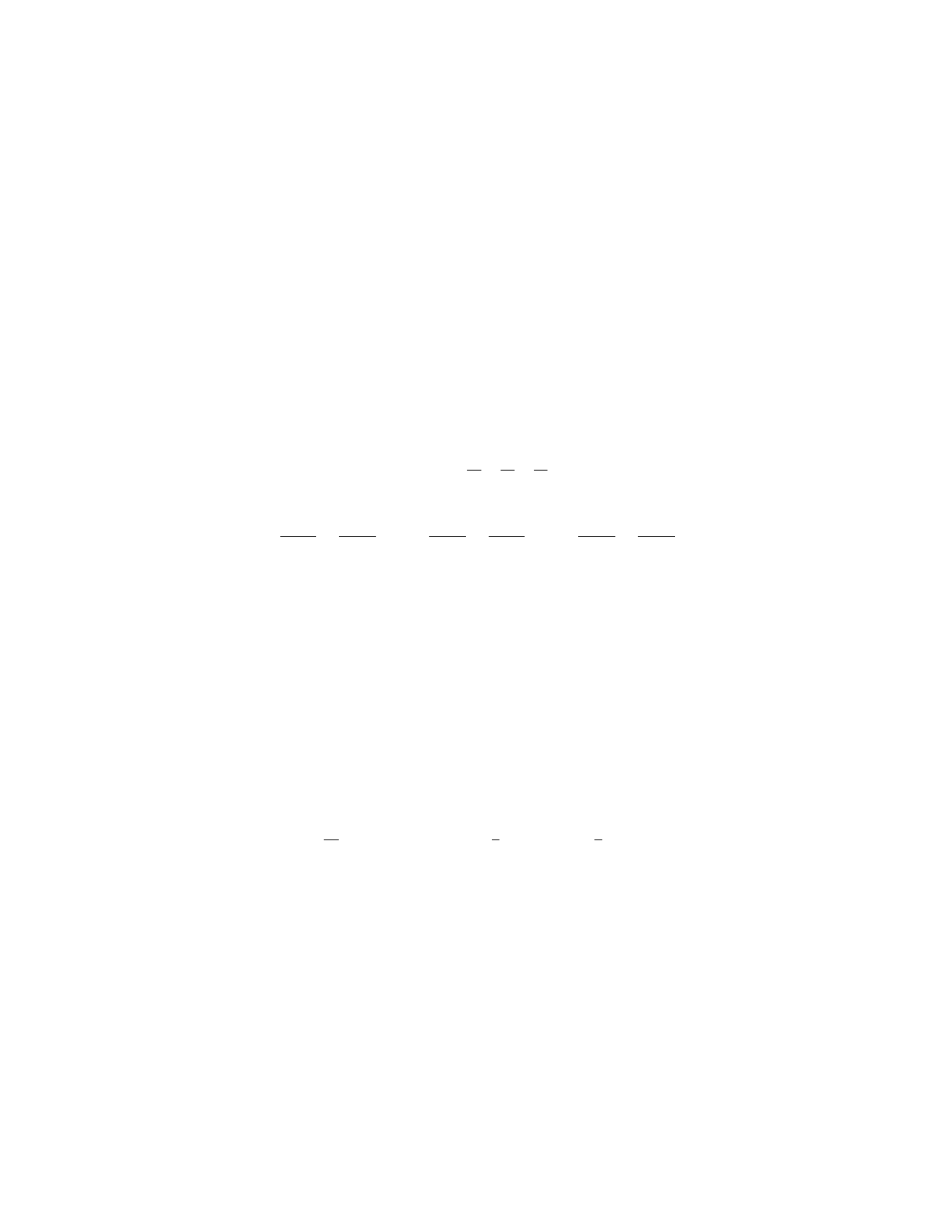
ZZS
(∇ × F)·ndS =ZZD
(∇ × F)·ndA
where Dis the region in the xy-plane corresponding to the projection of S.
20
Question 22
Question
Let Sbe the part of the plane z= 1 + x−ythat lies above the rectangle
0≤x≤2and 0≤y≤1. Let F(x, y, z) = ⟨x2, yz, z2⟩. Calculate the surface
integral RRS(∇ × F)·dSusing Stokes’ Theorem.
Solution
Step 1: Calculate ∇ × F. Step 2: Calculate the outward unit normal vector n
to the surface S. Step 3: Calculate the surface integral using Stokes’ Theorem.
Step 1: Calculate ∇ × F.
∇ × F=
i j k
∂
∂x
∂
∂y
∂
∂z
x2yz z2
=∂(z2)
∂y −∂(yz)
∂z i+∂(x2)
∂z −∂(z2)
∂x j+∂(yz)
∂x −∂(x2)
∂y k
= (0 −z)i+ (0 −0)j+ (y−0)k=−zi+yk
Step 2: Calculate the outward unit normal vector nto the surface S. The
unit normal vector to the plane z= 1 + x−yis n=⟨1,−1,−1⟩.
Step 3: Calculate the surface integral using Stokes’ Theorem. By Stokes’
Theorem, ZZS
(∇ × F)·dS=Z Z F·dr
where r=⟨x, y, 1 + x−y⟩on the surface S.
Thus, we have
Z2
0Z1
0
(−z, 0, y)·(1,−1,−1) dy dx =Z2
0Z1
0−z+y dy dx
=Z2
0−y+y2
2y=1
y=0
dx =Z2
0−1 + 1
2dx =Z2
0−1
2dx =−x
2
0=−2
Question 23
Question
Let Sbe the part of the plane z= 4−x−2ythat lies above the triangular region
with vertices (0,0,0),(0,2,0), and (1,1,0) in R3. Let F= (x2+y, y +z, xz)be
a vector field. Evaluate the surface integral RRSF·dSusing Stokes’ Theorem.
21
Solution
Step 1: Find the normal vector nto the plane S. The normal vector to the
plane Sis given by n=∇h=−∂h
∂x ,−∂h
∂y ,1, where h(x, y, z) = 4 −x−2y.
Therefore, n= (−(−1),−(−2),1) = (1,2,1).
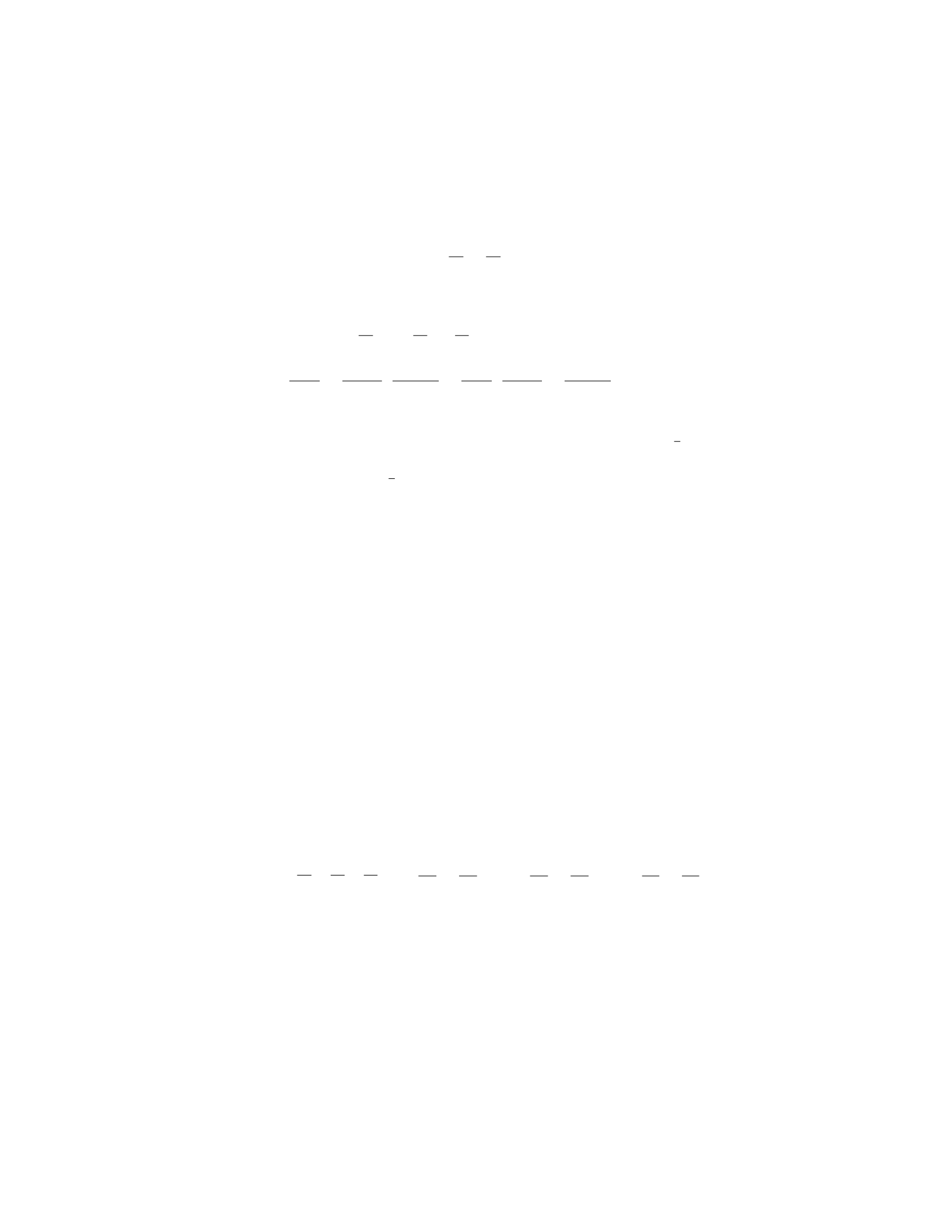
Step 2: Calculate the curl of F, denoted by ∇ × F. The curl of Fis
given by ∇ × F=
i j k
∂
∂x
∂
∂y
∂
∂z
x2+y y +z xz
. Expanding the determinant, we have
∇ × F=∂(xz)
∂y −∂(y+z)
∂z ,∂(x2+y)
∂z −∂(xz)
∂x ,∂(y+z)
∂x −∂(x2+y)
∂y . Simplifying, we
get ∇ × F= (−1, x −1,0).
Step 3: Find the surface area of the triangular region. The area of a triangle
with vertices (0,0,0),(0,2,0), and (1,1,0) can be calculated as A=1
2|A×B|,
where A=⟨0,2,0⟩and B=⟨1,1,0⟩. The cross product gives us A×B=
⟨0,0,2⟩. So, the area A=1
2|⟨0,0,2⟩| = 1.
Step 4: Apply Stokes’ Theorem to evaluate the surface integral. Stokes’
Theorem states that RRSF·dS=HCF·dr, where Cis the boundary of the
surface S. The boundary of the triangular region is the triangle itself. We
parameterize the curve as r(t) = ⟨t, 2−t, 0⟩for 0≤t≤1. Then, dr=
dt dt = ⟨1,−1,0⟩dt. Now, we have HCF·dr=R1
0F(r(t))·
dt dt = R1
0F(t, 2−t, 0) ·⟨1,−1,0⟩dt. Calculating the dot product, we get HC
Question 24
Question
Let Sbe the part of the plane z= 1−x−ythat lies above the square 0≤x≤1,
0≤y≤1in the xy-plane. Calculate the surface integral RRSF·dSof the vector
field F(x, y, z) = (z, y, x)over the surface Susing Stokes’ Theorem.
Solution
Step 1: Calculate the curl of F. To find the curl of F, we compute ∇ × F:
∇ × F=
i j k
∂
∂x
∂
∂y
∂
∂z
z y x
=∂x
∂y −∂y
∂x i−∂x
∂z −∂z
∂x j+∂y
∂z −∂z
∂y k
= (1 −0)i−(0 −1)j+ (0 −0)k=i+j
Step 2: Calculate the surface integral using Stokes’ Theorem. By Stokes’
Theorem, we have: ZZS
F·dS=IC
F·dr
22

where Cis the boundary of Soriented counterclockwise. The boundary of
the surface Sis the square in the xy-plane, which can be parameterized as
r(t) = (t, 0,1−t)for 0≤t≤1. Thus, the line integral becomes:
IC
F·dr=Z1
0
F(r(t)) ·r′(t)dt
=Z1
0
(1 −t, 0, t)·(1,0,−1)dt =Z1
0
(1 −t)dt =1
2
Therefore, the surface integral RRSF·dSof the vector field F(x, y, z) = (z, y, x)
over the surface Sis 1
2.
Question 25
Question
Let Sbe the part of the plane z= 4 −x−2ythat lies inside the cylinder
x2+y2= 4. Use Stokes’ Theorem to evaluate the surface integral
ZZS
(∇ × F)·dS,
where F(x, y, z) = ⟨x2y, z, x −y2⟩.
Solution
Step 1: Find the curl of F.
∇ × F=
i j k
∂
∂x
∂
∂y
∂
∂z
x2y z x −y2
=∂(x−y2)
∂y −∂z
∂x i−∂(x2y)
∂z −∂(x−y2)
∂x j+∂z
∂y −∂(x2y)
∂y k
= (1 −0)i−(0 −1)j+ (1 −x2)k
=i+j+ (1 −x2)k.
Step 2: Determine the unit normal vector to the surface S. Since the surface
Sis the part of the plane z= 4 −x−2yinside the cylinder x2+y2= 4, we
can represent Sparametrically as r(s, t) = ⟨2 cos s, 2 sin s, 4−2 cos s−4 sin s⟩,
where 0≤s≤2πand 0≤t≤1.
The unit normal vector to Sis given by ˆ
n=rs×rt
∥rs×rt∥. Calculating the cross
product and simplifying gives ˆ
n=1
√6⟨1,−2,−1⟩.
23

Step 3: Calculate the surface integral using Stokes’ Theorem. By Stokes’
Theorem, the given surface integral can be evaluated as
ZZS
(∇ × F)·dS=IC
F·dr,
where Cis the boundary curve of S.
The boundary curve Cis the intersection of the plane z= 4 −x−2yand
the cylinder x2+y2= 4. Thus, Cis the circle x2+y2= 4, but in the plane
z= 4−x−2y. We can parameterize Cas r(t) = ⟨2 cos t, 2 sin t, 4−2 cos t−4 sin t⟩,
where 0≤t≤2π.
Calculating the line integral HCF·drgives the value of the surface integral.
24
Solution
Step 1: Compute the curl of F:
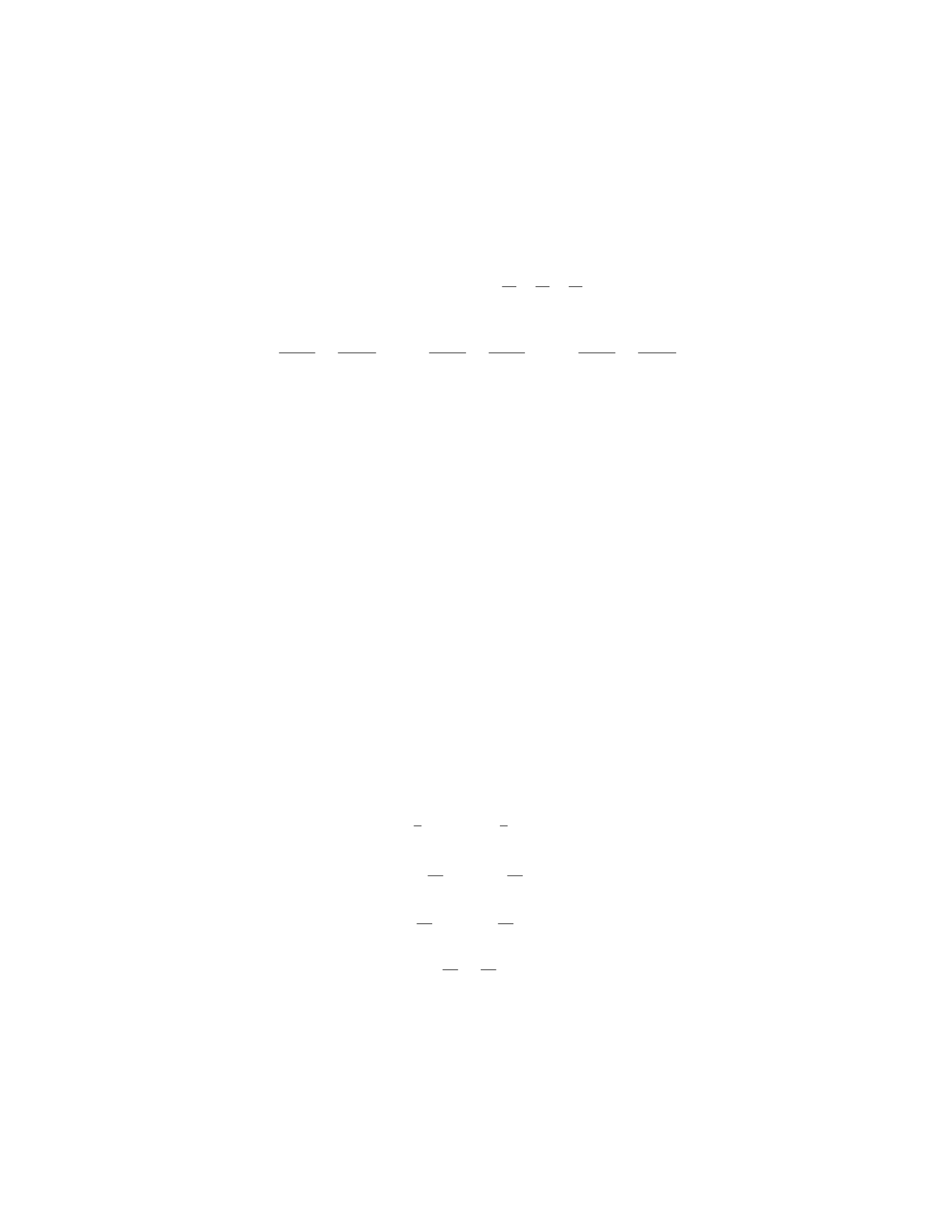
curl(F) = ∇ × F=
i j k
∂
∂x
∂
∂y
∂
∂z
x2xy y2
=∂(y2)
∂y −∂(xy)
∂z i−∂(x2)
∂x −∂(y2)
∂z j+∂(x2)
∂y −∂(xy)
∂x k
= 2yi+ 2xj+ 0k= 2yi+ 2xj
Step 2: Calculate the surface integral of Fover Susing Stokes’ Theorem:
ZZS
(curl(F)·n)dS =ZZD
(curl(F)·N)dA
where Dis the projection of Sonto the xy-plane, Nis the normal vector to D,
and dA is the area element in the xy-plane.
Step 3: Find the normal vector and area element: The normal vector to D
is N=−k. The area element is dA =dx dy.
Step 4: Parametrize the region D: The projection of the hemisphere onto
the xy-plane is the disk x2+y2≤4. This region can be parametrized by
x=rcos(θ),y=rsin(θ)where 0≤r≤2and 0≤θ≤2π.
Step 5: Calculate the dot product and the surface integral:
ZZD
(curl(F)·N)dA =ZZD−(2rsin(θ)+2rcos(θ)) dA
=−Z2π
0Z2
0
(2rsin(θ)+2rcos(θ))r dr dθ
=−Z2π
0Z2
0
(2r2sin(θ)+2r2cos(θ)) dr dθ
=−Z2π
02
3r3sin(θ) + 2
3r3cos(θ)
2
0dθ
=−Z2π
016
3sin(θ) + 16
3cos(θ)dθ
=−−16
3cos(θ) + 16
3sin(θ)
2π
0
=32
3−32
3= 0
Therefore, the surface integral of Fover S
2

Question 3
Question
Let Sbe the portion of the plane z= 4 −x−2ythat lies inside the cylinder
x2+y2= 1 and above the xy-plane. Use Stokes’ Theorem to evaluate the
circulation of the vector field F(x, y, z) = (z−3y)i+ (x−z)j+ (y−x)karound
the curve Cthat is the intersection of Swith the plane x+y= 1.
Solution
To apply Stokes’ Theorem, we need to calculate the curl of Fand find its surface
integral over the surface S.
Step 1: Find the Curl of FThe curl of Fis given by:
∇ × F=
i j k
∂
∂x
∂
∂y
∂
∂z
z−3y x −z y −x
=∂(y−x)
∂y −∂(x−z)
∂z i−∂(z−3y)
∂z −∂(y−x)
∂x j+∂(x−z)
∂x −∂(z−3y)
∂y k
= (−1−(−1))i−(1 −(−1))j+ (1 −(−3))k
= 0i−2j+ 4k=−2j+ 4k
Step 2: Parameterize the Surface and Find the Normal Vector The
surface Sis the portion of the plane z= 4 −x−2ythat lies inside the cylinder
x2+y2= 1. We can parameterize Sas r(u, v) = ui+vj+ (4 −u−2v)kfor
(u, v)∈D, where Dis the unit disk in the xy-plane.
The normal vector Nto Sis given by the cross product of the partial deriva-
tives of rwith respect to uand v:
N=∂r
∂u ×∂r
∂v
∂r
∂u =i−k,∂r
∂v =j−2k
N=
i j k
1 0 −1
0 1 −2
= (−1)i−(−2)j−(−1)k=−i+ 2j−k
Step 3: Evaluate the Surface Integral Applying Stokes’ Theorem, the
circulation of Faround Cis equal to the surface integral of ∇ × Fover S:
ZZS
(∇ × F)·NdS
=ZZD
(−2j+ 4k)·(−i+ 2j−k)dA
3

=ZZD
(−8) dA
=−8
Question 4
Question
Let Sbe the surface of the cone z=px2+y2that lies above the disk x2+y2≤1
in the xy-plane, oriented upward. Use Stokes’ Theorem to evaluate the surface
integral
ZZ
S
(∇ × F)·ndS,
where F(x, y, z) = ⟨x2, y2, z2⟩and nis the outward-pointing unit normal vector
to S.
Solution
Step 1: Compute ∇ × F. The curl of a vector field F(x, y, z) = ⟨M, N, P ⟩is
given by
∇ × F=∂P
∂y −∂N
∂z i+∂M
∂z −∂P
∂x j+∂N
∂x −∂M
∂y k.
In this case, F(x, y, z) = ⟨x2, y2, z2⟩, so
∇ × F= (0 −0) i+ (2z−0) j+ (0 −0) k= 2zj.
Step 2: Find the unit normal vector n. The surface Sis the cone z=
px2+y2above the disk x2+y2≤1. The outward-pointing unit normal vector
to Sis given by
n=∇g
∥∇g∥,
where g(x, y, z) = z−px2+y2is a scalar function defining S. The gradient of
gis
∇g=⟨− x
px2+y2,−y
px2+y2,1⟩,
so the unit normal vector is
n=⟨− x
√x2+y2,−y
√x2+y2,1⟩
sx
√x2+y22
+y
√x2+y22
+ 12
.
4

Step 3: Evaluate the surface integral using Stokes’ Theorem. Stokes’ The-
orem states that for a surface Swith boundary curve Coriented positively
(counterclockwise when viewed from above), we have
ZZ
S
(∇ × F)·ndS =IC
F·dr,
where dris the differential arc length along the boundary curve C. Since the
boundary of Sis the circle x2+y2= 1 in the xy-plane, we can parameterize
this circle as r(t) = ⟨cos t, sin t, 0⟩for 0≤t≤2π.
Then the line integral can be computed as
IC
F·dr=Z2π
0
F(r(t)) ·r′(t
Question 5
Question
Let Sbe the part of the surface z=x2+y2that lies below the plane z= 4. Use
Stokes’ Theorem to evaluate the surface integral RRSF·dS, where F(x, y, z) =
(y+z, x +z, x +y).
Solution
Step 1: Find the curl of F. The curl of Fis given by
∇×F=
i j k
∂
∂x
∂
∂y
∂
∂z
y+z x +z x +y
=∂
∂y (x+y)−∂
∂z (x+z),∂
∂z (y+z)−∂
∂x (x+y),∂
∂x (x+z)−∂
∂y (y+z)
= (1 −1,1−1,1−1) = (0,0,0).
Step 2: Calculate the surface integral using Stokes’ Theorem. By Stokes’
Theorem, ZZS
F·dS=Z Z∂S
F·dr,
where ∂S is the boundary of Swith outward orientation.
Step 3: Find the boundary curve of S. The surface z=x2+y2intersects
z= 4 when x2+y2= 4. This gives us the circle Cof radius 2centered at
the origin in the xy-plane. The parametric equations for Care x= 2 cos t,
y= 2 sin t,z= 4 with 0≤t≤2π.
Step 4: Parameterize the boundary curve. For C, the unit normal vector
pointing outwards is N=(x,y,−4)
√x2+y2+16 =(2 cos t,2 sin t,−4)
4= (cos t, sin t, −1).
Step 5: Evaluate the line integral. Now, we compute
ZC
F·dr=Z2π
0
F(2 cos t, 2 sin t, 4) ·(−2 sin t, 2 cos t, 0)dt.
5

Step 6: Simplify and solve the line integral. We have
F(2 cos t, 2 sin t, 4) = (2 sin t+ 4,2 cos t+ 4,2 cos t+ 2 sin t),
and
F(2 cos t, 2 sin t, 4) ·(−2 sin t, 2 cos t, 0) = 12.
Therefore, the surface integral of Fover Sis 12 .
Question 6
Question
Let
F(x, y, z) = (x2y, z, exyz )be a vector field. Let Sbe the part of the plane
z= 4 −x−2ythat lies above the region in the xy-plane bounded by the
curves y=x2and y=x. Use Stokes’ Theorem to evaluate the surface integral
RRS∇ ×
F·d
S.
Solution
Step 1: Determine the boundary curve Cin the xy-plane. This boundary is the
curve where y=x2and y=xintersect. We find their intersection by setting
x2=x:
x2=x
x2−x= 0
x(x−1) = 0
x= 0 or x= 1
So the boundary curve Cis the line segment from (0,0) to (1,1).
Step 2: Calculate the curl of
F:∇ ×
F=∂P
∂y −∂N
∂z ,∂M
∂z −∂P
∂x ,∂N
∂x −∂M
∂y
Here,
F(x, y, z) = (x2y, z, exyz ).
Calculating the curl, we get:
∇ ×
F= (0 −0,0−2xy, xyexyz −0)
∇ ×
F= (−2xy, 0, xyexyz )
Step 3: Use Stokes’ Theorem to evaluate the surface integral. Stokes’ The-
orem states: ZZS∇ ×
F·d
S=IC
F·dr
Since ∇ ×
F= (−2xy, 0, xyexyz ), the surface integral simplifies to:
ZZS
(−2xy, 0, xyexyz )·d
S
Therefore, our final task is to evaluate the line integral over the boundary
curve C.
6

Question 7
Question
Let F(x, y, z) = ⟨−y2, x2, z⟩be a vector field, and let Sbe the part of the plane
z=x+ythat lies above the triangle with vertices at (0,0,0),(1,0,1), and
(0,1,1). Calculate the flux of Facross Susing Stokes’ Theorem.
Solution
Step 1: First, we compute the curl of F:
curl(F) = ∇ × F=
i j k
∂
∂x
∂
∂y
∂
∂z
−y2x2z
=⟨0,0,2x+ 2y⟩
Step 2: Now, we find the normal vector to the surface S. The normal vector
is given by n=∇g
|∇g|where g(x, y, z) = z−x−yis the function defining the
plane z=x+y. We have ∇g=⟨−1,−1,1⟩and |∇g|=√12+ 12+ 12=√3,
so n=1
√3⟨−1,−1,1⟩.
Step 3: The flux of Facross Sis given by the surface integral RRScurl(F)·
ndS. Since the normal vector points upwards, we need to use −nin the dot
product.
Step 4: We parameterize the triangle Tin the xy-plane by r(u, v) = ui+vj
with 0≤u≤1and 0≤v≤1−u. The position vector on the surface Sis then
r(u, v) = ⟨u, v, u +v⟩.
Step 5: The normal vector to the triangle Tis n=ksince the triangle lies
in the xy-plane. Therefore, n·curl(F) = (2u+ 2v)·1 = 2u+ 2v.
Step 6: The flux of Facross Sis then given by the surface integral:
ZZS
curl(F)·ndS =ZZT
(2u+ 2v)dA
Step 7: We evaluate the integral over the region Tin the uv-plane:
Z1
0Z1−u
0
(2u+ 2v)dv du
=Z1
0
[2uv +v2]v=1−u
v=0 du
=Z1
0
(2u(1 −u) + (1 −u)2)du
=Z1
0
(2u−2u2+ 1 −2u+u2)du
=Z1
0
(1 −u−u2)du
7

= [u−u2
2−u3
3]1
0
= 1 −1
2−1
3=1
6
Therefore, the flux of Facross Sis 1
6.
Question 8
Question
Let Sbe the surface of the solid bounded by the cylinder x2+y2= 1 and the
planes z= 0 and z= 4. Find the flux of the vector field F= (x2, y2, z2)across
Susing Stokes’ Theorem.
Solution
Step 1: Calculate the curl of the vector field F:
curl(F) =
i j k
∂
∂x
∂
∂y
∂
∂z
x2y2z2
= (0,0,2z−2y)
Step 2: Use Stokes’ Theorem to find the flux of Facross S: The flux of
curl(F)across Sis equal to the line integral of Fover the boundary of S.
ZZS
curl(F)·dS=IC
F·dr
where Cis the boundary curve of S.
Step 3: Parameterize the boundary curve C: From the equations x2+y2= 1
and z= 0, we have x= cos(t),y= sin(t), and z= 0. Thus, Cis parameterized
by r(t) = (cos(t),sin(t),0). For 0≤t≤2π.
Step 4: Calculate the line integral over C:
IC
F·dr=Z2π
0
F(r(t)) ·r′(t)dt =Z2π
0
(cos2(t),sin2(t),0) ·(−sin(t),cos(t),0)dt
=Z2π
0
(−cos(t) sin(t) + sin(t) cos(t))dt =Z2π
0
0dt = 0
Step 5: Conclusion: Since the line integral over Cis 0, by Stokes’ Theorem,
the flux of Facross Sis also 0.
8

Question 9
Question
Let F(x, y, z) = (xz, yz, xy)be a vector field. Consider the surface Sdefined by
z= 1 −x2−y2for 0≤z≤1. Calculate the flux of Facross Susing Stokes’
Theorem.
Solution
Step 1: First, we need to find the curl of F. The curl of a vector field F(x, y, z) =
(P(x, y, z), Q(x, y, z), R(x, y, z)) is defined as:
curl(F) = ∂R
∂y −∂Q
∂z ,∂P
∂z −∂R
∂x ,∂Q
∂x −∂P
∂y
In our case, F(x, y, z)=(xz, yz, xy), so P(x, y, z) = xz,Q(x, y, z) = yz, and
R(x, y, z) = xy. Calculating the partial derivatives, we get:
∂R
∂y =x, ∂Q
∂z =y, ∂P
∂z =x, ∂R
∂x =y, ∂Q
∂x = 0,∂P
∂y = 0
Therefore, the curl of Fis:
curl(F) = (x−y, y −x, 0)
Step 2: Next, we need to find the unit normal vector to the surface S. The
surface Sis defined implicitly by F(x, y, z) = z−1 + x2+y2= 0. The gradient
of Fgives the normal vector to the surface. The gradient of Fis:
∇F=∂F
∂x ,∂F
∂y ,∂F
∂z = (2x, 2y, 1)
To find the unit normal vector, we normalize ∇Fby dividing it by its magnitude:
∥∇F∥=p4x2+ 4y2+ 1
So, the unit normal vector is:
n=1
p4x2+ 4y2+ 1(2x, 2y, 1)
Step 3: Stokes’ Theorem states that the flux of Facross Sis equal to the
surface integral of the dot product of Fand the curl of Fover the surface S.
Let’s denote the region in the xy-plane bounded by z= 1 −x2−y2as D. Then,
we can parameterize Sas r(x, y) = (x, y, 1−x2−y2)for (x, y)∈D. Now, the
flux of Facross Sis:
ZZS
(curl(F)•n)dS =ZZD
curl(F)•(
∂x×
∂ydA
We can now proceed to compute this surface integral to find the flux of F
across S.
9

Question 10
Question
Let F= (x2+y2)i+ (y2+z2)j+ (z2+x2)kbe a vector field, and let Sbe
the surface of the cone z=px2+y2for 0≤z≤2. Use Stokes’ Theorem to
evaluate the surface integral RRS(∇ × F)·ndS, where nis the outward unit
normal to S.
Solution
Step 1: First, we calculate the curl of F:
∇ × F=
i j k
∂
∂x
∂
∂y
∂
∂z
x2+y2y2+z2z2+x2
∇ × F= (2y−2z)i+ (2z−2x)j+ (2x−2y)k
Step 2: The unit normal vector to the cone z=px2+y2is given by
n=1
√2(x, y, −√2). So, we have n=1
√2(x, y, −px2+y2).
Step 3: Now, we need to find the projection of curl(F) onto n, i.e., (∇×F)·n.
(∇ × F)·n= (2y−2z)x
√2+ (2z−2x)y
√2+ (2x−2y)(−rx2+y2
2)
Step 4: We can simplify this expression further.
(∇ × F)·n=1
√2(2xy −2xz + 2yz −2xy −2xpx2+y2+ 2ypx2+y2)
Step 5: Considering the symmetry of the terms, most of them cancel out,
and we are left with:
(∇ × F)·n= 2ypx2+y2−2xpx2+y2
Step 6: The surface integral we are trying to evaluate is now:
ZZS
(∇ × F)·ndS =ZZS
(2ypx2+y2−2xpx2+y2)dS
Step 7: Since we have already expressed everything in terms of xand y, we
can convert dS into dA =r dr dθ in polar coordinates.
Step 8: The bounds of rare from 0to 2and the bounds of θare from 0to
2πas we are integrating over the entire cone surface.
Step 9: Finally, we evaluate the integral:
ZZS
(∇ × F)·ndS =Z2π
0Z2
0
(2rsin θ)·r dr dθ
Step 10: Solving the double integral gives us the final answer.
10

Question 11
Question
Let Sbe the portion of the plane z= 16 −x−ythat lies inside the cylinder
x2+y2= 16, oriented so that its unit normal points downward, and let F=
(y2, z, x)be a vector field. Calculate the surface integral RRS(∇ × F)·dSover
the surface Susing Stokes’ Theorem.
Solution
Step 1: Find the curl of F,∇ × F. The curl of a vector field F= (P, Q, R)is
given by
∇ × F=∂R
∂y −∂Q
∂z ,∂P
∂z −∂R
∂x ,∂Q
∂x −∂P
∂y .
For F= (y2, z, x), we have P=y2, Q =z, R =x. Therefore,
∇ × F= (0 −1,0−0,2y−0) = (−1,0,2y).
Step 2: Find the unit normal vector nto the surface S. Since the surface Sis
the portion of the plane z= 16 −x−ythat lies inside the cylinder x2+y2= 16,
we have n=1
√1+1+1 (−1,−1,−1) = −1
√3(1,1,1).
Step 3: Calculate the surface integral using Stokes’ Theorem. Stokes’ The-
orem states that ZZS
(∇ × F)·dS=IC
F·dr,
where Cis the boundary of S. The boundary Cof Sis the intersection of the
plane z= 16 −x−yand the cylinder x2+y2= 16. We can parameterize Cby
r(t) = (4 cos t, 4 sin t, 0) for 0≤t≤2π.
Step 4: Calculate the line integral
IC
F·dr=Z2π
0
F(r(t)) ·r′(t)dt.
We have F(r(t)) = (16 sin2t, 0,4 cos t)and r′(t) = (−4 sin t, 4 cos t, 0). Thus,
F(r(t)) ·r′(t) = 16 sin2t·(−4 sin t) + 0 + 4 cos t·4 cos t=−64 sin3t+ 16 cos2t.
Step 5: Calculate the integral
IC
F·dr=Z2π
0
(−64 sin3t+ 16 cos2t)dt = 0.
Therefore, the surface integral RRS(∇ × F)·dSover the surface Sis 0.
11

Question 12
Question
Let Sbe the part of the plane z= 5 −x−ythat lies above the square 0≤
x≤2,0≤y≤2. Use Stokes’ Theorem to evaluate RRS(∇ × F)·ndS, where
F(x, y, z) = zi+xj+ykand nis the outward unit normal vector to S.
Solution
Step 1: Find the curl of F.
∇ × F=
i j k
∂
∂x
∂
∂y
∂
∂z
z x y
=∂y
∂y −∂z
∂z i−∂x
∂x −∂z
∂z j+∂x
∂y −∂y
∂x k
=i+j+k
Step 2: Find the outward unit normal vector nto S. Since the unit normal
vector points in the direction of increasing z, we have n=k.
Step 3: Parameterize the surface Susing xand y. Let r(x, y) = xi+yj+
(5 −x−y)k.
Step 4: Calculate the curl of Fdot n.
∇ × F·n= (i+j+k)·k= 1
Step 5: Calculate the surface integral.
ZZS
(∇ × F)·ndS =ZZD
1dA
where Dis the region in the xy-plane corresponding to S, which is the square
0≤x≤2,0≤y≤2. The surface integral simplifies to
ZZD
1dA =Z2
0Z2
0
1dy dx =Z2
0
y
2
0
dx =Z2
0
2dx = 2 ·2 = 4
Therefore, ZZS
(∇ × F)·ndS = 4.
Question 13
Question
Let Sbe the part of the paraboloid z= 4 −x2−y2which lies above the square
0≤x≤2,0≤y≤2. Evaluate the surface integral RRS(∇ × F)·ˆndS, where
F(x, y, z) = ⟨y2, xz, z2⟩and ˆnis the outward unit normal to S.
12

Solution
Step 1: Find the curl of F. The curl of a vector field F(x, y, z) = ⟨M, N, P ⟩is
given by:
∇ × F=∂P
∂y −∂N
∂z i+∂M
∂z −∂P
∂x j+∂N
∂x −∂M
∂y k
In this case, F(x, y, z) = ⟨y2, xz, z2⟩, so:
∇ × F=∂(z2)
∂y −∂(xz)
∂z i+∂(y2)
∂z −∂(z2)
∂x j+∂(xz)
∂x −∂(y2)
∂y k
∇ × F= 0i+zj+xk=zj+xk
Step 2: Evaluate the surface integral. By Stokes’ Theorem, the surface
integral can be evaluated as the line integral around the boundary curve of S.
The boundary curve is the square 0≤x≤2,0≤y≤2. Parameterize the
boundary curve: For the line segment from (0,0, f(0,0)) to (2,0, f (2,0)) where
f(x, y) = 4 −x2−y2, we have: r(t) = ⟨t, 0,4−t2⟩for 0≤t≤2.
Similarly, parameterize the line segments from (2,0, f(2,0)) to (2,2, f (2,2)),
(2,2, f(2,2)) to (0,2, f(0,2)), and (0,2, f(0,2)) to (0,0, f(0,0)), then calculate
the line integrals along these curves.
Work through the calculations to find the required surface integral.
Question 14
Question
Let Sbe the part of the plane z= 4−x−ythat lies inside the cylinder x2+y2= 1
and above the xy-plane. Use Stokes’ Theorem to evaluate the surface integral
RRS(∇ × F)·dS, where F(x, y, z) = (y+z)i+ (x+z)j+ (x+y)k.
Solution
Step 1: We first compute the curl of F:
∇ × F=
i j k
∂
∂x
∂
∂y
∂
∂z
y+z x +z x +y
= (1 −1)i−(1 −1)j+ (1 −1)k=0
Step 2: Since the curl of Fis 0, the surface integral RRS(∇×F)·dSis equal
to 0.
Therefore, RRS(∇ × F)·dS= 0.
13
Question 15
Question
Let Sbe the part of the plane z= 4 −x−ythat lies above the rectangle in the
xy-plane with vertices at (0,0),(2,0),(2,1), and (0,1). Use Stokes’ Theorem
to evaluate the surface integral RRS(∇×F)·dS, where F(x, y, z) = ⟨yz, xz, xy⟩.
Solution
Step 1: Compute ∇ × F. The curl of a vector field F=⟨P, Q, R⟩is given by
∇ × F=∂R
∂y −∂Q
∂z i+∂P
∂z −∂R
∂x j+∂Q
∂x −∂P
∂y k.
Here, F(x, y, z) = ⟨yz, xz, xy⟩, so P=yz,Q=xz, and R=xy. Then we have:
∇ × F=∂(xy)
∂y −∂(xz)
∂z i+∂(yz)
∂z −∂(xy)
∂x j+∂(xz)
∂x −∂(yz)
∂y k
= (x−x)i+ (z−y)j+ (z−z)k
= 0i+ (z−y)j+ 0k
= (z−y)j.
Step 2: Evaluate the surface integral using Stokes’ Theorem. Stokes’ The-
orem states that for a vector field Fsmooth on an open region that contains
a piecewise-smooth, oriented surface Swith unit normal vector n, the surface
integral of the curl of Fover Sis equal to the line integral of Faround the
boundary curve of S:
ZZS
(∇ × F)·dS=IC
F·dr.
The closed curve Cis the boundary of Soriented counterclockwise. Here,
n=k=⟨0,0,1⟩. The curve Cconsists of four line segments: from (0,0,0)
to (2,0,0), from (2,0,0) to (2,1,0), from (2,1,0) to (0,1,0), and from (0,1,0)
back to (0,0,0). We have F·dr=yzdx +xzdy +xydz. Using the curve
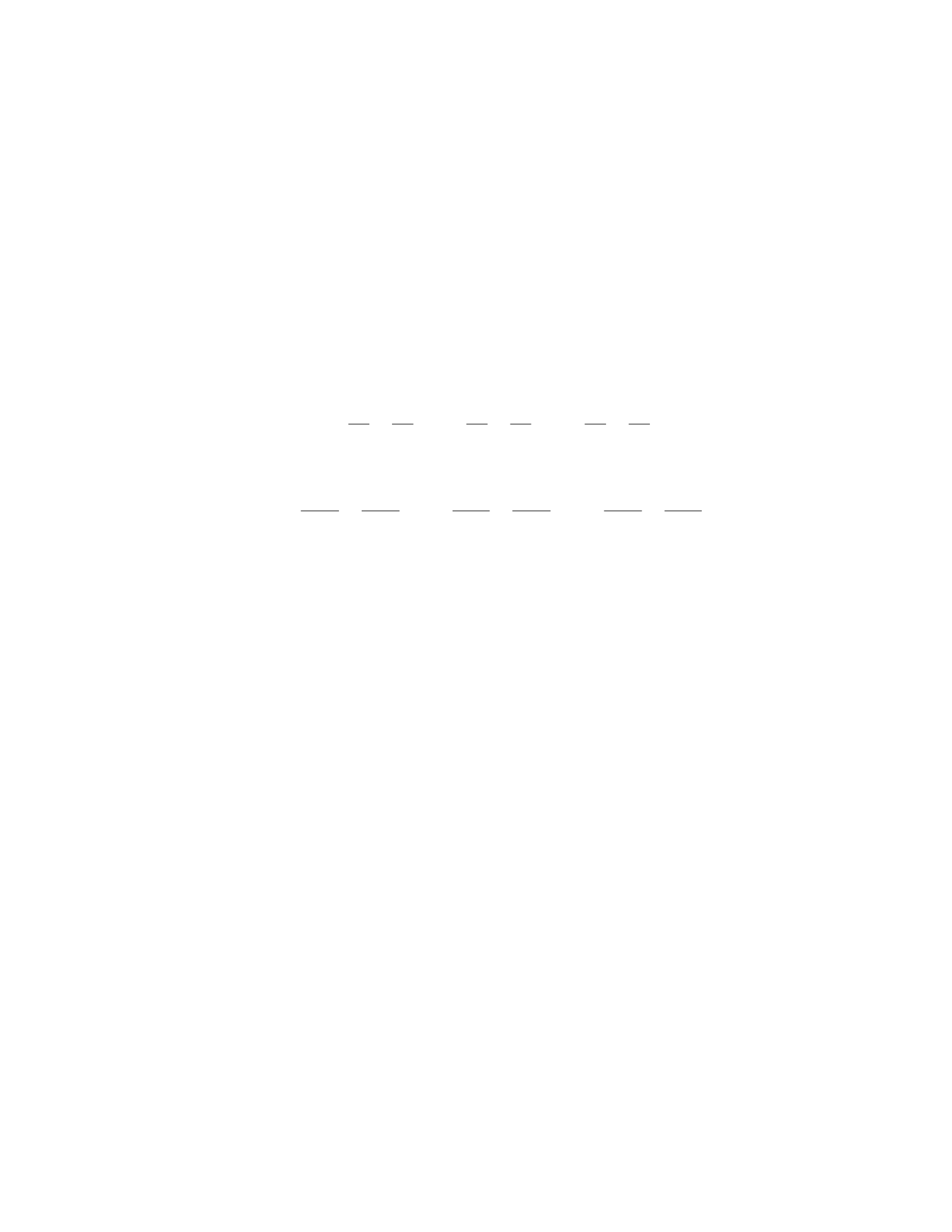
parameterization along the edges of the rectangle, we get the line integral to be
Z2
0
(0)(0)+x(0)+0(0)dx+Z1
0
y(2)+(1)(0)+0dy+Z0
2
(1)(0)+y(0)+(1)(0)dx+Z0
1
(0)(2)+x(1)+x(0)dy
=Z1
0
2ydy +Z2
0
2xdx = [y2]1
0+ [x2]0
14

Question 16
Question
Let Sbe the part of the plane z= 1 + x+ 2ythat lies inside the cylinder
x2+y2= 1. Use Stokes’ Theorem to evaluate the surface integral RRS∇×F·dS,
where F(x, y, z) = (z, 3x, y).
Solution
Step 1: Find the unit normal vector nto the surface S. Since the surface is
defined by z= 1 + x+ 2y, a normal vector to Sis given by n=⟨∂
∂x (1 + x+
2y),∂
∂y (1 + x+ 2y),−1⟩=⟨1,2,−1⟩.
Step 2: Calculate ∇ × F. The curl of Fis given by
∇ × F=
i j k
∂
∂x
∂
∂y
∂
∂z
z3x y
=⟨−1,−1,3⟩.
Step 3: Calculate the surface integral using Stokes’ Theorem. By Stokes’
Theorem, we have
ZZS∇ × F·dS=Z ZR
(∇ × F)·ndA,
where Ris the region in the xy-plane projected onto the xy-plane. Since S
lies inside the cylinder x2+y2= 1,Ris the unit circle centered at the origin:
0≤r≤1,0≤θ≤2π.
Step 4: Evaluate the surface integral.
·dS=R2π
0R1
0⟨−1,−1,3⟩·⟨1,2,−1⟩rdrdθ
=R2π
0R1
0(r−2r+ 3)rdrdθ
=R2π
0R1
0(r2−2r2+ 3r)drdθ
=R2π
0(1
3−2
3+3
2)dθ
=R2π
0
7
6dθ
=7
6·2π
=7π
3.
Question 17
Question
Let Sbe the portion of the plane z= 4 −x−2ythat lies above the triangle
with vertices (1,0,0),(0,1,0), and (0,0,1). Use Stokes’ Theorem to evaluate
the circulation of the vector field F=xi+yj+zkcounterclockwise around the
boundary curve of S.
15

Solution
Step 1: First, we need to parametrize the boundary curve of S. The boundary of
the triangle is formed by the three line segments connecting the vertices. Let’s
find the parametric equations for these line segments.
The line segment connecting (1,0,0) to (0,1,0): Let r1(t) = (1 −t)
1
0
0
+
t
0
1
0
for 0≤t≤1. Then,
r1(t) = (1 −t, t, 0)
The line segment connecting (0,1,0) to (0,0,1): Let r2(t) = (1 −t)
0
1
0
+
t
0
0
1
for 0≤t≤1. Then,
r2(t) = (0,1−t, t)
The line segment connecting (0,0,1) to (1,0,0): Let r3(t) = (1 −t)
0
0
1
+
t
1
0
0
for 0≤t≤1. Then,
r3(t) = (t, 0,1−t)
Step 2: Now, we calculate the line integrals of Fover each of these line
segments:
Zr
1F·dr1=Z1
0
((1 −t)dt +t(0) + 0) = 1
2
Zr
2F·dr2=Z1
0
(0 + (1 −t)dt +t(1)) = 1
2
Zr
3F·dr3=Z1
0
(tdt) = 1
2
Step 3: By Stokes’ Theorem, the circulation of Faround the boundary curve
of Sis equal to the double integral of the curl of Fover the region S:
Circulation of F=ZZS
(∇ × F)·dS
16

Step 4: Notice that ∇ × F=
−1
−1
2
. Thus, the circulation is:
Circulation of F=ZZS
(−1,−1,2) ·dS
Step 5: The boundary of Scorresponds to the three line segments we
parametrized earlier. Thus, we can rewrite the circulation as the sum of the
line integrals over these three line segments:
Circulation of F=1
2+1
2−1
2= 0
Therefore, the circulation of the vector field Fcounterclockwise around the
boundary curve of Sis 0.
Question 18
Question
Let Sbe the part of the plane z= 1 −x−yin the first octant (x≥0,y≥0,
z≥0) and let F= (x2+y2, z2, xy)be a vector field. Calculate the flux of F
across the boundary of Sin the positive z-direction using Stokes’ Theorem.
Solution
Step 1: Find the boundary curve of Sby determining the intersection of the
plane z= 0 with z= 1 −x−y.
Setting z= 0 in z= 1 −x−y, we get 0 = 1 −x−y, which implies x+y= 1.
Thus, the boundary curve of Sin the xy-plane is the line x+y= 1.
Step 2: Parametrize the boundary curve Cas a curve in the xy-plane.
Let x=t, then y= 1 −tfor 0≤t≤1. The boundary curve Ccan be
parametrized as r(t) = (t, 1−t, 0) for 0≤t≤1.
Step 3: Calculate the curl of the vector field F.
The curl of Fis given by
∇×F=
ˆ
iˆ
jˆ
k
∂
∂x
∂
∂y
∂
∂z
x2+y2z2xy
= (∂(xy)
∂y −∂(z2)
∂z )ˆ
i−(∂(x2+y2)
∂x −∂(xy)
∂z )ˆ
j+(∂(x2+y2)
∂y −∂(xy)
∂x )ˆ
k
=xˆ
i+ 2zˆ
j−yˆ
k.
Step 4: Compute the line integral of ∇ × Fover the boundary curve C.
ZC
(∇ × F)·dr=Z1
0
r(t)·(r′(t)×(∇ × F))dt
17
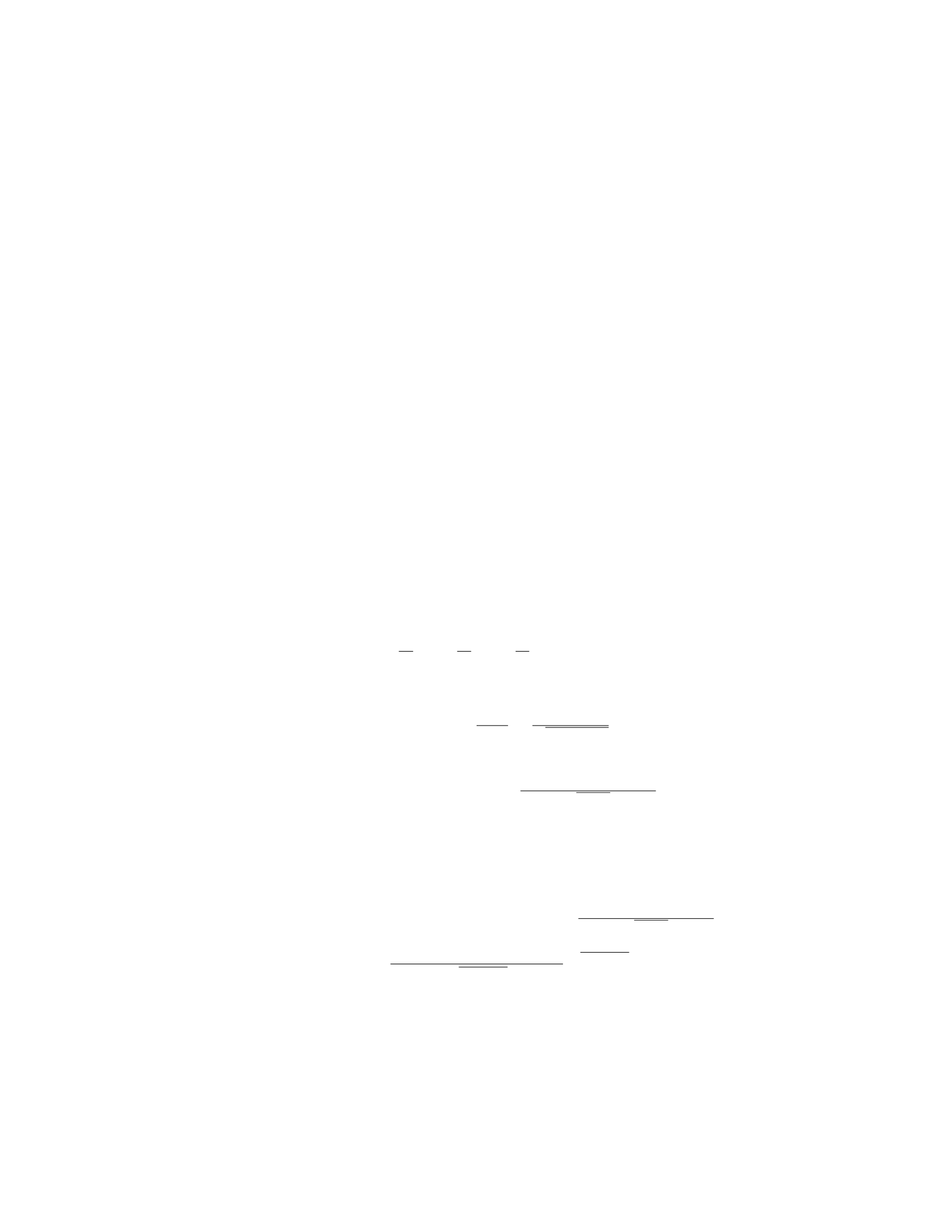
=Z1
0
(t, 1−t, 0) ·(1,−1,0)dt =Z1
0
t−(1 −t)dt =Z1
0
2t−1dt = [t2−t]1
0= 0.
Step 5: Apply Stokes’ Theorem.
By Stokes’ Theorem, the flux of Facross the boundary of Sin the positive
z-direction is equal to the line integral calculated in Step 4. Therefore, the flux
equals 0.
Question 19
Question
Let Sbe the part of the paraboloid z=x2+y2that lies above the disk x2+y2≤
4, oriented upward. Use Stokes’ Theorem to evaluate the surface integral
ZZS
(∇ × F)·dS,
where F(x, y, z) = (2y+z2, x +z, x2+y2).
Solution
Step 1: Find ∇ × F. We have that
∇ × F=
i j k
∂
∂x
∂
∂y
∂
∂z
2y+z2x+z x2+y2
= (2,−2,1).
Step 2: Determine the unit normal vector nto S. Since Sis oriented upward,
the unit normal vector is given by n=∇z
||∇z|| =⟨−2x,−2y,1⟩
√1+4x2+4y2.
Step 3: Calculate the outward-pointing unit normal vector nover the disk
D:x2+y2≤4. Since x2+y2≤4, we have D={(r, θ)|0≤r≤2,0≤θ≤2π}.
Then, the unit normal vector nbecomes n=⟨−2rcos(θ),−2rsin(θ),1⟩
√1+4r2.
Step 4: Use Stokes’ Theorem to evaluate the surface integral. We have the
surface integral over Sas
ZZS
(∇ × F)·dS=ZZD
(∇ × F)·n||n||dA.
Substitute the values of (∇ × F) = (2,−2,1) and n=⟨−2rcos(θ),−2rsin(θ),1⟩
√1+4r2, we
get
ZZD
(2,−2,1) ·⟨−2rcos(θ),−2rsin(θ),1⟩
√1+4r2p1+4r2drdθ.
Finally, we integrate over Dto solve for the surface integral.
18

Question 20
Question
Let Sbe the part of the plane z= 3 that lies inside the cylinder x2+y2= 9.
Use Stokes’ Theorem to evaluate the line integral
IC
(y2+z)dx + (z2+x)dy + (x2+y)dz
where Cis the boundary of Soriented counterclockwise as viewed from above.
Solution
Let’s first find the curl of the vector field F(x, y, z) = (y2+z, z2+x, x2+y):
curl F=
i j k
∂
∂x
∂
∂y
∂
∂z
y2+z z2+x x2+y
=∂(x2+y)
∂y −∂(z2+x)
∂z i−∂(y2+z)
∂x −∂(x2+y)
∂z j+∂(z2+x)
∂x −∂(y2+z)
∂y k
= (1 −0)i−(0 −1)j+ (1 −2)k=i+j−k
Now, let Dbe the region bounded by the circle x2+y2= 9 in the plane
z= 3. Applying Stokes’ Theorem:
ZZS
(curl F)·ndS =IC
F·dr
where nis the unit normal to Spointing in the direction consistent with the
right-hand rule, dS is the area element on S, and dris the tangent vector to C.
Since curl F=i+j−k, we have:
ZZS
(i+j−k)·(0,0,1) dS =IC
(y2+z)dx + (z2+x)dy + (x2+y)dz
=IC
(y2+ 3)dx + (9 + z)dy + (x2+y)dz
Let C1be the circle x2+y2= 9 in the plane z= 3. Then, the line integral
over C1can be parametrized as x(t) = 3 cos t,y(t) = 3 sin t,z(t)=3, for
19

0≤t≤2π. We have:
IC1
(y2+ 3)dx + (9 + z)dy + (x2+y)dz =Z2π
0
((3 sin t)2+ 3)(−3 sin t) + (9 + 3)(3 cos t) + (9(cos t)2+ 3 sin t)(0) dt
=Z2π
0
(−9 sin t+ 12 cos t+ 27) dt
= [−9(−cos t) + 12 sin t+ 27t]
2π
0
= 18π+0+0
= 18π
Therefore, the line integral over the boundary Cis 18π.
Question 21
Question
Let Sbe the surface of the portion of the sphere x2+y2+z2=a2where z≥0,
oriented with outward normal. Let F(x, y, z)=(xz, yz2, x2y). Calculate the
flux of Facross Susing Stokes’ Theorem.
Solution
Step 1: Find the curl of F. The curl of Fis given by:
∇ × F=
i j k
∂
∂x
∂
∂y
∂
∂z
xz yz2x2y
=∂(x2y)
∂y −∂(yz2)
∂z i−∂(xz)
∂x −∂(x2y)
∂z j+∂(xz)
∂y −∂(x2y)
∂x k
= (0 −2yz)i−(z−0)j+ (z−2xy)k
=−2yzi−zj+ (z−2xy)k
Step 2: Calculate the normal vector to the surface S. Since Sis a portion
of the sphere x2+y2+z2=a2where z≥0, the outward normal vector at each
point is n=x
a,y
a,z
a.
Step 3: Calculate the surface area element dS. The surface area element dS
in spherical coordinates is given by dS =a2sin ϕ dϕ dθ.
Step 4: Apply Stokes’ Theorem to find the flux of Facross S. The flux of
Facross Sis given by the surface integral:
ZZS
(∇ × F)·ndS =ZZD
(∇ × F)·ndA
where Dis the region in the xy-plane corresponding to the projection of S.
20
Question 22
Question
Let Sbe the part of the plane z= 1 + x−ythat lies above the rectangle
0≤x≤2and 0≤y≤1. Let F(x, y, z) = ⟨x2, yz, z2⟩. Calculate the surface
integral RRS(∇ × F)·dSusing Stokes’ Theorem.
Solution
Step 1: Calculate ∇ × F. Step 2: Calculate the outward unit normal vector n
to the surface S. Step 3: Calculate the surface integral using Stokes’ Theorem.
Step 1: Calculate ∇ × F.
∇ × F=
i j k
∂
∂x
∂
∂y
∂
∂z
x2yz z2
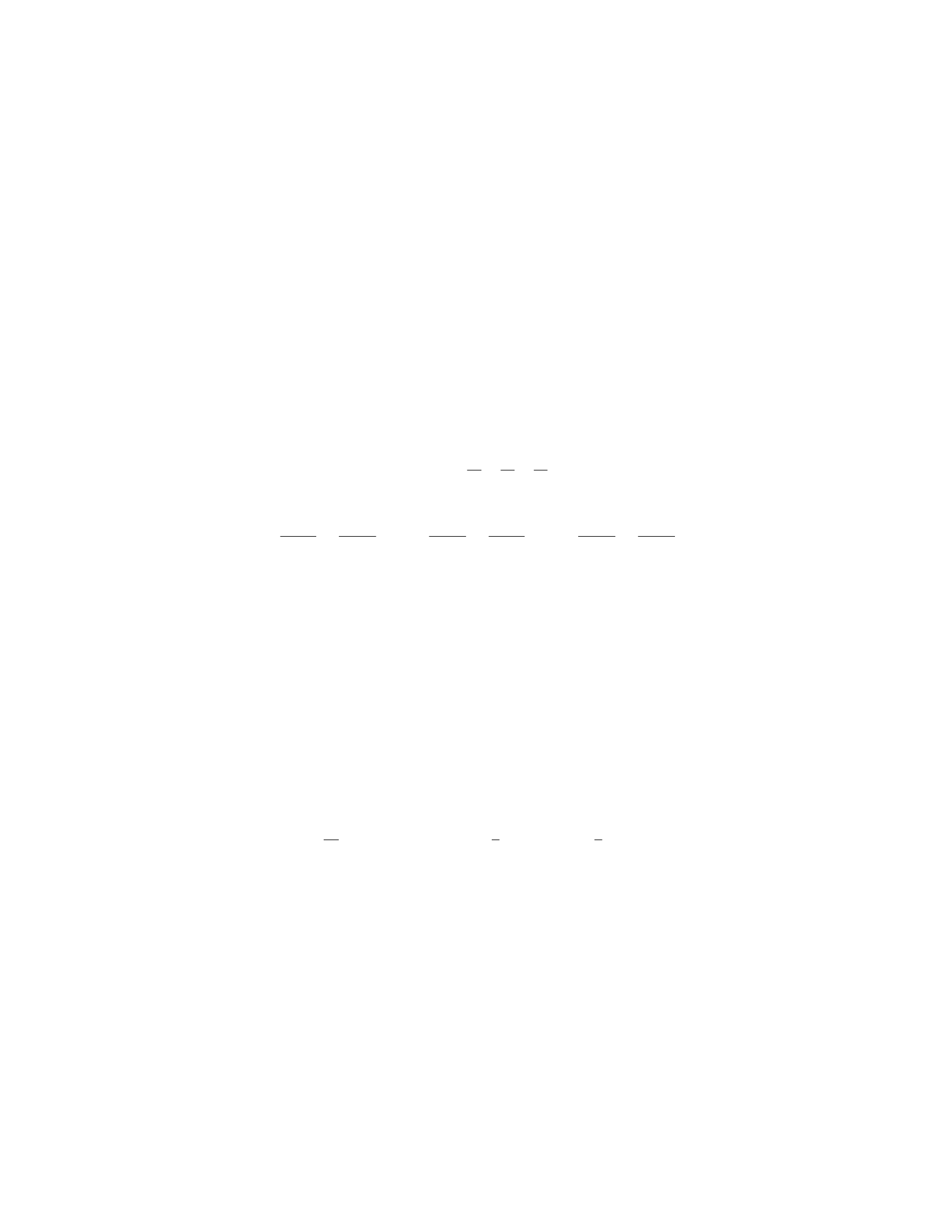
=∂(z2)
∂y −∂(yz)
∂z i+∂(x2)
∂z −∂(z2)
∂x j+∂(yz)
∂x −∂(x2)
∂y k
= (0 −z)i+ (0 −0)j+ (y−0)k=−zi+yk
Step 2: Calculate the outward unit normal vector nto the surface S. The
unit normal vector to the plane z= 1 + x−yis n=⟨1,−1,−1⟩.
Step 3: Calculate the surface integral using Stokes’ Theorem. By Stokes’
Theorem, ZZS
(∇ × F)·dS=Z Z F·dr
where r=⟨x, y, 1 + x−y⟩on the surface S.
Thus, we have
Z2
0Z1
0
(−z, 0, y)·(1,−1,−1) dy dx =Z2
0Z1
0−z+y dy dx
=Z2
0−y+y2
2y=1
y=0
dx =Z2
0−1 + 1
2dx =Z2
0−1
2dx =−x
2
0=−2
Question 23
Question
Let Sbe the part of the plane z= 4−x−2ythat lies above the triangular region
with vertices (0,0,0),(0,2,0), and (1,1,0) in R3. Let F= (x2+y, y +z, xz)be
a vector field. Evaluate the surface integral RRSF·dSusing Stokes’ Theorem.
21
Solution
Step 1: Find the normal vector nto the plane S. The normal vector to the
plane Sis given by n=∇h=−∂h
∂x ,−∂h
∂y ,1, where h(x, y, z) = 4 −x−2y.
Therefore, n= (−(−1),−(−2),1) = (1,2,1).
Step 2: Calculate the curl of F, denoted by ∇ × F. The curl of Fis
given by ∇ × F=
i j k
∂
∂x
∂
∂y
∂
∂z
x2+y y +z xz
. Expanding the determinant, we have
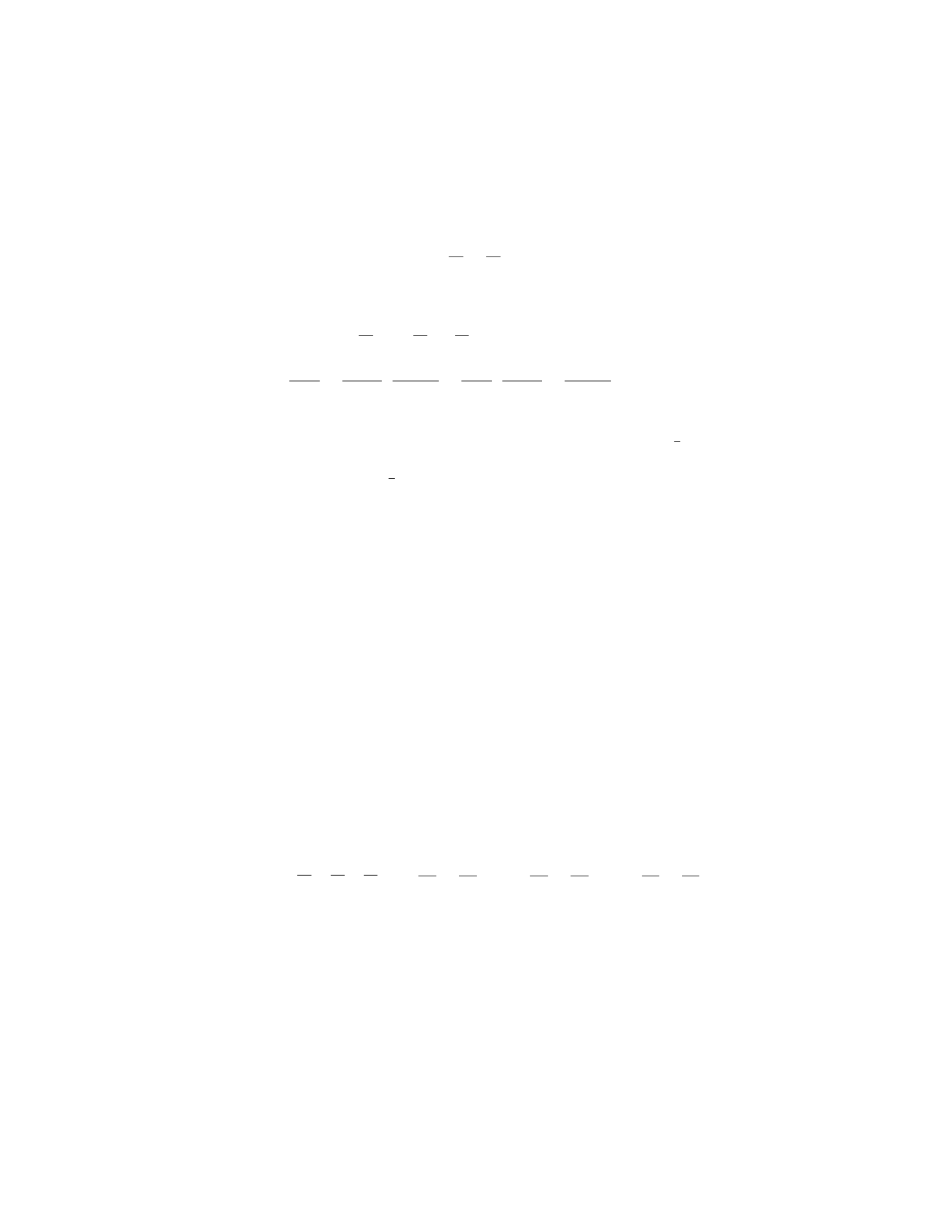
∇ × F=∂(xz)
∂y −∂(y+z)
∂z ,∂(x2+y)
∂z −∂(xz)
∂x ,∂(y+z)
∂x −∂(x2+y)
∂y . Simplifying, we
get ∇ × F= (−1, x −1,0).
Step 3: Find the surface area of the triangular region. The area of a triangle
with vertices (0,0,0),(0,2,0), and (1,1,0) can be calculated as A=1
2|A×B|,
where A=⟨0,2,0⟩and B=⟨1,1,0⟩. The cross product gives us A×B=
⟨0,0,2⟩. So, the area A=1
2|⟨0,0,2⟩| = 1.
Step 4: Apply Stokes’ Theorem to evaluate the surface integral. Stokes’
Theorem states that RRSF·dS=HCF·dr, where Cis the boundary of the
surface S. The boundary of the triangular region is the triangle itself. We
parameterize the curve as r(t) = ⟨t, 2−t, 0⟩for 0≤t≤1. Then, dr=
dt dt = ⟨1,−1,0⟩dt. Now, we have HCF·dr=R1
0F(r(t))·
dt dt = R1
0F(t, 2−t, 0) ·⟨1,−1,0⟩dt. Calculating the dot product, we get HC
Question 24
Question
Let Sbe the part of the plane z= 1−x−ythat lies above the square 0≤x≤1,
0≤y≤1in the xy-plane. Calculate the surface integral RRSF·dSof the vector
field F(x, y, z) = (z, y, x)over the surface Susing Stokes’ Theorem.
Solution
Step 1: Calculate the curl of F. To find the curl of F, we compute ∇ × F:
∇ × F=
i j k
∂
∂x
∂
∂y
∂
∂z
z y x
=∂x
∂y −∂y
∂x i−∂x
∂z −∂z
∂x j+∂y
∂z −∂z
∂y k
= (1 −0)i−(0 −1)j+ (0 −0)k=i+j
Step 2: Calculate the surface integral using Stokes’ Theorem. By Stokes’
Theorem, we have: ZZS
F·dS=IC
F·dr
22

where Cis the boundary of Soriented counterclockwise. The boundary of
the surface Sis the square in the xy-plane, which can be parameterized as
r(t) = (t, 0,1−t)for 0≤t≤1. Thus, the line integral becomes:
IC
F·dr=Z1
0
F(r(t)) ·r′(t)dt
=Z1
0
(1 −t, 0, t)·(1,0,−1)dt =Z1
0
(1 −t)dt =1
2
Therefore, the surface integral RRSF·dSof the vector field F(x, y, z) = (z, y, x)
over the surface Sis 1
2.
Question 25
Question
Let Sbe the part of the plane z= 4 −x−2ythat lies inside the cylinder
x2+y2= 4. Use Stokes’ Theorem to evaluate the surface integral
ZZS
(∇ × F)·dS,
where F(x, y, z) = ⟨x2y, z, x −y2⟩.
Solution
Step 1: Find the curl of F.
∇ × F=
i j k
∂
∂x
∂
∂y
∂
∂z
x2y z x −y2
=∂(x−y2)
∂y −∂z
∂x i−∂(x2y)
∂z −∂(x−y2)
∂x j+∂z
∂y −∂(x2y)
∂y k
= (1 −0)i−(0 −1)j+ (1 −x2)k
=i+j+ (1 −x2)k.
Step 2: Determine the unit normal vector to the surface S. Since the surface
Sis the part of the plane z= 4 −x−2yinside the cylinder x2+y2= 4, we
can represent Sparametrically as r(s, t) = ⟨2 cos s, 2 sin s, 4−2 cos s−4 sin s⟩,
where 0≤s≤2πand 0≤t≤1.
The unit normal vector to Sis given by ˆ
n=rs×rt
∥rs×rt∥. Calculating the cross
product and simplifying gives ˆ
n=1
√6⟨1,−2,−1⟩.
23

Step 3: Calculate the surface integral using Stokes’ Theorem. By Stokes’
Theorem, the given surface integral can be evaluated as
ZZS
(∇ × F)·dS=IC
F·dr,
where Cis the boundary curve of S.
The boundary curve Cis the intersection of the plane z= 4 −x−2yand
the cylinder x2+y2= 4. Thus, Cis the circle x2+y2= 4, but in the plane
z= 4−x−2y. We can parameterize Cas r(t) = ⟨2 cos t, 2 sin t, 4−2 cos t−4 sin t⟩,
where 0≤t≤2π.
Calculating the line integral HCF·drgives the value of the surface integral.
24
Solution
Step 1: Compute the curl of F:
curl(F) = ∇ × F=
i j k
∂
∂x
∂
∂y
∂
∂z
x2xy y2
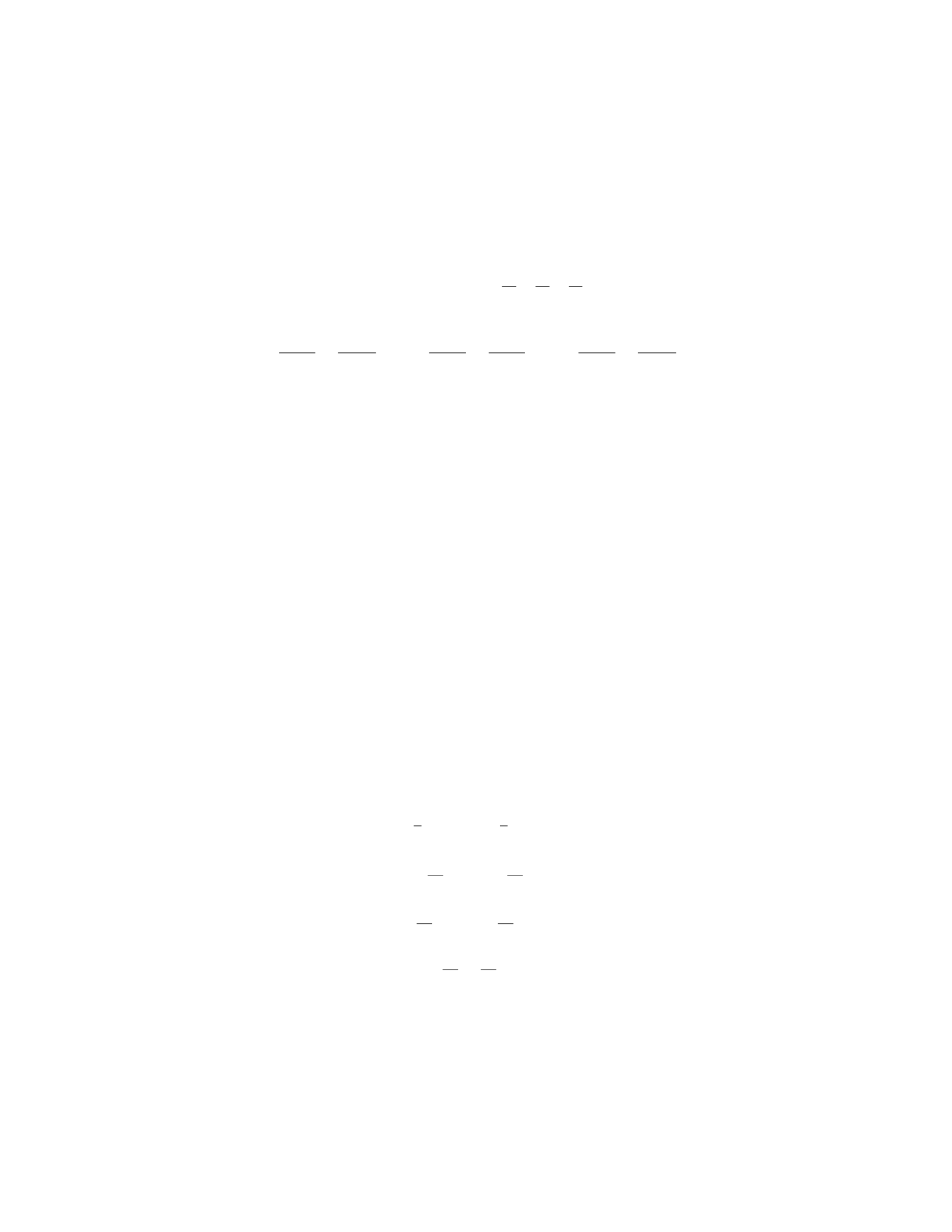
=∂(y2)
∂y −∂(xy)
∂z i−∂(x2)
∂x −∂(y2)
∂z j+∂(x2)
∂y −∂(xy)
∂x k
= 2yi+ 2xj+ 0k= 2yi+ 2xj
Step 2: Calculate the surface integral of Fover Susing Stokes’ Theorem:
ZZS
(curl(F)·n)dS =ZZD
(curl(F)·N)dA
where Dis the projection of Sonto the xy-plane, Nis the normal vector to D,
and dA is the area element in the xy-plane.
Step 3: Find the normal vector and area element: The normal vector to D
is N=−k. The area element is dA =dx dy.
Step 4: Parametrize the region D: The projection of the hemisphere onto
the xy-plane is the disk x2+y2≤4. This region can be parametrized by
x=rcos(θ),y=rsin(θ)where 0≤r≤2and 0≤θ≤2π.
Step 5: Calculate the dot product and the surface integral:
ZZD
(curl(F)·N)dA =ZZD−(2rsin(θ)+2rcos(θ)) dA
=−Z2π
0Z2
0
(2rsin(θ)+2rcos(θ))r dr dθ
=−Z2π
0Z2
0
(2r2sin(θ)+2r2cos(θ)) dr dθ
=−Z2π
02
3r3sin(θ) + 2
3r3cos(θ)
2
0dθ
=−Z2π
016
3sin(θ) + 16
3cos(θ)dθ
=−−16
3cos(θ) + 16
3sin(θ)
2π
0
=32
3−32
3= 0
Therefore, the surface integral of Fover S
2

Question 3
Question
Let Sbe the portion of the plane z= 4 −x−2ythat lies inside the cylinder
x2+y2= 1 and above the xy-plane. Use Stokes’ Theorem to evaluate the
circulation of the vector field F(x, y, z) = (z−3y)i+ (x−z)j+ (y−x)karound
the curve Cthat is the intersection of Swith the plane x+y= 1.
Solution
To apply Stokes’ Theorem, we need to calculate the curl of Fand find its surface
integral over the surface S.
Step 1: Find the Curl of FThe curl of Fis given by:
∇ × F=
i j k
∂
∂x
∂
∂y
∂
∂z
z−3y x −z y −x
=∂(y−x)
∂y −∂(x−z)
∂z i−∂(z−3y)
∂z −∂(y−x)
∂x j+∂(x−z)
∂x −∂(z−3y)
∂y k
= (−1−(−1))i−(1 −(−1))j+ (1 −(−3))k
= 0i−2j+ 4k=−2j+ 4k
Step 2: Parameterize the Surface and Find the Normal Vector The
surface Sis the portion of the plane z= 4 −x−2ythat lies inside the cylinder
x2+y2= 1. We can parameterize Sas r(u, v) = ui+vj+ (4 −u−2v)kfor
(u, v)∈D, where Dis the unit disk in the xy-plane.
The normal vector Nto Sis given by the cross product of the partial deriva-
tives of rwith respect to uand v:
N=∂r
∂u ×∂r
∂v
∂r
∂u =i−k,∂r
∂v =j−2k
N=
i j k
1 0 −1
0 1 −2
= (−1)i−(−2)j−(−1)k=−i+ 2j−k
Step 3: Evaluate the Surface Integral Applying Stokes’ Theorem, the
circulation of Faround Cis equal to the surface integral of ∇ × Fover S:
ZZS
(∇ × F)·NdS
=ZZD
(−2j+ 4k)·(−i+ 2j−k)dA
3

=ZZD
(−8) dA
=−8
Question 4
Question
Let Sbe the surface of the cone z=px2+y2that lies above the disk x2+y2≤1
in the xy-plane, oriented upward. Use Stokes’ Theorem to evaluate the surface
integral
ZZ
S
(∇ × F)·ndS,
where F(x, y, z) = ⟨x2, y2, z2⟩and nis the outward-pointing unit normal vector
to S.
Solution
Step 1: Compute ∇ × F. The curl of a vector field F(x, y, z) = ⟨M, N, P ⟩is
given by
∇ × F=∂P
∂y −∂N
∂z i+∂M
∂z −∂P
∂x j+∂N
∂x −∂M
∂y k.
In this case, F(x, y, z) = ⟨x2, y2, z2⟩, so
∇ × F= (0 −0) i+ (2z−0) j+ (0 −0) k= 2zj.
Step 2: Find the unit normal vector n. The surface Sis the cone z=
px2+y2above the disk x2+y2≤1. The outward-pointing unit normal vector
to Sis given by
n=∇g
∥∇g∥,
where g(x, y, z) = z−px2+y2is a scalar function defining S. The gradient of
gis
∇g=⟨− x
px2+y2,−y
px2+y2,1⟩,
so the unit normal vector is
n=⟨− x
√x2+y2,−y
√x2+y2,1⟩
sx
√x2+y22
+y
√x2+y22
+ 12
.
4

Step 3: Evaluate the surface integral using Stokes’ Theorem. Stokes’ The-
orem states that for a surface Swith boundary curve Coriented positively
(counterclockwise when viewed from above), we have
ZZ
S
(∇ × F)·ndS =IC
F·dr,
where dris the differential arc length along the boundary curve C. Since the
boundary of Sis the circle x2+y2= 1 in the xy-plane, we can parameterize
this circle as r(t) = ⟨cos t, sin t, 0⟩for 0≤t≤2π.
Then the line integral can be computed as
IC
F·dr=Z2π
0
F(r(t)) ·r′(t
Question 5
Question
Let Sbe the part of the surface z=x2+y2that lies below the plane z= 4. Use
Stokes’ Theorem to evaluate the surface integral RRSF·dS, where F(x, y, z) =
(y+z, x +z, x +y).
Solution
Step 1: Find the curl of F. The curl of Fis given by
∇×F=
i j k
∂
∂x
∂
∂y
∂
∂z
y+z x +z x +y
=∂
∂y (x+y)−∂
∂z (x+z),∂
∂z (y+z)−∂
∂x (x+y),∂
∂x (x+z)−∂
∂y (y+z)
= (1 −1,1−1,1−1) = (0,0,0).
Step 2: Calculate the surface integral using Stokes’ Theorem. By Stokes’
Theorem, ZZS
F·dS=Z Z∂S
F·dr,
where ∂S is the boundary of Swith outward orientation.
Step 3: Find the boundary curve of S. The surface z=x2+y2intersects
z= 4 when x2+y2= 4. This gives us the circle Cof radius 2centered at
the origin in the xy-plane. The parametric equations for Care x= 2 cos t,
y= 2 sin t,z= 4 with 0≤t≤2π.
Step 4: Parameterize the boundary curve. For C, the unit normal vector
pointing outwards is N=(x,y,−4)
√x2+y2+16 =(2 cos t,2 sin t,−4)
4= (cos t, sin t, −1).
Step 5: Evaluate the line integral. Now, we compute
ZC
F·dr=Z2π
0
F(2 cos t, 2 sin t, 4) ·(−2 sin t, 2 cos t, 0)dt.
5

Step 6: Simplify and solve the line integral. We have
F(2 cos t, 2 sin t, 4) = (2 sin t+ 4,2 cos t+ 4,2 cos t+ 2 sin t),
and
F(2 cos t, 2 sin t, 4) ·(−2 sin t, 2 cos t, 0) = 12.
Therefore, the surface integral of Fover Sis 12 .
Question 6
Question
Let
F(x, y, z) = (x2y, z, exyz )be a vector field. Let Sbe the part of the plane
z= 4 −x−2ythat lies above the region in the xy-plane bounded by the
curves y=x2and y=x. Use Stokes’ Theorem to evaluate the surface integral
RRS∇ ×
F·d
S.
Solution
Step 1: Determine the boundary curve Cin the xy-plane. This boundary is the
curve where y=x2and y=xintersect. We find their intersection by setting
x2=x:
x2=x
x2−x= 0
x(x−1) = 0
x= 0 or x= 1
So the boundary curve Cis the line segment from (0,0) to (1,1).
Step 2: Calculate the curl of
F:∇ ×
F=∂P
∂y −∂N
∂z ,∂M
∂z −∂P
∂x ,∂N
∂x −∂M
∂y
Here,
F(x, y, z) = (x2y, z, exyz ).
Calculating the curl, we get:
∇ ×
F= (0 −0,0−2xy, xyexyz −0)
∇ ×
F= (−2xy, 0, xyexyz )
Step 3: Use Stokes’ Theorem to evaluate the surface integral. Stokes’ The-
orem states: ZZS∇ ×
F·d
S=IC
F·dr
Since ∇ ×
F= (−2xy, 0, xyexyz ), the surface integral simplifies to:
ZZS
(−2xy, 0, xyexyz )·d
S
Therefore, our final task is to evaluate the line integral over the boundary
curve C.
6

Question 7
Question
Let F(x, y, z) = ⟨−y2, x2, z⟩be a vector field, and let Sbe the part of the plane
z=x+ythat lies above the triangle with vertices at (0,0,0),(1,0,1), and
(0,1,1). Calculate the flux of Facross Susing Stokes’ Theorem.
Solution
Step 1: First, we compute the curl of F:
curl(F) = ∇ × F=
i j k
∂
∂x
∂
∂y
∂
∂z
−y2x2z
=⟨0,0,2x+ 2y⟩
Step 2: Now, we find the normal vector to the surface S. The normal vector
is given by n=∇g
|∇g|where g(x, y, z) = z−x−yis the function defining the
plane z=x+y. We have ∇g=⟨−1,−1,1⟩and |∇g|=√12+ 12+ 12=√3,
so n=1
√3⟨−1,−1,1⟩.
Step 3: The flux of Facross Sis given by the surface integral RRScurl(F)·
ndS. Since the normal vector points upwards, we need to use −nin the dot
product.
Step 4: We parameterize the triangle Tin the xy-plane by r(u, v) = ui+vj
with 0≤u≤1and 0≤v≤1−u. The position vector on the surface Sis then
r(u, v) = ⟨u, v, u +v⟩.
Step 5: The normal vector to the triangle Tis n=ksince the triangle lies
in the xy-plane. Therefore, n·curl(F) = (2u+ 2v)·1 = 2u+ 2v.
Step 6: The flux of Facross Sis then given by the surface integral:
ZZS
curl(F)·ndS =ZZT
(2u+ 2v)dA
Step 7: We evaluate the integral over the region Tin the uv-plane:
Z1
0Z1−u
0
(2u+ 2v)dv du
=Z1
0
[2uv +v2]v=1−u
v=0 du
=Z1
0
(2u(1 −u) + (1 −u)2)du
=Z1
0
(2u−2u2+ 1 −2u+u2)du
=Z1
0
(1 −u−u2)du
7

= [u−u2
2−u3
3]1
0
= 1 −1
2−1
3=1
6
Therefore, the flux of Facross Sis 1
6.
Question 8
Question
Let Sbe the surface of the solid bounded by the cylinder x2+y2= 1 and the
planes z= 0 and z= 4. Find the flux of the vector field F= (x2, y2, z2)across
Susing Stokes’ Theorem.
Solution
Step 1: Calculate the curl of the vector field F:
curl(F) =
i j k
∂
∂x
∂
∂y
∂
∂z
x2y2z2
= (0,0,2z−2y)
Step 2: Use Stokes’ Theorem to find the flux of Facross S: The flux of
curl(F)across Sis equal to the line integral of Fover the boundary of S.
ZZS
curl(F)·dS=IC
F·dr
where Cis the boundary curve of S.
Step 3: Parameterize the boundary curve C: From the equations x2+y2= 1
and z= 0, we have x= cos(t),y= sin(t), and z= 0. Thus, Cis parameterized
by r(t) = (cos(t),sin(t),0). For 0≤t≤2π.
Step 4: Calculate the line integral over C:
IC
F·dr=Z2π
0
F(r(t)) ·r′(t)dt =Z2π
0
(cos2(t),sin2(t),0) ·(−sin(t),cos(t),0)dt
=Z2π
0
(−cos(t) sin(t) + sin(t) cos(t))dt =Z2π
0
0dt = 0
Step 5: Conclusion: Since the line integral over Cis 0, by Stokes’ Theorem,
the flux of Facross Sis also 0.
8

Question 9
Question
Let F(x, y, z) = (xz, yz, xy)be a vector field. Consider the surface Sdefined by
z= 1 −x2−y2for 0≤z≤1. Calculate the flux of Facross Susing Stokes’
Theorem.
Solution
Step 1: First, we need to find the curl of F. The curl of a vector field F(x, y, z) =
(P(x, y, z), Q(x, y, z), R(x, y, z)) is defined as:
curl(F) = ∂R
∂y −∂Q
∂z ,∂P
∂z −∂R
∂x ,∂Q
∂x −∂P
∂y
In our case, F(x, y, z)=(xz, yz, xy), so P(x, y, z) = xz,Q(x, y, z) = yz, and
R(x, y, z) = xy. Calculating the partial derivatives, we get:
∂R
∂y =x, ∂Q
∂z =y, ∂P
∂z =x, ∂R
∂x =y, ∂Q
∂x = 0,∂P
∂y = 0
Therefore, the curl of Fis:
curl(F) = (x−y, y −x, 0)
Step 2: Next, we need to find the unit normal vector to the surface S. The
surface Sis defined implicitly by F(x, y, z) = z−1 + x2+y2= 0. The gradient
of Fgives the normal vector to the surface. The gradient of Fis:
∇F=∂F
∂x ,∂F
∂y ,∂F
∂z = (2x, 2y, 1)
To find the unit normal vector, we normalize ∇Fby dividing it by its magnitude:
∥∇F∥=p4x2+ 4y2+ 1
So, the unit normal vector is:
n=1
p4x2+ 4y2+ 1(2x, 2y, 1)
Step 3: Stokes’ Theorem states that the flux of Facross Sis equal to the
surface integral of the dot product of Fand the curl of Fover the surface S.
Let’s denote the region in the xy-plane bounded by z= 1 −x2−y2as D. Then,
we can parameterize Sas r(x, y) = (x, y, 1−x2−y2)for (x, y)∈D. Now, the
flux of Facross Sis:
ZZS
(curl(F)•n)dS =ZZD
curl(F)•(
∂x×
∂ydA
We can now proceed to compute this surface integral to find the flux of F
across S.
9

Question 10
Question
Let F= (x2+y2)i+ (y2+z2)j+ (z2+x2)kbe a vector field, and let Sbe
the surface of the cone z=px2+y2for 0≤z≤2. Use Stokes’ Theorem to
evaluate the surface integral RRS(∇ × F)·ndS, where nis the outward unit
normal to S.
Solution
Step 1: First, we calculate the curl of F:
∇ × F=
i j k
∂
∂x
∂
∂y
∂
∂z
x2+y2y2+z2z2+x2
∇ × F= (2y−2z)i+ (2z−2x)j+ (2x−2y)k
Step 2: The unit normal vector to the cone z=px2+y2is given by
n=1
√2(x, y, −√2). So, we have n=1
√2(x, y, −px2+y2).
Step 3: Now, we need to find the projection of curl(F) onto n, i.e., (∇×F)·n.
(∇ × F)·n= (2y−2z)x
√2+ (2z−2x)y
√2+ (2x−2y)(−rx2+y2
2)
Step 4: We can simplify this expression further.
(∇ × F)·n=1
√2(2xy −2xz + 2yz −2xy −2xpx2+y2+ 2ypx2+y2)
Step 5: Considering the symmetry of the terms, most of them cancel out,
and we are left with:
(∇ × F)·n= 2ypx2+y2−2xpx2+y2
Step 6: The surface integral we are trying to evaluate is now:
ZZS
(∇ × F)·ndS =ZZS
(2ypx2+y2−2xpx2+y2)dS
Step 7: Since we have already expressed everything in terms of xand y, we
can convert dS into dA =r dr dθ in polar coordinates.
Step 8: The bounds of rare from 0to 2and the bounds of θare from 0to
2πas we are integrating over the entire cone surface.
Step 9: Finally, we evaluate the integral:
ZZS
(∇ × F)·ndS =Z2π
0Z2
0
(2rsin θ)·r dr dθ
Step 10: Solving the double integral gives us the final answer.
10

Question 11
Question
Let Sbe the portion of the plane z= 16 −x−ythat lies inside the cylinder
x2+y2= 16, oriented so that its unit normal points downward, and let F=
(y2, z, x)be a vector field. Calculate the surface integral RRS(∇ × F)·dSover
the surface Susing Stokes’ Theorem.
Solution
Step 1: Find the curl of F,∇ × F. The curl of a vector field F= (P, Q, R)is
given by
∇ × F=∂R
∂y −∂Q
∂z ,∂P
∂z −∂R
∂x ,∂Q
∂x −∂P
∂y .
For F= (y2, z, x), we have P=y2, Q =z, R =x. Therefore,
∇ × F= (0 −1,0−0,2y−0) = (−1,0,2y).
Step 2: Find the unit normal vector nto the surface S. Since the surface Sis
the portion of the plane z= 16 −x−ythat lies inside the cylinder x2+y2= 16,
we have n=1
√1+1+1 (−1,−1,−1) = −1
√3(1,1,1).
Step 3: Calculate the surface integral using Stokes’ Theorem. Stokes’ The-
orem states that ZZS
(∇ × F)·dS=IC
F·dr,
where Cis the boundary of S. The boundary Cof Sis the intersection of the
plane z= 16 −x−yand the cylinder x2+y2= 16. We can parameterize Cby
r(t) = (4 cos t, 4 sin t, 0) for 0≤t≤2π.
Step 4: Calculate the line integral
IC
F·dr=Z2π
0
F(r(t)) ·r′(t)dt.
We have F(r(t)) = (16 sin2t, 0,4 cos t)and r′(t) = (−4 sin t, 4 cos t, 0). Thus,
F(r(t)) ·r′(t) = 16 sin2t·(−4 sin t) + 0 + 4 cos t·4 cos t=−64 sin3t+ 16 cos2t.
Step 5: Calculate the integral
IC
F·dr=Z2π
0
(−64 sin3t+ 16 cos2t)dt = 0.
Therefore, the surface integral RRS(∇ × F)·dSover the surface Sis 0.
11

Question 12
Question
Let Sbe the part of the plane z= 5 −x−ythat lies above the square 0≤
x≤2,0≤y≤2. Use Stokes’ Theorem to evaluate RRS(∇ × F)·ndS, where
F(x, y, z) = zi+xj+ykand nis the outward unit normal vector to S.
Solution
Step 1: Find the curl of F.
∇ × F=
i j k
∂
∂x
∂
∂y
∂
∂z
z x y
=∂y
∂y −∂z
∂z i−∂x
∂x −∂z
∂z j+∂x
∂y −∂y
∂x k
=i+j+k
Step 2: Find the outward unit normal vector nto S. Since the unit normal
vector points in the direction of increasing z, we have n=k.
Step 3: Parameterize the surface Susing xand y. Let r(x, y) = xi+yj+
(5 −x−y)k.
Step 4: Calculate the curl of Fdot n.
∇ × F·n= (i+j+k)·k= 1
Step 5: Calculate the surface integral.
ZZS
(∇ × F)·ndS =ZZD
1dA
where Dis the region in the xy-plane corresponding to S, which is the square
0≤x≤2,0≤y≤2. The surface integral simplifies to
ZZD
1dA =Z2
0Z2
0
1dy dx =Z2
0
y
2
0
dx =Z2
0
2dx = 2 ·2 = 4
Therefore, ZZS
(∇ × F)·ndS = 4.
Question 13
Question
Let Sbe the part of the paraboloid z= 4 −x2−y2which lies above the square
0≤x≤2,0≤y≤2. Evaluate the surface integral RRS(∇ × F)·ˆndS, where
F(x, y, z) = ⟨y2, xz, z2⟩and ˆnis the outward unit normal to S.
12

Solution
Step 1: Find the curl of F. The curl of a vector field F(x, y, z) = ⟨M, N, P ⟩is
given by:
∇ × F=∂P
∂y −∂N
∂z i+∂M
∂z −∂P
∂x j+∂N
∂x −∂M
∂y k
In this case, F(x, y, z) = ⟨y2, xz, z2⟩, so:
∇ × F=∂(z2)
∂y −∂(xz)
∂z i+∂(y2)
∂z −∂(z2)
∂x j+∂(xz)
∂x −∂(y2)
∂y k
∇ × F= 0i+zj+xk=zj+xk
Step 2: Evaluate the surface integral. By Stokes’ Theorem, the surface
integral can be evaluated as the line integral around the boundary curve of S.
The boundary curve is the square 0≤x≤2,0≤y≤2. Parameterize the
boundary curve: For the line segment from (0,0, f(0,0)) to (2,0, f (2,0)) where
f(x, y) = 4 −x2−y2, we have: r(t) = ⟨t, 0,4−t2⟩for 0≤t≤2.
Similarly, parameterize the line segments from (2,0, f(2,0)) to (2,2, f (2,2)),
(2,2, f(2,2)) to (0,2, f(0,2)), and (0,2, f(0,2)) to (0,0, f(0,0)), then calculate
the line integrals along these curves.
Work through the calculations to find the required surface integral.
Question 14
Question
Let Sbe the part of the plane z= 4−x−ythat lies inside the cylinder x2+y2= 1
and above the xy-plane. Use Stokes’ Theorem to evaluate the surface integral
RRS(∇ × F)·dS, where F(x, y, z) = (y+z)i+ (x+z)j+ (x+y)k.
Solution
Step 1: We first compute the curl of F:
∇ × F=
i j k
∂
∂x
∂
∂y
∂
∂z
y+z x +z x +y
= (1 −1)i−(1 −1)j+ (1 −1)k=0
Step 2: Since the curl of Fis 0, the surface integral RRS(∇×F)·dSis equal
to 0.
Therefore, RRS(∇ × F)·dS= 0.
13
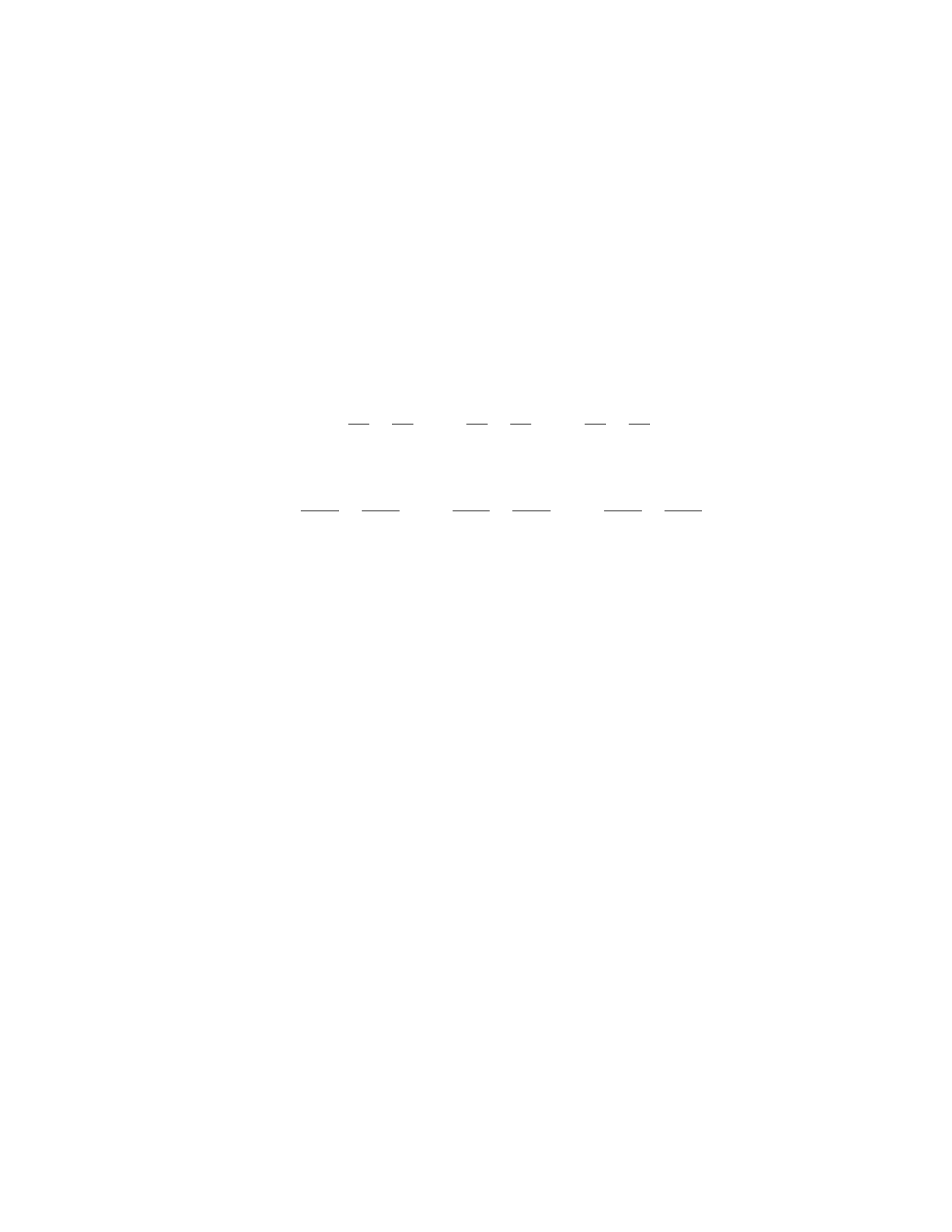
Question 15
Question
Let Sbe the part of the plane z= 4 −x−ythat lies above the rectangle in the
xy-plane with vertices at (0,0),(2,0),(2,1), and (0,1). Use Stokes’ Theorem
to evaluate the surface integral RRS(∇×F)·dS, where F(x, y, z) = ⟨yz, xz, xy⟩.
Solution
Step 1: Compute ∇ × F. The curl of a vector field F=⟨P, Q, R⟩is given by
∇ × F=∂R
∂y −∂Q
∂z i+∂P
∂z −∂R
∂x j+∂Q
∂x −∂P
∂y k.
Here, F(x, y, z) = ⟨yz, xz, xy⟩, so P=yz,Q=xz, and R=xy. Then we have:
∇ × F=∂(xy)
∂y −∂(xz)
∂z i+∂(yz)
∂z −∂(xy)
∂x j+∂(xz)
∂x −∂(yz)
∂y k
= (x−x)i+ (z−y)j+ (z−z)k
= 0i+ (z−y)j+ 0k
= (z−y)j.
Step 2: Evaluate the surface integral using Stokes’ Theorem. Stokes’ The-
orem states that for a vector field Fsmooth on an open region that contains
a piecewise-smooth, oriented surface Swith unit normal vector n, the surface
integral of the curl of Fover Sis equal to the line integral of Faround the
boundary curve of S:
ZZS
(∇ × F)·dS=IC
F·dr.
The closed curve Cis the boundary of Soriented counterclockwise. Here,
n=k=⟨0,0,1⟩. The curve Cconsists of four line segments: from (0,0,0)
to (2,0,0), from (2,0,0) to (2,1,0), from (2,1,0) to (0,1,0), and from (0,1,0)
back to (0,0,0). We have F·dr=yzdx +xzdy +xydz. Using the curve
parameterization along the edges of the rectangle, we get the line integral to be
Z2
0
(0)(0)+x(0)+0(0)dx+Z1
0
y(2)+(1)(0)+0dy+Z0
2
(1)(0)+y(0)+(1)(0)dx+Z0
1
(0)(2)+x(1)+x(0)dy
=Z1
0
2ydy +Z2
0
2xdx = [y2]1
0+ [x2]0
14

Question 16
Question
Let Sbe the part of the plane z= 1 + x+ 2ythat lies inside the cylinder
x2+y2= 1. Use Stokes’ Theorem to evaluate the surface integral RRS∇×F·dS,
where F(x, y, z) = (z, 3x, y).
Solution
Step 1: Find the unit normal vector nto the surface S. Since the surface is
defined by z= 1 + x+ 2y, a normal vector to Sis given by n=⟨∂
∂x (1 + x+
2y),∂
∂y (1 + x+ 2y),−1⟩=⟨1,2,−1⟩.
Step 2: Calculate ∇ × F. The curl of Fis given by
∇ × F=
i j k
∂
∂x
∂
∂y
∂
∂z
z3x y
=⟨−1,−1,3⟩.
Step 3: Calculate the surface integral using Stokes’ Theorem. By Stokes’
Theorem, we have
ZZS∇ × F·dS=Z ZR
(∇ × F)·ndA,
where Ris the region in the xy-plane projected onto the xy-plane. Since S
lies inside the cylinder x2+y2= 1,Ris the unit circle centered at the origin:
0≤r≤1,0≤θ≤2π.
Step 4: Evaluate the surface integral.
·dS=R2π
0R1
0⟨−1,−1,3⟩·⟨1,2,−1⟩rdrdθ
=R2π
0R1
0(r−2r+ 3)rdrdθ
=R2π
0R1
0(r2−2r2+ 3r)drdθ
=R2π
0(1
3−2
3+3
2)dθ
=R2π
0
7
6dθ
=7
6·2π
=7π
3.
Question 17
Question
Let Sbe the portion of the plane z= 4 −x−2ythat lies above the triangle
with vertices (1,0,0),(0,1,0), and (0,0,1). Use Stokes’ Theorem to evaluate
the circulation of the vector field F=xi+yj+zkcounterclockwise around the
boundary curve of S.
15

Solution
Step 1: First, we need to parametrize the boundary curve of S. The boundary of
the triangle is formed by the three line segments connecting the vertices. Let’s
find the parametric equations for these line segments.
The line segment connecting (1,0,0) to (0,1,0): Let r1(t) = (1 −t)
1
0
0
+
t
0
1
0
for 0≤t≤1. Then,
r1(t) = (1 −t, t, 0)
The line segment connecting (0,1,0) to (0,0,1): Let r2(t) = (1 −t)
0
1
0
+
t
0
0
1
for 0≤t≤1. Then,
r2(t) = (0,1−t, t)
The line segment connecting (0,0,1) to (1,0,0): Let r3(t) = (1 −t)
0
0
1
+
t
1
0
0
for 0≤t≤1. Then,
r3(t) = (t, 0,1−t)
Step 2: Now, we calculate the line integrals of Fover each of these line
segments:
Zr
1F·dr1=Z1
0
((1 −t)dt +t(0) + 0) = 1
2
Zr
2F·dr2=Z1
0
(0 + (1 −t)dt +t(1)) = 1
2
Zr
3F·dr3=Z1
0
(tdt) = 1
2
Step 3: By Stokes’ Theorem, the circulation of Faround the boundary curve
of Sis equal to the double integral of the curl of Fover the region S:
Circulation of F=ZZS
(∇ × F)·dS
16

Step 4: Notice that ∇ × F=
−1
−1
2
. Thus, the circulation is:
Circulation of F=ZZS
(−1,−1,2) ·dS
Step 5: The boundary of Scorresponds to the three line segments we
parametrized earlier. Thus, we can rewrite the circulation as the sum of the
line integrals over these three line segments:
Circulation of F=1
2+1
2−1
2= 0
Therefore, the circulation of the vector field Fcounterclockwise around the
boundary curve of Sis 0.
Question 18
Question
Let Sbe the part of the plane z= 1 −x−yin the first octant (x≥0,y≥0,
z≥0) and let F= (x2+y2, z2, xy)be a vector field. Calculate the flux of F
across the boundary of Sin the positive z-direction using Stokes’ Theorem.
Solution
Step 1: Find the boundary curve of Sby determining the intersection of the
plane z= 0 with z= 1 −x−y.
Setting z= 0 in z= 1 −x−y, we get 0 = 1 −x−y, which implies x+y= 1.
Thus, the boundary curve of Sin the xy-plane is the line x+y= 1.
Step 2: Parametrize the boundary curve Cas a curve in the xy-plane.
Let x=t, then y= 1 −tfor 0≤t≤1. The boundary curve Ccan be
parametrized as r(t) = (t, 1−t, 0) for 0≤t≤1.
Step 3: Calculate the curl of the vector field F.
The curl of Fis given by
∇×F=
ˆ
iˆ
jˆ
k
∂
∂x
∂
∂y
∂
∂z
x2+y2z2xy
= (∂(xy)
∂y −∂(z2)
∂z )ˆ
i−(∂(x2+y2)
∂x −∂(xy)
∂z )ˆ
j+(∂(x2+y2)
∂y −∂(xy)
∂x )ˆ
k
=xˆ
i+ 2zˆ
j−yˆ
k.
Step 4: Compute the line integral of ∇ × Fover the boundary curve C.
ZC
(∇ × F)·dr=Z1
0
r(t)·(r′(t)×(∇ × F))dt
17
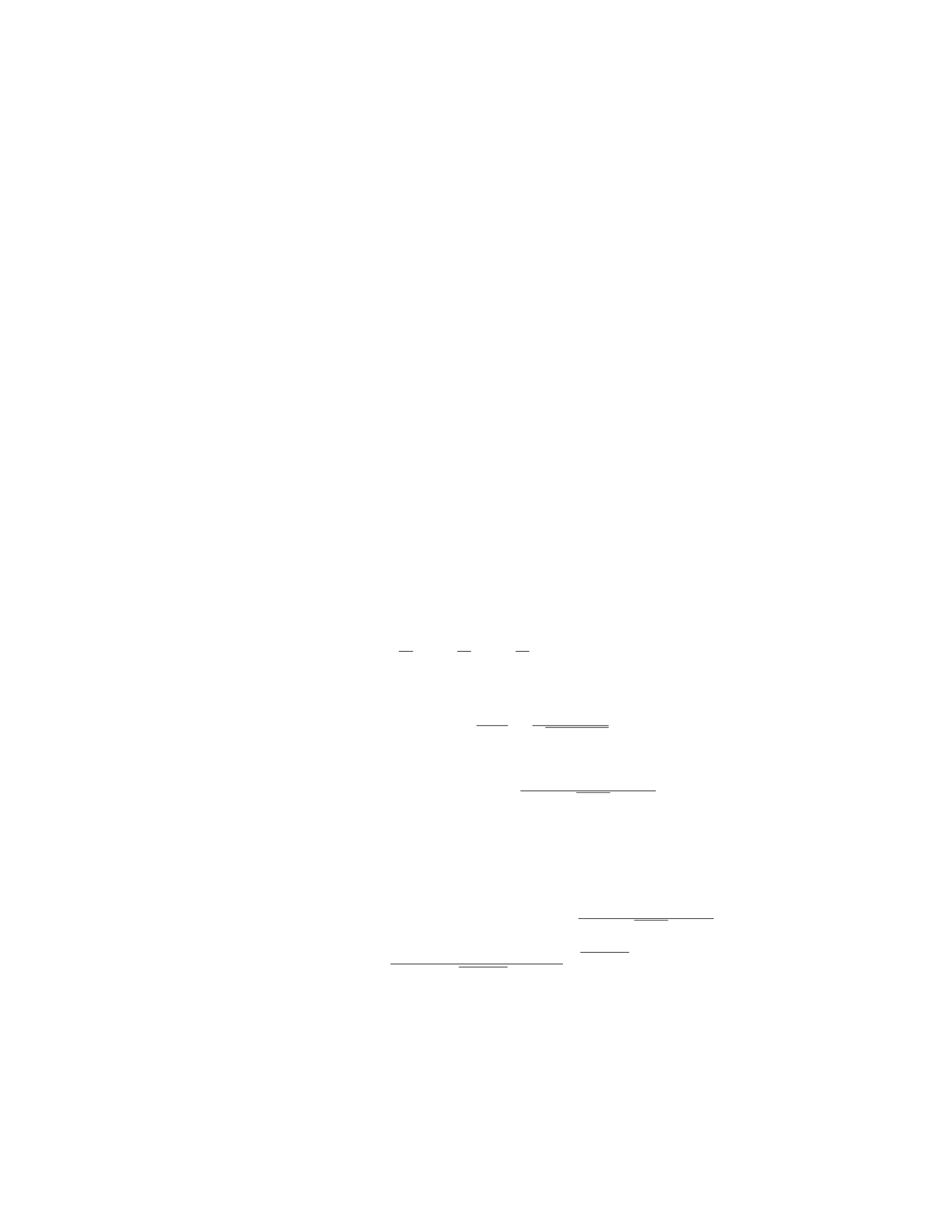
=Z1
0
(t, 1−t, 0) ·(1,−1,0)dt =Z1
0
t−(1 −t)dt =Z1
0
2t−1dt = [t2−t]1
0= 0.
Step 5: Apply Stokes’ Theorem.
By Stokes’ Theorem, the flux of Facross the boundary of Sin the positive
z-direction is equal to the line integral calculated in Step 4. Therefore, the flux
equals 0.
Question 19
Question
Let Sbe the part of the paraboloid z=x2+y2that lies above the disk x2+y2≤
4, oriented upward. Use Stokes’ Theorem to evaluate the surface integral
ZZS
(∇ × F)·dS,
where F(x, y, z) = (2y+z2, x +z, x2+y2).
Solution
Step 1: Find ∇ × F. We have that
∇ × F=
i j k
∂
∂x
∂
∂y
∂
∂z
2y+z2x+z x2+y2
= (2,−2,1).
Step 2: Determine the unit normal vector nto S. Since Sis oriented upward,
the unit normal vector is given by n=∇z
||∇z|| =⟨−2x,−2y,1⟩
√1+4x2+4y2.
Step 3: Calculate the outward-pointing unit normal vector nover the disk
D:x2+y2≤4. Since x2+y2≤4, we have D={(r, θ)|0≤r≤2,0≤θ≤2π}.
Then, the unit normal vector nbecomes n=⟨−2rcos(θ),−2rsin(θ),1⟩
√1+4r2.
Step 4: Use Stokes’ Theorem to evaluate the surface integral. We have the
surface integral over Sas
ZZS
(∇ × F)·dS=ZZD
(∇ × F)·n||n||dA.
Substitute the values of (∇ × F) = (2,−2,1) and n=⟨−2rcos(θ),−2rsin(θ),1⟩
√1+4r2, we
get
ZZD
(2,−2,1) ·⟨−2rcos(θ),−2rsin(θ),1⟩
√1+4r2p1+4r2drdθ.
Finally, we integrate over Dto solve for the surface integral.
18

Question 20
Question
Let Sbe the part of the plane z= 3 that lies inside the cylinder x2+y2= 9.
Use Stokes’ Theorem to evaluate the line integral
IC
(y2+z)dx + (z2+x)dy + (x2+y)dz
where Cis the boundary of Soriented counterclockwise as viewed from above.
Solution
Let’s first find the curl of the vector field F(x, y, z) = (y2+z, z2+x, x2+y):
curl F=
i j k
∂
∂x
∂
∂y
∂
∂z
y2+z z2+x x2+y
=∂(x2+y)
∂y −∂(z2+x)
∂z i−∂(y2+z)
∂x −∂(x2+y)
∂z j+∂(z2+x)
∂x −∂(y2+z)
∂y k
= (1 −0)i−(0 −1)j+ (1 −2)k=i+j−k
Now, let Dbe the region bounded by the circle x2+y2= 9 in the plane
z= 3. Applying Stokes’ Theorem:
ZZS
(curl F)·ndS =IC
F·dr
where nis the unit normal to Spointing in the direction consistent with the
right-hand rule, dS is the area element on S, and dris the tangent vector to C.
Since curl F=i+j−k, we have:
ZZS
(i+j−k)·(0,0,1) dS =IC
(y2+z)dx + (z2+x)dy + (x2+y)dz
=IC
(y2+ 3)dx + (9 + z)dy + (x2+y)dz
Let C1be the circle x2+y2= 9 in the plane z= 3. Then, the line integral
over C1can be parametrized as x(t) = 3 cos t,y(t) = 3 sin t,z(t)=3, for
19

0≤t≤2π. We have:
IC1
(y2+ 3)dx + (9 + z)dy + (x2+y)dz =Z2π
0
((3 sin t)2+ 3)(−3 sin t) + (9 + 3)(3 cos t) + (9(cos t)2+ 3 sin t)(0) dt
=Z2π
0
(−9 sin t+ 12 cos t+ 27) dt
= [−9(−cos t) + 12 sin t+ 27t]
2π
0
= 18π+0+0
= 18π
Therefore, the line integral over the boundary Cis 18π.
Question 21
Question
Let Sbe the surface of the portion of the sphere x2+y2+z2=a2where z≥0,
oriented with outward normal. Let F(x, y, z)=(xz, yz2, x2y). Calculate the
flux of Facross Susing Stokes’ Theorem.
Solution
Step 1: Find the curl of F. The curl of Fis given by:
∇ × F=
i j k
∂
∂x
∂
∂y
∂
∂z
xz yz2x2y
=∂(x2y)
∂y −∂(yz2)
∂z i−∂(xz)
∂x −∂(x2y)
∂z j+∂(xz)
∂y −∂(x2y)
∂x k
= (0 −2yz)i−(z−0)j+ (z−2xy)k
=−2yzi−zj+ (z−2xy)k
Step 2: Calculate the normal vector to the surface S. Since Sis a portion
of the sphere x2+y2+z2=a2where z≥0, the outward normal vector at each
point is n=x
a,y
a,z
a.
Step 3: Calculate the surface area element dS. The surface area element dS
in spherical coordinates is given by dS =a2sin ϕ dϕ dθ.
Step 4: Apply Stokes’ Theorem to find the flux of Facross S. The flux of
Facross Sis given by the surface integral:
ZZS
(∇ × F)·ndS =ZZD
(∇ × F)·ndA
where Dis the region in the xy-plane corresponding to the projection of S.
20
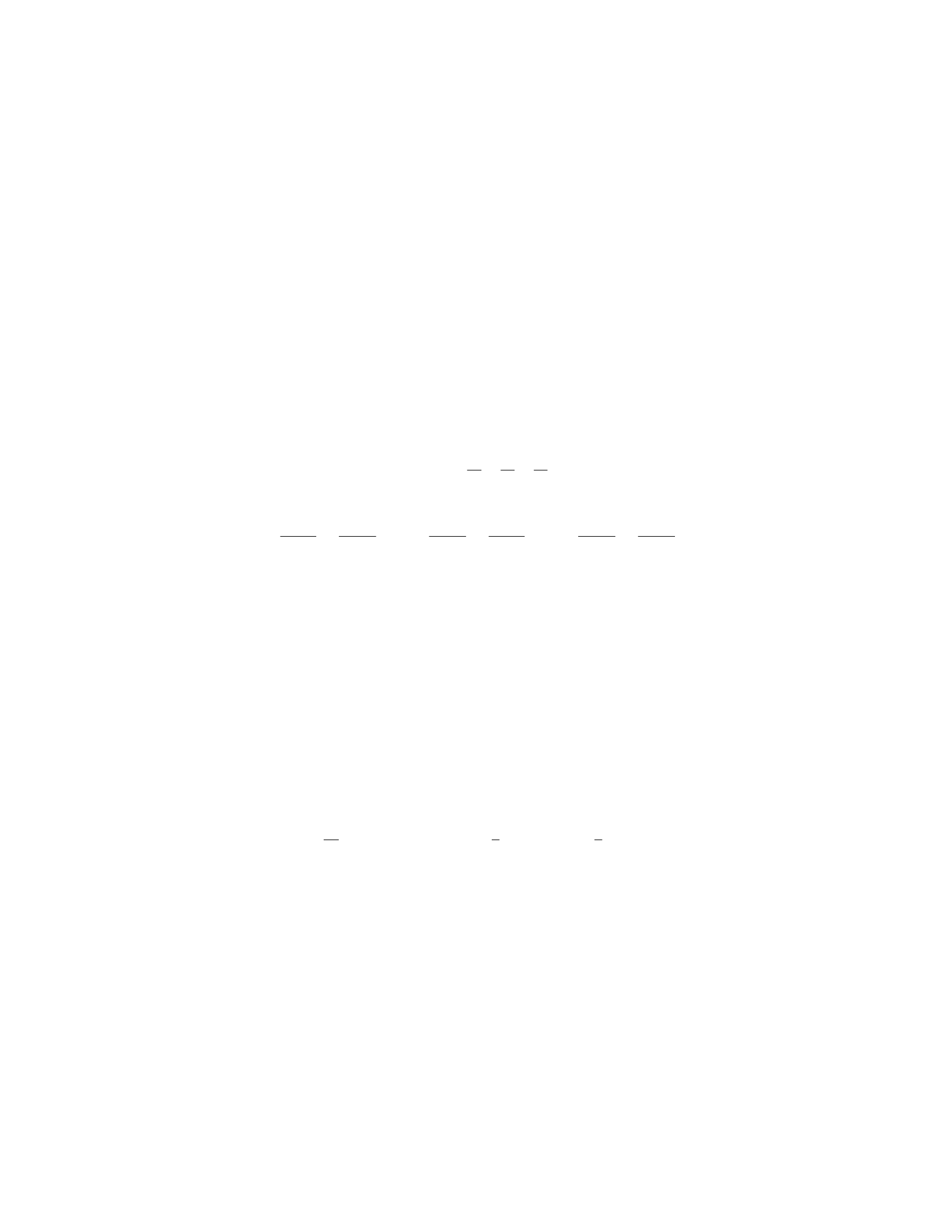
Question 22
Question
Let Sbe the part of the plane z= 1 + x−ythat lies above the rectangle
0≤x≤2and 0≤y≤1. Let F(x, y, z) = ⟨x2, yz, z2⟩. Calculate the surface
integral RRS(∇ × F)·dSusing Stokes’ Theorem.
Solution
Step 1: Calculate ∇ × F. Step 2: Calculate the outward unit normal vector n
to the surface S. Step 3: Calculate the surface integral using Stokes’ Theorem.
Step 1: Calculate ∇ × F.
∇ × F=
i j k
∂
∂x
∂
∂y
∂
∂z
x2yz z2
=∂(z2)
∂y −∂(yz)
∂z i+∂(x2)
∂z −∂(z2)
∂x j+∂(yz)
∂x −∂(x2)
∂y k
= (0 −z)i+ (0 −0)j+ (y−0)k=−zi+yk
Step 2: Calculate the outward unit normal vector nto the surface S. The
unit normal vector to the plane z= 1 + x−yis n=⟨1,−1,−1⟩.
Step 3: Calculate the surface integral using Stokes’ Theorem. By Stokes’
Theorem, ZZS
(∇ × F)·dS=Z Z F·dr
where r=⟨x, y, 1 + x−y⟩on the surface S.
Thus, we have
Z2
0Z1
0
(−z, 0, y)·(1,−1,−1) dy dx =Z2
0Z1
0−z+y dy dx
=Z2
0−y+y2
2y=1
y=0
dx =Z2
0−1 + 1
2dx =Z2
0−1
2dx =−x
2
0=−2
Question 23
Question
Let Sbe the part of the plane z= 4−x−2ythat lies above the triangular region
with vertices (0,0,0),(0,2,0), and (1,1,0) in R3. Let F= (x2+y, y +z, xz)be
a vector field. Evaluate the surface integral RRSF·dSusing Stokes’ Theorem.
21
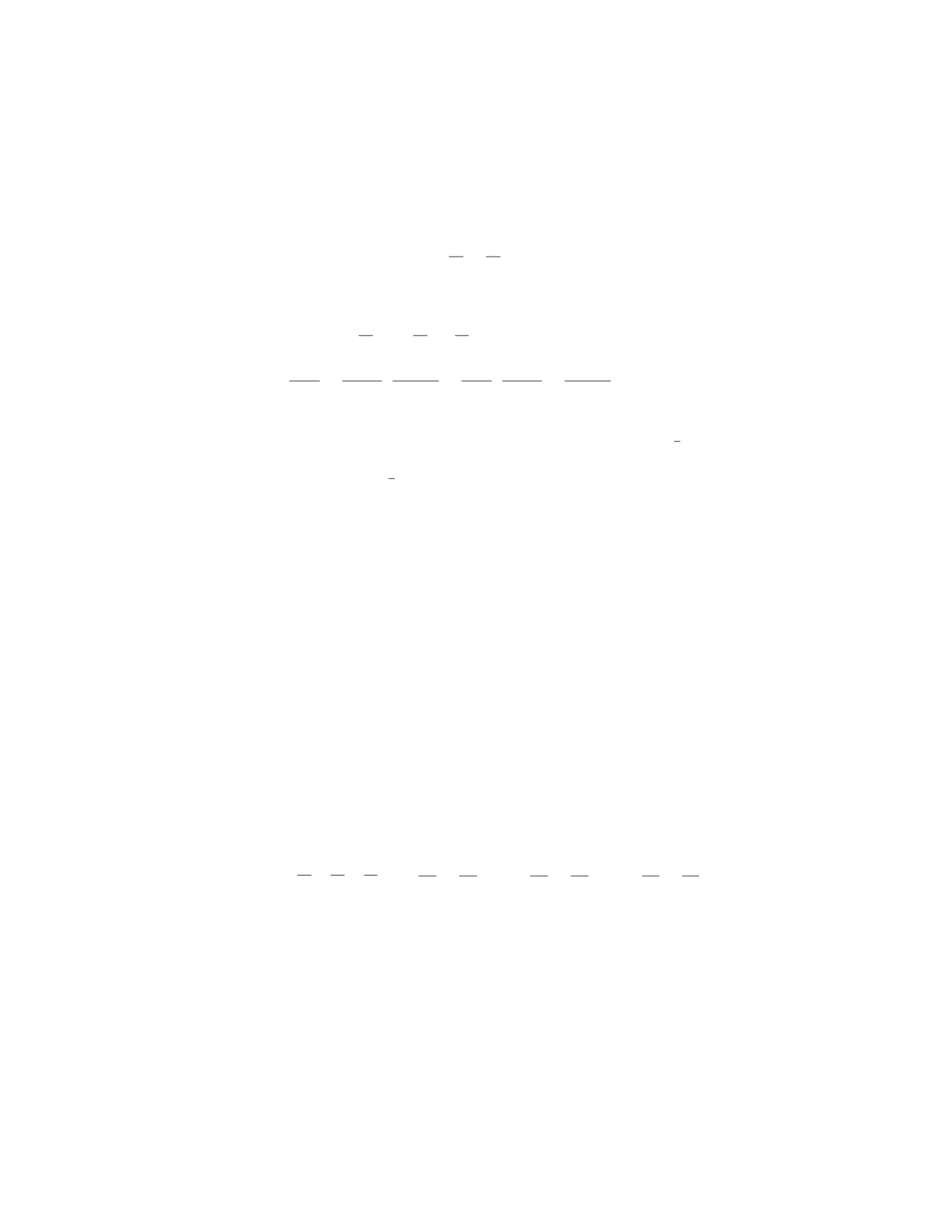
Solution
Step 1: Find the normal vector nto the plane S. The normal vector to the
plane Sis given by n=∇h=−∂h
∂x ,−∂h
∂y ,1, where h(x, y, z) = 4 −x−2y.
Therefore, n= (−(−1),−(−2),1) = (1,2,1).
Step 2: Calculate the curl of F, denoted by ∇ × F. The curl of Fis
given by ∇ × F=
i j k
∂
∂x
∂
∂y
∂
∂z
x2+y y +z xz
. Expanding the determinant, we have
∇ × F=∂(xz)
∂y −∂(y+z)
∂z ,∂(x2+y)
∂z −∂(xz)
∂x ,∂(y+z)
∂x −∂(x2+y)
∂y . Simplifying, we
get ∇ × F= (−1, x −1,0).
Step 3: Find the surface area of the triangular region. The area of a triangle
with vertices (0,0,0),(0,2,0), and (1,1,0) can be calculated as A=1
2|A×B|,
where A=⟨0,2,0⟩and B=⟨1,1,0⟩. The cross product gives us A×B=
⟨0,0,2⟩. So, the area A=1
2|⟨0,0,2⟩| = 1.
Step 4: Apply Stokes’ Theorem to evaluate the surface integral. Stokes’
Theorem states that RRSF·dS=HCF·dr, where Cis the boundary of the
surface S. The boundary of the triangular region is the triangle itself. We
parameterize the curve as r(t) = ⟨t, 2−t, 0⟩for 0≤t≤1. Then, dr=
dt dt = ⟨1,−1,0⟩dt. Now, we have HCF·dr=R1
0F(r(t))·
dt dt = R1
0F(t, 2−t, 0) ·⟨1,−1,0⟩dt. Calculating the dot product, we get HC
Question 24
Question
Let Sbe the part of the plane z= 1−x−ythat lies above the square 0≤x≤1,
0≤y≤1in the xy-plane. Calculate the surface integral RRSF·dSof the vector
field F(x, y, z) = (z, y, x)over the surface Susing Stokes’ Theorem.
Solution
Step 1: Calculate the curl of F. To find the curl of F, we compute ∇ × F:
∇ × F=
i j k
∂
∂x
∂
∂y
∂
∂z
z y x
=∂x
∂y −∂y
∂x i−∂x
∂z −∂z
∂x j+∂y
∂z −∂z
∂y k
= (1 −0)i−(0 −1)j+ (0 −0)k=i+j
Step 2: Calculate the surface integral using Stokes’ Theorem. By Stokes’
Theorem, we have: ZZS
F·dS=IC
F·dr
22

where Cis the boundary of Soriented counterclockwise. The boundary of
the surface Sis the square in the xy-plane, which can be parameterized as
r(t) = (t, 0,1−t)for 0≤t≤1. Thus, the line integral becomes:
IC
F·dr=Z1
0
F(r(t)) ·r′(t)dt
=Z1
0
(1 −t, 0, t)·(1,0,−1)dt =Z1
0
(1 −t)dt =1
2
Therefore, the surface integral RRSF·dSof the vector field F(x, y, z) = (z, y, x)
over the surface Sis 1
2.
Question 25
Question
Let Sbe the part of the plane z= 4 −x−2ythat lies inside the cylinder
x2+y2= 4. Use Stokes’ Theorem to evaluate the surface integral
ZZS
(∇ × F)·dS,
where F(x, y, z) = ⟨x2y, z, x −y2⟩.
Solution
Step 1: Find the curl of F.
∇ × F=
i j k
∂
∂x
∂
∂y
∂
∂z
x2y z x −y2
=∂(x−y2)
∂y −∂z
∂x i−∂(x2y)
∂z −∂(x−y2)
∂x j+∂z
∂y −∂(x2y)
∂y k
= (1 −0)i−(0 −1)j+ (1 −x2)k
=i+j+ (1 −x2)k.
Step 2: Determine the unit normal vector to the surface S. Since the surface
Sis the part of the plane z= 4 −x−2yinside the cylinder x2+y2= 4, we
can represent Sparametrically as r(s, t) = ⟨2 cos s, 2 sin s, 4−2 cos s−4 sin s⟩,
where 0≤s≤2πand 0≤t≤1.
The unit normal vector to Sis given by ˆ
n=rs×rt
∥rs×rt∥. Calculating the cross
product and simplifying gives ˆ
n=1
√6⟨1,−2,−1⟩.
23

Step 3: Calculate the surface integral using Stokes’ Theorem. By Stokes’
Theorem, the given surface integral can be evaluated as
ZZS
(∇ × F)·dS=IC
F·dr,
where Cis the boundary curve of S.
The boundary curve Cis the intersection of the plane z= 4 −x−2yand
the cylinder x2+y2= 4. Thus, Cis the circle x2+y2= 4, but in the plane
z= 4−x−2y. We can parameterize Cas r(t) = ⟨2 cos t, 2 sin t, 4−2 cos t−4 sin t⟩,
where 0≤t≤2π.
Calculating the line integral HCF·drgives the value of the surface integral.
24

