



MATH 332 - ADVANCED CALCULUS
- Green’s Theorem
Question Bank - Set 1
Liberty University
Question 1
Question
Let Cbe the circle with radius 3centered at the origin, oriented counterclock-
wise. Compute the line integral HC(x2−y2)dx + 2xydy using Green’s Theorem.
Solution
Step 1: Parameterize the circle C. Let x(t) = 3 cos tand y(t) = 3 sin tfor
0≤t≤2π. Step 2: Calculate the derivatives: dx
dt =−3 sin tand dy
dt = 3 cos t.
Step 3: Plug the parameterization into the line integral and simplify:
HC(x2−y2)dx + 2xydy =R2π
0((3 cos t)2−(3 sin t)2)·(−3 sin t)+2·(3 cos t)·
(3 sin t)·(3 cos t)dt. Step 4: Evaluate the integral:
=R2π
0(9 cos2t−9 sin2t)(−3 sin t) + 18 sin tcos t·3 cos tdt
=R2π
0(−27 cos2tsin t+27 sin3t+54 sin tcos2t)dt. Step 5: Use Green’s Theorem
to convert the line integral into a double integral:
HC(x2−y2)dx + 2xydy =RRD(∂Q
∂x −∂P
∂y )dA, where Dis the region enclosed by
C. Step 6: Compute the partial derivatives of Pand Q:∂
∂x (2xy)=2yand
∂
∂y (x2−y2) = −2y. Step 7: Substitute the partial derivatives into the double
integral:
=RRD(2y−(−2y))dA
=RRD4ydA. Step 8: Switch to polar coordinates: x=rcos θ,y=rsin θ, and
dA =rdrdθ. The region Dis defined by 0≤r≤3and 0≤θ≤2π. Step 9:
Rewrite the double integral:
=R2π
0R3
04rsin θrdrdθ
=R2π
0[2r2sin θ]3
0dθ
=R2π
018 sin θdθ
= [−18 cos θ]2π
0

=−18(cos 2π−cos 0)
=−18(1 −1)
= 0. Step 10: Therefore, the line integral HC(x2−y2)dx + 2xydy is equal to 0.
Question 2
Question
Let Cbe the curve given by the intersection of the plane z= 3 −x−yand
the cylinder x2+y2= 1. Use Green’s Theorem to evaluate the line integral
HC(x−y)dx + (x+y)dy counterclockwise along C.
Solution
To apply Green’s Theorem, we need to parametrize the curve C. The curve C
is the intersection of the plane z= 3 −x−yand the cylinder x2+y2= 1. Since
we are integrating over a 2D curve, we can ignore the zcomponent in the line
integral.
Let’s first parameterize the curve C. The cylinder x2+y2= 1 can be
parameterized as x= cos(t)and y= sin(t)with 0≤t≤2π. Now, substituting
into the equation of the plane, we get z= 3 −cos(t)−sin(t).
Therefore, the parameterization of Cis given by:
r(t) = ⟨cos(t),sin(t),3−cos(t)−sin(t)⟩for 0≤t≤2π
Now, we can compute the line integral using Green’s Theorem. Green’s
Theorem states: IC
F·dr=ZZD∂Q
∂x −∂P
∂y dA
where F=⟨P, Q⟩.
In this case, P=x−yand Q=x+y. Therefore, ∂Q
∂x −∂P
∂y = 1 −(−1) = 2.
Now, we need to find the region Denclosed by the curve C, which is a circle
of radius 1. The integral becomes:
IC
(x−y)dx + (x+y)dy =ZZD
2dA = 2 ZZD
dA
To calculate the area of the region D, we can use polar coordinates. The
integral becomes:
2Z2π
0Z1
0
r dr dθ = 2 Z2π
0
1
2dr dθ = 2π
Thus, the line integral HC(x−y)dx + (x+y)dy counterclockwise along Cis
2π.
2

Question 3
Question
Let Cbe the curve defined by x= cos(t),y= sin(t)for 0≤t≤2π, oriented
counterclockwise. Let Dbe the region enclosed by C. Use Green’s Theorem to
evaluate the line integral
IC
(x2+y2)dx + (x2−y2)dy
Solution
Step 1: Determine the partial derivatives ∂Q
∂x and ∂P
∂y .
∂Q
∂x = 2x2−2y2and ∂P
∂y = 2x−(−2y) = 2x+ 2y
Step 2: Calculate the double integral over the region D.
ZZD∂Q
∂x −∂P
∂y dA =ZZD
(2x2−2y2−2x−2y)dA
Step 3: Convert the integral to polar coordinates.
=Z2π
0Z1
0
(2r2cos2(θ)−2r2sin2(θ)−2rcos(θ)−2rsin(θ)) r drdθ
Step 4: Simplify and evaluate the double integral.
=Z2π
0Z1
0
(−2r3)drdθ
=Z2π
0−1
2r41
0
dθ
=Z2π
0−1
2dθ
=−π
Therefore, the value of the line integral HC(x2+y2)dx + (x2−y2)dy over
the curve Cis −π.
Question 4
Question
Let Cbe the curve defined by x2+y2= 4 oriented counterclockwise. Calculate
the line integral HC(2x−y)dx + (x+ 2y)dy using Green’s Theorem.
3

Solution
Step 1: Find the region Denclosed by the curve C. Since x2+y2= 4 represents
a circle centered at the origin with radius 2, the region Dis the interior of the
circle.
Step 2: Apply Green’s Theorem, which states:
IC
(P dx +Q dy) = ZZ
D∂Q
∂x −∂P
∂y dA
Step 3: Identify Pand Qfrom the given line integral: P(x, y) = 2x−y
Q(x, y) = x+ 2y
Step 4: Calculate the partial derivatives: ∂P
∂y =−1
∂Q
∂x = 1
Step 5: Compute the double integral over the region D:
ZZ
D
(1 −(−1)) dA =ZZ
D
2dA
Step 6: Change to polar coordinates for the double integral:
Z2π
0Z2
0
2r drdθ
Step 7: Evaluate the double integral:
Z2π
0r2
22
0
dθ =Z2π
0
2dθ = 4π
Therefore, the line integral HC(2x−y)dx + (x+ 2y)dy around the curve C
is 4π.
Question 5
Question
Let Cbe the curve defined by the intersection of the plane z= 2x−yand
the cylinder x2+y2= 4. Use Green’s Theorem to evaluate the line integral
HCF·dr, where F(x, y) = (−y2, x2).
Solution
To apply Green’s Theorem, we first need to find the region Denclosed by the
curve C. This region Dis the projection of the curve Conto the xy-plane.
Step 1: Find the region Denclosed by the curve C.
4

The curve Cis the intersection of the plane z= 2x−yand the cylinder
x2+y2= 4. To find the projection of Conto the xy-plane, we need to express
zin terms of xand y.
First, we rewrite the equation of the plane as z= 2x−y. Then, substituting
this into the equation of the cylinder, we get
2x−y=x2+y2.
This equation represents the projection of the curve Conto the xy-plane.
To find D, we need to determine the region enclosed by this curve.
Solving for xin terms of y, we get
x=1
2(y−y2).
Now, given that the cylinder x2+y2= 4 bounds the region D, we have
1
4(y−y2)2+y2= 4.
1
4(y2−2y3+y4) + y2= 4.
y4−2y3+ 5y2−16 = 0.
This equation is difficult to solve directly, so we will find the roots numeri-
cally, which gives us y≈ −1.7693,0.8308,2.8049.
Therefore, the region Dis the area enclosed by the curve Cin the xy-plane.
Step 2: Apply Green’s Theorem
Green’s Theorem relates a line integral over a curve to a double integral over
the region enclosed by the curve. It states:
IC
F·dr=ZZD∂Q
∂x −∂P
∂y dA,
where F(x, y) = (P(x, y), Q(x, y)).
In our case, F(x, y) = (−y2, x2), so P(x, y) = −y2and Q(x, y) = x2. We
need to find the partial derivatives of Pand Q.
∂Q
∂x = 2x, ∂P
∂y =−2y.
Applying Green’s Theorem, the line integral becomes a double integral over
region Das follows:
IC
F·dr=ZZD
(2x+ 2y)dA.
Step 3: Evaluate the double integral
To evaluate the double integral RRD(2x+ 2y)dA, we need to find limits of
integration for xand yover the region D.
5

Using the intersections of the curve with the xy-plane and the equation of
the cylinder, we can find the region limits. This involves setting x=1
2(y−y2)
and solving for ywithin the limits found in step 1.
After setting up the integral and finding the appropriate limits of integration,
the final step is to evaluate the double integral to find the value of the line
integral over the curve C. This numerical computation would give the final
result.
Question 6
Question
Let Cbe the circle with radius acentered at the origin, oriented counterclock-
wise. Use Green’s Theorem to evaluate the line integral
IC
(x2+y2)dx +xydy.
Solution
1. Step 1: Green’s Theorem states that for a piecewise-smooth, simply con-
nected region Din the plane whose boundary is a simple, piecewise-smooth
curve Coriented counterclockwise, and if
F(x, y) = P(x, y)
i+Q(x, y)
jis
a vector field with continuous partial derivatives in an open region con-
taining D, then
IC
F·dr =ZZD∂Q
∂x −∂P
∂y dA,
where r(t) = x(t)
i+y(t)
jparametrizes C.
2. Step 2: First, rewrite the line integral in terms of
F(x, y) = (x2+y2)
i+
(xy)
j.
IC
F·dr =IC
(x2+y2)dx +xydy.
3. Step 3: Calculate the partial derivatives of P(x, y) = x2+y2and Q(x, y) =
xy:
∂P
∂y = 0 and ∂Q
∂x =y.
4. Step 4: Apply Green’s Theorem:
IC
(x2+y2)dx +xydy =ZZD
(y−0) dA =ZZD
ydA.
6

5. Step 5: To evaluate RRDydA, we need to parametrize the region Den-
closed by the circle C.
Let x=rcos θand y=rsin θbe the parametric equations for the circle.
Then D={(x, y) : x2+y2≤a2}implies 0≤r≤a.
6. Step 6: Compute the Jacobian determinant dA =rdrdθ and rewrite the
integral:
ZZD
ydA =Z2π
0Za
0
(rsin θ)rdrdθ.
7. Step 7: Integrate with respect to r:
Z2π
0Za
0
(r2sin θ)drdθ =Z2π
0a3
3sin θdθ = 0.
8. Step 8: Therefore, the value of the line integral HC(x2+y2)dx +xydy is
0.
Question 7
Question
Let Cbe the curve defined by x= 2 cos(t),y= 3 sin(t), where 0≤t≤π/2.
Use Green’s Theorem to evaluate the line integral HC(x2+y2)dx +xy dy.
Solution
We will first parameterize the curve Cusing x= 2 cos(t)and y= 3 sin(t), where
0≤t≤π/2:
r(t) = 2 cos(t)
3 sin(t)
Next, we need to find the derivatives with respect to t:
dr
dt =−2 sin(t)
3 cos(t)
Using Green’s Theorem, we have:
IC
(x2+y2)dx +xy dy =ZZD∂(xy)
∂x −∂(x2+y2)
∂y dA
where Dis the region enclosed by the curve C. Now, substituting x= 2 cos(t)
and y= 3 sin(t)into the integrand, we get:
∂(xy)
∂x =yand ∂(x2+y2)
∂y = 2y
7
Therefore, the line integral simplifies to:
IC
(x2+y2)dx +xy dy =ZZD
(y−2y)dA =ZZD
(−y)dA
Next, we need to find the limits of integration for tin terms of xand y. Since
x= 2 cos(t)and y= 3 sin(t), we have:
x2+y2= 4 cos2(t) + 9 sin2(t) = 4 = constant
This implies that the region Dis a circle with radius 2. Thus, the integral
simplifies to:
ZZD
(−y)dA =−Z2π
0Z2
0
3 sin(t)r dr dt
Solving this double integral gives us the final answer.
Question 8
Question
Let Cbe the circle x2+y2= 1 oriented counterclockwise. Evaluate the line
integral HC(ycos x−xsin y)dx + (xcos y+ysin x)dy using Green’s Theorem.
Solution
Step 1: Determine the region enclosed by C. The region enclosed by the circle
x2+y2= 1 is the unit disk Dwith center at the origin.
Step 2: Compute the partial derivatives of the given vector field. Let
F= (ycos x−xsin y, x cos y+ysin x). We have ∂Q
∂x = sin x+xcos yand
∂P
∂y = cos y+ sin x.
Step 3: Apply Green’s Theorem. By Green’s Theorem, we have
IC
F·dr =ZZD∂Q
∂x −∂P
∂y dA.
Step 4: Evaluate the double integral. Since ∂Q
∂x −∂P
∂y = sin x+xcos y−
(cos y+ sin x) = xcos y−cos y, we have
ZZD
(xcos y−cos y)dA =Z2π
0Z1
0
(rcos θ−cos θ)rdrdθ.
8

Step 5: Integrate over the region.
Z2π
0Z1
0
(rcos θ−cos θ)rdrdθ =Z2π
0Z1
0
r2cos θdr −Z1
0
cos θdrdθ
=Z2π
01
3cos θ−cos θdθ
=Z2π
0
−2
3cos θdθ
=−2
3sin θ2π
0
= 0.
Therefore, the value of the line integral HCF·dr is 0.
Question 9
Question
Let Cbe the curve formed by the intersection of the planes z= 0,x+y+2z= 4,
and y= 2x. Calculate the circulation of the vector field F(x, y, z) = (2z, x, y)
around Cin the anticlockwise direction.
Solution
Step 1: Find the parametrization of the curve C.
The curve Cis formed by the intersection of the planes z= 0,x+y+2z= 4,
and y= 2x. Substituting z= 0 into the second equation gives x+y= 4.
Combining this with y= 2x, we have the parametrization of the curve:
C:r(t) = (t, 2t, 0) for t∈[0,2]
Step 2: Compute the circulation of Faround C.
The circulation of Faround Cin the anticlockwise direction is given by the
line integral:
IC
F·dr=Z2
0
F(r(t)) ·r′(t)dt
Substitute r(t) = (t, 2t, 0) and r′(t) = (1,2,0) into the dot product:
F(r(t)) ·r′(t) =
0
t
2t
·
1
2
0
= 0 + 2t+ 0 = 2t
Integrating with respect to t:
Z2
0
2t dt = [t2]2
0= 4
9

Therefore, the circulation of the vector field F(x, y, z) = (2z, x, y)around C
in the anticlockwise direction is 4.
Question 10
Question
Let Cbe the curve defined by x=t2,y=t3,0≤t≤1. Use Green’s Theorem
to evaluate the line integral HC(x2+y2)dx +xy dy.
Solution
• The curve Cis given by x=t2,y=t3,0≤t≤1. We can parametrize
the curve as r(t) = (t2, t3)for 0≤t≤1.
• To apply Green’s Theorem, we need to find the partial derivatives of P=
x2+y2and Q=xy with respect to xand y:
∂P
∂x = 2x,
∂Q
∂y =x.
• Green’s Theorem states that for a positively oriented simple closed curve
Cand a region Rbounded by C, we have
IC
(P dx +Q dy) = ZZR∂Q
∂x −∂P
∂y dA.
• Calculate the partial derivatives:
∂Q
∂x =∂
∂x(xy) = y,
∂P
∂y =∂
∂y (x2+y2) = 2y.
• Substitute these values into the double integral formula:
ZZR
(y−2y)dA =ZZR
(−y)dA.
• To find the area integral, we first need to find the region Rbounded by
C. The curve is a parabola y=x3/2where 0≤x≤1. Thus, the region
Ris the area between the curve y=x3/2and the x-axis in the xy-plane.
• The integral becomes:
Z1
0Zx3/2
0
(−y)dy dx.
10

• Evaluate the double integral:
Z1
0−1
2y2x3/2
0
dx =Z1
0−1
2x3dx
=−1
8x41
0
=−1
8.
• Therefore, the line integral HC(x2+y2)dx +xy dy along the curve Cis
−1
8.
Question 11
Question
Let Cbe the curve parametrized by r(t) = ⟨t2, t3⟩for 0≤t≤1. Let Dbe the
region enclosed by C. Calculate the line integral
IC
(xy2−x2y)dx + (x2+y2)dy
using Green’s Theorem.
Solution
Step 1: Find the partial derivatives of the given vector field. The vector field
is given by F(x, y) = ⟨xy2−x2y, x2+y2⟩. We find the partial derivatives of
P(x, y) = xy2−x2ywith respect to yand Q(x, y) = x2+y2with respect to x:
∂P
∂y = 2xy −x2and ∂Q
∂x = 2x
Step 2: Apply Green’s Theorem. Green’s Theorem states that for a pos-
itively oriented simple closed curve Cand a region Denclosed by C, the line
integral of a vector field F=⟨P, Q⟩along Cis equal to the double integral of
the curl of Fover the region D. Mathematically,
IC
F·dr=ZZD∂Q
∂x −∂P
∂y dA
Step 3: Calculate the curl of F. The curl of Fis given by
curl F=∂Q
∂x −∂P
∂y = (2x)−(2xy −x2) = 2x−2xy +x2
11

Step 4: Determine the region Denclosed by C. The region Denclosed by
Cis the area under the curve r(t) = ⟨t2, t3⟩for 0≤t≤1. This region is a
simply connected region bounded by the curve.
Step 5: Evaluate the double integral. Substitute the expression for the curl
of Finto Green’s Theorem:
ZZD
(2x−2xy +x2)dA
This double integral can be challenging to calculate without knowing the
specific shape of the region D. However, the curl expression simplifies the
computation significantly.
Therefore, we have reduced the line integral problem to a double integral
problem using Green’s Theorem.
Question 12
Question
Let Cbe the curve parameterized by r(t) = (2 cos t, 3 sin t)for 0≤t≤2π.
Calculate the circulation of the vector field F(x, y) = (y, −x)around the curve
Cusing Green’s Theorem.
Solution
Step 1: Calculate the circulation of F(x, y)=(y, −x)around the curve C.
First, we need to parameterize the vector field Falong with the curve C. The
curve Cis given by r(t) = (2 cos t, 3 sin t)for 0≤t≤2π, and we can write
r(t) = (x(t), y(t)) where x(t) = 2 cos tand y(t) = 3 sin t.
Step 2: Applying Green’s Theorem Green’s Theorem states that for a vector
field F(x, y) = (P(x, y), Q(x, y)) that is continuously differentiable on a simple
closed curve Cwhich encloses a region D, the circulation of Faround Cis equal
to the double integral of the curl of Fover the region D. Mathematically, this
can be written as:
IC
F·dr=ZZD∂Q
∂x −∂P
∂y dA
Step 3: Calculate the curl of FThe curl of Fis given by:
∇ × F=∂
∂x,∂
∂y ,∂
∂z ×(y, −x) = (0,0,1)
Step 4: Compute the double integral over the region DSince the unit normal
vector n= (0,0,1) for the xy-plane is always in the z-direction, the double
integral over the region Dis simply the area of the region spanned by C. This
region turns out to be an ellipse with semi-major axis a= 3 and semi-minor
axis b= 2.
12

Step 5: Calculate the area of the ellipse and the double integral The area of
an ellipse is given by π×a×b, so in this case, the area is 6π. Therefore, the
circulation of Faround the curve Cis 6π.
Question 13
Question
Let Cbe the curve given by the intersection of the plane 2x+ 4y+z= 8 and
the cylinder x2+y2= 4, oriented counterclockwise as viewed from above. Use
Green’s Theorem to evaluate the line integral
IC
(x+y)dx + (2x+y)dy.
Solution
Step 1: First, let’s find the region Denclosed by the curve C. The curve Cis
the intersection of the plane 2x+ 4y+z= 8 and the cylinder x2+y2= 4. Since
z= 8 −2x−4y, we can substitute this into x2+y2= 4 to get:
x2+y2= 4 =⇒x2+y2= 4 =⇒(8−2x−4y)2= 4 =⇒4x2+16xy−16x−32y+60 = 0.
This simplifies to (x−1)2+ (y−2)2= 1. Thus, the curve Cis a circle centered
at (1,2) with radius 1.
Step 2: Next, let’s parameterize the circle. We can use x= 1 + cos t,
y= 2 + sin t, where 0≤t≤2π. Then, dx =−sin t dt and dy = cos t dt.
Step 3: Now, we can rewrite the line integral using these parameterizations:
IC
(x+y)dx+(2x+y)dy =Z2π
0
((1+cos t)+(2+sin t))(−sin t)+2(1+cos t+2+sin t) cos t dt.
Step 4: Simplify the integrand:
Integral =Z2π
0
(−sin t−sin tcos t+ 2 cos t+ 2 cos tcos t+ 4 cos t+ 2 sin t)dt
=Z2π
0
(−sin t−1
2sin(2t) + 2 cos t+3
2+ 2 sin t)dt.
13

Step 5: Integrate the functions term by term:
Integral =−cos t+1
4cos(2t) + 2 sin t+3
2t−2 cos t2π
0
=−cos(2π) + 1
4cos(4π) + 2 sin(2π) + 3
2(2π)−2 cos(2π)
−−cos(0) + 1
4cos(0) + 2 sin(0) + 3
2(0) −2 cos(0)
= 0 + 1
4+0+3π−2−(−1−1
4+0+0−2)
=9
4+ 3π−1.
Therefore, the line integral HC(x+y)dx + (2x+y)dy is 9
4+ 3π−1.
Question 14
Question
Let Cbe the curve formed by the intersection of the plane z= 2xand the
surface z=x2+y2. Use Green’s Theorem to calculate the circulation of the
vector field F=⟨y, x, z⟩around the curve C.
Solution
Given z= 2xand z=x2+y2, we have 2x=x2+y2. Rewrite this equation as
x2−2x+y2= 0, which is the equation of a circle with radius 1 centered at (1,0).
So, Cis a circle centered at (1,0) with radius 1, which can be parameterized as
x= 1 + cos(t),y= sin(t)for 0≤t≤2π.
Now, let’s calculate the circulation of F=⟨y, x, z⟩around the curve Cusing
Green’s Theorem. Green’s Theorem states that for a curve Cenclosing a region
Din the plane and a vector field F=⟨P, Q⟩, the circulation of Faround Cis
equal to the double integral of the curl of Fover the region D. In this case,
P=y,Q=x, and the curl of Fis ∇ × F= (0,0,1).
Step 1: Parameterize the curve C:
x= 1 + cos(t), y = sin(t), z = 2(1 + cos(t))
Step 2: Calculate the partial derivatives of Pand Qwith respect to xand
y:
∂Q
∂x = 1,∂P
∂y = 1
Step 3: Apply Green’s Theorem:
circulation =ZZ
D∂Q
∂x −∂P
∂y dA
14

Step 4: Since the region Denclosed by the curve Cis a unit disk, D=
{(x, y) : x2+y2≤1}, the circulation simplifies to:
circulation =ZZ
D
1dA =ZZ
D
dA =Area(D) = π
Therefore, the circulation of the vector field F=⟨y, x, z⟩around the curve
Cis π.
Question 15
Question
Let Cbe the curve given by the intersection of the plane z= 4 −x−yand the
cylinder x2+y2= 1. Use Green’s Theorem to evaluate the line integral
IC
(y2−z)dx + (z2−x)dy + (x2−y)dz.
Solution
To use Green’s Theorem, we need to find a vector field Fsuch that its curl is
the integrand of the line integral over C. Let F= (M, N, P )be the vector field,
where M=y2−z,N=z2−x, and P=x2−y. Then, the curl of Fis given by
∇ × F=∂P
∂y −∂N
∂z ,∂M
∂z −∂P
∂x ,∂N
∂x −∂M
∂y .
Calculating the components of the curl, we have
∂P
∂y −∂N
∂z = 2x, ∂M
∂z −∂P
∂x = 2y, ∂N
∂x −∂M
∂y = 2z.
Thus, the curl of Fis ∇ × F= (2x, 2y, 2z) = 2(x, y, z).
Applying Green’s Theorem, we have
IC
F·dr=ZZD
(∇ × F)·ndA,
where Dis the region in the xy-plane bounded by Cand nis the unit outward
normal to D. Since the curl of Fis 2(x, y, z), we have
ZZD
2(x, y, z)·ndA = 2 ZZD
(xcos ϕ+ysin ϕ)dA,
where ϕis the angle between nand the positive x-axis.
Now, we need to parametrize the curve C. The intersection of the plane
z= 4 −x−yand the cylinder x2+y2= 1 gives us the parameterization
x= cos t,y= sin t, and z= 3 −cos t−sin tfor 0≤t≤2π.
15
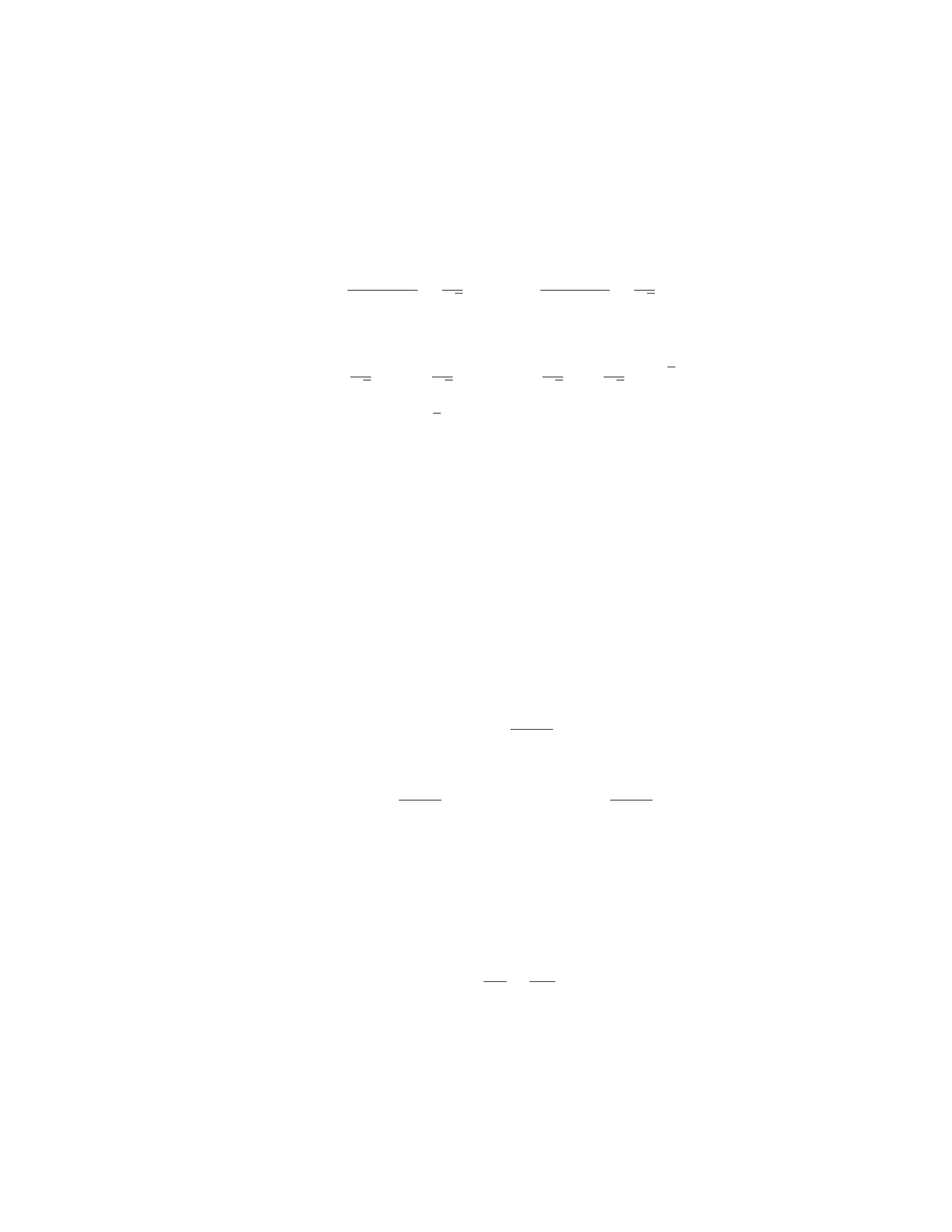
Then, we have
D(cos t, sin t) =
cos tsin t
−sin tcos t
= cos2t+ sin2t= 1,
cos ϕ=∇z× ∇x
|∇z× ∇x|=1
√2,sin ϕ=∇z× ∇y
|∇z× ∇y|=1
√2.
Thus, the line integral becomes
2Z2π
0
(cos t·1
√2+ sin t·1
√2)dt = 2 Z2π
0
1
√2dt =4π
√2= 2√2π.
So, the line integral over Cis 2√2π.
Question 16
Question
Let Cbe the curve formed by the intersection of the cylinder x2+y2= 1 and the
plane z=x+y. Calculate the circulation of the vector field F= (x2+2y2, y2, z2)
around Cin the counterclockwise direction.
Solution
Step 1: Determine the region enclosed by the curve Cin the xy-plane.
Since Cis the intersection of the cylinder x2+y2= 1 and the plane z=x+y,
we can rewrite the equation of the cylinder in terms of z:
z=x+y=±p1−x2
This gives us the two equations of the curve in the xy-plane:
z=x+y=p1−x2and z=x+y=−p1−x2
The region enclosed by Cin the xy-plane is the unit circle.
Step 2: Use Green’s Theorem to calculate the circulation of Faround C.
Green’s Theorem states that the circulation of a vector field F= (M, N)
around a closed curve Cis given by
IC
F·dr=ZZD∂N
∂x −∂M
∂y dA
where Dis the region enclosed by C.
16

In this case, M=x2+ 2y2and N=y2. Therefore,
∂N
∂x = 0 and ∂M
∂y = 4y
The circulation of Faround Cis then
IC
F·dr=ZZD
(4y)dA
Step 3: Evaluate the double integral on the unit circle in the xy-plane.
Switch to polar coordinates, x=rcos(θ), y =rsin(θ), and dA =r dr dθ.
The limits of integration for rare from 0to 1and for θare from 0to 2π.
Substituting into the integral gives us:
IC
F·dr=Z2π
0Z1
0
(4rsin(θ)) ·r dr dθ
Question 17
Question
Let Cbe the counterclockwise-oriented boundary of the region enclosed by
the circles x2+y2= 1 and x2+y2= 4. Use Green’s Theorem to evaluate
HC(2x−3y)dx + (x+ 4y)dy.
Solution
Step 1: Identify the region enclosed by C.
The region enclosed by Cis the annular region between the two circles
x2+y2= 1 and x2+y2= 4.
Step 2: Write the given line integral as a double integral over the region
enclosed by C.
We can rewrite HC(2x−3y)dx + (x+ 4y)dy as a double integral over the
region Denclosed by C:
IC
(2x−3y)dx + (x+ 4y)dy =ZZD∂Q
∂x −∂P
∂y dA
where P= 2x−3yand Q=x+ 4y.
Step 3: Calculate the partial derivatives.
Compute ∂Q
∂x = 1 and ∂P
∂y =−3.
Step 4: Evaluate the double integral.
By Green’s Theorem, we have:
IC
(2x−3y)dx + (x+ 4y)dy =ZZD
(1 −(−3)) dA =ZZD
4dA
17

Since the region Dis an annulus, we can evaluate this double integral in
polar coordinates.
Step 5: Convert to polar coordinates and evaluate the integral.
The region Dcan be described in polar coordinates as 1≤r≤2,0≤θ≤2π.
So, the double integral becomes:
ZZD
4dA =Z2π
0Z2
1
4r dr dθ
=Z2π
02r22
1dθ =Z2π
0
(8 −2) dθ =Z2π
0
6dθ = 6(2π) = 12π
Therefore, the line integral HC(2x−3y)dx+(x+4y)dy over the given region
is 12π.
Question 18
Question
Let Cbe the circle centered at the origin with radius 3 oriented counterclockwise.
Use Green’s Theorem to evaluate the line integral HC(x2+y2)dx +y2dy.
Solution
Step 1: We first need to find the region Denclosed by the curve C, which in
this case is the circle centered at the origin with radius 3. We can represent D
as D={(x, y)|x2+y2≤9}.
Step 2: Green’s Theorem states that for a simple positively oriented curve
Cenclosing a region D, the line integral around Cof the vector field F= (P, Q)
is equal to the double integral over the region Dof (∂Q
∂x −∂P
∂y )dA, where Pand
Qare the components of F.
Step 3: In this case, we have F= (x2+y2, y2), so P=x2+y2and Q=y2.
We need to compute ∂Q
∂x and ∂P
∂y .
Step 4: We find ∂Q
∂x = 0 and ∂P
∂y = 2y. Therefore, (∂Q
∂x −∂P
∂y ) = −2y.
Step 5: The given line integral can be rewritten in terms of the components
of F:HC(x2+y2)dx +y2dy =HCP dx +Qdy.
Step 6: By Green’s Theorem, this line integral is equal to the double integral
over Dof −2ydA. We can convert this to polar coordinates to evaluate the
integral.
Step 7: −2y=−2rsin(θ)in polar coordinates. Also, dA =rdrdθ.
Step 8: Therefore, the double integral becomes R2π
0R3
0−2rsin(θ)rdrdθ.
Step 9: Evaluating this integral gives us R2π
0−9
2cos(θ)dθ.
Step 10: The integral of cos(θ)over [0,2π]is 0. So, the line integral HC(x2+
y2)dx +y2dy is 0.
18

Question 19
Question
Let Cbe the curve given by the intersection of the plane x+y+z= 1 and the
cylinder x2+y2= 1. Compute the circulation of the vector field F(x, y, z) =
(x2+y, y2+z, z2+x)around Cin the counterclockwise direction.
Solution
To apply Green’s Theorem to compute the circulation of Faround the curve C
in the counterclockwise direction, we first need to find the region Denclosed by
C. We realize that Dis a disk in the xy-plane bounded by the circle x2+y2= 1.
Thus, we can apply Green’s Theorem as follows:
IC
F·dr=ZZD∂Q
∂x −∂P
∂y dA,
where F= (P, Q, R).
Step 1: Find the components P,Q, and Rof the vector field F.
Here, P=x2+y,Q=y2+z, and R=z2+x.
Step 2: Calculate the circulation of Faround C.
Using Green’s Theorem, we have:
IC
F·dr=ZZD∂Q
∂x −∂P
∂y dA.
The partial derivatives are:
∂Q
∂x = 0,∂P
∂y = 1.
Therefore, the circulation is:
IC
F·dr=ZZD
(0 −1)dA =−ZZD
dA.
Step 3: Compute the double integral over D.
Since Dis the unit circle, we have:
−ZZD
dA =−π·12=−π.
Therefore, the circulation of Faround Cin the counterclockwise direction
is −π.
Question 20
Question
Let Cbe the curve defined by x2+y2= 1 oriented counterclockwise. Use
Green’s Theorem to evaluate the line integral HC(x3−y)dx +xdy.
19

Solution
1. Let’s denote P(x, y) = x3−yand Q(x, y) = x.
2. Green’s Theorem states that for a region Dbounded by a positively ori-
ented simple closed curve C, if Pand Qhave continuous partial derivatives
on Dthen:
IC
(P dx +Qdy) = ZZD∂Q
∂x −∂P
∂y dA
3. We first need to find ∂Q
∂x and ∂P
∂y :
∂Q
∂x = 1
∂P
∂y =−1
4. Therefore, the given line integral becomes:
IC
(x3−y)dx +xdy =ZZD
(1 −(−1))dA =ZZD
2dA
5. The curve Cis the unit circle centered at the origin. Therefore, the region
Dinside Cis the circle itself. We can represent it in polar coordinates as
D={(r, θ)|0≤r≤1,0≤θ≤2π}
6. Therefore, the double integral becomes:
ZZD
2dA =Z2π
0Z1
0
2rdrdθ
7. Solving the integral, we get:
Z2π
0Z1
0
2rdrdθ = 2π
8. Thus, the line integral HC(x3−y)dx +xdy around the curve Cis 2π.
Question 21
Question
Let Cbe the positively oriented curve that bounds the region Din the xy-
plane given by y=x2and y= 4. Calculate the circulation of the vector field
F= (x2+y, 2xy)around C.
20

Solution
Step 1: Find the parametrization of C.
The curve Cis formed by the lines y=x2and y= 4. To find the
parametrization of C, we can let x=tand then express yin terms of t. So, we
have y=t2for tvarying from −2to 2.
Step 2: Calculate the circulation of Faround Cusing Green’s theorem.
Green’s theorem states that for a vector field F= (M, N )and a region D
bounded by a simple, closed, positively oriented curve C, the circulation of F
around Cis equal to the double integral of the curl of Fover the region D.
In this case, F= (x2+y, 2xy), and the region Dis bounded by the curves
y=x2and y= 4.
Step 3: Calculate the curl of F.
The curl of Fis given by ∇ × F=∂N
∂x −∂M
∂y . So, we have:
∂N
∂x −∂M
∂y =∂(2xy)
∂x −∂(x2+y)
∂y = 2y−1
Step 4: Calculate the circulation of Faround C.
Using Green’s theorem, the circulation of Faround Cis equal to the double
integral of 2y−1over the region D:
ZZD
(2y−1) dA
Step 5: Determine the bounds of integration.
The region Dis bounded by the curves y=x2and y= 4. Since yvaries from
x2to 4and xvaries from −2to 2, the bounds of integration are −2≤x≤2
and x2≤y≤4.
Step 6: Evaluate the integral.
21

ZZD
(2y−1) dA =Z2
−2Z4
x2
(2y−1) dydx
=Z2
−2y2−y4
x2dx
=Z2
−2
(16 −4−(x4−x2)) dx
=Z2
−2
(−x4+x2+ 12) dx
=−x5
5+x3
3+ 12x2
−2
=−32
5+8
3+ 24−32
5−8
3−24
=128
15 +8
3+ 48
=128
15 +40
15 +720
15
=888
15
= 59.2
Thus, the circulation of the vector field Faround Cis 59.2.
Question 22
Question
Let Cbe the curve defined by x2+y2= 1 oriented counterclockwise. Compute
the circulation of the vector field F(x, y) = (x2+y2)i+ 2xyjaround C.
Solution
Step 1: We first need to parametrize the curve C. Since Cis the unit circle
centered at the origin, we can parametrize it as r(t) = cos(t)i+ sin(t)jfor
0≤t≤2π.
Step 2: Next, we find the tangent vector r′(t)by differentiating r(t)with
respect to t. We have
r′(t) = −sin(t)i+ cos(t)j.
Step 3: Using the circulation formula, we compute the line integral as
circulation =IC
F·dr=Z2π
0
F(r(t)) ·r′(t)dt.
22

Step 4: Substituting r(t),r′(t), and F(r(t)) into the integral, we get
Z2π
0(cos2(t) + sin2(t)) cos(t) + 2 cos(t) sin(t)(−sin(t))
+(cos2(t) + sin2(t)) sin(t) + 2 cos(t) sin(t)(cos(t)) dt.
Step 5: Simplifying the integrand and integrating over 0≤t≤2π, we find
circulation =Z2π
0
(−cos(t) sin(t)+2 cos(t) sin(t)+cos(t) sin(t)+2 cos(t) sin(t)) dt = 3π.
Therefore, the circulation of Faround Cis 3π.
Question 23
Question
Let Cbe the boundary of the region Denclosed by the parabola y=x2and
the line y=x. Calculate the line integral HC(2x2y−y2)dx + (x3−xy)dy using
Green’s Theorem.
Solution
Step 1: Find the region Denclosed by the given curves y=x2and y=x.
• The intersection points of the two curves are (0,0) and (1,1).
• The region enclosed by the curves is D: 0 ≤x≤1,x2≤y≤x.
Step 2: Apply Green’s Theorem: Green’s Theorem states that for a simply
connected region Dwith piecewise smooth boundary Coriented counterclock-
wise, and a vector field F= (P(x, y), Q(x, y)),
IC
F·dr=ZZD∂Q
∂x −∂P
∂y dA
where F= (2x2y−y2, x3−xy)in this case.
Step 3: Compute the partial derivatives involved:
∂Q
∂x =∂
∂x(x3−xy) = 3x−y
∂P
∂y =∂
∂y (2x2y−y2) = 2x2−2y
Step 4: Calculate the double integral by Green’s Theorem:
ZZD
(3x−y−2x2+ 2y)dA =ZZD
(3x−2x2+y)dA
23
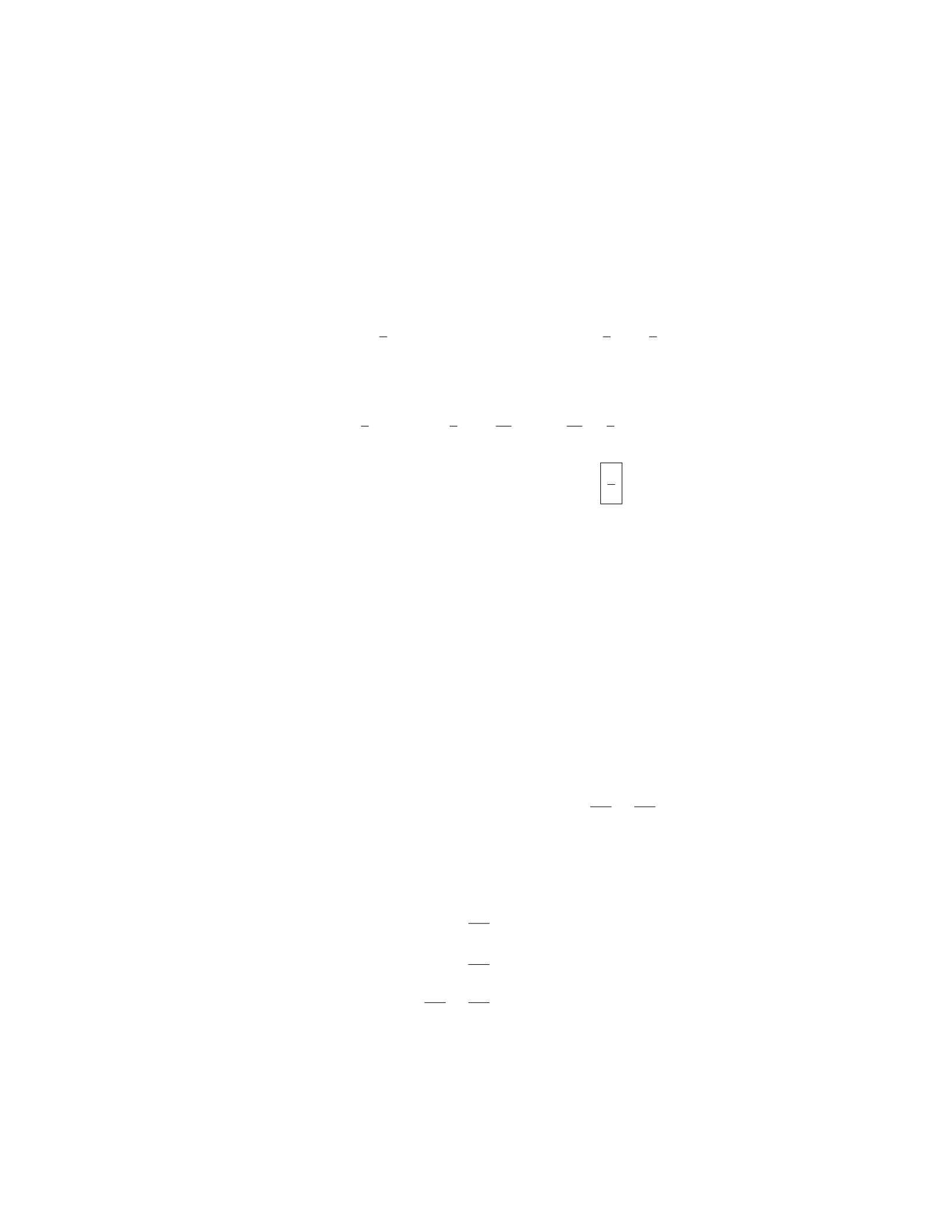
Step 5: Evaluate the double integral over the region D:
ZZD
(3x−2x2+y)dA =Z1
0Zx
x2
(3x−2x2+y)dydx
Step 6: Integrate over yfirst:
Z1
0y(3x−2x2) + 1
2y2x
x2
dx =Z1
0x(3x−2x2) + 1
2x2−1
2x4dx
Step 7: Compute the integral:
=3
2x2−2x3+1
2x2−1
10x51
0
=5
10 =1
2
Therefore, the line integral around the boundary Cis 1
2.
Question 24
Question
Let Cbe the positively-oriented circle x2+y2= 4. Use Green’s Theorem to
evaluate the line integral
IC
(x2y+ex)dx + (2xy + sin y)dy.
Solution
1. First, let’s rewrite the line integral in terms of a double integral over the
region enclosed by C:
IC
(x2y+ex)dx + (2xy + sin y)dy =ZZD∂Q
∂x −∂P
∂y dA,
where P(x, y) = x2y+exand Q(x, y) = 2xy + sin y.
2. Calculate the partial derivatives:
∂P
∂y =x2,
∂Q
∂x = 2y,
∂Q
∂x −∂P
∂y = 2y−x2.
24

3. By Green’s Theorem, the line integral is equal to the double integral over
the region enclosed by C:
IC
(x2y+ex)dx + (2xy + sin y)dy =ZZD
(2y−x2)dA.
4. Since Cis the circle x2+y2= 4, we can use polar coordinates to evaluate
the double integral:
ZZD
(2y−x2)dA =Z2π
0Z2
0
(2rsin θ−r2cos2θ)r dr dθ
=Z2π
0Z2
0
(2r2sin θ−r3cos2θ)drdθ
=Z2π
0 2
3r3sin θ−1
4r4cos2θ2
0!dθ
=Z2π
016
3sin θ−4 cos2θdθ
=−16
3cos θ−4θsin θ2π
0
=−16
3(cos 2π−cos 0) −4(2πsin 2π−0)
=32
3.
5. Therefore, the value of the line integral is 32
3.
Question 25
Question
Let Cbe the curve given by x2+y2= 4, oriented counterclockwise, and let
F= (x2+y2, xy). Use Green’s Theorem to evaluate the line integral HCF·dr.
Solution
1. Step 1: Determine the region Denclosed by the curve C. Since x2+y2=
4represents a circle centered at the origin with radius 2, the region D
enclosed by Cis the interior of this circle.
2. Step 2: Apply Green’s Theorem, which states HCF·dr=RRD∂Q
∂x −∂P
∂y dA,
where F= (P, Q).
In this case, F= (x2+y2, xy), so P=x2+y2and Q=xy. We need to
find ∂Q
∂x and ∂P
∂y .
25

3. Step 3: Calculate the partial derivatives.
∂Q
∂x =y
∂P
∂y = 2y
4. Step 4: Substitute the partial derivatives into Green’s Theorem and eval-
uate the double integral over region D.
IC
F·dr=ZZD
(y−2y)dA =ZZD
(−y)dA
5. Step 5: Convert the integral to polar coordinates. Since the region Dis
a circle of radius 2, we can rewrite the integral as:
Z2π
0Z2
0
(−rsin(θ)) ·r dr dθ
6. Step 6: Evaluate the double integral.
=−Z2π
0r2
2sin(θ)2
0
dθ
=−Z2π
0
(2 sin(θ)) dθ
= 4 Z2π
0
sin(θ)dθ
= 4 ·0
= 0
Hence, the line integral HCF·dris equal to 0.
26

=−18(cos 2π−cos 0)
=−18(1 −1)
= 0. Step 10: Therefore, the line integral HC(x2−y2)dx + 2xydy is equal to 0.
Question 2
Question
Let Cbe the curve given by the intersection of the plane z= 3 −x−yand
the cylinder x2+y2= 1. Use Green’s Theorem to evaluate the line integral
HC(x−y)dx + (x+y)dy counterclockwise along C.
Solution
To apply Green’s Theorem, we need to parametrize the curve C. The curve C
is the intersection of the plane z= 3 −x−yand the cylinder x2+y2= 1. Since
we are integrating over a 2D curve, we can ignore the zcomponent in the line
integral.
Let’s first parameterize the curve C. The cylinder x2+y2= 1 can be
parameterized as x= cos(t)and y= sin(t)with 0≤t≤2π. Now, substituting
into the equation of the plane, we get z= 3 −cos(t)−sin(t).
Therefore, the parameterization of Cis given by:
r(t) = ⟨cos(t),sin(t),3−cos(t)−sin(t)⟩for 0≤t≤2π
Now, we can compute the line integral using Green’s Theorem. Green’s
Theorem states: IC
F·dr=ZZD∂Q
∂x −∂P
∂y dA
where F=⟨P, Q⟩.
In this case, P=x−yand Q=x+y. Therefore, ∂Q
∂x −∂P
∂y = 1 −(−1) = 2.
Now, we need to find the region Denclosed by the curve C, which is a circle
of radius 1. The integral becomes:
IC
(x−y)dx + (x+y)dy =ZZD
2dA = 2 ZZD
dA
To calculate the area of the region D, we can use polar coordinates. The
integral becomes:
2Z2π
0Z1
0
r dr dθ = 2 Z2π
0
1
2dr dθ = 2π
Thus, the line integral HC(x−y)dx + (x+y)dy counterclockwise along Cis
2π.
2

Question 3
Question
Let Cbe the curve defined by x= cos(t),y= sin(t)for 0≤t≤2π, oriented
counterclockwise. Let Dbe the region enclosed by C. Use Green’s Theorem to
evaluate the line integral
IC
(x2+y2)dx + (x2−y2)dy
Solution
Step 1: Determine the partial derivatives ∂Q
∂x and ∂P
∂y .
∂Q
∂x = 2x2−2y2and ∂P
∂y = 2x−(−2y) = 2x+ 2y
Step 2: Calculate the double integral over the region D.
ZZD∂Q
∂x −∂P
∂y dA =ZZD
(2x2−2y2−2x−2y)dA
Step 3: Convert the integral to polar coordinates.
=Z2π
0Z1
0
(2r2cos2(θ)−2r2sin2(θ)−2rcos(θ)−2rsin(θ)) r drdθ
Step 4: Simplify and evaluate the double integral.
=Z2π
0Z1
0
(−2r3)drdθ
=Z2π
0−1
2r41
0
dθ
=Z2π
0−1
2dθ
=−π
Therefore, the value of the line integral HC(x2+y2)dx + (x2−y2)dy over
the curve Cis −π.
Question 4
Question
Let Cbe the curve defined by x2+y2= 4 oriented counterclockwise. Calculate
the line integral HC(2x−y)dx + (x+ 2y)dy using Green’s Theorem.
3

Solution
Step 1: Find the region Denclosed by the curve C. Since x2+y2= 4 represents
a circle centered at the origin with radius 2, the region Dis the interior of the
circle.
Step 2: Apply Green’s Theorem, which states:
IC
(P dx +Q dy) = ZZ
D∂Q
∂x −∂P
∂y dA
Step 3: Identify Pand Qfrom the given line integral: P(x, y) = 2x−y
Q(x, y) = x+ 2y
Step 4: Calculate the partial derivatives: ∂P
∂y =−1
∂Q
∂x = 1
Step 5: Compute the double integral over the region D:
ZZ
D
(1 −(−1)) dA =ZZ
D
2dA
Step 6: Change to polar coordinates for the double integral:
Z2π
0Z2
0
2r drdθ
Step 7: Evaluate the double integral:
Z2π
0r2
22
0
dθ =Z2π
0
2dθ = 4π
Therefore, the line integral HC(2x−y)dx + (x+ 2y)dy around the curve C
is 4π.
Question 5
Question
Let Cbe the curve defined by the intersection of the plane z= 2x−yand
the cylinder x2+y2= 4. Use Green’s Theorem to evaluate the line integral
HCF·dr, where F(x, y) = (−y2, x2).
Solution
To apply Green’s Theorem, we first need to find the region Denclosed by the
curve C. This region Dis the projection of the curve Conto the xy-plane.
Step 1: Find the region Denclosed by the curve C.
4

The curve Cis the intersection of the plane z= 2x−yand the cylinder
x2+y2= 4. To find the projection of Conto the xy-plane, we need to express
zin terms of xand y.
First, we rewrite the equation of the plane as z= 2x−y. Then, substituting
this into the equation of the cylinder, we get
2x−y=x2+y2.
This equation represents the projection of the curve Conto the xy-plane.
To find D, we need to determine the region enclosed by this curve.
Solving for xin terms of y, we get
x=1
2(y−y2).
Now, given that the cylinder x2+y2= 4 bounds the region D, we have
1
4(y−y2)2+y2= 4.
1
4(y2−2y3+y4) + y2= 4.
y4−2y3+ 5y2−16 = 0.
This equation is difficult to solve directly, so we will find the roots numeri-
cally, which gives us y≈ −1.7693,0.8308,2.8049.
Therefore, the region Dis the area enclosed by the curve Cin the xy-plane.
Step 2: Apply Green’s Theorem
Green’s Theorem relates a line integral over a curve to a double integral over
the region enclosed by the curve. It states:
IC
F·dr=ZZD∂Q
∂x −∂P
∂y dA,
where F(x, y) = (P(x, y), Q(x, y)).
In our case, F(x, y) = (−y2, x2), so P(x, y) = −y2and Q(x, y) = x2. We
need to find the partial derivatives of Pand Q.
∂Q
∂x = 2x, ∂P
∂y =−2y.
Applying Green’s Theorem, the line integral becomes a double integral over
region Das follows:
IC
F·dr=ZZD
(2x+ 2y)dA.
Step 3: Evaluate the double integral
To evaluate the double integral RRD(2x+ 2y)dA, we need to find limits of
integration for xand yover the region D.
5

Using the intersections of the curve with the xy-plane and the equation of
the cylinder, we can find the region limits. This involves setting x=1
2(y−y2)
and solving for ywithin the limits found in step 1.
After setting up the integral and finding the appropriate limits of integration,
the final step is to evaluate the double integral to find the value of the line
integral over the curve C. This numerical computation would give the final
result.
Question 6
Question
Let Cbe the circle with radius acentered at the origin, oriented counterclock-
wise. Use Green’s Theorem to evaluate the line integral
IC
(x2+y2)dx +xydy.
Solution
1. Step 1: Green’s Theorem states that for a piecewise-smooth, simply con-
nected region Din the plane whose boundary is a simple, piecewise-smooth
curve Coriented counterclockwise, and if
F(x, y) = P(x, y)
i+Q(x, y)
jis
a vector field with continuous partial derivatives in an open region con-
taining D, then
IC
F·dr =ZZD∂Q
∂x −∂P
∂y dA,
where r(t) = x(t)
i+y(t)
jparametrizes C.
2. Step 2: First, rewrite the line integral in terms of
F(x, y) = (x2+y2)
i+
(xy)
j.
IC
F·dr =IC
(x2+y2)dx +xydy.
3. Step 3: Calculate the partial derivatives of P(x, y) = x2+y2and Q(x, y) =
xy:
∂P
∂y = 0 and ∂Q
∂x =y.
4. Step 4: Apply Green’s Theorem:
IC
(x2+y2)dx +xydy =ZZD
(y−0) dA =ZZD
ydA.
6

5. Step 5: To evaluate RRDydA, we need to parametrize the region Den-
closed by the circle C.
Let x=rcos θand y=rsin θbe the parametric equations for the circle.
Then D={(x, y) : x2+y2≤a2}implies 0≤r≤a.
6. Step 6: Compute the Jacobian determinant dA =rdrdθ and rewrite the
integral:
ZZD
ydA =Z2π
0Za
0
(rsin θ)rdrdθ.
7. Step 7: Integrate with respect to r:
Z2π
0Za
0
(r2sin θ)drdθ =Z2π
0a3
3sin θdθ = 0.
8. Step 8: Therefore, the value of the line integral HC(x2+y2)dx +xydy is
0.
Question 7
Question
Let Cbe the curve defined by x= 2 cos(t),y= 3 sin(t), where 0≤t≤π/2.
Use Green’s Theorem to evaluate the line integral HC(x2+y2)dx +xy dy.
Solution
We will first parameterize the curve Cusing x= 2 cos(t)and y= 3 sin(t), where
0≤t≤π/2:
r(t) = 2 cos(t)
3 sin(t)
Next, we need to find the derivatives with respect to t:
dr
dt =−2 sin(t)
3 cos(t)
Using Green’s Theorem, we have:
IC
(x2+y2)dx +xy dy =ZZD∂(xy)
∂x −∂(x2+y2)
∂y dA
where Dis the region enclosed by the curve C. Now, substituting x= 2 cos(t)
and y= 3 sin(t)into the integrand, we get:
∂(xy)
∂x =yand ∂(x2+y2)
∂y = 2y
7
Therefore, the line integral simplifies to:
IC
(x2+y2)dx +xy dy =ZZD
(y−2y)dA =ZZD
(−y)dA
Next, we need to find the limits of integration for tin terms of xand y. Since
x= 2 cos(t)and y= 3 sin(t), we have:
x2+y2= 4 cos2(t) + 9 sin2(t) = 4 = constant
This implies that the region Dis a circle with radius 2. Thus, the integral
simplifies to:
ZZD
(−y)dA =−Z2π
0Z2
0
3 sin(t)r dr dt
Solving this double integral gives us the final answer.
Question 8
Question
Let Cbe the circle x2+y2= 1 oriented counterclockwise. Evaluate the line
integral HC(ycos x−xsin y)dx + (xcos y+ysin x)dy using Green’s Theorem.
Solution
Step 1: Determine the region enclosed by C. The region enclosed by the circle
x2+y2= 1 is the unit disk Dwith center at the origin.
Step 2: Compute the partial derivatives of the given vector field. Let
F= (ycos x−xsin y, x cos y+ysin x). We have ∂Q
∂x = sin x+xcos yand
∂P
∂y = cos y+ sin x.
Step 3: Apply Green’s Theorem. By Green’s Theorem, we have
IC
F·dr =ZZD∂Q
∂x −∂P
∂y dA.
Step 4: Evaluate the double integral. Since ∂Q
∂x −∂P
∂y = sin x+xcos y−
(cos y+ sin x) = xcos y−cos y, we have
ZZD
(xcos y−cos y)dA =Z2π
0Z1
0
(rcos θ−cos θ)rdrdθ.
8

Step 5: Integrate over the region.
Z2π
0Z1
0
(rcos θ−cos θ)rdrdθ =Z2π
0Z1
0
r2cos θdr −Z1
0
cos θdrdθ
=Z2π
01
3cos θ−cos θdθ
=Z2π
0
−2
3cos θdθ
=−2
3sin θ2π
0
= 0.
Therefore, the value of the line integral HCF·dr is 0.
Question 9
Question
Let Cbe the curve formed by the intersection of the planes z= 0,x+y+2z= 4,
and y= 2x. Calculate the circulation of the vector field F(x, y, z) = (2z, x, y)
around Cin the anticlockwise direction.
Solution
Step 1: Find the parametrization of the curve C.
The curve Cis formed by the intersection of the planes z= 0,x+y+2z= 4,
and y= 2x. Substituting z= 0 into the second equation gives x+y= 4.
Combining this with y= 2x, we have the parametrization of the curve:
C:r(t) = (t, 2t, 0) for t∈[0,2]
Step 2: Compute the circulation of Faround C.
The circulation of Faround Cin the anticlockwise direction is given by the
line integral:
IC
F·dr=Z2
0
F(r(t)) ·r′(t)dt
Substitute r(t) = (t, 2t, 0) and r′(t) = (1,2,0) into the dot product:
F(r(t)) ·r′(t) =
0
t
2t
·
1
2
0
= 0 + 2t+ 0 = 2t
Integrating with respect to t:
Z2
0
2t dt = [t2]2
0= 4
9

Therefore, the circulation of the vector field F(x, y, z) = (2z, x, y)around C
in the anticlockwise direction is 4.
Question 10
Question
Let Cbe the curve defined by x=t2,y=t3,0≤t≤1. Use Green’s Theorem
to evaluate the line integral HC(x2+y2)dx +xy dy.
Solution
• The curve Cis given by x=t2,y=t3,0≤t≤1. We can parametrize
the curve as r(t) = (t2, t3)for 0≤t≤1.
• To apply Green’s Theorem, we need to find the partial derivatives of P=
x2+y2and Q=xy with respect to xand y:
∂P
∂x = 2x,
∂Q
∂y =x.
• Green’s Theorem states that for a positively oriented simple closed curve
Cand a region Rbounded by C, we have
IC
(P dx +Q dy) = ZZR∂Q
∂x −∂P
∂y dA.
• Calculate the partial derivatives:
∂Q
∂x =∂
∂x(xy) = y,
∂P
∂y =∂
∂y (x2+y2) = 2y.
• Substitute these values into the double integral formula:
ZZR
(y−2y)dA =ZZR
(−y)dA.
• To find the area integral, we first need to find the region Rbounded by
C. The curve is a parabola y=x3/2where 0≤x≤1. Thus, the region
Ris the area between the curve y=x3/2and the x-axis in the xy-plane.
• The integral becomes:
Z1
0Zx3/2
0
(−y)dy dx.
10

• Evaluate the double integral:
Z1
0−1
2y2x3/2
0
dx =Z1
0−1
2x3dx
=−1
8x41
0
=−1
8.
• Therefore, the line integral HC(x2+y2)dx +xy dy along the curve Cis
−1
8.
Question 11
Question
Let Cbe the curve parametrized by r(t) = ⟨t2, t3⟩for 0≤t≤1. Let Dbe the
region enclosed by C. Calculate the line integral
IC
(xy2−x2y)dx + (x2+y2)dy
using Green’s Theorem.
Solution
Step 1: Find the partial derivatives of the given vector field. The vector field
is given by F(x, y) = ⟨xy2−x2y, x2+y2⟩. We find the partial derivatives of
P(x, y) = xy2−x2ywith respect to yand Q(x, y) = x2+y2with respect to x:
∂P
∂y = 2xy −x2and ∂Q
∂x = 2x
Step 2: Apply Green’s Theorem. Green’s Theorem states that for a pos-
itively oriented simple closed curve Cand a region Denclosed by C, the line
integral of a vector field F=⟨P, Q⟩along Cis equal to the double integral of
the curl of Fover the region D. Mathematically,
IC
F·dr=ZZD∂Q
∂x −∂P
∂y dA
Step 3: Calculate the curl of F. The curl of Fis given by
curl F=∂Q
∂x −∂P
∂y = (2x)−(2xy −x2) = 2x−2xy +x2
11

Step 4: Determine the region Denclosed by C. The region Denclosed by
Cis the area under the curve r(t) = ⟨t2, t3⟩for 0≤t≤1. This region is a
simply connected region bounded by the curve.
Step 5: Evaluate the double integral. Substitute the expression for the curl
of Finto Green’s Theorem:
ZZD
(2x−2xy +x2)dA
This double integral can be challenging to calculate without knowing the
specific shape of the region D. However, the curl expression simplifies the
computation significantly.
Therefore, we have reduced the line integral problem to a double integral
problem using Green’s Theorem.
Question 12
Question
Let Cbe the curve parameterized by r(t) = (2 cos t, 3 sin t)for 0≤t≤2π.
Calculate the circulation of the vector field F(x, y) = (y, −x)around the curve
Cusing Green’s Theorem.
Solution
Step 1: Calculate the circulation of F(x, y)=(y, −x)around the curve C.
First, we need to parameterize the vector field Falong with the curve C. The
curve Cis given by r(t) = (2 cos t, 3 sin t)for 0≤t≤2π, and we can write
r(t) = (x(t), y(t)) where x(t) = 2 cos tand y(t) = 3 sin t.
Step 2: Applying Green’s Theorem Green’s Theorem states that for a vector
field F(x, y) = (P(x, y), Q(x, y)) that is continuously differentiable on a simple
closed curve Cwhich encloses a region D, the circulation of Faround Cis equal
to the double integral of the curl of Fover the region D. Mathematically, this
can be written as:
IC
F·dr=ZZD∂Q
∂x −∂P
∂y dA
Step 3: Calculate the curl of FThe curl of Fis given by:
∇ × F=∂
∂x,∂
∂y ,∂
∂z ×(y, −x) = (0,0,1)
Step 4: Compute the double integral over the region DSince the unit normal
vector n= (0,0,1) for the xy-plane is always in the z-direction, the double
integral over the region Dis simply the area of the region spanned by C. This
region turns out to be an ellipse with semi-major axis a= 3 and semi-minor
axis b= 2.
12

Step 5: Calculate the area of the ellipse and the double integral The area of
an ellipse is given by π×a×b, so in this case, the area is 6π. Therefore, the
circulation of Faround the curve Cis 6π.
Question 13
Question
Let Cbe the curve given by the intersection of the plane 2x+ 4y+z= 8 and
the cylinder x2+y2= 4, oriented counterclockwise as viewed from above. Use
Green’s Theorem to evaluate the line integral
IC
(x+y)dx + (2x+y)dy.
Solution
Step 1: First, let’s find the region Denclosed by the curve C. The curve Cis
the intersection of the plane 2x+ 4y+z= 8 and the cylinder x2+y2= 4. Since
z= 8 −2x−4y, we can substitute this into x2+y2= 4 to get:
x2+y2= 4 =⇒x2+y2= 4 =⇒(8−2x−4y)2= 4 =⇒4x2+16xy−16x−32y+60 = 0.
This simplifies to (x−1)2+ (y−2)2= 1. Thus, the curve Cis a circle centered
at (1,2) with radius 1.
Step 2: Next, let’s parameterize the circle. We can use x= 1 + cos t,
y= 2 + sin t, where 0≤t≤2π. Then, dx =−sin t dt and dy = cos t dt.
Step 3: Now, we can rewrite the line integral using these parameterizations:
IC
(x+y)dx+(2x+y)dy =Z2π
0
((1+cos t)+(2+sin t))(−sin t)+2(1+cos t+2+sin t) cos t dt.
Step 4: Simplify the integrand:
Integral =Z2π
0
(−sin t−sin tcos t+ 2 cos t+ 2 cos tcos t+ 4 cos t+ 2 sin t)dt
=Z2π
0
(−sin t−1
2sin(2t) + 2 cos t+3
2+ 2 sin t)dt.
13

Step 5: Integrate the functions term by term:
Integral =−cos t+1
4cos(2t) + 2 sin t+3
2t−2 cos t2π
0
=−cos(2π) + 1
4cos(4π) + 2 sin(2π) + 3
2(2π)−2 cos(2π)
−−cos(0) + 1
4cos(0) + 2 sin(0) + 3
2(0) −2 cos(0)
= 0 + 1
4+0+3π−2−(−1−1
4+0+0−2)
=9
4+ 3π−1.
Therefore, the line integral HC(x+y)dx + (2x+y)dy is 9
4+ 3π−1.
Question 14
Question
Let Cbe the curve formed by the intersection of the plane z= 2xand the
surface z=x2+y2. Use Green’s Theorem to calculate the circulation of the
vector field F=⟨y, x, z⟩around the curve C.
Solution
Given z= 2xand z=x2+y2, we have 2x=x2+y2. Rewrite this equation as
x2−2x+y2= 0, which is the equation of a circle with radius 1 centered at (1,0).
So, Cis a circle centered at (1,0) with radius 1, which can be parameterized as
x= 1 + cos(t),y= sin(t)for 0≤t≤2π.
Now, let’s calculate the circulation of F=⟨y, x, z⟩around the curve Cusing
Green’s Theorem. Green’s Theorem states that for a curve Cenclosing a region
Din the plane and a vector field F=⟨P, Q⟩, the circulation of Faround Cis
equal to the double integral of the curl of Fover the region D. In this case,
P=y,Q=x, and the curl of Fis ∇ × F= (0,0,1).
Step 1: Parameterize the curve C:
x= 1 + cos(t), y = sin(t), z = 2(1 + cos(t))
Step 2: Calculate the partial derivatives of Pand Qwith respect to xand
y:
∂Q
∂x = 1,∂P
∂y = 1
Step 3: Apply Green’s Theorem:
circulation =ZZ
D∂Q
∂x −∂P
∂y dA
14

Step 4: Since the region Denclosed by the curve Cis a unit disk, D=
{(x, y) : x2+y2≤1}, the circulation simplifies to:
circulation =ZZ
D
1dA =ZZ
D
dA =Area(D) = π
Therefore, the circulation of the vector field F=⟨y, x, z⟩around the curve
Cis π.
Question 15
Question
Let Cbe the curve given by the intersection of the plane z= 4 −x−yand the
cylinder x2+y2= 1. Use Green’s Theorem to evaluate the line integral
IC
(y2−z)dx + (z2−x)dy + (x2−y)dz.
Solution
To use Green’s Theorem, we need to find a vector field Fsuch that its curl is
the integrand of the line integral over C. Let F= (M, N, P )be the vector field,
where M=y2−z,N=z2−x, and P=x2−y. Then, the curl of Fis given by
∇ × F=∂P
∂y −∂N
∂z ,∂M
∂z −∂P
∂x ,∂N
∂x −∂M
∂y .
Calculating the components of the curl, we have
∂P
∂y −∂N
∂z = 2x, ∂M
∂z −∂P
∂x = 2y, ∂N
∂x −∂M
∂y = 2z.
Thus, the curl of Fis ∇ × F= (2x, 2y, 2z) = 2(x, y, z).
Applying Green’s Theorem, we have
IC
F·dr=ZZD
(∇ × F)·ndA,
where Dis the region in the xy-plane bounded by Cand nis the unit outward
normal to D. Since the curl of Fis 2(x, y, z), we have
ZZD
2(x, y, z)·ndA = 2 ZZD
(xcos ϕ+ysin ϕ)dA,
where ϕis the angle between nand the positive x-axis.
Now, we need to parametrize the curve C. The intersection of the plane
z= 4 −x−yand the cylinder x2+y2= 1 gives us the parameterization
x= cos t,y= sin t, and z= 3 −cos t−sin tfor 0≤t≤2π.
15
Then, we have
D(cos t, sin t) =
cos tsin t
−sin tcos t
= cos2t+ sin2t= 1,
cos ϕ=∇z× ∇x
|∇z× ∇x|=1
√2,sin ϕ=∇z× ∇y
|∇z× ∇y|=1
√2.
Thus, the line integral becomes
2Z2π
0
(cos t·1
√2+ sin t·1
√2)dt = 2 Z2π
0
1
√2dt =4π
√2= 2√2π.
So, the line integral over Cis 2√2π.
Question 16
Question
Let Cbe the curve formed by the intersection of the cylinder x2+y2= 1 and the
plane z=x+y. Calculate the circulation of the vector field F= (x2+2y2, y2, z2)
around Cin the counterclockwise direction.
Solution
Step 1: Determine the region enclosed by the curve Cin the xy-plane.
Since Cis the intersection of the cylinder x2+y2= 1 and the plane z=x+y,
we can rewrite the equation of the cylinder in terms of z:
z=x+y=±p1−x2
This gives us the two equations of the curve in the xy-plane:
z=x+y=p1−x2and z=x+y=−p1−x2
The region enclosed by Cin the xy-plane is the unit circle.
Step 2: Use Green’s Theorem to calculate the circulation of Faround C.
Green’s Theorem states that the circulation of a vector field F= (M, N)
around a closed curve Cis given by
IC
F·dr=ZZD∂N
∂x −∂M
∂y dA
where Dis the region enclosed by C.
16

In this case, M=x2+ 2y2and N=y2. Therefore,
∂N
∂x = 0 and ∂M
∂y = 4y
The circulation of Faround Cis then
IC
F·dr=ZZD
(4y)dA
Step 3: Evaluate the double integral on the unit circle in the xy-plane.
Switch to polar coordinates, x=rcos(θ), y =rsin(θ), and dA =r dr dθ.
The limits of integration for rare from 0to 1and for θare from 0to 2π.
Substituting into the integral gives us:
IC
F·dr=Z2π
0Z1
0
(4rsin(θ)) ·r dr dθ
Question 17
Question
Let Cbe the counterclockwise-oriented boundary of the region enclosed by
the circles x2+y2= 1 and x2+y2= 4. Use Green’s Theorem to evaluate
HC(2x−3y)dx + (x+ 4y)dy.
Solution
Step 1: Identify the region enclosed by C.
The region enclosed by Cis the annular region between the two circles
x2+y2= 1 and x2+y2= 4.
Step 2: Write the given line integral as a double integral over the region
enclosed by C.
We can rewrite HC(2x−3y)dx + (x+ 4y)dy as a double integral over the
region Denclosed by C:
IC
(2x−3y)dx + (x+ 4y)dy =ZZD∂Q
∂x −∂P
∂y dA
where P= 2x−3yand Q=x+ 4y.
Step 3: Calculate the partial derivatives.
Compute ∂Q
∂x = 1 and ∂P
∂y =−3.
Step 4: Evaluate the double integral.
By Green’s Theorem, we have:
IC
(2x−3y)dx + (x+ 4y)dy =ZZD
(1 −(−3)) dA =ZZD
4dA
17

Since the region Dis an annulus, we can evaluate this double integral in
polar coordinates.
Step 5: Convert to polar coordinates and evaluate the integral.
The region Dcan be described in polar coordinates as 1≤r≤2,0≤θ≤2π.
So, the double integral becomes:
ZZD
4dA =Z2π
0Z2
1
4r dr dθ
=Z2π
02r22
1dθ =Z2π
0
(8 −2) dθ =Z2π
0
6dθ = 6(2π) = 12π
Therefore, the line integral HC(2x−3y)dx+(x+4y)dy over the given region
is 12π.
Question 18
Question
Let Cbe the circle centered at the origin with radius 3 oriented counterclockwise.
Use Green’s Theorem to evaluate the line integral HC(x2+y2)dx +y2dy.
Solution
Step 1: We first need to find the region Denclosed by the curve C, which in
this case is the circle centered at the origin with radius 3. We can represent D
as D={(x, y)|x2+y2≤9}.
Step 2: Green’s Theorem states that for a simple positively oriented curve
Cenclosing a region D, the line integral around Cof the vector field F= (P, Q)
is equal to the double integral over the region Dof (∂Q
∂x −∂P
∂y )dA, where Pand
Qare the components of F.
Step 3: In this case, we have F= (x2+y2, y2), so P=x2+y2and Q=y2.
We need to compute ∂Q
∂x and ∂P
∂y .
Step 4: We find ∂Q
∂x = 0 and ∂P
∂y = 2y. Therefore, (∂Q
∂x −∂P
∂y ) = −2y.
Step 5: The given line integral can be rewritten in terms of the components
of F:HC(x2+y2)dx +y2dy =HCP dx +Qdy.
Step 6: By Green’s Theorem, this line integral is equal to the double integral
over Dof −2ydA. We can convert this to polar coordinates to evaluate the
integral.
Step 7: −2y=−2rsin(θ)in polar coordinates. Also, dA =rdrdθ.
Step 8: Therefore, the double integral becomes R2π
0R3
0−2rsin(θ)rdrdθ.
Step 9: Evaluating this integral gives us R2π
0−9
2cos(θ)dθ.
Step 10: The integral of cos(θ)over [0,2π]is 0. So, the line integral HC(x2+
y2)dx +y2dy is 0.
18

Question 19
Question
Let Cbe the curve given by the intersection of the plane x+y+z= 1 and the
cylinder x2+y2= 1. Compute the circulation of the vector field F(x, y, z) =
(x2+y, y2+z, z2+x)around Cin the counterclockwise direction.
Solution
To apply Green’s Theorem to compute the circulation of Faround the curve C
in the counterclockwise direction, we first need to find the region Denclosed by
C. We realize that Dis a disk in the xy-plane bounded by the circle x2+y2= 1.
Thus, we can apply Green’s Theorem as follows:
IC
F·dr=ZZD∂Q
∂x −∂P
∂y dA,
where F= (P, Q, R).
Step 1: Find the components P,Q, and Rof the vector field F.
Here, P=x2+y,Q=y2+z, and R=z2+x.
Step 2: Calculate the circulation of Faround C.
Using Green’s Theorem, we have:
IC
F·dr=ZZD∂Q
∂x −∂P
∂y dA.
The partial derivatives are:
∂Q
∂x = 0,∂P
∂y = 1.
Therefore, the circulation is:
IC
F·dr=ZZD
(0 −1)dA =−ZZD
dA.
Step 3: Compute the double integral over D.
Since Dis the unit circle, we have:
−ZZD
dA =−π·12=−π.
Therefore, the circulation of Faround Cin the counterclockwise direction
is −π.
Question 20
Question
Let Cbe the curve defined by x2+y2= 1 oriented counterclockwise. Use
Green’s Theorem to evaluate the line integral HC(x3−y)dx +xdy.
19

Solution
1. Let’s denote P(x, y) = x3−yand Q(x, y) = x.
2. Green’s Theorem states that for a region Dbounded by a positively ori-
ented simple closed curve C, if Pand Qhave continuous partial derivatives
on Dthen:
IC
(P dx +Qdy) = ZZD∂Q
∂x −∂P
∂y dA
3. We first need to find ∂Q
∂x and ∂P
∂y :
∂Q
∂x = 1
∂P
∂y =−1
4. Therefore, the given line integral becomes:
IC
(x3−y)dx +xdy =ZZD
(1 −(−1))dA =ZZD
2dA
5. The curve Cis the unit circle centered at the origin. Therefore, the region
Dinside Cis the circle itself. We can represent it in polar coordinates as
D={(r, θ)|0≤r≤1,0≤θ≤2π}
6. Therefore, the double integral becomes:
ZZD
2dA =Z2π
0Z1
0
2rdrdθ
7. Solving the integral, we get:
Z2π
0Z1
0
2rdrdθ = 2π
8. Thus, the line integral HC(x3−y)dx +xdy around the curve Cis 2π.
Question 21
Question
Let Cbe the positively oriented curve that bounds the region Din the xy-
plane given by y=x2and y= 4. Calculate the circulation of the vector field
F= (x2+y, 2xy)around C.
20

Solution
Step 1: Find the parametrization of C.
The curve Cis formed by the lines y=x2and y= 4. To find the
parametrization of C, we can let x=tand then express yin terms of t. So, we
have y=t2for tvarying from −2to 2.
Step 2: Calculate the circulation of Faround Cusing Green’s theorem.
Green’s theorem states that for a vector field F= (M, N )and a region D
bounded by a simple, closed, positively oriented curve C, the circulation of F
around Cis equal to the double integral of the curl of Fover the region D.
In this case, F= (x2+y, 2xy), and the region Dis bounded by the curves
y=x2and y= 4.
Step 3: Calculate the curl of F.
The curl of Fis given by ∇ × F=∂N
∂x −∂M
∂y . So, we have:
∂N
∂x −∂M
∂y =∂(2xy)
∂x −∂(x2+y)
∂y = 2y−1
Step 4: Calculate the circulation of Faround C.
Using Green’s theorem, the circulation of Faround Cis equal to the double
integral of 2y−1over the region D:
ZZD
(2y−1) dA
Step 5: Determine the bounds of integration.
The region Dis bounded by the curves y=x2and y= 4. Since yvaries from
x2to 4and xvaries from −2to 2, the bounds of integration are −2≤x≤2
and x2≤y≤4.
Step 6: Evaluate the integral.
21

ZZD
(2y−1) dA =Z2
−2Z4
x2
(2y−1) dydx
=Z2
−2y2−y4
x2dx
=Z2
−2
(16 −4−(x4−x2)) dx
=Z2
−2
(−x4+x2+ 12) dx
=−x5
5+x3
3+ 12x2
−2
=−32
5+8
3+ 24−32
5−8
3−24
=128
15 +8
3+ 48
=128
15 +40
15 +720
15
=888
15
= 59.2
Thus, the circulation of the vector field Faround Cis 59.2.
Question 22
Question
Let Cbe the curve defined by x2+y2= 1 oriented counterclockwise. Compute
the circulation of the vector field F(x, y) = (x2+y2)i+ 2xyjaround C.
Solution
Step 1: We first need to parametrize the curve C. Since Cis the unit circle
centered at the origin, we can parametrize it as r(t) = cos(t)i+ sin(t)jfor
0≤t≤2π.
Step 2: Next, we find the tangent vector r′(t)by differentiating r(t)with
respect to t. We have
r′(t) = −sin(t)i+ cos(t)j.
Step 3: Using the circulation formula, we compute the line integral as
circulation =IC
F·dr=Z2π
0
F(r(t)) ·r′(t)dt.
22

Step 4: Substituting r(t),r′(t), and F(r(t)) into the integral, we get
Z2π
0(cos2(t) + sin2(t)) cos(t) + 2 cos(t) sin(t)(−sin(t))
+(cos2(t) + sin2(t)) sin(t) + 2 cos(t) sin(t)(cos(t)) dt.
Step 5: Simplifying the integrand and integrating over 0≤t≤2π, we find
circulation =Z2π
0
(−cos(t) sin(t)+2 cos(t) sin(t)+cos(t) sin(t)+2 cos(t) sin(t)) dt = 3π.
Therefore, the circulation of Faround Cis 3π.
Question 23
Question
Let Cbe the boundary of the region Denclosed by the parabola y=x2and
the line y=x. Calculate the line integral HC(2x2y−y2)dx + (x3−xy)dy using
Green’s Theorem.
Solution
Step 1: Find the region Denclosed by the given curves y=x2and y=x.
• The intersection points of the two curves are (0,0) and (1,1).
• The region enclosed by the curves is D: 0 ≤x≤1,x2≤y≤x.
Step 2: Apply Green’s Theorem: Green’s Theorem states that for a simply
connected region Dwith piecewise smooth boundary Coriented counterclock-
wise, and a vector field F= (P(x, y), Q(x, y)),
IC
F·dr=ZZD∂Q
∂x −∂P
∂y dA
where F= (2x2y−y2, x3−xy)in this case.
Step 3: Compute the partial derivatives involved:
∂Q
∂x =∂
∂x(x3−xy) = 3x−y
∂P
∂y =∂
∂y (2x2y−y2) = 2x2−2y
Step 4: Calculate the double integral by Green’s Theorem:
ZZD
(3x−y−2x2+ 2y)dA =ZZD
(3x−2x2+y)dA
23
Step 5: Evaluate the double integral over the region D:
ZZD
(3x−2x2+y)dA =Z1
0Zx
x2
(3x−2x2+y)dydx
Step 6: Integrate over yfirst:
Z1
0y(3x−2x2) + 1
2y2x
x2
dx =Z1
0x(3x−2x2) + 1
2x2−1
2x4dx
Step 7: Compute the integral:
=3
2x2−2x3+1
2x2−1
10x51
0
=5
10 =1
2
Therefore, the line integral around the boundary Cis 1
2.
Question 24
Question
Let Cbe the positively-oriented circle x2+y2= 4. Use Green’s Theorem to
evaluate the line integral
IC
(x2y+ex)dx + (2xy + sin y)dy.
Solution
1. First, let’s rewrite the line integral in terms of a double integral over the
region enclosed by C:
IC
(x2y+ex)dx + (2xy + sin y)dy =ZZD∂Q
∂x −∂P
∂y dA,
where P(x, y) = x2y+exand Q(x, y) = 2xy + sin y.
2. Calculate the partial derivatives:
∂P
∂y =x2,
∂Q
∂x = 2y,
∂Q
∂x −∂P
∂y = 2y−x2.
24

3. By Green’s Theorem, the line integral is equal to the double integral over
the region enclosed by C:
IC
(x2y+ex)dx + (2xy + sin y)dy =ZZD
(2y−x2)dA.
4. Since Cis the circle x2+y2= 4, we can use polar coordinates to evaluate
the double integral:
ZZD
(2y−x2)dA =Z2π
0Z2
0
(2rsin θ−r2cos2θ)r dr dθ
=Z2π
0Z2
0
(2r2sin θ−r3cos2θ)drdθ
=Z2π
0 2
3r3sin θ−1
4r4cos2θ2
0!dθ
=Z2π
016
3sin θ−4 cos2θdθ
=−16
3cos θ−4θsin θ2π
0
=−16
3(cos 2π−cos 0) −4(2πsin 2π−0)
=32
3.
5. Therefore, the value of the line integral is 32
3.
Question 25
Question
Let Cbe the curve given by x2+y2= 4, oriented counterclockwise, and let
F= (x2+y2, xy). Use Green’s Theorem to evaluate the line integral HCF·dr.
Solution
1. Step 1: Determine the region Denclosed by the curve C. Since x2+y2=
4represents a circle centered at the origin with radius 2, the region D
enclosed by Cis the interior of this circle.
2. Step 2: Apply Green’s Theorem, which states HCF·dr=RRD∂Q
∂x −∂P
∂y dA,
where F= (P, Q).
In this case, F= (x2+y2, xy), so P=x2+y2and Q=xy. We need to
find ∂Q
∂x and ∂P
∂y .
25

3. Step 3: Calculate the partial derivatives.
∂Q
∂x =y
∂P
∂y = 2y
4. Step 4: Substitute the partial derivatives into Green’s Theorem and eval-
uate the double integral over region D.
IC
F·dr=ZZD
(y−2y)dA =ZZD
(−y)dA
5. Step 5: Convert the integral to polar coordinates. Since the region Dis
a circle of radius 2, we can rewrite the integral as:
Z2π
0Z2
0
(−rsin(θ)) ·r dr dθ
6. Step 6: Evaluate the double integral.
=−Z2π
0r2
2sin(θ)2
0
dθ
=−Z2π
0
(2 sin(θ)) dθ
= 4 Z2π
0
sin(θ)dθ
= 4 ·0
= 0
Hence, the line integral HCF·dris equal to 0.
26

=−18(cos 2π−cos 0)
=−18(1 −1)
= 0. Step 10: Therefore, the line integral HC(x2−y2)dx + 2xydy is equal to 0.
Question 2
Question
Let Cbe the curve given by the intersection of the plane z= 3 −x−yand
the cylinder x2+y2= 1. Use Green’s Theorem to evaluate the line integral
HC(x−y)dx + (x+y)dy counterclockwise along C.
Solution
To apply Green’s Theorem, we need to parametrize the curve C. The curve C
is the intersection of the plane z= 3 −x−yand the cylinder x2+y2= 1. Since
we are integrating over a 2D curve, we can ignore the zcomponent in the line
integral.
Let’s first parameterize the curve C. The cylinder x2+y2= 1 can be
parameterized as x= cos(t)and y= sin(t)with 0≤t≤2π. Now, substituting
into the equation of the plane, we get z= 3 −cos(t)−sin(t).
Therefore, the parameterization of Cis given by:
r(t) = ⟨cos(t),sin(t),3−cos(t)−sin(t)⟩for 0≤t≤2π
Now, we can compute the line integral using Green’s Theorem. Green’s
Theorem states: IC
F·dr=ZZD∂Q
∂x −∂P
∂y dA
where F=⟨P, Q⟩.
In this case, P=x−yand Q=x+y. Therefore, ∂Q
∂x −∂P
∂y = 1 −(−1) = 2.
Now, we need to find the region Denclosed by the curve C, which is a circle
of radius 1. The integral becomes:
IC
(x−y)dx + (x+y)dy =ZZD
2dA = 2 ZZD
dA
To calculate the area of the region D, we can use polar coordinates. The
integral becomes:
2Z2π
0Z1
0
r dr dθ = 2 Z2π
0
1
2dr dθ = 2π
Thus, the line integral HC(x−y)dx + (x+y)dy counterclockwise along Cis
2π.
2

Question 3
Question
Let Cbe the curve defined by x= cos(t),y= sin(t)for 0≤t≤2π, oriented
counterclockwise. Let Dbe the region enclosed by C. Use Green’s Theorem to
evaluate the line integral
IC
(x2+y2)dx + (x2−y2)dy
Solution
Step 1: Determine the partial derivatives ∂Q
∂x and ∂P
∂y .
∂Q
∂x = 2x2−2y2and ∂P
∂y = 2x−(−2y) = 2x+ 2y
Step 2: Calculate the double integral over the region D.
ZZD∂Q
∂x −∂P
∂y dA =ZZD
(2x2−2y2−2x−2y)dA
Step 3: Convert the integral to polar coordinates.
=Z2π
0Z1
0
(2r2cos2(θ)−2r2sin2(θ)−2rcos(θ)−2rsin(θ)) r drdθ
Step 4: Simplify and evaluate the double integral.
=Z2π
0Z1
0
(−2r3)drdθ
=Z2π
0−1
2r41
0
dθ
=Z2π
0−1
2dθ
=−π
Therefore, the value of the line integral HC(x2+y2)dx + (x2−y2)dy over
the curve Cis −π.
Question 4
Question
Let Cbe the curve defined by x2+y2= 4 oriented counterclockwise. Calculate
the line integral HC(2x−y)dx + (x+ 2y)dy using Green’s Theorem.
3

Solution
Step 1: Find the region Denclosed by the curve C. Since x2+y2= 4 represents
a circle centered at the origin with radius 2, the region Dis the interior of the
circle.
Step 2: Apply Green’s Theorem, which states:
IC
(P dx +Q dy) = ZZ
D∂Q
∂x −∂P
∂y dA
Step 3: Identify Pand Qfrom the given line integral: P(x, y) = 2x−y
Q(x, y) = x+ 2y
Step 4: Calculate the partial derivatives: ∂P
∂y =−1
∂Q
∂x = 1
Step 5: Compute the double integral over the region D:
ZZ
D
(1 −(−1)) dA =ZZ
D
2dA
Step 6: Change to polar coordinates for the double integral:
Z2π
0Z2
0
2r drdθ
Step 7: Evaluate the double integral:
Z2π
0r2
22
0
dθ =Z2π
0
2dθ = 4π
Therefore, the line integral HC(2x−y)dx + (x+ 2y)dy around the curve C
is 4π.
Question 5
Question
Let Cbe the curve defined by the intersection of the plane z= 2x−yand
the cylinder x2+y2= 4. Use Green’s Theorem to evaluate the line integral
HCF·dr, where F(x, y) = (−y2, x2).
Solution
To apply Green’s Theorem, we first need to find the region Denclosed by the
curve C. This region Dis the projection of the curve Conto the xy-plane.
Step 1: Find the region Denclosed by the curve C.
4

The curve Cis the intersection of the plane z= 2x−yand the cylinder
x2+y2= 4. To find the projection of Conto the xy-plane, we need to express
zin terms of xand y.
First, we rewrite the equation of the plane as z= 2x−y. Then, substituting
this into the equation of the cylinder, we get
2x−y=x2+y2.
This equation represents the projection of the curve Conto the xy-plane.
To find D, we need to determine the region enclosed by this curve.
Solving for xin terms of y, we get
x=1
2(y−y2).
Now, given that the cylinder x2+y2= 4 bounds the region D, we have
1
4(y−y2)2+y2= 4.
1
4(y2−2y3+y4) + y2= 4.
y4−2y3+ 5y2−16 = 0.
This equation is difficult to solve directly, so we will find the roots numeri-
cally, which gives us y≈ −1.7693,0.8308,2.8049.
Therefore, the region Dis the area enclosed by the curve Cin the xy-plane.
Step 2: Apply Green’s Theorem
Green’s Theorem relates a line integral over a curve to a double integral over
the region enclosed by the curve. It states:
IC
F·dr=ZZD∂Q
∂x −∂P
∂y dA,
where F(x, y) = (P(x, y), Q(x, y)).
In our case, F(x, y) = (−y2, x2), so P(x, y) = −y2and Q(x, y) = x2. We
need to find the partial derivatives of Pand Q.
∂Q
∂x = 2x, ∂P
∂y =−2y.
Applying Green’s Theorem, the line integral becomes a double integral over
region Das follows:
IC
F·dr=ZZD
(2x+ 2y)dA.
Step 3: Evaluate the double integral
To evaluate the double integral RRD(2x+ 2y)dA, we need to find limits of
integration for xand yover the region D.
5

Using the intersections of the curve with the xy-plane and the equation of
the cylinder, we can find the region limits. This involves setting x=1
2(y−y2)
and solving for ywithin the limits found in step 1.
After setting up the integral and finding the appropriate limits of integration,
the final step is to evaluate the double integral to find the value of the line
integral over the curve C. This numerical computation would give the final
result.
Question 6
Question
Let Cbe the circle with radius acentered at the origin, oriented counterclock-
wise. Use Green’s Theorem to evaluate the line integral
IC
(x2+y2)dx +xydy.
Solution
1. Step 1: Green’s Theorem states that for a piecewise-smooth, simply con-
nected region Din the plane whose boundary is a simple, piecewise-smooth
curve Coriented counterclockwise, and if
F(x, y) = P(x, y)
i+Q(x, y)
jis
a vector field with continuous partial derivatives in an open region con-
taining D, then
IC
F·dr =ZZD∂Q
∂x −∂P
∂y dA,
where r(t) = x(t)
i+y(t)
jparametrizes C.
2. Step 2: First, rewrite the line integral in terms of
F(x, y) = (x2+y2)
i+
(xy)
j.
IC
F·dr =IC
(x2+y2)dx +xydy.
3. Step 3: Calculate the partial derivatives of P(x, y) = x2+y2and Q(x, y) =
xy:
∂P
∂y = 0 and ∂Q
∂x =y.
4. Step 4: Apply Green’s Theorem:
IC
(x2+y2)dx +xydy =ZZD
(y−0) dA =ZZD
ydA.
6

5. Step 5: To evaluate RRDydA, we need to parametrize the region Den-
closed by the circle C.
Let x=rcos θand y=rsin θbe the parametric equations for the circle.
Then D={(x, y) : x2+y2≤a2}implies 0≤r≤a.
6. Step 6: Compute the Jacobian determinant dA =rdrdθ and rewrite the
integral:
ZZD
ydA =Z2π
0Za
0
(rsin θ)rdrdθ.
7. Step 7: Integrate with respect to r:
Z2π
0Za
0
(r2sin θ)drdθ =Z2π
0a3
3sin θdθ = 0.
8. Step 8: Therefore, the value of the line integral HC(x2+y2)dx +xydy is
0.
Question 7
Question
Let Cbe the curve defined by x= 2 cos(t),y= 3 sin(t), where 0≤t≤π/2.
Use Green’s Theorem to evaluate the line integral HC(x2+y2)dx +xy dy.
Solution
We will first parameterize the curve Cusing x= 2 cos(t)and y= 3 sin(t), where
0≤t≤π/2:
r(t) = 2 cos(t)
3 sin(t)
Next, we need to find the derivatives with respect to t:
dr
dt =−2 sin(t)
3 cos(t)
Using Green’s Theorem, we have:
IC
(x2+y2)dx +xy dy =ZZD∂(xy)
∂x −∂(x2+y2)
∂y dA
where Dis the region enclosed by the curve C. Now, substituting x= 2 cos(t)
and y= 3 sin(t)into the integrand, we get:
∂(xy)
∂x =yand ∂(x2+y2)
∂y = 2y
7
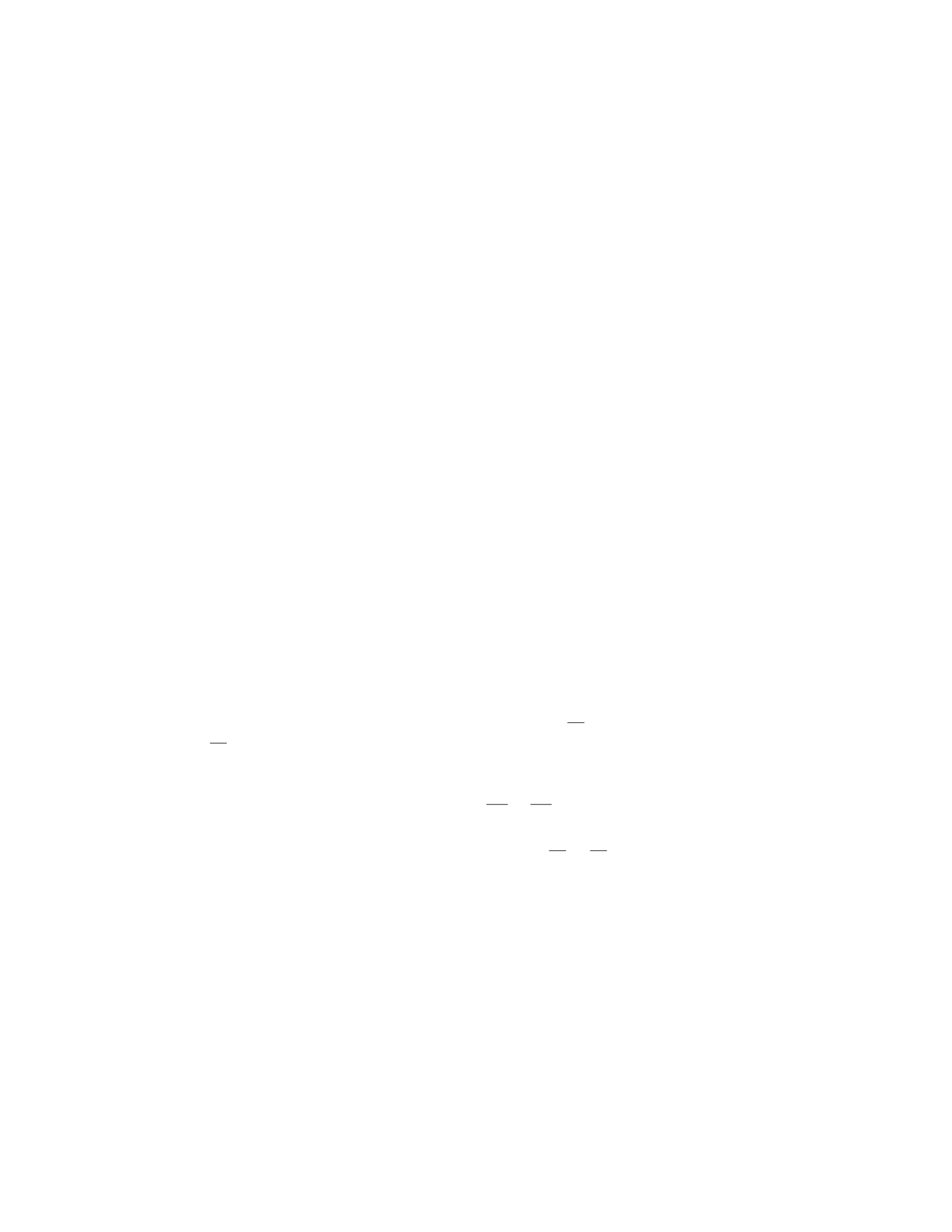
Therefore, the line integral simplifies to:
IC
(x2+y2)dx +xy dy =ZZD
(y−2y)dA =ZZD
(−y)dA
Next, we need to find the limits of integration for tin terms of xand y. Since
x= 2 cos(t)and y= 3 sin(t), we have:
x2+y2= 4 cos2(t) + 9 sin2(t) = 4 = constant
This implies that the region Dis a circle with radius 2. Thus, the integral
simplifies to:
ZZD
(−y)dA =−Z2π
0Z2
0
3 sin(t)r dr dt
Solving this double integral gives us the final answer.
Question 8
Question
Let Cbe the circle x2+y2= 1 oriented counterclockwise. Evaluate the line
integral HC(ycos x−xsin y)dx + (xcos y+ysin x)dy using Green’s Theorem.
Solution
Step 1: Determine the region enclosed by C. The region enclosed by the circle
x2+y2= 1 is the unit disk Dwith center at the origin.
Step 2: Compute the partial derivatives of the given vector field. Let
F= (ycos x−xsin y, x cos y+ysin x). We have ∂Q
∂x = sin x+xcos yand
∂P
∂y = cos y+ sin x.
Step 3: Apply Green’s Theorem. By Green’s Theorem, we have
IC
F·dr =ZZD∂Q
∂x −∂P
∂y dA.
Step 4: Evaluate the double integral. Since ∂Q
∂x −∂P
∂y = sin x+xcos y−
(cos y+ sin x) = xcos y−cos y, we have
ZZD
(xcos y−cos y)dA =Z2π
0Z1
0
(rcos θ−cos θ)rdrdθ.
8

Step 5: Integrate over the region.
Z2π
0Z1
0
(rcos θ−cos θ)rdrdθ =Z2π
0Z1
0
r2cos θdr −Z1
0
cos θdrdθ
=Z2π
01
3cos θ−cos θdθ
=Z2π
0
−2
3cos θdθ
=−2
3sin θ2π
0
= 0.
Therefore, the value of the line integral HCF·dr is 0.
Question 9
Question
Let Cbe the curve formed by the intersection of the planes z= 0,x+y+2z= 4,
and y= 2x. Calculate the circulation of the vector field F(x, y, z) = (2z, x, y)
around Cin the anticlockwise direction.
Solution
Step 1: Find the parametrization of the curve C.
The curve Cis formed by the intersection of the planes z= 0,x+y+2z= 4,
and y= 2x. Substituting z= 0 into the second equation gives x+y= 4.
Combining this with y= 2x, we have the parametrization of the curve:
C:r(t) = (t, 2t, 0) for t∈[0,2]
Step 2: Compute the circulation of Faround C.
The circulation of Faround Cin the anticlockwise direction is given by the
line integral:
IC
F·dr=Z2
0
F(r(t)) ·r′(t)dt
Substitute r(t) = (t, 2t, 0) and r′(t) = (1,2,0) into the dot product:
F(r(t)) ·r′(t) =
0
t
2t
·
1
2
0
= 0 + 2t+ 0 = 2t
Integrating with respect to t:
Z2
0
2t dt = [t2]2
0= 4
9

Therefore, the circulation of the vector field F(x, y, z) = (2z, x, y)around C
in the anticlockwise direction is 4.
Question 10
Question
Let Cbe the curve defined by x=t2,y=t3,0≤t≤1. Use Green’s Theorem
to evaluate the line integral HC(x2+y2)dx +xy dy.
Solution
• The curve Cis given by x=t2,y=t3,0≤t≤1. We can parametrize
the curve as r(t) = (t2, t3)for 0≤t≤1.
• To apply Green’s Theorem, we need to find the partial derivatives of P=
x2+y2and Q=xy with respect to xand y:
∂P
∂x = 2x,
∂Q
∂y =x.
• Green’s Theorem states that for a positively oriented simple closed curve
Cand a region Rbounded by C, we have
IC
(P dx +Q dy) = ZZR∂Q
∂x −∂P
∂y dA.
• Calculate the partial derivatives:
∂Q
∂x =∂
∂x(xy) = y,
∂P
∂y =∂
∂y (x2+y2) = 2y.
• Substitute these values into the double integral formula:
ZZR
(y−2y)dA =ZZR
(−y)dA.
• To find the area integral, we first need to find the region Rbounded by
C. The curve is a parabola y=x3/2where 0≤x≤1. Thus, the region
Ris the area between the curve y=x3/2and the x-axis in the xy-plane.
• The integral becomes:
Z1
0Zx3/2
0
(−y)dy dx.
10

• Evaluate the double integral:
Z1
0−1
2y2x3/2
0
dx =Z1
0−1
2x3dx
=−1
8x41
0
=−1
8.
• Therefore, the line integral HC(x2+y2)dx +xy dy along the curve Cis
−1
8.
Question 11
Question
Let Cbe the curve parametrized by r(t) = ⟨t2, t3⟩for 0≤t≤1. Let Dbe the
region enclosed by C. Calculate the line integral
IC
(xy2−x2y)dx + (x2+y2)dy
using Green’s Theorem.
Solution
Step 1: Find the partial derivatives of the given vector field. The vector field
is given by F(x, y) = ⟨xy2−x2y, x2+y2⟩. We find the partial derivatives of
P(x, y) = xy2−x2ywith respect to yand Q(x, y) = x2+y2with respect to x:
∂P
∂y = 2xy −x2and ∂Q
∂x = 2x
Step 2: Apply Green’s Theorem. Green’s Theorem states that for a pos-
itively oriented simple closed curve Cand a region Denclosed by C, the line
integral of a vector field F=⟨P, Q⟩along Cis equal to the double integral of
the curl of Fover the region D. Mathematically,
IC
F·dr=ZZD∂Q
∂x −∂P
∂y dA
Step 3: Calculate the curl of F. The curl of Fis given by
curl F=∂Q
∂x −∂P
∂y = (2x)−(2xy −x2) = 2x−2xy +x2
11

Step 4: Determine the region Denclosed by C. The region Denclosed by
Cis the area under the curve r(t) = ⟨t2, t3⟩for 0≤t≤1. This region is a
simply connected region bounded by the curve.
Step 5: Evaluate the double integral. Substitute the expression for the curl
of Finto Green’s Theorem:
ZZD
(2x−2xy +x2)dA
This double integral can be challenging to calculate without knowing the
specific shape of the region D. However, the curl expression simplifies the
computation significantly.
Therefore, we have reduced the line integral problem to a double integral
problem using Green’s Theorem.
Question 12
Question
Let Cbe the curve parameterized by r(t) = (2 cos t, 3 sin t)for 0≤t≤2π.
Calculate the circulation of the vector field F(x, y) = (y, −x)around the curve
Cusing Green’s Theorem.
Solution
Step 1: Calculate the circulation of F(x, y)=(y, −x)around the curve C.
First, we need to parameterize the vector field Falong with the curve C. The
curve Cis given by r(t) = (2 cos t, 3 sin t)for 0≤t≤2π, and we can write
r(t) = (x(t), y(t)) where x(t) = 2 cos tand y(t) = 3 sin t.
Step 2: Applying Green’s Theorem Green’s Theorem states that for a vector
field F(x, y) = (P(x, y), Q(x, y)) that is continuously differentiable on a simple
closed curve Cwhich encloses a region D, the circulation of Faround Cis equal
to the double integral of the curl of Fover the region D. Mathematically, this
can be written as:
IC
F·dr=ZZD∂Q
∂x −∂P
∂y dA
Step 3: Calculate the curl of FThe curl of Fis given by:
∇ × F=∂
∂x,∂
∂y ,∂
∂z ×(y, −x) = (0,0,1)
Step 4: Compute the double integral over the region DSince the unit normal
vector n= (0,0,1) for the xy-plane is always in the z-direction, the double
integral over the region Dis simply the area of the region spanned by C. This
region turns out to be an ellipse with semi-major axis a= 3 and semi-minor
axis b= 2.
12

Step 5: Calculate the area of the ellipse and the double integral The area of
an ellipse is given by π×a×b, so in this case, the area is 6π. Therefore, the
circulation of Faround the curve Cis 6π.
Question 13
Question
Let Cbe the curve given by the intersection of the plane 2x+ 4y+z= 8 and
the cylinder x2+y2= 4, oriented counterclockwise as viewed from above. Use
Green’s Theorem to evaluate the line integral
IC
(x+y)dx + (2x+y)dy.
Solution
Step 1: First, let’s find the region Denclosed by the curve C. The curve Cis
the intersection of the plane 2x+ 4y+z= 8 and the cylinder x2+y2= 4. Since
z= 8 −2x−4y, we can substitute this into x2+y2= 4 to get:
x2+y2= 4 =⇒x2+y2= 4 =⇒(8−2x−4y)2= 4 =⇒4x2+16xy−16x−32y+60 = 0.
This simplifies to (x−1)2+ (y−2)2= 1. Thus, the curve Cis a circle centered
at (1,2) with radius 1.
Step 2: Next, let’s parameterize the circle. We can use x= 1 + cos t,
y= 2 + sin t, where 0≤t≤2π. Then, dx =−sin t dt and dy = cos t dt.
Step 3: Now, we can rewrite the line integral using these parameterizations:
IC
(x+y)dx+(2x+y)dy =Z2π
0
((1+cos t)+(2+sin t))(−sin t)+2(1+cos t+2+sin t) cos t dt.
Step 4: Simplify the integrand:
Integral =Z2π
0
(−sin t−sin tcos t+ 2 cos t+ 2 cos tcos t+ 4 cos t+ 2 sin t)dt
=Z2π
0
(−sin t−1
2sin(2t) + 2 cos t+3
2+ 2 sin t)dt.
13

Step 5: Integrate the functions term by term:
Integral =−cos t+1
4cos(2t) + 2 sin t+3
2t−2 cos t2π
0
=−cos(2π) + 1
4cos(4π) + 2 sin(2π) + 3
2(2π)−2 cos(2π)
−−cos(0) + 1
4cos(0) + 2 sin(0) + 3
2(0) −2 cos(0)
= 0 + 1
4+0+3π−2−(−1−1
4+0+0−2)
=9
4+ 3π−1.
Therefore, the line integral HC(x+y)dx + (2x+y)dy is 9
4+ 3π−1.
Question 14
Question
Let Cbe the curve formed by the intersection of the plane z= 2xand the
surface z=x2+y2. Use Green’s Theorem to calculate the circulation of the
vector field F=⟨y, x, z⟩around the curve C.
Solution
Given z= 2xand z=x2+y2, we have 2x=x2+y2. Rewrite this equation as
x2−2x+y2= 0, which is the equation of a circle with radius 1 centered at (1,0).
So, Cis a circle centered at (1,0) with radius 1, which can be parameterized as
x= 1 + cos(t),y= sin(t)for 0≤t≤2π.
Now, let’s calculate the circulation of F=⟨y, x, z⟩around the curve Cusing
Green’s Theorem. Green’s Theorem states that for a curve Cenclosing a region
Din the plane and a vector field F=⟨P, Q⟩, the circulation of Faround Cis
equal to the double integral of the curl of Fover the region D. In this case,
P=y,Q=x, and the curl of Fis ∇ × F= (0,0,1).
Step 1: Parameterize the curve C:
x= 1 + cos(t), y = sin(t), z = 2(1 + cos(t))
Step 2: Calculate the partial derivatives of Pand Qwith respect to xand
y:
∂Q
∂x = 1,∂P
∂y = 1
Step 3: Apply Green’s Theorem:
circulation =ZZ
D∂Q
∂x −∂P
∂y dA
14

Step 4: Since the region Denclosed by the curve Cis a unit disk, D=
{(x, y) : x2+y2≤1}, the circulation simplifies to:
circulation =ZZ
D
1dA =ZZ
D
dA =Area(D) = π
Therefore, the circulation of the vector field F=⟨y, x, z⟩around the curve
Cis π.
Question 15
Question
Let Cbe the curve given by the intersection of the plane z= 4 −x−yand the
cylinder x2+y2= 1. Use Green’s Theorem to evaluate the line integral
IC
(y2−z)dx + (z2−x)dy + (x2−y)dz.
Solution
To use Green’s Theorem, we need to find a vector field Fsuch that its curl is
the integrand of the line integral over C. Let F= (M, N, P )be the vector field,
where M=y2−z,N=z2−x, and P=x2−y. Then, the curl of Fis given by
∇ × F=∂P
∂y −∂N
∂z ,∂M
∂z −∂P
∂x ,∂N
∂x −∂M
∂y .
Calculating the components of the curl, we have
∂P
∂y −∂N
∂z = 2x, ∂M
∂z −∂P
∂x = 2y, ∂N
∂x −∂M
∂y = 2z.
Thus, the curl of Fis ∇ × F= (2x, 2y, 2z) = 2(x, y, z).
Applying Green’s Theorem, we have
IC
F·dr=ZZD
(∇ × F)·ndA,
where Dis the region in the xy-plane bounded by Cand nis the unit outward
normal to D. Since the curl of Fis 2(x, y, z), we have
ZZD
2(x, y, z)·ndA = 2 ZZD
(xcos ϕ+ysin ϕ)dA,
where ϕis the angle between nand the positive x-axis.
Now, we need to parametrize the curve C. The intersection of the plane
z= 4 −x−yand the cylinder x2+y2= 1 gives us the parameterization
x= cos t,y= sin t, and z= 3 −cos t−sin tfor 0≤t≤2π.
15
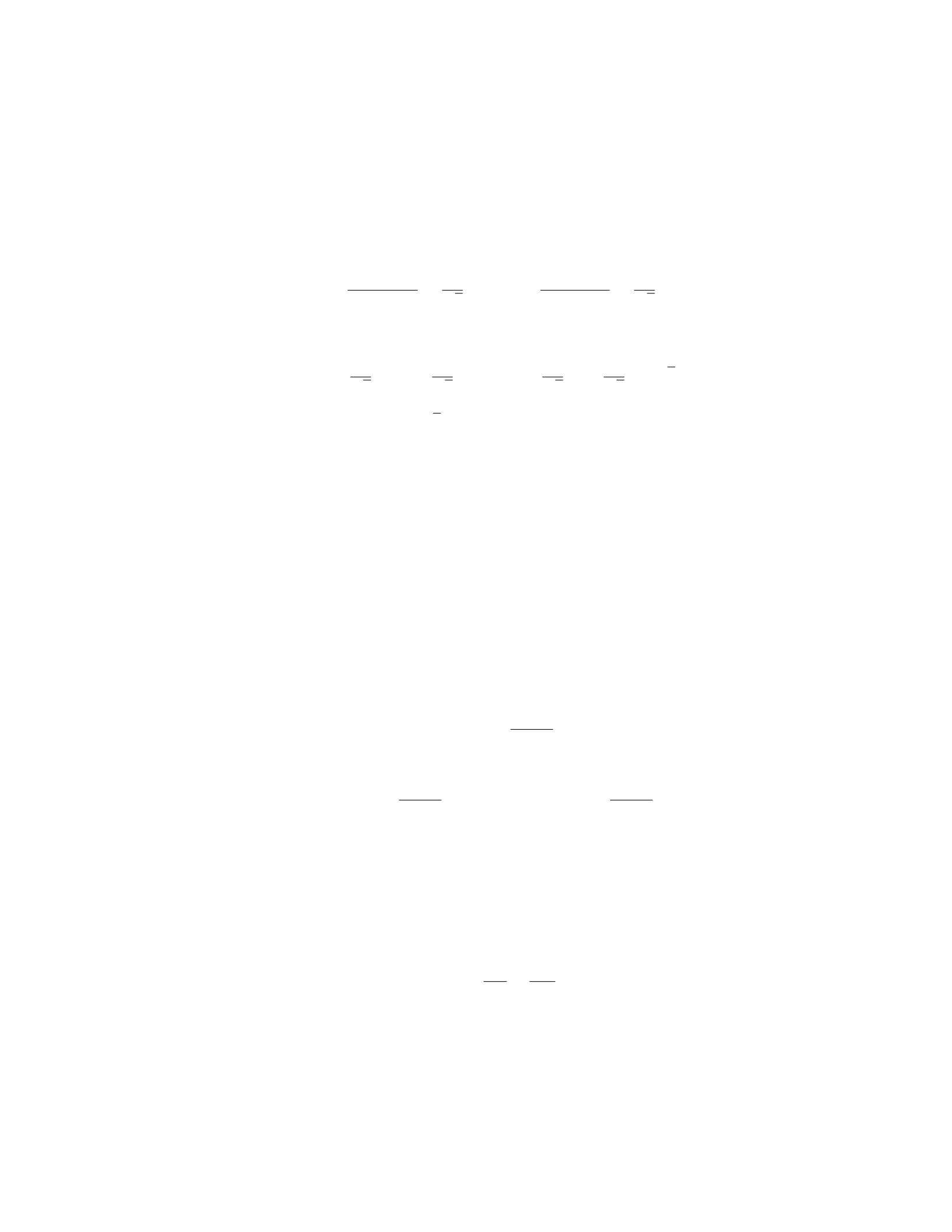
Then, we have
D(cos t, sin t) =
cos tsin t
−sin tcos t
= cos2t+ sin2t= 1,
cos ϕ=∇z× ∇x
|∇z× ∇x|=1
√2,sin ϕ=∇z× ∇y
|∇z× ∇y|=1
√2.
Thus, the line integral becomes
2Z2π
0
(cos t·1
√2+ sin t·1
√2)dt = 2 Z2π
0
1
√2dt =4π
√2= 2√2π.
So, the line integral over Cis 2√2π.
Question 16
Question
Let Cbe the curve formed by the intersection of the cylinder x2+y2= 1 and the
plane z=x+y. Calculate the circulation of the vector field F= (x2+2y2, y2, z2)
around Cin the counterclockwise direction.
Solution
Step 1: Determine the region enclosed by the curve Cin the xy-plane.
Since Cis the intersection of the cylinder x2+y2= 1 and the plane z=x+y,
we can rewrite the equation of the cylinder in terms of z:
z=x+y=±p1−x2
This gives us the two equations of the curve in the xy-plane:
z=x+y=p1−x2and z=x+y=−p1−x2
The region enclosed by Cin the xy-plane is the unit circle.
Step 2: Use Green’s Theorem to calculate the circulation of Faround C.
Green’s Theorem states that the circulation of a vector field F= (M, N)
around a closed curve Cis given by
IC
F·dr=ZZD∂N
∂x −∂M
∂y dA
where Dis the region enclosed by C.
16

In this case, M=x2+ 2y2and N=y2. Therefore,
∂N
∂x = 0 and ∂M
∂y = 4y
The circulation of Faround Cis then
IC
F·dr=ZZD
(4y)dA
Step 3: Evaluate the double integral on the unit circle in the xy-plane.
Switch to polar coordinates, x=rcos(θ), y =rsin(θ), and dA =r dr dθ.
The limits of integration for rare from 0to 1and for θare from 0to 2π.
Substituting into the integral gives us:
IC
F·dr=Z2π
0Z1
0
(4rsin(θ)) ·r dr dθ
Question 17
Question
Let Cbe the counterclockwise-oriented boundary of the region enclosed by
the circles x2+y2= 1 and x2+y2= 4. Use Green’s Theorem to evaluate
HC(2x−3y)dx + (x+ 4y)dy.
Solution
Step 1: Identify the region enclosed by C.
The region enclosed by Cis the annular region between the two circles
x2+y2= 1 and x2+y2= 4.
Step 2: Write the given line integral as a double integral over the region
enclosed by C.
We can rewrite HC(2x−3y)dx + (x+ 4y)dy as a double integral over the
region Denclosed by C:
IC
(2x−3y)dx + (x+ 4y)dy =ZZD∂Q
∂x −∂P
∂y dA
where P= 2x−3yand Q=x+ 4y.
Step 3: Calculate the partial derivatives.
Compute ∂Q
∂x = 1 and ∂P
∂y =−3.
Step 4: Evaluate the double integral.
By Green’s Theorem, we have:
IC
(2x−3y)dx + (x+ 4y)dy =ZZD
(1 −(−3)) dA =ZZD
4dA
17

Since the region Dis an annulus, we can evaluate this double integral in
polar coordinates.
Step 5: Convert to polar coordinates and evaluate the integral.
The region Dcan be described in polar coordinates as 1≤r≤2,0≤θ≤2π.
So, the double integral becomes:
ZZD
4dA =Z2π
0Z2
1
4r dr dθ
=Z2π
02r22
1dθ =Z2π
0
(8 −2) dθ =Z2π
0
6dθ = 6(2π) = 12π
Therefore, the line integral HC(2x−3y)dx+(x+4y)dy over the given region
is 12π.
Question 18
Question
Let Cbe the circle centered at the origin with radius 3 oriented counterclockwise.
Use Green’s Theorem to evaluate the line integral HC(x2+y2)dx +y2dy.
Solution
Step 1: We first need to find the region Denclosed by the curve C, which in
this case is the circle centered at the origin with radius 3. We can represent D
as D={(x, y)|x2+y2≤9}.
Step 2: Green’s Theorem states that for a simple positively oriented curve
Cenclosing a region D, the line integral around Cof the vector field F= (P, Q)
is equal to the double integral over the region Dof (∂Q
∂x −∂P
∂y )dA, where Pand
Qare the components of F.
Step 3: In this case, we have F= (x2+y2, y2), so P=x2+y2and Q=y2.
We need to compute ∂Q
∂x and ∂P
∂y .
Step 4: We find ∂Q
∂x = 0 and ∂P
∂y = 2y. Therefore, (∂Q
∂x −∂P
∂y ) = −2y.
Step 5: The given line integral can be rewritten in terms of the components
of F:HC(x2+y2)dx +y2dy =HCP dx +Qdy.
Step 6: By Green’s Theorem, this line integral is equal to the double integral
over Dof −2ydA. We can convert this to polar coordinates to evaluate the
integral.
Step 7: −2y=−2rsin(θ)in polar coordinates. Also, dA =rdrdθ.
Step 8: Therefore, the double integral becomes R2π
0R3
0−2rsin(θ)rdrdθ.
Step 9: Evaluating this integral gives us R2π
0−9
2cos(θ)dθ.
Step 10: The integral of cos(θ)over [0,2π]is 0. So, the line integral HC(x2+
y2)dx +y2dy is 0.
18

Question 19
Question
Let Cbe the curve given by the intersection of the plane x+y+z= 1 and the
cylinder x2+y2= 1. Compute the circulation of the vector field F(x, y, z) =
(x2+y, y2+z, z2+x)around Cin the counterclockwise direction.
Solution
To apply Green’s Theorem to compute the circulation of Faround the curve C
in the counterclockwise direction, we first need to find the region Denclosed by
C. We realize that Dis a disk in the xy-plane bounded by the circle x2+y2= 1.
Thus, we can apply Green’s Theorem as follows:
IC
F·dr=ZZD∂Q
∂x −∂P
∂y dA,
where F= (P, Q, R).
Step 1: Find the components P,Q, and Rof the vector field F.
Here, P=x2+y,Q=y2+z, and R=z2+x.
Step 2: Calculate the circulation of Faround C.
Using Green’s Theorem, we have:
IC
F·dr=ZZD∂Q
∂x −∂P
∂y dA.
The partial derivatives are:
∂Q
∂x = 0,∂P
∂y = 1.
Therefore, the circulation is:
IC
F·dr=ZZD
(0 −1)dA =−ZZD
dA.
Step 3: Compute the double integral over D.
Since Dis the unit circle, we have:
−ZZD
dA =−π·12=−π.
Therefore, the circulation of Faround Cin the counterclockwise direction
is −π.
Question 20
Question
Let Cbe the curve defined by x2+y2= 1 oriented counterclockwise. Use
Green’s Theorem to evaluate the line integral HC(x3−y)dx +xdy.
19

Solution
1. Let’s denote P(x, y) = x3−yand Q(x, y) = x.
2. Green’s Theorem states that for a region Dbounded by a positively ori-
ented simple closed curve C, if Pand Qhave continuous partial derivatives
on Dthen:
IC
(P dx +Qdy) = ZZD∂Q
∂x −∂P
∂y dA
3. We first need to find ∂Q
∂x and ∂P
∂y :
∂Q
∂x = 1
∂P
∂y =−1
4. Therefore, the given line integral becomes:
IC
(x3−y)dx +xdy =ZZD
(1 −(−1))dA =ZZD
2dA
5. The curve Cis the unit circle centered at the origin. Therefore, the region
Dinside Cis the circle itself. We can represent it in polar coordinates as
D={(r, θ)|0≤r≤1,0≤θ≤2π}
6. Therefore, the double integral becomes:
ZZD
2dA =Z2π
0Z1
0
2rdrdθ
7. Solving the integral, we get:
Z2π
0Z1
0
2rdrdθ = 2π
8. Thus, the line integral HC(x3−y)dx +xdy around the curve Cis 2π.
Question 21
Question
Let Cbe the positively oriented curve that bounds the region Din the xy-
plane given by y=x2and y= 4. Calculate the circulation of the vector field
F= (x2+y, 2xy)around C.
20

Solution
Step 1: Find the parametrization of C.
The curve Cis formed by the lines y=x2and y= 4. To find the
parametrization of C, we can let x=tand then express yin terms of t. So, we
have y=t2for tvarying from −2to 2.
Step 2: Calculate the circulation of Faround Cusing Green’s theorem.
Green’s theorem states that for a vector field F= (M, N )and a region D
bounded by a simple, closed, positively oriented curve C, the circulation of F
around Cis equal to the double integral of the curl of Fover the region D.
In this case, F= (x2+y, 2xy), and the region Dis bounded by the curves
y=x2and y= 4.
Step 3: Calculate the curl of F.
The curl of Fis given by ∇ × F=∂N
∂x −∂M
∂y . So, we have:
∂N
∂x −∂M
∂y =∂(2xy)
∂x −∂(x2+y)
∂y = 2y−1
Step 4: Calculate the circulation of Faround C.
Using Green’s theorem, the circulation of Faround Cis equal to the double
integral of 2y−1over the region D:
ZZD
(2y−1) dA
Step 5: Determine the bounds of integration.
The region Dis bounded by the curves y=x2and y= 4. Since yvaries from
x2to 4and xvaries from −2to 2, the bounds of integration are −2≤x≤2
and x2≤y≤4.
Step 6: Evaluate the integral.
21

ZZD
(2y−1) dA =Z2
−2Z4
x2
(2y−1) dydx
=Z2
−2y2−y4
x2dx
=Z2
−2
(16 −4−(x4−x2)) dx
=Z2
−2
(−x4+x2+ 12) dx
=−x5
5+x3
3+ 12x2
−2
=−32
5+8
3+ 24−32
5−8
3−24
=128
15 +8
3+ 48
=128
15 +40
15 +720
15
=888
15
= 59.2
Thus, the circulation of the vector field Faround Cis 59.2.
Question 22
Question
Let Cbe the curve defined by x2+y2= 1 oriented counterclockwise. Compute
the circulation of the vector field F(x, y) = (x2+y2)i+ 2xyjaround C.
Solution
Step 1: We first need to parametrize the curve C. Since Cis the unit circle
centered at the origin, we can parametrize it as r(t) = cos(t)i+ sin(t)jfor
0≤t≤2π.
Step 2: Next, we find the tangent vector r′(t)by differentiating r(t)with
respect to t. We have
r′(t) = −sin(t)i+ cos(t)j.
Step 3: Using the circulation formula, we compute the line integral as
circulation =IC
F·dr=Z2π
0
F(r(t)) ·r′(t)dt.
22

Step 4: Substituting r(t),r′(t), and F(r(t)) into the integral, we get
Z2π
0(cos2(t) + sin2(t)) cos(t) + 2 cos(t) sin(t)(−sin(t))
+(cos2(t) + sin2(t)) sin(t) + 2 cos(t) sin(t)(cos(t)) dt.
Step 5: Simplifying the integrand and integrating over 0≤t≤2π, we find
circulation =Z2π
0
(−cos(t) sin(t)+2 cos(t) sin(t)+cos(t) sin(t)+2 cos(t) sin(t)) dt = 3π.
Therefore, the circulation of Faround Cis 3π.
Question 23
Question
Let Cbe the boundary of the region Denclosed by the parabola y=x2and
the line y=x. Calculate the line integral HC(2x2y−y2)dx + (x3−xy)dy using
Green’s Theorem.
Solution
Step 1: Find the region Denclosed by the given curves y=x2and y=x.
• The intersection points of the two curves are (0,0) and (1,1).
• The region enclosed by the curves is D: 0 ≤x≤1,x2≤y≤x.
Step 2: Apply Green’s Theorem: Green’s Theorem states that for a simply
connected region Dwith piecewise smooth boundary Coriented counterclock-
wise, and a vector field F= (P(x, y), Q(x, y)),
IC
F·dr=ZZD∂Q
∂x −∂P
∂y dA
where F= (2x2y−y2, x3−xy)in this case.
Step 3: Compute the partial derivatives involved:
∂Q
∂x =∂
∂x(x3−xy) = 3x−y
∂P
∂y =∂
∂y (2x2y−y2) = 2x2−2y
Step 4: Calculate the double integral by Green’s Theorem:
ZZD
(3x−y−2x2+ 2y)dA =ZZD
(3x−2x2+y)dA
23
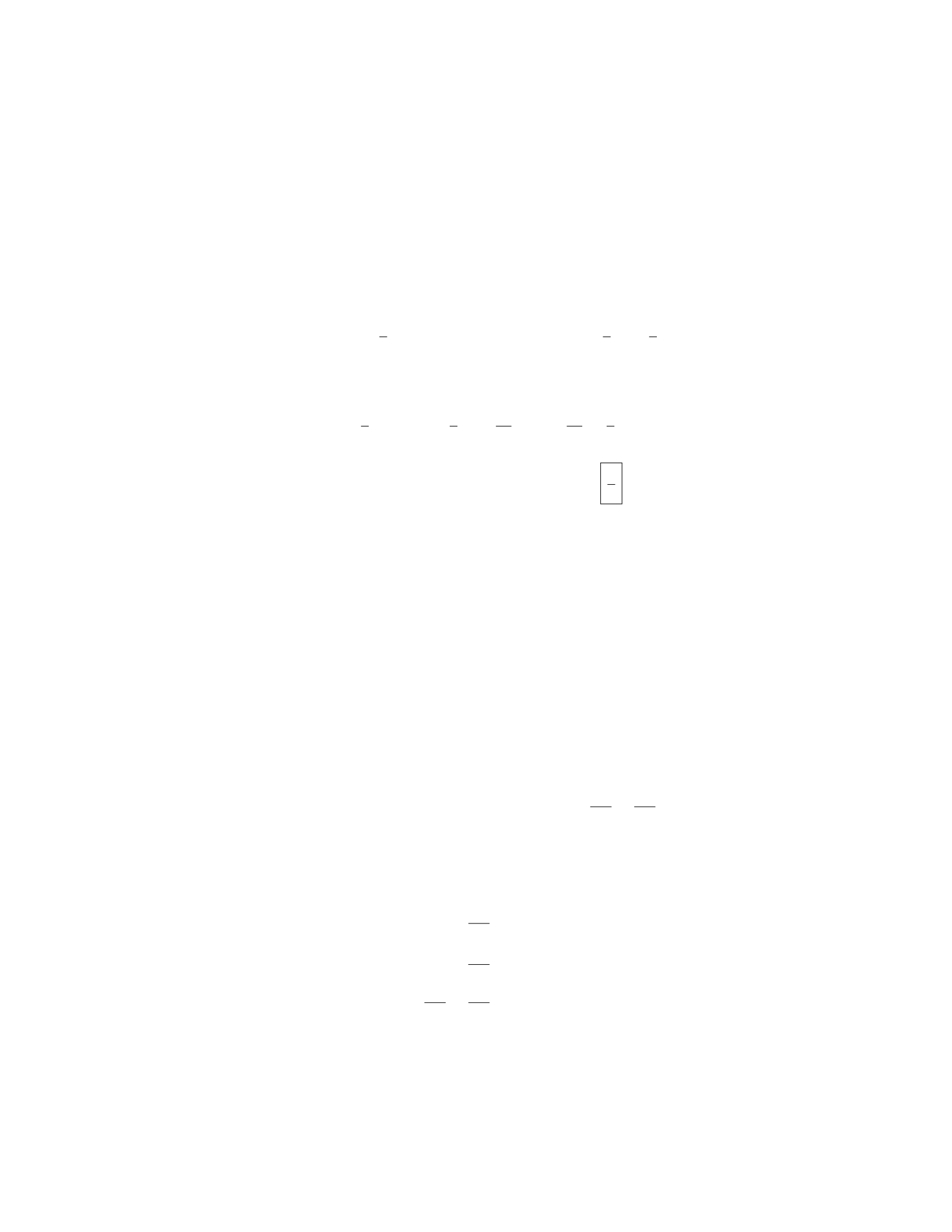
Step 5: Evaluate the double integral over the region D:
ZZD
(3x−2x2+y)dA =Z1
0Zx
x2
(3x−2x2+y)dydx
Step 6: Integrate over yfirst:
Z1
0y(3x−2x2) + 1
2y2x
x2
dx =Z1
0x(3x−2x2) + 1
2x2−1
2x4dx
Step 7: Compute the integral:
=3
2x2−2x3+1
2x2−1
10x51
0
=5
10 =1
2
Therefore, the line integral around the boundary Cis 1
2.
Question 24
Question
Let Cbe the positively-oriented circle x2+y2= 4. Use Green’s Theorem to
evaluate the line integral
IC
(x2y+ex)dx + (2xy + sin y)dy.
Solution
1. First, let’s rewrite the line integral in terms of a double integral over the
region enclosed by C:
IC
(x2y+ex)dx + (2xy + sin y)dy =ZZD∂Q
∂x −∂P
∂y dA,
where P(x, y) = x2y+exand Q(x, y) = 2xy + sin y.
2. Calculate the partial derivatives:
∂P
∂y =x2,
∂Q
∂x = 2y,
∂Q
∂x −∂P
∂y = 2y−x2.
24

3. By Green’s Theorem, the line integral is equal to the double integral over
the region enclosed by C:
IC
(x2y+ex)dx + (2xy + sin y)dy =ZZD
(2y−x2)dA.
4. Since Cis the circle x2+y2= 4, we can use polar coordinates to evaluate
the double integral:
ZZD
(2y−x2)dA =Z2π
0Z2
0
(2rsin θ−r2cos2θ)r dr dθ
=Z2π
0Z2
0
(2r2sin θ−r3cos2θ)drdθ
=Z2π
0 2
3r3sin θ−1
4r4cos2θ2
0!dθ
=Z2π
016
3sin θ−4 cos2θdθ
=−16
3cos θ−4θsin θ2π
0
=−16
3(cos 2π−cos 0) −4(2πsin 2π−0)
=32
3.
5. Therefore, the value of the line integral is 32
3.
Question 25
Question
Let Cbe the curve given by x2+y2= 4, oriented counterclockwise, and let
F= (x2+y2, xy). Use Green’s Theorem to evaluate the line integral HCF·dr.
Solution
1. Step 1: Determine the region Denclosed by the curve C. Since x2+y2=
4represents a circle centered at the origin with radius 2, the region D
enclosed by Cis the interior of this circle.
2. Step 2: Apply Green’s Theorem, which states HCF·dr=RRD∂Q
∂x −∂P
∂y dA,
where F= (P, Q).
In this case, F= (x2+y2, xy), so P=x2+y2and Q=xy. We need to
find ∂Q
∂x and ∂P
∂y .
25

3. Step 3: Calculate the partial derivatives.
∂Q
∂x =y
∂P
∂y = 2y
4. Step 4: Substitute the partial derivatives into Green’s Theorem and eval-
uate the double integral over region D.
IC
F·dr=ZZD
(y−2y)dA =ZZD
(−y)dA
5. Step 5: Convert the integral to polar coordinates. Since the region Dis
a circle of radius 2, we can rewrite the integral as:
Z2π
0Z2
0
(−rsin(θ)) ·r dr dθ
6. Step 6: Evaluate the double integral.
=−Z2π
0r2
2sin(θ)2
0
dθ
=−Z2π
0
(2 sin(θ)) dθ
= 4 Z2π
0
sin(θ)dθ
= 4 ·0
= 0
Hence, the line integral HCF·dris equal to 0.
26

