


MATH 125 - FINITE MATHEMATICS -
Euclidean space Question Bank - Set 1
Question 1
Question 1: Let v=
2
−1
3
and w=
−1
0
2
be vectors in R3. Find the dot
product v·w.
Step-by-step Solution: To find the dot product of two vectors vand w, we
use the formula:
v·w=v1w1+v2w2+v3w3
where v1,v2,v3are the components of vand w1,w2,w3are the components of
w.
Substitute the given values into the formula:
v·w= (2)(−1) + (−1)(0) + (3)(2)
v·w=−2+0+6
v·w= 4
Therefore, the dot product of vand wis 4.Sure! Here is a question on
Euclidean space along with a step-by-step solution in LateX code:
Question 1: Let v =
2
−1
3
and w =
−1
0
2
be vectors in R3. Find
the dot product v ·w.
Step-by-step Solution: To find the dot product of two vectors v
and w, we use the formula:
v·w=v1w1+v2w2+v3w3
where v1,v2,v3are the components of v and w1,w2,w3are the
components of w.
Substitute the given values into the formula:
v·w= (2)(−1) + (−1)(0) + (3)(2)
v·w=−2+0+6
v·w= 4
Therefore, the dot product of v and w is 4.
1

Question 2
Question: Let u =
3
4
5
and v =
−2
1
2
be vectors in R3. Find the
unit vector in the direction of u + 2v.
Solution: To find the unit vector in the direction of u + 2v, we first
need to calculate u + 2v:
u+ 2v=
3
4
5
+ 2
−2
1
2
=
3
4
5
+
−4
2
4
=
−1
6
9
Next, we find the magnitude of u + 2v:
∥u+ 2v∥=p(−1)2+ 62+ 92=√1 + 36 + 81 = √118
Finally, the unit vector in the direction of u + 2v is:
ˆu=u+ 2v
∥u+ 2v∥=
−1
6
9
√118 =
−1
√118
6
√118
9
√118
We have found that the unit vector in the direction of u + 2v is
−1
√118
6
√118
9
√118
.Certainly! Here is a question on Euclidean space along
with step-by-step solutions in LateX code for Liberty University, set
1, question 2:
Question: Let u =
3
4
5
and v =
−2
1
2
be vectors in R3. Find the
unit vector in the direction of u + 2v.
Solution: To find the unit vector in the direction of u + 2v, we first
need to calculate u + 2v:
u+ 2v=
3
4
5
+ 2
−2
1
2
=
3
4
5
+
−4
2
4
=
−1
6
9
Next, we find the magnitude of u + 2v:
∥u+ 2v∥=p(−1)2+ 62+ 92=√1 + 36 + 81 = √118
Finally, the unit vector in the direction of u + 2v is:
2

ˆu=u+ 2v
∥u+ 2v∥=
−1
6
9
√118 =
−1
√118
6
√118
9
√118
We have found that the unit vector in the direction of u + 2v is
−1
√118
6
√118
9
√118
.
Question 3
Question 3: Let u =
2
−1
3
and v =
4
5
1
. Find the angle between
vectors u and v.
Solution: The angle between two vectors can be found using the
dot product formula:
cos θ=u·v
∥u∥·∥v∥
Substitute the values for u and v:
u·v= 2 ·4+(−1) ·5+3·1=8−5 + 3 = 6
∥u∥=p22+ (−1)2+ 32=√4 + 1 + 9 = √14
∥v∥=p42+ 52+ 12=√16 + 25 + 1 = √42
Therefore, the cosine of the angle between u and v is:
cos θ=6
√14 ·√42
The angle θcan be found using cos−1:
θ= cos−16
√14 ·√42
Thus, the angle between vectors u and v is θradians.Sure, here is a
question along with its solution in LateX code for Liberty University
on Euclidean space.
Question 3: Let u =
2
−1
3
and v =
4
5
1
. Find the angle between
vectors u and v.
3

Solution: The angle between two vectors can be found using the
dot product formula:
cos θ=u·v
∥u∥·∥v∥
Substitute the values for u and v:
u·v= 2 ·4+(−1) ·5+3·1=8−5 + 3 = 6
∥u∥=p22+ (−1)2+ 32=√4 + 1 + 9 = √14
∥v∥=p42+ 52+ 12=√16 + 25 + 1 = √42
Therefore, the cosine of the angle between u and v is:
cos θ=6
√14 ·√42
The angle θcan be found using cos−1:
θ= cos−16
√14 ·√42
Thus, the angle between vectors u and v is θradians.
Question 4
Step-by-step solution: The distance dbetween two points (x1, y1, z1)
and (x2, y2, z2)in R3is given by the formula:
d=p(x2−x1)2+ (y2−y1)2+ (z2−z1)2
Given that P1(3,2,−1) and P2(−1,0,4), the distance dbetween these
two points is:
d=p(−1−3)2+ (0 −2)2+ (4 −(−1))2
d=p(−4)2+ (−2)2+ (5)2
d=√16 + 4 + 25
d=√45
d= 3√5
Therefore, the distance between the points P1and P2is 3√5.Question
4: Let P1(3,2,−1) and P2(−1,0,4) be two points in Euclidean space R3.
Find the distance between these two points.
Step-by-step solution: The distance dbetween two points (x1, y1, z1)
and (x2, y2, z2)in R3is given by the formula:
d=p(x2−x1)2+ (y2−y1)2+ (z2−z1)2
4

Given that P1(3,2,−1) and P2(−1,0,4), the distance dbetween these
two points is:
d=p(−1−3)2+ (0 −2)2+ (4 −(−1))2
d=p(−4)2+ (−2)2+ (5)2
d=√16 + 4 + 25
d=√45
d= 3√5
Therefore, the distance between the points P1and P2is 3√5.
Question 5
Question 5: Find the distance between the points A(−2,3,1) and
B(4,−1,5) in R3.
Solution: To find the distance between two points A(x1, y1, z1)and
B(x2, y2, z2)in R3, we use the distance formula:
d=p(x2−x1)2+ (y2−y1)2+ (z2−z1)2
Given A(−2,3,1) and B(4,−1,5), we can substitute the coordinates
into the formula:
d=p(4 −(−2))2+ (−1−3)2+ (5 −1)2
d=p(6)2+ (−4)2+ (4)2
d=√36 + 16 + 16
d=√68
d= 2√17
Therefore, the distance between points A(−2,3,1) and B(4,−1,5) in
R3is 2√17.Certainly! Here is the LateX code for the question and
solution on Euclidean space for Liberty University:
Question 5: Find the distance between the points A(−2,3,1) and
B(4,−1,5) in R3.
Solution: To find the distance between two points A(x1, y1, z1)and
B(x2, y2, z2)in R3, we use the distance formula:
d=p(x2−x1)2+ (y2−y1)2+ (z2−z1)2
Given A(−2,3,1) and B(4,−1,5), we can substitute the coordinates
into the formula:
d=p(4 −(−2))2+ (−1−3)2+ (5 −1)2
5

d=p(6)2+ (−4)2+ (4)2
d=√36 + 16 + 16
d=√68
d= 2√17
Therefore, the distance between points A(−2,3,1) and B(4,−1,5) in
R3is 2√17.
Question 6
Question 6: Let u =
2
−1
4
and v =
3
0
5
be vectors in R3. Find
∥u+v∥.
Solution: To find the norm of u+v, we first need to compute u+v:
u+v=
2
−1
4
+
3
0
5
=
2+3
−1+0
4+5
=
5
−1
9
Now, we can find the norm of this vector:
∥u+v∥=p52+ (−1)2+ 92=√25 + 1 + 81 = √107 ≈10.34
Therefore, ∥u+v∥ ≈ 10.34.Sure, here is the question along with the
step-by-step solution in LaTeX code:
Question 6: Let u =
2
−1
4
and v =
3
0
5
be vectors in R3. Find
∥u+v∥.
Solution: To find the norm of u+v, we first need to compute u+v:
u+v=
2
−1
4
+
3
0
5
=
2+3
−1+0
4+5
=
5
−1
9
Now, we can find the norm of this vector:
∥u+v∥=p52+ (−1)2+ 92=√25 + 1 + 81 = √107 ≈10.34
Therefore, ∥u+v∥ ≈ 10.34.
6

Question 7
Step-by-step solution: To find the distance between two points
A(x1, y1, z1)and B(x2, y2, z2)in three-dimensional Euclidean space, we
use the formula:
Distance =p(x2−x1)2+ (y2−y1)2+ (z2−z1)2
Given points A(2,−3,5) and B(−1,4,−2), we substitute the coordi-
nates into the formula:
Distance =p(−1−2)2+ (4 −(−3))2+ (−2−5)2
=p(−3)2+ (4 + 3)2+ (−7)2
=√9 + 49 + 49
=√107
Therefore, the distance between points Aand Bin Euclidean
three-space is √107.Question 7: Find the distance between the points
A(2,−3,5) and B(−1,4,−2) in Euclidean three-space.
Step-by-step solution: To find the distance between two points
A(x1, y1, z1)and B(x2, y2, z2)in three-dimensional Euclidean space, we
use the formula:
Distance =p(x2−x1)2+ (y2−y1)2+ (z2−z1)2
Given points A(2,−3,5) and B(−1,4,−2), we substitute the coordi-
nates into the formula:
Distance =p(−1−2)2+ (4 −(−3))2+ (−2−5)2
=p(−3)2+ (4 + 3)2+ (−7)2
=√9 + 49 + 49
=√107
Therefore, the distance between points Aand Bin Euclidean three-
space is √107.
7

Question 8
a) Find the distance between points Pand Q.
b) Find the midpoint of the line segment connecting points Pand
Q.
c) Find the equation of the sphere passing through points Pand
Qwith radius 5.
Step-by-step Solutions:
a) To find the distance between points Pand Q, we can use the
distance formula:
The distance between points P(3,−2,5) and Q(−1,4,7) is given by
d=p(x2−x1)2+ (y2−y1)2+ (z2−z1)2
Substitute the coordinates of points Pand Q:
d=p(−1−3)2+ (4 −(−2))2+ (7 −5)2
d=p(−4)2+ (6)2+ (2)2
d=√16 + 36 + 4
d=√56
d= 2√14
b) To find the midpoint of the line segment connecting points P
and Q, we use the midpoint formula: The midpoint M(x, y, z)is given
by
Mx1+x2
2,y1+y2
2,z1+z2
2
Substitute the coordinates of points Pand Q:
M3−1
2,−2+4
2,5+7
2
M2
2,2
2,12
2
M(1,1,6)
M(1,1,6)
c) The equation of the sphere passing through points P(3,−2,5)
and Q(−1,4,7) with radius 5is given by
(x−a)2+ (y−b)2+ (z−c)2=r2
where (a, b, c)is the center of the sphere and ris the radius. We
already have two points and the radius. Let’s use these to find the
center:
8

1. Find the midpoint of the line segment connecting points Pand
Q: The midpoint is M(1,1,6).
2. The center of the sphere is the midpoint. Therefore, the center
of the sphere passing through points Pand Qis (1,1,6).
Now, substitute the center and the radius into the equation of a
sphere:
(x−1)2+ (y−1)2+ (z−6)2= 52
(x−1)2+ (y−1)2+ (z−6)2= 25
(x−1)2+ (y−1)2+ (z−6)2= 25
Question 8: Let P(3,−2,5) and Q(−1,4,7) be two points in Euclidean
space.
a) Find the distance between points Pand Q.
b) Find the midpoint of the line segment connecting points Pand
Q.
c) Find the equation of the sphere passing through points Pand
Qwith radius 5.
Step-by-step Solutions:
a) To find the distance between points Pand Q, we can use the
distance formula:
The distance between points P(3,−2,5) and Q(−1,4,7) is given by
d=p(x2−x1)2+ (y2−y1)2+ (z2−z1)2
Substitute the coordinates of points Pand Q:
d=p(−1−3)2+ (4 −(−2))2+ (7 −5)2
d=p(−4)2+ (6)2+ (2)2
d=√16 + 36 + 4
d=√56
d= 2√14
b) To find the midpoint of the line segment connecting points P
and Q, we use the midpoint formula: The midpoint M(x, y, z)is given
by
Mx1+x2
2,y1+y2
2,z1+z2
2
Substitute the coordinates of points Pand Q:
M3−1
2,−2+4
2,5+7
2
9

M2
2,2
2,12
2
M(1,1,6)
M(1,1,6)
c) The equation of the sphere passing through points P(3,−2,5)
and Q(−1,4,7) with radius 5is given by
(x−a)2+ (y−b)2+ (z−c)2=r2
where (a, b, c)is the center of the sphere and ris the radius. We
already have two points and the radius. Let’s use these to find the
center:
1. Find the midpoint of the line segment connecting points Pand
Q: The midpoint is M(1,1,6).
2. The center of the sphere is the midpoint. Therefore, the center
of the sphere passing through points Pand Qis (1,1,6).
Now, substitute the center and the radius into the equation of a
sphere:
(x−1)2+ (y−1)2+ (z−6)2= 52
(x−1)2+ (y−1)2+ (z−6)2= 25
(x−1)2+ (y−1)2+ (z−6)2= 25
Question 9
Find the distance between the points A(2,−3,1) and B(−1,4,−2) in
Euclidean space.
Step-by-step solution:
Given points: A(2,−3,1) and B(−1,4,−2)
The distance between two points A(x1, y1, z1)and B(x2, y2, z2)in
three-dimensional space is given by the formula:
d=p(x2−x1)2+ (y2−y1)2+ (z2−z1)2
Substitute the coordinates of points A and B into the formula:
d=p(−1−2)2+ (4 −(−3))2+ (−2−1)2
d=p(−3)2+ (7)2+ (−3)2
d=√9 + 49 + 9
10

d=√67
Therefore, the distance between points A and B in Euclidean space
is √67.Question 9:
Find the distance between the points A(2,−3,1) and B(−1,4,−2) in
Euclidean space.
Step-by-step solution:
Given points: A(2,−3,1) and B(−1,4,−2)
The distance between two points A(x1, y1, z1)and B(x2, y2, z2)in
three-dimensional space is given by the formula:
d=p(x2−x1)2+ (y2−y1)2+ (z2−z1)2
Substitute the coordinates of points A and B into the formula:
d=p(−1−2)2+ (4 −(−3))2+ (−2−1)2
d=p(−3)2+ (7)2+ (−3)2
d=√9 + 49 + 9
d=√67
Therefore, the distance between points A and B in Euclidean space
is √67.
Question 10
Let v =
2
−3
1
and w =
5
2
−4
be vectors in R3.
(a) Find the magnitude of the vector v.
(b) Find the dot product of v and w.
(c) Find the angle between the vectors v and w.
Step-by-step solutions:
(a) The magnitude of a vector v =
v1
v2
v3
is given by the formula:
∥v∥=qv2
1+v2
2+v2
3
Given v =
2
−3
1
, substituting the values, we get:
∥v∥=p22+ (−3)2+ 12=√4 + 9 + 1 = √14
11
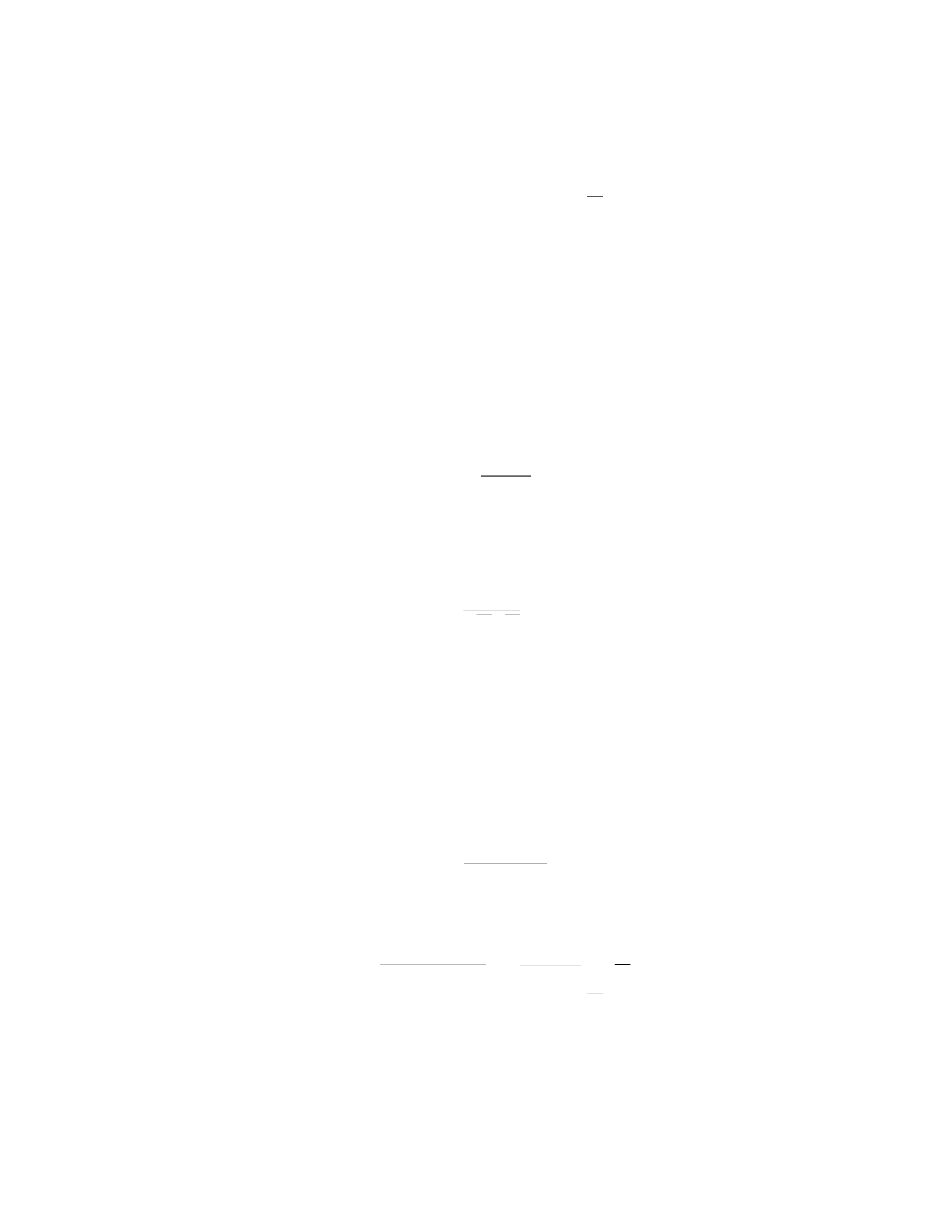
Therefore, the magnitude of the vector v is √14.
(b) The dot product of two vectors v and w in R3is given by the
formula:
v ·w =v1w1+v2w2+v3w3
Given v =
2
−3
1
and w =
5
2
−4
, substituting the values, we get:
v ·w = (2)(5) + (−3)(2) + (1)(−4) = 10 −6−4=0
Therefore, the dot product of v and w is 0.
(c) The angle θbetween two vectors v and w can be found using
the formula:
cos(θ) = v ·w
∥v∥∥w∥
Given v =
2
−3
1
and w =
5
2
−4
, and using the results from parts
(a) and (b), we can calculate the angle θ:
cos(θ) = 0
√14√45 = 0
Since cos(θ) = 0, the angle between the vectors v and w is θ=
90◦.Question 10:
Let v =
2
−3
1
and w =
5
2
−4
be vectors in R3.
(a) Find the magnitude of the vector v.
(b) Find the dot product of v and w.
(c) Find the angle between the vectors v and w.
Step-by-step solutions:
(a) The magnitude of a vector v =
v1
v2
v3
is given by the formula:
∥v∥=qv2
1+v2
2+v2
3
Given v =
2
−3
1
, substituting the values, we get:
∥v∥=p22+ (−3)2+ 12=√4 + 9 + 1 = √14
Therefore, the magnitude of the vector v is √14.
(b) The dot product of two vectors v and w in R3is given by the
formula:
12

v ·w =v1w1+v2w2+v3w3
Given v =
2
−3
1
and w =
5
2
−4
, substituting the values, we get:
v ·w = (2)(5) + (−3)(2) + (1)(−4) = 10 −6−4=0
Therefore, the dot product of v and w is 0.
(c) The angle θbetween two vectors v and w can be found using
the formula:
cos(θ) = v ·w
∥v∥∥w∥
Given v =
2
−3
1
and w =
5
2
−4
, and using the results from parts
(a) and (b), we can calculate the angle θ:
cos(θ) = 0
√14√45 = 0
Since cos(θ)=0, the angle between the vectors v and w is θ= 90◦.
Question 11
“‘latex Question 11:
Let u =
2
−1
3
and v =
5
2
4
in R3. Compute the dot product of u
and v.
Solution:
The dot product of two vectors u =
u1
u2
u3
and v =
v1
v2
v3
is given by:
u ·v =u1v1+u2v2+u3v3
Substitute u =
2
−1
3
and v =
5
2
4
into the formula:
u ·v = (2)(5) + (−1)(2) + (3)(4) = 10 −2 + 12 = 20
Therefore, the dot product of u and v is 20. “‘Sure, here is a
question on Euclidean space for Liberty University in LateX code:
“‘latex Question 11:
13

Let u =
2
−1
3
and v =
5
2
4
in R3. Compute the dot product of u
and v.
Solution:
The dot product of two vectors u =
u1
u2
u3
and v =
v1
v2
v3
is given by:
u ·v =u1v1+u2v2+u3v3
Substitute u =
2
−1
3
and v =
5
2
4
into the formula:
u ·v = (2)(5) + (−1)(2) + (3)(4) = 10 −2 + 12 = 20
Therefore, the dot product of u and v is 20. “‘
Question 12
Question 12:
Find the distance between the points A(3,−2,5) and B(−1,4,−3) in
R3.
Step-by-step solution:
Let dbe the distance between points Aand B.
The distance formula in 3-dimensional space is given by:
d=p(x2−x1)2+ (y2−y1)2+ (z2−z1)2
Substitute the coordinates of A(3,−2,5) and B(−1,4,−3) into the
distance formula:
d=p(−1−3)2+ (4 −(−2))2+ (−3−5)2
d=p(−4)2+ (6)2+ (−8)2
d=√16 + 36 + 64
d=√116
d=√4·29
d= 2√29
14

Therefore, the distance between points A(3,−2,5) and B(−1,4,−3)
in R3is 2√29 units.Sure, here is a question along with its step-by-step
solution on Euclidean space for Liberty University in LateX code:
Question 12:
Find the distance between the points A(3,−2,5) and B(−1,4,−3) in
R3.
Step-by-step solution:
Let dbe the distance between points Aand B.
The distance formula in 3-dimensional space is given by:
d=p(x2−x1)2+ (y2−y1)2+ (z2−z1)2
Substitute the coordinates of A(3,−2,5) and B(−1,4,−3) into the
distance formula:
d=p(−1−3)2+ (4 −(−2))2+ (−3−5)2
d=p(−4)2+ (6)2+ (−8)2
d=√16 + 36 + 64
d=√116
d=√4·29
d= 2√29
Therefore, the distance between points A(3,−2,5) and B(−1,4,−3)
in R3is 2√29 units.
Question 13
Let A(2,−3,5),B(1,4,−2), and C(−3,1,0) be three points in R3. Cal-
culate the distance between Aand Busing the distance formula.
Solution:
The distance between two points A(x1, y1, z1)and B(x2, y2, z2)in R3
can be calculated using the distance formula:
d=p(x2−x1)2+ (y2−y1)2+ (z2−z1)2(1)
In this case, A(2,−3,5) and B(1,4,−2).
Substitute the coordinates into the formula:
15

d=p(1 −2)2+ (4 −(−3))2+ (−2−5)2
=p(−1)2+ (4 + 3)2+ (−7)2
=√1 + 49 + 49
=√99
= 3√11
Therefore, the distance between points Aand Bis 3√11.Question
13:
Let A(2,−3,5),B(1,4,−2), and C(−3,1,0) be three points in R3. Cal-
culate the distance between Aand Busing the distance formula.
Solution:
The distance between two points A(x1, y1, z1)and B(x2, y2, z2)in R3
can be calculated using the distance formula:
d=p(x2−x1)2+ (y2−y1)2+ (z2−z1)2(2)
In this case, A(2,−3,5) and B(1,4,−2).
Substitute the coordinates into the formula:
d=p(1 −2)2+ (4 −(−3))2+ (−2−5)2
=p(−1)2+ (4 + 3)2+ (−7)2
=√1 + 49 + 49
=√99
= 3√11
Therefore, the distance between points Aand Bis 3√11.
Question 14
“‘latex Question 14: Consider the points A(−3,2,1) and B(4,−1,−2)
in R3.
1. Find the distance between points Aand B.
2. Find the midpoint of the line segment joining points Aand B.
Solution:
16

1. To find the distance between points Aand B, we can use the
distance formula:
d=p(x2−x1)2+ (y2−y1)2+ (z2−z1)2
=p(4 −(−3))2+ (−1−2)2+ (−2−1)2
=p72+ (−3)2+ (−3)2
=√49 + 9 + 9
=√67.
Therefore, the distance between points Aand Bis √67.
2. To find the midpoint of the line segment joining points Aand B,
we can average the coordinates:
M=x1+x2
2,y1+y2
2,z1+z2
2
=−3+4
2,2+(−1)
2,1+(−2)
2
=1
2,1
2,−1
2.
Thus, the midpoint of the line segment joining points Aand B
is 1
2,1
2,−1
2.
“‘
Feel free to adjust the formatting or content as needed!Certainly!
Here is a question on Euclidean space along with its step-by-step
solution in LateX code:
“‘latex Question 14: Consider the points A(−3,2,1) and B(4,−1,−2)
in R3.
1. Find the distance between points Aand B.
2. Find the midpoint of the line segment joining points Aand B.
Solution:
1. To find the distance between points Aand B, we can use the
distance formula:
d=p(x2−x1)2+ (y2−y1)2+ (z2−z1)2
=p(4 −(−3))2+ (−1−2)2+ (−2−1)2
=p72+ (−3)2+ (−3)2
=√49 + 9 + 9
=√67.
Therefore, the distance between points Aand Bis √67.
17

2. To find the midpoint of the line segment joining points Aand B,
we can average the coordinates:
M=x1+x2
2,y1+y2
2,z1+z2
2
=−3+4
2,2+(−1)
2,1+(−2)
2
=1
2,1
2,−1
2.
Thus, the midpoint of the line segment joining points Aand B
is 1
2,1
2,−1
2.
“‘
Feel free to adjust the formatting or content as needed!
Question 15
Question 15: Find the distance between the points A(2,−3,4) and
B(−1,5,−2) in Euclidean space.
Solution: The distance between points Aand Bin Euclidean space
is given by the formula:
d=p(x2−x1)2+ (y2−y1)2+ (z2−z1)2
Given points A(2,−3,4) and B(−1,5,−2), we can substitute the co-
ordinates into the formula:
d=p((−1) −2)2+ (5 −(−3))2+ ((−2) −4)2
d=p(−3)2+ (8)2+ (−6)2
d=√9 + 64 + 36
d=√109
d≈10.44
Therefore, the distance between points A(2,−3,4) and B(−1,5,−2)
in Euclidean space is approximately 10.44 units.
Please let me know if you need help with anything else!Sure! Here
is a question along with its solution in LateX code:
Question 15: Find the distance between the points A(2,−3,4) and
B(−1,5,−2) in Euclidean space.
Solution: The distance between points Aand Bin Euclidean space
is given by the formula:
d=p(x2−x1)2+ (y2−y1)2+ (z2−z1)2
18

Given points A(2,−3,4) and B(−1,5,−2), we can substitute the co-
ordinates into the formula:
d=p((−1) −2)2+ (5 −(−3))2+ ((−2) −4)2
d=p(−3)2+ (8)2+ (−6)2
d=√9 + 64 + 36
d=√109
d≈10.44
Therefore, the distance between points A(2,−3,4) and B(−1,5,−2)
in Euclidean space is approximately 10.44 units.
Please let me know if you need help with anything else!
Question 16
Let u =
−3
2
4
and v =
1
−1
2
be vectors in R3.
a) Find the dot product u ·v.
b) Determine whether the vectors u and v are orthogonal.
c) Find the projection of u onto v.
Step-by-step solutions:
a) For the dot product of two vectors u and v, we use the formula
u·v=u1v1+u2v2+u3v3, where u1, u2, u3are the components of u and
v1, v2, v3are the components of v.
Plugging in the values, we have:
u·v= (−3)(1) + (2)(−1) + (4)(2) = −3−2 + 8 = 3
Therefore, u ·v= 3.
b) Two vectors u and v are orthogonal if their dot product is zero,
i.e., u ·v= 0.
In this case, we found u ·v= 3, which is not zero. Therefore, the
vectors u and v are not orthogonal.
c) The projection of vector u onto vector v is given by:
projvu=u·v
∥v∥2v
First, calculate ∥v∥:
∥v∥=p12+ (−1)2+ 22=√1 + 1 + 4 = √6
Now, find the projection:
19

projvu=3
6
1
−1
2
=1
2
1
−1
2
=
1
2
−1
2
1
Therefore, the projection of u onto v is
1
2
−1
2
1
.Question 16:
Let u =
−3
2
4
and v =
1
−1
2
be vectors in R3.
a) Find the dot product u ·v.
b) Determine whether the vectors u and v are orthogonal.
c) Find the projection of u onto v.
Step-by-step solutions:
a) For the dot product of two vectors u and v, we use the formula
u·v=u1v1+u2v2+u3v3, where u1, u2, u3are the components of u and
v1, v2, v3are the components of v.
Plugging in the values, we have:
u·v= (−3)(1) + (2)(−1) + (4)(2) = −3−2 + 8 = 3
Therefore, u ·v= 3.
b) Two vectors u and v are orthogonal if their dot product is zero,
i.e., u ·v= 0.
In this case, we found u ·v= 3, which is not zero. Therefore, the
vectors u and v are not orthogonal.
c) The projection of vector u onto vector v is given by:
projvu=u·v
∥v∥2v
First, calculate ∥v∥:
∥v∥=p12+ (−1)2+ 22=√1 + 1 + 4 = √6
Now, find the projection:
projvu=3
6
1
−1
2
=1
2
1
−1
2
=
1
2
−1
2
1
Therefore, the projection of u onto v is
1
2
−1
2
1
.
20

Question 17
Step-by-step solution: 1. Use the distance formula in three-dimensional
space, which is given by:
d=p(x2−x1)2+ (y2−y1)2+ (z2−z1)2
2. Substitute the coordinates of the points P(3, -2, 5) and Q(-1,
4, -7) into the distance formula:
d=p(−1−3)2+ (4 + 2)2+ (−7−5)2
3. Calculate the differences in coordinates:
d=p(−4)2+ (6)2+ (−12)2
4. Simplify the expression:
d=√16 + 36 + 144
d=√196
d= 14
Therefore, the distance between the points P(3, -2, 5) and Q(-1,
4, -7) in three-dimensional space is 14 units.Question 17: Find the
distance between the points P(3, -2, 5) and Q(-1, 4, -7) in three-
dimensional Euclidean space.
Step-by-step solution: 1. Use the distance formula in three-dimensional
space, which is given by:
d=p(x2−x1)2+ (y2−y1)2+ (z2−z1)2
2. Substitute the coordinates of the points P(3, -2, 5) and Q(-1,
4, -7) into the distance formula:
d=p(−1−3)2+ (4 + 2)2+ (−7−5)2
3. Calculate the differences in coordinates:
d=p(−4)2+ (6)2+ (−12)2
4. Simplify the expression:
d=√16 + 36 + 144
d=√196
d= 14
Therefore, the distance between the points P(3, -2, 5) and Q(-1,
4, -7) in three-dimensional space is 14 units.
21

Question 18
Question 18: Let u =
2
−3
4
and v =
−1
2
3
. Find the vector projec-
tion of u onto v.
Step-by-step solution: 1. The vector projection of u onto v is given
by:
projv(u) = u·v
∥v∥2v
2. Calculate u ·v:
u·v= (2)(−1) + (−3)(2) + (4)(3)
3. Calculate ∥v∥2:
∥v∥=p(−1)2+ 22+ 32
4. Find the projection:
projv(u) = u·v
∥v∥2v
Thus, projv(u)is the vector projection of u onto v.Sure, here is a
question along with step-by-step solutions related to Euclidean space
for Liberty University in LateX code:
Question 18: Let u =
2
−3
4
and v =
−1
2
3
. Find the vector projec-
tion of u onto v.
Step-by-step solution: 1. The vector projection of u onto v is given
by:
projv(u) = u·v
∥v∥2v
2. Calculate u ·v:
u·v= (2)(−1) + (−3)(2) + (4)(3)
3. Calculate ∥v∥2:
∥v∥=p(−1)2+ 22+ 32
4. Find the projection:
projv(u) = u·v
∥v∥2v
Thus, projv(u)is the vector projection of u onto v.
22

Question 19
“‘latex Question 19: Find the distance between the points A(2,−3,5)
and B(−1,4,−2) in Euclidean space.
Solution: To find the distance between two points A(x1, y1, z1)and
B(x2, y2, z2)in Euclidean space, we use the distance formula:
d=p(x2−x1)2+ (y2−y1)2+ (z2−z1)2
Given points A(2,−3,5) and B(−1,4,−2), we can substitute the co-
ordinates into the formula:
d=p(−1−2)2+ (4 + 3)2+ (−2−5)2
d=p(−3)2+ (7)2+ (−7)2
d=√9 + 49 + 49
d=√107
Therefore, the distance between points A(2,−3,5) and B(−1,4,−2)
in Euclidean space is √107 units. “‘
Feel free to reach out if you need any more questions or assis-
tance!Sure! Here is a question along with its step-by-step solution in
LaTeX code:
“‘latex Question 19: Find the distance between the points A(2,−3,5)
and B(−1,4,−2) in Euclidean space.
Solution: To find the distance between two points A(x1, y1, z1)and
B(x2, y2, z2)in Euclidean space, we use the distance formula:
d=p(x2−x1)2+ (y2−y1)2+ (z2−z1)2
Given points A(2,−3,5) and B(−1,4,−2), we can substitute the co-
ordinates into the formula:
d=p(−1−2)2+ (4 + 3)2+ (−2−5)2
d=p(−3)2+ (7)2+ (−7)2
d=√9 + 49 + 49
d=√107
Therefore, the distance between points A(2,−3,5) and B(−1,4,−2)
in Euclidean space is √107 units. “‘
Feel free to reach out if you need any more questions or assistance!
23

Question 20
Question 20: Let u =
2
−1
3
and v =
1
4
−2
be vectors in R3. Deter-
mine the angle between u and v in radians.
Solution: The angle θbetween two vectors u and v is given by the
formula:
cos θ=u·v
∥u∥·∥v∥
Substitute the given vectors:
cos θ=
2
−1
3
·
1
4
−2
p22+ (−1)2+ 32·p12+ 42+ (−2)2
cos θ=(2)(1) + (−1)(4) + (3)(−2)
√14 ·√21 =2−4−6
√14 ·√21 =−8
√294
cos θ=−8
√14 ·√21 =−8
√294
Therefore, the angle θbetween u and v is arccos −8
√294 radi-
ans.Sure, here is a question on Euclidean space for Liberty University:
Question 20: Let u =
2
−1
3
and v =
1
4
−2
be vectors in R3. Deter-
mine the angle between u and v in radians.
Solution: The angle θbetween two vectors u and v is given by the
formula:
cos θ=u·v
∥u∥·∥v∥
Substitute the given vectors:
cos θ=
2
−1
3
·
1
4
−2
p22+ (−1)2+ 32·p12+ 42+ (−2)2
cos θ=(2)(1) + (−1)(4) + (3)(−2)
√14 ·√21 =2−4−6
√14 ·√21 =−8
√294
cos θ=−8
√14 ·√21 =−8
√294
Therefore, the angle θbetween u and v is arccos −8
√294 radians.
24

Question 21
Question 21: Let u =
2
−3
4
and v =
−1
5
−2
be vectors in R3.
Calculate the dot product u ·v.
Solution: The dot product of two vectors u and v in R3is given
by:
u·v=u1v1+u2v2+u3v3
Substitute the values of u and v into the formula:
u·v= (2)(−1) + (−3)(5) + (4)(−2)
u·v=−2−15 −8
u·v=−25
Therefore, the dot product of vectors u and v is −25.Sure, here is
a question on Euclidean space along with its step-by-step solution:
Question 21: Let u =
2
−3
4
and v =
−1
5
−2
be vectors in R3.
Calculate the dot product u ·v.
Solution: The dot product of two vectors u and v in R3is given
by:
u·v=u1v1+u2v2+u3v3
Substitute the values of u and v into the formula:
u·v= (2)(−1) + (−3)(5) + (4)(−2)
u·v=−2−15 −8
u·v=−25
Therefore, the dot product of vectors u and v is −25.
25

Question 22
“‘latex Question 22: Given two points A(2,−3,4) and B(−1,1,−5)
in R3, find the distance between them.
Solution:
The distance dbetween two points A(x1, y1, z1)and B(x2, y2, z2)in
R3is given by the formula:
d=p(x2−x1)2+ (y2−y1)2+ (z2−z1)2
Given A(2,−3,4) and B(−1,1,−5), we can plug in the coordinates
into the formula:
d=p(−1−2)2+ (1 −(−3))2+ (−5−4)2
d=p(−3)2+ (4)2+ (−9)2
d=√9 + 16 + 81
d=√106
Therefore, the distance between the points Aand Bin R3is √106.
“‘
Feel free to modify the formatting or content according to your
preferences.Certainly! Here is the LateX code for question number
22 on Euclidean space for Liberty University:
“‘latex Question 22: Given two points A(2,−3,4) and B(−1,1,−5)
in R3, find the distance between them.
Solution:
The distance dbetween two points A(x1, y1, z1)and B(x2, y2, z2)in
R3is given by the formula:
d=p(x2−x1)2+ (y2−y1)2+ (z2−z1)2
Given A(2,−3,4) and B(−1,1,−5), we can plug in the coordinates
into the formula:
d=p(−1−2)2+ (1 −(−3))2+ (−5−4)2
d=p(−3)2+ (4)2+ (−9)2
d=√9 + 16 + 81
d=√106
Therefore, the distance between the points Aand Bin R3is √106.
“‘
Feel free to modify the formatting or content according to your
preferences.
26

Question 23
“‘latex Question 23:
Let u =
2
−1
4
and v =
−3
2
0
be vectors in R3. Calculate the angle
between the vectors u and v.
Solution:
The angle θbetween two vectors u and v is given by the formula:
cos(θ) = u·v
∥u∥∥v∥
where ·denotes the dot product and ∥·∥denotes the magnitude
of the vector.
First, let’s calculate the dot product of u and v:
u·v= (2)(−3) + (−1)(2) + (4)(0) = −6−2 + 0 = −8
Next, we calculate the magnitudes of u and v:
∥u∥=p22+ (−1)2+ 42=√4 + 1 + 16 = √21
∥v∥=p(−3)2+ 22+ 02=√9 + 4 + 0 = √13
Now, plug these values into the formula for cosine of the angle
between two vectors:
cos(θ) = −8
√21√13 =−8
√273
Finally, find the angle θby taking the arccos of the result:
θ= arccos −8
√273
“‘
Let me know if you need further assistance with this question!Certainly!
Here is question number 23 for set 1 on Euclidean space for Liberty
University in LateX code:
“‘latex Question 23:
Let u =
2
−1
4
and v =
−3
2
0
be vectors in R3. Calculate the angle
between the vectors u and v.
Solution:
The angle θbetween two vectors u and v is given by the formula:
cos(θ) = u·v
∥u∥∥v∥
27

where ·denotes the dot product and ∥·∥denotes the magnitude
of the vector.
First, let’s calculate the dot product of u and v:
u·v= (2)(−3) + (−1)(2) + (4)(0) = −6−2 + 0 = −8
Next, we calculate the magnitudes of u and v:
∥u∥=p22+ (−1)2+ 42=√4 + 1 + 16 = √21
∥v∥=p(−3)2+ 22+ 02=√9 + 4 + 0 = √13
Now, plug these values into the formula for cosine of the angle
between two vectors:
cos(θ) = −8
√21√13 =−8
√273
Finally, find the angle θby taking the arccos of the result:
θ= arccos −8
√273
“‘
Let me know if you need further assistance with this question!
Question 24
Let v =
2
−1
4
and w =
−3
5
2
be two vectors in R3.
(a) Find the dot product v ·w.
(b) Find the angle between vectors v and w. Round your answer
to the nearest degree.
Solution:
(a) The dot product of two vectors v =
v1
v2
v3
and w =
w1
w2
w3
is given
by
v·w=v1w1+v2w2+v3w3
Given v =
2
−1
4
and w =
−3
5
2
,
v·w= (2)(−3) + (−1)(5) + (4)(2) = −6−5 + 8 = −3
Therefore, v ·w=−3.
28

(b) The angle between two vectors v and w can be found using
the formula
cos θ=v·w
∥v∥∥w∥
where θis the angle between the vectors, ∥v∥is the magnitude of
vector v, and ∥w∥is the magnitude of vector w.
The magnitudes of vectors v and w are
∥v∥=p22+ (−1)2+ 42=√4 + 1 + 16 = √21
∥w∥=p(−3)2+ 52+ 22=√9 + 25 + 4 = √38
Substitute these values into the formula:
cos θ=−3
√21√38
θ= arccos −3
√21√38
θ≈arccos (−0.228220724)
θ≈104.6◦
Therefore, the angle between vectors v and w is approximately
104.6◦.Question 24:
Let v =
2
−1
4
and w =
−3
5
2
be two vectors in R3.
(a) Find the dot product v ·w.
(b) Find the angle between vectors v and w. Round your answer
to the nearest degree.
Solution:
(a) The dot product of two vectors v =
v1
v2
v3
and w =
w1
w2
w3
is given
by
v·w=v1w1+v2w2+v3w3
Given v =
2
−1
4
and w =
−3
5
2
,
v·w= (2)(−3) + (−1)(5) + (4)(2) = −6−5 + 8 = −3
Therefore, v ·w=−3.
29

(b) The angle between two vectors v and w can be found using
the formula
cos θ=v·w
∥v∥∥w∥
where θis the angle between the vectors, ∥v∥is the magnitude of
vector v, and ∥w∥is the magnitude of vector w.
The magnitudes of vectors v and w are
∥v∥=p22+ (−1)2+ 42=√4 + 1 + 16 = √21
∥w∥=p(−3)2+ 52+ 22=√9 + 25 + 4 = √38
Substitute these values into the formula:
cos θ=−3
√21√38
θ= arccos −3
√21√38
θ≈arccos (−0.228220724)
θ≈104.6◦
Therefore, the angle between vectors v and w is approximately
104.6◦.
Question 25
Step-by-step Solution: Let P1= (x1, y1, z1)and P2= (x2, y2, z2)be
two points in 3D space. The distance between these points is given
by the formula:
d=p(x2−x1)2+ (y2−y1)2+ (z2−z1)2
Given A(3,4,−2) and B(−1,2,5), we can substitute the coordinates
into the formula:
d=p(−1−3)2+ (2 −4)2+ (5 + 2)2
d=p(−4)2+ (−2)2+ (7)2
d=√16 + 4 + 49
d=√69
30

Question 2
Question: Let u =
3
4
5
and v =
−2
1
2
be vectors in R3. Find the
unit vector in the direction of u + 2v.
Solution: To find the unit vector in the direction of u + 2v, we first
need to calculate u + 2v:
u+ 2v=
3
4
5
+ 2
−2
1
2
=
3
4
5
+
−4
2
4
=
−1
6
9
Next, we find the magnitude of u + 2v:
∥u+ 2v∥=p(−1)2+ 62+ 92=√1 + 36 + 81 = √118
Finally, the unit vector in the direction of u + 2v is:
ˆu=u+ 2v
∥u+ 2v∥=
−1
6
9
√118 =
−1
√118
6
√118
9
√118
We have found that the unit vector in the direction of u + 2v is
−1
√118
6
√118
9
√118
.Certainly! Here is a question on Euclidean space along
with step-by-step solutions in LateX code for Liberty University, set
1, question 2:
Question: Let u =
3
4
5
and v =
−2
1
2
be vectors in R3. Find the
unit vector in the direction of u + 2v.
Solution: To find the unit vector in the direction of u + 2v, we first
need to calculate u + 2v:
u+ 2v=
3
4
5
+ 2
−2
1
2
=
3
4
5
+
−4
2
4
=
−1
6
9
Next, we find the magnitude of u + 2v:
∥u+ 2v∥=p(−1)2+ 62+ 92=√1 + 36 + 81 = √118
Finally, the unit vector in the direction of u + 2v is:
2

ˆu=u+ 2v
∥u+ 2v∥=
−1
6
9
√118 =
−1
√118
6
√118
9
√118
We have found that the unit vector in the direction of u + 2v is
−1
√118
6
√118
9
√118
.
Question 3
Question 3: Let u =
2
−1
3
and v =
4
5
1
. Find the angle between
vectors u and v.
Solution: The angle between two vectors can be found using the
dot product formula:
cos θ=u·v
∥u∥·∥v∥
Substitute the values for u and v:
u·v= 2 ·4+(−1) ·5+3·1=8−5 + 3 = 6
∥u∥=p22+ (−1)2+ 32=√4 + 1 + 9 = √14
∥v∥=p42+ 52+ 12=√16 + 25 + 1 = √42
Therefore, the cosine of the angle between u and v is:
cos θ=6
√14 ·√42
The angle θcan be found using cos−1:
θ= cos−16
√14 ·√42
Thus, the angle between vectors u and v is θradians.Sure, here is a
question along with its solution in LateX code for Liberty University
on Euclidean space.
Question 3: Let u =
2
−1
3
and v =
4
5
1
. Find the angle between
vectors u and v.
3

Solution: The angle between two vectors can be found using the
dot product formula:
cos θ=u·v
∥u∥·∥v∥
Substitute the values for u and v:
u·v= 2 ·4+(−1) ·5+3·1=8−5 + 3 = 6
∥u∥=p22+ (−1)2+ 32=√4 + 1 + 9 = √14
∥v∥=p42+ 52+ 12=√16 + 25 + 1 = √42
Therefore, the cosine of the angle between u and v is:
cos θ=6
√14 ·√42
The angle θcan be found using cos−1:
θ= cos−16
√14 ·√42
Thus, the angle between vectors u and v is θradians.
Question 4
Step-by-step solution: The distance dbetween two points (x1, y1, z1)
and (x2, y2, z2)in R3is given by the formula:
d=p(x2−x1)2+ (y2−y1)2+ (z2−z1)2
Given that P1(3,2,−1) and P2(−1,0,4), the distance dbetween these
two points is:
d=p(−1−3)2+ (0 −2)2+ (4 −(−1))2
d=p(−4)2+ (−2)2+ (5)2
d=√16 + 4 + 25
d=√45
d= 3√5
Therefore, the distance between the points P1and P2is 3√5.Question
4: Let P1(3,2,−1) and P2(−1,0,4) be two points in Euclidean space R3.
Find the distance between these two points.
Step-by-step solution: The distance dbetween two points (x1, y1, z1)
and (x2, y2, z2)in R3is given by the formula:
d=p(x2−x1)2+ (y2−y1)2+ (z2−z1)2
4

Given that P1(3,2,−1) and P2(−1,0,4), the distance dbetween these
two points is:
d=p(−1−3)2+ (0 −2)2+ (4 −(−1))2
d=p(−4)2+ (−2)2+ (5)2
d=√16 + 4 + 25
d=√45
d= 3√5
Therefore, the distance between the points P1and P2is 3√5.
Question 5
Question 5: Find the distance between the points A(−2,3,1) and
B(4,−1,5) in R3.
Solution: To find the distance between two points A(x1, y1, z1)and
B(x2, y2, z2)in R3, we use the distance formula:
d=p(x2−x1)2+ (y2−y1)2+ (z2−z1)2
Given A(−2,3,1) and B(4,−1,5), we can substitute the coordinates
into the formula:
d=p(4 −(−2))2+ (−1−3)2+ (5 −1)2
d=p(6)2+ (−4)2+ (4)2
d=√36 + 16 + 16
d=√68
d= 2√17
Therefore, the distance between points A(−2,3,1) and B(4,−1,5) in
R3is 2√17.Certainly! Here is the LateX code for the question and
solution on Euclidean space for Liberty University:
Question 5: Find the distance between the points A(−2,3,1) and
B(4,−1,5) in R3.
Solution: To find the distance between two points A(x1, y1, z1)and
B(x2, y2, z2)in R3, we use the distance formula:
d=p(x2−x1)2+ (y2−y1)2+ (z2−z1)2
Given A(−2,3,1) and B(4,−1,5), we can substitute the coordinates
into the formula:
d=p(4 −(−2))2+ (−1−3)2+ (5 −1)2
5

d=p(6)2+ (−4)2+ (4)2
d=√36 + 16 + 16
d=√68
d= 2√17
Therefore, the distance between points A(−2,3,1) and B(4,−1,5) in
R3is 2√17.
Question 6
Question 6: Let u =
2
−1
4
and v =
3
0
5
be vectors in R3. Find
∥u+v∥.
Solution: To find the norm of u+v, we first need to compute u+v:
u+v=
2
−1
4
+
3
0
5
=
2+3
−1+0
4+5
=
5
−1
9
Now, we can find the norm of this vector:
∥u+v∥=p52+ (−1)2+ 92=√25 + 1 + 81 = √107 ≈10.34
Therefore, ∥u+v∥ ≈ 10.34.Sure, here is the question along with the
step-by-step solution in LaTeX code:
Question 6: Let u =
2
−1
4
and v =
3
0
5
be vectors in R3. Find
∥u+v∥.
Solution: To find the norm of u+v, we first need to compute u+v:
u+v=
2
−1
4
+
3
0
5
=
2+3
−1+0
4+5
=
5
−1
9
Now, we can find the norm of this vector:
∥u+v∥=p52+ (−1)2+ 92=√25 + 1 + 81 = √107 ≈10.34
Therefore, ∥u+v∥ ≈ 10.34.
6

Question 7
Step-by-step solution: To find the distance between two points
A(x1, y1, z1)and B(x2, y2, z2)in three-dimensional Euclidean space, we
use the formula:
Distance =p(x2−x1)2+ (y2−y1)2+ (z2−z1)2
Given points A(2,−3,5) and B(−1,4,−2), we substitute the coordi-
nates into the formula:
Distance =p(−1−2)2+ (4 −(−3))2+ (−2−5)2
=p(−3)2+ (4 + 3)2+ (−7)2
=√9 + 49 + 49
=√107
Therefore, the distance between points Aand Bin Euclidean
three-space is √107.Question 7: Find the distance between the points
A(2,−3,5) and B(−1,4,−2) in Euclidean three-space.
Step-by-step solution: To find the distance between two points
A(x1, y1, z1)and B(x2, y2, z2)in three-dimensional Euclidean space, we
use the formula:
Distance =p(x2−x1)2+ (y2−y1)2+ (z2−z1)2
Given points A(2,−3,5) and B(−1,4,−2), we substitute the coordi-
nates into the formula:
Distance =p(−1−2)2+ (4 −(−3))2+ (−2−5)2
=p(−3)2+ (4 + 3)2+ (−7)2
=√9 + 49 + 49
=√107
Therefore, the distance between points Aand Bin Euclidean three-
space is √107.
7

Question 8
a) Find the distance between points Pand Q.
b) Find the midpoint of the line segment connecting points Pand
Q.
c) Find the equation of the sphere passing through points Pand
Qwith radius 5.
Step-by-step Solutions:
a) To find the distance between points Pand Q, we can use the
distance formula:
The distance between points P(3,−2,5) and Q(−1,4,7) is given by
d=p(x2−x1)2+ (y2−y1)2+ (z2−z1)2
Substitute the coordinates of points Pand Q:
d=p(−1−3)2+ (4 −(−2))2+ (7 −5)2
d=p(−4)2+ (6)2+ (2)2
d=√16 + 36 + 4
d=√56
d= 2√14
b) To find the midpoint of the line segment connecting points P
and Q, we use the midpoint formula: The midpoint M(x, y, z)is given
by
Mx1+x2
2,y1+y2
2,z1+z2
2
Substitute the coordinates of points Pand Q:
M3−1
2,−2+4
2,5+7
2
M2
2,2
2,12
2
M(1,1,6)
M(1,1,6)
c) The equation of the sphere passing through points P(3,−2,5)
and Q(−1,4,7) with radius 5is given by
(x−a)2+ (y−b)2+ (z−c)2=r2
where (a, b, c)is the center of the sphere and ris the radius. We
already have two points and the radius. Let’s use these to find the
center:
8

1. Find the midpoint of the line segment connecting points Pand
Q: The midpoint is M(1,1,6).
2. The center of the sphere is the midpoint. Therefore, the center
of the sphere passing through points Pand Qis (1,1,6).
Now, substitute the center and the radius into the equation of a
sphere:
(x−1)2+ (y−1)2+ (z−6)2= 52
(x−1)2+ (y−1)2+ (z−6)2= 25
(x−1)2+ (y−1)2+ (z−6)2= 25
Question 8: Let P(3,−2,5) and Q(−1,4,7) be two points in Euclidean
space.
a) Find the distance between points Pand Q.
b) Find the midpoint of the line segment connecting points Pand
Q.
c) Find the equation of the sphere passing through points Pand
Qwith radius 5.
Step-by-step Solutions:
a) To find the distance between points Pand Q, we can use the
distance formula:
The distance between points P(3,−2,5) and Q(−1,4,7) is given by
d=p(x2−x1)2+ (y2−y1)2+ (z2−z1)2
Substitute the coordinates of points Pand Q:
d=p(−1−3)2+ (4 −(−2))2+ (7 −5)2
d=p(−4)2+ (6)2+ (2)2
d=√16 + 36 + 4
d=√56
d= 2√14
b) To find the midpoint of the line segment connecting points P
and Q, we use the midpoint formula: The midpoint M(x, y, z)is given
by
Mx1+x2
2,y1+y2
2,z1+z2
2
Substitute the coordinates of points Pand Q:
M3−1
2,−2+4
2,5+7
2
9

M2
2,2
2,12
2
M(1,1,6)
M(1,1,6)
c) The equation of the sphere passing through points P(3,−2,5)
and Q(−1,4,7) with radius 5is given by
(x−a)2+ (y−b)2+ (z−c)2=r2
where (a, b, c)is the center of the sphere and ris the radius. We
already have two points and the radius. Let’s use these to find the
center:
1. Find the midpoint of the line segment connecting points Pand
Q: The midpoint is M(1,1,6).
2. The center of the sphere is the midpoint. Therefore, the center
of the sphere passing through points Pand Qis (1,1,6).
Now, substitute the center and the radius into the equation of a
sphere:
(x−1)2+ (y−1)2+ (z−6)2= 52
(x−1)2+ (y−1)2+ (z−6)2= 25
(x−1)2+ (y−1)2+ (z−6)2= 25
Question 9
Find the distance between the points A(2,−3,1) and B(−1,4,−2) in
Euclidean space.
Step-by-step solution:
Given points: A(2,−3,1) and B(−1,4,−2)
The distance between two points A(x1, y1, z1)and B(x2, y2, z2)in
three-dimensional space is given by the formula:
d=p(x2−x1)2+ (y2−y1)2+ (z2−z1)2
Substitute the coordinates of points A and B into the formula:
d=p(−1−2)2+ (4 −(−3))2+ (−2−1)2
d=p(−3)2+ (7)2+ (−3)2
d=√9 + 49 + 9
10

d=√67
Therefore, the distance between points A and B in Euclidean space
is √67.Question 9:
Find the distance between the points A(2,−3,1) and B(−1,4,−2) in
Euclidean space.
Step-by-step solution:
Given points: A(2,−3,1) and B(−1,4,−2)
The distance between two points A(x1, y1, z1)and B(x2, y2, z2)in
three-dimensional space is given by the formula:
d=p(x2−x1)2+ (y2−y1)2+ (z2−z1)2
Substitute the coordinates of points A and B into the formula:
d=p(−1−2)2+ (4 −(−3))2+ (−2−1)2
d=p(−3)2+ (7)2+ (−3)2
d=√9 + 49 + 9
d=√67
Therefore, the distance between points A and B in Euclidean space
is √67.
Question 10
Let v =
2
−3
1
and w =
5
2
−4
be vectors in R3.
(a) Find the magnitude of the vector v.
(b) Find the dot product of v and w.
(c) Find the angle between the vectors v and w.
Step-by-step solutions:
(a) The magnitude of a vector v =
v1
v2
v3
is given by the formula:
∥v∥=qv2
1+v2
2+v2
3
Given v =
2
−3
1
, substituting the values, we get:
∥v∥=p22+ (−3)2+ 12=√4 + 9 + 1 = √14
11
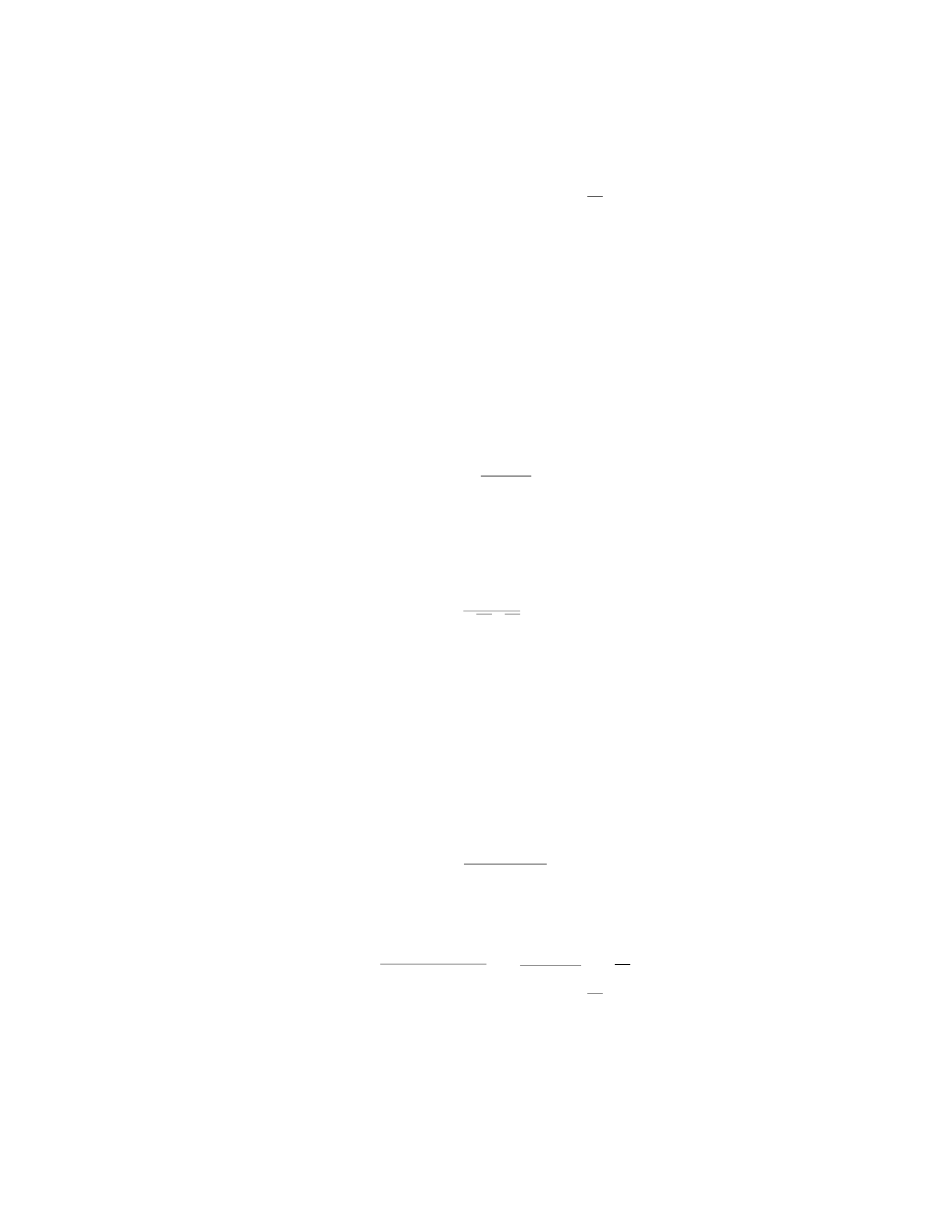
Therefore, the magnitude of the vector v is √14.
(b) The dot product of two vectors v and w in R3is given by the
formula:
v ·w =v1w1+v2w2+v3w3
Given v =
2
−3
1
and w =
5
2
−4
, substituting the values, we get:
v ·w = (2)(5) + (−3)(2) + (1)(−4) = 10 −6−4=0
Therefore, the dot product of v and w is 0.
(c) The angle θbetween two vectors v and w can be found using
the formula:
cos(θ) = v ·w
∥v∥∥w∥
Given v =
2
−3
1
and w =
5
2
−4
, and using the results from parts
(a) and (b), we can calculate the angle θ:
cos(θ) = 0
√14√45 = 0
Since cos(θ) = 0, the angle between the vectors v and w is θ=
90◦.Question 10:
Let v =
2
−3
1
and w =
5
2
−4
be vectors in R3.
(a) Find the magnitude of the vector v.
(b) Find the dot product of v and w.
(c) Find the angle between the vectors v and w.
Step-by-step solutions:
(a) The magnitude of a vector v =
v1
v2
v3
is given by the formula:
∥v∥=qv2
1+v2
2+v2
3
Given v =
2
−3
1
, substituting the values, we get:
∥v∥=p22+ (−3)2+ 12=√4 + 9 + 1 = √14
Therefore, the magnitude of the vector v is √14.
(b) The dot product of two vectors v and w in R3is given by the
formula:
12

v ·w =v1w1+v2w2+v3w3
Given v =
2
−3
1
and w =
5
2
−4
, substituting the values, we get:
v ·w = (2)(5) + (−3)(2) + (1)(−4) = 10 −6−4=0
Therefore, the dot product of v and w is 0.
(c) The angle θbetween two vectors v and w can be found using
the formula:
cos(θ) = v ·w
∥v∥∥w∥
Given v =
2
−3
1
and w =
5
2
−4
, and using the results from parts
(a) and (b), we can calculate the angle θ:
cos(θ) = 0
√14√45 = 0
Since cos(θ)=0, the angle between the vectors v and w is θ= 90◦.
Question 11
“‘latex Question 11:
Let u =
2
−1
3
and v =
5
2
4
in R3. Compute the dot product of u
and v.
Solution:
The dot product of two vectors u =
u1
u2
u3
and v =
v1
v2
v3
is given by:
u ·v =u1v1+u2v2+u3v3
Substitute u =
2
−1
3
and v =
5
2
4
into the formula:
u ·v = (2)(5) + (−1)(2) + (3)(4) = 10 −2 + 12 = 20
Therefore, the dot product of u and v is 20. “‘Sure, here is a
question on Euclidean space for Liberty University in LateX code:
“‘latex Question 11:
13

Let u =
2
−1
3
and v =
5
2
4
in R3. Compute the dot product of u
and v.
Solution:
The dot product of two vectors u =
u1
u2
u3
and v =
v1
v2
v3
is given by:
u ·v =u1v1+u2v2+u3v3
Substitute u =
2
−1
3
and v =
5
2
4
into the formula:
u ·v = (2)(5) + (−1)(2) + (3)(4) = 10 −2 + 12 = 20
Therefore, the dot product of u and v is 20. “‘
Question 12
Question 12:
Find the distance between the points A(3,−2,5) and B(−1,4,−3) in
R3.
Step-by-step solution:
Let dbe the distance between points Aand B.
The distance formula in 3-dimensional space is given by:
d=p(x2−x1)2+ (y2−y1)2+ (z2−z1)2
Substitute the coordinates of A(3,−2,5) and B(−1,4,−3) into the
distance formula:
d=p(−1−3)2+ (4 −(−2))2+ (−3−5)2
d=p(−4)2+ (6)2+ (−8)2
d=√16 + 36 + 64
d=√116
d=√4·29
d= 2√29
14

Therefore, the distance between points A(3,−2,5) and B(−1,4,−3)
in R3is 2√29 units.Sure, here is a question along with its step-by-step
solution on Euclidean space for Liberty University in LateX code:
Question 12:
Find the distance between the points A(3,−2,5) and B(−1,4,−3) in
R3.
Step-by-step solution:
Let dbe the distance between points Aand B.
The distance formula in 3-dimensional space is given by:
d=p(x2−x1)2+ (y2−y1)2+ (z2−z1)2
Substitute the coordinates of A(3,−2,5) and B(−1,4,−3) into the
distance formula:
d=p(−1−3)2+ (4 −(−2))2+ (−3−5)2
d=p(−4)2+ (6)2+ (−8)2
d=√16 + 36 + 64
d=√116
d=√4·29
d= 2√29
Therefore, the distance between points A(3,−2,5) and B(−1,4,−3)
in R3is 2√29 units.
Question 13
Let A(2,−3,5),B(1,4,−2), and C(−3,1,0) be three points in R3. Cal-
culate the distance between Aand Busing the distance formula.
Solution:
The distance between two points A(x1, y1, z1)and B(x2, y2, z2)in R3
can be calculated using the distance formula:
d=p(x2−x1)2+ (y2−y1)2+ (z2−z1)2(1)
In this case, A(2,−3,5) and B(1,4,−2).
Substitute the coordinates into the formula:
15

d=p(1 −2)2+ (4 −(−3))2+ (−2−5)2
=p(−1)2+ (4 + 3)2+ (−7)2
=√1 + 49 + 49
=√99
= 3√11
Therefore, the distance between points Aand Bis 3√11.Question
13:
Let A(2,−3,5),B(1,4,−2), and C(−3,1,0) be three points in R3. Cal-
culate the distance between Aand Busing the distance formula.
Solution:
The distance between two points A(x1, y1, z1)and B(x2, y2, z2)in R3
can be calculated using the distance formula:
d=p(x2−x1)2+ (y2−y1)2+ (z2−z1)2(2)
In this case, A(2,−3,5) and B(1,4,−2).
Substitute the coordinates into the formula:
d=p(1 −2)2+ (4 −(−3))2+ (−2−5)2
=p(−1)2+ (4 + 3)2+ (−7)2
=√1 + 49 + 49
=√99
= 3√11
Therefore, the distance between points Aand Bis 3√11.
Question 14
“‘latex Question 14: Consider the points A(−3,2,1) and B(4,−1,−2)
in R3.
1. Find the distance between points Aand B.
2. Find the midpoint of the line segment joining points Aand B.
Solution:
16

1. To find the distance between points Aand B, we can use the
distance formula:
d=p(x2−x1)2+ (y2−y1)2+ (z2−z1)2
=p(4 −(−3))2+ (−1−2)2+ (−2−1)2
=p72+ (−3)2+ (−3)2
=√49 + 9 + 9
=√67.
Therefore, the distance between points Aand Bis √67.
2. To find the midpoint of the line segment joining points Aand B,
we can average the coordinates:
M=x1+x2
2,y1+y2
2,z1+z2
2
=−3+4
2,2+(−1)
2,1+(−2)
2
=1
2,1
2,−1
2.
Thus, the midpoint of the line segment joining points Aand B
is 1
2,1
2,−1
2.
“‘
Feel free to adjust the formatting or content as needed!Certainly!
Here is a question on Euclidean space along with its step-by-step
solution in LateX code:
“‘latex Question 14: Consider the points A(−3,2,1) and B(4,−1,−2)
in R3.
1. Find the distance between points Aand B.
2. Find the midpoint of the line segment joining points Aand B.
Solution:
1. To find the distance between points Aand B, we can use the
distance formula:
d=p(x2−x1)2+ (y2−y1)2+ (z2−z1)2
=p(4 −(−3))2+ (−1−2)2+ (−2−1)2
=p72+ (−3)2+ (−3)2
=√49 + 9 + 9
=√67.
Therefore, the distance between points Aand Bis √67.
17

2. To find the midpoint of the line segment joining points Aand B,
we can average the coordinates:
M=x1+x2
2,y1+y2
2,z1+z2
2
=−3+4
2,2+(−1)
2,1+(−2)
2
=1
2,1
2,−1
2.
Thus, the midpoint of the line segment joining points Aand B
is 1
2,1
2,−1
2.
“‘
Feel free to adjust the formatting or content as needed!
Question 15
Question 15: Find the distance between the points A(2,−3,4) and
B(−1,5,−2) in Euclidean space.
Solution: The distance between points Aand Bin Euclidean space
is given by the formula:
d=p(x2−x1)2+ (y2−y1)2+ (z2−z1)2
Given points A(2,−3,4) and B(−1,5,−2), we can substitute the co-
ordinates into the formula:
d=p((−1) −2)2+ (5 −(−3))2+ ((−2) −4)2
d=p(−3)2+ (8)2+ (−6)2
d=√9 + 64 + 36
d=√109
d≈10.44
Therefore, the distance between points A(2,−3,4) and B(−1,5,−2)
in Euclidean space is approximately 10.44 units.
Please let me know if you need help with anything else!Sure! Here
is a question along with its solution in LateX code:
Question 15: Find the distance between the points A(2,−3,4) and
B(−1,5,−2) in Euclidean space.
Solution: The distance between points Aand Bin Euclidean space
is given by the formula:
d=p(x2−x1)2+ (y2−y1)2+ (z2−z1)2
18

Given points A(2,−3,4) and B(−1,5,−2), we can substitute the co-
ordinates into the formula:
d=p((−1) −2)2+ (5 −(−3))2+ ((−2) −4)2
d=p(−3)2+ (8)2+ (−6)2
d=√9 + 64 + 36
d=√109
d≈10.44
Therefore, the distance between points A(2,−3,4) and B(−1,5,−2)
in Euclidean space is approximately 10.44 units.
Please let me know if you need help with anything else!
Question 16
Let u =
−3
2
4
and v =
1
−1
2
be vectors in R3.
a) Find the dot product u ·v.
b) Determine whether the vectors u and v are orthogonal.
c) Find the projection of u onto v.
Step-by-step solutions:
a) For the dot product of two vectors u and v, we use the formula
u·v=u1v1+u2v2+u3v3, where u1, u2, u3are the components of u and
v1, v2, v3are the components of v.
Plugging in the values, we have:
u·v= (−3)(1) + (2)(−1) + (4)(2) = −3−2 + 8 = 3
Therefore, u ·v= 3.
b) Two vectors u and v are orthogonal if their dot product is zero,
i.e., u ·v= 0.
In this case, we found u ·v= 3, which is not zero. Therefore, the
vectors u and v are not orthogonal.
c) The projection of vector u onto vector v is given by:
projvu=u·v
∥v∥2v
First, calculate ∥v∥:
∥v∥=p12+ (−1)2+ 22=√1 + 1 + 4 = √6
Now, find the projection:
19

projvu=3
6
1
−1
2
=1
2
1
−1
2
=
1
2
−1
2
1
Therefore, the projection of u onto v is
1
2
−1
2
1
.Question 16:
Let u =
−3
2
4
and v =
1
−1
2
be vectors in R3.
a) Find the dot product u ·v.
b) Determine whether the vectors u and v are orthogonal.
c) Find the projection of u onto v.
Step-by-step solutions:
a) For the dot product of two vectors u and v, we use the formula
u·v=u1v1+u2v2+u3v3, where u1, u2, u3are the components of u and
v1, v2, v3are the components of v.
Plugging in the values, we have:
u·v= (−3)(1) + (2)(−1) + (4)(2) = −3−2 + 8 = 3
Therefore, u ·v= 3.
b) Two vectors u and v are orthogonal if their dot product is zero,
i.e., u ·v= 0.
In this case, we found u ·v= 3, which is not zero. Therefore, the
vectors u and v are not orthogonal.
c) The projection of vector u onto vector v is given by:
projvu=u·v
∥v∥2v
First, calculate ∥v∥:
∥v∥=p12+ (−1)2+ 22=√1 + 1 + 4 = √6
Now, find the projection:
projvu=3
6
1
−1
2
=1
2
1
−1
2
=
1
2
−1
2
1
Therefore, the projection of u onto v is
1
2
−1
2
1
.
20

Question 17
Step-by-step solution: 1. Use the distance formula in three-dimensional
space, which is given by:
d=p(x2−x1)2+ (y2−y1)2+ (z2−z1)2
2. Substitute the coordinates of the points P(3, -2, 5) and Q(-1,
4, -7) into the distance formula:
d=p(−1−3)2+ (4 + 2)2+ (−7−5)2
3. Calculate the differences in coordinates:
d=p(−4)2+ (6)2+ (−12)2
4. Simplify the expression:
d=√16 + 36 + 144
d=√196
d= 14
Therefore, the distance between the points P(3, -2, 5) and Q(-1,
4, -7) in three-dimensional space is 14 units.Question 17: Find the
distance between the points P(3, -2, 5) and Q(-1, 4, -7) in three-
dimensional Euclidean space.
Step-by-step solution: 1. Use the distance formula in three-dimensional
space, which is given by:
d=p(x2−x1)2+ (y2−y1)2+ (z2−z1)2
2. Substitute the coordinates of the points P(3, -2, 5) and Q(-1,
4, -7) into the distance formula:
d=p(−1−3)2+ (4 + 2)2+ (−7−5)2
3. Calculate the differences in coordinates:
d=p(−4)2+ (6)2+ (−12)2
4. Simplify the expression:
d=√16 + 36 + 144
d=√196
d= 14
Therefore, the distance between the points P(3, -2, 5) and Q(-1,
4, -7) in three-dimensional space is 14 units.
21

Question 18
Question 18: Let u =
2
−3
4
and v =
−1
2
3
. Find the vector projec-
tion of u onto v.
Step-by-step solution: 1. The vector projection of u onto v is given
by:
projv(u) = u·v
∥v∥2v
2. Calculate u ·v:
u·v= (2)(−1) + (−3)(2) + (4)(3)
3. Calculate ∥v∥2:
∥v∥=p(−1)2+ 22+ 32
4. Find the projection:
projv(u) = u·v
∥v∥2v
Thus, projv(u)is the vector projection of u onto v.Sure, here is a
question along with step-by-step solutions related to Euclidean space
for Liberty University in LateX code:
Question 18: Let u =
2
−3
4
and v =
−1
2
3
. Find the vector projec-
tion of u onto v.
Step-by-step solution: 1. The vector projection of u onto v is given
by:
projv(u) = u·v
∥v∥2v
2. Calculate u ·v:
u·v= (2)(−1) + (−3)(2) + (4)(3)
3. Calculate ∥v∥2:
∥v∥=p(−1)2+ 22+ 32
4. Find the projection:
projv(u) = u·v
∥v∥2v
Thus, projv(u)is the vector projection of u onto v.
22

Question 19
“‘latex Question 19: Find the distance between the points A(2,−3,5)
and B(−1,4,−2) in Euclidean space.
Solution: To find the distance between two points A(x1, y1, z1)and
B(x2, y2, z2)in Euclidean space, we use the distance formula:
d=p(x2−x1)2+ (y2−y1)2+ (z2−z1)2
Given points A(2,−3,5) and B(−1,4,−2), we can substitute the co-
ordinates into the formula:
d=p(−1−2)2+ (4 + 3)2+ (−2−5)2
d=p(−3)2+ (7)2+ (−7)2
d=√9 + 49 + 49
d=√107
Therefore, the distance between points A(2,−3,5) and B(−1,4,−2)
in Euclidean space is √107 units. “‘
Feel free to reach out if you need any more questions or assis-
tance!Sure! Here is a question along with its step-by-step solution in
LaTeX code:
“‘latex Question 19: Find the distance between the points A(2,−3,5)
and B(−1,4,−2) in Euclidean space.
Solution: To find the distance between two points A(x1, y1, z1)and
B(x2, y2, z2)in Euclidean space, we use the distance formula:
d=p(x2−x1)2+ (y2−y1)2+ (z2−z1)2
Given points A(2,−3,5) and B(−1,4,−2), we can substitute the co-
ordinates into the formula:
d=p(−1−2)2+ (4 + 3)2+ (−2−5)2
d=p(−3)2+ (7)2+ (−7)2
d=√9 + 49 + 49
d=√107
Therefore, the distance between points A(2,−3,5) and B(−1,4,−2)
in Euclidean space is √107 units. “‘
Feel free to reach out if you need any more questions or assistance!
23

Question 20
Question 20: Let u =
2
−1
3
and v =
1
4
−2
be vectors in R3. Deter-
mine the angle between u and v in radians.
Solution: The angle θbetween two vectors u and v is given by the
formula:
cos θ=u·v
∥u∥·∥v∥
Substitute the given vectors:
cos θ=
2
−1
3
·
1
4
−2
p22+ (−1)2+ 32·p12+ 42+ (−2)2
cos θ=(2)(1) + (−1)(4) + (3)(−2)
√14 ·√21 =2−4−6
√14 ·√21 =−8
√294
cos θ=−8
√14 ·√21 =−8
√294
Therefore, the angle θbetween u and v is arccos −8
√294 radi-
ans.Sure, here is a question on Euclidean space for Liberty University:
Question 20: Let u =
2
−1
3
and v =
1
4
−2
be vectors in R3. Deter-
mine the angle between u and v in radians.
Solution: The angle θbetween two vectors u and v is given by the
formula:
cos θ=u·v
∥u∥·∥v∥
Substitute the given vectors:
cos θ=
2
−1
3
·
1
4
−2
p22+ (−1)2+ 32·p12+ 42+ (−2)2
cos θ=(2)(1) + (−1)(4) + (3)(−2)
√14 ·√21 =2−4−6
√14 ·√21 =−8
√294
cos θ=−8
√14 ·√21 =−8
√294
Therefore, the angle θbetween u and v is arccos −8
√294 radians.
24

Question 21
Question 21: Let u =
2
−3
4
and v =
−1
5
−2
be vectors in R3.
Calculate the dot product u ·v.
Solution: The dot product of two vectors u and v in R3is given
by:
u·v=u1v1+u2v2+u3v3
Substitute the values of u and v into the formula:
u·v= (2)(−1) + (−3)(5) + (4)(−2)
u·v=−2−15 −8
u·v=−25
Therefore, the dot product of vectors u and v is −25.Sure, here is
a question on Euclidean space along with its step-by-step solution:
Question 21: Let u =
2
−3
4
and v =
−1
5
−2
be vectors in R3.
Calculate the dot product u ·v.
Solution: The dot product of two vectors u and v in R3is given
by:
u·v=u1v1+u2v2+u3v3
Substitute the values of u and v into the formula:
u·v= (2)(−1) + (−3)(5) + (4)(−2)
u·v=−2−15 −8
u·v=−25
Therefore, the dot product of vectors u and v is −25.
25

Question 22
“‘latex Question 22: Given two points A(2,−3,4) and B(−1,1,−5)
in R3, find the distance between them.
Solution:
The distance dbetween two points A(x1, y1, z1)and B(x2, y2, z2)in
R3is given by the formula:
d=p(x2−x1)2+ (y2−y1)2+ (z2−z1)2
Given A(2,−3,4) and B(−1,1,−5), we can plug in the coordinates
into the formula:
d=p(−1−2)2+ (1 −(−3))2+ (−5−4)2
d=p(−3)2+ (4)2+ (−9)2
d=√9 + 16 + 81
d=√106
Therefore, the distance between the points Aand Bin R3is √106.
“‘
Feel free to modify the formatting or content according to your
preferences.Certainly! Here is the LateX code for question number
22 on Euclidean space for Liberty University:
“‘latex Question 22: Given two points A(2,−3,4) and B(−1,1,−5)
in R3, find the distance between them.
Solution:
The distance dbetween two points A(x1, y1, z1)and B(x2, y2, z2)in
R3is given by the formula:
d=p(x2−x1)2+ (y2−y1)2+ (z2−z1)2
Given A(2,−3,4) and B(−1,1,−5), we can plug in the coordinates
into the formula:
d=p(−1−2)2+ (1 −(−3))2+ (−5−4)2
d=p(−3)2+ (4)2+ (−9)2
d=√9 + 16 + 81
d=√106
Therefore, the distance between the points Aand Bin R3is √106.
“‘
Feel free to modify the formatting or content according to your
preferences.
26

Question 23
“‘latex Question 23:
Let u =
2
−1
4
and v =
−3
2
0
be vectors in R3. Calculate the angle
between the vectors u and v.
Solution:
The angle θbetween two vectors u and v is given by the formula:
cos(θ) = u·v
∥u∥∥v∥
where ·denotes the dot product and ∥·∥denotes the magnitude
of the vector.
First, let’s calculate the dot product of u and v:
u·v= (2)(−3) + (−1)(2) + (4)(0) = −6−2 + 0 = −8
Next, we calculate the magnitudes of u and v:
∥u∥=p22+ (−1)2+ 42=√4 + 1 + 16 = √21
∥v∥=p(−3)2+ 22+ 02=√9 + 4 + 0 = √13
Now, plug these values into the formula for cosine of the angle
between two vectors:
cos(θ) = −8
√21√13 =−8
√273
Finally, find the angle θby taking the arccos of the result:
θ= arccos −8
√273
“‘
Let me know if you need further assistance with this question!Certainly!
Here is question number 23 for set 1 on Euclidean space for Liberty
University in LateX code:
“‘latex Question 23:
Let u =
2
−1
4
and v =
−3
2
0
be vectors in R3. Calculate the angle
between the vectors u and v.
Solution:
The angle θbetween two vectors u and v is given by the formula:
cos(θ) = u·v
∥u∥∥v∥
27

where ·denotes the dot product and ∥·∥denotes the magnitude
of the vector.
First, let’s calculate the dot product of u and v:
u·v= (2)(−3) + (−1)(2) + (4)(0) = −6−2 + 0 = −8
Next, we calculate the magnitudes of u and v:
∥u∥=p22+ (−1)2+ 42=√4 + 1 + 16 = √21
∥v∥=p(−3)2+ 22+ 02=√9 + 4 + 0 = √13
Now, plug these values into the formula for cosine of the angle
between two vectors:
cos(θ) = −8
√21√13 =−8
√273
Finally, find the angle θby taking the arccos of the result:
θ= arccos −8
√273
“‘
Let me know if you need further assistance with this question!
Question 24
Let v =
2
−1
4
and w =
−3
5
2
be two vectors in R3.
(a) Find the dot product v ·w.
(b) Find the angle between vectors v and w. Round your answer
to the nearest degree.
Solution:
(a) The dot product of two vectors v =
v1
v2
v3
and w =
w1
w2
w3
is given
by
v·w=v1w1+v2w2+v3w3
Given v =
2
−1
4
and w =
−3
5
2
,
v·w= (2)(−3) + (−1)(5) + (4)(2) = −6−5 + 8 = −3
Therefore, v ·w=−3.
28

(b) The angle between two vectors v and w can be found using
the formula
cos θ=v·w
∥v∥∥w∥
where θis the angle between the vectors, ∥v∥is the magnitude of
vector v, and ∥w∥is the magnitude of vector w.
The magnitudes of vectors v and w are
∥v∥=p22+ (−1)2+ 42=√4 + 1 + 16 = √21
∥w∥=p(−3)2+ 52+ 22=√9 + 25 + 4 = √38
Substitute these values into the formula:
cos θ=−3
√21√38
θ= arccos −3
√21√38
θ≈arccos (−0.228220724)
θ≈104.6◦
Therefore, the angle between vectors v and w is approximately
104.6◦.Question 24:
Let v =
2
−1
4
and w =
−3
5
2
be two vectors in R3.
(a) Find the dot product v ·w.
(b) Find the angle between vectors v and w. Round your answer
to the nearest degree.
Solution:
(a) The dot product of two vectors v =
v1
v2
v3
and w =
w1
w2
w3
is given
by
v·w=v1w1+v2w2+v3w3
Given v =
2
−1
4
and w =
−3
5
2
,
v·w= (2)(−3) + (−1)(5) + (4)(2) = −6−5 + 8 = −3
Therefore, v ·w=−3.
29

(b) The angle between two vectors v and w can be found using
the formula
cos θ=v·w
∥v∥∥w∥
where θis the angle between the vectors, ∥v∥is the magnitude of
vector v, and ∥w∥is the magnitude of vector w.
The magnitudes of vectors v and w are
∥v∥=p22+ (−1)2+ 42=√4 + 1 + 16 = √21
∥w∥=p(−3)2+ 52+ 22=√9 + 25 + 4 = √38
Substitute these values into the formula:
cos θ=−3
√21√38
θ= arccos −3
√21√38
θ≈arccos (−0.228220724)
θ≈104.6◦
Therefore, the angle between vectors v and w is approximately
104.6◦.
Question 25
Step-by-step Solution: Let P1= (x1, y1, z1)and P2= (x2, y2, z2)be
two points in 3D space. The distance between these points is given
by the formula:
d=p(x2−x1)2+ (y2−y1)2+ (z2−z1)2
Given A(3,4,−2) and B(−1,2,5), we can substitute the coordinates
into the formula:
d=p(−1−3)2+ (2 −4)2+ (5 + 2)2
d=p(−4)2+ (−2)2+ (7)2
d=√16 + 4 + 49
d=√69
30

Therefore, the distance between points Aand Bis √69 units.Question
25 for Set 1: Find the distance between the points A(3,4,−2) and
B(−1,2,5) in Euclidean space.
Step-by-step Solution: Let P1= (x1, y1, z1)and P2= (x2, y2, z2)be
two points in 3D space. The distance between these points is given
by the formula:
d=p(x2−x1)2+ (y2−y1)2+ (z2−z1)2
Given A(3,4,−2) and B(−1,2,5), we can substitute the coordinates
into the formula:
d=p(−1−3)2+ (2 −4)2+ (5 + 2)2
d=p(−4)2+ (−2)2+ (7)2
d=√16 + 4 + 49
d=√69
Therefore, the distance between points Aand Bis √69 units.
31

