



MATH 121 - COLLEGE ALGEBRA -
Equations and properties of conic
sections
Question Bank - Set 6
Liberty University
Question 1
Question
Given the equation of a hyperbola in standard form: (x−1)2
16 −(y+3)2
9= 1,
determine the center, vertices, foci, asymptotes, and eccentricity.
Solution
Step 1: Identify the center of the hyperbola using the equation (h, k), where h
is the x-coordinate of the center and kis the y-coordinate of the center. For the
equation (x−1)2
16 −(y+3)2
9= 1, the center is (1,−3).
Step 2: Find the vertices. For a hyperbola with center at (h, k)and where
the x-term has a positive coefficient, the vertices are at (h±a, k), where ais
the square root of the value under the positive term in the x-term. In this case,
the vertices are at (1 ±4,−3), so the vertices are at (5,−3) and (−3,−3).
Step 3: Calculate the foci. The distance from the center to the foci is the
square root of a2+b2. In this case, c2=a2+b2= 16 + 9 = 25, so c=√25 = 5.
Therefore, the foci are at (1±5,−3), which gives the foci at (6,−3) and (−4,−3).
Step 4: Determine the asymptotes. The general form for the equation of the
asymptotes of a hyperbola is y=±b
a(x−h) + k. Substituting the values of a,
b,h, and k, we get y=±3
4(x−1) −3.
Step 5: Calculate the eccentricity (e), which is defined as c
a. In this case,
e=5
4.
Therefore, the center of the hyperbola is at (1,−3), the vertices are at (5,−3)
and (−3,−3), the foci are at (6,−3) and (−4,−3), the asymptotes are y=
3
4(x−1) −3and y=−3
4(x−1) −3, and the eccentricity is 5
4.

Question 2
Question
Find the standard form of the equation of the hyperbola with vertices at (-4,3)
and (-4,-3), and foci at (-4,6) and (-4,-6).
Solution
Step 1: Find the center of the hyperbola by averaging the coordinates of the ver-
tices. Since the vertices are at (-4,3) and (-4,-3), the center is at (−4,3+(−3)
2) =
(−4,0).
Step 2: Find the distance between the center and one of the vertices to
determine a. Use the formula a=distance to vertices
2. The distance between the
center (−4,0) and either of the vertices is 3 units. Therefore, a=3
2= 1.5.
Step 3: Find the distance between the center and one of the foci to determine
c. Use the formula c=distance to foci
2. The distance between the center (−4,0)
and either of the foci is 6 units. Therefore, c=6
2= 3.
Step 4: Find busing the formula for hyperbolas: b2=c2−a2. Substituting
the known values, we get b2= 32−1.52= 9 −2.25 = 6.75. So, b=√6.75 =
√27
4=3√3
2.
Step 5: The standard form of the equation of a hyperbola with center at
(h, k), vertices along the transverse axis on the x-axis, and foci at (h, k + c)
and (h, k - c) is
(x−h)2/a2−(y−k)2/b2= 1.
For this hyperbola, the equation becomes
(x+ 4)2/(1.5)2−y2/(3√3/2)2= 1.
Therefore, the standard form of the equation of the hyperbola is
(x+ 4)2/2.25 −y2/(27/4) = 1.
Question 3
Question
Solve the equation 3x2+4xy +4y2−8x−16y+16 = 0 by completing the square.
Solution
Step 1: Rearrange the terms in the equation to group the xterms and yterms
separately:
3x2+ 4xy + 4y2−8x−16y+ 16 = 0
3x2+ 4xy −8x+ 4y2−16y+ 16 = 0
2

Step 2: Complete the square for the xterms by focusing on the 3x2+4xy−8x
part:
3x2+ 4xy −8x= 3(x2−8
3x)+4xy
= 3(x2−8
3x+16
9)+4xy −3(16
9)
= 3(x−4
3)2+ 4xy −16
3
Step 3: Similarly, complete the square for the yterms by focusing on the
4y2−16ypart:
4y2−16y= 4(y2−4y)
= 4(y2−4y+ 4) −4(4)
= 4(y−2)2−16
Step 4: Substitute the completed squares back into the original equation:
3(x−4
3)2+ 4xy −16
3+ 4(y−2)2−16 + 16 = 0
Step 5: Simplify the equation:
3(x−4
3)2+ 4xy + 4(y−2)2−16
3−16 = 0
Step 6: The equation can be further simplified to the standard form of a
conic section:
3(x−4
3)2+ 4(y−2)2=64
3
Therefore, the given equation represents an ellipse in standard form.
Question 4
Question
Determine the standard form of the equation of the conic section with the focus
F(2,3) and the directrix y= 4.
Solution
Step 1: Recall that the standard form of the equation for a conic section with
focus (h, k)and directrix ax +by +c= 0 is given by:
For a parabola:
(x−h)2= 4p(y−k)
For an ellipse:
(x−h)2
a2+(y−k)2
b2= 1
3

For a hyperbola:
(x−h)2
a2−(y−k)2
b2= 1
Step 2: Since the given directrix is y= 4, the equation of the directrix is of
the form y=b. This suggests that the conic section is a parabola.
Step 3: Determine the distance pbetween the focus and the directrix. The
distance pfor a parabola is the distance from the vertex to the focus (or direc-
trix).
Step 4: Using the distance formula, we have:
p=|3−4|= 1
Step 5: The vertex of the parabola is halfway between the focus and the
directrix. Since the directrix is at y= 4, the vertex has a y-coordinate of 3.5.
Step 6: The standard form of the equation for a vertical parabola is:
(x−h)2= 4p(y−k)
Substitute the given values h= 2,k= 3.5, and p= 1 into the standard form
to get the equation of the parabola:
(x−2)2= 4(y−3.5)
Therefore, the standard form of the equation of the parabola is (x−2)2=
4(y−3.5).
Question 5
Question
Solve for xand yin the system of equations:
{x2−4y2= 5
4x2+ 9y2= 36
Solution
Step 1: We start by multiplying the first equation by 9and the second equation
by 4to make the coefficients of y2equal in both equations:
{9x2−36y2= 45
16x2+ 36y2= 144
Step 2: Now, add the two equations together to eliminate the y2term:
9x2−36y2+ 16x2+ 36y2= 45 + 144
4

25x2= 189
Step 3: Divide by 25 to solve for x2:
x2=189
25 =189
25 = 7.56
Step 4: Take the square root of both sides to solve for x:
x=±√7.56 = ±2.75
Step 5: Substitute xback into the first equation x2−4y2= 5 to solve for y:
(2.75)2−4y2= 5
7.56 −4y2= 5
−4y2=−2.56
y2= 0.64
y=±√0.64 = ±0.8
Therefore, the solutions to the system of equations are x= 2.75, y = 0.8and
x=−2.75, y =−0.8.
Question 6
Question
Find the standard form of the equation of a hyperbola with vertices at (-3,2)
and (-3,8), and a major axis of length 10.
Solution
Step 1: Determine the center of the hyperbola by finding the midpoint of the
vertices. Step 2: Determine the distance from the center to one of the vertices
to find the value of a. Step 3: Determine the value of busing the length of the
major axis. Step 4: Use the information obtained to write the standard form of
the equation of the hyperbola.
Step 1: The center of the hyperbola is the midpoint of the vertices. Midpoint
=(x1+x2
2,y1+y2
2)Midpoint = (−3+(−3)
2,2+8
2)Midpoint = (−3,5)
Step 2: The value of ais the distance from the center to one of the vertices.
a=length of major axis
2=10
2= 5
Step 3: The value of bcan be found using the length of the major axis.
For a hyperbola, the relation between a,band the length of the major axis
is: a2+b2=length of major axis252+b2= 10225 + b2= 100 b2= 75
b=√75 = 5√3
5

Step 4: The standard form of the equation of a hyperbola centered at (−3,5)
with vertices at (−3,2) and (−3,8) is:
(y−5)2
25 −(x+ 3)2
75 = 1
Question 7
Question
Find the standard form of the equation of the parabola with focus F(2,3) and
vertex V(−1,3).
Solution
Step 1: Use the definition of a parabola to find the distance from the vertex to
the focus. The distance between the vertex and the focus of a parabola is called
the focal length and is denoted by p. Step 2: Calculate the focal length pusing
the distance formula: With V(−1,3) and F(2,3), we have
p=√(2 −(−1))2+ (3 −3)2=√32+ 02= 3.
So, p= 3.
Step 3: Determine the equation of the parabola according to which way it
opens. Since the focus is to the right of the vertex, the parabola opens to the
right.
Step 4: Use the standard form of the equation for a parabola that opens to
the right:
(x−h)2= 4p(y−k),
where (h, k)is the vertex. Substitute h=−1,k= 3, and p= 3:
(x+ 1)2= 12(y−3).
Thus, the standard form of the equation of the parabola is (x+ 1)2= 12(y−3).
Question 8
Question
Find the standard form of the equation of the hyperbola with vertices at (-5, 0)
and (5, 0) and passing through the point (6, 2).
6

Solution
To find the standard form of the equation of the hyperbola, we need to determine
the center, a, b, and c values. Then we can plug these values into the standard
form of a hyperbola equation.
Step 1: Find the center The center of the hyperbola can be found at the
midpoint of the vertices:
(h, k) = (−5+5
2,0+0
2)= (0,0).
Step 2: Find the values of a and b The distance from the center to one
of the vertices gives us the value of a, while the distance from the center to the
foci gives us the value of c:
a= 5 −0 = 5.
Step 3: Find c The distance between the center and one of the foci equals:
c=√a2+b2.
Step 4: Use the point on the hyperbola to determine b Using the
point (6, 2) on the hyperbola, we can substitute the values into the equation of
a hyperbola:
(x−h)2
a2−(y−k)2
b2= 1,
to solve for b.
Step 5: Write the standard form of the equation of the hyperbola
Substitute the values of h, k, a, and b into the standard form of the hyperbola
equation:
x2
25 −y2
9= 1.
Thus, the standard form of the equation of the hyperbola is x2
25 −y2
9= 1.
Question 9
Question
Solve the quadratic equation 3x2+ 7x−5=0using the quadratic formula.
Write the solutions in simplest radical form.
Solution
Step 1: Identify the coefficients a,b, and cin the quadratic equation ax2+
bx +c= 0. In this case, a= 3,b= 7, and c=−5.
Step 2: Write down the quadratic formula:
x=−b±√b2−4ac
2a
7

Step 3: Substitute the values of a,b, and cinto the quadratic formula:
x=−(7) ±√(7)2−4(3)(−5)
2(3)
Step 4: Simplify the expression under the square root:
x=−7±√49 + 60
6
x=−7±√109
6
Step 5: The solutions are then:
x=−7 + √109
6and x=−7−√109
6
Therefore, the solutions to the quadratic equation 3x2+7x−5 = 0 in simplest
radical form are x=−7+√109
6and x=−7−√109
6.
Question 10
Question
Find the standard form of the equation of the hyperbola that satisfies the given
conditions: vertices at (−2,3) and (2,3), and passing through the point (4,2).
Solution
To find the standard form of the equation of the hyperbola, we first need to
determine the center and parameters of the hyperbola.
Step 1: Find the center of the hyperbola. The center of the hyperbola
is the midpoint of the segment connecting the vertices. The midpoint of the
line segment with endpoints (−2,3) and (2,3) is:
(−2+2
2,3+3
2)= (0,3)
So, the center of the hyperbola is (0,3).
Step 2: Find the distance from the center to a vertex. The distance
from the center (0,3) to either vertex (−2,3) or (2,3) is the distance between 0
and 2, which is 2.
Step 3: Determine the equation of the transverse axis. Since the
transverse axis is horizontal in this case, the standard form of the equation of
the hyperbola is:
(x−h)2
a2−(y−k)2
b2= 1
8

where (h, k)is the center of the hyperbola, ais the distance from the center to
a vertex, and bis the distance from the center to a co-vertex.
Step 4: Substitute the given information into the equation. We
have: center (h, k) = (0,3),a= 2,bcan be found using the Pythagorean
theorem as b=√c2−a2where cis the distance from the center to the given
point (4,2).
The distance from the center to (4,2) is:
√(4 −0)2+ (2 −3)2=√16 + 1 = √17
Thus,
b=√(√17)2−22=√17 −4 = √13
Therefore, the equation of the hyperbola is:
x2
4−(y−3)2
13 = 1
Question 11
Question
Solve the system of equations:
{x2+y2−5x+ 6y= 0
x+ 2y= 2
Solution
Step 1: Let’s rewrite the second equation to solve for xin terms of y.
x= 2 −2y
Step 2: Substitute xin terms of yinto the first equation.
(2 −2y)2+y2−5(2 −2y)+6y= 0
Step 3: Expand and simplify the equation.
4−8y+ 4y2+y2−10 + 10y+ 6y= 0
5y2+ 8y−6 = 0
Step 4: Solve the quadratic equation for y.
y=−b±√b2−4ac
2a
9

y=−8±√82−4(5)(−6)
2(5)
y=−8±√64 + 120
10
y=−8±√184
10
y=−8±2√46
10
y=−4
5±√46
5
Step 5: Now substitute yback into x= 2 −2yto solve for x.
x= 2 −2(−4
5±√46
5)
x= 2 + 8
5∓2√46
5
x=18
5∓2√46
5
Step 6: Thus, the solutions to the system of equations are:
(18
5+2√46
5,−4
5−√46
5)
and (18
5−2√46
5,−4
5+√46
5)
Question 12
Question
Solve the following system of equations:
{x2−y2= 9
x+y= 5
10

Solution
Step 1: Let’s solve the second equation for one of the variables. We can do this
by subtracting yfrom both sides to get:
x= 5 −y
Step 2: Now, substitute x= 5 −yinto the first equation:
(5 −y)2−y2= 9
Step 3: Expand (5 −y)2:
25 −10y+y2−y2= 9
Step 4: Simplify the equation:
25 −10y= 9
Step 5: Solve for y:
10y= 16
y=16
10
y= 1.6
Step 6: Substitute y= 1.6back into x= 5 −yto find x:
x= 5 −1.6
x= 3.4
Step 7: Therefore, the solution to the system of equations is (x, y) = (3.4,1.6).
Question 13
Question
Find the standard form of the equation of a hyperbola with vertices at (−3,0)
and (3,0) and foci at (−5,0) and (5,0).
Solution
Step 1: The standard form of the equation of a hyperbola with vertices at
(h±a, k)and foci at (h±c, k)is given by
(x−h)2/a2−(y−k)2/b2= 1
where ais the distance from the center to a vertex, bis the distance from the
center to the co-vertex, and cis the distance from the center to a focus. In this
case, we are given that the center lies on the x-axis, so k= 0.
Step 2: From the given information, we can find:
11

• Center: (h, k) = (−3+3
2,0)= (0,0)
• Distance from the center to a vertex: a= 3
• Distance from the center to a focus: c= 5
Step 3: Now, we can substitute the center and ainto the standard form of
the equation to find b:
(x−0)2/32−(y−0)2/b2= 1
x2/9−y2/b2= 1
Step 4: We can find busing the relationship a2+b2=c2:
32+b2= 52
9 + b2= 25
b2= 16
b= 4
Step 5: Finally, substitute the values of aand bback into the standard form
of the equation to get the final equation of the hyperbola:
x2/9−y2/16 = 1
Question 14
Question
Solve the system of equations:
{x2+y2= 10
x−y= 2
Solution
Step 1: Solve the second equation for xin terms of y:
Subtract yfrom both sides of the equation x−y= 2 to get x=y+ 2.
Step 2: Substitute x=y+ 2 into the first equation:
Substitute x=y+2 into the equation x2+y2= 10 to get (y+2)2+y2= 10.
Step 3: Expand and simplify the equation:
Expanding (y+ 2)2gives us y2+ 4y+ 4. Substituting this into the equation
gives y2+ 4y+4+y2= 10.
Step 4: Rearrange the equation:
Combine like terms to get 2y2+ 4y+ 4 = 10.
Step 5: Solve the quadratic equation:
12

Subtracting 10 from both sides, we have 2y2+ 4y−6 = 0. Dividing all
terms by 2 gives y2+ 2y−3 = 0. Factoring this quadratic equation gives
(y+ 3)(y−1) = 0.
Step 6: Find the values of y:
From the factored form, we get two possible values for y:y=−3and y= 1.
Step 7: Find the corresponding values of x:
Substitute y=−3into x=y+ 2 to get x=−3 + 2 = −1and substitute
y= 1 to get x= 1 + 2 = 3.
Step 8: The solutions to the system of equations are (x, y)=(−1,−3) and
(x, y) = (3,1).
Question 15
Question
Find the standard form of the equation of the ellipse with foci F1(−1,2) and
F2(5,2), and a major axis of length 10.
Solution
Step 1: Find the center of the ellipse.
To find the center of the ellipse, we need to find the midpoint of the line segment
connecting the foci. The midpoint of the line segment with endpoints (−1,2)
and (5,2) is:
(−1+5
2,2+2
2)= (2,2).
So, the center of the ellipse is at (2,2).
Step 2: Find the distance between the foci.
The distance between the two foci is the length of the major axis of the ellipse,
which is given as 10. By using the distance formula, the distance between
F1(−1,2) and F2(5,2) is:
√(5 −(−1))2+ (2 −2)2=√62= 6.
Step 3: Find the value of a.
The value of ais half the length of the major axis, so a=10
2= 5.
Step 4: Find the value of c.
The value of cis half the distance between the foci, so c=6
2= 3.
Step 5: Find the value of b.
The value of bcan be found using the relationship c2=a2−b2. Substituting in
the values of aand c:
32= 52−b2=⇒9 = 25 −b2=⇒b2= 16 =⇒b= 4.
Step 6: Write the equation in standard form.
The standard form of the equation of an ellipse is (x−h)2
a2+(y−k)2
b2= 1, where
13

(h, k)is the center of the ellipse. Substitute h= 2,k= 2,a= 5, and b= 4 into
the equation to get:
(x−2)2
52+(y−2)2
42= 1.
Therefore, the standard form of the equation of the ellipse is (x−2)2
25 +(y−2)2
16 = 1 .
Question 16
Question
Solve the following system of equations:
{x2+y2= 25
y= 2x
Solution
Step 1: Substitute y= 2xinto the first equation to eliminate y:
x2+ (2x)2= 25
Step 2: Simplify the equation:
x2+ 4x2= 25
5x2= 25
x2= 5
x=±√5
Step 3: Substitute the values of xback into the equation y= 2xto find the
corresponding values of y: For x=√5:
y= 2(√5) = 2√5
For x=−√5:
y= 2(−√5) = −2√5
Thus, the solutions to the system of equations are:
{x=√5, y = 2√5
x=−√5, y =−2√5
Question 17
Question
Solve the equation 4x2+ 16y2−32x+ 64y+ 16 = 0 by completing the square,
and then determine the type of conic section that the equation represents.
14

Solution
Step 1: Rearrange the equation by grouping the xterms and yterms separately:
(4x2−32x) + (16y2+ 64y) = −16
Step 2: Complete the square for the xterms:
4(x2−8x) + (16y2+ 64y) = −16
4(x2−8x+ 16) + (16y2+ 64y) = −16 + 4(16)
4(x−4)2+ (16y2+ 64y) = 48
Step 3: Complete the square for the yterms:
4(x−4)2+ 16(y2+ 4y) = 48
4(x−4)2+ 16(y2+ 4y+ 4) = 48 + 16(4)
4(x−4)2+ 16(y+ 2)2= 112
Step 4: Divide both sides by 112 to simplify the equation:
(x−4)2
7+(y+ 2)2
7= 1
Step 5: Compare the equation with the standard form of conic sections:
(x−h)2
a2+(y−k)2
b2= 1
Since a2= 7 and b2= 7 are both positive and equal, the equation represents
an ellipse.
Question 18
Question
Solve the following system of equations:
{2x2−5y2= 5
3x+ 4y= 2
15

Solution
Step 1: Solve the second equation for one variable in terms of the other. We
can solve the second equation for xin terms of y:
3x+ 4y= 2 =⇒3x= 2 −4y=⇒x=2−4y
3
Step 2: Substitute xfrom the second equation into the first equation to
eliminate x:
2(2−4y
3)2
−5y2= 5
Step 3: Simplify the equation by expanding and solving for y:
8−16y+ 16y2
9−5y2= 5
8−16y+ 16y2−45y2
9= 5
16y2−16y−37
9= 5
16y2−16y−37 = 45
16y2−16y−82 = 0
2y2−2y−10 = 0
Step 4: Solve the quadratic equation for yusing the quadratic formula:
y=−(−2) ±√(−2)2−4(2)(−10)
2(2)
y=2±√4 + 80
4
y=2±√84
4
y=2±2√21
4
y=1±√21
2
Step 5: Find the corresponding values of xusing x=2−4y
3For y=1+√21
2:
x=
2−4(1+√21
2)
3=−5 + √21
3
16

For y=1−√21
2:
x=
2−4(1−√21
2)
3=−5−√21
3
Therefore, the solutions to the system of equations are:
(−5 + √21
3,1 + √21
2)and (−5−√21
3,1−√21
2)
Question 19
Question
Find the equation of the hyperbola with vertices at (−4,0) and (4,0) and foci
at (−5,0) and (5,0).
Solution
Step 1: Find the center of the hyperbola using the midpoint formula. The center
is the midpoint of the line segment connecting the vertices, so we have:
Center =((−4 + 4)
2,(0 + 0)
2)= (0,0)
Step 2: Calculate the distance between the center and one of the foci. The
distance between the center and a focus is given by the formula c=√a2+b2,
where ais the distance from the center to a vertex, and bis a constant related
to the shape of the hyperbola. In this case, a= 4 (the distance from the center
to a vertex), and c= 5 (the distance from the center to a focus).
52= 42+b2
25 = 16 + b2
b2= 9
b= 3
Step 3: Determine the equation of the hyperbola in standard form. The
standard form of a hyperbola centered at the origin is x2
a2−y2
b2= 1. Since this
hyperbola has a center at the origin, the equation is instead given by x2
a2−y2
b2=
1. Substituting in the values of aand b:
x2
16 −y2
9= 1
17

Question 20
Question
Find the equation of the hyperbola with vertices at (−5,0) and (5,0) and foci
at (−8,0) and (8,0).
Solution
Step 1: The standard form of the equation of a hyperbola with the center at
the origin and vertices on the x-axis is given by:
x2
a2−y2
b2= 1
where ais the distance from the center to a vertex and bis the distance from
the center to a co-vertex.
Given that the distance between the vertices is 2a= 10, we have a= 5.
Additionally, the distance between the foci is 2√a2+b2= 16. Since 2a= 10,
we can find busing the equation:
2√a2+b2= 16
2√52+b2= 16
10 + b2= 42
b2= 16 −10 = 6
b=√6
So, the standard form of the equation is:
x2
52−y2
√62= 1
x2
25 −y2
6= 1
Step 2: Since the center of the hyperbola is at the origin, we do not need to
shift the vertices to find the equation.
Hence, the equation of the hyperbola with vertices at (−5,0) and (5,0) and
foci at (−8,0) and (8,0) is:
x2
25 −y2
6= 1
18

Question 21
Question
Solve the system of equations:
{3x2−2xy + 4y2= 11
x+ 2y= 3
Solution
Step 1: We start by solving the second equation for x:
x= 3 −2y
Step 2: Substitute xinto the first equation:
3(3 −2y)2−2(3 −2y)y+ 4y2= 11
Step 3: Expand and simplify the equation:
3(9 −12y+ 4y2)−6y+ 4y2= 11
27 −36y+ 12y2−6y+ 4y2= 11
Step 4: Combine like terms and arrange the terms to form a quadratic
equation:
16y2−42y+ 16 = 0
Step 5: Solve the quadratic equation:
y=−(−42) ±√(−42)2−4(16)(16)
2(16)
y=42 ±√1764 −1024
32
y=42 ±√740
32
Step 6: Evaluate the solutions for yto find the corresponding values of x:
For y=42+√740
32 :
x= 3 −2(42 + √740
32 )
For y=42−√740
32 :
x= 3 −2(42 −√740
32 )
19
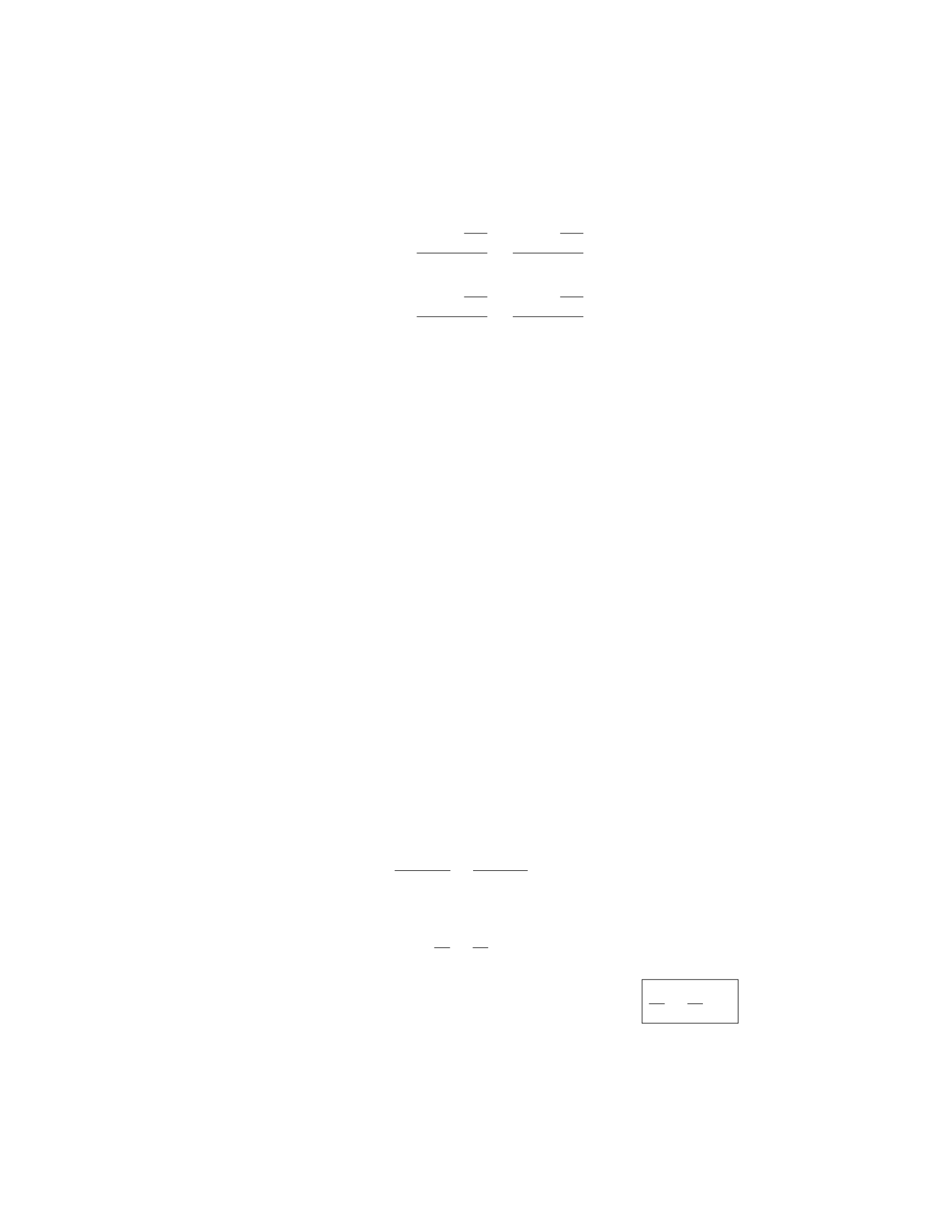
Therefore, the solutions to the system of equations are:
(3−2(42 + √740
32 ),42 + √740
32 )
(3−2(42 −√740
32 ),42 −√740
32 )
Question 22
Question
Find the standard form of the equation of the hyperbola with foci at (−4,0)
and (4,0) and vertices at (−6,0) and (6,0).
Solution
Step 1: Determine the center of the hyperbola. The center of the hyperbola is
the midpoint of the line segment connecting the vertices. Therefore, the center
is at (0,0).
Step 2: Find the distance between the center and the foci. The distance
between the center and either focus is equal to the distance between the center
and either vertex plus the distance between the vertex and the focus. Thus, the
distance is 6 + 4 = 10.
Step 3: Determine the value of c, which is the distance between the center
and either focus. In this case, c= 10.
Step 4: Find the value of a, which is the distance between the center and
either vertex. In this case, a= 6.
Step 5: Use the relationship c2=a2+b2and the values of aand cto find b.
102= 62+b2=⇒b2= 100 −36 = 64 =⇒b=±8
Step 6: Determine the equation of the hyperbola with the given information.
Since the transverse axis is horizontal, the standard form of the equation of a
hyperbola is:
(x−h)2
a2−(y−k)2
b2= 1
where (h, k)is the center of the hyperbola. Plugging in the values, we get:
x2
36 −y2
64 = 1
Therefore, the standard form of the equation of the hyperbola is x2
36 −y2
64 = 1 .
20

Question 23
Question
Find the standard form of the equation of the conic section defined by the given
equation: 9x2−36x−4y2+ 16y−36 = 0. Identify the conic section represented
by the equation.
Solution
Step 1: Rearrange the terms in the given equation:
9x2−36x−4y2+ 16y−36 = 0
Step 2: Complete the square for the x-terms by adding (36/2)2= 324 inside
the parentheses and subtracting 324 outside to keep the equation balanced:
9(x2−4x+ 36) −4y2+ 16y−36 = 0
Step 3: Complete the square for the y-terms by adding (16/2)2= 64 inside
the parentheses and subtracting 64 outside to keep the equation balanced:
9(x2−4x+ 36) −4(y2−4y+ 64) = 0
Step 4: Rewriting the perfect square trinomials:
9(x−2)2−4(y−2)2−576 = 0
Step 5: Move the constant term to the other side:
9(x−2)2−4(y−2)2= 576
Step 6: Divide by 576 to get the equation in the standard form, dividing
each term by 576:
(x−2)2
64 −(y−2)2
144 = 1
So, the standard form of the equation is (x−2)2
64 −(y−2)2
144 = 1. This represents
a hyperbola.
Question 24
Question
Find the standard form equation of the ellipse with foci at (-5, 0) and (5, 0),
and minor axis length of 4.
21

Solution
Step 1: Determine the center of the ellipse by finding the midpoint between
the two foci. Let the center of the ellipse be (h, k). The midpoint formula is
(x1+x2
2,y1+y2
2). The center of the ellipse is (−5+5
2,0+02 , giving us the center at (0, 0).
Step 2: Determine the length of the major axis. The distance between the
foci is the length of the major axis. In this case, the distance is 10 units.
Step 3: Determine the equation involving the major and minor axes. The
standard form equation of an ellipse is (x−h)2
a2+(y−k)2
b2= 1, where ais the length
of the semi-major axis and bis the length of the semi-minor axis.
Step 4: Determine the value of a. Since the minor axis length is 4, we have
2b= 4, which means b= 2.
Step 5: Substitute the known values into the equation and solve for a. Sub-
stitute h= 0,k= 0,a= 5, and b= 2 into the standard form equation. We
have x2
52+y2
22= 1.
Step 6: Write the final equation in standard form. The standard form
equation of the ellipse with foci at (-5, 0) and (5, 0), and minor axis length
of 4 is x2
25 +y2
4= 1 .
Question 25
Question
Solve the equation 4x2+ 9y2+ 8x−36y−4=0for xto find the equation of
the corresponding conic section.
Solution
Step 1: Rearrange the given equation by completing the square for both xand
yterms.
4x2+ 9y2+ 8x−36y−4 = 0
4x2+ 8x+ 9y2−36y= 4
4(x2+ 2x) + 9(y2−4y) = 4
4(x2+ 2x+ 1) + 9(y2−4y+ 4) = 4 + 4(1) + 9(4)
4(x+ 1)2+ 9(y−2)2= 49
Step 2: Identify the standard form of the equation which corresponds to an
ellipse. The standard form of the equation of an ellipse centered at (h, k)with
major axis along the x-axis and minor axis along the y-axis is: (x−h)2
a2+(y−k)2
b2=
1, where ais the length of the semi-major axis and bis the length of the semi-
minor axis.
Comparing the given equation to the standard form of an ellipse, we have
a=√49
4=7
2and b=√49
9=7
3. So, the center of the ellipse is (−1,2).
22

Question 2
Question
Find the standard form of the equation of the hyperbola with vertices at (-4,3)
and (-4,-3), and foci at (-4,6) and (-4,-6).
Solution
Step 1: Find the center of the hyperbola by averaging the coordinates of the ver-
tices. Since the vertices are at (-4,3) and (-4,-3), the center is at (−4,3+(−3)
2) =
(−4,0).
Step 2: Find the distance between the center and one of the vertices to
determine a. Use the formula a=distance to vertices
2. The distance between the
center (−4,0) and either of the vertices is 3 units. Therefore, a=3
2= 1.5.
Step 3: Find the distance between the center and one of the foci to determine
c. Use the formula c=distance to foci
2. The distance between the center (−4,0)
and either of the foci is 6 units. Therefore, c=6
2= 3.
Step 4: Find busing the formula for hyperbolas: b2=c2−a2. Substituting
the known values, we get b2= 32−1.52= 9 −2.25 = 6.75. So, b=√6.75 =
√27
4=3√3
2.
Step 5: The standard form of the equation of a hyperbola with center at
(h, k), vertices along the transverse axis on the x-axis, and foci at (h, k + c)
and (h, k - c) is
(x−h)2/a2−(y−k)2/b2= 1.
For this hyperbola, the equation becomes
(x+ 4)2/(1.5)2−y2/(3√3/2)2= 1.
Therefore, the standard form of the equation of the hyperbola is
(x+ 4)2/2.25 −y2/(27/4) = 1.
Question 3
Question
Solve the equation 3x2+4xy +4y2−8x−16y+16 = 0 by completing the square.
Solution
Step 1: Rearrange the terms in the equation to group the xterms and yterms
separately:
3x2+ 4xy + 4y2−8x−16y+ 16 = 0
3x2+ 4xy −8x+ 4y2−16y+ 16 = 0
2

Step 2: Complete the square for the xterms by focusing on the 3x2+4xy−8x
part:
3x2+ 4xy −8x= 3(x2−8
3x)+4xy
= 3(x2−8
3x+16
9)+4xy −3(16
9)
= 3(x−4
3)2+ 4xy −16
3
Step 3: Similarly, complete the square for the yterms by focusing on the
4y2−16ypart:
4y2−16y= 4(y2−4y)
= 4(y2−4y+ 4) −4(4)
= 4(y−2)2−16
Step 4: Substitute the completed squares back into the original equation:
3(x−4
3)2+ 4xy −16
3+ 4(y−2)2−16 + 16 = 0
Step 5: Simplify the equation:
3(x−4
3)2+ 4xy + 4(y−2)2−16
3−16 = 0
Step 6: The equation can be further simplified to the standard form of a
conic section:
3(x−4
3)2+ 4(y−2)2=64
3
Therefore, the given equation represents an ellipse in standard form.
Question 4
Question
Determine the standard form of the equation of the conic section with the focus
F(2,3) and the directrix y= 4.
Solution
Step 1: Recall that the standard form of the equation for a conic section with
focus (h, k)and directrix ax +by +c= 0 is given by:
For a parabola:
(x−h)2= 4p(y−k)
For an ellipse:
(x−h)2
a2+(y−k)2
b2= 1
3

For a hyperbola:
(x−h)2
a2−(y−k)2
b2= 1
Step 2: Since the given directrix is y= 4, the equation of the directrix is of
the form y=b. This suggests that the conic section is a parabola.
Step 3: Determine the distance pbetween the focus and the directrix. The
distance pfor a parabola is the distance from the vertex to the focus (or direc-
trix).
Step 4: Using the distance formula, we have:
p=|3−4|= 1
Step 5: The vertex of the parabola is halfway between the focus and the
directrix. Since the directrix is at y= 4, the vertex has a y-coordinate of 3.5.
Step 6: The standard form of the equation for a vertical parabola is:
(x−h)2= 4p(y−k)
Substitute the given values h= 2,k= 3.5, and p= 1 into the standard form
to get the equation of the parabola:
(x−2)2= 4(y−3.5)
Therefore, the standard form of the equation of the parabola is (x−2)2=
4(y−3.5).
Question 5
Question
Solve for xand yin the system of equations:
{x2−4y2= 5
4x2+ 9y2= 36
Solution
Step 1: We start by multiplying the first equation by 9and the second equation
by 4to make the coefficients of y2equal in both equations:
{9x2−36y2= 45
16x2+ 36y2= 144
Step 2: Now, add the two equations together to eliminate the y2term:
9x2−36y2+ 16x2+ 36y2= 45 + 144
4

25x2= 189
Step 3: Divide by 25 to solve for x2:
x2=189
25 =189
25 = 7.56
Step 4: Take the square root of both sides to solve for x:
x=±√7.56 = ±2.75
Step 5: Substitute xback into the first equation x2−4y2= 5 to solve for y:
(2.75)2−4y2= 5
7.56 −4y2= 5
−4y2=−2.56
y2= 0.64
y=±√0.64 = ±0.8
Therefore, the solutions to the system of equations are x= 2.75, y = 0.8and
x=−2.75, y =−0.8.
Question 6
Question
Find the standard form of the equation of a hyperbola with vertices at (-3,2)
and (-3,8), and a major axis of length 10.
Solution
Step 1: Determine the center of the hyperbola by finding the midpoint of the
vertices. Step 2: Determine the distance from the center to one of the vertices
to find the value of a. Step 3: Determine the value of busing the length of the
major axis. Step 4: Use the information obtained to write the standard form of
the equation of the hyperbola.
Step 1: The center of the hyperbola is the midpoint of the vertices. Midpoint
=(x1+x2
2,y1+y2
2)Midpoint = (−3+(−3)
2,2+8
2)Midpoint = (−3,5)
Step 2: The value of ais the distance from the center to one of the vertices.
a=length of major axis
2=10
2= 5
Step 3: The value of bcan be found using the length of the major axis.
For a hyperbola, the relation between a,band the length of the major axis
is: a2+b2=length of major axis252+b2= 10225 + b2= 100 b2= 75
b=√75 = 5√3
5

Step 4: The standard form of the equation of a hyperbola centered at (−3,5)
with vertices at (−3,2) and (−3,8) is:
(y−5)2
25 −(x+ 3)2
75 = 1
Question 7
Question
Find the standard form of the equation of the parabola with focus F(2,3) and
vertex V(−1,3).
Solution
Step 1: Use the definition of a parabola to find the distance from the vertex to
the focus. The distance between the vertex and the focus of a parabola is called
the focal length and is denoted by p. Step 2: Calculate the focal length pusing
the distance formula: With V(−1,3) and F(2,3), we have
p=√(2 −(−1))2+ (3 −3)2=√32+ 02= 3.
So, p= 3.
Step 3: Determine the equation of the parabola according to which way it
opens. Since the focus is to the right of the vertex, the parabola opens to the
right.
Step 4: Use the standard form of the equation for a parabola that opens to
the right:
(x−h)2= 4p(y−k),
where (h, k)is the vertex. Substitute h=−1,k= 3, and p= 3:
(x+ 1)2= 12(y−3).
Thus, the standard form of the equation of the parabola is (x+ 1)2= 12(y−3).
Question 8
Question
Find the standard form of the equation of the hyperbola with vertices at (-5, 0)
and (5, 0) and passing through the point (6, 2).
6

Solution
To find the standard form of the equation of the hyperbola, we need to determine
the center, a, b, and c values. Then we can plug these values into the standard
form of a hyperbola equation.
Step 1: Find the center The center of the hyperbola can be found at the
midpoint of the vertices:
(h, k) = (−5+5
2,0+0
2)= (0,0).
Step 2: Find the values of a and b The distance from the center to one
of the vertices gives us the value of a, while the distance from the center to the
foci gives us the value of c:
a= 5 −0 = 5.
Step 3: Find c The distance between the center and one of the foci equals:
c=√a2+b2.
Step 4: Use the point on the hyperbola to determine b Using the
point (6, 2) on the hyperbola, we can substitute the values into the equation of
a hyperbola:
(x−h)2
a2−(y−k)2
b2= 1,
to solve for b.
Step 5: Write the standard form of the equation of the hyperbola
Substitute the values of h, k, a, and b into the standard form of the hyperbola
equation:
x2
25 −y2
9= 1.
Thus, the standard form of the equation of the hyperbola is x2
25 −y2
9= 1.
Question 9
Question
Solve the quadratic equation 3x2+ 7x−5=0using the quadratic formula.
Write the solutions in simplest radical form.
Solution
Step 1: Identify the coefficients a,b, and cin the quadratic equation ax2+
bx +c= 0. In this case, a= 3,b= 7, and c=−5.
Step 2: Write down the quadratic formula:
x=−b±√b2−4ac
2a
7

Step 3: Substitute the values of a,b, and cinto the quadratic formula:
x=−(7) ±√(7)2−4(3)(−5)
2(3)
Step 4: Simplify the expression under the square root:
x=−7±√49 + 60
6
x=−7±√109
6
Step 5: The solutions are then:
x=−7 + √109
6and x=−7−√109
6
Therefore, the solutions to the quadratic equation 3x2+7x−5 = 0 in simplest
radical form are x=−7+√109
6and x=−7−√109
6.
Question 10
Question
Find the standard form of the equation of the hyperbola that satisfies the given
conditions: vertices at (−2,3) and (2,3), and passing through the point (4,2).
Solution
To find the standard form of the equation of the hyperbola, we first need to
determine the center and parameters of the hyperbola.
Step 1: Find the center of the hyperbola. The center of the hyperbola
is the midpoint of the segment connecting the vertices. The midpoint of the
line segment with endpoints (−2,3) and (2,3) is:
(−2+2
2,3+3
2)= (0,3)
So, the center of the hyperbola is (0,3).
Step 2: Find the distance from the center to a vertex. The distance
from the center (0,3) to either vertex (−2,3) or (2,3) is the distance between 0
and 2, which is 2.
Step 3: Determine the equation of the transverse axis. Since the
transverse axis is horizontal in this case, the standard form of the equation of
the hyperbola is:
(x−h)2
a2−(y−k)2
b2= 1
8

where (h, k)is the center of the hyperbola, ais the distance from the center to
a vertex, and bis the distance from the center to a co-vertex.
Step 4: Substitute the given information into the equation. We
have: center (h, k) = (0,3),a= 2,bcan be found using the Pythagorean
theorem as b=√c2−a2where cis the distance from the center to the given
point (4,2).
The distance from the center to (4,2) is:
√(4 −0)2+ (2 −3)2=√16 + 1 = √17
Thus,
b=√(√17)2−22=√17 −4 = √13
Therefore, the equation of the hyperbola is:
x2
4−(y−3)2
13 = 1
Question 11
Question
Solve the system of equations:
{x2+y2−5x+ 6y= 0
x+ 2y= 2
Solution
Step 1: Let’s rewrite the second equation to solve for xin terms of y.
x= 2 −2y
Step 2: Substitute xin terms of yinto the first equation.
(2 −2y)2+y2−5(2 −2y)+6y= 0
Step 3: Expand and simplify the equation.
4−8y+ 4y2+y2−10 + 10y+ 6y= 0
5y2+ 8y−6 = 0
Step 4: Solve the quadratic equation for y.
y=−b±√b2−4ac
2a
9

y=−8±√82−4(5)(−6)
2(5)
y=−8±√64 + 120
10
y=−8±√184
10
y=−8±2√46
10
y=−4
5±√46
5
Step 5: Now substitute yback into x= 2 −2yto solve for x.
x= 2 −2(−4
5±√46
5)
x= 2 + 8
5∓2√46
5
x=18
5∓2√46
5
Step 6: Thus, the solutions to the system of equations are:
(18
5+2√46
5,−4
5−√46
5)
and (18
5−2√46
5,−4
5+√46
5)
Question 12
Question
Solve the following system of equations:
{x2−y2= 9
x+y= 5
10

Solution
Step 1: Let’s solve the second equation for one of the variables. We can do this
by subtracting yfrom both sides to get:
x= 5 −y
Step 2: Now, substitute x= 5 −yinto the first equation:
(5 −y)2−y2= 9
Step 3: Expand (5 −y)2:
25 −10y+y2−y2= 9
Step 4: Simplify the equation:
25 −10y= 9
Step 5: Solve for y:
10y= 16
y=16
10
y= 1.6
Step 6: Substitute y= 1.6back into x= 5 −yto find x:
x= 5 −1.6
x= 3.4
Step 7: Therefore, the solution to the system of equations is (x, y) = (3.4,1.6).
Question 13
Question
Find the standard form of the equation of a hyperbola with vertices at (−3,0)
and (3,0) and foci at (−5,0) and (5,0).
Solution
Step 1: The standard form of the equation of a hyperbola with vertices at
(h±a, k)and foci at (h±c, k)is given by
(x−h)2/a2−(y−k)2/b2= 1
where ais the distance from the center to a vertex, bis the distance from the
center to the co-vertex, and cis the distance from the center to a focus. In this
case, we are given that the center lies on the x-axis, so k= 0.
Step 2: From the given information, we can find:
11

• Center: (h, k) = (−3+3
2,0)= (0,0)
• Distance from the center to a vertex: a= 3
• Distance from the center to a focus: c= 5
Step 3: Now, we can substitute the center and ainto the standard form of
the equation to find b:
(x−0)2/32−(y−0)2/b2= 1
x2/9−y2/b2= 1
Step 4: We can find busing the relationship a2+b2=c2:
32+b2= 52
9 + b2= 25
b2= 16
b= 4
Step 5: Finally, substitute the values of aand bback into the standard form
of the equation to get the final equation of the hyperbola:
x2/9−y2/16 = 1
Question 14
Question
Solve the system of equations:
{x2+y2= 10
x−y= 2
Solution
Step 1: Solve the second equation for xin terms of y:
Subtract yfrom both sides of the equation x−y= 2 to get x=y+ 2.
Step 2: Substitute x=y+ 2 into the first equation:
Substitute x=y+2 into the equation x2+y2= 10 to get (y+2)2+y2= 10.
Step 3: Expand and simplify the equation:
Expanding (y+ 2)2gives us y2+ 4y+ 4. Substituting this into the equation
gives y2+ 4y+4+y2= 10.
Step 4: Rearrange the equation:
Combine like terms to get 2y2+ 4y+ 4 = 10.
Step 5: Solve the quadratic equation:
12

Subtracting 10 from both sides, we have 2y2+ 4y−6 = 0. Dividing all
terms by 2 gives y2+ 2y−3 = 0. Factoring this quadratic equation gives
(y+ 3)(y−1) = 0.
Step 6: Find the values of y:
From the factored form, we get two possible values for y:y=−3and y= 1.
Step 7: Find the corresponding values of x:
Substitute y=−3into x=y+ 2 to get x=−3 + 2 = −1and substitute
y= 1 to get x= 1 + 2 = 3.
Step 8: The solutions to the system of equations are (x, y)=(−1,−3) and
(x, y) = (3,1).
Question 15
Question
Find the standard form of the equation of the ellipse with foci F1(−1,2) and
F2(5,2), and a major axis of length 10.
Solution
Step 1: Find the center of the ellipse.
To find the center of the ellipse, we need to find the midpoint of the line segment
connecting the foci. The midpoint of the line segment with endpoints (−1,2)
and (5,2) is:
(−1+5
2,2+2
2)= (2,2).
So, the center of the ellipse is at (2,2).
Step 2: Find the distance between the foci.
The distance between the two foci is the length of the major axis of the ellipse,
which is given as 10. By using the distance formula, the distance between
F1(−1,2) and F2(5,2) is:
√(5 −(−1))2+ (2 −2)2=√62= 6.
Step 3: Find the value of a.
The value of ais half the length of the major axis, so a=10
2= 5.
Step 4: Find the value of c.
The value of cis half the distance between the foci, so c=6
2= 3.
Step 5: Find the value of b.
The value of bcan be found using the relationship c2=a2−b2. Substituting in
the values of aand c:
32= 52−b2=⇒9 = 25 −b2=⇒b2= 16 =⇒b= 4.
Step 6: Write the equation in standard form.
The standard form of the equation of an ellipse is (x−h)2
a2+(y−k)2
b2= 1, where
13

(h, k)is the center of the ellipse. Substitute h= 2,k= 2,a= 5, and b= 4 into
the equation to get:
(x−2)2
52+(y−2)2
42= 1.
Therefore, the standard form of the equation of the ellipse is (x−2)2
25 +(y−2)2
16 = 1 .
Question 16
Question
Solve the following system of equations:
{x2+y2= 25
y= 2x
Solution
Step 1: Substitute y= 2xinto the first equation to eliminate y:
x2+ (2x)2= 25
Step 2: Simplify the equation:
x2+ 4x2= 25
5x2= 25
x2= 5
x=±√5
Step 3: Substitute the values of xback into the equation y= 2xto find the
corresponding values of y: For x=√5:
y= 2(√5) = 2√5
For x=−√5:
y= 2(−√5) = −2√5
Thus, the solutions to the system of equations are:
{x=√5, y = 2√5
x=−√5, y =−2√5
Question 17
Question
Solve the equation 4x2+ 16y2−32x+ 64y+ 16 = 0 by completing the square,
and then determine the type of conic section that the equation represents.
14

Solution
Step 1: Rearrange the equation by grouping the xterms and yterms separately:
(4x2−32x) + (16y2+ 64y) = −16
Step 2: Complete the square for the xterms:
4(x2−8x) + (16y2+ 64y) = −16
4(x2−8x+ 16) + (16y2+ 64y) = −16 + 4(16)
4(x−4)2+ (16y2+ 64y) = 48
Step 3: Complete the square for the yterms:
4(x−4)2+ 16(y2+ 4y) = 48
4(x−4)2+ 16(y2+ 4y+ 4) = 48 + 16(4)
4(x−4)2+ 16(y+ 2)2= 112
Step 4: Divide both sides by 112 to simplify the equation:
(x−4)2
7+(y+ 2)2
7= 1
Step 5: Compare the equation with the standard form of conic sections:
(x−h)2
a2+(y−k)2
b2= 1
Since a2= 7 and b2= 7 are both positive and equal, the equation represents
an ellipse.
Question 18
Question
Solve the following system of equations:
{2x2−5y2= 5
3x+ 4y= 2
15

Solution
Step 1: Solve the second equation for one variable in terms of the other. We
can solve the second equation for xin terms of y:
3x+ 4y= 2 =⇒3x= 2 −4y=⇒x=2−4y
3
Step 2: Substitute xfrom the second equation into the first equation to
eliminate x:
2(2−4y
3)2
−5y2= 5
Step 3: Simplify the equation by expanding and solving for y:
8−16y+ 16y2
9−5y2= 5
8−16y+ 16y2−45y2
9= 5
16y2−16y−37
9= 5
16y2−16y−37 = 45
16y2−16y−82 = 0
2y2−2y−10 = 0
Step 4: Solve the quadratic equation for yusing the quadratic formula:
y=−(−2) ±√(−2)2−4(2)(−10)
2(2)
y=2±√4 + 80
4
y=2±√84
4
y=2±2√21
4
y=1±√21
2
Step 5: Find the corresponding values of xusing x=2−4y
3For y=1+√21
2:
x=
2−4(1+√21
2)
3=−5 + √21
3
16

For y=1−√21
2:
x=
2−4(1−√21
2)
3=−5−√21
3
Therefore, the solutions to the system of equations are:
(−5 + √21
3,1 + √21
2)and (−5−√21
3,1−√21
2)
Question 19
Question
Find the equation of the hyperbola with vertices at (−4,0) and (4,0) and foci
at (−5,0) and (5,0).
Solution
Step 1: Find the center of the hyperbola using the midpoint formula. The center
is the midpoint of the line segment connecting the vertices, so we have:
Center =((−4 + 4)
2,(0 + 0)
2)= (0,0)
Step 2: Calculate the distance between the center and one of the foci. The
distance between the center and a focus is given by the formula c=√a2+b2,
where ais the distance from the center to a vertex, and bis a constant related
to the shape of the hyperbola. In this case, a= 4 (the distance from the center
to a vertex), and c= 5 (the distance from the center to a focus).
52= 42+b2
25 = 16 + b2
b2= 9
b= 3
Step 3: Determine the equation of the hyperbola in standard form. The
standard form of a hyperbola centered at the origin is x2
a2−y2
b2= 1. Since this
hyperbola has a center at the origin, the equation is instead given by x2
a2−y2
b2=
1. Substituting in the values of aand b:
x2
16 −y2
9= 1
17

Question 20
Question
Find the equation of the hyperbola with vertices at (−5,0) and (5,0) and foci
at (−8,0) and (8,0).
Solution
Step 1: The standard form of the equation of a hyperbola with the center at
the origin and vertices on the x-axis is given by:
x2
a2−y2
b2= 1
where ais the distance from the center to a vertex and bis the distance from
the center to a co-vertex.
Given that the distance between the vertices is 2a= 10, we have a= 5.
Additionally, the distance between the foci is 2√a2+b2= 16. Since 2a= 10,
we can find busing the equation:
2√a2+b2= 16
2√52+b2= 16
10 + b2= 42
b2= 16 −10 = 6
b=√6
So, the standard form of the equation is:
x2
52−y2
√62= 1
x2
25 −y2
6= 1
Step 2: Since the center of the hyperbola is at the origin, we do not need to
shift the vertices to find the equation.
Hence, the equation of the hyperbola with vertices at (−5,0) and (5,0) and
foci at (−8,0) and (8,0) is:
x2
25 −y2
6= 1
18

Question 21
Question
Solve the system of equations:
{3x2−2xy + 4y2= 11
x+ 2y= 3
Solution
Step 1: We start by solving the second equation for x:
x= 3 −2y
Step 2: Substitute xinto the first equation:
3(3 −2y)2−2(3 −2y)y+ 4y2= 11
Step 3: Expand and simplify the equation:
3(9 −12y+ 4y2)−6y+ 4y2= 11
27 −36y+ 12y2−6y+ 4y2= 11
Step 4: Combine like terms and arrange the terms to form a quadratic
equation:
16y2−42y+ 16 = 0
Step 5: Solve the quadratic equation:
y=−(−42) ±√(−42)2−4(16)(16)
2(16)
y=42 ±√1764 −1024
32
y=42 ±√740
32
Step 6: Evaluate the solutions for yto find the corresponding values of x:
For y=42+√740
32 :
x= 3 −2(42 + √740
32 )
For y=42−√740
32 :
x= 3 −2(42 −√740
32 )
19
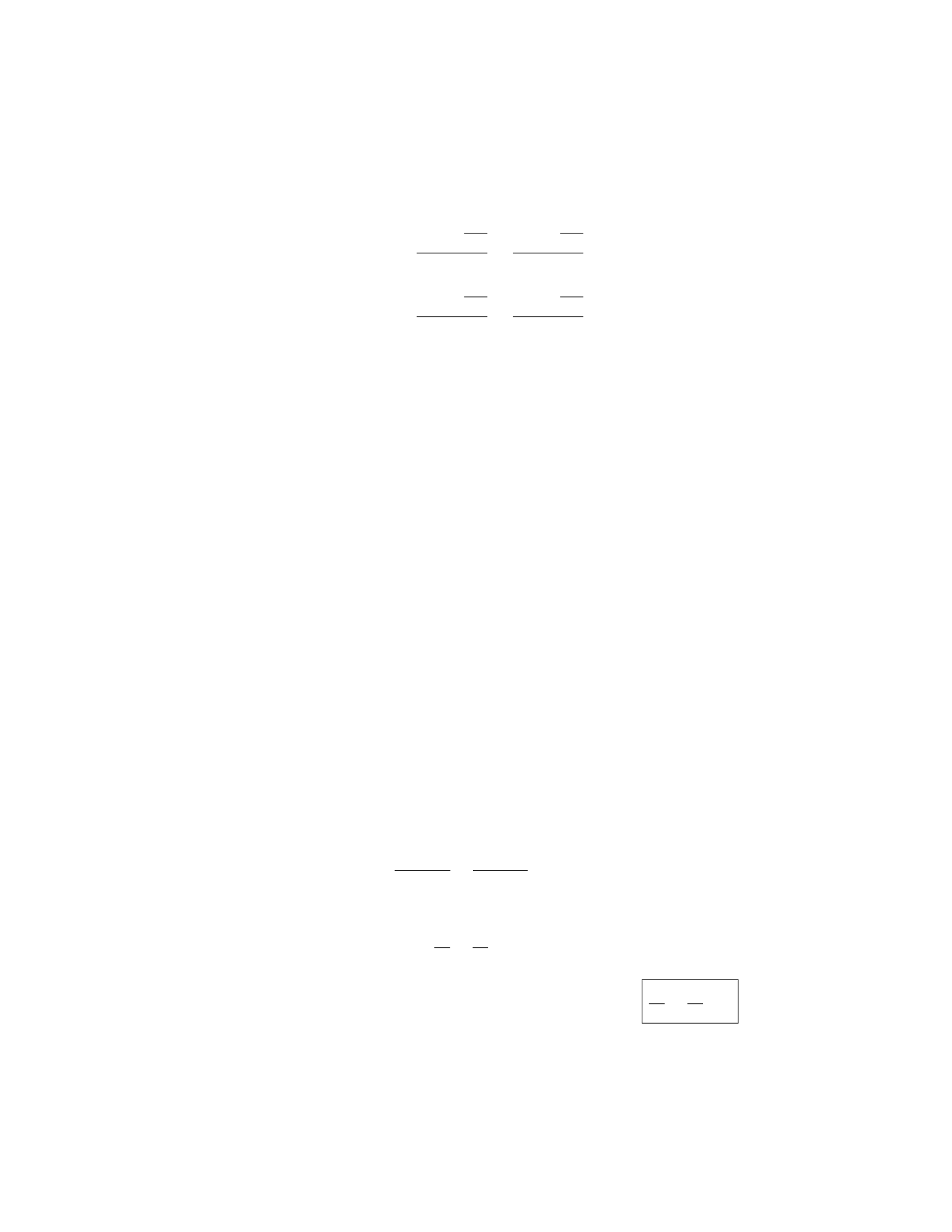
Therefore, the solutions to the system of equations are:
(3−2(42 + √740
32 ),42 + √740
32 )
(3−2(42 −√740
32 ),42 −√740
32 )
Question 22
Question
Find the standard form of the equation of the hyperbola with foci at (−4,0)
and (4,0) and vertices at (−6,0) and (6,0).
Solution
Step 1: Determine the center of the hyperbola. The center of the hyperbola is
the midpoint of the line segment connecting the vertices. Therefore, the center
is at (0,0).
Step 2: Find the distance between the center and the foci. The distance
between the center and either focus is equal to the distance between the center
and either vertex plus the distance between the vertex and the focus. Thus, the
distance is 6 + 4 = 10.
Step 3: Determine the value of c, which is the distance between the center
and either focus. In this case, c= 10.
Step 4: Find the value of a, which is the distance between the center and
either vertex. In this case, a= 6.
Step 5: Use the relationship c2=a2+b2and the values of aand cto find b.
102= 62+b2=⇒b2= 100 −36 = 64 =⇒b=±8
Step 6: Determine the equation of the hyperbola with the given information.
Since the transverse axis is horizontal, the standard form of the equation of a
hyperbola is:
(x−h)2
a2−(y−k)2
b2= 1
where (h, k)is the center of the hyperbola. Plugging in the values, we get:
x2
36 −y2
64 = 1
Therefore, the standard form of the equation of the hyperbola is x2
36 −y2
64 = 1 .
20

Question 23
Question
Find the standard form of the equation of the conic section defined by the given
equation: 9x2−36x−4y2+ 16y−36 = 0. Identify the conic section represented
by the equation.
Solution
Step 1: Rearrange the terms in the given equation:
9x2−36x−4y2+ 16y−36 = 0
Step 2: Complete the square for the x-terms by adding (36/2)2= 324 inside
the parentheses and subtracting 324 outside to keep the equation balanced:
9(x2−4x+ 36) −4y2+ 16y−36 = 0
Step 3: Complete the square for the y-terms by adding (16/2)2= 64 inside
the parentheses and subtracting 64 outside to keep the equation balanced:
9(x2−4x+ 36) −4(y2−4y+ 64) = 0
Step 4: Rewriting the perfect square trinomials:
9(x−2)2−4(y−2)2−576 = 0
Step 5: Move the constant term to the other side:
9(x−2)2−4(y−2)2= 576
Step 6: Divide by 576 to get the equation in the standard form, dividing
each term by 576:
(x−2)2
64 −(y−2)2
144 = 1
So, the standard form of the equation is (x−2)2
64 −(y−2)2
144 = 1. This represents
a hyperbola.
Question 24
Question
Find the standard form equation of the ellipse with foci at (-5, 0) and (5, 0),
and minor axis length of 4.
21

Solution
Step 1: Determine the center of the ellipse by finding the midpoint between
the two foci. Let the center of the ellipse be (h, k). The midpoint formula is
(x1+x2
2,y1+y2
2). The center of the ellipse is (−5+5
2,0+02 , giving us the center at (0, 0).
Step 2: Determine the length of the major axis. The distance between the
foci is the length of the major axis. In this case, the distance is 10 units.
Step 3: Determine the equation involving the major and minor axes. The
standard form equation of an ellipse is (x−h)2
a2+(y−k)2
b2= 1, where ais the length
of the semi-major axis and bis the length of the semi-minor axis.
Step 4: Determine the value of a. Since the minor axis length is 4, we have
2b= 4, which means b= 2.
Step 5: Substitute the known values into the equation and solve for a. Sub-
stitute h= 0,k= 0,a= 5, and b= 2 into the standard form equation. We
have x2
52+y2
22= 1.
Step 6: Write the final equation in standard form. The standard form
equation of the ellipse with foci at (-5, 0) and (5, 0), and minor axis length
of 4 is x2
25 +y2
4= 1 .
Question 25
Question
Solve the equation 4x2+ 9y2+ 8x−36y−4=0for xto find the equation of
the corresponding conic section.
Solution
Step 1: Rearrange the given equation by completing the square for both xand
yterms.
4x2+ 9y2+ 8x−36y−4 = 0
4x2+ 8x+ 9y2−36y= 4
4(x2+ 2x) + 9(y2−4y) = 4
4(x2+ 2x+ 1) + 9(y2−4y+ 4) = 4 + 4(1) + 9(4)
4(x+ 1)2+ 9(y−2)2= 49
Step 2: Identify the standard form of the equation which corresponds to an
ellipse. The standard form of the equation of an ellipse centered at (h, k)with
major axis along the x-axis and minor axis along the y-axis is: (x−h)2
a2+(y−k)2
b2=
1, where ais the length of the semi-major axis and bis the length of the semi-
minor axis.
Comparing the given equation to the standard form of an ellipse, we have
a=√49
4=7
2and b=√49
9=7
3. So, the center of the ellipse is (−1,2).
22

Question 2
Question
Find the standard form of the equation of the hyperbola with vertices at (-4,3)
and (-4,-3), and foci at (-4,6) and (-4,-6).
Solution
Step 1: Find the center of the hyperbola by averaging the coordinates of the ver-
tices. Since the vertices are at (-4,3) and (-4,-3), the center is at (−4,3+(−3)
2) =
(−4,0).
Step 2: Find the distance between the center and one of the vertices to
determine a. Use the formula a=distance to vertices
2. The distance between the
center (−4,0) and either of the vertices is 3 units. Therefore, a=3
2= 1.5.
Step 3: Find the distance between the center and one of the foci to determine
c. Use the formula c=distance to foci
2. The distance between the center (−4,0)
and either of the foci is 6 units. Therefore, c=6
2= 3.
Step 4: Find busing the formula for hyperbolas: b2=c2−a2. Substituting
the known values, we get b2= 32−1.52= 9 −2.25 = 6.75. So, b=√6.75 =
√27
4=3√3
2.
Step 5: The standard form of the equation of a hyperbola with center at
(h, k), vertices along the transverse axis on the x-axis, and foci at (h, k + c)
and (h, k - c) is
(x−h)2/a2−(y−k)2/b2= 1.
For this hyperbola, the equation becomes
(x+ 4)2/(1.5)2−y2/(3√3/2)2= 1.
Therefore, the standard form of the equation of the hyperbola is
(x+ 4)2/2.25 −y2/(27/4) = 1.
Question 3
Question
Solve the equation 3x2+4xy +4y2−8x−16y+16 = 0 by completing the square.
Solution
Step 1: Rearrange the terms in the equation to group the xterms and yterms
separately:
3x2+ 4xy + 4y2−8x−16y+ 16 = 0
3x2+ 4xy −8x+ 4y2−16y+ 16 = 0
2

Step 2: Complete the square for the xterms by focusing on the 3x2+4xy−8x
part:
3x2+ 4xy −8x= 3(x2−8
3x)+4xy
= 3(x2−8
3x+16
9)+4xy −3(16
9)
= 3(x−4
3)2+ 4xy −16
3
Step 3: Similarly, complete the square for the yterms by focusing on the
4y2−16ypart:
4y2−16y= 4(y2−4y)
= 4(y2−4y+ 4) −4(4)
= 4(y−2)2−16
Step 4: Substitute the completed squares back into the original equation:
3(x−4
3)2+ 4xy −16
3+ 4(y−2)2−16 + 16 = 0
Step 5: Simplify the equation:
3(x−4
3)2+ 4xy + 4(y−2)2−16
3−16 = 0
Step 6: The equation can be further simplified to the standard form of a
conic section:
3(x−4
3)2+ 4(y−2)2=64
3
Therefore, the given equation represents an ellipse in standard form.
Question 4
Question
Determine the standard form of the equation of the conic section with the focus
F(2,3) and the directrix y= 4.
Solution
Step 1: Recall that the standard form of the equation for a conic section with
focus (h, k)and directrix ax +by +c= 0 is given by:
For a parabola:
(x−h)2= 4p(y−k)
For an ellipse:
(x−h)2
a2+(y−k)2
b2= 1
3

For a hyperbola:
(x−h)2
a2−(y−k)2
b2= 1
Step 2: Since the given directrix is y= 4, the equation of the directrix is of
the form y=b. This suggests that the conic section is a parabola.
Step 3: Determine the distance pbetween the focus and the directrix. The
distance pfor a parabola is the distance from the vertex to the focus (or direc-
trix).
Step 4: Using the distance formula, we have:
p=|3−4|= 1
Step 5: The vertex of the parabola is halfway between the focus and the
directrix. Since the directrix is at y= 4, the vertex has a y-coordinate of 3.5.
Step 6: The standard form of the equation for a vertical parabola is:
(x−h)2= 4p(y−k)
Substitute the given values h= 2,k= 3.5, and p= 1 into the standard form
to get the equation of the parabola:
(x−2)2= 4(y−3.5)
Therefore, the standard form of the equation of the parabola is (x−2)2=
4(y−3.5).
Question 5
Question
Solve for xand yin the system of equations:
{x2−4y2= 5
4x2+ 9y2= 36
Solution
Step 1: We start by multiplying the first equation by 9and the second equation
by 4to make the coefficients of y2equal in both equations:
{9x2−36y2= 45
16x2+ 36y2= 144
Step 2: Now, add the two equations together to eliminate the y2term:
9x2−36y2+ 16x2+ 36y2= 45 + 144
4

25x2= 189
Step 3: Divide by 25 to solve for x2:
x2=189
25 =189
25 = 7.56
Step 4: Take the square root of both sides to solve for x:
x=±√7.56 = ±2.75
Step 5: Substitute xback into the first equation x2−4y2= 5 to solve for y:
(2.75)2−4y2= 5
7.56 −4y2= 5
−4y2=−2.56
y2= 0.64
y=±√0.64 = ±0.8
Therefore, the solutions to the system of equations are x= 2.75, y = 0.8and
x=−2.75, y =−0.8.
Question 6
Question
Find the standard form of the equation of a hyperbola with vertices at (-3,2)
and (-3,8), and a major axis of length 10.
Solution
Step 1: Determine the center of the hyperbola by finding the midpoint of the
vertices. Step 2: Determine the distance from the center to one of the vertices
to find the value of a. Step 3: Determine the value of busing the length of the
major axis. Step 4: Use the information obtained to write the standard form of
the equation of the hyperbola.
Step 1: The center of the hyperbola is the midpoint of the vertices. Midpoint
=(x1+x2
2,y1+y2
2)Midpoint = (−3+(−3)
2,2+8
2)Midpoint = (−3,5)
Step 2: The value of ais the distance from the center to one of the vertices.
a=length of major axis
2=10
2= 5
Step 3: The value of bcan be found using the length of the major axis.
For a hyperbola, the relation between a,band the length of the major axis
is: a2+b2=length of major axis252+b2= 10225 + b2= 100 b2= 75
b=√75 = 5√3
5

Step 4: The standard form of the equation of a hyperbola centered at (−3,5)
with vertices at (−3,2) and (−3,8) is:
(y−5)2
25 −(x+ 3)2
75 = 1
Question 7
Question
Find the standard form of the equation of the parabola with focus F(2,3) and
vertex V(−1,3).
Solution
Step 1: Use the definition of a parabola to find the distance from the vertex to
the focus. The distance between the vertex and the focus of a parabola is called
the focal length and is denoted by p. Step 2: Calculate the focal length pusing
the distance formula: With V(−1,3) and F(2,3), we have
p=√(2 −(−1))2+ (3 −3)2=√32+ 02= 3.
So, p= 3.
Step 3: Determine the equation of the parabola according to which way it
opens. Since the focus is to the right of the vertex, the parabola opens to the
right.
Step 4: Use the standard form of the equation for a parabola that opens to
the right:
(x−h)2= 4p(y−k),
where (h, k)is the vertex. Substitute h=−1,k= 3, and p= 3:
(x+ 1)2= 12(y−3).
Thus, the standard form of the equation of the parabola is (x+ 1)2= 12(y−3).
Question 8
Question
Find the standard form of the equation of the hyperbola with vertices at (-5, 0)
and (5, 0) and passing through the point (6, 2).
6

Solution
To find the standard form of the equation of the hyperbola, we need to determine
the center, a, b, and c values. Then we can plug these values into the standard
form of a hyperbola equation.
Step 1: Find the center The center of the hyperbola can be found at the
midpoint of the vertices:
(h, k) = (−5+5
2,0+0
2)= (0,0).
Step 2: Find the values of a and b The distance from the center to one
of the vertices gives us the value of a, while the distance from the center to the
foci gives us the value of c:
a= 5 −0 = 5.
Step 3: Find c The distance between the center and one of the foci equals:
c=√a2+b2.
Step 4: Use the point on the hyperbola to determine b Using the
point (6, 2) on the hyperbola, we can substitute the values into the equation of
a hyperbola:
(x−h)2
a2−(y−k)2
b2= 1,
to solve for b.
Step 5: Write the standard form of the equation of the hyperbola
Substitute the values of h, k, a, and b into the standard form of the hyperbola
equation:
x2
25 −y2
9= 1.
Thus, the standard form of the equation of the hyperbola is x2
25 −y2
9= 1.
Question 9
Question
Solve the quadratic equation 3x2+ 7x−5=0using the quadratic formula.
Write the solutions in simplest radical form.
Solution
Step 1: Identify the coefficients a,b, and cin the quadratic equation ax2+
bx +c= 0. In this case, a= 3,b= 7, and c=−5.
Step 2: Write down the quadratic formula:
x=−b±√b2−4ac
2a
7

Step 3: Substitute the values of a,b, and cinto the quadratic formula:
x=−(7) ±√(7)2−4(3)(−5)
2(3)
Step 4: Simplify the expression under the square root:
x=−7±√49 + 60
6
x=−7±√109
6
Step 5: The solutions are then:
x=−7 + √109
6and x=−7−√109
6
Therefore, the solutions to the quadratic equation 3x2+7x−5 = 0 in simplest
radical form are x=−7+√109
6and x=−7−√109
6.
Question 10
Question
Find the standard form of the equation of the hyperbola that satisfies the given
conditions: vertices at (−2,3) and (2,3), and passing through the point (4,2).
Solution
To find the standard form of the equation of the hyperbola, we first need to
determine the center and parameters of the hyperbola.
Step 1: Find the center of the hyperbola. The center of the hyperbola
is the midpoint of the segment connecting the vertices. The midpoint of the
line segment with endpoints (−2,3) and (2,3) is:
(−2+2
2,3+3
2)= (0,3)
So, the center of the hyperbola is (0,3).
Step 2: Find the distance from the center to a vertex. The distance
from the center (0,3) to either vertex (−2,3) or (2,3) is the distance between 0
and 2, which is 2.
Step 3: Determine the equation of the transverse axis. Since the
transverse axis is horizontal in this case, the standard form of the equation of
the hyperbola is:
(x−h)2
a2−(y−k)2
b2= 1
8

where (h, k)is the center of the hyperbola, ais the distance from the center to
a vertex, and bis the distance from the center to a co-vertex.
Step 4: Substitute the given information into the equation. We
have: center (h, k) = (0,3),a= 2,bcan be found using the Pythagorean
theorem as b=√c2−a2where cis the distance from the center to the given
point (4,2).
The distance from the center to (4,2) is:
√(4 −0)2+ (2 −3)2=√16 + 1 = √17
Thus,
b=√(√17)2−22=√17 −4 = √13
Therefore, the equation of the hyperbola is:
x2
4−(y−3)2
13 = 1
Question 11
Question
Solve the system of equations:
{x2+y2−5x+ 6y= 0
x+ 2y= 2
Solution
Step 1: Let’s rewrite the second equation to solve for xin terms of y.
x= 2 −2y
Step 2: Substitute xin terms of yinto the first equation.
(2 −2y)2+y2−5(2 −2y)+6y= 0
Step 3: Expand and simplify the equation.
4−8y+ 4y2+y2−10 + 10y+ 6y= 0
5y2+ 8y−6 = 0
Step 4: Solve the quadratic equation for y.
y=−b±√b2−4ac
2a
9

y=−8±√82−4(5)(−6)
2(5)
y=−8±√64 + 120
10
y=−8±√184
10
y=−8±2√46
10
y=−4
5±√46
5
Step 5: Now substitute yback into x= 2 −2yto solve for x.
x= 2 −2(−4
5±√46
5)
x= 2 + 8
5∓2√46
5
x=18
5∓2√46
5
Step 6: Thus, the solutions to the system of equations are:
(18
5+2√46
5,−4
5−√46
5)
and (18
5−2√46
5,−4
5+√46
5)
Question 12
Question
Solve the following system of equations:
{x2−y2= 9
x+y= 5
10

Solution
Step 1: Let’s solve the second equation for one of the variables. We can do this
by subtracting yfrom both sides to get:
x= 5 −y
Step 2: Now, substitute x= 5 −yinto the first equation:
(5 −y)2−y2= 9
Step 3: Expand (5 −y)2:
25 −10y+y2−y2= 9
Step 4: Simplify the equation:
25 −10y= 9
Step 5: Solve for y:
10y= 16
y=16
10
y= 1.6
Step 6: Substitute y= 1.6back into x= 5 −yto find x:
x= 5 −1.6
x= 3.4
Step 7: Therefore, the solution to the system of equations is (x, y) = (3.4,1.6).
Question 13
Question
Find the standard form of the equation of a hyperbola with vertices at (−3,0)
and (3,0) and foci at (−5,0) and (5,0).
Solution
Step 1: The standard form of the equation of a hyperbola with vertices at
(h±a, k)and foci at (h±c, k)is given by
(x−h)2/a2−(y−k)2/b2= 1
where ais the distance from the center to a vertex, bis the distance from the
center to the co-vertex, and cis the distance from the center to a focus. In this
case, we are given that the center lies on the x-axis, so k= 0.
Step 2: From the given information, we can find:
11

• Center: (h, k) = (−3+3
2,0)= (0,0)
• Distance from the center to a vertex: a= 3
• Distance from the center to a focus: c= 5
Step 3: Now, we can substitute the center and ainto the standard form of
the equation to find b:
(x−0)2/32−(y−0)2/b2= 1
x2/9−y2/b2= 1
Step 4: We can find busing the relationship a2+b2=c2:
32+b2= 52
9 + b2= 25
b2= 16
b= 4
Step 5: Finally, substitute the values of aand bback into the standard form
of the equation to get the final equation of the hyperbola:
x2/9−y2/16 = 1
Question 14
Question
Solve the system of equations:
{x2+y2= 10
x−y= 2
Solution
Step 1: Solve the second equation for xin terms of y:
Subtract yfrom both sides of the equation x−y= 2 to get x=y+ 2.
Step 2: Substitute x=y+ 2 into the first equation:
Substitute x=y+2 into the equation x2+y2= 10 to get (y+2)2+y2= 10.
Step 3: Expand and simplify the equation:
Expanding (y+ 2)2gives us y2+ 4y+ 4. Substituting this into the equation
gives y2+ 4y+4+y2= 10.
Step 4: Rearrange the equation:
Combine like terms to get 2y2+ 4y+ 4 = 10.
Step 5: Solve the quadratic equation:
12

Subtracting 10 from both sides, we have 2y2+ 4y−6 = 0. Dividing all
terms by 2 gives y2+ 2y−3 = 0. Factoring this quadratic equation gives
(y+ 3)(y−1) = 0.
Step 6: Find the values of y:
From the factored form, we get two possible values for y:y=−3and y= 1.
Step 7: Find the corresponding values of x:
Substitute y=−3into x=y+ 2 to get x=−3 + 2 = −1and substitute
y= 1 to get x= 1 + 2 = 3.
Step 8: The solutions to the system of equations are (x, y)=(−1,−3) and
(x, y) = (3,1).
Question 15
Question
Find the standard form of the equation of the ellipse with foci F1(−1,2) and
F2(5,2), and a major axis of length 10.
Solution
Step 1: Find the center of the ellipse.
To find the center of the ellipse, we need to find the midpoint of the line segment
connecting the foci. The midpoint of the line segment with endpoints (−1,2)
and (5,2) is:
(−1+5
2,2+2
2)= (2,2).
So, the center of the ellipse is at (2,2).
Step 2: Find the distance between the foci.
The distance between the two foci is the length of the major axis of the ellipse,
which is given as 10. By using the distance formula, the distance between
F1(−1,2) and F2(5,2) is:
√(5 −(−1))2+ (2 −2)2=√62= 6.
Step 3: Find the value of a.
The value of ais half the length of the major axis, so a=10
2= 5.
Step 4: Find the value of c.
The value of cis half the distance between the foci, so c=6
2= 3.
Step 5: Find the value of b.
The value of bcan be found using the relationship c2=a2−b2. Substituting in
the values of aand c:
32= 52−b2=⇒9 = 25 −b2=⇒b2= 16 =⇒b= 4.
Step 6: Write the equation in standard form.
The standard form of the equation of an ellipse is (x−h)2
a2+(y−k)2
b2= 1, where
13

(h, k)is the center of the ellipse. Substitute h= 2,k= 2,a= 5, and b= 4 into
the equation to get:
(x−2)2
52+(y−2)2
42= 1.
Therefore, the standard form of the equation of the ellipse is (x−2)2
25 +(y−2)2
16 = 1 .
Question 16
Question
Solve the following system of equations:
{x2+y2= 25
y= 2x
Solution
Step 1: Substitute y= 2xinto the first equation to eliminate y:
x2+ (2x)2= 25
Step 2: Simplify the equation:
x2+ 4x2= 25
5x2= 25
x2= 5
x=±√5
Step 3: Substitute the values of xback into the equation y= 2xto find the
corresponding values of y: For x=√5:
y= 2(√5) = 2√5
For x=−√5:
y= 2(−√5) = −2√5
Thus, the solutions to the system of equations are:
{x=√5, y = 2√5
x=−√5, y =−2√5
Question 17
Question
Solve the equation 4x2+ 16y2−32x+ 64y+ 16 = 0 by completing the square,
and then determine the type of conic section that the equation represents.
14

Solution
Step 1: Rearrange the equation by grouping the xterms and yterms separately:
(4x2−32x) + (16y2+ 64y) = −16
Step 2: Complete the square for the xterms:
4(x2−8x) + (16y2+ 64y) = −16
4(x2−8x+ 16) + (16y2+ 64y) = −16 + 4(16)
4(x−4)2+ (16y2+ 64y) = 48
Step 3: Complete the square for the yterms:
4(x−4)2+ 16(y2+ 4y) = 48
4(x−4)2+ 16(y2+ 4y+ 4) = 48 + 16(4)
4(x−4)2+ 16(y+ 2)2= 112
Step 4: Divide both sides by 112 to simplify the equation:
(x−4)2
7+(y+ 2)2
7= 1
Step 5: Compare the equation with the standard form of conic sections:
(x−h)2
a2+(y−k)2
b2= 1
Since a2= 7 and b2= 7 are both positive and equal, the equation represents
an ellipse.
Question 18
Question
Solve the following system of equations:
{2x2−5y2= 5
3x+ 4y= 2
15

Solution
Step 1: Solve the second equation for one variable in terms of the other. We
can solve the second equation for xin terms of y:
3x+ 4y= 2 =⇒3x= 2 −4y=⇒x=2−4y
3
Step 2: Substitute xfrom the second equation into the first equation to
eliminate x:
2(2−4y
3)2
−5y2= 5
Step 3: Simplify the equation by expanding and solving for y:
8−16y+ 16y2
9−5y2= 5
8−16y+ 16y2−45y2
9= 5
16y2−16y−37
9= 5
16y2−16y−37 = 45
16y2−16y−82 = 0
2y2−2y−10 = 0
Step 4: Solve the quadratic equation for yusing the quadratic formula:
y=−(−2) ±√(−2)2−4(2)(−10)
2(2)
y=2±√4 + 80
4
y=2±√84
4
y=2±2√21
4
y=1±√21
2
Step 5: Find the corresponding values of xusing x=2−4y
3For y=1+√21
2:
x=
2−4(1+√21
2)
3=−5 + √21
3
16

For y=1−√21
2:
x=
2−4(1−√21
2)
3=−5−√21
3
Therefore, the solutions to the system of equations are:
(−5 + √21
3,1 + √21
2)and (−5−√21
3,1−√21
2)
Question 19
Question
Find the equation of the hyperbola with vertices at (−4,0) and (4,0) and foci
at (−5,0) and (5,0).
Solution
Step 1: Find the center of the hyperbola using the midpoint formula. The center
is the midpoint of the line segment connecting the vertices, so we have:
Center =((−4 + 4)
2,(0 + 0)
2)= (0,0)
Step 2: Calculate the distance between the center and one of the foci. The
distance between the center and a focus is given by the formula c=√a2+b2,
where ais the distance from the center to a vertex, and bis a constant related
to the shape of the hyperbola. In this case, a= 4 (the distance from the center
to a vertex), and c= 5 (the distance from the center to a focus).
52= 42+b2
25 = 16 + b2
b2= 9
b= 3
Step 3: Determine the equation of the hyperbola in standard form. The
standard form of a hyperbola centered at the origin is x2
a2−y2
b2= 1. Since this
hyperbola has a center at the origin, the equation is instead given by x2
a2−y2
b2=
1. Substituting in the values of aand b:
x2
16 −y2
9= 1
17

Question 20
Question
Find the equation of the hyperbola with vertices at (−5,0) and (5,0) and foci
at (−8,0) and (8,0).
Solution
Step 1: The standard form of the equation of a hyperbola with the center at
the origin and vertices on the x-axis is given by:
x2
a2−y2
b2= 1
where ais the distance from the center to a vertex and bis the distance from
the center to a co-vertex.
Given that the distance between the vertices is 2a= 10, we have a= 5.
Additionally, the distance between the foci is 2√a2+b2= 16. Since 2a= 10,
we can find busing the equation:
2√a2+b2= 16
2√52+b2= 16
10 + b2= 42
b2= 16 −10 = 6
b=√6
So, the standard form of the equation is:
x2
52−y2
√62= 1
x2
25 −y2
6= 1
Step 2: Since the center of the hyperbola is at the origin, we do not need to
shift the vertices to find the equation.
Hence, the equation of the hyperbola with vertices at (−5,0) and (5,0) and
foci at (−8,0) and (8,0) is:
x2
25 −y2
6= 1
18

Question 21
Question
Solve the system of equations:
{3x2−2xy + 4y2= 11
x+ 2y= 3
Solution
Step 1: We start by solving the second equation for x:
x= 3 −2y
Step 2: Substitute xinto the first equation:
3(3 −2y)2−2(3 −2y)y+ 4y2= 11
Step 3: Expand and simplify the equation:
3(9 −12y+ 4y2)−6y+ 4y2= 11
27 −36y+ 12y2−6y+ 4y2= 11
Step 4: Combine like terms and arrange the terms to form a quadratic
equation:
16y2−42y+ 16 = 0
Step 5: Solve the quadratic equation:
y=−(−42) ±√(−42)2−4(16)(16)
2(16)
y=42 ±√1764 −1024
32
y=42 ±√740
32
Step 6: Evaluate the solutions for yto find the corresponding values of x:
For y=42+√740
32 :
x= 3 −2(42 + √740
32 )
For y=42−√740
32 :
x= 3 −2(42 −√740
32 )
19
Therefore, the solutions to the system of equations are:
(3−2(42 + √740
32 ),42 + √740
32 )
(3−2(42 −√740
32 ),42 −√740
32 )
Question 22
Question
Find the standard form of the equation of the hyperbola with foci at (−4,0)
and (4,0) and vertices at (−6,0) and (6,0).
Solution
Step 1: Determine the center of the hyperbola. The center of the hyperbola is
the midpoint of the line segment connecting the vertices. Therefore, the center
is at (0,0).
Step 2: Find the distance between the center and the foci. The distance
between the center and either focus is equal to the distance between the center
and either vertex plus the distance between the vertex and the focus. Thus, the
distance is 6 + 4 = 10.
Step 3: Determine the value of c, which is the distance between the center
and either focus. In this case, c= 10.
Step 4: Find the value of a, which is the distance between the center and
either vertex. In this case, a= 6.
Step 5: Use the relationship c2=a2+b2and the values of aand cto find b.
102= 62+b2=⇒b2= 100 −36 = 64 =⇒b=±8
Step 6: Determine the equation of the hyperbola with the given information.
Since the transverse axis is horizontal, the standard form of the equation of a
hyperbola is:
(x−h)2
a2−(y−k)2
b2= 1
where (h, k)is the center of the hyperbola. Plugging in the values, we get:
x2
36 −y2
64 = 1
Therefore, the standard form of the equation of the hyperbola is x2
36 −y2
64 = 1 .
20

Question 23
Question
Find the standard form of the equation of the conic section defined by the given
equation: 9x2−36x−4y2+ 16y−36 = 0. Identify the conic section represented
by the equation.
Solution
Step 1: Rearrange the terms in the given equation:
9x2−36x−4y2+ 16y−36 = 0
Step 2: Complete the square for the x-terms by adding (36/2)2= 324 inside
the parentheses and subtracting 324 outside to keep the equation balanced:
9(x2−4x+ 36) −4y2+ 16y−36 = 0
Step 3: Complete the square for the y-terms by adding (16/2)2= 64 inside
the parentheses and subtracting 64 outside to keep the equation balanced:
9(x2−4x+ 36) −4(y2−4y+ 64) = 0
Step 4: Rewriting the perfect square trinomials:
9(x−2)2−4(y−2)2−576 = 0
Step 5: Move the constant term to the other side:
9(x−2)2−4(y−2)2= 576
Step 6: Divide by 576 to get the equation in the standard form, dividing
each term by 576:
(x−2)2
64 −(y−2)2
144 = 1
So, the standard form of the equation is (x−2)2
64 −(y−2)2
144 = 1. This represents
a hyperbola.
Question 24
Question
Find the standard form equation of the ellipse with foci at (-5, 0) and (5, 0),
and minor axis length of 4.
21

Solution
Step 1: Determine the center of the ellipse by finding the midpoint between
the two foci. Let the center of the ellipse be (h, k). The midpoint formula is
(x1+x2
2,y1+y2
2). The center of the ellipse is (−5+5
2,0+02 , giving us the center at (0, 0).
Step 2: Determine the length of the major axis. The distance between the
foci is the length of the major axis. In this case, the distance is 10 units.
Step 3: Determine the equation involving the major and minor axes. The
standard form equation of an ellipse is (x−h)2
a2+(y−k)2
b2= 1, where ais the length
of the semi-major axis and bis the length of the semi-minor axis.
Step 4: Determine the value of a. Since the minor axis length is 4, we have
2b= 4, which means b= 2.
Step 5: Substitute the known values into the equation and solve for a. Sub-
stitute h= 0,k= 0,a= 5, and b= 2 into the standard form equation. We
have x2
52+y2
22= 1.
Step 6: Write the final equation in standard form. The standard form
equation of the ellipse with foci at (-5, 0) and (5, 0), and minor axis length
of 4 is x2
25 +y2
4= 1 .
Question 25
Question
Solve the equation 4x2+ 9y2+ 8x−36y−4=0for xto find the equation of
the corresponding conic section.
Solution
Step 1: Rearrange the given equation by completing the square for both xand
yterms.
4x2+ 9y2+ 8x−36y−4 = 0
4x2+ 8x+ 9y2−36y= 4
4(x2+ 2x) + 9(y2−4y) = 4
4(x2+ 2x+ 1) + 9(y2−4y+ 4) = 4 + 4(1) + 9(4)
4(x+ 1)2+ 9(y−2)2= 49
Step 2: Identify the standard form of the equation which corresponds to an
ellipse. The standard form of the equation of an ellipse centered at (h, k)with
major axis along the x-axis and minor axis along the y-axis is: (x−h)2
a2+(y−k)2
b2=
1, where ais the length of the semi-major axis and bis the length of the semi-
minor axis.
Comparing the given equation to the standard form of an ellipse, we have
a=√49
4=7
2and b=√49
9=7
3. So, the center of the ellipse is (−1,2).
22

Therefore, the equation corresponds to an ellipse centered at (−1,2) with a
semi-major axis of 7
2and a semi-minor axis of 7
3.
23

