


MATH 117 - ELEMENTS OF
MATHEMATICS - Gradient,
divergence, and curl
Question Bank - Set 6
Liberty University
Question 1
Question
Let F(x, y, z)=2xyi+ (x2−z2)j+yzkbe a vector field in R3. Compute the
curl of F.
Solution
To find the curl of a vector field F(x, y, z) = P(x, y, z)i+Q(x, y, z)j+R(x, y, z)k,
we use the formula
∇ × F=
i j k
∂
∂x
∂
∂y
∂
∂z
P Q R
.
Step 1: Compute the curl of F.
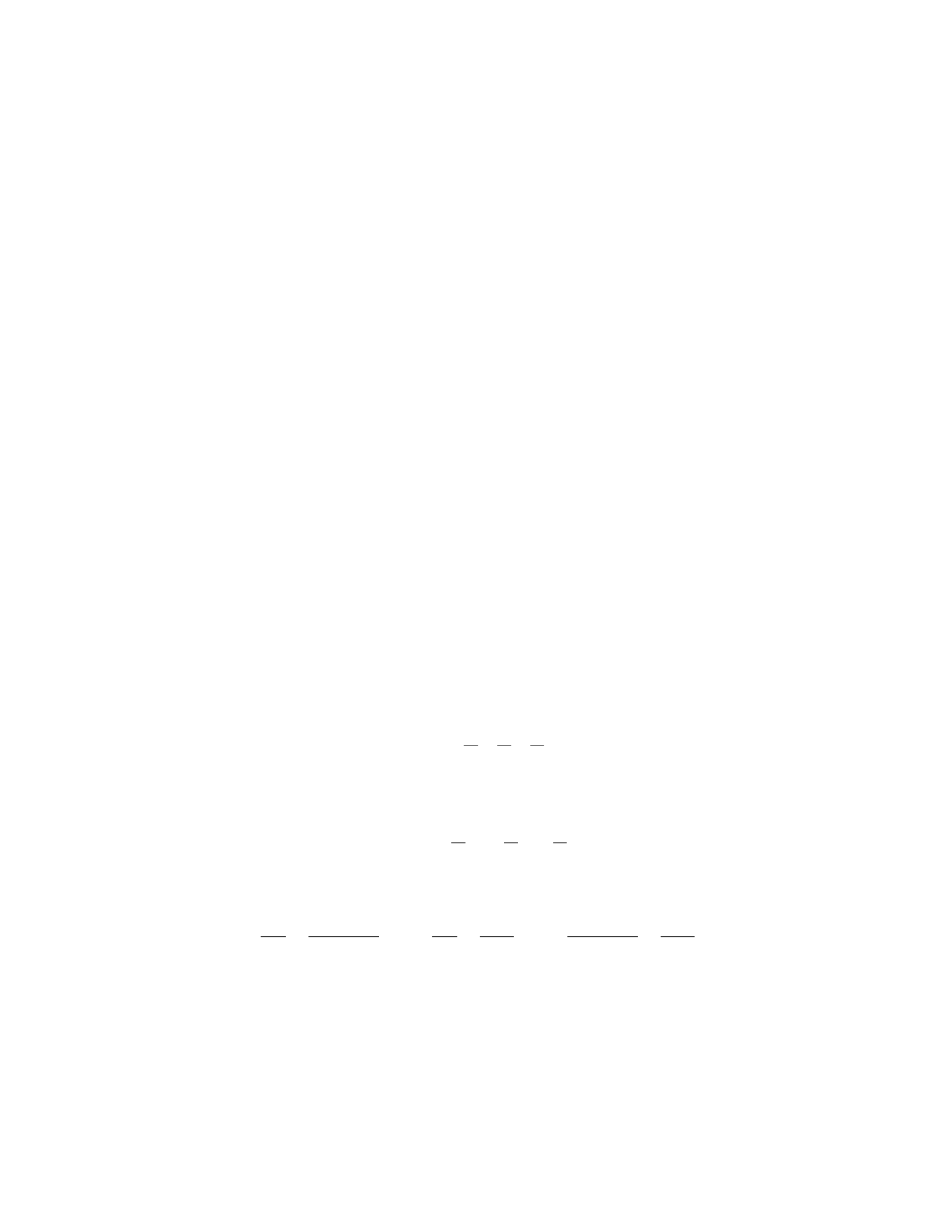
∇ × F=
i j k
∂
∂x
∂
∂y
∂
∂z
2xy x2−z2yz
Step 2: Expand the determinant to find the curl.
=∂yz
∂y −∂(x2−z2)
∂z i−∂yz
∂x −∂2xy
∂z j+∂(x2−z2)
∂x −∂2xy
∂y k
Step 3: Simplify the expressions to find the components of the curl.
= (z)i−(−2x)j+ (0)k
Step 4: Final answer: The curl of Fis ∇ × F=zi+ 2xj.
Question 2
Question
Let F(x, y, z)=(x2+y2)i+ (y2+z2)j+ (z2+x2)k. Calculate the curl of F.
Solution
Step 1: Recall that the curl of a vector field F(x, y, z) = P(x, y, z)i+Q(x, y, z)j+
R(x, y, z)kis given by the determinant of the following matrix:
∇ × F=
i j k
∂
∂x
∂
∂y
∂
∂z
P Q R
Step 2: Let’s find the components P,Q, and Rfor F:P(x, y, z) = x2+y2
Q(x, y, z) = y2+z2R(x, y, z) = z2+x2
Step 3: Compute the curl of F:
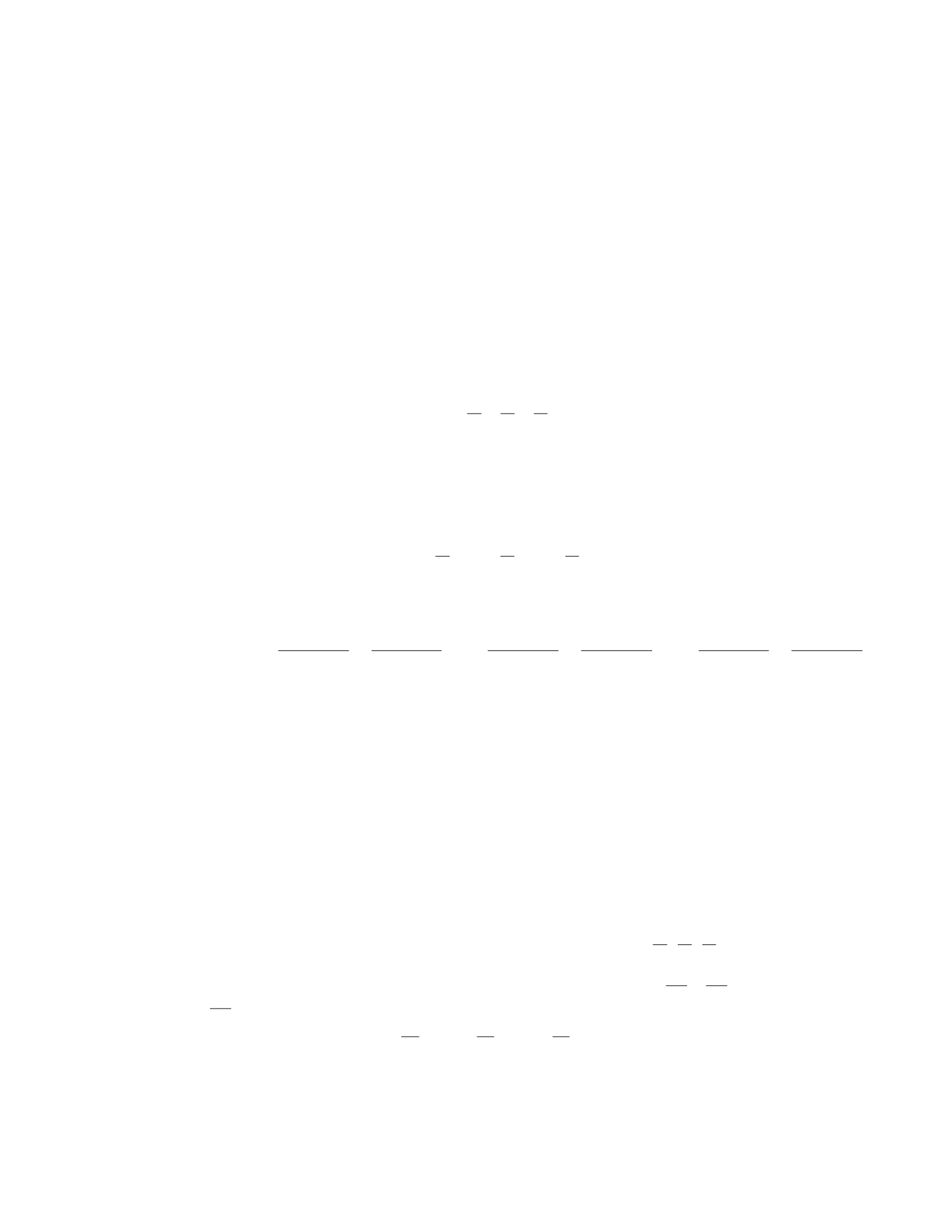
∇ × F=
i j k
∂
∂x
∂
∂y
∂
∂z
x2+y2y2+z2z2+x2
Step 4: Calculate the determinant by expanding along the first row:
∇×F=∂(z2+x2)
∂y −∂(y2+z2)
∂z i−∂(z2+x2)
∂x −∂(x2+y2)
∂z j+∂(y2+z2)
∂x −∂(x2+y2)
∂y k
Step 5: Simplify the partial derivatives to get the final expression for the
curl of F:
∇ × F= (−2y−2z)i+ (2x−2z)j+ (2y−2x)k
Therefore, the curl of Fis (−2y−2z)i+ (2x−2z)j+ (2y−2x)k.
Question 3
Question
Let F= (y2z, x2z, xy2) be a vector field in R3. Find the divergence of F.
Solution
To find the divergence of F, we will compute ∇ · F, where ∇=∂
∂x ,∂
∂y ,∂
∂z is
the del operator.
Step 1: Compute the divergence of Fusing the formula ∇·F=∂F1
∂x +∂F2
∂y +
∂F3
∂z .
∇ · F=∂
∂x (y2z) + ∂
∂y (x2z) + ∂
∂z (xy2)
2
Step 2: Compute the partial derivatives.
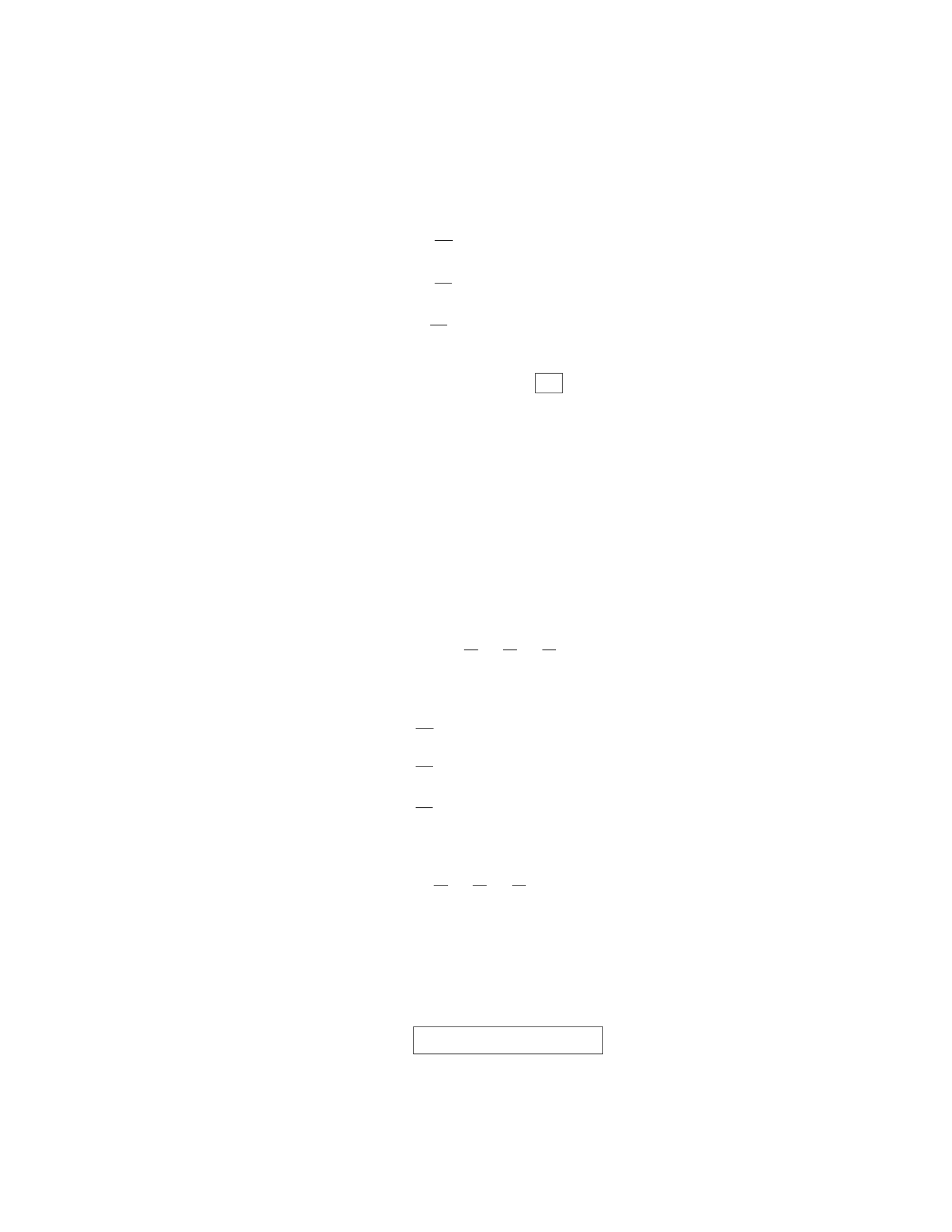
∂
∂x (y2z) = 0
∂
∂y (x2z) = 0
∂
∂z (xy2) = xy
Step 3: Sum the partial derivatives to find the divergence.
∇ · F=0+0+xy =xy
Therefore, the divergence of Fis xy.
Question 4
Question
Let F(x, y, z)=(yz2, xz2, xy2). Calculate the curl of F.
Solution
To find the curl of F, we need to compute the determinant of the following
matrix:
curl(F) =
i j k
∂
∂x
∂
∂y
∂
∂z
yz2xz2xy2
Step 1: Compute the partial derivatives:
∂
∂x = (0, z2, y2)
∂
∂y = (z2,0,2xy)
∂
∂z = (2yz, 2xz, 0)
Step 2: Calculate the determinant:
curl(F) =
i j k
∂
∂x
∂
∂y
∂
∂z
yz2xz2xy2
= (2xy −0) −(2xz −0)i
−(2yz −z2) + (0 −y2)j
+ (z2−z2)−(0 −0)k
= 2xyi−2xzi−(2yz −z2)j
Therefore, the curl of Fis (2xy −2xz)i−(2yz −z2)j.
3

Question 5
Question
Let F(x, y, z)=(xz, xey, yz) be a vector field. Compute the divergence of Fat
the point (1,2,3).
Solution
Step 1: Recall that the divergence of a vector field F= (P(x, y, z), Q(x, y, z), R(x, y, z))
is given by the scalar function ∇ · F=∂P
∂x +∂Q
∂y +∂R
∂z .
Step 2: For the given vector field F(x, y, z)=(xz, xey, yz), we have P(x, y, z) =
xz,Q(x, y, z) = xey, and R(x, y, z) = yz.
Step 3: Calculate the partial derivatives:
∂P
∂x =z,
∂Q
∂y =xey,
∂R
∂z =y.
Step 4: Now, find the divergence of F:
∇ · F=∂P
∂x +∂Q
∂y +∂R
∂z
=z+xey+y.
Step 5: Finally, evaluate the divergence at the point (1,2,3):
∇ · F(1,2,3) = 3 + 1 ·e2+ 2
= 3 + e2+ 2
= 5 + e2.
Therefore, the divergence of the vector field Fat the point (1,2,3) is 5 + e2.
Question 6
Question
Let F(x, y, z) = xcos(yz)i+ysin(xz)j+zsin(xy)kbe a vector field. Compute
the curl of F.
4
Solution
To compute the curl of a vector field F(x, y, z) = P(x, y, z)i+Q(x, y, z)j+
R(x, y, z)k, we use the formula:
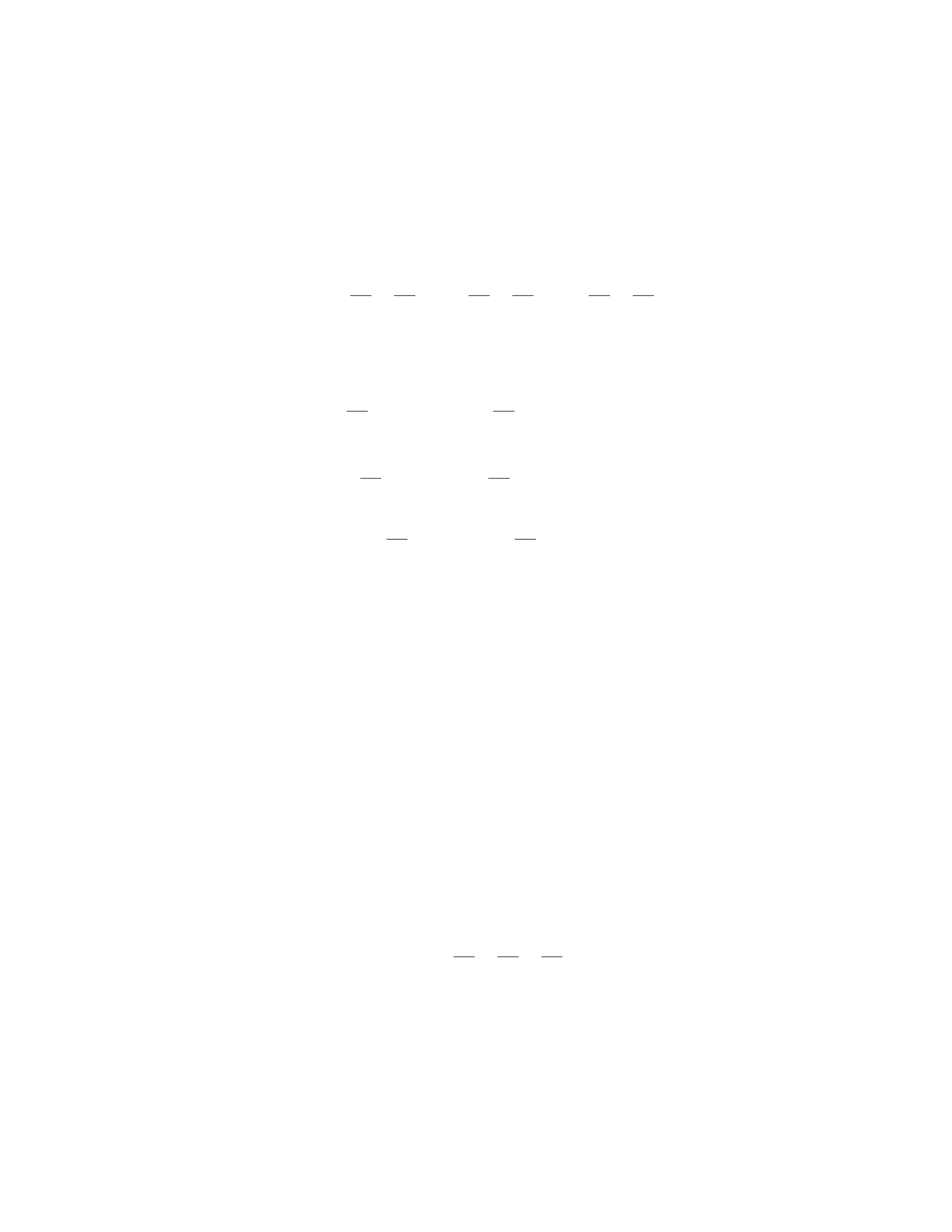
∇ × F=∂R
∂y −∂Q
∂z i−∂R
∂x −∂P
∂z j+∂Q
∂x −∂P
∂y k
In our case, P(x, y, z) = xcos(yz), Q(x, y, z) = ysin(xz), and R(x, y, z) =
zsin(xy). Let’s compute the curl of F:
Step 1: Calculate the partial derivatives:
∂P
∂y =−xz sin(yz),∂Q
∂z =xy cos(xz)
Step 2:
∂R
∂y =zcos(xy),∂Q
∂x =zcos(xy)
Step 3:
∂R
∂x =ycos(xy),∂P
∂z = 0
Step 4: Substitute these partial derivatives into the formula for the curl:
∇ × F= (zcos(xy)−ycos(xy))i−(−xz sin(yz))j+ (xy cos(xz))k
Step 5: Simplify the components:
∇ × F=zcos(xy)i+xz sin(yz)j+xy cos(xz)k
Therefore, the curl of the vector field Fis ∇×F=zcos(xy)i+xz sin(yz)j+
xy cos(xz)k.
Question 7
Question
Let F(x, y, z)=(exyz, x2y, z3) be a vector field in R3. Find the divergence of F.
Solution
To find the divergence of a vector field F(x, y, z)=(P(x, y, z), Q(x, y, z), R(x, y, z)),
we use the formula:
div(F) = ∂P
∂x +∂Q
∂y +∂R
∂z
Step 1: Identify P,Q, and Rin our vector field F(x, y, z):
P(x, y, z) = exyz, Q(x, y, z) = x2y, R(x, y, z) = z3
5
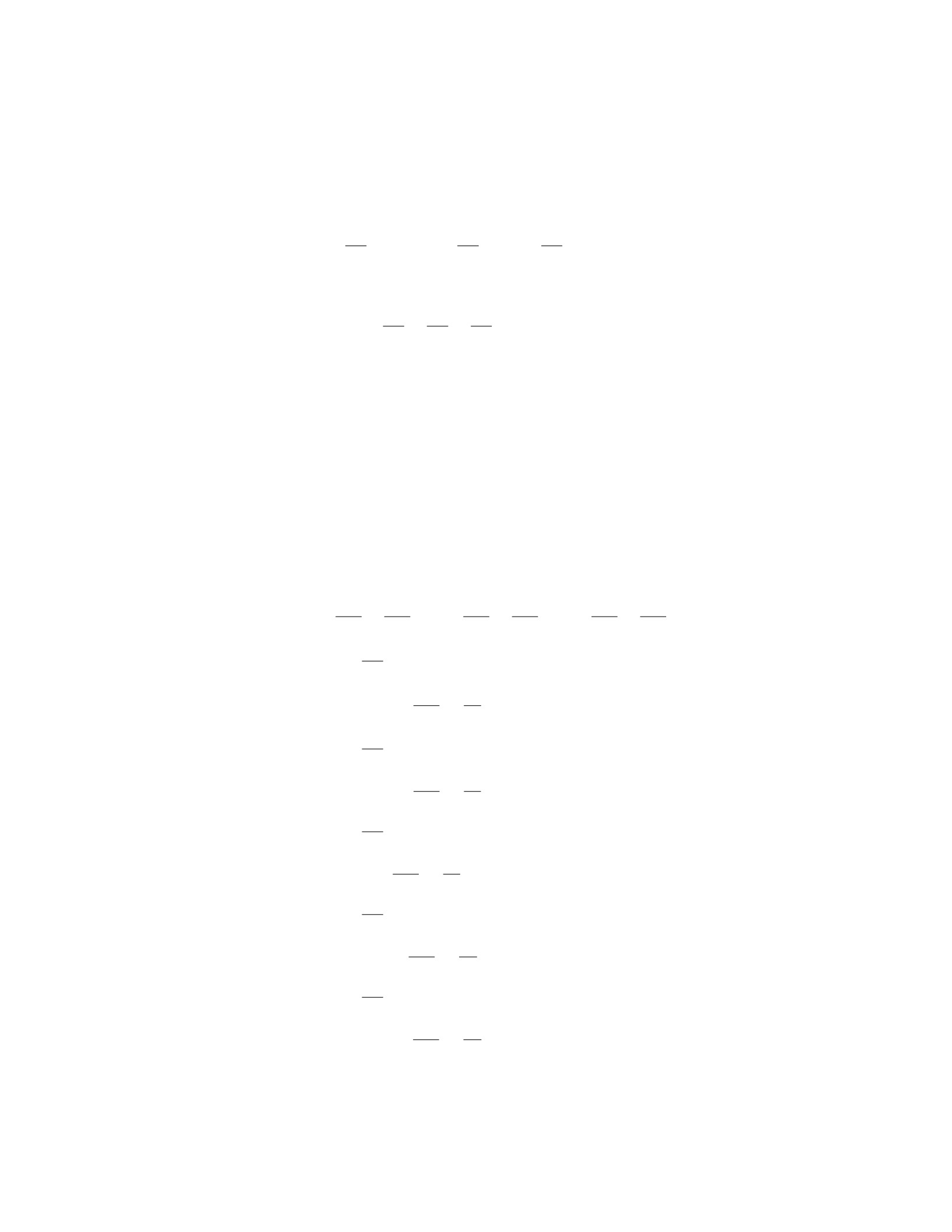
Step 2: Compute the partial derivatives:
∂P
∂x =yzexyz ,∂Q
∂y =x2,∂R
∂z = 3z2
Step 3: Calculate the divergence:
div(F) = ∂P
∂x +∂Q
∂y +∂R
∂z =yzexyz +x2+ 3z2
Therefore, the divergence of the vector field F(x, y, z) = (exyz, x2y, z3) is
yzexyz +x2+ 3z2.
Question 8
Question
Let F(x, y, z) = −3xzi+ 2yj+x2k. Compute the curl of F.
Solution
To compute the curl of a vector field F=F1i+F2j+F3k, we use the formula:
curl F=∂F3
∂y −∂F2
∂z i+∂F1
∂z −∂F3
∂x j+∂F2
∂x −∂F1
∂y k
Step 1: Compute ∂F3
∂y .
∂F3
∂y =∂
∂y (x2)=0
Step 2: Compute ∂F2
∂z .
∂F2
∂z =∂
∂z (2y)=0
Step 3: Compute ∂F1
∂z .
∂F1
∂z =∂
∂z (−3xz) = −3x
Step 4: Compute ∂F3
∂x .
∂F3
∂x =∂
∂x (x2) = 2x
Step 5: Compute ∂F2
∂x .
∂F2
∂x =∂
∂x (2y)=0
6
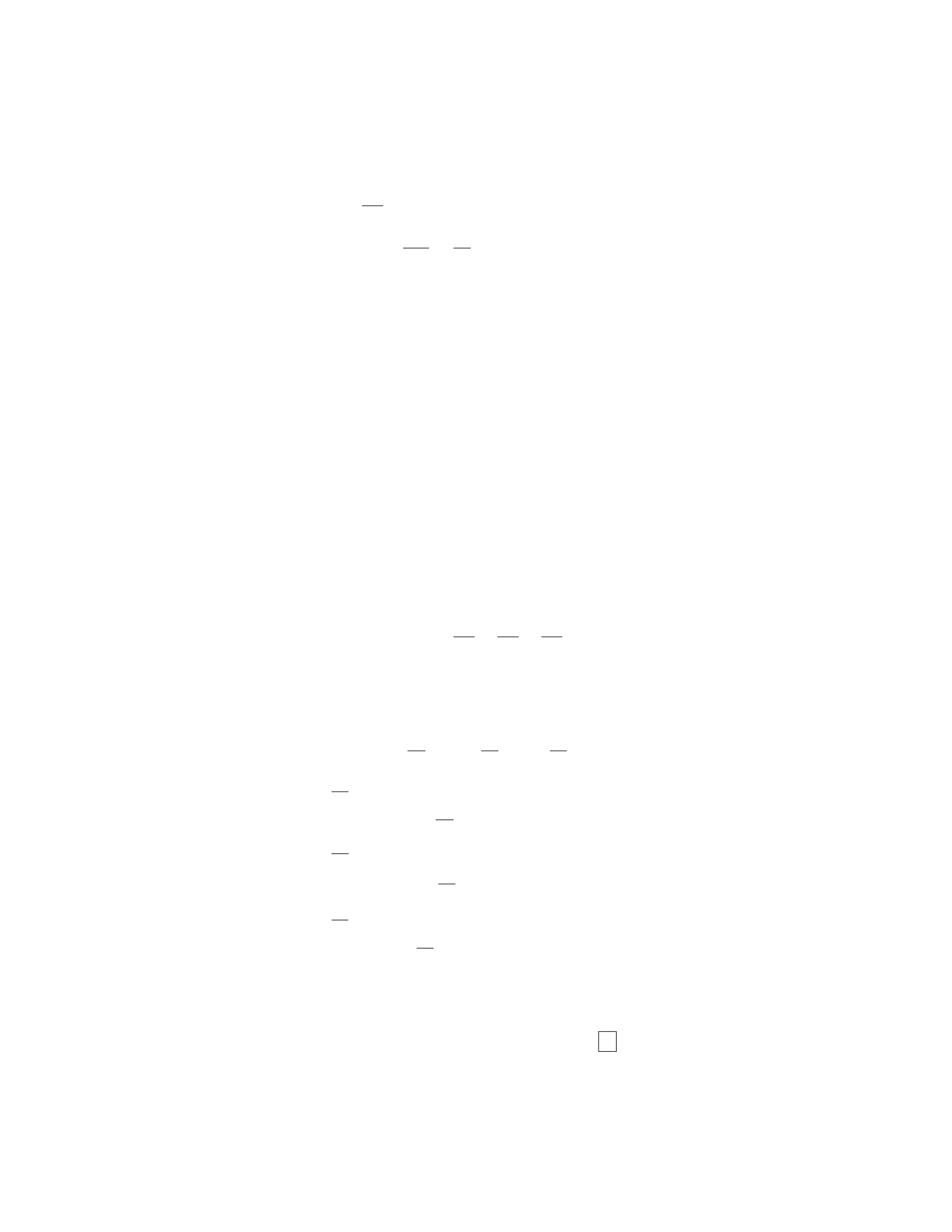
Step 6: Compute ∂F1
∂y .
∂F1
∂y =∂
∂y (−3xz) = 0
Step 7: Plug the computed partial derivatives into the formula for curl.
curl F= (0 −0)i+ (−3x−2x)j+ (0 −0)k
curl F=−5xj
Therefore, the curl of Fis −5xj.
Question 9
Question
Let F(x, y, z) = eyzi+xzj+yexz kbe a vector field. Determine the divergence
of Fat the point (1,2,0).
Solution
To find the divergence of a vector field F(x, y, z) = P(x, y, z)i+Q(x, y, z)j+
R(x, y, z)kat a point (x0, y0, z0), we use the formula:
div(F) = ∂P
∂x +∂Q
∂y +∂R
∂z
In this case, our vector field is F(x, y, z) = eyz i+xzj+yexz k, so P(x, y, z) =
eyz,Q(x, y, z) = xz, and R(x, y, z) = yexz .
Therefore, the divergence of Fis:
div(F) = ∂
∂x (eyz ) + ∂
∂y (xz) + ∂
∂z (yexz )
Step 1: Find ∂P
∂x :
∂
∂x (eyz )=0
Step 2: Find ∂Q
∂y :
∂
∂y (xz)=0
Step 3: Find ∂R
∂z :
∂
∂z (yexz ) = xyexz
Step 4: Calculate the divergence of Fat the point (1,2,0):
div(F) = 0 + 0 + (1)(2)(e(1)(0)) = 2
Therefore, the divergence of Fat the point (1,2,0) is 2 .
7

Question 10
Question
Let F(x, y)=(yex+x2, ex+ycos(y)) be a vector field. Find the divergence of
F.
Solution
To find the divergence of F, we need to compute the following:
div F=∇ · F=∂P
∂x +∂Q
∂y ,
where F(x, y)=(P(x, y), Q(x, y)).
Step 1: Compute ∂P
∂x .
∂P
∂x =∂
∂x (yex+x2) = yex
Step 2: Compute ∂Q
∂y .
∂Q
∂y =∂
∂y (ex+ycos(y)) = cos(y) + y(−sin(y)) = cos(y)−ysin(y)
Step 3: Find the divergence of F.
div F=∇ · F=∂P
∂x +∂Q
∂y =yex+ cos(y)−ysin(y)
Therefore, the divergence of Fis yex+ cos(y)−ysin(y).
Question 11
Question
Let F(x, y) = (2x2y−y3)i+ (x3−3xy2)jbe a vector field. Compute the curl
of F.
Solution
To compute the curl of a vector field F(x, y) = P(x, y)i+Q(x, y)j, where Pand
Qare component functions, we can use the formula:
∇ × F=∂Q
∂x −∂P
∂y k
Step 1: Compute ∂Q
∂x and ∂P
∂y .
8
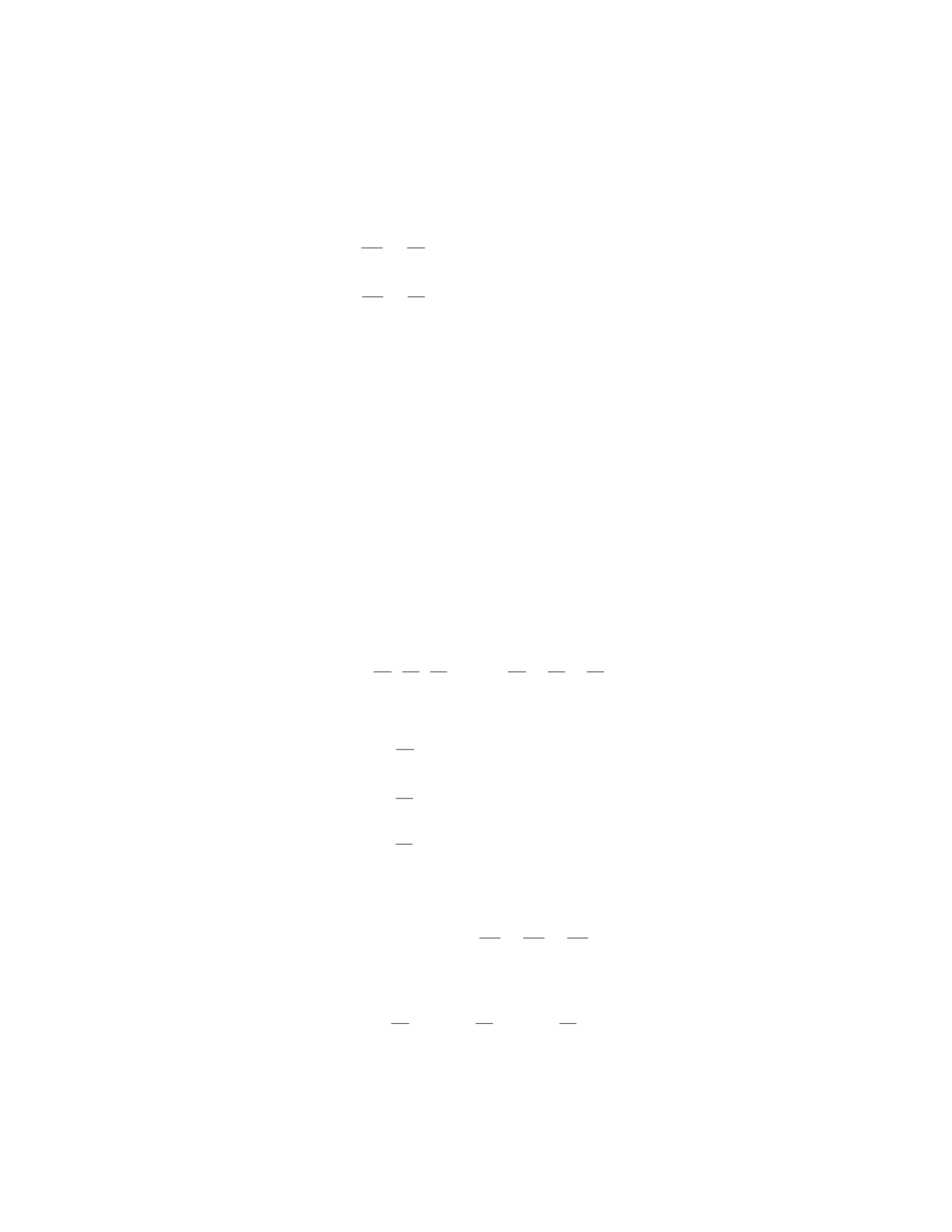
We have P(x, y) = 2x2y−y3and Q(x, y) = x3−3xy2. So,
∂Q
∂x =∂
∂x (x3−3xy2)=3x2−3y2
∂P
∂y =∂
∂y (2x2y−y3)=2x2−3y2
Step 2: Compute ∇ × F.
Substitute the computed partial derivatives into the formula:
∇ × F= (3x2−3y2−(2x2−3y2))k= (x2)k
Therefore, the curl of Fis x2k.
Question 12
Question
Consider the vector field F(x, y, z) = (x2yz, xy2z, xyz2). Determine the gradi-
ent, divergence, and curl of F.
Solution
Step 1: Find the gradient of F. The gradient of a vector field F(x, y, z) is given
by
∇F=∂
∂x ,∂
∂y ,∂
∂z F=∂
∂x F,∂
∂y F,∂
∂z F.
So, we need to find the partial derivatives of Fwith respect to x,y, and z.
∂
∂x F= (2xyz, y2z, yz2),
∂
∂y F= (x2z, 2xyz, xz2),
∂
∂z F= (x2y, xy2,2xyz).
Step 2: Find the divergence of F. The divergence of a vector field F(x, y, z) =
(P, Q, R) is given by
div(F) = ∇ · F=∂P
∂x +∂Q
∂y +∂R
∂z .
For F(x, y, z)=(x2yz, xy2z, xyz2), we have
div(F) = ∂
∂x (x2yz) + ∂
∂y (xy2z) + ∂
∂z (xyz2).
9

Computing the partial derivatives and summing them up, we get
div(F)=2xyz +xz2+yz2.
Step 3: Find the curl of F. The curl of a vector field F(x, y, z)=(P, Q, R)
is given by
curl(F) = ∇ × F=∂R
∂y −∂Q
∂z ,∂P
∂z −∂R
∂x ,∂Q
∂x −∂P
∂y .
For F(x, y, z)=(x2yz, xy2z, xyz2), we have
curl(F) = z2, z2, z2.
Question 13
Question
Let F(x, y, z) = (2x3y2,3xy3z, xyz2) be a vector field. Calculate the curl of F.
Solution
To find the curl of F, we need to compute the determinant of the following
matrix:
curl F=
i j k
∂
∂x
∂
∂y
∂
∂z
2x3y23xy3z xyz2
Step 1: Compute the partial derivatives:
∂
∂x (2x3y2)=6x2y2
∂
∂y (3xy3z)=3x(3y2z) = 9xy2z
∂
∂z (xyz2) = xz2
Step 2: Replace the partial derivatives in the determinant:
curl F=
i j k
6x2y29xy2z xz2
Step 3: Expand the determinant to find the curl:
curl F=∂(xz2)
∂y −∂(9xy2z)
∂z i−∂(xz2)
∂x −∂(6x2y2)
∂z j+∂(6x2y2)
∂x −∂(9xy2z)
∂y k
Simplify the expressions to find the final answer.
10

Question 14
Question
Let F(x, y, z)=2x2yi+ (x2+ 2yz)j+ 3xz2k. Calculate the curl of F.
Solution
To find the curl of F, we first need to express Fin terms of the unit vectors i,
j, and k. Then, we can apply the formula for the curl.
Step 1: Express F in terms of i,j, and k:
F(x, y, z)=2x2yi+ (x2+ 2yz)j+ 3xz2k
Step 2: Calculate the curl of F: The curl of a vector field F=Pi+
Qj+Rkis given by:
curl F=∇ × F=∂R
∂y −∂Q
∂z i−∂R
∂x −∂P
∂z j+∂Q
∂x −∂P
∂y k
Now, let’s compute the curl of F:
curl F=∂(3xz2)
∂y −∂(x2+ 2yz)
∂z i−∂(3xz2)
∂x −∂(2x2y)
∂z j+∂(x2+ 2yz)
∂x −∂(2x2y)
∂y k
Calculating each partial derivative, we get:
curl F= (0 −2z)i−(3z2−2y)j+ (0 −2x)k
Therefore, the curl of Fis:
curl F=−2zi−(3z2−2y)j−2xk
Question 15
Question
Let F(x, y, z) = x2ey+ysin(z), x cos(z), ex+z2. Calculate the divergence of
Fat the point (1, π, 0).
Solution
To find the divergence of F, we need to calculate the dot product of the gradient
operator ∇with the vector field F. The divergence of Fis given by:
div(F) = ∇ · F=∂Fx
∂x +∂Fy
∂y +∂Fz
∂z
11
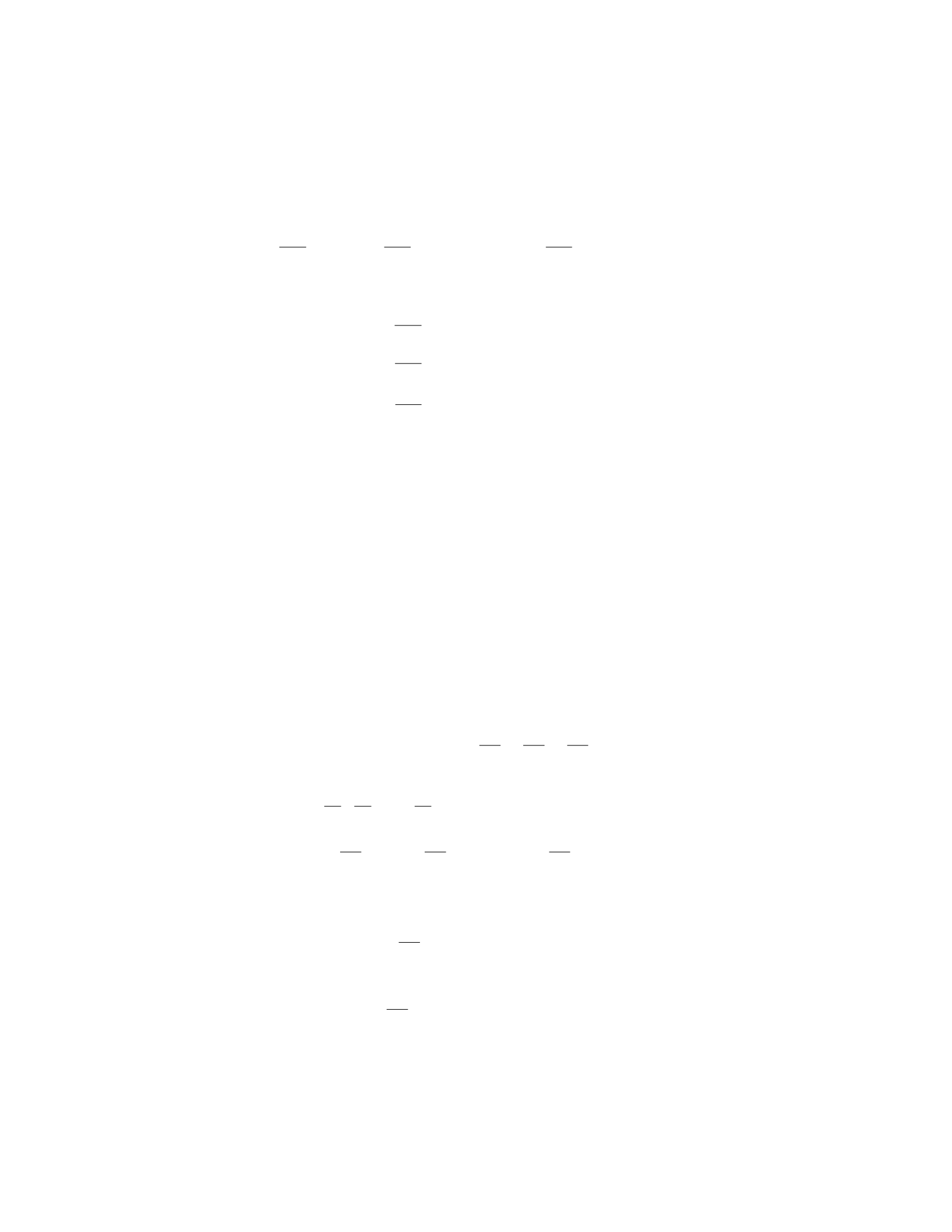
Given F(x, y, z) = x2ey+ysin(z), x cos(z), ex+z2, the partial derivatives
are: ∂Fx
∂x = 2xey,∂Fy
∂y =x2ey+ sin(z),∂Fz
∂z =x(−sin(z)),
Now compute these partial derivatives using the given point (1, π, 0):
∂Fx
∂x = 2eπ,
∂Fy
∂y =eπ+ sin(0) = eπ,
∂Fz
∂z = 1(−sin(0)) = 0.
Thus, the divergence of Fat the point (1, π, 0) is:
div(F)=2eπ+eπ+ 0 = 3eπ.
Question 16
Question
Let F(x, y, z) = x2−2y, y2−2z, z2−2xbe a vector field. Calculate the
divergence of Fat the point (1,−1,2).
Solution
To find the divergence of the vector field Fat the point (1,−1,2), we use the
formula for divergence:
div(F) = ∇ · F=∂P
∂x +∂Q
∂y +∂R
∂z ,
where F(x, y, z)=(P(x, y, z), Q(x, y, z), R(x, y, z)).
Step 1: Find ∂P
∂x ,∂Q
∂y , and ∂R
∂z .
∂P
∂x = 2x, ∂Q
∂y = 2y, and ∂R
∂z = 2z.
Step 2: Evaluate the partial derivatives at the given point (1,−1,2).
∂P
∂x
(1,−1,2)
= 2(1) = 2,
∂Q
∂y
(1,−1,2)
= 2(−1) = −2,
12
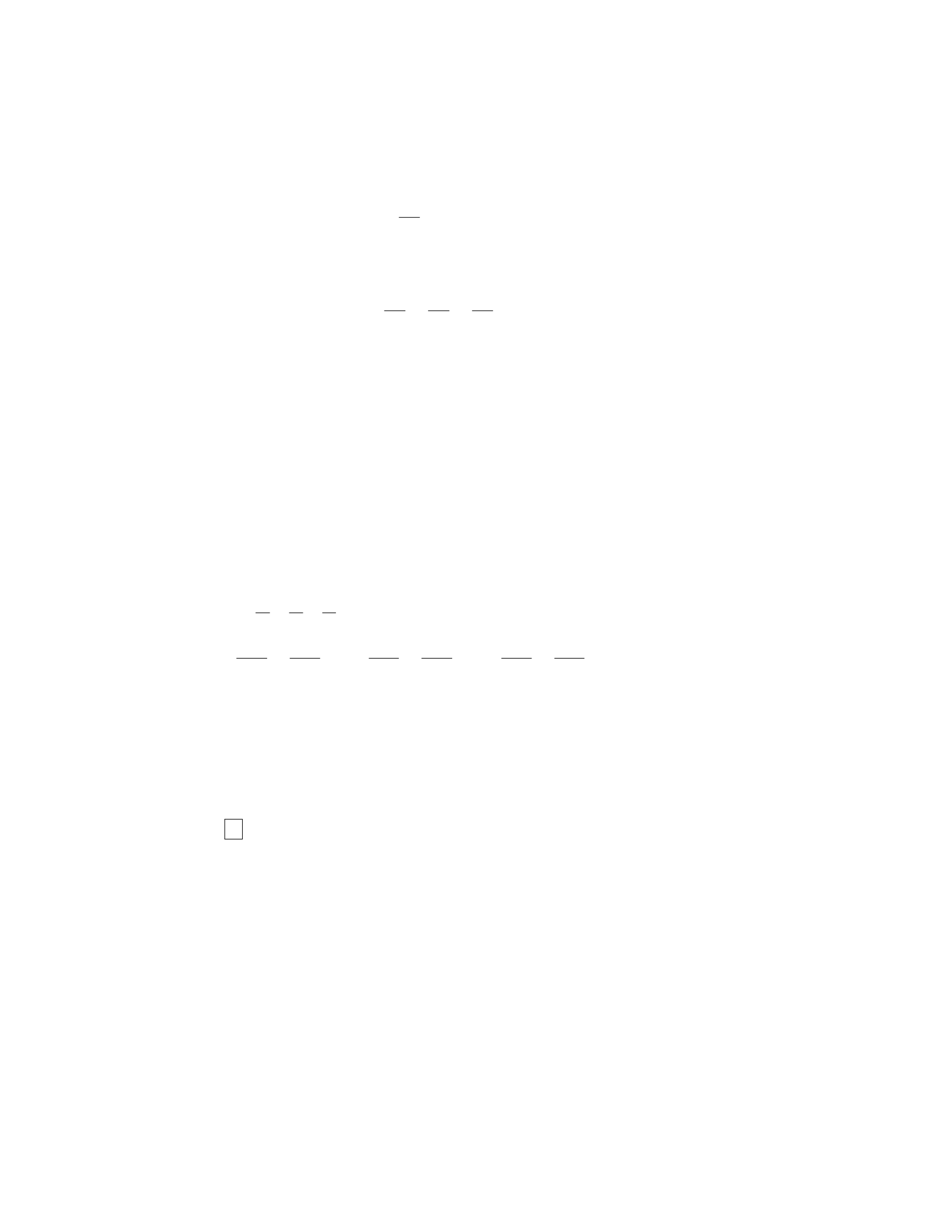
∂R
∂z
(1,−1,2)
= 2(2) = 4.
Step 3: Calculate the divergence of Fat the point (1,−1,2).
div(F)
(1,−1,2)
=∂P
∂x +∂Q
∂y +∂R
∂z
(1,−1,2)
= 2 + (−2) + 4 = 4.
Therefore, the divergence of the vector field Fat the point (1,−1,2) is 4.
Question 17
Question
Let F(x, y, z) = yzi+xzj+xyk. Calculate ∇ · ∇ × F.
Solution
Step 1: Find ∇ × F.
=
i j k
∂
∂x
∂
∂y
∂
∂z
yz xz xy
=∂(xy)
∂y −∂(xz)
∂z i−∂(yz)
∂x −∂(xy)
∂z j+∂(xz)
∂x −∂(yz)
∂y k
= (x−x)i−(z−z)j+ (y−y)k
=0
Step 2: Calculate ∇ · ∇ × F.
=∇ · 0
= 0
Question 18
Question
Let F(x, y, z) = yzi+xzj+xykbe a vector field in R3. Determine the curl of
F.
13
Solution
To find the curl of a vector field F(x, y, z) = P(x, y, z)i+Q(x, y, z)j+R(x, y, z)k,
we use the formula:
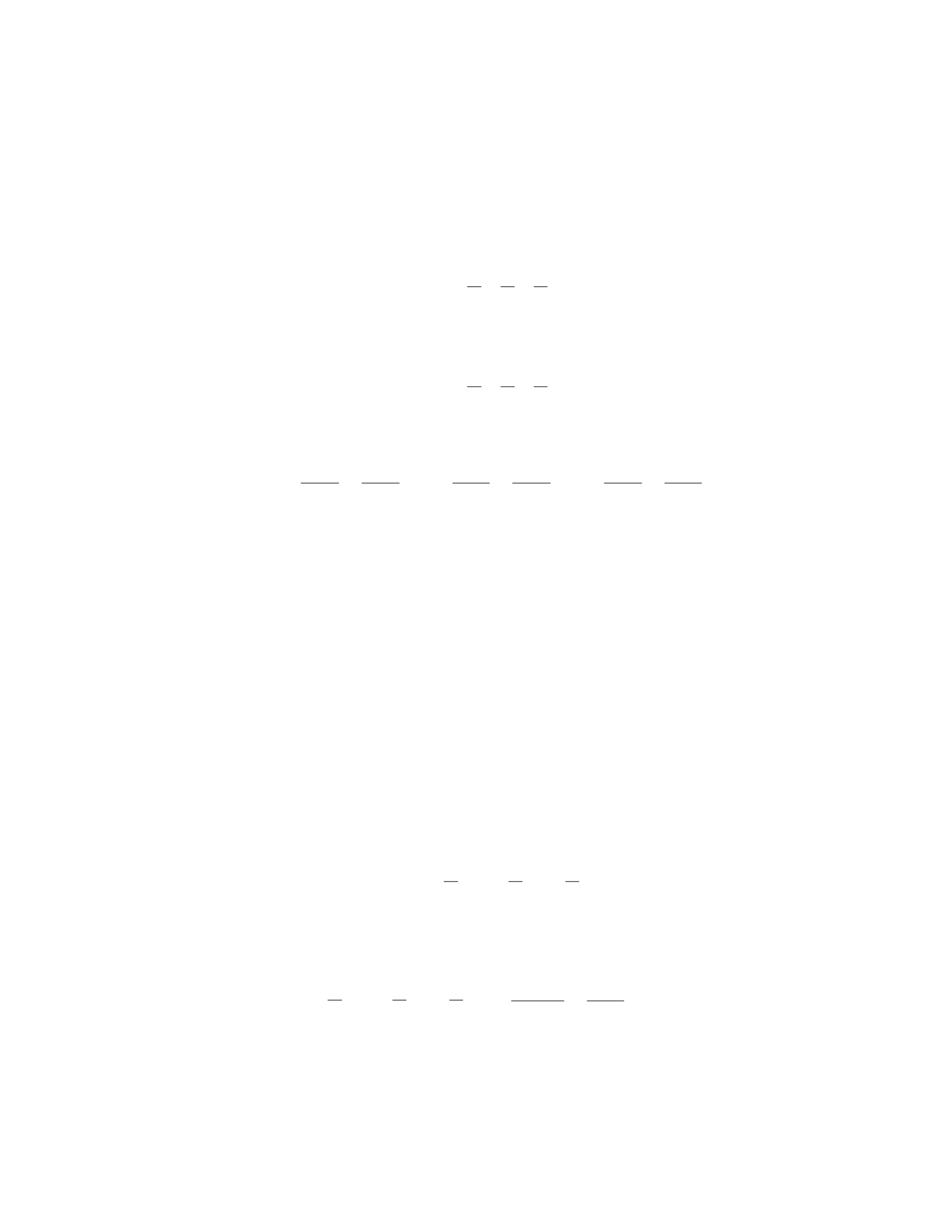
∇ × F=
i j k
∂
∂x
∂
∂y
∂
∂z
P Q R
Step 1: Compute the curl of Fusing the formula.
∇ × F=
i j k
∂
∂x
∂
∂y
∂
∂z
yz xz xy
Step 2: Calculate the determinant expansion.
∇ × F=∂(xy)
∂y −∂(xz)
∂z i−∂(yz)
∂x −∂(xy)
∂z j+∂(xz)
∂x −∂(yz)
∂y k
Step 3: Differentiate and simplify.
∇ × F= (x−x)i−(z−z)j+ (y−y)k
Step 4: Simplify further.
∇ × F=0
So, the curl of Fis the zero vector field.
Question 19
Question
Let F(x, y, z) = ⟨exsin y, x2+yz, xyz2⟩. Find the curl of F.
Solution
To find the curl of F, denoted as ∇ × F, we need to compute the following
determinant:
∇ × F=
i j k
∂
∂x
∂
∂y
∂
∂z
exsin y x2+yz xyz2
Step 1: Calculate the determinant for each component of the curl:
For the icomponent:
i j k
∂
∂x
∂
∂y
∂
∂z
exsin y x2+yz xyz2
=∂(xyz2)
∂y −∂(yz)
∂z i
14
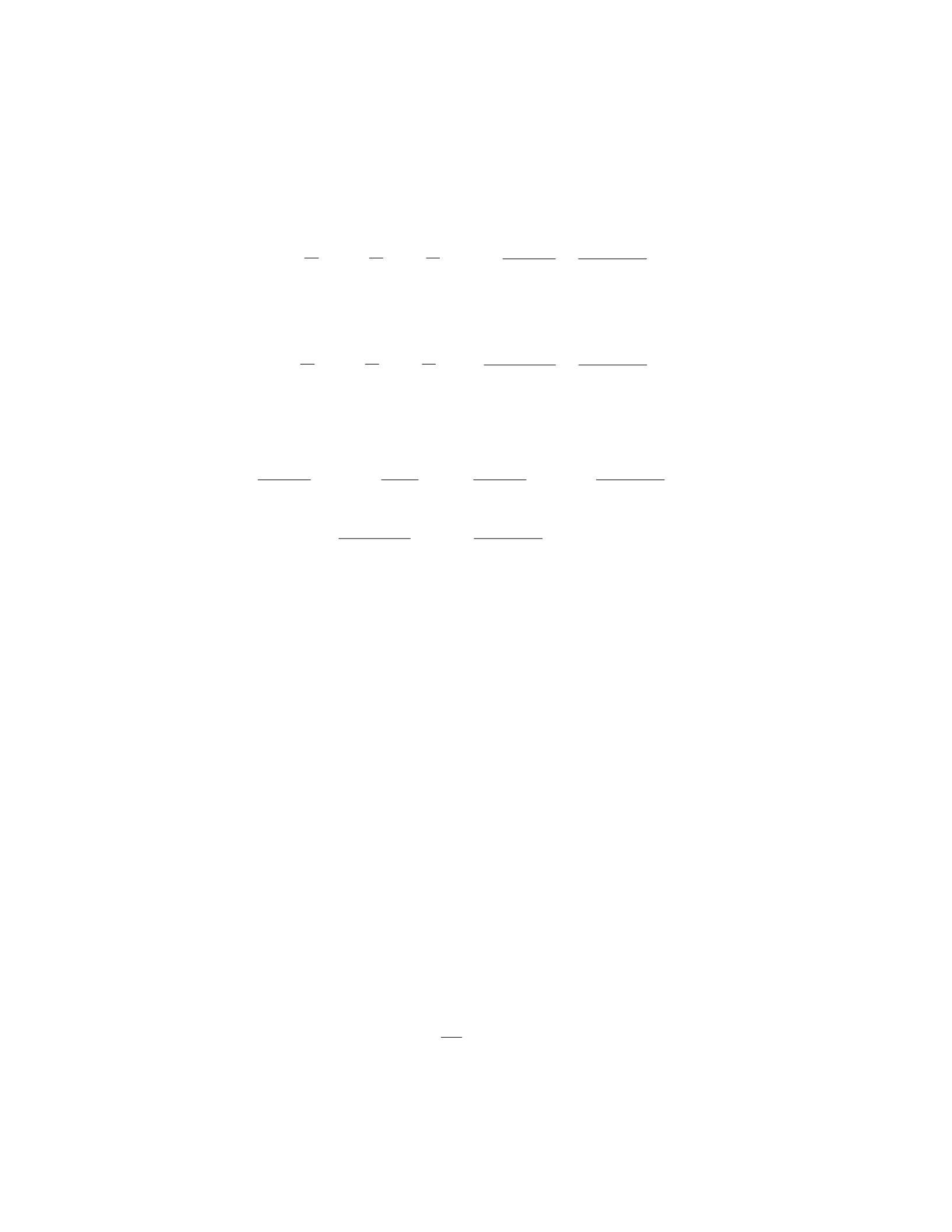
For the jcomponent:
i j k
∂
∂x
∂
∂y
∂
∂z
exsin y x2+yz xyz2
=−∂(xyz2)
∂x −∂(exsin y)
∂z j
For the kcomponent:
i j k
∂
∂x
∂
∂y
∂
∂z
exsin y x2+yz xyz2
=∂(x2+yz)
∂x −∂(exsin y)
∂y k
Step 2: Calculate the partial derivatives for each component.
Now, calculate the partial derivatives:
∂(xyz2)
∂y =xz2,∂(yz)
∂z =y, ∂(xyz2)
∂x =yz2,∂(exsin y)
∂z = 0
∂(x2+yz)
∂x = 2x, ∂(exsin y)
∂y =excos y
Step 3: Substitute the calculated values into the expressions for each com-
ponent.
Substitute the values in for each component:
(∇ × F)x=xz2−y, (∇ × F)y=−yz2,(∇ × F)z= 2x−excos y
Step 4: Final Answer
Therefore, the curl of Fis:
∇ × F=⟨xz2−y, −yz2,2x−excos y⟩
Question 20
Question
Let F(x, y, z) = (2xy2+z)i+ (x2y+ 3z2)j+ (x2+ 2yz)kbe a vector field in R3.
Calculate the divergence of F.
Solution
To find the divergence of F, we need to compute ∇ · Fwhere F(x, y, z) =
P(x, y, z)i+Q(x, y, z)j+R(x, y, z)k.
Step 1: Calculate the partial derivatives of P,Q, and R. Let P(x, y, z) =
2xy2+z,Q(x, y, z) = x2y+ 3z2, and R(x, y, z) = x2+ 2yz. We have:
∂P
∂x = 2y2,
15
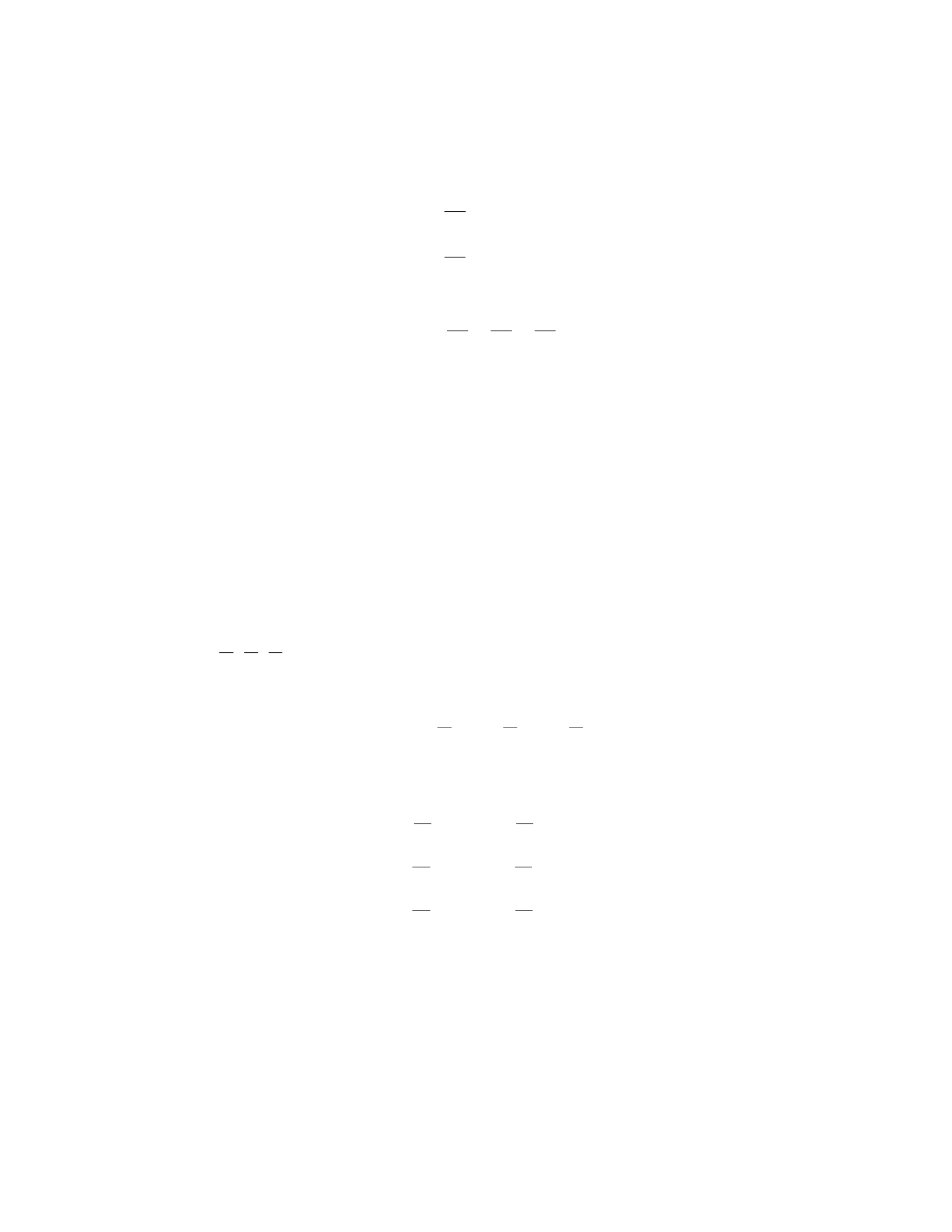
∂Q
∂y =x2,
∂R
∂z = 2y.
Step 2: Calculate the divergence of F. The divergence of Fis given by:
∇ · F=∂P
∂x +∂Q
∂y +∂R
∂z .
Substitute the partial derivatives we calculated:
∇ · F= 2y2+x2+ 2y.
Therefore, the divergence of Fis 2y2+x2+ 2y.
Question 21
Question
Let F(x, y, z)=(yz +ex, xz +ey, xy +ez). Find the curl of F.
Solution
To find the curl of F, we will use the formula: curl(F) = ∇ × F, where ∇=
∂
∂x ,∂
∂y ,∂
∂z is the del operator.
Step 1: Compute the curl of Fusing the formula:
curl(F) =
i j k
∂
∂x
∂
∂y
∂
∂z
yz +exxz +eyxy +ez
Step 2: Calculate the determinant to find the curl:
curl(F) = ∂
∂y (xy +ez)−∂
∂z (xz +ey)i
−∂
∂x (yz +ex)−∂
∂z (xy +ez)j
+∂
∂x (xz +ey)−∂
∂y (yz +ex)k
Now, differentiate each component of Fwith respect to the corresponding
variable.
16
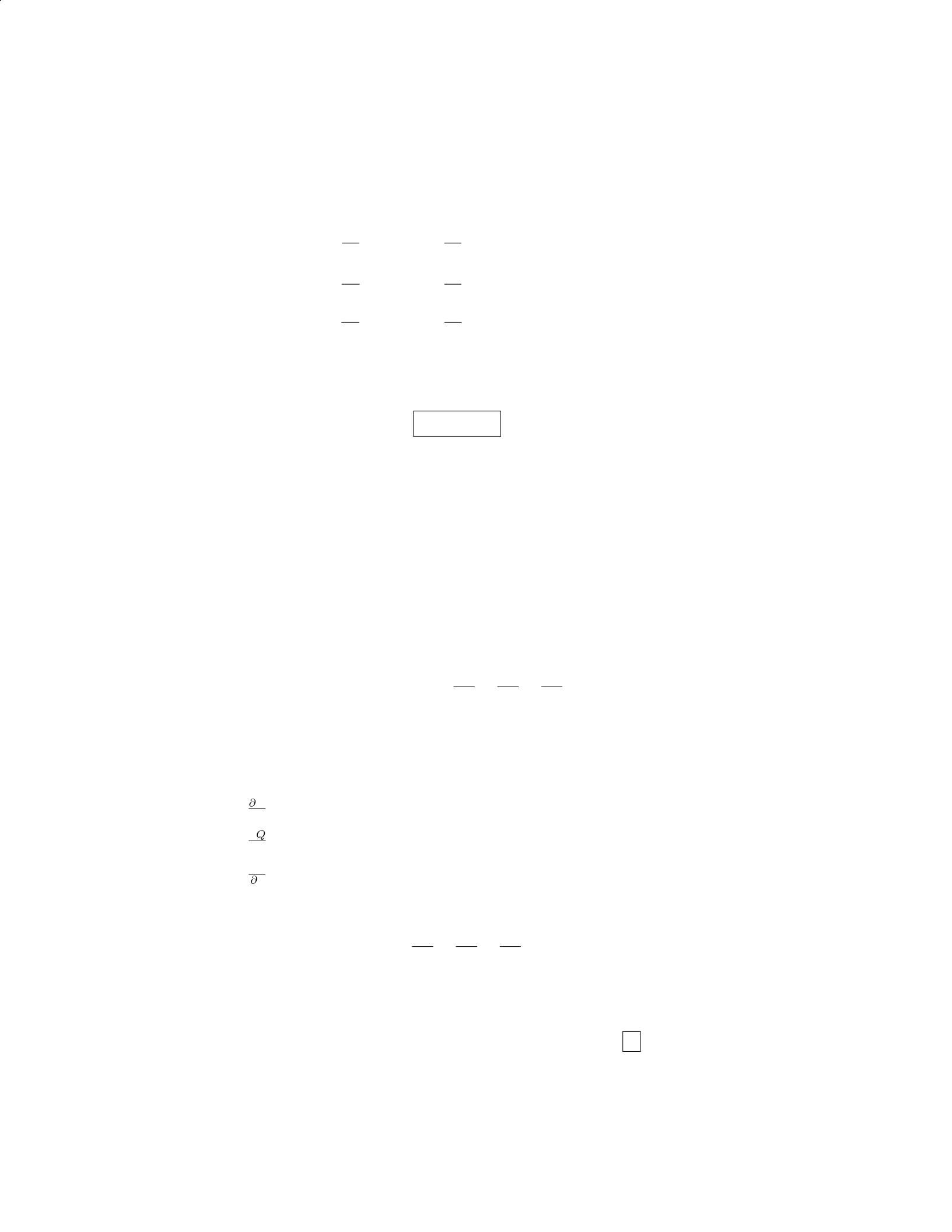
Step 3: Compute the components of the curl:
∂
∂y (xy +ez)−∂
∂z (xz +ey) = x−x= 0
∂
∂x (yz +ex)−∂
∂z (xy +ez) = z−z= 0
∂
∂x (xz +ey)−∂
∂y (yz +ex) = x−y
Step 4: Assemble the components into the vector form of the curl:
curl(F) = (0,0, x −y)
Therefore, the curl of Fis (0,0, x −y) .
Question 22
Question
Let F(x, y, z)=2yzi+xzj+xykbe a vector field. Determine the divergence of
Fat the point P(1,−1,2).
Solution
Step 1: The divergence of a vector field F(x, y, z) = P(x, y, z)i+Q(x, y, z)j+
R(x, y, z)kis given by the formula:
div(F) = ∂P
∂x +∂Q
∂y +∂R
∂z
Step 2: In this case, F(x, y, z)=2yzi+xzj+xyk, so P(x, y, z)=2yz,
Q(x, y, z) = xz, and R(x, y, z) = xy.
Step 3: Calculate the partial derivatives of P,Q, and Rwith respect to x,
y, and z.
∂P
∂x = 0
∂Q
∂y =z
∂R
∂z =x
Step 4: Substitute the values of the partial derivatives into the formula for
the divergence:
div(F) = ∂P
∂x +∂Q
∂y +∂R
∂z = 0 + z+x
Step 5: Evaluate div(F) at the point P(1,−1,2):
div(F)(1,−1,2) = 2 + 1 = 3
Therefore, the divergence of Fat the point P(1,−1,2) is 3 .
17
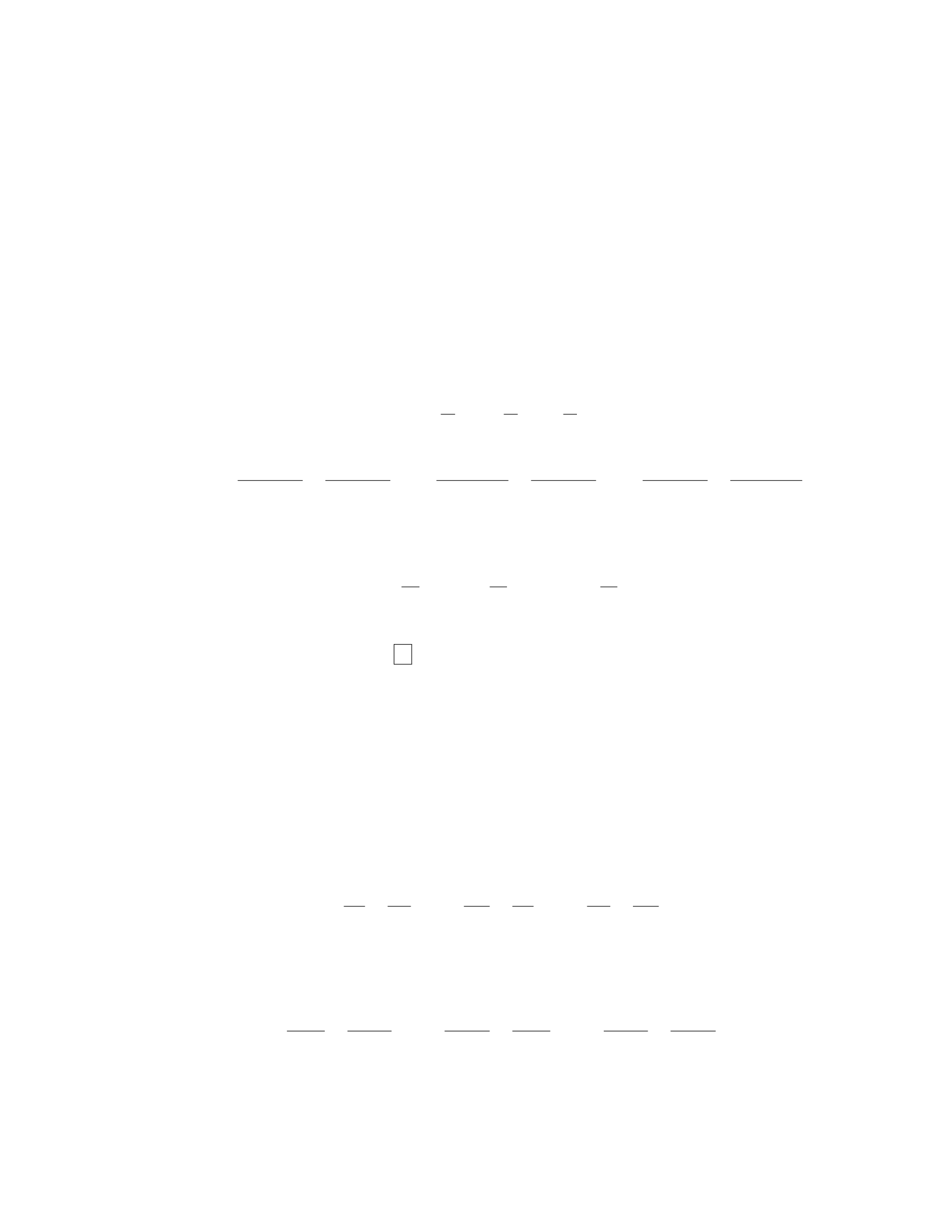
Question 23
Question
Let F(x, y, z)=(yz +x2)i+ (xz +y)j+ (xy +z)kbe a vector field in R3.
Calculate ∇ · ∇ × F.
Solution
Step 1: Calculate ∇ × F.
∇ × F=
i j k
∂
∂x
∂
∂y
∂
∂z
yz +x2xz +y xy +z
=∂(xy +z)
∂y −∂(xz +y)
∂z i−∂(yz +x2)
∂x −∂(xy +z)
∂z j+∂(xz +y)
∂x −∂(yz +x2)
∂y k
= (x−1)i−(z−1)j+ (y−y)k= (x−1)i−(z−1)j
Step 2: Calculate ∇ · ∇ × F.
∇ · ∇ × F=∂
∂x (x−1) + ∂
∂y (−(z−1)) + ∂
∂z (0)
= 1 −0 + 0 = 1
Therefore, ∇ · ∇ × F= 1 .
Question 24
Question
Let F(x, y, z) = ⟨x2y, yz3, xz⟩be a vector field. Compute ∇ · (∇ × F).
Solution
Step 1: First, we need to find the curl of F. The curl of a vector field F=
⟨M, N, P ⟩is given by
∇ × F=∂P
∂y −∂N
∂z i+∂M
∂z −∂P
∂x j+∂N
∂x −∂M
∂y k
Step 2: In this case, F=⟨x2y, yz3, xz⟩. So, M=x2y,N=yz3, and P=xz.
Now, we can find the curl of F.
Step 3: Compute
∇ × F=∂(xz)
∂y −∂(yz3)
∂z i+∂(x2y)
∂z −∂(xz)
∂x j+∂(yz3)
∂x −∂(x2y)
∂y k
18
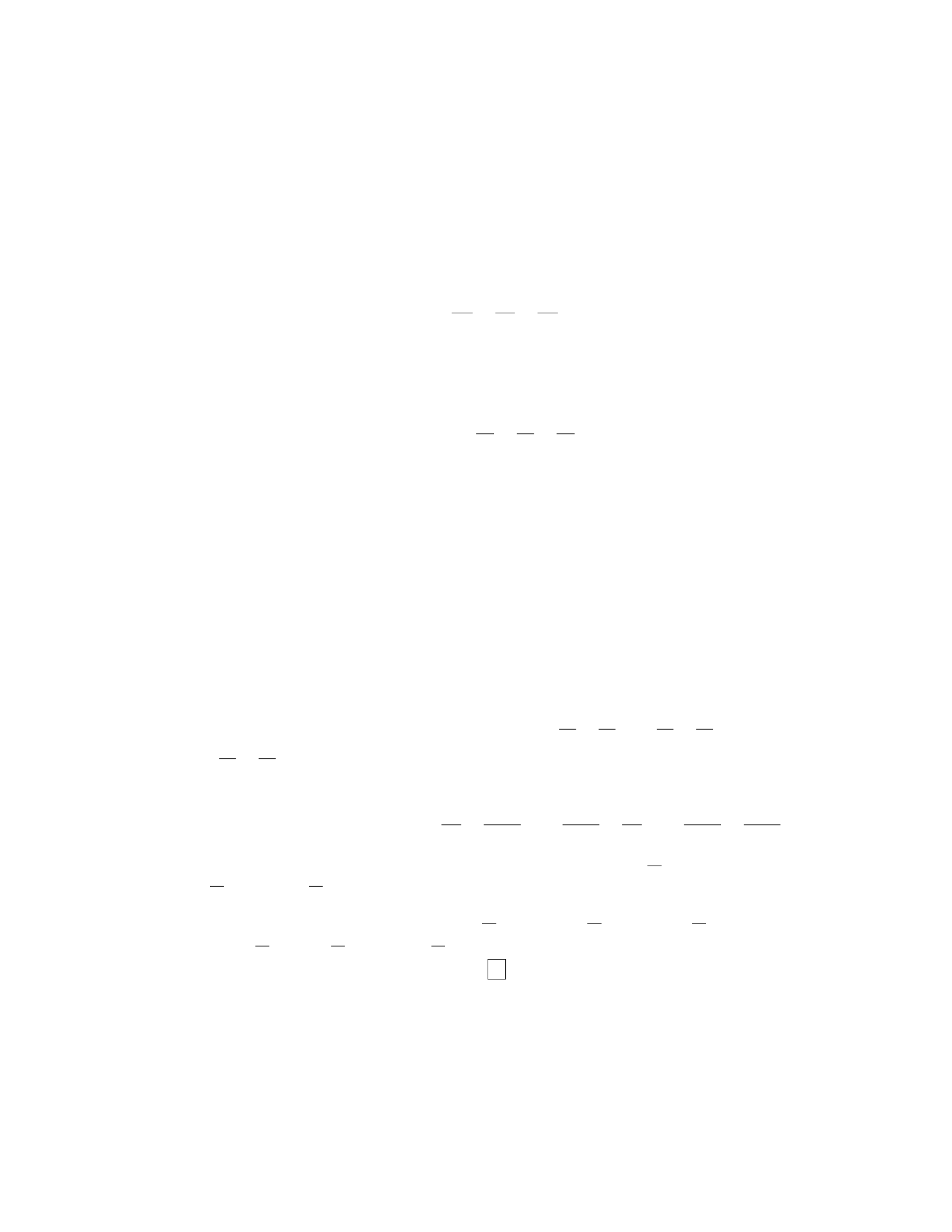
Step 4: Simplify to get
∇ × F=⟨z, 0, x⟩
Step 5: Next, we need to find the divergence of ∇ × F. The divergence of a
vector field G=⟨R, S, T ⟩is given by
∇ · G=∂R
∂x +∂S
∂y +∂T
∂z
Step 6: In this case, ∇ × F=⟨z, 0, x⟩. So, R=z,S= 0, and T=x. Now,
we can find the divergence of ∇ × F.
Step 7: Compute
∇ · (∇ × F) = ∂z
∂x +∂0
∂y +∂x
∂z
Step 8: Simplify to get
∇ · (∇ × F)=1
Therefore, ∇ · (∇ × F) = 1.
Question 25
Question
Let F(x, y, z) = x2yi+xyzj+z2k. Calculate ∇·∇×F, where ∇is the gradient
operator and ×is the cross product operator.
Solution
Step 1: Calculate ∇×Fusing the formula ∇×F=∂Q
∂y −∂P
∂z i+∂R
∂z −∂P
∂x j+
∂P
∂y −∂Q
∂x k, where F(x, y, z) = P(x, y, z)i+Q(x, y, z)j+R(x, y, z)k.
Given F(x, y, z) = x2yi+xyzj+z2k, we have: P(x, y, z) = x2y, Q(x, y, z) =
xyz, R(x, y, z) = z2.
Calculating the curl: ∇×F=∂z2
∂y −∂(xyz)
∂z i+∂(x2y)
∂z −∂z2
∂x j+∂(xyz)
∂y −∂(x2y)
∂x k
Expanding and simplifying: ∇ × F=−xi+yj+xk.
Step 2: Calculate ∇ · ∇ × Fusing the formula ∇ · ∇ × F=∂
∂x (∇ × Fx) +
∂
∂y (∇ × Fy) + ∂
∂z (∇ × Fz).
We already know ∇ × F=−xi+yj+xk.
Calculating each partial derivative: ∂
∂x (∇ × Fx) = ∂
∂x (−x) = −1, ∂
∂y (∇ ×
Fy) = ∂
∂y (y) = 1, ∂
∂z (∇ × Fz) = ∂
∂z (x) = 0.
Therefore, ∇ · ∇ × F=−1 + 1 + 0 = 0 .
19
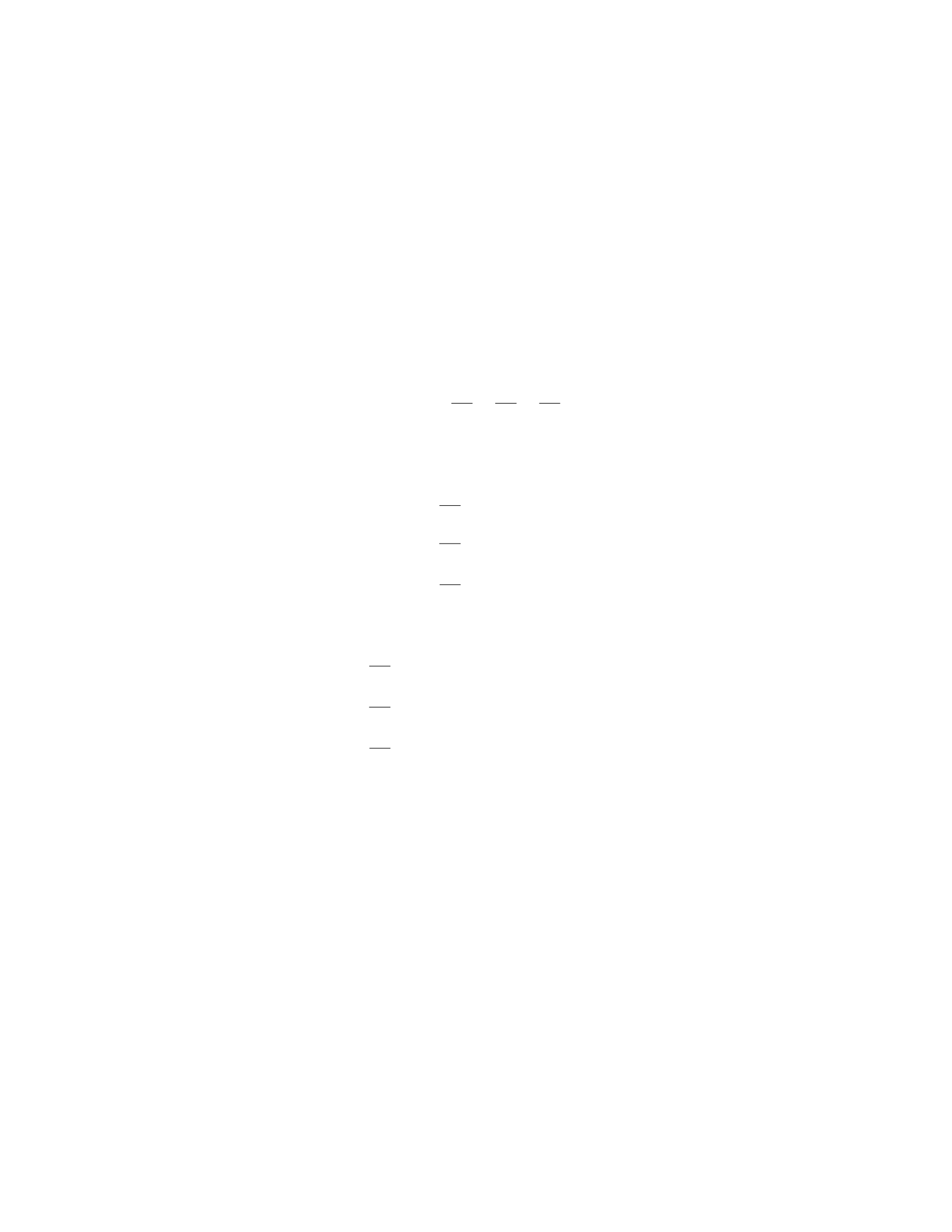
Question 26
Question
Let F(x, y, z)=(yex+z2, xey+ 2z, 2yez+ 3x) be a vector field. Calculate the
divergence of Fat the point (1,0,−1).
Solution
To calculate the divergence of F, we use the formula:
div(F) = ∂P
∂x +∂Q
∂y +∂R
∂z ,
where F(x, y, z)=(P, Q, R).
Step 1: Find the partial derivatives of P,Q, and R.
∂P
∂x =yex
∂Q
∂y =xey
∂R
∂z = 2yez
Step 2: Evaluate the partial derivatives at the point (1,0,−1).
∂P
∂x
(1,0,−1) = 0e1= 0
∂Q
∂y
(1,0,−1) = 1e0= 1
∂R
∂z
(1,0,−1) =−2e−1≈ −0.7358
Step 3: Calculate the divergence at the point (1,0,−1).
div(F)
(1,0,−1) = 0 + 1 −0.7358 ≈0.2642.
Therefore, the divergence of Fat the point (1,0,−1) is approximately 0.2642.
Question 27
Question
Let F(x, y, z)=(x2y+z)i+ (xy2+z)j+ (xyz + 1)kbe a vector field. Calculate
the curl of F.
20
Solution
To calculate the curl of F, we use the formula:
curl F=∇ × F
where ∇=∂
∂x ,∂
∂y ,∂
∂z is the gradient operator.
Step 1: Compute the components of the curl.
curl F=
i j k
∂
∂x
∂
∂y
∂
∂z
x2y+z xy2+z xyz + 1
=∂(xyz + 1)
∂y −∂(xy2+z)
∂z i−∂(xyz + 1)
∂x −∂(x2y+z)
∂z j+∂(xy2+z)
∂x −∂(x2y+z)
∂y k
Step 2: Compute the partial derivatives.
∂(xyz + 1)
∂y =xz
∂(xy2+z)
∂z = 1
∂(xyz + 1)
∂x =yz
∂(x2y+z)
∂z = 1
∂(xy2+z)
∂x =y2
∂(x2y+z)
∂y =x2
Step 3: Plug the partial derivatives into the components of the curl.
curl F= (xz −1)i−(yz −1)j+ (y2−x2)k
Therefore, the curl of Fis (xz −1)i−(yz −1)j+ (y2−x2)k.
Question 28
Question
Let F(x, y, z) = x2yi+y2zj+z2xk. Calculate the curl of F.
Solution
To compute the curl of a vector field F=P(x, y, z)i+Q(x, y, z)j+R(x, y, z)k,
where P,Q, and Rare the component functions, we use the formula:
curl(F) = ∂R
∂y −∂Q
∂z i−∂R
∂x −∂P
∂z j+∂Q
∂x −∂P
∂y k
21
Step 1: Identify P,Q, and Rfor F=x2yi+y2zj+z2xk.P(x, y, z) = x2y,
Q(x, y, z) = y2z,R(x, y, z) = z2x.
Step 2: Calculate the partial derivatives:
∂P
∂y =x2,∂Q
∂z =y2,∂R
∂x = 2zx, ∂P
∂z = 0,∂Q
∂x = 0,∂R
∂y = 2z
Step 3: Substitute the partial derivatives into the curl formula:
curl(F) = (2z−0)i−(2zx −0)j+ (0 −x2)k
Step 4: Simplify the expression:
curl(F)=2zi−2zxj−x2k
Therefore, the curl of Fis 2zi−2zxj−x2k.
Question 29
Question
Let F(x, y, z) = x2yi−2xyzj+yezk. Calculate the curl of F.
Solution
Step 1: The curl of a vector field F(x, y, z) = P(x, y, z)i+Q(x, y, z)j+R(x, y, z)k
is defined as
∇ × F=
i j k
∂
∂x
∂
∂y
∂
∂z
P Q R
Step 2: In our case, P(x, y, z) = x2y,Q(x, y, z) = −2xyz, and R(x, y, z) = yez.
So, we need to compute the determinant
i j k
∂
∂x
∂
∂y
∂
∂z
x2y−2xyz yez
Step 3: Computing the partial derivatives, we get
∂R
∂y −∂Q
∂z =ez−(−2x)
=ez+ 2x
Step 4: Similarly,
∂P
∂z −∂R
∂x = 0 −0
= 0
22

Step 5: Lastly,
∂Q
∂x −∂P
∂y =−2yz −2xy
=−2y(z+x)
Step 6: Therefore, the curl of Fis
∇ × F= (ez+ 2x)i+ 0j−2y(z+x)k
Question 30
Question
Let F(x, y)=(exy cos(y), exy sin(y)) be a vector field. Compute ∇ · F, where ∇
is the gradient operator.
Solution
Step 1: Compute the gradient of Fby finding its partial derivatives.
∇F=∂
∂x (exy cos(y)),∂
∂y (exy sin(y))
Step 2: Taking the partial derivatives yields:
∇F= (yexy cos(y)−yexy sin(y), xexy cos(y) + exy sin(y))
Step 3: Compute the divergence of Fby taking the dot product of ∇and F:
∇ · F=∂
∂x (yexy cos(y)−yexy sin(y)) + ∂
∂y (xexy cos(y) + exy sin(y))
Step 4: Simplify the expression by evaluating the partial derivatives:
∇ · F=yexy cos(y)−yexy sin(y) + xexy cos(y) + exy sin(y)
∇ · F= (x+y)exy cos(y) + (1 −y)exy sin(y)
23
Question 2
Question
Let F(x, y, z)=(x2+y2)i+ (y2+z2)j+ (z2+x2)k. Calculate the curl of F.
Solution
Step 1: Recall that the curl of a vector field F(x, y, z) = P(x, y, z)i+Q(x, y, z)j+
R(x, y, z)kis given by the determinant of the following matrix:
∇ × F=
i j k
∂
∂x
∂
∂y
∂
∂z
P Q R
Step 2: Let’s find the components P,Q, and Rfor F:P(x, y, z) = x2+y2
Q(x, y, z) = y2+z2R(x, y, z) = z2+x2
Step 3: Compute the curl of F:
∇ × F=
i j k
∂
∂x
∂
∂y
∂
∂z
x2+y2y2+z2z2+x2
Step 4: Calculate the determinant by expanding along the first row:
∇×F=∂(z2+x2)
∂y −∂(y2+z2)
∂z i−∂(z2+x2)
∂x −∂(x2+y2)
∂z j+∂(y2+z2)
∂x −∂(x2+y2)
∂y k
Step 5: Simplify the partial derivatives to get the final expression for the
curl of F:
∇ × F= (−2y−2z)i+ (2x−2z)j+ (2y−2x)k
Therefore, the curl of Fis (−2y−2z)i+ (2x−2z)j+ (2y−2x)k.
Question 3
Question
Let F= (y2z, x2z, xy2) be a vector field in R3. Find the divergence of F.
Solution
To find the divergence of F, we will compute ∇ · F, where ∇=∂
∂x ,∂
∂y ,∂
∂z is
the del operator.
Step 1: Compute the divergence of Fusing the formula ∇·F=∂F1
∂x +∂F2
∂y +
∂F3
∂z .
∇ · F=∂
∂x (y2z) + ∂
∂y (x2z) + ∂
∂z (xy2)
2
Step 2: Compute the partial derivatives.
∂
∂x (y2z) = 0
∂
∂y (x2z) = 0
∂
∂z (xy2) = xy
Step 3: Sum the partial derivatives to find the divergence.
∇ · F=0+0+xy =xy
Therefore, the divergence of Fis xy.
Question 4
Question
Let F(x, y, z)=(yz2, xz2, xy2). Calculate the curl of F.
Solution
To find the curl of F, we need to compute the determinant of the following
matrix:
curl(F) =
i j k
∂
∂x
∂
∂y
∂
∂z
yz2xz2xy2
Step 1: Compute the partial derivatives:
∂
∂x = (0, z2, y2)
∂
∂y = (z2,0,2xy)
∂
∂z = (2yz, 2xz, 0)
Step 2: Calculate the determinant:
curl(F) =
i j k
∂
∂x
∂
∂y
∂
∂z
yz2xz2xy2
= (2xy −0) −(2xz −0)i
−(2yz −z2) + (0 −y2)j
+ (z2−z2)−(0 −0)k
= 2xyi−2xzi−(2yz −z2)j
Therefore, the curl of Fis (2xy −2xz)i−(2yz −z2)j.
3

Question 5
Question
Let F(x, y, z)=(xz, xey, yz) be a vector field. Compute the divergence of Fat
the point (1,2,3).
Solution
Step 1: Recall that the divergence of a vector field F= (P(x, y, z), Q(x, y, z), R(x, y, z))
is given by the scalar function ∇ · F=∂P
∂x +∂Q
∂y +∂R
∂z .
Step 2: For the given vector field F(x, y, z)=(xz, xey, yz), we have P(x, y, z) =
xz,Q(x, y, z) = xey, and R(x, y, z) = yz.
Step 3: Calculate the partial derivatives:
∂P
∂x =z,
∂Q
∂y =xey,
∂R
∂z =y.
Step 4: Now, find the divergence of F:
∇ · F=∂P
∂x +∂Q
∂y +∂R
∂z
=z+xey+y.
Step 5: Finally, evaluate the divergence at the point (1,2,3):
∇ · F(1,2,3) = 3 + 1 ·e2+ 2
= 3 + e2+ 2
= 5 + e2.
Therefore, the divergence of the vector field Fat the point (1,2,3) is 5 + e2.
Question 6
Question
Let F(x, y, z) = xcos(yz)i+ysin(xz)j+zsin(xy)kbe a vector field. Compute
the curl of F.
4
Solution
To compute the curl of a vector field F(x, y, z) = P(x, y, z)i+Q(x, y, z)j+
R(x, y, z)k, we use the formula:
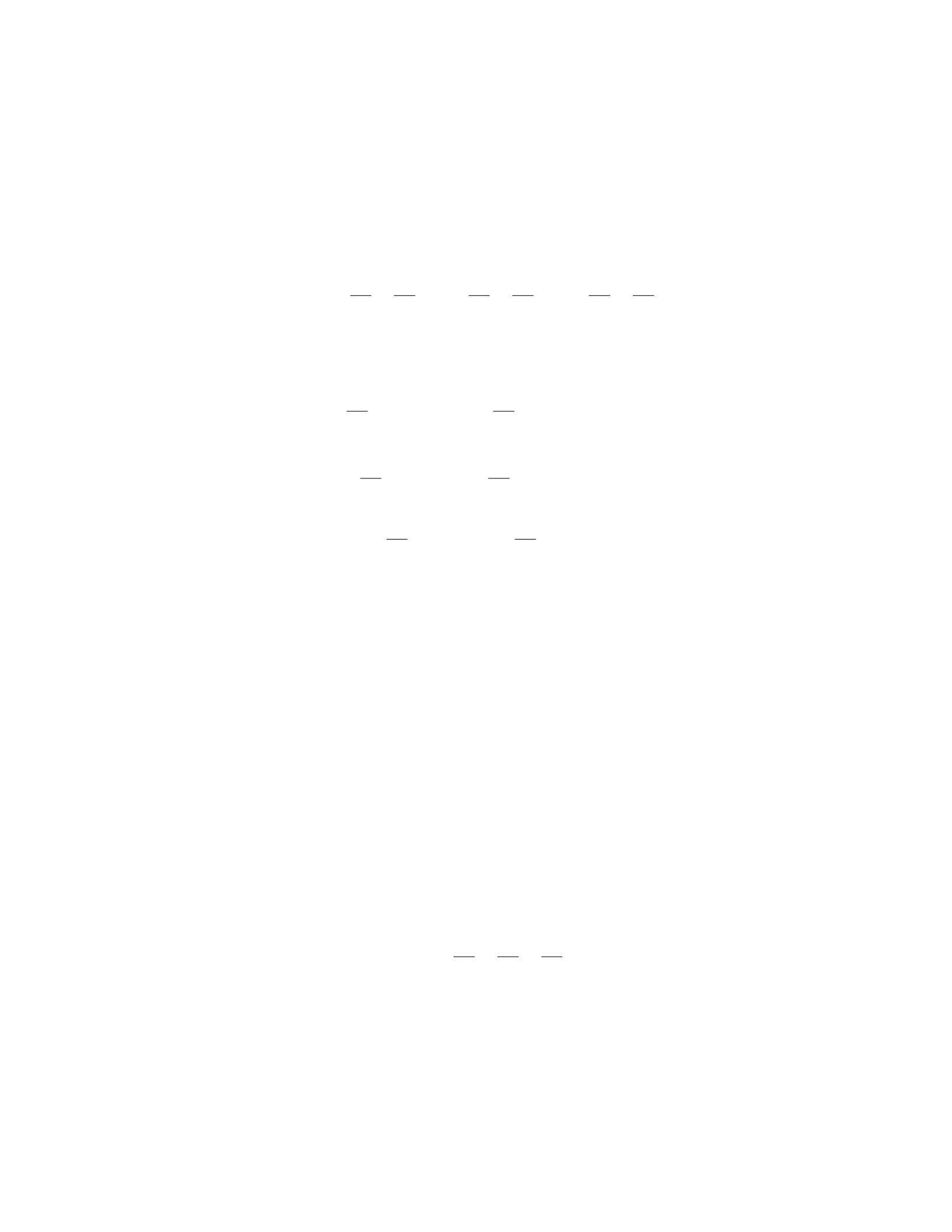
∇ × F=∂R
∂y −∂Q
∂z i−∂R
∂x −∂P
∂z j+∂Q
∂x −∂P
∂y k
In our case, P(x, y, z) = xcos(yz), Q(x, y, z) = ysin(xz), and R(x, y, z) =
zsin(xy). Let’s compute the curl of F:
Step 1: Calculate the partial derivatives:
∂P
∂y =−xz sin(yz),∂Q
∂z =xy cos(xz)
Step 2:
∂R
∂y =zcos(xy),∂Q
∂x =zcos(xy)
Step 3:
∂R
∂x =ycos(xy),∂P
∂z = 0
Step 4: Substitute these partial derivatives into the formula for the curl:
∇ × F= (zcos(xy)−ycos(xy))i−(−xz sin(yz))j+ (xy cos(xz))k
Step 5: Simplify the components:
∇ × F=zcos(xy)i+xz sin(yz)j+xy cos(xz)k
Therefore, the curl of the vector field Fis ∇×F=zcos(xy)i+xz sin(yz)j+
xy cos(xz)k.
Question 7
Question
Let F(x, y, z)=(exyz, x2y, z3) be a vector field in R3. Find the divergence of F.
Solution
To find the divergence of a vector field F(x, y, z)=(P(x, y, z), Q(x, y, z), R(x, y, z)),
we use the formula:
div(F) = ∂P
∂x +∂Q
∂y +∂R
∂z
Step 1: Identify P,Q, and Rin our vector field F(x, y, z):
P(x, y, z) = exyz, Q(x, y, z) = x2y, R(x, y, z) = z3
5
Step 2: Compute the partial derivatives:
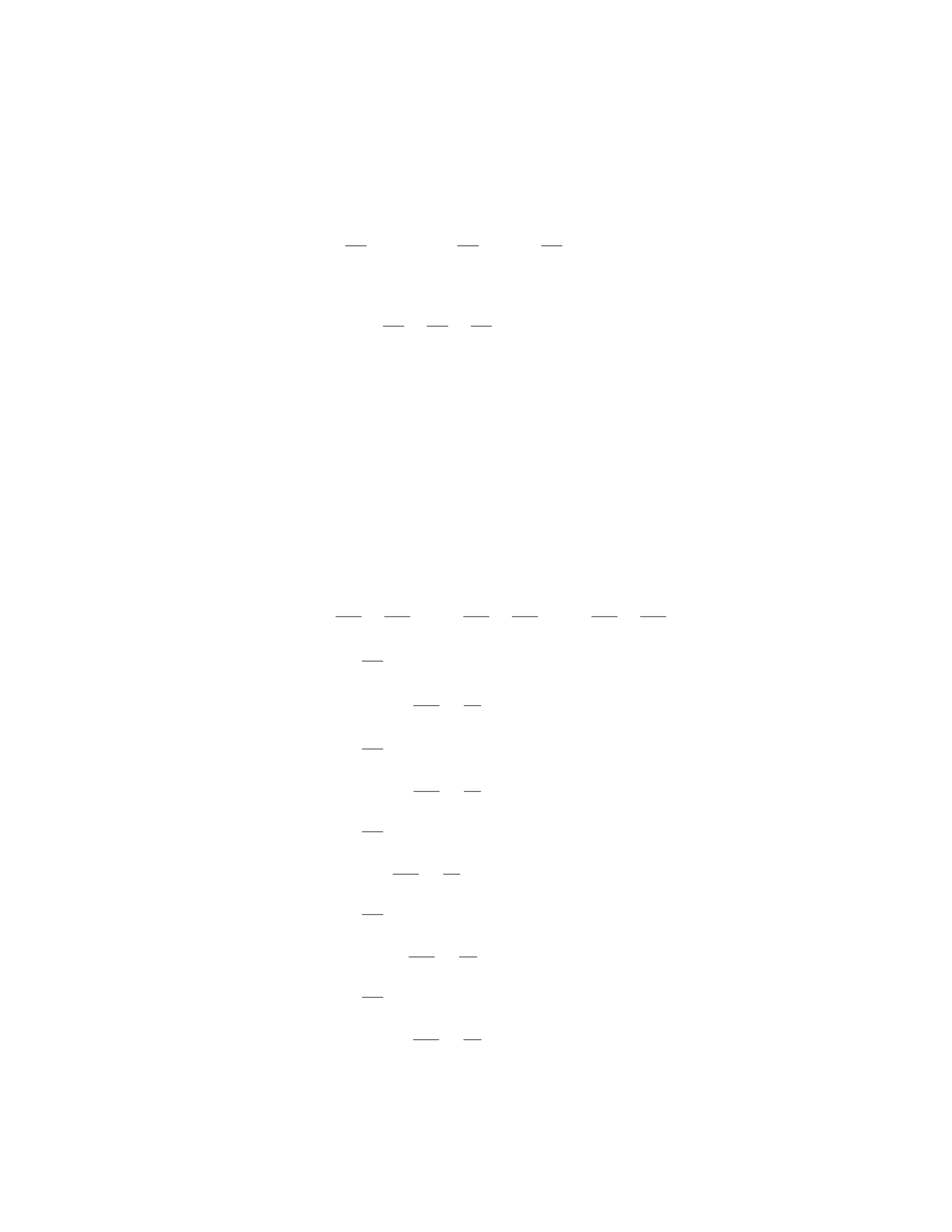
∂P
∂x =yzexyz ,∂Q
∂y =x2,∂R
∂z = 3z2
Step 3: Calculate the divergence:
div(F) = ∂P
∂x +∂Q
∂y +∂R
∂z =yzexyz +x2+ 3z2
Therefore, the divergence of the vector field F(x, y, z) = (exyz, x2y, z3) is
yzexyz +x2+ 3z2.
Question 8
Question
Let F(x, y, z) = −3xzi+ 2yj+x2k. Compute the curl of F.
Solution
To compute the curl of a vector field F=F1i+F2j+F3k, we use the formula:
curl F=∂F3
∂y −∂F2
∂z i+∂F1
∂z −∂F3
∂x j+∂F2
∂x −∂F1
∂y k
Step 1: Compute ∂F3
∂y .
∂F3
∂y =∂
∂y (x2)=0
Step 2: Compute ∂F2
∂z .
∂F2
∂z =∂
∂z (2y)=0
Step 3: Compute ∂F1
∂z .
∂F1
∂z =∂
∂z (−3xz) = −3x
Step 4: Compute ∂F3
∂x .
∂F3
∂x =∂
∂x (x2) = 2x
Step 5: Compute ∂F2
∂x .
∂F2
∂x =∂
∂x (2y)=0
6
Step 6: Compute ∂F1
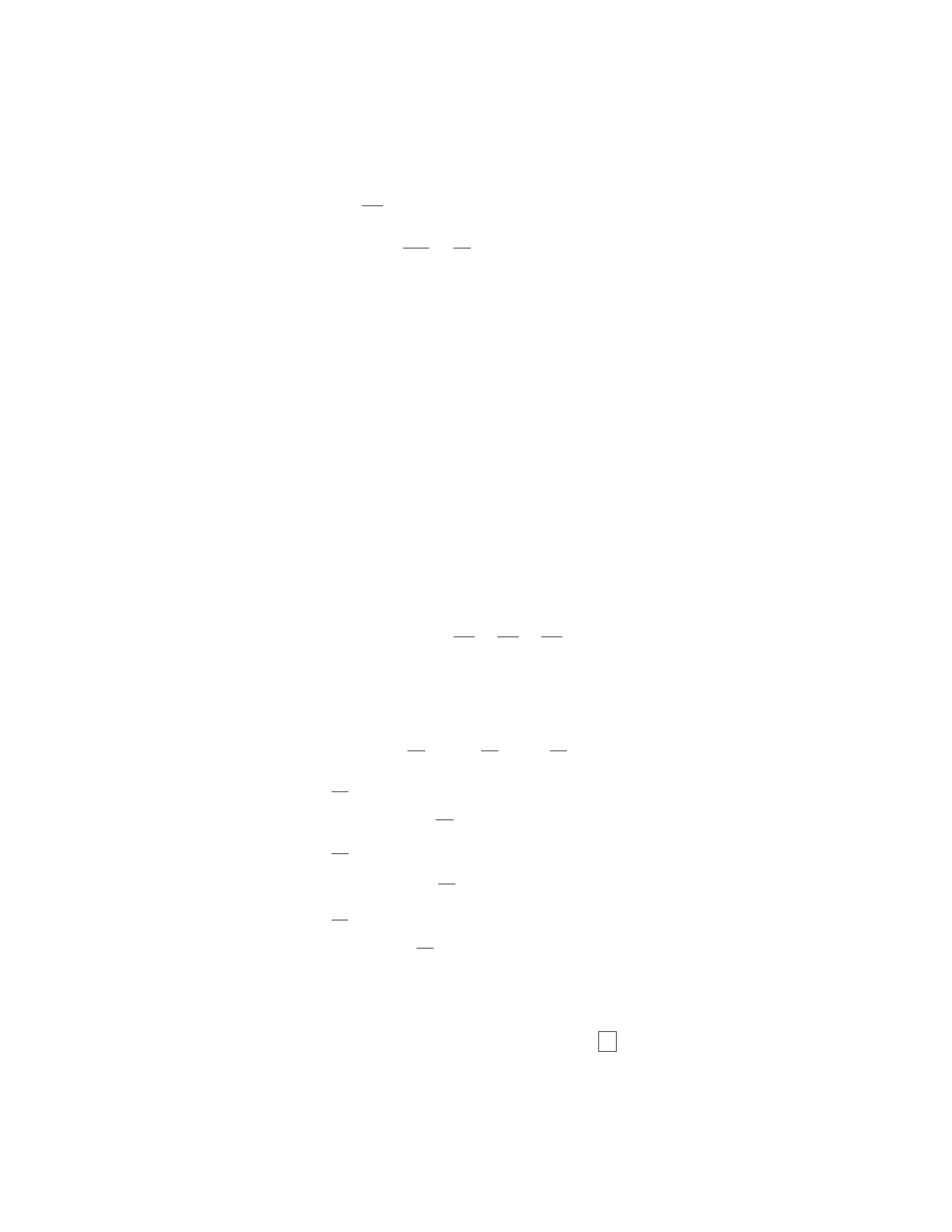
∂y .
∂F1
∂y =∂
∂y (−3xz) = 0
Step 7: Plug the computed partial derivatives into the formula for curl.
curl F= (0 −0)i+ (−3x−2x)j+ (0 −0)k
curl F=−5xj
Therefore, the curl of Fis −5xj.
Question 9
Question
Let F(x, y, z) = eyzi+xzj+yexz kbe a vector field. Determine the divergence
of Fat the point (1,2,0).
Solution
To find the divergence of a vector field F(x, y, z) = P(x, y, z)i+Q(x, y, z)j+
R(x, y, z)kat a point (x0, y0, z0), we use the formula:
div(F) = ∂P
∂x +∂Q
∂y +∂R
∂z
In this case, our vector field is F(x, y, z) = eyz i+xzj+yexz k, so P(x, y, z) =
eyz,Q(x, y, z) = xz, and R(x, y, z) = yexz .
Therefore, the divergence of Fis:
div(F) = ∂
∂x (eyz ) + ∂
∂y (xz) + ∂
∂z (yexz )
Step 1: Find ∂P
∂x :
∂
∂x (eyz )=0
Step 2: Find ∂Q
∂y :
∂
∂y (xz)=0
Step 3: Find ∂R
∂z :
∂
∂z (yexz ) = xyexz
Step 4: Calculate the divergence of Fat the point (1,2,0):
div(F) = 0 + 0 + (1)(2)(e(1)(0)) = 2
Therefore, the divergence of Fat the point (1,2,0) is 2 .
7

Question 10
Question
Let F(x, y)=(yex+x2, ex+ycos(y)) be a vector field. Find the divergence of
F.
Solution
To find the divergence of F, we need to compute the following:
div F=∇ · F=∂P
∂x +∂Q
∂y ,
where F(x, y)=(P(x, y), Q(x, y)).
Step 1: Compute ∂P
∂x .
∂P
∂x =∂
∂x (yex+x2) = yex
Step 2: Compute ∂Q
∂y .
∂Q
∂y =∂
∂y (ex+ycos(y)) = cos(y) + y(−sin(y)) = cos(y)−ysin(y)
Step 3: Find the divergence of F.
div F=∇ · F=∂P
∂x +∂Q
∂y =yex+ cos(y)−ysin(y)
Therefore, the divergence of Fis yex+ cos(y)−ysin(y).
Question 11
Question
Let F(x, y) = (2x2y−y3)i+ (x3−3xy2)jbe a vector field. Compute the curl
of F.
Solution
To compute the curl of a vector field F(x, y) = P(x, y)i+Q(x, y)j, where Pand
Qare component functions, we can use the formula:
∇ × F=∂Q
∂x −∂P
∂y k
Step 1: Compute ∂Q
∂x and ∂P
∂y .
8
We have P(x, y) = 2x2y−y3and Q(x, y) = x3−3xy2. So,
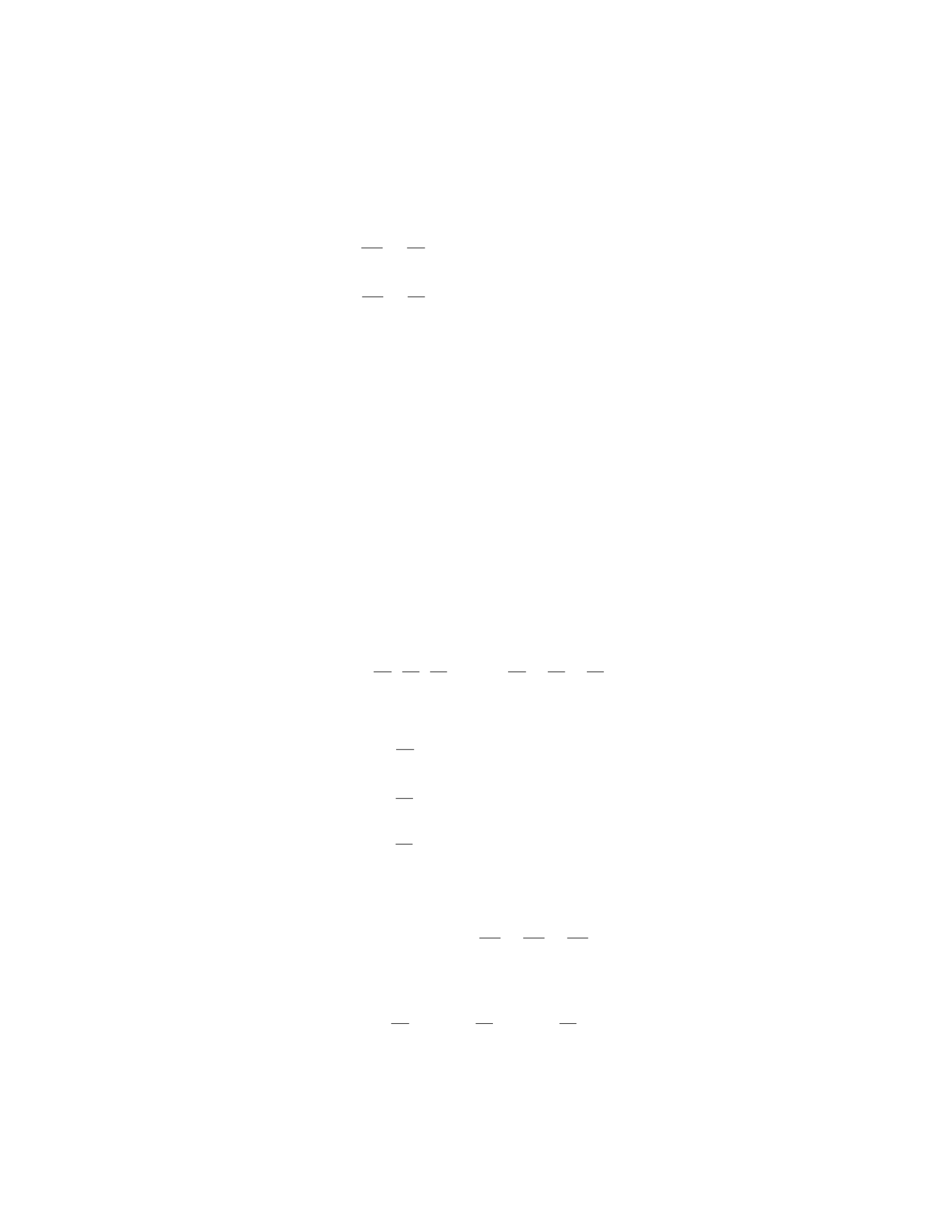
∂Q
∂x =∂
∂x (x3−3xy2)=3x2−3y2
∂P
∂y =∂
∂y (2x2y−y3)=2x2−3y2
Step 2: Compute ∇ × F.
Substitute the computed partial derivatives into the formula:
∇ × F= (3x2−3y2−(2x2−3y2))k= (x2)k
Therefore, the curl of Fis x2k.
Question 12
Question
Consider the vector field F(x, y, z) = (x2yz, xy2z, xyz2). Determine the gradi-
ent, divergence, and curl of F.
Solution
Step 1: Find the gradient of F. The gradient of a vector field F(x, y, z) is given
by
∇F=∂
∂x ,∂
∂y ,∂
∂z F=∂
∂x F,∂
∂y F,∂
∂z F.
So, we need to find the partial derivatives of Fwith respect to x,y, and z.
∂
∂x F= (2xyz, y2z, yz2),
∂
∂y F= (x2z, 2xyz, xz2),
∂
∂z F= (x2y, xy2,2xyz).
Step 2: Find the divergence of F. The divergence of a vector field F(x, y, z) =
(P, Q, R) is given by
div(F) = ∇ · F=∂P
∂x +∂Q
∂y +∂R
∂z .
For F(x, y, z)=(x2yz, xy2z, xyz2), we have
div(F) = ∂
∂x (x2yz) + ∂
∂y (xy2z) + ∂
∂z (xyz2).
9

Computing the partial derivatives and summing them up, we get
div(F)=2xyz +xz2+yz2.
Step 3: Find the curl of F. The curl of a vector field F(x, y, z)=(P, Q, R)
is given by
curl(F) = ∇ × F=∂R
∂y −∂Q
∂z ,∂P
∂z −∂R
∂x ,∂Q
∂x −∂P
∂y .
For F(x, y, z)=(x2yz, xy2z, xyz2), we have
curl(F) = z2, z2, z2.
Question 13
Question
Let F(x, y, z) = (2x3y2,3xy3z, xyz2) be a vector field. Calculate the curl of F.
Solution
To find the curl of F, we need to compute the determinant of the following
matrix:
curl F=
i j k
∂
∂x
∂
∂y
∂
∂z
2x3y23xy3z xyz2
Step 1: Compute the partial derivatives:
∂
∂x (2x3y2)=6x2y2
∂
∂y (3xy3z)=3x(3y2z) = 9xy2z
∂
∂z (xyz2) = xz2
Step 2: Replace the partial derivatives in the determinant:
curl F=
i j k
6x2y29xy2z xz2
Step 3: Expand the determinant to find the curl:
curl F=∂(xz2)
∂y −∂(9xy2z)
∂z i−∂(xz2)
∂x −∂(6x2y2)
∂z j+∂(6x2y2)
∂x −∂(9xy2z)
∂y k
Simplify the expressions to find the final answer.
10

Question 14
Question
Let F(x, y, z)=2x2yi+ (x2+ 2yz)j+ 3xz2k. Calculate the curl of F.
Solution
To find the curl of F, we first need to express Fin terms of the unit vectors i,
j, and k. Then, we can apply the formula for the curl.
Step 1: Express F in terms of i,j, and k:
F(x, y, z)=2x2yi+ (x2+ 2yz)j+ 3xz2k
Step 2: Calculate the curl of F: The curl of a vector field F=Pi+
Qj+Rkis given by:
curl F=∇ × F=∂R
∂y −∂Q
∂z i−∂R
∂x −∂P
∂z j+∂Q
∂x −∂P
∂y k
Now, let’s compute the curl of F:
curl F=∂(3xz2)
∂y −∂(x2+ 2yz)
∂z i−∂(3xz2)
∂x −∂(2x2y)
∂z j+∂(x2+ 2yz)
∂x −∂(2x2y)
∂y k
Calculating each partial derivative, we get:
curl F= (0 −2z)i−(3z2−2y)j+ (0 −2x)k
Therefore, the curl of Fis:
curl F=−2zi−(3z2−2y)j−2xk
Question 15
Question
Let F(x, y, z) = x2ey+ysin(z), x cos(z), ex+z2. Calculate the divergence of
Fat the point (1, π, 0).
Solution
To find the divergence of F, we need to calculate the dot product of the gradient
operator ∇with the vector field F. The divergence of Fis given by:
div(F) = ∇ · F=∂Fx
∂x +∂Fy
∂y +∂Fz
∂z
11
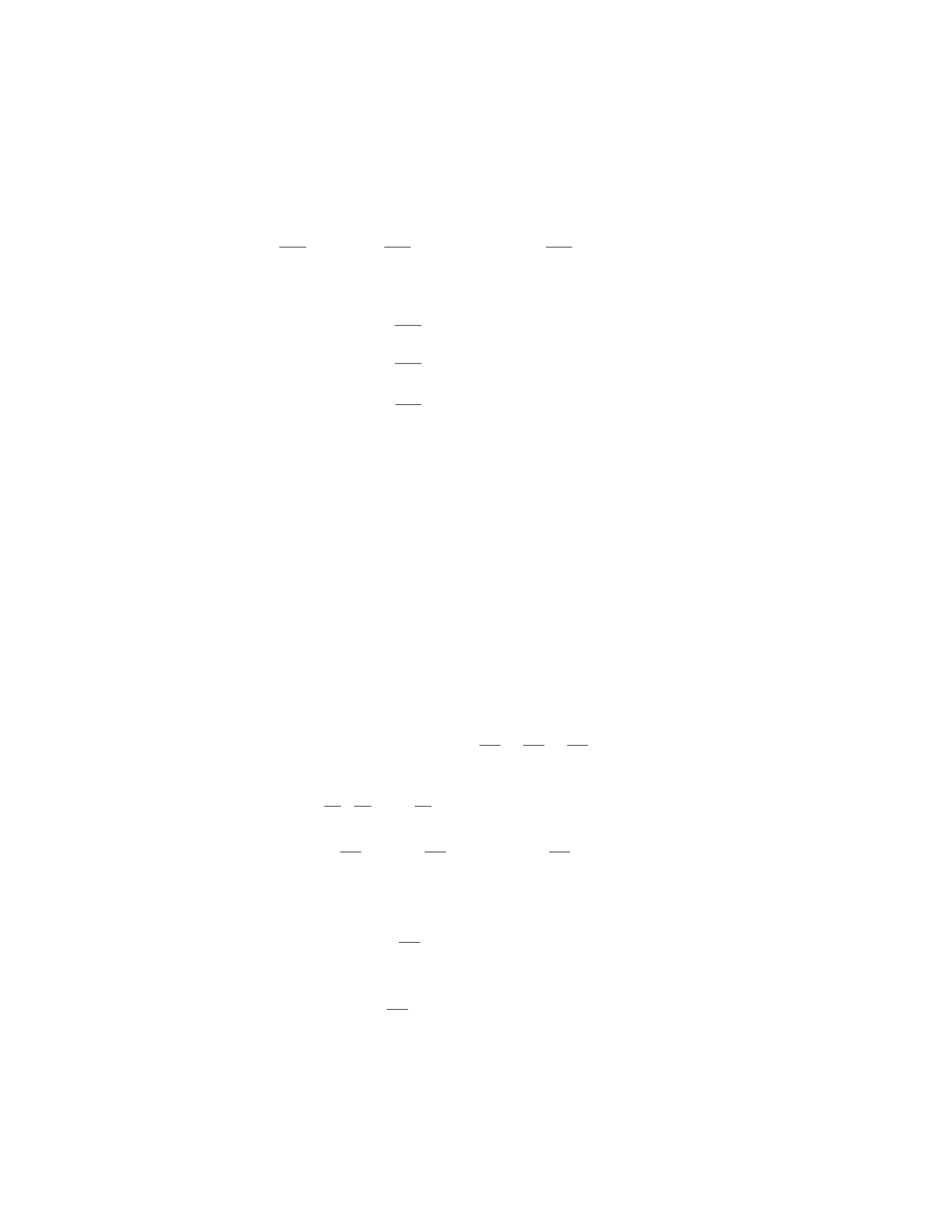
Given F(x, y, z) = x2ey+ysin(z), x cos(z), ex+z2, the partial derivatives
are: ∂Fx
∂x = 2xey,∂Fy
∂y =x2ey+ sin(z),∂Fz
∂z =x(−sin(z)),
Now compute these partial derivatives using the given point (1, π, 0):
∂Fx
∂x = 2eπ,
∂Fy
∂y =eπ+ sin(0) = eπ,
∂Fz
∂z = 1(−sin(0)) = 0.
Thus, the divergence of Fat the point (1, π, 0) is:
div(F)=2eπ+eπ+ 0 = 3eπ.
Question 16
Question
Let F(x, y, z) = x2−2y, y2−2z, z2−2xbe a vector field. Calculate the
divergence of Fat the point (1,−1,2).
Solution
To find the divergence of the vector field Fat the point (1,−1,2), we use the
formula for divergence:
div(F) = ∇ · F=∂P
∂x +∂Q
∂y +∂R
∂z ,
where F(x, y, z)=(P(x, y, z), Q(x, y, z), R(x, y, z)).
Step 1: Find ∂P
∂x ,∂Q
∂y , and ∂R
∂z .
∂P
∂x = 2x, ∂Q
∂y = 2y, and ∂R
∂z = 2z.
Step 2: Evaluate the partial derivatives at the given point (1,−1,2).
∂P
∂x
(1,−1,2)
= 2(1) = 2,
∂Q
∂y
(1,−1,2)
= 2(−1) = −2,
12
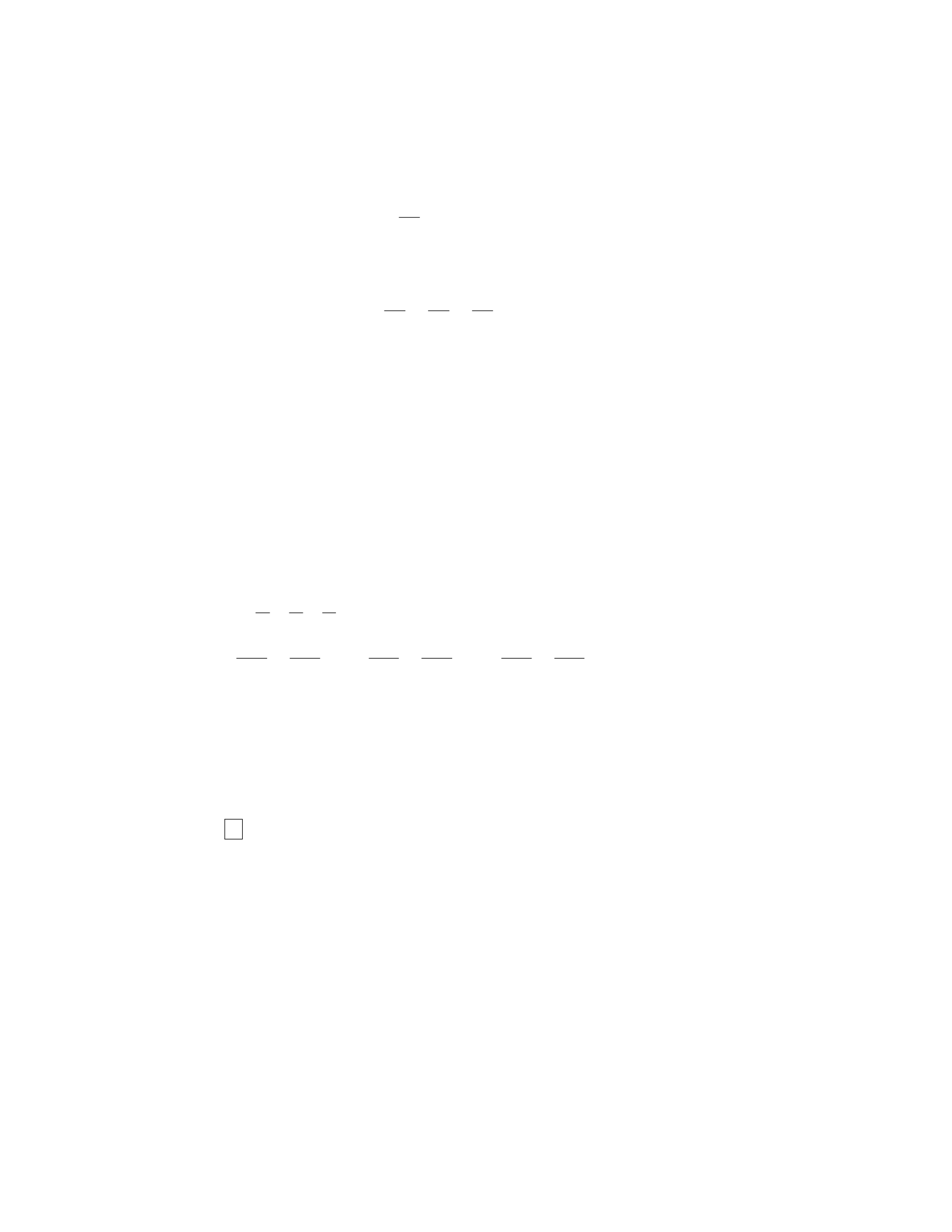
∂R
∂z
(1,−1,2)
= 2(2) = 4.
Step 3: Calculate the divergence of Fat the point (1,−1,2).
div(F)
(1,−1,2)
=∂P
∂x +∂Q
∂y +∂R
∂z
(1,−1,2)
= 2 + (−2) + 4 = 4.
Therefore, the divergence of the vector field Fat the point (1,−1,2) is 4.
Question 17
Question
Let F(x, y, z) = yzi+xzj+xyk. Calculate ∇ · ∇ × F.
Solution
Step 1: Find ∇ × F.
=
i j k
∂
∂x
∂
∂y
∂
∂z
yz xz xy
=∂(xy)
∂y −∂(xz)
∂z i−∂(yz)
∂x −∂(xy)
∂z j+∂(xz)
∂x −∂(yz)
∂y k
= (x−x)i−(z−z)j+ (y−y)k
=0
Step 2: Calculate ∇ · ∇ × F.
=∇ · 0
= 0
Question 18
Question
Let F(x, y, z) = yzi+xzj+xykbe a vector field in R3. Determine the curl of
F.
13
Solution
To find the curl of a vector field F(x, y, z) = P(x, y, z)i+Q(x, y, z)j+R(x, y, z)k,
we use the formula:
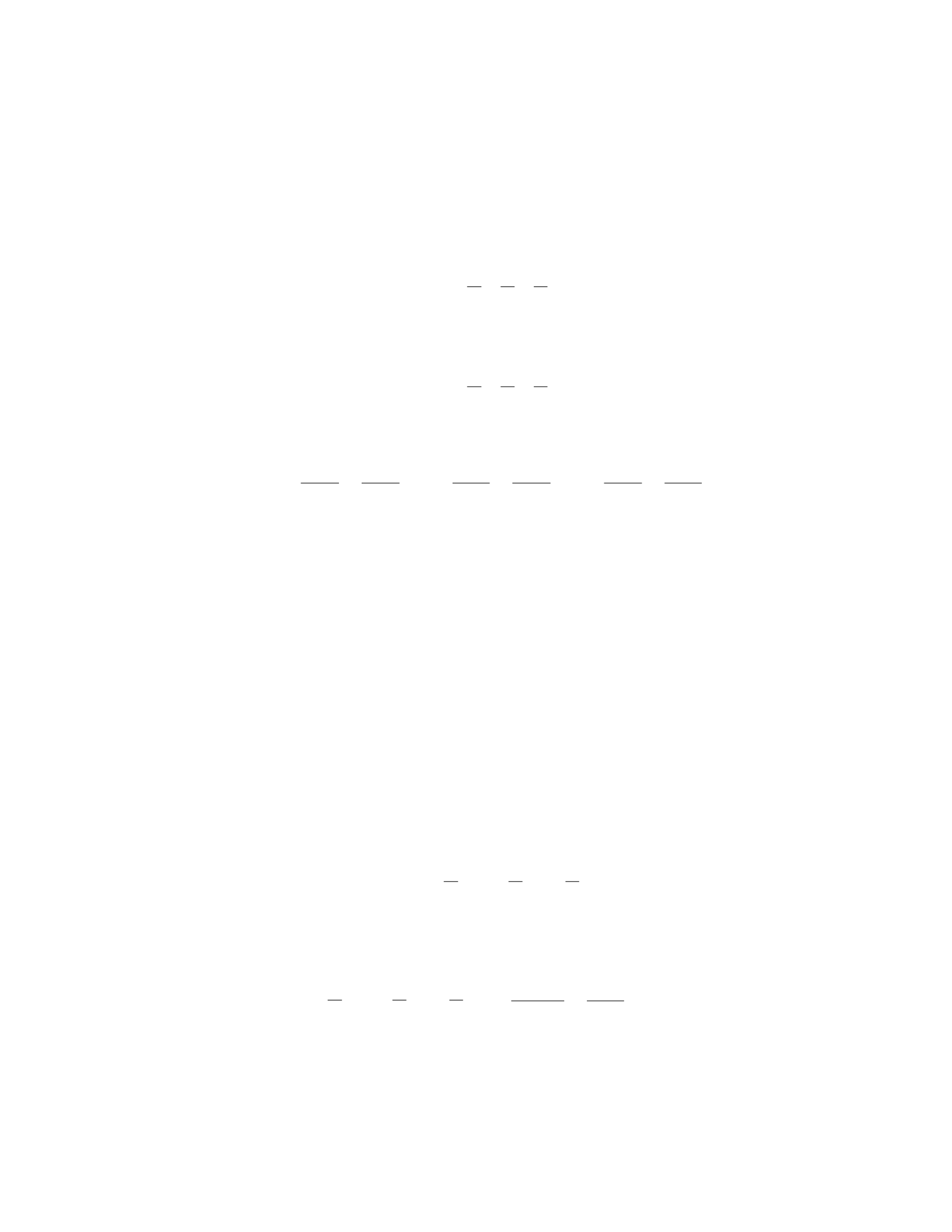
∇ × F=
i j k
∂
∂x
∂
∂y
∂
∂z
P Q R
Step 1: Compute the curl of Fusing the formula.
∇ × F=
i j k
∂
∂x
∂
∂y
∂
∂z
yz xz xy
Step 2: Calculate the determinant expansion.
∇ × F=∂(xy)
∂y −∂(xz)
∂z i−∂(yz)
∂x −∂(xy)
∂z j+∂(xz)
∂x −∂(yz)
∂y k
Step 3: Differentiate and simplify.
∇ × F= (x−x)i−(z−z)j+ (y−y)k
Step 4: Simplify further.
∇ × F=0
So, the curl of Fis the zero vector field.
Question 19
Question
Let F(x, y, z) = ⟨exsin y, x2+yz, xyz2⟩. Find the curl of F.
Solution
To find the curl of F, denoted as ∇ × F, we need to compute the following
determinant:
∇ × F=
i j k
∂
∂x
∂
∂y
∂
∂z
exsin y x2+yz xyz2
Step 1: Calculate the determinant for each component of the curl:
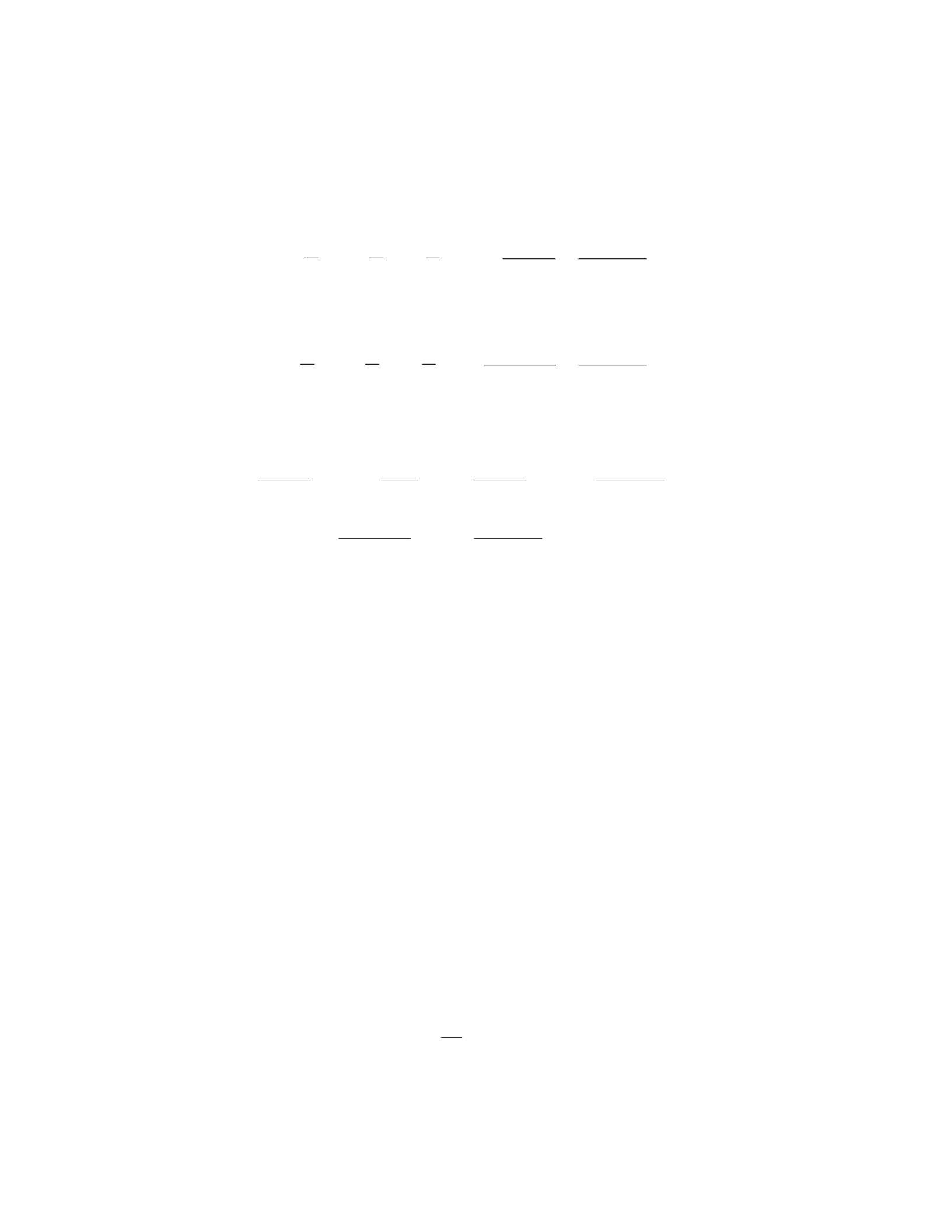
For the icomponent:
i j k
∂
∂x
∂
∂y
∂
∂z
exsin y x2+yz xyz2
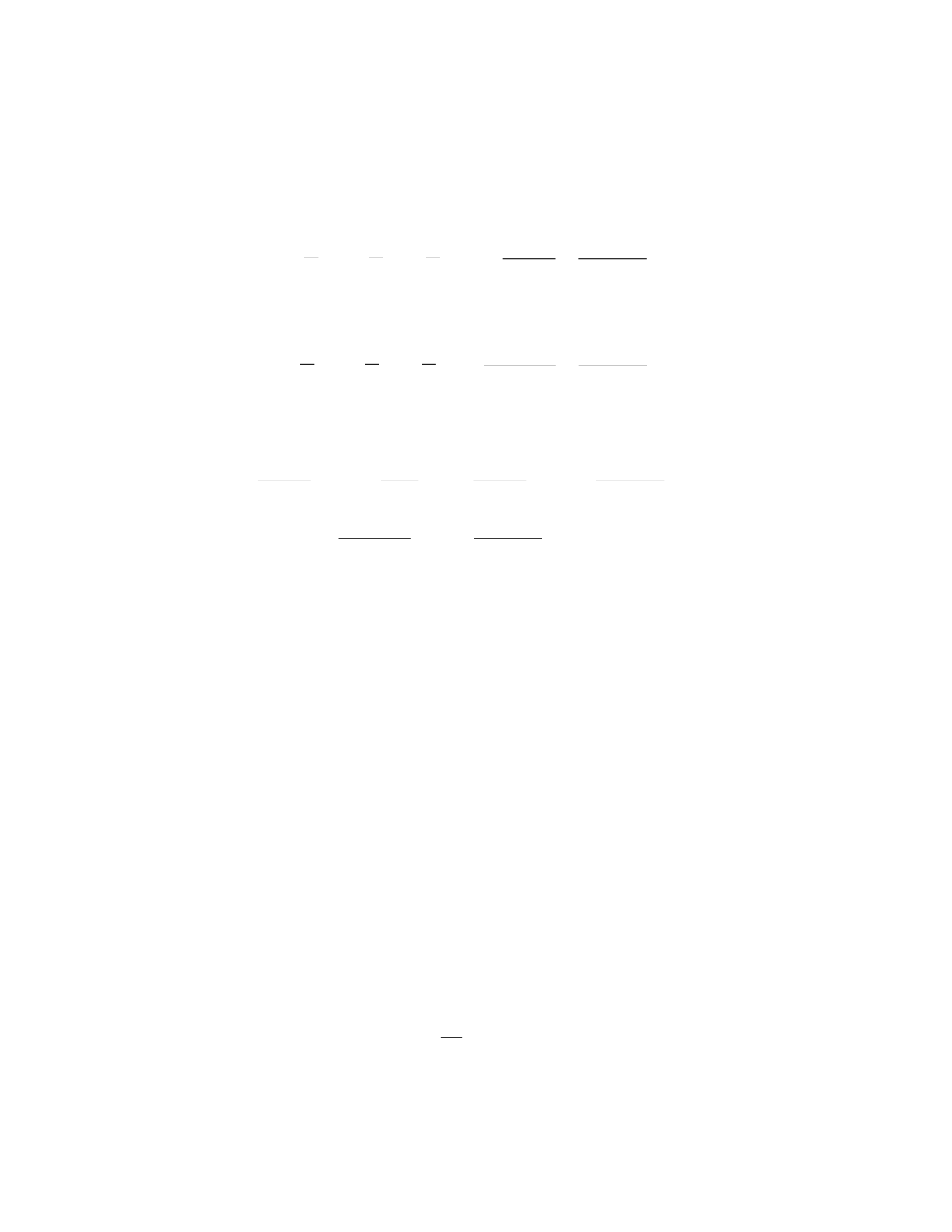
=∂(xyz2)
∂y −∂(yz)
∂z i
14
For the jcomponent:
i j k
∂
∂x
∂
∂y
∂
∂z
exsin y x2+yz xyz2
=−∂(xyz2)
∂x −∂(exsin y)
∂z j
For the kcomponent:
i j k
∂
∂x
∂
∂y
∂
∂z
exsin y x2+yz xyz2
=∂(x2+yz)
∂x −∂(exsin y)
∂y k
Step 2: Calculate the partial derivatives for each component.
Now, calculate the partial derivatives:
∂(xyz2)
∂y =xz2,∂(yz)
∂z =y, ∂(xyz2)
∂x =yz2,∂(exsin y)
∂z = 0
∂(x2+yz)
∂x = 2x, ∂(exsin y)
∂y =excos y
Step 3: Substitute the calculated values into the expressions for each com-
ponent.
Substitute the values in for each component:
(∇ × F)x=xz2−y, (∇ × F)y=−yz2,(∇ × F)z= 2x−excos y
Step 4: Final Answer
Therefore, the curl of Fis:
∇ × F=⟨xz2−y, −yz2,2x−excos y⟩
Question 20
Question
Let F(x, y, z) = (2xy2+z)i+ (x2y+ 3z2)j+ (x2+ 2yz)kbe a vector field in R3.
Calculate the divergence of F.
Solution
To find the divergence of F, we need to compute ∇ · Fwhere F(x, y, z) =
P(x, y, z)i+Q(x, y, z)j+R(x, y, z)k.
Step 1: Calculate the partial derivatives of P,Q, and R. Let P(x, y, z) =
2xy2+z,Q(x, y, z) = x2y+ 3z2, and R(x, y, z) = x2+ 2yz. We have:
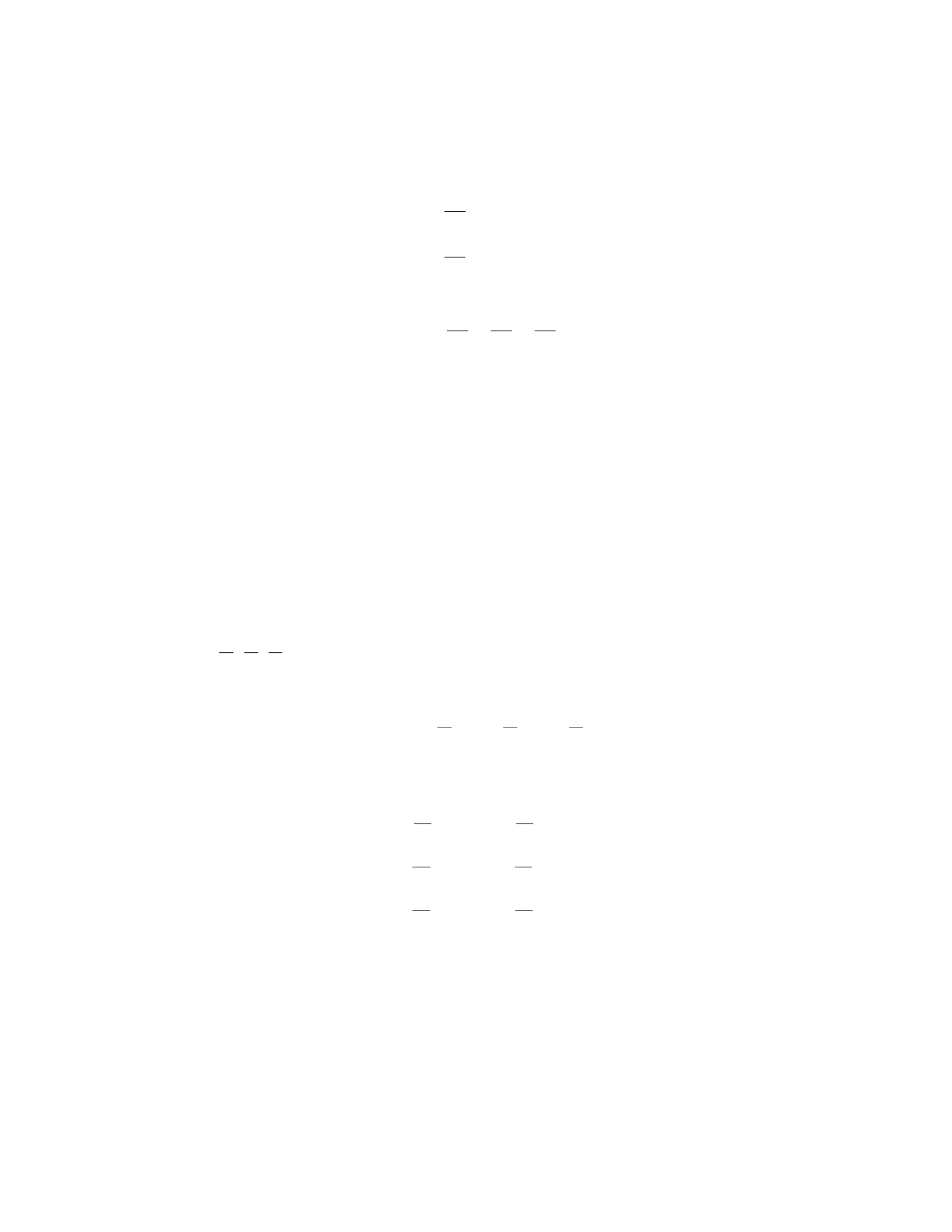
∂P
∂x = 2y2,
15
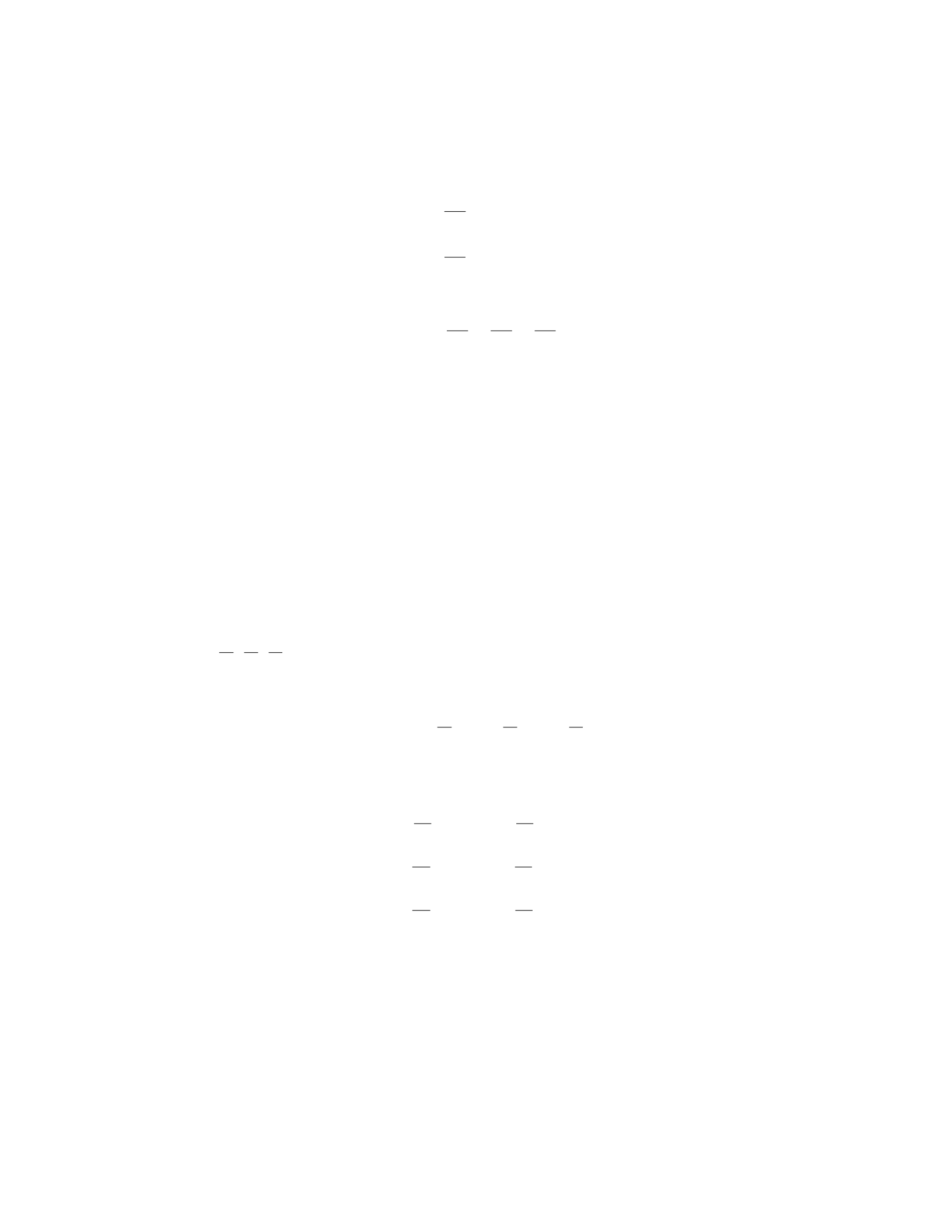
∂Q
∂y =x2,
∂R
∂z = 2y.
Step 2: Calculate the divergence of F. The divergence of Fis given by:
∇ · F=∂P
∂x +∂Q
∂y +∂R
∂z .
Substitute the partial derivatives we calculated:
∇ · F= 2y2+x2+ 2y.
Therefore, the divergence of Fis 2y2+x2+ 2y.
Question 21
Question
Let F(x, y, z)=(yz +ex, xz +ey, xy +ez). Find the curl of F.
Solution
To find the curl of F, we will use the formula: curl(F) = ∇ × F, where ∇=
∂
∂x ,∂
∂y ,∂
∂z is the del operator.
Step 1: Compute the curl of Fusing the formula:
curl(F) =
i j k
∂
∂x
∂
∂y
∂
∂z
yz +exxz +eyxy +ez
Step 2: Calculate the determinant to find the curl:
curl(F) = ∂
∂y (xy +ez)−∂
∂z (xz +ey)i
−∂
∂x (yz +ex)−∂
∂z (xy +ez)j
+∂
∂x (xz +ey)−∂
∂y (yz +ex)k
Now, differentiate each component of Fwith respect to the corresponding
variable.
16
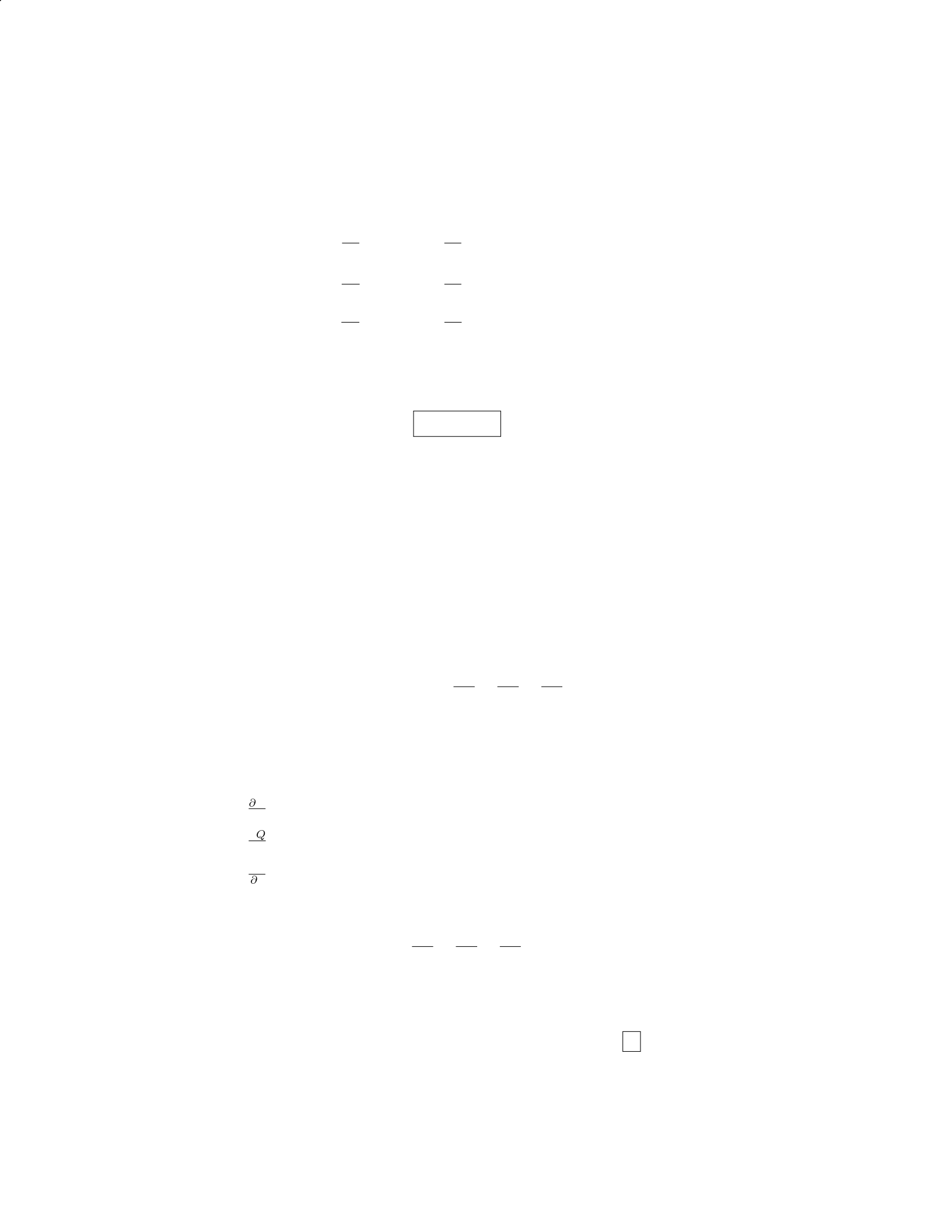
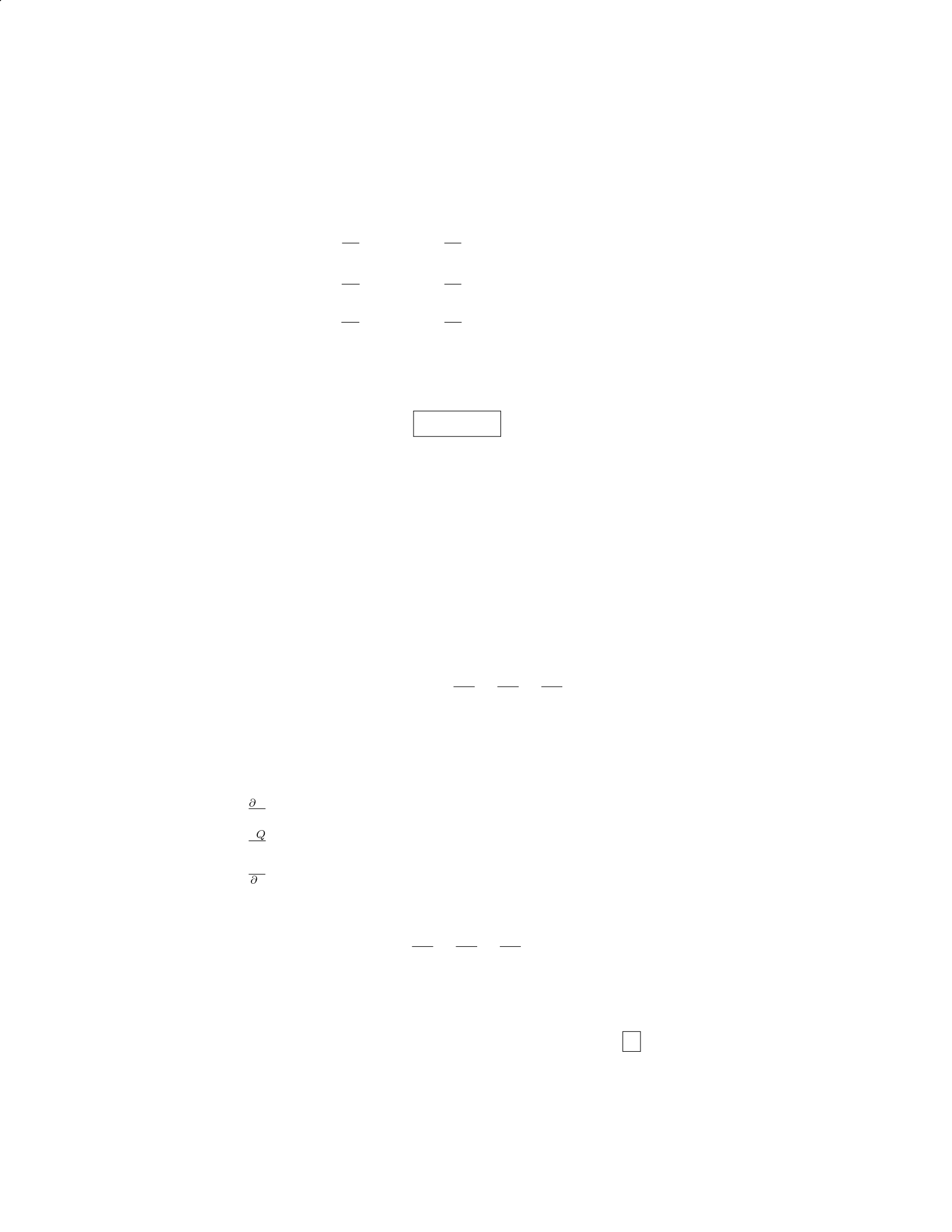
Step 3: Compute the components of the curl:
∂
∂y (xy +ez)−∂
∂z (xz +ey) = x−x= 0
∂
∂x (yz +ex)−∂
∂z (xy +ez) = z−z= 0
∂
∂x (xz +ey)−∂
∂y (yz +ex) = x−y
Step 4: Assemble the components into the vector form of the curl:
curl(F) = (0,0, x −y)
Therefore, the curl of Fis (0,0, x −y) .
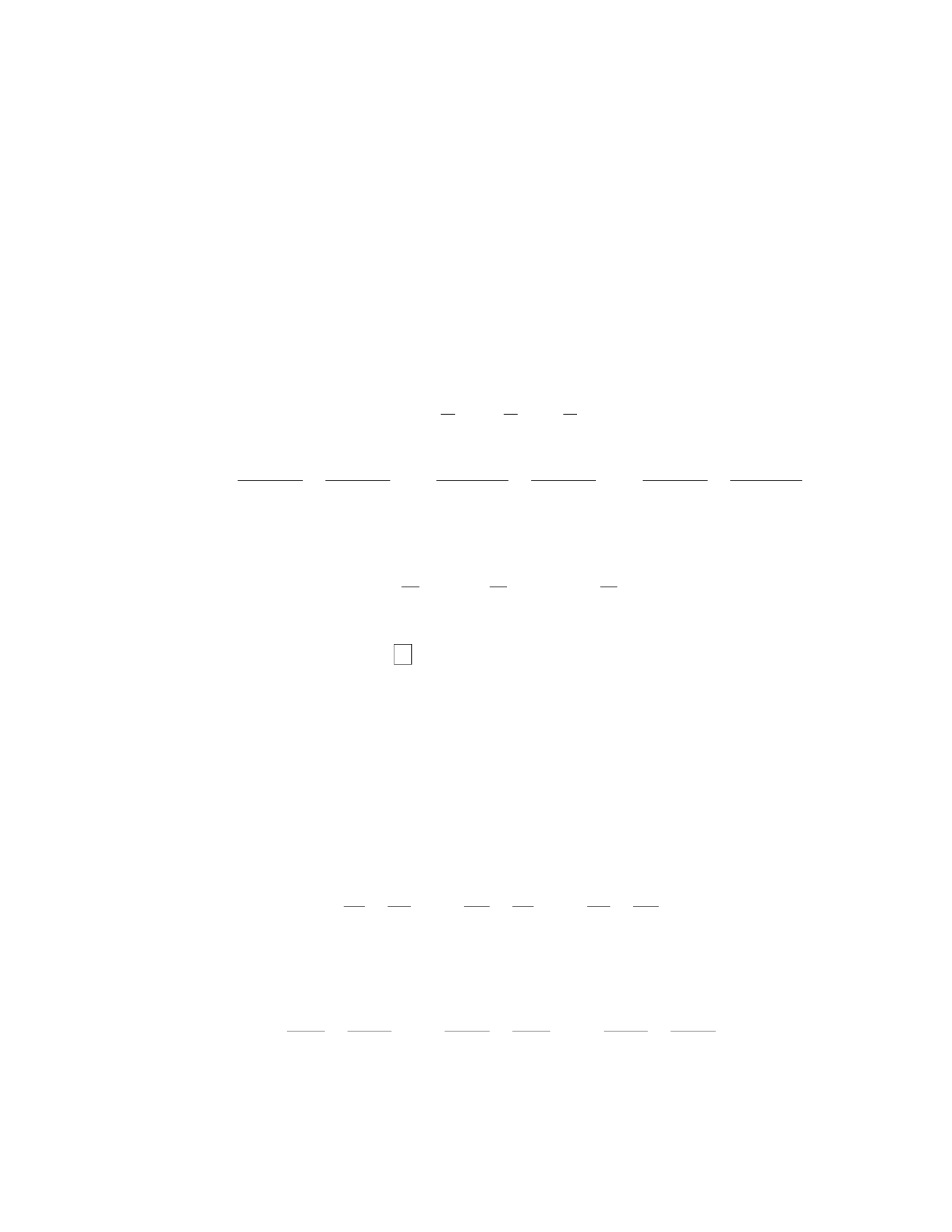
Question 22
Question
Let F(x, y, z)=2yzi+xzj+xykbe a vector field. Determine the divergence of
Fat the point P(1,−1,2).
Solution
Step 1: The divergence of a vector field F(x, y, z) = P(x, y, z)i+Q(x, y, z)j+
R(x, y, z)kis given by the formula:
div(F) = ∂P
∂x +∂Q
∂y +∂R
∂z
Step 2: In this case, F(x, y, z)=2yzi+xzj+xyk, so P(x, y, z)=2yz,
Q(x, y, z) = xz, and R(x, y, z) = xy.
Step 3: Calculate the partial derivatives of P,Q, and Rwith respect to x,
y, and z.
∂P
∂x = 0
∂Q
∂y =z
∂R
∂z =x
Step 4: Substitute the values of the partial derivatives into the formula for
the divergence:
div(F) = ∂P
∂x +∂Q
∂y +∂R
∂z = 0 + z+x
Step 5: Evaluate div(F) at the point P(1,−1,2):
div(F)(1,−1,2) = 2 + 1 = 3
Therefore, the divergence of Fat the point P(1,−1,2) is 3 .
17
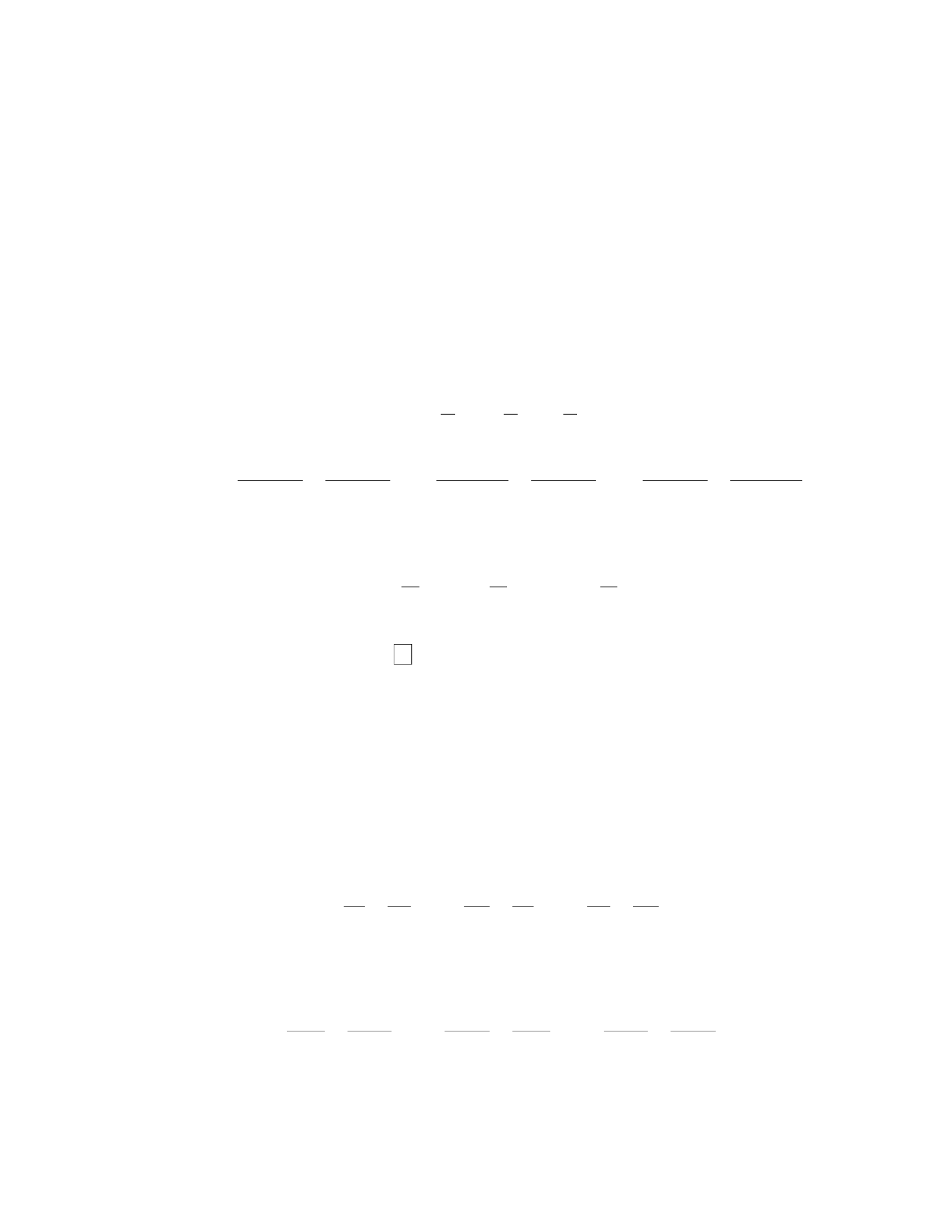
Question 23
Question
Let F(x, y, z)=(yz +x2)i+ (xz +y)j+ (xy +z)kbe a vector field in R3.
Calculate ∇ · ∇ × F.
Solution
Step 1: Calculate ∇ × F.
∇ × F=
i j k
∂
∂x
∂
∂y
∂
∂z
yz +x2xz +y xy +z
=∂(xy +z)
∂y −∂(xz +y)
∂z i−∂(yz +x2)
∂x −∂(xy +z)
∂z j+∂(xz +y)
∂x −∂(yz +x2)
∂y k
= (x−1)i−(z−1)j+ (y−y)k= (x−1)i−(z−1)j
Step 2: Calculate ∇ · ∇ × F.
∇ · ∇ × F=∂
∂x (x−1) + ∂
∂y (−(z−1)) + ∂
∂z (0)
= 1 −0 + 0 = 1
Therefore, ∇ · ∇ × F= 1 .
Question 24
Question
Let F(x, y, z) = ⟨x2y, yz3, xz⟩be a vector field. Compute ∇ · (∇ × F).
Solution
Step 1: First, we need to find the curl of F. The curl of a vector field F=
⟨M, N, P ⟩is given by
∇ × F=∂P
∂y −∂N
∂z i+∂M
∂z −∂P
∂x j+∂N
∂x −∂M
∂y k
Step 2: In this case, F=⟨x2y, yz3, xz⟩. So, M=x2y,N=yz3, and P=xz.
Now, we can find the curl of F.
Step 3: Compute
∇ × F=∂(xz)
∂y −∂(yz3)
∂z i+∂(x2y)
∂z −∂(xz)
∂x j+∂(yz3)
∂x −∂(x2y)
∂y k
18
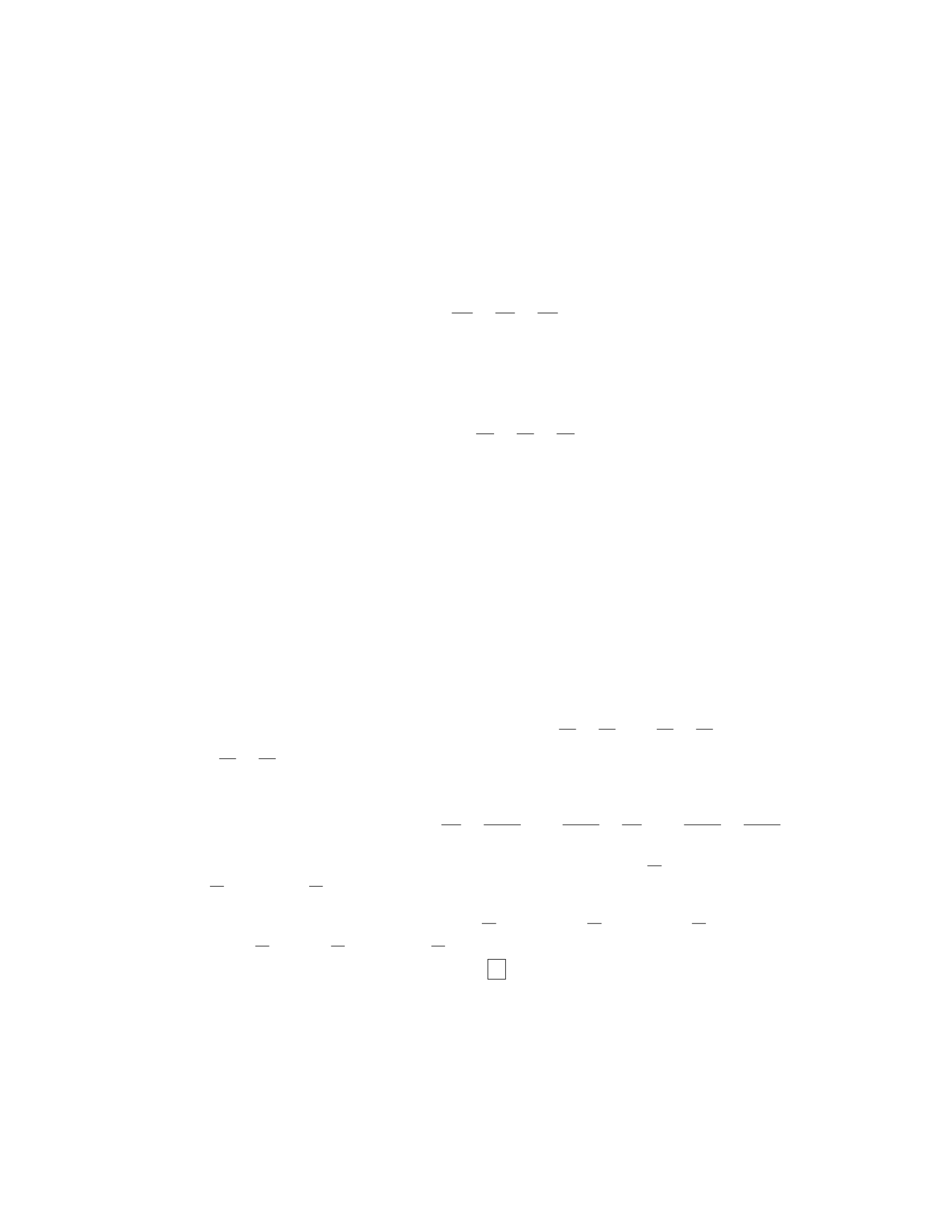
Step 4: Simplify to get
∇ × F=⟨z, 0, x⟩
Step 5: Next, we need to find the divergence of ∇ × F. The divergence of a
vector field G=⟨R, S, T ⟩is given by
∇ · G=∂R
∂x +∂S
∂y +∂T
∂z
Step 6: In this case, ∇ × F=⟨z, 0, x⟩. So, R=z,S= 0, and T=x. Now,
we can find the divergence of ∇ × F.
Step 7: Compute
∇ · (∇ × F) = ∂z
∂x +∂0
∂y +∂x
∂z
Step 8: Simplify to get
∇ · (∇ × F)=1
Therefore, ∇ · (∇ × F) = 1.
Question 25
Question
Let F(x, y, z) = x2yi+xyzj+z2k. Calculate ∇·∇×F, where ∇is the gradient
operator and ×is the cross product operator.
Solution
Step 1: Calculate ∇×Fusing the formula ∇×F=∂Q
∂y −∂P
∂z i+∂R
∂z −∂P
∂x j+
∂P
∂y −∂Q
∂x k, where F(x, y, z) = P(x, y, z)i+Q(x, y, z)j+R(x, y, z)k.
Given F(x, y, z) = x2yi+xyzj+z2k, we have: P(x, y, z) = x2y, Q(x, y, z) =
xyz, R(x, y, z) = z2.
Calculating the curl: ∇×F=∂z2
∂y −∂(xyz)
∂z i+∂(x2y)
∂z −∂z2
∂x j+∂(xyz)
∂y −∂(x2y)
∂x k
Expanding and simplifying: ∇ × F=−xi+yj+xk.
Step 2: Calculate ∇ · ∇ × Fusing the formula ∇ · ∇ × F=∂
∂x (∇ × Fx) +
∂
∂y (∇ × Fy) + ∂
∂z (∇ × Fz).
We already know ∇ × F=−xi+yj+xk.
Calculating each partial derivative: ∂
∂x (∇ × Fx) = ∂
∂x (−x) = −1, ∂
∂y (∇ ×
Fy) = ∂
∂y (y) = 1, ∂
∂z (∇ × Fz) = ∂
∂z (x) = 0.
Therefore, ∇ · ∇ × F=−1 + 1 + 0 = 0 .
19
Question 26
Question
Let F(x, y, z)=(yex+z2, xey+ 2z, 2yez+ 3x) be a vector field. Calculate the
divergence of Fat the point (1,0,−1).
Solution
To calculate the divergence of F, we use the formula:
div(F) = ∂P
∂x +∂Q
∂y +∂R
∂z ,
where F(x, y, z)=(P, Q, R).
Step 1: Find the partial derivatives of P,Q, and R.
∂P
∂x =yex
∂Q
∂y =xey
∂R
∂z = 2yez
Step 2: Evaluate the partial derivatives at the point (1,0,−1).
∂P
∂x
(1,0,−1) = 0e1= 0
∂Q
∂y
(1,0,−1) = 1e0= 1
∂R
∂z
(1,0,−1) =−2e−1≈ −0.7358
Step 3: Calculate the divergence at the point (1,0,−1).
div(F)
(1,0,−1) = 0 + 1 −0.7358 ≈0.2642.
Therefore, the divergence of Fat the point (1,0,−1) is approximately 0.2642.
Question 27
Question
Let F(x, y, z)=(x2y+z)i+ (xy2+z)j+ (xyz + 1)kbe a vector field. Calculate
the curl of F.
20
Solution
To calculate the curl of F, we use the formula:
curl F=∇ × F
where ∇=∂
∂x ,∂
∂y ,∂
∂z is the gradient operator.
Step 1: Compute the components of the curl.
curl F=
i j k
∂
∂x
∂
∂y
∂
∂z
x2y+z xy2+z xyz + 1
=∂(xyz + 1)
∂y −∂(xy2+z)
∂z i−∂(xyz + 1)
∂x −∂(x2y+z)
∂z j+∂(xy2+z)
∂x −∂(x2y+z)
∂y k
Step 2: Compute the partial derivatives.
∂(xyz + 1)
∂y =xz
∂(xy2+z)
∂z = 1
∂(xyz + 1)
∂x =yz
∂(x2y+z)
∂z = 1
∂(xy2+z)
∂x =y2
∂(x2y+z)
∂y =x2
Step 3: Plug the partial derivatives into the components of the curl.
curl F= (xz −1)i−(yz −1)j+ (y2−x2)k
Therefore, the curl of Fis (xz −1)i−(yz −1)j+ (y2−x2)k.
Question 28
Question
Let F(x, y, z) = x2yi+y2zj+z2xk. Calculate the curl of F.
Solution
To compute the curl of a vector field F=P(x, y, z)i+Q(x, y, z)j+R(x, y, z)k,
where P,Q, and Rare the component functions, we use the formula:
curl(F) = ∂R
∂y −∂Q
∂z i−∂R
∂x −∂P
∂z j+∂Q
∂x −∂P
∂y k
21
Step 1: Identify P,Q, and Rfor F=x2yi+y2zj+z2xk.P(x, y, z) = x2y,
Q(x, y, z) = y2z,R(x, y, z) = z2x.
Step 2: Calculate the partial derivatives:
∂P
∂y =x2,∂Q
∂z =y2,∂R
∂x = 2zx, ∂P
∂z = 0,∂Q
∂x = 0,∂R
∂y = 2z
Step 3: Substitute the partial derivatives into the curl formula:
curl(F) = (2z−0)i−(2zx −0)j+ (0 −x2)k
Step 4: Simplify the expression:
curl(F)=2zi−2zxj−x2k
Therefore, the curl of Fis 2zi−2zxj−x2k.
Question 29
Question
Let F(x, y, z) = x2yi−2xyzj+yezk. Calculate the curl of F.
Solution
Step 1: The curl of a vector field F(x, y, z) = P(x, y, z)i+Q(x, y, z)j+R(x, y, z)k
is defined as
∇ × F=
i j k
∂
∂x
∂
∂y
∂
∂z
P Q R
Step 2: In our case, P(x, y, z) = x2y,Q(x, y, z) = −2xyz, and R(x, y, z) = yez.
So, we need to compute the determinant
i j k
∂
∂x
∂
∂y
∂
∂z
x2y−2xyz yez
Step 3: Computing the partial derivatives, we get
∂R
∂y −∂Q
∂z =ez−(−2x)
=ez+ 2x
Step 4: Similarly,
∂P
∂z −∂R
∂x = 0 −0
= 0
22

Step 5: Lastly,
∂Q
∂x −∂P
∂y =−2yz −2xy
=−2y(z+x)
Step 6: Therefore, the curl of Fis
∇ × F= (ez+ 2x)i+ 0j−2y(z+x)k
Question 30
Question
Let F(x, y)=(exy cos(y), exy sin(y)) be a vector field. Compute ∇ · F, where ∇
is the gradient operator.
Solution
Step 1: Compute the gradient of Fby finding its partial derivatives.
∇F=∂
∂x (exy cos(y)),∂
∂y (exy sin(y))
Step 2: Taking the partial derivatives yields:
∇F= (yexy cos(y)−yexy sin(y), xexy cos(y) + exy sin(y))
Step 3: Compute the divergence of Fby taking the dot product of ∇and F:
∇ · F=∂
∂x (yexy cos(y)−yexy sin(y)) + ∂
∂y (xexy cos(y) + exy sin(y))
Step 4: Simplify the expression by evaluating the partial derivatives:
∇ · F=yexy cos(y)−yexy sin(y) + xexy cos(y) + exy sin(y)
∇ · F= (x+y)exy cos(y) + (1 −y)exy sin(y)
23
Question 2
Question
Let F(x, y, z)=(x2+y2)i+ (y2+z2)j+ (z2+x2)k. Calculate the curl of F.
Solution
Step 1: Recall that the curl of a vector field F(x, y, z) = P(x, y, z)i+Q(x, y, z)j+
R(x, y, z)kis given by the determinant of the following matrix:
∇ × F=
i j k
∂
∂x
∂
∂y
∂
∂z
P Q R
Step 2: Let’s find the components P,Q, and Rfor F:P(x, y, z) = x2+y2
Q(x, y, z) = y2+z2R(x, y, z) = z2+x2
Step 3: Compute the curl of F:
∇ × F=
i j k
∂
∂x
∂
∂y
∂
∂z
x2+y2y2+z2z2+x2
Step 4: Calculate the determinant by expanding along the first row:
∇×F=∂(z2+x2)
∂y −∂(y2+z2)
∂z i−∂(z2+x2)
∂x −∂(x2+y2)
∂z j+∂(y2+z2)
∂x −∂(x2+y2)
∂y k
Step 5: Simplify the partial derivatives to get the final expression for the
curl of F:
∇ × F= (−2y−2z)i+ (2x−2z)j+ (2y−2x)k
Therefore, the curl of Fis (−2y−2z)i+ (2x−2z)j+ (2y−2x)k.
Question 3
Question
Let F= (y2z, x2z, xy2) be a vector field in R3. Find the divergence of F.
Solution
To find the divergence of F, we will compute ∇ · F, where ∇=∂
∂x ,∂
∂y ,∂
∂z is
the del operator.
Step 1: Compute the divergence of Fusing the formula ∇·F=∂F1
∂x +∂F2
∂y +
∂F3
∂z .
∇ · F=∂
∂x (y2z) + ∂
∂y (x2z) + ∂
∂z (xy2)
2
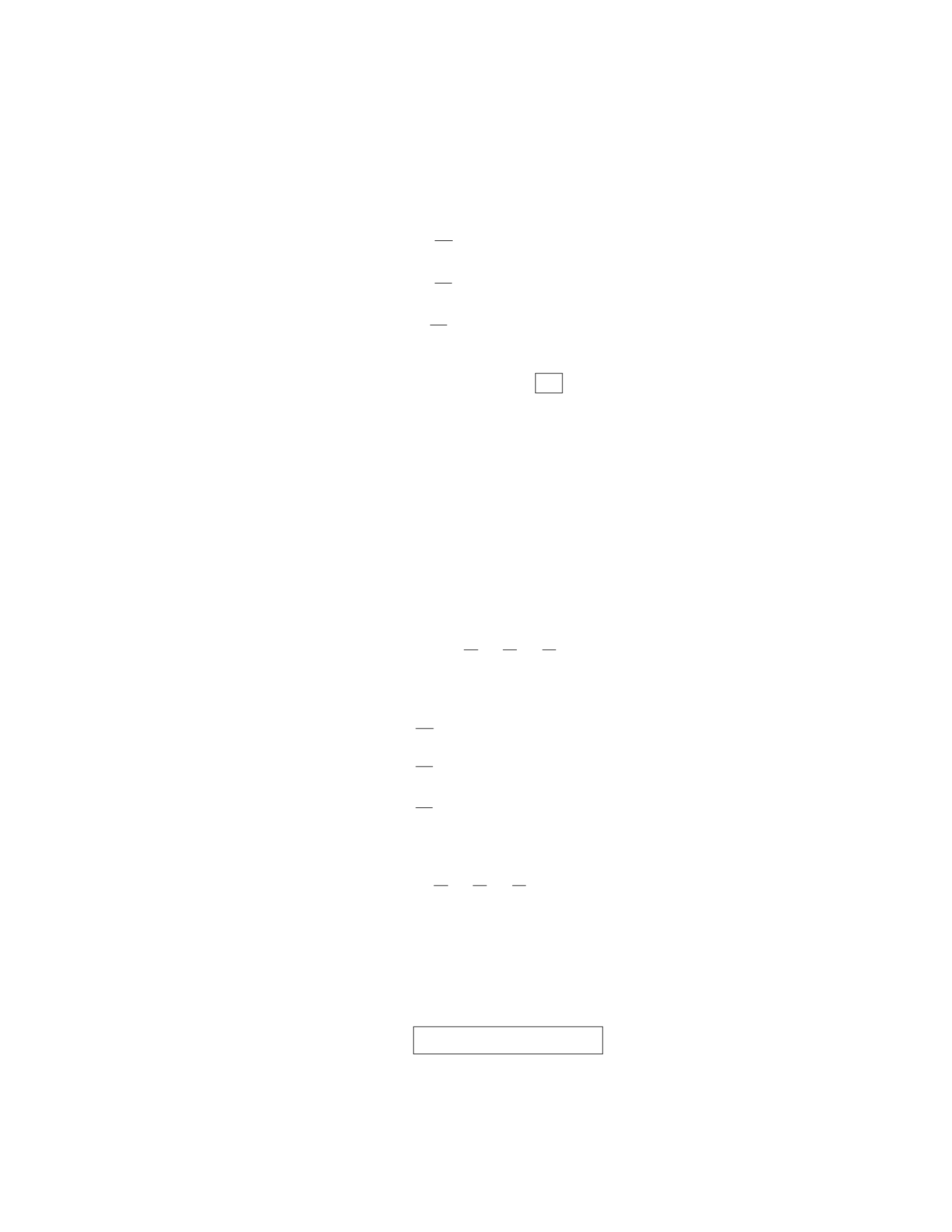
Step 2: Compute the partial derivatives.
∂
∂x (y2z) = 0
∂
∂y (x2z) = 0
∂
∂z (xy2) = xy
Step 3: Sum the partial derivatives to find the divergence.
∇ · F=0+0+xy =xy
Therefore, the divergence of Fis xy.
Question 4
Question
Let F(x, y, z)=(yz2, xz2, xy2). Calculate the curl of F.
Solution
To find the curl of F, we need to compute the determinant of the following
matrix:
curl(F) =
i j k
∂
∂x
∂
∂y
∂
∂z
yz2xz2xy2
Step 1: Compute the partial derivatives:
∂
∂x = (0, z2, y2)
∂
∂y = (z2,0,2xy)
∂
∂z = (2yz, 2xz, 0)
Step 2: Calculate the determinant:
curl(F) =
i j k
∂
∂x
∂
∂y
∂
∂z
yz2xz2xy2
= (2xy −0) −(2xz −0)i
−(2yz −z2) + (0 −y2)j
+ (z2−z2)−(0 −0)k
= 2xyi−2xzi−(2yz −z2)j
Therefore, the curl of Fis (2xy −2xz)i−(2yz −z2)j.
3

Question 5
Question
Let F(x, y, z)=(xz, xey, yz) be a vector field. Compute the divergence of Fat
the point (1,2,3).
Solution
Step 1: Recall that the divergence of a vector field F= (P(x, y, z), Q(x, y, z), R(x, y, z))
is given by the scalar function ∇ · F=∂P
∂x +∂Q
∂y +∂R
∂z .
Step 2: For the given vector field F(x, y, z)=(xz, xey, yz), we have P(x, y, z) =
xz,Q(x, y, z) = xey, and R(x, y, z) = yz.
Step 3: Calculate the partial derivatives:
∂P
∂x =z,
∂Q
∂y =xey,
∂R
∂z =y.
Step 4: Now, find the divergence of F:
∇ · F=∂P
∂x +∂Q
∂y +∂R
∂z
=z+xey+y.
Step 5: Finally, evaluate the divergence at the point (1,2,3):
∇ · F(1,2,3) = 3 + 1 ·e2+ 2
= 3 + e2+ 2
= 5 + e2.
Therefore, the divergence of the vector field Fat the point (1,2,3) is 5 + e2.
Question 6
Question
Let F(x, y, z) = xcos(yz)i+ysin(xz)j+zsin(xy)kbe a vector field. Compute
the curl of F.
4
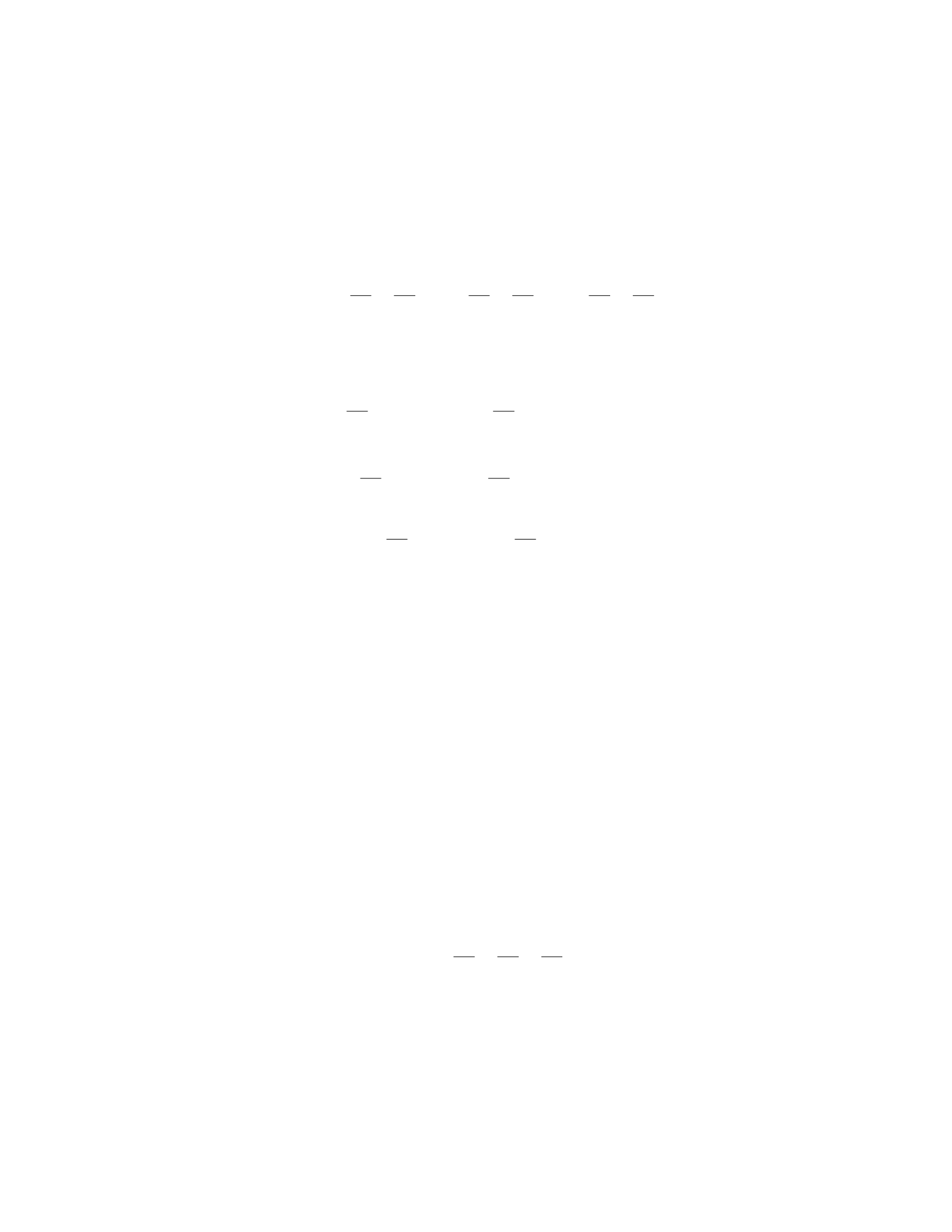
Solution
To compute the curl of a vector field F(x, y, z) = P(x, y, z)i+Q(x, y, z)j+
R(x, y, z)k, we use the formula:
∇ × F=∂R
∂y −∂Q
∂z i−∂R
∂x −∂P
∂z j+∂Q
∂x −∂P
∂y k
In our case, P(x, y, z) = xcos(yz), Q(x, y, z) = ysin(xz), and R(x, y, z) =
zsin(xy). Let’s compute the curl of F:
Step 1: Calculate the partial derivatives:
∂P
∂y =−xz sin(yz),∂Q
∂z =xy cos(xz)
Step 2:
∂R
∂y =zcos(xy),∂Q
∂x =zcos(xy)
Step 3:
∂R
∂x =ycos(xy),∂P
∂z = 0
Step 4: Substitute these partial derivatives into the formula for the curl:
∇ × F= (zcos(xy)−ycos(xy))i−(−xz sin(yz))j+ (xy cos(xz))k
Step 5: Simplify the components:
∇ × F=zcos(xy)i+xz sin(yz)j+xy cos(xz)k
Therefore, the curl of the vector field Fis ∇×F=zcos(xy)i+xz sin(yz)j+
xy cos(xz)k.
Question 7
Question
Let F(x, y, z)=(exyz, x2y, z3) be a vector field in R3. Find the divergence of F.
Solution
To find the divergence of a vector field F(x, y, z)=(P(x, y, z), Q(x, y, z), R(x, y, z)),
we use the formula:
div(F) = ∂P
∂x +∂Q
∂y +∂R
∂z
Step 1: Identify P,Q, and Rin our vector field F(x, y, z):
P(x, y, z) = exyz, Q(x, y, z) = x2y, R(x, y, z) = z3
5
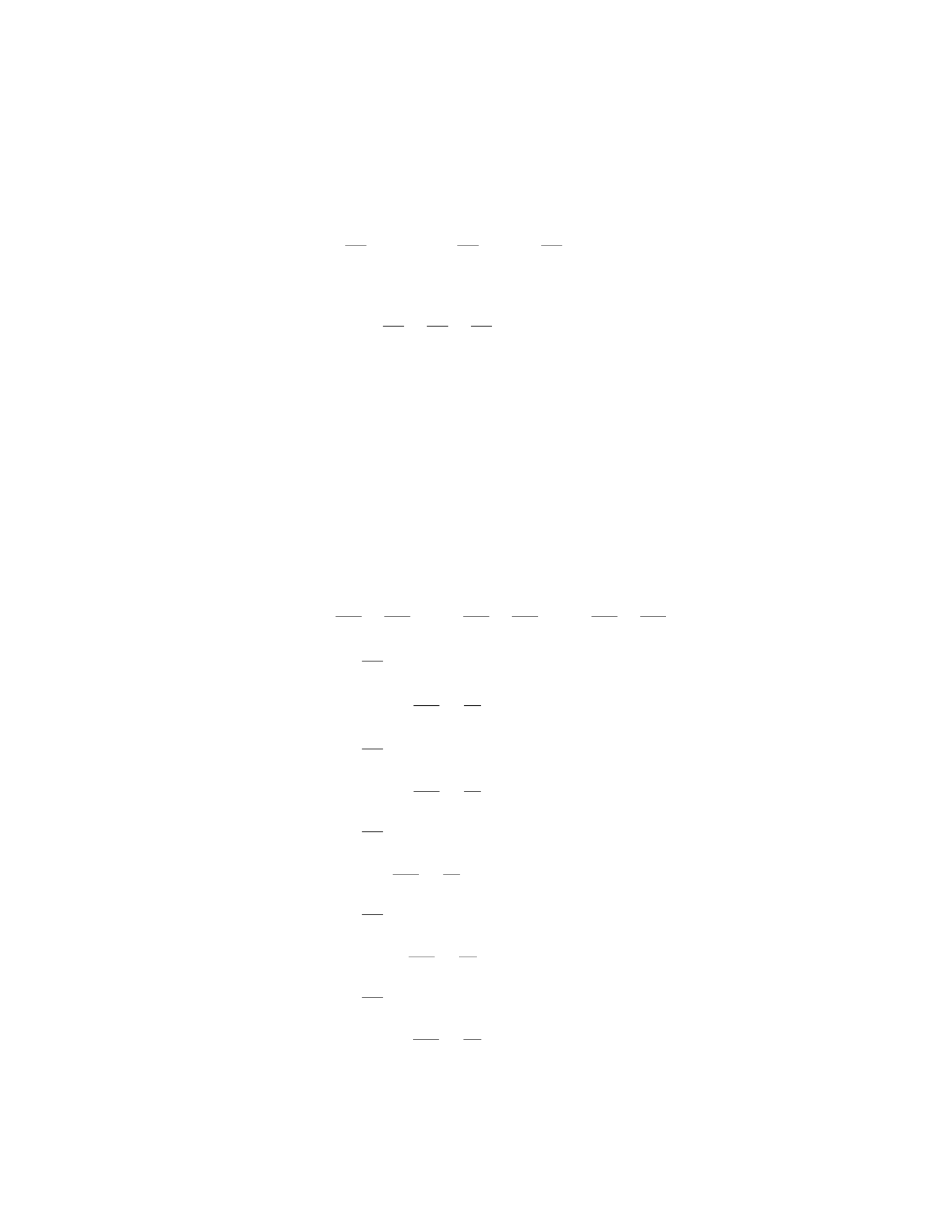
Step 2: Compute the partial derivatives:
∂P
∂x =yzexyz ,∂Q
∂y =x2,∂R
∂z = 3z2
Step 3: Calculate the divergence:
div(F) = ∂P
∂x +∂Q
∂y +∂R
∂z =yzexyz +x2+ 3z2
Therefore, the divergence of the vector field F(x, y, z) = (exyz, x2y, z3) is
yzexyz +x2+ 3z2.
Question 8
Question
Let F(x, y, z) = −3xzi+ 2yj+x2k. Compute the curl of F.
Solution
To compute the curl of a vector field F=F1i+F2j+F3k, we use the formula:
curl F=∂F3
∂y −∂F2
∂z i+∂F1
∂z −∂F3
∂x j+∂F2
∂x −∂F1
∂y k
Step 1: Compute ∂F3
∂y .
∂F3
∂y =∂
∂y (x2)=0
Step 2: Compute ∂F2
∂z .
∂F2
∂z =∂
∂z (2y)=0
Step 3: Compute ∂F1
∂z .
∂F1
∂z =∂
∂z (−3xz) = −3x
Step 4: Compute ∂F3
∂x .
∂F3
∂x =∂
∂x (x2) = 2x
Step 5: Compute ∂F2
∂x .
∂F2
∂x =∂
∂x (2y)=0
6
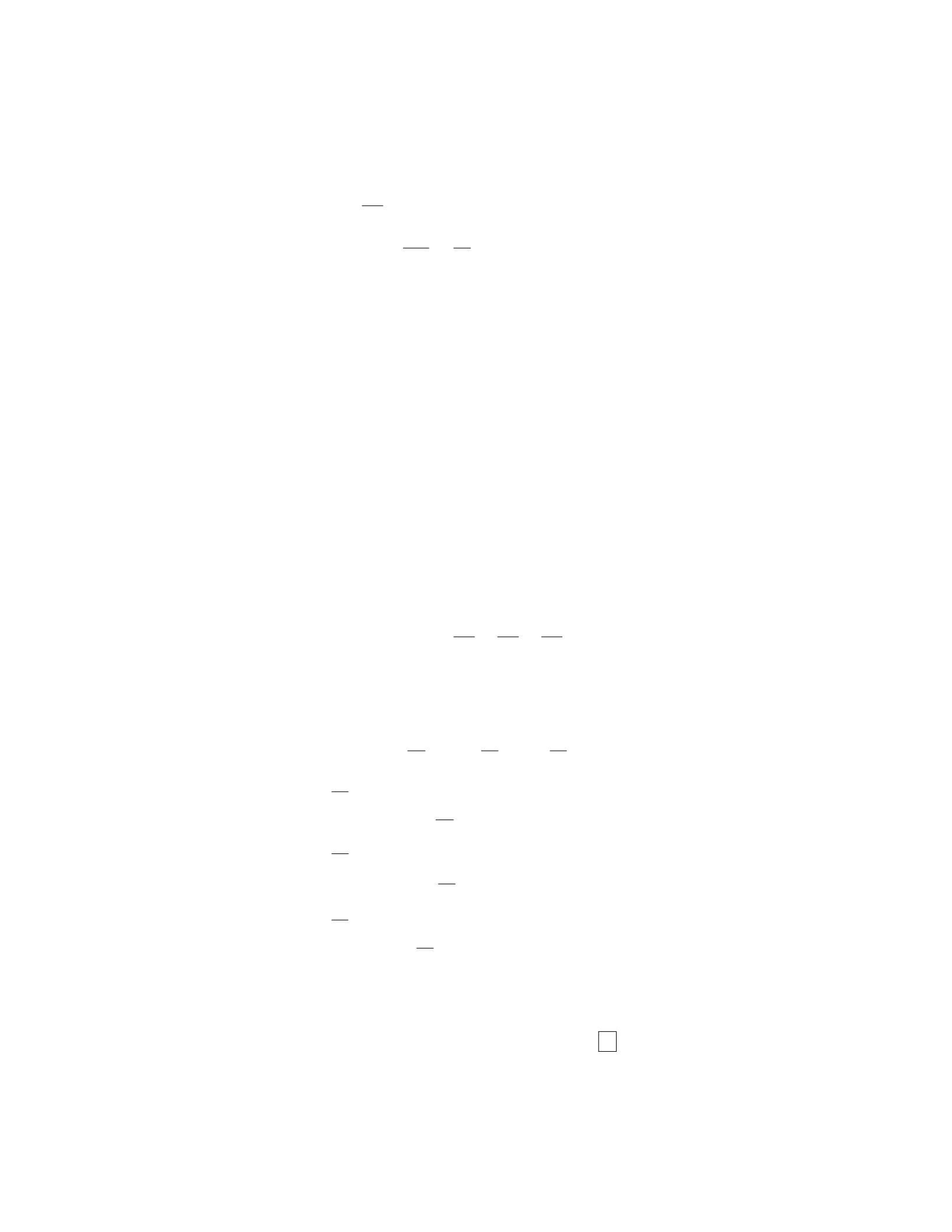
Step 6: Compute ∂F1
∂y .
∂F1
∂y =∂
∂y (−3xz) = 0
Step 7: Plug the computed partial derivatives into the formula for curl.
curl F= (0 −0)i+ (−3x−2x)j+ (0 −0)k
curl F=−5xj
Therefore, the curl of Fis −5xj.
Question 9
Question
Let F(x, y, z) = eyzi+xzj+yexz kbe a vector field. Determine the divergence
of Fat the point (1,2,0).
Solution
To find the divergence of a vector field F(x, y, z) = P(x, y, z)i+Q(x, y, z)j+
R(x, y, z)kat a point (x0, y0, z0), we use the formula:
div(F) = ∂P
∂x +∂Q
∂y +∂R
∂z
In this case, our vector field is F(x, y, z) = eyz i+xzj+yexz k, so P(x, y, z) =
eyz,Q(x, y, z) = xz, and R(x, y, z) = yexz .
Therefore, the divergence of Fis:
div(F) = ∂
∂x (eyz ) + ∂
∂y (xz) + ∂
∂z (yexz )
Step 1: Find ∂P
∂x :
∂
∂x (eyz )=0
Step 2: Find ∂Q
∂y :
∂
∂y (xz)=0
Step 3: Find ∂R
∂z :
∂
∂z (yexz ) = xyexz
Step 4: Calculate the divergence of Fat the point (1,2,0):
div(F) = 0 + 0 + (1)(2)(e(1)(0)) = 2
Therefore, the divergence of Fat the point (1,2,0) is 2 .
7

Question 10
Question
Let F(x, y)=(yex+x2, ex+ycos(y)) be a vector field. Find the divergence of
F.
Solution
To find the divergence of F, we need to compute the following:
div F=∇ · F=∂P
∂x +∂Q
∂y ,
where F(x, y)=(P(x, y), Q(x, y)).
Step 1: Compute ∂P
∂x .
∂P
∂x =∂
∂x (yex+x2) = yex
Step 2: Compute ∂Q
∂y .
∂Q
∂y =∂
∂y (ex+ycos(y)) = cos(y) + y(−sin(y)) = cos(y)−ysin(y)
Step 3: Find the divergence of F.
div F=∇ · F=∂P
∂x +∂Q
∂y =yex+ cos(y)−ysin(y)
Therefore, the divergence of Fis yex+ cos(y)−ysin(y).
Question 11
Question
Let F(x, y) = (2x2y−y3)i+ (x3−3xy2)jbe a vector field. Compute the curl
of F.
Solution
To compute the curl of a vector field F(x, y) = P(x, y)i+Q(x, y)j, where Pand
Qare component functions, we can use the formula:
∇ × F=∂Q
∂x −∂P
∂y k
Step 1: Compute ∂Q
∂x and ∂P
∂y .
8
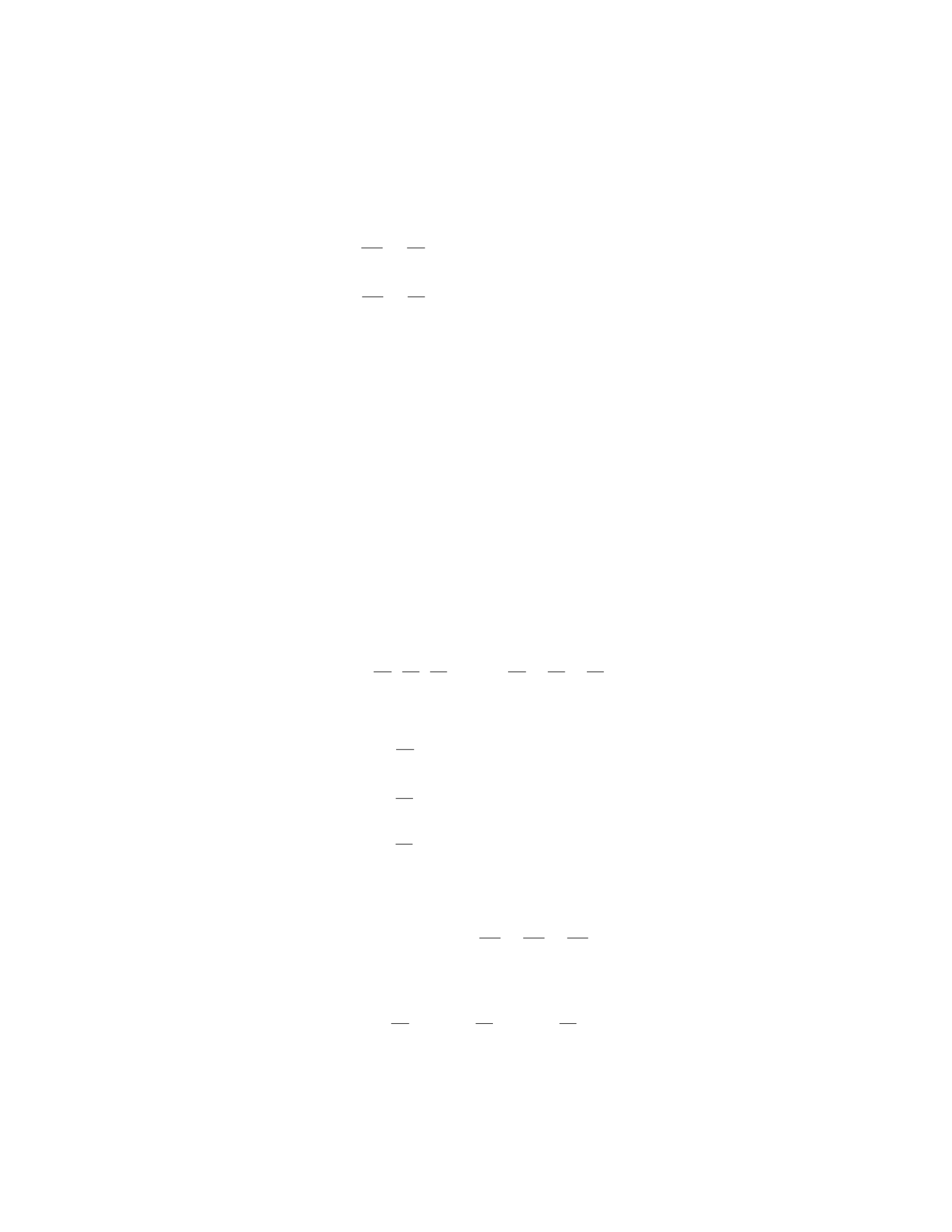
We have P(x, y) = 2x2y−y3and Q(x, y) = x3−3xy2. So,
∂Q
∂x =∂
∂x (x3−3xy2)=3x2−3y2
∂P
∂y =∂
∂y (2x2y−y3)=2x2−3y2
Step 2: Compute ∇ × F.
Substitute the computed partial derivatives into the formula:
∇ × F= (3x2−3y2−(2x2−3y2))k= (x2)k
Therefore, the curl of Fis x2k.
Question 12
Question
Consider the vector field F(x, y, z) = (x2yz, xy2z, xyz2). Determine the gradi-
ent, divergence, and curl of F.
Solution
Step 1: Find the gradient of F. The gradient of a vector field F(x, y, z) is given
by
∇F=∂
∂x ,∂
∂y ,∂
∂z F=∂
∂x F,∂
∂y F,∂
∂z F.
So, we need to find the partial derivatives of Fwith respect to x,y, and z.
∂
∂x F= (2xyz, y2z, yz2),
∂
∂y F= (x2z, 2xyz, xz2),
∂
∂z F= (x2y, xy2,2xyz).
Step 2: Find the divergence of F. The divergence of a vector field F(x, y, z) =
(P, Q, R) is given by
div(F) = ∇ · F=∂P
∂x +∂Q
∂y +∂R
∂z .
For F(x, y, z)=(x2yz, xy2z, xyz2), we have
div(F) = ∂
∂x (x2yz) + ∂
∂y (xy2z) + ∂
∂z (xyz2).
9

Computing the partial derivatives and summing them up, we get
div(F)=2xyz +xz2+yz2.
Step 3: Find the curl of F. The curl of a vector field F(x, y, z)=(P, Q, R)
is given by
curl(F) = ∇ × F=∂R
∂y −∂Q
∂z ,∂P
∂z −∂R
∂x ,∂Q
∂x −∂P
∂y .
For F(x, y, z)=(x2yz, xy2z, xyz2), we have
curl(F) = z2, z2, z2.
Question 13
Question
Let F(x, y, z) = (2x3y2,3xy3z, xyz2) be a vector field. Calculate the curl of F.
Solution
To find the curl of F, we need to compute the determinant of the following
matrix:
curl F=
i j k
∂
∂x
∂
∂y
∂
∂z
2x3y23xy3z xyz2
Step 1: Compute the partial derivatives:
∂
∂x (2x3y2)=6x2y2
∂
∂y (3xy3z)=3x(3y2z) = 9xy2z
∂
∂z (xyz2) = xz2
Step 2: Replace the partial derivatives in the determinant:
curl F=
i j k
6x2y29xy2z xz2
Step 3: Expand the determinant to find the curl:
curl F=∂(xz2)
∂y −∂(9xy2z)
∂z i−∂(xz2)
∂x −∂(6x2y2)
∂z j+∂(6x2y2)
∂x −∂(9xy2z)
∂y k
Simplify the expressions to find the final answer.
10

Question 14
Question
Let F(x, y, z)=2x2yi+ (x2+ 2yz)j+ 3xz2k. Calculate the curl of F.
Solution
To find the curl of F, we first need to express Fin terms of the unit vectors i,
j, and k. Then, we can apply the formula for the curl.
Step 1: Express F in terms of i,j, and k:
F(x, y, z)=2x2yi+ (x2+ 2yz)j+ 3xz2k
Step 2: Calculate the curl of F: The curl of a vector field F=Pi+
Qj+Rkis given by:
curl F=∇ × F=∂R
∂y −∂Q
∂z i−∂R
∂x −∂P
∂z j+∂Q
∂x −∂P
∂y k
Now, let’s compute the curl of F:
curl F=∂(3xz2)
∂y −∂(x2+ 2yz)
∂z i−∂(3xz2)
∂x −∂(2x2y)
∂z j+∂(x2+ 2yz)
∂x −∂(2x2y)
∂y k
Calculating each partial derivative, we get:
curl F= (0 −2z)i−(3z2−2y)j+ (0 −2x)k
Therefore, the curl of Fis:
curl F=−2zi−(3z2−2y)j−2xk
Question 15
Question
Let F(x, y, z) = x2ey+ysin(z), x cos(z), ex+z2. Calculate the divergence of
Fat the point (1, π, 0).
Solution
To find the divergence of F, we need to calculate the dot product of the gradient
operator ∇with the vector field F. The divergence of Fis given by:
div(F) = ∇ · F=∂Fx
∂x +∂Fy
∂y +∂Fz
∂z
11
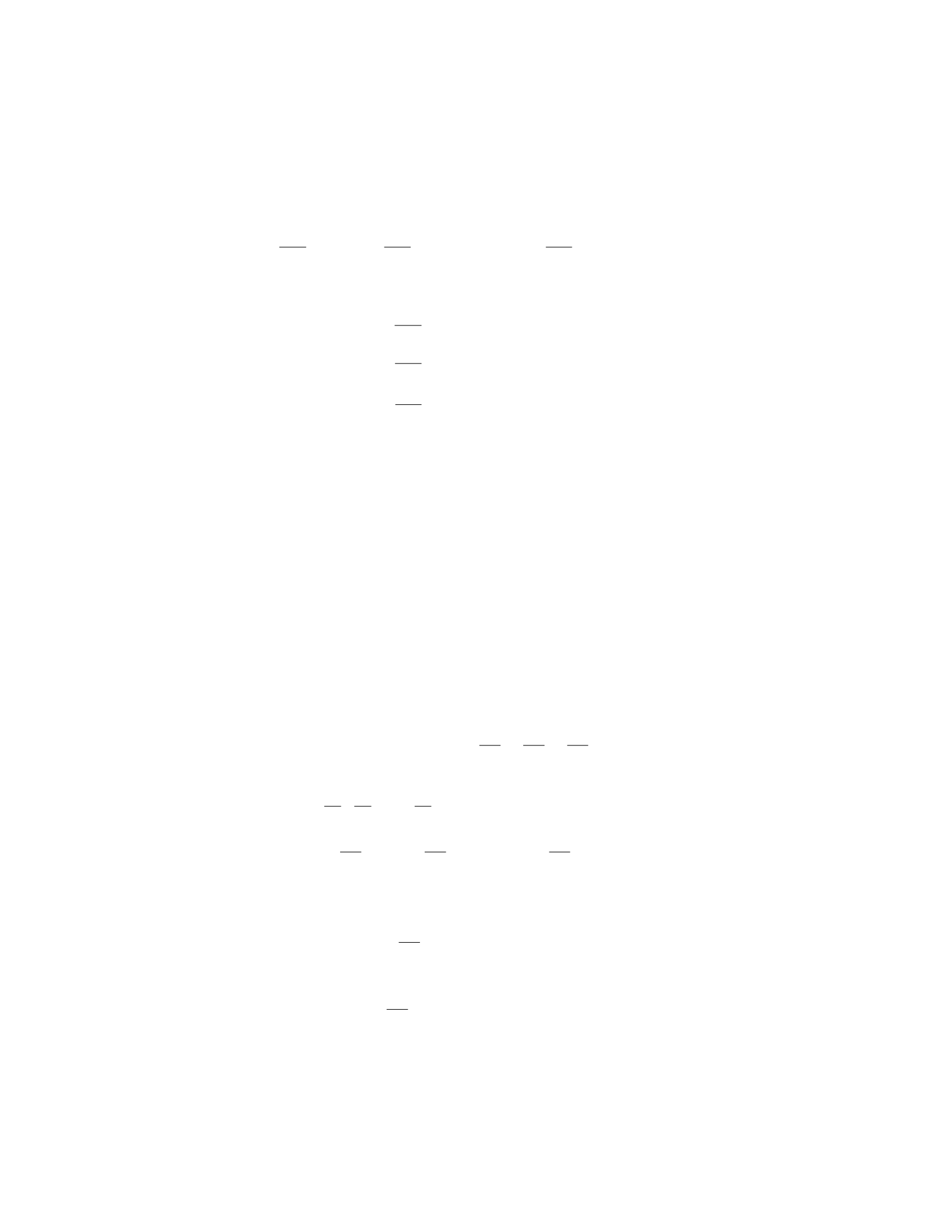
Given F(x, y, z) = x2ey+ysin(z), x cos(z), ex+z2, the partial derivatives
are: ∂Fx
∂x = 2xey,∂Fy
∂y =x2ey+ sin(z),∂Fz
∂z =x(−sin(z)),
Now compute these partial derivatives using the given point (1, π, 0):
∂Fx
∂x = 2eπ,
∂Fy
∂y =eπ+ sin(0) = eπ,
∂Fz
∂z = 1(−sin(0)) = 0.
Thus, the divergence of Fat the point (1, π, 0) is:
div(F)=2eπ+eπ+ 0 = 3eπ.
Question 16
Question
Let F(x, y, z) = x2−2y, y2−2z, z2−2xbe a vector field. Calculate the
divergence of Fat the point (1,−1,2).
Solution
To find the divergence of the vector field Fat the point (1,−1,2), we use the
formula for divergence:
div(F) = ∇ · F=∂P
∂x +∂Q
∂y +∂R
∂z ,
where F(x, y, z)=(P(x, y, z), Q(x, y, z), R(x, y, z)).
Step 1: Find ∂P
∂x ,∂Q
∂y , and ∂R
∂z .
∂P
∂x = 2x, ∂Q
∂y = 2y, and ∂R
∂z = 2z.
Step 2: Evaluate the partial derivatives at the given point (1,−1,2).
∂P
∂x
(1,−1,2)
= 2(1) = 2,
∂Q
∂y
(1,−1,2)
= 2(−1) = −2,
12
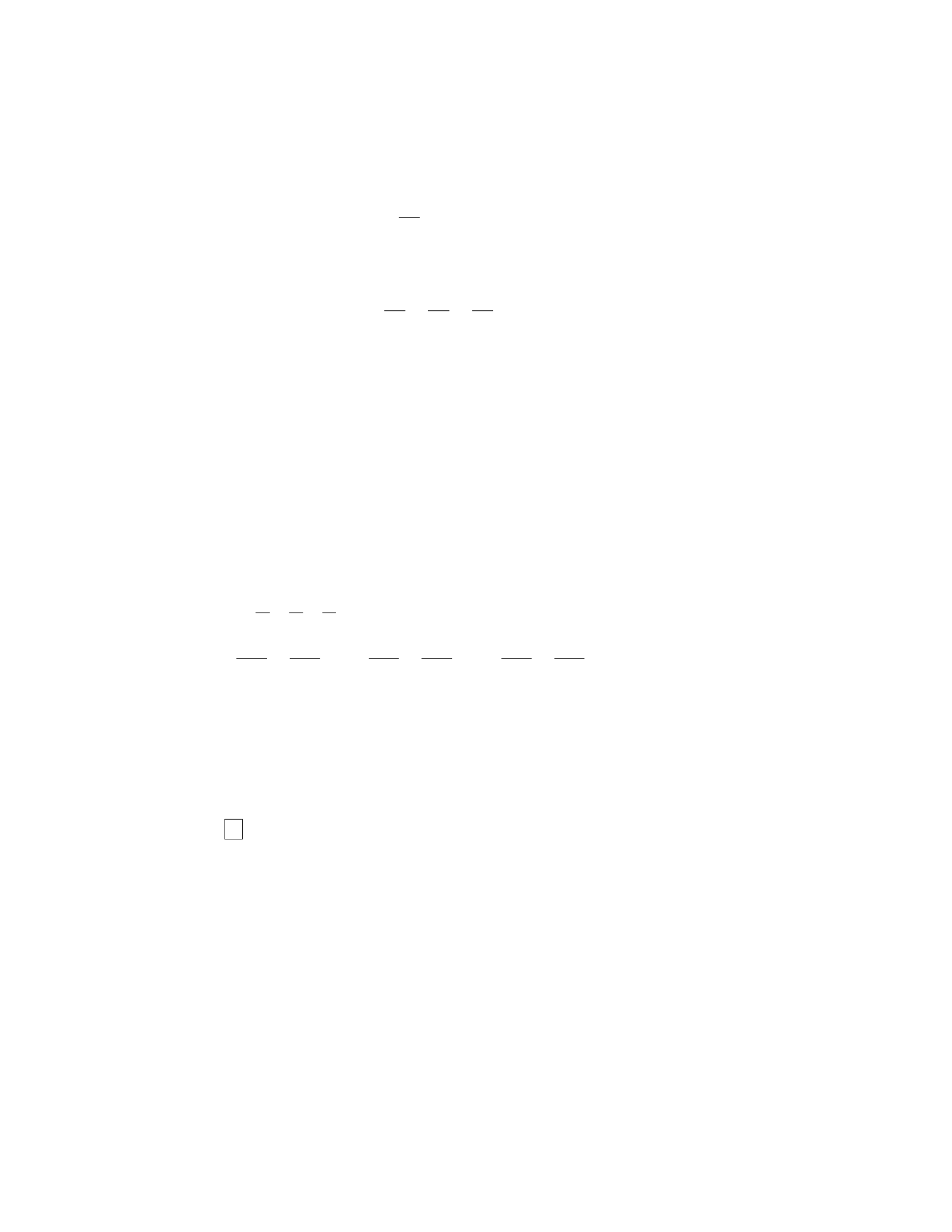
∂R
∂z
(1,−1,2)
= 2(2) = 4.
Step 3: Calculate the divergence of Fat the point (1,−1,2).
div(F)
(1,−1,2)
=∂P
∂x +∂Q
∂y +∂R
∂z
(1,−1,2)
= 2 + (−2) + 4 = 4.
Therefore, the divergence of the vector field Fat the point (1,−1,2) is 4.
Question 17
Question
Let F(x, y, z) = yzi+xzj+xyk. Calculate ∇ · ∇ × F.
Solution
Step 1: Find ∇ × F.
=
i j k
∂
∂x
∂
∂y
∂
∂z
yz xz xy
=∂(xy)
∂y −∂(xz)
∂z i−∂(yz)
∂x −∂(xy)
∂z j+∂(xz)
∂x −∂(yz)
∂y k
= (x−x)i−(z−z)j+ (y−y)k
=0
Step 2: Calculate ∇ · ∇ × F.
=∇ · 0
= 0
Question 18
Question
Let F(x, y, z) = yzi+xzj+xykbe a vector field in R3. Determine the curl of
F.
13
Solution
To find the curl of a vector field F(x, y, z) = P(x, y, z)i+Q(x, y, z)j+R(x, y, z)k,
we use the formula:
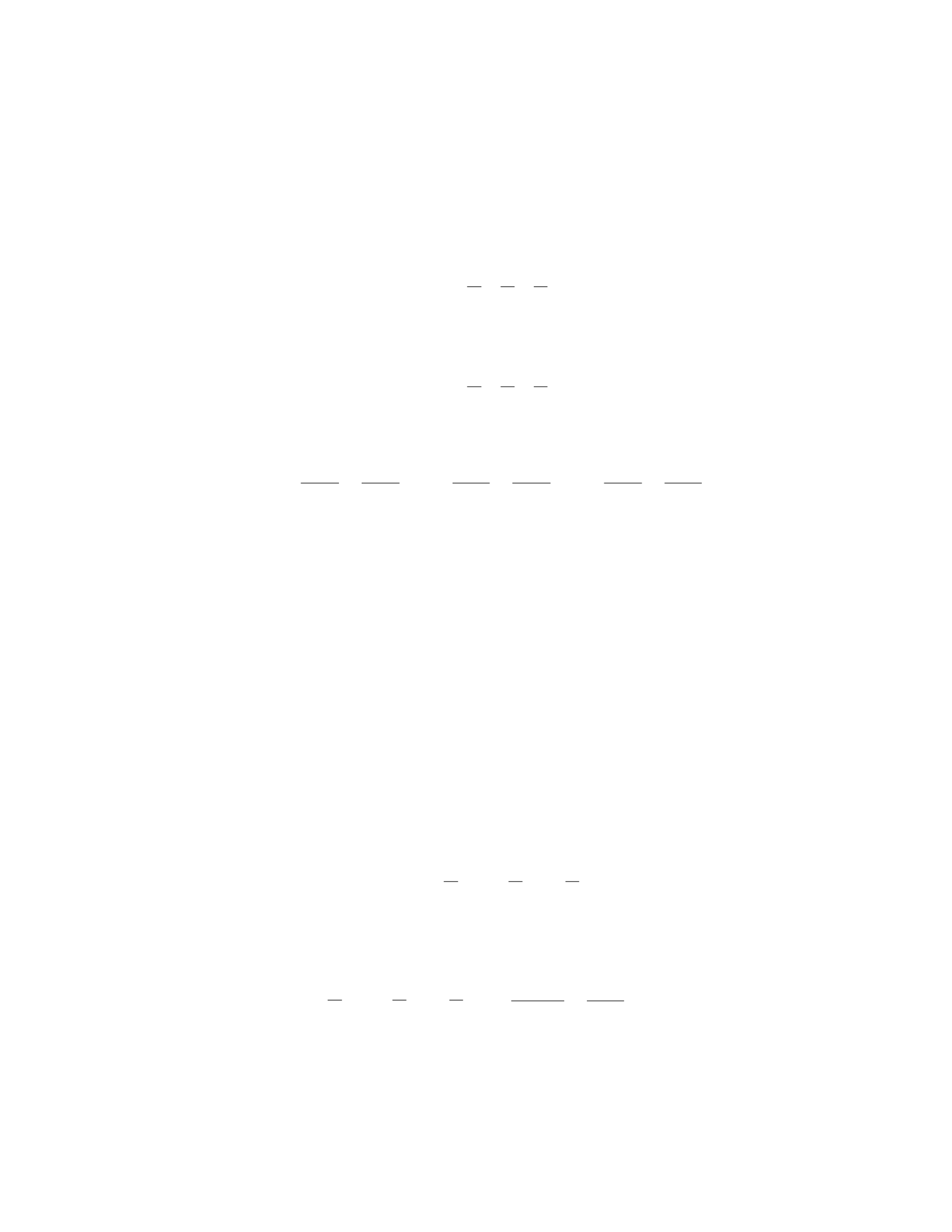
∇ × F=
i j k
∂
∂x
∂
∂y
∂
∂z
P Q R
Step 1: Compute the curl of Fusing the formula.
∇ × F=
i j k
∂
∂x
∂
∂y
∂
∂z
yz xz xy
Step 2: Calculate the determinant expansion.
∇ × F=∂(xy)
∂y −∂(xz)
∂z i−∂(yz)
∂x −∂(xy)
∂z j+∂(xz)
∂x −∂(yz)
∂y k
Step 3: Differentiate and simplify.
∇ × F= (x−x)i−(z−z)j+ (y−y)k
Step 4: Simplify further.
∇ × F=0
So, the curl of Fis the zero vector field.
Question 19
Question
Let F(x, y, z) = ⟨exsin y, x2+yz, xyz2⟩. Find the curl of F.
Solution
To find the curl of F, denoted as ∇ × F, we need to compute the following
determinant:
∇ × F=
i j k
∂
∂x
∂
∂y
∂
∂z
exsin y x2+yz xyz2
Step 1: Calculate the determinant for each component of the curl:
For the icomponent:
i j k
∂
∂x
∂
∂y
∂
∂z
exsin y x2+yz xyz2
=∂(xyz2)
∂y −∂(yz)
∂z i
14
For the jcomponent:
i j k
∂
∂x
∂
∂y
∂
∂z
exsin y x2+yz xyz2
=−∂(xyz2)
∂x −∂(exsin y)
∂z j
For the kcomponent:
i j k
∂
∂x
∂
∂y
∂
∂z
exsin y x2+yz xyz2
=∂(x2+yz)
∂x −∂(exsin y)
∂y k
Step 2: Calculate the partial derivatives for each component.
Now, calculate the partial derivatives:
∂(xyz2)
∂y =xz2,∂(yz)
∂z =y, ∂(xyz2)
∂x =yz2,∂(exsin y)
∂z = 0
∂(x2+yz)
∂x = 2x, ∂(exsin y)
∂y =excos y
Step 3: Substitute the calculated values into the expressions for each com-
ponent.
Substitute the values in for each component:
(∇ × F)x=xz2−y, (∇ × F)y=−yz2,(∇ × F)z= 2x−excos y
Step 4: Final Answer
Therefore, the curl of Fis:
∇ × F=⟨xz2−y, −yz2,2x−excos y⟩
Question 20
Question
Let F(x, y, z) = (2xy2+z)i+ (x2y+ 3z2)j+ (x2+ 2yz)kbe a vector field in R3.
Calculate the divergence of F.
Solution
To find the divergence of F, we need to compute ∇ · Fwhere F(x, y, z) =
P(x, y, z)i+Q(x, y, z)j+R(x, y, z)k.
Step 1: Calculate the partial derivatives of P,Q, and R. Let P(x, y, z) =
2xy2+z,Q(x, y, z) = x2y+ 3z2, and R(x, y, z) = x2+ 2yz. We have:
∂P
∂x = 2y2,
15
∂Q
∂y =x2,
∂R
∂z = 2y.
Step 2: Calculate the divergence of F. The divergence of Fis given by:
∇ · F=∂P
∂x +∂Q
∂y +∂R
∂z .
Substitute the partial derivatives we calculated:
∇ · F= 2y2+x2+ 2y.
Therefore, the divergence of Fis 2y2+x2+ 2y.
Question 21
Question
Let F(x, y, z)=(yz +ex, xz +ey, xy +ez). Find the curl of F.
Solution
To find the curl of F, we will use the formula: curl(F) = ∇ × F, where ∇=
∂
∂x ,∂
∂y ,∂
∂z is the del operator.
Step 1: Compute the curl of Fusing the formula:
curl(F) =
i j k
∂
∂x
∂
∂y
∂
∂z
yz +exxz +eyxy +ez
Step 2: Calculate the determinant to find the curl:
curl(F) = ∂
∂y (xy +ez)−∂
∂z (xz +ey)i
−∂
∂x (yz +ex)−∂
∂z (xy +ez)j
+∂
∂x (xz +ey)−∂
∂y (yz +ex)k
Now, differentiate each component of Fwith respect to the corresponding
variable.
16
Step 3: Compute the components of the curl:
∂
∂y (xy +ez)−∂
∂z (xz +ey) = x−x= 0
∂
∂x (yz +ex)−∂
∂z (xy +ez) = z−z= 0
∂
∂x (xz +ey)−∂
∂y (yz +ex) = x−y
Step 4: Assemble the components into the vector form of the curl:
curl(F) = (0,0, x −y)
Therefore, the curl of Fis (0,0, x −y) .
Question 22
Question
Let F(x, y, z)=2yzi+xzj+xykbe a vector field. Determine the divergence of
Fat the point P(1,−1,2).
Solution
Step 1: The divergence of a vector field F(x, y, z) = P(x, y, z)i+Q(x, y, z)j+
R(x, y, z)kis given by the formula:
div(F) = ∂P
∂x +∂Q
∂y +∂R
∂z
Step 2: In this case, F(x, y, z)=2yzi+xzj+xyk, so P(x, y, z)=2yz,
Q(x, y, z) = xz, and R(x, y, z) = xy.
Step 3: Calculate the partial derivatives of P,Q, and Rwith respect to x,
y, and z.
∂P
∂x = 0
∂Q
∂y =z
∂R
∂z =x
Step 4: Substitute the values of the partial derivatives into the formula for
the divergence:
div(F) = ∂P
∂x +∂Q
∂y +∂R
∂z = 0 + z+x
Step 5: Evaluate div(F) at the point P(1,−1,2):
div(F)(1,−1,2) = 2 + 1 = 3
Therefore, the divergence of Fat the point P(1,−1,2) is 3 .
17
Question 23
Question
Let F(x, y, z)=(yz +x2)i+ (xz +y)j+ (xy +z)kbe a vector field in R3.
Calculate ∇ · ∇ × F.
Solution
Step 1: Calculate ∇ × F.
∇ × F=
i j k
∂
∂x
∂
∂y
∂
∂z
yz +x2xz +y xy +z
=∂(xy +z)
∂y −∂(xz +y)
∂z i−∂(yz +x2)
∂x −∂(xy +z)
∂z j+∂(xz +y)
∂x −∂(yz +x2)
∂y k
= (x−1)i−(z−1)j+ (y−y)k= (x−1)i−(z−1)j
Step 2: Calculate ∇ · ∇ × F.
∇ · ∇ × F=∂
∂x (x−1) + ∂
∂y (−(z−1)) + ∂
∂z (0)
= 1 −0 + 0 = 1
Therefore, ∇ · ∇ × F= 1 .
Question 24
Question
Let F(x, y, z) = ⟨x2y, yz3, xz⟩be a vector field. Compute ∇ · (∇ × F).
Solution
Step 1: First, we need to find the curl of F. The curl of a vector field F=
⟨M, N, P ⟩is given by
∇ × F=∂P
∂y −∂N
∂z i+∂M
∂z −∂P
∂x j+∂N
∂x −∂M
∂y k
Step 2: In this case, F=⟨x2y, yz3, xz⟩. So, M=x2y,N=yz3, and P=xz.
Now, we can find the curl of F.
Step 3: Compute
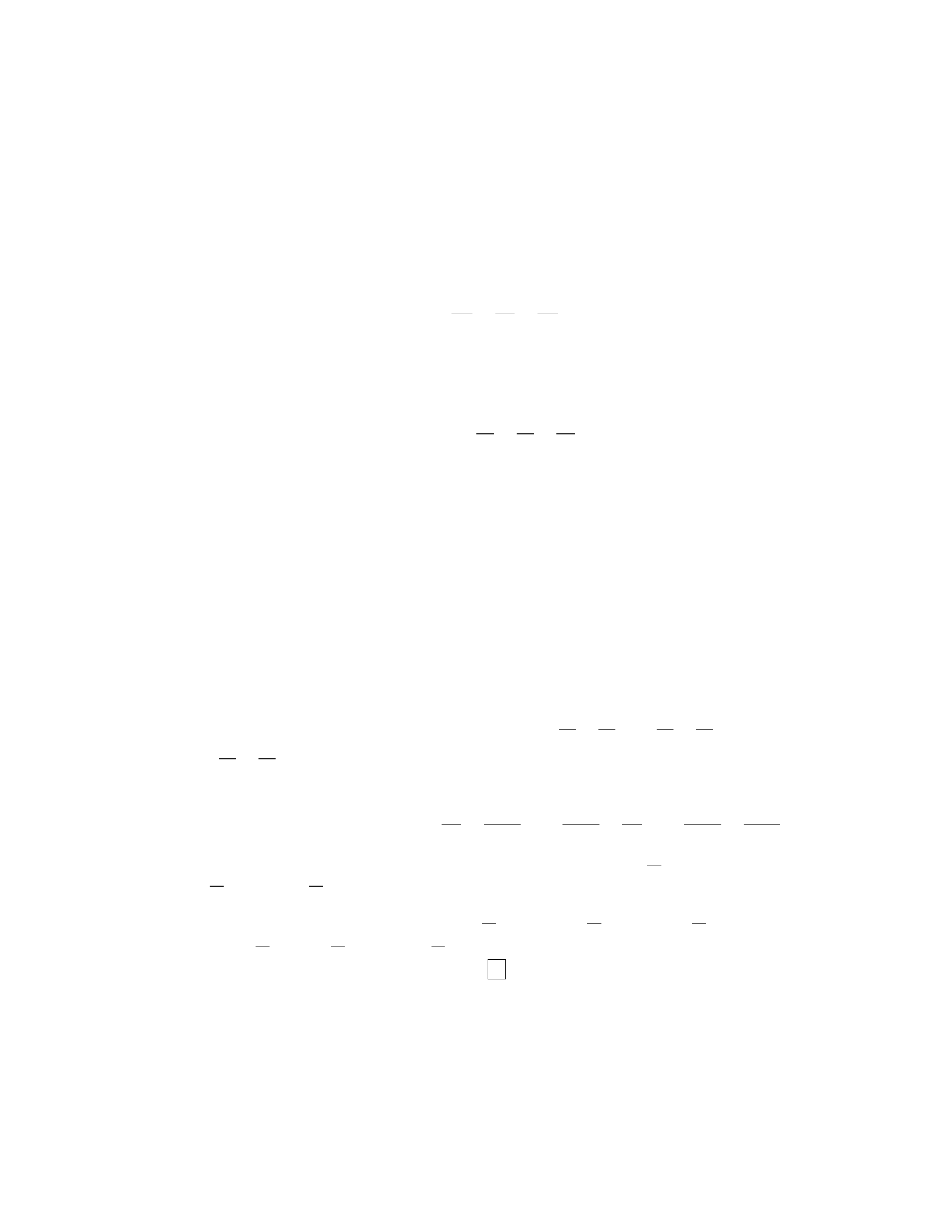
∇ × F=∂(xz)
∂y −∂(yz3)
∂z i+∂(x2y)
∂z −∂(xz)
∂x j+∂(yz3)
∂x −∂(x2y)
∂y k
18
Step 4: Simplify to get
∇ × F=⟨z, 0, x⟩
Step 5: Next, we need to find the divergence of ∇ × F. The divergence of a
vector field G=⟨R, S, T ⟩is given by
∇ · G=∂R
∂x +∂S
∂y +∂T
∂z
Step 6: In this case, ∇ × F=⟨z, 0, x⟩. So, R=z,S= 0, and T=x. Now,
we can find the divergence of ∇ × F.
Step 7: Compute
∇ · (∇ × F) = ∂z
∂x +∂0
∂y +∂x
∂z
Step 8: Simplify to get
∇ · (∇ × F)=1
Therefore, ∇ · (∇ × F) = 1.
Question 25
Question
Let F(x, y, z) = x2yi+xyzj+z2k. Calculate ∇·∇×F, where ∇is the gradient
operator and ×is the cross product operator.
Solution
Step 1: Calculate ∇×Fusing the formula ∇×F=∂Q
∂y −∂P
∂z i+∂R
∂z −∂P
∂x j+
∂P
∂y −∂Q
∂x k, where F(x, y, z) = P(x, y, z)i+Q(x, y, z)j+R(x, y, z)k.
Given F(x, y, z) = x2yi+xyzj+z2k, we have: P(x, y, z) = x2y, Q(x, y, z) =
xyz, R(x, y, z) = z2.
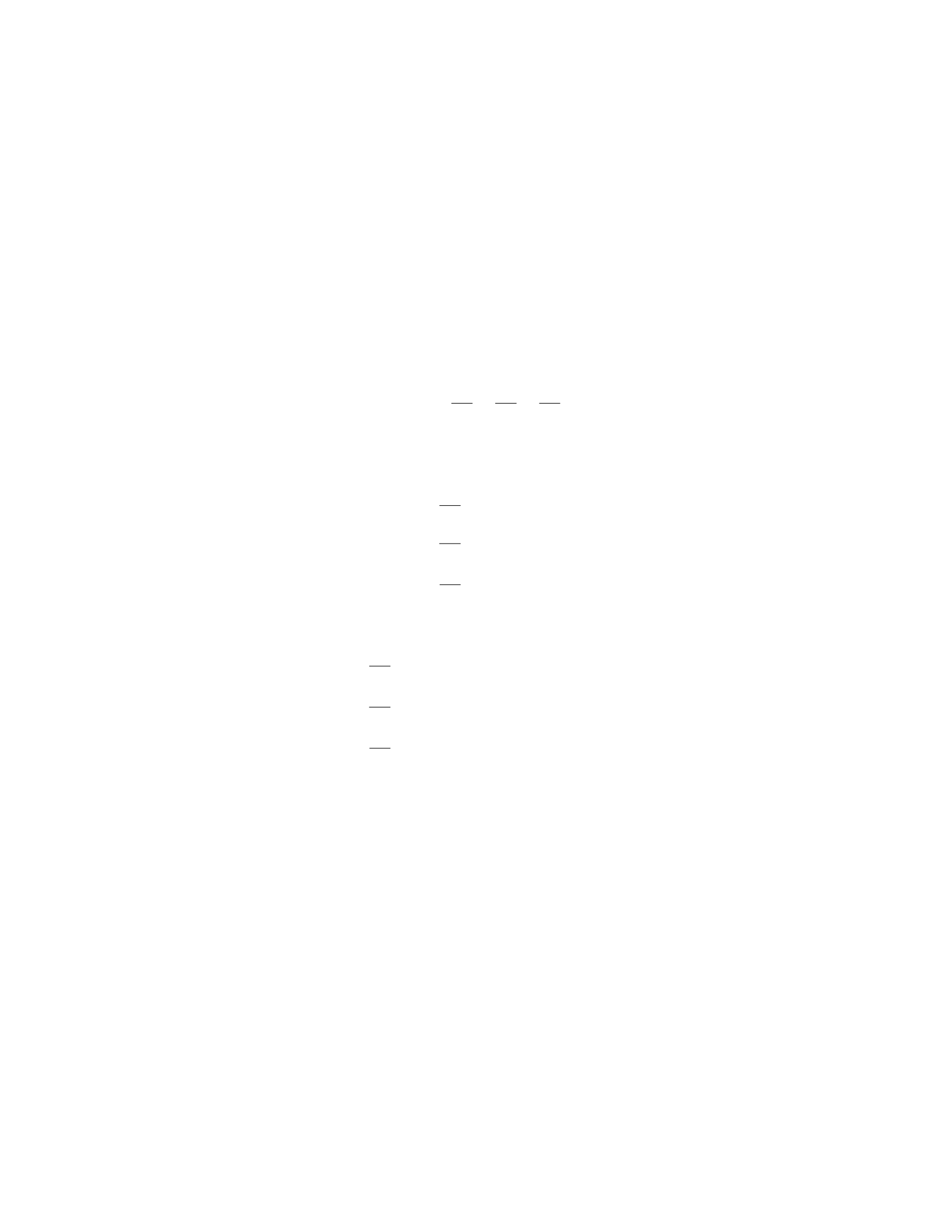
Calculating the curl: ∇×F=∂z2
∂y −∂(xyz)
∂z i+∂(x2y)
∂z −∂z2
∂x j+∂(xyz)
∂y −∂(x2y)
∂x k
Expanding and simplifying: ∇ × F=−xi+yj+xk.
Step 2: Calculate ∇ · ∇ × Fusing the formula ∇ · ∇ × F=∂
∂x (∇ × Fx) +
∂
∂y (∇ × Fy) + ∂
∂z (∇ × Fz).
We already know ∇ × F=−xi+yj+xk.
Calculating each partial derivative: ∂
∂x (∇ × Fx) = ∂
∂x (−x) = −1, ∂
∂y (∇ ×
Fy) = ∂
∂y (y) = 1, ∂
∂z (∇ × Fz) = ∂
∂z (x) = 0.
Therefore, ∇ · ∇ × F=−1 + 1 + 0 = 0 .
19
Question 26
Question
Let F(x, y, z)=(yex+z2, xey+ 2z, 2yez+ 3x) be a vector field. Calculate the
divergence of Fat the point (1,0,−1).
Solution
To calculate the divergence of F, we use the formula:
div(F) = ∂P
∂x +∂Q
∂y +∂R
∂z ,
where F(x, y, z)=(P, Q, R).
Step 1: Find the partial derivatives of P,Q, and R.
∂P
∂x =yex
∂Q
∂y =xey
∂R
∂z = 2yez
Step 2: Evaluate the partial derivatives at the point (1,0,−1).
∂P
∂x
(1,0,−1) = 0e1= 0
∂Q
∂y
(1,0,−1) = 1e0= 1
∂R
∂z
(1,0,−1) =−2e−1≈ −0.7358
Step 3: Calculate the divergence at the point (1,0,−1).
div(F)
(1,0,−1) = 0 + 1 −0.7358 ≈0.2642.
Therefore, the divergence of Fat the point (1,0,−1) is approximately 0.2642.
Question 27
Question
Let F(x, y, z)=(x2y+z)i+ (xy2+z)j+ (xyz + 1)kbe a vector field. Calculate
the curl of F.
20
Solution
To calculate the curl of F, we use the formula:
curl F=∇ × F
where ∇=∂
∂x ,∂
∂y ,∂
∂z is the gradient operator.
Step 1: Compute the components of the curl.
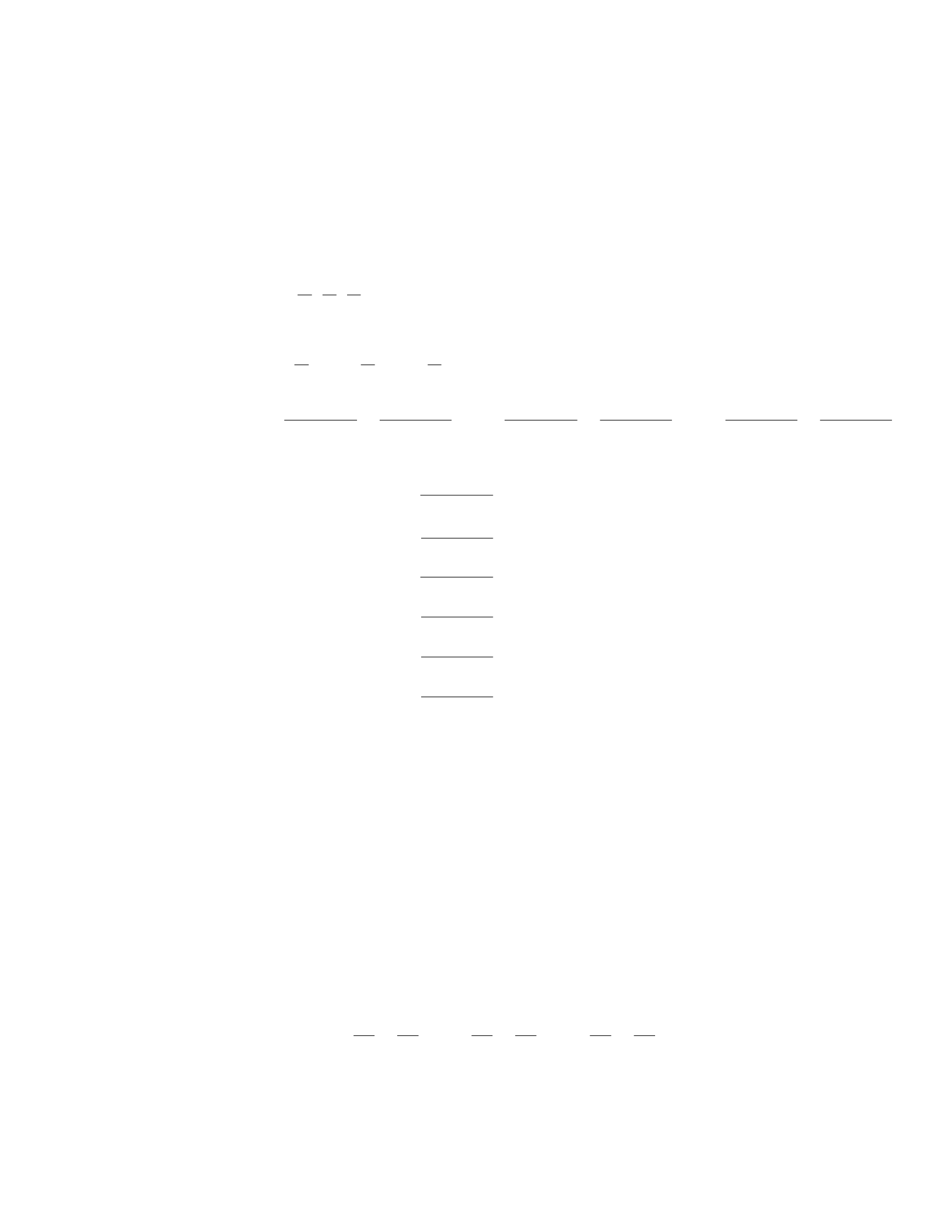
curl F=
i j k
∂
∂x
∂
∂y
∂
∂z
x2y+z xy2+z xyz + 1
=∂(xyz + 1)
∂y −∂(xy2+z)
∂z i−∂(xyz + 1)
∂x −∂(x2y+z)
∂z j+∂(xy2+z)
∂x −∂(x2y+z)
∂y k
Step 2: Compute the partial derivatives.
∂(xyz + 1)
∂y =xz
∂(xy2+z)
∂z = 1
∂(xyz + 1)
∂x =yz
∂(x2y+z)
∂z = 1
∂(xy2+z)
∂x =y2
∂(x2y+z)
∂y =x2
Step 3: Plug the partial derivatives into the components of the curl.
curl F= (xz −1)i−(yz −1)j+ (y2−x2)k
Therefore, the curl of Fis (xz −1)i−(yz −1)j+ (y2−x2)k.
Question 28
Question
Let F(x, y, z) = x2yi+y2zj+z2xk. Calculate the curl of F.
Solution
To compute the curl of a vector field F=P(x, y, z)i+Q(x, y, z)j+R(x, y, z)k,
where P,Q, and Rare the component functions, we use the formula:
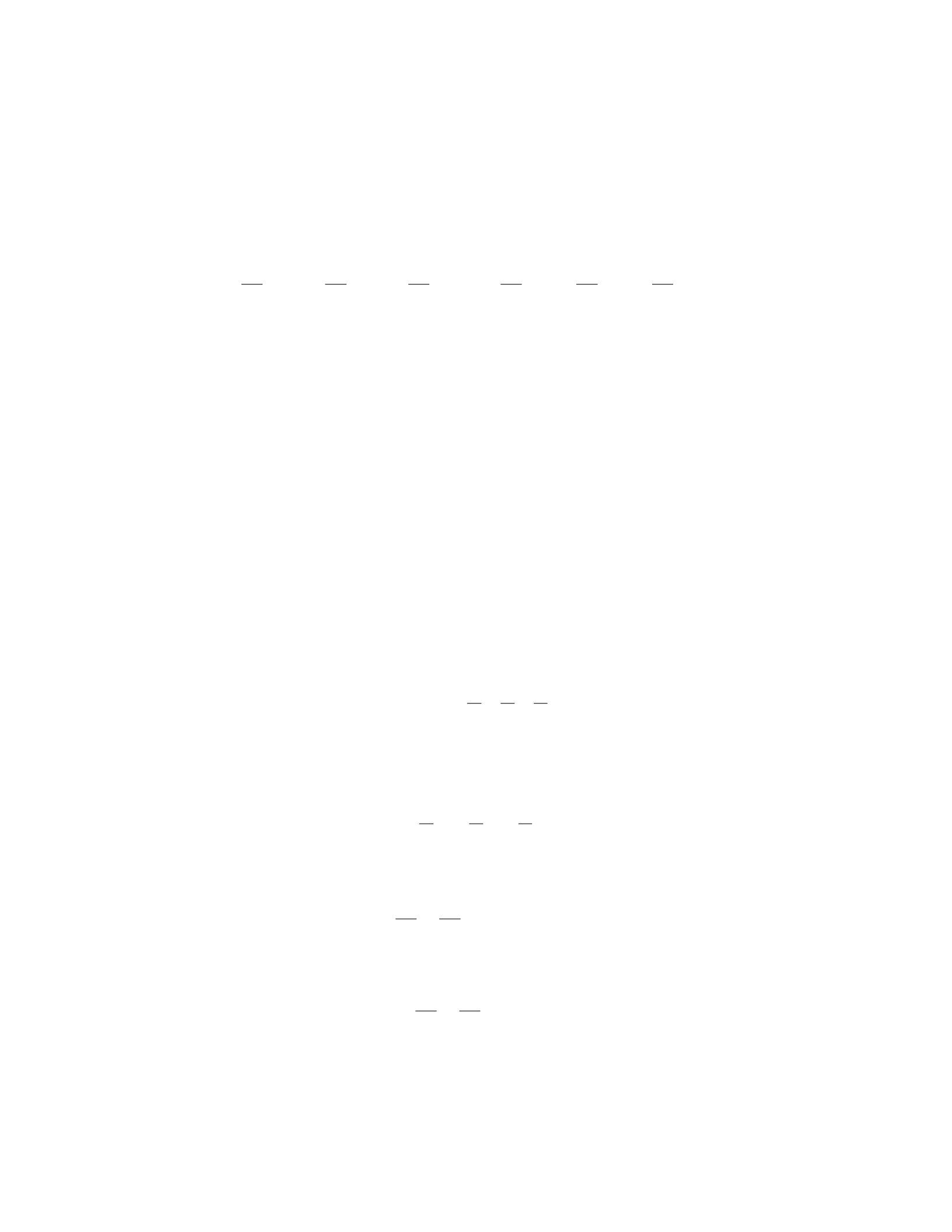
curl(F) = ∂R
∂y −∂Q
∂z i−∂R
∂x −∂P
∂z j+∂Q
∂x −∂P
∂y k
21
Step 1: Identify P,Q, and Rfor F=x2yi+y2zj+z2xk.P(x, y, z) = x2y,
Q(x, y, z) = y2z,R(x, y, z) = z2x.
Step 2: Calculate the partial derivatives:
∂P
∂y =x2,∂Q
∂z =y2,∂R
∂x = 2zx, ∂P
∂z = 0,∂Q
∂x = 0,∂R
∂y = 2z
Step 3: Substitute the partial derivatives into the curl formula:
curl(F) = (2z−0)i−(2zx −0)j+ (0 −x2)k
Step 4: Simplify the expression:
curl(F)=2zi−2zxj−x2k
Therefore, the curl of Fis 2zi−2zxj−x2k.
Question 29
Question
Let F(x, y, z) = x2yi−2xyzj+yezk. Calculate the curl of F.
Solution
Step 1: The curl of a vector field F(x, y, z) = P(x, y, z)i+Q(x, y, z)j+R(x, y, z)k
is defined as
∇ × F=
i j k
∂
∂x
∂
∂y
∂
∂z
P Q R
Step 2: In our case, P(x, y, z) = x2y,Q(x, y, z) = −2xyz, and R(x, y, z) = yez.
So, we need to compute the determinant
i j k
∂
∂x
∂
∂y
∂
∂z
x2y−2xyz yez
Step 3: Computing the partial derivatives, we get
∂R
∂y −∂Q
∂z =ez−(−2x)
=ez+ 2x
Step 4: Similarly,
∂P
∂z −∂R
∂x = 0 −0
= 0
22

Step 5: Lastly,
∂Q
∂x −∂P
∂y =−2yz −2xy
=−2y(z+x)
Step 6: Therefore, the curl of Fis
∇ × F= (ez+ 2x)i+ 0j−2y(z+x)k
Question 30
Question
Let F(x, y)=(exy cos(y), exy sin(y)) be a vector field. Compute ∇ · F, where ∇
is the gradient operator.
Solution
Step 1: Compute the gradient of Fby finding its partial derivatives.
∇F=∂
∂x (exy cos(y)),∂
∂y (exy sin(y))
Step 2: Taking the partial derivatives yields:
∇F= (yexy cos(y)−yexy sin(y), xexy cos(y) + exy sin(y))
Step 3: Compute the divergence of Fby taking the dot product of ∇and F:
∇ · F=∂
∂x (yexy cos(y)−yexy sin(y)) + ∂
∂y (xexy cos(y) + exy sin(y))
Step 4: Simplify the expression by evaluating the partial derivatives:
∇ · F=yexy cos(y)−yexy sin(y) + xexy cos(y) + exy sin(y)
∇ · F= (x+y)exy cos(y) + (1 −y)exy sin(y)
23

