



MATH 117 - ELEMENTS OF
MATHEMATICS - Gradient,
divergence, and curl
Question Bank - Set 4
Liberty University
Question 1
Question
Let F(x, y, z)=(x2y, yexz, z sin(xy)) be a vector field in R3. Compute ∇ · F
where ∇is the gradient operator.
Solution
Step 1: Compute the gradient of F. The gradient of F, denoted by ∇F, is given
by:
∇F=∂F1
∂x ,∂F2
∂y ,∂F3
∂z
where F1=x2y,F2=yexz, and F3=zsin(xy).
Step 2: Compute the partial derivatives.
∂F1
∂x = 2xy
∂F2
∂y =xexz
∂F3
∂z =ysin(xy)
Step 3: Calculate the divergence of F. The divergence of F, denoted by
∇ · F, is given by:
∇ · F=∂F1
∂x +∂F2
∂y +∂F3
∂z
Step 4: Substitute the partial derivatives into the divergence expression.
∇ · F= 2xy +xexz +ysin(xy)
Therefore, ∇ · F= 2xy +xexz +ysin(xy).

Question 2
Question
Let F(x, y) = (3x2y3,2x3y2) be a vector field in the plane. Calculate the diver-
gence of Fat the point (1,2).
Solution
To find the divergence of Fat the point (1,2), we need to calculate the following
expression:
div F=∂
∂x Fx+∂
∂y Fy
Step 1: Calculate the partial derivatives of F
The components of the vector field Fare Fx= 3x2y3and Fy= 2x3y2. Let’s
calculate the partial derivatives:
∂
∂x Fx=∂
∂x (3x2y3)=6xy3
∂
∂y Fy=∂
∂y (2x3y2)=4x3y
Step 2: Find the divergence of F at (1,2)
Now, substitute the values x= 1 and y= 2 into the partial derivatives we
just calculated:
∂
∂x Fx
(1,2)
= 6(1)(2)3= 48
∂
∂y Fy
(1,2)
= 4(1)3(2) = 8
Finally, we can find the divergence of Fat (1,2):
div F
(1,2)
=∂
∂x Fx
(1,2)
+∂
∂y Fy
(1,2)
= 48 + 8 = 56
Therefore, the divergence of Fat the point (1,2) is 56.
Question 3
Question
Let F(x, y, z)=(yez+xcos y, zex+ycos z, xey+zcos x) be a vector field.
Calculate ∇ · ∇ × F.
Solution
Step 1: Calculate ∇ × F. Step 2: Calculate ∇ · (∇ × F).
2
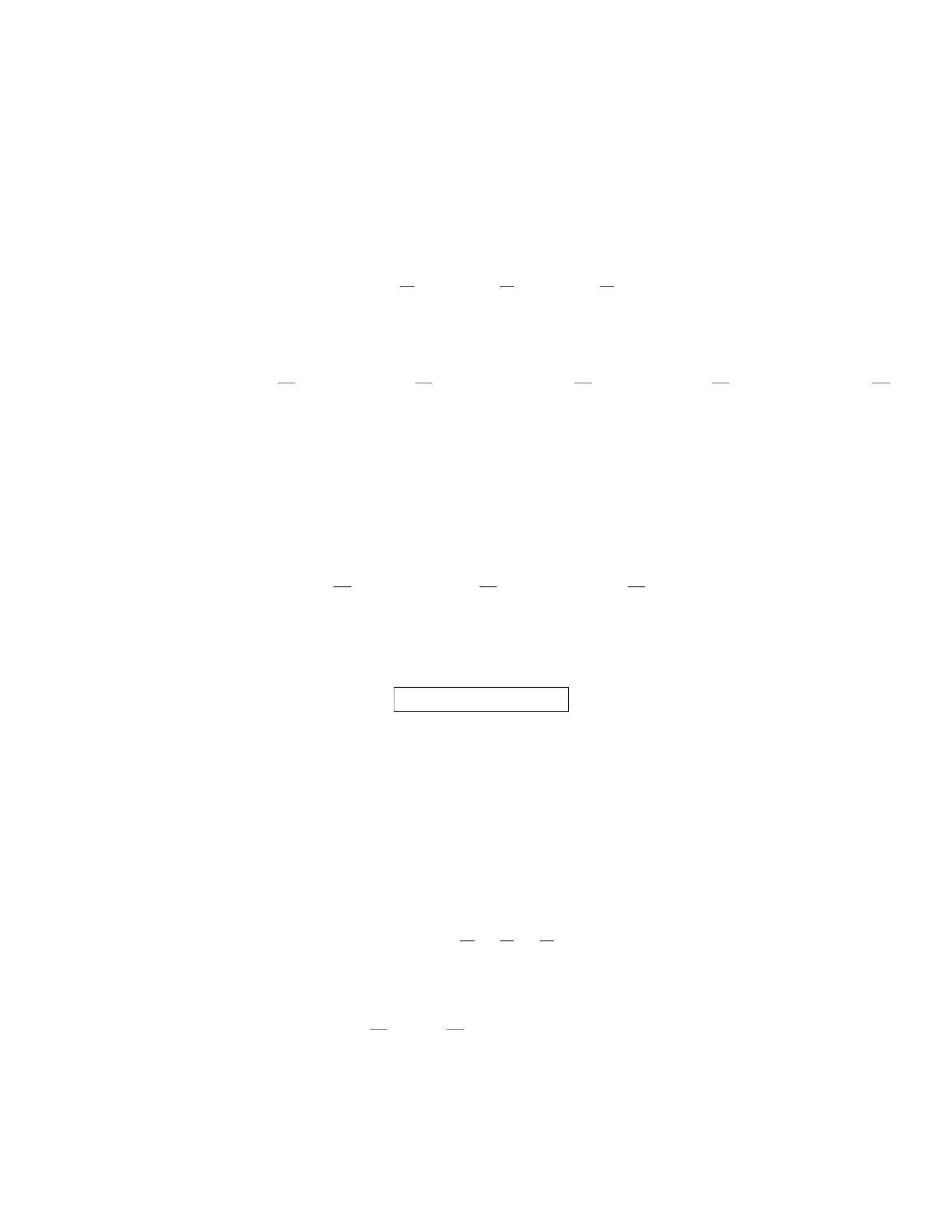
Step 1:
To calculate ∇ × F, we need to find the determinant of the following matrix:
∇ × F=
i j k
∂
∂x
∂
∂y
∂
∂z
yez+xcos y zex+ycos z xey+zcos x
Calculating this determinant, we get:
∇×F=∂
∂y (xey+zcos x)−∂
∂z (zex+ycos z)i−∂
∂x (xey+zcos x)−∂
∂z (yez+xcos y)j+∂
∂x (zex+ycos z)−∂
∂y (yez+xcos y)k
After simplifying, we find:
∇ × F= (−sin x−sin z)i−(−cos y−cos z)j+ (−ez−ex)k
Step 2:
Next, we calculate ∇·(∇×F) by taking the dot product of the gradient operator
∇with ∇ × F:
∇ · (∇ × F) = ∂
∂x (−sin x−sin z) + ∂
∂y (−cos y−cos z) + ∂
∂z (−ez−ex)
Simplifying this expression gives:
∇ · (∇ × F) = −cos x−cos y−ex−ez
Therefore, ∇ · ∇ × F=−cos x−cos y−ex−ez.
Question 4
Question
Let F(x, y, z) = x2yi+xy2j+xyzk. Compute the curl of F.
Solution
To compute the curl of F, we use the formula:
∇ × F=
i j k
∂
∂x
∂
∂y
∂
∂z
x2y xy2xyz
Step 1: Calculate the determinants for icomponent:
∂
∂y (xyz)−∂
∂z (xy2) = xz −2xy
3
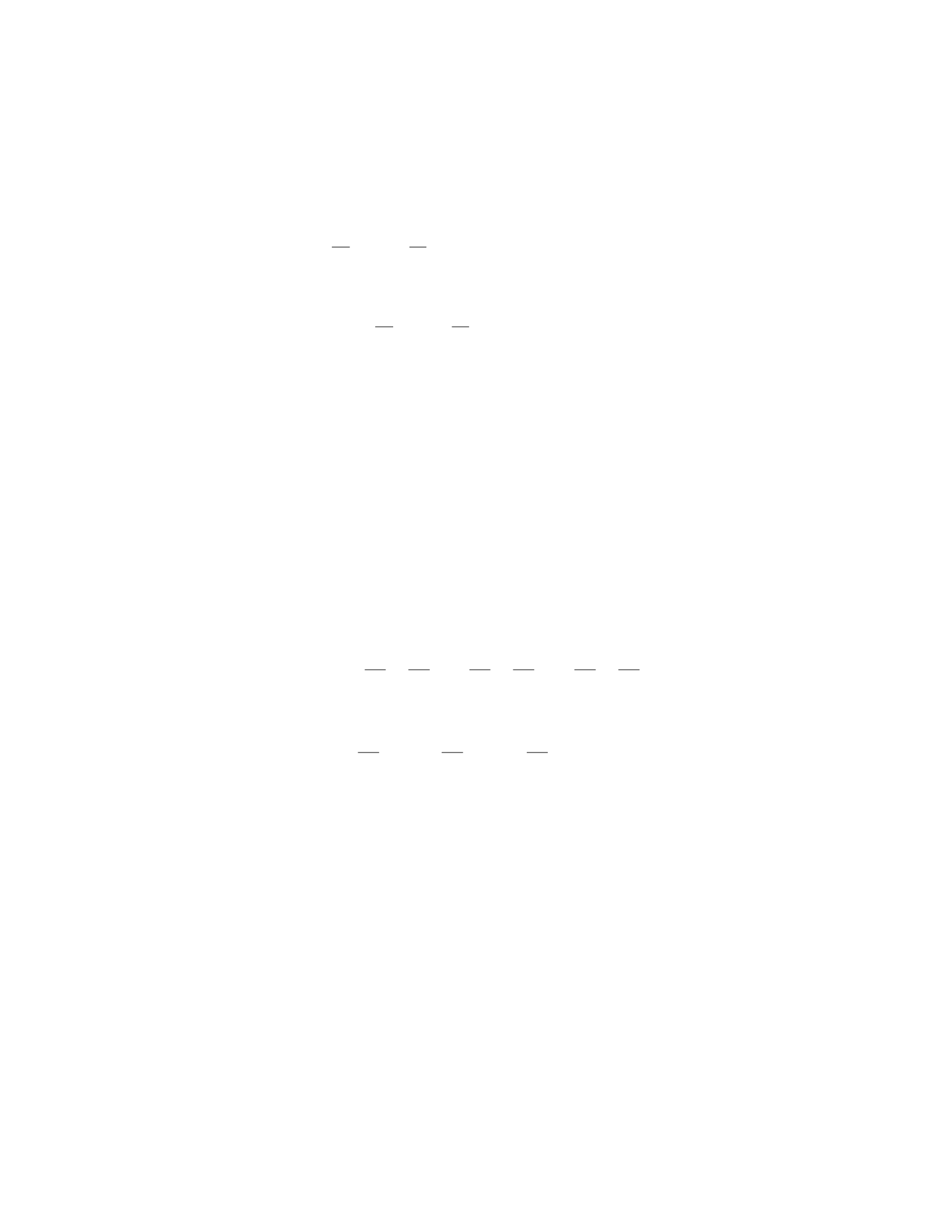
Step 2: Calculate the determinants for jcomponent:
−(∂
∂x (xyz)−∂
∂z (x2y)) = −(z−2xy)=2xy −z
Step 3: Calculate the determinants for kcomponent:
∂
∂x (xy2)−∂
∂y (x2y) = y2−x2
Therefore, the curl of Fis:
∇ × F= (xz −2xy)i+ (2xy −z)j+ (y2−x2)k
Question 5
Question
Let F(x, y, z) = x2yi+xyzj+x2zkbe a vector field in R3. Calculate the curl
of F.
Solution
To find the curl of a vector field F(x, y, z) = P(x, y, z)i+Q(x, y, z)j+R(x, y, z)k,
where P, Q, R are the component functions, we use the formula:
curl F= (∂R
∂y −∂Q
∂z )i−(∂R
∂x −∂P
∂z )j+ ( ∂Q
∂x −∂P
∂y )k
Step 1: Compute the partial derivatives of the component functions:
∂P
∂y =x2,∂Q
∂z =xy, ∂R
∂x = 2xz
Step 2: Compute the curl of Fusing the formula:
curl F= (xy −2xz)i−(2xz −x2)j+ (x2−xy)k
Therefore, the curl of vector field F(x, y, z) = x2yi+xyzj+x2zkis (xy −
2xz)i−(2xz −x2)j+ (x2−xy)k.
Question 6
Question
Let F(x, y, z) = (2xy +y2sin z)i+ (x2+ 2yz cos z)j+ (2xy cos z−z2)k. Find
∇ · ∇ × F.
4
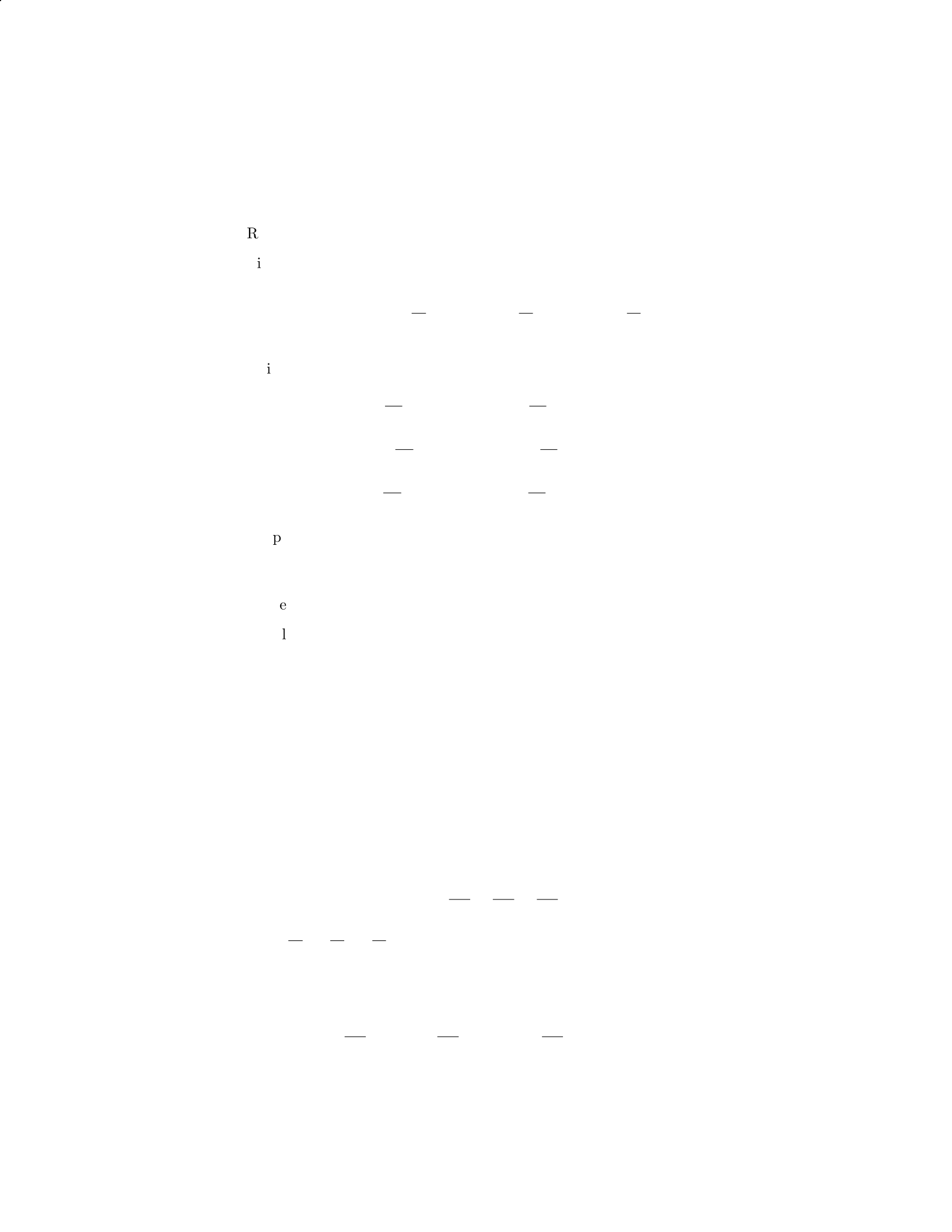
Solution
Recall that ∇ · ∇ × F=∇ · (∇ × F).
First, we need to find ∇ × Fwhich is given by:
∇ × F=
i j k
∂
∂x
∂
∂y
∂
∂z
2xy +y2sin z x2+ 2yz cos z2xy cos z−z2
This evaluates to:
∇ × F=∂
∂y (2xy cos z−z2)−∂
∂z (x2+ 2yz cos z)i
+−∂
∂x (2xy cos z−z2) + ∂
∂z (2xy +y2sin z)j
+∂
∂x (x2+ 2yz cos z)−∂
∂y (2xy +y2sin z)k
Simplifying each component gives:
∇ × F= (2z−2z)i+ (0 + 0)j+ (0 −0)k
Therefore, ∇ × F=0.
Finally, ∇ · ∇ × F=∇ · 0= 0.
Question 7
Question
Let F(x, y, z) = x2yi−2xyzj+z3kbe a vector field. Calculate the divergence
of F.
Solution
To find the divergence of a vector field F(x, y, z) = P(x, y, z)i+Q(x, y, z)j+
R(x, y, z)k, we use the formula:
∇ · F=∂P
∂x +∂Q
∂y +∂R
∂z
where ∇=∂
∂x i+∂
∂y j+∂
∂z kis the del operator.
Step 1: Find the components P(x, y, z), Q(x, y, z), and R(x, y, z) of F:
P(x, y, z) = x2y,Q(x, y, z) = −2xyz,R(x, y, z) = z3.
Step 2: Calculate the partial derivatives:
∂P
∂x = 2xy, ∂Q
∂y =−2xz, ∂R
∂z = 3z2
5
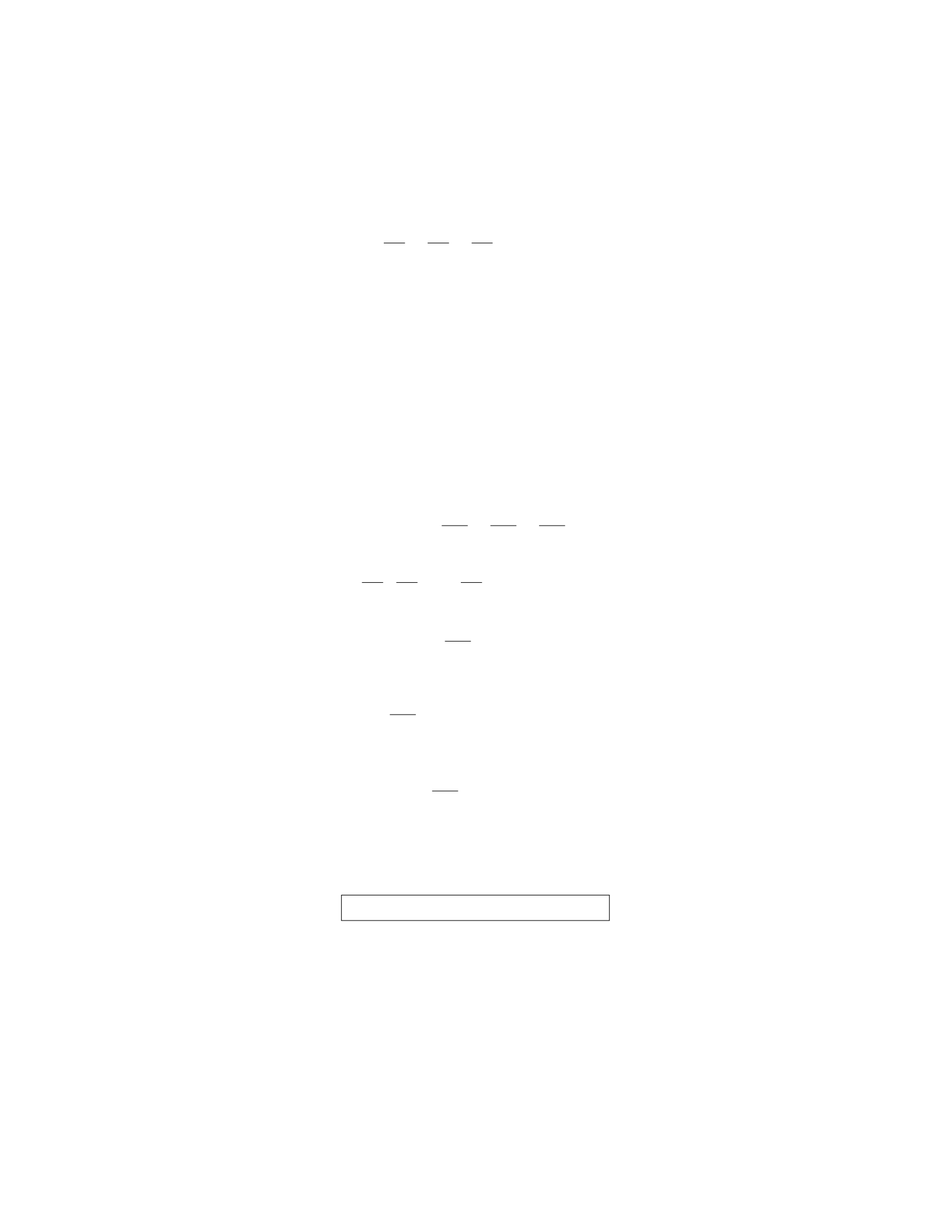
Step 3: Compute the divergence:
∇ · F=∂P
∂x +∂Q
∂y +∂R
∂z = 2xy −2xz + 3z2
Therefore, the divergence of Fis 2xy −2xz + 3z2.
Question 8
Question
Let F(x, y, z) = ⟨xez,−ycos(y), z sin(x)⟩be a vector field in R3. Compute the
divergence of F.
Solution
To find the divergence of F, denoted by ∇ · F, we use the formula:
∇ · F=∂F1
∂x +∂F2
∂y +∂F3
∂z
Where F(x, y, z) = ⟨F1(x, y, z), F2(x, y, z), F3(x, y, z)⟩.
Step 1: Compute ∂F1
∂x ,∂F2
∂y , and ∂F3
∂z .
For F1(x, y, z) = xez, we have:
∂F1
∂x =ez
For F2(x, y, z) = −ycos(y), we have:
∂F2
∂y =−cos(y) + ysin(y)
For F3(x, y, z) = zsin(x), we have:
∂F3
∂z = sin(x)
Step 2: Compute the divergence of F.
Therefore, the divergence of Fis:
∇ · F=ez+ (−cos(y) + ysin(y)) + sin(x)
∇ · F=ez−cos(y) + ysin(y) + sin(x)
Question 9
Question
Let F(x, y, z)=2x2yi−3xz2j+xy sin(z)k. Calculate the divergence of Fat
the point (1,2,0).
6
Solution
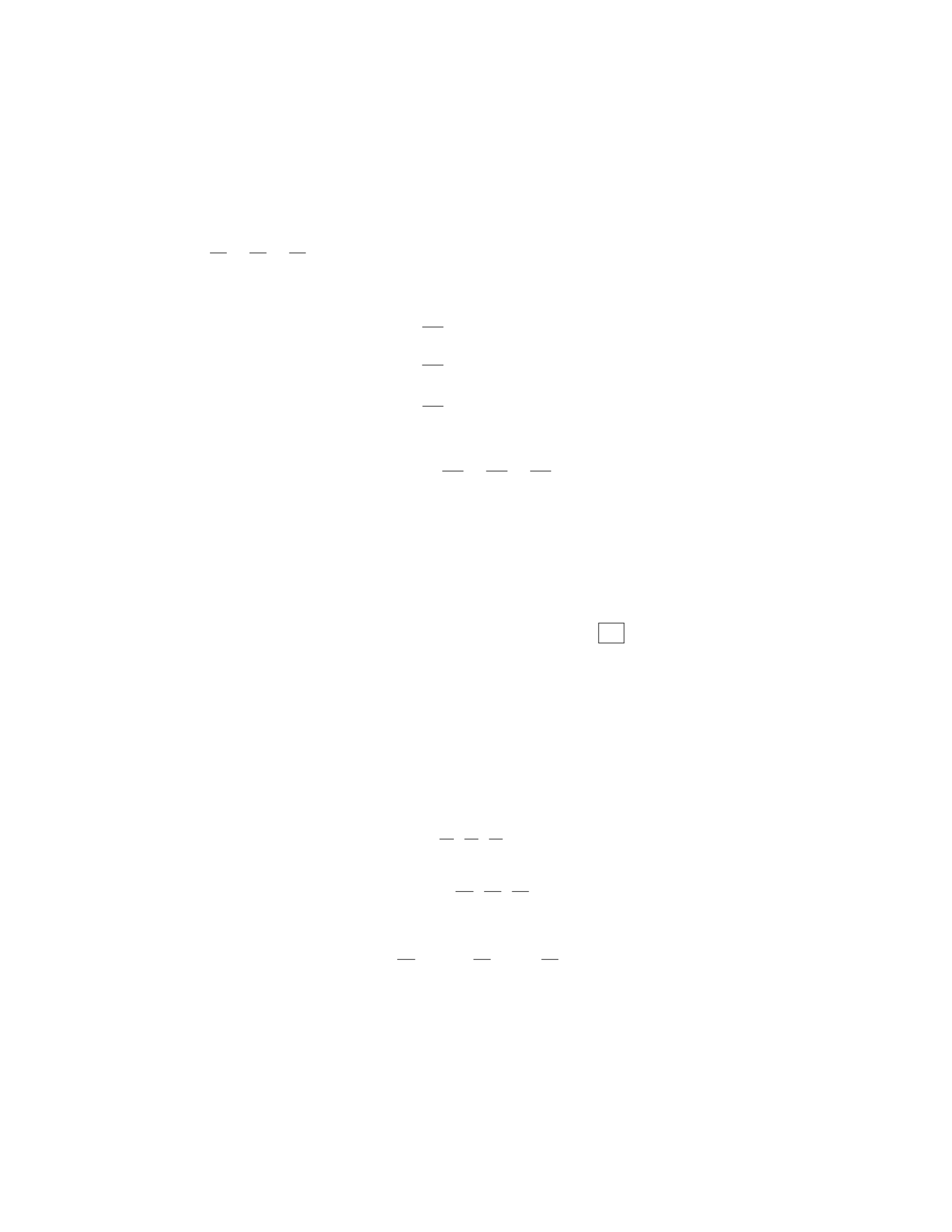
Step 1: The divergence of a vector field F=Pi+Qj+Rkis given by div(F) =
∂P
∂x +∂Q
∂y +∂R
∂z .
Step 2: In this case, we have P= 2x2y,Q=−3xz2, and R=xy sin(z).
Step 3: Calculating the partial derivatives:
∂P
∂x = 4xy,
∂Q
∂y = 0,
∂R
∂z =xy cos(z).
Step 4: Now, we can find the divergence:
div(F) = ∂P
∂x +∂Q
∂y +∂R
∂z
= 4xy +0+xy cos(z).
Step 5: Evaluate the divergence at the point (1,2,0):
div(F)(1,2,0) = 4(1)(2) + 0 + (1)(2) cos(0)
= 8 + 0 + 2
= 10.
Therefore, the divergence of Fat the point (1,2,0) is 10 .
Question 10
Question
Let F(x, y, z) = ⟨xey, yz, zex+y⟩. Compute the divergence of F.
Solution
To find the divergence of F(x, y, z), denoted as ∇ · F, we need to take the dot
product of the del operator ∇=⟨∂
∂x ,∂
∂y ,∂
∂z ⟩with F.
Step 1: Compute the del operator ∇.
∇=⟨∂
∂x ,∂
∂y ,∂
∂z ⟩
Step 2: Compute the divergence of F.
∇ · F=∂
∂x (xey) + ∂
∂y (yz) + ∂
∂z (zex+y)
∇ · F=ey+z+ex+y+z
∇ · F=ey+ex+y+ 2z
Therefore, the divergence of Fis ∇ · F=ey+ex+y+ 2z.
7
Question 11
Question
Let F(x, y, z) = ⟨ezsin y, xz, ezcos y⟩. Find the gradient of Fand evaluate it at
the point (0, π, 1).
Solution
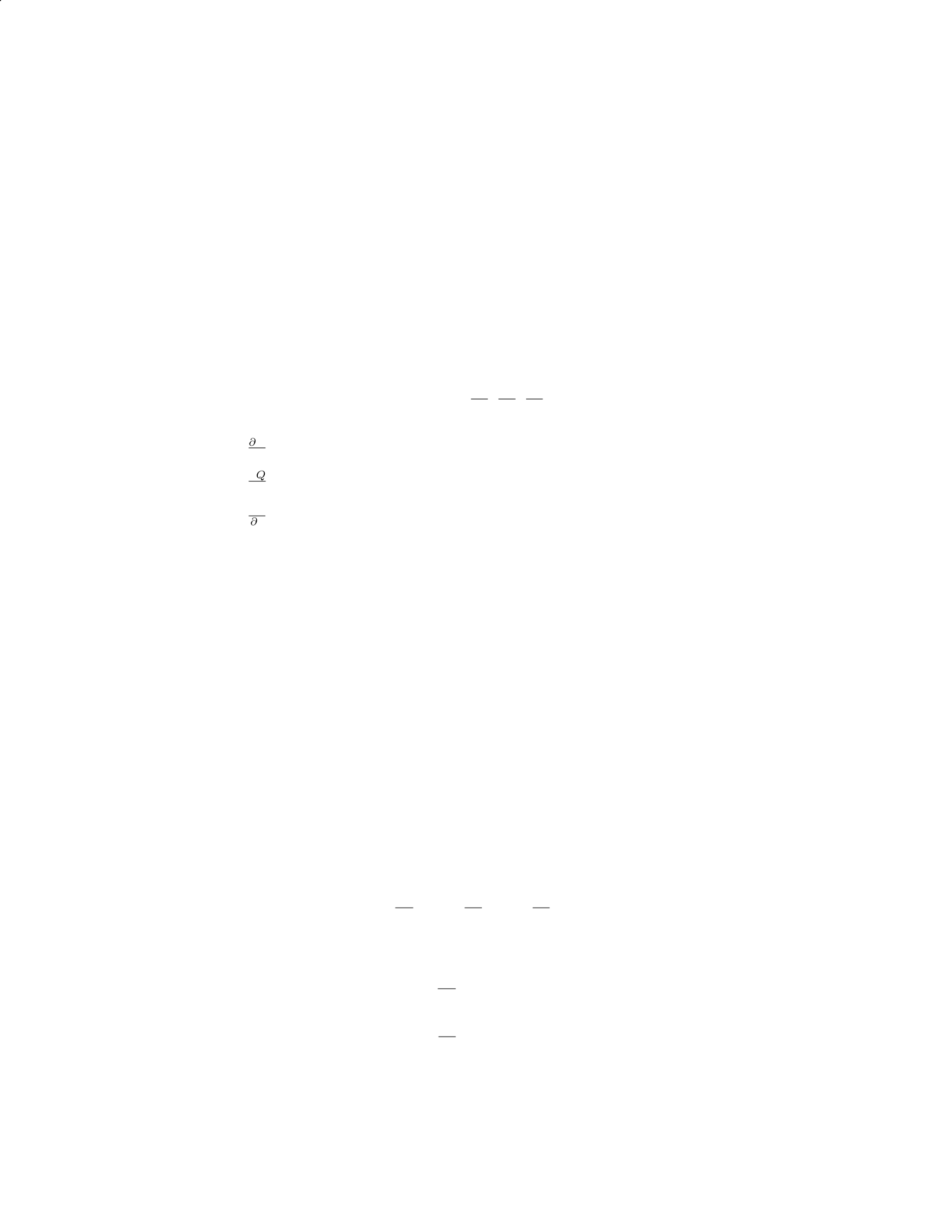
To find the gradient of F, we need to compute the partial derivatives of each
component function. Let F(x, y, z) = ⟨P(x, y, z), Q(x, y, z), R(x, y, z)⟩. Then
the gradient of Fis given by ∇ · F=⟨∂P
∂x ,∂Q
∂y ,∂R
∂z ⟩.
Step 1: Find the partial derivatives of P,Q, and R:
∂P
∂x = 0
∂Q
∂y = 0
∂R
∂z =ezcos y
Step 2: Compute the gradient of F:
∇ · F=⟨0,0, ezcos y⟩
Step 3: Evaluate the gradient at the point (0, π, 1):
∇ · F(0, π, 1) = ⟨0,0, e cos π⟩=⟨0,0,−e⟩
Therefore, the gradient of Fat the point (0, π, 1) is ⟨0,0,−e⟩.
Question 12
Question
Let F(x, y, z) = xzi+yzj+ (x2+y2)k. Determine ∇ · F.
Solution
Step 1: Compute the components of ∇ · F.
∇ · F=∂
∂x (xz) + ∂
∂y (yz) + ∂
∂z (x2+y2)
Step 2: Calculate the partial derivatives.
∂
∂x (xz) = z
∂
∂y (yz) = z
8

∂
∂z (x2+y2) = 0
Step 3: Combine the partial derivatives to find ∇ · F.
∇ · F=z+z+ 0 = 2z
Therefore, ∇ · F= 2z.
Question 13
Question
Let F(x, y, z)=2xyi+ (x2+z)j+xezk. Calculate the curl of F.
Solution
To find the curl of F, we proceed by computing the determinant of the following
matrix:
∇ × F=
i j k
∂
∂x
∂
∂y
∂
∂z
2xy x2+z xez
Step 1: Calculate the partial derivatives:
∂
∂x =yi+ 2xj+ezxk
∂
∂y = 2xi
∂
∂z =j+xezk
Step 2: Evaluate the determinant:
∇ × F=∂
∂y (xez)−∂
∂z (x2+z)i−∂
∂x (xez)−∂
∂z (2xy)j+∂
∂x (x2+z)−∂
∂y (2xy)k
= (ez)i−((1) ·ez)j+ (2x)k
=ezi−ezj+ 2xk
Therefore, the curl of Fis ∇ × F= (ez)i−(ez)j+ 2xk.
Question 14
Question
Let F(x, y, z) = x2yi+xy2j+xyzkbe a vector field in R3. Compute div(curl(F)).
9

Solution
Step 1: Compute the curl of F.
curl(F) = ∇ × F=
i j k
∂
∂x
∂
∂y
∂
∂z
x2y xy2xyz
curl(F) = (∂(xyz)
∂y −∂(xy2)
∂z )i−(∂(xyz)
∂x −∂(x2y)
∂z )j+ ( ∂(x2y)
∂x −∂(xy2)
∂y )k
= (xz −2xy)i−(z−2xy)j+ (2y−x)k
Step 2: Compute the divergence of the curl of F.
div(curl(F)) = ∇ · curl(F) = ∂
∂x (xz −2xy) + ∂
∂y (−z+ 2xy) + ∂
∂z (2y−x)
=z+ 2 −2 = z
Therefore, div(curl(F)) = z.
Question 15
Question
Let F(x, y, z) = x2i+xy2j+xz2k. Calculate ∇ · (∇ × F).
Solution
Step 1: Let’s first calculate ∇ × F.
=
i j k
∂
∂x
∂
∂y
∂
∂z
x2xy2xz2
=∂(xz2)
∂y −∂(xy2)
∂z i−∂(x2)
∂z −∂(xz2)
∂x j+∂(xy2)
∂x −∂(x2)
∂y k
= (0 −2xz)i−(0 −z2)j+ (y2−0)k
=−2xzi−z2j+y2k
Step 2: Now, calculate ∇ · (∇ × F).
) = ∂∂x(−2xz)+ ∂
∂y (−z2)+ ∂
∂z (y2)=−2z+0+0=−2z
Therefore, ∇ · (∇ × F) = −2z.
10

Question 16
Question
Let F(x, y, z) = ⟨exy cos(z), x sin(y),−xyz2⟩. Compute ∇ · F, where ∇is the
gradient operator.
Solution
Step 1: The gradient operator ∇is defined in Cartesian coordinates (x, y, z) as
∇=⟨∂
∂x ,∂
∂y ,∂
∂z ⟩.
Step 2: Compute the divergence of F, denoted as ∇ · F, where F(x, y, z) =
⟨exy cos(z), x sin(y),−xyz2⟩.
Step 3: The divergence of Fis given by ∇ · F=∂P
∂x +∂Q
∂y +∂R
∂z , where
F(x, y, z) = ⟨P, Q, R⟩.
Step 4: Compute the partial derivatives of P=exy cos(z) with respect to x,
Q=xsin(y) with respect to y, and R=−xyz2with respect to z.
Step 5: For P=exy cos(z), ∂P
∂x =yexy cos(z).
Step 6: For Q=xsin(y), ∂Q
∂y =xcos(y).
Step 7: For R=−xyz2,∂R
∂z =−xy2z.
Step 8: Summing up the partial derivatives, we get
∇ · F=∂P
∂x +∂Q
∂y +∂R
∂z =yexy cos(z) + xcos(y)−2xyz
Thus, ∇ · F=yexy cos(z) + xcos(y)−2xyz.
Question 17
Question
Let F(x, y, z) = (x2y, yz, xyz) be a vector field. Compute ∇ · F, where ∇is the
gradient operator.
Solution
Step 1: The divergence of a vector field F= (P, Q, R) is defined as ∇ · F=
∂P
∂x +∂Q
∂y +∂R
∂z .
Step 2: In this case, we have F(x, y, z)=(x2y, yz, xyz).
Step 3: So, P=x2y,Q=yz, and R=xyz.
Step 4: Now, let’s compute the partial derivatives:
∂P
∂x = 2xy, ∂Q
∂y =z, ∂R
∂z =xy
Step 5: Therefore, the divergence of Fis:
∇ · F= 2xy +z+xy
11

Step 6: Simplifying the expression, we get:
∇ · F= 3xy +z
Hence, the divergence of the vector field Fis 3xy +z.
Question 18
Question
Let F(x, y, z) = (3x2y+ 2yz, x3+ 2xyz, y2z2−3xz). Calculate the curl of F.
Solution
To find the curl of a vector field F(x, y, z)=(P, Q, R), we can use the formula:
∇ × F=∂R
∂y −∂Q
∂z ,∂P
∂z −∂R
∂x ,∂Q
∂x −∂P
∂y
Step 1: Calculate the partial derivatives Let P= 3x2y+ 2yz,Q=
x3+ 2xyz, and R=y2z2−3xz.
We need to compute the partial derivatives:
∂P
∂y ,∂Q
∂z ,∂R
∂x ,∂R
∂y ,∂Q
∂x ,∂P
∂z
Step 2: Compute the curl Using the formula for the curl, we have:
∇ × F=∂R
∂y −∂Q
∂z ,∂P
∂z −∂R
∂x ,∂Q
∂x −∂P
∂y
Substitute the partial derivatives we calculated into the formula to find the curl
of F.
Question 19
Question
Let F(x, y) = −y2, x2+y3. Compute the divergence of Fand determine
whether the vector field Fis conservative.
Solution
Step 1: The divergence of a vector field F(x, y)=(P(x, y), Q(x, y)) is given by
div(F) = ∂P
∂x +∂Q
∂y .
12
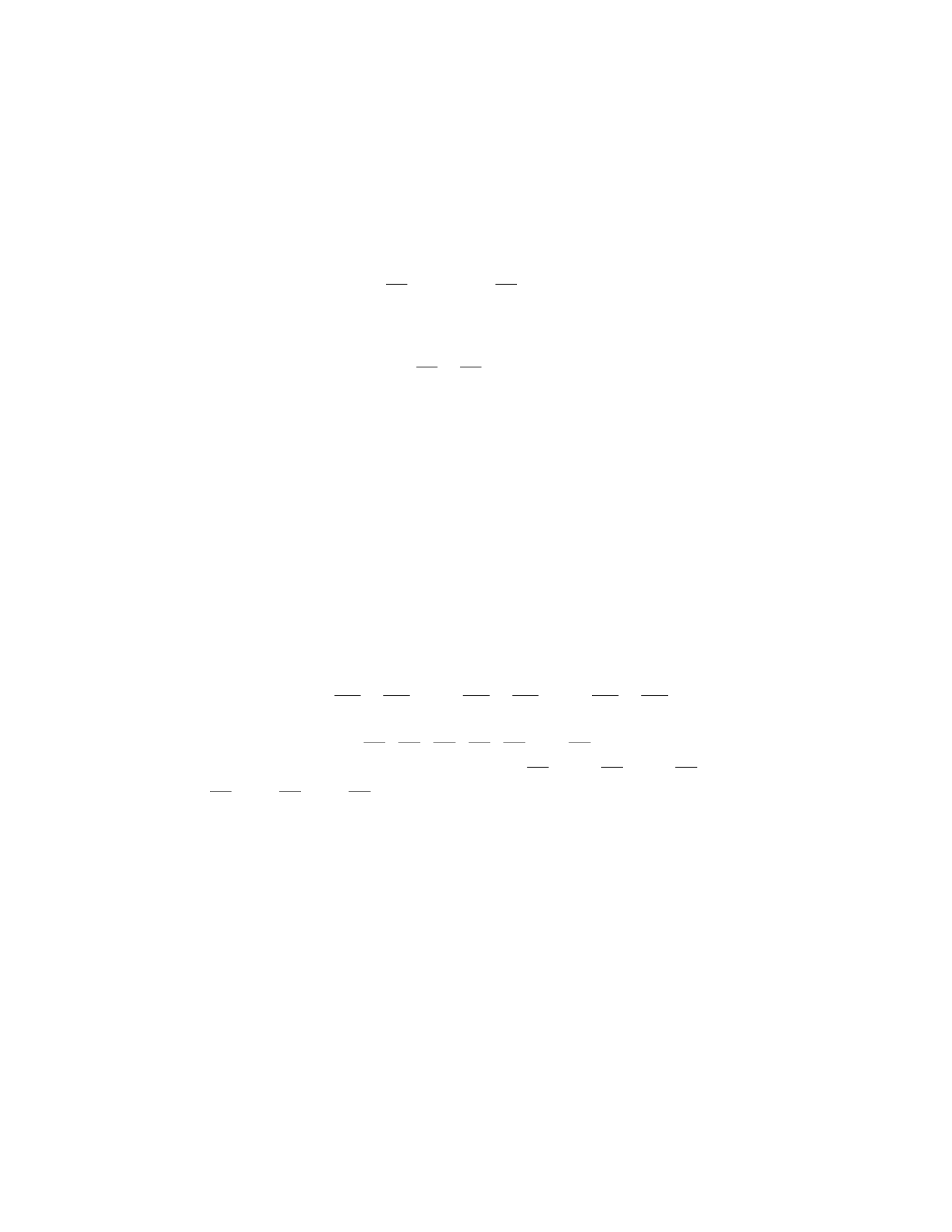
Step 2: Given F(x, y)=(−y2, x2+y3), we have P(x, y) = −y2and Q(x, y) =
x2+y3.
Step 3: Calculate the partial derivatives:
∂P
∂x = 0 and ∂Q
∂y = 3y2.
Step 4: The divergence of Fis
div(F) = ∂P
∂x +∂Q
∂y = 0 + 3y2= 3y2.
Step 5: To determine if Fis conservative, note that if F=∇ffor some
scalar function f, then Fis conservative.
Step 6: Since the divergence of Fis not zero, the vector field Fis not
conservative.
Question 20
Question
Let F(x, y, z)=(y2, xz, yz) be a vector field. Calculate the curl of F.
Solution
To calculate the curl of F, we use the formula:
∇ × F=∂Fz
∂y −∂Fy
∂z i+∂Fx
∂z −∂Fz
∂x j+∂Fy
∂x −∂Fx
∂y k
Step 1: Calculate ∂Fz
∂y ,∂Fy
∂z ,∂Fx
∂z ,∂Fz
∂x ,∂Fy
∂x , and ∂Fx
∂y .
Given F(x, y, z) = (y2, xz, yz), we have: - ∂Fz
∂y =z-∂Fy
∂z = 0 - ∂Fx
∂z =x-
∂Fz
∂x = 0 - ∂Fy
∂x = 0 - ∂Fx
∂y = 0
Step 2: Compute the curl of F.
∇ × F= (0 −0)i+ (x−0)j+ (0 −0)k
∇ × F=xj
Therefore, the curl of the vector field F(x, y, z) = (y2, xz, yz) is ∇ × F=xj.
Question 21
Question
Let F(x, y, z) = x2yi+xzj+yzkbe a vector field. Compute the curl of F.
13
Solution
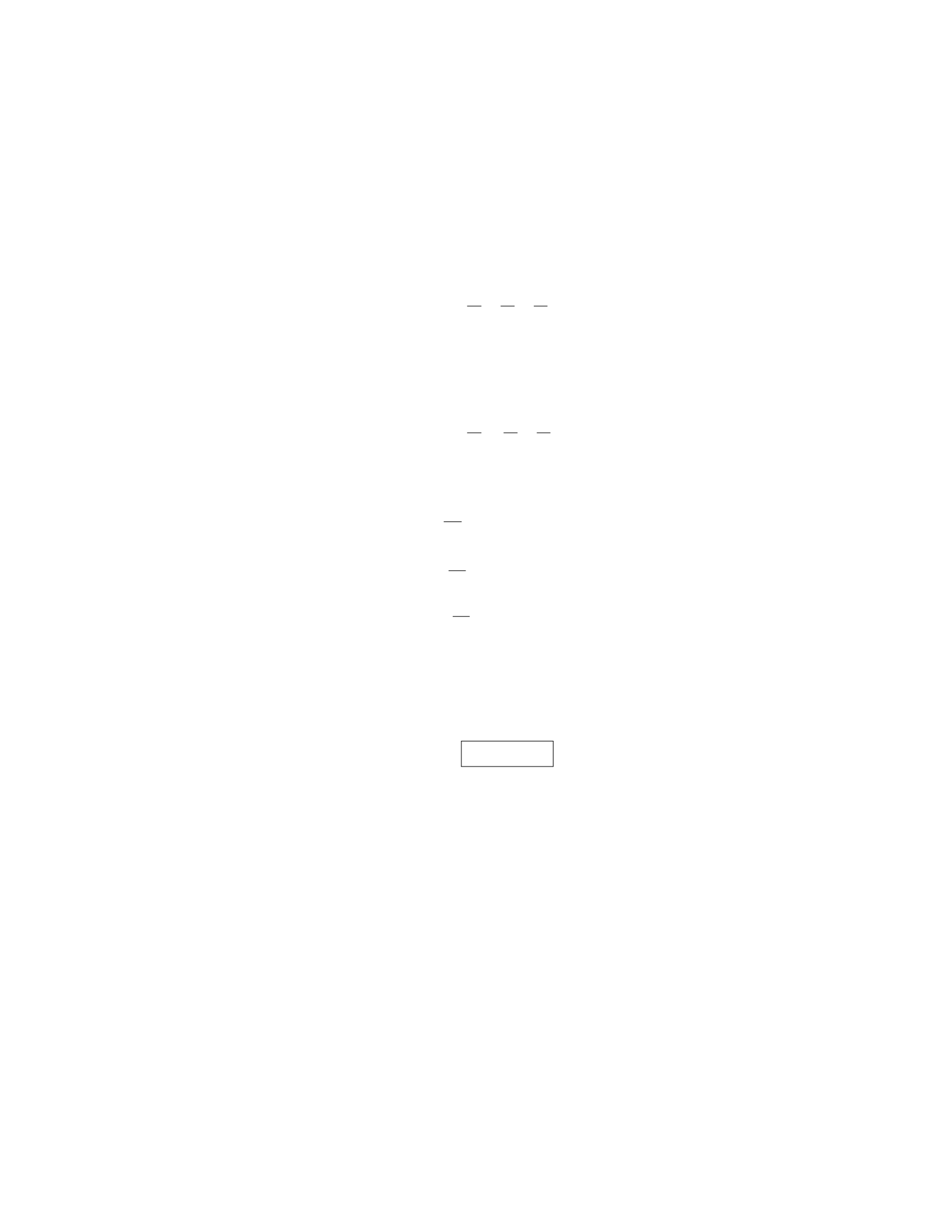
To compute the curl of a vector field F(x, y, z) = P(x, y, z)i+Q(x, y, z)j+
R(x, y, z)k, we use the formula:
∇ × F=
i j k
∂
∂x
∂
∂y
∂
∂z
P Q R
In our case, F(x, y, z) = x2yi+xzj+yzk, so P=x2y,Q=xz, and R=yz.
Now we can compute the curl:
∇ × F=
i j k
∂
∂x
∂
∂y
∂
∂z
x2y xz yz
Step 1: Compute the partial derivatives:
∂
∂x = 2xy
∂
∂y =x2
∂
∂z = 0
Step 2: Now, compute the determinant:
∇ × F= (0 −0) i−(0 −0) j+ (2xy −xz)k
Step 3: Simplify the result:
∇ × F= (2xy −xz)k
Therefore, the curl of the vector field F(x, y, z) = x2yi+xzj+yzkis (2xy −
xz)k.
Question 22
Question
Let F(x, y, z) = (2x2y, xz2,−y2z) be a vector field in R3. Compute the curl of
F.
14
Solution
To compute the curl of a vector field F(x, y, z)=(P(x, y, z), Q(x, y, z), R(x, y, z)),
we use the formula:
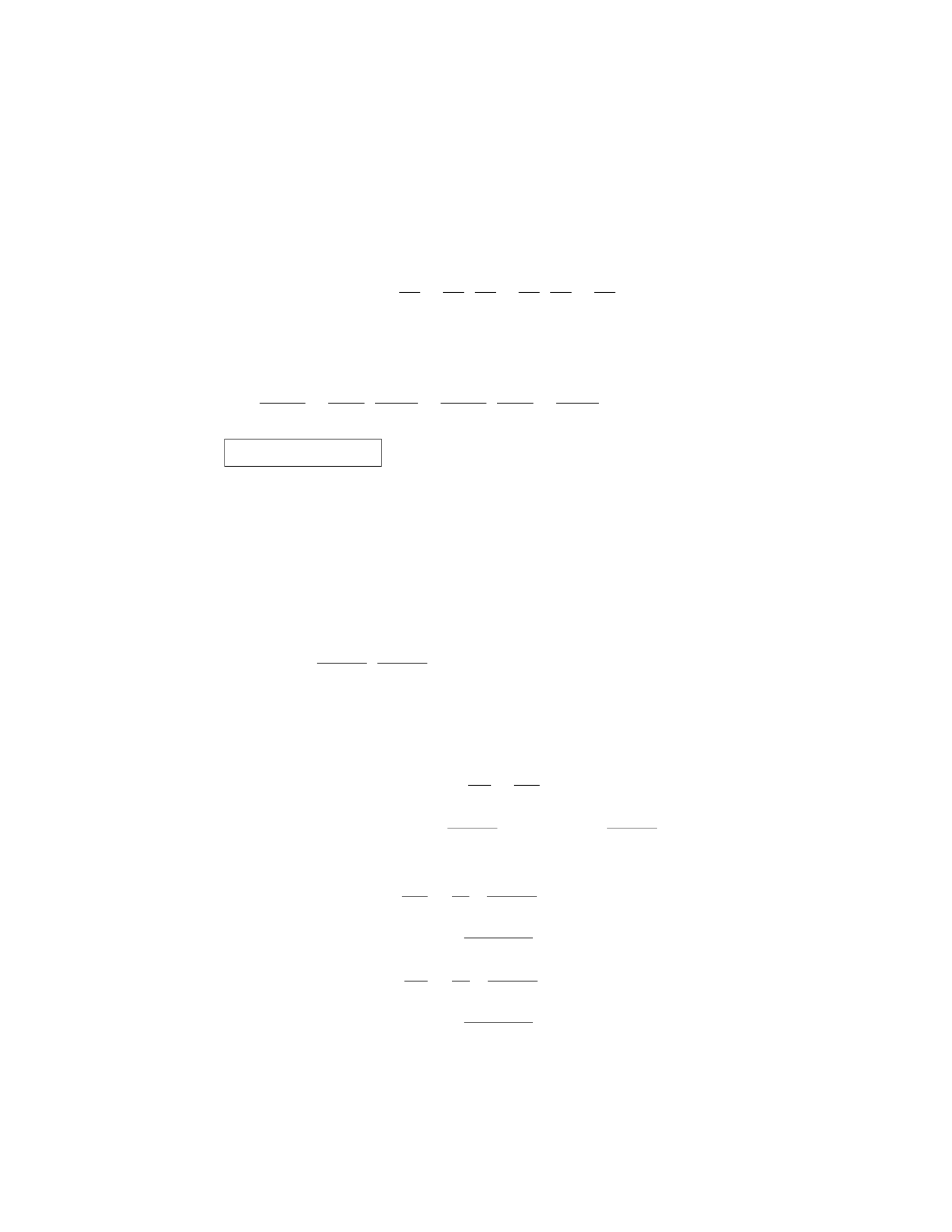
∇ × F=∂R
∂y −∂Q
∂z ,∂P
∂z −∂R
∂x ,∂Q
∂x −∂P
∂y
Step 1: Compute the curl of F.
=∂(−y2z)
∂y −∂(xz2)
∂z ,∂(2x2y)
∂z −∂(−y2z)
∂x ,∂(xz2)
∂x −∂(2x2y)
∂y
=−2yz −0,0−z2,2z−2x2
= (−2yz, −z2,2z−2x2)
Therefore, the curl of the vector field F(x, y, z) = (2x2y, xz2,−y2z) is (−2yz, −z2,2z−
2x2).
Question 23
Question
Let F(x, y) = x
x2+y2,y
x2+y2be a vector field. Determine the curl of F.
Solution
Step 1: The curl of a vector field F= (M(x, y), N (x, y)) in two dimensions is
defined as
∇ × F=∂N
∂x −∂M
∂y .
Step 2: In this case, M(x, y) = x
x2+y2and N(x, y) = y
x2+y2.
Step 3: Let’s find the partial derivatives needed to compute the curl.
∂M
∂y =∂
∂y x
x2+y2
=−2xy
(x2+y2)2
∂N
∂x =∂
∂x y
x2+y2
=−2xy
(x2+y2)2.
15

Step 4: Now, we can compute the curl of Fusing the formula.
∇ × F=−2xy
(x2+y2)2−(−2xy
(x2+y2)2)
= 0.
Step 5: Therefore, the curl of the vector field Fis 0.
Step 6: This implies that the vector field Fis conservative, as its curl is zero.
Question 24
Question
Let F(x, y, z) = (x2y2, y2z2, z2x2). Calculate the divergence of Fat the point
(1,2,3).
Solution
To find the divergence of a vector field F= (P, Q, R), we use the formula:
div(F) = ∂P
∂x +∂Q
∂y +∂R
∂z
Step 1: Find the partial derivatives of P, Q, R. Let P=x2y2,Q=y2z2,
and R=z2x2. Then, - ∂P
∂x = 2xy2-∂Q
∂y = 2yz2-∂R
∂z = 2zx2
Step 2: Evaluate the partial derivatives at (1,2,3). Substitute x= 1, y =
2, z = 3 into the partial derivatives: - ∂P
∂x = 2(1)(2)2= 8 - ∂Q
∂y = 2(2)(3)2= 36
-∂R
∂z = 2(3)(1)2= 6
Step 3: Calculate the divergence at the point (1,2,3).
div(F) = ∂P
∂x +∂Q
∂y +∂R
∂z = 8 + 36 + 6 = 50
Therefore, the divergence of Fat the point (1,2,3) is 50.
Question 25
Question
Let F(x, y, z) = x2yi +y2zj +z2xk. Calculate the divergence of F.
Solution
Step 1: The divergence of a vector field F(x, y, z) = P(x, y, z)i+Q(x, y, z)j+
R(x, y, z)kis defined as ∇ · F=∂P
∂x +∂Q
∂y +∂R
∂z .
Step 2: In this case, F(x, y, z) = x2yi +y2zj +z2xk, so P(x, y, z) = x2y,
Q(x, y, z) = y2z, and R(x, y, z) = z2x.
16

Step 3: Now, calculate the partial derivatives: ∂P
∂x = 2xy,∂Q
∂y = 2yz,∂R
∂z =
2zx.
Step 4: Therefore, the divergence of Fis: ∇ · F= 2xy + 2yz + 2zx.
Question 26
Question
Let Fbe a vector field in R3defined by F(x, y, z) = ⟨x2+yz, xz, y2−xz⟩.
Calculate the curl of F.
Solution
To calculate the curl of F, we will use the formula:
curl(F) = ∇ × F=∂
∂x ,∂
∂y ,∂
∂z × ⟨P, Q, R⟩
Step 1: Find the components of ∇ × Fusing the determinant formula:
curl(F) =
i j k
∂
∂x
∂
∂y
∂
∂z
x2+yz xz y2−xz
Step 2: Calculate the determinant along the first row:
curl(F) = ∂
∂y (y2−xz)−∂
∂z (xz),∂
∂z (x2+yz)−∂
∂x (y2−xz),∂
∂x (xz)−∂
∂y (x2+yz)
Step 3: Compute the partial derivatives:
curl(F)=(−x, −z, x +y)
Therefore, the curl of Fis curl(F) = ⟨−x, −z, x +y⟩.
Question 27
Question
Let F(x, y, z) = (x2y, yexz , xz cos(y)) be a vector field in 3-dimensional space.
Compute the curl of F.
Solution
To find the curl of a vector field F(x, y, z)=(P, Q, R), we use the formula:
curl F=∂R
∂y −∂Q
∂z ,∂P
∂z −∂R
∂x ,∂Q
∂x −∂P
∂y
17

Step 1: Compute ∂P
∂z ,∂Q
∂x , and ∂R
∂y .
∂P
∂z =∂
∂z (xz cos(y)) = xcos(y)
∂Q
∂x =∂
∂x (yexz ) = yzexz
∂R
∂y =∂
∂y (xz cos(y)) = −xz sin(y)
Step 2: Compute ∂Q
∂z ,∂R
∂x , and ∂P
∂y .
∂Q
∂z =∂
∂z (yexz ) = xyexz
∂R
∂x =∂
∂x (xz cos(y)) = zcos(y)
∂P
∂y =∂
∂y (x2y) = x2
Step 3: Now, compute the curl of Fusing the formula:
curl F=xcos(y)−xyexz, yzexz −zcos(y),−xz sin(y)−x2
Therefore, the curl of Fis (xcos(y)−xyexz , yzexz −zcos(y),−xz sin(y)−x2) .
Question 28
Question
Let F(x, y, z)=(x2z, 2xy, x +y2) be a vector field in R3. Compute ∇ · ∇ × F.
Solution
Step 1: Compute ∇ × F.
∇ × F=
i j k
∂
∂x
∂
∂y
∂
∂z
x2z2xy x +y2
=∂
∂y (x+y2)−∂
∂z (2xy),∂
∂z (x2z)−∂
∂x (x+y2),∂
∂x (2xy)−∂
∂y (x2z)
= (2y−0, x2−1,2y−2xz) = (2y, x2−1,2y−2xz)
Step 2: Compute ∇ · (2y, x2−1,2y−2xz).
∇ · ∇ × F=∂
∂x (2y) + ∂
∂y (x2−1) + ∂
∂z (2y−2xz)
= 0 + 0 −2x=−2x
18
Question 29
Question
Let F(x, y, z) = x2yi+y2zj+z2xkbe a vector field. Compute ∇ · (∇ × F).
Solution
Step 1: Compute ∇ × F.
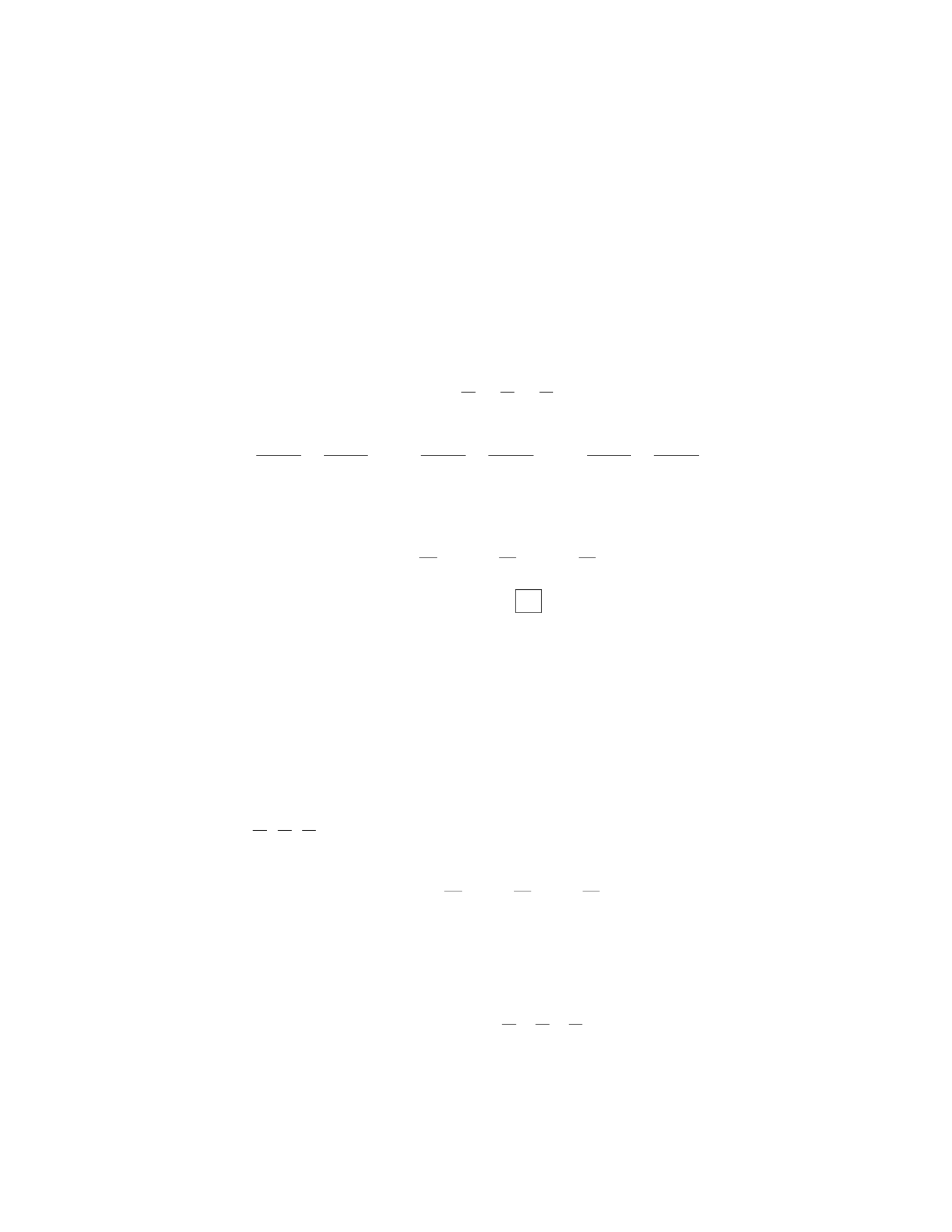
∇ × F=
i j k
∂
∂x
∂
∂y
∂
∂z
x2y y2z z2x
=∂(z2x)
∂y −∂(y2z)
∂z i−∂(z2x)
∂x −∂(x2y)
∂z j+∂(y2z)
∂x −∂(x2y)
∂y k
= (0 −y2)i−(2z−0)j+ (2yz −0)k=−y2i−2zj+ 2yzk
Step 2: Compute ∇ · (∇ × F).
∇ · (∇ × F) = ∂
∂x (−y2) + ∂
∂y (−2z) + ∂
∂z (2yz)
= 0 −0+2y= 2y
Question 30
Question
Let F(x, y, z) = xyi+xzj+yzkbe a vector field in 3D space. Determine the
divergence and curl of F.
Solution
To find the divergence of F, we apply the formula div(F) = ∇ · F, where
∇=∂
∂x ,∂
∂y ,∂
∂z is the del operator.
Step 1: Calculate the divergence of F.
div(F) = ∇ · F=∂
∂x (xy) + ∂
∂y (xz) + ∂
∂z (yz)
div(F) = y+z+x
Next, to find the curl of F, we apply the formula curl(F) = ∇ × F.
Step 2: Calculate the curl of F.
curl(F) = ∇ × F=
i j k
∂
∂x
∂
∂y
∂
∂z
xy xz yz
19

Question 2
Question
Let F(x, y) = (3x2y3,2x3y2) be a vector field in the plane. Calculate the diver-
gence of Fat the point (1,2).
Solution
To find the divergence of Fat the point (1,2), we need to calculate the following
expression:
div F=∂
∂x Fx+∂
∂y Fy
Step 1: Calculate the partial derivatives of F
The components of the vector field Fare Fx= 3x2y3and Fy= 2x3y2. Let’s
calculate the partial derivatives:
∂
∂x Fx=∂
∂x (3x2y3)=6xy3
∂
∂y Fy=∂
∂y (2x3y2)=4x3y
Step 2: Find the divergence of F at (1,2)
Now, substitute the values x= 1 and y= 2 into the partial derivatives we
just calculated:
∂
∂x Fx
(1,2)
= 6(1)(2)3= 48
∂
∂y Fy
(1,2)
= 4(1)3(2) = 8
Finally, we can find the divergence of Fat (1,2):
div F
(1,2)
=∂
∂x Fx
(1,2)
+∂
∂y Fy
(1,2)
= 48 + 8 = 56
Therefore, the divergence of Fat the point (1,2) is 56.
Question 3
Question
Let F(x, y, z)=(yez+xcos y, zex+ycos z, xey+zcos x) be a vector field.
Calculate ∇ · ∇ × F.
Solution
Step 1: Calculate ∇ × F. Step 2: Calculate ∇ · (∇ × F).
2
Step 1:
To calculate ∇ × F, we need to find the determinant of the following matrix:
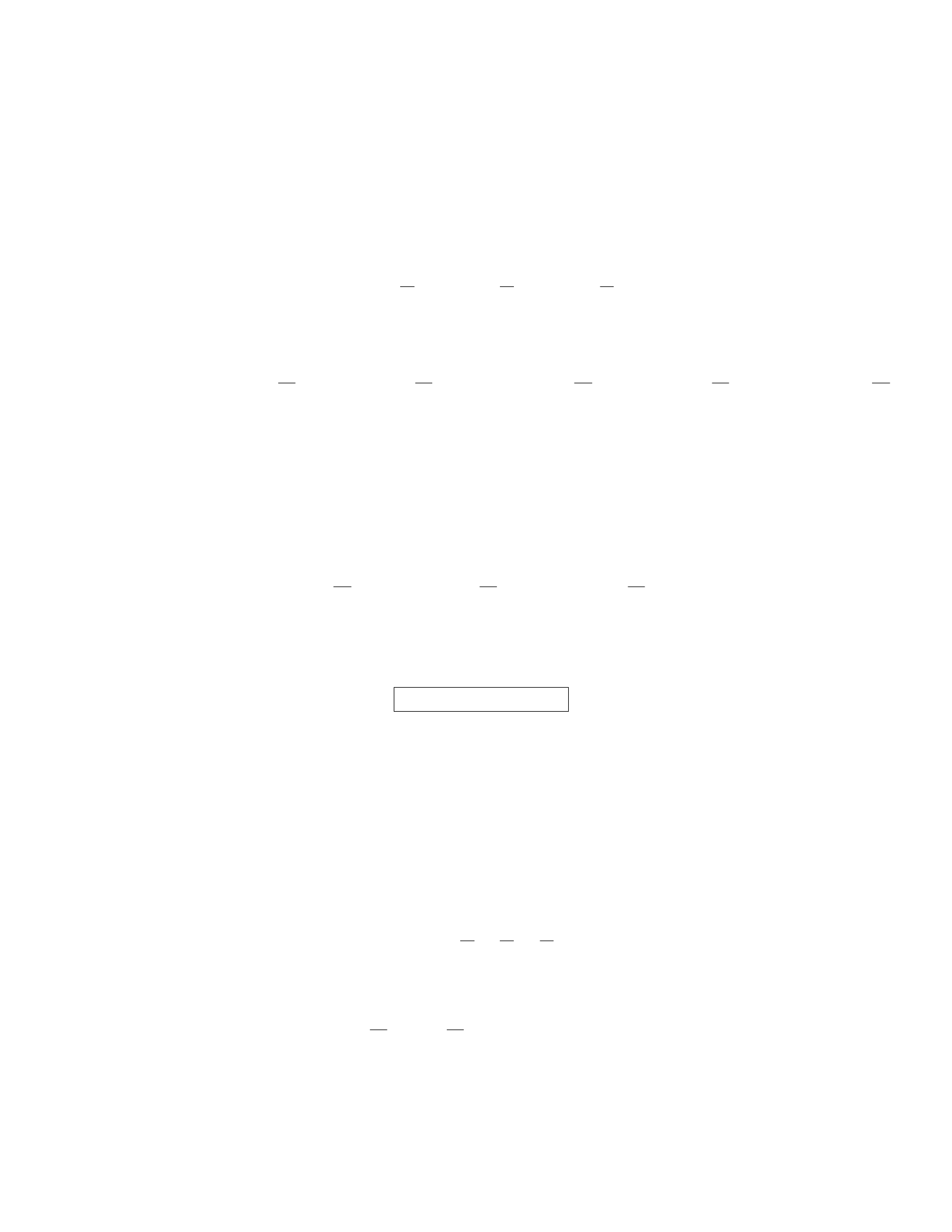
∇ × F=
i j k
∂
∂x
∂
∂y
∂
∂z
yez+xcos y zex+ycos z xey+zcos x
Calculating this determinant, we get:
∇×F=∂
∂y (xey+zcos x)−∂
∂z (zex+ycos z)i−∂
∂x (xey+zcos x)−∂
∂z (yez+xcos y)j+∂
∂x (zex+ycos z)−∂
∂y (yez+xcos y)k
After simplifying, we find:
∇ × F= (−sin x−sin z)i−(−cos y−cos z)j+ (−ez−ex)k
Step 2:
Next, we calculate ∇·(∇×F) by taking the dot product of the gradient operator
∇with ∇ × F:
∇ · (∇ × F) = ∂
∂x (−sin x−sin z) + ∂
∂y (−cos y−cos z) + ∂
∂z (−ez−ex)
Simplifying this expression gives:
∇ · (∇ × F) = −cos x−cos y−ex−ez
Therefore, ∇ · ∇ × F=−cos x−cos y−ex−ez.
Question 4
Question
Let F(x, y, z) = x2yi+xy2j+xyzk. Compute the curl of F.
Solution
To compute the curl of F, we use the formula:
∇ × F=
i j k
∂
∂x
∂
∂y
∂
∂z
x2y xy2xyz
Step 1: Calculate the determinants for icomponent:
∂
∂y (xyz)−∂
∂z (xy2) = xz −2xy
3
Step 2: Calculate the determinants for jcomponent:
−(∂
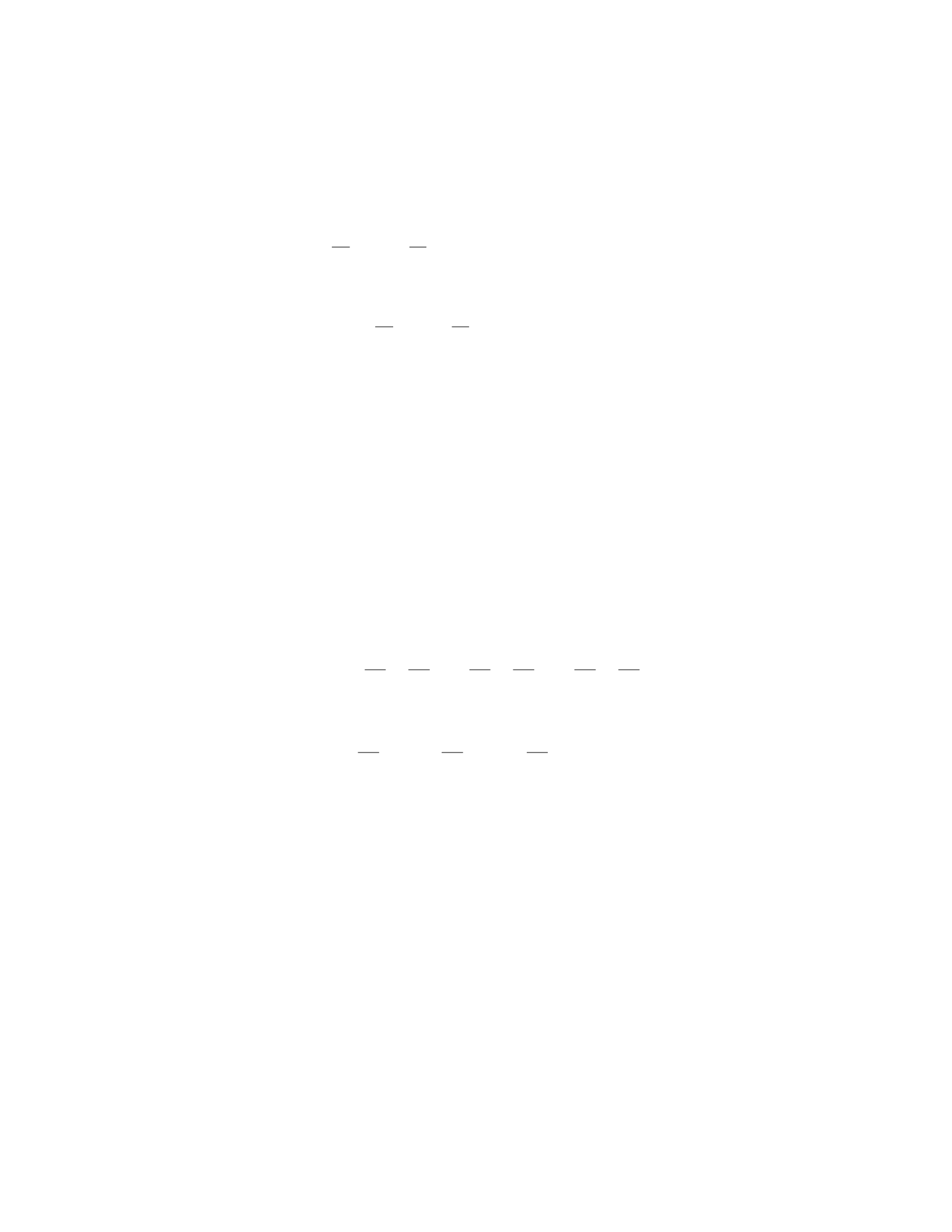
∂x (xyz)−∂
∂z (x2y)) = −(z−2xy)=2xy −z
Step 3: Calculate the determinants for kcomponent:
∂
∂x (xy2)−∂
∂y (x2y) = y2−x2
Therefore, the curl of Fis:
∇ × F= (xz −2xy)i+ (2xy −z)j+ (y2−x2)k
Question 5
Question
Let F(x, y, z) = x2yi+xyzj+x2zkbe a vector field in R3. Calculate the curl
of F.
Solution
To find the curl of a vector field F(x, y, z) = P(x, y, z)i+Q(x, y, z)j+R(x, y, z)k,
where P, Q, R are the component functions, we use the formula:
curl F= (∂R
∂y −∂Q
∂z )i−(∂R
∂x −∂P
∂z )j+ ( ∂Q
∂x −∂P
∂y )k
Step 1: Compute the partial derivatives of the component functions:
∂P
∂y =x2,∂Q
∂z =xy, ∂R
∂x = 2xz
Step 2: Compute the curl of Fusing the formula:
curl F= (xy −2xz)i−(2xz −x2)j+ (x2−xy)k
Therefore, the curl of vector field F(x, y, z) = x2yi+xyzj+x2zkis (xy −
2xz)i−(2xz −x2)j+ (x2−xy)k.
Question 6
Question
Let F(x, y, z) = (2xy +y2sin z)i+ (x2+ 2yz cos z)j+ (2xy cos z−z2)k. Find
∇ · ∇ × F.
4
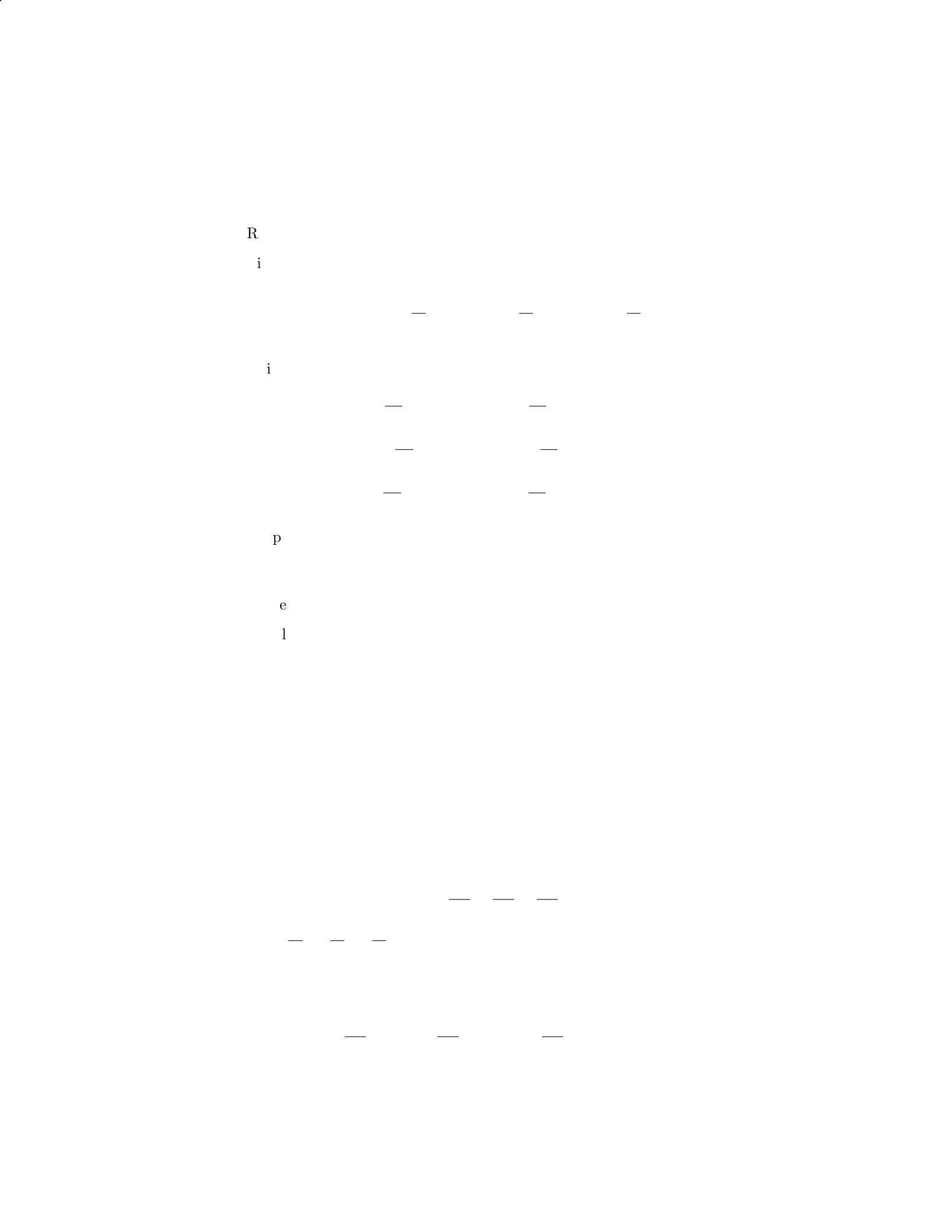
Solution
Recall that ∇ · ∇ × F=∇ · (∇ × F).
First, we need to find ∇ × Fwhich is given by:
∇ × F=
i j k
∂
∂x
∂
∂y
∂
∂z
2xy +y2sin z x2+ 2yz cos z2xy cos z−z2
This evaluates to:
∇ × F=∂
∂y (2xy cos z−z2)−∂
∂z (x2+ 2yz cos z)i
+−∂
∂x (2xy cos z−z2) + ∂
∂z (2xy +y2sin z)j
+∂
∂x (x2+ 2yz cos z)−∂
∂y (2xy +y2sin z)k
Simplifying each component gives:
∇ × F= (2z−2z)i+ (0 + 0)j+ (0 −0)k
Therefore, ∇ × F=0.
Finally, ∇ · ∇ × F=∇ · 0= 0.
Question 7
Question
Let F(x, y, z) = x2yi−2xyzj+z3kbe a vector field. Calculate the divergence
of F.
Solution
To find the divergence of a vector field F(x, y, z) = P(x, y, z)i+Q(x, y, z)j+
R(x, y, z)k, we use the formula:
∇ · F=∂P
∂x +∂Q
∂y +∂R
∂z
where ∇=∂
∂x i+∂
∂y j+∂
∂z kis the del operator.
Step 1: Find the components P(x, y, z), Q(x, y, z), and R(x, y, z) of F:
P(x, y, z) = x2y,Q(x, y, z) = −2xyz,R(x, y, z) = z3.
Step 2: Calculate the partial derivatives:
∂P
∂x = 2xy, ∂Q
∂y =−2xz, ∂R
∂z = 3z2
5
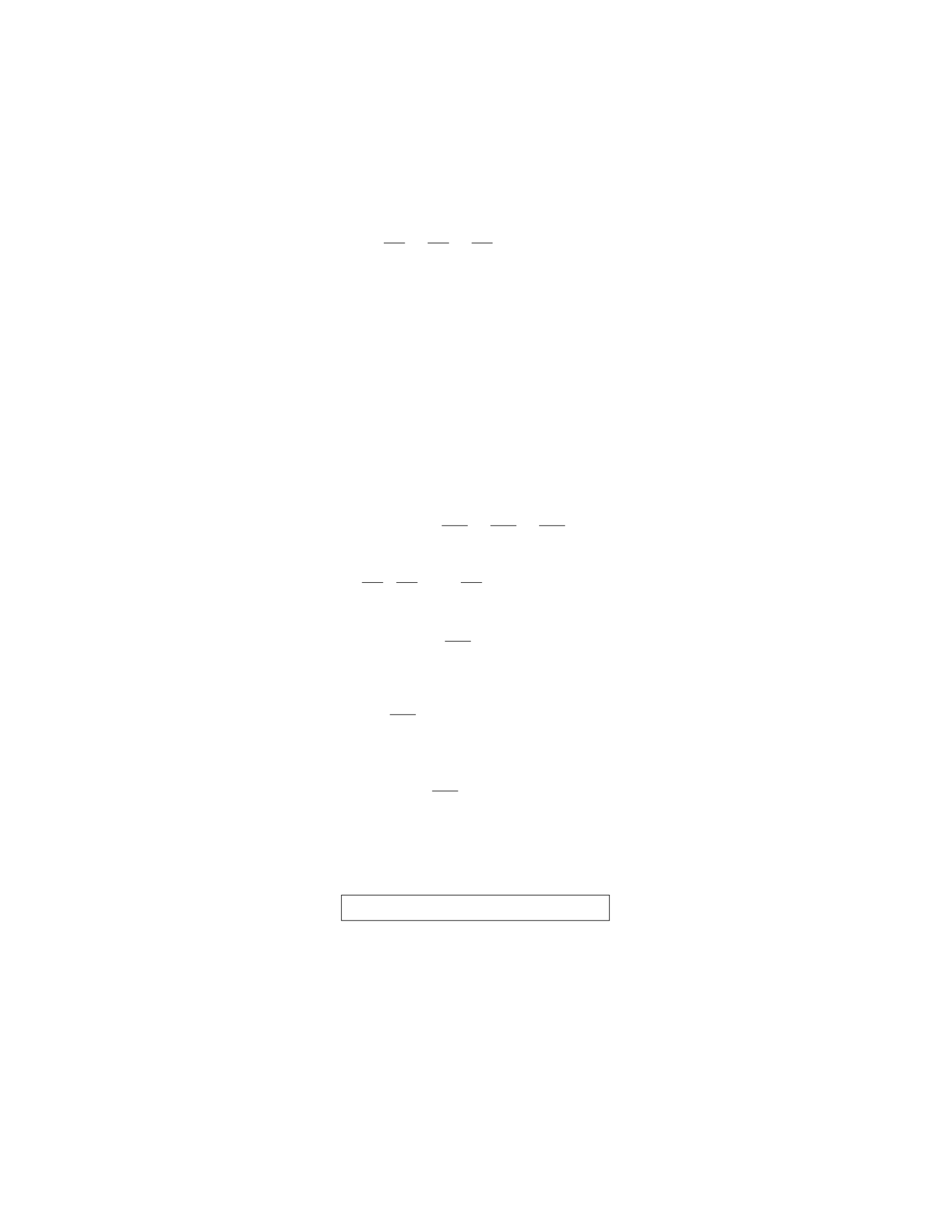
Step 3: Compute the divergence:
∇ · F=∂P
∂x +∂Q
∂y +∂R
∂z = 2xy −2xz + 3z2
Therefore, the divergence of Fis 2xy −2xz + 3z2.
Question 8
Question
Let F(x, y, z) = ⟨xez,−ycos(y), z sin(x)⟩be a vector field in R3. Compute the
divergence of F.
Solution
To find the divergence of F, denoted by ∇ · F, we use the formula:
∇ · F=∂F1
∂x +∂F2
∂y +∂F3
∂z
Where F(x, y, z) = ⟨F1(x, y, z), F2(x, y, z), F3(x, y, z)⟩.
Step 1: Compute ∂F1
∂x ,∂F2
∂y , and ∂F3
∂z .
For F1(x, y, z) = xez, we have:
∂F1
∂x =ez
For F2(x, y, z) = −ycos(y), we have:
∂F2
∂y =−cos(y) + ysin(y)
For F3(x, y, z) = zsin(x), we have:
∂F3
∂z = sin(x)
Step 2: Compute the divergence of F.
Therefore, the divergence of Fis:
∇ · F=ez+ (−cos(y) + ysin(y)) + sin(x)
∇ · F=ez−cos(y) + ysin(y) + sin(x)
Question 9
Question
Let F(x, y, z)=2x2yi−3xz2j+xy sin(z)k. Calculate the divergence of Fat
the point (1,2,0).
6
Solution
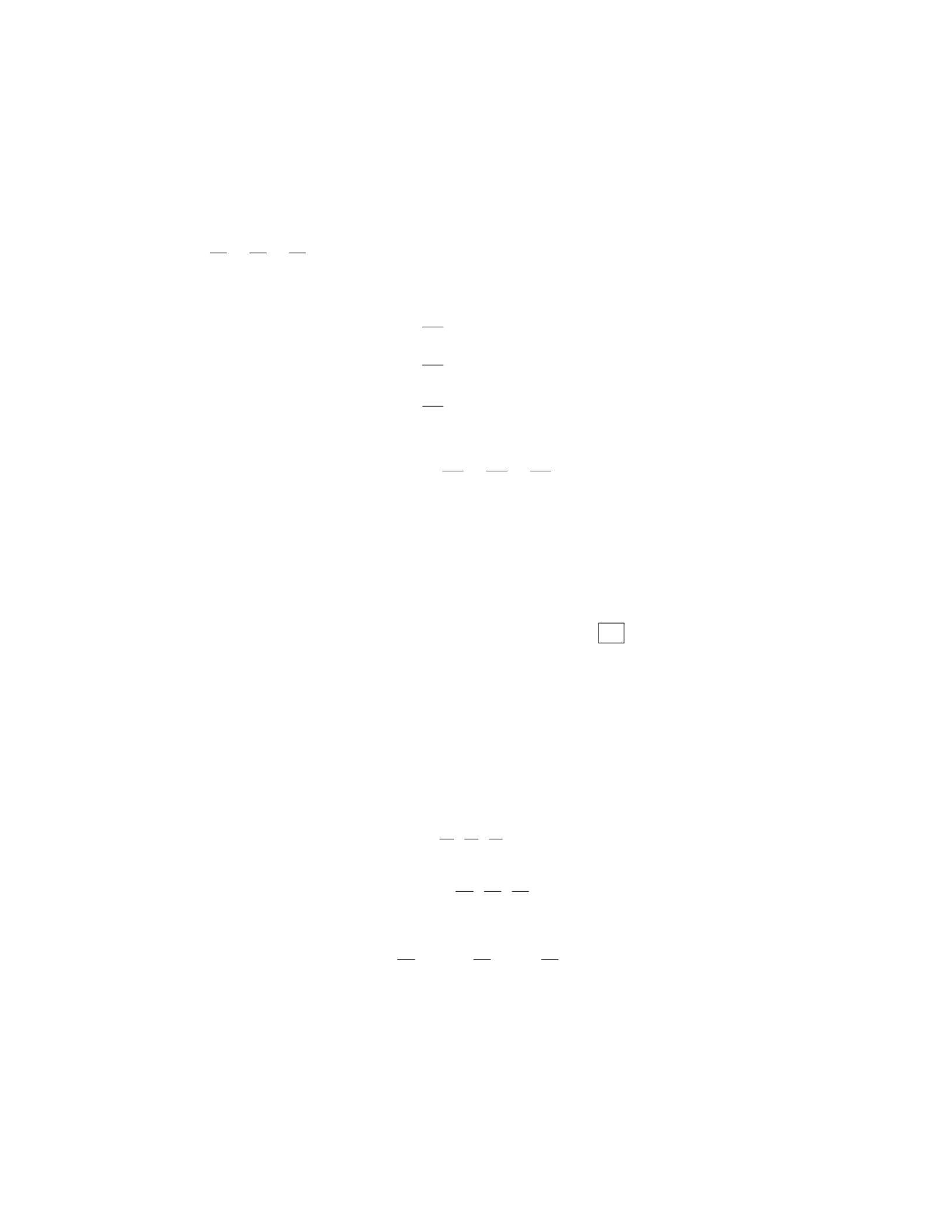
Step 1: The divergence of a vector field F=Pi+Qj+Rkis given by div(F) =
∂P
∂x +∂Q
∂y +∂R
∂z .
Step 2: In this case, we have P= 2x2y,Q=−3xz2, and R=xy sin(z).
Step 3: Calculating the partial derivatives:
∂P
∂x = 4xy,
∂Q
∂y = 0,
∂R
∂z =xy cos(z).
Step 4: Now, we can find the divergence:
div(F) = ∂P
∂x +∂Q
∂y +∂R
∂z
= 4xy +0+xy cos(z).
Step 5: Evaluate the divergence at the point (1,2,0):
div(F)(1,2,0) = 4(1)(2) + 0 + (1)(2) cos(0)
= 8 + 0 + 2
= 10.
Therefore, the divergence of Fat the point (1,2,0) is 10 .
Question 10
Question
Let F(x, y, z) = ⟨xey, yz, zex+y⟩. Compute the divergence of F.
Solution
To find the divergence of F(x, y, z), denoted as ∇ · F, we need to take the dot
product of the del operator ∇=⟨∂
∂x ,∂
∂y ,∂
∂z ⟩with F.
Step 1: Compute the del operator ∇.
∇=⟨∂
∂x ,∂
∂y ,∂
∂z ⟩
Step 2: Compute the divergence of F.
∇ · F=∂
∂x (xey) + ∂
∂y (yz) + ∂
∂z (zex+y)
∇ · F=ey+z+ex+y+z
∇ · F=ey+ex+y+ 2z
Therefore, the divergence of Fis ∇ · F=ey+ex+y+ 2z.
7
Question 11
Question
Let F(x, y, z) = ⟨ezsin y, xz, ezcos y⟩. Find the gradient of Fand evaluate it at
the point (0, π, 1).
Solution
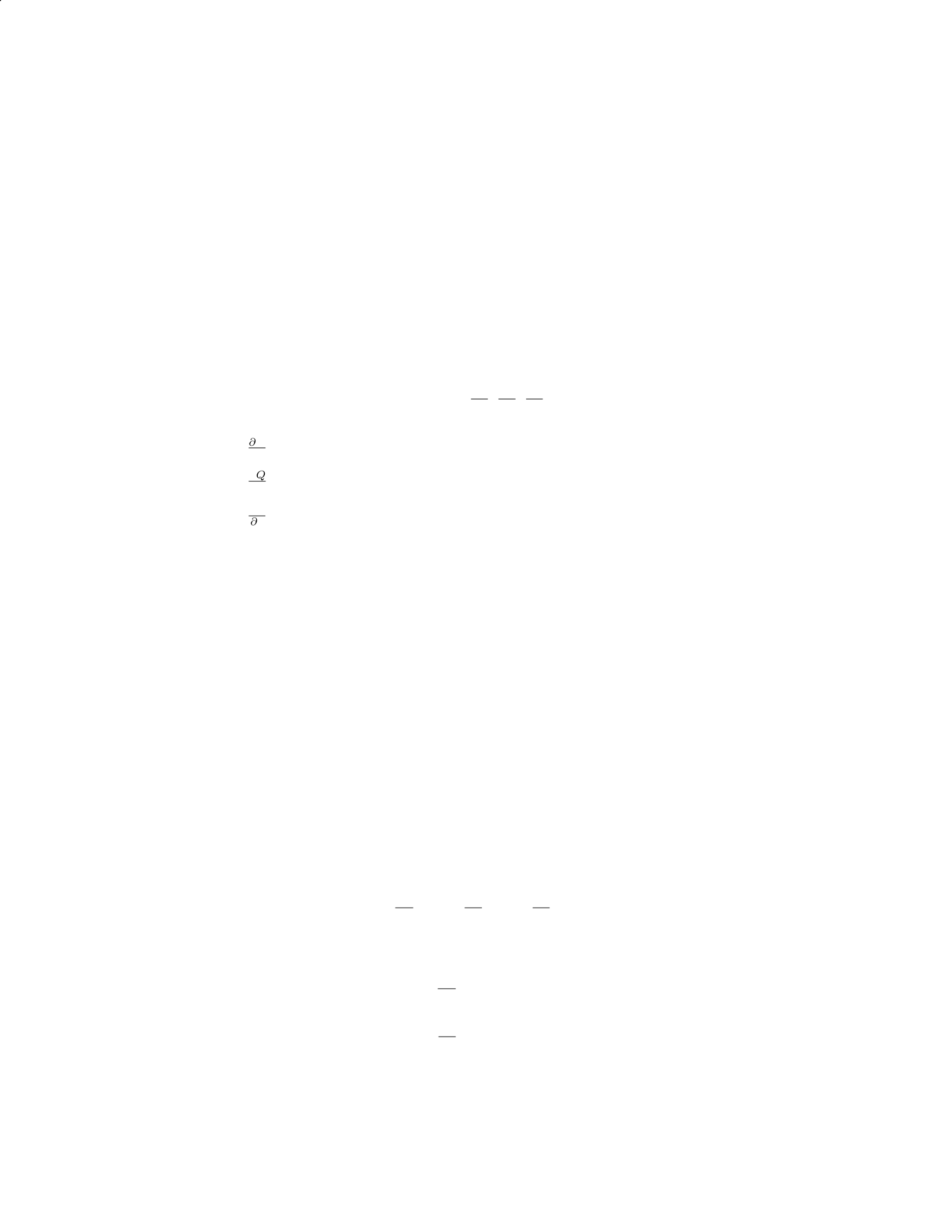
To find the gradient of F, we need to compute the partial derivatives of each
component function. Let F(x, y, z) = ⟨P(x, y, z), Q(x, y, z), R(x, y, z)⟩. Then
the gradient of Fis given by ∇ · F=⟨∂P
∂x ,∂Q
∂y ,∂R
∂z ⟩.
Step 1: Find the partial derivatives of P,Q, and R:
∂P
∂x = 0
∂Q
∂y = 0
∂R
∂z =ezcos y
Step 2: Compute the gradient of F:
∇ · F=⟨0,0, ezcos y⟩
Step 3: Evaluate the gradient at the point (0, π, 1):
∇ · F(0, π, 1) = ⟨0,0, e cos π⟩=⟨0,0,−e⟩
Therefore, the gradient of Fat the point (0, π, 1) is ⟨0,0,−e⟩.
Question 12
Question
Let F(x, y, z) = xzi+yzj+ (x2+y2)k. Determine ∇ · F.
Solution
Step 1: Compute the components of ∇ · F.
∇ · F=∂
∂x (xz) + ∂
∂y (yz) + ∂
∂z (x2+y2)
Step 2: Calculate the partial derivatives.
∂
∂x (xz) = z
∂
∂y (yz) = z
8

∂
∂z (x2+y2) = 0
Step 3: Combine the partial derivatives to find ∇ · F.
∇ · F=z+z+ 0 = 2z
Therefore, ∇ · F= 2z.
Question 13
Question
Let F(x, y, z)=2xyi+ (x2+z)j+xezk. Calculate the curl of F.
Solution
To find the curl of F, we proceed by computing the determinant of the following
matrix:
∇ × F=
i j k
∂
∂x
∂
∂y
∂
∂z
2xy x2+z xez
Step 1: Calculate the partial derivatives:
∂
∂x =yi+ 2xj+ezxk
∂
∂y = 2xi
∂
∂z =j+xezk
Step 2: Evaluate the determinant:
∇ × F=∂
∂y (xez)−∂
∂z (x2+z)i−∂
∂x (xez)−∂
∂z (2xy)j+∂
∂x (x2+z)−∂
∂y (2xy)k
= (ez)i−((1) ·ez)j+ (2x)k
=ezi−ezj+ 2xk
Therefore, the curl of Fis ∇ × F= (ez)i−(ez)j+ 2xk.
Question 14
Question
Let F(x, y, z) = x2yi+xy2j+xyzkbe a vector field in R3. Compute div(curl(F)).
9

Solution
Step 1: Compute the curl of F.
curl(F) = ∇ × F=
i j k
∂
∂x
∂
∂y
∂
∂z
x2y xy2xyz
curl(F) = (∂(xyz)
∂y −∂(xy2)
∂z )i−(∂(xyz)
∂x −∂(x2y)
∂z )j+ ( ∂(x2y)
∂x −∂(xy2)
∂y )k
= (xz −2xy)i−(z−2xy)j+ (2y−x)k
Step 2: Compute the divergence of the curl of F.
div(curl(F)) = ∇ · curl(F) = ∂
∂x (xz −2xy) + ∂
∂y (−z+ 2xy) + ∂
∂z (2y−x)
=z+ 2 −2 = z
Therefore, div(curl(F)) = z.
Question 15
Question
Let F(x, y, z) = x2i+xy2j+xz2k. Calculate ∇ · (∇ × F).
Solution
Step 1: Let’s first calculate ∇ × F.
=
i j k
∂
∂x
∂
∂y
∂
∂z
x2xy2xz2
=∂(xz2)
∂y −∂(xy2)
∂z i−∂(x2)
∂z −∂(xz2)
∂x j+∂(xy2)
∂x −∂(x2)
∂y k
= (0 −2xz)i−(0 −z2)j+ (y2−0)k
=−2xzi−z2j+y2k
Step 2: Now, calculate ∇ · (∇ × F).
) = ∂∂x(−2xz)+ ∂
∂y (−z2)+ ∂
∂z (y2)=−2z+0+0=−2z
Therefore, ∇ · (∇ × F) = −2z.
10

Question 16
Question
Let F(x, y, z) = ⟨exy cos(z), x sin(y),−xyz2⟩. Compute ∇ · F, where ∇is the
gradient operator.
Solution
Step 1: The gradient operator ∇is defined in Cartesian coordinates (x, y, z) as
∇=⟨∂
∂x ,∂
∂y ,∂
∂z ⟩.
Step 2: Compute the divergence of F, denoted as ∇ · F, where F(x, y, z) =
⟨exy cos(z), x sin(y),−xyz2⟩.
Step 3: The divergence of Fis given by ∇ · F=∂P
∂x +∂Q
∂y +∂R
∂z , where
F(x, y, z) = ⟨P, Q, R⟩.
Step 4: Compute the partial derivatives of P=exy cos(z) with respect to x,
Q=xsin(y) with respect to y, and R=−xyz2with respect to z.
Step 5: For P=exy cos(z), ∂P
∂x =yexy cos(z).
Step 6: For Q=xsin(y), ∂Q
∂y =xcos(y).
Step 7: For R=−xyz2,∂R
∂z =−xy2z.
Step 8: Summing up the partial derivatives, we get
∇ · F=∂P
∂x +∂Q
∂y +∂R
∂z =yexy cos(z) + xcos(y)−2xyz
Thus, ∇ · F=yexy cos(z) + xcos(y)−2xyz.
Question 17
Question
Let F(x, y, z) = (x2y, yz, xyz) be a vector field. Compute ∇ · F, where ∇is the
gradient operator.
Solution
Step 1: The divergence of a vector field F= (P, Q, R) is defined as ∇ · F=
∂P
∂x +∂Q
∂y +∂R
∂z .
Step 2: In this case, we have F(x, y, z)=(x2y, yz, xyz).
Step 3: So, P=x2y,Q=yz, and R=xyz.
Step 4: Now, let’s compute the partial derivatives:
∂P
∂x = 2xy, ∂Q
∂y =z, ∂R
∂z =xy
Step 5: Therefore, the divergence of Fis:
∇ · F= 2xy +z+xy
11

Step 6: Simplifying the expression, we get:
∇ · F= 3xy +z
Hence, the divergence of the vector field Fis 3xy +z.
Question 18
Question
Let F(x, y, z) = (3x2y+ 2yz, x3+ 2xyz, y2z2−3xz). Calculate the curl of F.
Solution
To find the curl of a vector field F(x, y, z)=(P, Q, R), we can use the formula:
∇ × F=∂R
∂y −∂Q
∂z ,∂P
∂z −∂R
∂x ,∂Q
∂x −∂P
∂y
Step 1: Calculate the partial derivatives Let P= 3x2y+ 2yz,Q=
x3+ 2xyz, and R=y2z2−3xz.
We need to compute the partial derivatives:
∂P
∂y ,∂Q
∂z ,∂R
∂x ,∂R
∂y ,∂Q
∂x ,∂P
∂z
Step 2: Compute the curl Using the formula for the curl, we have:
∇ × F=∂R
∂y −∂Q
∂z ,∂P
∂z −∂R
∂x ,∂Q
∂x −∂P
∂y
Substitute the partial derivatives we calculated into the formula to find the curl
of F.
Question 19
Question
Let F(x, y) = −y2, x2+y3. Compute the divergence of Fand determine
whether the vector field Fis conservative.
Solution
Step 1: The divergence of a vector field F(x, y)=(P(x, y), Q(x, y)) is given by
div(F) = ∂P
∂x +∂Q
∂y .
12
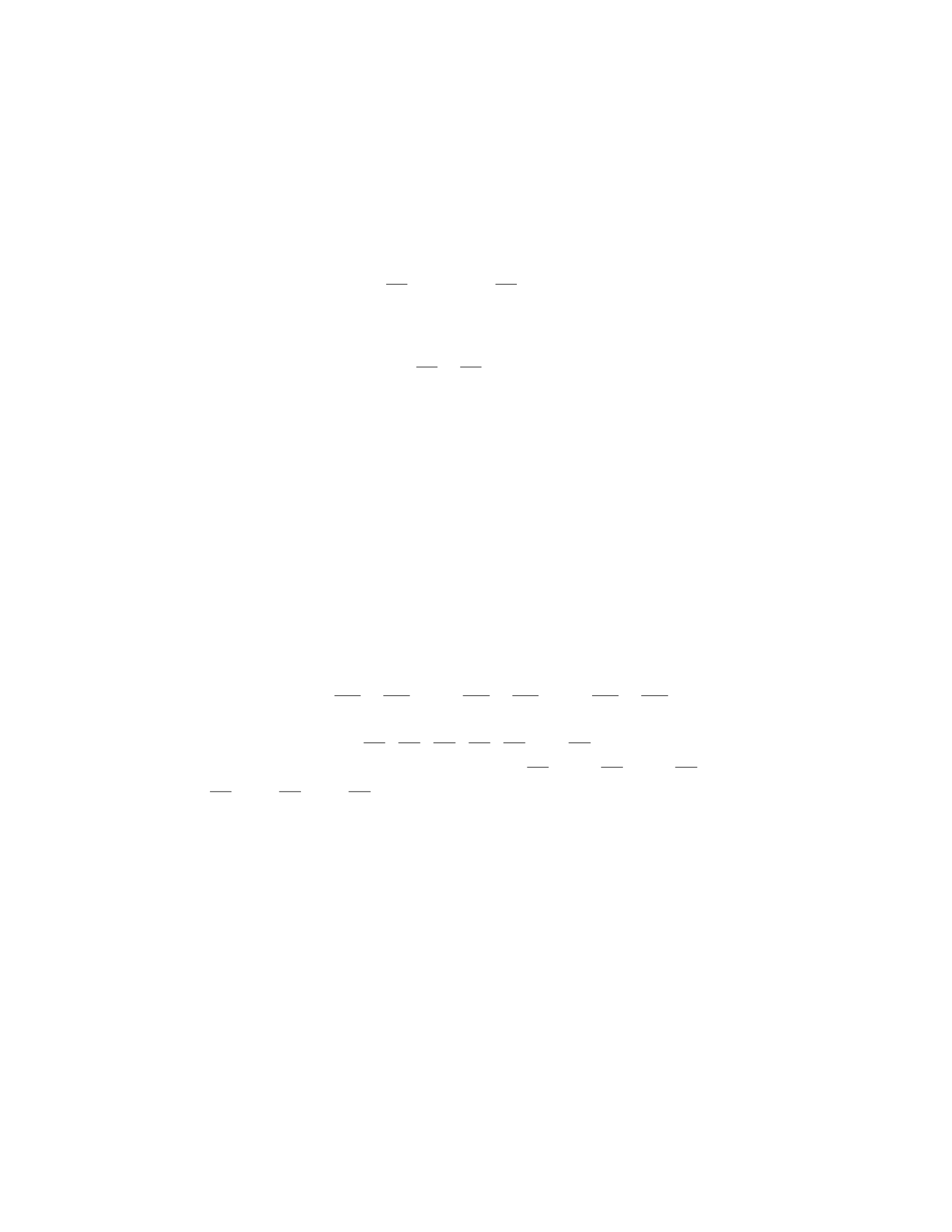
Step 2: Given F(x, y)=(−y2, x2+y3), we have P(x, y) = −y2and Q(x, y) =
x2+y3.
Step 3: Calculate the partial derivatives:
∂P
∂x = 0 and ∂Q
∂y = 3y2.
Step 4: The divergence of Fis
div(F) = ∂P
∂x +∂Q
∂y = 0 + 3y2= 3y2.
Step 5: To determine if Fis conservative, note that if F=∇ffor some
scalar function f, then Fis conservative.
Step 6: Since the divergence of Fis not zero, the vector field Fis not
conservative.
Question 20
Question
Let F(x, y, z)=(y2, xz, yz) be a vector field. Calculate the curl of F.
Solution
To calculate the curl of F, we use the formula:
∇ × F=∂Fz
∂y −∂Fy
∂z i+∂Fx
∂z −∂Fz
∂x j+∂Fy
∂x −∂Fx
∂y k
Step 1: Calculate ∂Fz
∂y ,∂Fy
∂z ,∂Fx
∂z ,∂Fz
∂x ,∂Fy
∂x , and ∂Fx
∂y .
Given F(x, y, z) = (y2, xz, yz), we have: - ∂Fz
∂y =z-∂Fy
∂z = 0 - ∂Fx
∂z =x-
∂Fz
∂x = 0 - ∂Fy
∂x = 0 - ∂Fx
∂y = 0
Step 2: Compute the curl of F.
∇ × F= (0 −0)i+ (x−0)j+ (0 −0)k
∇ × F=xj
Therefore, the curl of the vector field F(x, y, z) = (y2, xz, yz) is ∇ × F=xj.
Question 21
Question
Let F(x, y, z) = x2yi+xzj+yzkbe a vector field. Compute the curl of F.
13
Solution
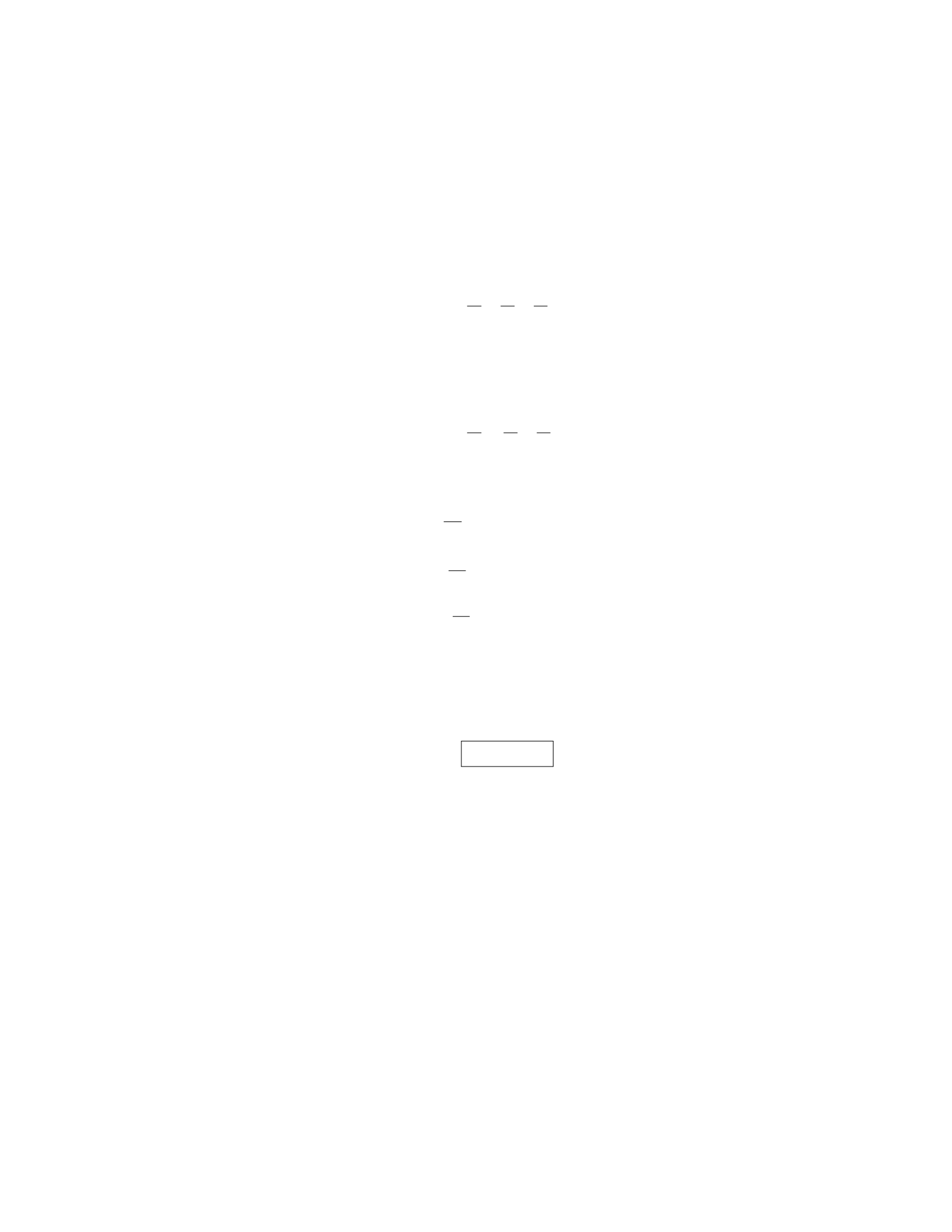
To compute the curl of a vector field F(x, y, z) = P(x, y, z)i+Q(x, y, z)j+
R(x, y, z)k, we use the formula:
∇ × F=
i j k
∂
∂x
∂
∂y
∂
∂z
P Q R
In our case, F(x, y, z) = x2yi+xzj+yzk, so P=x2y,Q=xz, and R=yz.
Now we can compute the curl:
∇ × F=
i j k
∂
∂x
∂
∂y
∂
∂z
x2y xz yz
Step 1: Compute the partial derivatives:
∂
∂x = 2xy
∂
∂y =x2
∂
∂z = 0
Step 2: Now, compute the determinant:
∇ × F= (0 −0) i−(0 −0) j+ (2xy −xz)k
Step 3: Simplify the result:
∇ × F= (2xy −xz)k
Therefore, the curl of the vector field F(x, y, z) = x2yi+xzj+yzkis (2xy −
xz)k.
Question 22
Question
Let F(x, y, z) = (2x2y, xz2,−y2z) be a vector field in R3. Compute the curl of
F.
14
Solution
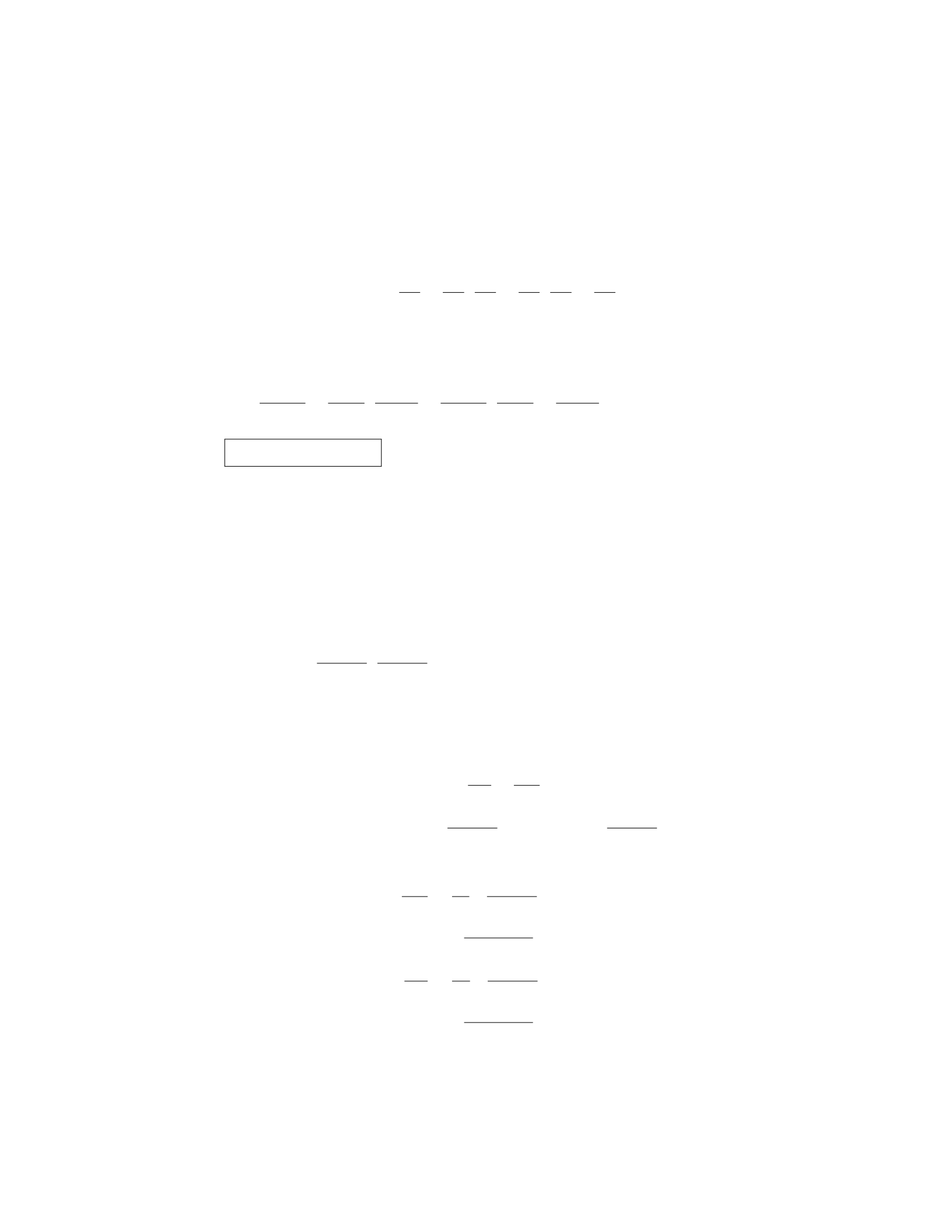
To compute the curl of a vector field F(x, y, z)=(P(x, y, z), Q(x, y, z), R(x, y, z)),
we use the formula:
∇ × F=∂R
∂y −∂Q
∂z ,∂P
∂z −∂R
∂x ,∂Q
∂x −∂P
∂y
Step 1: Compute the curl of F.
=∂(−y2z)
∂y −∂(xz2)
∂z ,∂(2x2y)
∂z −∂(−y2z)
∂x ,∂(xz2)
∂x −∂(2x2y)
∂y
=−2yz −0,0−z2,2z−2x2
= (−2yz, −z2,2z−2x2)
Therefore, the curl of the vector field F(x, y, z) = (2x2y, xz2,−y2z) is (−2yz, −z2,2z−
2x2).
Question 23
Question
Let F(x, y) = x
x2+y2,y
x2+y2be a vector field. Determine the curl of F.
Solution
Step 1: The curl of a vector field F= (M(x, y), N (x, y)) in two dimensions is
defined as
∇ × F=∂N
∂x −∂M
∂y .
Step 2: In this case, M(x, y) = x
x2+y2and N(x, y) = y
x2+y2.
Step 3: Let’s find the partial derivatives needed to compute the curl.
∂M
∂y =∂
∂y x
x2+y2
=−2xy
(x2+y2)2
∂N
∂x =∂
∂x y
x2+y2
=−2xy
(x2+y2)2.
15

Step 4: Now, we can compute the curl of Fusing the formula.
∇ × F=−2xy
(x2+y2)2−(−2xy
(x2+y2)2)
= 0.
Step 5: Therefore, the curl of the vector field Fis 0.
Step 6: This implies that the vector field Fis conservative, as its curl is zero.
Question 24
Question
Let F(x, y, z) = (x2y2, y2z2, z2x2). Calculate the divergence of Fat the point
(1,2,3).
Solution
To find the divergence of a vector field F= (P, Q, R), we use the formula:
div(F) = ∂P
∂x +∂Q
∂y +∂R
∂z
Step 1: Find the partial derivatives of P, Q, R. Let P=x2y2,Q=y2z2,
and R=z2x2. Then, - ∂P
∂x = 2xy2-∂Q
∂y = 2yz2-∂R
∂z = 2zx2
Step 2: Evaluate the partial derivatives at (1,2,3). Substitute x= 1, y =
2, z = 3 into the partial derivatives: - ∂P
∂x = 2(1)(2)2= 8 - ∂Q
∂y = 2(2)(3)2= 36
-∂R
∂z = 2(3)(1)2= 6
Step 3: Calculate the divergence at the point (1,2,3).
div(F) = ∂P
∂x +∂Q
∂y +∂R
∂z = 8 + 36 + 6 = 50
Therefore, the divergence of Fat the point (1,2,3) is 50.
Question 25
Question
Let F(x, y, z) = x2yi +y2zj +z2xk. Calculate the divergence of F.
Solution
Step 1: The divergence of a vector field F(x, y, z) = P(x, y, z)i+Q(x, y, z)j+
R(x, y, z)kis defined as ∇ · F=∂P
∂x +∂Q
∂y +∂R
∂z .
Step 2: In this case, F(x, y, z) = x2yi +y2zj +z2xk, so P(x, y, z) = x2y,
Q(x, y, z) = y2z, and R(x, y, z) = z2x.
16

Step 3: Now, calculate the partial derivatives: ∂P
∂x = 2xy,∂Q
∂y = 2yz,∂R
∂z =
2zx.
Step 4: Therefore, the divergence of Fis: ∇ · F= 2xy + 2yz + 2zx.
Question 26
Question
Let Fbe a vector field in R3defined by F(x, y, z) = ⟨x2+yz, xz, y2−xz⟩.
Calculate the curl of F.
Solution
To calculate the curl of F, we will use the formula:
curl(F) = ∇ × F=∂
∂x ,∂
∂y ,∂
∂z × ⟨P, Q, R⟩
Step 1: Find the components of ∇ × Fusing the determinant formula:
curl(F) =
i j k
∂
∂x
∂
∂y
∂
∂z
x2+yz xz y2−xz
Step 2: Calculate the determinant along the first row:
curl(F) = ∂
∂y (y2−xz)−∂
∂z (xz),∂
∂z (x2+yz)−∂
∂x (y2−xz),∂
∂x (xz)−∂
∂y (x2+yz)
Step 3: Compute the partial derivatives:
curl(F)=(−x, −z, x +y)
Therefore, the curl of Fis curl(F) = ⟨−x, −z, x +y⟩.
Question 27
Question
Let F(x, y, z) = (x2y, yexz , xz cos(y)) be a vector field in 3-dimensional space.
Compute the curl of F.
Solution
To find the curl of a vector field F(x, y, z)=(P, Q, R), we use the formula:
curl F=∂R
∂y −∂Q
∂z ,∂P
∂z −∂R
∂x ,∂Q
∂x −∂P
∂y
17

Step 1: Compute ∂P
∂z ,∂Q
∂x , and ∂R
∂y .
∂P
∂z =∂
∂z (xz cos(y)) = xcos(y)
∂Q
∂x =∂
∂x (yexz ) = yzexz
∂R
∂y =∂
∂y (xz cos(y)) = −xz sin(y)
Step 2: Compute ∂Q
∂z ,∂R
∂x , and ∂P
∂y .
∂Q
∂z =∂
∂z (yexz ) = xyexz
∂R
∂x =∂
∂x (xz cos(y)) = zcos(y)
∂P
∂y =∂
∂y (x2y) = x2
Step 3: Now, compute the curl of Fusing the formula:
curl F=xcos(y)−xyexz, yzexz −zcos(y),−xz sin(y)−x2
Therefore, the curl of Fis (xcos(y)−xyexz , yzexz −zcos(y),−xz sin(y)−x2) .
Question 28
Question
Let F(x, y, z)=(x2z, 2xy, x +y2) be a vector field in R3. Compute ∇ · ∇ × F.
Solution
Step 1: Compute ∇ × F.
∇ × F=
i j k
∂
∂x
∂
∂y
∂
∂z
x2z2xy x +y2
=∂
∂y (x+y2)−∂
∂z (2xy),∂
∂z (x2z)−∂
∂x (x+y2),∂
∂x (2xy)−∂
∂y (x2z)
= (2y−0, x2−1,2y−2xz) = (2y, x2−1,2y−2xz)
Step 2: Compute ∇ · (2y, x2−1,2y−2xz).
∇ · ∇ × F=∂
∂x (2y) + ∂
∂y (x2−1) + ∂
∂z (2y−2xz)
= 0 + 0 −2x=−2x
18
Question 29
Question
Let F(x, y, z) = x2yi+y2zj+z2xkbe a vector field. Compute ∇ · (∇ × F).
Solution
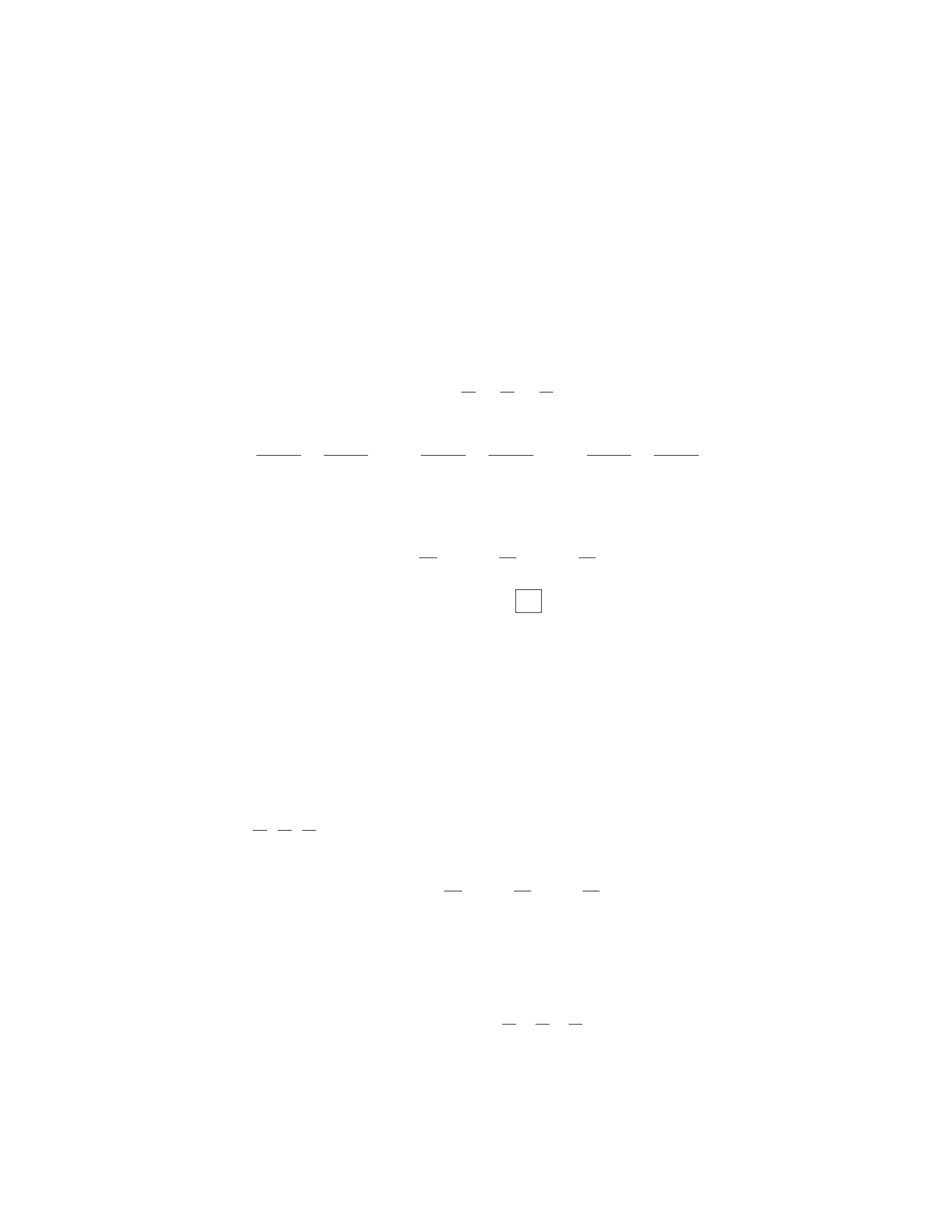
Step 1: Compute ∇ × F.
∇ × F=
i j k
∂
∂x
∂
∂y
∂
∂z
x2y y2z z2x
=∂(z2x)
∂y −∂(y2z)
∂z i−∂(z2x)
∂x −∂(x2y)
∂z j+∂(y2z)
∂x −∂(x2y)
∂y k
= (0 −y2)i−(2z−0)j+ (2yz −0)k=−y2i−2zj+ 2yzk
Step 2: Compute ∇ · (∇ × F).
∇ · (∇ × F) = ∂
∂x (−y2) + ∂
∂y (−2z) + ∂
∂z (2yz)
= 0 −0+2y= 2y
Question 30
Question
Let F(x, y, z) = xyi+xzj+yzkbe a vector field in 3D space. Determine the
divergence and curl of F.
Solution
To find the divergence of F, we apply the formula div(F) = ∇ · F, where
∇=∂
∂x ,∂
∂y ,∂
∂z is the del operator.
Step 1: Calculate the divergence of F.
div(F) = ∇ · F=∂
∂x (xy) + ∂
∂y (xz) + ∂
∂z (yz)
div(F) = y+z+x
Next, to find the curl of F, we apply the formula curl(F) = ∇ × F.
Step 2: Calculate the curl of F.
curl(F) = ∇ × F=
i j k
∂
∂x
∂
∂y
∂
∂z
xy xz yz
19

Question 2
Question
Let F(x, y) = (3x2y3,2x3y2) be a vector field in the plane. Calculate the diver-
gence of Fat the point (1,2).
Solution
To find the divergence of Fat the point (1,2), we need to calculate the following
expression:
div F=∂
∂x Fx+∂
∂y Fy
Step 1: Calculate the partial derivatives of F
The components of the vector field Fare Fx= 3x2y3and Fy= 2x3y2. Let’s
calculate the partial derivatives:
∂
∂x Fx=∂
∂x (3x2y3)=6xy3
∂
∂y Fy=∂
∂y (2x3y2)=4x3y
Step 2: Find the divergence of F at (1,2)
Now, substitute the values x= 1 and y= 2 into the partial derivatives we
just calculated:
∂
∂x Fx
(1,2)
= 6(1)(2)3= 48
∂
∂y Fy
(1,2)
= 4(1)3(2) = 8
Finally, we can find the divergence of Fat (1,2):
div F
(1,2)
=∂
∂x Fx
(1,2)
+∂
∂y Fy
(1,2)
= 48 + 8 = 56
Therefore, the divergence of Fat the point (1,2) is 56.
Question 3
Question
Let F(x, y, z)=(yez+xcos y, zex+ycos z, xey+zcos x) be a vector field.
Calculate ∇ · ∇ × F.
Solution
Step 1: Calculate ∇ × F. Step 2: Calculate ∇ · (∇ × F).
2
Step 1:
To calculate ∇ × F, we need to find the determinant of the following matrix:
∇ × F=
i j k
∂
∂x
∂
∂y
∂
∂z
yez+xcos y zex+ycos z xey+zcos x
Calculating this determinant, we get:
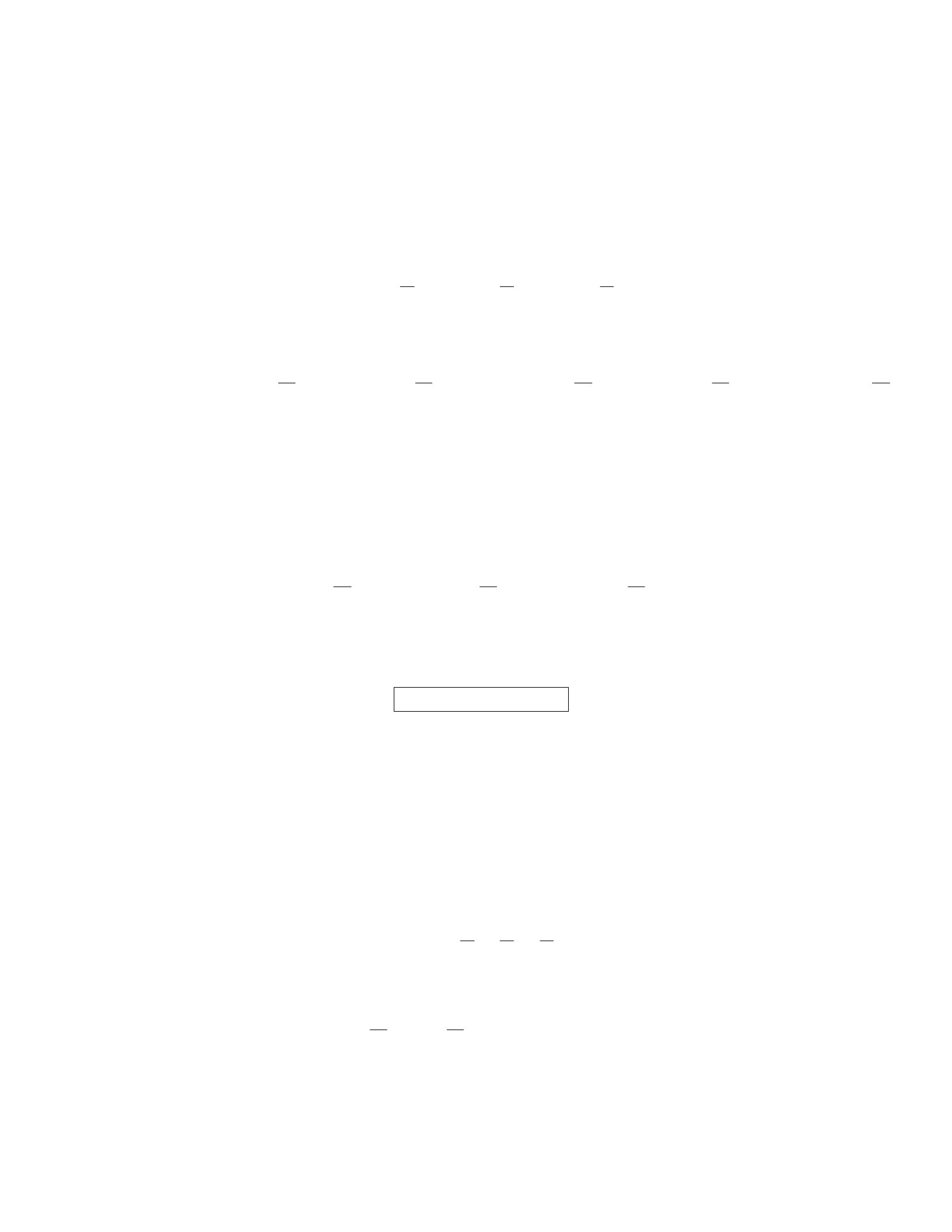
∇×F=∂
∂y (xey+zcos x)−∂
∂z (zex+ycos z)i−∂
∂x (xey+zcos x)−∂
∂z (yez+xcos y)j+∂
∂x (zex+ycos z)−∂
∂y (yez+xcos y)k
After simplifying, we find:
∇ × F= (−sin x−sin z)i−(−cos y−cos z)j+ (−ez−ex)k
Step 2:
Next, we calculate ∇·(∇×F) by taking the dot product of the gradient operator
∇with ∇ × F:
∇ · (∇ × F) = ∂
∂x (−sin x−sin z) + ∂
∂y (−cos y−cos z) + ∂
∂z (−ez−ex)
Simplifying this expression gives:
∇ · (∇ × F) = −cos x−cos y−ex−ez
Therefore, ∇ · ∇ × F=−cos x−cos y−ex−ez.
Question 4
Question
Let F(x, y, z) = x2yi+xy2j+xyzk. Compute the curl of F.
Solution
To compute the curl of F, we use the formula:
∇ × F=
i j k
∂
∂x
∂
∂y
∂
∂z
x2y xy2xyz
Step 1: Calculate the determinants for icomponent:
∂
∂y (xyz)−∂
∂z (xy2) = xz −2xy
3
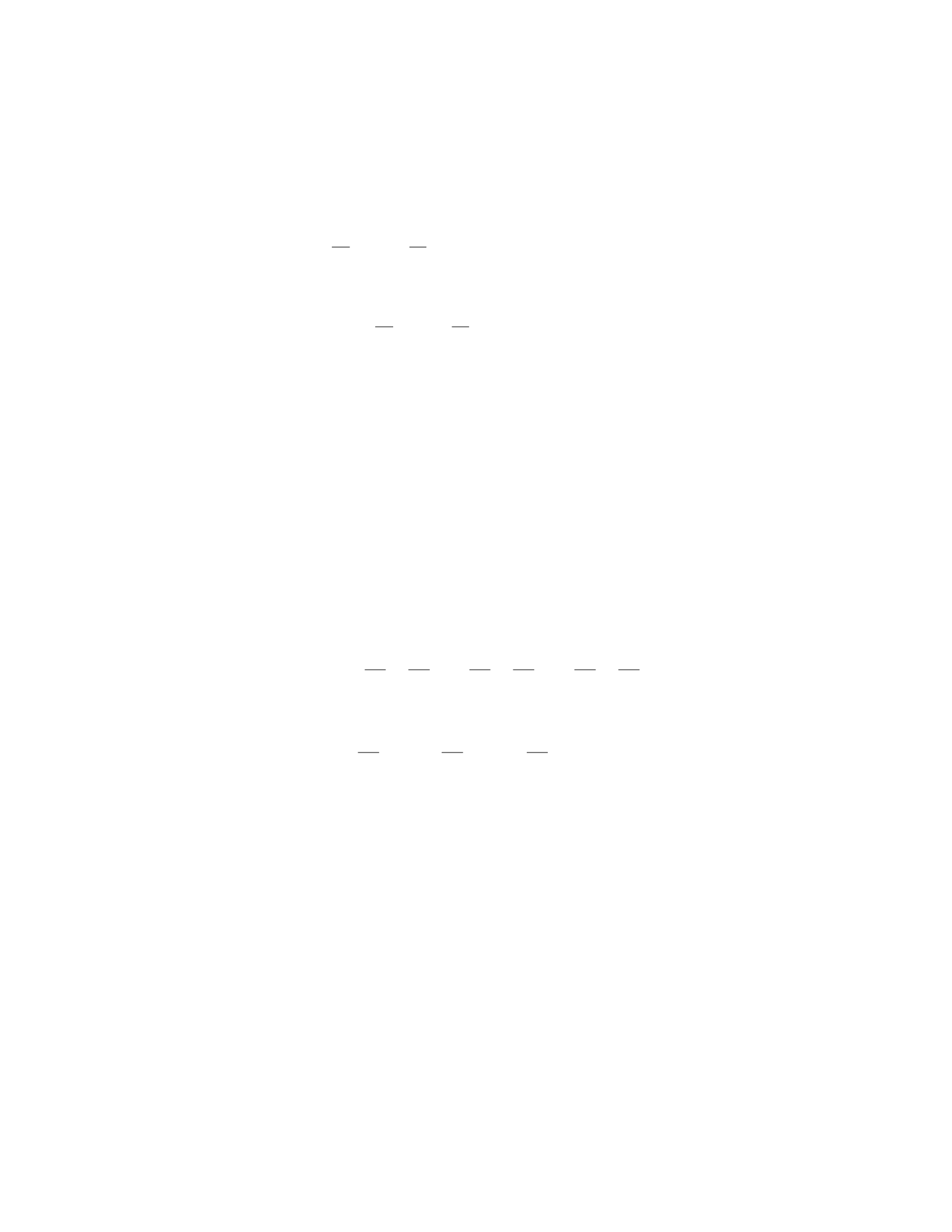
Step 2: Calculate the determinants for jcomponent:
−(∂
∂x (xyz)−∂
∂z (x2y)) = −(z−2xy)=2xy −z
Step 3: Calculate the determinants for kcomponent:
∂
∂x (xy2)−∂
∂y (x2y) = y2−x2
Therefore, the curl of Fis:
∇ × F= (xz −2xy)i+ (2xy −z)j+ (y2−x2)k
Question 5
Question
Let F(x, y, z) = x2yi+xyzj+x2zkbe a vector field in R3. Calculate the curl
of F.
Solution
To find the curl of a vector field F(x, y, z) = P(x, y, z)i+Q(x, y, z)j+R(x, y, z)k,
where P, Q, R are the component functions, we use the formula:
curl F= (∂R
∂y −∂Q
∂z )i−(∂R
∂x −∂P
∂z )j+ ( ∂Q
∂x −∂P
∂y )k
Step 1: Compute the partial derivatives of the component functions:
∂P
∂y =x2,∂Q
∂z =xy, ∂R
∂x = 2xz
Step 2: Compute the curl of Fusing the formula:
curl F= (xy −2xz)i−(2xz −x2)j+ (x2−xy)k
Therefore, the curl of vector field F(x, y, z) = x2yi+xyzj+x2zkis (xy −
2xz)i−(2xz −x2)j+ (x2−xy)k.
Question 6
Question
Let F(x, y, z) = (2xy +y2sin z)i+ (x2+ 2yz cos z)j+ (2xy cos z−z2)k. Find
∇ · ∇ × F.
4
Solution
Recall that ∇ · ∇ × F=∇ · (∇ × F).
First, we need to find ∇ × Fwhich is given by:
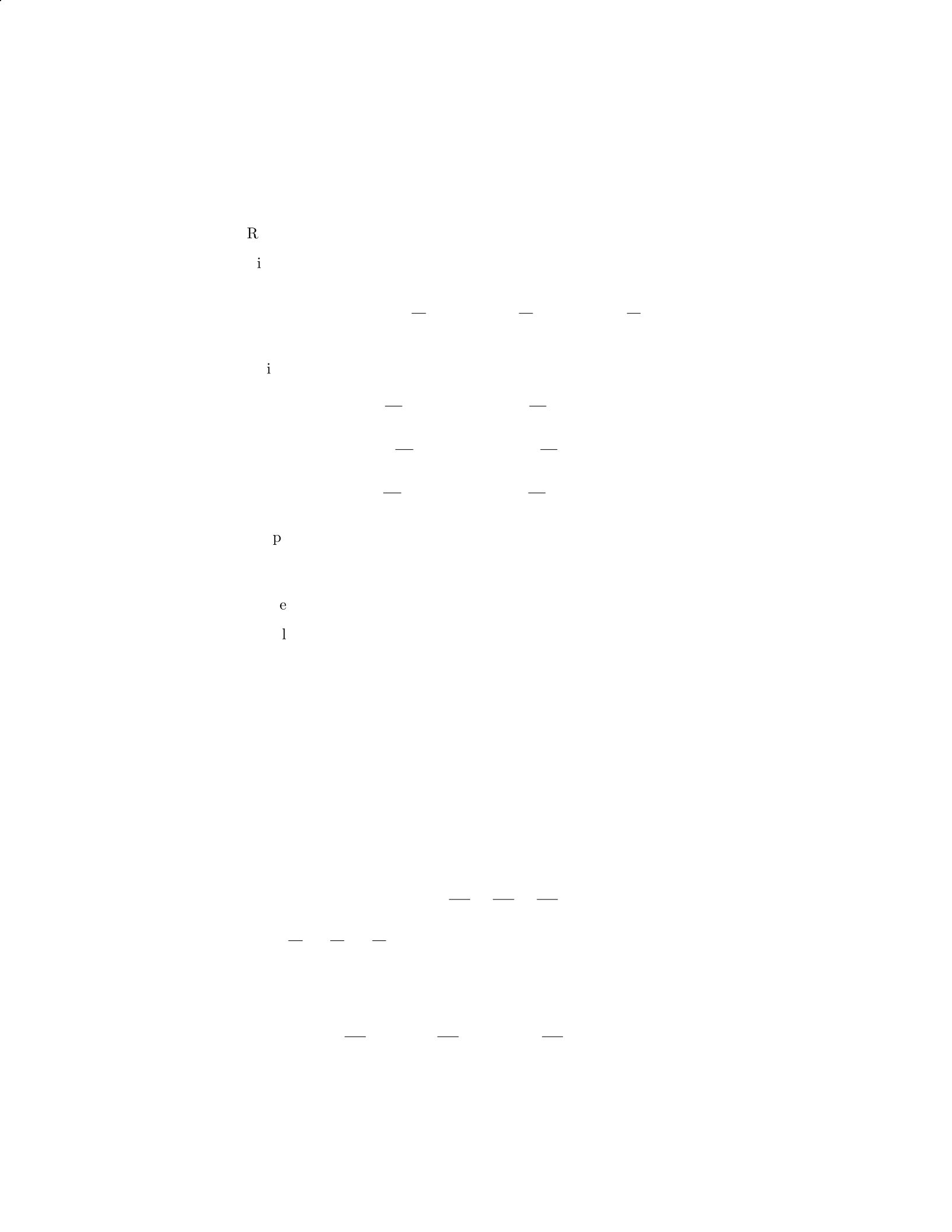
∇ × F=
i j k
∂
∂x
∂
∂y
∂
∂z
2xy +y2sin z x2+ 2yz cos z2xy cos z−z2
This evaluates to:
∇ × F=∂
∂y (2xy cos z−z2)−∂
∂z (x2+ 2yz cos z)i
+−∂
∂x (2xy cos z−z2) + ∂
∂z (2xy +y2sin z)j
+∂
∂x (x2+ 2yz cos z)−∂
∂y (2xy +y2sin z)k
Simplifying each component gives:
∇ × F= (2z−2z)i+ (0 + 0)j+ (0 −0)k
Therefore, ∇ × F=0.
Finally, ∇ · ∇ × F=∇ · 0= 0.
Question 7
Question
Let F(x, y, z) = x2yi−2xyzj+z3kbe a vector field. Calculate the divergence
of F.
Solution
To find the divergence of a vector field F(x, y, z) = P(x, y, z)i+Q(x, y, z)j+
R(x, y, z)k, we use the formula:
∇ · F=∂P
∂x +∂Q
∂y +∂R
∂z
where ∇=∂
∂x i+∂
∂y j+∂
∂z kis the del operator.
Step 1: Find the components P(x, y, z), Q(x, y, z), and R(x, y, z) of F:
P(x, y, z) = x2y,Q(x, y, z) = −2xyz,R(x, y, z) = z3.
Step 2: Calculate the partial derivatives:
∂P
∂x = 2xy, ∂Q
∂y =−2xz, ∂R
∂z = 3z2
5
Step 3: Compute the divergence:
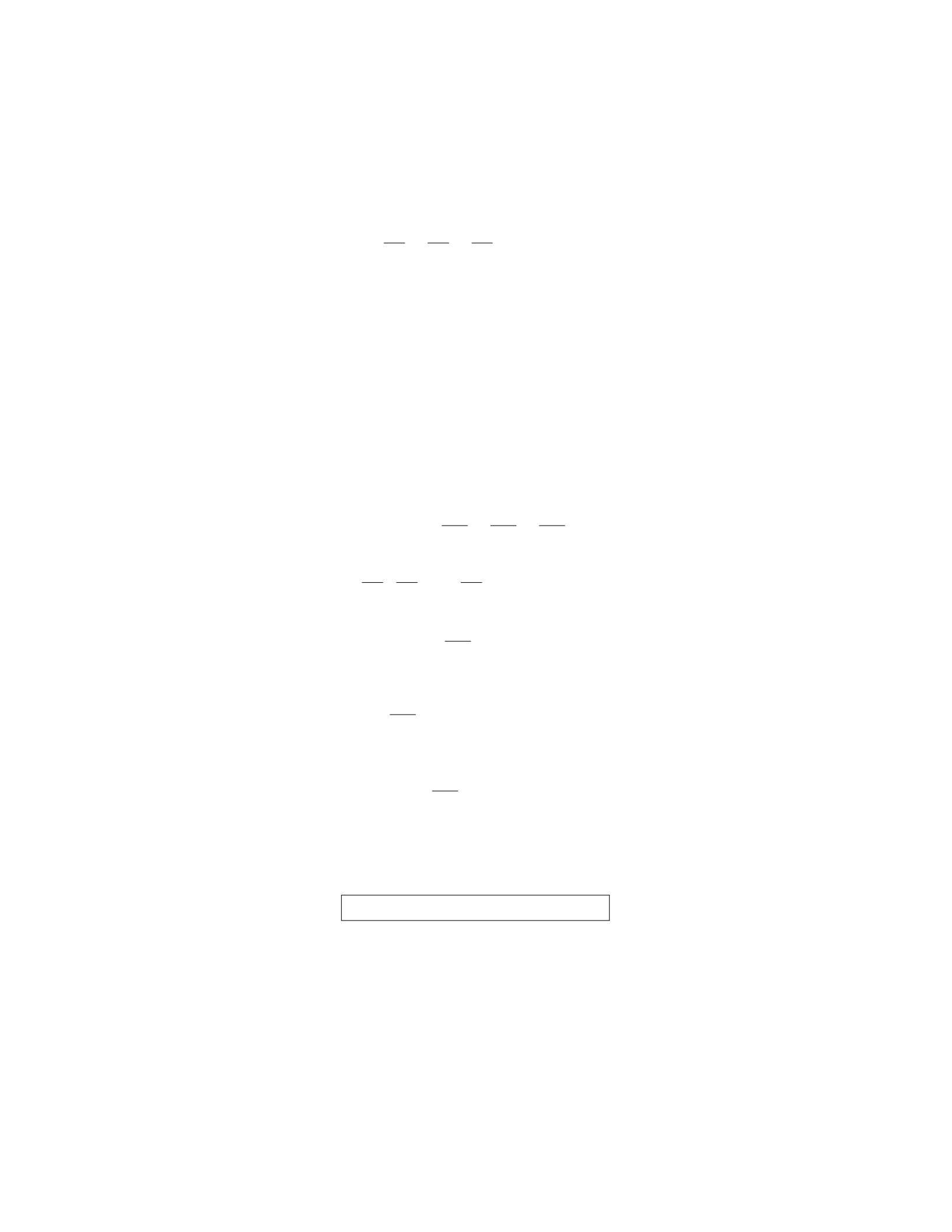
∇ · F=∂P
∂x +∂Q
∂y +∂R
∂z = 2xy −2xz + 3z2
Therefore, the divergence of Fis 2xy −2xz + 3z2.
Question 8
Question
Let F(x, y, z) = ⟨xez,−ycos(y), z sin(x)⟩be a vector field in R3. Compute the
divergence of F.
Solution
To find the divergence of F, denoted by ∇ · F, we use the formula:
∇ · F=∂F1
∂x +∂F2
∂y +∂F3
∂z
Where F(x, y, z) = ⟨F1(x, y, z), F2(x, y, z), F3(x, y, z)⟩.
Step 1: Compute ∂F1
∂x ,∂F2
∂y , and ∂F3
∂z .
For F1(x, y, z) = xez, we have:
∂F1
∂x =ez
For F2(x, y, z) = −ycos(y), we have:
∂F2
∂y =−cos(y) + ysin(y)
For F3(x, y, z) = zsin(x), we have:
∂F3
∂z = sin(x)
Step 2: Compute the divergence of F.
Therefore, the divergence of Fis:
∇ · F=ez+ (−cos(y) + ysin(y)) + sin(x)
∇ · F=ez−cos(y) + ysin(y) + sin(x)
Question 9
Question
Let F(x, y, z)=2x2yi−3xz2j+xy sin(z)k. Calculate the divergence of Fat
the point (1,2,0).
6
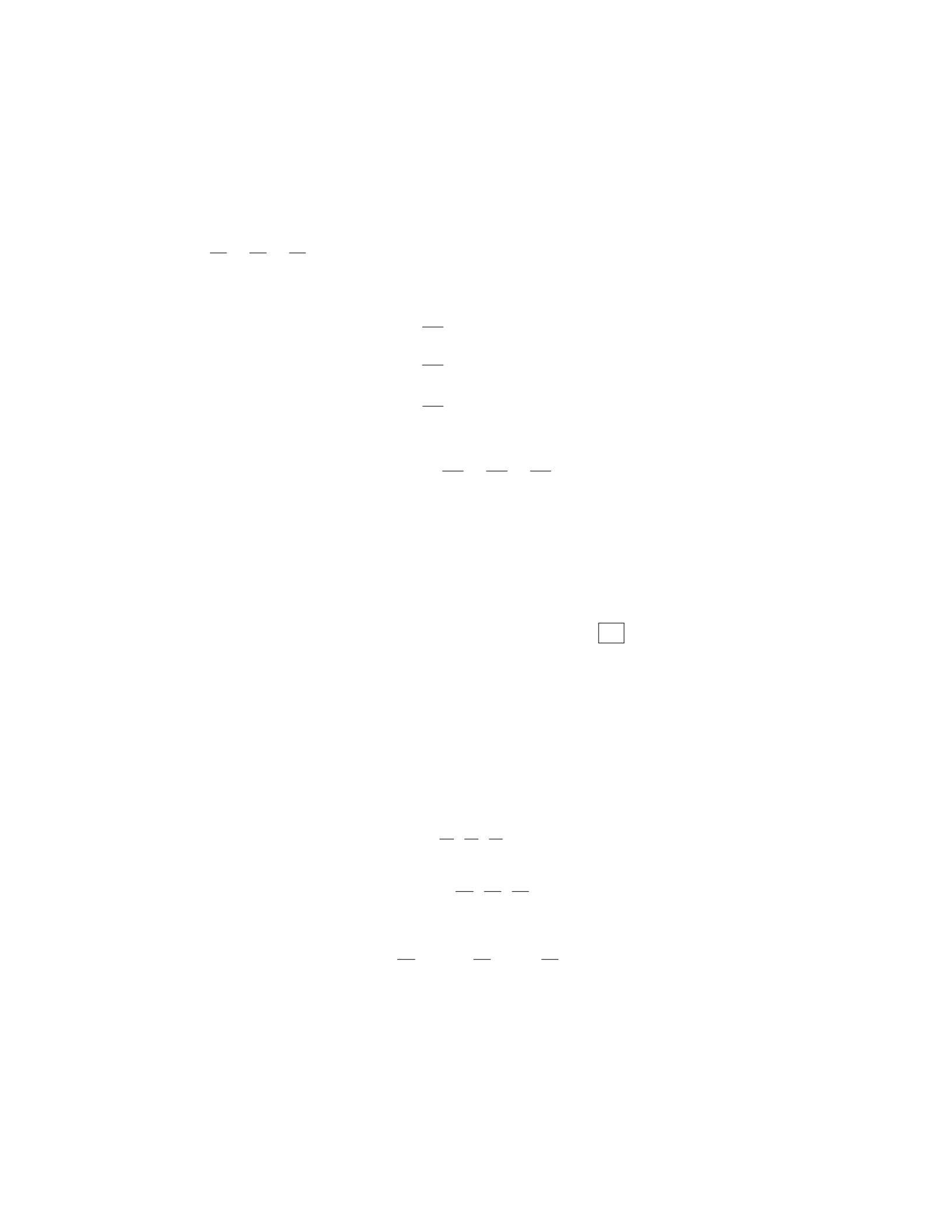
Solution
Step 1: The divergence of a vector field F=Pi+Qj+Rkis given by div(F) =
∂P
∂x +∂Q
∂y +∂R
∂z .
Step 2: In this case, we have P= 2x2y,Q=−3xz2, and R=xy sin(z).
Step 3: Calculating the partial derivatives:
∂P
∂x = 4xy,
∂Q
∂y = 0,
∂R
∂z =xy cos(z).
Step 4: Now, we can find the divergence:
div(F) = ∂P
∂x +∂Q
∂y +∂R
∂z
= 4xy +0+xy cos(z).
Step 5: Evaluate the divergence at the point (1,2,0):
div(F)(1,2,0) = 4(1)(2) + 0 + (1)(2) cos(0)
= 8 + 0 + 2
= 10.
Therefore, the divergence of Fat the point (1,2,0) is 10 .
Question 10
Question
Let F(x, y, z) = ⟨xey, yz, zex+y⟩. Compute the divergence of F.
Solution
To find the divergence of F(x, y, z), denoted as ∇ · F, we need to take the dot
product of the del operator ∇=⟨∂
∂x ,∂
∂y ,∂
∂z ⟩with F.
Step 1: Compute the del operator ∇.
∇=⟨∂
∂x ,∂
∂y ,∂
∂z ⟩
Step 2: Compute the divergence of F.
∇ · F=∂
∂x (xey) + ∂
∂y (yz) + ∂
∂z (zex+y)
∇ · F=ey+z+ex+y+z
∇ · F=ey+ex+y+ 2z
Therefore, the divergence of Fis ∇ · F=ey+ex+y+ 2z.
7
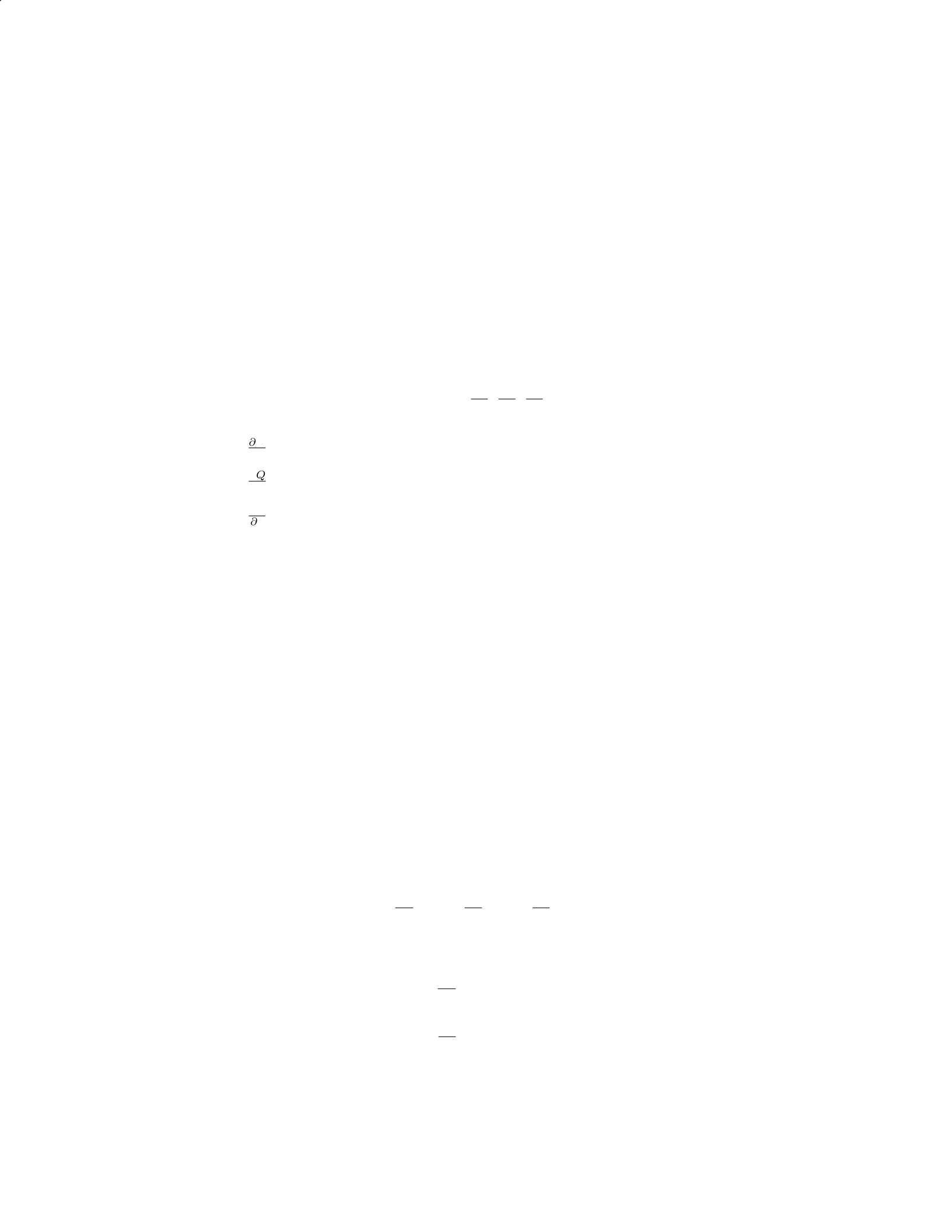
Question 11
Question
Let F(x, y, z) = ⟨ezsin y, xz, ezcos y⟩. Find the gradient of Fand evaluate it at
the point (0, π, 1).
Solution
To find the gradient of F, we need to compute the partial derivatives of each
component function. Let F(x, y, z) = ⟨P(x, y, z), Q(x, y, z), R(x, y, z)⟩. Then
the gradient of Fis given by ∇ · F=⟨∂P
∂x ,∂Q
∂y ,∂R
∂z ⟩.
Step 1: Find the partial derivatives of P,Q, and R:
∂P
∂x = 0
∂Q
∂y = 0
∂R
∂z =ezcos y
Step 2: Compute the gradient of F:
∇ · F=⟨0,0, ezcos y⟩
Step 3: Evaluate the gradient at the point (0, π, 1):
∇ · F(0, π, 1) = ⟨0,0, e cos π⟩=⟨0,0,−e⟩
Therefore, the gradient of Fat the point (0, π, 1) is ⟨0,0,−e⟩.
Question 12
Question
Let F(x, y, z) = xzi+yzj+ (x2+y2)k. Determine ∇ · F.
Solution
Step 1: Compute the components of ∇ · F.
∇ · F=∂
∂x (xz) + ∂
∂y (yz) + ∂
∂z (x2+y2)
Step 2: Calculate the partial derivatives.
∂
∂x (xz) = z
∂
∂y (yz) = z
8

∂
∂z (x2+y2) = 0
Step 3: Combine the partial derivatives to find ∇ · F.
∇ · F=z+z+ 0 = 2z
Therefore, ∇ · F= 2z.
Question 13
Question
Let F(x, y, z)=2xyi+ (x2+z)j+xezk. Calculate the curl of F.
Solution
To find the curl of F, we proceed by computing the determinant of the following
matrix:
∇ × F=
i j k
∂
∂x
∂
∂y
∂
∂z
2xy x2+z xez
Step 1: Calculate the partial derivatives:
∂
∂x =yi+ 2xj+ezxk
∂
∂y = 2xi
∂
∂z =j+xezk
Step 2: Evaluate the determinant:
∇ × F=∂
∂y (xez)−∂
∂z (x2+z)i−∂
∂x (xez)−∂
∂z (2xy)j+∂
∂x (x2+z)−∂
∂y (2xy)k
= (ez)i−((1) ·ez)j+ (2x)k
=ezi−ezj+ 2xk
Therefore, the curl of Fis ∇ × F= (ez)i−(ez)j+ 2xk.
Question 14
Question
Let F(x, y, z) = x2yi+xy2j+xyzkbe a vector field in R3. Compute div(curl(F)).
9

Solution
Step 1: Compute the curl of F.
curl(F) = ∇ × F=
i j k
∂
∂x
∂
∂y
∂
∂z
x2y xy2xyz
curl(F) = (∂(xyz)
∂y −∂(xy2)
∂z )i−(∂(xyz)
∂x −∂(x2y)
∂z )j+ ( ∂(x2y)
∂x −∂(xy2)
∂y )k
= (xz −2xy)i−(z−2xy)j+ (2y−x)k
Step 2: Compute the divergence of the curl of F.
div(curl(F)) = ∇ · curl(F) = ∂
∂x (xz −2xy) + ∂
∂y (−z+ 2xy) + ∂
∂z (2y−x)
=z+ 2 −2 = z
Therefore, div(curl(F)) = z.
Question 15
Question
Let F(x, y, z) = x2i+xy2j+xz2k. Calculate ∇ · (∇ × F).
Solution
Step 1: Let’s first calculate ∇ × F.
=
i j k
∂
∂x
∂
∂y
∂
∂z
x2xy2xz2
=∂(xz2)
∂y −∂(xy2)
∂z i−∂(x2)
∂z −∂(xz2)
∂x j+∂(xy2)
∂x −∂(x2)
∂y k
= (0 −2xz)i−(0 −z2)j+ (y2−0)k
=−2xzi−z2j+y2k
Step 2: Now, calculate ∇ · (∇ × F).
) = ∂∂x(−2xz)+ ∂
∂y (−z2)+ ∂
∂z (y2)=−2z+0+0=−2z
Therefore, ∇ · (∇ × F) = −2z.
10

Question 16
Question
Let F(x, y, z) = ⟨exy cos(z), x sin(y),−xyz2⟩. Compute ∇ · F, where ∇is the
gradient operator.
Solution
Step 1: The gradient operator ∇is defined in Cartesian coordinates (x, y, z) as
∇=⟨∂
∂x ,∂
∂y ,∂
∂z ⟩.
Step 2: Compute the divergence of F, denoted as ∇ · F, where F(x, y, z) =
⟨exy cos(z), x sin(y),−xyz2⟩.
Step 3: The divergence of Fis given by ∇ · F=∂P
∂x +∂Q
∂y +∂R
∂z , where
F(x, y, z) = ⟨P, Q, R⟩.
Step 4: Compute the partial derivatives of P=exy cos(z) with respect to x,
Q=xsin(y) with respect to y, and R=−xyz2with respect to z.
Step 5: For P=exy cos(z), ∂P
∂x =yexy cos(z).
Step 6: For Q=xsin(y), ∂Q
∂y =xcos(y).
Step 7: For R=−xyz2,∂R
∂z =−xy2z.
Step 8: Summing up the partial derivatives, we get
∇ · F=∂P
∂x +∂Q
∂y +∂R
∂z =yexy cos(z) + xcos(y)−2xyz
Thus, ∇ · F=yexy cos(z) + xcos(y)−2xyz.
Question 17
Question
Let F(x, y, z) = (x2y, yz, xyz) be a vector field. Compute ∇ · F, where ∇is the
gradient operator.
Solution
Step 1: The divergence of a vector field F= (P, Q, R) is defined as ∇ · F=
∂P
∂x +∂Q
∂y +∂R
∂z .
Step 2: In this case, we have F(x, y, z)=(x2y, yz, xyz).
Step 3: So, P=x2y,Q=yz, and R=xyz.
Step 4: Now, let’s compute the partial derivatives:
∂P
∂x = 2xy, ∂Q
∂y =z, ∂R
∂z =xy
Step 5: Therefore, the divergence of Fis:
∇ · F= 2xy +z+xy
11

Step 6: Simplifying the expression, we get:
∇ · F= 3xy +z
Hence, the divergence of the vector field Fis 3xy +z.
Question 18
Question
Let F(x, y, z) = (3x2y+ 2yz, x3+ 2xyz, y2z2−3xz). Calculate the curl of F.
Solution
To find the curl of a vector field F(x, y, z)=(P, Q, R), we can use the formula:
∇ × F=∂R
∂y −∂Q
∂z ,∂P
∂z −∂R
∂x ,∂Q
∂x −∂P
∂y
Step 1: Calculate the partial derivatives Let P= 3x2y+ 2yz,Q=
x3+ 2xyz, and R=y2z2−3xz.
We need to compute the partial derivatives:
∂P
∂y ,∂Q
∂z ,∂R
∂x ,∂R
∂y ,∂Q
∂x ,∂P
∂z
Step 2: Compute the curl Using the formula for the curl, we have:
∇ × F=∂R
∂y −∂Q
∂z ,∂P
∂z −∂R
∂x ,∂Q
∂x −∂P
∂y
Substitute the partial derivatives we calculated into the formula to find the curl
of F.
Question 19
Question
Let F(x, y) = −y2, x2+y3. Compute the divergence of Fand determine
whether the vector field Fis conservative.
Solution
Step 1: The divergence of a vector field F(x, y)=(P(x, y), Q(x, y)) is given by
div(F) = ∂P
∂x +∂Q
∂y .
12
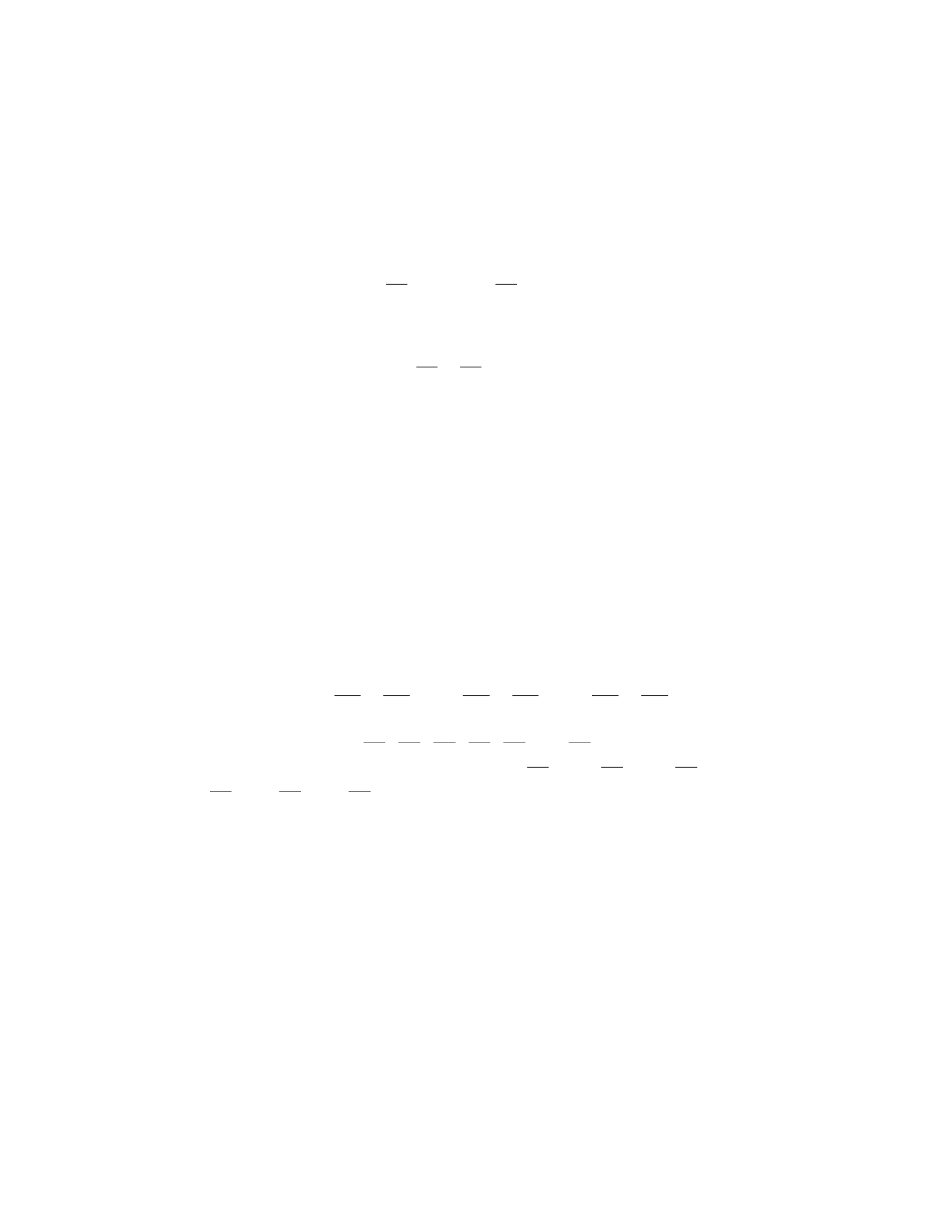
Step 2: Given F(x, y)=(−y2, x2+y3), we have P(x, y) = −y2and Q(x, y) =
x2+y3.
Step 3: Calculate the partial derivatives:
∂P
∂x = 0 and ∂Q
∂y = 3y2.
Step 4: The divergence of Fis
div(F) = ∂P
∂x +∂Q
∂y = 0 + 3y2= 3y2.
Step 5: To determine if Fis conservative, note that if F=∇ffor some
scalar function f, then Fis conservative.
Step 6: Since the divergence of Fis not zero, the vector field Fis not
conservative.
Question 20
Question
Let F(x, y, z)=(y2, xz, yz) be a vector field. Calculate the curl of F.
Solution
To calculate the curl of F, we use the formula:
∇ × F=∂Fz
∂y −∂Fy
∂z i+∂Fx
∂z −∂Fz
∂x j+∂Fy
∂x −∂Fx
∂y k
Step 1: Calculate ∂Fz
∂y ,∂Fy
∂z ,∂Fx
∂z ,∂Fz
∂x ,∂Fy
∂x , and ∂Fx
∂y .
Given F(x, y, z) = (y2, xz, yz), we have: - ∂Fz
∂y =z-∂Fy
∂z = 0 - ∂Fx
∂z =x-
∂Fz
∂x = 0 - ∂Fy
∂x = 0 - ∂Fx
∂y = 0
Step 2: Compute the curl of F.
∇ × F= (0 −0)i+ (x−0)j+ (0 −0)k
∇ × F=xj
Therefore, the curl of the vector field F(x, y, z) = (y2, xz, yz) is ∇ × F=xj.
Question 21
Question
Let F(x, y, z) = x2yi+xzj+yzkbe a vector field. Compute the curl of F.
13
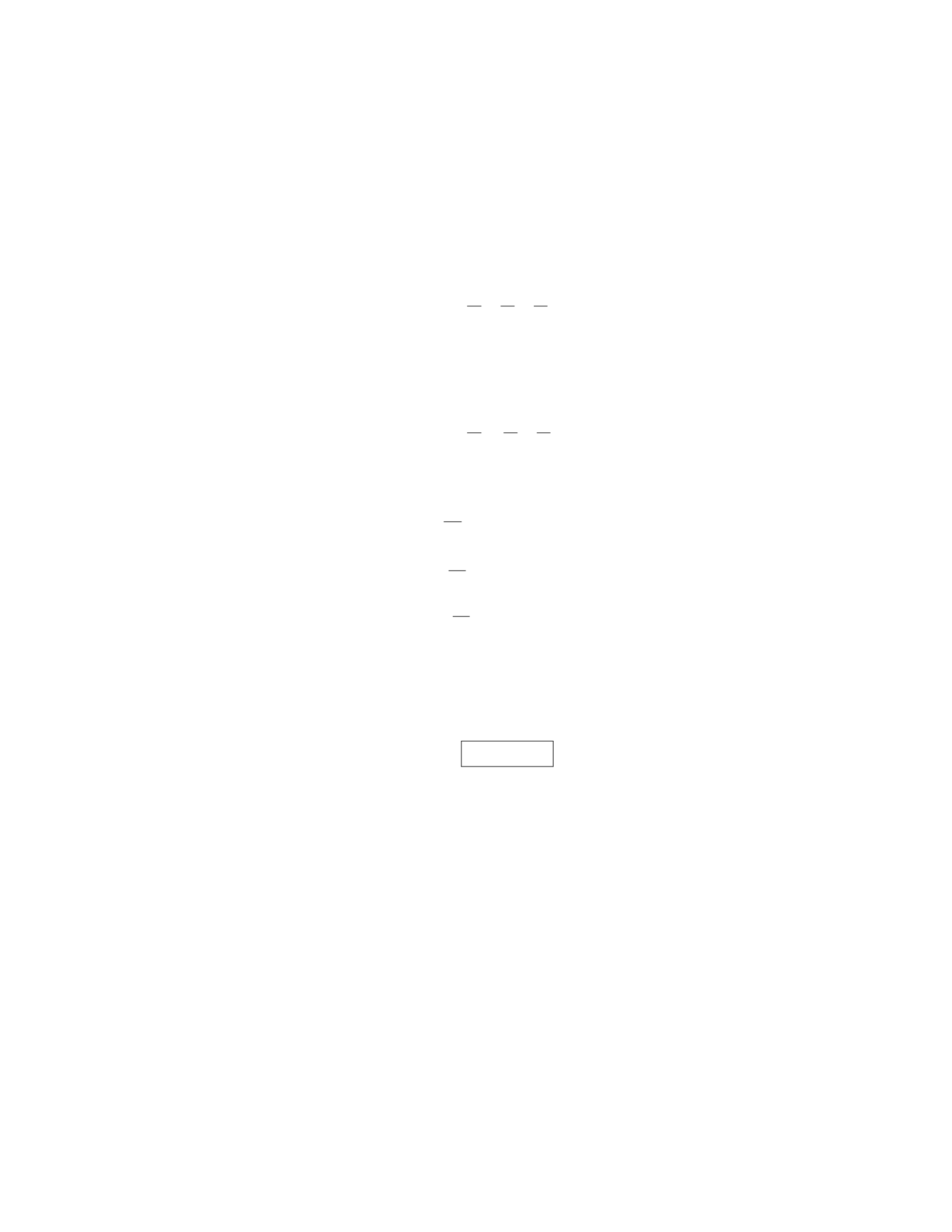
Solution
To compute the curl of a vector field F(x, y, z) = P(x, y, z)i+Q(x, y, z)j+
R(x, y, z)k, we use the formula:
∇ × F=
i j k
∂
∂x
∂
∂y
∂
∂z
P Q R
In our case, F(x, y, z) = x2yi+xzj+yzk, so P=x2y,Q=xz, and R=yz.
Now we can compute the curl:
∇ × F=
i j k
∂
∂x
∂
∂y
∂
∂z
x2y xz yz
Step 1: Compute the partial derivatives:
∂
∂x = 2xy
∂
∂y =x2
∂
∂z = 0
Step 2: Now, compute the determinant:
∇ × F= (0 −0) i−(0 −0) j+ (2xy −xz)k
Step 3: Simplify the result:
∇ × F= (2xy −xz)k
Therefore, the curl of the vector field F(x, y, z) = x2yi+xzj+yzkis (2xy −
xz)k.
Question 22
Question
Let F(x, y, z) = (2x2y, xz2,−y2z) be a vector field in R3. Compute the curl of
F.
14
Solution
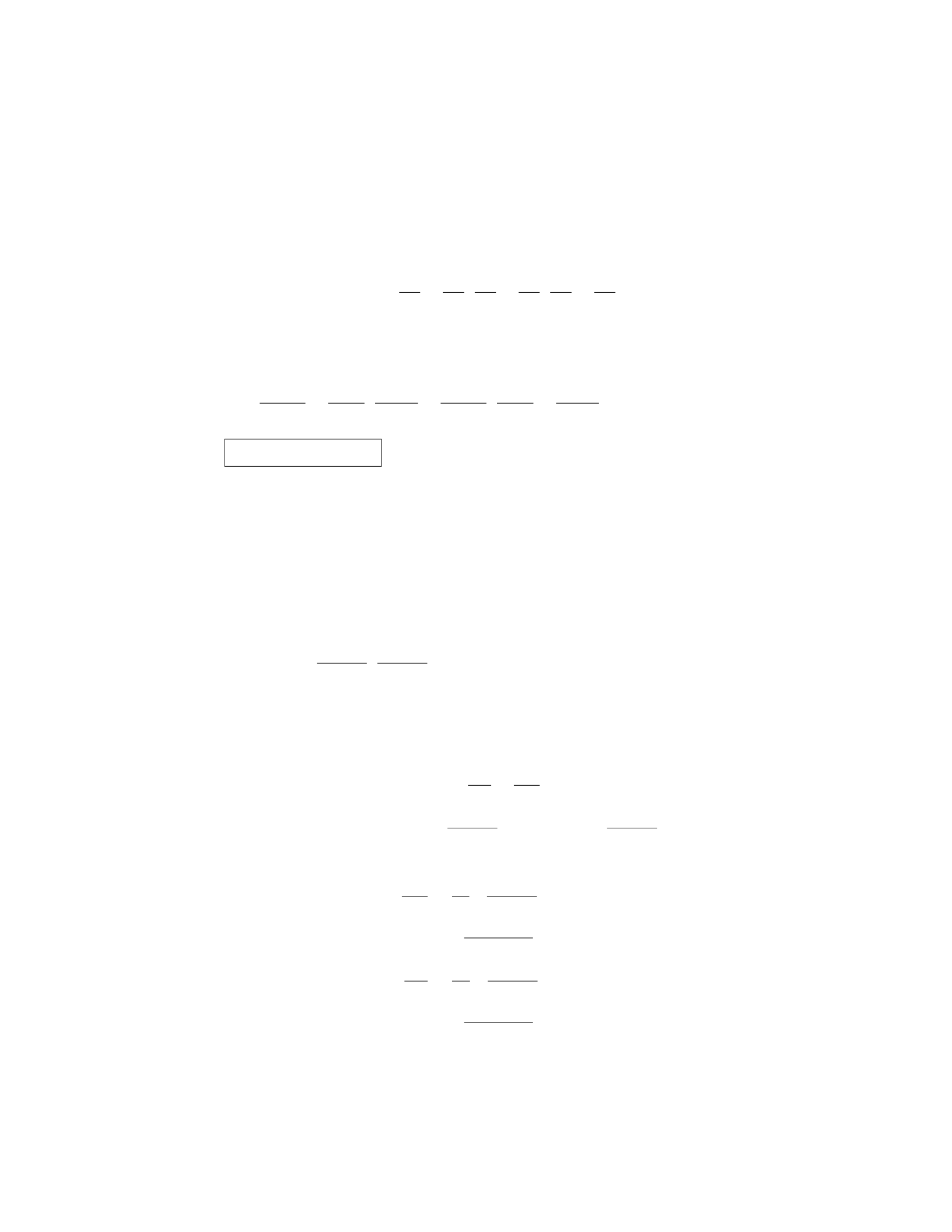
To compute the curl of a vector field F(x, y, z)=(P(x, y, z), Q(x, y, z), R(x, y, z)),
we use the formula:
∇ × F=∂R
∂y −∂Q
∂z ,∂P
∂z −∂R
∂x ,∂Q
∂x −∂P
∂y
Step 1: Compute the curl of F.
=∂(−y2z)
∂y −∂(xz2)
∂z ,∂(2x2y)
∂z −∂(−y2z)
∂x ,∂(xz2)
∂x −∂(2x2y)
∂y
=−2yz −0,0−z2,2z−2x2
= (−2yz, −z2,2z−2x2)
Therefore, the curl of the vector field F(x, y, z) = (2x2y, xz2,−y2z) is (−2yz, −z2,2z−
2x2).
Question 23
Question
Let F(x, y) = x
x2+y2,y
x2+y2be a vector field. Determine the curl of F.
Solution
Step 1: The curl of a vector field F= (M(x, y), N (x, y)) in two dimensions is
defined as
∇ × F=∂N
∂x −∂M
∂y .
Step 2: In this case, M(x, y) = x
x2+y2and N(x, y) = y
x2+y2.
Step 3: Let’s find the partial derivatives needed to compute the curl.
∂M
∂y =∂
∂y x
x2+y2
=−2xy
(x2+y2)2
∂N
∂x =∂
∂x y
x2+y2
=−2xy
(x2+y2)2.
15

Step 4: Now, we can compute the curl of Fusing the formula.
∇ × F=−2xy
(x2+y2)2−(−2xy
(x2+y2)2)
= 0.
Step 5: Therefore, the curl of the vector field Fis 0.
Step 6: This implies that the vector field Fis conservative, as its curl is zero.
Question 24
Question
Let F(x, y, z) = (x2y2, y2z2, z2x2). Calculate the divergence of Fat the point
(1,2,3).
Solution
To find the divergence of a vector field F= (P, Q, R), we use the formula:
div(F) = ∂P
∂x +∂Q
∂y +∂R
∂z
Step 1: Find the partial derivatives of P, Q, R. Let P=x2y2,Q=y2z2,
and R=z2x2. Then, - ∂P
∂x = 2xy2-∂Q
∂y = 2yz2-∂R
∂z = 2zx2
Step 2: Evaluate the partial derivatives at (1,2,3). Substitute x= 1, y =
2, z = 3 into the partial derivatives: - ∂P
∂x = 2(1)(2)2= 8 - ∂Q
∂y = 2(2)(3)2= 36
-∂R
∂z = 2(3)(1)2= 6
Step 3: Calculate the divergence at the point (1,2,3).
div(F) = ∂P
∂x +∂Q
∂y +∂R
∂z = 8 + 36 + 6 = 50
Therefore, the divergence of Fat the point (1,2,3) is 50.
Question 25
Question
Let F(x, y, z) = x2yi +y2zj +z2xk. Calculate the divergence of F.
Solution
Step 1: The divergence of a vector field F(x, y, z) = P(x, y, z)i+Q(x, y, z)j+
R(x, y, z)kis defined as ∇ · F=∂P
∂x +∂Q
∂y +∂R
∂z .
Step 2: In this case, F(x, y, z) = x2yi +y2zj +z2xk, so P(x, y, z) = x2y,
Q(x, y, z) = y2z, and R(x, y, z) = z2x.
16

Step 3: Now, calculate the partial derivatives: ∂P
∂x = 2xy,∂Q
∂y = 2yz,∂R
∂z =
2zx.
Step 4: Therefore, the divergence of Fis: ∇ · F= 2xy + 2yz + 2zx.
Question 26
Question
Let Fbe a vector field in R3defined by F(x, y, z) = ⟨x2+yz, xz, y2−xz⟩.
Calculate the curl of F.
Solution
To calculate the curl of F, we will use the formula:
curl(F) = ∇ × F=∂
∂x ,∂
∂y ,∂
∂z × ⟨P, Q, R⟩
Step 1: Find the components of ∇ × Fusing the determinant formula:
curl(F) =
i j k
∂
∂x
∂
∂y
∂
∂z
x2+yz xz y2−xz
Step 2: Calculate the determinant along the first row:
curl(F) = ∂
∂y (y2−xz)−∂
∂z (xz),∂
∂z (x2+yz)−∂
∂x (y2−xz),∂
∂x (xz)−∂
∂y (x2+yz)
Step 3: Compute the partial derivatives:
curl(F)=(−x, −z, x +y)
Therefore, the curl of Fis curl(F) = ⟨−x, −z, x +y⟩.
Question 27
Question
Let F(x, y, z) = (x2y, yexz , xz cos(y)) be a vector field in 3-dimensional space.
Compute the curl of F.
Solution
To find the curl of a vector field F(x, y, z)=(P, Q, R), we use the formula:
curl F=∂R
∂y −∂Q
∂z ,∂P
∂z −∂R
∂x ,∂Q
∂x −∂P
∂y
17

Step 1: Compute ∂P
∂z ,∂Q
∂x , and ∂R
∂y .
∂P
∂z =∂
∂z (xz cos(y)) = xcos(y)
∂Q
∂x =∂
∂x (yexz ) = yzexz
∂R
∂y =∂
∂y (xz cos(y)) = −xz sin(y)
Step 2: Compute ∂Q
∂z ,∂R
∂x , and ∂P
∂y .
∂Q
∂z =∂
∂z (yexz ) = xyexz
∂R
∂x =∂
∂x (xz cos(y)) = zcos(y)
∂P
∂y =∂
∂y (x2y) = x2
Step 3: Now, compute the curl of Fusing the formula:
curl F=xcos(y)−xyexz, yzexz −zcos(y),−xz sin(y)−x2
Therefore, the curl of Fis (xcos(y)−xyexz , yzexz −zcos(y),−xz sin(y)−x2) .
Question 28
Question
Let F(x, y, z)=(x2z, 2xy, x +y2) be a vector field in R3. Compute ∇ · ∇ × F.
Solution
Step 1: Compute ∇ × F.
∇ × F=
i j k
∂
∂x
∂
∂y
∂
∂z
x2z2xy x +y2
=∂
∂y (x+y2)−∂
∂z (2xy),∂
∂z (x2z)−∂
∂x (x+y2),∂
∂x (2xy)−∂
∂y (x2z)
= (2y−0, x2−1,2y−2xz) = (2y, x2−1,2y−2xz)
Step 2: Compute ∇ · (2y, x2−1,2y−2xz).
∇ · ∇ × F=∂
∂x (2y) + ∂
∂y (x2−1) + ∂
∂z (2y−2xz)
= 0 + 0 −2x=−2x
18
Question 29
Question
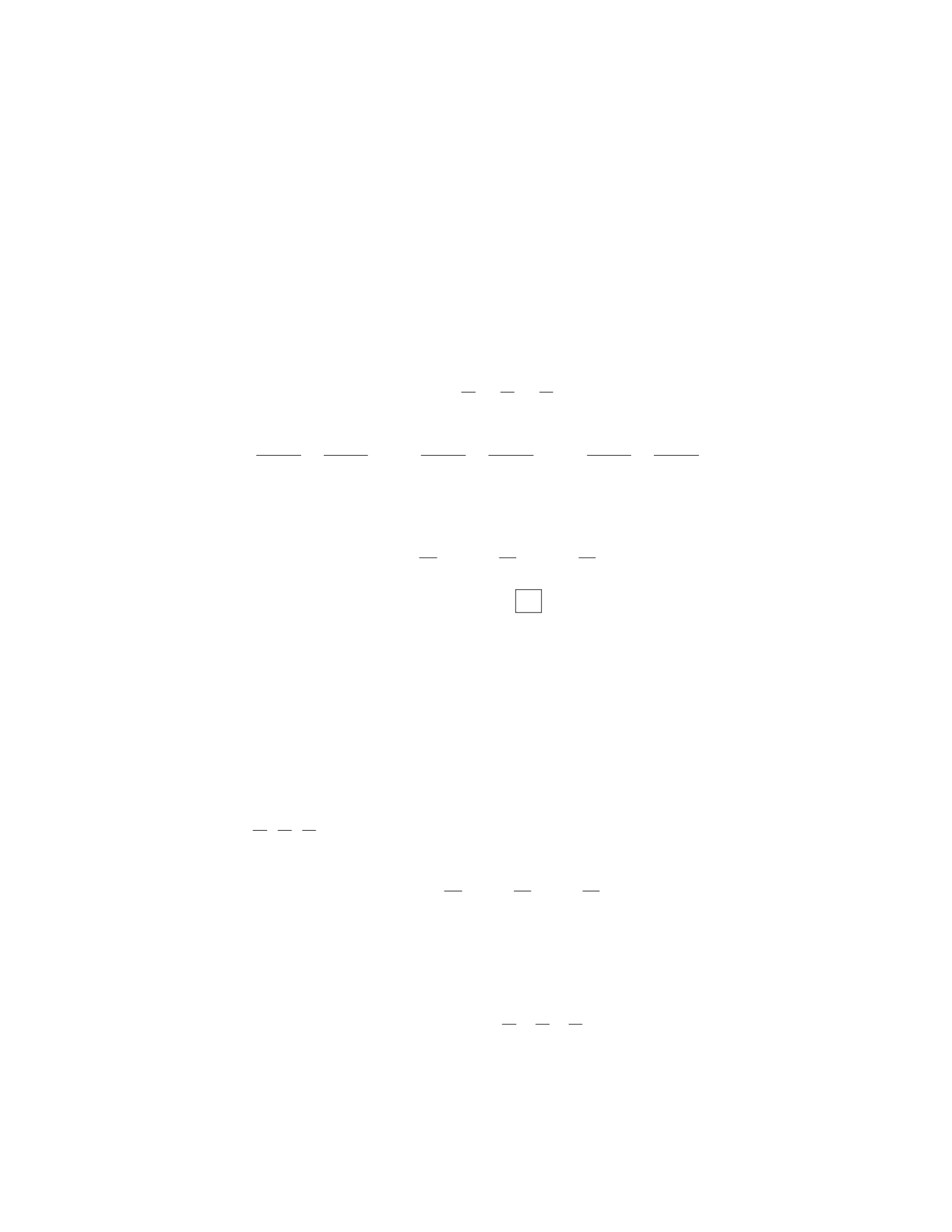
Let F(x, y, z) = x2yi+y2zj+z2xkbe a vector field. Compute ∇ · (∇ × F).
Solution
Step 1: Compute ∇ × F.
∇ × F=
i j k
∂
∂x
∂
∂y
∂
∂z
x2y y2z z2x
=∂(z2x)
∂y −∂(y2z)
∂z i−∂(z2x)
∂x −∂(x2y)
∂z j+∂(y2z)
∂x −∂(x2y)
∂y k
= (0 −y2)i−(2z−0)j+ (2yz −0)k=−y2i−2zj+ 2yzk
Step 2: Compute ∇ · (∇ × F).
∇ · (∇ × F) = ∂
∂x (−y2) + ∂
∂y (−2z) + ∂
∂z (2yz)
= 0 −0+2y= 2y
Question 30
Question
Let F(x, y, z) = xyi+xzj+yzkbe a vector field in 3D space. Determine the
divergence and curl of F.
Solution
To find the divergence of F, we apply the formula div(F) = ∇ · F, where
∇=∂
∂x ,∂
∂y ,∂
∂z is the del operator.
Step 1: Calculate the divergence of F.
div(F) = ∇ · F=∂
∂x (xy) + ∂
∂y (xz) + ∂
∂z (yz)
div(F) = y+z+x
Next, to find the curl of F, we apply the formula curl(F) = ∇ × F.
Step 2: Calculate the curl of F.
curl(F) = ∇ × F=
i j k
∂
∂x
∂
∂y
∂
∂z
xy xz yz
19

=∂(yz)
∂y −∂(xz)
∂z i−∂(yz)
∂x −∂(xy)
∂z j+∂(xz)
∂x −∂(xy)
∂y k
=zi−yj+xk
Therefore, the divergence of Fis y+z+xand the curl of Fis zi−yj+xk.
20

