


MATH 117 - ELEMENTS OF
MATHEMATICS - Gradient,
divergence, and curl
Question Bank - Set 2
Liberty University
Question 1
Question
Let F(x, y, z) = (2xy +yz, x2+xz, x2+y2) be a vector field. Calculate the curl
of F.
Solution
To find the curl of a vector field F(x, y, z) given by F(x, y, z)=(M, N, P ), we
use the formula for the curl:
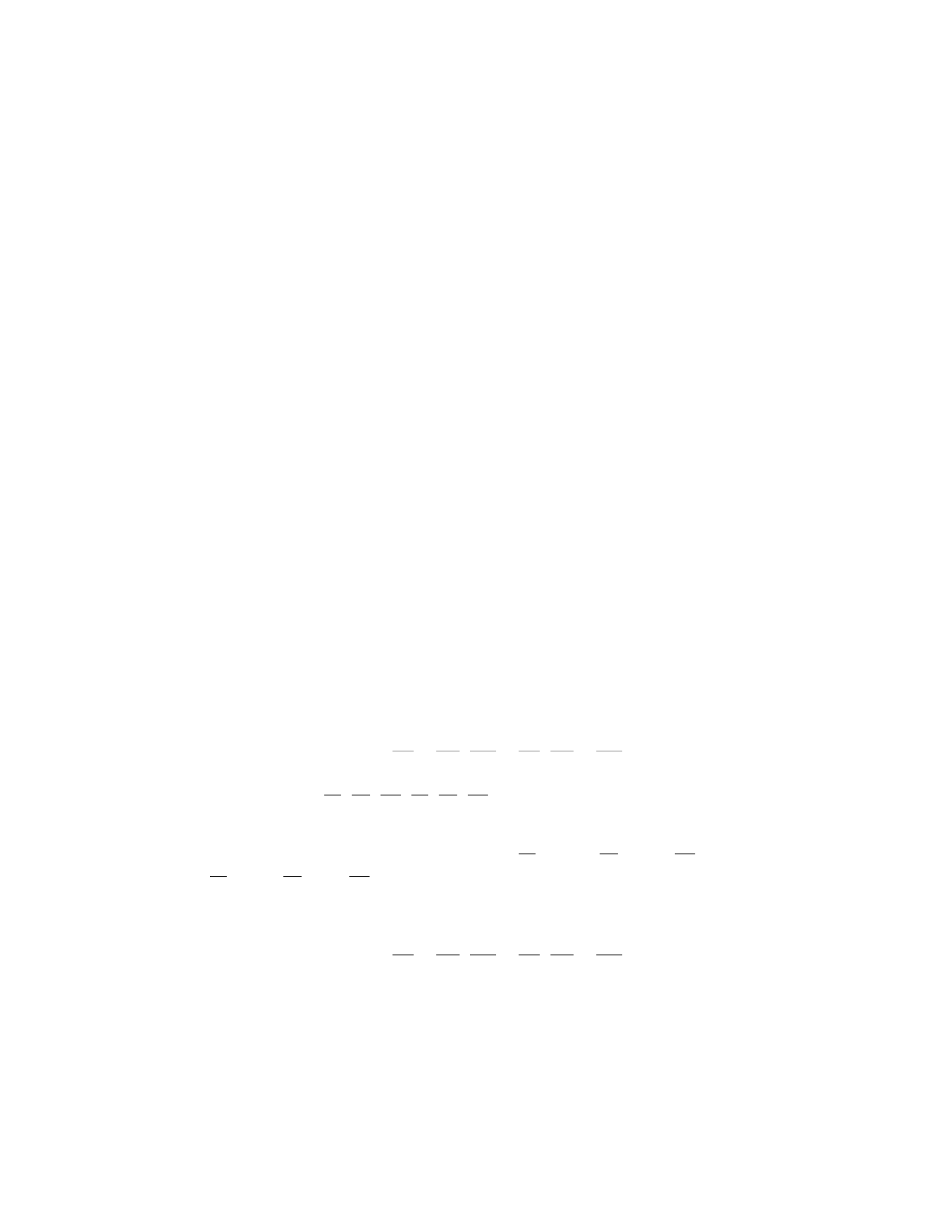
∇ × F=∂P
∂y −∂N
∂z ,∂M
∂z −∂P
∂x ,∂N
∂x −∂M
∂y
Step 1: Find ∂P
∂y ,∂N
∂z ,∂M
∂z ,∂P
∂x ,∂N
∂x ,∂M
∂y .
Given F(x, y, z) = (2xy +yz, x2+xz, x2+y2), we have: - M= 2xy +yz -
N=x2+xz -P=x2+y2
Now, calculate the partial derivatives: - ∂P
∂y = 2y-∂N
∂z =x-∂M
∂z =y-
∂P
∂x = 2x-∂N
∂x =z-∂M
∂y = 2x+z
Step 2: Calculate the components of the curl. Using the formula for the
curl, we can now find the components:
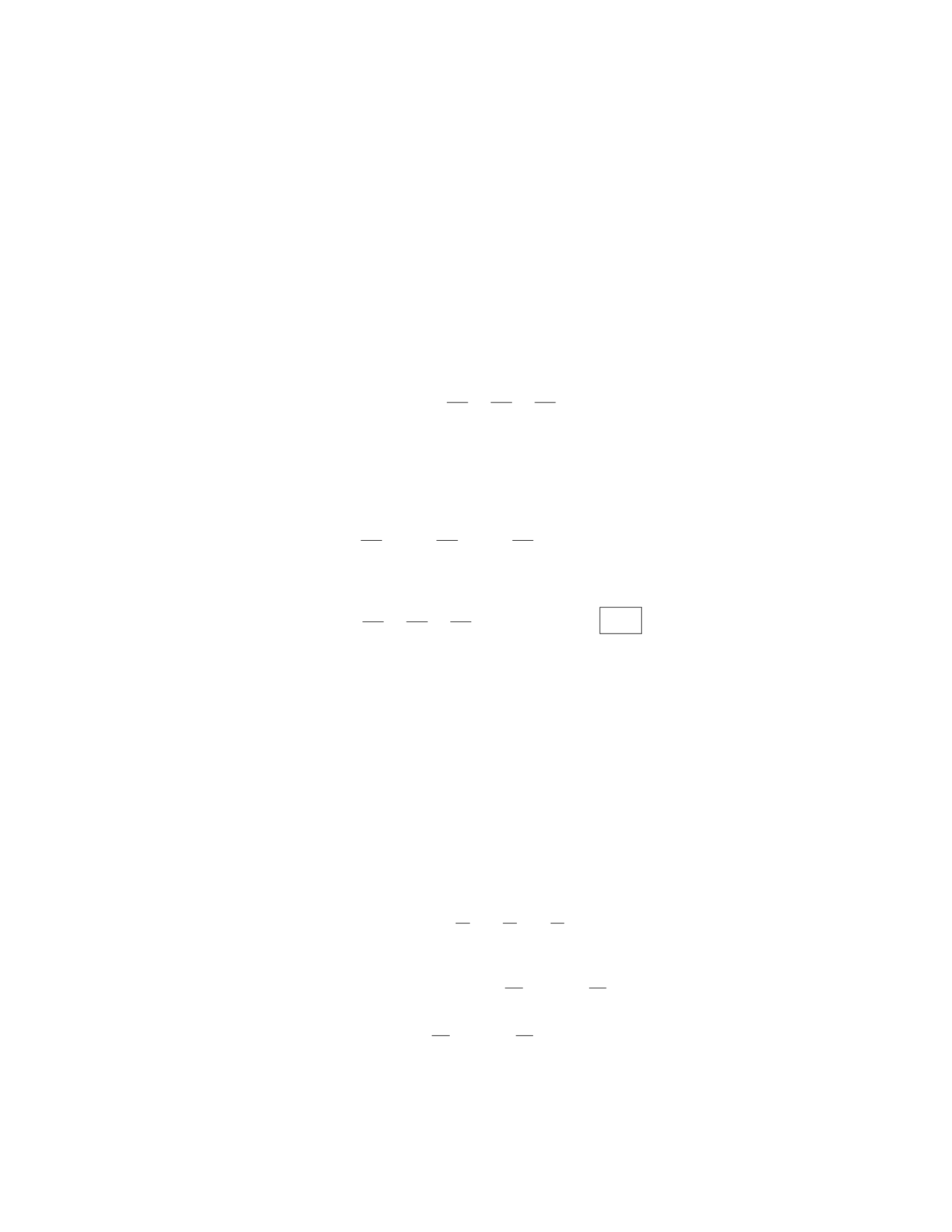
∇ × F=∂P
∂y −∂N
∂z ,∂M
∂z −∂P
∂x ,∂N
∂x −∂M
∂y
= (2y−x, y −2x, z −(2x+z)) = (2y−x, y −2x, −2x)
Therefore, the curl of the vector field F(x, y, z) is ∇ × F= (2y−x, y −
2x, −2x).
Question 2
Question
Let F(x, y, z)=(y2z3, x2z3, x2y2) be a vector field. Calculate the divergence of
F.
Solution
To find the divergence of F, we use the formula:
∇ · F=∂P
∂x +∂Q
∂y +∂R
∂z ,
where F(x, y, z)=(P(x, y, z), Q(x, y, z), R(x, y, z)).
Step 1: Identify the components of F:F(x, y, z) = (y2z3, x2z3, x2y2), so
P(x, y, z) = y2z3,Q(x, y, z) = x2z3, and R(x, y, z) = x2y2.
Step 2: Find the partial derivatives:
∂P
∂x = 0,∂Q
∂y = 0,∂R
∂z = 2xy2.
Step 3: Calculate the divergence of F:
∇ · F=∂P
∂x +∂Q
∂y +∂R
∂z = 0 + 0 + 2xy2= 2xy2.
Therefore, the divergence of Fis 2xy2.
Question 3
Question
Let F= 2x2yi+ 3x2zj+ 4xyzk.
Calculate div(curl(F)).
Solution
Step 1: Calculate the curl of F:
curl(F) =
i j k
∂
∂x
∂
∂y
∂
∂z
2x2y3x2z4xyz
curl(F) = (0 −0) i−(0 −0) j+∂
∂x (3x2z)−∂
∂y (2x2y)k
curl(F) = ∂
∂x (3x2z)−∂
∂y (2x2y)k
2
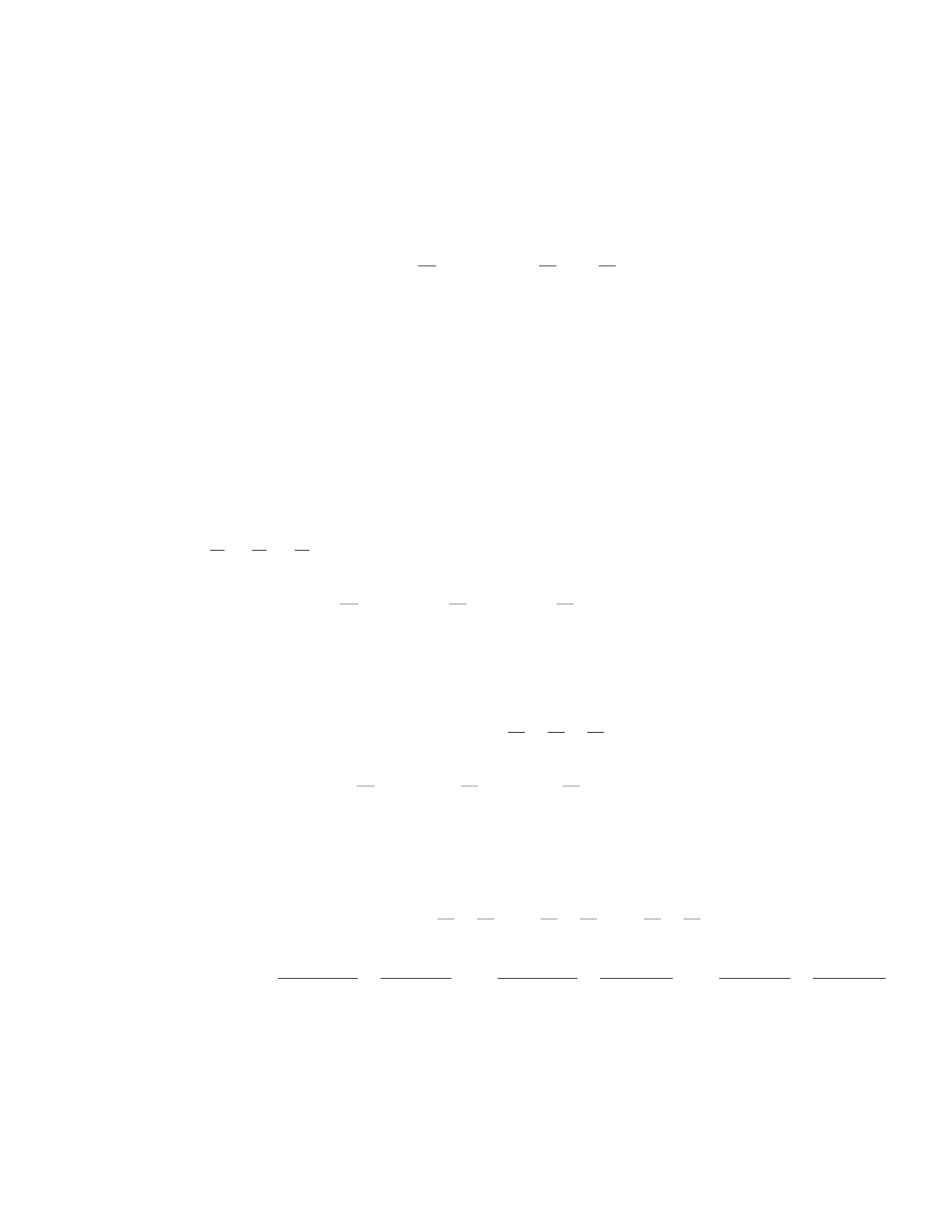
curl(F) = (6xz −4xy)k
Step 2: Calculate the divergence of curl(F):
div(curl(F)) = ∂
∂x (6xz −4xy) + ∂
∂y (0) + ∂
∂z (0)
div(curl(F)) = 6z−4x
Therefore, div(curl(F)) = 6z−4x.
Question 4
Question
Let F(x, y, z) = (2xy +z)i+ (x2+y2)j+ (3yz −x2)k. Find the gradient,
divergence, and curl of F.
Solution
Gradient: Step 1: The gradient of a scalar field f(x, y, z) is given by ∇f=
∂f
∂x i+∂f
∂y j+∂f
∂z k.
Applying this formula to F, we have:
∇f=∂
∂x (2xy +z)i+∂
∂y (x2+y2)j+∂
∂z (3yz −x2)k
Step 2: Computing each partial derivative gives:
∇f= (2y)i+ (2x)j+ (3y)k
Therefore, the gradient of Fis ∇F= (2y)i+ (2x)j+ (3y)k.
Divergence: Step 1: The divergence of a vector field F(x, y, z) = P(x, y, z)i+
Q(x, y, z)j+R(x, y, z)kis given by ∇ · F=∂P
∂x +∂Q
∂y +∂R
∂z .
Applying this formula to F, we have:
∇ · F=∂
∂x (2xy +z) + ∂
∂y (x2+y2) + ∂
∂z (3yz −x2)
Step 2: Computing each partial derivative and adding them together gives:
∇ · F= 2y+ 2x+ 3y= 2x+ 5y
Therefore, the divergence of Fis ∇ · F= 2x+ 5y.
Curl: Step 1: The curl of a vector field F(x, y, z) = P(x, y, z)i+Q(x, y, z)j+
R(x, y, z)kis given by ∇ × F=∂R
∂y −∂Q
∂z i−∂R
∂x −∂P
∂z j+∂Q
∂x −∂P
∂y k.
Applying this formula to F, we have:
∇×F=∂(3yz −x2)
∂y −∂(x2+y2)
∂z i−∂(3yz −x2)
∂x −∂(2xy +z)
∂z j+∂(x2+y2)
∂x −∂(2xy +z)
∂y k
Step 2: Calculating each partial derivative and simplifying, we get:
∇ × F= (0 −2z)i−(−2x−0)j+ (2y−2x)
3
Question 5
Question
Let F(x, y, z)=(x2yz, exy, xz3). Determine the gradient, divergence, and curl
of F.
Solution
Step 1: Gradient of F The gradient of a vector field F(x, y, z)=(P(x, y, z), Q(x, y, z), R(x, y, z))
is given by
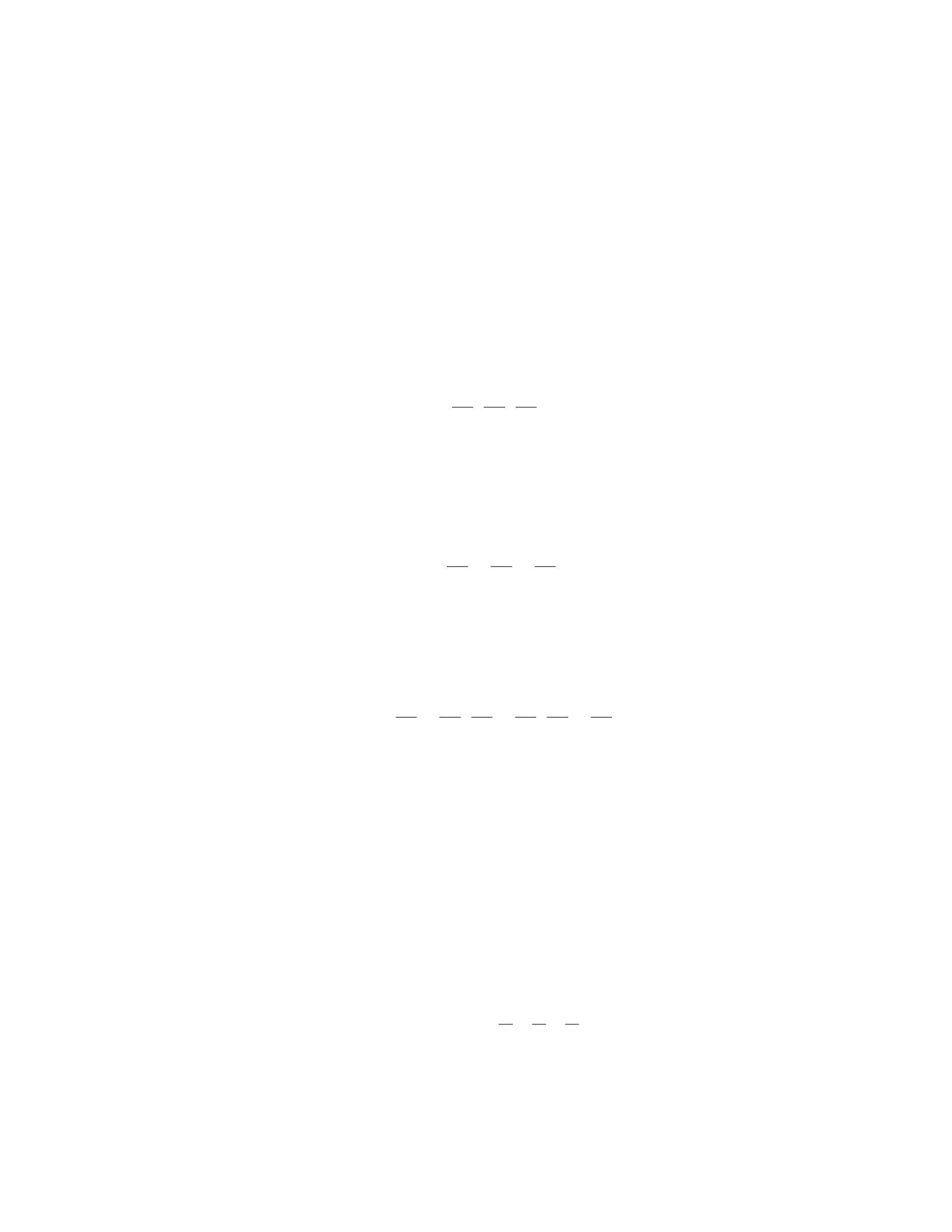
∇F=∂P
∂x ,∂Q
∂y ,∂R
∂z .
For F(x, y, z)=(x2yz, exy , xz3), we have
∇F=2xyz, xexy , z3.
Step 2: Divergence of F The divergence of a vector field F(x, y, z) =
(P(x, y, z), Q(x, y, z), R(x, y, z)) is given by
∇ · F=∂P
∂x +∂Q
∂y +∂R
∂z .
For F(x, y, z)=(x2yz, exy , xz3), we have
∇ · F= 2xyz +xexy + 3z2.
Step 3: Curl of F The curl of a vector field F(x, y, z)=(P(x, y, z), Q(x, y, z), R(x, y, z))
is given by
∇ × F=∂R
∂y −∂Q
∂z ,∂P
∂z −∂R
∂x ,∂Q
∂x −∂P
∂y .
For F(x, y, z)=(x2yz, exy , xz3), we have
∇ × F=xz3−y, −2xyz, exy −2z3.
Question 6
Question
Let F(x, y, z)=4xzi+ 3xyj+ (2z2−x2)k. Compute the curl of F.
Solution
To compute the curl of F, we will use the formula for the curl of a vector field:
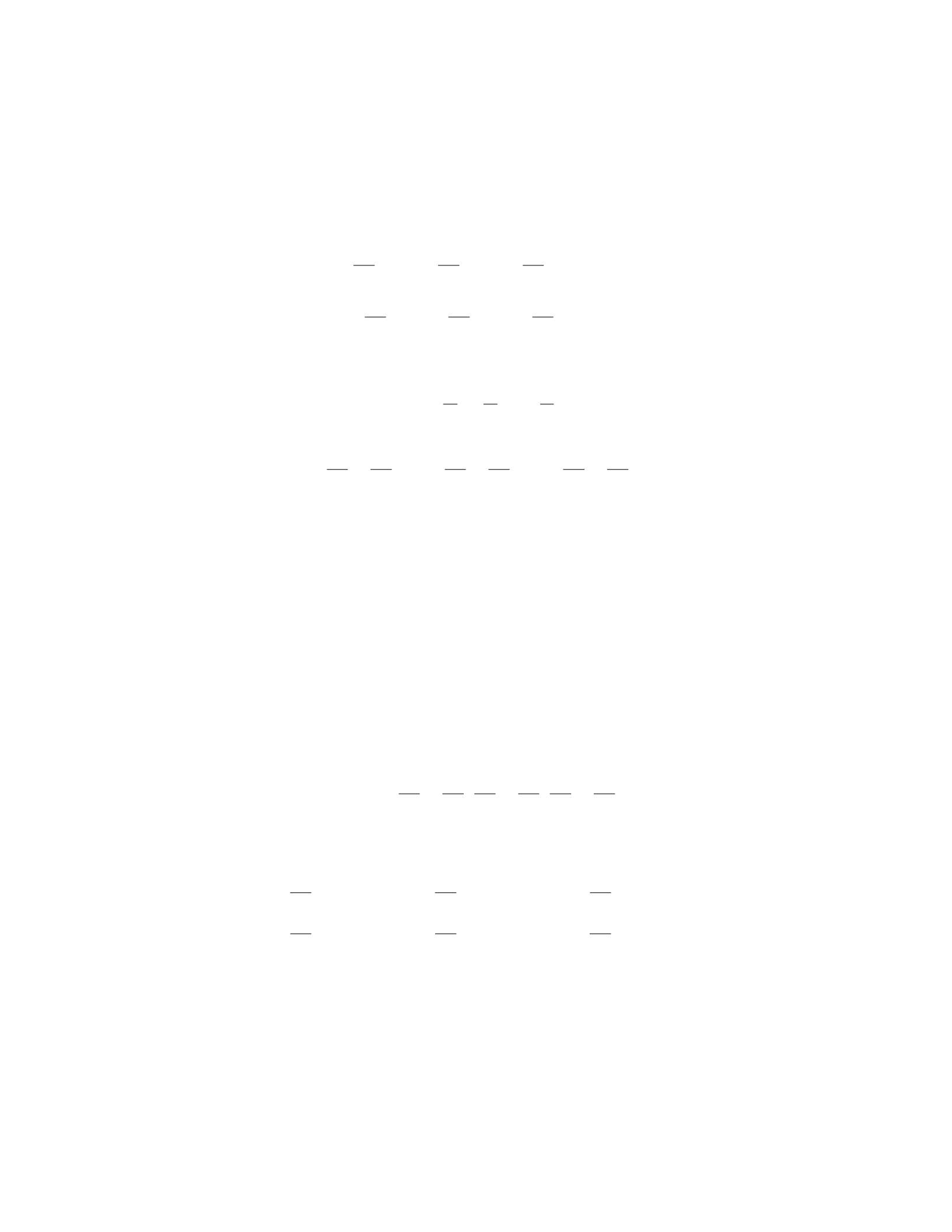
curl F=∇ × F=
i j k
∂
∂x
∂
∂y
∂
∂z
P Q R
4
Where F(x, y, z) = P(x, y, z)i+Q(x, y, z)j+R(x, y, z)k.
Step 1: Compute the partial derivatives:
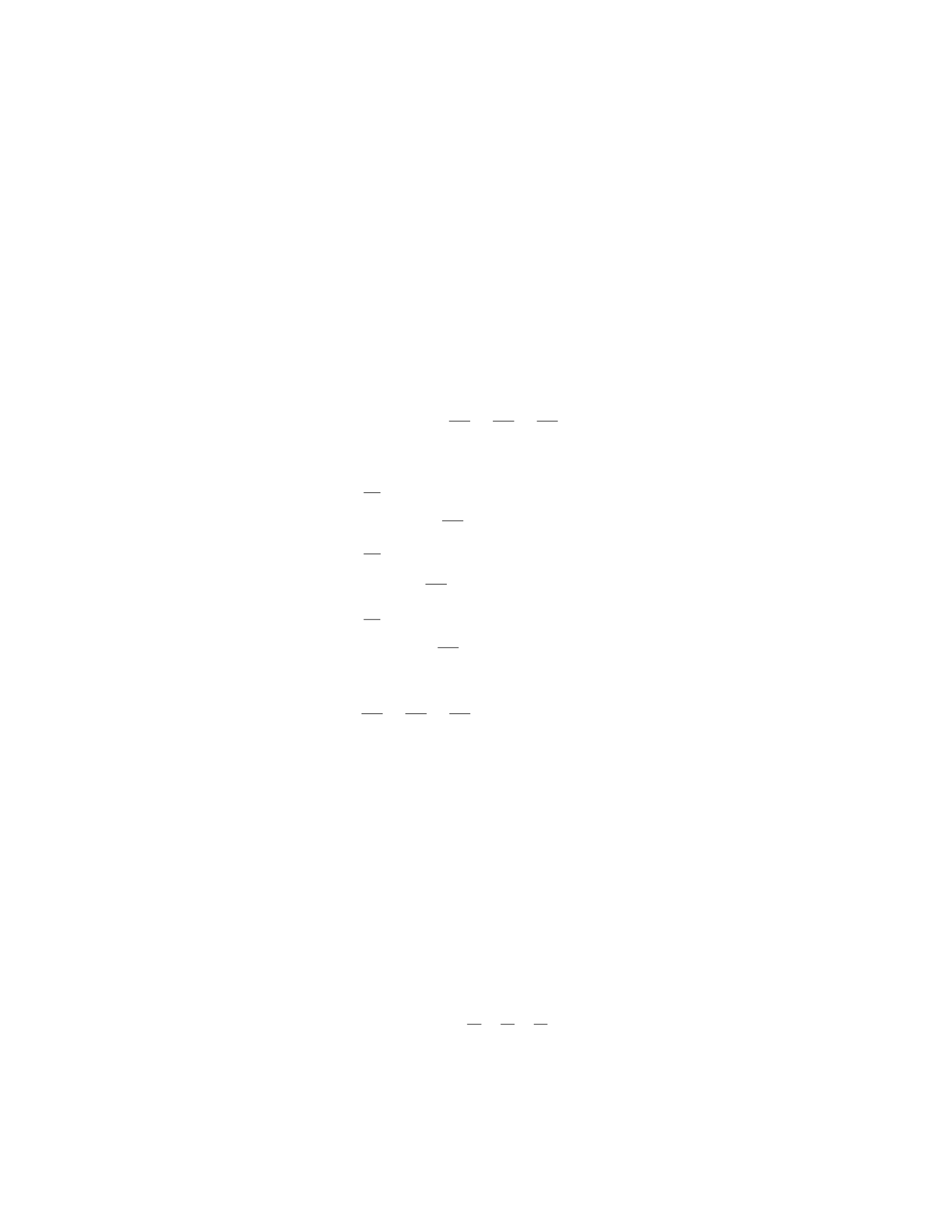
∂P
∂y = 3x, ∂Q
∂z = 4x, ∂R
∂x =−2x,
∂P
∂z = 4z, ∂Q
∂x = 3y, ∂R
∂y = 0.
Step 2: Compute the curl:
curl F=
i j k
∂
∂x
∂
∂y
∂
∂z
4xz 3xy 2z2−x2
=∂R
∂y −∂Q
∂z i−∂R
∂x −∂P
∂z j+∂Q
∂x −∂P
∂y k
= (0 −4x)i−(−2x−4z)j+ (3y−3x)k
=−4xi+ (2x+ 4z)j+ (3y−3x)k.
Therefore, the curl of Fis −4xi+ (2x+ 4z)j+ (3y−3x)k.
Question 7
Question
Let F(x, y, z)=(y2z+xz2, x2z+xy2, xy +xz). Compute the curl of F.
Solution
To find the curl of a vector field F(x, y, z)=(P, Q, R), we use the formula:
curl(F) = ∂R
∂y −∂Q
∂z ,∂P
∂z −∂R
∂x ,∂Q
∂x −∂P
∂y .
Step 1: Compute the partial derivatives of P,Q, and Rwith respect to
each variable.
∂P
∂y =z2,∂Q
∂z = 2xz, ∂R
∂x =z,
∂R
∂y =x, ∂P
∂z = 2xz, ∂Q
∂x = 2xy.
Step 2: Use the formula for the curl to compute the components.
curl(F) = z−x, 2xz −2xz, 2xy −z2= (z−x, 0,2xy −z2).
Therefore, the curl of Fis curl(F)=(z−x, 0,2xy −z2).
5
Question 8
Question
Let F(x, y, z) = x2yi+ezsin(y)j+zln(x)kbe a vector field. Calculate the
divergence of F.
Solution
To calculate the divergence of a vector field F(x, y, z) = P(x, y, z)i+Q(x, y, z)j+
R(x, y, z)k, where P,Q, and Rare the component functions, we use the formula:
∇ · F=∂P
∂x +∂Q
∂y +∂R
∂z
Given F(x, y, z) = x2yi+ezsin(y)j+zln(x)k, we have P(x, y, z) = x2y,
Q(x, y, z) = ezsin(y), and R(x, y, z) = zln(x).
Step 1: Calculate ∂P
∂x :
∂P
∂x = 2xy
Step 2: Calculate ∂Q
∂y :
∂Q
∂y =ezcos(y)
Step 3: Calculate ∂R
∂z :
∂R
∂z = ln(x)
Step 4: Now, we can find the divergence of F:
∇ · F=∂P
∂x +∂Q
∂y +∂R
∂z = 2xy +ezcos(y) + ln(x)
Therefore, the divergence of the vector field Fis 2xy +ezcos(y) + ln(x).
Question 9
Question
Let F(x, y, z)=4xyi+ 3xzj+ 5yzk. Calculate the curl of Fat the point
P(2,−1,3).
Solution
To calculate the curl of a vector field F(x, y, z) = P(x, y, z)i+Q(x, y, z)j+
R(x, y, z)kat a point P(a, b, c), we can use the formula:
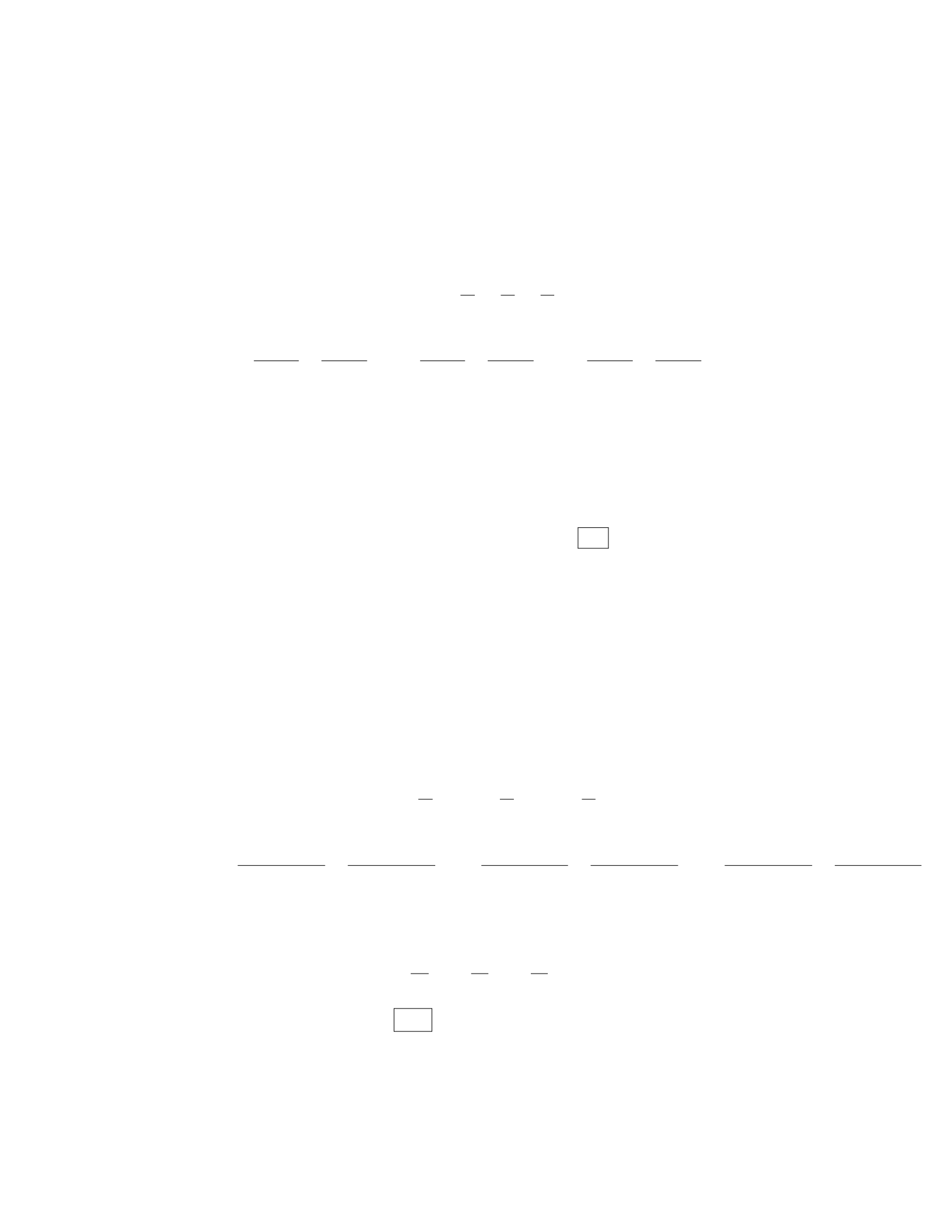
∇ × F=
i j k
∂
∂x
∂
∂y
∂
∂z
P Q R
6
Given F(x, y, z)=4xyi+ 3xzj+ 5yzk, the components of Fare P(x, y, z) =
4xy,Q(x, y, z)=3xz, and R(x, y, z)=5yz.
Step 1: Calculate the curl of F.
∇ × F=
i j k
∂
∂x
∂
∂y
∂
∂z
4xy 3xz 5yz
=∂(5yz)
∂y −∂(3xz)
∂z i−∂(5yz)
∂x −∂(4xy)
∂z j+∂(3xz)
∂x −∂(4xy)
∂y k
= (5z−3)i−(−5y)j+ (3z)k
Step 2: Evaluate the curl of Fat the point P(2,−1,3). At the point
P(2,−1,3), plug in x= 2, y=−1, and z= 3 into the components of the
curl.
∇ × F= (5(3) −3)i−(−5(−1))j+ (3(3))k
= 12i−5j+ 9k
Therefore, the curl of Fat the point P(2,−1,3) is 12i−5j+ 9k.
Question 10
Question
Let F(x, y, z) = (2xz2+y3)i+ (3x2z+ 2y)j+ (2x2y+ 3z)kbe a vector field.
Calculate ∇ · ∇ × F.
Solution
Step 1: Calculate the curl of F.
∇ × F=
i j k
∂
∂x
∂
∂y
∂
∂z
2xz2+y33x2z+ 2y2x2y+ 3z
=∂(2x2y+ 3z)
∂y −∂(3x2z+ 2y)
∂z i−∂(2xz2+y3)
∂x −∂(2x2y+ 3z)
∂z j+∂(3x2z+ 2y)
∂x −∂(2xz2+y3)
∂y k
= (2x2−2x2)i−(2z−2z)j+ (6xz −3y2)k=−3y2k
Step 2: Calculate the divergence of the curl.
∇ · −3y2k=∂
∂x (0) + ∂
∂y (0) + ∂
∂z (−3y2) = −6y
Therefore, ∇ · ∇ × F=−6y.
7
Question 11
Question
Let F(x, y, z) = x2yi+xy2j+xyzkbe a vector field in R3. Compute the
divergence of Fat the point (1,2,−1).
Solution
Step 1: The divergence of a vector field F(x, y, z) = P(x, y, z)i+Q(x, y, z)j+
R(x, y, z)kis given by:
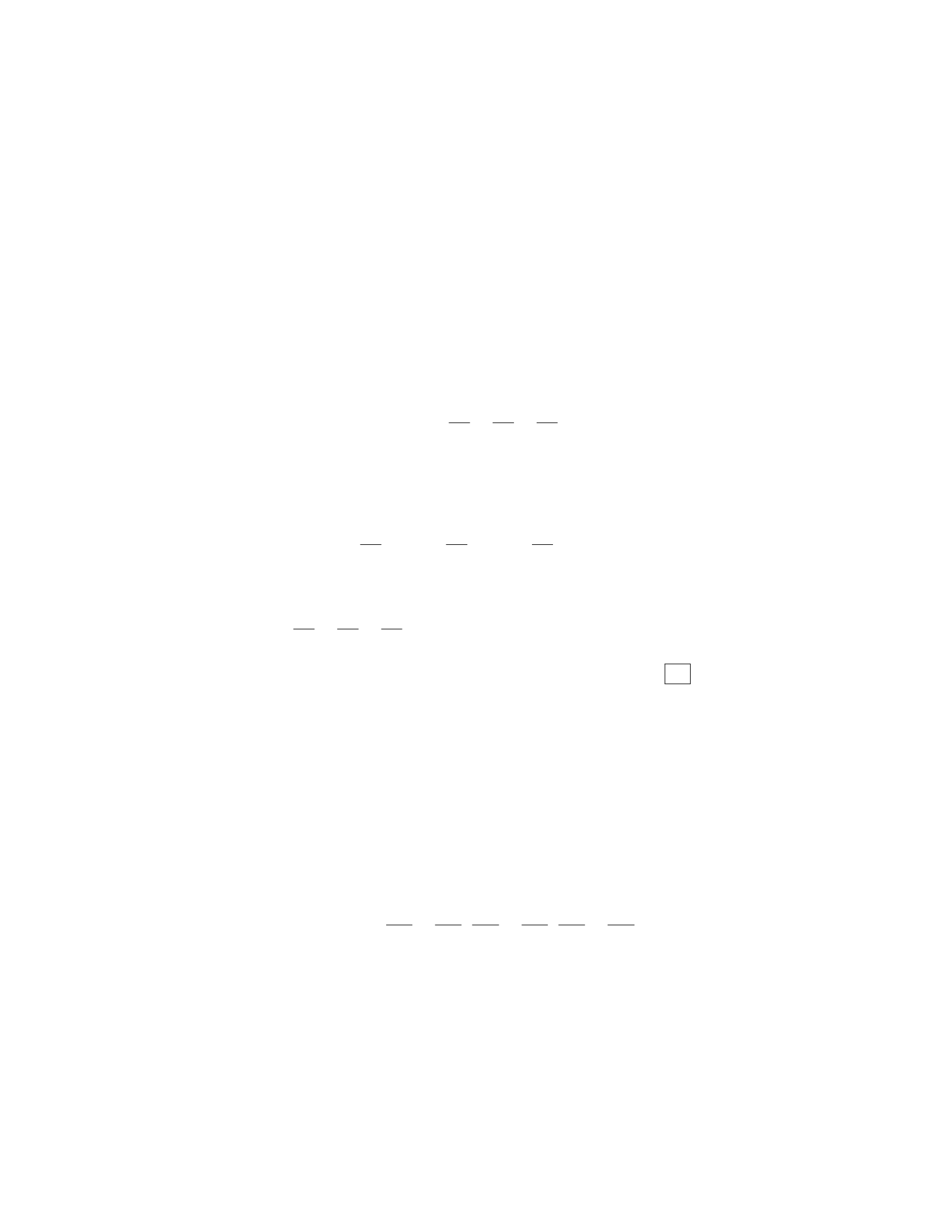
div F=∂P
∂x +∂Q
∂y +∂R
∂z
Step 2: Given F(x, y, z) = x2yi+xy2j+xyzk, we have P(x, y, z) = x2y,
Q(x, y, z) = xy2, and R(x, y, z) = xyz.
Step 3: Compute the partial derivatives:
∂P
∂x = 2xy ∂Q
∂y = 2xy ∂R
∂z =xy
Step 4: Compute the divergence of Fat the point (1,2,−1):
div F=∂P
∂x +∂Q
∂y +∂R
∂z = 2(1)(2) + 2(1)(2) + (1)(2) = 6 + 4 + 2 = 12
Step 5: Therefore, the divergence of Fat the point (1,2,−1) is 12 .
Question 12
Question
Let F(x, y)=(exy −ycos(x), x sin(y)−exy). Find the curl of F.
Solution
To find the curl of F, we first need to compute the components of the curl
vector. The curl of Fis given by
curl(F) = ∂Fz
∂y −∂Fy
∂z ,∂Fx
∂z −∂Fz
∂x ,∂Fy
∂x −∂Fx
∂y
8
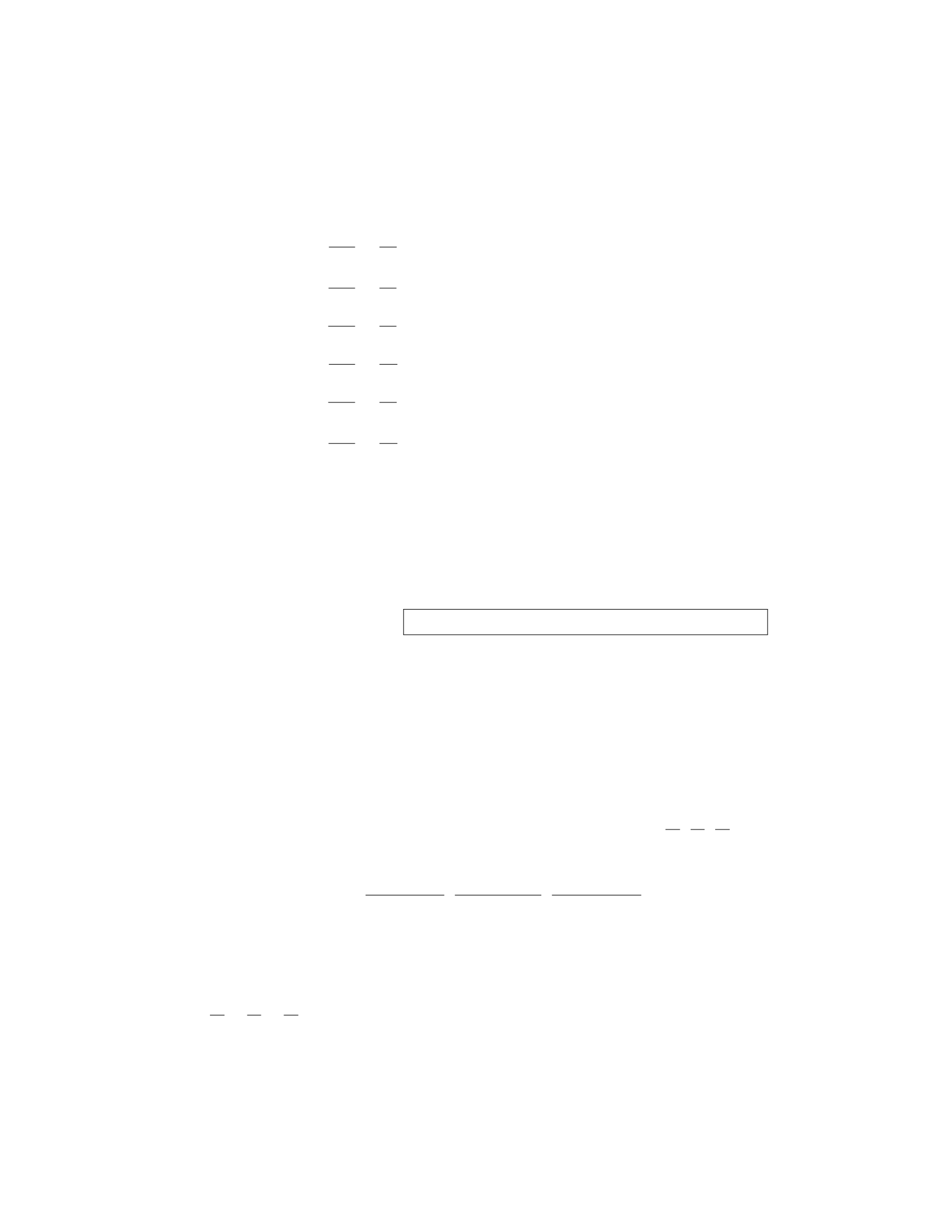
Step 1: Compute the partial derivatives of F.
∂Fz
∂y =∂
∂y (xsin(y)−exy ) = xcos(y)−xexy
∂Fy
∂z =∂
∂z (exy −ycos(x)) = 0
∂Fx
∂z =∂
∂z (ycos(x)) = 0
∂Fz
∂x =∂
∂x (xsin(y)−exy ) = ycos(y)
∂Fx
∂y =∂
∂y (ycos(x)) = −ysin(x)
∂Fy
∂x =∂
∂x (exy −ycos(x)) = yexy + cos(x)
Step 2: Calculate the components of the curl vector.
curl(F)=(xcos(y)−xexy,0−0, y cos(y),−ysin(x), yexy + cos(x))
Step 3: Simplify the components of the curl vector.
curl(F)=(xcos(y)−xexy,0, y cos(y),−ysin(x), yexy + cos(x))
Therefore, the curl of Fis (xcos(y)−xexy ,0, y cos(y),−ysin(x), yexy + cos(x)) .
Question 13
Question
Find the gradient, divergence, and curl of the vector field F= (xey+y2, x2ey−
2y, z cos(xyz)).
Solution
Step 1: The gradient of a vector field F= (f, g, h) is given by ∇f=∂f
∂x ,∂g
∂y ,∂h
∂z .
Step 2: For the given vector field F, its gradient ∇ · Fis:
∇ · F=∂(xey+y2)
∂x ,∂(x2ey−2y)
∂y ,∂(zcos(xyz))
∂z
Step 3: Calculating the partial derivatives, we have:
∇ · F= (ey, x2ey−2,cos(xyz))
Step 4: The divergence of a vector field F= (f, g, h) is given by ∇ · F=
∂f
∂x +∂g
∂y +∂h
∂z .
Step 5: Therefore, the divergence of the vector field Fis:
9
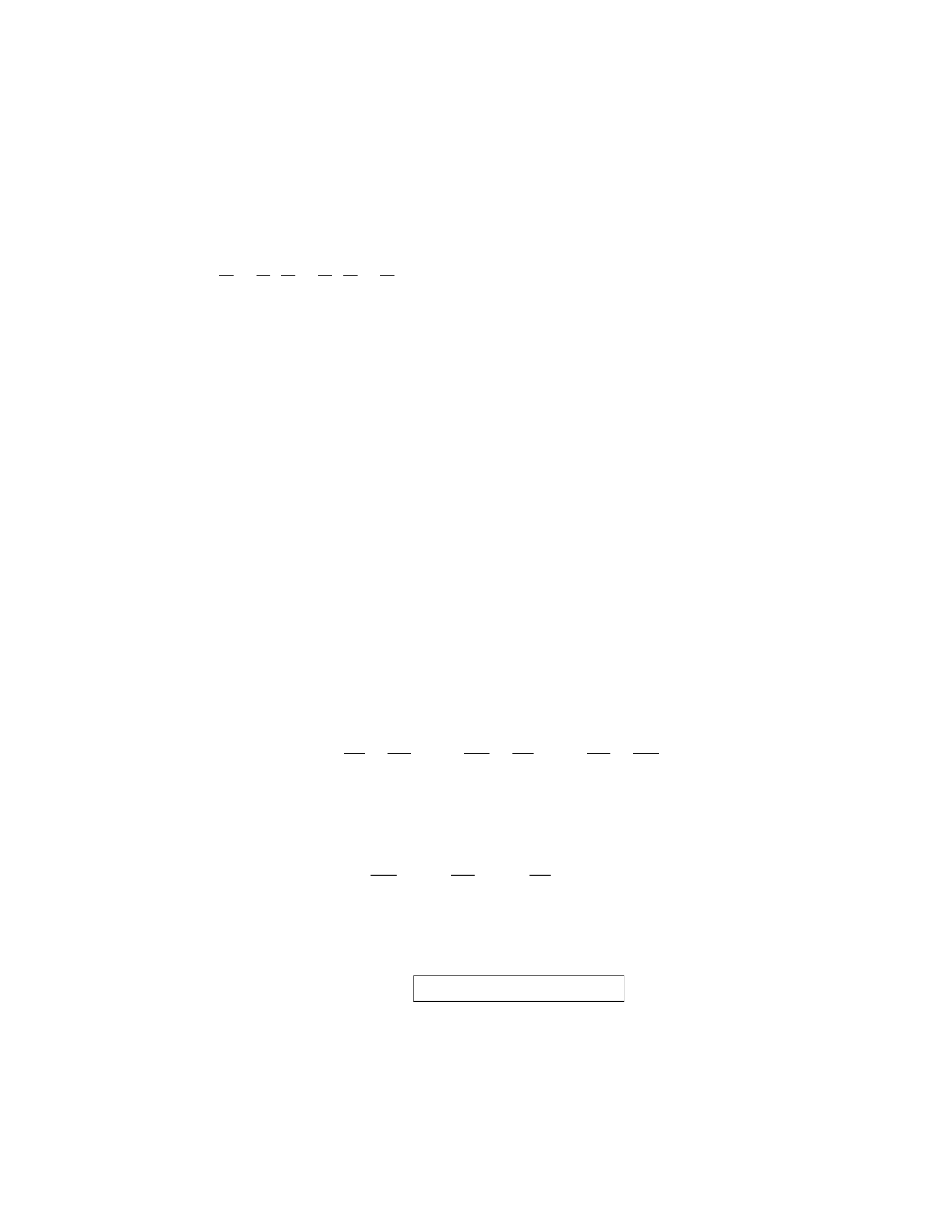
∇ · F=ey+x2ey−2 + cos(xyz)
Step 6: The curl of a vector field F= (f, g, h) is given by ∇ × F=
∂h
∂y −∂g
∂z ,∂f
∂z −∂h
∂x ,∂g
∂x −∂f
∂y .
Step 7: Calculating the curl of the vector field F, we get:
∇ × F=0−0,0−0, z(−x2yz sin(xyz))
Step 8: Simplifying, we find:
∇ × F= (−z2x2y2sin(xyz),0,0)
Therefore, the gradient, divergence, and curl of the vector field Fare:
Gradient: ∇ · F= (ey, x2ey−2,cos(xyz))
Divergence: ∇ · F=ey+x2ey−2 + cos(xyz)
Curl: ∇ × F= (−z2x2y2sin(xyz),0,0)
Question 14
Question
Let F(x, y, z)=(yz, xz, xy) be a vector field in R3. Calculate the curl of F.
Solution
To find the curl of a vector field F(x, y, z)=(M, N, P ) in R3, we use the formula:
∇ × F=∂P
∂y −∂N
∂z i+∂M
∂z −∂P
∂x j+∂N
∂x −∂M
∂y k
For our vector field F(x, y, z)=(yz, xz, xy), we have M=yz,N=xz, and
P=xy.
Step 1: Calculate the partial derivatives
∂M
∂z =y, ∂N
∂x =z, ∂P
∂y =x
Step 2: Calculate the curl
∇ × F= (x−z)i+ (y−x)j+ (z−y)k
Therefore, the curl of Fis (x−z)i+ (y−x)j+ (z−y)k.
10
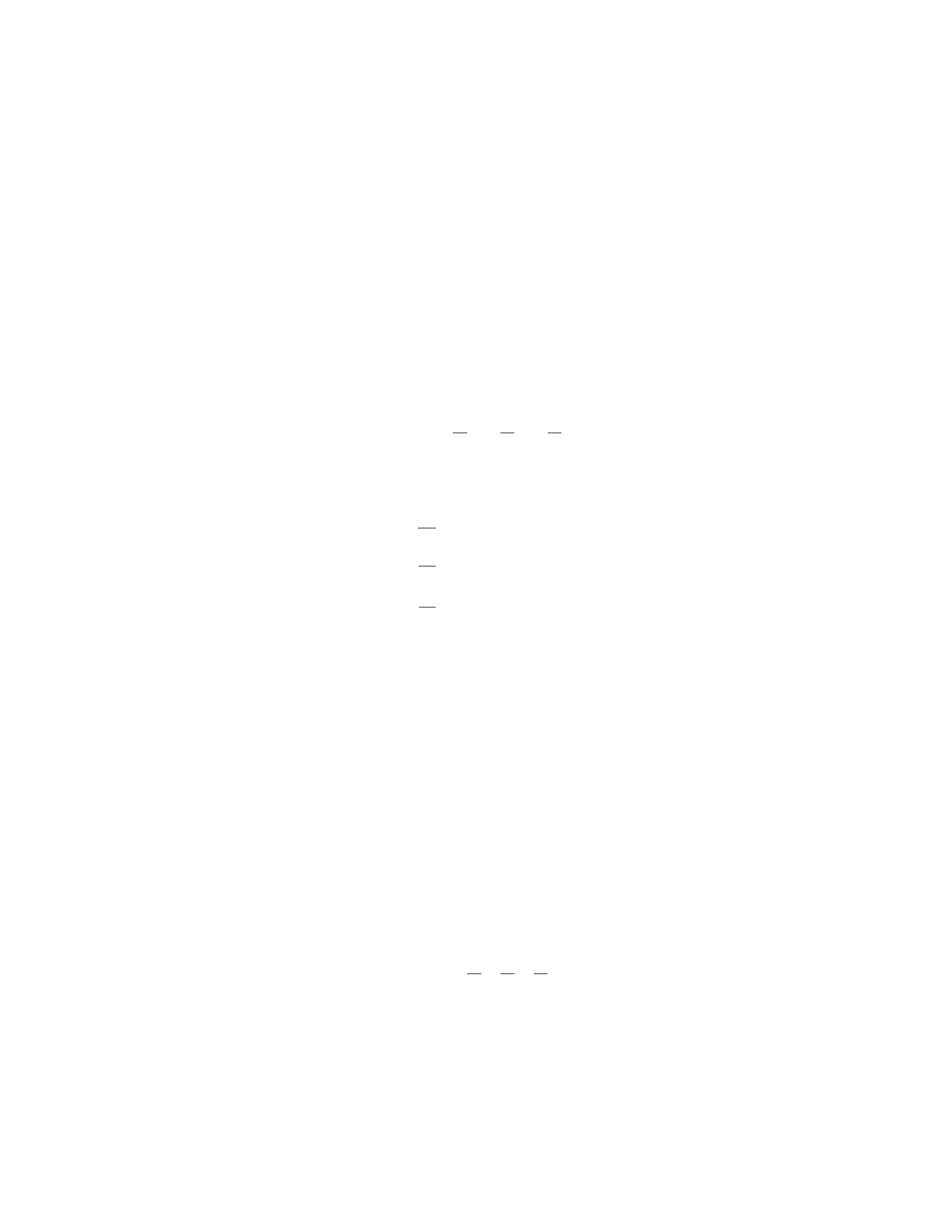
Question 15
Question
Let F(x, y, z) = x2yzi+xyz2j+xy2zkbe a vector field. Calculate the curl of
F.
Solution
To find the curl of F, denoted by ∇ × F, we need to compute the determinant
of the following matrix:
∇ × F=
i j k
∂
∂x
∂
∂y
∂
∂z
x2yz xyz2xy2z
Step 1: Compute the partial derivatives of the components of F.
∂
∂x (x2yz)=2xyz
∂
∂y (xyz2) = xz2
∂
∂z (xy2z) = xy2
Step 2: Plug these derivatives into the determinant to find the curl.
∇ × F=
i j k
2xyz xz2xy2
= (xz2−xy2)i−(2xyz)j+ (2y−z2)k
Therefore, the curl of Fis ∇ × F= (xz2−xy2)i−(2xyz)j+ (2y−z2)k.
Question 16
Question
Let F(x, y, z) = x2ezi+ 2yezj+xyzk. Find the curl of F.
Solution
To find the curl of F, we use the formula:
∇ × F=
i j k
∂
∂x
∂
∂y
∂
∂z
FxFyFz
where Fx, Fy, Fzare the components of F.
11
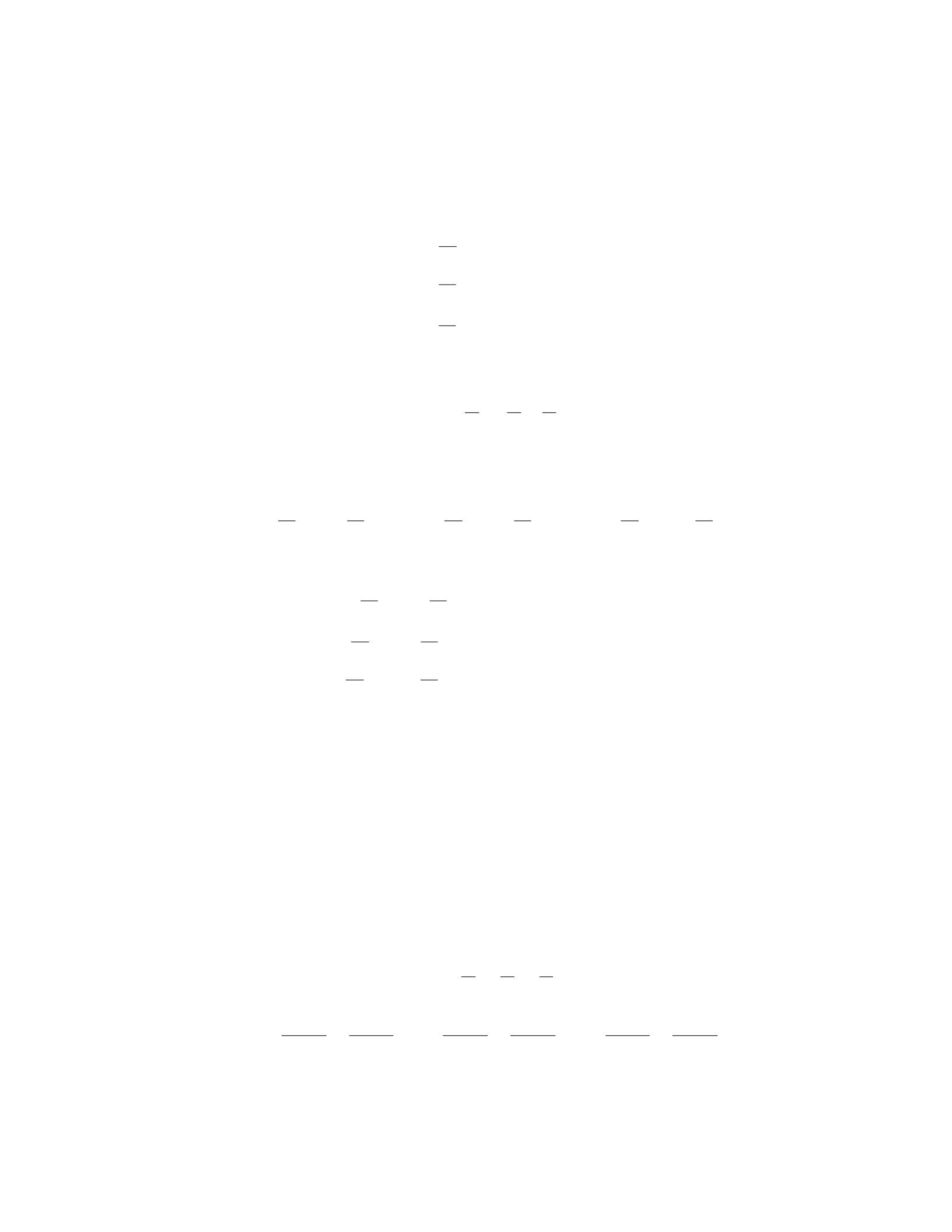
Step 1: Compute Fx,Fy, and Fz.
Fx=∂
∂x (x2ez)=2xez
Fy=∂
∂y (2yez)=2ez
Fz=∂
∂z (xyz) = xy
Step 2: Now, evaluate the determinant for the curl.
∇ × F=
i j k
∂
∂x
∂
∂y
∂
∂z
2xez2ezxy
Step 3: Expand the determinant using the cofactor expansion along the top
row.
∇×F=∂
∂y (xy)−∂
∂z (2ez)i−∂
∂x (xy)−∂
∂z (2xez)j+∂
∂x (2ez)−∂
∂y (2xez)k
Step 4: Compute the partial derivatives.
∂
∂y (xy)−∂
∂z (2ez) = x−0 = x
∂
∂x (xy)−∂
∂z (2xez) = y−0 = y
∂
∂x (2ez)−∂
∂y (2xez)=0−2ez=−2ez
Step 5: Therefore, the curl of Fis:
∇ × F=xi+yj−2ezk
Question 17
Question
Let F(x, y, z) = x2yi+y2zj+z2xk. Calculate ∇ · (∇ × F).
Solution
Step 1: Find ∇ × F:
∇ × F=
i j k
∂
∂x
∂
∂y
∂
∂z
x2y y2z z2x
∇ × F=∂(z2x)
∂y −∂(y2z)
∂z i−∂(z2x)
∂x −∂(x2y)
∂z j+∂(y2z)
∂x −∂(x2y)
∂y k
12
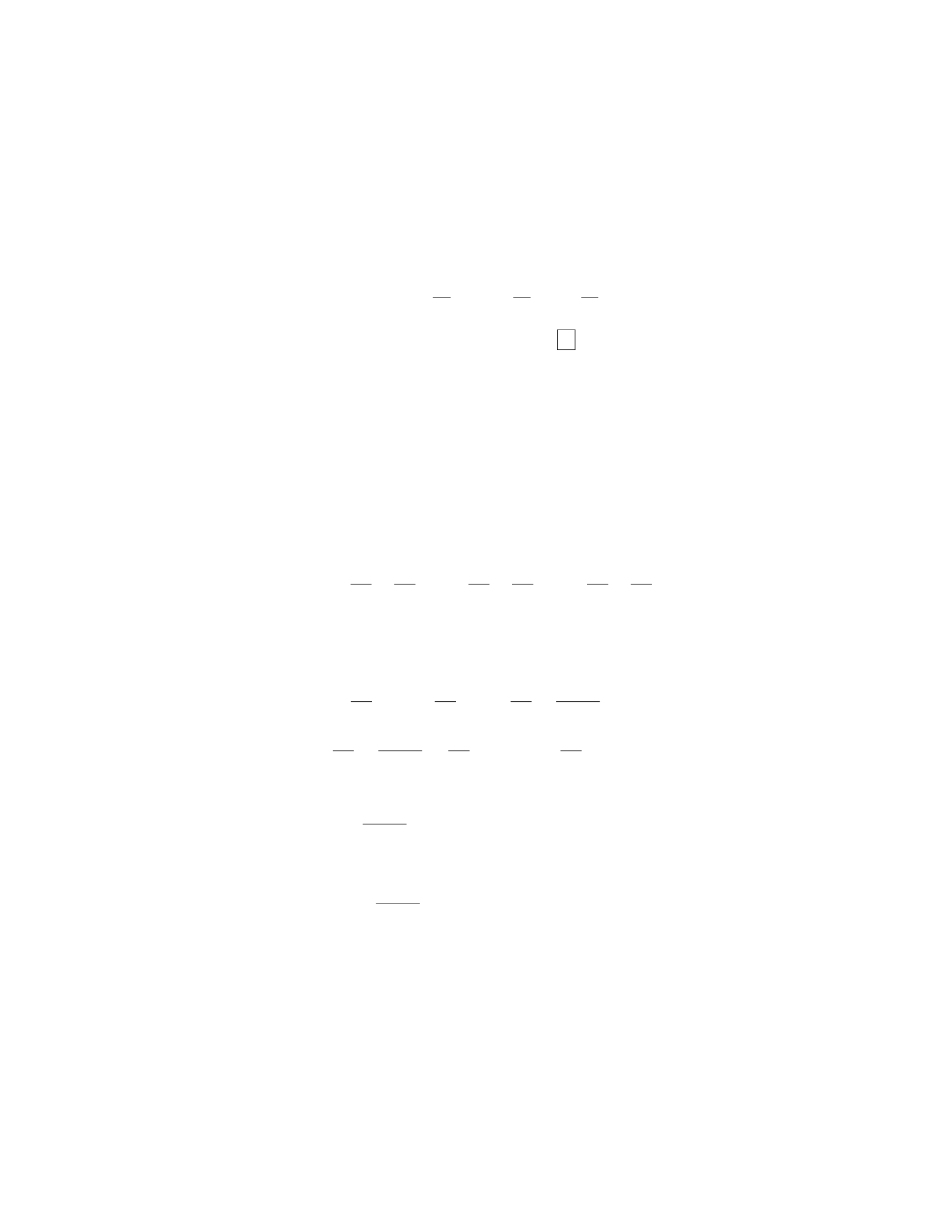
∇ × F= (2z−2z)i−(2z−2y)j+ (2y−2x)k
∇ × F= 0i−2yj+ 2yk=−2yj+ 2yk
Step 2: Find ∇ · (∇ × F):
∇ · (∇ × F) = ∂
∂x (−2y) + ∂
∂y (2y) + ∂
∂z (0)
∇ · (∇ × F) = 0 + 2 + 0 = 2
Question 18
Question
Let F(x, y, z)=(x2+y2+z2)i+exyzj+ ln(xy +z)k. Calculate the curl of F.
Solution
To find the curl of a vector field F(x, y, z) = P(x, y, z)i+Q(x, y, z)j+R(x, y, z)k,
we use the formula:
∇ × F=∂R
∂y −∂Q
∂z i−∂R
∂x −∂P
∂z j+∂Q
∂x −∂P
∂y k
Given F(x, y, z) = (x2+y2+z2)i+exyzj+ln(xy +z)k, we have: P(x, y, z) =
x2+y2+z2,Q(x, y, z) = exyz, and R(x, y, z) = ln(xy +z).
Step 1: Calculate the partial derivatives:
∂P
∂y = 2y, ∂Q
∂z = 0,∂R
∂y =x
xy +z
∂R
∂z =1
xy +z,∂Q
∂x =yzexyz ,∂P
∂z = 2z
Step 2: Plug the partial derivatives into the curl formula:
∇ × F=x
xy +z−0i−(2z−yzexyz)j+ (2y−2z)k
Hence, the curl of Fis given by:
∇ × F=x
xy +zi−(2z−yzexyz)j+ (2y−2z)k
Question 19
Question
Let F(x, y, z) = (2xy+xz, x2+y2+z2, yz +yz) be a vector field in R3. Calculate
∇ · ∇ × F.
13
Solution
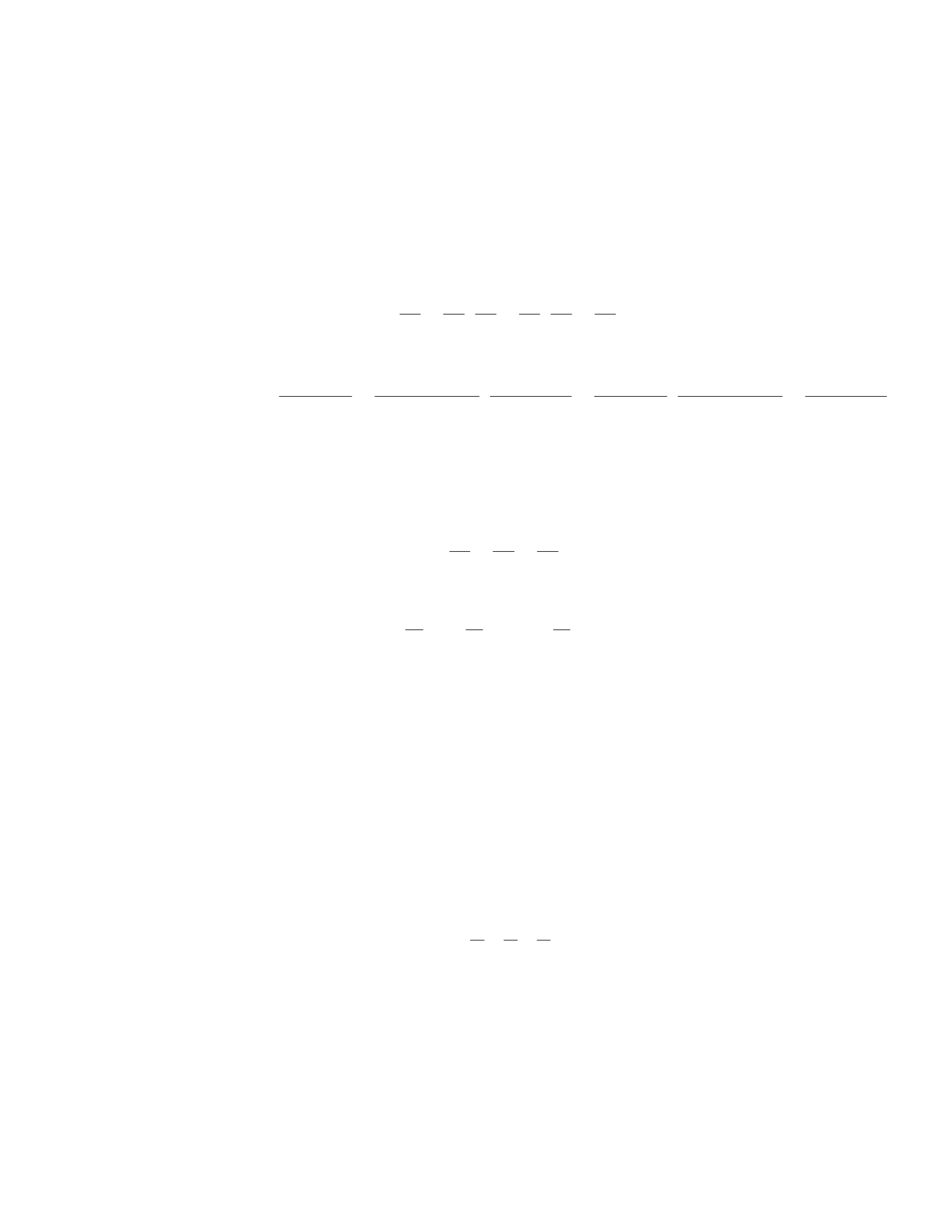
To find ∇ · ∇ × Fwhere Fis a vector field in R3, we first need to calculate
∇ × F.
Step 1: Calculate ∇ × FThe curl of a vector field F= (P, Q, R) is defined
as:
∇ × F=∂R
∂y −∂Q
∂z ,∂P
∂z −∂R
∂x ,∂Q
∂x −∂P
∂y
In this case, F(x, y, z) = (2xy +xz, x2+y2+z2, yz +xz), so:
∇×F=∂(yz +xz)
∂y −∂(x2+y2+z2)
∂z ,∂(2xy +xz)
∂z −∂(yz +xz)
∂x ,∂(x2+y2+z2)
∂x −∂(2xy +xz)
∂y
Calculating the partial derivatives and simplifying, we get:
∇ × F= (1, x −1,−y)
Step 2: Calculate ∇·∇×FThe divergence of a vector field G= (A, B, C)
is given by:
∇ · G=∂A
∂x +∂B
∂y +∂C
∂z
In this case, G= (1, x −1,−y), so:
∇ · G=∂
∂x (1) + ∂
∂y (x−1) + ∂
∂z (−y)
∇ · G= 0
Therefore, ∇ · ∇ × F= 0.
Question 20
Question
Let F(x, y, z) = xzi+yzj+xykbe a vector field in R3. Determine curl(F).
Solution
Step 1: The curl of a vector field F=Pi+Qj+Rkin R3is given by the
determinant
curl(F) =
i j k
∂
∂x
∂
∂y
∂
∂z
P Q R
where P,Q, and Rare the components of F.
Step 2: In our case, F(x, y, z) = xzi+yzj+xyk, so P=xz,Q=yz, and
R=xy.
14
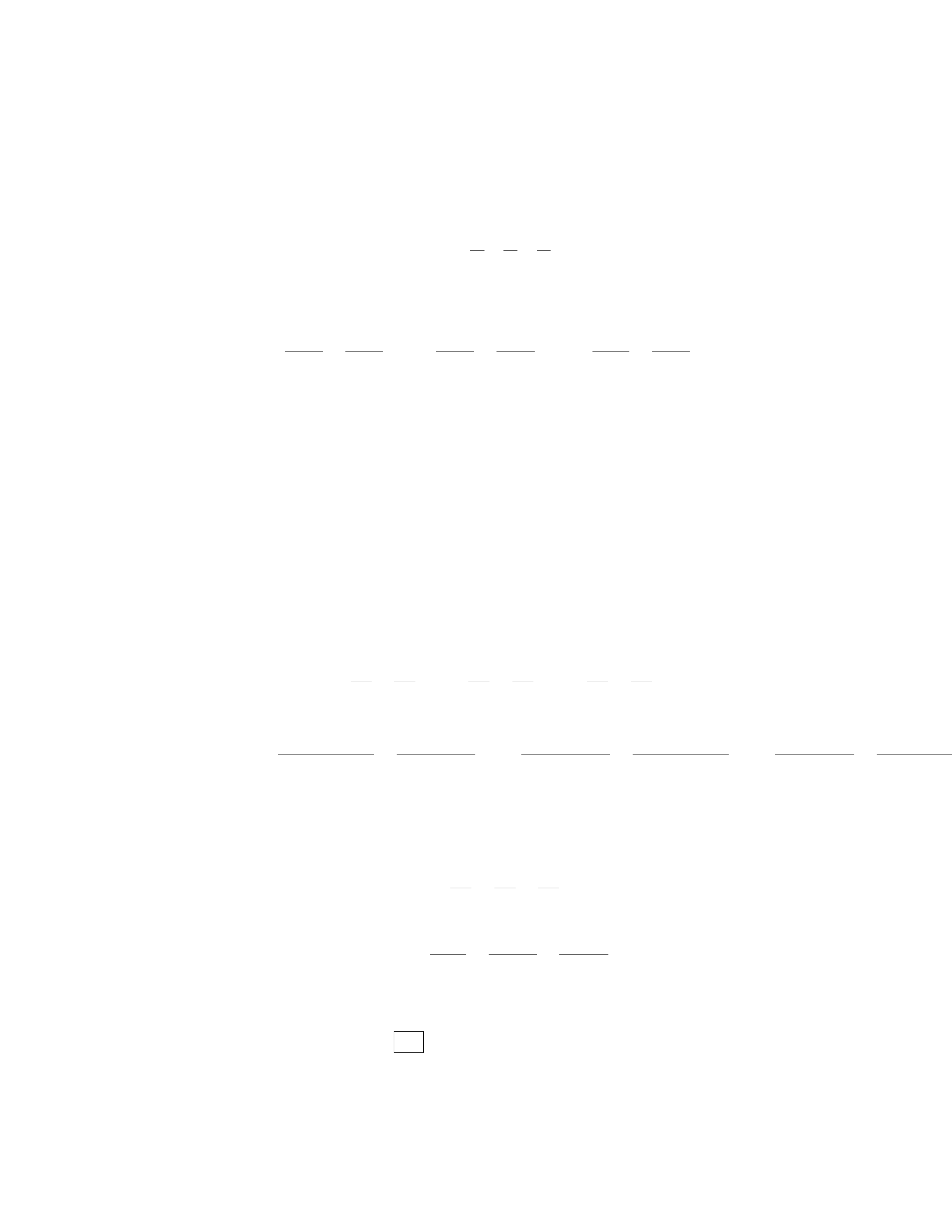
Step 3: Compute the curl of Fby evaluating the determinant:
curl(F) =
i j k
∂
∂x
∂
∂y
∂
∂z
xz yz xy
Step 4: Calculate the determinant using the cofactor expansion along the
top row:
=i∂(xy)
∂y −∂(yz)
∂z −j∂(xz)
∂x −∂(xy)
∂z +k∂(yz)
∂x −∂(xz)
∂y
Step 5: Simplify the expressions:
=i(x−z)−j(z) + k(y) = (x−z)i−zj+yk
Therefore, curl(F)=(x−z)i−zj+yk.
Question 21
Question
Let F(x, y, z) = (2xy +x2z)i+ (x2+y2z)j+ (xyz2+ 2yz)k. Calculate ∇ · ∇ × F.
Solution
Step 1: Calculate ∇ × F. The curl of a vector field F(x, y, z) = P(x, y, z)i+
Q(x, y, z)j+R(x, y, z)kis defined as:
∇ × F=∂R
∂y −∂Q
∂z i+∂P
∂z −∂R
∂x j+∂Q
∂x −∂P
∂y k
For F(x, y, z) = (2xy +x2z)i+ (x2+y2z)j+ (xyz2+ 2yz)k, we have:
∇×F=∂(xyz2+ 2yz)
∂y −∂(x2+y2z)
∂z i+∂(2xy +x2z)
∂z −∂(xyz2+ 2yz)
∂x j+∂(x2+y2z)
∂x −∂(2xy +x2z)
∂y k
Calculating the partial derivatives, we get:
∇ × F= (z2)i−(z2)j−(2y)k
Step 2: Calculate ∇·∇×F. The divergence of a vector field G=Pi+Qj+Rk
is given by:
∇ · G=∂P
∂x +∂Q
∂y +∂R
∂z
For ∇ · ∇ × F, we have:
∇ · ∇ × F=∂(z2)
∂x +∂(−z2)
∂y +∂(−2y)
∂z
Calculating the partial derivatives, we get:
∇ · ∇ × F= 0 + 0 −2
Therefore, ∇ · ∇ × F=−2 .
15
Question 22
Question
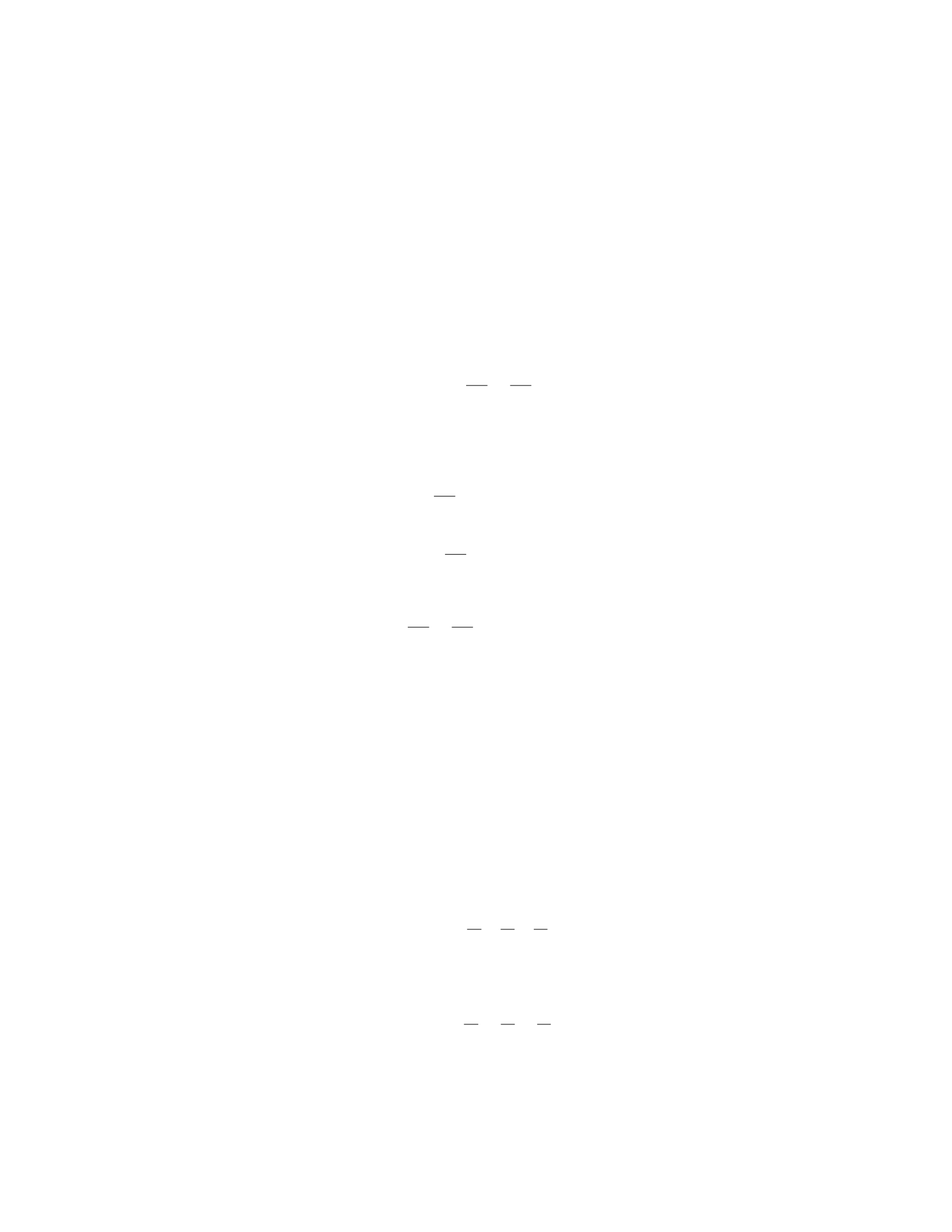
Let F(x, y) = eyi+xcos(y)jbe a vector field in R2. Calculate the curl of F.
Solution
To compute the curl of a vector field F(x, y) = P(x, y)i+Q(x, y)jin R2, we use
the formula
curl F=∂Q
∂x −∂P
∂y k.
Step 1: Identify P(x, y) and Q(x, y) from F. Here, P(x, y) = eyand
Q(x, y) = xcos(y).
Step 2: Compute the partial derivatives needed for the formula:
∂Q
∂x = cos(y)
and ∂P
∂y =ey.
Step 3: Substitute the partial derivatives into the formula for the curl:
curl F=∂Q
∂x −∂P
∂y k= (cos(y)−ey)k.
Thus, the curl of Fis (cos(y)−ey)k.
Question 23
Question
Let F(x, y, z)=2xyi+yzj+x2zk. Compute the curl of F.
Solution
To compute the curl of F, we will use the determinant form of the curl for a
vector field F(x, y, z) = P(x, y, z)i+Q(x, y, z)j+R(x, y, z)k, where the curl is
given by:
∇ × F=
i j k
∂
∂x
∂
∂y
∂
∂z
P Q R
Step 1: Calculate the curl of Fusing the determinant form:
∇ × F=
i j k
∂
∂x
∂
∂y
∂
∂z
2xy yz x2z
16
Step 2: Expand the determinant along the top row:
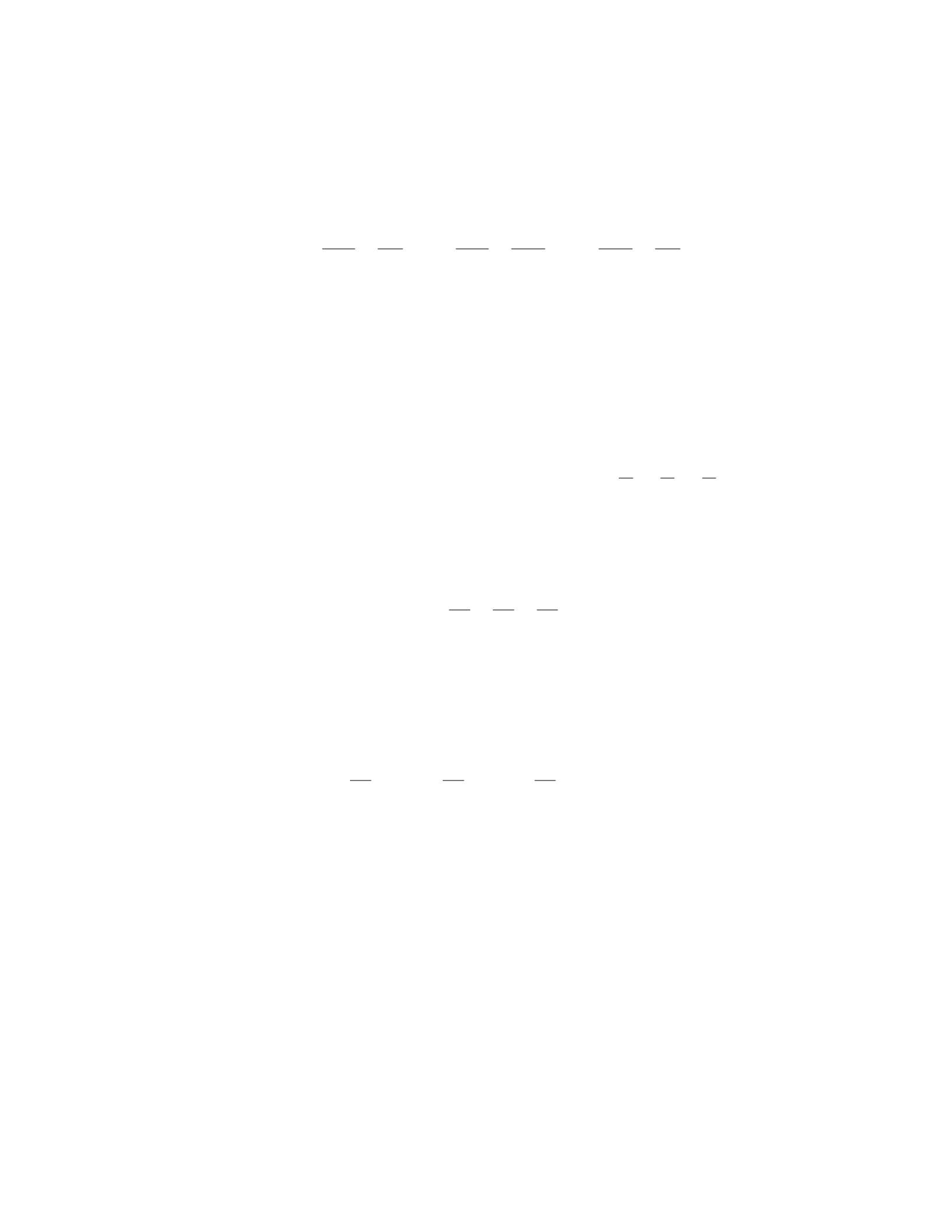
∇ × F=∂x2z
∂y −∂yz
∂z i−∂x2z
∂x −∂2xy
∂z j+∂2xy
∂x −∂yz
∂y k
Step 3: Compute the partial derivatives:
∇ × F=x2−yi−x2j+ 2yk
Therefore, the curl of Fis x2−yi−x2j+ 2yk.
Question 24
Question
Let F(x, y, z) = x2yi+y2zj+z2xk. Find ∇ · F, where ∇=∂
∂x i+∂
∂y j+∂
∂z kis
the gradient operator.
Solution
Step 1: Calculate the components of ∇ · Fusing the formula:
∇ · F=∂P
∂x +∂Q
∂y +∂R
∂z
where F(x, y, z) = Pi+Qj+Rk.
Step 2: Identify the components of F(x, y, z):
P(x, y, z) = x2y, Q(x, y, z) = y2z, R(x, y, z) = z2x
Step 3: Find the partial derivatives of P,Q, and Rwith respect to x,y, and
z:∂P
∂x = 2xy, ∂Q
∂y = 2yz, ∂R
∂z = 2zx
Step 4: Substitute the partial derivatives into the formula for ∇ · F:
∇ · F= 2xy + 2yz + 2zx = 2xy + 2yz + 2xz
Therefore, the divergence of Fis 2xy + 2yz + 2xz.
Question 25
Question
Let F(x, y, z) = 2x2y+y3z, x2z, 2xy2z. Find the gradient, divergence, and
curl of F.
17
Solution
Step 1: Find the gradient of F. The gradient of a vector field Fis given by:
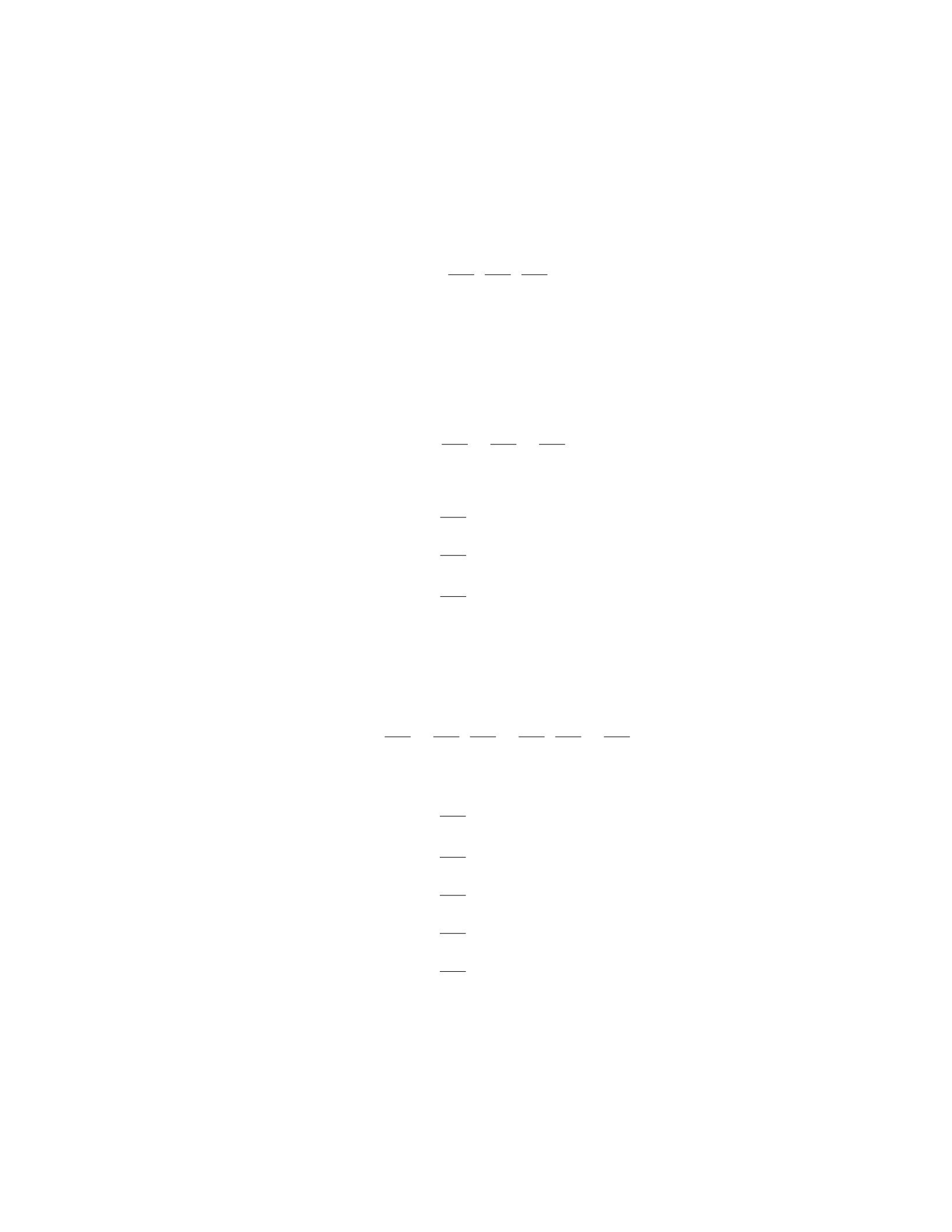
∇F=∂F1
∂x ,∂F2
∂y ,∂F3
∂z
where F= (F1, F2, F3).
So, for F(x, y, z) = 2x2y+y3z, x2z, 2xy2z, the gradient is:
∇F=4xy, x2+ 3y2z, 2y2z
Step 2: Find the divergence of F. The divergence of a vector field Fis given
by:
∇ · F=∂F1
∂x +∂F2
∂y +∂F3
∂z
Computing the partial derivatives, we have:
∂F1
∂x = 4y
∂F2
∂y = 2yz
∂F3
∂z = 2y2
Therefore, the divergence of Fis:
∇ · F= 4y+ 2yz + 2y2
Step 3: Find the curl of F. The curl of a vector field Fis given by:
∇ × F=∂F3
∂y −∂F2
∂z ,∂F1
∂z −∂F3
∂x ,∂F2
∂x −∂F1
∂y
Calculating the partial derivatives, we get:
∂F3
∂y = 4xz
∂F2
∂z =x2
∂F1
∂z = 0
∂F3
∂x = 0
∂F1
∂y = 2x2
Thus, the curl of Fis:
∇ × F= (4xz −x2,0,2x2)
18
Question 26
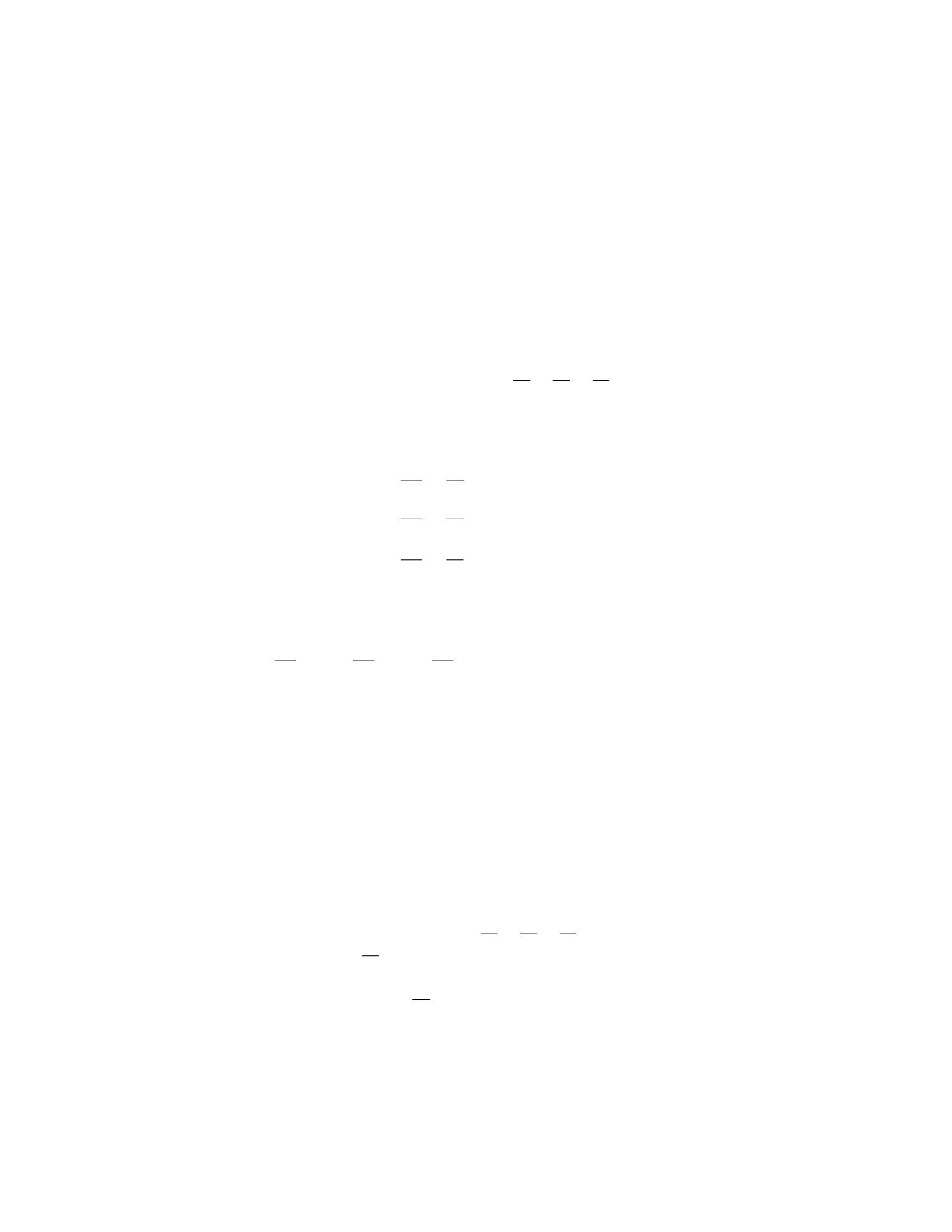
Question
Let F(x, y, z) = x2yi+xyzj+y2zkbe a vector field in R3. Calculate the
divergence of Fat the point (1,2,3).
Solution
Step 1: The divergence of a vector field F(x, y, z) = P(x, y, z)i+Q(x, y, z)j+
R(x, y, z)kis given by the formula div(F) = ∂P
∂x +∂Q
∂y +∂R
∂z .
Step 2: Given F(x, y, z) = x2yi+xyzj+y2zk, we can see that P(x, y, z) =
x2y,Q(x, y, z) = xyz, and R(x, y, z) = y2z.
Step 3: Calculate the partial derivatives:
∂P
∂x =∂
∂x (x2y)=2xy,
∂Q
∂y =∂
∂y (xyz) = xz,
∂R
∂z =∂
∂z (y2z) = y2.
Step 4: Now, find the divergence of Fat the point (1,2,3) by evaluating the
partial derivatives at that point:
div(F) = ∂P
∂x
(1,2,3)
+∂Q
∂y
(1,2,3)
+∂R
∂z
(1,2,3)
= (2·1·2)+(1·3)+(22) = 4+3+4 = 11.
Therefore, the divergence of Fat the point (1,2,3) is 11.
Question 27
Question
Let F(x, y, z) = (2xy + 3z)i+ (x2+ 3yz)j+ (3xz)k. Compute the divergence of
F.
Solution
To compute the divergence of a vector field F(x, y, z) = P(x, y, z)i+Q(x, y, z)j+
R(x, y, z)k, we use the formula ∇ · F=∂P
∂x +∂Q
∂y +∂R
∂z .
Step 1: Compute ∂P
∂x .
∂
∂x (2xy + 3z) = 2y
19
Step 2: Compute ∂Q
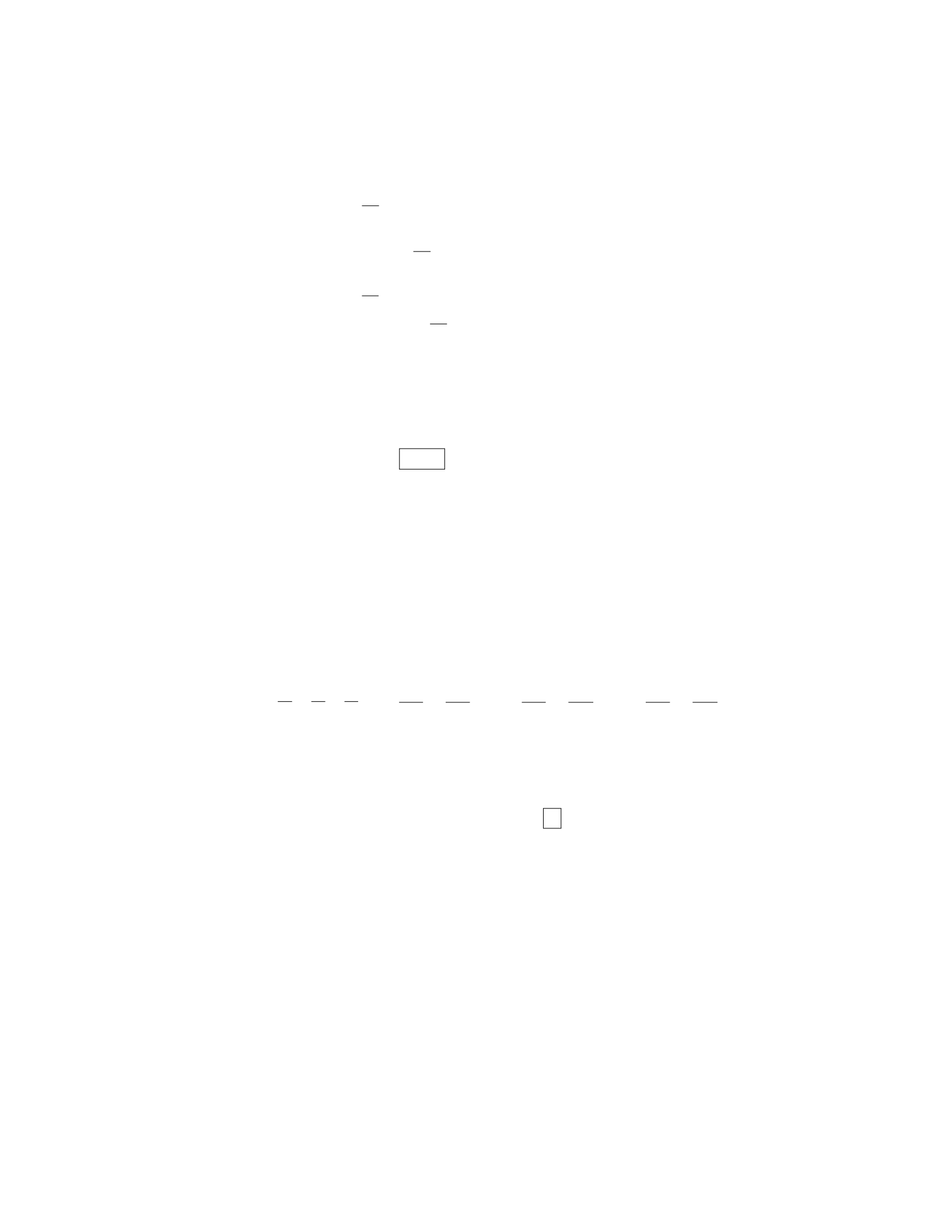
∂y .
∂
∂y (x2+ 3yz)=3z
Step 3: Compute ∂R
∂z .
∂
∂z (3xz)=3x
Step 4: Add the three partial derivatives to find the divergence.
∇ · F= 2y+ 3z+ 3x
Step 5: Simplify the expression.
∇ · F= 3x+ 2y+ 3z
Question 28
Question
Let F=x2i+y2j+z2k. Compute ∇ · (∇ × F).
Solution
Step 1: Compute ∇ × F.
∇ × F=
i j k
∂
∂x
∂
∂y
∂
∂z
x2y2z2
=∂z2
∂y −∂y2
∂z i−∂z2
∂x −∂x2
∂z j+∂y2
∂x −∂x2
∂y k
= 0 −0i−0+0j+ 0 −0k=0
Step 2: Compute ∇ · (∇ × F).
∇ · (∇ × F) = ∇ · 0= 0
Therefore, ∇ · (∇ × F) = 0.
Question 29
Question
Let F(x, y, z) = x2yi+yexz j+xzk. Calculate ∇ · ∇ × F.
20
Solution
To calculate ∇·∇×F, we first need to find ∇ × Fand then take the divergence
of that result.
Step 1: Find ∇ × FThe curl of Fis given by:
∇ × F=
i j k
∂
∂x
∂
∂y
∂
∂z
x2y yexz xz
Expanding the determinant, we get:
=∂(xz)
∂y −∂(yexz )
∂z i−∂(x2y)
∂x −∂(xz)
∂z j+∂(yexz )
∂x −∂(x2y)
∂y k
Calculating the partial derivatives, we get:
=zi−xj+yexzk
Step 2: Find ∇ · ∇ × FNow, we need to find the divergence of ∇ × F. The
divergence of a vector field G=Pi+Qj+Rkis given by ∇ · G=∂P
∂x +∂Q
∂y +∂R
∂z .
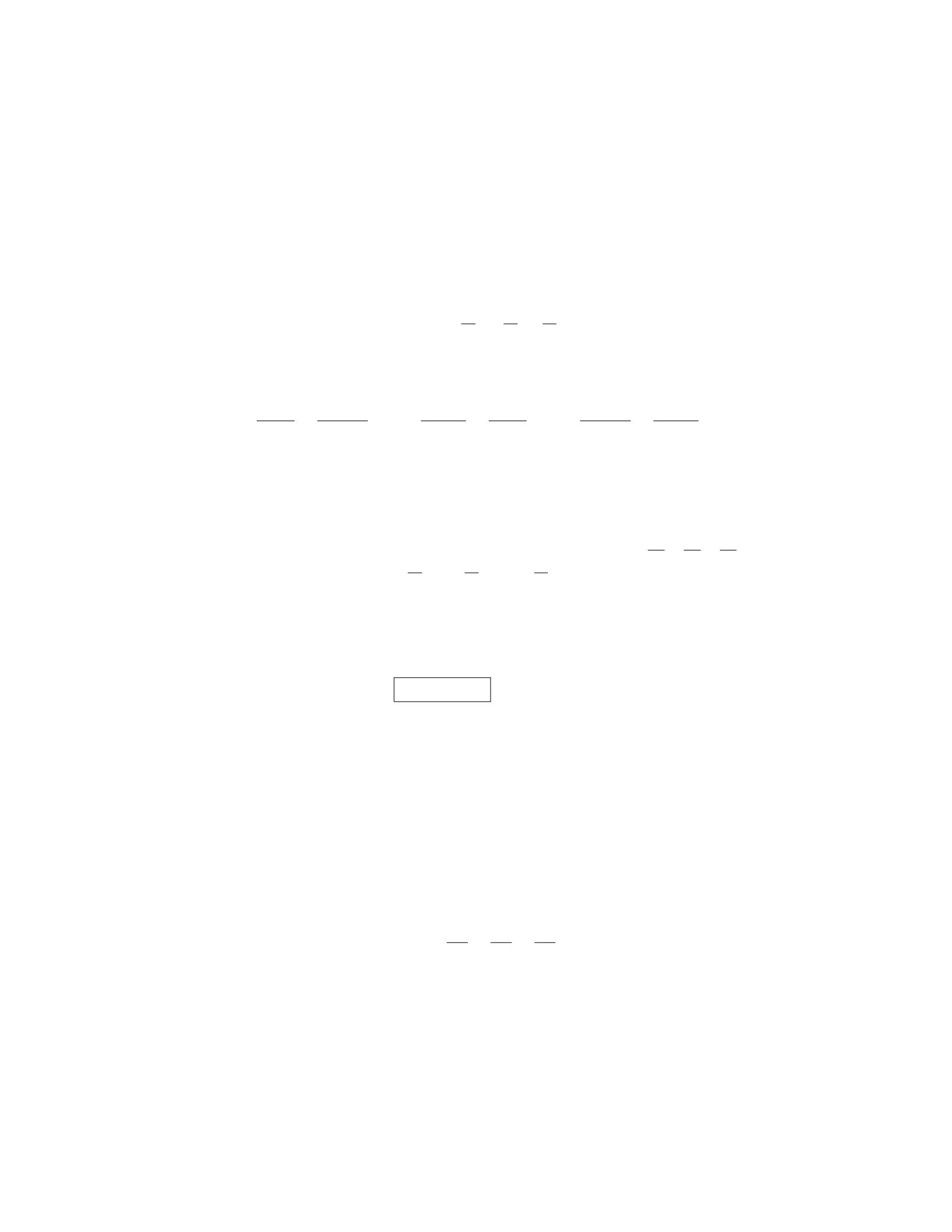
In this case, ∇ · ∇ × F=∂
∂x (z) + ∂
∂y (−x) + ∂
∂z (yexz ).
Calculating the partial derivatives, we get:
= 0 −0 + yexz +xzexz
=yexz +xzexz
Therefore, ∇ · ∇ × F=yexz +xzexz .
Question 30
Question
Let F(x, y, z) = x2i+ 2yzj+ 3z2kbe a vector field. Compute the divergence of
F.
Solution
Step 1: The divergence of a vector field F(x, y, z) = P(x, y, z)i+Q(x, y, z)j+
R(x, y, z)kis given by
div F=∂P
∂x +∂Q
∂y +∂R
∂z .
Step 2: For our given vector field, F(x, y, z) = x2i+ 2yzj+ 3z2k, we have
P(x, y, z) = x2, Q(x, y, z)=2yz, R(x, y, z)=3z2.
21
Question 2
Question
Let F(x, y, z)=(y2z3, x2z3, x2y2) be a vector field. Calculate the divergence of
F.
Solution
To find the divergence of F, we use the formula:
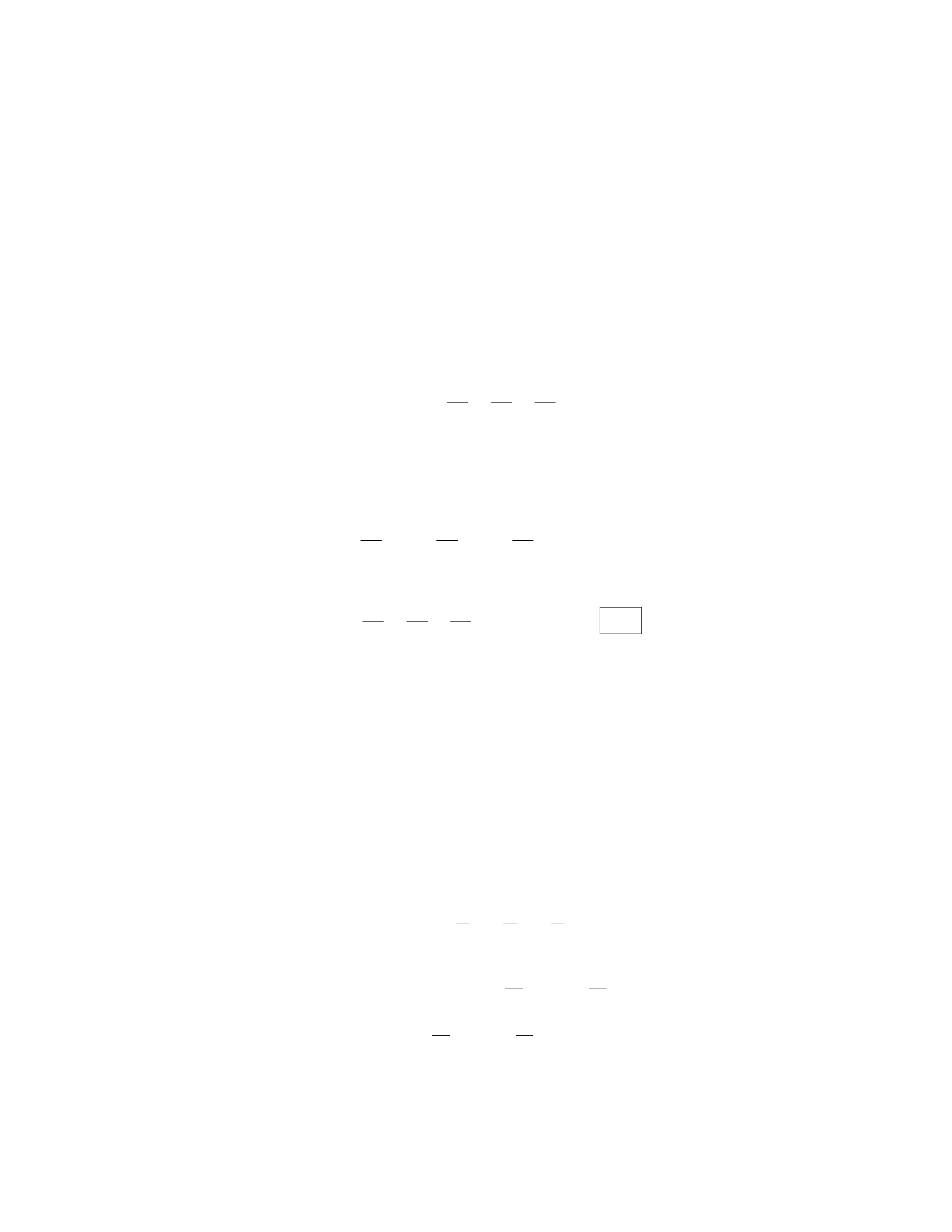
∇ · F=∂P
∂x +∂Q
∂y +∂R
∂z ,
where F(x, y, z)=(P(x, y, z), Q(x, y, z), R(x, y, z)).
Step 1: Identify the components of F:F(x, y, z) = (y2z3, x2z3, x2y2), so
P(x, y, z) = y2z3,Q(x, y, z) = x2z3, and R(x, y, z) = x2y2.
Step 2: Find the partial derivatives:
∂P
∂x = 0,∂Q
∂y = 0,∂R
∂z = 2xy2.
Step 3: Calculate the divergence of F:
∇ · F=∂P
∂x +∂Q
∂y +∂R
∂z = 0 + 0 + 2xy2= 2xy2.
Therefore, the divergence of Fis 2xy2.
Question 3
Question
Let F= 2x2yi+ 3x2zj+ 4xyzk.
Calculate div(curl(F)).
Solution
Step 1: Calculate the curl of F:
curl(F) =
i j k
∂
∂x
∂
∂y
∂
∂z
2x2y3x2z4xyz
curl(F) = (0 −0) i−(0 −0) j+∂
∂x (3x2z)−∂
∂y (2x2y)k
curl(F) = ∂
∂x (3x2z)−∂
∂y (2x2y)k
2
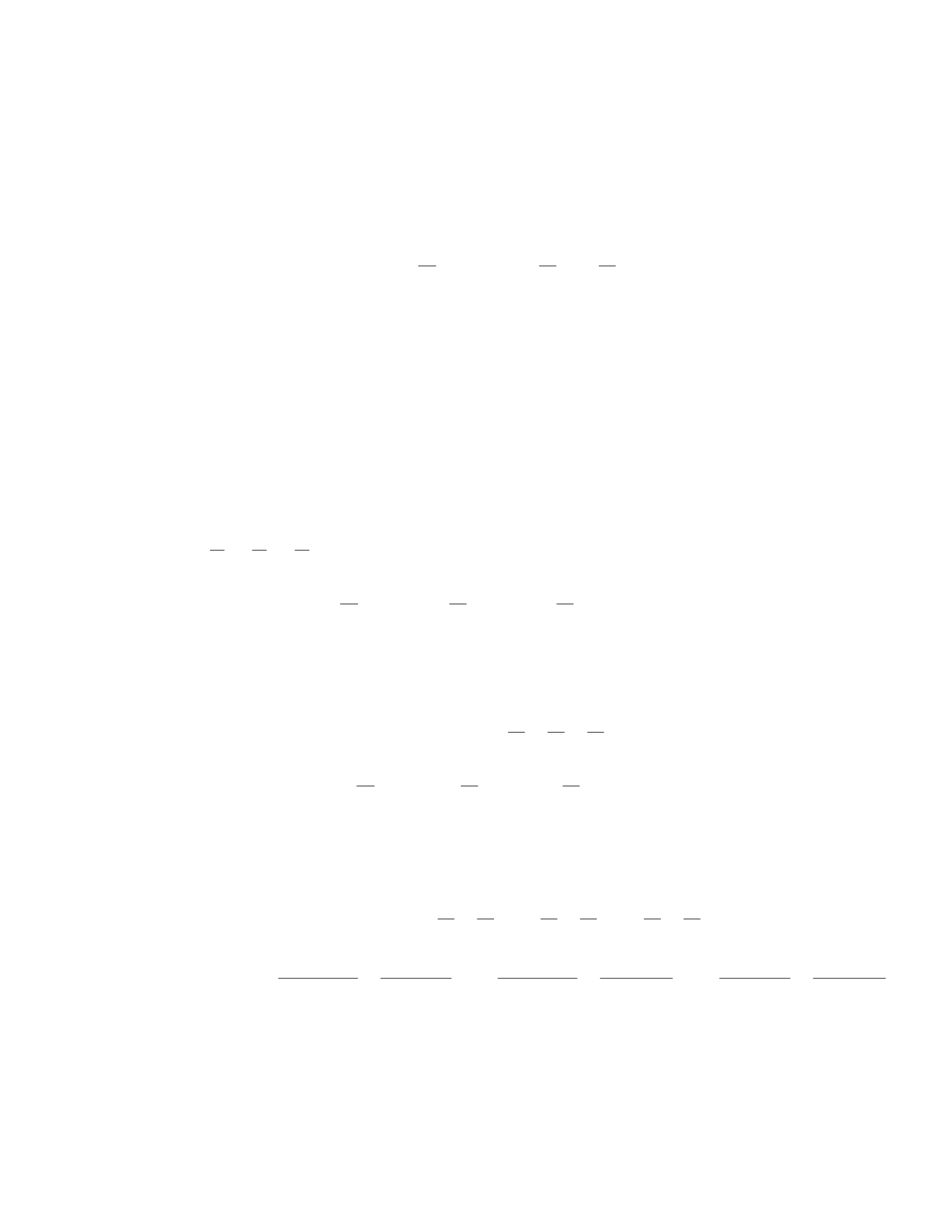
curl(F) = (6xz −4xy)k
Step 2: Calculate the divergence of curl(F):
div(curl(F)) = ∂
∂x (6xz −4xy) + ∂
∂y (0) + ∂
∂z (0)
div(curl(F)) = 6z−4x
Therefore, div(curl(F)) = 6z−4x.
Question 4
Question
Let F(x, y, z) = (2xy +z)i+ (x2+y2)j+ (3yz −x2)k. Find the gradient,
divergence, and curl of F.
Solution
Gradient: Step 1: The gradient of a scalar field f(x, y, z) is given by ∇f=
∂f
∂x i+∂f
∂y j+∂f
∂z k.
Applying this formula to F, we have:
∇f=∂
∂x (2xy +z)i+∂
∂y (x2+y2)j+∂
∂z (3yz −x2)k
Step 2: Computing each partial derivative gives:
∇f= (2y)i+ (2x)j+ (3y)k
Therefore, the gradient of Fis ∇F= (2y)i+ (2x)j+ (3y)k.
Divergence: Step 1: The divergence of a vector field F(x, y, z) = P(x, y, z)i+
Q(x, y, z)j+R(x, y, z)kis given by ∇ · F=∂P
∂x +∂Q
∂y +∂R
∂z .
Applying this formula to F, we have:
∇ · F=∂
∂x (2xy +z) + ∂
∂y (x2+y2) + ∂
∂z (3yz −x2)
Step 2: Computing each partial derivative and adding them together gives:
∇ · F= 2y+ 2x+ 3y= 2x+ 5y
Therefore, the divergence of Fis ∇ · F= 2x+ 5y.
Curl: Step 1: The curl of a vector field F(x, y, z) = P(x, y, z)i+Q(x, y, z)j+
R(x, y, z)kis given by ∇ × F=∂R
∂y −∂Q
∂z i−∂R
∂x −∂P
∂z j+∂Q
∂x −∂P
∂y k.
Applying this formula to F, we have:
∇×F=∂(3yz −x2)
∂y −∂(x2+y2)
∂z i−∂(3yz −x2)
∂x −∂(2xy +z)
∂z j+∂(x2+y2)
∂x −∂(2xy +z)
∂y k
Step 2: Calculating each partial derivative and simplifying, we get:
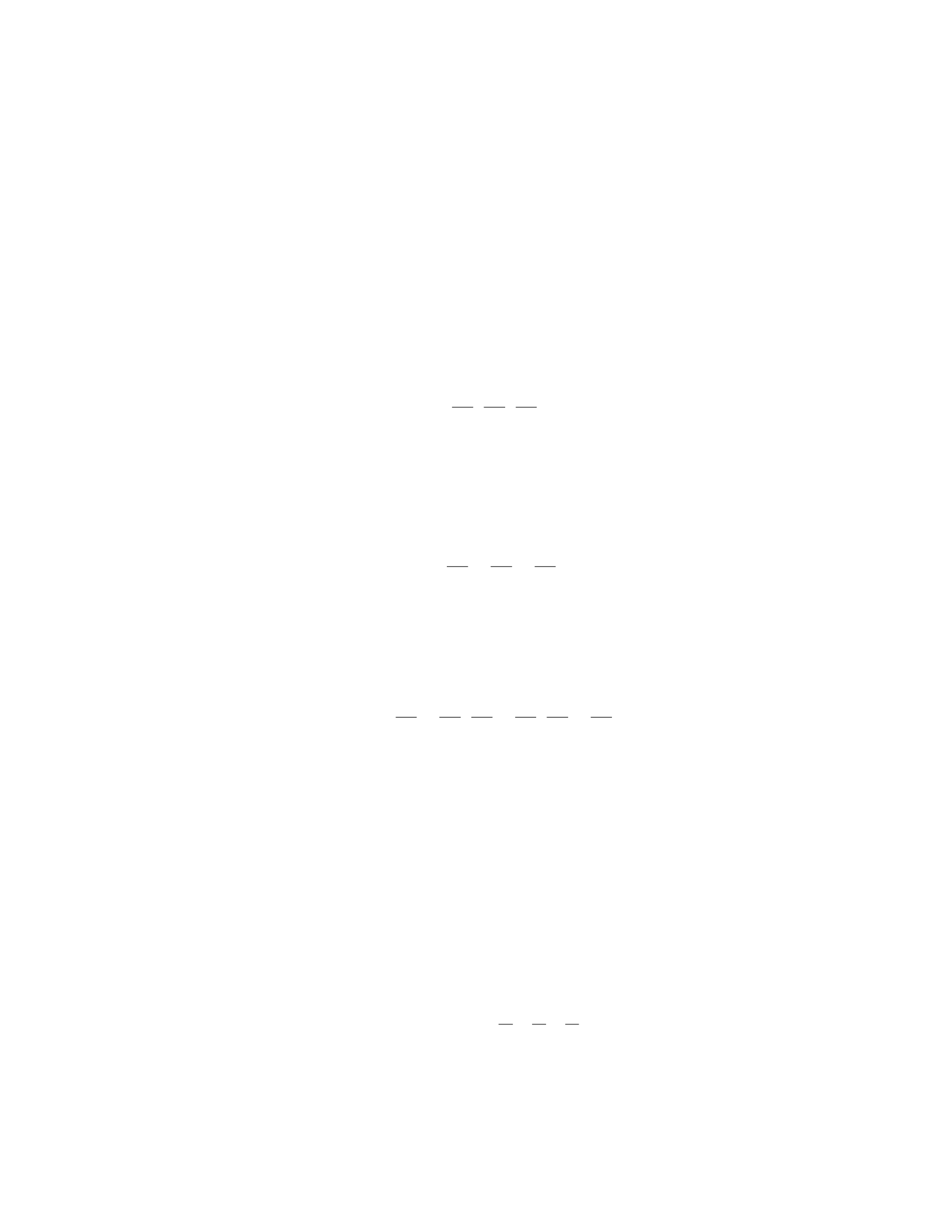
∇ × F= (0 −2z)i−(−2x−0)j+ (2y−2x)
3
Question 5
Question
Let F(x, y, z)=(x2yz, exy, xz3). Determine the gradient, divergence, and curl
of F.
Solution
Step 1: Gradient of F The gradient of a vector field F(x, y, z)=(P(x, y, z), Q(x, y, z), R(x, y, z))
is given by
∇F=∂P
∂x ,∂Q
∂y ,∂R
∂z .
For F(x, y, z)=(x2yz, exy , xz3), we have
∇F=2xyz, xexy , z3.
Step 2: Divergence of F The divergence of a vector field F(x, y, z) =
(P(x, y, z), Q(x, y, z), R(x, y, z)) is given by
∇ · F=∂P
∂x +∂Q
∂y +∂R
∂z .
For F(x, y, z)=(x2yz, exy , xz3), we have
∇ · F= 2xyz +xexy + 3z2.
Step 3: Curl of F The curl of a vector field F(x, y, z)=(P(x, y, z), Q(x, y, z), R(x, y, z))
is given by
∇ × F=∂R
∂y −∂Q
∂z ,∂P
∂z −∂R
∂x ,∂Q
∂x −∂P
∂y .
For F(x, y, z)=(x2yz, exy , xz3), we have
∇ × F=xz3−y, −2xyz, exy −2z3.
Question 6
Question
Let F(x, y, z)=4xzi+ 3xyj+ (2z2−x2)k. Compute the curl of F.
Solution
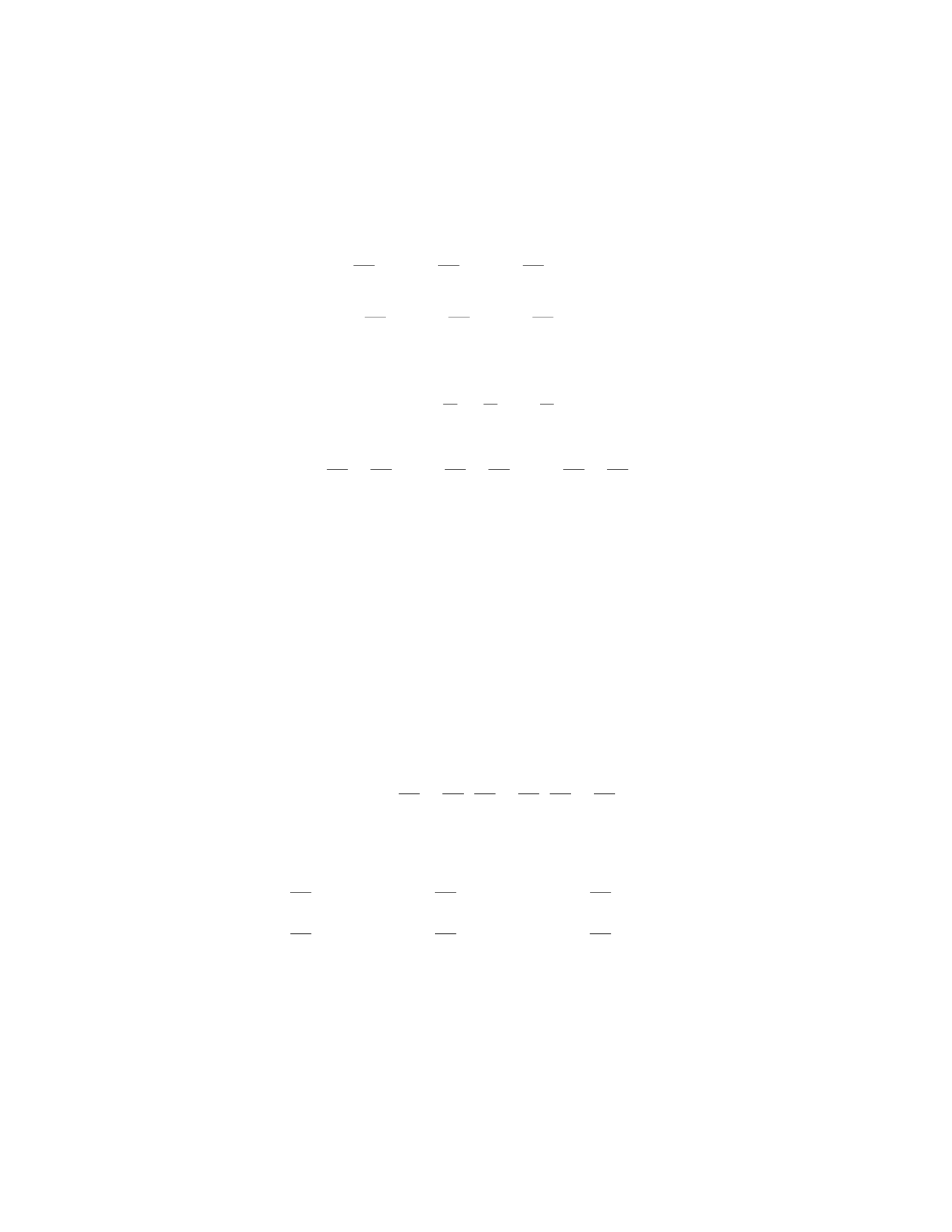
To compute the curl of F, we will use the formula for the curl of a vector field:
curl F=∇ × F=
i j k
∂
∂x
∂
∂y
∂
∂z
P Q R
4
Where F(x, y, z) = P(x, y, z)i+Q(x, y, z)j+R(x, y, z)k.
Step 1: Compute the partial derivatives:
∂P
∂y = 3x, ∂Q
∂z = 4x, ∂R
∂x =−2x,
∂P
∂z = 4z, ∂Q
∂x = 3y, ∂R
∂y = 0.
Step 2: Compute the curl:
curl F=
i j k
∂
∂x
∂
∂y
∂
∂z
4xz 3xy 2z2−x2
=∂R
∂y −∂Q
∂z i−∂R
∂x −∂P
∂z j+∂Q
∂x −∂P
∂y k
= (0 −4x)i−(−2x−4z)j+ (3y−3x)k
=−4xi+ (2x+ 4z)j+ (3y−3x)k.
Therefore, the curl of Fis −4xi+ (2x+ 4z)j+ (3y−3x)k.
Question 7
Question
Let F(x, y, z)=(y2z+xz2, x2z+xy2, xy +xz). Compute the curl of F.
Solution
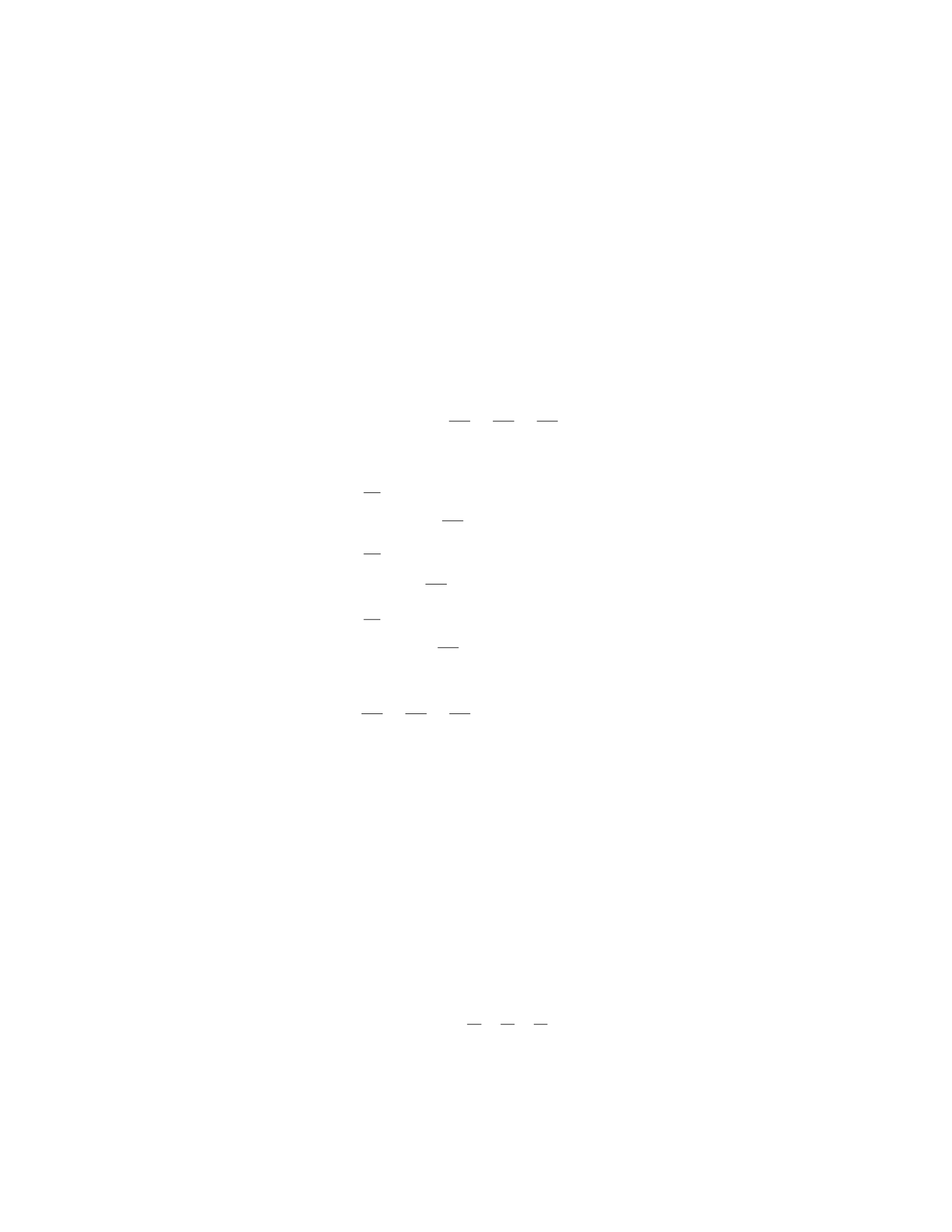
To find the curl of a vector field F(x, y, z)=(P, Q, R), we use the formula:
curl(F) = ∂R
∂y −∂Q
∂z ,∂P
∂z −∂R
∂x ,∂Q
∂x −∂P
∂y .
Step 1: Compute the partial derivatives of P,Q, and Rwith respect to
each variable.
∂P
∂y =z2,∂Q
∂z = 2xz, ∂R
∂x =z,
∂R
∂y =x, ∂P
∂z = 2xz, ∂Q
∂x = 2xy.
Step 2: Use the formula for the curl to compute the components.
curl(F) = z−x, 2xz −2xz, 2xy −z2= (z−x, 0,2xy −z2).
Therefore, the curl of Fis curl(F)=(z−x, 0,2xy −z2).
5
Question 8
Question
Let F(x, y, z) = x2yi+ezsin(y)j+zln(x)kbe a vector field. Calculate the
divergence of F.
Solution
To calculate the divergence of a vector field F(x, y, z) = P(x, y, z)i+Q(x, y, z)j+
R(x, y, z)k, where P,Q, and Rare the component functions, we use the formula:
∇ · F=∂P
∂x +∂Q
∂y +∂R
∂z
Given F(x, y, z) = x2yi+ezsin(y)j+zln(x)k, we have P(x, y, z) = x2y,
Q(x, y, z) = ezsin(y), and R(x, y, z) = zln(x).
Step 1: Calculate ∂P
∂x :
∂P
∂x = 2xy
Step 2: Calculate ∂Q
∂y :
∂Q
∂y =ezcos(y)
Step 3: Calculate ∂R
∂z :
∂R
∂z = ln(x)
Step 4: Now, we can find the divergence of F:
∇ · F=∂P
∂x +∂Q
∂y +∂R
∂z = 2xy +ezcos(y) + ln(x)
Therefore, the divergence of the vector field Fis 2xy +ezcos(y) + ln(x).
Question 9
Question
Let F(x, y, z)=4xyi+ 3xzj+ 5yzk. Calculate the curl of Fat the point
P(2,−1,3).
Solution
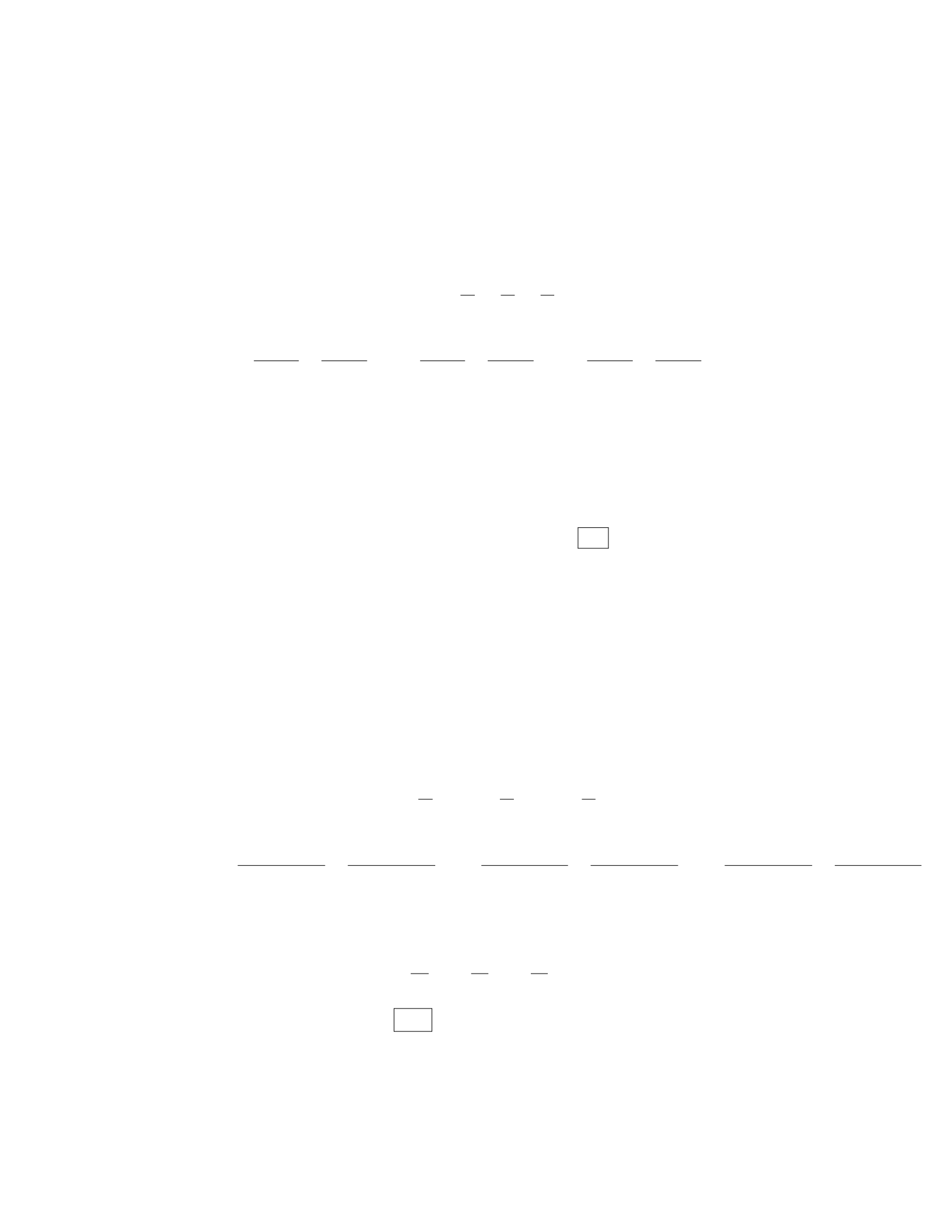
To calculate the curl of a vector field F(x, y, z) = P(x, y, z)i+Q(x, y, z)j+
R(x, y, z)kat a point P(a, b, c), we can use the formula:
∇ × F=
i j k
∂
∂x
∂
∂y
∂
∂z
P Q R
6
Given F(x, y, z)=4xyi+ 3xzj+ 5yzk, the components of Fare P(x, y, z) =
4xy,Q(x, y, z)=3xz, and R(x, y, z)=5yz.
Step 1: Calculate the curl of F.
∇ × F=
i j k
∂
∂x
∂
∂y
∂
∂z
4xy 3xz 5yz
=∂(5yz)
∂y −∂(3xz)
∂z i−∂(5yz)
∂x −∂(4xy)
∂z j+∂(3xz)
∂x −∂(4xy)
∂y k
= (5z−3)i−(−5y)j+ (3z)k
Step 2: Evaluate the curl of Fat the point P(2,−1,3). At the point
P(2,−1,3), plug in x= 2, y=−1, and z= 3 into the components of the
curl.
∇ × F= (5(3) −3)i−(−5(−1))j+ (3(3))k
= 12i−5j+ 9k
Therefore, the curl of Fat the point P(2,−1,3) is 12i−5j+ 9k.
Question 10
Question
Let F(x, y, z) = (2xz2+y3)i+ (3x2z+ 2y)j+ (2x2y+ 3z)kbe a vector field.
Calculate ∇ · ∇ × F.
Solution
Step 1: Calculate the curl of F.
∇ × F=
i j k
∂
∂x
∂
∂y
∂
∂z
2xz2+y33x2z+ 2y2x2y+ 3z
=∂(2x2y+ 3z)
∂y −∂(3x2z+ 2y)
∂z i−∂(2xz2+y3)
∂x −∂(2x2y+ 3z)
∂z j+∂(3x2z+ 2y)
∂x −∂(2xz2+y3)
∂y k
= (2x2−2x2)i−(2z−2z)j+ (6xz −3y2)k=−3y2k
Step 2: Calculate the divergence of the curl.
∇ · −3y2k=∂
∂x (0) + ∂
∂y (0) + ∂
∂z (−3y2) = −6y
Therefore, ∇ · ∇ × F=−6y.
7
Question 11
Question
Let F(x, y, z) = x2yi+xy2j+xyzkbe a vector field in R3. Compute the
divergence of Fat the point (1,2,−1).
Solution
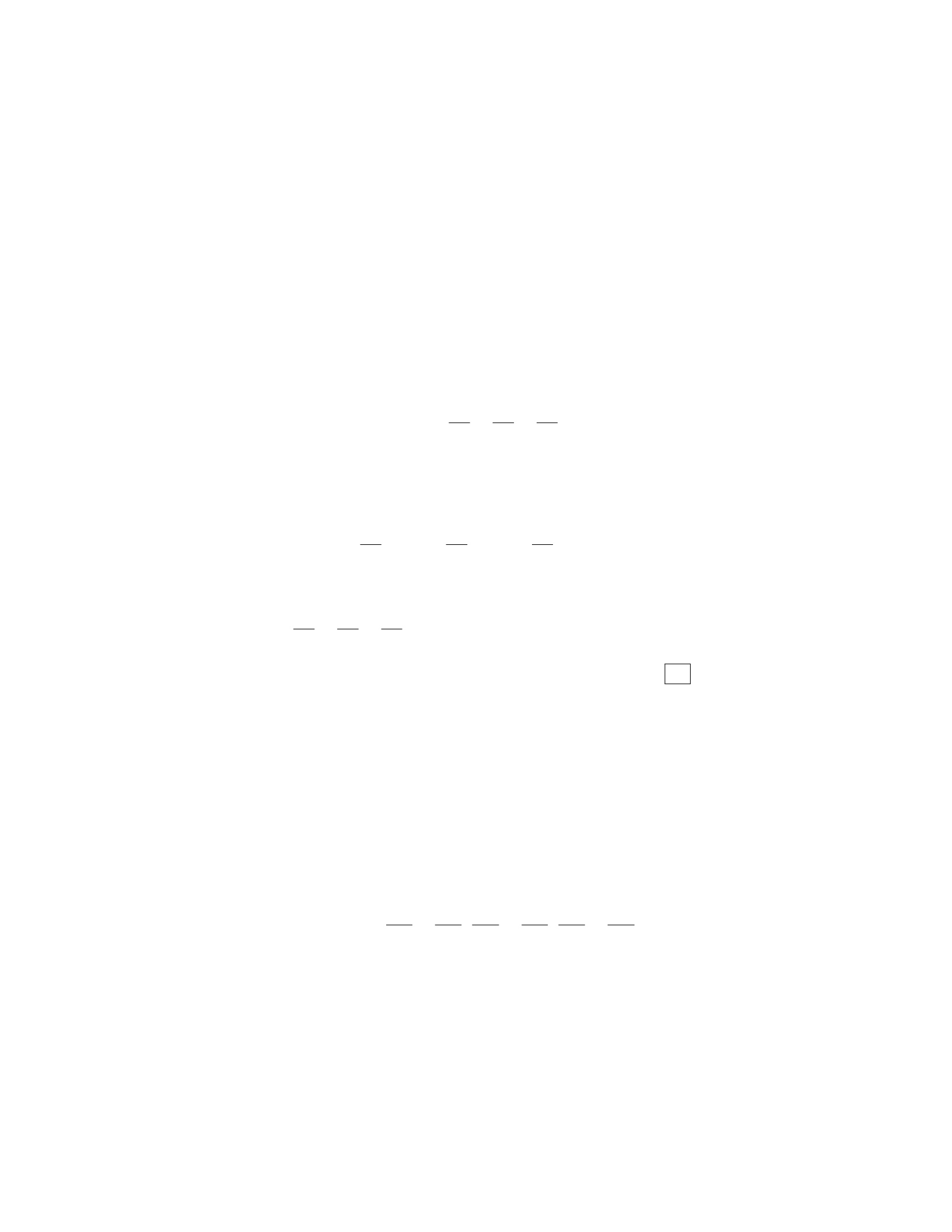
Step 1: The divergence of a vector field F(x, y, z) = P(x, y, z)i+Q(x, y, z)j+
R(x, y, z)kis given by:
div F=∂P
∂x +∂Q
∂y +∂R
∂z
Step 2: Given F(x, y, z) = x2yi+xy2j+xyzk, we have P(x, y, z) = x2y,
Q(x, y, z) = xy2, and R(x, y, z) = xyz.
Step 3: Compute the partial derivatives:
∂P
∂x = 2xy ∂Q
∂y = 2xy ∂R
∂z =xy
Step 4: Compute the divergence of Fat the point (1,2,−1):
div F=∂P
∂x +∂Q
∂y +∂R
∂z = 2(1)(2) + 2(1)(2) + (1)(2) = 6 + 4 + 2 = 12
Step 5: Therefore, the divergence of Fat the point (1,2,−1) is 12 .
Question 12
Question
Let F(x, y)=(exy −ycos(x), x sin(y)−exy). Find the curl of F.
Solution
To find the curl of F, we first need to compute the components of the curl
vector. The curl of Fis given by
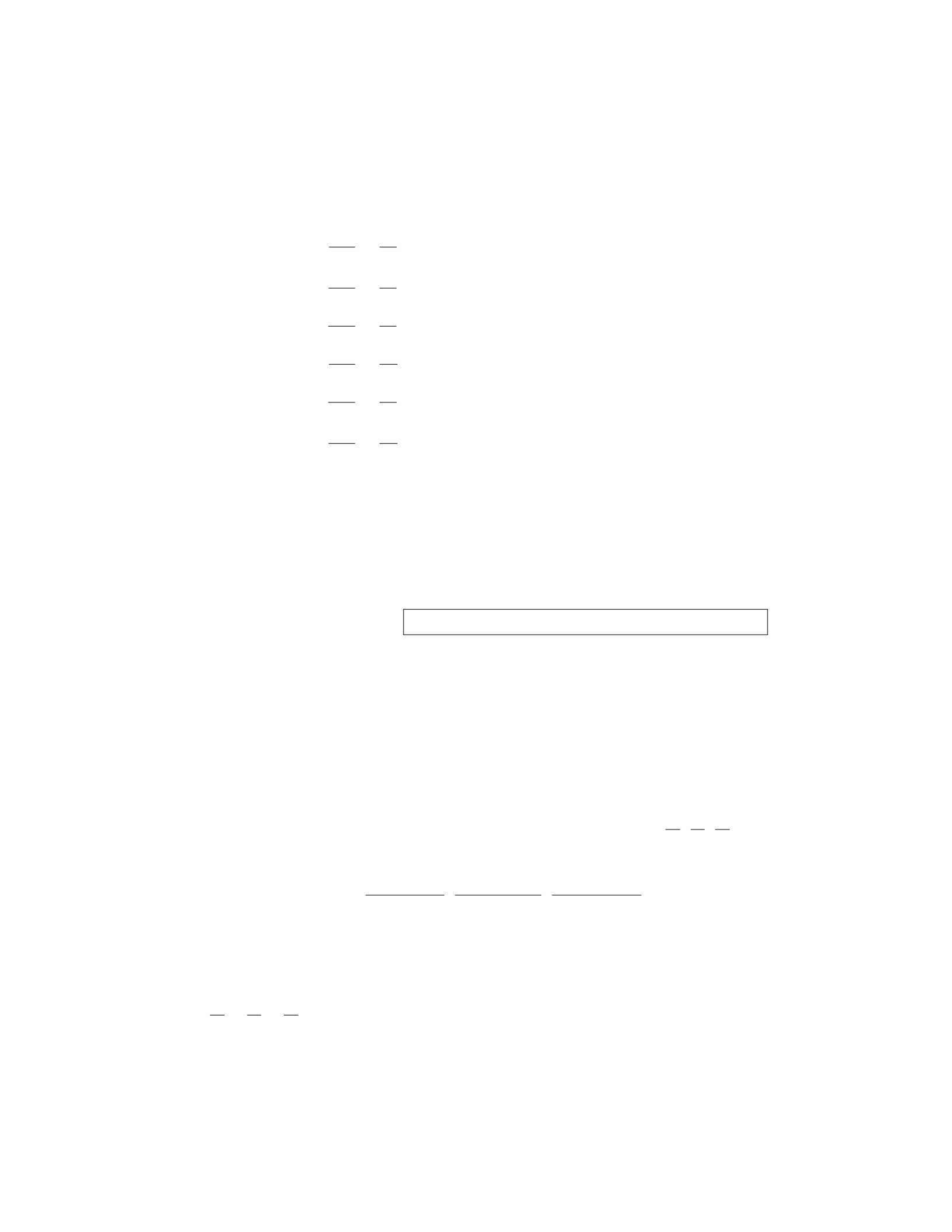
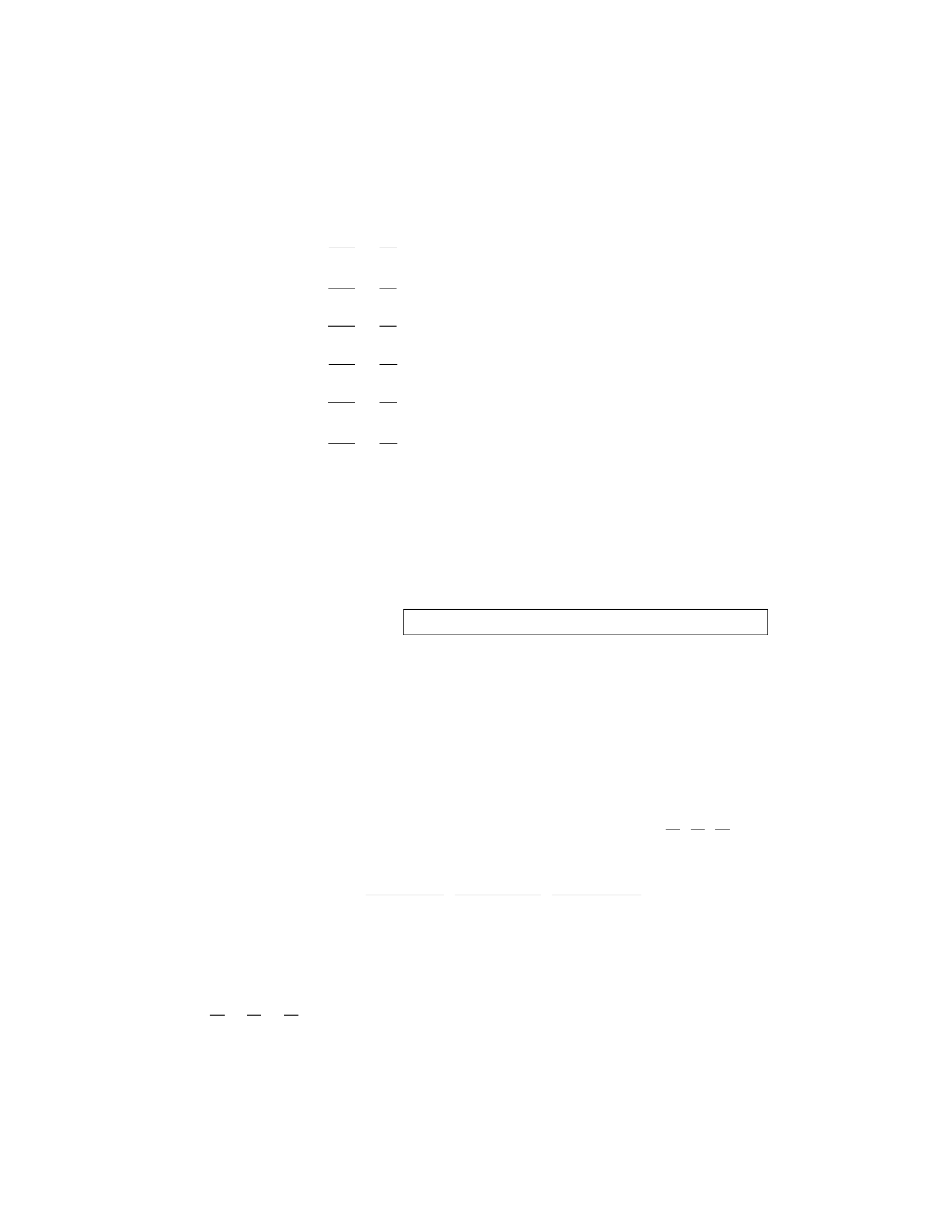
curl(F) = ∂Fz
∂y −∂Fy
∂z ,∂Fx
∂z −∂Fz
∂x ,∂Fy
∂x −∂Fx
∂y
8
Step 1: Compute the partial derivatives of F.
∂Fz
∂y =∂
∂y (xsin(y)−exy ) = xcos(y)−xexy
∂Fy
∂z =∂
∂z (exy −ycos(x)) = 0
∂Fx
∂z =∂
∂z (ycos(x)) = 0
∂Fz
∂x =∂
∂x (xsin(y)−exy ) = ycos(y)
∂Fx
∂y =∂
∂y (ycos(x)) = −ysin(x)
∂Fy
∂x =∂
∂x (exy −ycos(x)) = yexy + cos(x)
Step 2: Calculate the components of the curl vector.
curl(F)=(xcos(y)−xexy,0−0, y cos(y),−ysin(x), yexy + cos(x))
Step 3: Simplify the components of the curl vector.
curl(F)=(xcos(y)−xexy,0, y cos(y),−ysin(x), yexy + cos(x))
Therefore, the curl of Fis (xcos(y)−xexy ,0, y cos(y),−ysin(x), yexy + cos(x)) .
Question 13
Question
Find the gradient, divergence, and curl of the vector field F= (xey+y2, x2ey−
2y, z cos(xyz)).
Solution
Step 1: The gradient of a vector field F= (f, g, h) is given by ∇f=∂f
∂x ,∂g
∂y ,∂h
∂z .
Step 2: For the given vector field F, its gradient ∇ · Fis:
∇ · F=∂(xey+y2)
∂x ,∂(x2ey−2y)
∂y ,∂(zcos(xyz))
∂z
Step 3: Calculating the partial derivatives, we have:
∇ · F= (ey, x2ey−2,cos(xyz))
Step 4: The divergence of a vector field F= (f, g, h) is given by ∇ · F=
∂f
∂x +∂g
∂y +∂h
∂z .
Step 5: Therefore, the divergence of the vector field Fis:
9
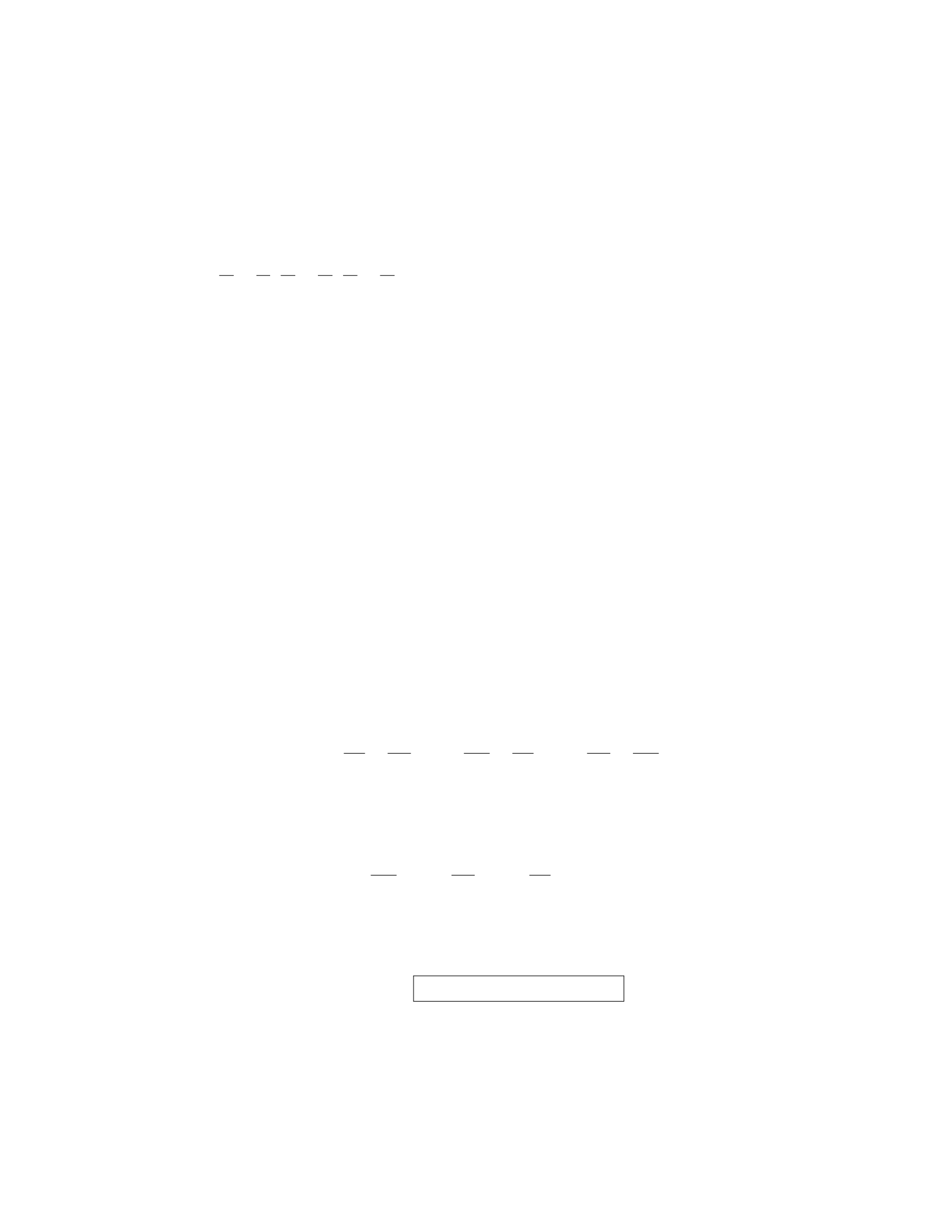
∇ · F=ey+x2ey−2 + cos(xyz)
Step 6: The curl of a vector field F= (f, g, h) is given by ∇ × F=
∂h
∂y −∂g
∂z ,∂f
∂z −∂h
∂x ,∂g
∂x −∂f
∂y .
Step 7: Calculating the curl of the vector field F, we get:
∇ × F=0−0,0−0, z(−x2yz sin(xyz))
Step 8: Simplifying, we find:
∇ × F= (−z2x2y2sin(xyz),0,0)
Therefore, the gradient, divergence, and curl of the vector field Fare:
Gradient: ∇ · F= (ey, x2ey−2,cos(xyz))
Divergence: ∇ · F=ey+x2ey−2 + cos(xyz)
Curl: ∇ × F= (−z2x2y2sin(xyz),0,0)
Question 14
Question
Let F(x, y, z)=(yz, xz, xy) be a vector field in R3. Calculate the curl of F.
Solution
To find the curl of a vector field F(x, y, z)=(M, N, P ) in R3, we use the formula:
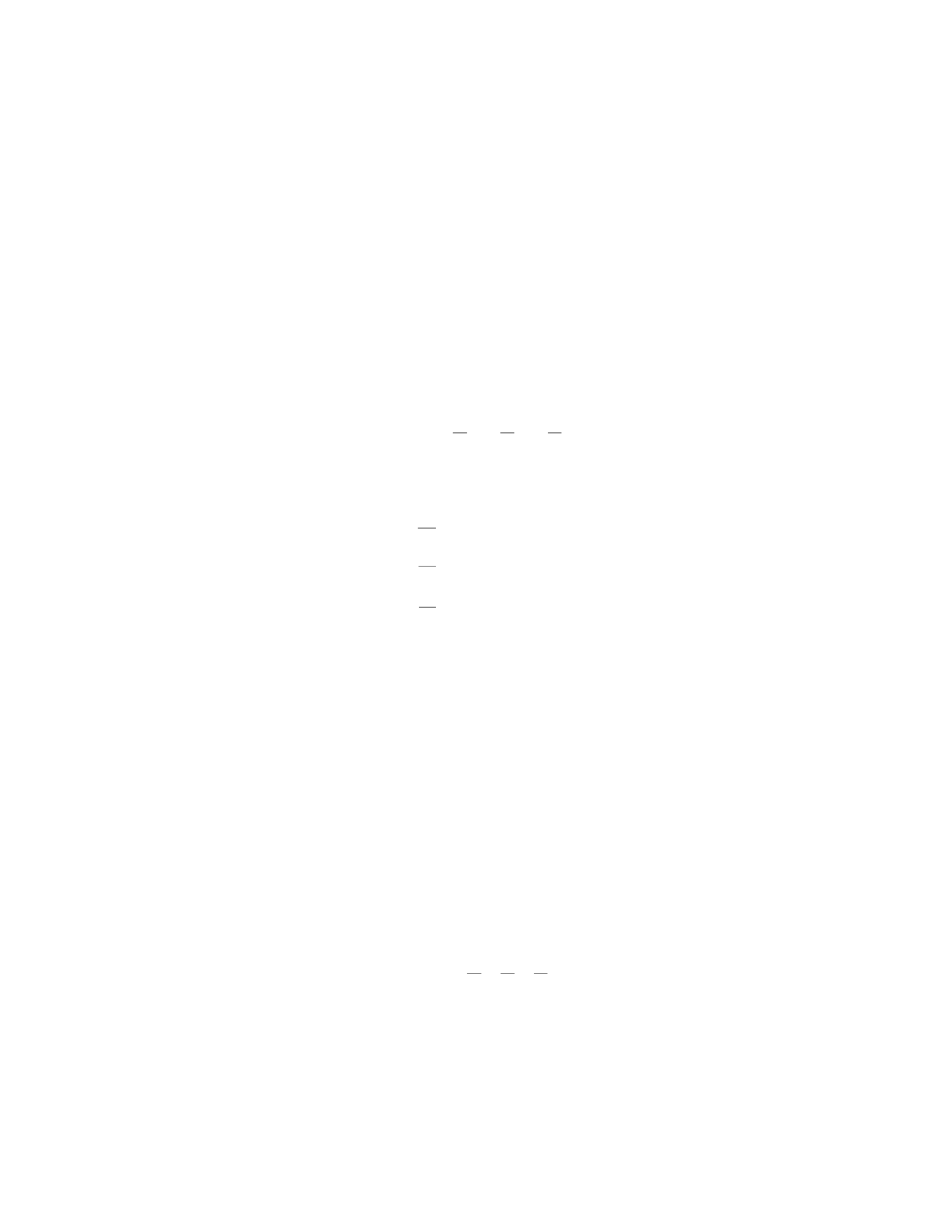
∇ × F=∂P
∂y −∂N
∂z i+∂M
∂z −∂P
∂x j+∂N
∂x −∂M
∂y k
For our vector field F(x, y, z)=(yz, xz, xy), we have M=yz,N=xz, and
P=xy.
Step 1: Calculate the partial derivatives
∂M
∂z =y, ∂N
∂x =z, ∂P
∂y =x
Step 2: Calculate the curl
∇ × F= (x−z)i+ (y−x)j+ (z−y)k
Therefore, the curl of Fis (x−z)i+ (y−x)j+ (z−y)k.
10
Question 15
Question
Let F(x, y, z) = x2yzi+xyz2j+xy2zkbe a vector field. Calculate the curl of
F.
Solution
To find the curl of F, denoted by ∇ × F, we need to compute the determinant
of the following matrix:
∇ × F=
i j k
∂
∂x
∂
∂y
∂
∂z
x2yz xyz2xy2z
Step 1: Compute the partial derivatives of the components of F.
∂
∂x (x2yz)=2xyz
∂
∂y (xyz2) = xz2
∂
∂z (xy2z) = xy2
Step 2: Plug these derivatives into the determinant to find the curl.
∇ × F=
i j k
2xyz xz2xy2
= (xz2−xy2)i−(2xyz)j+ (2y−z2)k
Therefore, the curl of Fis ∇ × F= (xz2−xy2)i−(2xyz)j+ (2y−z2)k.
Question 16
Question
Let F(x, y, z) = x2ezi+ 2yezj+xyzk. Find the curl of F.
Solution
To find the curl of F, we use the formula:
∇ × F=
i j k
∂
∂x
∂
∂y
∂
∂z
FxFyFz
where Fx, Fy, Fzare the components of F.
11
Step 1: Compute Fx,Fy, and Fz.
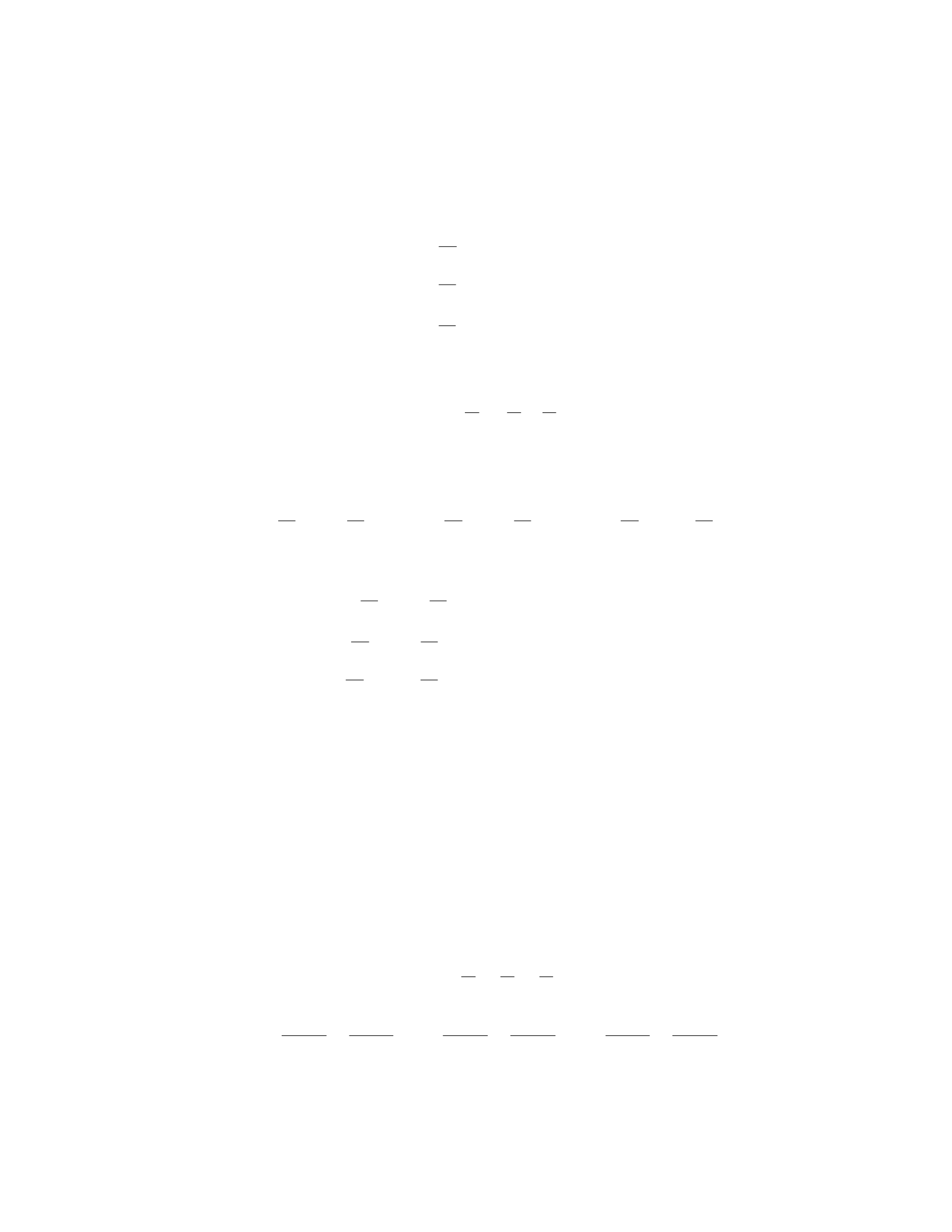
Fx=∂
∂x (x2ez)=2xez
Fy=∂
∂y (2yez)=2ez
Fz=∂
∂z (xyz) = xy
Step 2: Now, evaluate the determinant for the curl.
∇ × F=
i j k
∂
∂x
∂
∂y
∂
∂z
2xez2ezxy
Step 3: Expand the determinant using the cofactor expansion along the top
row.
∇×F=∂
∂y (xy)−∂
∂z (2ez)i−∂
∂x (xy)−∂
∂z (2xez)j+∂
∂x (2ez)−∂
∂y (2xez)k
Step 4: Compute the partial derivatives.
∂
∂y (xy)−∂
∂z (2ez) = x−0 = x
∂
∂x (xy)−∂
∂z (2xez) = y−0 = y
∂
∂x (2ez)−∂
∂y (2xez)=0−2ez=−2ez
Step 5: Therefore, the curl of Fis:
∇ × F=xi+yj−2ezk
Question 17
Question
Let F(x, y, z) = x2yi+y2zj+z2xk. Calculate ∇ · (∇ × F).
Solution
Step 1: Find ∇ × F:
∇ × F=
i j k
∂
∂x
∂
∂y
∂
∂z
x2y y2z z2x
∇ × F=∂(z2x)
∂y −∂(y2z)
∂z i−∂(z2x)
∂x −∂(x2y)
∂z j+∂(y2z)
∂x −∂(x2y)
∂y k
12
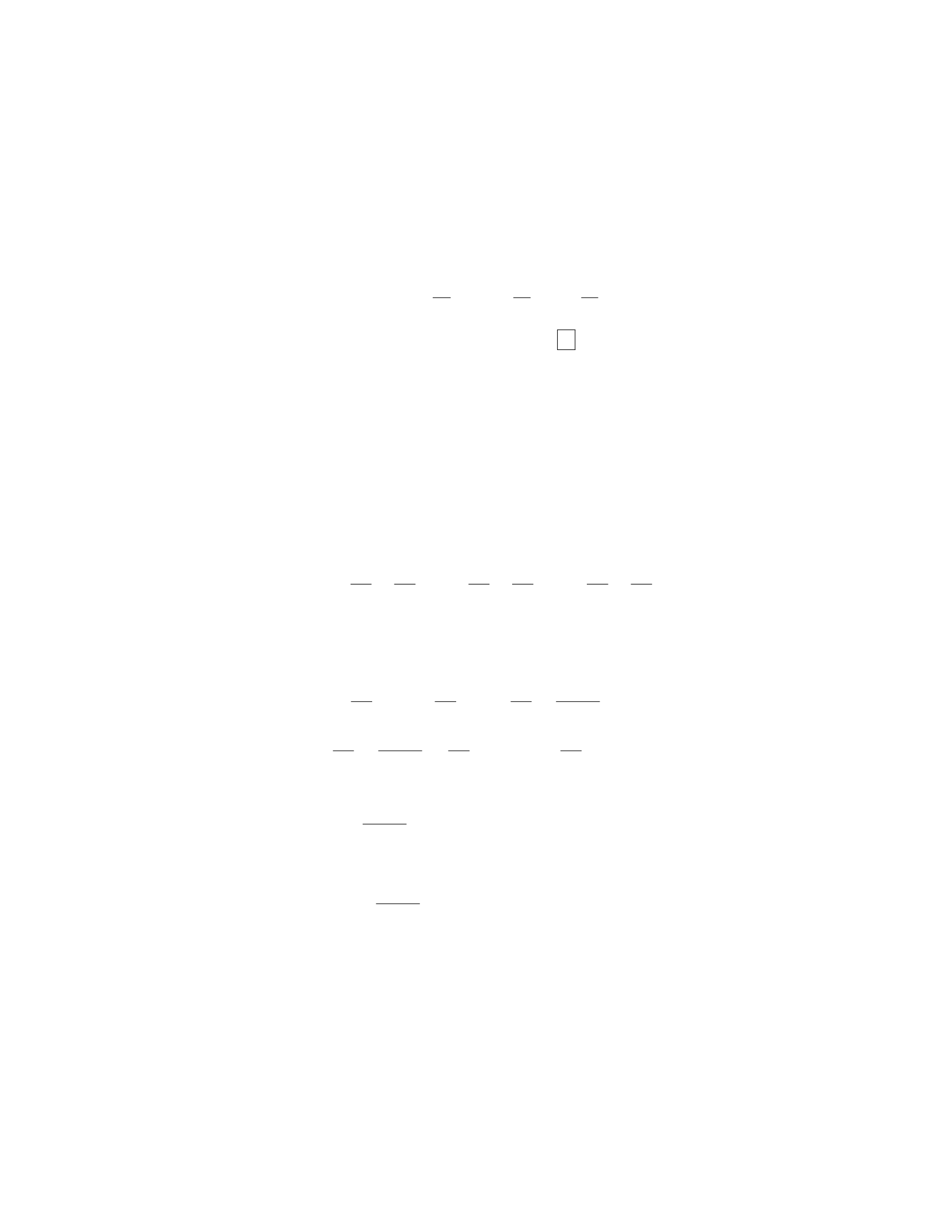
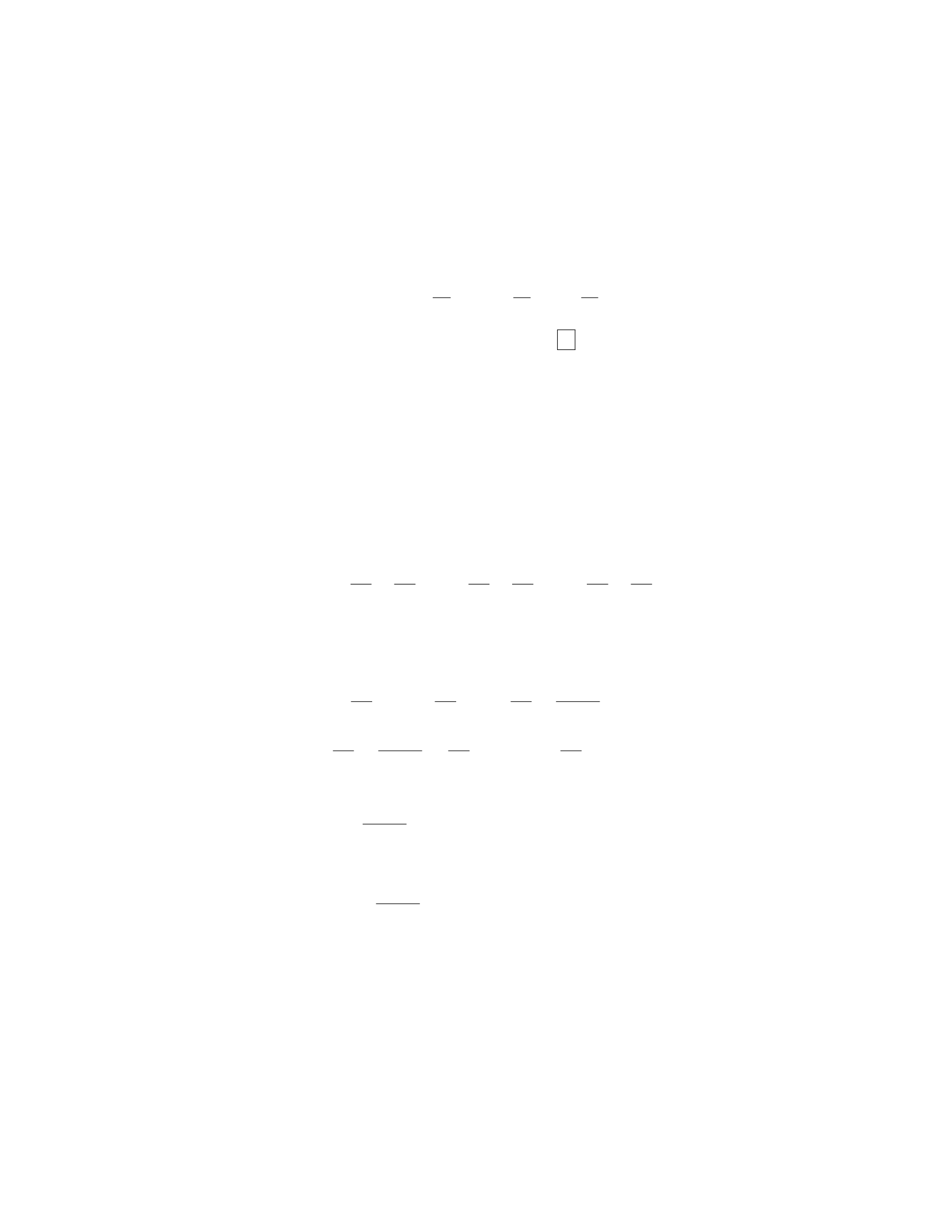
∇ × F= (2z−2z)i−(2z−2y)j+ (2y−2x)k
∇ × F= 0i−2yj+ 2yk=−2yj+ 2yk
Step 2: Find ∇ · (∇ × F):
∇ · (∇ × F) = ∂
∂x (−2y) + ∂
∂y (2y) + ∂
∂z (0)
∇ · (∇ × F) = 0 + 2 + 0 = 2
Question 18
Question
Let F(x, y, z)=(x2+y2+z2)i+exyzj+ ln(xy +z)k. Calculate the curl of F.
Solution
To find the curl of a vector field F(x, y, z) = P(x, y, z)i+Q(x, y, z)j+R(x, y, z)k,
we use the formula:
∇ × F=∂R
∂y −∂Q
∂z i−∂R
∂x −∂P
∂z j+∂Q
∂x −∂P
∂y k
Given F(x, y, z) = (x2+y2+z2)i+exyzj+ln(xy +z)k, we have: P(x, y, z) =
x2+y2+z2,Q(x, y, z) = exyz, and R(x, y, z) = ln(xy +z).
Step 1: Calculate the partial derivatives:
∂P
∂y = 2y, ∂Q
∂z = 0,∂R
∂y =x
xy +z
∂R
∂z =1
xy +z,∂Q
∂x =yzexyz ,∂P
∂z = 2z
Step 2: Plug the partial derivatives into the curl formula:
∇ × F=x
xy +z−0i−(2z−yzexyz)j+ (2y−2z)k
Hence, the curl of Fis given by:
∇ × F=x
xy +zi−(2z−yzexyz)j+ (2y−2z)k
Question 19
Question
Let F(x, y, z) = (2xy+xz, x2+y2+z2, yz +yz) be a vector field in R3. Calculate
∇ · ∇ × F.
13
Solution
To find ∇ · ∇ × Fwhere Fis a vector field in R3, we first need to calculate
∇ × F.
Step 1: Calculate ∇ × FThe curl of a vector field F= (P, Q, R) is defined
as:
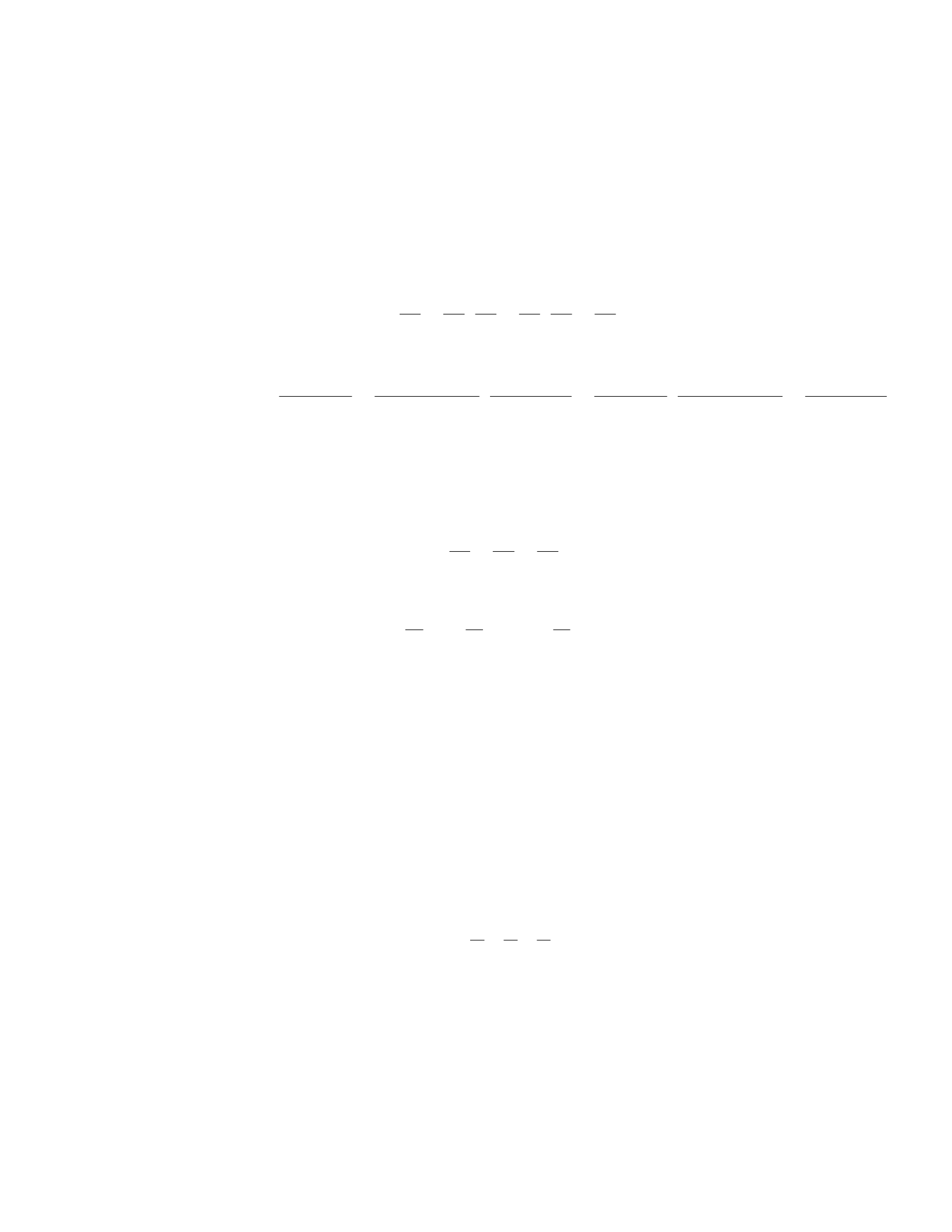
∇ × F=∂R
∂y −∂Q
∂z ,∂P
∂z −∂R
∂x ,∂Q
∂x −∂P
∂y
In this case, F(x, y, z) = (2xy +xz, x2+y2+z2, yz +xz), so:
∇×F=∂(yz +xz)
∂y −∂(x2+y2+z2)
∂z ,∂(2xy +xz)
∂z −∂(yz +xz)
∂x ,∂(x2+y2+z2)
∂x −∂(2xy +xz)
∂y
Calculating the partial derivatives and simplifying, we get:
∇ × F= (1, x −1,−y)
Step 2: Calculate ∇·∇×FThe divergence of a vector field G= (A, B, C)
is given by:
∇ · G=∂A
∂x +∂B
∂y +∂C
∂z
In this case, G= (1, x −1,−y), so:
∇ · G=∂
∂x (1) + ∂
∂y (x−1) + ∂
∂z (−y)
∇ · G= 0
Therefore, ∇ · ∇ × F= 0.
Question 20
Question
Let F(x, y, z) = xzi+yzj+xykbe a vector field in R3. Determine curl(F).
Solution
Step 1: The curl of a vector field F=Pi+Qj+Rkin R3is given by the
determinant
curl(F) =
i j k
∂
∂x
∂
∂y
∂
∂z
P Q R
where P,Q, and Rare the components of F.
Step 2: In our case, F(x, y, z) = xzi+yzj+xyk, so P=xz,Q=yz, and
R=xy.
14
Step 3: Compute the curl of Fby evaluating the determinant:
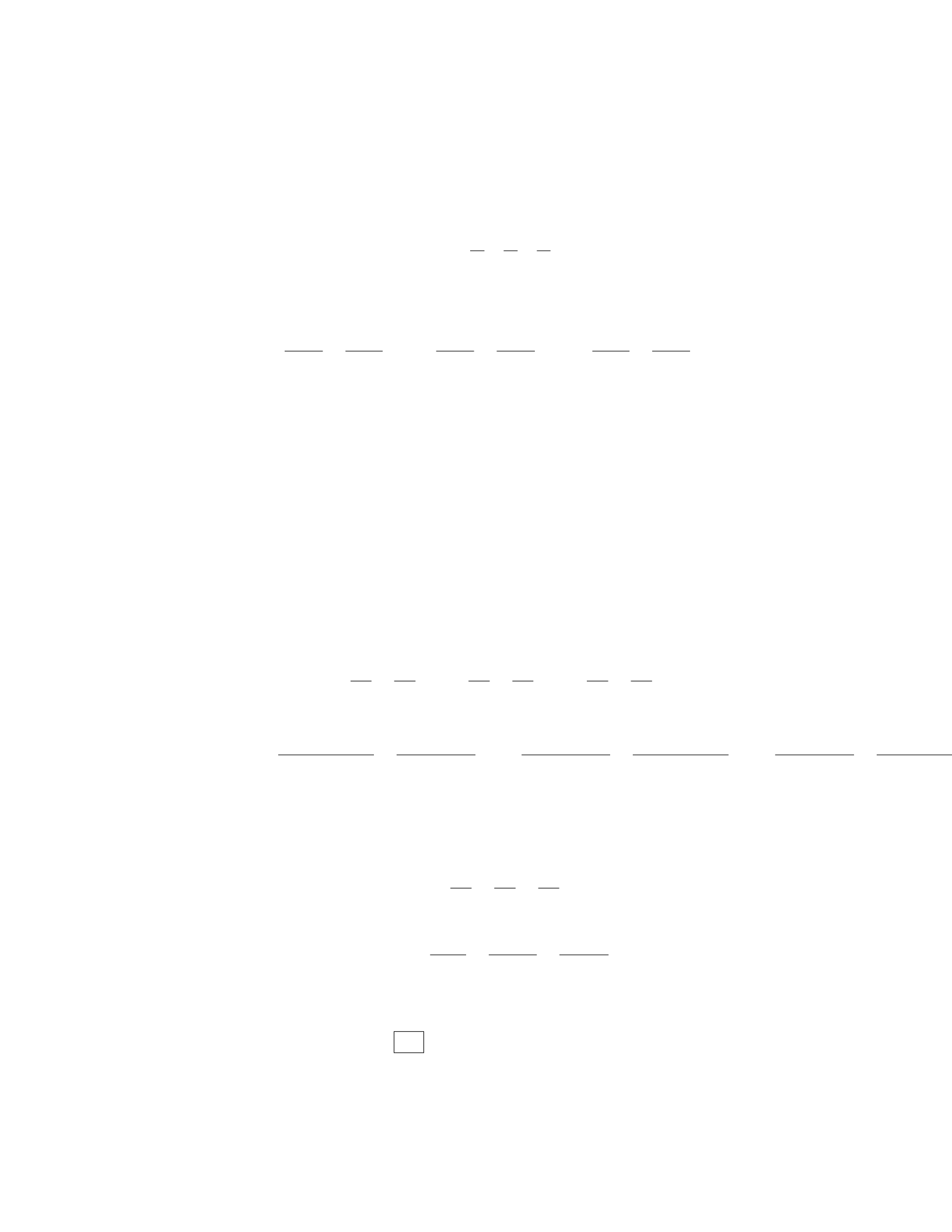
curl(F) =
i j k
∂
∂x
∂
∂y
∂
∂z
xz yz xy
Step 4: Calculate the determinant using the cofactor expansion along the
top row:
=i∂(xy)
∂y −∂(yz)
∂z −j∂(xz)
∂x −∂(xy)
∂z +k∂(yz)
∂x −∂(xz)
∂y
Step 5: Simplify the expressions:
=i(x−z)−j(z) + k(y) = (x−z)i−zj+yk
Therefore, curl(F)=(x−z)i−zj+yk.
Question 21
Question
Let F(x, y, z) = (2xy +x2z)i+ (x2+y2z)j+ (xyz2+ 2yz)k. Calculate ∇ · ∇ × F.
Solution
Step 1: Calculate ∇ × F. The curl of a vector field F(x, y, z) = P(x, y, z)i+
Q(x, y, z)j+R(x, y, z)kis defined as:
∇ × F=∂R
∂y −∂Q
∂z i+∂P
∂z −∂R
∂x j+∂Q
∂x −∂P
∂y k
For F(x, y, z) = (2xy +x2z)i+ (x2+y2z)j+ (xyz2+ 2yz)k, we have:
∇×F=∂(xyz2+ 2yz)
∂y −∂(x2+y2z)
∂z i+∂(2xy +x2z)
∂z −∂(xyz2+ 2yz)
∂x j+∂(x2+y2z)
∂x −∂(2xy +x2z)
∂y k
Calculating the partial derivatives, we get:
∇ × F= (z2)i−(z2)j−(2y)k
Step 2: Calculate ∇·∇×F. The divergence of a vector field G=Pi+Qj+Rk
is given by:
∇ · G=∂P
∂x +∂Q
∂y +∂R
∂z
For ∇ · ∇ × F, we have:
∇ · ∇ × F=∂(z2)
∂x +∂(−z2)
∂y +∂(−2y)
∂z
Calculating the partial derivatives, we get:
∇ · ∇ × F= 0 + 0 −2
Therefore, ∇ · ∇ × F=−2 .
15
Question 22
Question
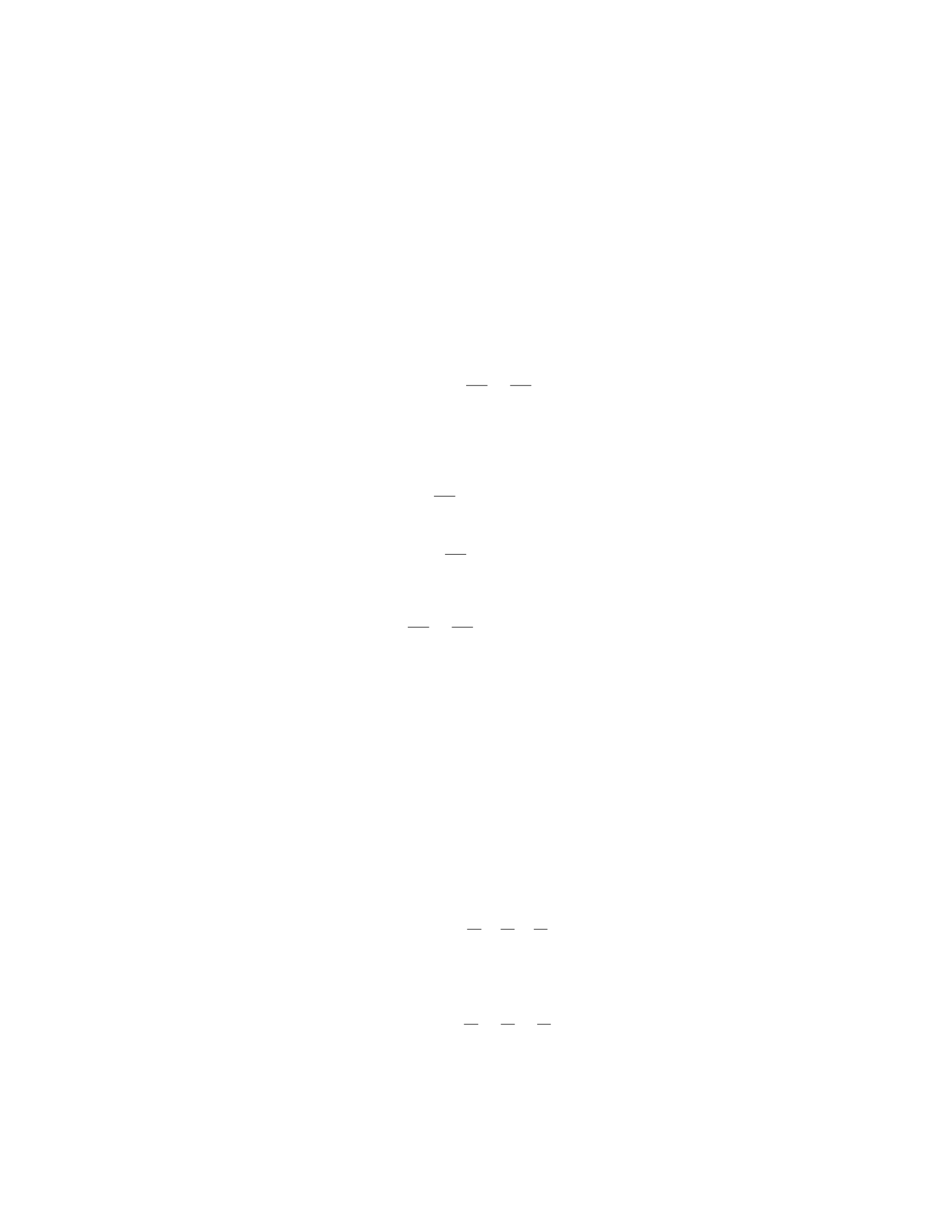
Let F(x, y) = eyi+xcos(y)jbe a vector field in R2. Calculate the curl of F.
Solution
To compute the curl of a vector field F(x, y) = P(x, y)i+Q(x, y)jin R2, we use
the formula
curl F=∂Q
∂x −∂P
∂y k.
Step 1: Identify P(x, y) and Q(x, y) from F. Here, P(x, y) = eyand
Q(x, y) = xcos(y).
Step 2: Compute the partial derivatives needed for the formula:
∂Q
∂x = cos(y)
and ∂P
∂y =ey.
Step 3: Substitute the partial derivatives into the formula for the curl:
curl F=∂Q
∂x −∂P
∂y k= (cos(y)−ey)k.
Thus, the curl of Fis (cos(y)−ey)k.
Question 23
Question
Let F(x, y, z)=2xyi+yzj+x2zk. Compute the curl of F.
Solution
To compute the curl of F, we will use the determinant form of the curl for a
vector field F(x, y, z) = P(x, y, z)i+Q(x, y, z)j+R(x, y, z)k, where the curl is
given by:
∇ × F=
i j k
∂
∂x
∂
∂y
∂
∂z
P Q R
Step 1: Calculate the curl of Fusing the determinant form:
∇ × F=
i j k
∂
∂x
∂
∂y
∂
∂z
2xy yz x2z
16
Step 2: Expand the determinant along the top row:
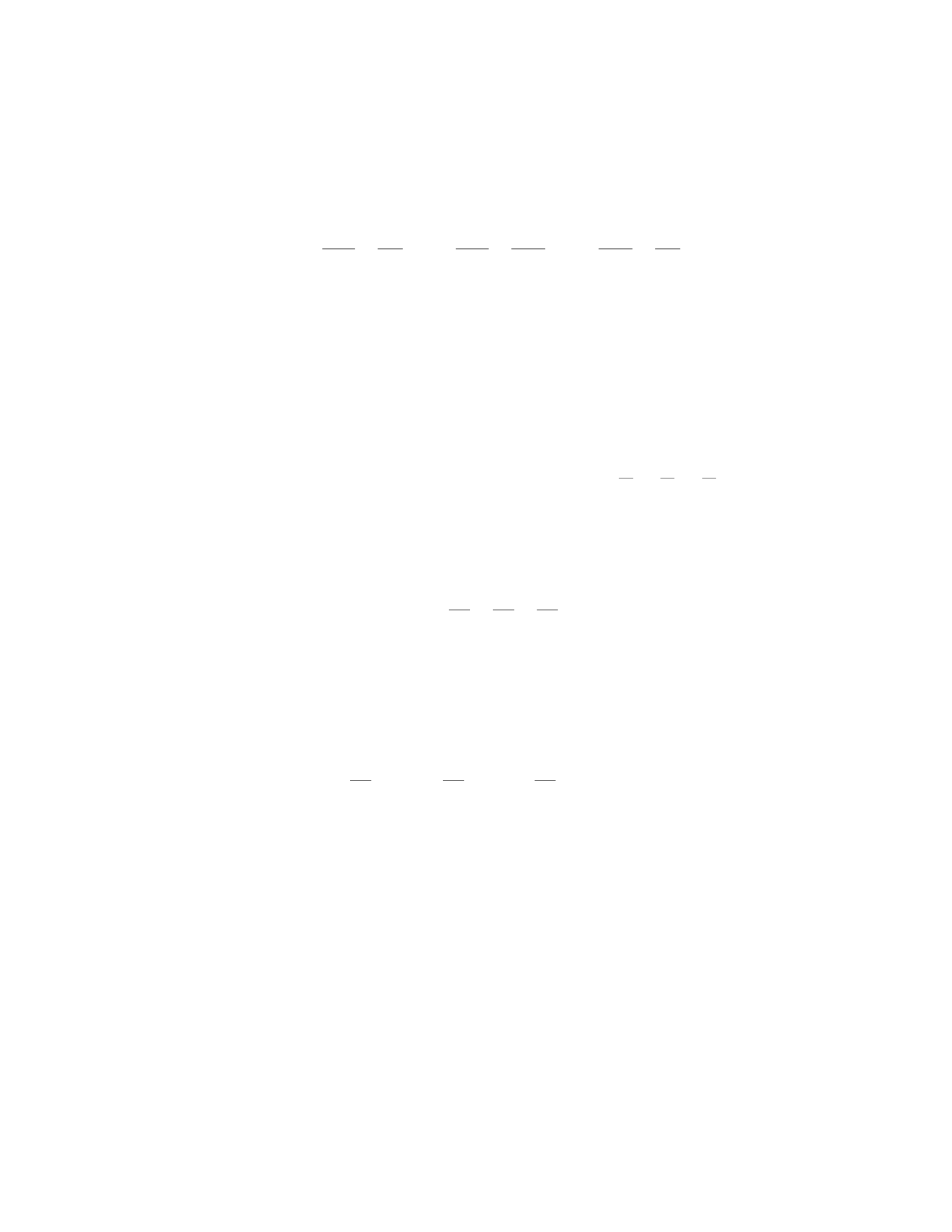
∇ × F=∂x2z
∂y −∂yz
∂z i−∂x2z
∂x −∂2xy
∂z j+∂2xy
∂x −∂yz
∂y k
Step 3: Compute the partial derivatives:
∇ × F=x2−yi−x2j+ 2yk
Therefore, the curl of Fis x2−yi−x2j+ 2yk.
Question 24
Question
Let F(x, y, z) = x2yi+y2zj+z2xk. Find ∇ · F, where ∇=∂
∂x i+∂
∂y j+∂
∂z kis
the gradient operator.
Solution
Step 1: Calculate the components of ∇ · Fusing the formula:
∇ · F=∂P
∂x +∂Q
∂y +∂R
∂z
where F(x, y, z) = Pi+Qj+Rk.
Step 2: Identify the components of F(x, y, z):
P(x, y, z) = x2y, Q(x, y, z) = y2z, R(x, y, z) = z2x
Step 3: Find the partial derivatives of P,Q, and Rwith respect to x,y, and
z:∂P
∂x = 2xy, ∂Q
∂y = 2yz, ∂R
∂z = 2zx
Step 4: Substitute the partial derivatives into the formula for ∇ · F:
∇ · F= 2xy + 2yz + 2zx = 2xy + 2yz + 2xz
Therefore, the divergence of Fis 2xy + 2yz + 2xz.
Question 25
Question
Let F(x, y, z) = 2x2y+y3z, x2z, 2xy2z. Find the gradient, divergence, and
curl of F.
17
Solution
Step 1: Find the gradient of F. The gradient of a vector field Fis given by:
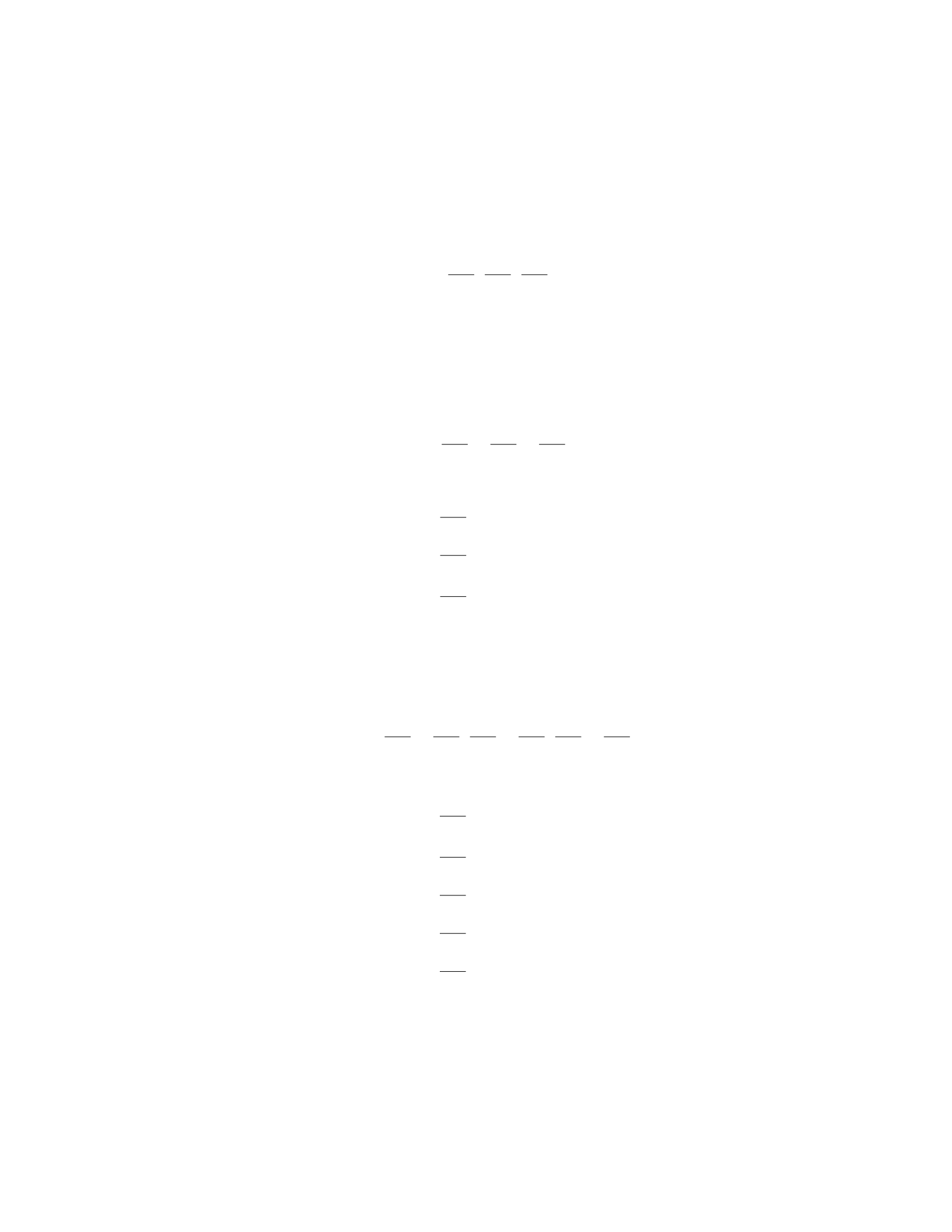
∇F=∂F1
∂x ,∂F2
∂y ,∂F3
∂z
where F= (F1, F2, F3).
So, for F(x, y, z) = 2x2y+y3z, x2z, 2xy2z, the gradient is:
∇F=4xy, x2+ 3y2z, 2y2z
Step 2: Find the divergence of F. The divergence of a vector field Fis given
by:
∇ · F=∂F1
∂x +∂F2
∂y +∂F3
∂z
Computing the partial derivatives, we have:
∂F1
∂x = 4y
∂F2
∂y = 2yz
∂F3
∂z = 2y2
Therefore, the divergence of Fis:
∇ · F= 4y+ 2yz + 2y2
Step 3: Find the curl of F. The curl of a vector field Fis given by:
∇ × F=∂F3
∂y −∂F2
∂z ,∂F1
∂z −∂F3
∂x ,∂F2
∂x −∂F1
∂y
Calculating the partial derivatives, we get:
∂F3
∂y = 4xz
∂F2
∂z =x2
∂F1
∂z = 0
∂F3
∂x = 0
∂F1
∂y = 2x2
Thus, the curl of Fis:
∇ × F= (4xz −x2,0,2x2)
18
Question 26
Question
Let F(x, y, z) = x2yi+xyzj+y2zkbe a vector field in R3. Calculate the
divergence of Fat the point (1,2,3).
Solution
Step 1: The divergence of a vector field F(x, y, z) = P(x, y, z)i+Q(x, y, z)j+
R(x, y, z)kis given by the formula div(F) = ∂P
∂x +∂Q
∂y +∂R
∂z .
Step 2: Given F(x, y, z) = x2yi+xyzj+y2zk, we can see that P(x, y, z) =
x2y,Q(x, y, z) = xyz, and R(x, y, z) = y2z.
Step 3: Calculate the partial derivatives:
∂P
∂x =∂
∂x (x2y)=2xy,
∂Q
∂y =∂
∂y (xyz) = xz,
∂R
∂z =∂
∂z (y2z) = y2.
Step 4: Now, find the divergence of Fat the point (1,2,3) by evaluating the
partial derivatives at that point:
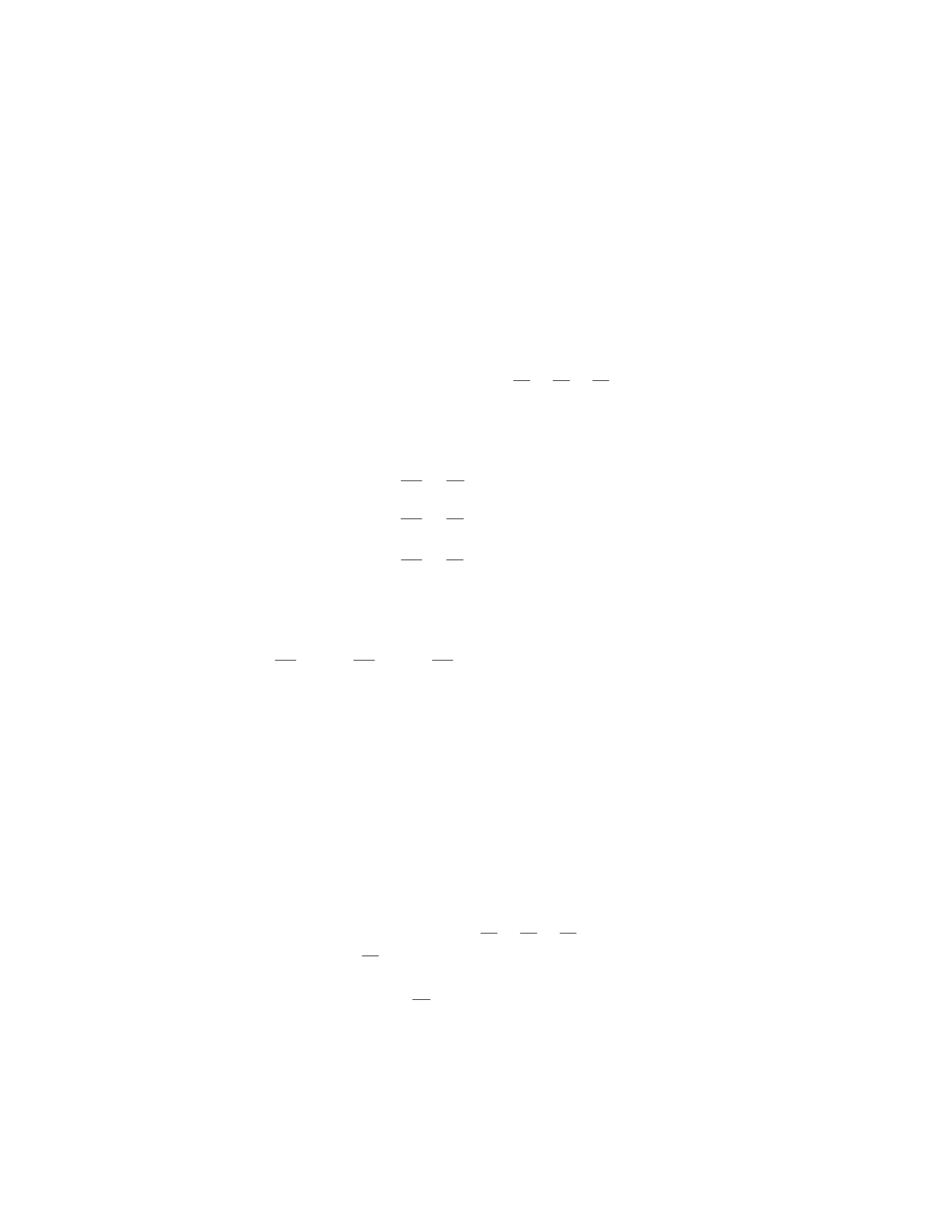
div(F) = ∂P
∂x
(1,2,3)
+∂Q
∂y
(1,2,3)
+∂R
∂z
(1,2,3)
= (2·1·2)+(1·3)+(22) = 4+3+4 = 11.
Therefore, the divergence of Fat the point (1,2,3) is 11.
Question 27
Question
Let F(x, y, z) = (2xy + 3z)i+ (x2+ 3yz)j+ (3xz)k. Compute the divergence of
F.
Solution
To compute the divergence of a vector field F(x, y, z) = P(x, y, z)i+Q(x, y, z)j+
R(x, y, z)k, we use the formula ∇ · F=∂P
∂x +∂Q
∂y +∂R
∂z .
Step 1: Compute ∂P
∂x .
∂
∂x (2xy + 3z) = 2y
19
Step 2: Compute ∂Q
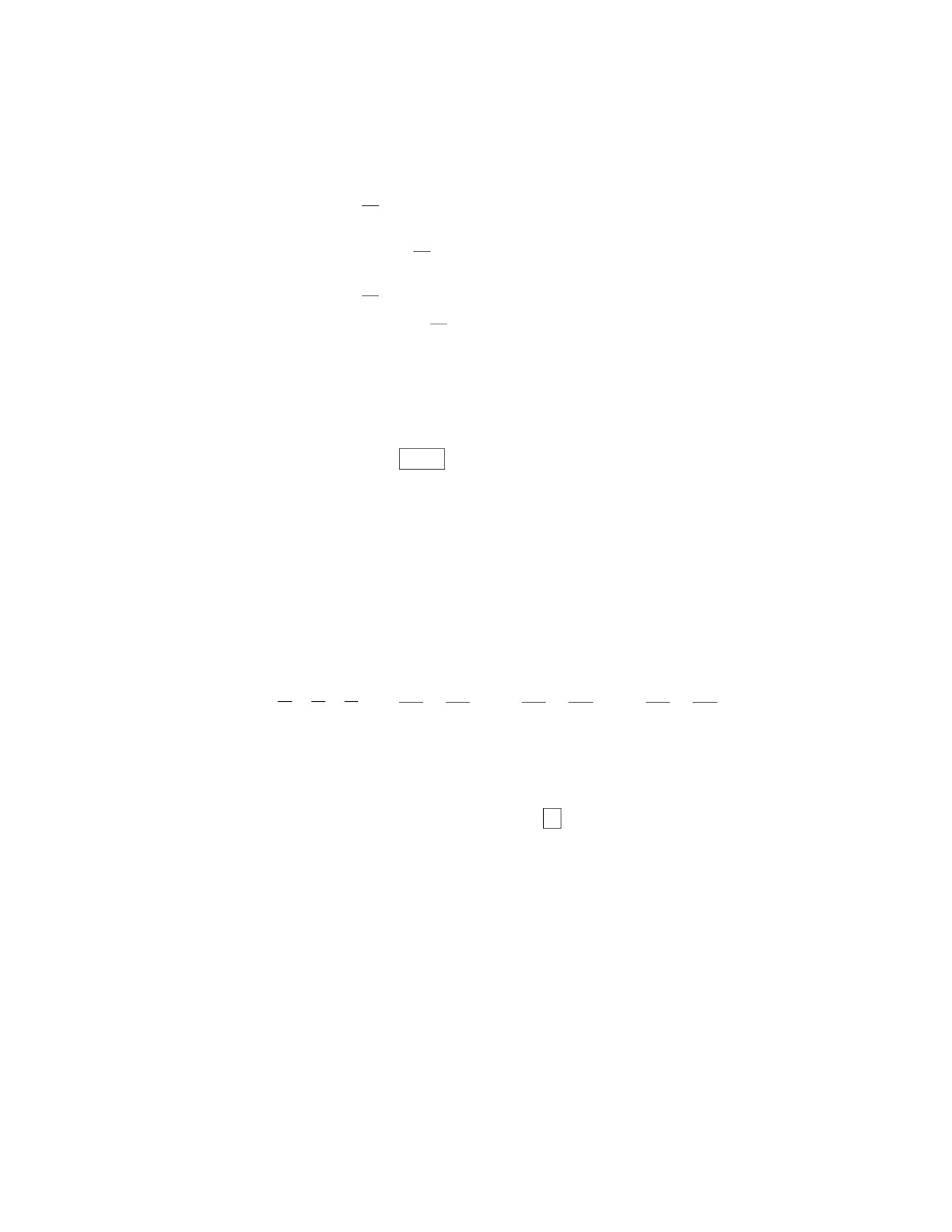
∂y .
∂
∂y (x2+ 3yz)=3z
Step 3: Compute ∂R
∂z .
∂
∂z (3xz)=3x
Step 4: Add the three partial derivatives to find the divergence.
∇ · F= 2y+ 3z+ 3x
Step 5: Simplify the expression.
∇ · F= 3x+ 2y+ 3z
Question 28
Question
Let F=x2i+y2j+z2k. Compute ∇ · (∇ × F).
Solution
Step 1: Compute ∇ × F.
∇ × F=
i j k
∂
∂x
∂
∂y
∂
∂z
x2y2z2
=∂z2
∂y −∂y2
∂z i−∂z2
∂x −∂x2
∂z j+∂y2
∂x −∂x2
∂y k
= 0 −0i−0+0j+ 0 −0k=0
Step 2: Compute ∇ · (∇ × F).
∇ · (∇ × F) = ∇ · 0= 0
Therefore, ∇ · (∇ × F) = 0.
Question 29
Question
Let F(x, y, z) = x2yi+yexz j+xzk. Calculate ∇ · ∇ × F.
20
Solution
To calculate ∇·∇×F, we first need to find ∇ × Fand then take the divergence
of that result.
Step 1: Find ∇ × FThe curl of Fis given by:
∇ × F=
i j k
∂
∂x
∂
∂y
∂
∂z
x2y yexz xz
Expanding the determinant, we get:
=∂(xz)
∂y −∂(yexz )
∂z i−∂(x2y)
∂x −∂(xz)
∂z j+∂(yexz )
∂x −∂(x2y)
∂y k
Calculating the partial derivatives, we get:
=zi−xj+yexzk
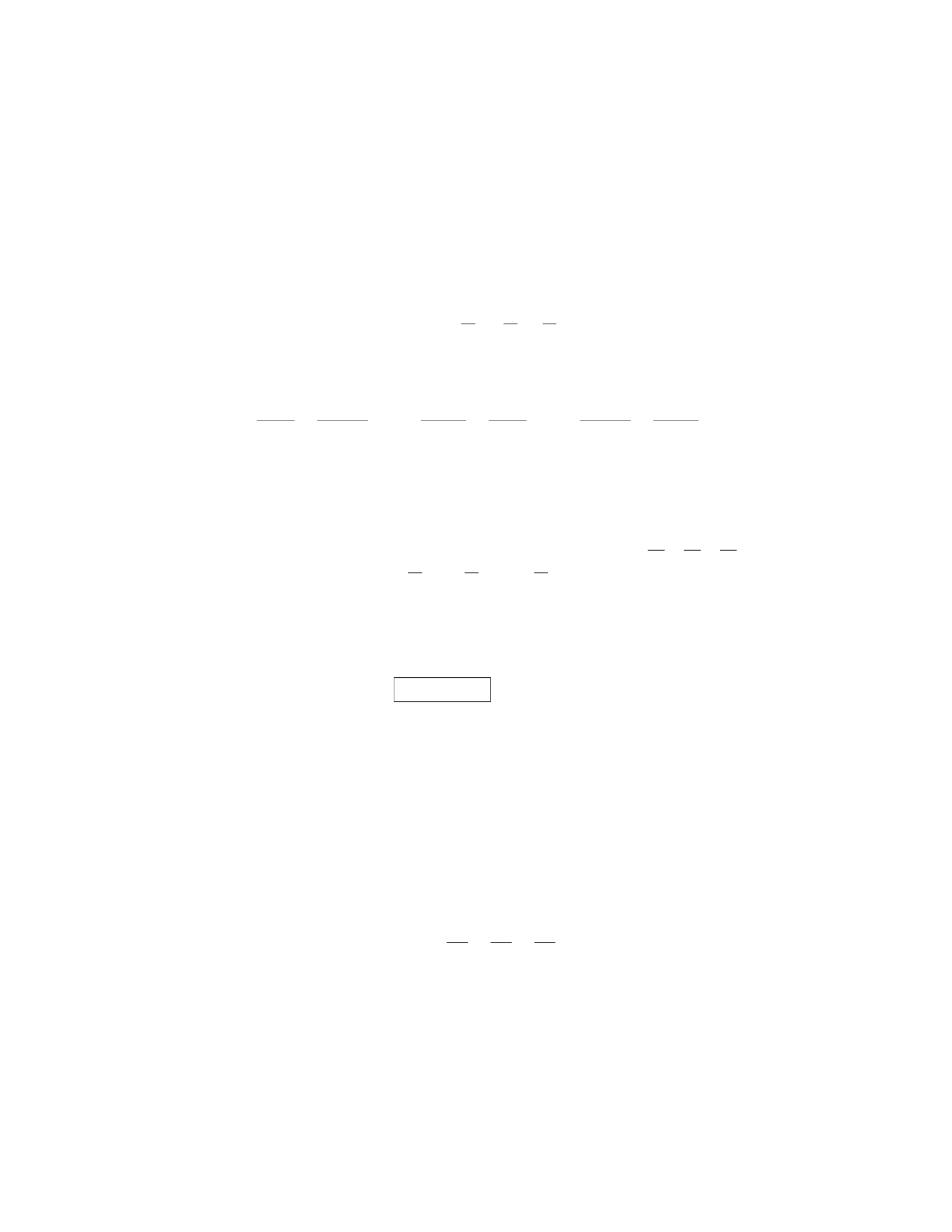
Step 2: Find ∇ · ∇ × FNow, we need to find the divergence of ∇ × F. The
divergence of a vector field G=Pi+Qj+Rkis given by ∇ · G=∂P
∂x +∂Q
∂y +∂R
∂z .
In this case, ∇ · ∇ × F=∂
∂x (z) + ∂
∂y (−x) + ∂
∂z (yexz ).
Calculating the partial derivatives, we get:
= 0 −0 + yexz +xzexz
=yexz +xzexz
Therefore, ∇ · ∇ × F=yexz +xzexz .
Question 30
Question
Let F(x, y, z) = x2i+ 2yzj+ 3z2kbe a vector field. Compute the divergence of
F.
Solution
Step 1: The divergence of a vector field F(x, y, z) = P(x, y, z)i+Q(x, y, z)j+
R(x, y, z)kis given by
div F=∂P
∂x +∂Q
∂y +∂R
∂z .
Step 2: For our given vector field, F(x, y, z) = x2i+ 2yzj+ 3z2k, we have
P(x, y, z) = x2, Q(x, y, z)=2yz, R(x, y, z)=3z2.
21
Question 2
Question
Let F(x, y, z)=(y2z3, x2z3, x2y2) be a vector field. Calculate the divergence of
F.
Solution
To find the divergence of F, we use the formula:
∇ · F=∂P
∂x +∂Q
∂y +∂R
∂z ,
where F(x, y, z)=(P(x, y, z), Q(x, y, z), R(x, y, z)).
Step 1: Identify the components of F:F(x, y, z) = (y2z3, x2z3, x2y2), so
P(x, y, z) = y2z3,Q(x, y, z) = x2z3, and R(x, y, z) = x2y2.
Step 2: Find the partial derivatives:
∂P
∂x = 0,∂Q
∂y = 0,∂R
∂z = 2xy2.
Step 3: Calculate the divergence of F:
∇ · F=∂P
∂x +∂Q
∂y +∂R
∂z = 0 + 0 + 2xy2= 2xy2.
Therefore, the divergence of Fis 2xy2.
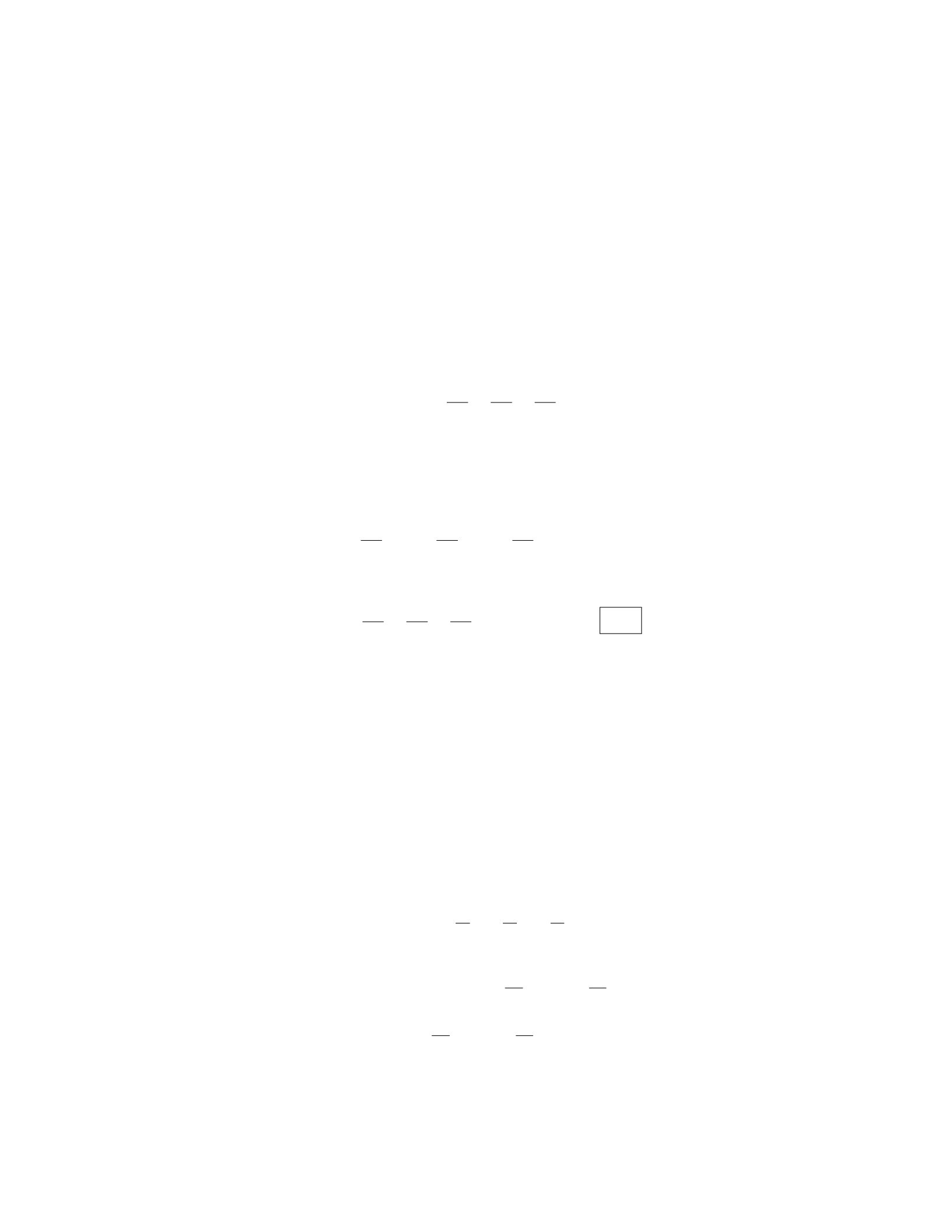
Question 3
Question
Let F= 2x2yi+ 3x2zj+ 4xyzk.
Calculate div(curl(F)).
Solution
Step 1: Calculate the curl of F:
curl(F) =
i j k
∂
∂x
∂
∂y
∂
∂z
2x2y3x2z4xyz
curl(F) = (0 −0) i−(0 −0) j+∂
∂x (3x2z)−∂
∂y (2x2y)k
curl(F) = ∂
∂x (3x2z)−∂
∂y (2x2y)k
2
curl(F) = (6xz −4xy)k
Step 2: Calculate the divergence of curl(F):
div(curl(F)) = ∂
∂x (6xz −4xy) + ∂
∂y (0) + ∂
∂z (0)
div(curl(F)) = 6z−4x
Therefore, div(curl(F)) = 6z−4x.
Question 4
Question
Let F(x, y, z) = (2xy +z)i+ (x2+y2)j+ (3yz −x2)k. Find the gradient,
divergence, and curl of F.
Solution
Gradient: Step 1: The gradient of a scalar field f(x, y, z) is given by ∇f=
∂f
∂x i+∂f
∂y j+∂f
∂z k.
Applying this formula to F, we have:
∇f=∂
∂x (2xy +z)i+∂
∂y (x2+y2)j+∂
∂z (3yz −x2)k
Step 2: Computing each partial derivative gives:
∇f= (2y)i+ (2x)j+ (3y)k
Therefore, the gradient of Fis ∇F= (2y)i+ (2x)j+ (3y)k.
Divergence: Step 1: The divergence of a vector field F(x, y, z) = P(x, y, z)i+
Q(x, y, z)j+R(x, y, z)kis given by ∇ · F=∂P
∂x +∂Q
∂y +∂R
∂z .
Applying this formula to F, we have:
∇ · F=∂
∂x (2xy +z) + ∂
∂y (x2+y2) + ∂
∂z (3yz −x2)
Step 2: Computing each partial derivative and adding them together gives:
∇ · F= 2y+ 2x+ 3y= 2x+ 5y
Therefore, the divergence of Fis ∇ · F= 2x+ 5y.
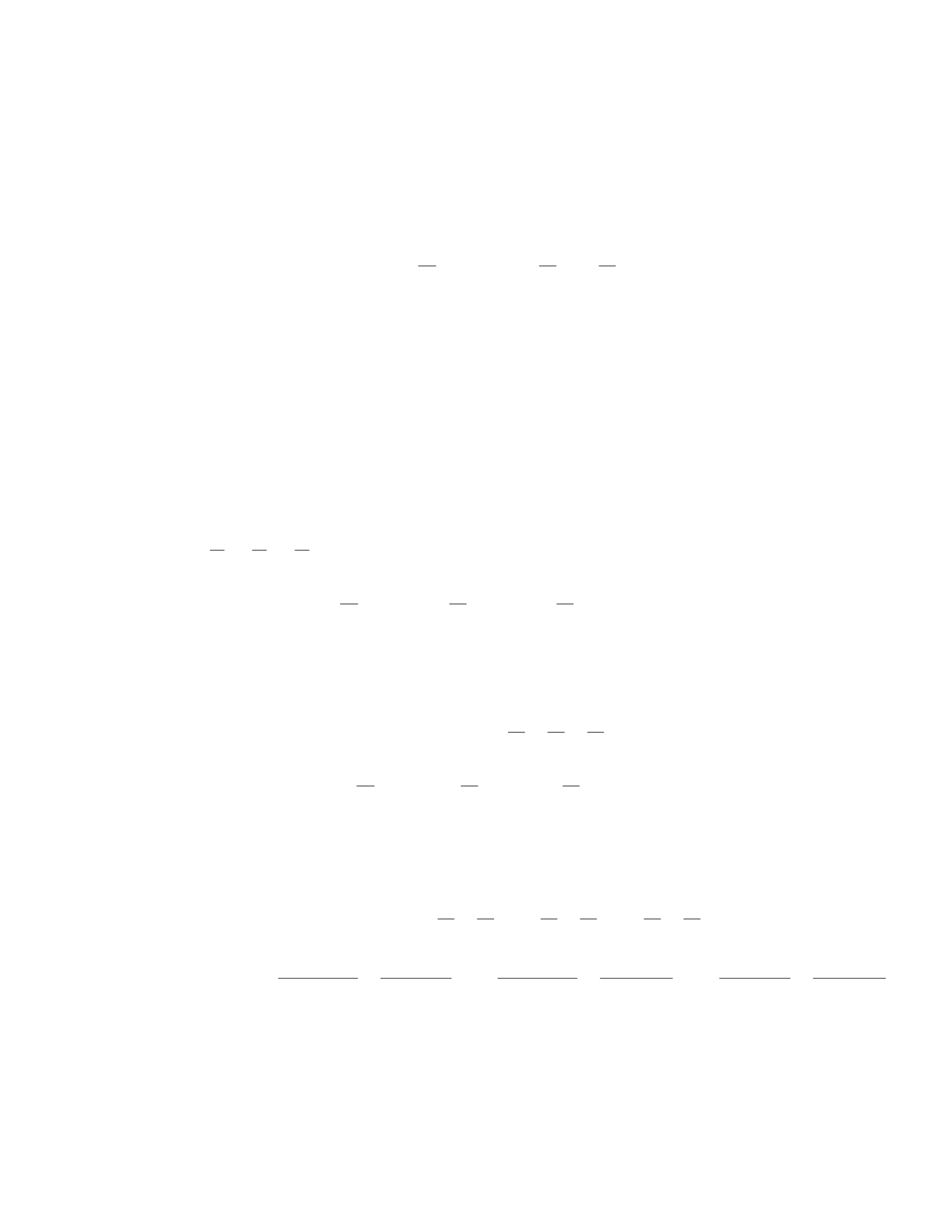
Curl: Step 1: The curl of a vector field F(x, y, z) = P(x, y, z)i+Q(x, y, z)j+
R(x, y, z)kis given by ∇ × F=∂R
∂y −∂Q
∂z i−∂R
∂x −∂P
∂z j+∂Q
∂x −∂P
∂y k.
Applying this formula to F, we have:
∇×F=∂(3yz −x2)
∂y −∂(x2+y2)
∂z i−∂(3yz −x2)
∂x −∂(2xy +z)
∂z j+∂(x2+y2)
∂x −∂(2xy +z)
∂y k
Step 2: Calculating each partial derivative and simplifying, we get:
∇ × F= (0 −2z)i−(−2x−0)j+ (2y−2x)
3
Question 5
Question
Let F(x, y, z)=(x2yz, exy, xz3). Determine the gradient, divergence, and curl
of F.
Solution
Step 1: Gradient of F The gradient of a vector field F(x, y, z)=(P(x, y, z), Q(x, y, z), R(x, y, z))
is given by
∇F=∂P
∂x ,∂Q
∂y ,∂R
∂z .
For F(x, y, z)=(x2yz, exy , xz3), we have
∇F=2xyz, xexy , z3.
Step 2: Divergence of F The divergence of a vector field F(x, y, z) =
(P(x, y, z), Q(x, y, z), R(x, y, z)) is given by
∇ · F=∂P
∂x +∂Q
∂y +∂R
∂z .
For F(x, y, z)=(x2yz, exy , xz3), we have
∇ · F= 2xyz +xexy + 3z2.
Step 3: Curl of F The curl of a vector field F(x, y, z)=(P(x, y, z), Q(x, y, z), R(x, y, z))
is given by
∇ × F=∂R
∂y −∂Q
∂z ,∂P
∂z −∂R
∂x ,∂Q
∂x −∂P
∂y .
For F(x, y, z)=(x2yz, exy , xz3), we have
∇ × F=xz3−y, −2xyz, exy −2z3.
Question 6
Question
Let F(x, y, z)=4xzi+ 3xyj+ (2z2−x2)k. Compute the curl of F.
Solution
To compute the curl of F, we will use the formula for the curl of a vector field:
curl F=∇ × F=
i j k
∂
∂x
∂
∂y
∂
∂z
P Q R
4
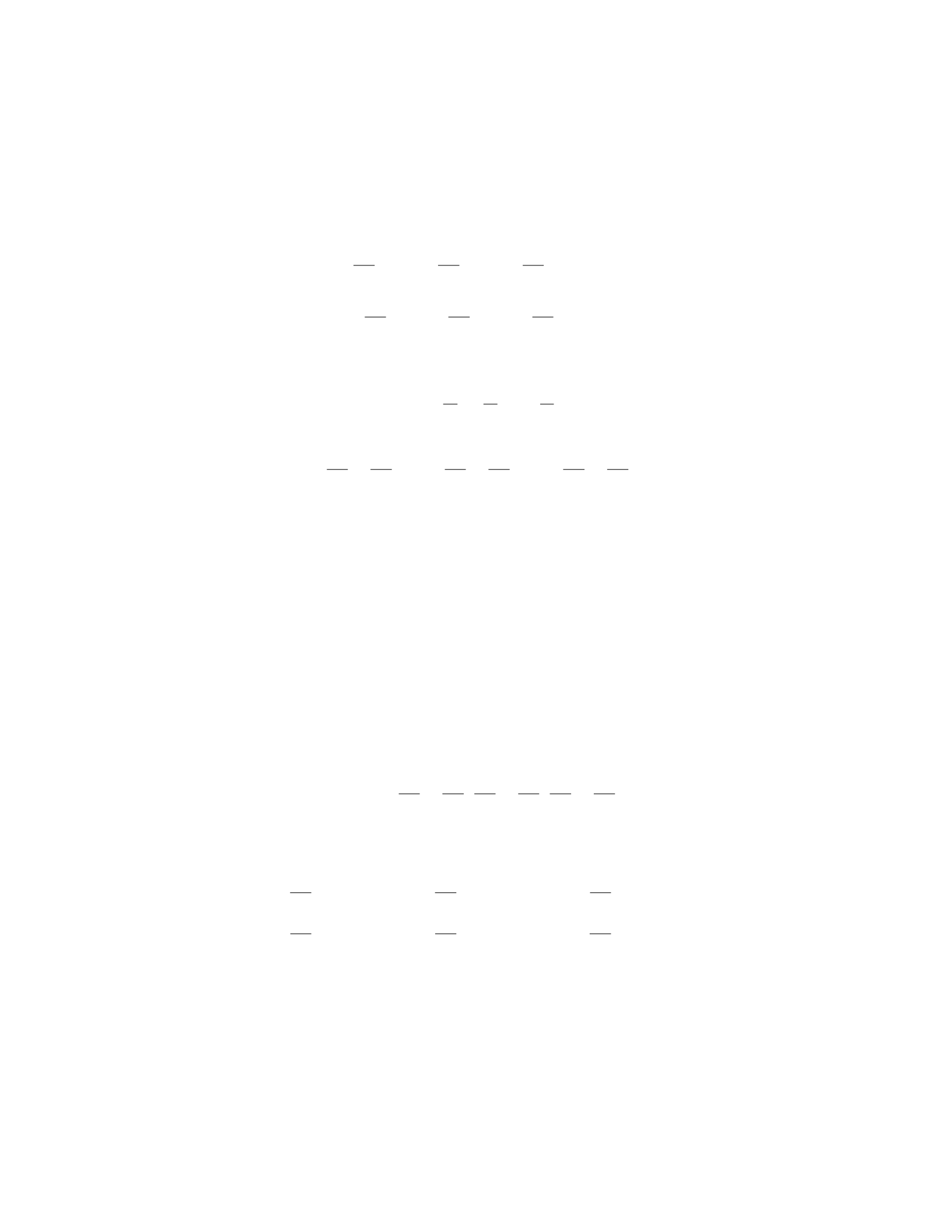
Where F(x, y, z) = P(x, y, z)i+Q(x, y, z)j+R(x, y, z)k.
Step 1: Compute the partial derivatives:
∂P
∂y = 3x, ∂Q
∂z = 4x, ∂R
∂x =−2x,
∂P
∂z = 4z, ∂Q
∂x = 3y, ∂R
∂y = 0.
Step 2: Compute the curl:
curl F=
i j k
∂
∂x
∂
∂y
∂
∂z
4xz 3xy 2z2−x2
=∂R
∂y −∂Q
∂z i−∂R
∂x −∂P
∂z j+∂Q
∂x −∂P
∂y k
= (0 −4x)i−(−2x−4z)j+ (3y−3x)k
=−4xi+ (2x+ 4z)j+ (3y−3x)k.
Therefore, the curl of Fis −4xi+ (2x+ 4z)j+ (3y−3x)k.
Question 7
Question
Let F(x, y, z)=(y2z+xz2, x2z+xy2, xy +xz). Compute the curl of F.
Solution
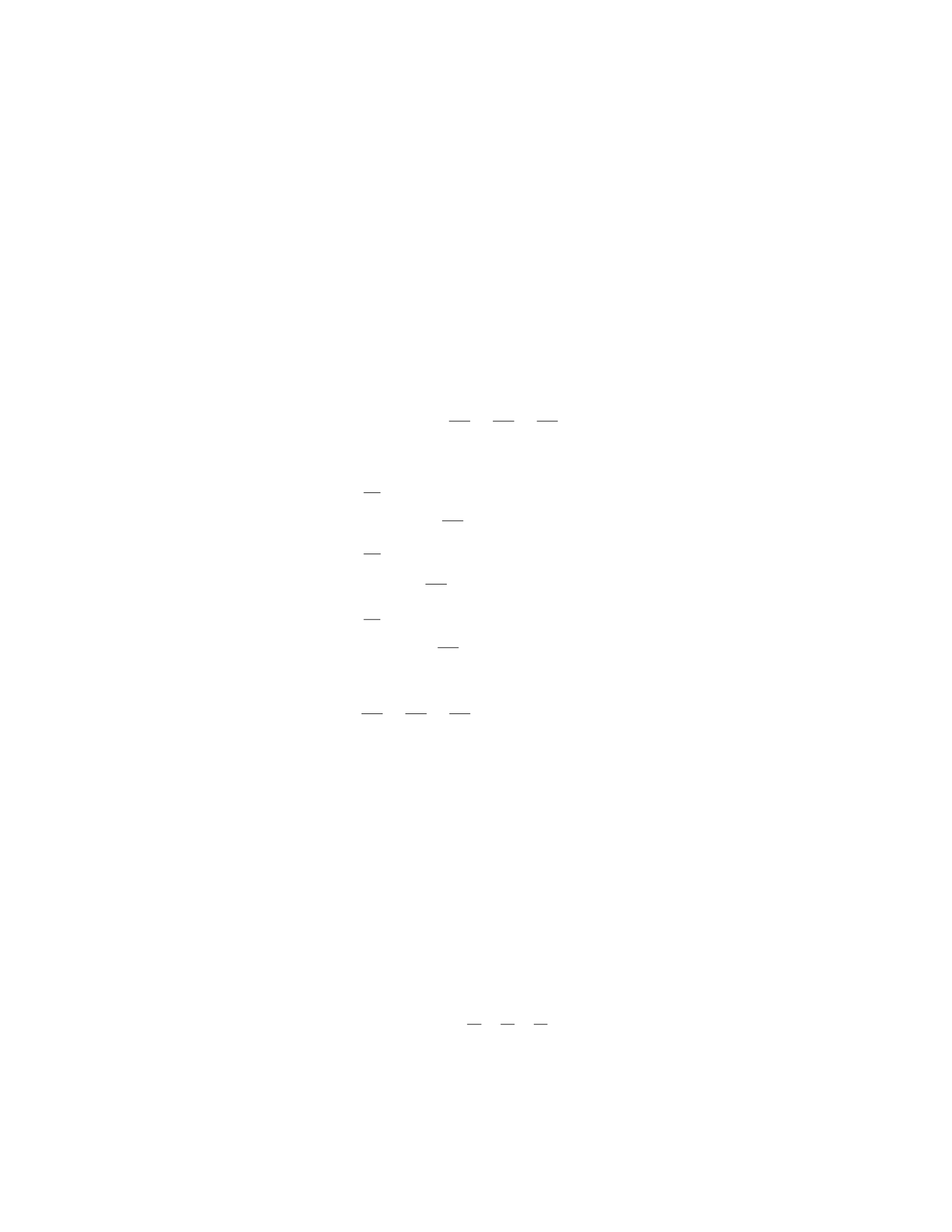
To find the curl of a vector field F(x, y, z)=(P, Q, R), we use the formula:
curl(F) = ∂R
∂y −∂Q
∂z ,∂P
∂z −∂R
∂x ,∂Q
∂x −∂P
∂y .
Step 1: Compute the partial derivatives of P,Q, and Rwith respect to
each variable.
∂P
∂y =z2,∂Q
∂z = 2xz, ∂R
∂x =z,
∂R
∂y =x, ∂P
∂z = 2xz, ∂Q
∂x = 2xy.
Step 2: Use the formula for the curl to compute the components.
curl(F) = z−x, 2xz −2xz, 2xy −z2= (z−x, 0,2xy −z2).
Therefore, the curl of Fis curl(F)=(z−x, 0,2xy −z2).
5
Question 8
Question
Let F(x, y, z) = x2yi+ezsin(y)j+zln(x)kbe a vector field. Calculate the
divergence of F.
Solution
To calculate the divergence of a vector field F(x, y, z) = P(x, y, z)i+Q(x, y, z)j+
R(x, y, z)k, where P,Q, and Rare the component functions, we use the formula:
∇ · F=∂P
∂x +∂Q
∂y +∂R
∂z
Given F(x, y, z) = x2yi+ezsin(y)j+zln(x)k, we have P(x, y, z) = x2y,
Q(x, y, z) = ezsin(y), and R(x, y, z) = zln(x).
Step 1: Calculate ∂P
∂x :
∂P
∂x = 2xy
Step 2: Calculate ∂Q
∂y :
∂Q
∂y =ezcos(y)
Step 3: Calculate ∂R
∂z :
∂R
∂z = ln(x)
Step 4: Now, we can find the divergence of F:
∇ · F=∂P
∂x +∂Q
∂y +∂R
∂z = 2xy +ezcos(y) + ln(x)
Therefore, the divergence of the vector field Fis 2xy +ezcos(y) + ln(x).
Question 9
Question
Let F(x, y, z)=4xyi+ 3xzj+ 5yzk. Calculate the curl of Fat the point
P(2,−1,3).
Solution
To calculate the curl of a vector field F(x, y, z) = P(x, y, z)i+Q(x, y, z)j+
R(x, y, z)kat a point P(a, b, c), we can use the formula:
∇ × F=
i j k
∂
∂x
∂
∂y
∂
∂z
P Q R
6
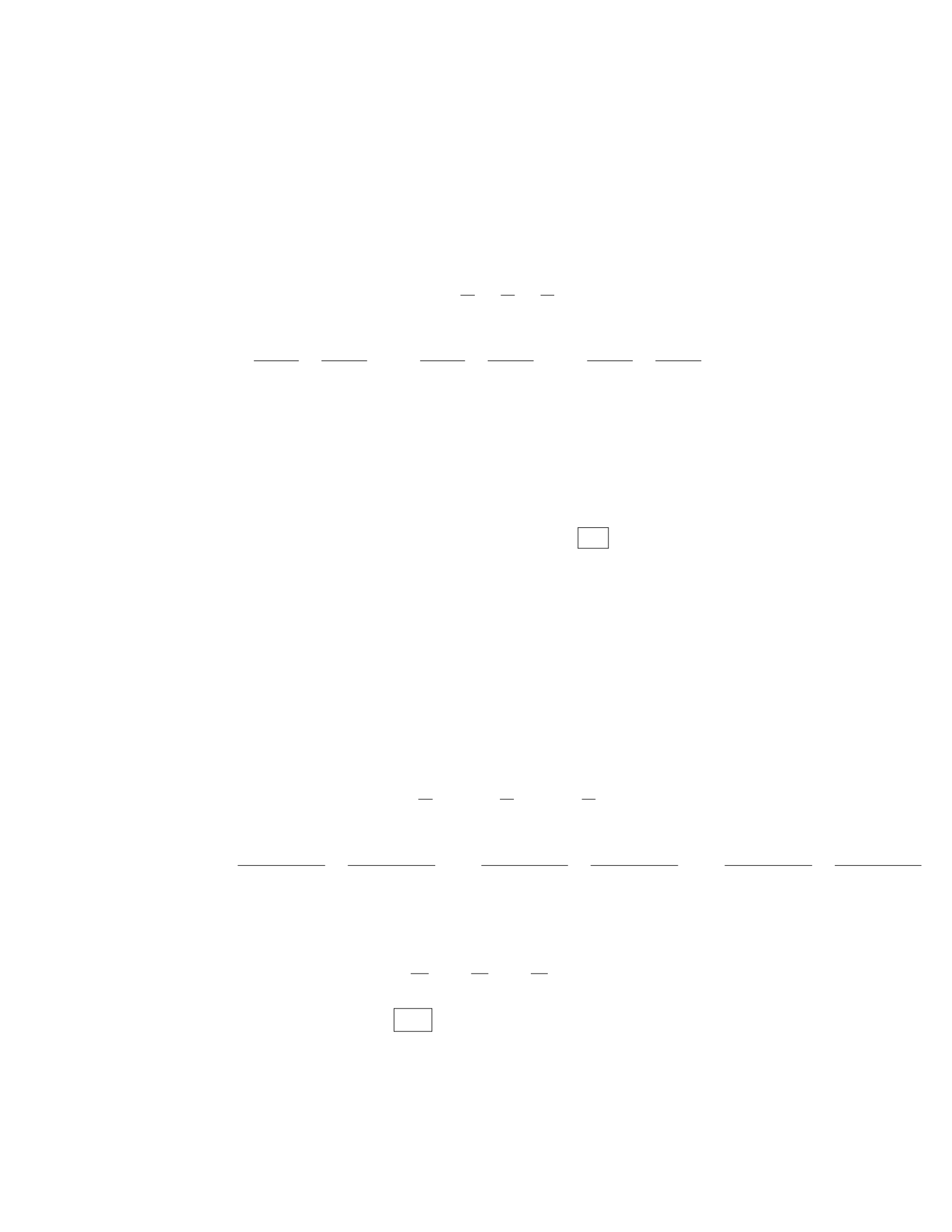
Given F(x, y, z)=4xyi+ 3xzj+ 5yzk, the components of Fare P(x, y, z) =
4xy,Q(x, y, z)=3xz, and R(x, y, z)=5yz.
Step 1: Calculate the curl of F.
∇ × F=
i j k
∂
∂x
∂
∂y
∂
∂z
4xy 3xz 5yz
=∂(5yz)
∂y −∂(3xz)
∂z i−∂(5yz)
∂x −∂(4xy)
∂z j+∂(3xz)
∂x −∂(4xy)
∂y k
= (5z−3)i−(−5y)j+ (3z)k
Step 2: Evaluate the curl of Fat the point P(2,−1,3). At the point
P(2,−1,3), plug in x= 2, y=−1, and z= 3 into the components of the
curl.
∇ × F= (5(3) −3)i−(−5(−1))j+ (3(3))k
= 12i−5j+ 9k
Therefore, the curl of Fat the point P(2,−1,3) is 12i−5j+ 9k.
Question 10
Question
Let F(x, y, z) = (2xz2+y3)i+ (3x2z+ 2y)j+ (2x2y+ 3z)kbe a vector field.
Calculate ∇ · ∇ × F.
Solution
Step 1: Calculate the curl of F.
∇ × F=
i j k
∂
∂x
∂
∂y
∂
∂z
2xz2+y33x2z+ 2y2x2y+ 3z
=∂(2x2y+ 3z)
∂y −∂(3x2z+ 2y)
∂z i−∂(2xz2+y3)
∂x −∂(2x2y+ 3z)
∂z j+∂(3x2z+ 2y)
∂x −∂(2xz2+y3)
∂y k
= (2x2−2x2)i−(2z−2z)j+ (6xz −3y2)k=−3y2k
Step 2: Calculate the divergence of the curl.
∇ · −3y2k=∂
∂x (0) + ∂
∂y (0) + ∂
∂z (−3y2) = −6y
Therefore, ∇ · ∇ × F=−6y.
7
Question 11
Question
Let F(x, y, z) = x2yi+xy2j+xyzkbe a vector field in R3. Compute the
divergence of Fat the point (1,2,−1).
Solution
Step 1: The divergence of a vector field F(x, y, z) = P(x, y, z)i+Q(x, y, z)j+
R(x, y, z)kis given by:
div F=∂P
∂x +∂Q
∂y +∂R
∂z
Step 2: Given F(x, y, z) = x2yi+xy2j+xyzk, we have P(x, y, z) = x2y,
Q(x, y, z) = xy2, and R(x, y, z) = xyz.
Step 3: Compute the partial derivatives:
∂P
∂x = 2xy ∂Q
∂y = 2xy ∂R
∂z =xy
Step 4: Compute the divergence of Fat the point (1,2,−1):
div F=∂P
∂x +∂Q
∂y +∂R
∂z = 2(1)(2) + 2(1)(2) + (1)(2) = 6 + 4 + 2 = 12
Step 5: Therefore, the divergence of Fat the point (1,2,−1) is 12 .
Question 12
Question
Let F(x, y)=(exy −ycos(x), x sin(y)−exy). Find the curl of F.
Solution
To find the curl of F, we first need to compute the components of the curl
vector. The curl of Fis given by
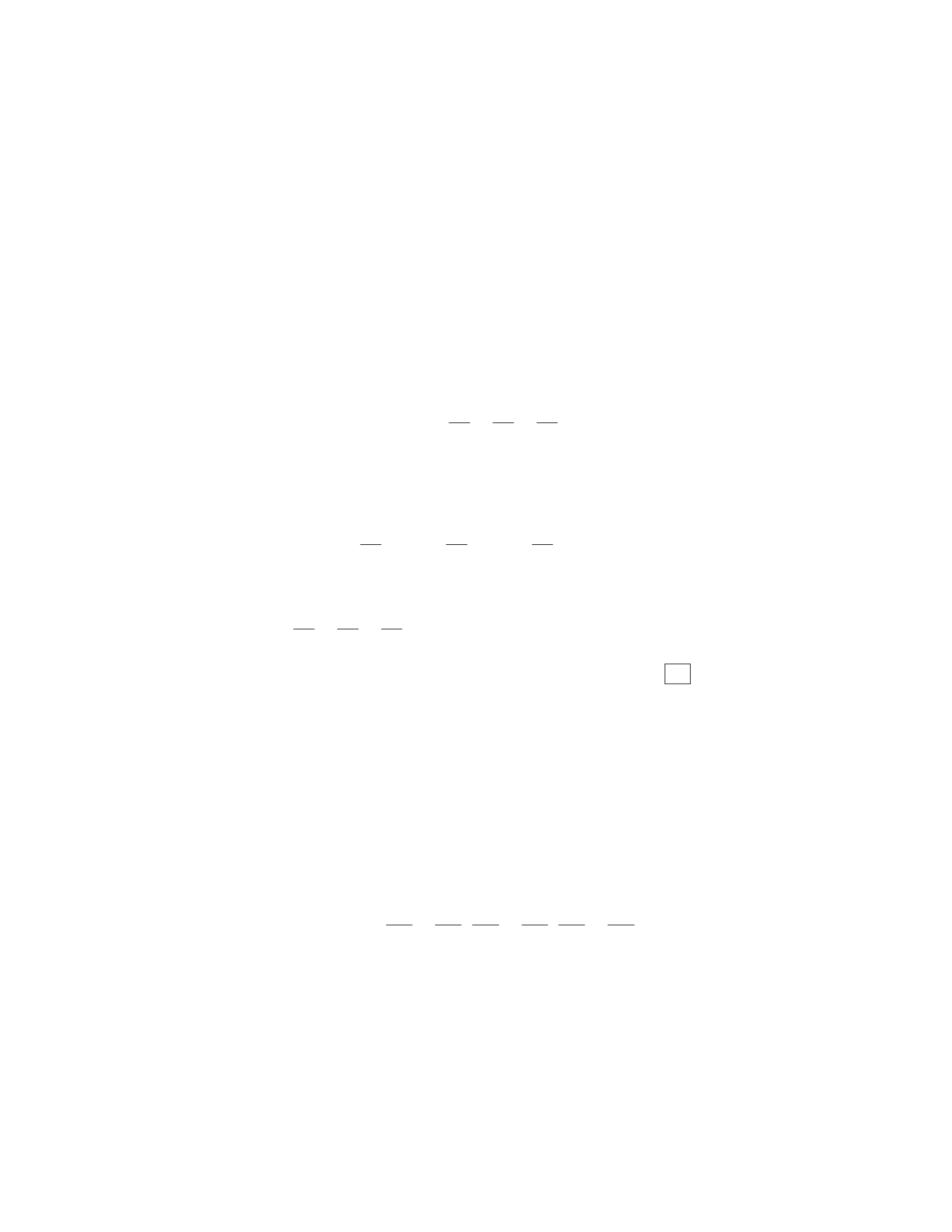
curl(F) = ∂Fz
∂y −∂Fy
∂z ,∂Fx
∂z −∂Fz
∂x ,∂Fy
∂x −∂Fx
∂y
8
Step 1: Compute the partial derivatives of F.
∂Fz
∂y =∂
∂y (xsin(y)−exy ) = xcos(y)−xexy
∂Fy
∂z =∂
∂z (exy −ycos(x)) = 0
∂Fx
∂z =∂
∂z (ycos(x)) = 0
∂Fz
∂x =∂
∂x (xsin(y)−exy ) = ycos(y)
∂Fx
∂y =∂
∂y (ycos(x)) = −ysin(x)
∂Fy
∂x =∂
∂x (exy −ycos(x)) = yexy + cos(x)
Step 2: Calculate the components of the curl vector.
curl(F)=(xcos(y)−xexy,0−0, y cos(y),−ysin(x), yexy + cos(x))
Step 3: Simplify the components of the curl vector.
curl(F)=(xcos(y)−xexy,0, y cos(y),−ysin(x), yexy + cos(x))
Therefore, the curl of Fis (xcos(y)−xexy ,0, y cos(y),−ysin(x), yexy + cos(x)) .
Question 13
Question
Find the gradient, divergence, and curl of the vector field F= (xey+y2, x2ey−
2y, z cos(xyz)).
Solution
Step 1: The gradient of a vector field F= (f, g, h) is given by ∇f=∂f
∂x ,∂g
∂y ,∂h
∂z .
Step 2: For the given vector field F, its gradient ∇ · Fis:
∇ · F=∂(xey+y2)
∂x ,∂(x2ey−2y)
∂y ,∂(zcos(xyz))
∂z
Step 3: Calculating the partial derivatives, we have:
∇ · F= (ey, x2ey−2,cos(xyz))
Step 4: The divergence of a vector field F= (f, g, h) is given by ∇ · F=
∂f
∂x +∂g
∂y +∂h
∂z .
Step 5: Therefore, the divergence of the vector field Fis:
9
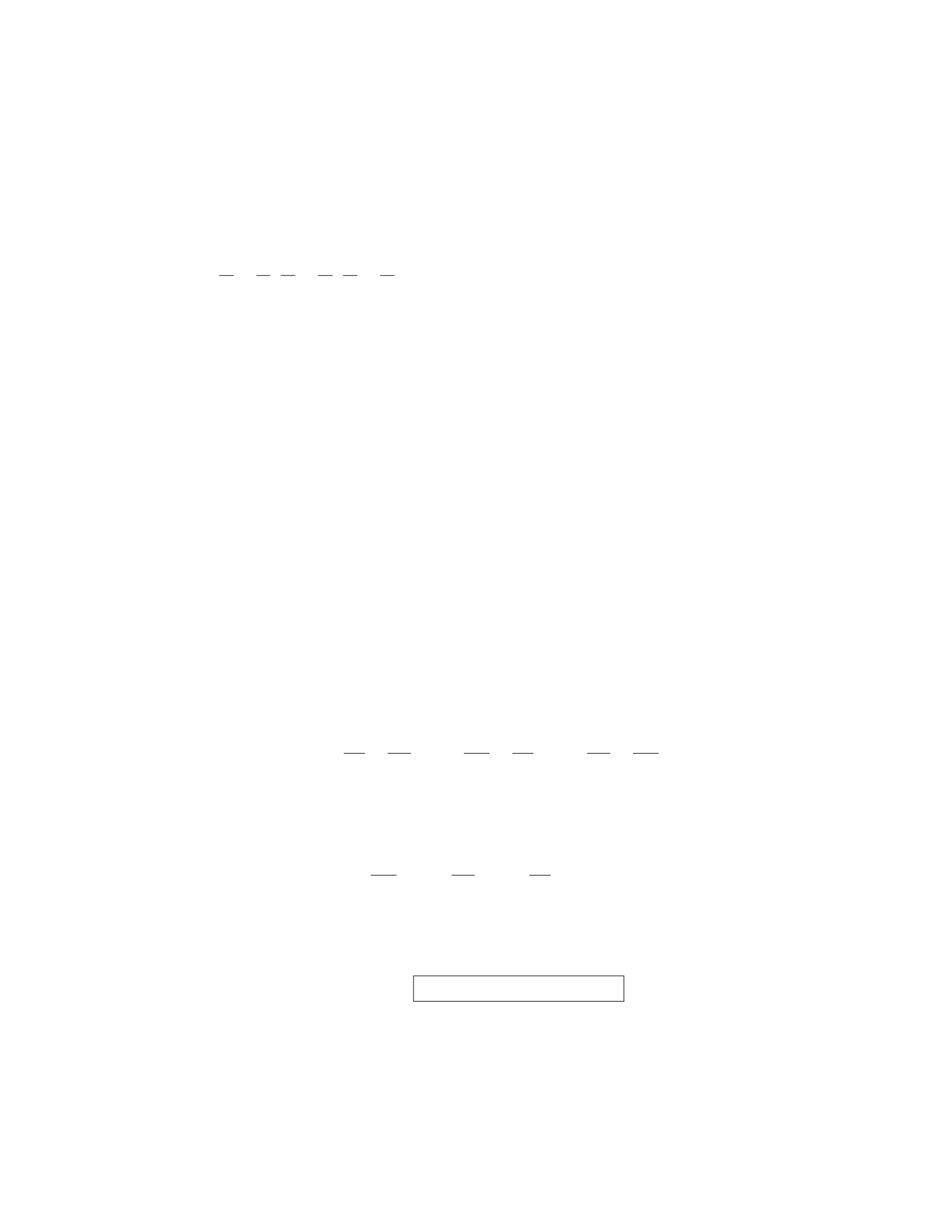
∇ · F=ey+x2ey−2 + cos(xyz)
Step 6: The curl of a vector field F= (f, g, h) is given by ∇ × F=
∂h
∂y −∂g
∂z ,∂f
∂z −∂h
∂x ,∂g
∂x −∂f
∂y .
Step 7: Calculating the curl of the vector field F, we get:
∇ × F=0−0,0−0, z(−x2yz sin(xyz))
Step 8: Simplifying, we find:
∇ × F= (−z2x2y2sin(xyz),0,0)
Therefore, the gradient, divergence, and curl of the vector field Fare:
Gradient: ∇ · F= (ey, x2ey−2,cos(xyz))
Divergence: ∇ · F=ey+x2ey−2 + cos(xyz)
Curl: ∇ × F= (−z2x2y2sin(xyz),0,0)
Question 14
Question
Let F(x, y, z)=(yz, xz, xy) be a vector field in R3. Calculate the curl of F.
Solution
To find the curl of a vector field F(x, y, z)=(M, N, P ) in R3, we use the formula:
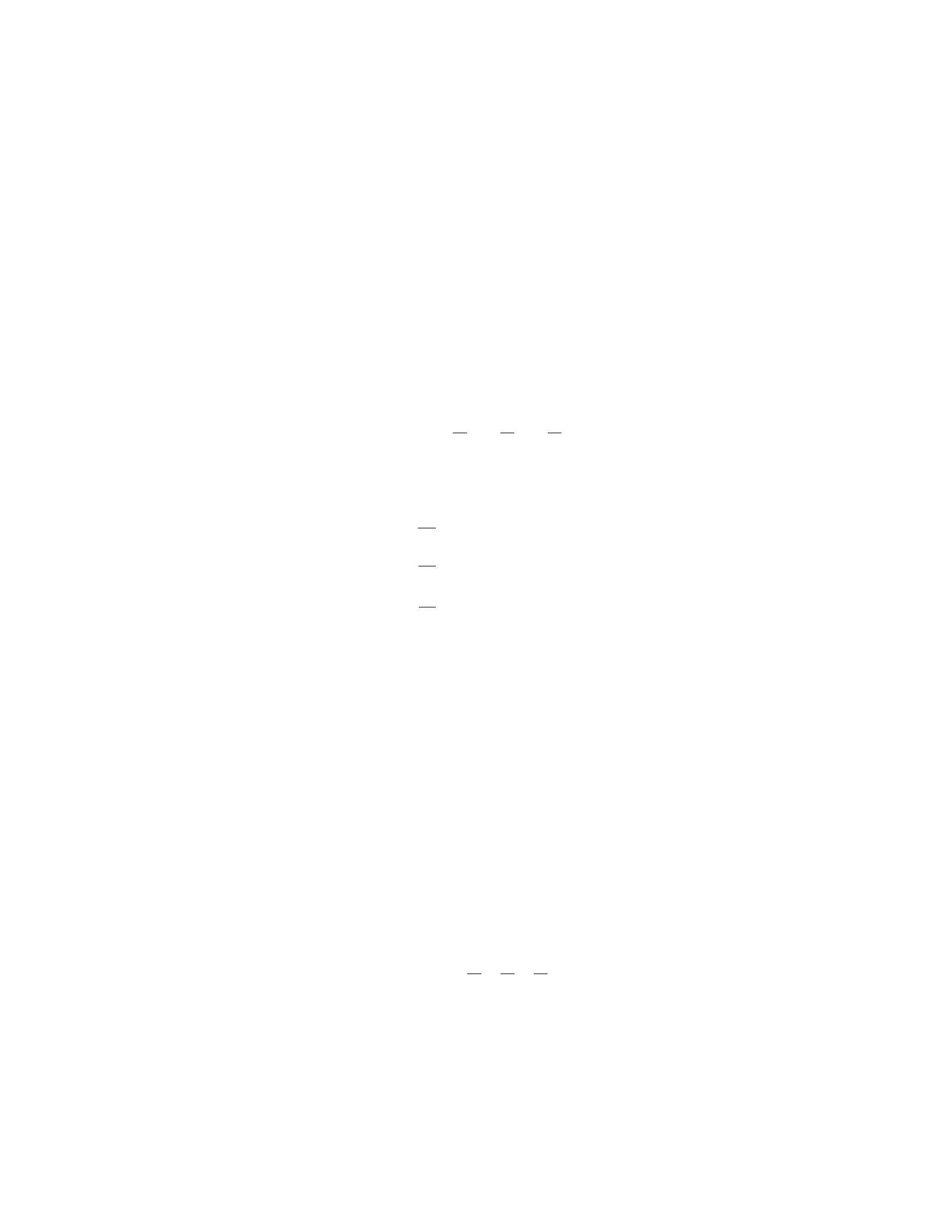
∇ × F=∂P
∂y −∂N
∂z i+∂M
∂z −∂P
∂x j+∂N
∂x −∂M
∂y k
For our vector field F(x, y, z)=(yz, xz, xy), we have M=yz,N=xz, and
P=xy.
Step 1: Calculate the partial derivatives
∂M
∂z =y, ∂N
∂x =z, ∂P
∂y =x
Step 2: Calculate the curl
∇ × F= (x−z)i+ (y−x)j+ (z−y)k
Therefore, the curl of Fis (x−z)i+ (y−x)j+ (z−y)k.
10
Question 15
Question
Let F(x, y, z) = x2yzi+xyz2j+xy2zkbe a vector field. Calculate the curl of
F.
Solution
To find the curl of F, denoted by ∇ × F, we need to compute the determinant
of the following matrix:
∇ × F=
i j k
∂
∂x
∂
∂y
∂
∂z
x2yz xyz2xy2z
Step 1: Compute the partial derivatives of the components of F.
∂
∂x (x2yz)=2xyz
∂
∂y (xyz2) = xz2
∂
∂z (xy2z) = xy2
Step 2: Plug these derivatives into the determinant to find the curl.
∇ × F=
i j k
2xyz xz2xy2
= (xz2−xy2)i−(2xyz)j+ (2y−z2)k
Therefore, the curl of Fis ∇ × F= (xz2−xy2)i−(2xyz)j+ (2y−z2)k.
Question 16
Question
Let F(x, y, z) = x2ezi+ 2yezj+xyzk. Find the curl of F.
Solution
To find the curl of F, we use the formula:
∇ × F=
i j k
∂
∂x
∂
∂y
∂
∂z
FxFyFz
where Fx, Fy, Fzare the components of F.
11
Step 1: Compute Fx,Fy, and Fz.
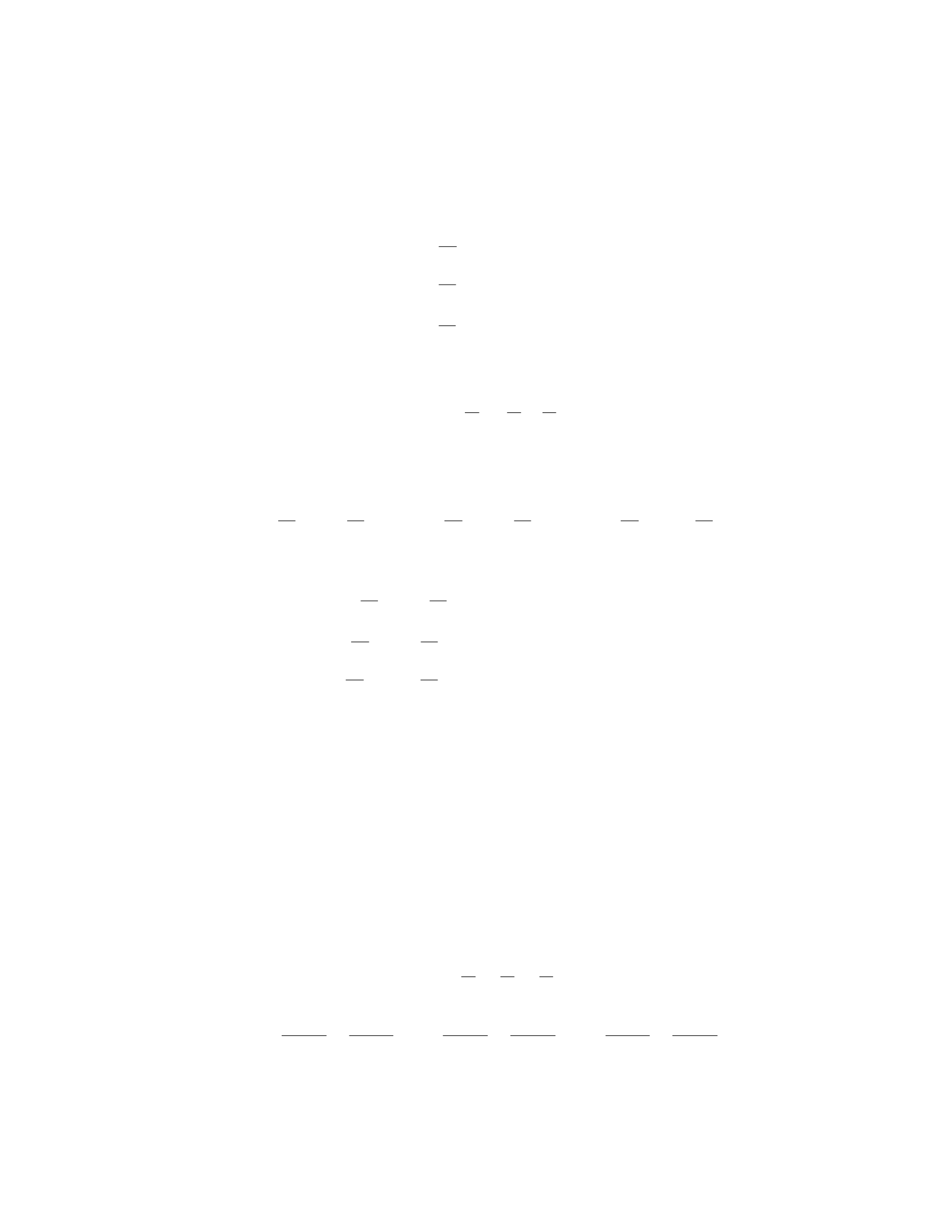
Fx=∂
∂x (x2ez)=2xez
Fy=∂
∂y (2yez)=2ez
Fz=∂
∂z (xyz) = xy
Step 2: Now, evaluate the determinant for the curl.
∇ × F=
i j k
∂
∂x
∂
∂y
∂
∂z
2xez2ezxy
Step 3: Expand the determinant using the cofactor expansion along the top
row.
∇×F=∂
∂y (xy)−∂
∂z (2ez)i−∂
∂x (xy)−∂
∂z (2xez)j+∂
∂x (2ez)−∂
∂y (2xez)k
Step 4: Compute the partial derivatives.
∂
∂y (xy)−∂
∂z (2ez) = x−0 = x
∂
∂x (xy)−∂
∂z (2xez) = y−0 = y
∂
∂x (2ez)−∂
∂y (2xez)=0−2ez=−2ez
Step 5: Therefore, the curl of Fis:
∇ × F=xi+yj−2ezk
Question 17
Question
Let F(x, y, z) = x2yi+y2zj+z2xk. Calculate ∇ · (∇ × F).
Solution
Step 1: Find ∇ × F:
∇ × F=
i j k
∂
∂x
∂
∂y
∂
∂z
x2y y2z z2x
∇ × F=∂(z2x)
∂y −∂(y2z)
∂z i−∂(z2x)
∂x −∂(x2y)
∂z j+∂(y2z)
∂x −∂(x2y)
∂y k
12
∇ × F= (2z−2z)i−(2z−2y)j+ (2y−2x)k
∇ × F= 0i−2yj+ 2yk=−2yj+ 2yk
Step 2: Find ∇ · (∇ × F):
∇ · (∇ × F) = ∂
∂x (−2y) + ∂
∂y (2y) + ∂
∂z (0)
∇ · (∇ × F) = 0 + 2 + 0 = 2
Question 18
Question
Let F(x, y, z)=(x2+y2+z2)i+exyzj+ ln(xy +z)k. Calculate the curl of F.
Solution
To find the curl of a vector field F(x, y, z) = P(x, y, z)i+Q(x, y, z)j+R(x, y, z)k,
we use the formula:
∇ × F=∂R
∂y −∂Q
∂z i−∂R
∂x −∂P
∂z j+∂Q
∂x −∂P
∂y k
Given F(x, y, z) = (x2+y2+z2)i+exyzj+ln(xy +z)k, we have: P(x, y, z) =
x2+y2+z2,Q(x, y, z) = exyz, and R(x, y, z) = ln(xy +z).
Step 1: Calculate the partial derivatives:
∂P
∂y = 2y, ∂Q
∂z = 0,∂R
∂y =x
xy +z
∂R
∂z =1
xy +z,∂Q
∂x =yzexyz ,∂P
∂z = 2z
Step 2: Plug the partial derivatives into the curl formula:
∇ × F=x
xy +z−0i−(2z−yzexyz)j+ (2y−2z)k
Hence, the curl of Fis given by:
∇ × F=x
xy +zi−(2z−yzexyz)j+ (2y−2z)k
Question 19
Question
Let F(x, y, z) = (2xy+xz, x2+y2+z2, yz +yz) be a vector field in R3. Calculate
∇ · ∇ × F.
13
Solution
To find ∇ · ∇ × Fwhere Fis a vector field in R3, we first need to calculate
∇ × F.
Step 1: Calculate ∇ × FThe curl of a vector field F= (P, Q, R) is defined
as:
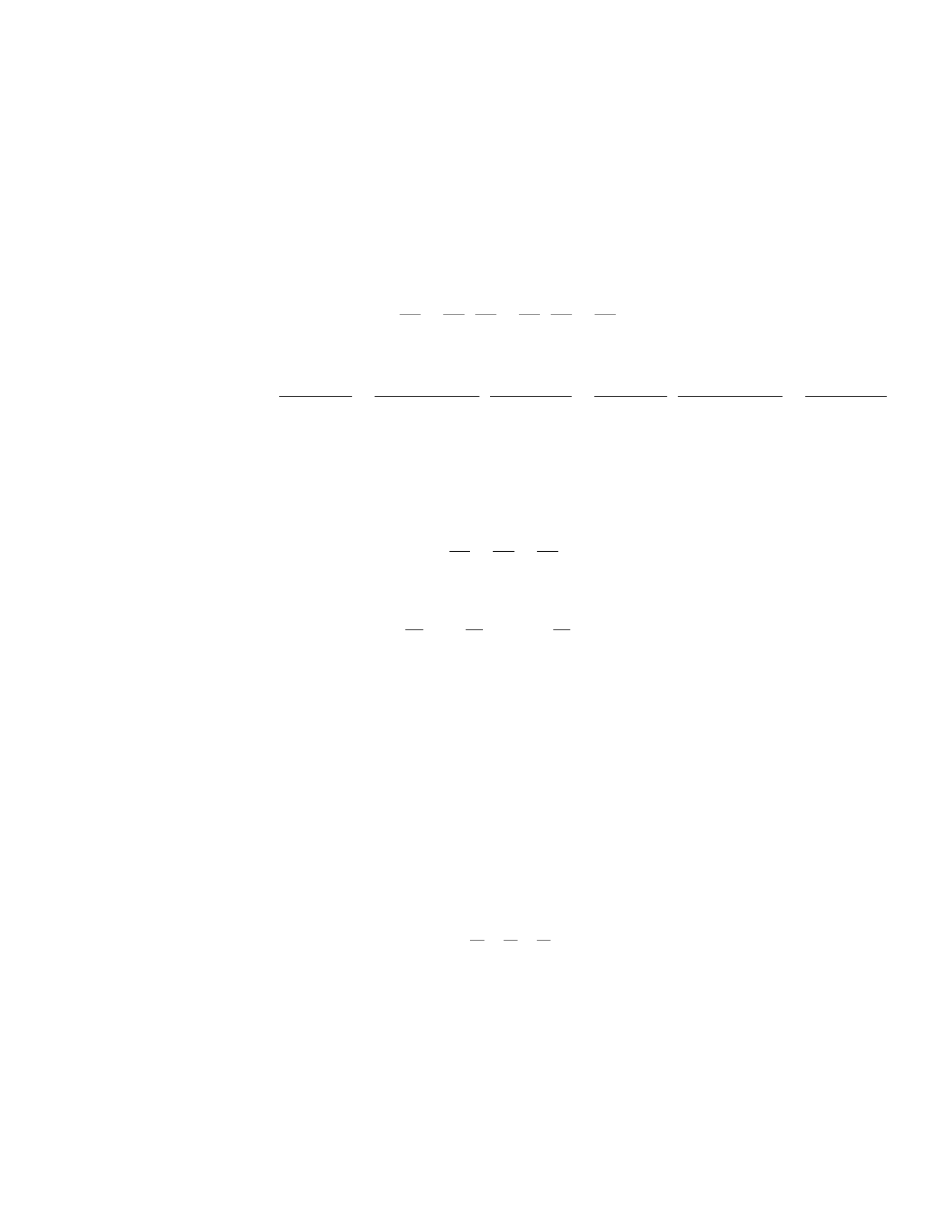
∇ × F=∂R
∂y −∂Q
∂z ,∂P
∂z −∂R
∂x ,∂Q
∂x −∂P
∂y
In this case, F(x, y, z) = (2xy +xz, x2+y2+z2, yz +xz), so:
∇×F=∂(yz +xz)
∂y −∂(x2+y2+z2)
∂z ,∂(2xy +xz)
∂z −∂(yz +xz)
∂x ,∂(x2+y2+z2)
∂x −∂(2xy +xz)
∂y
Calculating the partial derivatives and simplifying, we get:
∇ × F= (1, x −1,−y)
Step 2: Calculate ∇·∇×FThe divergence of a vector field G= (A, B, C)
is given by:
∇ · G=∂A
∂x +∂B
∂y +∂C
∂z
In this case, G= (1, x −1,−y), so:
∇ · G=∂
∂x (1) + ∂
∂y (x−1) + ∂
∂z (−y)
∇ · G= 0
Therefore, ∇ · ∇ × F= 0.
Question 20
Question
Let F(x, y, z) = xzi+yzj+xykbe a vector field in R3. Determine curl(F).
Solution
Step 1: The curl of a vector field F=Pi+Qj+Rkin R3is given by the
determinant
curl(F) =
i j k
∂
∂x
∂
∂y
∂
∂z
P Q R
where P,Q, and Rare the components of F.
Step 2: In our case, F(x, y, z) = xzi+yzj+xyk, so P=xz,Q=yz, and
R=xy.
14
Step 3: Compute the curl of Fby evaluating the determinant:
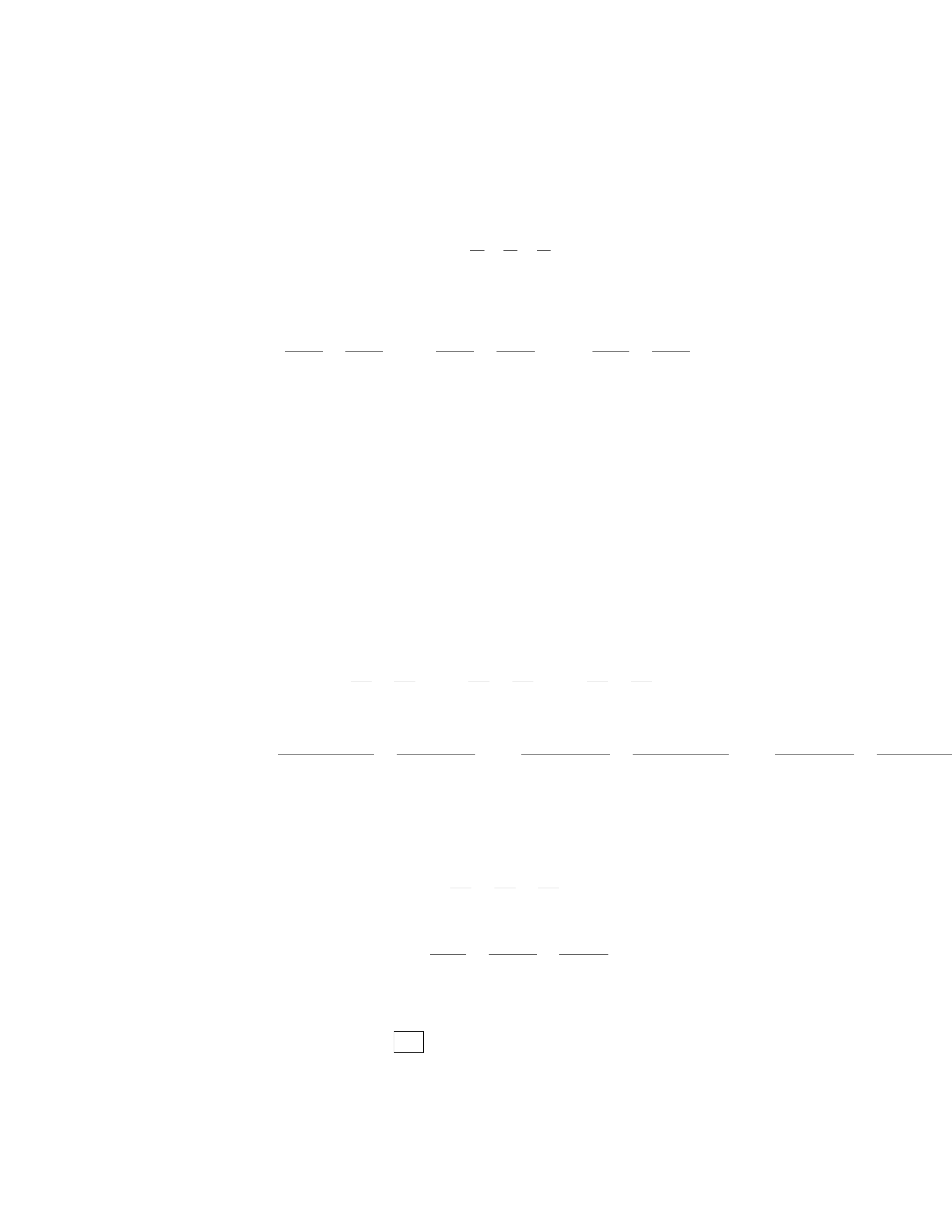
curl(F) =
i j k
∂
∂x
∂
∂y
∂
∂z
xz yz xy
Step 4: Calculate the determinant using the cofactor expansion along the
top row:
=i∂(xy)
∂y −∂(yz)
∂z −j∂(xz)
∂x −∂(xy)
∂z +k∂(yz)
∂x −∂(xz)
∂y
Step 5: Simplify the expressions:
=i(x−z)−j(z) + k(y) = (x−z)i−zj+yk
Therefore, curl(F)=(x−z)i−zj+yk.
Question 21
Question
Let F(x, y, z) = (2xy +x2z)i+ (x2+y2z)j+ (xyz2+ 2yz)k. Calculate ∇ · ∇ × F.
Solution
Step 1: Calculate ∇ × F. The curl of a vector field F(x, y, z) = P(x, y, z)i+
Q(x, y, z)j+R(x, y, z)kis defined as:
∇ × F=∂R
∂y −∂Q
∂z i+∂P
∂z −∂R
∂x j+∂Q
∂x −∂P
∂y k
For F(x, y, z) = (2xy +x2z)i+ (x2+y2z)j+ (xyz2+ 2yz)k, we have:
∇×F=∂(xyz2+ 2yz)
∂y −∂(x2+y2z)
∂z i+∂(2xy +x2z)
∂z −∂(xyz2+ 2yz)
∂x j+∂(x2+y2z)
∂x −∂(2xy +x2z)
∂y k
Calculating the partial derivatives, we get:
∇ × F= (z2)i−(z2)j−(2y)k
Step 2: Calculate ∇·∇×F. The divergence of a vector field G=Pi+Qj+Rk
is given by:
∇ · G=∂P
∂x +∂Q
∂y +∂R
∂z
For ∇ · ∇ × F, we have:
∇ · ∇ × F=∂(z2)
∂x +∂(−z2)
∂y +∂(−2y)
∂z
Calculating the partial derivatives, we get:
∇ · ∇ × F= 0 + 0 −2
Therefore, ∇ · ∇ × F=−2 .
15
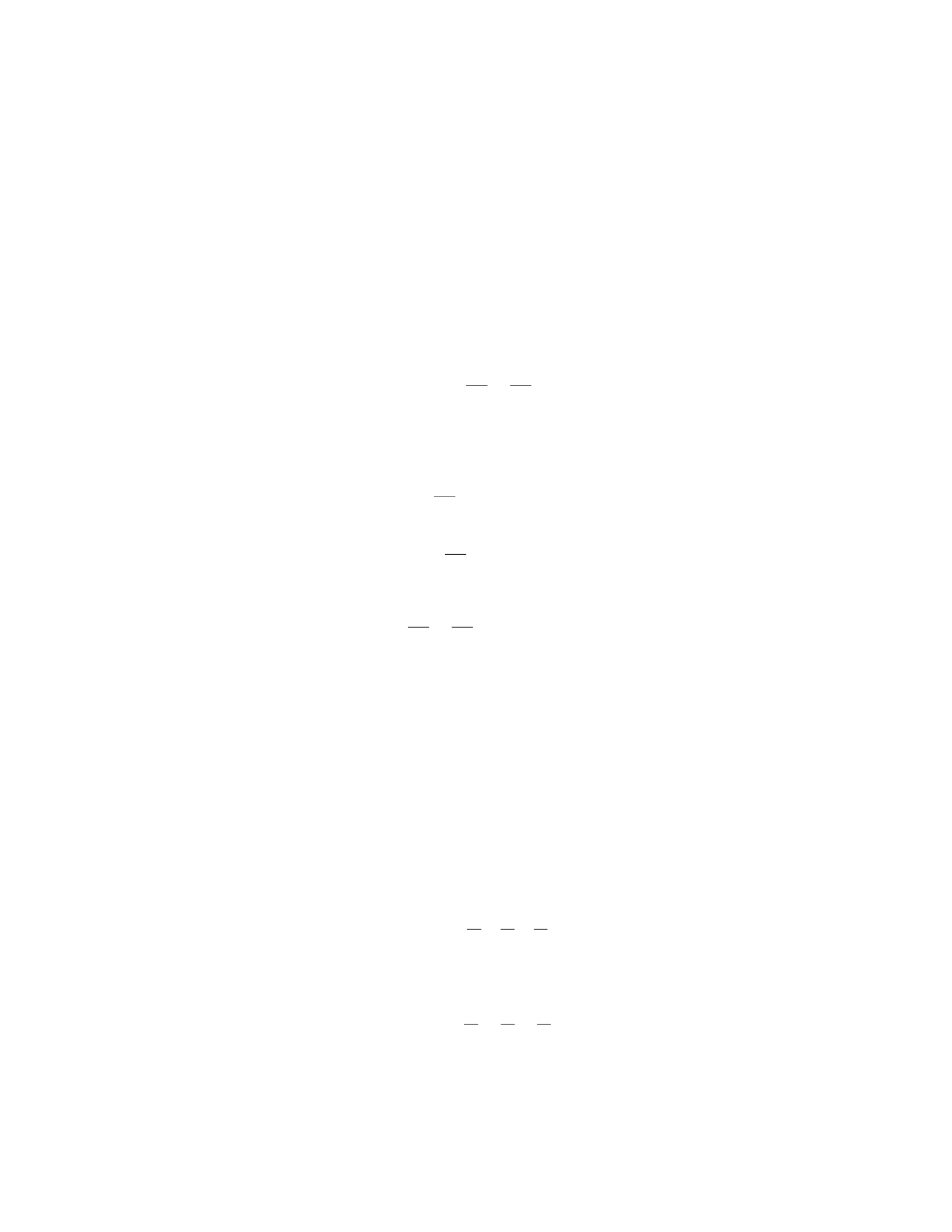
Question 22
Question
Let F(x, y) = eyi+xcos(y)jbe a vector field in R2. Calculate the curl of F.
Solution
To compute the curl of a vector field F(x, y) = P(x, y)i+Q(x, y)jin R2, we use
the formula
curl F=∂Q
∂x −∂P
∂y k.
Step 1: Identify P(x, y) and Q(x, y) from F. Here, P(x, y) = eyand
Q(x, y) = xcos(y).
Step 2: Compute the partial derivatives needed for the formula:
∂Q
∂x = cos(y)
and ∂P
∂y =ey.
Step 3: Substitute the partial derivatives into the formula for the curl:
curl F=∂Q
∂x −∂P
∂y k= (cos(y)−ey)k.
Thus, the curl of Fis (cos(y)−ey)k.
Question 23
Question
Let F(x, y, z)=2xyi+yzj+x2zk. Compute the curl of F.
Solution
To compute the curl of F, we will use the determinant form of the curl for a
vector field F(x, y, z) = P(x, y, z)i+Q(x, y, z)j+R(x, y, z)k, where the curl is
given by:
∇ × F=
i j k
∂
∂x
∂
∂y
∂
∂z
P Q R
Step 1: Calculate the curl of Fusing the determinant form:
∇ × F=
i j k
∂
∂x
∂
∂y
∂
∂z
2xy yz x2z
16
Step 2: Expand the determinant along the top row:
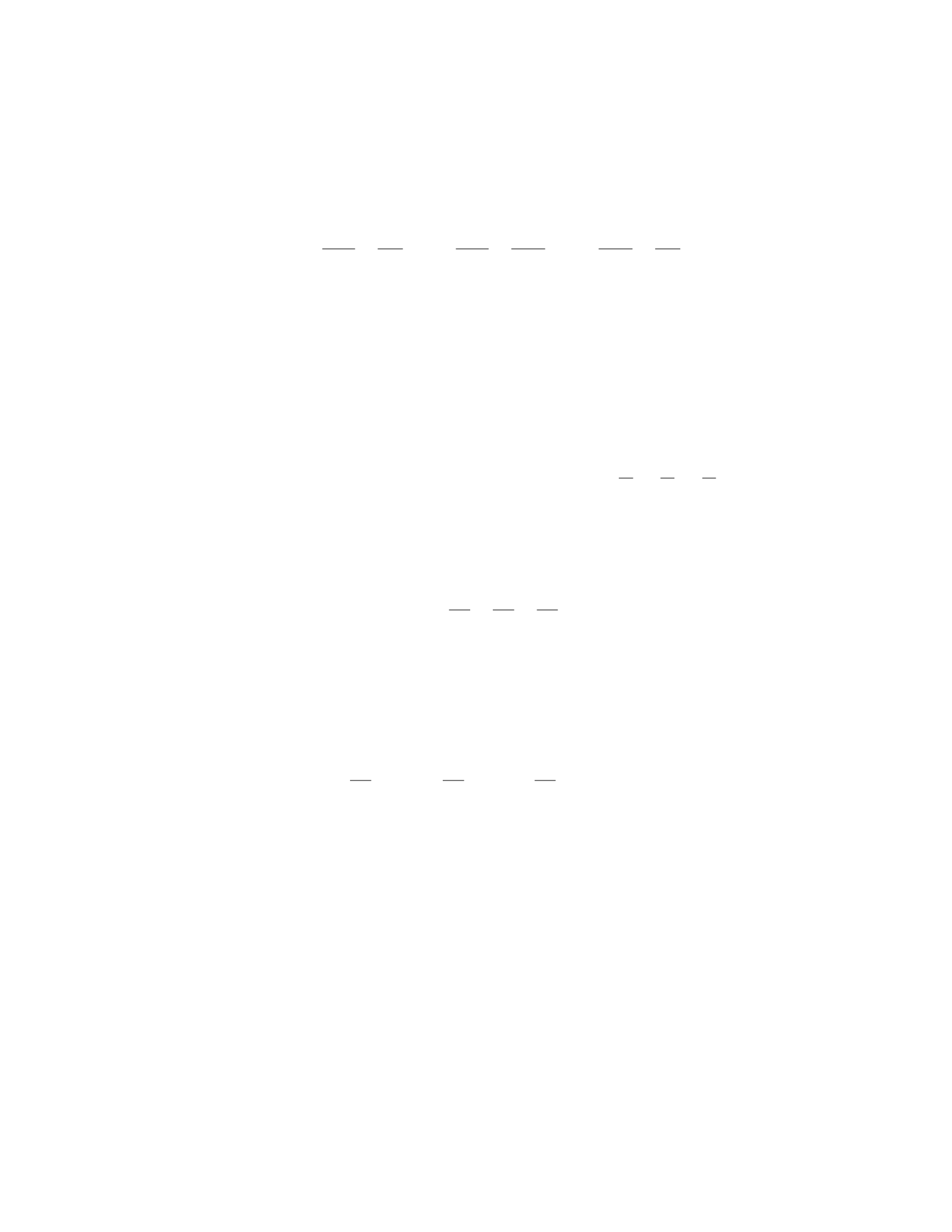
∇ × F=∂x2z
∂y −∂yz
∂z i−∂x2z
∂x −∂2xy
∂z j+∂2xy
∂x −∂yz
∂y k
Step 3: Compute the partial derivatives:
∇ × F=x2−yi−x2j+ 2yk
Therefore, the curl of Fis x2−yi−x2j+ 2yk.
Question 24
Question
Let F(x, y, z) = x2yi+y2zj+z2xk. Find ∇ · F, where ∇=∂
∂x i+∂
∂y j+∂
∂z kis
the gradient operator.
Solution
Step 1: Calculate the components of ∇ · Fusing the formula:
∇ · F=∂P
∂x +∂Q
∂y +∂R
∂z
where F(x, y, z) = Pi+Qj+Rk.
Step 2: Identify the components of F(x, y, z):
P(x, y, z) = x2y, Q(x, y, z) = y2z, R(x, y, z) = z2x
Step 3: Find the partial derivatives of P,Q, and Rwith respect to x,y, and
z:∂P
∂x = 2xy, ∂Q
∂y = 2yz, ∂R
∂z = 2zx
Step 4: Substitute the partial derivatives into the formula for ∇ · F:
∇ · F= 2xy + 2yz + 2zx = 2xy + 2yz + 2xz
Therefore, the divergence of Fis 2xy + 2yz + 2xz.
Question 25
Question
Let F(x, y, z) = 2x2y+y3z, x2z, 2xy2z. Find the gradient, divergence, and
curl of F.
17
Solution
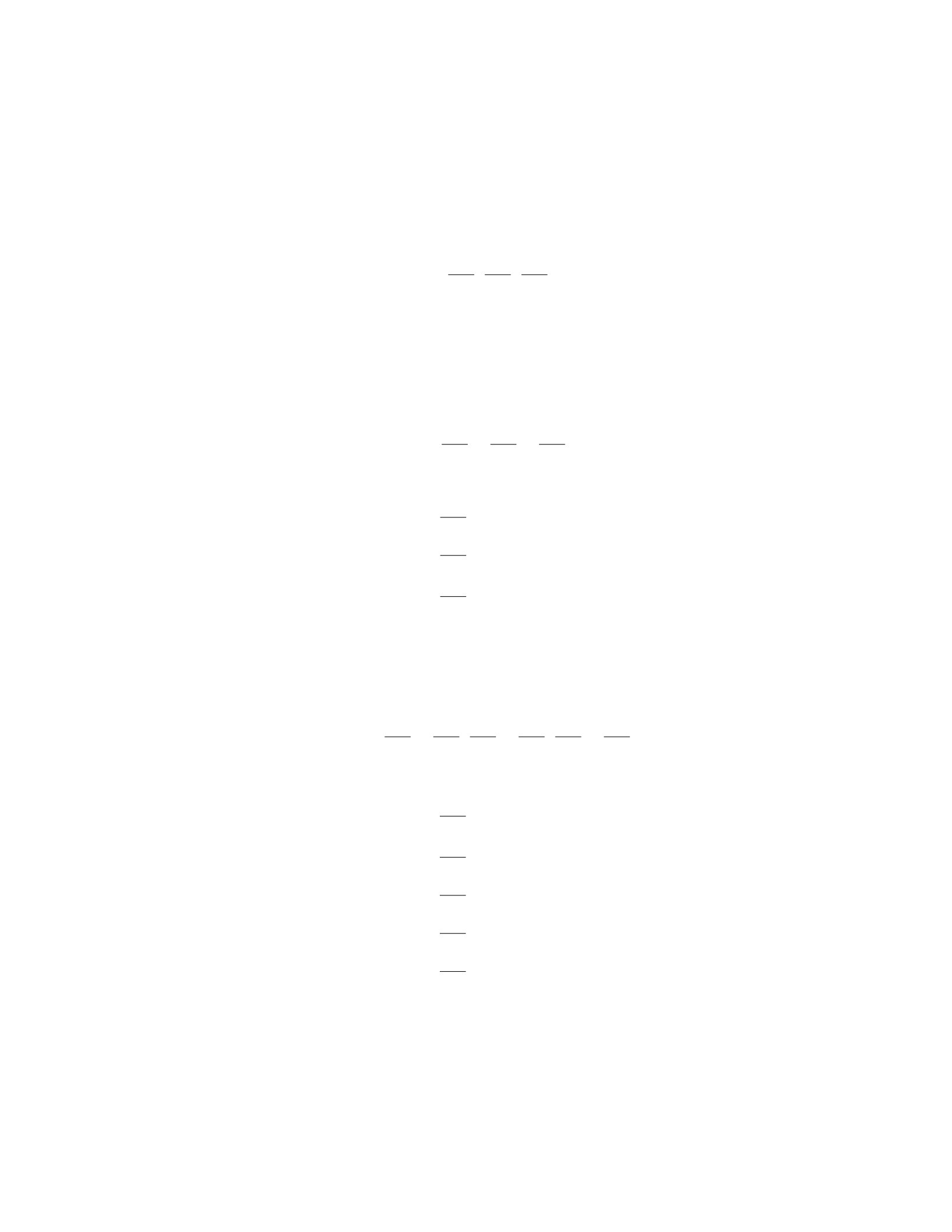
Step 1: Find the gradient of F. The gradient of a vector field Fis given by:
∇F=∂F1
∂x ,∂F2
∂y ,∂F3
∂z
where F= (F1, F2, F3).
So, for F(x, y, z) = 2x2y+y3z, x2z, 2xy2z, the gradient is:
∇F=4xy, x2+ 3y2z, 2y2z
Step 2: Find the divergence of F. The divergence of a vector field Fis given
by:
∇ · F=∂F1
∂x +∂F2
∂y +∂F3
∂z
Computing the partial derivatives, we have:
∂F1
∂x = 4y
∂F2
∂y = 2yz
∂F3
∂z = 2y2
Therefore, the divergence of Fis:
∇ · F= 4y+ 2yz + 2y2
Step 3: Find the curl of F. The curl of a vector field Fis given by:
∇ × F=∂F3
∂y −∂F2
∂z ,∂F1
∂z −∂F3
∂x ,∂F2
∂x −∂F1
∂y
Calculating the partial derivatives, we get:
∂F3
∂y = 4xz
∂F2
∂z =x2
∂F1
∂z = 0
∂F3
∂x = 0
∂F1
∂y = 2x2
Thus, the curl of Fis:
∇ × F= (4xz −x2,0,2x2)
18
Question 26
Question
Let F(x, y, z) = x2yi+xyzj+y2zkbe a vector field in R3. Calculate the
divergence of Fat the point (1,2,3).
Solution
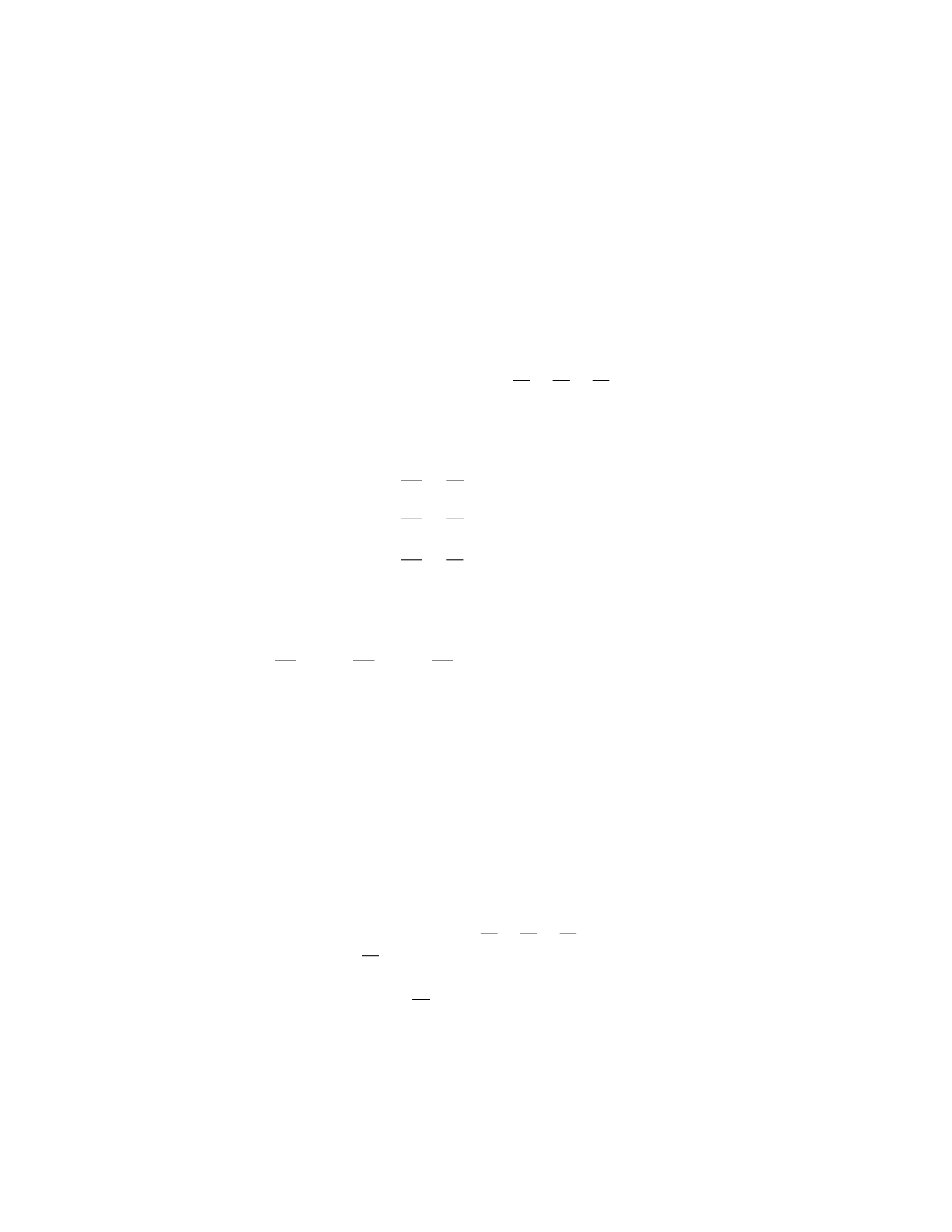
Step 1: The divergence of a vector field F(x, y, z) = P(x, y, z)i+Q(x, y, z)j+
R(x, y, z)kis given by the formula div(F) = ∂P
∂x +∂Q
∂y +∂R
∂z .
Step 2: Given F(x, y, z) = x2yi+xyzj+y2zk, we can see that P(x, y, z) =
x2y,Q(x, y, z) = xyz, and R(x, y, z) = y2z.
Step 3: Calculate the partial derivatives:
∂P
∂x =∂
∂x (x2y)=2xy,
∂Q
∂y =∂
∂y (xyz) = xz,
∂R
∂z =∂
∂z (y2z) = y2.
Step 4: Now, find the divergence of Fat the point (1,2,3) by evaluating the
partial derivatives at that point:
div(F) = ∂P
∂x
(1,2,3)
+∂Q
∂y
(1,2,3)
+∂R
∂z
(1,2,3)
= (2·1·2)+(1·3)+(22) = 4+3+4 = 11.
Therefore, the divergence of Fat the point (1,2,3) is 11.
Question 27
Question
Let F(x, y, z) = (2xy + 3z)i+ (x2+ 3yz)j+ (3xz)k. Compute the divergence of
F.
Solution
To compute the divergence of a vector field F(x, y, z) = P(x, y, z)i+Q(x, y, z)j+
R(x, y, z)k, we use the formula ∇ · F=∂P
∂x +∂Q
∂y +∂R
∂z .
Step 1: Compute ∂P
∂x .
∂
∂x (2xy + 3z) = 2y
19
Step 2: Compute ∂Q
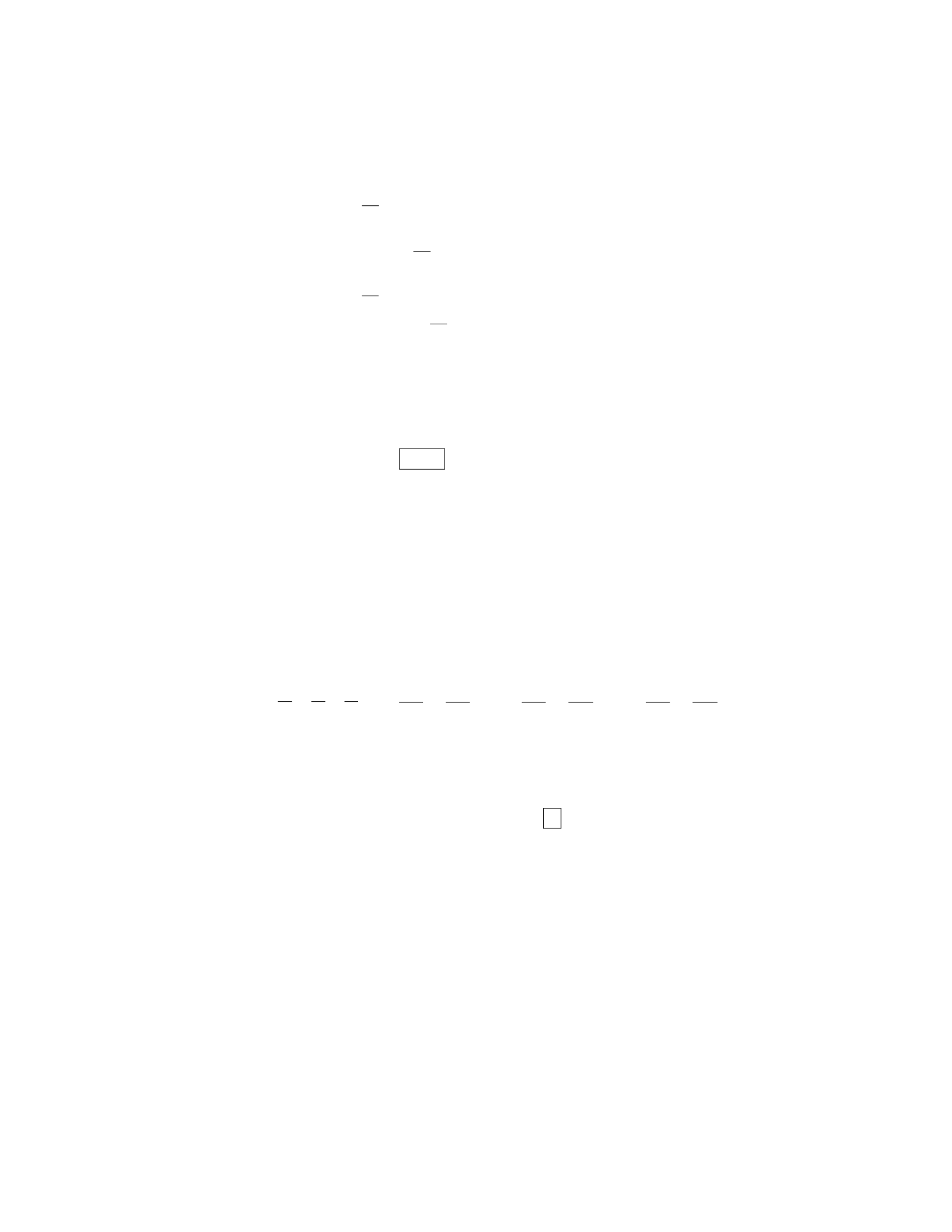
∂y .
∂
∂y (x2+ 3yz)=3z
Step 3: Compute ∂R
∂z .
∂
∂z (3xz)=3x
Step 4: Add the three partial derivatives to find the divergence.
∇ · F= 2y+ 3z+ 3x
Step 5: Simplify the expression.
∇ · F= 3x+ 2y+ 3z
Question 28
Question
Let F=x2i+y2j+z2k. Compute ∇ · (∇ × F).
Solution
Step 1: Compute ∇ × F.
∇ × F=
i j k
∂
∂x
∂
∂y
∂
∂z
x2y2z2
=∂z2
∂y −∂y2
∂z i−∂z2
∂x −∂x2
∂z j+∂y2
∂x −∂x2
∂y k
= 0 −0i−0+0j+ 0 −0k=0
Step 2: Compute ∇ · (∇ × F).
∇ · (∇ × F) = ∇ · 0= 0
Therefore, ∇ · (∇ × F) = 0.
Question 29
Question
Let F(x, y, z) = x2yi+yexz j+xzk. Calculate ∇ · ∇ × F.
20
Solution
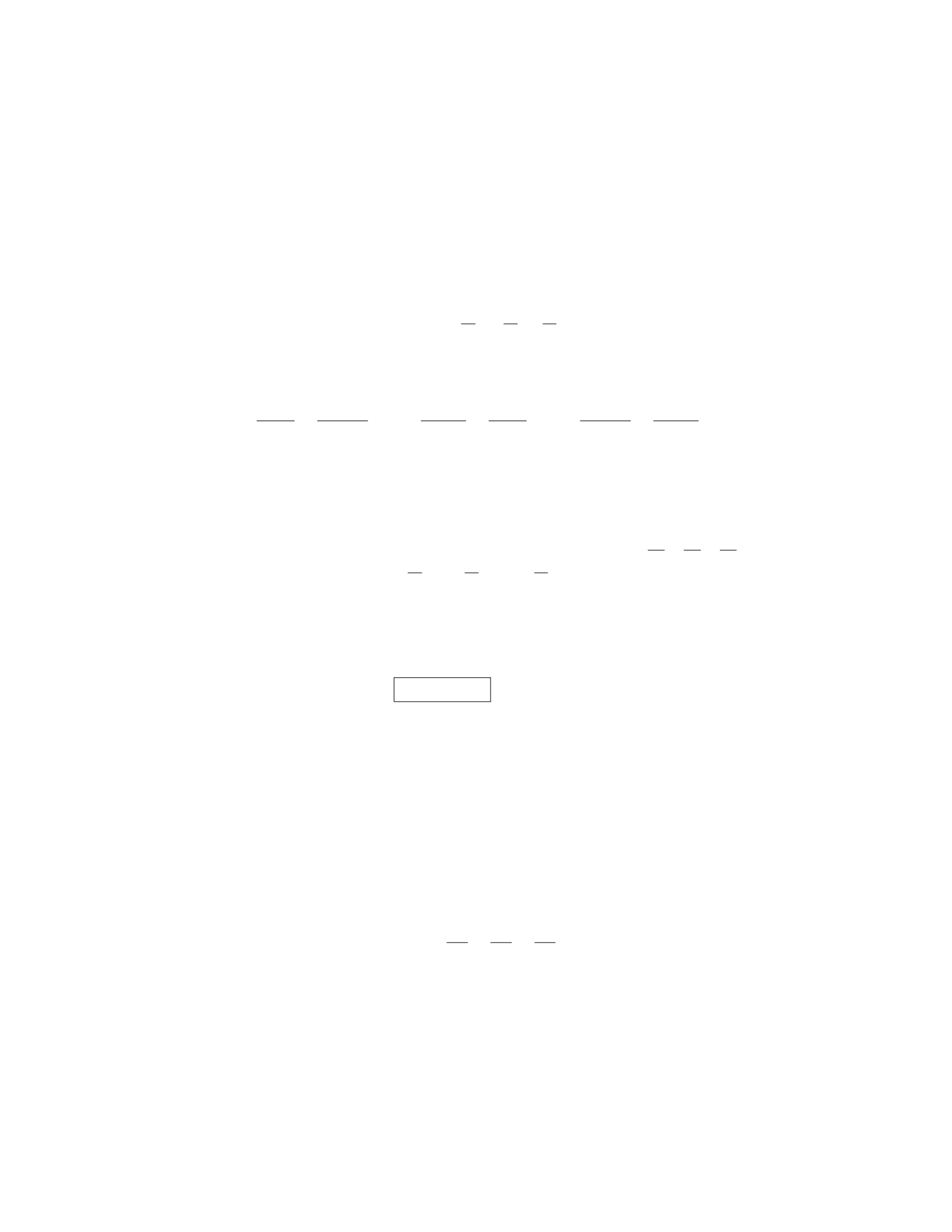
To calculate ∇·∇×F, we first need to find ∇ × Fand then take the divergence
of that result.
Step 1: Find ∇ × FThe curl of Fis given by:
∇ × F=
i j k
∂
∂x
∂
∂y
∂
∂z
x2y yexz xz
Expanding the determinant, we get:
=∂(xz)
∂y −∂(yexz )
∂z i−∂(x2y)
∂x −∂(xz)
∂z j+∂(yexz )
∂x −∂(x2y)
∂y k
Calculating the partial derivatives, we get:
=zi−xj+yexzk
Step 2: Find ∇ · ∇ × FNow, we need to find the divergence of ∇ × F. The
divergence of a vector field G=Pi+Qj+Rkis given by ∇ · G=∂P
∂x +∂Q
∂y +∂R
∂z .
In this case, ∇ · ∇ × F=∂
∂x (z) + ∂
∂y (−x) + ∂
∂z (yexz ).
Calculating the partial derivatives, we get:
= 0 −0 + yexz +xzexz
=yexz +xzexz
Therefore, ∇ · ∇ × F=yexz +xzexz .
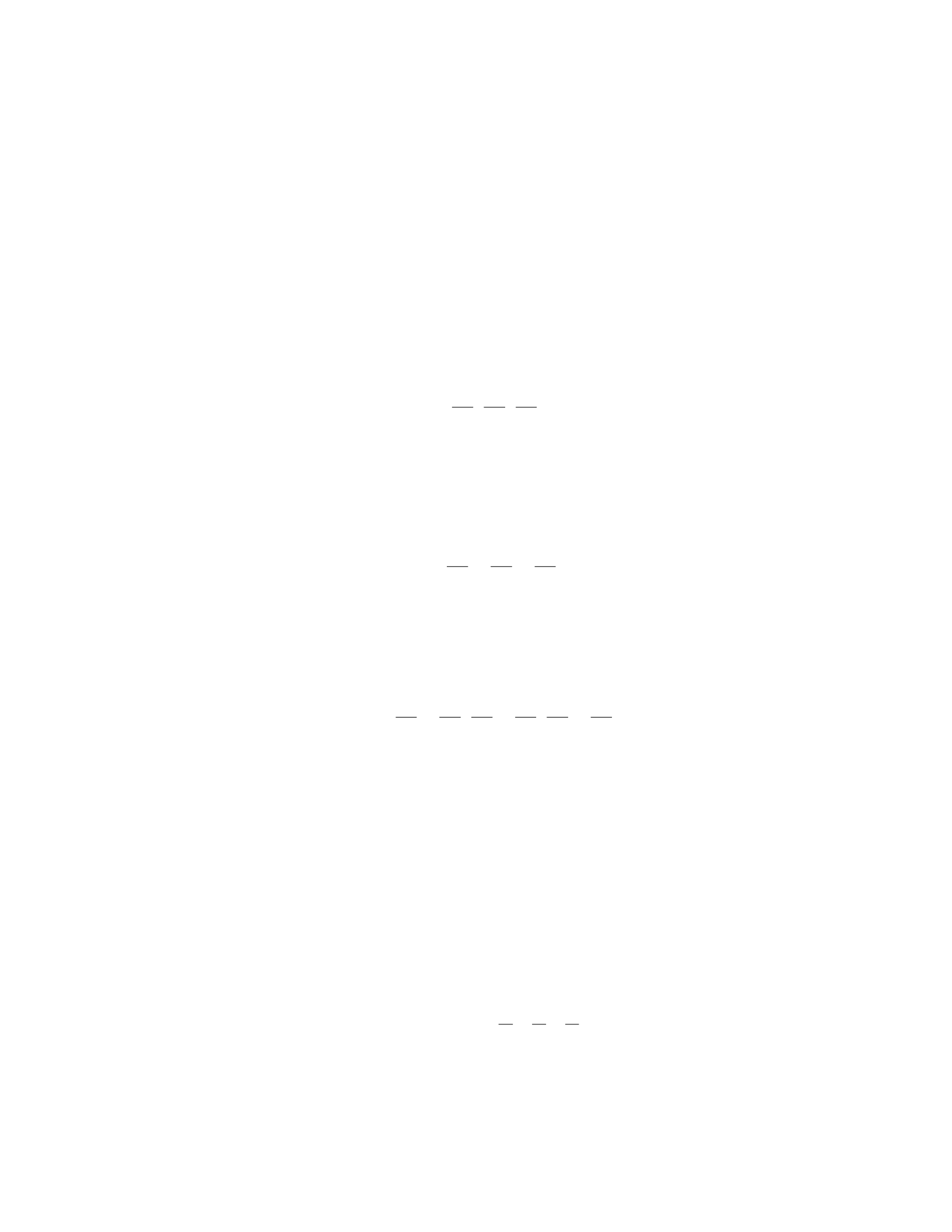
Question 30
Question
Let F(x, y, z) = x2i+ 2yzj+ 3z2kbe a vector field. Compute the divergence of
F.
Solution
Step 1: The divergence of a vector field F(x, y, z) = P(x, y, z)i+Q(x, y, z)j+
R(x, y, z)kis given by
div F=∂P
∂x +∂Q
∂y +∂R
∂z .
Step 2: For our given vector field, F(x, y, z) = x2i+ 2yzj+ 3z2k, we have
P(x, y, z) = x2, Q(x, y, z)=2yz, R(x, y, z)=3z2.
21
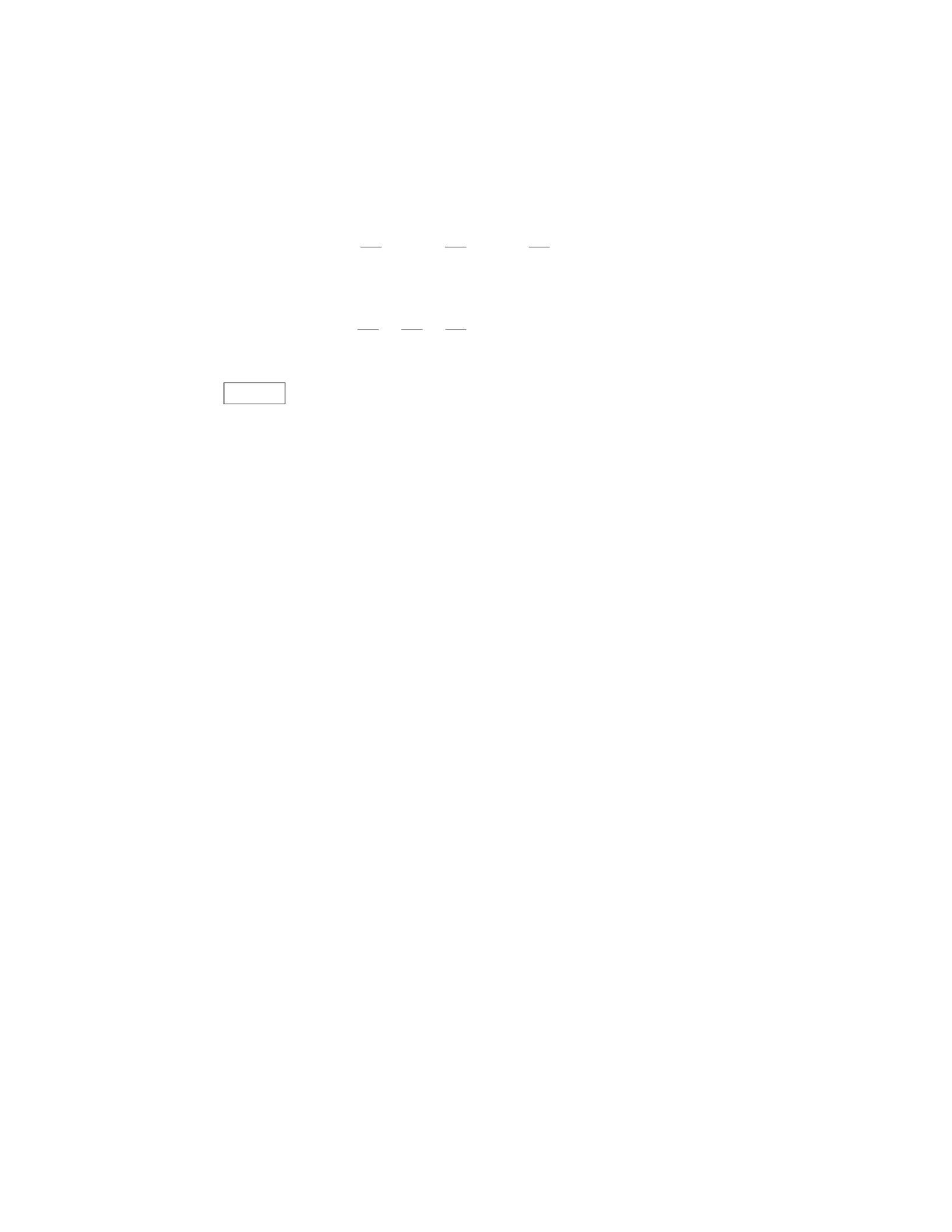
Step 3: Compute the partial derivatives:
∂P
∂x = 2x, ∂Q
∂y = 2z, ∂R
∂z = 6z.
Step 4: Now, calculate the divergence:
div F=∂P
∂x +∂Q
∂y +∂R
∂z = 2x+ 2z+ 6z= 2x+ 8z.
Therefore, the divergence of the vector field F(x, y, z) = x2i+ 2yzj+ 3z2k
is 2x+ 8z.
22

