



MATH 112 - TECHNICAL
MATHEMATICS - Vector operations
Question Bank - Set 3
Liberty University
Question 1
Question
Let a= 2i−3j+ 5kand b=−i+ 4j−2k. Find the angle between vectors a
and b.
Solution
Step 1: To find the angle between two vectors aand b, we can use the formula:
cos θ=a·b
||a|| · ||b||
where θis the angle between the vectors, a·bis the dot product of aand b,
and ||a|| and ||b|| are the magnitudes of aand b, respectively.
Step 2: First, let’s compute the dot product a·b:
a·b= (2)(−1) + (−3)(4) + (5)(−2)
a·b=−2−12 −10
a·b=−24
Step 3: Next, let’s find the magnitudes of aand b:
||a|| =p(2)2+ (−3)2+ (5)2
||a|| =√4 + 9 + 25
||a|| =√38
||b|| =p(−1)2+ (4)2+ (−2)2
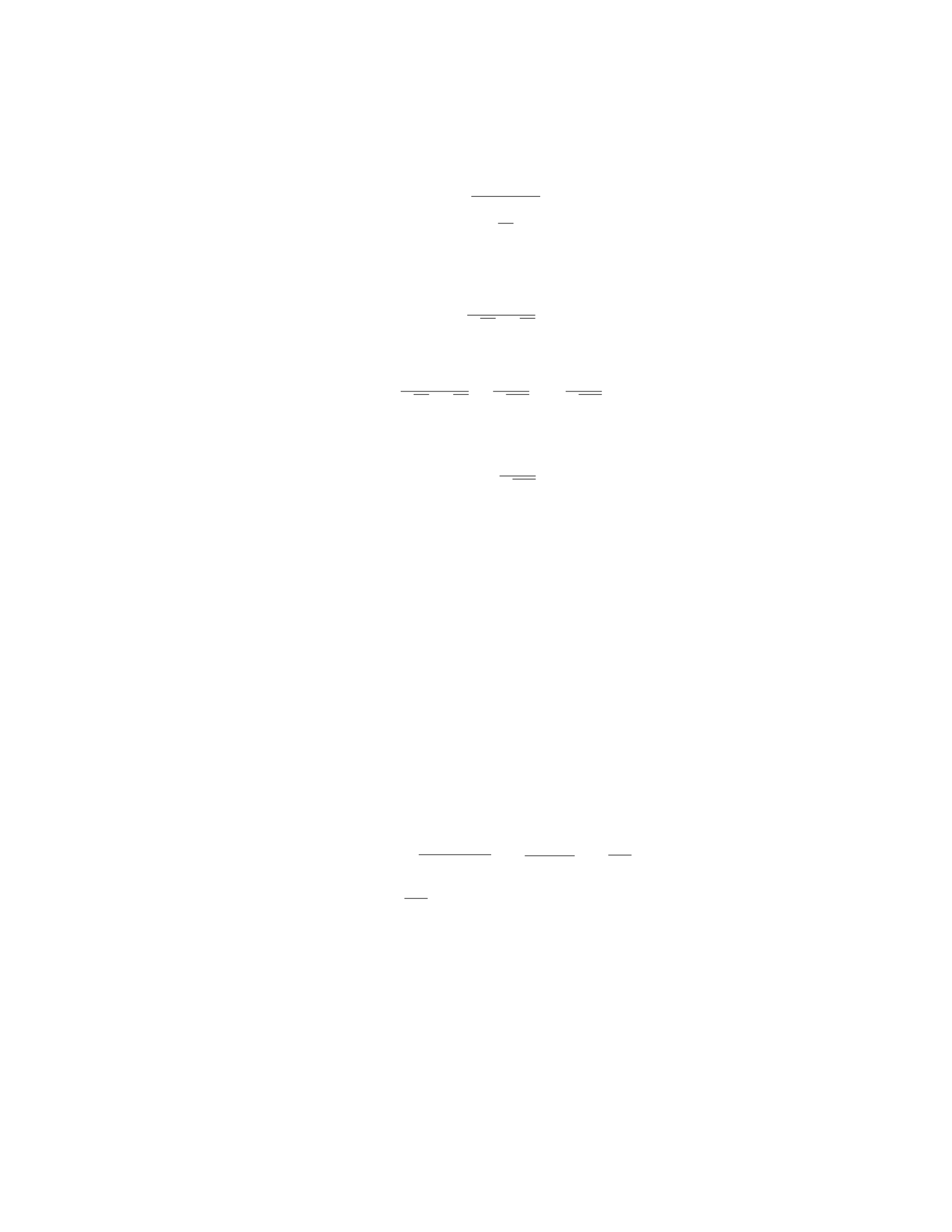
||b|| =√1 + 16 + 4
||b|| =√21
Step 4: Now we can substitute the values into the formula for cosine of the
angle between the vectors:
cos θ=−24
√38 ·√21
Step 5: Simplifying the expression:
cos θ=−24
√38 ·√21 =−24
√798 =−24
√798
Step 6: Finally, we find the angle by taking the arccos of the result from
step 5:
θ= arccos −24
√798
Question 2
Question
Let v=4
3and w=−2
5. Find ∥v−2w∥.
Solution
Step 1: Find 2w.
−2
5×2 = −4
10
Step 2: Find v−2w.
4
3−−4
10 =4
3+4
−10=8
−7
Step 3: Find ∥v−2w∥.
∥8
−7∥=p82+ (−7)2=√64 + 49 = √113
Therefore, ∥v−2w∥=√113.
Question 3
Question
Let u= 3i−2j+kand v=i+ 2j−3kbe two vectors in R3. Determine the
angle between the vectors uand v.
2

Solution
To find the angle between two vectors uand v, we can use the dot product
formula:
u·v=|u||v|cos(θ),
where θis the angle between the two vectors.
Step 1: Calculate the dot product of vectors uand v:
u·v= (3)(1) + (−2)(2) + (1)(−3) = 3 −4−3 = −4.
Step 2: Calculate the magnitudes of vectors uand v:
|u|=p32+ (−2)2+ 12=√14,
|v|=p12+ 22+ (−3)2=√14.
Step 3: Substitute these values into the dot product formula to solve for θ:
−4 = √14 ·√14 ·cos(θ),
−4 = 14 cos(θ),
cos(θ) = −4
14 =−2
7.
Step 4: Find the angle θ(in radians) using the inverse cosine function:
θ= cos−1−2
7.
Thus, the angle between the vectors uand vis cos−1−2
7radians.
Question 4
Question
Let u=
2
−3
1
and v=
−1
4
2
. Find the vector projection of uonto v.
Solution
Step 1: Compute the dot product of uand v:
u·v= (2)(−1) + (−3)(4) + (1)(2) = −2−12 + 2 = −12
Step 2: Compute the magnitude of v:
||v|| =p(−1)2+ 42+ 22=√1 + 16 + 4 = √21
3

Step 3: Compute the vector projection of uonto v:
projv(u) = u·v
||v||2v
=−12
21
−1
4
2
=−12
21
−1
4
2
=
4
7
−16
7
−8
7
Therefore, the vector projection of uonto vis
4
7
−16
7
−8
7
.
Question 5
Question
Let a=
2
−3
1
and b=
−1
4
−2
. Determine the angle between vectors aand b.
Solution
Step 1: Calculate the dot product of vectors aand b:
a·b= (2)(−1) + (−3)(4) + (1)(−2) = −2−12 −2 = −16
Step 2: Calculate the magnitudes of vectors aand b:
|a|=p22+ (−3)2+ 12=√4 + 9 + 1 = √14
|b|=p(−1)2+ 42+ (−2)2=√1 + 16 + 4 = √21
Step 3: Use the formula cos(θ) = a·b
|a||b|to find the cosine of the angle between
the vectors:
cos(θ) = −16
√14√21 =−16
√294
Step 4: Solve for θusing the inverse cosine function:
θ= arccos −16
√294≈126.47◦
Therefore, the angle between vectors aand bis approximately 126.47◦.
Question 6
Question
Consider the vectors a=
2
−3
1
and b=
−1
4
2
. Determine the angle between
the vectors aand b.
4

Solution
To find the angle between two vectors, we can use the formula:
cos(θ) = a·b
∥a∥∥b∥
where θis the angle between the vectors, a·bis the dot product of the vectors,
and ∥a∥and ∥b∥are the magnitudes of the vectors.
Step 1: Calculate the dot product of aand b.
a·b= (2)(−1) + (−3)(4) + (1)(2) = −2−12 + 2 = −12
Step 2: Calculate the magnitudes of vectors aand b.
∥a∥=p22+ (−3)2+ 12=√4 + 9 + 1 = √14
∥b∥=p(−1)2+ 42+ 22=√1 + 16 + 4 = √21
Step 3: Use the formula to find the cosine of the angle between the vectors.
cos(θ) = −12
√14√21 =−12
√294
Step 4: Solve for the angle θby taking the arccosine of the result.
θ= arccos −12
√294
Therefore, the angle between the vectors aand bis θ≈126.70 degrees.
Question 7
Question
Let u=⟨3,−4,5⟩and v=⟨−2,1,7⟩. Find the vector wthat is orthogonal to
both uand v.
Solution
Step 1: To find a vector orthogonal to two given vectors, we can take the cross
product of the two vectors.
Step 2: Calculate the cross product u×v:
u×v=
i j k
3−4 5
−2 1 7
5

Step 3: Expand the determinant to find u×v:
u×v= ((−4)(7) −(5)(1))i−(3(7) −5(−2))j+ (3(1) −(−4)(−2))k
= (−28 −5)i−(21 + 10)j+ (3 −8)k
=−33i−31j−5k
Therefore, u×v=⟨−33,−31,−5⟩.
Step 4: The vector wthat is orthogonal to both uand vis u×v.
So, w=⟨−33,−31,−5⟩.
Question 8
Question
Let v=
2
−1
3
and w=
−1
4
2
. Find the angle between the vectors vand w.
Solution
Step 1: To find the angle between two vectors vand w, we use the formula:
cos θ=v
·w∥v∥∥w∥
Step 2: First, let’s calculate the dot product of vectors vand w:
v·w= (2)(−1) + (−1)(4) + (3)(2) = −2−4 + 6 = 0
Therefore, v·w= 0.
Step 3: Next, let’s calculate the magnitudes of vectors vand w:
∥v∥=p22+ (−1)2+ 32=√4 + 1 + 9 = √14
∥w∥=p(−1)2+ 42+ 22=√1 + 16 + 4 = √21
Step 4: Now, substitute the dot product and magnitudes into the formula
to find cos θ:
cos θ=0
√14 ·√21 =0
√294 = 0
Step 5: Finally, to find the angle θ, we take the inverse cosine of cos θ:
θ= cos−1(0) = 90◦
Therefore, the angle between the vectors vand wis 90◦.
6

Question 9
Question
Given three vectors u= 3i+ 2j−k,v=i−4j+ 2k, and w= 2i−3j+ 2k,
determine if the vectors u,v, and ware linearly independent.
Solution
Step 1: To determine if the vectors u,v, and ware linearly independent, we
need to see if there exist scalars a,b, and c(not all zero) such that the linear
combination au+bv+cw=0.
Step 2: Let’s write out the equation based on the given vectors:
a(3i+ 2j−k) + b(i−4j+ 2k) + c(2i−3j+ 2k) = 0
Step 3: Expand the equation:
(3a+b+ 2c)i+ (2a−4b−3c)j+ (−a+ 2b+ 2c)k=0
Step 4: Set up a system of equations based on the components of the vectors
being equal to zero:
3a+b+ 2c= 0
2a−4b−3c= 0
−a+ 2b+ 2c= 0
Step 5: Solve the system of equations to determine if a,b, and care all zero.
Step 6: From the system of equations, we get a= 2, b=−3, and c= 3.
Since the only solution is a=b=c= 0, the vectors u,v, and ware linearly
independent.
Question 10
Question
Let a=⟨3,−2,1⟩and b=⟨−1,4,2⟩. Determine the angle between vectors a
and b.
Solution
Step 1: The dot product of two vectors aand bis given by the formula:
a·b=|a||b|cos(θ)
where θis the angle between vectors aand b.
Step 2: We first calculate the magnitudes of vectors aand b:
|a|=p32+ (−2)2+ 12=√14
7

|b|=p(−1)2+ 42+ 22=√21
Step 3: Next, we calculate the dot product of aand b:
a·b= 3(−1) + (−2)(4) + 1(2) = −3−8 + 2 = −9
Step 4: Now, we substitute the magnitudes and dot product into the dot
product formula to find θ:
−9 = √14 ·√21 ·cos(θ)
Step 5: Solving for cos(θ):
cos(θ) = −9
√14 ·√21 =−3
√98 =−3√98
98
Step 6: Finally, we find the angle θby taking the inverse cosine of −3√98
98 :
θ= cos−1 −3√98
98 !≈134.21◦
Therefore, the angle between vectors aand bis approximately 134.21◦.
Question 11
Question
Let a= [−2,1,3] and b= [4,−2,1] be two vectors. Determine the angle between
aand brounded to the nearest degree.
Solution
Step 1: Calculate the dot product of aand b.
a·b= (−2)(4) + (1)(−2) + (3)(1) = −8−2 + 3 = −7
Step 2: Calculate the magnitudes of aand b.
|a|=p(−2)2+ 12+ 32=√4 + 1 + 9 = √14
|b|=p42+ (−2)2+ 12=√16 + 4 + 1 = √21
Step 3: Use the formula for the angle between two vectors θ= arccos a·b
|a|·|b|.
θ= arccos −7
√14 ·√21
Step 4: Calculate the angle in degrees by converting from radians.
θ≈180
πarccos −7
√14 ·√21≈180
πarccos −7
√294≈180
πarccos −7
17.1464≈180
πarccos(−0.4082) ≈180
π(114.0456) ≈65◦
Therefore, the angle between vectors aand bis approximately 65◦when
rounded to the nearest degree.
8

Question 12
Question
Let a =3
−2and
b=1
4. Find the magnitude of the vector a + 2
b.
Solution
Step 1: Determine a + 2
b.
a + 2
b=3
−2+ 2 1
4=3
−2+2
8=5
6
Step 2: Find the magnitude of a + 2
b. The magnitude of a vector v =a
b
is given by |v|=√a2+b2. So, for a + 2
b=5
6, the magnitude is:
|a + 2
b|=p52+ 62=√25 + 36 = √61
Therefore, the magnitude of the vector a + 2
bis √61.
Question 13
Question
Let a=
−1
2
3
and b=
4
−3
2
be two vectors. Determine the angle between
the vectors aand b.
Solution
To find the angle between two vectors aand b, we can use the formula:
cos θ=a·b
∥a∥·∥b∥
where aand bare vectors, a·bis the dot product of aand b,∥a∥is the
magnitude of vector a, and ∥b∥is the magnitude of vector b.
Step 1: Calculate the dot product of vectors aand b:
a·b= (−1)(4) + (2)(−3) + (3)(2) = −4−6 + 6 = −4
Step 2: Calculate the magnitudes of vectors aand b:
∥a∥=p(−1)2+ 22+ 32=√1 + 4 + 9 = √14
9

∥b∥=p42+ (−3)2+ 22=√16 + 9 + 4 = √29
Step 3: Substitute the dot product and magnitudes into the formula for θ:
cos θ=−4
√14 ·√29
cos θ=−4
√406
θ= cos−1−4
√406
θ≈109.1◦
Therefore, the angle between the vectors aand bis approximately 109.1◦.
Question 14
Question
Let v =3
−2and w =−1
4. Find the scalar ksuch that ∥v +k w∥= 2∥w∥.
Solution
Step 1: Compute the norm of v and w.
Norm of v =∥v∥=p32+ (−2)2=√9 + 4 = √13
Norm of w =∥w∥=p(−1)2+ 42=√1 + 16 = √17
Step 2: Express ∥v +k w∥in terms of v,w, and k.
∥v +k w∥=
3
−2+k−1
4
Step 3: Use the properties of vector addition and scalar multiplication to
simplify the expression.
∥v +k w∥=
3−k
−2+4k
=p(3 −k)2+ (−2+4k)2
Step 4: Set up the equation based on the given information. Since ∥v+k w∥=
2∥w∥, we have:
p(3 −k)2+ (−2+4k)2= 2√17
Step 5: Solve the equation to find the value of kthat satisfies the equation.
(3 −k)2+ (−2+4k)2= 4 ×17
10

9−6k+k2+ 4 + 16k2−16k= 68
17k2−22k−55 = 0
17k2−34k+ 12k−55 = 0
17k(k−2) + 12(k−2) = 0
(17k+ 12)(k−2) = 0
Step 6: Find the values of k. By solving the equation (17k+ 12)(k−2) = 0,
we get k=−12
17 or k= 2.
Therefore, the scalar ksuch that ∥v +k w∥= 2∥w∥is k= 2.
Question 15
Question
Let v=
3
−1
5
and u=
−2
4
1
. Determine the vector projection of vonto u.
Solution
Step 1: Calculate the dot product of vand u.
v·u= (3)(−2) + (−1)(4) + (5)(1)
v·u=−6−4 + 5 = −5
Step 2: Calculate the magnitude of vector u, denoted by ∥u∥.
∥u∥=p(−2)2+ 42+ 12
∥u∥=√4 + 16 + 1 = √21
Step 3: Calculate the vector projection of vonto u, denoted by projuv.
projuv=v
·u∥u∥2u
projuv=−5
21
−2
4
1
projuv=
10
21
−20
21
−5
21
11

Question 16
Question
Let a=
3
−2
1
,b=
−1
4
5
, and c=
2
0
−3
. Find the angle between vectors
aand b.
Solution
Step 1: Calculate the dot product of vectors aand b.
a·b= (3)(−1) + (−2)(4) + (1)(5)
a·b=−3−8+5
a·b=−6
Step 2: Calculate the magnitudes of vectors aand b.
||a|| =p32+ (−2)2+ 12=√9 + 4 + 1 = √14
||b|| =p(−1)2+ 42+ 52=√1 + 16 + 25 = √42
Step 3: Use the formula for the angle between two vectors in 3D space.
cos θ=a·b
||a|| · ||b||
cos θ=−6
√14 ·√42
Step 4: Solve for the angle θ.
θ= cos−1−6
√14 ·√42
θ≈113.63◦
Therefore, the angle between vectors aand bis approximately 113.63◦.
Question 17
Question
Let a=
3
−2
5
and b=
−1
4
2
. Find the vector csuch that c·(a×b) = 0.
12

Solution
Step 1: Find the cross product of vectors aand b.
a×b=
3
−2
5
×
−1
4
2
a×b=
i j k
3−2 5
−1 4 2
a×b=i(2 ×5−4× −2) −j(3 ×5−1× −2) + k(3 ×4−(−2× −1))
a×b=
−6
−17
14
Step 2: Find the vector c. Let c=
c1
c2
c3
. Now, we have c·
−6
−17
14
= 0. This
implies −6c1−17c2+ 14c3= 0.
So, any vector in the form
17x
14x
6x
, where xis a scalar, will be orthogonal to
the cross product of vectors aand b.
Question 18
Question
Let u=⟨3,−2,5⟩and v=⟨−1,4,2⟩. Find the angle between the vectors uand
v.
Solution
Step 1: Calculate the dot product of the vectors uand v.
u·v= (3)(−1) + (−2)(4) + (5)(2) = −3−8 + 10 = −1
Step 2: Calculate the magnitudes of vectors uand v.
|u|=p32+ (−2)2+ 52=√9 + 4 + 25 = √38
|v|=p(−1)2+ 42+ 22=√1 + 16 + 4 = √21
Step 3: Calculate the angle between uand vusing the formula θ= cos−1u·v
|u|·|v|.
θ= cos−1−1
√38 ·√21= cos−1−1
√798
θ≈cos−1(−0.0628) ≈93.61◦
Therefore, the angle between the vectors uand vis approximately 93.61◦.
13

Question 19
Question
Let a=
3
−2
1
,b=
−1
0
2
, and c=
4
1
−3
. Given that d= 2a−1
2b+ 3c, find
the magnitude of the vector d.
Solution
Step 1: Compute the vector d:
d= 2a−1
2b+ 3c
d= 2
3
−2
1
−1
2
−1
0
2
+ 3
4
1
−3
d=
6
−4
2
−
−1
2
0
1
+
12
3
−9
d=
6 + 1
2+ 12
−4+0+3
2−1−9
d=
18.5
−1
−8
Step 2: Find the magnitude of vector d: The magnitude of a vector v=
v1
v2
v3
is given by
||v|| =qv2
1+v2
2+v2
3
Therefore, the magnitude of dis
||d|| =p18.52+ (−1)2+ (−8)2
||d|| =√342.25 + 1 + 64
||d|| =√407.25
||d|| ≈ √407.25 ≈20.18
Hence, the magnitude of vector dis approximately 20.18.
14

Question 20
Question
Let a=
3
−1
2
,b=
−2
4
0
, and c=
1
3
−2
. Determine if the vectors a,b,
and care linearly independent or linearly dependent.
Solution
Step 1: To determine if the vectors a,b, and care linearly independent or
linearly dependent, we need to check if the scalar equation k1a+k2b+k3c=0
has a nontrivial solution.
Step 2: Setting up the equation k1
3
−1
2
+k2
−2
4
0
+k3
1
3
−2
=
0
0
0
,
we get the system of equations:
3k1−2k2+k3= 0
−k1+ 4k2+ 3k3= 0
2k1+ 0k2−2k3= 0
Step 3: Solving the system of equations, we obtain:
k1= 8
k2= 10
k3= 12
Step 4: Since the only solution is k1= 8, k2= 10, k3= 12, which is a
nontrivial solution, the vectors a,b, and care linearly dependent.
Question 21
Question
Let a = 3ˆ
i+ 2ˆ
jand
b=ˆ
i−2ˆ
j. Find the angle between vectors a and
b.
Solution
Step 1: Calculate the dot product of vectors a and
b.
a ·
b= (3ˆ
i+ 2ˆ
j)·(ˆ
i−2ˆ
j)
a ·
b= 3 ·1+2·(−2)
a ·
b= 3 −4
15

a ·
b=−1
Step 2: Calculate the magnitude of vector a and vector
b.
|a|=p32+ 22
|a|=√9+4
|a|=√13
|
b|=p12+ (−2)2
|
b|=√1+4
|
b|=√5
Step 3: Use the dot product formula to find the angle between vectors a and
b.
cos θ=a ·
b
|a|·|
b|
cos θ=−1
√13 ·√5
cos θ=−1
√65
Step 4: Solve for the angle θ.
θ= cos−1−1
√65
θ≈113.58◦
Therefore, the angle between vectors a and
bis approximately 113.58◦.
Question 22
Question
Let a and
bbe two vectors in 3-dimensional space given by a = 3
i−2
j+ 4
kand
b= 2
i+
j−5
k. Find the component form of the vector 2a −3
b.
16

Solution
Step 1: Multiply the vectors by the scalars.
2a = 2(3
i−2
j+ 4
k)
= 6
i−4
j+ 8
k
−3
b=−3(2
i+
j−5
k)
=−6
i−3
j+ 15
k
Step 2: Subtract the two vectors to find the component form of 2a −3
b.
2a −3
b= (6
i−4
j+ 8
k)−(6
i+ 3
j−15
k)
= 6
i−4
j+ 8
k−6
i−3
j+ 15
k
=
i−7
j+ 23
k
Therefore, the component form of the vector 2a −3
bis
i−7
j+ 23
k.
Question 23
Question
Given two vectors a=
3
−1
4
and b=
2
5
−2
, find the angle between these two
vectors.
Solution
Step 1: Find the dot product of aand b.
a·b= (3)(2) + (−1)(5) + (4)(−2) = 6 −5−8 = −7
Step 2: Calculate the magnitudes of vectors aand b.
||a|| =p32+ (−1)2+ 42=√9 + 1 + 16 = √26
||b|| =p22+ 52+ (−2)2=√4 + 25 + 4 = √33
Step 3: Use the formula cos θ=a
·b||a|| · ||b|| to find the cosine of the angle
between the two vectors.
cos θ=−7
√26 ·√33 =−7
√858
Step 4: Find the angle θby taking the arccosine of the value obtained in
Step 3.
θ= arccos −7
√858≈126.6◦
Therefore, the angle between the vectors aand bis approximately 126.6◦.
17

Question 24
Question
Find the magnitude of the resultant vector when two forces F1= 3i+ 2j−4k
N and F2=−2i+ 4j+ 3kN act on an object.
Solution
To find the magnitude of the resultant vector, we first need to find the resultant
vector by adding F1and F2, and then calculate the magnitude of that resultant
vector.
Step 1: Find the resultant vector Rby adding F1and F2:
R=F1+F2= (3i+ 2j−4k)+(−2i+ 4j+ 3k)
R= 3i−2i+ 2j+ 4j−4k+ 3k
R=i+ 6j−k
Step 2: Calculate the magnitude of the resultant vector R:
|R|=p(i)2+ (6j)2+ (−k)2
|R|=√1 + 36 + 1
|R|=√38
|R|=√38 N
Question 25
Question
Let u=
3
−2
5
and v=
−1
4
0
. Determine the angle between vectors uand v
to the nearest degree.
Solution
Step 1: Calculate the dot product of uand v:
u·v= (3)(−1) + (−2)(4) + (5)(0) = −3−8 + 0 = −11
Step 2: Calculate the magnitude of vector u:
∥u∥=p32+ (−2)2+ 52=√9 + 4 + 25 = √38
18

Step 3: Calculate the magnitude of vector v:
∥v∥=p(−1)2+ 42+ 02=√1 + 16 = √17
Step 4: Use the formula for the angle between two vectors, θ= arccos u·v
∥u∥∥v∥,
and substitute the values calculated in steps 1, 2, and 3:
θ= arccos −11
√38 ·√17≈arccos −11
√646
Step 5: Calculate the angle to the nearest degree:
θ≈arccos −11
√646≈129◦
Therefore, the angle between vectors uand vis approximately 129◦.
Question 26
Question
Let a=
3
−2
1
,b=
−1
4
2
, and c=
0
3
1
. Find the unit vector in the
direction of a+ 2b−c.
Solution
Step 1: Calculate the vector v=a+ 2b−c.
v=
3
−2
1
+ 2
−1
4
2
−
0
3
1
v=
3
−2
1
+
−2
8
4
−
0
3
1
v=
3−2−0
−2+8−3
1+4−1
=
1
3
4
Step 2: Calculate the magnitude of v.
|v|=p12+ 32+ 42=√26
19
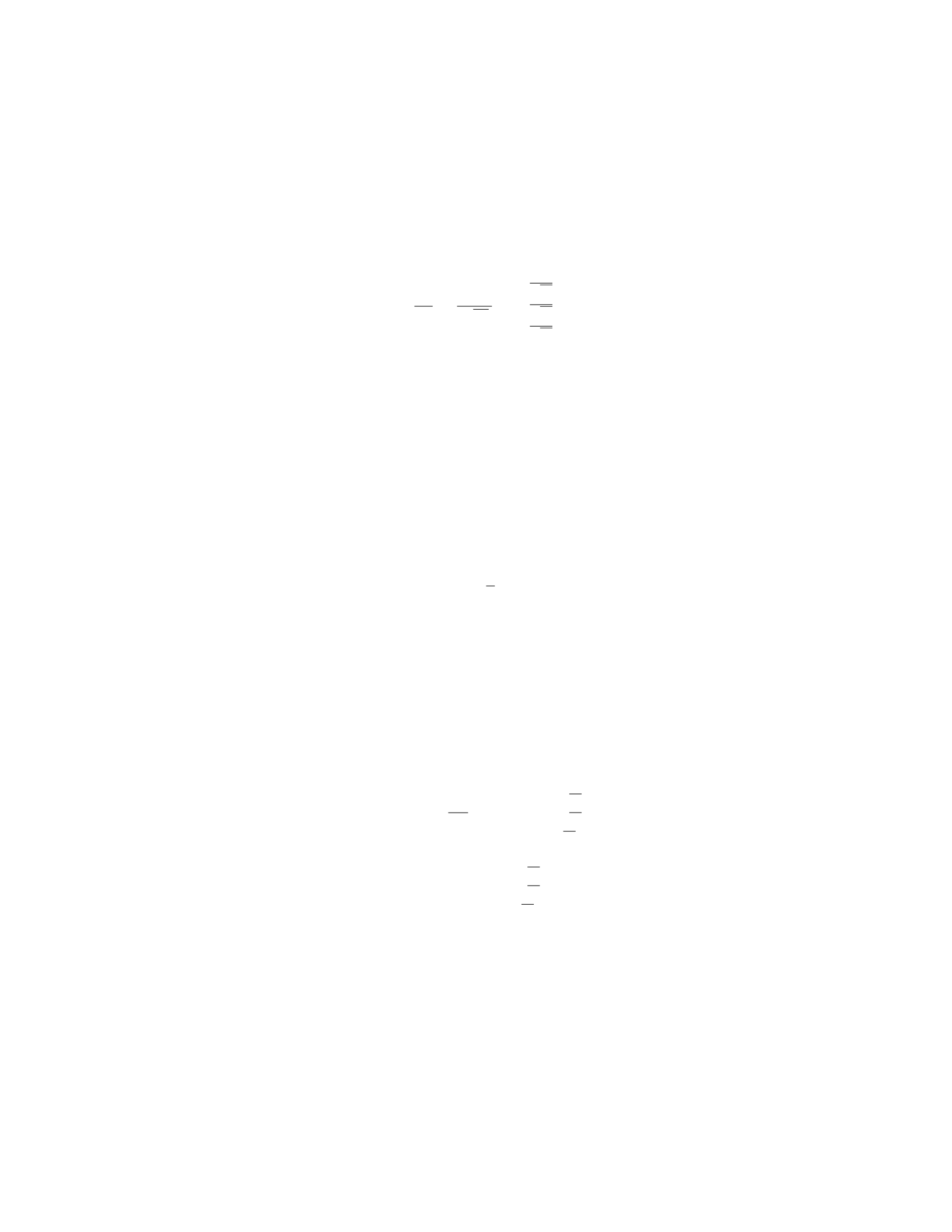
Step 3: Find the unit vector in the direction of v. The unit vector in the
direction of vis given by
ˆu=v
|v|=
1
3
4
√26 =
1
√26
3
√26
4
√26
Question 27
Question
Let a=
2
−1
3
and b=
1
4
−2
. Find the projection of aonto b.
Solution
To find the projection of aonto b, we will use the formula:
projb(a) = a
·b|b|2b
Step 1: Calculate a·b.
a·b= (2)(1) + (−1)(4) + (3)(−2) = 2 −4−6 = −8
Step 2: Calculate |b|2.
|b|2= (1)2+ (4)2+ (−2)2= 1 + 16 + 4 = 21
Step 3: Substitute the values into the projection formula.
projb(a) = −8
21
1
4
−2
=
−8
21
−32
21
16
21
Therefore, the projection of aonto bis
−8
21
−32
21
16
21
.
Question 28
Question
Let u = 2ˆ
i−3ˆ
j+ 4ˆ
kand v =−ˆ
i+ 2ˆ
j−ˆ
k. Find the projection of u onto v.
20

Solution
To find the projection of u onto v, we will use the formula:
projv (u) = u ·v
∥v∥2v
Step 1: Calculate the dot product of u and v.
u ·v = (2)(−1) + (−3)(2) + (4)(−1) = −2−6−4 = −12
Step 2: Calculate the magnitude of v.
∥v∥=p(−1)2+ (2)2+ (−1)2=√1 + 4 + 1 = √6
Step 3: Substitute the dot product and magnitude into the projection for-
mula.
projv (u) = −12
(√6)2v =−12
6v =−2v
Step 4: Plug in the values for v.
−2v =−2(−ˆ
i+ 2ˆ
j−ˆ
k)=2ˆ
i−4ˆ
j+ 2ˆ
k
Therefore, the projection of u onto v is 2ˆ
i−4ˆ
j+ 2ˆ
k.
Question 29
Question
Let u =2
−1and v =3
4. Find the magnitude of u +v.
Solution
Step 1: Calculate u +v.
u +v =2
−1+3
4=2+3
−1+4=5
3
Step 2: Find the magnitude of u +v. The magnitude of a vector a =a1
a2
is given by ∥a∥=pa2
1+a2
2.
So, for u +v =5
3, the magnitude is:
∥u +v∥=p52+ 32=√25 + 9 = √34
Therefore, the magnitude of u +v is √34.
21

Question 30
Question
Let a= 2i−3j+ 5kand b=i−2j−2kbe two vectors in R3. Determine the
angle between aand b.
Solution
Step 1: To find the angle between two vectors aand bin R3, we can use the
dot product formula: a·b=|a||b|cos θ, where θis the angle between aand b.
Step 2: First calculate the dot product of aand b:
a·b= (2)(1) + (−3)(−2) + (5)(−2)
a·b= 2 + 6 −10
a·b=−2
Step 3: Next, find the magnitudes of aand b:
|a|=p(2)2+ (−3)2+ (5)2
|a|=√4 + 9 + 25
|a|=√38
|b|=p(1)2+ (−2)2+ (−2)2
|b|=√1+4+4
|b|=√9
|b|= 3
Step 4: Substitute the dot product and magnitudes into the formula a·b=
|a||b|cos θ:
−2 = √38 ·3·cos θ
Step 5: Solve for θ:
cos θ=−2
3√38
θ= cos−1−2
3√38
Step 6: Using a calculator, we find:
θ≈123.15◦
Therefore, the angle between aand bis approximately 123.15◦.
22

Question 31
Question
Let u =
3
−2
5
and v =
−1
4
2
be two vectors in R3. Find the angle between
u and v.
Solution
To find the angle between two vectors u and v in R3, we can use the dot product
formula
u ·v =∥u∥∥v∥cos(θ),
where θis the angle between the vectors.
Step 1: Calculate the dot product Calculate the dot product u ·v using
the formula
u ·v = (3)(−1) + (−2)(4) + (5)(2).
Step 2: Calculate the magnitudes of the vectors Calculate the mag-
nitudes of the vectors u and v using the formula
∥u∥=p32+ (−2)2+ 52
and
∥v∥=p(−1)2+ 42+ 22.
Step 3: Substitute into the formula Substitute the dot product and
magnitudes into the formula
u ·v =∥u∥∥v∥cos(θ)
and solve for θ. Recall that u ·v =∥u∥∥v∥cos(θ) when the vectors are not the
zero vector.
Step 4: Calculate the angle Using the values found in previous steps,
solve for θusing the equation θ= arccos u·v
∥u∥∥v∥.
Therefore, the angle between u and v is θdegrees.
Question 32
Question
Let v=
3
−1
2
and w=
−2
0
5
. Find a vector usuch that 2v−3w= 4u.
23

Solution
Step 1: Compute 2vand 3w:
2v= 2
3
−1
2
=
6
−2
4
,
3w= 3
−2
0
5
=
−6
0
15
.
Step 2: Compute 2v−3w:
2v−3w=
6
−2
4
−
−6
0
15
=
6+6
−2−0
4−15
=
12
−2
−11
.
Step 3: Determine usuch that 4u=
12
−2
−11
by scaling: Solving u=
1
4
12
−2
−11
gives:
u=
3
−0.5
−2.75
.
Therefore, u=
3
−0.5
−2.75
is a vector that satisfies 2v−3w= 4u.
Question 33
Question
Let a=
1
2
−1
and b=
3
−4
5
. Find a unit vector parallel to the vector a−2b.
24

Solution
Step 1: Find the vector a−2b.
a−2b=
1
2
−1
−2
3
−4
5
=
1
2
−1
−
6
−8
10
=
−5
10
−11
Step 2: Find the magnitude of the vector a−2b.
∥a−2b∥=p(−5)2+ 102+ (−11)2=√25 + 100 + 121 = √246
Step 3: Compute the unit vector parallel to a−2b. The unit vector ˆuin
the direction of a vector vis given by
ˆu=v
∥v∥
Hence, the unit vector parallel to the vector a−2bis
ˆu=1
√246
−5
10
−11
=
−5
√246
10
√246
−11
√246
Question 34
Question
Let a =
2
4
−1
and
b=
−3
1
5
. Find a ·
band a ×
b.
Solution
Step 1: To find the dot product a·
b, we use the formula a·
b=a1b1+a2b2+a3b3:
a ·
b= (2)(−3) + (4)(1) + (−1)(5)
a ·
b=−6+4−5
a ·
b=−7
Step 2: To find the cross product a ×
b, we use the formula a ×
b=
a2b3−a3b2
a3b1−a1b3
a1b2−a2b1
:
a ×
b=
(4)(5) −(−1)(1)
(−1)(−3) −(2)(5)
(2)(1) −(4)(−3)
25

a ×
b=
20 + 1
3−10
2 + 12
a ×
b=
21
−7
14
Therefore, a ·
b=−7 and a ×
b=
21
−7
14
.
Question 35
Question
Let a= 2i+ 4j−kand b= 3i−2j+ 5k. Find the angle between vectors aand
b.
Solution
Step 1: Calculate the dot product of vectors aand b.
a·b= (2)(3) + (4)(−2) + (−1)(5) = 6 −8−5 = −7
Step 2: Calculate the magnitude of vector a.
|a|=p(2)2+ (4)2+ (−1)2=√4 + 16 + 1 = √21
Step 3: Calculate the magnitude of vector b.
|b|=p(3)2+ (−2)2+ (5)2=√9 + 4 + 25 = √38
Step 4: Use the formula cos θ=a·b
|a||b|to find the cosine of the angle between
the vectors.
cos θ=−7
√21 ·√38 =−7
√798
Step 5: Solve for the angle θusing the inverse cosine function.
θ= cos−1−7
√798≈121.38◦
Therefore, the angle between vectors aand bis approximately 121.38 de-
grees.
26

Question 9
Question
Given three vectors u= 3i+ 2j−k,v=i−4j+ 2k, and w= 2i−3j+ 2k,
determine if the vectors u,v, and ware linearly independent.
Solution
Step 1: To determine if the vectors u,v, and ware linearly independent, we
need to see if there exist scalars a,b, and c(not all zero) such that the linear
combination au+bv+cw=0.
Step 2: Let’s write out the equation based on the given vectors:
a(3i+ 2j−k) + b(i−4j+ 2k) + c(2i−3j+ 2k) = 0
Step 3: Expand the equation:
(3a+b+ 2c)i+ (2a−4b−3c)j+ (−a+ 2b+ 2c)k=0
Step 4: Set up a system of equations based on the components of the vectors
being equal to zero:
3a+b+ 2c= 0
2a−4b−3c= 0
−a+ 2b+ 2c= 0
Step 5: Solve the system of equations to determine if a,b, and care all zero.
Step 6: From the system of equations, we get a= 2, b=−3, and c= 3.
Since the only solution is a=b=c= 0, the vectors u,v, and ware linearly
independent.
Question 10
Question
Let a=⟨3,−2,1⟩and b=⟨−1,4,2⟩. Determine the angle between vectors a
and b.
Solution
Step 1: The dot product of two vectors aand bis given by the formula:
a·b=|a||b|cos(θ)
where θis the angle between vectors aand b.
Step 2: We first calculate the magnitudes of vectors aand b:
|a|=p32+ (−2)2+ 12=√14
7

|b|=p(−1)2+ 42+ 22=√21
Step 3: Next, we calculate the dot product of aand b:
a·b= 3(−1) + (−2)(4) + 1(2) = −3−8 + 2 = −9
Step 4: Now, we substitute the magnitudes and dot product into the dot
product formula to find θ:
−9 = √14 ·√21 ·cos(θ)
Step 5: Solving for cos(θ):
cos(θ) = −9
√14 ·√21 =−3
√98 =−3√98
98
Step 6: Finally, we find the angle θby taking the inverse cosine of −3√98
98 :
θ= cos−1 −3√98
98 !≈134.21◦
Therefore, the angle between vectors aand bis approximately 134.21◦.
Question 11
Question
Let a= [−2,1,3] and b= [4,−2,1] be two vectors. Determine the angle between
aand brounded to the nearest degree.
Solution
Step 1: Calculate the dot product of aand b.
a·b= (−2)(4) + (1)(−2) + (3)(1) = −8−2 + 3 = −7
Step 2: Calculate the magnitudes of aand b.
|a|=p(−2)2+ 12+ 32=√4 + 1 + 9 = √14
|b|=p42+ (−2)2+ 12=√16 + 4 + 1 = √21
Step 3: Use the formula for the angle between two vectors θ= arccos a·b
|a|·|b|.
θ= arccos −7
√14 ·√21
Step 4: Calculate the angle in degrees by converting from radians.
θ≈180
πarccos −7
√14 ·√21≈180
πarccos −7
√294≈180
πarccos −7
17.1464≈180
πarccos(−0.4082) ≈180
π(114.0456) ≈65◦
Therefore, the angle between vectors aand bis approximately 65◦when
rounded to the nearest degree.
8

Question 12
Question
Let a =3
−2and
b=1
4. Find the magnitude of the vector a + 2
b.
Solution
Step 1: Determine a + 2
b.
a + 2
b=3
−2+ 2 1
4=3
−2+2
8=5
6
Step 2: Find the magnitude of a + 2
b. The magnitude of a vector v =a
b
is given by |v|=√a2+b2. So, for a + 2
b=5
6, the magnitude is:
|a + 2
b|=p52+ 62=√25 + 36 = √61
Therefore, the magnitude of the vector a + 2
bis √61.
Question 13
Question
Let a=
−1
2
3
and b=
4
−3
2
be two vectors. Determine the angle between
the vectors aand b.
Solution
To find the angle between two vectors aand b, we can use the formula:
cos θ=a·b
∥a∥·∥b∥
where aand bare vectors, a·bis the dot product of aand b,∥a∥is the
magnitude of vector a, and ∥b∥is the magnitude of vector b.
Step 1: Calculate the dot product of vectors aand b:
a·b= (−1)(4) + (2)(−3) + (3)(2) = −4−6 + 6 = −4
Step 2: Calculate the magnitudes of vectors aand b:
∥a∥=p(−1)2+ 22+ 32=√1 + 4 + 9 = √14
9

∥b∥=p42+ (−3)2+ 22=√16 + 9 + 4 = √29
Step 3: Substitute the dot product and magnitudes into the formula for θ:
cos θ=−4
√14 ·√29
cos θ=−4
√406
θ= cos−1−4
√406
θ≈109.1◦
Therefore, the angle between the vectors aand bis approximately 109.1◦.
Question 14
Question
Let v =3
−2and w =−1
4. Find the scalar ksuch that ∥v +k w∥= 2∥w∥.
Solution
Step 1: Compute the norm of v and w.
Norm of v =∥v∥=p32+ (−2)2=√9 + 4 = √13
Norm of w =∥w∥=p(−1)2+ 42=√1 + 16 = √17
Step 2: Express ∥v +k w∥in terms of v,w, and k.
∥v +k w∥=
3
−2+k−1
4
Step 3: Use the properties of vector addition and scalar multiplication to
simplify the expression.
∥v +k w∥=
3−k
−2+4k
=p(3 −k)2+ (−2+4k)2
Step 4: Set up the equation based on the given information. Since ∥v+k w∥=
2∥w∥, we have:
p(3 −k)2+ (−2+4k)2= 2√17
Step 5: Solve the equation to find the value of kthat satisfies the equation.
(3 −k)2+ (−2+4k)2= 4 ×17
10

9−6k+k2+ 4 + 16k2−16k= 68
17k2−22k−55 = 0
17k2−34k+ 12k−55 = 0
17k(k−2) + 12(k−2) = 0
(17k+ 12)(k−2) = 0
Step 6: Find the values of k. By solving the equation (17k+ 12)(k−2) = 0,
we get k=−12
17 or k= 2.
Therefore, the scalar ksuch that ∥v +k w∥= 2∥w∥is k= 2.
Question 15
Question
Let v=
3
−1
5
and u=
−2
4
1
. Determine the vector projection of vonto u.
Solution
Step 1: Calculate the dot product of vand u.
v·u= (3)(−2) + (−1)(4) + (5)(1)
v·u=−6−4 + 5 = −5
Step 2: Calculate the magnitude of vector u, denoted by ∥u∥.
∥u∥=p(−2)2+ 42+ 12
∥u∥=√4 + 16 + 1 = √21
Step 3: Calculate the vector projection of vonto u, denoted by projuv.
projuv=v
·u∥u∥2u
projuv=−5
21
−2
4
1
projuv=
10
21
−20
21
−5
21
11

Question 16
Question
Let a=
3
−2
1
,b=
−1
4
5
, and c=
2
0
−3
. Find the angle between vectors
aand b.
Solution
Step 1: Calculate the dot product of vectors aand b.
a·b= (3)(−1) + (−2)(4) + (1)(5)
a·b=−3−8+5
a·b=−6
Step 2: Calculate the magnitudes of vectors aand b.
||a|| =p32+ (−2)2+ 12=√9 + 4 + 1 = √14
||b|| =p(−1)2+ 42+ 52=√1 + 16 + 25 = √42
Step 3: Use the formula for the angle between two vectors in 3D space.
cos θ=a·b
||a|| · ||b||
cos θ=−6
√14 ·√42
Step 4: Solve for the angle θ.
θ= cos−1−6
√14 ·√42
θ≈113.63◦
Therefore, the angle between vectors aand bis approximately 113.63◦.
Question 17
Question
Let a=
3
−2
5
and b=
−1
4
2
. Find the vector csuch that c·(a×b) = 0.
12

Solution
Step 1: Find the cross product of vectors aand b.
a×b=
3
−2
5
×
−1
4
2
a×b=
i j k
3−2 5
−1 4 2
a×b=i(2 ×5−4× −2) −j(3 ×5−1× −2) + k(3 ×4−(−2× −1))
a×b=
−6
−17
14
Step 2: Find the vector c. Let c=
c1
c2
c3
. Now, we have c·
−6
−17
14
= 0. This
implies −6c1−17c2+ 14c3= 0.
So, any vector in the form
17x
14x
6x
, where xis a scalar, will be orthogonal to
the cross product of vectors aand b.
Question 18
Question
Let u=⟨3,−2,5⟩and v=⟨−1,4,2⟩. Find the angle between the vectors uand
v.
Solution
Step 1: Calculate the dot product of the vectors uand v.
u·v= (3)(−1) + (−2)(4) + (5)(2) = −3−8 + 10 = −1
Step 2: Calculate the magnitudes of vectors uand v.
|u|=p32+ (−2)2+ 52=√9 + 4 + 25 = √38
|v|=p(−1)2+ 42+ 22=√1 + 16 + 4 = √21
Step 3: Calculate the angle between uand vusing the formula θ= cos−1u·v
|u|·|v|.
θ= cos−1−1
√38 ·√21= cos−1−1
√798
θ≈cos−1(−0.0628) ≈93.61◦
Therefore, the angle between the vectors uand vis approximately 93.61◦.
13

Question 19
Question
Let a=
3
−2
1
,b=
−1
0
2
, and c=
4
1
−3
. Given that d= 2a−1
2b+ 3c, find
the magnitude of the vector d.
Solution
Step 1: Compute the vector d:
d= 2a−1
2b+ 3c
d= 2
3
−2
1
−1
2
−1
0
2
+ 3
4
1
−3
d=
6
−4
2
−
−1
2
0
1
+
12
3
−9
d=
6 + 1
2+ 12
−4+0+3
2−1−9
d=
18.5
−1
−8
Step 2: Find the magnitude of vector d: The magnitude of a vector v=
v1
v2
v3
is given by
||v|| =qv2
1+v2
2+v2
3
Therefore, the magnitude of dis
||d|| =p18.52+ (−1)2+ (−8)2
||d|| =√342.25 + 1 + 64
||d|| =√407.25
||d|| ≈ √407.25 ≈20.18
Hence, the magnitude of vector dis approximately 20.18.
14

Question 20
Question
Let a=
3
−1
2
,b=
−2
4
0
, and c=
1
3
−2
. Determine if the vectors a,b,
and care linearly independent or linearly dependent.
Solution
Step 1: To determine if the vectors a,b, and care linearly independent or
linearly dependent, we need to check if the scalar equation k1a+k2b+k3c=0
has a nontrivial solution.
Step 2: Setting up the equation k1
3
−1
2
+k2
−2
4
0
+k3
1
3
−2
=
0
0
0
,
we get the system of equations:
3k1−2k2+k3= 0
−k1+ 4k2+ 3k3= 0
2k1+ 0k2−2k3= 0
Step 3: Solving the system of equations, we obtain:
k1= 8
k2= 10
k3= 12
Step 4: Since the only solution is k1= 8, k2= 10, k3= 12, which is a
nontrivial solution, the vectors a,b, and care linearly dependent.
Question 21
Question
Let a = 3ˆ
i+ 2ˆ
jand
b=ˆ
i−2ˆ
j. Find the angle between vectors a and
b.
Solution
Step 1: Calculate the dot product of vectors a and
b.
a ·
b= (3ˆ
i+ 2ˆ
j)·(ˆ
i−2ˆ
j)
a ·
b= 3 ·1+2·(−2)
a ·
b= 3 −4
15

a ·
b=−1
Step 2: Calculate the magnitude of vector a and vector
b.
|a|=p32+ 22
|a|=√9+4
|a|=√13
|
b|=p12+ (−2)2
|
b|=√1+4
|
b|=√5
Step 3: Use the dot product formula to find the angle between vectors a and
b.
cos θ=a ·
b
|a|·|
b|
cos θ=−1
√13 ·√5
cos θ=−1
√65
Step 4: Solve for the angle θ.
θ= cos−1−1
√65
θ≈113.58◦
Therefore, the angle between vectors a and
bis approximately 113.58◦.
Question 22
Question
Let a and
bbe two vectors in 3-dimensional space given by a = 3
i−2
j+ 4
kand
b= 2
i+
j−5
k. Find the component form of the vector 2a −3
b.
16

Solution
Step 1: Multiply the vectors by the scalars.
2a = 2(3
i−2
j+ 4
k)
= 6
i−4
j+ 8
k
−3
b=−3(2
i+
j−5
k)
=−6
i−3
j+ 15
k
Step 2: Subtract the two vectors to find the component form of 2a −3
b.
2a −3
b= (6
i−4
j+ 8
k)−(6
i+ 3
j−15
k)
= 6
i−4
j+ 8
k−6
i−3
j+ 15
k
=
i−7
j+ 23
k
Therefore, the component form of the vector 2a −3
bis
i−7
j+ 23
k.
Question 23
Question
Given two vectors a=
3
−1
4
and b=
2
5
−2
, find the angle between these two
vectors.
Solution
Step 1: Find the dot product of aand b.
a·b= (3)(2) + (−1)(5) + (4)(−2) = 6 −5−8 = −7
Step 2: Calculate the magnitudes of vectors aand b.
||a|| =p32+ (−1)2+ 42=√9 + 1 + 16 = √26
||b|| =p22+ 52+ (−2)2=√4 + 25 + 4 = √33
Step 3: Use the formula cos θ=a
·b||a|| · ||b|| to find the cosine of the angle
between the two vectors.
cos θ=−7
√26 ·√33 =−7
√858
Step 4: Find the angle θby taking the arccosine of the value obtained in
Step 3.
θ= arccos −7
√858≈126.6◦
Therefore, the angle between the vectors aand bis approximately 126.6◦.
17

Question 24
Question
Find the magnitude of the resultant vector when two forces F1= 3i+ 2j−4k
N and F2=−2i+ 4j+ 3kN act on an object.
Solution
To find the magnitude of the resultant vector, we first need to find the resultant
vector by adding F1and F2, and then calculate the magnitude of that resultant
vector.
Step 1: Find the resultant vector Rby adding F1and F2:
R=F1+F2= (3i+ 2j−4k)+(−2i+ 4j+ 3k)
R= 3i−2i+ 2j+ 4j−4k+ 3k
R=i+ 6j−k
Step 2: Calculate the magnitude of the resultant vector R:
|R|=p(i)2+ (6j)2+ (−k)2
|R|=√1 + 36 + 1
|R|=√38
|R|=√38 N
Question 25
Question
Let u=
3
−2
5
and v=
−1
4
0
. Determine the angle between vectors uand v
to the nearest degree.
Solution
Step 1: Calculate the dot product of uand v:
u·v= (3)(−1) + (−2)(4) + (5)(0) = −3−8 + 0 = −11
Step 2: Calculate the magnitude of vector u:
∥u∥=p32+ (−2)2+ 52=√9 + 4 + 25 = √38
18

Step 3: Calculate the magnitude of vector v:
∥v∥=p(−1)2+ 42+ 02=√1 + 16 = √17
Step 4: Use the formula for the angle between two vectors, θ= arccos u·v
∥u∥∥v∥,
and substitute the values calculated in steps 1, 2, and 3:
θ= arccos −11
√38 ·√17≈arccos −11
√646
Step 5: Calculate the angle to the nearest degree:
θ≈arccos −11
√646≈129◦
Therefore, the angle between vectors uand vis approximately 129◦.
Question 26
Question
Let a=
3
−2
1
,b=
−1
4
2
, and c=
0
3
1
. Find the unit vector in the
direction of a+ 2b−c.
Solution
Step 1: Calculate the vector v=a+ 2b−c.
v=
3
−2
1
+ 2
−1
4
2
−
0
3
1
v=
3
−2
1
+
−2
8
4
−
0
3
1
v=
3−2−0
−2+8−3
1+4−1
=
1
3
4
Step 2: Calculate the magnitude of v.
|v|=p12+ 32+ 42=√26
19
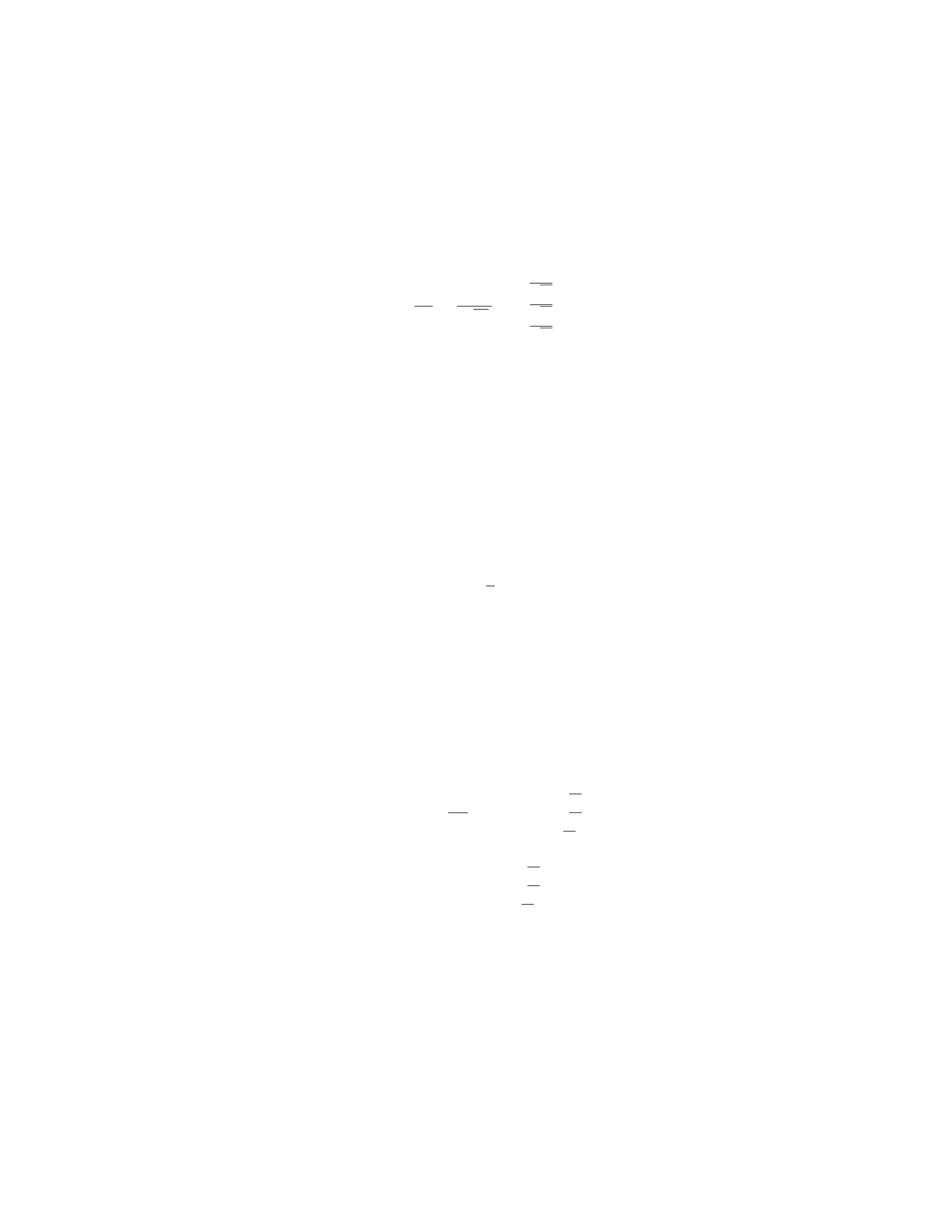
Step 3: Find the unit vector in the direction of v. The unit vector in the
direction of vis given by
ˆu=v
|v|=
1
3
4
√26 =
1
√26
3
√26
4
√26
Question 27
Question
Let a=
2
−1
3
and b=
1
4
−2
. Find the projection of aonto b.
Solution
To find the projection of aonto b, we will use the formula:
projb(a) = a
·b|b|2b
Step 1: Calculate a·b.
a·b= (2)(1) + (−1)(4) + (3)(−2) = 2 −4−6 = −8
Step 2: Calculate |b|2.
|b|2= (1)2+ (4)2+ (−2)2= 1 + 16 + 4 = 21
Step 3: Substitute the values into the projection formula.
projb(a) = −8
21
1
4
−2
=
−8
21
−32
21
16
21
Therefore, the projection of aonto bis
−8
21
−32
21
16
21
.
Question 28
Question
Let u = 2ˆ
i−3ˆ
j+ 4ˆ
kand v =−ˆ
i+ 2ˆ
j−ˆ
k. Find the projection of u onto v.
20

Solution
To find the projection of u onto v, we will use the formula:
projv (u) = u ·v
∥v∥2v
Step 1: Calculate the dot product of u and v.
u ·v = (2)(−1) + (−3)(2) + (4)(−1) = −2−6−4 = −12
Step 2: Calculate the magnitude of v.
∥v∥=p(−1)2+ (2)2+ (−1)2=√1 + 4 + 1 = √6
Step 3: Substitute the dot product and magnitude into the projection for-
mula.
projv (u) = −12
(√6)2v =−12
6v =−2v
Step 4: Plug in the values for v.
−2v =−2(−ˆ
i+ 2ˆ
j−ˆ
k)=2ˆ
i−4ˆ
j+ 2ˆ
k
Therefore, the projection of u onto v is 2ˆ
i−4ˆ
j+ 2ˆ
k.
Question 29
Question
Let u =2
−1and v =3
4. Find the magnitude of u +v.
Solution
Step 1: Calculate u +v.
u +v =2
−1+3
4=2+3
−1+4=5
3
Step 2: Find the magnitude of u +v. The magnitude of a vector a =a1
a2
is given by ∥a∥=pa2
1+a2
2.
So, for u +v =5
3, the magnitude is:
∥u +v∥=p52+ 32=√25 + 9 = √34
Therefore, the magnitude of u +v is √34.
21

Question 30
Question
Let a= 2i−3j+ 5kand b=i−2j−2kbe two vectors in R3. Determine the
angle between aand b.
Solution
Step 1: To find the angle between two vectors aand bin R3, we can use the
dot product formula: a·b=|a||b|cos θ, where θis the angle between aand b.
Step 2: First calculate the dot product of aand b:
a·b= (2)(1) + (−3)(−2) + (5)(−2)
a·b= 2 + 6 −10
a·b=−2
Step 3: Next, find the magnitudes of aand b:
|a|=p(2)2+ (−3)2+ (5)2
|a|=√4 + 9 + 25
|a|=√38
|b|=p(1)2+ (−2)2+ (−2)2
|b|=√1+4+4
|b|=√9
|b|= 3
Step 4: Substitute the dot product and magnitudes into the formula a·b=
|a||b|cos θ:
−2 = √38 ·3·cos θ
Step 5: Solve for θ:
cos θ=−2
3√38
θ= cos−1−2
3√38
Step 6: Using a calculator, we find:
θ≈123.15◦
Therefore, the angle between aand bis approximately 123.15◦.
22

Question 31
Question
Let u =
3
−2
5
and v =
−1
4
2
be two vectors in R3. Find the angle between
u and v.
Solution
To find the angle between two vectors u and v in R3, we can use the dot product
formula
u ·v =∥u∥∥v∥cos(θ),
where θis the angle between the vectors.
Step 1: Calculate the dot product Calculate the dot product u ·v using
the formula
u ·v = (3)(−1) + (−2)(4) + (5)(2).
Step 2: Calculate the magnitudes of the vectors Calculate the mag-
nitudes of the vectors u and v using the formula
∥u∥=p32+ (−2)2+ 52
and
∥v∥=p(−1)2+ 42+ 22.
Step 3: Substitute into the formula Substitute the dot product and
magnitudes into the formula
u ·v =∥u∥∥v∥cos(θ)
and solve for θ. Recall that u ·v =∥u∥∥v∥cos(θ) when the vectors are not the
zero vector.
Step 4: Calculate the angle Using the values found in previous steps,
solve for θusing the equation θ= arccos u·v
∥u∥∥v∥.
Therefore, the angle between u and v is θdegrees.
Question 32
Question
Let v=
3
−1
2
and w=
−2
0
5
. Find a vector usuch that 2v−3w= 4u.
23

Solution
Step 1: Compute 2vand 3w:
2v= 2
3
−1
2
=
6
−2
4
,
3w= 3
−2
0
5
=
−6
0
15
.
Step 2: Compute 2v−3w:
2v−3w=
6
−2
4
−
−6
0
15
=
6+6
−2−0
4−15
=
12
−2
−11
.
Step 3: Determine usuch that 4u=
12
−2
−11
by scaling: Solving u=
1
4
12
−2
−11
gives:
u=
3
−0.5
−2.75
.
Therefore, u=
3
−0.5
−2.75
is a vector that satisfies 2v−3w= 4u.
Question 33
Question
Let a=
1
2
−1
and b=
3
−4
5
. Find a unit vector parallel to the vector a−2b.
24

Solution
Step 1: Find the vector a−2b.
a−2b=
1
2
−1
−2
3
−4
5
=
1
2
−1
−
6
−8
10
=
−5
10
−11
Step 2: Find the magnitude of the vector a−2b.
∥a−2b∥=p(−5)2+ 102+ (−11)2=√25 + 100 + 121 = √246
Step 3: Compute the unit vector parallel to a−2b. The unit vector ˆuin
the direction of a vector vis given by
ˆu=v
∥v∥
Hence, the unit vector parallel to the vector a−2bis
ˆu=1
√246
−5
10
−11
=
−5
√246
10
√246
−11
√246
Question 34
Question
Let a =
2
4
−1
and
b=
−3
1
5
. Find a ·
band a ×
b.
Solution
Step 1: To find the dot product a·
b, we use the formula a·
b=a1b1+a2b2+a3b3:
a ·
b= (2)(−3) + (4)(1) + (−1)(5)
a ·
b=−6+4−5
a ·
b=−7
Step 2: To find the cross product a ×
b, we use the formula a ×
b=
a2b3−a3b2
a3b1−a1b3
a1b2−a2b1
:
a ×
b=
(4)(5) −(−1)(1)
(−1)(−3) −(2)(5)
(2)(1) −(4)(−3)
25

a ×
b=
20 + 1
3−10
2 + 12
a ×
b=
21
−7
14
Therefore, a ·
b=−7 and a ×
b=
21
−7
14
.
Question 35
Question
Let a= 2i+ 4j−kand b= 3i−2j+ 5k. Find the angle between vectors aand
b.
Solution
Step 1: Calculate the dot product of vectors aand b.
a·b= (2)(3) + (4)(−2) + (−1)(5) = 6 −8−5 = −7
Step 2: Calculate the magnitude of vector a.
|a|=p(2)2+ (4)2+ (−1)2=√4 + 16 + 1 = √21
Step 3: Calculate the magnitude of vector b.
|b|=p(3)2+ (−2)2+ (5)2=√9 + 4 + 25 = √38
Step 4: Use the formula cos θ=a·b
|a||b|to find the cosine of the angle between
the vectors.
cos θ=−7
√21 ·√38 =−7
√798
Step 5: Solve for the angle θusing the inverse cosine function.
θ= cos−1−7
√798≈121.38◦
Therefore, the angle between vectors aand bis approximately 121.38 de-
grees.
26

Question 9
Question
Given three vectors u= 3i+ 2j−k,v=i−4j+ 2k, and w= 2i−3j+ 2k,
determine if the vectors u,v, and ware linearly independent.
Solution
Step 1: To determine if the vectors u,v, and ware linearly independent, we
need to see if there exist scalars a,b, and c(not all zero) such that the linear
combination au+bv+cw=0.
Step 2: Let’s write out the equation based on the given vectors:
a(3i+ 2j−k) + b(i−4j+ 2k) + c(2i−3j+ 2k) = 0
Step 3: Expand the equation:
(3a+b+ 2c)i+ (2a−4b−3c)j+ (−a+ 2b+ 2c)k=0
Step 4: Set up a system of equations based on the components of the vectors
being equal to zero:
3a+b+ 2c= 0
2a−4b−3c= 0
−a+ 2b+ 2c= 0
Step 5: Solve the system of equations to determine if a,b, and care all zero.
Step 6: From the system of equations, we get a= 2, b=−3, and c= 3.
Since the only solution is a=b=c= 0, the vectors u,v, and ware linearly
independent.
Question 10
Question
Let a=⟨3,−2,1⟩and b=⟨−1,4,2⟩. Determine the angle between vectors a
and b.
Solution
Step 1: The dot product of two vectors aand bis given by the formula:
a·b=|a||b|cos(θ)
where θis the angle between vectors aand b.
Step 2: We first calculate the magnitudes of vectors aand b:
|a|=p32+ (−2)2+ 12=√14
7

|b|=p(−1)2+ 42+ 22=√21
Step 3: Next, we calculate the dot product of aand b:
a·b= 3(−1) + (−2)(4) + 1(2) = −3−8 + 2 = −9
Step 4: Now, we substitute the magnitudes and dot product into the dot
product formula to find θ:
−9 = √14 ·√21 ·cos(θ)
Step 5: Solving for cos(θ):
cos(θ) = −9
√14 ·√21 =−3
√98 =−3√98
98
Step 6: Finally, we find the angle θby taking the inverse cosine of −3√98
98 :
θ= cos−1 −3√98
98 !≈134.21◦
Therefore, the angle between vectors aand bis approximately 134.21◦.
Question 11
Question
Let a= [−2,1,3] and b= [4,−2,1] be two vectors. Determine the angle between
aand brounded to the nearest degree.
Solution
Step 1: Calculate the dot product of aand b.
a·b= (−2)(4) + (1)(−2) + (3)(1) = −8−2 + 3 = −7
Step 2: Calculate the magnitudes of aand b.
|a|=p(−2)2+ 12+ 32=√4 + 1 + 9 = √14
|b|=p42+ (−2)2+ 12=√16 + 4 + 1 = √21
Step 3: Use the formula for the angle between two vectors θ= arccos a·b
|a|·|b|.
θ= arccos −7
√14 ·√21
Step 4: Calculate the angle in degrees by converting from radians.
θ≈180
πarccos −7
√14 ·√21≈180
πarccos −7
√294≈180
πarccos −7
17.1464≈180
πarccos(−0.4082) ≈180
π(114.0456) ≈65◦
Therefore, the angle between vectors aand bis approximately 65◦when
rounded to the nearest degree.
8

Question 12
Question
Let a =3
−2and
b=1
4. Find the magnitude of the vector a + 2
b.
Solution
Step 1: Determine a + 2
b.
a + 2
b=3
−2+ 2 1
4=3
−2+2
8=5
6
Step 2: Find the magnitude of a + 2
b. The magnitude of a vector v =a
b
is given by |v|=√a2+b2. So, for a + 2
b=5
6, the magnitude is:
|a + 2
b|=p52+ 62=√25 + 36 = √61
Therefore, the magnitude of the vector a + 2
bis √61.
Question 13
Question
Let a=
−1
2
3
and b=
4
−3
2
be two vectors. Determine the angle between
the vectors aand b.
Solution
To find the angle between two vectors aand b, we can use the formula:
cos θ=a·b
∥a∥·∥b∥
where aand bare vectors, a·bis the dot product of aand b,∥a∥is the
magnitude of vector a, and ∥b∥is the magnitude of vector b.
Step 1: Calculate the dot product of vectors aand b:
a·b= (−1)(4) + (2)(−3) + (3)(2) = −4−6 + 6 = −4
Step 2: Calculate the magnitudes of vectors aand b:
∥a∥=p(−1)2+ 22+ 32=√1 + 4 + 9 = √14
9

∥b∥=p42+ (−3)2+ 22=√16 + 9 + 4 = √29
Step 3: Substitute the dot product and magnitudes into the formula for θ:
cos θ=−4
√14 ·√29
cos θ=−4
√406
θ= cos−1−4
√406
θ≈109.1◦
Therefore, the angle between the vectors aand bis approximately 109.1◦.
Question 14
Question
Let v =3
−2and w =−1
4. Find the scalar ksuch that ∥v +k w∥= 2∥w∥.
Solution
Step 1: Compute the norm of v and w.
Norm of v =∥v∥=p32+ (−2)2=√9 + 4 = √13
Norm of w =∥w∥=p(−1)2+ 42=√1 + 16 = √17
Step 2: Express ∥v +k w∥in terms of v,w, and k.
∥v +k w∥=
3
−2+k−1
4
Step 3: Use the properties of vector addition and scalar multiplication to
simplify the expression.
∥v +k w∥=
3−k
−2+4k
=p(3 −k)2+ (−2+4k)2
Step 4: Set up the equation based on the given information. Since ∥v+k w∥=
2∥w∥, we have:
p(3 −k)2+ (−2+4k)2= 2√17
Step 5: Solve the equation to find the value of kthat satisfies the equation.
(3 −k)2+ (−2+4k)2= 4 ×17
10

9−6k+k2+ 4 + 16k2−16k= 68
17k2−22k−55 = 0
17k2−34k+ 12k−55 = 0
17k(k−2) + 12(k−2) = 0
(17k+ 12)(k−2) = 0
Step 6: Find the values of k. By solving the equation (17k+ 12)(k−2) = 0,
we get k=−12
17 or k= 2.
Therefore, the scalar ksuch that ∥v +k w∥= 2∥w∥is k= 2.
Question 15
Question
Let v=
3
−1
5
and u=
−2
4
1
. Determine the vector projection of vonto u.
Solution
Step 1: Calculate the dot product of vand u.
v·u= (3)(−2) + (−1)(4) + (5)(1)
v·u=−6−4 + 5 = −5
Step 2: Calculate the magnitude of vector u, denoted by ∥u∥.
∥u∥=p(−2)2+ 42+ 12
∥u∥=√4 + 16 + 1 = √21
Step 3: Calculate the vector projection of vonto u, denoted by projuv.
projuv=v
·u∥u∥2u
projuv=−5
21
−2
4
1
projuv=
10
21
−20
21
−5
21
11

Question 16
Question
Let a=
3
−2
1
,b=
−1
4
5
, and c=
2
0
−3
. Find the angle between vectors
aand b.
Solution
Step 1: Calculate the dot product of vectors aand b.
a·b= (3)(−1) + (−2)(4) + (1)(5)
a·b=−3−8+5
a·b=−6
Step 2: Calculate the magnitudes of vectors aand b.
||a|| =p32+ (−2)2+ 12=√9 + 4 + 1 = √14
||b|| =p(−1)2+ 42+ 52=√1 + 16 + 25 = √42
Step 3: Use the formula for the angle between two vectors in 3D space.
cos θ=a·b
||a|| · ||b||
cos θ=−6
√14 ·√42
Step 4: Solve for the angle θ.
θ= cos−1−6
√14 ·√42
θ≈113.63◦
Therefore, the angle between vectors aand bis approximately 113.63◦.
Question 17
Question
Let a=
3
−2
5
and b=
−1
4
2
. Find the vector csuch that c·(a×b) = 0.
12

Solution
Step 1: Find the cross product of vectors aand b.
a×b=
3
−2
5
×
−1
4
2
a×b=
i j k
3−2 5
−1 4 2
a×b=i(2 ×5−4× −2) −j(3 ×5−1× −2) + k(3 ×4−(−2× −1))
a×b=
−6
−17
14
Step 2: Find the vector c. Let c=
c1
c2
c3
. Now, we have c·
−6
−17
14
= 0. This
implies −6c1−17c2+ 14c3= 0.
So, any vector in the form
17x
14x
6x
, where xis a scalar, will be orthogonal to
the cross product of vectors aand b.
Question 18
Question
Let u=⟨3,−2,5⟩and v=⟨−1,4,2⟩. Find the angle between the vectors uand
v.
Solution
Step 1: Calculate the dot product of the vectors uand v.
u·v= (3)(−1) + (−2)(4) + (5)(2) = −3−8 + 10 = −1
Step 2: Calculate the magnitudes of vectors uand v.
|u|=p32+ (−2)2+ 52=√9 + 4 + 25 = √38
|v|=p(−1)2+ 42+ 22=√1 + 16 + 4 = √21
Step 3: Calculate the angle between uand vusing the formula θ= cos−1u·v
|u|·|v|.
θ= cos−1−1
√38 ·√21= cos−1−1
√798
θ≈cos−1(−0.0628) ≈93.61◦
Therefore, the angle between the vectors uand vis approximately 93.61◦.
13

Question 19
Question
Let a=
3
−2
1
,b=
−1
0
2
, and c=
4
1
−3
. Given that d= 2a−1
2b+ 3c, find
the magnitude of the vector d.
Solution
Step 1: Compute the vector d:
d= 2a−1
2b+ 3c
d= 2
3
−2
1
−1
2
−1
0
2
+ 3
4
1
−3
d=
6
−4
2
−
−1
2
0
1
+
12
3
−9
d=
6 + 1
2+ 12
−4+0+3
2−1−9
d=
18.5
−1
−8
Step 2: Find the magnitude of vector d: The magnitude of a vector v=
v1
v2
v3
is given by
||v|| =qv2
1+v2
2+v2
3
Therefore, the magnitude of dis
||d|| =p18.52+ (−1)2+ (−8)2
||d|| =√342.25 + 1 + 64
||d|| =√407.25
||d|| ≈ √407.25 ≈20.18
Hence, the magnitude of vector dis approximately 20.18.
14

Question 20
Question
Let a=
3
−1
2
,b=
−2
4
0
, and c=
1
3
−2
. Determine if the vectors a,b,
and care linearly independent or linearly dependent.
Solution
Step 1: To determine if the vectors a,b, and care linearly independent or
linearly dependent, we need to check if the scalar equation k1a+k2b+k3c=0
has a nontrivial solution.
Step 2: Setting up the equation k1
3
−1
2
+k2
−2
4
0
+k3
1
3
−2
=
0
0
0
,
we get the system of equations:
3k1−2k2+k3= 0
−k1+ 4k2+ 3k3= 0
2k1+ 0k2−2k3= 0
Step 3: Solving the system of equations, we obtain:
k1= 8
k2= 10
k3= 12
Step 4: Since the only solution is k1= 8, k2= 10, k3= 12, which is a
nontrivial solution, the vectors a,b, and care linearly dependent.
Question 21
Question
Let a = 3ˆ
i+ 2ˆ
jand
b=ˆ
i−2ˆ
j. Find the angle between vectors a and
b.
Solution
Step 1: Calculate the dot product of vectors a and
b.
a ·
b= (3ˆ
i+ 2ˆ
j)·(ˆ
i−2ˆ
j)
a ·
b= 3 ·1+2·(−2)
a ·
b= 3 −4
15

a ·
b=−1
Step 2: Calculate the magnitude of vector a and vector
b.
|a|=p32+ 22
|a|=√9+4
|a|=√13
|
b|=p12+ (−2)2
|
b|=√1+4
|
b|=√5
Step 3: Use the dot product formula to find the angle between vectors a and
b.
cos θ=a ·
b
|a|·|
b|
cos θ=−1
√13 ·√5
cos θ=−1
√65
Step 4: Solve for the angle θ.
θ= cos−1−1
√65
θ≈113.58◦
Therefore, the angle between vectors a and
bis approximately 113.58◦.
Question 22
Question
Let a and
bbe two vectors in 3-dimensional space given by a = 3
i−2
j+ 4
kand
b= 2
i+
j−5
k. Find the component form of the vector 2a −3
b.
16

Solution
Step 1: Multiply the vectors by the scalars.
2a = 2(3
i−2
j+ 4
k)
= 6
i−4
j+ 8
k
−3
b=−3(2
i+
j−5
k)
=−6
i−3
j+ 15
k
Step 2: Subtract the two vectors to find the component form of 2a −3
b.
2a −3
b= (6
i−4
j+ 8
k)−(6
i+ 3
j−15
k)
= 6
i−4
j+ 8
k−6
i−3
j+ 15
k
=
i−7
j+ 23
k
Therefore, the component form of the vector 2a −3
bis
i−7
j+ 23
k.
Question 23
Question
Given two vectors a=
3
−1
4
and b=
2
5
−2
, find the angle between these two
vectors.
Solution
Step 1: Find the dot product of aand b.
a·b= (3)(2) + (−1)(5) + (4)(−2) = 6 −5−8 = −7
Step 2: Calculate the magnitudes of vectors aand b.
||a|| =p32+ (−1)2+ 42=√9 + 1 + 16 = √26
||b|| =p22+ 52+ (−2)2=√4 + 25 + 4 = √33
Step 3: Use the formula cos θ=a
·b||a|| · ||b|| to find the cosine of the angle
between the two vectors.
cos θ=−7
√26 ·√33 =−7
√858
Step 4: Find the angle θby taking the arccosine of the value obtained in
Step 3.
θ= arccos −7
√858≈126.6◦
Therefore, the angle between the vectors aand bis approximately 126.6◦.
17

Question 24
Question
Find the magnitude of the resultant vector when two forces F1= 3i+ 2j−4k
N and F2=−2i+ 4j+ 3kN act on an object.
Solution
To find the magnitude of the resultant vector, we first need to find the resultant
vector by adding F1and F2, and then calculate the magnitude of that resultant
vector.
Step 1: Find the resultant vector Rby adding F1and F2:
R=F1+F2= (3i+ 2j−4k)+(−2i+ 4j+ 3k)
R= 3i−2i+ 2j+ 4j−4k+ 3k
R=i+ 6j−k
Step 2: Calculate the magnitude of the resultant vector R:
|R|=p(i)2+ (6j)2+ (−k)2
|R|=√1 + 36 + 1
|R|=√38
|R|=√38 N
Question 25
Question
Let u=
3
−2
5
and v=
−1
4
0
. Determine the angle between vectors uand v
to the nearest degree.
Solution
Step 1: Calculate the dot product of uand v:
u·v= (3)(−1) + (−2)(4) + (5)(0) = −3−8 + 0 = −11
Step 2: Calculate the magnitude of vector u:
∥u∥=p32+ (−2)2+ 52=√9 + 4 + 25 = √38
18

Step 3: Calculate the magnitude of vector v:
∥v∥=p(−1)2+ 42+ 02=√1 + 16 = √17
Step 4: Use the formula for the angle between two vectors, θ= arccos u·v
∥u∥∥v∥,
and substitute the values calculated in steps 1, 2, and 3:
θ= arccos −11
√38 ·√17≈arccos −11
√646
Step 5: Calculate the angle to the nearest degree:
θ≈arccos −11
√646≈129◦
Therefore, the angle between vectors uand vis approximately 129◦.
Question 26
Question
Let a=
3
−2
1
,b=
−1
4
2
, and c=
0
3
1
. Find the unit vector in the
direction of a+ 2b−c.
Solution
Step 1: Calculate the vector v=a+ 2b−c.
v=
3
−2
1
+ 2
−1
4
2
−
0
3
1
v=
3
−2
1
+
−2
8
4
−
0
3
1
v=
3−2−0
−2+8−3
1+4−1
=
1
3
4
Step 2: Calculate the magnitude of v.
|v|=p12+ 32+ 42=√26
19
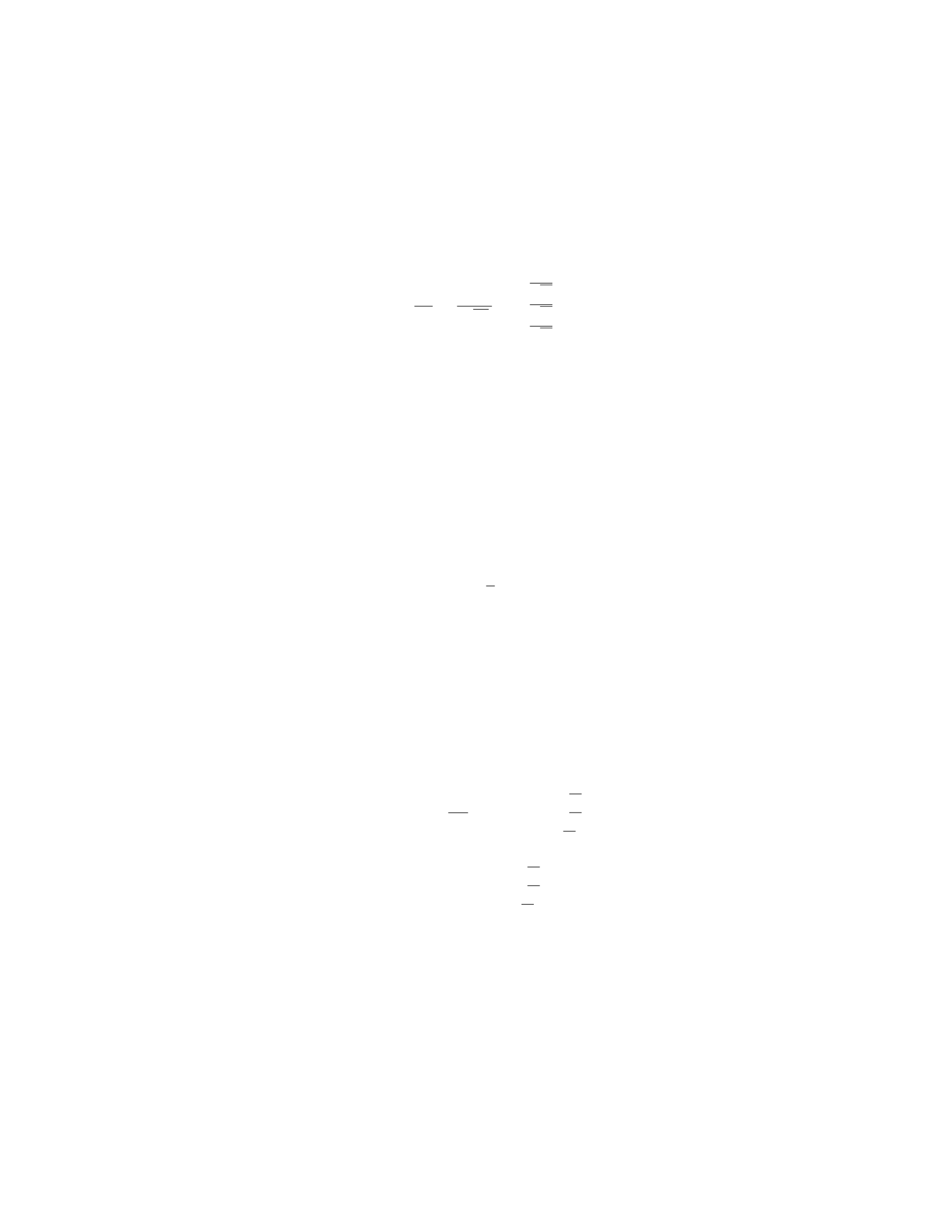
Step 3: Find the unit vector in the direction of v. The unit vector in the
direction of vis given by
ˆu=v
|v|=
1
3
4
√26 =
1
√26
3
√26
4
√26
Question 27
Question
Let a=
2
−1
3
and b=
1
4
−2
. Find the projection of aonto b.
Solution
To find the projection of aonto b, we will use the formula:
projb(a) = a
·b|b|2b
Step 1: Calculate a·b.
a·b= (2)(1) + (−1)(4) + (3)(−2) = 2 −4−6 = −8
Step 2: Calculate |b|2.
|b|2= (1)2+ (4)2+ (−2)2= 1 + 16 + 4 = 21
Step 3: Substitute the values into the projection formula.
projb(a) = −8
21
1
4
−2
=
−8
21
−32
21
16
21
Therefore, the projection of aonto bis
−8
21
−32
21
16
21
.
Question 28
Question
Let u = 2ˆ
i−3ˆ
j+ 4ˆ
kand v =−ˆ
i+ 2ˆ
j−ˆ
k. Find the projection of u onto v.
20

Solution
To find the projection of u onto v, we will use the formula:
projv (u) = u ·v
∥v∥2v
Step 1: Calculate the dot product of u and v.
u ·v = (2)(−1) + (−3)(2) + (4)(−1) = −2−6−4 = −12
Step 2: Calculate the magnitude of v.
∥v∥=p(−1)2+ (2)2+ (−1)2=√1 + 4 + 1 = √6
Step 3: Substitute the dot product and magnitude into the projection for-
mula.
projv (u) = −12
(√6)2v =−12
6v =−2v
Step 4: Plug in the values for v.
−2v =−2(−ˆ
i+ 2ˆ
j−ˆ
k)=2ˆ
i−4ˆ
j+ 2ˆ
k
Therefore, the projection of u onto v is 2ˆ
i−4ˆ
j+ 2ˆ
k.
Question 29
Question
Let u =2
−1and v =3
4. Find the magnitude of u +v.
Solution
Step 1: Calculate u +v.
u +v =2
−1+3
4=2+3
−1+4=5
3
Step 2: Find the magnitude of u +v. The magnitude of a vector a =a1
a2
is given by ∥a∥=pa2
1+a2
2.
So, for u +v =5
3, the magnitude is:
∥u +v∥=p52+ 32=√25 + 9 = √34
Therefore, the magnitude of u +v is √34.
21

Question 30
Question
Let a= 2i−3j+ 5kand b=i−2j−2kbe two vectors in R3. Determine the
angle between aand b.
Solution
Step 1: To find the angle between two vectors aand bin R3, we can use the
dot product formula: a·b=|a||b|cos θ, where θis the angle between aand b.
Step 2: First calculate the dot product of aand b:
a·b= (2)(1) + (−3)(−2) + (5)(−2)
a·b= 2 + 6 −10
a·b=−2
Step 3: Next, find the magnitudes of aand b:
|a|=p(2)2+ (−3)2+ (5)2
|a|=√4 + 9 + 25
|a|=√38
|b|=p(1)2+ (−2)2+ (−2)2
|b|=√1+4+4
|b|=√9
|b|= 3
Step 4: Substitute the dot product and magnitudes into the formula a·b=
|a||b|cos θ:
−2 = √38 ·3·cos θ
Step 5: Solve for θ:
cos θ=−2
3√38
θ= cos−1−2
3√38
Step 6: Using a calculator, we find:
θ≈123.15◦
Therefore, the angle between aand bis approximately 123.15◦.
22

Question 31
Question
Let u =
3
−2
5
and v =
−1
4
2
be two vectors in R3. Find the angle between
u and v.
Solution
To find the angle between two vectors u and v in R3, we can use the dot product
formula
u ·v =∥u∥∥v∥cos(θ),
where θis the angle between the vectors.
Step 1: Calculate the dot product Calculate the dot product u ·v using
the formula
u ·v = (3)(−1) + (−2)(4) + (5)(2).
Step 2: Calculate the magnitudes of the vectors Calculate the mag-
nitudes of the vectors u and v using the formula
∥u∥=p32+ (−2)2+ 52
and
∥v∥=p(−1)2+ 42+ 22.
Step 3: Substitute into the formula Substitute the dot product and
magnitudes into the formula
u ·v =∥u∥∥v∥cos(θ)
and solve for θ. Recall that u ·v =∥u∥∥v∥cos(θ) when the vectors are not the
zero vector.
Step 4: Calculate the angle Using the values found in previous steps,
solve for θusing the equation θ= arccos u·v
∥u∥∥v∥.
Therefore, the angle between u and v is θdegrees.
Question 32
Question
Let v=
3
−1
2
and w=
−2
0
5
. Find a vector usuch that 2v−3w= 4u.
23

Solution
Step 1: Compute 2vand 3w:
2v= 2
3
−1
2
=
6
−2
4
,
3w= 3
−2
0
5
=
−6
0
15
.
Step 2: Compute 2v−3w:
2v−3w=
6
−2
4
−
−6
0
15
=
6+6
−2−0
4−15
=
12
−2
−11
.
Step 3: Determine usuch that 4u=
12
−2
−11
by scaling: Solving u=
1
4
12
−2
−11
gives:
u=
3
−0.5
−2.75
.
Therefore, u=
3
−0.5
−2.75
is a vector that satisfies 2v−3w= 4u.
Question 33
Question
Let a=
1
2
−1
and b=
3
−4
5
. Find a unit vector parallel to the vector a−2b.
24

Solution
Step 1: Find the vector a−2b.
a−2b=
1
2
−1
−2
3
−4
5
=
1
2
−1
−
6
−8
10
=
−5
10
−11
Step 2: Find the magnitude of the vector a−2b.
∥a−2b∥=p(−5)2+ 102+ (−11)2=√25 + 100 + 121 = √246
Step 3: Compute the unit vector parallel to a−2b. The unit vector ˆuin
the direction of a vector vis given by
ˆu=v
∥v∥
Hence, the unit vector parallel to the vector a−2bis
ˆu=1
√246
−5
10
−11
=
−5
√246
10
√246
−11
√246
Question 34
Question
Let a =
2
4
−1
and
b=
−3
1
5
. Find a ·
band a ×
b.
Solution
Step 1: To find the dot product a·
b, we use the formula a·
b=a1b1+a2b2+a3b3:
a ·
b= (2)(−3) + (4)(1) + (−1)(5)
a ·
b=−6+4−5
a ·
b=−7
Step 2: To find the cross product a ×
b, we use the formula a ×
b=
a2b3−a3b2
a3b1−a1b3
a1b2−a2b1
:
a ×
b=
(4)(5) −(−1)(1)
(−1)(−3) −(2)(5)
(2)(1) −(4)(−3)
25

a ×
b=
20 + 1
3−10
2 + 12
a ×
b=
21
−7
14
Therefore, a ·
b=−7 and a ×
b=
21
−7
14
.
Question 35
Question
Let a= 2i+ 4j−kand b= 3i−2j+ 5k. Find the angle between vectors aand
b.
Solution
Step 1: Calculate the dot product of vectors aand b.
a·b= (2)(3) + (4)(−2) + (−1)(5) = 6 −8−5 = −7
Step 2: Calculate the magnitude of vector a.
|a|=p(2)2+ (4)2+ (−1)2=√4 + 16 + 1 = √21
Step 3: Calculate the magnitude of vector b.
|b|=p(3)2+ (−2)2+ (5)2=√9 + 4 + 25 = √38
Step 4: Use the formula cos θ=a·b
|a||b|to find the cosine of the angle between
the vectors.
cos θ=−7
√21 ·√38 =−7
√798
Step 5: Solve for the angle θusing the inverse cosine function.
θ= cos−1−7
√798≈121.38◦
Therefore, the angle between vectors aand bis approximately 121.38 de-
grees.
26

