investigate the many ways that the concept of "slope" and "angle"
touch our daily lives.
In this week's lessons you will learn about some characteristics of
lines and curves. Your discussion forum exercise this week is to
apply the concepts of angle of inclination and slope (rise over run)
to everyday ?examples.
You can go out and measure the slope something actual, like the
windscreen of your car. Or you can take a picture of ?something,
draw a line along its slope, and make measurements on the
picture to calculate the slope. This is illustrated in the picture
below.
Slope and Angle
The slope of a line and ?the angle of tilt of a line represent the
same thing but they are not identical things.?
A slope of a line is a ratio; it's the ratio of "rise over run" (rise
divided by run). A slope has no units, it's ?just a number; whereas,
an angle does have units. Angles are expressed in degrees or
radians. So ?what is the connection between slope and angle of
tilt?
A slope of a line is the tangent of the angle of tilt of that line.
(Tangent from trigonometry, like sine and cosine)?:
Slope = tan(Angle of Tilt).
You can get the angle from the slope by taking its inverse tangent.
Angle = tan-1(Slope).
Tan-1 can also ?be written as arctan, so
Angle = arctan(Slope).?
The two angles in the picture above are:
Steeper angle = arctan(0.80) = 38.7°?
Less steep angle = arctan(0.41) = 22.3°?
On to Measurement
Find an object, or a picture of an object, that is tilted.

Paste the picture of that object directly in your post.
Give the numbers for the horizontal and vertical distances you
used to calculate the tilt of the object.
Give the calculated slope and angle of inclination of the object.
Tell us how you obtained the horizontal and vertical distances. Did
you measure the actual object? Or did you draw lines on a picture
and measure them?
Can you think of something in your daily life whose slope or angle
of inclination you would like to know?
Don't forget that you must give attribution to the source of your
picture. If you took the picture yourself, say so. If you found the
picture on the Internet, be sure to copy and paste the URL of the
page from where you got the picture.

1
Slope and Inclination Angle
Student's Name
Professor’s Name
Institution
Course
Date
2
1 image
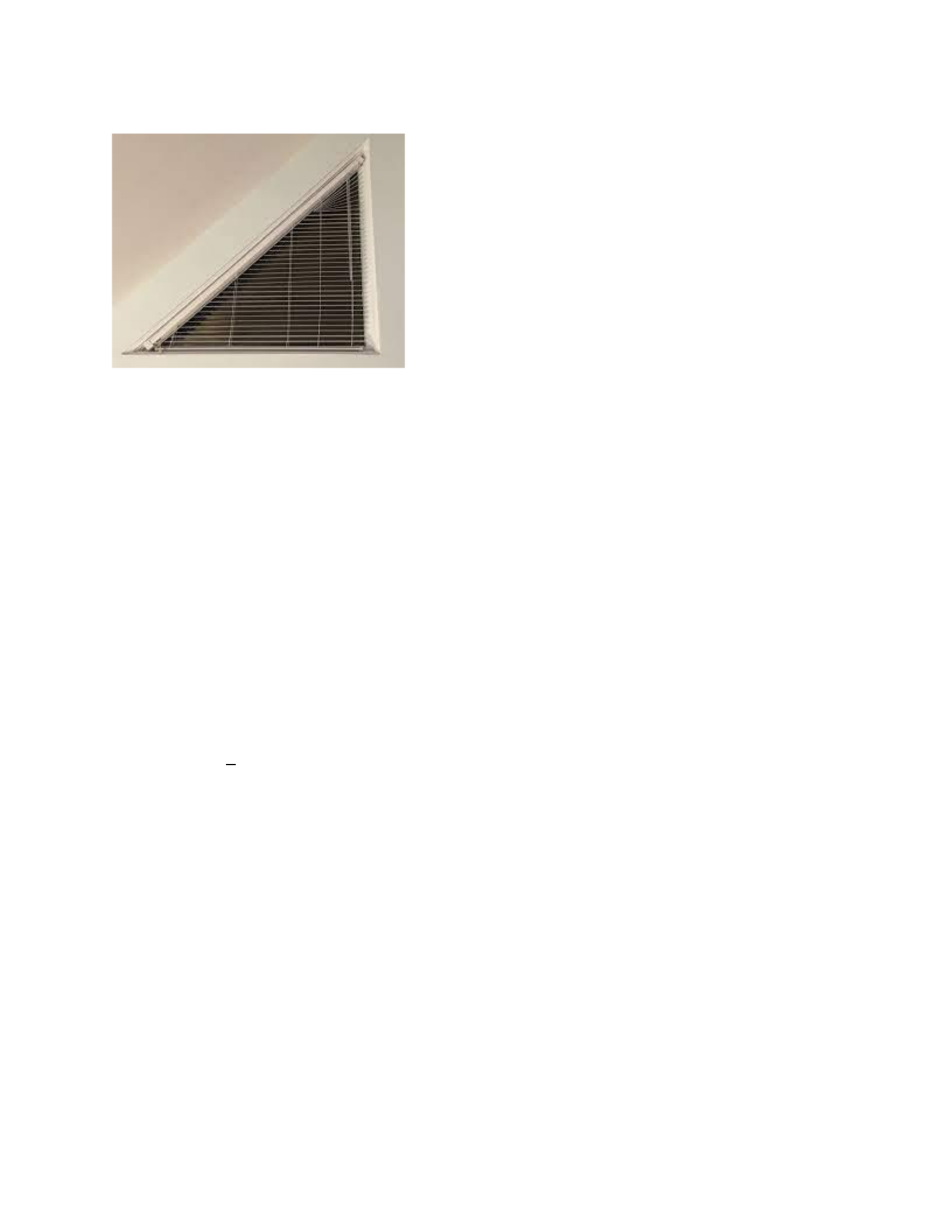
Figure 1Image of triangular window
Give the numbers for the horizontal and vertical distances you used to calculate the tilt of
the object.
The image provided for this exercise is of a triangular window. The object's vertical distance
(height) in the photo is 4.6 in. The horizontal length (width) of the object in the image is 5.5 in.
Give the calculated slope and angle of inclination of the object.
The slope of the object in the image is given by finding the tan. The tan is calculated by taking
the value of the opposite side and dividing it by the value of the adjacent side. The formula is as
follows; tan =𝑂
𝐴.
Substituting the values in the formula provided, we get; 𝑡𝑎𝑛 = 4.6/5.5. The slope is calculated
to be 0.836. The inclination angle can be calculated as the inverse of the obtained tan value. The
inclination angle is 0.696309984 rad or 39.896ᶿ(5 s.f).

3
Tell us how you obtained the horizontal and vertical distances. Did you measure the actual
object? Or did you draw lines on a picture and measure them?
The vertical and horizontal distances of the included image of the triangular window were
measured for the accessed webpage. The extreme ends of the image for each respective distance
of interest to the exercise were noted and used in getting the dimensions in inches. A line was
thus used for each distance being measured, and from it, the distance measured in inches as the
preferred unit.
Can you think of something in your daily life whose slope or angle of inclination you would
like to know?
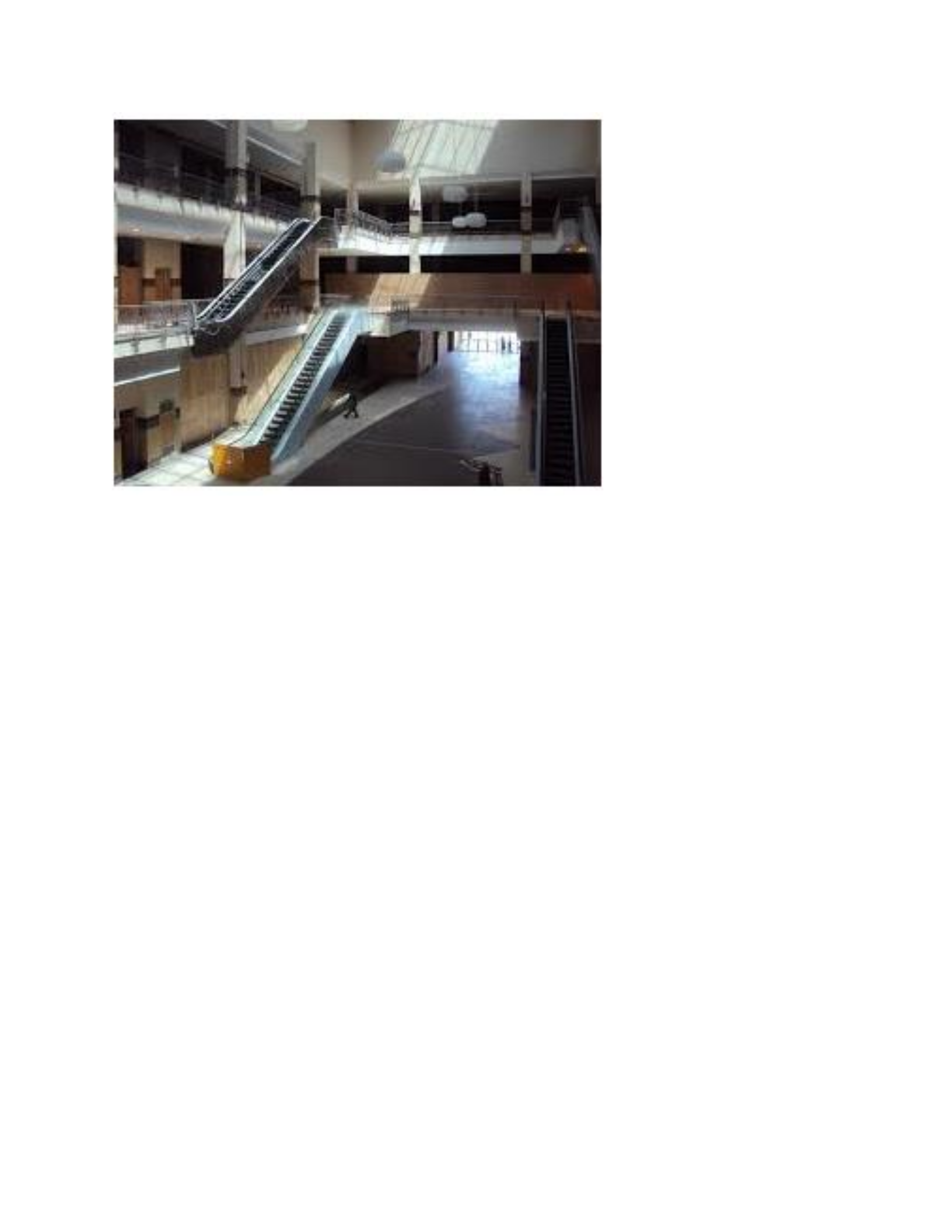
I frequent my local shopping mall for groceries, among other supplies. The infrastructure set-up
comes in all manner of sizes and shapes. The shopping mall has a set of escalators that help get
shoppers onto different store levels. The escalators take up a triangle shape from the ground
where it is erected. The escalator bit that one steps on makes up the hypotenuse. It is, therefore,
intriguing for me to one day find out the slope and angle of inclination of the escalators used in
the shopping mall.