


MATH 100 - FUNDAMENTALS OF
MATHEMATICS - Vector
Differentiation
Question Bank - Set 3
Liberty University
Question 1
Question
Let v=
3x2y
2xy3
x3
. Find the gradient of v.
Solution
To find the gradient of v, we need to take the partial derivatives of each com-
ponent of vwith respect to xand y.
Step 1: Compute ∂
∂x 3x2y.
∂
∂x 3x2y= 6xy
Step 2: Compute ∂
∂y 3x2y.
∂
∂y 3x2y= 3x2
Step 3: Compute ∂
∂x 2xy3.
∂
∂x 2xy3= 2y3
Step 4: Compute ∂
∂y 2xy3.
∂
∂y 2xy3= 6xy2

Step 5: Compute ∂
∂x x3.
∂
∂x x3= 3x2
Step 6: Compute ∂
∂y x3. Since there is no yterm in x3, the partial deriva-
tive with respect to yis 0.
Therefore, the gradient of vis:
∇v=
6xy
3x2+ 6xy2
3x2
Question 2
Question
Let u= 2x2yi+ 3xy2jand v= 5xyi−4x2j. Find d
dx (u·v).
Solution
Step 1: Calculate d
dx (u·v) using the rule for differentiating dot products:
d
dx (u·v) = u·dv
dx +du
dx ·v
Step 2: Find du
dx :
du
dx =d
dx (2x2y)i+d
dx (3xy2)j
du
dx = 4xyi+ (3y2+ 6xy)j
Step 3: Find dv
dx :
dv
dx =d
dx (5xy)i−d
dx (4x2)j
dv
dx = 5yi−8xj
Step 4: Substitute du
dx and dv
dx back into the formula:
d
dx (u·v) = (2x2yi+ 3xy2j)·(5yi−8xj) + (4xyi+ (3y2+ 6xy)j)·(5xyi−4x2j)
Step 5: Simplify the dot products to obtain the final answer.
2

Question 3
Question
Let f(x) = xTAx, where Ais a symmetric matrix and xis a vector in Rn. Find
the gradient of f(x) with respect to x.
Solution
Step 1: We will start by expanding f(x) = xTAx.
f(x) = x1x2. . . xn
a11 a12 . . . a1n
a21 a22 . . . a2n
.
.
..
.
.....
.
.
an1an2. . . ann
x1
x2
.
.
.
xn
=
n
X
i=1
n
X
j=1
aij xixj
Step 2: Now, let’s find the gradient of f(x). We have ∇f(x) =
∂f(x)
∂x1
∂f(x)
∂x2
.
.
.
∂f(x)
∂xn
.
Step 3: Computing the partial derivative of f(x) with respect to xifor each
i:
∂f(x)
∂xi
=∂
∂xi
n
X
j=1
n
X
k=1
ajkxjxk
=
n
X
j=1
ajixj+
n
X
k=1
aikxk=
n
X
j=1
ajixj+
n
X
k=1
akixk
Step 4: Therefore, the gradient of f(x) with respect to xis:
∇f(x) =
Pn
j=1 a1jxj+Pn
k=1 ak1xk
Pn
j=1 a2jxj+Pn
k=1 ak2xk
.
.
.
Pn
j=1 anj xj+Pn
k=1 aknxk
Question 4
Question
Let v=
3x2
4y
2z3
be a vector function. Find the derivative of vwith respect to
x,y, and z.
3

Solution
To find the derivative of the vector function vwith respect to x,y, and z, we
need to differentiate each component of vseparately.
Step 1: Find ∂v
∂x .
∂v
∂x =
∂
∂x (3x2)
∂
∂x (4y)
∂
∂x (2z3)
=
6x
0
0
Step 2: Find ∂v
∂y .
∂v
∂y =
∂
∂y (3x2)
∂
∂y (4y)
∂
∂y (2z3)
=
0
4
0
Step 3: Find ∂v
∂z .
∂v
∂z =
∂
∂z (3x2)
∂
∂z (4y)
∂
∂z (2z3)
=
0
0
6z2
Therefore, the derivative of vwith respect to xis
6x
0
0
, with respect to y
is
0
4
0
, and with respect to zis
0
0
6z2
.
Question 5
Question
Let u=x2
exand v=sin(x)
cos(x). Compute d
dx (u·v).
Solution
To differentiate the dot product u·vwith respect to x, we can use the properties
of dot product and the chain rule.
d
dx (u·v) = d
dx x2sin(x) + excos(x)
=d
dx (x2) sin(x) + x2d
dx (sin(x)) + d
dx (ex) cos(x) + exd
dx (cos(x))
= 2xsin(x) + x2cos(x) + excos(x)−exsin(x)
Therefore, d
dx (u·v) = 2xsin(x) + x2cos(x) + excos(x)−exsin(x).
4

Question 6
Question
Let u=
x2
ex
sin(x)
and v=
ln(x)
xcos(x)
√x
. Find d
dx (u·v), where ·represents the
dot product.
Solution
To find the derivative of u·vwith respect to x, we can use the properties of
the dot product as follows:
d
dx (u·v) = d
dx (u1v1+u2v2+u3v3)
where u1,u2, and u3are the components of uand v1,v2, and v3are the
components of v.
Step 1: Compute the dot product u·v:
u·v=x2ln(x) + exxcos(x) + sin(x)√x
Step 2: Differentiate the dot product with respect to x:
d
dx (u·v) = d
dx (x2ln(x) + exxcos(x) + sin(x)√x)
Using the product rule, the derivative of each term is:
d
dx (x2ln(x)) = 2xln(x) + x
d
dx (exxcos(x)) = exxcos(x) + excos(x)−exxsin(x)
d
dx (sin(x)√x) = cos(x)√x+sin(x)
2√x
Step 3: Put it all together:
d
dx (u·v) = (2xln(x)+x)+(exxcos(x)+excos(x)−exxsin(x))+(cos(x)√x+sin(x)
2√x)
= 2xln(x) + x+exxcos(x) + excos(x)−exxsin(x) + cos(x)√x+sin(x)
2√x
Therefore, d
dx (u·v) = 2xln(x) + x+exxcos(x) + excos(x)−exxsin(x) +
cos(x)√x+sin(x)
2√x.
5

Question 7
Question
Let v=
3x2y
2xy2
xyz
be a vector function. Find dv
dx .
Solution
Step 1: To differentiate the vector function vwith respect to x, we will differ-
entiate each component of vwith respect to xseparately.
Step 2: Let’s start with the first component of v:
d(3x2y)
dx = 6xy
So, the first component of dv
dx is 6xy.
Step 3: Moving on to the second component of v:
d(2xy2)
dx = 2y2
Therefore, the second component of dv
dx is 2y2.
Step 4: Finally, let’s differentiate the third component of v:
d(xyz)
dx =yz
Hence, the third component of dv
dx is yz.
Step 5: Putting it all together, we have:
dv
dx =
6xy
2y2
yz
Question 8
Question
Let r=xi+yj+zkbe a position vector. Find the gradient of the scalar field
f(r) = x2y+yz3.
Solution
To find the gradient of the scalar field f(r) = x2y+yz3, we need to differentiate
each component of f(r) with respect to x,y, and z.
Step 1: Compute ∂f
∂x :
∂f
∂x = 2xyi
6

Step 2: Compute ∂f
∂y :
∂f
∂y =x2j+z3k
Step 3: Compute ∂f
∂z :
∂f
∂z = 3yz2j
Step 4: Assemble the gradient of f(r):
∇f=∂f
∂x i+∂f
∂y j+∂f
∂z k
∇f= 2xyi+x2j+z3k+ 3yz2j
∇f= 2xyi+x2j+ (z3+ 3yz2)k
Therefore, the gradient of the scalar field f(r) = x2y+yz3is ∇f= 2xyi+
x2j+ (z3+ 3yz2)k.
Question 9
Question
Let uand vbe vectors in R3such that u=
x2
y3
z4
and v=
sin(x)
ey
ln(z)
. Find
d(u·v)
dv.
Solution
Step 1: Compute the dot product u·v.
u·v=x2sin(x) + y3ey+z4ln(z)
Step 2: Differentiate the dot product with respect to each component of v.
d(u·v)
dx = 2xsin(x) + x2cos(x)
d(u·v)
dy = 3y2ey+y3ey
d(u·v)
dz = 4z3ln(z) + z41
z
Step 3: Combine the results to get the final answer. So, d(u·v)
dv=
2xsin(x) + x2cos(x)
3y2ey+y3ey
4z3ln(z) + z41
z
.
7

Question 10
Question
Let uand vbe vectors in R3, where u=
x2
y2
z2
and v=
ex
ey
ez
. Determine
d(u·v)
du.
Solution
Step 1: Calculate the dot product u·v.
u·v=x2ex+y2ey+z2ez
Step 2: Next, differentiate u·vwith respect to each component of vector u.
d(u·v)
du=
∂(x2ex+y2ey+z2ez)
∂x
∂(x2ex+y2ey+z2ez)
∂y
∂(x2ex+y2ey+z2ez)
∂z
Step 3: Evaluate the partial derivatives with respect to each component of
u.
d(u·v)
du=
2xex+x2ex
2yey+y2ey
2zez+z2ez
=
x(2 + ex)
y(2 + ey)
z(2 + ez)
Therefore, d(u·v)
du=
x(2 + ex)
y(2 + ey)
z(2 + ez)
.
Question 11
Question
Let u=xi+yj+zkand v=xyzi−xz2j+y2zk. Find d(u·v)
dt .
Solution
Step 1: Compute u·v.
u·v= (xi+yj+zk)·(xyzi−xz2j+y2zk)
=xxyz + (−x)yz2+zy2z
=xy2z−xyz2+y2z2
8

Step 2: Differentiate both sides with respect to t.
d(u·v)
dt =d(xy2z−xyz2+y2z2)
dt
d(u·v)
dt =d(xy2z)
dt −d(xyz2)
dt +d(y2z2)
dt
Step 3: Compute the derivatives.
d(xy2z)
dt =dx
dt y2z+xdy
dt z+xy2dz
dt
d(xyz2)
dt =dx
dt yz2+xdy
dt z2+xyz2dz
dt
d(y2z2)
dt = 2ydy
dt z2+y2dz
dt z+y2zdz
dt
Step 4: Substitute the derivatives back into the expression.
d(u·v)
dt = (dx
dt y2z+xdy
dt z+xy2dz
dt )−(dx
dt yz2+xdy
dt z2+xyz2dz
dt )+(2ydy
dt z2+y2dz
dt z+y2zdz
dt )
Therefore, d(u·v)
dt =y2dx
dt z+xdy
dt z−yz2dx
dt −xz2dy
dt +2ydy
dt z2+y2zdz
dt +y2zdz
dt .
Question 12
Question
Let u= 3i−2j+ 5kand v= 2i+ 4j−3k. Find d
dt (u·v).
Solution
Let u= 3i−2j+ 5kand v= 2i+ 4j−3k. We are asked to find d
dt (u·v).
Step 1: We first find the dot product of uand v:
u·v= (3i−2j+ 5k)·(2i+ 4j−3k)
u·v= 3 ·2+(−2) ·4+5·(−3)
u·v= 6 −8−15
u·v=−17
Step 2: Now, we differentiate u·vwith respect to t:
d
dt (u·v) = d
dt (−17)
d
dt (u·v) = 0
Therefore, d
dt (u·v) = 0.
9

Question 13
Question
Let aand bbe two vectors such that a= 2i+ 3jand b= 4i−j. Find the
derivative of the vector c=a·bwith respect to t, where aand bare functions
of t.
Solution
Step 1: Write the expressions for aand bas functions of t:
a(t)=2i+ 3j,
b(t)=4i−j.
Step 2: Compute the dot product c(t) = a(t)·b(t):
c(t) = (2i+ 3j)·(4i−j)
= 2 ∗4+3∗(−1)
= 8 −3
= 5.
Step 3: Find the derivative of cwith respect to tusing the product rule for
differentiation: dc
dt =d(a·b)
dt =da
dt ·b+a·db
dt .
Step 4: Compute the derivatives of a(t) and b(t):
da
dt =d
dt (2i+ 3j)=0i+ 0j=0,
db
dt =d
dt (4i−j)=0i−0j=0.
Step 5: Substitute the values into the product rule formula:
dc
dt =0·b+a·0=0+0=0.
Therefore, the derivative of the vector cwith respect to tis 0.
Question 14
Question
Let v=3x2y
x3+ 2y3. Find dv
dx .
10

Solution
Step 1: Write the components of vexplicitly and differentiate each component
with respect to x.
v=3x2y
x3+ 2y3
dv
dx =d
dx (3x2y)
d
dx (x3+ 2y3)
Step 2: Differentiate each component with respect to x.
d
dx (3x2y) = 3(2x)y+ 3x2dy
dx = 6xy + 3x2dy
dx
d
dx (x3+ 2y3)=3x2+ 0 = 3x2
Therefore, dv
dx =6xy + 3x2dy
dx
3x2.
Question 15
Question
Let v= 2ti−4t2j+ 3t3k. Find
dt.
Solution
Step 1: To differentiate each component separately, we can use the basic rules
of differentiation. We know that d
dt tn=ntn−1for any constant n. So, given
v= 2ti−4t2j+ 3t3k, we can differentiate each component as follows:
Step 2: Differentiate the x-component:
d
dt (2t)=2
So, dx
dt = 2. Step 3: Differentiate the y-component:
d
dt (−4t2) = −8t
So, dy
dt =−8t. Step 4: Differentiate the z-component:
d
dt (3t3)=9t2
So, dz
dt = 9t2. Step 5: Combine the results to find
dt:
dt = dxdti+dy
dt j+dz
dt k=2i−8tj+9t2kTherefore,
dt = 2 i- 8t j+ 9t2k.
11

Question 16
Question
Let u=
x2
ex
sin(2x)
and v=
ln(x)
cos(x)
ex
. Find d(u·v)
dx .
Solution
Step 1: Calculate the dot product u·v.
u·v=x2ln(x) + excos(x) + sin(2x)ex
Step 2: Differentiate the dot product with respect to x.
d(u·v)
dx =d
dx (x2ln(x)) + d
dx (excos(x)) + d
dx (sin(2x)ex)
Step 3: Apply the product rule and chain rule as needed.
d(u·v)
dx = 2xln(x) + x+d
dx (ex) cos(x)−exsin(x) + cos(2x)ex+ 2exsin(2x)
Step 4: Simplify the expression.
d(u·v)
dx = 2xln(x) + x+excos(x)−exsin(x) + excos(2x)+2exsin(2x)
Therefore, d(u·v)
dx = 2xln(x)+x+excos(x)−exsin(x)+excos(2x)+2exsin(2x).
Question 17
Question
Let v=
2x3
x4
ex2
. Find dv
dx , the derivative of vwith respect to x.
Solution
To find the derivative of vwith respect to x, we will differentiate each component
of vseparately.
dv
dx =
d
dx (2x3)
d
dx (x4)
d
dx (ex2)
=
6x2
4x3
2xex2
12

Therefore, the derivative of vwith respect to xis v′=
6x2
4x3
2xex2
.
Question 18
Question
Let u= 3i−j+ 2kand v=i+ 2j−4k. Find d(u
·v)dt, where tis a scalar.
Solution
Step 1: Calculate the dot product of uand v.
u·v= (3)(1) + (−1)(2) + (2)(−4) = 3 −2−8 = −7
Step 2: Differentiate the dot product with respect to tusing the product
rule. d
dt (u·v) = d
dt (−7) = 0
Therefore, d(u
·v)dt = 0.
Question 19
Question
Let u= 2xi+ 3yj−4zkand v=x2i−2yj+zk. Determine d(u·v)
dr, where
r= (x, y, z).
Solution
To find d(u·v)
dr, we first need to express u·vin terms of x,y, and z.
Step 1: Calculate u·v.
u·v= (2x)(x2) + (3y)(−2y)+(−4z)(z)=2x3−6y2−4z2
So, u·v= 2x3−6y2−4z2.
Step 2: Express d(u·v)
drin terms of x,y, and z.
d(u·v)
dr=∂
∂x (2x3−6y2−4z2)i+∂
∂y (2x3−6y2−4z2)j+∂
∂z (2x3−6y2−4z2)k
Step 3: Calculate the partial derivatives.
∂
∂x (2x3−6y2−4z2)=6x2
13

∂
∂y (2x3−6y2−4z2) = −12y
∂
∂z (2x3−6y2−4z2) = −8z
Step 4: Substitute the partial derivatives back.
d(u·v)
dr= 6x2i−12yj−8zk
Therefore, d(u·v)
dr= 6x2i−12yj−8zk.
Question 20
Question
Let a= 3i−2j+ 4kand b= 2i+ 5j−3k. Find the gradient of the scalar
function f(r) = a·r×b, where r=xi+yj+zk.
Solution
To find the gradient of a scalar function, we need to find the partial derivatives
with respect to x,y, and z.
Step 1: Find ∂f
∂x
r×b=
i j k
x y z
2 5 −3
= (5z+ 3y)i−(2z+x)j+ (5x−2y)k
a·(r×b) = 3(5z+ 3y)−2(2z+x) + 4(5x−2y) = 15z+ 9y−4z−2x+ 20x−8y
= 11x+y+ 11z
Therefore, ∂f
∂x = 11i+j+ 11k.
Step 2: Find ∂f
∂y
r×b= (5z+ 3y)i−(2z+x)j+ (5x−2y)k
a·(r×b) = 3(5z+ 3y)−2(2z+x) + 4(5x−2y) = 15z+ 9y−4z−2x+ 20x−8y
= 20x+y+ 11z
Therefore, ∂f
∂y = 20i+j+ 11k.
Step 3: Find ∂f
∂z
r×b= (5z+ 3y)i−(2z+x)j+ (5x−2y)k
14

a·(r×b) = 3(5z+ 3y)−2(2z+x) + 4(5x−2y) = 15z+ 9y−4z−2x+ 20x−8y
=−2x+ 9y+ 11z
Therefore, ∂f
∂z =−2i+ 9j+ 11k.
Hence, the gradient of the scalar function f(r) is ∇f= 11i+j+ 11kfor ∂f
∂x ,
20i+j+ 11kfor ∂f
∂y , and −2i+ 9j+ 11kfor ∂f
∂z .
Question 21
Question
Let v=x2
sin(x). Find dv
dx .
Solution
To find dv
dx , we will differentiate each component of vwith respect to x.
Step 1: Differentiate the first component of v:
d
dx (x2)=2x
Step 2: Differentiate the second component of v:
d
dx (sin(x)) = cos(x)
Step 3: Combine the derivatives of the components to find dv
dx :
dv
dx =2x
cos(x)
Therefore, dv
dx =2x
cos(x).
Question 22
Question
Let v=3x2+ 2y
4xy −5be a vector function. Compute the gradient of v.
15

Solution
To find the gradient of v, we need to find the partial derivatives of each com-
ponent function.
Step 1: Find ∂
∂x of the first component function:
∂
∂x (3x2+ 2y) = 6x
Step 2: Find ∂
∂y of the first component function:
∂
∂y (3x2+ 2y) = 2
Step 3: Find ∂
∂x of the second component function:
∂
∂x (4xy −5) = 4y
Step 4: Find ∂
∂y of the second component function:
∂
∂y (4xy −5) = 4x
Step 5: Assemble the gradient of v:
∇v=6x
2+4y
4x=6x+ 4y
2+4x
Question 23
Question
Let v=
x2
ex
sin(x)
. Find dv
dx .
Solution
Step 1: Compute the derivative of each component of vwith respect to x.
d
dx x2= 2x
d
dx (ex) = ex
d
dx (sin(x)) = cos(x)
16

Step 2: Assemble the derivatives of the components into the derivative of
the vector v.
dv
dx =
d
dx (x2)
d
dx (ex)
d
dx (sin(x))
=
2x
ex
cos(x)
Therefore, dv
dx =
2x
ex
cos(x)
.
Question 24
Question
Let v=x2
yex. Find dv
dx .
Solution
To find dv
dx , we differentiate each component of vwith respect to xseparately.
Step 1: Differentiate the first component of v
d
dx (x2)=2x
Step 2: Differentiate the second component of v
d
dx (yex) = yex+yd
dx (ex) = yex+yex= 2yex
Step 3: Combine the derivatives to find dvdx
dv
dx =2x
2yex
Question 25
Question
Let v= 3i−2j+ 4kand w= 2i+ 5j−k. Determine d
dt (v·w).
Solution
Step 1: Recall that the dot product of two vectors a=a1i+a2j+a3kand
b=b1i+b2j+b3kis given by a·b=a1b1+a2b2+a3b3.
Step 2: Find the dot product of vand w:v·w= (3)(2)+(−2)(5)+(4)(−1) =
6−10 −4 = −8.
Step 3: Differentiate the dot product with respect to t:d
dt (v·w) = d
dt (−8).
Step 4: The derivative of a constant is zero, so: d
dt (v·w) = 0 .
17

Question 26
Question
Let v=
x2
3x
2
be a vector function in R3. Find the derivative of vwith respect
to x.
Solution
Step 1: The derivative of a vector function is found by taking the derivative of
each component individually. Therefore, we need to find the derivative of each
component of vwith respect to x.
Step 2: Let’s find the derivative of the first component of vwith respect to
x:d
dx (x2)=2x
Step 3: Next, let’s find the derivative of the second component of vwith
respect to x:
d
dx (3x)=3
Step 4: Lastly, let’s find the derivative of the third component of vwith
respect to x:
d
dx (2) = 0
Step 5: Putting it all together, the derivative of vwith respect to xis:
v′=
2x
3
0
Question 27
Question
Let u=
x2
ex
sin x
and v=
ln x
cos x
x3
. Compute the derivative of u·vwith respect
to x.
Solution
Step 1: Recall the formula for the derivative of the dot product of two vectors:
(u·v)′=u′·v+u·v′.
18

Step 2: Compute the derivatives of uand v:
u′=
2x
ex
cos x
,v′=
1
x
−sin x
3x2
Step 3: Compute u·v:
u·v=x2ln x+excos x+ sin xx3
Step 4: Apply the formula for the derivative of the dot product:
(u·v)′=u′·v+u·v′
=
2x
ex
cos x
·
ln x
cos x
x3
+
x2
ex
sin x
·
1
x
−sin x
3x2
Step 5: Simplify the expression using the dot product:
(2xln x+excos x+ cos xx3)+(x2·1
x+ex·(−sin x) + sin x·3x2)
= 2xln x+excos x+ cos xx3+x+exsin x+ 3x3sin x
Therefore, the derivative of u·vwith respect to xis 2xln x+excos x+
cos xx3+x+exsin x+ 3x3sin x.
Question 28
Question
Let f(x, y, z)=(x2y, 3yz, z2). Find ∂f
∂v, where v= (2,−1,4).
19

Solution
Step 1: Compute the partial derivatives of each component of fwith respect to
x, y, z.
∂
∂x (x2y)=2xy,
∂
∂x (3yz)=0,
∂
∂x (z2)=0,
∂
∂y (x2y) = x2,
∂
∂y (3yz)=3z,
∂
∂y (z2)=0,
∂
∂z (x2y)=0,
∂
∂z (3yz)=3y,
∂
∂z (z2)=2z.
Step 2: Evaluate the partial derivatives at v= (2,−1,4).
∂f
∂x
v
= (2(2)(−1),0,0) = (−4,0,0),
∂f
∂y
v
= (22,3(4),0) = (4,12,0),
∂f
∂z
v
= (0,3(−1),2(4)) = (0,−3,8).
Step 3: Combine the partial derivatives to find ∂f
∂v.
∂f
∂v=
−4 4 0
0 12 −3
008
Question 29
Question
Let v= (x2+ 2xy)i+ (2yx −y2)jbe a vector in R2. Calculate dv
dx .
20

Solution
Step 1: Write the vector vin component form:
v= (x2+ 2xy)i+ (2yx −y2)j
Step 2: Differentiate each component of vwith respect to x, treating yas a
constant: dv
dx =d
dx [(x2+ 2xy)i] + d
dx [(2yx −y2)j]
Step 3: Use the rules for differentiating each component. For the first com-
ponent:
d
dx (x2+ 2xy)=2x+ 2ydy
dx
For the second component:
d
dx (2yx −y2)=2ydx
dx + 2xdy
dx −2ydy
dx = 2y+ 2xdy
dx −2ydy
dx
Step 4: Write the differentiated vector as:
dv
dx = (2x+ 2ydy
dx )i+ (2y+ 2xdy
dx −2ydy
dx )j
dv
dx = (2x+ 2ydy
dx )i+ (2y+ 2xdy
dx −2ydy
dx )j
Question 30
Question
Let v=
x2
sin(2x)
ex
. Find the derivative of vwith respect to x.
Solution
To find the derivative of vwith respect to x, we will differentiate each component
of vindividually.
Step 1: Differentiating the first component: Let f(x) = x2. Then, d
dx (f(x)) =
2x. Therefore, the derivative of the first component of vis d
dx (x2)=2x.
Step 2: Differentiating the second component: Let g(x) = sin(2x). Then,
d
dx (g(x)) = 2 cos(2x) (using the chain rule). Therefore, the derivative of the
second component of vis d
dx (sin(2x)) = 2 cos(2x).
Step 3: Differentiating the third component: Let h(x) = ex. Then, d
dx (h(x)) =
ex. Therefore, the derivative of the third component of vis d
dx (ex) = ex.
Step 4: Combining the derivatives: The derivative of vwith respect to xis
21

dx =
2x
2 cos(2x)
ex
Question 31
Question
Let u=x2
sin(y)and v=cos(z)
ex. Find the derivative of w=u·vwith
respect to x.
Solution
Step 1: Compute the dot product u·v:
u·v=x2cos(z) + sin(y)ex
Step 2: Differentiate with respect to xusing the product rule:
d
dx (u·v) = d
dx (x2cos(z)) + d
dx (sin(y)ex)
Step 3: Differentiate each term separately:
d
dx (x2cos(z)) = 2xcos(z)
d
dx (sin(y)ex) = exsin(y)
Step 4: Combine the derivatives to find the final result:
d
dx (u·v)=2xcos(z) + exsin(y)
Therefore, the derivative of w=u·vwith respect to xis 2xcos(z)+exsin(y).
Question 32
Question
Let v=
x2
ex
cos(x)
be a vector-valued function. Find the derivative dv
dx .
22

Solution
Step 1: To find the derivative of vwith respect to x, we differentiate each
component of vwith respect to xseparately. Let v=
x2
ex
cos(x)
.
Step 2: Differentiating the first component x2with respect to xgives d
dx (x2) =
2x.
Step 3: Differentiating the second component exwith respect to xgives
d
dx (ex) = ex.
Step 4: Differentiating the third component cos(x) with respect to xgives
d
dx (cos(x)) = −sin(x).
Step 5: Therefore, the derivative dv
dx is:
dv
dx =
2x
ex
−sin(x)
Question 33
Question
Let vand wbe two vectors in R3defined by v=⟨x2, y3, z4⟩and w=⟨x, y, z⟩.
Calculate the derivative of v·wwith respect to y.
Solution
Step 1: Find the dot product of vand w:
v·w= (x2)(x)+(y3)(y)+(z4)(z)
=x3+y4+z5
Step 2: Differentiate the dot product with respect to y:
d
dy (v·w) = d
dy (x3+y4+z5)
= 4y3
Therefore, the derivative of v·wwith respect to yis 4y3.
Question 34
Question
Let u=
x2y
cos(y)
exy
and v=
sin(y)
x2
ln(x)
. Find d(u·v)
d(x).
23
Solution
Step 1: Calculate the dot product u·v:
u·v=x2ysin(y) + cos(y)x2+exy ln(x)
Step 2: Differentiate u·vwith respect to x:
d(u·v)
d(x)=d
dx (x2ysin(y) + cos(y)x2+exy ln(x))
Step 3: Apply the product rule and chain rule to differentiate each term:
d(u·v)
d(x)=d
dx (x2ysin(y)) + d
dx (cos(y)x2) + d
dx (exy ln(x))
Step 4: Compute the derivatives of each term:
For x2ysin(y):
d
dx (x2ysin(y)) = (2xy +x2dy
dx ) sin(y)
For cos(y)x2:
d
dx (cos(y)x2) = −sin(y)x2+ 2xcos(y)
For exy ln(x):
d
dx (exy ln(x)) = yexy ln(x) + exy
x
Step 5: Combine the results to get the final derivative:
d(u·v)
d(x)= (2xy +x2dy
dx ) sin(y)−sin(y)x2+ 2xcos(y) + yexy ln(x) + exy
x
Question 35
Question
Let u= 3i−2j+kand v= 2i+ 4j−6k. Find d
dt (u·v).
Solution
Step 1: Calculate u·v.
u·v= (3i−2j+k)·(2i+ 4j−6k)
u·v= 3 ×2+(−2) ×4+1×(−6)
24

Step 5: Compute ∂
∂x x3.
∂
∂x x3= 3x2
Step 6: Compute ∂
∂y x3. Since there is no yterm in x3, the partial deriva-
tive with respect to yis 0.
Therefore, the gradient of vis:
∇v=
6xy
3x2+ 6xy2
3x2
Question 2
Question
Let u= 2x2yi+ 3xy2jand v= 5xyi−4x2j. Find d
dx (u·v).
Solution
Step 1: Calculate d
dx (u·v) using the rule for differentiating dot products:
d
dx (u·v) = u·dv
dx +du
dx ·v
Step 2: Find du
dx :
du
dx =d
dx (2x2y)i+d
dx (3xy2)j
du
dx = 4xyi+ (3y2+ 6xy)j
Step 3: Find dv
dx :
dv
dx =d
dx (5xy)i−d
dx (4x2)j
dv
dx = 5yi−8xj
Step 4: Substitute du
dx and dv
dx back into the formula:
d
dx (u·v) = (2x2yi+ 3xy2j)·(5yi−8xj) + (4xyi+ (3y2+ 6xy)j)·(5xyi−4x2j)
Step 5: Simplify the dot products to obtain the final answer.
2

Question 3
Question
Let f(x) = xTAx, where Ais a symmetric matrix and xis a vector in Rn. Find
the gradient of f(x) with respect to x.
Solution
Step 1: We will start by expanding f(x) = xTAx.
f(x) = x1x2. . . xn
a11 a12 . . . a1n
a21 a22 . . . a2n
.
.
..
.
.....
.
.
an1an2. . . ann
x1
x2
.
.
.
xn
=
n
X
i=1
n
X
j=1
aij xixj
Step 2: Now, let’s find the gradient of f(x). We have ∇f(x) =
∂f(x)
∂x1
∂f(x)
∂x2
.
.
.
∂f(x)
∂xn
.
Step 3: Computing the partial derivative of f(x) with respect to xifor each
i:
∂f(x)
∂xi
=∂
∂xi
n
X
j=1
n
X
k=1
ajkxjxk
=
n
X
j=1
ajixj+
n
X
k=1
aikxk=
n
X
j=1
ajixj+
n
X
k=1
akixk
Step 4: Therefore, the gradient of f(x) with respect to xis:
∇f(x) =
Pn
j=1 a1jxj+Pn
k=1 ak1xk
Pn
j=1 a2jxj+Pn
k=1 ak2xk
.
.
.
Pn
j=1 anj xj+Pn
k=1 aknxk
Question 4
Question
Let v=
3x2
4y
2z3
be a vector function. Find the derivative of vwith respect to
x,y, and z.
3

Solution
To find the derivative of the vector function vwith respect to x,y, and z, we
need to differentiate each component of vseparately.
Step 1: Find ∂v
∂x .
∂v
∂x =
∂
∂x (3x2)
∂
∂x (4y)
∂
∂x (2z3)
=
6x
0
0
Step 2: Find ∂v
∂y .
∂v
∂y =
∂
∂y (3x2)
∂
∂y (4y)
∂
∂y (2z3)
=
0
4
0
Step 3: Find ∂v
∂z .
∂v
∂z =
∂
∂z (3x2)
∂
∂z (4y)
∂
∂z (2z3)
=
0
0
6z2
Therefore, the derivative of vwith respect to xis
6x
0
0
, with respect to y
is
0
4
0
, and with respect to zis
0
0
6z2
.
Question 5
Question
Let u=x2
exand v=sin(x)
cos(x). Compute d
dx (u·v).
Solution
To differentiate the dot product u·vwith respect to x, we can use the properties
of dot product and the chain rule.
d
dx (u·v) = d
dx x2sin(x) + excos(x)
=d
dx (x2) sin(x) + x2d
dx (sin(x)) + d
dx (ex) cos(x) + exd
dx (cos(x))
= 2xsin(x) + x2cos(x) + excos(x)−exsin(x)
Therefore, d
dx (u·v) = 2xsin(x) + x2cos(x) + excos(x)−exsin(x).
4

Question 6
Question
Let u=
x2
ex
sin(x)
and v=
ln(x)
xcos(x)
√x
. Find d
dx (u·v), where ·represents the
dot product.
Solution
To find the derivative of u·vwith respect to x, we can use the properties of
the dot product as follows:
d
dx (u·v) = d
dx (u1v1+u2v2+u3v3)
where u1,u2, and u3are the components of uand v1,v2, and v3are the
components of v.
Step 1: Compute the dot product u·v:
u·v=x2ln(x) + exxcos(x) + sin(x)√x
Step 2: Differentiate the dot product with respect to x:
d
dx (u·v) = d
dx (x2ln(x) + exxcos(x) + sin(x)√x)
Using the product rule, the derivative of each term is:
d
dx (x2ln(x)) = 2xln(x) + x
d
dx (exxcos(x)) = exxcos(x) + excos(x)−exxsin(x)
d
dx (sin(x)√x) = cos(x)√x+sin(x)
2√x
Step 3: Put it all together:
d
dx (u·v) = (2xln(x)+x)+(exxcos(x)+excos(x)−exxsin(x))+(cos(x)√x+sin(x)
2√x)
= 2xln(x) + x+exxcos(x) + excos(x)−exxsin(x) + cos(x)√x+sin(x)
2√x
Therefore, d
dx (u·v) = 2xln(x) + x+exxcos(x) + excos(x)−exxsin(x) +
cos(x)√x+sin(x)
2√x.
5

Question 7
Question
Let v=
3x2y
2xy2
xyz
be a vector function. Find dv
dx .
Solution
Step 1: To differentiate the vector function vwith respect to x, we will differ-
entiate each component of vwith respect to xseparately.
Step 2: Let’s start with the first component of v:
d(3x2y)
dx = 6xy
So, the first component of dv
dx is 6xy.
Step 3: Moving on to the second component of v:
d(2xy2)
dx = 2y2
Therefore, the second component of dv
dx is 2y2.
Step 4: Finally, let’s differentiate the third component of v:
d(xyz)
dx =yz
Hence, the third component of dv
dx is yz.
Step 5: Putting it all together, we have:
dv
dx =
6xy
2y2
yz
Question 8
Question
Let r=xi+yj+zkbe a position vector. Find the gradient of the scalar field
f(r) = x2y+yz3.
Solution
To find the gradient of the scalar field f(r) = x2y+yz3, we need to differentiate
each component of f(r) with respect to x,y, and z.
Step 1: Compute ∂f
∂x :
∂f
∂x = 2xyi
6

Step 2: Compute ∂f
∂y :
∂f
∂y =x2j+z3k
Step 3: Compute ∂f
∂z :
∂f
∂z = 3yz2j
Step 4: Assemble the gradient of f(r):
∇f=∂f
∂x i+∂f
∂y j+∂f
∂z k
∇f= 2xyi+x2j+z3k+ 3yz2j
∇f= 2xyi+x2j+ (z3+ 3yz2)k
Therefore, the gradient of the scalar field f(r) = x2y+yz3is ∇f= 2xyi+
x2j+ (z3+ 3yz2)k.
Question 9
Question
Let uand vbe vectors in R3such that u=
x2
y3
z4
and v=
sin(x)
ey
ln(z)
. Find
d(u·v)
dv.
Solution
Step 1: Compute the dot product u·v.
u·v=x2sin(x) + y3ey+z4ln(z)
Step 2: Differentiate the dot product with respect to each component of v.
d(u·v)
dx = 2xsin(x) + x2cos(x)
d(u·v)
dy = 3y2ey+y3ey
d(u·v)
dz = 4z3ln(z) + z41
z
Step 3: Combine the results to get the final answer. So, d(u·v)
dv=
2xsin(x) + x2cos(x)
3y2ey+y3ey
4z3ln(z) + z41
z
.
7

Question 10
Question
Let uand vbe vectors in R3, where u=
x2
y2
z2
and v=
ex
ey
ez
. Determine
d(u·v)
du.
Solution
Step 1: Calculate the dot product u·v.
u·v=x2ex+y2ey+z2ez
Step 2: Next, differentiate u·vwith respect to each component of vector u.
d(u·v)
du=
∂(x2ex+y2ey+z2ez)
∂x
∂(x2ex+y2ey+z2ez)
∂y
∂(x2ex+y2ey+z2ez)
∂z
Step 3: Evaluate the partial derivatives with respect to each component of
u.
d(u·v)
du=
2xex+x2ex
2yey+y2ey
2zez+z2ez
=
x(2 + ex)
y(2 + ey)
z(2 + ez)
Therefore, d(u·v)
du=
x(2 + ex)
y(2 + ey)
z(2 + ez)
.
Question 11
Question
Let u=xi+yj+zkand v=xyzi−xz2j+y2zk. Find d(u·v)
dt .
Solution
Step 1: Compute u·v.
u·v= (xi+yj+zk)·(xyzi−xz2j+y2zk)
=xxyz + (−x)yz2+zy2z
=xy2z−xyz2+y2z2
8

Step 2: Differentiate both sides with respect to t.
d(u·v)
dt =d(xy2z−xyz2+y2z2)
dt
d(u·v)
dt =d(xy2z)
dt −d(xyz2)
dt +d(y2z2)
dt
Step 3: Compute the derivatives.
d(xy2z)
dt =dx
dt y2z+xdy
dt z+xy2dz
dt
d(xyz2)
dt =dx
dt yz2+xdy
dt z2+xyz2dz
dt
d(y2z2)
dt = 2ydy
dt z2+y2dz
dt z+y2zdz
dt
Step 4: Substitute the derivatives back into the expression.
d(u·v)
dt = (dx
dt y2z+xdy
dt z+xy2dz
dt )−(dx
dt yz2+xdy
dt z2+xyz2dz
dt )+(2ydy
dt z2+y2dz
dt z+y2zdz
dt )
Therefore, d(u·v)
dt =y2dx
dt z+xdy
dt z−yz2dx
dt −xz2dy
dt +2ydy
dt z2+y2zdz
dt +y2zdz
dt .
Question 12
Question
Let u= 3i−2j+ 5kand v= 2i+ 4j−3k. Find d
dt (u·v).
Solution
Let u= 3i−2j+ 5kand v= 2i+ 4j−3k. We are asked to find d
dt (u·v).
Step 1: We first find the dot product of uand v:
u·v= (3i−2j+ 5k)·(2i+ 4j−3k)
u·v= 3 ·2+(−2) ·4+5·(−3)
u·v= 6 −8−15
u·v=−17
Step 2: Now, we differentiate u·vwith respect to t:
d
dt (u·v) = d
dt (−17)
d
dt (u·v) = 0
Therefore, d
dt (u·v) = 0.
9

Question 13
Question
Let aand bbe two vectors such that a= 2i+ 3jand b= 4i−j. Find the
derivative of the vector c=a·bwith respect to t, where aand bare functions
of t.
Solution
Step 1: Write the expressions for aand bas functions of t:
a(t)=2i+ 3j,
b(t)=4i−j.
Step 2: Compute the dot product c(t) = a(t)·b(t):
c(t) = (2i+ 3j)·(4i−j)
= 2 ∗4+3∗(−1)
= 8 −3
= 5.
Step 3: Find the derivative of cwith respect to tusing the product rule for
differentiation: dc
dt =d(a·b)
dt =da
dt ·b+a·db
dt .
Step 4: Compute the derivatives of a(t) and b(t):
da
dt =d
dt (2i+ 3j)=0i+ 0j=0,
db
dt =d
dt (4i−j)=0i−0j=0.
Step 5: Substitute the values into the product rule formula:
dc
dt =0·b+a·0=0+0=0.
Therefore, the derivative of the vector cwith respect to tis 0.
Question 14
Question
Let v=3x2y
x3+ 2y3. Find dv
dx .
10

Solution
Step 1: Write the components of vexplicitly and differentiate each component
with respect to x.
v=3x2y
x3+ 2y3
dv
dx =d
dx (3x2y)
d
dx (x3+ 2y3)
Step 2: Differentiate each component with respect to x.
d
dx (3x2y) = 3(2x)y+ 3x2dy
dx = 6xy + 3x2dy
dx
d
dx (x3+ 2y3)=3x2+ 0 = 3x2
Therefore, dv
dx =6xy + 3x2dy
dx
3x2.
Question 15
Question
Let v= 2ti−4t2j+ 3t3k. Find
dt.
Solution
Step 1: To differentiate each component separately, we can use the basic rules
of differentiation. We know that d
dt tn=ntn−1for any constant n. So, given
v= 2ti−4t2j+ 3t3k, we can differentiate each component as follows:
Step 2: Differentiate the x-component:
d
dt (2t)=2
So, dx
dt = 2. Step 3: Differentiate the y-component:
d
dt (−4t2) = −8t
So, dy
dt =−8t. Step 4: Differentiate the z-component:
d
dt (3t3)=9t2
So, dz
dt = 9t2. Step 5: Combine the results to find
dt:
dt = dxdti+dy
dt j+dz
dt k=2i−8tj+9t2kTherefore,
dt = 2 i- 8t j+ 9t2k.
11
Question 16
Question
Let u=
x2
ex
sin(2x)
and v=
ln(x)
cos(x)
ex
. Find d(u·v)
dx .
Solution
Step 1: Calculate the dot product u·v.
u·v=x2ln(x) + excos(x) + sin(2x)ex
Step 2: Differentiate the dot product with respect to x.
d(u·v)
dx =d
dx (x2ln(x)) + d
dx (excos(x)) + d
dx (sin(2x)ex)
Step 3: Apply the product rule and chain rule as needed.
d(u·v)
dx = 2xln(x) + x+d
dx (ex) cos(x)−exsin(x) + cos(2x)ex+ 2exsin(2x)
Step 4: Simplify the expression.
d(u·v)
dx = 2xln(x) + x+excos(x)−exsin(x) + excos(2x)+2exsin(2x)
Therefore, d(u·v)
dx = 2xln(x)+x+excos(x)−exsin(x)+excos(2x)+2exsin(2x).
Question 17
Question
Let v=
2x3
x4
ex2
. Find dv
dx , the derivative of vwith respect to x.
Solution
To find the derivative of vwith respect to x, we will differentiate each component
of vseparately.
dv
dx =
d
dx (2x3)
d
dx (x4)
d
dx (ex2)
=
6x2
4x3
2xex2
12

Therefore, the derivative of vwith respect to xis v′=
6x2
4x3
2xex2
.
Question 18
Question
Let u= 3i−j+ 2kand v=i+ 2j−4k. Find d(u
·v)dt, where tis a scalar.
Solution
Step 1: Calculate the dot product of uand v.
u·v= (3)(1) + (−1)(2) + (2)(−4) = 3 −2−8 = −7
Step 2: Differentiate the dot product with respect to tusing the product
rule. d
dt (u·v) = d
dt (−7) = 0
Therefore, d(u
·v)dt = 0.
Question 19
Question
Let u= 2xi+ 3yj−4zkand v=x2i−2yj+zk. Determine d(u·v)
dr, where
r= (x, y, z).
Solution
To find d(u·v)
dr, we first need to express u·vin terms of x,y, and z.
Step 1: Calculate u·v.
u·v= (2x)(x2) + (3y)(−2y)+(−4z)(z)=2x3−6y2−4z2
So, u·v= 2x3−6y2−4z2.
Step 2: Express d(u·v)
drin terms of x,y, and z.
d(u·v)
dr=∂
∂x (2x3−6y2−4z2)i+∂
∂y (2x3−6y2−4z2)j+∂
∂z (2x3−6y2−4z2)k
Step 3: Calculate the partial derivatives.
∂
∂x (2x3−6y2−4z2)=6x2
13

∂
∂y (2x3−6y2−4z2) = −12y
∂
∂z (2x3−6y2−4z2) = −8z
Step 4: Substitute the partial derivatives back.
d(u·v)
dr= 6x2i−12yj−8zk
Therefore, d(u·v)
dr= 6x2i−12yj−8zk.
Question 20
Question
Let a= 3i−2j+ 4kand b= 2i+ 5j−3k. Find the gradient of the scalar
function f(r) = a·r×b, where r=xi+yj+zk.
Solution
To find the gradient of a scalar function, we need to find the partial derivatives
with respect to x,y, and z.
Step 1: Find ∂f
∂x
r×b=
i j k
x y z
2 5 −3
= (5z+ 3y)i−(2z+x)j+ (5x−2y)k
a·(r×b) = 3(5z+ 3y)−2(2z+x) + 4(5x−2y) = 15z+ 9y−4z−2x+ 20x−8y
= 11x+y+ 11z
Therefore, ∂f
∂x = 11i+j+ 11k.
Step 2: Find ∂f
∂y
r×b= (5z+ 3y)i−(2z+x)j+ (5x−2y)k
a·(r×b) = 3(5z+ 3y)−2(2z+x) + 4(5x−2y) = 15z+ 9y−4z−2x+ 20x−8y
= 20x+y+ 11z
Therefore, ∂f
∂y = 20i+j+ 11k.
Step 3: Find ∂f
∂z
r×b= (5z+ 3y)i−(2z+x)j+ (5x−2y)k
14

a·(r×b) = 3(5z+ 3y)−2(2z+x) + 4(5x−2y) = 15z+ 9y−4z−2x+ 20x−8y
=−2x+ 9y+ 11z
Therefore, ∂f
∂z =−2i+ 9j+ 11k.
Hence, the gradient of the scalar function f(r) is ∇f= 11i+j+ 11kfor ∂f
∂x ,
20i+j+ 11kfor ∂f
∂y , and −2i+ 9j+ 11kfor ∂f
∂z .
Question 21
Question
Let v=x2
sin(x). Find dv
dx .
Solution
To find dv
dx , we will differentiate each component of vwith respect to x.
Step 1: Differentiate the first component of v:
d
dx (x2)=2x
Step 2: Differentiate the second component of v:
d
dx (sin(x)) = cos(x)
Step 3: Combine the derivatives of the components to find dv
dx :
dv
dx =2x
cos(x)
Therefore, dv
dx =2x
cos(x).
Question 22
Question
Let v=3x2+ 2y
4xy −5be a vector function. Compute the gradient of v.
15

Solution
To find the gradient of v, we need to find the partial derivatives of each com-
ponent function.
Step 1: Find ∂
∂x of the first component function:
∂
∂x (3x2+ 2y) = 6x
Step 2: Find ∂
∂y of the first component function:
∂
∂y (3x2+ 2y) = 2
Step 3: Find ∂
∂x of the second component function:
∂
∂x (4xy −5) = 4y
Step 4: Find ∂
∂y of the second component function:
∂
∂y (4xy −5) = 4x
Step 5: Assemble the gradient of v:
∇v=6x
2+4y
4x=6x+ 4y
2+4x
Question 23
Question
Let v=
x2
ex
sin(x)
. Find dv
dx .
Solution
Step 1: Compute the derivative of each component of vwith respect to x.
d
dx x2= 2x
d
dx (ex) = ex
d
dx (sin(x)) = cos(x)
16

Step 2: Assemble the derivatives of the components into the derivative of
the vector v.
dv
dx =
d
dx (x2)
d
dx (ex)
d
dx (sin(x))
=
2x
ex
cos(x)
Therefore, dv
dx =
2x
ex
cos(x)
.
Question 24
Question
Let v=x2
yex. Find dv
dx .
Solution
To find dv
dx , we differentiate each component of vwith respect to xseparately.
Step 1: Differentiate the first component of v
d
dx (x2)=2x
Step 2: Differentiate the second component of v
d
dx (yex) = yex+yd
dx (ex) = yex+yex= 2yex
Step 3: Combine the derivatives to find dvdx
dv
dx =2x
2yex
Question 25
Question
Let v= 3i−2j+ 4kand w= 2i+ 5j−k. Determine d
dt (v·w).
Solution
Step 1: Recall that the dot product of two vectors a=a1i+a2j+a3kand
b=b1i+b2j+b3kis given by a·b=a1b1+a2b2+a3b3.
Step 2: Find the dot product of vand w:v·w= (3)(2)+(−2)(5)+(4)(−1) =
6−10 −4 = −8.
Step 3: Differentiate the dot product with respect to t:d
dt (v·w) = d
dt (−8).
Step 4: The derivative of a constant is zero, so: d
dt (v·w) = 0 .
17

Question 26
Question
Let v=
x2
3x
2
be a vector function in R3. Find the derivative of vwith respect
to x.
Solution
Step 1: The derivative of a vector function is found by taking the derivative of
each component individually. Therefore, we need to find the derivative of each
component of vwith respect to x.
Step 2: Let’s find the derivative of the first component of vwith respect to
x:d
dx (x2)=2x
Step 3: Next, let’s find the derivative of the second component of vwith
respect to x:
d
dx (3x)=3
Step 4: Lastly, let’s find the derivative of the third component of vwith
respect to x:
d
dx (2) = 0
Step 5: Putting it all together, the derivative of vwith respect to xis:
v′=
2x
3
0
Question 27
Question
Let u=
x2
ex
sin x
and v=
ln x
cos x
x3
. Compute the derivative of u·vwith respect
to x.
Solution
Step 1: Recall the formula for the derivative of the dot product of two vectors:
(u·v)′=u′·v+u·v′.
18

Step 2: Compute the derivatives of uand v:
u′=
2x
ex
cos x
,v′=
1
x
−sin x
3x2
Step 3: Compute u·v:
u·v=x2ln x+excos x+ sin xx3
Step 4: Apply the formula for the derivative of the dot product:
(u·v)′=u′·v+u·v′
=
2x
ex
cos x
·
ln x
cos x
x3
+
x2
ex
sin x
·
1
x
−sin x
3x2
Step 5: Simplify the expression using the dot product:
(2xln x+excos x+ cos xx3)+(x2·1
x+ex·(−sin x) + sin x·3x2)
= 2xln x+excos x+ cos xx3+x+exsin x+ 3x3sin x
Therefore, the derivative of u·vwith respect to xis 2xln x+excos x+
cos xx3+x+exsin x+ 3x3sin x.
Question 28
Question
Let f(x, y, z)=(x2y, 3yz, z2). Find ∂f
∂v, where v= (2,−1,4).
19

Solution
Step 1: Compute the partial derivatives of each component of fwith respect to
x, y, z.
∂
∂x (x2y)=2xy,
∂
∂x (3yz)=0,
∂
∂x (z2)=0,
∂
∂y (x2y) = x2,
∂
∂y (3yz)=3z,
∂
∂y (z2)=0,
∂
∂z (x2y)=0,
∂
∂z (3yz)=3y,
∂
∂z (z2)=2z.
Step 2: Evaluate the partial derivatives at v= (2,−1,4).
∂f
∂x
v
= (2(2)(−1),0,0) = (−4,0,0),
∂f
∂y
v
= (22,3(4),0) = (4,12,0),
∂f
∂z
v
= (0,3(−1),2(4)) = (0,−3,8).
Step 3: Combine the partial derivatives to find ∂f
∂v.
∂f
∂v=
−4 4 0
0 12 −3
008
Question 29
Question
Let v= (x2+ 2xy)i+ (2yx −y2)jbe a vector in R2. Calculate dv
dx .
20

Solution
Step 1: Write the vector vin component form:
v= (x2+ 2xy)i+ (2yx −y2)j
Step 2: Differentiate each component of vwith respect to x, treating yas a
constant: dv
dx =d
dx [(x2+ 2xy)i] + d
dx [(2yx −y2)j]
Step 3: Use the rules for differentiating each component. For the first com-
ponent:
d
dx (x2+ 2xy)=2x+ 2ydy
dx
For the second component:
d
dx (2yx −y2)=2ydx
dx + 2xdy
dx −2ydy
dx = 2y+ 2xdy
dx −2ydy
dx
Step 4: Write the differentiated vector as:
dv
dx = (2x+ 2ydy
dx )i+ (2y+ 2xdy
dx −2ydy
dx )j
dv
dx = (2x+ 2ydy
dx )i+ (2y+ 2xdy
dx −2ydy
dx )j
Question 30
Question
Let v=
x2
sin(2x)
ex
. Find the derivative of vwith respect to x.
Solution
To find the derivative of vwith respect to x, we will differentiate each component
of vindividually.
Step 1: Differentiating the first component: Let f(x) = x2. Then, d
dx (f(x)) =
2x. Therefore, the derivative of the first component of vis d
dx (x2)=2x.
Step 2: Differentiating the second component: Let g(x) = sin(2x). Then,
d
dx (g(x)) = 2 cos(2x) (using the chain rule). Therefore, the derivative of the
second component of vis d
dx (sin(2x)) = 2 cos(2x).
Step 3: Differentiating the third component: Let h(x) = ex. Then, d
dx (h(x)) =
ex. Therefore, the derivative of the third component of vis d
dx (ex) = ex.
Step 4: Combining the derivatives: The derivative of vwith respect to xis
21

dx =
2x
2 cos(2x)
ex
Question 31
Question
Let u=x2
sin(y)and v=cos(z)
ex. Find the derivative of w=u·vwith
respect to x.
Solution
Step 1: Compute the dot product u·v:
u·v=x2cos(z) + sin(y)ex
Step 2: Differentiate with respect to xusing the product rule:
d
dx (u·v) = d
dx (x2cos(z)) + d
dx (sin(y)ex)
Step 3: Differentiate each term separately:
d
dx (x2cos(z)) = 2xcos(z)
d
dx (sin(y)ex) = exsin(y)
Step 4: Combine the derivatives to find the final result:
d
dx (u·v)=2xcos(z) + exsin(y)
Therefore, the derivative of w=u·vwith respect to xis 2xcos(z)+exsin(y).
Question 32
Question
Let v=
x2
ex
cos(x)
be a vector-valued function. Find the derivative dv
dx .
22

Solution
Step 1: To find the derivative of vwith respect to x, we differentiate each
component of vwith respect to xseparately. Let v=
x2
ex
cos(x)
.
Step 2: Differentiating the first component x2with respect to xgives d
dx (x2) =
2x.
Step 3: Differentiating the second component exwith respect to xgives
d
dx (ex) = ex.
Step 4: Differentiating the third component cos(x) with respect to xgives
d
dx (cos(x)) = −sin(x).
Step 5: Therefore, the derivative dv
dx is:
dv
dx =
2x
ex
−sin(x)
Question 33
Question
Let vand wbe two vectors in R3defined by v=⟨x2, y3, z4⟩and w=⟨x, y, z⟩.
Calculate the derivative of v·wwith respect to y.
Solution
Step 1: Find the dot product of vand w:
v·w= (x2)(x)+(y3)(y)+(z4)(z)
=x3+y4+z5
Step 2: Differentiate the dot product with respect to y:
d
dy (v·w) = d
dy (x3+y4+z5)
= 4y3
Therefore, the derivative of v·wwith respect to yis 4y3.
Question 34
Question
Let u=
x2y
cos(y)
exy
and v=
sin(y)
x2
ln(x)
. Find d(u·v)
d(x).
23

Solution
Step 1: Calculate the dot product u·v:
u·v=x2ysin(y) + cos(y)x2+exy ln(x)
Step 2: Differentiate u·vwith respect to x:
d(u·v)
d(x)=d
dx (x2ysin(y) + cos(y)x2+exy ln(x))
Step 3: Apply the product rule and chain rule to differentiate each term:
d(u·v)
d(x)=d
dx (x2ysin(y)) + d
dx (cos(y)x2) + d
dx (exy ln(x))
Step 4: Compute the derivatives of each term:
For x2ysin(y):
d
dx (x2ysin(y)) = (2xy +x2dy
dx ) sin(y)
For cos(y)x2:
d
dx (cos(y)x2) = −sin(y)x2+ 2xcos(y)
For exy ln(x):
d
dx (exy ln(x)) = yexy ln(x) + exy
x
Step 5: Combine the results to get the final derivative:
d(u·v)
d(x)= (2xy +x2dy
dx ) sin(y)−sin(y)x2+ 2xcos(y) + yexy ln(x) + exy
x
Question 35
Question
Let u= 3i−2j+kand v= 2i+ 4j−6k. Find d
dt (u·v).
Solution
Step 1: Calculate u·v.
u·v= (3i−2j+k)·(2i+ 4j−6k)
u·v= 3 ×2+(−2) ×4+1×(−6)
24
Step 5: Compute ∂
∂x x3.
∂
∂x x3= 3x2
Step 6: Compute ∂
∂y x3. Since there is no yterm in x3, the partial deriva-
tive with respect to yis 0.
Therefore, the gradient of vis:
∇v=
6xy
3x2+ 6xy2
3x2
Question 2
Question
Let u= 2x2yi+ 3xy2jand v= 5xyi−4x2j. Find d
dx (u·v).
Solution
Step 1: Calculate d
dx (u·v) using the rule for differentiating dot products:
d
dx (u·v) = u·dv
dx +du
dx ·v
Step 2: Find du
dx :
du
dx =d
dx (2x2y)i+d
dx (3xy2)j
du
dx = 4xyi+ (3y2+ 6xy)j
Step 3: Find dv
dx :
dv
dx =d
dx (5xy)i−d
dx (4x2)j
dv
dx = 5yi−8xj
Step 4: Substitute du
dx and dv
dx back into the formula:
d
dx (u·v) = (2x2yi+ 3xy2j)·(5yi−8xj) + (4xyi+ (3y2+ 6xy)j)·(5xyi−4x2j)
Step 5: Simplify the dot products to obtain the final answer.
2
Question 3
Question
Let f(x) = xTAx, where Ais a symmetric matrix and xis a vector in Rn. Find
the gradient of f(x) with respect to x.
Solution
Step 1: We will start by expanding f(x) = xTAx.
f(x) = x1x2. . . xn
a11 a12 . . . a1n
a21 a22 . . . a2n
.
.
..
.
.....
.
.
an1an2. . . ann
x1
x2
.
.
.
xn
=
n
X
i=1
n
X
j=1
aij xixj
Step 2: Now, let’s find the gradient of f(x). We have ∇f(x) =
∂f(x)
∂x1
∂f(x)
∂x2
.
.
.
∂f(x)
∂xn
.
Step 3: Computing the partial derivative of f(x) with respect to xifor each
i:
∂f(x)
∂xi
=∂
∂xi
n
X
j=1
n
X
k=1
ajkxjxk
=
n
X
j=1
ajixj+
n
X
k=1
aikxk=
n
X
j=1
ajixj+
n
X
k=1
akixk
Step 4: Therefore, the gradient of f(x) with respect to xis:
∇f(x) =
Pn
j=1 a1jxj+Pn
k=1 ak1xk
Pn
j=1 a2jxj+Pn
k=1 ak2xk
.
.
.
Pn
j=1 anj xj+Pn
k=1 aknxk
Question 4
Question
Let v=
3x2
4y
2z3
be a vector function. Find the derivative of vwith respect to
x,y, and z.
3

Solution
To find the derivative of the vector function vwith respect to x,y, and z, we
need to differentiate each component of vseparately.
Step 1: Find ∂v
∂x .
∂v
∂x =
∂
∂x (3x2)
∂
∂x (4y)
∂
∂x (2z3)
=
6x
0
0
Step 2: Find ∂v
∂y .
∂v
∂y =
∂
∂y (3x2)
∂
∂y (4y)
∂
∂y (2z3)
=
0
4
0
Step 3: Find ∂v
∂z .
∂v
∂z =
∂
∂z (3x2)
∂
∂z (4y)
∂
∂z (2z3)
=
0
0
6z2
Therefore, the derivative of vwith respect to xis
6x
0
0
, with respect to y
is
0
4
0
, and with respect to zis
0
0
6z2
.
Question 5
Question
Let u=x2
exand v=sin(x)
cos(x). Compute d
dx (u·v).
Solution
To differentiate the dot product u·vwith respect to x, we can use the properties
of dot product and the chain rule.
d
dx (u·v) = d
dx x2sin(x) + excos(x)
=d
dx (x2) sin(x) + x2d
dx (sin(x)) + d
dx (ex) cos(x) + exd
dx (cos(x))
= 2xsin(x) + x2cos(x) + excos(x)−exsin(x)
Therefore, d
dx (u·v) = 2xsin(x) + x2cos(x) + excos(x)−exsin(x).
4

Question 6
Question
Let u=
x2
ex
sin(x)
and v=
ln(x)
xcos(x)
√x
. Find d
dx (u·v), where ·represents the
dot product.
Solution
To find the derivative of u·vwith respect to x, we can use the properties of
the dot product as follows:
d
dx (u·v) = d
dx (u1v1+u2v2+u3v3)
where u1,u2, and u3are the components of uand v1,v2, and v3are the
components of v.
Step 1: Compute the dot product u·v:
u·v=x2ln(x) + exxcos(x) + sin(x)√x
Step 2: Differentiate the dot product with respect to x:
d
dx (u·v) = d
dx (x2ln(x) + exxcos(x) + sin(x)√x)
Using the product rule, the derivative of each term is:
d
dx (x2ln(x)) = 2xln(x) + x
d
dx (exxcos(x)) = exxcos(x) + excos(x)−exxsin(x)
d
dx (sin(x)√x) = cos(x)√x+sin(x)
2√x
Step 3: Put it all together:
d
dx (u·v) = (2xln(x)+x)+(exxcos(x)+excos(x)−exxsin(x))+(cos(x)√x+sin(x)
2√x)
= 2xln(x) + x+exxcos(x) + excos(x)−exxsin(x) + cos(x)√x+sin(x)
2√x
Therefore, d
dx (u·v) = 2xln(x) + x+exxcos(x) + excos(x)−exxsin(x) +
cos(x)√x+sin(x)
2√x.
5

Question 7
Question
Let v=
3x2y
2xy2
xyz
be a vector function. Find dv
dx .
Solution
Step 1: To differentiate the vector function vwith respect to x, we will differ-
entiate each component of vwith respect to xseparately.
Step 2: Let’s start with the first component of v:
d(3x2y)
dx = 6xy
So, the first component of dv
dx is 6xy.
Step 3: Moving on to the second component of v:
d(2xy2)
dx = 2y2
Therefore, the second component of dv
dx is 2y2.
Step 4: Finally, let’s differentiate the third component of v:
d(xyz)
dx =yz
Hence, the third component of dv
dx is yz.
Step 5: Putting it all together, we have:
dv
dx =
6xy
2y2
yz
Question 8
Question
Let r=xi+yj+zkbe a position vector. Find the gradient of the scalar field
f(r) = x2y+yz3.
Solution
To find the gradient of the scalar field f(r) = x2y+yz3, we need to differentiate
each component of f(r) with respect to x,y, and z.
Step 1: Compute ∂f
∂x :
∂f
∂x = 2xyi
6

Step 2: Compute ∂f
∂y :
∂f
∂y =x2j+z3k
Step 3: Compute ∂f
∂z :
∂f
∂z = 3yz2j
Step 4: Assemble the gradient of f(r):
∇f=∂f
∂x i+∂f
∂y j+∂f
∂z k
∇f= 2xyi+x2j+z3k+ 3yz2j
∇f= 2xyi+x2j+ (z3+ 3yz2)k
Therefore, the gradient of the scalar field f(r) = x2y+yz3is ∇f= 2xyi+
x2j+ (z3+ 3yz2)k.
Question 9
Question
Let uand vbe vectors in R3such that u=
x2
y3
z4
and v=
sin(x)
ey
ln(z)
. Find
d(u·v)
dv.
Solution
Step 1: Compute the dot product u·v.
u·v=x2sin(x) + y3ey+z4ln(z)
Step 2: Differentiate the dot product with respect to each component of v.
d(u·v)
dx = 2xsin(x) + x2cos(x)
d(u·v)
dy = 3y2ey+y3ey
d(u·v)
dz = 4z3ln(z) + z41
z
Step 3: Combine the results to get the final answer. So, d(u·v)
dv=
2xsin(x) + x2cos(x)
3y2ey+y3ey
4z3ln(z) + z41
z
.
7

Question 10
Question
Let uand vbe vectors in R3, where u=
x2
y2
z2
and v=
ex
ey
ez
. Determine
d(u·v)
du.
Solution
Step 1: Calculate the dot product u·v.
u·v=x2ex+y2ey+z2ez
Step 2: Next, differentiate u·vwith respect to each component of vector u.
d(u·v)
du=
∂(x2ex+y2ey+z2ez)
∂x
∂(x2ex+y2ey+z2ez)
∂y
∂(x2ex+y2ey+z2ez)
∂z
Step 3: Evaluate the partial derivatives with respect to each component of
u.
d(u·v)
du=
2xex+x2ex
2yey+y2ey
2zez+z2ez
=
x(2 + ex)
y(2 + ey)
z(2 + ez)
Therefore, d(u·v)
du=
x(2 + ex)
y(2 + ey)
z(2 + ez)
.
Question 11
Question
Let u=xi+yj+zkand v=xyzi−xz2j+y2zk. Find d(u·v)
dt .
Solution
Step 1: Compute u·v.
u·v= (xi+yj+zk)·(xyzi−xz2j+y2zk)
=xxyz + (−x)yz2+zy2z
=xy2z−xyz2+y2z2
8
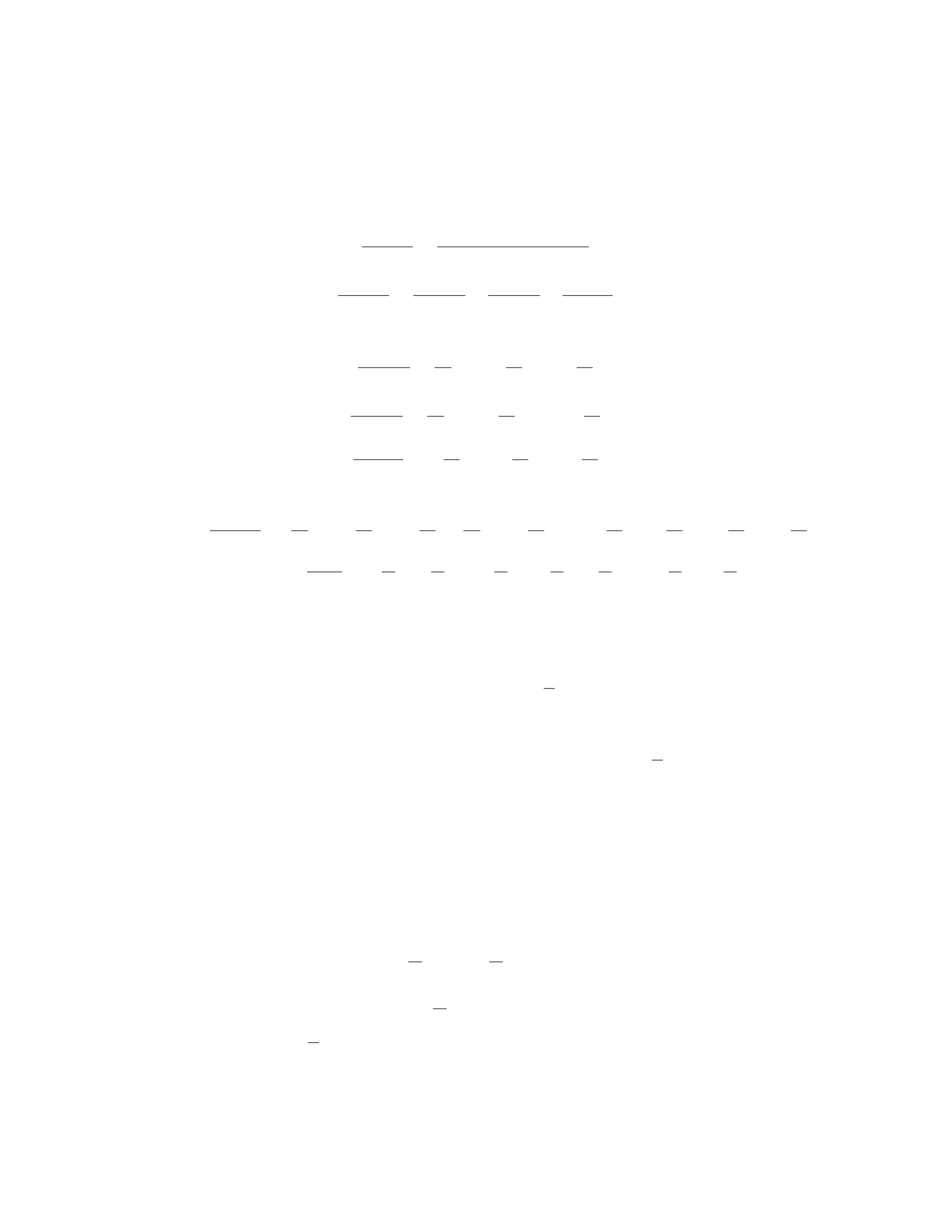
Step 2: Differentiate both sides with respect to t.
d(u·v)
dt =d(xy2z−xyz2+y2z2)
dt
d(u·v)
dt =d(xy2z)
dt −d(xyz2)
dt +d(y2z2)
dt
Step 3: Compute the derivatives.
d(xy2z)
dt =dx
dt y2z+xdy
dt z+xy2dz
dt
d(xyz2)
dt =dx
dt yz2+xdy
dt z2+xyz2dz
dt
d(y2z2)
dt = 2ydy
dt z2+y2dz
dt z+y2zdz
dt
Step 4: Substitute the derivatives back into the expression.
d(u·v)
dt = (dx
dt y2z+xdy
dt z+xy2dz
dt )−(dx
dt yz2+xdy
dt z2+xyz2dz
dt )+(2ydy
dt z2+y2dz
dt z+y2zdz
dt )
Therefore, d(u·v)
dt =y2dx
dt z+xdy
dt z−yz2dx
dt −xz2dy
dt +2ydy
dt z2+y2zdz
dt +y2zdz
dt .
Question 12
Question
Let u= 3i−2j+ 5kand v= 2i+ 4j−3k. Find d
dt (u·v).
Solution
Let u= 3i−2j+ 5kand v= 2i+ 4j−3k. We are asked to find d
dt (u·v).
Step 1: We first find the dot product of uand v:
u·v= (3i−2j+ 5k)·(2i+ 4j−3k)
u·v= 3 ·2+(−2) ·4+5·(−3)
u·v= 6 −8−15
u·v=−17
Step 2: Now, we differentiate u·vwith respect to t:
d
dt (u·v) = d
dt (−17)
d
dt (u·v) = 0
Therefore, d
dt (u·v) = 0.
9

Question 13
Question
Let aand bbe two vectors such that a= 2i+ 3jand b= 4i−j. Find the
derivative of the vector c=a·bwith respect to t, where aand bare functions
of t.
Solution
Step 1: Write the expressions for aand bas functions of t:
a(t)=2i+ 3j,
b(t)=4i−j.
Step 2: Compute the dot product c(t) = a(t)·b(t):
c(t) = (2i+ 3j)·(4i−j)
= 2 ∗4+3∗(−1)
= 8 −3
= 5.
Step 3: Find the derivative of cwith respect to tusing the product rule for
differentiation: dc
dt =d(a·b)
dt =da
dt ·b+a·db
dt .
Step 4: Compute the derivatives of a(t) and b(t):
da
dt =d
dt (2i+ 3j)=0i+ 0j=0,
db
dt =d
dt (4i−j)=0i−0j=0.
Step 5: Substitute the values into the product rule formula:
dc
dt =0·b+a·0=0+0=0.
Therefore, the derivative of the vector cwith respect to tis 0.
Question 14
Question
Let v=3x2y
x3+ 2y3. Find dv
dx .
10

Solution
Step 1: Write the components of vexplicitly and differentiate each component
with respect to x.
v=3x2y
x3+ 2y3
dv
dx =d
dx (3x2y)
d
dx (x3+ 2y3)
Step 2: Differentiate each component with respect to x.
d
dx (3x2y) = 3(2x)y+ 3x2dy
dx = 6xy + 3x2dy
dx
d
dx (x3+ 2y3)=3x2+ 0 = 3x2
Therefore, dv
dx =6xy + 3x2dy
dx
3x2.
Question 15
Question
Let v= 2ti−4t2j+ 3t3k. Find
dt.
Solution
Step 1: To differentiate each component separately, we can use the basic rules
of differentiation. We know that d
dt tn=ntn−1for any constant n. So, given
v= 2ti−4t2j+ 3t3k, we can differentiate each component as follows:
Step 2: Differentiate the x-component:
d
dt (2t)=2
So, dx
dt = 2. Step 3: Differentiate the y-component:
d
dt (−4t2) = −8t
So, dy
dt =−8t. Step 4: Differentiate the z-component:
d
dt (3t3)=9t2
So, dz
dt = 9t2. Step 5: Combine the results to find
dt:
dt = dxdti+dy
dt j+dz
dt k=2i−8tj+9t2kTherefore,
dt = 2 i- 8t j+ 9t2k.
11

Question 16
Question
Let u=
x2
ex
sin(2x)
and v=
ln(x)
cos(x)
ex
. Find d(u·v)
dx .
Solution
Step 1: Calculate the dot product u·v.
u·v=x2ln(x) + excos(x) + sin(2x)ex
Step 2: Differentiate the dot product with respect to x.
d(u·v)
dx =d
dx (x2ln(x)) + d
dx (excos(x)) + d
dx (sin(2x)ex)
Step 3: Apply the product rule and chain rule as needed.
d(u·v)
dx = 2xln(x) + x+d
dx (ex) cos(x)−exsin(x) + cos(2x)ex+ 2exsin(2x)
Step 4: Simplify the expression.
d(u·v)
dx = 2xln(x) + x+excos(x)−exsin(x) + excos(2x)+2exsin(2x)
Therefore, d(u·v)
dx = 2xln(x)+x+excos(x)−exsin(x)+excos(2x)+2exsin(2x).
Question 17
Question
Let v=
2x3
x4
ex2
. Find dv
dx , the derivative of vwith respect to x.
Solution
To find the derivative of vwith respect to x, we will differentiate each component
of vseparately.
dv
dx =
d
dx (2x3)
d
dx (x4)
d
dx (ex2)
=
6x2
4x3
2xex2
12

Therefore, the derivative of vwith respect to xis v′=
6x2
4x3
2xex2
.
Question 18
Question
Let u= 3i−j+ 2kand v=i+ 2j−4k. Find d(u
·v)dt, where tis a scalar.
Solution
Step 1: Calculate the dot product of uand v.
u·v= (3)(1) + (−1)(2) + (2)(−4) = 3 −2−8 = −7
Step 2: Differentiate the dot product with respect to tusing the product
rule. d
dt (u·v) = d
dt (−7) = 0
Therefore, d(u
·v)dt = 0.
Question 19
Question
Let u= 2xi+ 3yj−4zkand v=x2i−2yj+zk. Determine d(u·v)
dr, where
r= (x, y, z).
Solution
To find d(u·v)
dr, we first need to express u·vin terms of x,y, and z.
Step 1: Calculate u·v.
u·v= (2x)(x2) + (3y)(−2y)+(−4z)(z)=2x3−6y2−4z2
So, u·v= 2x3−6y2−4z2.
Step 2: Express d(u·v)
drin terms of x,y, and z.
d(u·v)
dr=∂
∂x (2x3−6y2−4z2)i+∂
∂y (2x3−6y2−4z2)j+∂
∂z (2x3−6y2−4z2)k
Step 3: Calculate the partial derivatives.
∂
∂x (2x3−6y2−4z2)=6x2
13

∂
∂y (2x3−6y2−4z2) = −12y
∂
∂z (2x3−6y2−4z2) = −8z
Step 4: Substitute the partial derivatives back.
d(u·v)
dr= 6x2i−12yj−8zk
Therefore, d(u·v)
dr= 6x2i−12yj−8zk.
Question 20
Question
Let a= 3i−2j+ 4kand b= 2i+ 5j−3k. Find the gradient of the scalar
function f(r) = a·r×b, where r=xi+yj+zk.
Solution
To find the gradient of a scalar function, we need to find the partial derivatives
with respect to x,y, and z.
Step 1: Find ∂f
∂x
r×b=
i j k
x y z
2 5 −3
= (5z+ 3y)i−(2z+x)j+ (5x−2y)k
a·(r×b) = 3(5z+ 3y)−2(2z+x) + 4(5x−2y) = 15z+ 9y−4z−2x+ 20x−8y
= 11x+y+ 11z
Therefore, ∂f
∂x = 11i+j+ 11k.
Step 2: Find ∂f
∂y
r×b= (5z+ 3y)i−(2z+x)j+ (5x−2y)k
a·(r×b) = 3(5z+ 3y)−2(2z+x) + 4(5x−2y) = 15z+ 9y−4z−2x+ 20x−8y
= 20x+y+ 11z
Therefore, ∂f
∂y = 20i+j+ 11k.
Step 3: Find ∂f
∂z
r×b= (5z+ 3y)i−(2z+x)j+ (5x−2y)k
14

a·(r×b) = 3(5z+ 3y)−2(2z+x) + 4(5x−2y) = 15z+ 9y−4z−2x+ 20x−8y
=−2x+ 9y+ 11z
Therefore, ∂f
∂z =−2i+ 9j+ 11k.
Hence, the gradient of the scalar function f(r) is ∇f= 11i+j+ 11kfor ∂f
∂x ,
20i+j+ 11kfor ∂f
∂y , and −2i+ 9j+ 11kfor ∂f
∂z .
Question 21
Question
Let v=x2
sin(x). Find dv
dx .
Solution
To find dv
dx , we will differentiate each component of vwith respect to x.
Step 1: Differentiate the first component of v:
d
dx (x2)=2x
Step 2: Differentiate the second component of v:
d
dx (sin(x)) = cos(x)
Step 3: Combine the derivatives of the components to find dv
dx :
dv
dx =2x
cos(x)
Therefore, dv
dx =2x
cos(x).
Question 22
Question
Let v=3x2+ 2y
4xy −5be a vector function. Compute the gradient of v.
15

Solution
To find the gradient of v, we need to find the partial derivatives of each com-
ponent function.
Step 1: Find ∂
∂x of the first component function:
∂
∂x (3x2+ 2y) = 6x
Step 2: Find ∂
∂y of the first component function:
∂
∂y (3x2+ 2y) = 2
Step 3: Find ∂
∂x of the second component function:
∂
∂x (4xy −5) = 4y
Step 4: Find ∂
∂y of the second component function:
∂
∂y (4xy −5) = 4x
Step 5: Assemble the gradient of v:
∇v=6x
2+4y
4x=6x+ 4y
2+4x
Question 23
Question
Let v=
x2
ex
sin(x)
. Find dv
dx .
Solution
Step 1: Compute the derivative of each component of vwith respect to x.
d
dx x2= 2x
d
dx (ex) = ex
d
dx (sin(x)) = cos(x)
16

Step 2: Assemble the derivatives of the components into the derivative of
the vector v.
dv
dx =
d
dx (x2)
d
dx (ex)
d
dx (sin(x))
=
2x
ex
cos(x)
Therefore, dv
dx =
2x
ex
cos(x)
.
Question 24
Question
Let v=x2
yex. Find dv
dx .
Solution
To find dv
dx , we differentiate each component of vwith respect to xseparately.
Step 1: Differentiate the first component of v
d
dx (x2)=2x
Step 2: Differentiate the second component of v
d
dx (yex) = yex+yd
dx (ex) = yex+yex= 2yex
Step 3: Combine the derivatives to find dvdx
dv
dx =2x
2yex
Question 25
Question
Let v= 3i−2j+ 4kand w= 2i+ 5j−k. Determine d
dt (v·w).
Solution
Step 1: Recall that the dot product of two vectors a=a1i+a2j+a3kand
b=b1i+b2j+b3kis given by a·b=a1b1+a2b2+a3b3.
Step 2: Find the dot product of vand w:v·w= (3)(2)+(−2)(5)+(4)(−1) =
6−10 −4 = −8.
Step 3: Differentiate the dot product with respect to t:d
dt (v·w) = d
dt (−8).
Step 4: The derivative of a constant is zero, so: d
dt (v·w) = 0 .
17

Question 26
Question
Let v=
x2
3x
2
be a vector function in R3. Find the derivative of vwith respect
to x.
Solution
Step 1: The derivative of a vector function is found by taking the derivative of
each component individually. Therefore, we need to find the derivative of each
component of vwith respect to x.
Step 2: Let’s find the derivative of the first component of vwith respect to
x:d
dx (x2)=2x
Step 3: Next, let’s find the derivative of the second component of vwith
respect to x:
d
dx (3x)=3
Step 4: Lastly, let’s find the derivative of the third component of vwith
respect to x:
d
dx (2) = 0
Step 5: Putting it all together, the derivative of vwith respect to xis:
v′=
2x
3
0
Question 27
Question
Let u=
x2
ex
sin x
and v=
ln x
cos x
x3
. Compute the derivative of u·vwith respect
to x.
Solution
Step 1: Recall the formula for the derivative of the dot product of two vectors:
(u·v)′=u′·v+u·v′.
18

Step 2: Compute the derivatives of uand v:
u′=
2x
ex
cos x
,v′=
1
x
−sin x
3x2
Step 3: Compute u·v:
u·v=x2ln x+excos x+ sin xx3
Step 4: Apply the formula for the derivative of the dot product:
(u·v)′=u′·v+u·v′
=
2x
ex
cos x
·
ln x
cos x
x3
+
x2
ex
sin x
·
1
x
−sin x
3x2
Step 5: Simplify the expression using the dot product:
(2xln x+excos x+ cos xx3)+(x2·1
x+ex·(−sin x) + sin x·3x2)
= 2xln x+excos x+ cos xx3+x+exsin x+ 3x3sin x
Therefore, the derivative of u·vwith respect to xis 2xln x+excos x+
cos xx3+x+exsin x+ 3x3sin x.
Question 28
Question
Let f(x, y, z)=(x2y, 3yz, z2). Find ∂f
∂v, where v= (2,−1,4).
19

Solution
Step 1: Compute the partial derivatives of each component of fwith respect to
x, y, z.
∂
∂x (x2y)=2xy,
∂
∂x (3yz)=0,
∂
∂x (z2)=0,
∂
∂y (x2y) = x2,
∂
∂y (3yz)=3z,
∂
∂y (z2)=0,
∂
∂z (x2y)=0,
∂
∂z (3yz)=3y,
∂
∂z (z2)=2z.
Step 2: Evaluate the partial derivatives at v= (2,−1,4).
∂f
∂x
v
= (2(2)(−1),0,0) = (−4,0,0),
∂f
∂y
v
= (22,3(4),0) = (4,12,0),
∂f
∂z
v
= (0,3(−1),2(4)) = (0,−3,8).
Step 3: Combine the partial derivatives to find ∂f
∂v.
∂f
∂v=
−4 4 0
0 12 −3
008
Question 29
Question
Let v= (x2+ 2xy)i+ (2yx −y2)jbe a vector in R2. Calculate dv
dx .
20
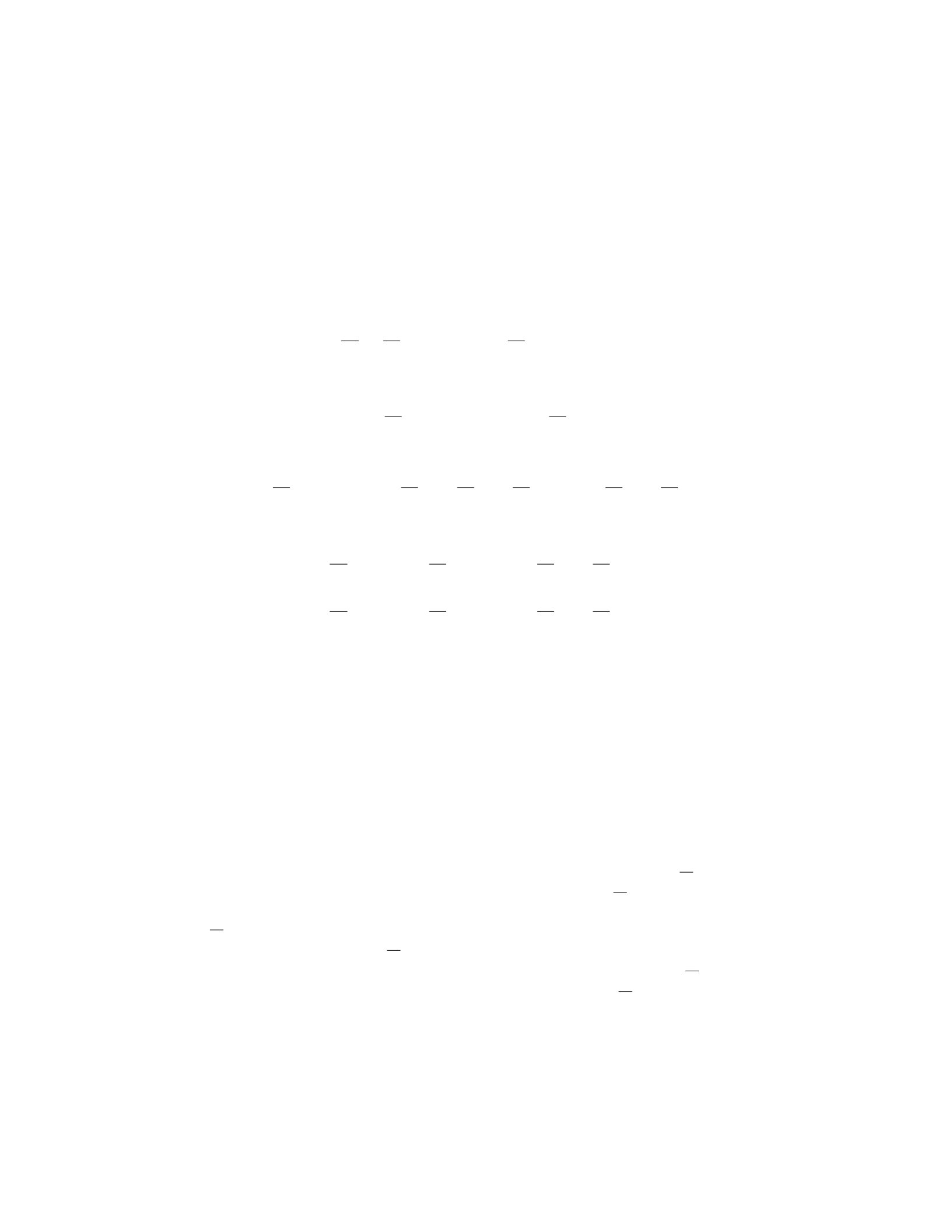
Solution
Step 1: Write the vector vin component form:
v= (x2+ 2xy)i+ (2yx −y2)j
Step 2: Differentiate each component of vwith respect to x, treating yas a
constant: dv
dx =d
dx [(x2+ 2xy)i] + d
dx [(2yx −y2)j]
Step 3: Use the rules for differentiating each component. For the first com-
ponent:
d
dx (x2+ 2xy)=2x+ 2ydy
dx
For the second component:
d
dx (2yx −y2)=2ydx
dx + 2xdy
dx −2ydy
dx = 2y+ 2xdy
dx −2ydy
dx
Step 4: Write the differentiated vector as:
dv
dx = (2x+ 2ydy
dx )i+ (2y+ 2xdy
dx −2ydy
dx )j
dv
dx = (2x+ 2ydy
dx )i+ (2y+ 2xdy
dx −2ydy
dx )j
Question 30
Question
Let v=
x2
sin(2x)
ex
. Find the derivative of vwith respect to x.
Solution
To find the derivative of vwith respect to x, we will differentiate each component
of vindividually.
Step 1: Differentiating the first component: Let f(x) = x2. Then, d
dx (f(x)) =
2x. Therefore, the derivative of the first component of vis d
dx (x2)=2x.
Step 2: Differentiating the second component: Let g(x) = sin(2x). Then,
d
dx (g(x)) = 2 cos(2x) (using the chain rule). Therefore, the derivative of the
second component of vis d
dx (sin(2x)) = 2 cos(2x).
Step 3: Differentiating the third component: Let h(x) = ex. Then, d
dx (h(x)) =
ex. Therefore, the derivative of the third component of vis d
dx (ex) = ex.
Step 4: Combining the derivatives: The derivative of vwith respect to xis
21

dx =
2x
2 cos(2x)
ex
Question 31
Question
Let u=x2
sin(y)and v=cos(z)
ex. Find the derivative of w=u·vwith
respect to x.
Solution
Step 1: Compute the dot product u·v:
u·v=x2cos(z) + sin(y)ex
Step 2: Differentiate with respect to xusing the product rule:
d
dx (u·v) = d
dx (x2cos(z)) + d
dx (sin(y)ex)
Step 3: Differentiate each term separately:
d
dx (x2cos(z)) = 2xcos(z)
d
dx (sin(y)ex) = exsin(y)
Step 4: Combine the derivatives to find the final result:
d
dx (u·v)=2xcos(z) + exsin(y)
Therefore, the derivative of w=u·vwith respect to xis 2xcos(z)+exsin(y).
Question 32
Question
Let v=
x2
ex
cos(x)
be a vector-valued function. Find the derivative dv
dx .
22

Solution
Step 1: To find the derivative of vwith respect to x, we differentiate each
component of vwith respect to xseparately. Let v=
x2
ex
cos(x)
.
Step 2: Differentiating the first component x2with respect to xgives d
dx (x2) =
2x.
Step 3: Differentiating the second component exwith respect to xgives
d
dx (ex) = ex.
Step 4: Differentiating the third component cos(x) with respect to xgives
d
dx (cos(x)) = −sin(x).
Step 5: Therefore, the derivative dv
dx is:
dv
dx =
2x
ex
−sin(x)
Question 33
Question
Let vand wbe two vectors in R3defined by v=⟨x2, y3, z4⟩and w=⟨x, y, z⟩.
Calculate the derivative of v·wwith respect to y.
Solution
Step 1: Find the dot product of vand w:
v·w= (x2)(x)+(y3)(y)+(z4)(z)
=x3+y4+z5
Step 2: Differentiate the dot product with respect to y:
d
dy (v·w) = d
dy (x3+y4+z5)
= 4y3
Therefore, the derivative of v·wwith respect to yis 4y3.
Question 34
Question
Let u=
x2y
cos(y)
exy
and v=
sin(y)
x2
ln(x)
. Find d(u·v)
d(x).
23

Solution
Step 1: Calculate the dot product u·v:
u·v=x2ysin(y) + cos(y)x2+exy ln(x)
Step 2: Differentiate u·vwith respect to x:
d(u·v)
d(x)=d
dx (x2ysin(y) + cos(y)x2+exy ln(x))
Step 3: Apply the product rule and chain rule to differentiate each term:
d(u·v)
d(x)=d
dx (x2ysin(y)) + d
dx (cos(y)x2) + d
dx (exy ln(x))
Step 4: Compute the derivatives of each term:
For x2ysin(y):
d
dx (x2ysin(y)) = (2xy +x2dy
dx ) sin(y)
For cos(y)x2:
d
dx (cos(y)x2) = −sin(y)x2+ 2xcos(y)
For exy ln(x):
d
dx (exy ln(x)) = yexy ln(x) + exy
x
Step 5: Combine the results to get the final derivative:
d(u·v)
d(x)= (2xy +x2dy
dx ) sin(y)−sin(y)x2+ 2xcos(y) + yexy ln(x) + exy
x
Question 35
Question
Let u= 3i−2j+kand v= 2i+ 4j−6k. Find d
dt (u·v).
Solution
Step 1: Calculate u·v.
u·v= (3i−2j+k)·(2i+ 4j−6k)
u·v= 3 ×2+(−2) ×4+1×(−6)
24

u·v= 6 −8−6 = −8
Step 2: Differentiate u·vwith respect to t.
d
dt (u·v) = d
dt (−8)
d
dt (u·v)=0
Therefore, d
dt (u·v) = 0 .
25

