


1
Hybrid Model
Student’s Name
Institution
Course
Tutor
Date

2
Hybrid Model
Part 1
Complex project landscape do not have clear objectives or have objectives that are
partially known. It is difficult to successfully accomplish complex projects using traditional or
waterfall approaches. To successfully complete complex projects, it is important to utilize agile
or hybrid approaches. The hybrid approach is the most suitable for projects with unclear
deliverable. The hybrid approach gives flexibility to utilize both traditional and agile approaches
in different phases of the projects. An example of a complex project that can be completed using
the hybrid approach is the mega project (Flyvbjerg, 2021). Such a mega project can be a nuclear
power plant that has to analyze structures, systems and components and give a risk assessment.
Since such a project involves physical changes and software development to ensure that the
calculations are automated, a hybrid approach becomes the most suitable approach. Through the
utilization of the approach, all the physical changes in the plant will be appropriately planned
before the work already starts. The calculation software can utilize the agile approach where
there will be several iterations being performed to include the feedback from the client, peer-
reviewers as well as the regulatory authorities. Any increment that will be implemented in the
project will allow improvements in the software package which will also allow the engineers to
make it more universal such that it can be used in other projects. Projects that last for long
periods make it difficult to have accurate plans at the start. This limits the utilization of
traditional approach to ensure the completion of the project is successful.
Part 2
What should Ferreira do next to accelerate Flow Adoption?

3
Ferreira should seek to have additional resources or personnel to train the software
developers. Additionally, he should request Dell for additional software developers since all the
current employees are busy. He should also establish a lucid plan of his ideas and methods to
implement the flow to ensure that it is easy for the executive team to comprehend the outcomes
and planned deliverables. Additionally, he should seek to have a dedicated team that can work on
the flow and test the methodology for software development.
What three points should Ferreira make at the 7 Feb 2017 SPI Board Review?
Ferreira should start by explaining in a clear and concise manner why the flow adoption
is important for the success of the rapidly developed high quality software that is reliable to offer
competition in the computing industry. Secondly, Ferreira should display the outcomes of the
pilot test for the board to see the progress and let them understand that the competition
implementation may take some time. Finally, Ferreira should note his plan to increase the pilot
tests to cover all software development programs and explain the need to include all team
members in the innovative methodology.
Review the seven lean manufacturing principles and demonstrate how Ferreira used them
when implementing Flow.
It is imperative for Ferreira to incorporate all the seven lean manufacturing principles in
software development. Ferreira made a decision to remove all aspects that were not adding value
to product development and implement those that were immediately required to achieve
customer satisfaction. He considered late making of decisions to be effective since he was in an
uncertain position and it gave him the opportunity to build capacity for potential changes. He
emphasized on speedy delivery since when a product is delivered fast, it gets used and reviewed
fast thus allowing him to receive feedback fast and implement changes in the next software
4
version. He empowered his teams to ensure that they were always motivated to allow them
incorporate the last minute decisions that he made. He always believed in delivering quality
products that had the integrity to meet the requirements of the customer. He emphasized on the
overall system development rather than maximizing only on performance on particular parts of
the product.
Part 3
One vital aspect of complex project is that there is scanty information about their
objectives and requirements. The solutions are generated through an iteration process of handling
several sprints and applying the learning of each sprint to the next one. Since mega projects
involve huge capital input, manpower and time, the projects are uncertain and highly risky
(Flyvbjerg, 2021). Mega projects also involve private stakeholders which may complicate the
decision-making process. Therefore, it is imperative that an appropriate project management
approach is selected to ensure the success of the project. Large projects need to be subdivided
into smaller aspects since many project management processes are simplified. The process is
essentially the modularization of the mega project where replicable modularity and speed of the
iterations need to be introduced to ensure success of the project. Modularity allows the project
team to conduct iterations faster and learn from them and have a less complicated rework
whenever changes are required. The quality management is left with little room for over
budgeting. Despite not having all processes being replicable, there should be emphasis to ensure
process automation.
5
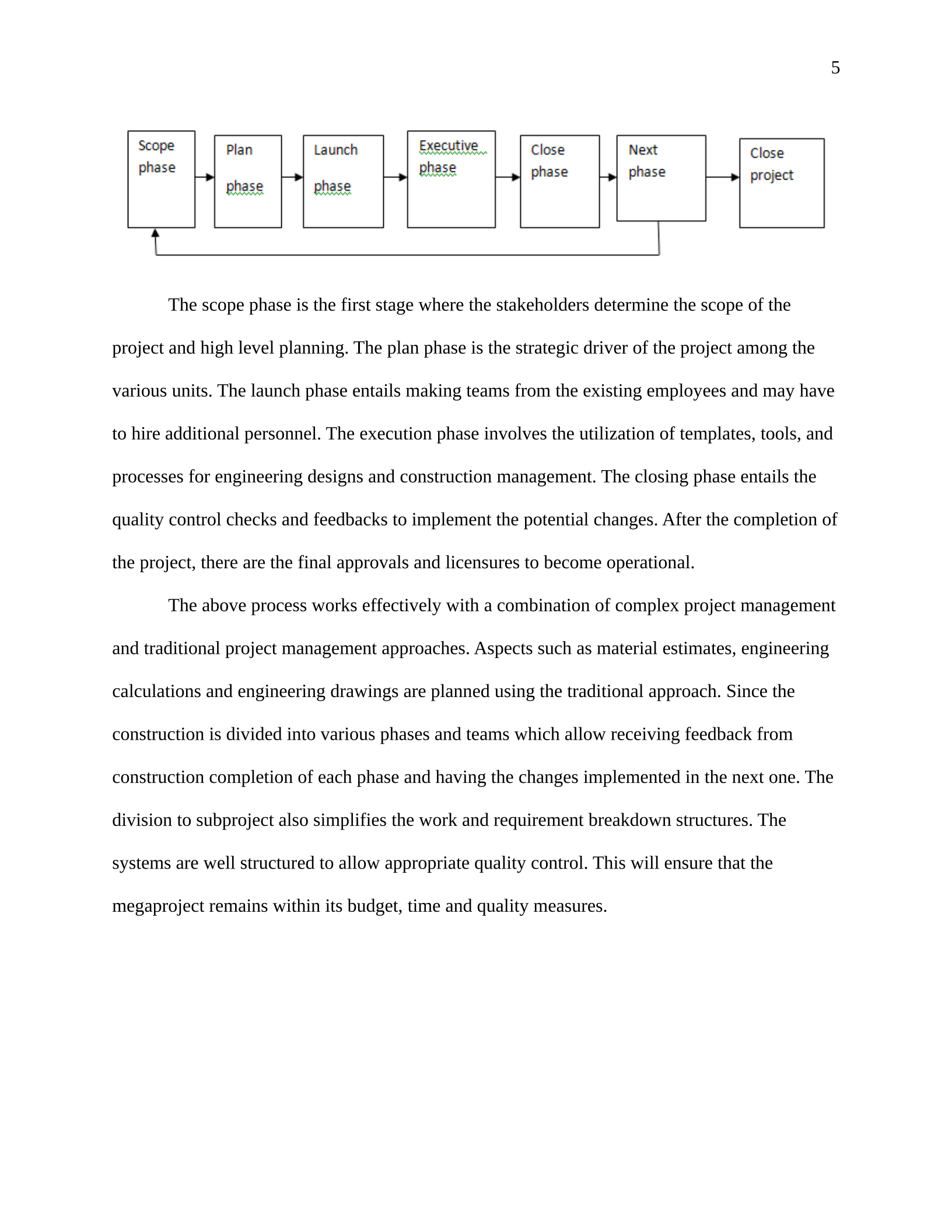
The scope phase is the first stage where the stakeholders determine the scope of the
project and high level planning. The plan phase is the strategic driver of the project among the
various units. The launch phase entails making teams from the existing employees and may have
to hire additional personnel. The execution phase involves the utilization of templates, tools, and
processes for engineering designs and construction management. The closing phase entails the
quality control checks and feedbacks to implement the potential changes. After the completion of
the project, there are the final approvals and licensures to become operational.
The above process works effectively with a combination of complex project management
and traditional project management approaches. Aspects such as material estimates, engineering
calculations and engineering drawings are planned using the traditional approach. Since the
construction is divided into various phases and teams which allow receiving feedback from
construction completion of each phase and having the changes implemented in the next one. The
division to subproject also simplifies the work and requirement breakdown structures. The
systems are well structured to allow appropriate quality control. This will ensure that the
megaproject remains within its budget, time and quality measures.


