



lOMoARcPSD|261202 28
THE POLITICS-ADMINISTRATION DICHOTOMY NEGATED AGAIN
Savannah Nalls
GOVT 475
2-11-18

lOMoARcPSD|261202 28
FACTS
Historically, the public-administration dichotomy grew out of the progressive and civil
reform movements and asserted that the spoils system and political interference in administration
eroded the opportunities for administrative efficiency (Shafritz et al., 2011).Although these
principles of neutrality and the maintenance of a divide between those who make the laws and
those who implement the laws remain today, the reality is that all administrations at all levels of
government implement their programs with political considerations in mind (Shafritz et al.,
2011).
While early influencers of this theory such as Woodrow Wilson and Frank Goodnow
advocated that this separation between public policy and administration was completely possible,
Paul Appleby in his novel, Big Democracy advocated that it was a myth that administration and
politics could be separated. In his opinion, political involvement is beneficial for society rather
than a burden. Today, most functions of public administration are inherently intertwined with
politics and policy. Because public administrators maintain a great deal of discretion in carrying
out public polices and implementing the public interests, their decisions can directly affect the
standing of elected officials with various interests and the public at large.
Since the beginning of the new century, no individual had a greater impact on the way
U.S politics is practiced better than Karl Rove. He shaped the strategies that helped Republicans
gain control of both the white house and congress between 2000 and 2006. Rove established a
doctrine that intertwined politics and policy in a manner that directly affected the way public
policies are conducted in the United States. Under Rove the Bush administration introduced the
electoral well-being of the republican party into policy decisions which were identified by the

lOMoARcPSD|261202 28
Rove Doctrine. Under Rove’s doctrine every localized policy decisions were evaluated in terms
of their impact on maintaining republican control of the federal government.
While Rove was ultimately unsuccessful in creating a long lasting republican coalition
like he had hoped as the political advisor of George W. Bush, he was able to accurately portray
the notion that politics and administration were not meant to be separated like Woodrow Wilson
had suggested and that it seemed the best place for the two systems were working together after
all.
Ultimately, Rove aspired to create a governing coalition which would outlast George
Bush’s presidency. As the person with the long-term vision in the Bush administration, Rove had
thought long and hard about achieving this goal before ever arriving in the White House and he
pursued it more aggressively than anyone else. Rove made an everlasting legacy when he
revolutionized political policy through creating a political lens under which all public policy was
examined (Shafrtiz et al., 2011). Additionally, his cunning methodology of creating George W.
Bush into a legitimate and presidential candidate where he encourages candidates to promote the
needs of one’s base rather than appealing to the masses to win an election, has continued to be a
staple of American campaigns from President Obama to Donald Trump.
Ultimately, the facts of this case will display how the Rove Doctrine’s success was
largely due to the current polarization among the populous and it also gives some insight into the
surprising election of President Trump.
DECISION
Karl Rove’s advice to George Bush during his time as his political advisor which
illustrated the concept that republican candidates ought to focus on appealing to their base rather

lOMoARcPSD|261202 28
than focusing on swing voters, is one which displays ultimately just how polarized the voters in
America have become. Whereas, while the past provides examples of successful elections due to
bipartisanship, the modern political polarization among both the citizens and the political elites is
evidence which supports Rove’s doctrine of refraining from appealing towards the masses.
Ultimately, regarding the republican party, it seems that the existence of Karl Rove’s principle
indicates that the party will be undergoing massive changes in a few decades in order to gain a
reliable base which will directly negate the left’s pursuit of social and civil reform through
utilizing the conservative vote.
Additionally, it would seem that the principles learned during the Bush Administration
campaign should have been able to predict the surprising election of Donald J. Trump in the most
recent 2016 presidential election between him and Hillary Clinton. Finally, the success Karl
Rove experienced during his time as a policy advisor for the Bush Administration is evidence of
how politics and administration can work together in a way that is well-organized and ultimately
displays an example of how strict dichotomy among the two is not necessary for efficiency.
SOLUTION
The narrow Bush victory in the 2000 election was plagued with democratic rage at the
new “illegitimate” president (Novak, 2007). In reaction to this narrow win, Karl Rove went to
work to build a stronger Republican base which took advantage of the modern political climate
which catered an insignificant amount of swing voters (PBS, 2016).
Rove’s Doctrine advocates that building a strong coalition of reliable party voters meant
appealing to the religious right and utilizing the “Evangelical voters as foot soldiers.” (PBS,
2016). Additionally, Rove created the revolutionary GOP “72 hour task force” which main goal
lOMoARcPSD|261202 28
was utilizing commercial marketing tools in order to identify the political parties among voters
(PBS, 2016).
I. ROVE’S DOCTORINE SUCCESS IS DUE TO INCREASED POLITICAL
POLARIZATION
The victories of the Bush administration in both elections had much to do with the
cunningness of Karl Rove, but it also was a byproduct of the increasing divisive political climate
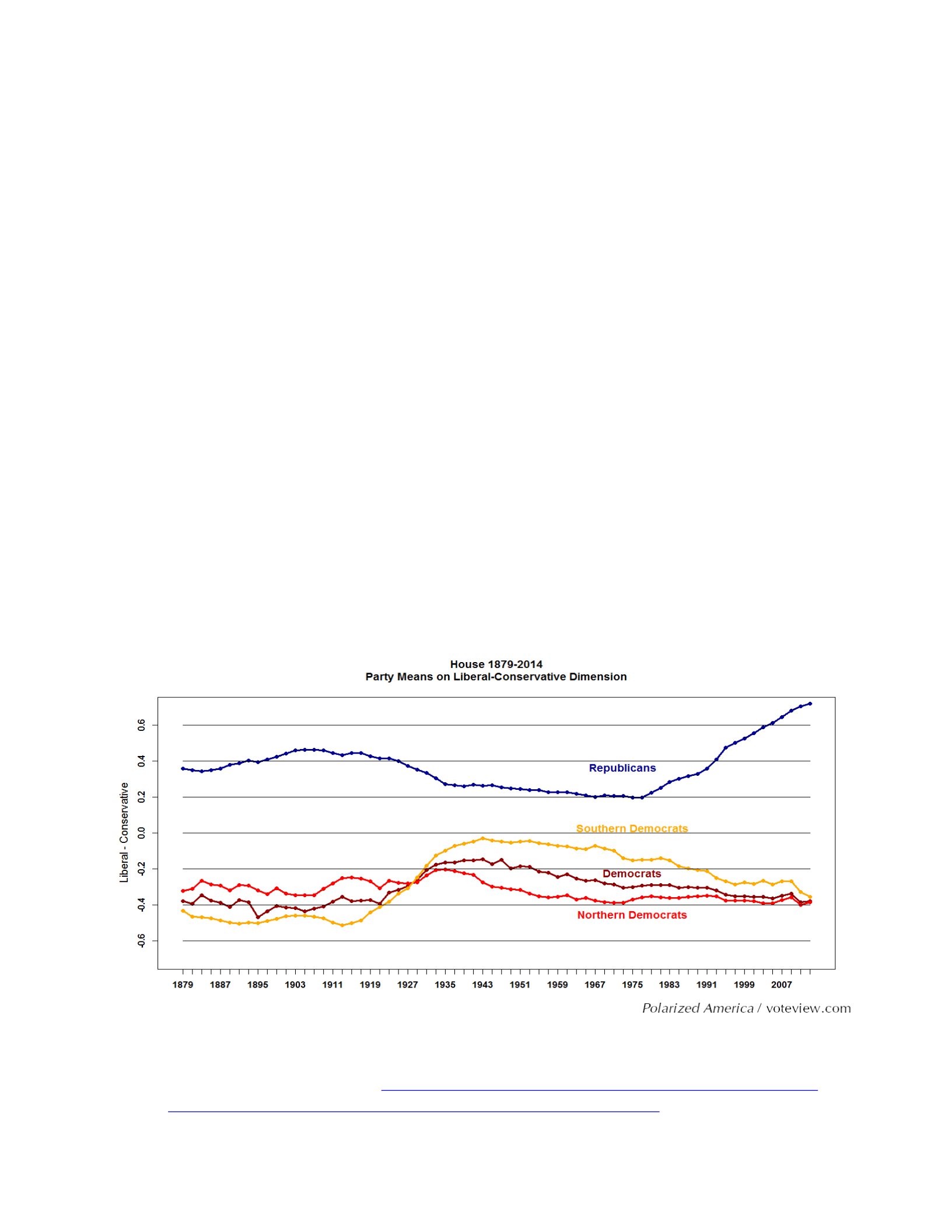
that was separating the right from the left. In fact, after the passage of the Voting Rights Act of
1965, the increasing education among the American populous, and the increasing homogeneity
of political party alliances due to geographic location, the political climate in America
continually polarized itself where those on the right became significantly more conservative and
those on the left became significantly more liberal. This ultimately resulted in a small minority of
participating voters in the middle (Novak, 2007).
Fallows, J. (2013) Why This is Not Just “Washington Dysfunction” in One More Graph.
The Atlantic. Retrieved at < https://www.theatlantic.com/politics/archive/2013/10/why-
this-is-not-just-washington-dysfunction-in-1-more-graph/280161/>.

lOMoARcPSD|261202 28
As a result of this political division, George Bush was able to win both elections in 2000
and 2006 through only appealing to his religiously affiliated and right winged parties and could
afford to ignore the moderates who were significantly decreasing in numbers.
This immense division of civilian voting was first predicted from historian, Richard
Hofstadter. Hofstadter advocated that the spans of time which illustrated political division among
the political parties, especially the conservative party, would eventually lead to a decreasing need
of party leaders to collaborate with moderates and other political parties to pass legislation and to
mobilize voting for an electorate win. In his opinion, the American political landscape can be
explained as “paranoid politics” where there are short periods in history where citizens are
overheated, over suspicious, overaggressive, and apocalyptic in expression which one feels to
see the hostile and conspirational world seeks to undermine his or her nation, culture, and a way
of life of millions of others (Hofstadter, 1964, p. 4). He explains the modern right-wing feels
dispossessed that America has been largely been taken away from them and their kind. The old
American virtues have been eaten away by the cosmopolitans and intellectuals, the old
competitive capitalism has been undermined by socialist and communist schemers, and the old
national security and independence have been destroyed by treasonous plots of foreigners and
major statesmen seated at the Centers of American Power (Hofstadter, 1964, p. 24).
Richard Hofstadter recognized that evangelical leaders were playing a significant role in
right-wing movements decades ago within the 1950s and 1960s, but he noticed that a
fundamentalist style of mind was not confined to the matters of religious doctrine. It affected
opinions about secular affairs, especially political battles. He noticed that right-wing spokesmen
applied the methods and messages of evangelical revivalists to U.S. politics. Agitated partisans
on the right talked about epic clashes between good and evil, and they recommended

lOMoARcPSD|261202 28
extraordinary measures to resist liberalism. The American way of life was at stake, they argued.
Compromise was unsatisfactory; the situation required militancy. Nothing but complete victory
would do (Hofstadter, 1964).
This ideological divide, he argued, would fester and cause a large polarization between
the republican and democratic party. Additionally, this division has only increased since the
restructuring of the southern republican party after the passage of the Voting Rights Act of 1965
which changed public policy forever with the integration of granting minorities more
opportunities to vote. Ultimately, the attitudes first exemplified by Hofstadter and the modern
polarization of republican candidates created a perfect scenario where Rove’s doctrine of
angering the religious right through hot button issues would provide for party discipline and
encouragement to continue to vote in each election.
II. THE PARANOID STYLE OF POLITICS AND THE ELECTION OF DONALD
TRUMP
Since Hofstadter advocated his theories of the paranoid style of American politics, it has
been frequently revisited by political commentators and historians to compare and contrast
contemporary and historical movements that are prone to this paranoid style. His theories seem
especially pertinent in the modern day, after the election of Donald Trump, a president whose
campaign was founded on revolting against modern politicians, the “disillusionment” of the left,
and the conspiracies of “fake news” media. Furthermore, the paranoia of American politics of
the modern day(which Hofstadter explains to be only short period of minority assumptions
among the populous) includes thoughts such as Obama being a Kenyan Muslim who
sympathizes with radical Islamists, global warming being seen as a myth propagated by the
Chinese, entertaining the idea that the late Justice Scalia was murdered, declaring inaccurately

lOMoARcPSD|261202 28
that thousands of Muslim Americans were cheering in New Jersey on 9-11, and asserting that the
Mexican government deliberately sends the “bad ones” to America (Golfarb, 2015). Of course, it
would not be accurate to assume that the election of Donald Trump was completely the result of
paranoid politics and republican polarization, as there were some serious factors which would
have predicted a republican majority within both the white house and congress including the
recession under democrat control, failing immigration policies, and weak foreign affair policies
during a period of immense domestic terrorism. However, it would also not be accurate to
assume that the minority coalitions of heightened paranoia defined by Hofstadter was not a factor
within the previous election cycle, especially considering the large conspiracy theories
surrounding former president Obama and immigrants.
III. HOW TO DECREASE ANIMOSITY AMONG POLITICAL PARTIES
What is interesting regarding Karl Rove is the fact that he recognizes that while polarization
was beneficial towards his success in the Bush campaign as he and Bush focused primarily on
religious desires of the republican party, he argues that the polarization caused by negative
nationalism exposed by Donald Trump is bad for the republican coalition (Schultze, 2015). This
is because while religious affiliations among republicans tend to promote republicans around a
righteous cause, fear mongering nationalism, while beneficial for the win over Hillary, will result
in more conservatives leaving the republican party as a whole. In fact, Rove advocates that
President Trump can learn a lot from the 25th president of the United States, William McKinley.
According to Rove, “McKinley understood the changing demographic of the country which
included a lot of people who were Catholic urban industrial workers. Many from parts of the
world that had been sources of big migration before like Central and Southern and Eastern
Europe” (Rove, 2016). Rove goes on to explain that in order to grow [the republican] party

lOMoARcPSD|261202 28
[republicans have] to attract people to it, not drive people away” (Rove, 2016). Rove, like many
others immersed in politics, argue that one of the greatest weaknesses of the Trump
administration is his lack of creating unity (Schultze, 2015). In fact, Trump’s first original
campaign advisor, Roger Stone believes within politics, “Hate is a stronger motivator than love”
(Toobin, 2008). This extreme divisiveness, while one of the reasons for him winning the 2016
presidential election, will eventually cause his support to dwindle (especially once the economy
and immigration reform is fixed).
Decreasing polarization in the modern day is no easy task. In fact, many political scientists
advocate that polarization is a hallmark of American democracy and the United States is just
experiencing another episode of divide like during the Gilded Age.
The polarization among both political parties and the existence of “paranoia” within politics
created a foundational platform where Rove’s doctrines of mobilizing the republican party and
disregarding swing voters could be highly successful. This was due in part to the fact that it
created a large divide between both the republican and liberal parties and ultimately left a very
small minority in the middle. Additionally, Rove’s implementation of public policy and
administration together will continue to provide great lessons for candidates in the future. These
principles have already been replicated by president Obama and President Trump within their
campaigns. In fact, “where President Obama has embraced the Bush world view, things have
gone well. Where President Obama has not embraced the Bush world view, it has not gone as
well” (Cannon et al., 2002).
CONCLUSION
The work of both Richard Hofstadter and Karl Rove will be incredibly significant in the
upcoming elections while campaign directors try to manage a platform in the midst of the most

lOMoARcPSD|261202 28
polarized landscape since the Civil War. In fact, the success Rove had in the election of George
Bush because of focusing the republican coalition on those who were already affiliated with the
party rather than search for methods of persuading swing voters, displayed Hofstadter’s thoughts
of the continual polarization of republicans and democrats over time. Whereas, it would be
doubtful if Bush could have been elected if his administration did not take advantage of that
political division plaguing the citizens.
These lessons of the current status of American politics display an immense need for
unity among both the citizens and the congressional leadership which can only be sufficiently
promoted through an inspiring leader who seeks to unify the country rather than separate it on
nationalistic principles. In the words of president Abraham Lincoln, “a house divided against
itself cannot stand”.
The lessons learned from both influential men is also of significant importance to
evangelicals as well. While Christians ought to promote the elections of those which promote the
concepts within the Bible, they must keep in mind that the “militancy” of concepts where other
political parties are hated and only their conservative party is good, promotes deep resentment
and polarization within the political platform. Scripture informs Christians to protect the virtues
of the lord as he tells Christians to “endure hardness as a good soldier of Jesus Christ” (2 Tim
2:3) However, Jesus also instructs Christians “to love your enemies” (Matthew 5:44). Therefore,
while it is important for Christians to continue to promote God’s concepts through electing
candidates that produce legislation which promotes the Lord’s doctrine; it is also imperative that
Christians do not acquire hatred and deep resentment for large groups of people within opposing
political parties. Ultimately, Christians ought to elect party members who resemble the word of
God but be mindful to behave lovingly to others at the same time.

lOMoARcPSD|261202 28
REFERENCES
Cannon, C. M., & Simendinger, A. (2002, Apr 27). The evolution of karl rove.National
Journal, 34, 1210-1216. Retrieved from http://ezproxy.liberty.edu/login?
url=https://search-proquest-com.ezproxy.liberty.edu/docview/200319762?
accountid=12085
Golfarb, M. (2015) Donald Trump and the Politics of Paranoia.
Hofstadter, R. (1964) The Paranoid Style of American Politics. Harper’s Magazine.
Novak, R. (2007, Aug 20). Examining karl rove's legacy. Human Events, 63, 10. Retrieved from
http://ezproxy.liberty.edu/login?url=https://search-proquest-
com.ezproxy.liberty.edu/docview/235842141?accountid=12085.
PBS (2016). Frontline: Karl Rove the Architect. Retrieved from
https://www.youtube.com/watch?time_continue=3046&v=kMpz14FMMCM.
Rove, K. (2016) The Triumph of William McKinley, American Enterprise Institute.
Shafritz, J., & Borick, C. (2011) Cases in Public Policy and Administration. Pearson.
Schultze, M. (2015) Karl Rove Says Donald Trump Could Learn a Lot from William McKinley.
Toobin, J. (2008) The Dirty Trickster: Campaign Tips from the Man who has Done it all. The
New Yorker.

