


1
ASSESSMENT AND PLAN ASSIGNMENT
Program Design Project: Assessment and Plan Assignment
Introduction
A high school baseball player approached me regarding his current performance and
training programs. He has expressed to me that he is lacking in the following areas: bat speed,
overall explosiveness, and change of direction speed. The athlete is a switch hitter and plays
third base. He admits that in his two past off-season training programs he was solely performing
resistance training programs that did not incorporate plyometric, speed, or agility training. My
first response is to assess the athlete’s strength, which he exceeded average scores in in all of the
strength tests I performed. Furthermore, he tested above average for various other standard
fitness assessments. With this being said, he fell in the below average category when it came to
the power, speed, and agility assessments. Understanding the athlete’s goals, I suggested to
incorporate plyometric training to his existing resistance training program during his off-season
training. We will begin plyometric training for roughly 15 minutes before his corresponding
strength-training days in hopes of improving his overall speed, power, and agility performance.
Assessments
In order to properly track progress, I want to incorporate regular speed, power, and agility
assessments. As mentioned above, we included a pre-assessment of the athlete’s current abilities.
This assessment included functional assessments as well as agility and change of direction
assessments. I included the first pre-assessment, which will be followed by a midpoint
assessment as well as a final assessment at the end of the 6 weeks. We want to include a variety
of tests to ensure that we are assessing his power, agility, and change of direction abilities.
Due to the fact that I want to assess the athlete in his power, agility, and change of
direction abilities, I chose to include the 505 agility test, due to the need for baseball players to
2
ASSESSMENT AND PLAN ASSIGNMENT
be able to quickly change directions as well as accelerate, such as when a player is stealing
second base (Dawes, 2019). We will complete this assessment by placing a starting line with two
cones approximately two meters wide (Dawes, 2019). After 10 meters from the starting line, we
will place a laser timer along with two more cones parallel to the first two (Dawes, 2019).
Finally, we will place two more cones 15 meters away from the starting line (Dawes, 2019). The
athlete will take off quickly from the starting line toward the 15m line and will complete a 180
degree turn once he has made it to the 15m line and again sprint toward the starting line (Dawes,
2019). The timer begins when he first passes the 10m line and ends when he passes the 10m line
on the way back (Dawes, 2019). The athlete will complete this test three times, and we will
record the highest score of the three (Dawes, 2019). This form of an agility test is applicable to
baseball players as it mimics their in-sport movement patterns. The test is a simple and accurate
test for assessing change of direction.
Not only will we use the 505 agility test to assess agility and change of direction, but we
will also utilize the 10-yard dash in order to assess the athlete’s acceleration abilities, as this is a
necessity for baseball players as hitters running to bases (Klein et al., 2021). A starting line will
be set up with a finish line 10 yards parallel to the starting line. The athlete will be timed from
takeoff to the finish line.
In addition to the 505 agility test and the 10-yard dash, I will also administer a few
functional assessments. One assessment will be a depth jump assessment (Klein et al., 2021). I
will begin by offering him verbal cues for ensuring that he is landing properly, and we have
incorporated depth jumps into his program in order to work on his landing mechanics as well as
his power. We will utilize a 24” box that he will drop off of and immediately jump vertically as
high as he can after making contact with the ground. We will utilize time and formulas to
3
ASSESSMENT AND PLAN ASSIGNMENT
calculate his vertical jump height. This assessment will help me assess the athlete’s power. We
will also use single leg hops, and vertical jumps to measure his power (Klein et al., 2021). For
the single leg hop assessment, the athlete will jump from one foot over to the other foot, seeing
how far he can jump without losing balance. The distance of the jump will be recorded. We will
measure his vertical through a Vertec jump tester, where he will get three attempts. Lastly, we
will want to assess his throwing velocity through measuring how far he throws from a starting
point. Each of these assessments provides us with useful information on the athlete’s power,
agility, and change of direction abilities. We have already performed the pre-assessment and will
conduct a midterm between week 3 and week 4 and a final after week 6.
Plyometric Plan
Assessment plays a large role in providing information on whether or not an implemented
program is successful. The program itself needs to align with what is being tested in order to
produce results. The athlete requested improvements in the areas of power, agility, and change of
direction speed. We chose assessments that align with his goals, and we have assembled a
program that will help him improve in those areas. The athlete will be performing plyometric
exercises, following his dynamic warm-up, for 15 minutes 3 times a week prior to his resistance
training. We have selected a split that follows the strength training split that he will be on for his
off-season training. With the three-day split, we have incorporated a full body, upper body, and
lower body split that corresponds with his strength training.
Baseball requires rotational movements paired with rapid acceleration and changes of
directions, as well as powerful arm movements. This sport includes repetitive movements such
as pitching, hitting, catching, and linear sprinting (Kim et al., 2022). With this in mind, we want
to mimic some of these movements in our training to ensure that we are improving the athlete’s
4
ASSESSMENT AND PLAN ASSIGNMENT
power, agility, and change of direction abilities specific to his sport, which will hopefully act as
an injury prevention method as well (Kim et al., 2022). In order to do so, I have incorporated
plyometric training, which is known as the stretch-shortening cycle (Kim et al., 2022). This type
of training increases power and improves neuromuscular function, especially in younger athletes
(Kim et al., 2022).
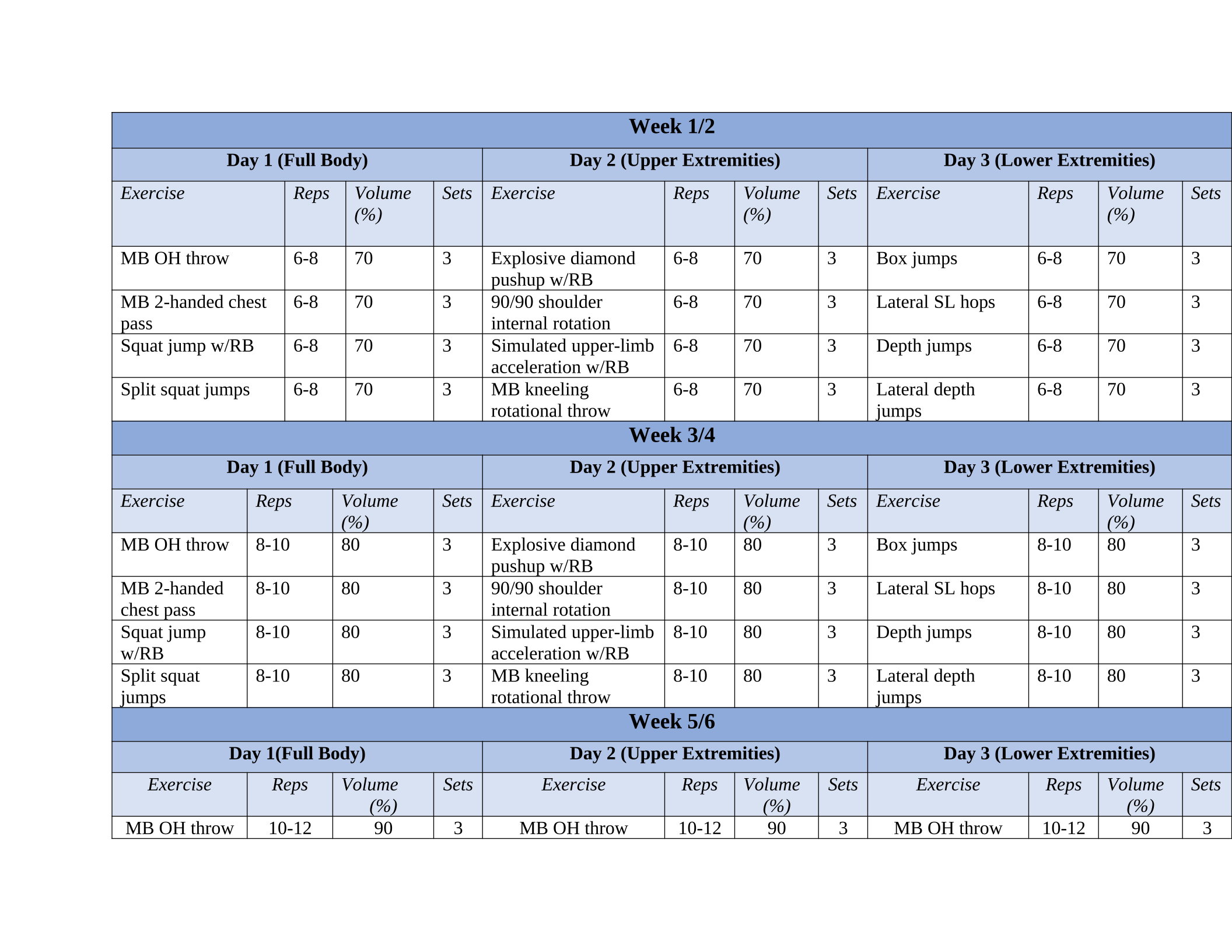
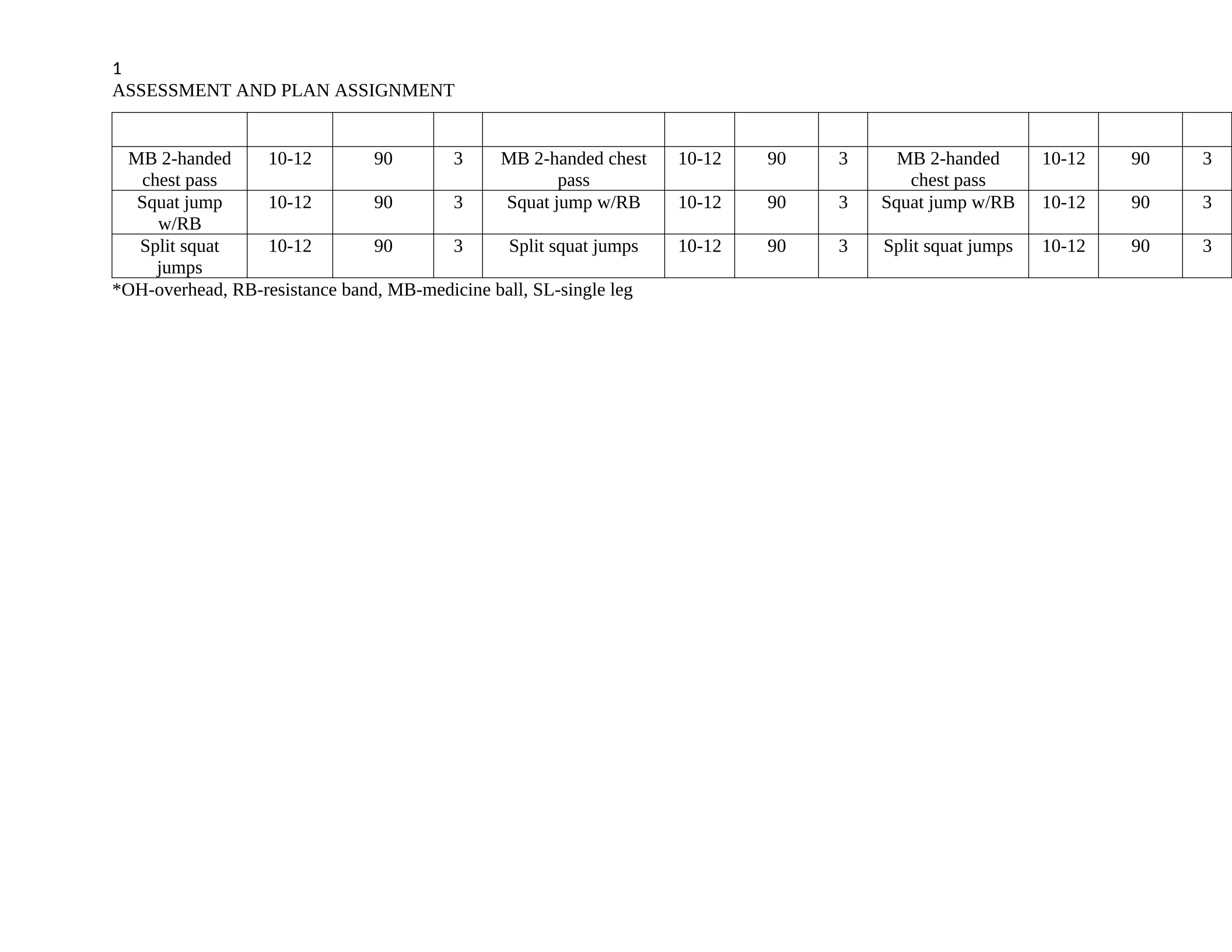
The program is 6 weeks in length with each two-week segment being the same. For each
week, the athlete will perform the following movements: overhead throws, 2-handed chest
passes, squat jumps, split squat jumps, explosive diamond push-up, 90/90 shoulder internal
rotation, simulated upper-limb acceleration, kneeling rotational throws, box jumps, lateral single
leg hops, depth jumps, and lateral depth jumps. These movements are organized accordingly into
a full body day, an upper-body day, and lower-body day. The athlete will perform the 4 different
movements each day that corresponds with the split day for a total of 3 sets in circuit style. Since
the athlete already has a resistance training program in place, he will most likely be decreasing
his volume while increasing his intensity, as his goal will be geared toward strength. For our
plyometric training, we will be increasing volume overtime and potentially intensity if needed in
order to promote endurance and explosiveness. I have combined weighted throwing motions,
rotations movements, explosive jumps, and balance movements in hopes of making the athlete
more well-rounded for his sport.
Results
My hypothesized results for the athlete is that the assessments will demonstrate an
increase in the athlete’s power, agility, and change of direction speed. I believe we will also
notice that his throwing velocity has increased. The article by Cure et al. (2020) described how
their participants engaging in plyometric exercises saw an increase in their overall throwing
5
ASSESSMENT AND PLAN ASSIGNMENT
velocity. Due to the fact that we are implementing exercises that are designed for increasing
acceleration, throwing, balance, change of direction, and explosiveness, I believe that the athlete
will be able to improve his power, agility, and change of direction speed; however, due to the
fact that this program is only 6 weeks long, the results may not be drastic. Repeating this
program for years to come during the off-season is what I believe will truly make the difference.
Conclusion
In conclusion, the athlete presented a problem in which he was struggling in the areas of
power, agility, and changing of direction. This is largely due to the fact that the athlete never
specifically trained to improve those abilities. To improve his overall athletic performance, I
initiated a 6-week program that relied on plyometric exercises that I have hypothesized should
improve his performance in those areas mentioned above.
Week 1/2
Day 1 (Full Body) Day 2 (Upper Extremities) Day 3 (Lower Extremities)
Exercise Reps Volume
(%)
Sets Exercise Reps Volume
(%)
Sets Exercise Reps Volume
(%)
Sets
MB OH throw 6-8 70 3 Explosive diamond
pushup w/RB
6-8 70 3 Box jumps 6-8 70 3
MB 2-handed chest
pass
6-8 70 3 90/90 shoulder
internal rotation
6-8 70 3 Lateral SL hops 6-8 70 3
Squat jump w/RB 6-8 70 3 Simulated upper-limb
acceleration w/RB
6-8 70 3 Depth jumps 6-8 70 3
Split squat jumps 6-8 70 3 MB kneeling
rotational throw
6-8 70 3 Lateral depth
jumps
6-8 70 3
Week 3/4
Day 1 (Full Body) Day 2 (Upper Extremities) Day 3 (Lower Extremities)
Exercise Reps Volume
(%)
Sets Exercise Reps Volume
(%)
Sets Exercise Reps Volume
(%)
Sets
MB OH throw 8-10 80 3 Explosive diamond
pushup w/RB
8-10 80 3 Box jumps 8-10 80 3
MB 2-handed
chest pass
8-10 80 3 90/90 shoulder
internal rotation
8-10 80 3 Lateral SL hops 8-10 80 3
Squat jump
w/RB
8-10 80 3 Simulated upper-limb
acceleration w/RB
8-10 80 3 Depth jumps 8-10 80 3
Split squat
jumps
8-10 80 3 MB kneeling
rotational throw
8-10 80 3 Lateral depth
jumps
8-10 80 3
Week 5/6
Day 1(Full Body) Day 2 (Upper Extremities) Day 3 (Lower Extremities)
Exercise Reps Volume
(%)
Sets Exercise Reps Volume
(%)
Sets Exercise Reps Volume
(%)
Sets
MB OH throw 10-12 90 3 MB OH throw 10-12 90 3 MB OH throw 10-12 90 3
https://www.coursehero.com/file/226400467/Program-Design-Project-Assessment-and-Plan-Assignmentdocx/
1
ASSESSMENT AND PLAN ASSIGNMENT
MB 2-handed
chest pass
10-12 90 3 MB 2-handed chest
pass
10-12 90 3 MB 2-handed
chest pass
10-12 90 3
Squat jump
w/RB
10-12 90 3 Squat jump w/RB 10-12 90 3 Squat jump w/RB 10-12 90 3
Split squat
jumps
10-12 90 3 Split squat jumps 10-12 90 3 Split squat jumps 10-12 90 3
*OH-overhead, RB-resistance band, MB-medicine ball, SL-single leg
https://www.coursehero.com/file/226400467/Program-Design-Project-Assessment-and-Plan-Assignmentdocx/
References
Cüre, D., Griffiths, D., & Sterlace, A. (2020). Implementation of plyometric exercises to improve
throwing velocity of male youth baseball players. Gaziantep Üniversitesi Spor Bilimleri
Dergisi, 5(3), 310–327. https://doi.org/10.31680/gaunjss.764381
Dawes, J. (2019). Developing Agility and Quickness-2nd Edition. Human Kinetics Publishers.
Kim, S., Rhi, S. Y., Kim, J., & Chung, J. S. (2022). Plyometric training effects on physical
fitness and muscle damage in high school baseball players. Physical Activity and
Nutrition, 26(1), 1–7. https://doi.org/10.20463/pan.2022.0001
Klein, B., Cobian, D., Simmons, G., & Reinold, M. (2021). Offseason Workout
Recommendations for Baseball Players. Current Reviews in Musculoskeletal Medicine,
14(2), 174–184. https://doi.org/10.1007/s12178-021-09700-z
Powered by TCPDF (www.tcpdf.org)

