


EDUC 530
LESSON PLAN GRADING RUBRIC
Advanced
Proficient
Developing
Not Present
Standards
11 to 12 points
Reflects both National and
State standards that are
well written and
comprehensive
7 to 10 points
Reflects either National or
State standards but not both
and is well written and
comprehensive
1 to 6 points
Reflects either National or State
standards but not both and is not
well written or comprehensive
0 points
Not present
Objectives
11 to 12 points
Content, Language,
Vocabulary described
7 to 10 points
Either Content, Language or
Vocabulary is described with
one category missing
1 to 6 points
Either Content, Language or
Vocabulary is described with two
categories missing
0 points
Not present
Lesson
Consideration
7 to 8 points
Materials, Prior Learning
and Misconceptions
addressed
5 to 6 points
Either Materials, Prior
Learning or Misconceptions
addressed with one category
missing
1 to 4 points
Either Materials, Prior Learning
or Misconceptions addressed with
two categories missing
0 points
Not present
Lesson
Introduction
“Before”
7 to 8 points
Setting the stage, activate
and build background
knowledge, introduce and
explain
5 to 6 points
Either setting the stage,
activating or building
background knowledge or
introduce and explain is
missing.
1 to 4 points
Two of the three elements are
missing.
0 points
Not present
Learning Activities
“During”
7 to 8 points
Active engagement in
meaning making, explicit
instruction, and practice
(you should be checking
for understanding
throughout the lesson)
5 to 6 points
Active engagement in
meaning making, or explicit
instruction, or practice (you
should be checking for
understanding throughout the
lesson) is missing.
1 to 4 points
Two of the three elements are
missing.
0 points
Not present
Closure “After”
7 to 8 points
Restate teaching point,
clarify key points, extend
ideas, check for
understanding
5 to 6 points
Restates the teaching points,
clarifies key points but does
not extend ideas or check for
understanding
1 to 4 points
Either does not restate teaching
point or does not clarify key points,
or does not extend ideas or check
for understanding
0 points
Not present

EDUC 530
Extension
7 to 8 points
Information is provided on
what specific extension
activity the students will
do to continue practicing
and building meaning.
5 to 6 points
Information is provided on
what specific extension
activity the students but no
clear plan on how they will
continue practicing and
building meaning.
1 to 4 points
A plan on how they will continue
practicing and building meaning is
provided but no mention of what
the activity will be is provided.
0 points
Not present
Evidence and
Formative
Assessment of
Student Learning
7 to 8 points
Description includes how
the teacher will determine
if students are making
progress toward the
learning goal(s) and will
assess the extent to which
they have met the goal(s),
along with providing two
examples provided
5 to 6 points
Description does not include
how the teacher will
determine if students are
making progress toward the
learning goal(s) or does not
include how the teacher will
assess the extent to which
they have met the goal(s),
and only one example is
included
1 to 4 points
Description does not include how
the teacher will determine if
students are making progress
toward the learning goal(s) or
does not include how the teacher
will assess the extent to which
they have met the goal(s), and
there are no examples included
0 points
Not present
Utilizing
Knowledge about
Students to Plan
and Implement
Effective
Instruction
7 to 8 points
Builds on personal,
cultural, community
assets; provides grouping
strategies; describes
instructional supports
5 to 6 points
Builds on personal, cultural,
community assets; but does
not provide grouping
strategies; or describes
instructional supports, and the
description is not explicit
1 to 4 points
Does not build on personal,
cultural, community assets; but
provides grouping strategies,
describes instructional supports and
the description is explicit
0 points
Not present
Technology
Integration
7 to 8 points
Description includes how
both the teacher and
student will use the
technology
5 to 6 points
Description does not include
either how the teacher will
use the technology or how the
student will use the
technology.
1 to 4 points
Technology only lists what will be
used but not how the teacher or
student will use the technology.
0 points
Not present
Grammar and
Spelling
10 to 11 points
Responses are written in
complete sentences and
multiple paragraphs with
8 to 9 points
Responses are written in
complete sentences and
paragraphs. 1-3 errors in
1 to 7 points
Responses are not written in
complete sentences and
paragraphs. More than three
0 points
Not present
EDUC 530
no errors in grammar and
spelling.
grammar and spelling but do
not affect meaning.
errors in grammar and spelling
and the meaning is affected.
APA
10 to 11 points
The use of current APA
formatting standards is
correct for each source. A
title page and reference
page are included in current
APA style. No errors are
present in formatting.
8 to 9 points
The use of current APA
formatting standards is mostly
correct for each source. A title
page and reference page are
included in current APA style.
There are 1–3 errors are present
in formatting.
1 to 7 points
The use of current APA formatting
standards is incorrect for the
majority of sources. The title page
or reference page are missing.
There are more than 3 errors in
formatting.
0 points
Not present
EDUC 530
Lesson Plan Template
Note: Please delete the italicized directives as you complete your plans.
Name: Grade Level: Date:
Lesson Goals
Central Focus of Lesson:
What is the big idea or focus question of the lesson?
Standard(s) Addressed:
What VA SOLs and Common Core standards will be addressed during the lesson? (List number and text)
Lesson Objectives and Demands
Content Objectives:
What will the students know and be able to do by the end of the lesson? (use observable language with measurable verbs)
Language Objectives:
What language will students be expected to utilize when illustrating their understanding?
Key Vocabulary in Lesson:
Lesson Considerations
Materials:
Prior Academic Learning and Prerequisite Skills:
List the prior knowledge that students will need to use and build upon to be successful in this lesson
Misconceptions: Identify common misconceptions regarding the concepts addressed in this lesson
EDUC 530
Lesson Plan Details: Write a detailed outline of your class session including instructional strategies, learning tasks, key questions, key
transitions, student supports, assessment strategies, and conclusion. Your outline should be detailed enough that another teacher could
understand them well enough to use them. Include what you will do as a teacher and what your students will be doing during each
lesson phase. Include a few key time guidelines. Note: The italicized statements and scaffolding questions are meant to guide your
thinking and planning. You do not need to answer them explicitly or address each one in your plan. Delete them before typing your
lesson outline.
Lesson Introduction - “Before”: Setting the stage, activate and build background knowledge, introduce and explain
How will you set a purpose and help students learn why today’s lesson is important to them as readers/writers/learners?
How will you pique interest and/or curiosity regarding today’s topic?
How will you activate and build on prior knowledge and experiences related to the topic?
How will you introduce and explain this strategy/skill so that students will understand the how and why?
Learning Activities - “During”: Active engagement in meaning making, explicit instruction, and practice (you should be checking for
understanding throughout the lesson)
How will you engage students in active meaning making of key concepts and ideas?
How will you model this strategy/skill for your students (exemplars and/or demonstrations)?
How will you provide opportunities for guided practice?
How will students independently practice using the strategy and the skill it targets?
What planned supports will you use for the whole class, individuals, and/or students with specific learning needs?
Closure - “After”: Restate teaching point, clarify key points, extend ideas, check for understanding
EDUC 530
How will students share or show what they have learned in this lesson?
How will you restate the teaching point and clarify key concepts?
How will you engage students in reflection on how the strategies/skills learned today can be used as readers/writers/learners?
How will you provide opportunities to extend ideas and check for understanding?
Extension: How could you extend this lesson if time permits?
What specific extension activity might the students do to continue practicing and building meaning?
NOTE: Attach any Relevant handouts, activities, templates, PPT slides, etc. that are referenced and utilized in this lesson.
EDUC 530
Lesson Plan Appendix and Commentary Section
[Note: Complete the Sections Below Indicated by your Course Instructor]
Evidence and Formative Assessment of Student Learning: How will you know whether students are making progress toward
your learning goal(s) and/or how will you assess the extent to which they have met your goal(s)? Use the chart below to describe
and justify at least 2 formal or informal assessment strategies that occur in your detailed plan above.
Assessment Strategy #1:
Describe assessment strategy here.
Alignment with Objectives:
Describe how this assessment is aligned to your stated
objectives. Which objective(s) is it assessing?
Evidence of Student Understanding:
Describe how this assessment strategy provides evidence of
student understanding of the concepts being taught.
Student Feedback:
Describe how you will provide feedback to students on this
assessment.
Assessment Strategy #2:
Describe assessment strategy here.
Alignment with Objectives:
Describe how this assessment is aligned to your stated
objectives. Which objective(s) is it assessing?
Evidence of Student Understanding:
Describe how this assessment strategy provides evidence of
student understanding of the concepts being taught.
Student Feedback:
Describe how you will provide feedback to students on this
assessment.
EDUC 530
Utilizing Knowledge about Students to Plan and Implement Effective Instruction
Building on Personal/Cultural/Community Assets:
Explain how your plans linked student’s prior academic learning and personal/cultural/community assets to new learning
Grouping Strategies:
Describe how and why students will be divided into groups, if applicable (random, ability, interest, social purposes, etc.).
Planned Supports:
Describe the instructional supports during your lesson that address diverse learning needs in order for all students to successfully
meet lesson objectives. This can include possible accommodations and differentiation strategies.
Supporting Literacy Development
Essential Literacy Strategies:
Identify a strategy used to help students comprehend vocabulary and other mathematical terms within this lesson
Technology
Explain how the teacher and how the students will use technology
EDUC 530
Acknowledgements
Sources:
If ideas in this lesson were based on work from others, acknowledge your sources here
EDUC 530
Lesson Plan Template
Name: Grade Level: 1 Date:
Lesson Goals
Central Focus of Lesson:
Identify square , circles, triangles , trapezoids, rhombuses, pentagons, hexagons, octagons, cubes, spheres, cylinders,
cones, triangular prisms, rectangular prisms. Recognize and draw shapes having specified attributes, such as a given
number of angles or a given number of equal faces.
Standard(s) Addressed:
The student will identify 2 dimensional shapes such as trapezoids, rhombuses, pentagons, hexagons, octagons,
parallelograms, and quadrilaterals.
Lesson Objectives and Demands
Content Objectives:
Visual thinking skills through geometry-oriented activity may lead to more robust understanding of shape concepts. The
visual thinking skills such as perceptual flexibility, visual encoding and decoding, and visual memory may have been
enhanced through the synthesized curriculum, leading to a more robust understanding of the shape concepts. As done
in this curriculum, and effectively so, visual thinking skills can be taught as a basic skill in order to enhance visual
imagery
Language Objectives:
ENGLISH
Key Vocabulary in Lesson:
LINE, SQUARE , TRIANGLE , CIRCLE , RECTANGLE , ANGLE , SPHERE , CUBE , CONE , PYRAMIDS , 2-D SHAPE , 3-D
SHAPE , DIFFERENT ,GROUPS
Lesson Considerations

EDUC 530
Materials:
Materials:
IMAGES , 3D SHAPES MODEL, PAPER CUTOUTS (square , circles, rectanges, triangles).
Prior Academic Learning and Prerequisite Skills
Understanding of numbers from 1 to 10, knowledge about alphabets, experience and understanding about the shape
seen in day today life.
Misconceptions:
Miss classifying a shape due to its orientation. This often happens when students are only exposed to shapes oriented
the same way every time
Incorrectly naming points or spaces on a coordinate grid.
Lesson Plan Details:
To start, the topic of 2D shapes is introduced to students and the proficiency scale for the lesson is shown.
Students will get a preview of what they will be learning and know what is being expected of them.
• Anticipatory Set: Students will watch and observe different images and shapes presented to them.
• Then, students will be introduced to the vocabulary for the lesson such as circle , square, rectangle , triangle ,
cube , cone , line , angles , pyramids , pentagon , hexagon , vertices ,
• After learning the vocabulary, they will learn about the attributes for each shape. Each slide covers how many
sides, vertices, etc. each shape has.
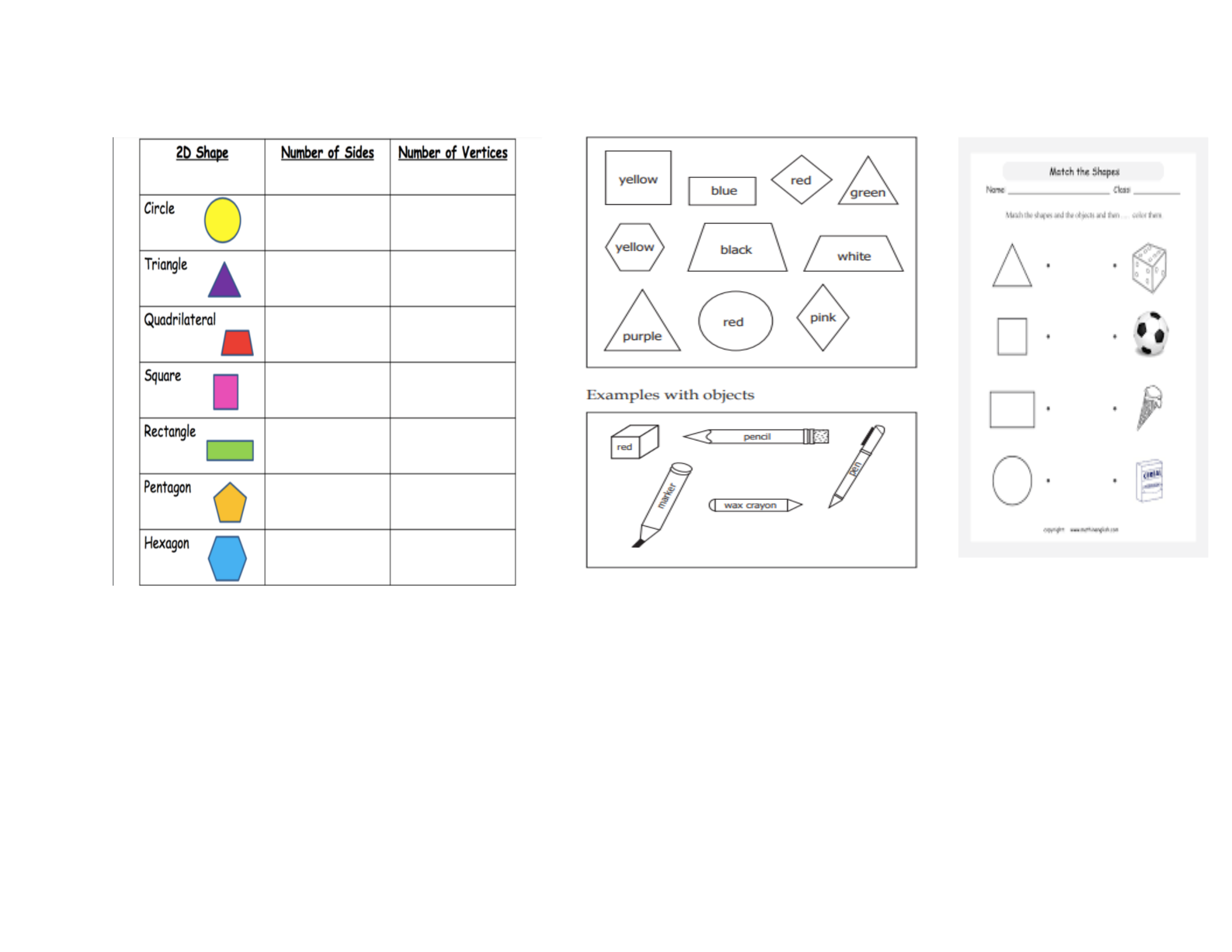
For each shape, there is also a real-world example. o Shapes covered are circle, triangle, quadrilaterals, square,
rectangle, rhombus, trapezoid, pentagon, hexagon, and octagon. Each shape has its own slide.
• Then, students will complete a shape scavenger hunt in their surroundings. They will look for examples of each
shape in the given images.
• Finally, students will fill out the 2D shapes graphic organizer as a formative assessment to check their
understanding. The graphic organizer lists and shows the shape, and student fill in how many sides and vertices it
has. Once students have finished the graphic organizer.

EDUC 530
Learning Activities – “During”:
Frequently asking simple and fun question to student based on the story going. If a story is about a birthday party we
can ask ,what was the shape of the cakes , what was the shape of that big balloon . Letting students to think about their
prior experience which will increase their interest.
Having the actual model of all the 3-D shapes and allowing students to interact with them them.
1) Telling student to build a house using a cube and a trapezoid.
2) Construct a building using only rectangular prism and cubes.
Closure - “After”:
Repeating the concepts in different ways to so that student will get completely engaged into the topic, using
pictorial presentations and stories.
I will give students an activity test paper which will have games question related to the topic they have learned
Students make a picture using different-sized paper shapes, including circles, squares, rectangles, and triangles. As
students are working, ask students to describe the shapes they are using. Students glue their pictures onto paper, add
additional features, and describe their picture in sentences.
Connecting the concepts with day to day life experiences is a good way to understand the importance to the topic.
Asking question “what is the shape of the bottle?” “what is a brick?” , “how many side does a box have?” etc
Provide a collection of 3-D objects such as blocks, interlocking plastic building blocks, household food-stuff
containers, buttons, etc. Have students sort them and then identify the sorting rule.
Show students a set that contains an object or shape that does not belong.
Ask the students to remove the object or shape that does not belong and explain why. “Which shape/object does not
belong? Why?” and
“Find another shape/object that would belong to this set.”

EDUC 530
Examples with shapes
Extension:
1) Allowing student to express on a paper by telling them to draw a MAN, HOUSE , A BUS using all the figures we have
learned,
2) Build a composite 3-D object. Have students select the appropriate 3-D objects and reproduce the composite.
3) Provide a set of pictures of composite objects that are possible or impossible to build. Ask students to sort the pictures
and to justify their choices. Then ask students to build the possible composite objects using the solids shown in the
pictures.
NOTE: Attach any Relevant handouts, activities, templates, PPT slides, etc. that are referenced and utilized in this lesson.
EDUC 530

EDUC 530
Lesson Plan Appendix and Commentary Section
[Note: Complete the Sections Below Indicated by your Course Instructor]
Evidence and Formative Assessment of Student Learning: How will you know whether students are making progress toward
your learning goal(s) and/or how will you assess the extent to which they have met your goal(s)? Use the chart below to describe
and justify at least 2 formal or informal assessment strategies that occur in your detailed plan above.
Assessment Strategy #1:
1) Giving students task on papers such as identifying the
figures .
2) identifying the number of circles, triangles , rectangle ,
square in the given picture.
Alignment with Objectives:
The student will know to identify the shapes based on the
their vertices , shape , faces.
The correct answers will show us that the student has
understood the concepts.
Student Feedback:
Demonstrate to students what you are looking for by giving
them an example of what an A+ paper looks like.
Assessment Strategy #2:
1)Provide students with a collection of paper shapes of
various sizes including triangles, rectangles, circles, and
other shapes. Ask students to sort the collection into two
groups and name the sorting rule. Then have students
regroup the collection and sort it in other ways.
2)Provide a collection of 3-D objects such as blocks,
interlocking plastic building blocks, household food-stuff
containers, buttons, etc. Have students sort them and then
identify the sorting rule .
Alignment with Objectives:
Student will identify different shapes(based on rules such
as separating figures based on number of sides they have )
and will group them. That means they know how this
different shapes are different from each other.
This will be a group activity allowing student to interact to
build something with individual past knowledge and
understanding about shapes.
Evidence of Student Understanding:
sort a collection of 3-D objects using self-selected
attribute(s), sort a collection of 2-D shapes using self-
selected attribute(s)
state the sorting rule of 3-D objects ,state the sorting rule of
EDUC 530
2-D shapes ,re-sort a set of 3-D objects in another way, re-
sort a set of 2-D shapes in another way
Student Feedback:
Appreciating the model they have produced based on their
experience and what other good things can come.
Utilizing Knowledge about Students to Plan and Implement Effective Instruction
Building on Personal/Cultural/Community Assets:
Most of the activities are based on prior experience of the student, this will increase the interaction between the students.
Grouping Strategies:
Based on the first Assessment Strategy teacher will come to know the abilities of the students. Accordingly the students
will be grouped.
Planned Supports:
Having all the charts , and model shapes required ready . The environment should be made so friendly that student
should be able to communicate with the teacher freely.
Supporting Literacy Development
Essential Literacy Strategies:
Including words and phrases with subject-specific meaning that differ from the meaning used in every day life.
Refer to specific backgrounds information that students bring to the learning environment this will increase their interest
in learning.

EDUC 530
Technology
Providing games and videos ,based on the concept, on students tablets.
Providing website links to students for online fun games based on the topic.
Providing students with youtube video links for homework help.
Acknowledgements
Sources:
google images.

