


SHORTENED TITLE 2
Math calculator
Discussion Post
When I was younger, using a calculator was frowned upon. Kids were told that we wouldn’t have
a calculator in our pocket. I personally struggle with the computation of fractions. I spend so
much time working on the problem and trying to solve it, that it’s a laboring process. Now that I
have a calculator, I will attempt to work on a problem and will check my answer. Then I go back
to see where I went wrong. I started to understand fractions when cooking. I would have to
double a recipe or cut a large recipe in half or quarters. At first, I would measure out the recipe
twice – but then started computing the new fractions.
To effectively use a calculator that will add, subtract, multiply, or divide fractions, you must still
understand fractions and how to solve them. You must know how to plug the equations into the
calculator, to use the calculator to solve the problem. This is why it is still important to teach
students to solve fraction problems by hand. It is important to allow students to learn how to use
a calculator. Johnson et al. talk about students learning to use a calculator at the same time that
they are learning to solve math problems by hand in paper and pencil form (2016). If a student
learns how to effectively use a calculator, they will be able to solve problems quicker and be able
to check their solutions to verify they are correct. Learning how to use a calculator for fractions
also provides a foundation for higher level math.
References
Johnson, A., Tipps, S., & Kennedy, L. M. (2016). Guiding children’s learning of mathematics.
Cengage Learning.
SHORTENED TITLE 3
Reply #1- Sarah Ray
Sarah, thank you for your thoughts. I’m not sure if your high school is using the same
program, but my school system uses Desmos on their Chromebook. The students start learning
how to use Desmos in elementary school. I agree that by students just plugging the numbers into
a calculator they are getting the answer correct, but are not understanding how to solve the
problem. As an educator (if I taught upper grades) I would allow the use of a calculator, but
require all students show their work. That way I could see if they understood how to solve the
problem. I have seen a student understand how to solve a problem, but because they made a
calculation error in the process the problem was wrong. If the student was allowed to use a
calculator, she would have gotten the answer correct. This student’s confidence was impacted by
continuously getting problems wrong, even though she understood the process. We know most of
the time we have calculators at our fingertips, so why not use them to enhance students’
learning? Johnson et al. state that effective teachers incorporate technology (calculators,
computer software, etc.) to increase learning for all students (2016).
References
Johnson, A., Tipps, S., & Kennedy, L. M. (2016). Guiding children’s learning of mathematics.
Cengage Learning.
SHORTENED TITLE 4
Reply #2- Reginia Law
Hello Reginia, I respectfully disagree with your position that calculators do not belong in
elementary math. Along with learning basic math skills, learning how to use a calculator will
give the students the building blocks for using it for later problem-solving purposes. If students
learn to use a calculator with repeated use, input errors decrease. Think of it as a student learning
to drive. The new student driver does not start driving on the interstate, they start off in a parking
lot and gets used to driving a car before getting out on the road. We provide instruction and
adequate practice to master the skill. We don’t just teach a driver how to do a maneuver and
then not let them practice it. A calculator should be the same. As a student is learning to add
basic numbers, they should be using a calculator to learn basic calculator skills. I do agree with
your point that there must be a balance between paper and pencil along with technology. The
NCTM supports the use of calculators in elementary schools to gain basic skills and apply them
to problem solving (2015).
References
National Council of Teachers of Mathematics. (2015, July). Calculator use in elementary grades
- national council of teachers of mathematics. National Council of Teachers of
Mathematics. https://www.nctm.org/Standards-and-Positions/Position-
Statements/Calculator-Use-in-Elementary-Grades/
SHORTENED TITLE 5
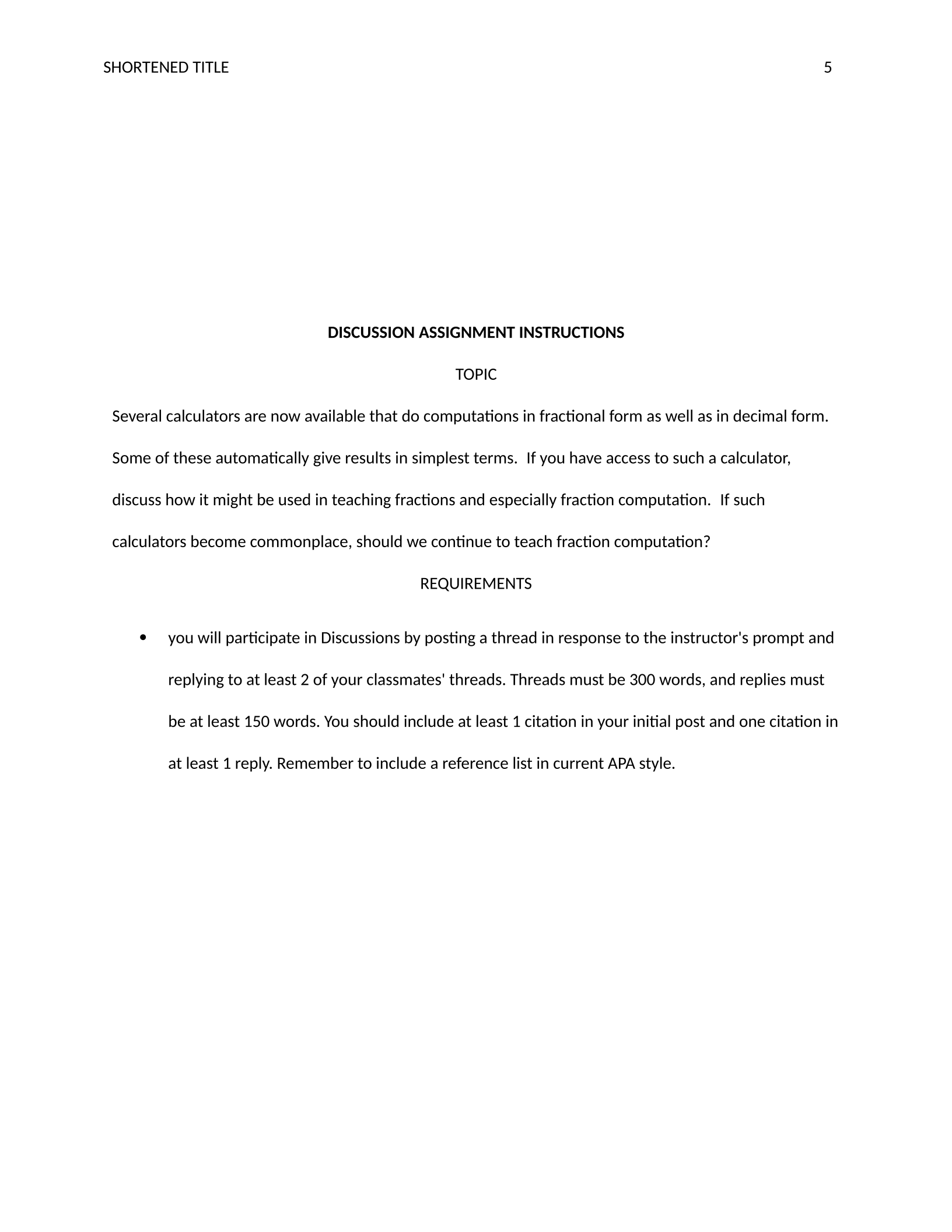
DISCUSSION ASSIGNMENT INSTRUCTIONS
TOPIC
Several calculators are now available that do computations in fractional form as well as in decimal form.
Some of these automatically give results in simplest terms. If you have access to such a calculator,
discuss how it might be used in teaching fractions and especially fraction computation. If such
calculators become commonplace, should we continue to teach fraction computation?
REQUIREMENTS
you will participate in Discussions by posting a thread in response to the instructor's prompt and
replying to at least 2 of your classmates' threads. Threads must be 300 words, and replies must
be at least 150 words. You should include at least 1 citation in your initial post and one citation in
at least 1 reply. Remember to include a reference list in current APA style.
Powered by TCPDF (www.tcpdf.org)

