




LIBERTY UNIVERSITY SCHOOL OF DIVINITY
The Bible in Translation
Submitted to Dr. James Sulfridge
in partial fulfillment of the requirements for the completion of
DSMN 500
Discipleship Ministries
By
Anthony Bean

Definition
Whether the translation is more functional or formal in its equivalence to the original text,
the task of the translator has always been to strike the balance of communicating the message
of the original language clearly while allowing the target reader to follow literary devices
through the text, an important goal to ensure that the written Word of God is able to speak
clearly to cultures around the world.
Summary
As the group of documents that comprise the written Word of God to all peoples, the Bible
has been translated into over 3,350 different languages. Even since before the New Testament
was written, the Scriptures have been translated into nearly every language that is used by
God’s increasingly global people. Two different philosophies characterize the poles of biblical
translations: formal equivalence, which seeks to follow the form of the original text as much as
possible, and functional equivalence, seeks to most accurately reproduce the meaning of the
original text. The King James Version, which leaned more towards the formal side, continued a
tradition of formal English translations going back to as the most famous example. However,
there has been an increasing number of functional equivalence translations in the English
language recently, including the NIV, which is the most used English translation in the world.
As Christians we are people of the Book. We believe that God has spoken to us through his
Word. Christian faith and practice are not to be based ultimately on church authorities, councils
or creeds, but on the written Word of God.
Yet the great majority of Bible readers access God’s Word not in its original languages
(Hebrew, Greek, Aramaic) but through a translation into their native tongue. This makes the
task of Bible translation critically important for the church. Hearing God’s voice in Scripture
requires the accurate rendering of God’s Word into the diverse languages of the world.
Translation Philosophies: Formal or Functional?
The goal of translation is to reproduce the meaning of a text in one language (the source or
donor language) into another (the target or receptor language). How best to do this? The
primary issue concerns whether to translate according to the form of a text or according to its
meaning (function). Formal equivalence, also known as literal or word-for-word translation,
seeks to follow the form of the original text as much as possible. This relates both to words and
to grammatical structures. For example, the Greek word logos is most commonly translated as
“word.” A formal equivalent version will seek to consistently render it this way. In terms of
grammar, a formal equivalent version will seek to replicate the grammatical forms of the
original. For example, the Greek prepositional phrase en tē oikia would be translated as a

prepositional phrase in English, “in the house”; and the Greek infinitive elthein as an English
infinitive, “to come.”
While formal versions seek to stay consistent, no translation is consistently literal in reality
since languages are different, both in terms of word meanings and grammatical structures. For
example, even a very literal translation, like the New American Standard Bible (NASB),
translates logos in a wide variety of ways: word, statement, saying, account, story, news, thing,
matter, exhortation, etc. The same is also true of grammatical forms. A consistently formal
version of John 3:16 would be something like this: “Thusly for loved the God the world, so the
son the unique gave, in order that all the believing in him not to be destroyed, but have life
eternal.” The words and grammatical constructions of Hebrew and Greek do not function in the
same way as those in English. Even the most literal versions default to idiomatic renderings.
Functional equivalence, also known as dynamic equivalence, idiomatic, or meaning-based
translation, seeks to reproduce the meaning of the text. The form should be retained only if it
accomplishes this goal. Since no two languages are the same, it is necessary to change the form
in order to capture the meaning. Anyone who has learned a second language soon recognizes
this. The Spanish phrase ¿Cómo se llama? would be translated “literally” as “How yourself call?”
(modal adverb + reflexive pronoun + verb) but is better rendered, “What’s your name?”
(interrogative pronoun + copulative verb + possessive pronoun + noun). The form must be
changed to capture the meaning. The German sentence Ich habe Hunger would be formally
translated, “I have hunger” (pronoun + verb + noun), but in English we would say, “I am hungry”
(pronoun + copulative verb + adjective).
Translating from Hebrew or Greek to English is no different. Matthew 1:18 in the Greek
says that Mary was en gastri echousa, literally, “having in belly.” This Greek idiom means she
was “pregnant.” Translating literally would make a text that was clear and natural to its Greek
readers into one that is strange and obscure to English ears. Compare the following biblical
idioms translated formally in one version and idiomatically in another:
Joshua 10:6
RSV (formal) Do not relax your hand from your servants
NIV (functional) Do not abandon your servants
2 Sam. 18:25
NRSV (formal) The king said, “If he is alone, there are tidings in his mouth.”
NET (functional) The king said, “If he is by himself, he brings good news.”
Amos 4:6
NKJV (formal) “Also I gave you cleanness of teeth in all your cities”
NLT (functional) “I brought hunger to every city”
Mark 1:2
ESV (formal) Behold, I send my messenger before you face…
CSB (functional) See, I am sending My messenger ahead of you…
In each of these examples translating the idiom literally results in awkward, obscure, or
inaccurate English. The form must be changed to capture the meaning. Since the ultimate goal
of translation is to transfer the meaning, functional equivalence represents the best method of
translation.
At the same time, both formal and functional versions have strengths and weaknesses. By
mechanically reproducing forms, formal equivalent versions risk miscommunicating the original
meaning. Yet they can be helpful tools for tracing formal features of the text, such as recurrent
words and verbal allusions. While functional versions more clearly communicate the meaning
of text, they are more interpretive and so have a greater risk of misinterpretation. Students
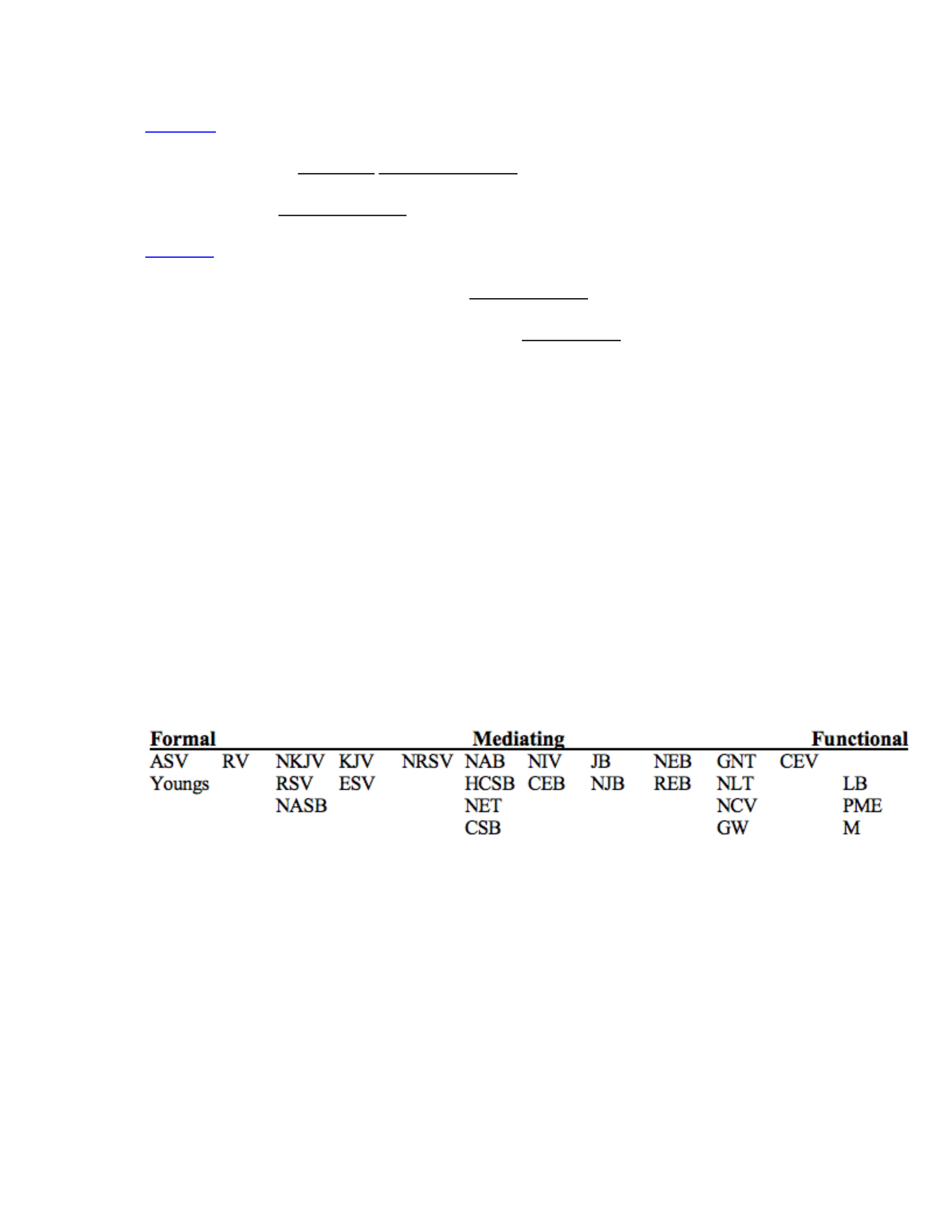
should be encouraged to use a variety of versions from across the translation spectrum. The
following chart represents the approximate location of the most popular English versions.
Continuum of Translations
Key
American Standard
Version (ASV)
Youngs Literal
Revised Version (RV)
King James Version (KJV)
(Holman) Christian
Standard (HCSB; CSB)
New English Translation
(NET)
New American Bible (NAB)
New International Version
Good News Translation
(GNT; TEV)
New Living Translation
(NLT)
New Century Version (NCV)

New King James Version
(NKJV)
New American Standard
Bible (NASB)
Revised Standard Version
(RSV)
English Standard Version
(ESV)
New Revised Standard
Version (NRSV)
(NIV)
Common English Bible (CEB)
New English Bible (NEB)
Revised English Bible (REB)
Jerusalem Bible (JB)
New Jerusalem Bible (NJB)
God’s Word (GW)
Contemporary English
Version (CEV)
Living Bible (LB)
Phillip’s Modern English
(PME)
The Message (M)
Where did all these versions come from? A brief history of Bible translation will help to put
these various versions in context.
Translations from Antiquity
A comprehensive survey of the history of Bible translation would include thousands of
versions into the many languages of the world (the Bible has been translated, in whole or in
part, into 3,350 languages; see the Wycliffe website for more information)—a task far beyond
our scope. Instead, we will note two great translations from antiquity followed by a very brief
history of the Bible in English and a survey of contemporary English versions.
The Septuagint
Bible translation first became necessary for the Jews following the conquests of Alexander
the Great (323 BC), when Greek became the common trade language of the eastern
Mediterranean region. Jews living in Egypt and elsewhere had gradually lost the ability to speak
and read in Hebrew and so needed a translation of the Scriptures into Greek. The result was the
Septuagint. The Septuagint (from the Latin septuaginta, “seventy”; abbreviated LXX) gets its
name from a legend found in the Letter of Aristeas (2nd c. BC), which recounts how 72 scholars,
six from each of the 12 tribes of Israel, completed the work of translation in 72 days. While the
specifics of this legend are in doubt, scholars affirm that the Pentateuch was likely translated
into Greek in Alexandria, Egypt in the third century BC and the rest of the Hebrew Scriptures
followed. The Septuagint became the standard Bible for Greek-speaking Jews of the Diaspora
(“dispersion”—Jews living outside Israel) as well as for the early Christians. Most Old Testament
quotes in the New Testament come from the Septuagint.
The Vulgate

A second great translation from antiquity is the Latin Vulgate. As a missionary religion,
Christianity sought to cross cultural boundaries to take the gospel to the ends of the earth.
Bible translations were therefore produced in the early centuries of the Christian era in
languages such as Latin, Syriac, Coptic, Armenian, Ethiopia, Georgian, and Slavic. In AD 382,
Pope Damasus I commissioned the church father Jerome to produce a new translation to
replace the Vetus Latina (“Old Latin”) version of the Gospels. Jerome went further and
translated almost the entire Bible. While most versions of the Old Testament at that time were
produced from the Greek Septuagint, Jerome traveled to Palestine and learned Hebrew from
Jewish rabbis. The result was the Latin Vulgate (versio vulgate, “common version”). Eclipsing
the Old Latin, the Vulgate soon became the standard Bible of the Catholic Church.
The Bible in English
John Wycliffe
The first English translation of the full Bible was completed around 1382 under the
direction of Oxford theologian John Wycliffe. Wycliffe spent much of his career challenging the
authority of the Pope and the hierarchy of the Roman Catholic Church. His motivation for
translation was his belief that the Bible was a Christian’s highest authority and that everyone
should be able to read and hear God’s Word. While Wycliffe oversaw the work of translation,
most of the work was likely done by his associates. A rather wooden literal first edition was
subsequently revised by Wycliffe’s associate John Purvey in 1388. Purvey’s edition became the
standard Wycliffe Bible.
Wycliffe’s fiery denunciation of church dogma resulted in strong opposition from the
church hierarchy. In 1408, a clergy synod at Oxford banned the production and public reading
of vernacular versions of the Bible.
William Tyndale
A century and a half after Wycliffe, William Tyndale produced the first printed English New
Testament translated directly from the Greek (Wycliffe’s work had been translated from the
Latin Vulgate). Yet the ban on vernacular versions was still in force and Tyndale faced severe
opposition. Harassed by his enemies, he fled from England to continental Europe, where his
New Testament was published in 1526 and smuggled back into England. The people loved it; it
was both accurate and readable. Yet Tyndale’s enemies pursued him relentlessly. While living in
exile in Belgium, Tyndale was kidnapped, imprisoned and subsequently executed. His body was
burned. Tyndale’s most famous words came in response to a charge that he was opposing the
Pope’s edicts.

