


JOHN W. RAWLINGS SCHOOL OF DIVINITY
LIBERTY UNIVERSITY
Making Disciples and Making Leaders
Submitted to Dr. William England,
In partial fulfillment of the requirements for the completion of
DSMN500-C02-202220
Discipleship Ministries
by
Stephen Heleman
March 20, 2022
1
Table Of Contents
Great Commission Leadership …………………………………………….…………………….. 3
Developing Disciples And Developing Leaders …………………………………...……………. 4
Earley, Dempsey, and Putman …………………………………………………………...……… 5
Healthy Disciples Create A Healthy Church …………………………………………...……….. 7
10 Kingdom Leadership Principles ……………………………………………...………………. 8
2
Great Commission Leadership
In the moments before Jesus ascended to heaven, he gathered his disciples and gave them
the following command, “All authority has been given to me in heaven and on earth. Go,
therefore, and make disciples of all nations, baptizing them in the name of the Father and of the
Son and of the Holy Spirit, teaching them to observe everything I have commanded you. And
remember, I am with you always, to the end of the age.” 1 These words are simple and incredibly
powerful. Even though Jesus is physically leaving he promises he will always be with his
disciples and give them the power they need to full this Great Commission. 2 For almost 2,000
years followers of Jesus have followed his command for, “believers to duplicate themselves
wherever they may be.” 3
While this is a command for all people it also means the church must have leaders who
can equip and encourage the body of Christ to use their gifts to make disciples. This is why the
apostle Paul writes, “And he himself gave some to be apostles, some prophets, some evangelists,
some pastors and teachers, to equip the saints for the work of ministry, to build up the body of
Christ, until we all reach unity in the faith and in the knowledge of God’s Son, growing into
maturity with a stature measured by Christ’s fullness.” 4 The heart of church leadership is
equipping people to do the ministry God created them for. This, “serves well to remind ministers
that the gifts of the Spirit are not for the enrichment of oneself but for the enrichment of the
1 Christian Standard Bible (Nashville, TN: Holman Bible Publishers, 2020), Mt 28:18–20.
2 Craig Blomberg, Matthew, vol. 22, The New American Commentary (Nashville: Broadman & Holman Publishers,
1992), 431.
3 Craig Blomberg, Matthew, vol. 22, The New American Commentary (Nashville: Broadman & Holman Publishers,
1992), 431.
4 Christian Standard Bible (Nashville, TN: Holman Bible Publishers, 2020), Eph 4:11–13.
3
Church.” 5 A leader who does not want to serve the Bod of Christ should not be a leader. As
Dempsey says, “Christian leadership is the idea that I am here to help you grow and develop.”6
Developing Disciples And Developing Leaders
Putman reminds us that, “Everyone is a disciple and should grow into an effective
disciple maker, but not everyone is gifted as a leader.” 7 There is a distinction and higher
responsibility for those in leadership. Yet the process for becoming a leader is the same process
for being a disciple. As you grow closer to God and discover your calling to leadership, you step
into the specific role God created you for. Several years ago, I developed a scale we use in the
church I pastor to help us identify where people are in the discipleship process, what their next
step should be, and who are potential leaders.
Level One refers to a person taking their “First Steps with Jesus.” We ask these people to
show up for worship, a group, and some form of service. The most important step at this level is
to give your life to Jesus and, followed by our Onramp Class that helps you lay a foundation of
discipleship. Level Two describes a person “Finding Your Way.” At this level we ask people to
being a 4G Life. This is a life where you spend time with God, Gather with your church family,
connect in a Group, and Give of your time, talent, and treasure to the Kingdom of God. Level
Three is an individual “Growing In Your Faith.” This is the level we want all of our members and
regular attendees to work toward. In addition to living a 4G life we ask these people to serve
weekly and participate in a huddle connected to the ministry God called them to be part of.
5 Francis Foulkes, Ephesians: An Introduction and Commentary, vol. 10, Tyndale New Testament Commentaries
(Downers Grove, IL: InterVarsity Press, 1989), 123–124.
6 Rod Dempsey, “Comprehending Spiritual Leadership,” in Disciple Making Is . . .: How to Live the Great
Commission with Passion and Confidence (Nashville, TN: B&H Academic, 2013).
7 Jim Putman, Bobby Harrington, and Robert E. Coleman, DiscipleShift: Five Steps That Help Your Church to
Make Disciples Who Make Disciples (Grand Rapids, MI: Zondervan, 2013).
4
The first three levels are for all people. The fourth and fifth level are not for all people,
but are a continuation. We work hard to communicate that a level four is not better than a level
three. Level Four is someone who is “Deacon Qualified” and describes a person who leads teams
and leaders. They must have a clear calling that is visible to those who know them and must be
respected by other leaders. The organize, equip, and encourage level three leaders so they can
fulfill God’s calling on their life. Leaders at this level much be involved in LeaderU, our
leadership training program. The final level, Level Five, are those who are “Overseer Qualified.”
These are people who either help lead our entire church or oversee large ministries. Some of
these people are paid staff but many are not. All the Level Five leaders are in a huddle with other
Level Five leaders
While not a perfect system it has worked well for us. It shows that leadership must be
part of discipleship and it provides a clear picture of where you are and how to take the next step.
Earley, Dempsey, and Putman
I greatly appreciated the way both books approached the topic of leadership. Putman’s
focus on being a transparent leader is refreshing. I related to his statement, “how many pastors
haven’t discovered the freedom that comes from being transparent about who they are as a sinner
saved by grace.” 8 For years I felt that to be an effective leader I had to have my life together. The
harder I tried the more I struggled and the more I felt like a failure. When I realized I can be real
it was freeing and allowed me to honestly deal with my brokenness.
8 Jim Putman, Bobby Harrington, and Robert E. Coleman, DiscipleShift: Five Steps That Help Your Church to
Make Disciples Who Make Disciples (Grand Rapids, MI: Zondervan, 2013).
5
I also found Putman’s statement, “To be a leader in the church, you must be a leader at
home. If you cannot lead your wife and family, then forget about leading the church,” 9 to be an
important reminder for all leaders. This is not a contradiction of Putman but a counterweight to
keep us in balance. My first ministry and focus must be my family. Too many leaders sacrifice
their family for the church. As Lenski states, “Any Christian man should be able to function well
as the head of his own home; one who fails in so simple a requirement is not fit to be elevated to
the ministry.” 10 This may seem like a high requirement, but it is truly a foundational
requirement. This is something we should teach all men to do.
I was also challenged by Putman’s assertion that the church should function more like a
12 Step Program than, “the educational or entertainment culture that currently defines many
churches.” 11 Too often we approach church like are putting on a show when we should create
and environment where the broken can find life and healing. The Pharisees said of Jesus, “This
man welcomes sinners and eats with them.” 12 Jesus was not ignoring their sin or encouraging
them to continue in their sin. “Jesus associated with such people to offer them salvation through
repentance and faith.” 13 This is why the church should be full of broken people. It is the only
way many of the will find life through Jesus.
Healthy Disciples Create A Healthy Church
9 Rod Dempsey, “Comprehending Spiritual Leadership,” in Disciple Making Is . . .: How to Live the Great
Commission with Passion and Confidence (Nashville, TN: B&H Academic, 2013).
10 R. C. H. Lenski, The Interpretation of St. Paul’s Epistles to the Colossians, to the Thessalonians, to Timothy, to
Titus and to Philemon (Columbus, OH: Lutheran Book Concern, 1937), 585.
11 Jim Putman, Bobby Harrington, and Robert E. Coleman, DiscipleShift: Five Steps That Help Your Church to
Make Disciples Who Make Disciples (Grand Rapids, MI: Zondervan, 2013).
12 Christian Standard Bible (Nashville, TN: Holman Bible Publishers, 2020), Lk 15:2.
13 Robert H. Stein, Luke, vol. 24, The New American Commentary (Nashville: Broadman & Holman Publishers,
1992), 403.
6
I have a row of books in my library that talk about creating a healthy church. Over the
years I have found many to be helpful. The best way to create a healthy church is to focus on
creating healthy disciples. When I arrived as pastor of Calvary Baptist Church the church was
not healthy and almost everyone knew it. There were organizational and stylistic changes that
needed to be made. The most important and significant change we made was to focus on making
disciples. I gathered two groups of men and poured into them. It did not take long for them to
begin growing and catch the vision for what CBC could be. The other changes, like changing our
style of worship, was easy once we had a growing number of Christ honoring disciples
This is why leaders in the church should focus on creating, “community-wide system in
which people can be involved in relational environments for the purpose of discipleship.” 14
Making disciples is slower and more challenging than gathering crowds but the long-term benefit
is unmistakable. A church full of disciples is not dependent on a staff or technology, they are
dependent on Jesus and that lasts longer. As Dempsey says, “When a person is correctly using
the gift God has given to them, he or she bears spiritual fruit to the glory of God.” 15 Pastors
would be wise to focus on building disciples if they want to build a healthy church.
10 Kingdom Leadership Principles
I found the “10 Kingdom Leadership Principles” to be a helpful reminder of the
differences in what our world calls leadership and what Jesus calls leadership. I feel like the
14 Jim Putman, Bobby Harrington, and Robert E. Coleman, DiscipleShift: Five Steps That Help Your Church to
Make Disciples Who Make Disciples (Grand Rapids, MI: Zondervan, 2013).
15 Rod Dempsey, “Reproducing Missional Leaders,” in Disciple Making Is . . .: How to Live the Great Commission
with Passion and Confidence (Nashville, TN: B&H Academic, 2013).
7
church I have the privilege of pastoring does a good job in all these areas. Of course, there is
always room to improve but we are doing well. There are two of the principles that I consider to
be especially important.
Principle number 3, none of it is yours, is foundational. We must hold everything with an
open hand, including people. I like being in control. I like making plans and figuring out how to
accomplish that plan. I like being successful. It took me a long time to learn the church and its
success is not up to me. God will always love his church more than I do so I need to get out of
his way and let him do his work. Additionally, Principle 7, the way up the ladder is down, is
often missing in leadership, even in the church. Paul reminds us that Jesus lowered himself so we
could have life. “Adopt the same attitude as that of Christ Jesus, who, existing in the form of
God, did not consider equality with God as something to be exploited. 7 Instead he emptied
himself by assuming the form of a servant.” 16 The more we empty ourselves the more God can
work through us.
16 Christian Standard Bible (Nashville, TN: Holman Bible Publishers, 2020), Php 2:5–7.
8
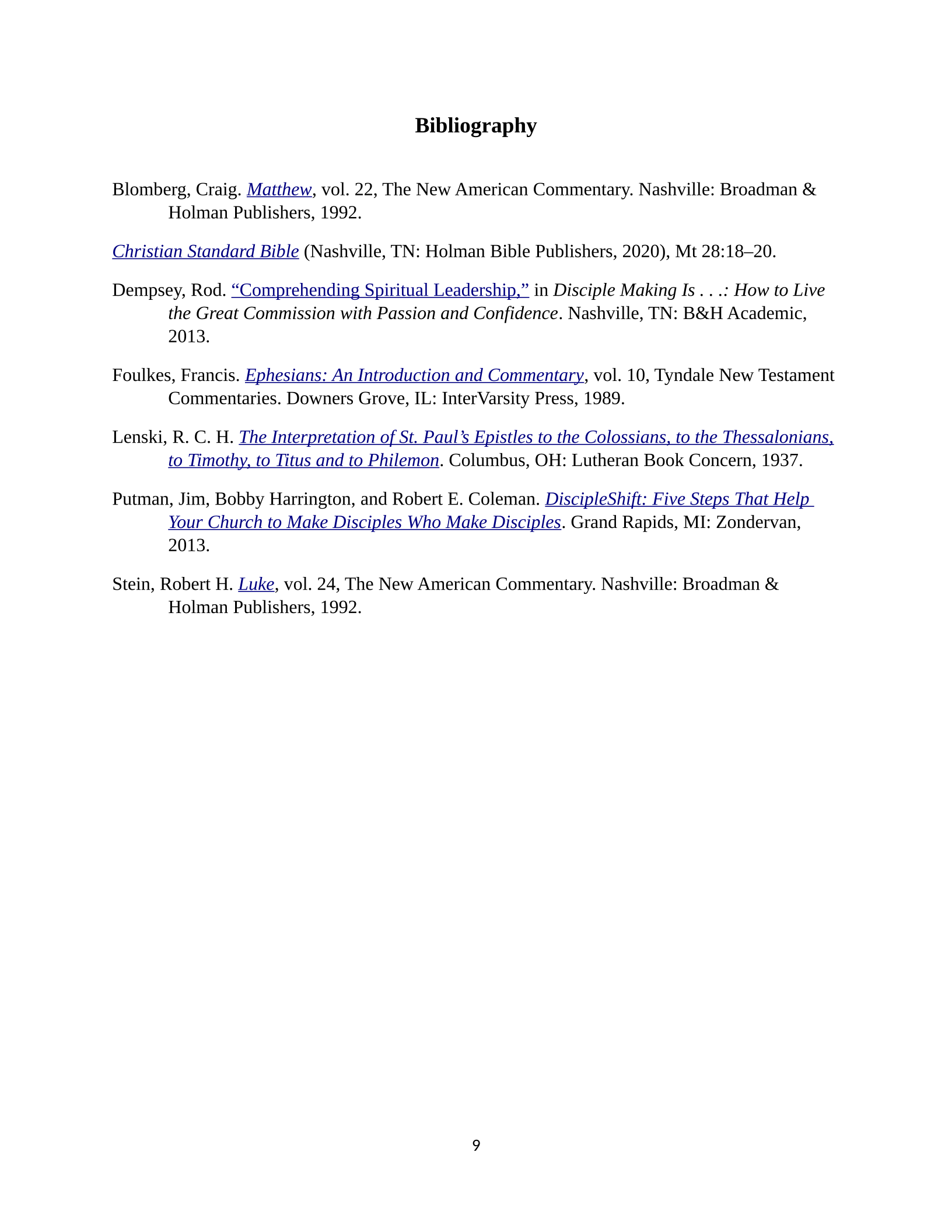
Bibliography
Blomberg, Craig. Matthew, vol. 22, The New American Commentary. Nashville: Broadman &
Holman Publishers, 1992.
Christian Standard Bible (Nashville, TN: Holman Bible Publishers, 2020), Mt 28:18–20.
Dempsey, Rod. “Comprehending Spiritual Leadership,” in Disciple Making Is . . .: How to Live
the Great Commission with Passion and Confidence. Nashville, TN: B&H Academic,
2013.
Foulkes, Francis. Ephesians: An Introduction and Commentary, vol. 10, Tyndale New Testament
Commentaries. Downers Grove, IL: InterVarsity Press, 1989.
Lenski, R. C. H. The Interpretation of St. Paul’s Epistles to the Colossians, to the Thessalonians,
to Timothy, to Titus and to Philemon. Columbus, OH: Lutheran Book Concern, 1937.
Putman, Jim, Bobby Harrington, and Robert E. Coleman. DiscipleShift: Five Steps That Help
Your Church to Make Disciples Who Make Disciples. Grand Rapids, MI: Zondervan,
2013.
Stein, Robert H. Luke, vol. 24, The New American Commentary. Nashville: Broadman &
Holman Publishers, 1992.
9
Powered by TCPDF (www.tcpdf.org)

