


Course Reflection- Discipleship Ministries
Beth Buster
DSMN 500- Discipleship Ministries
March 10, 2023
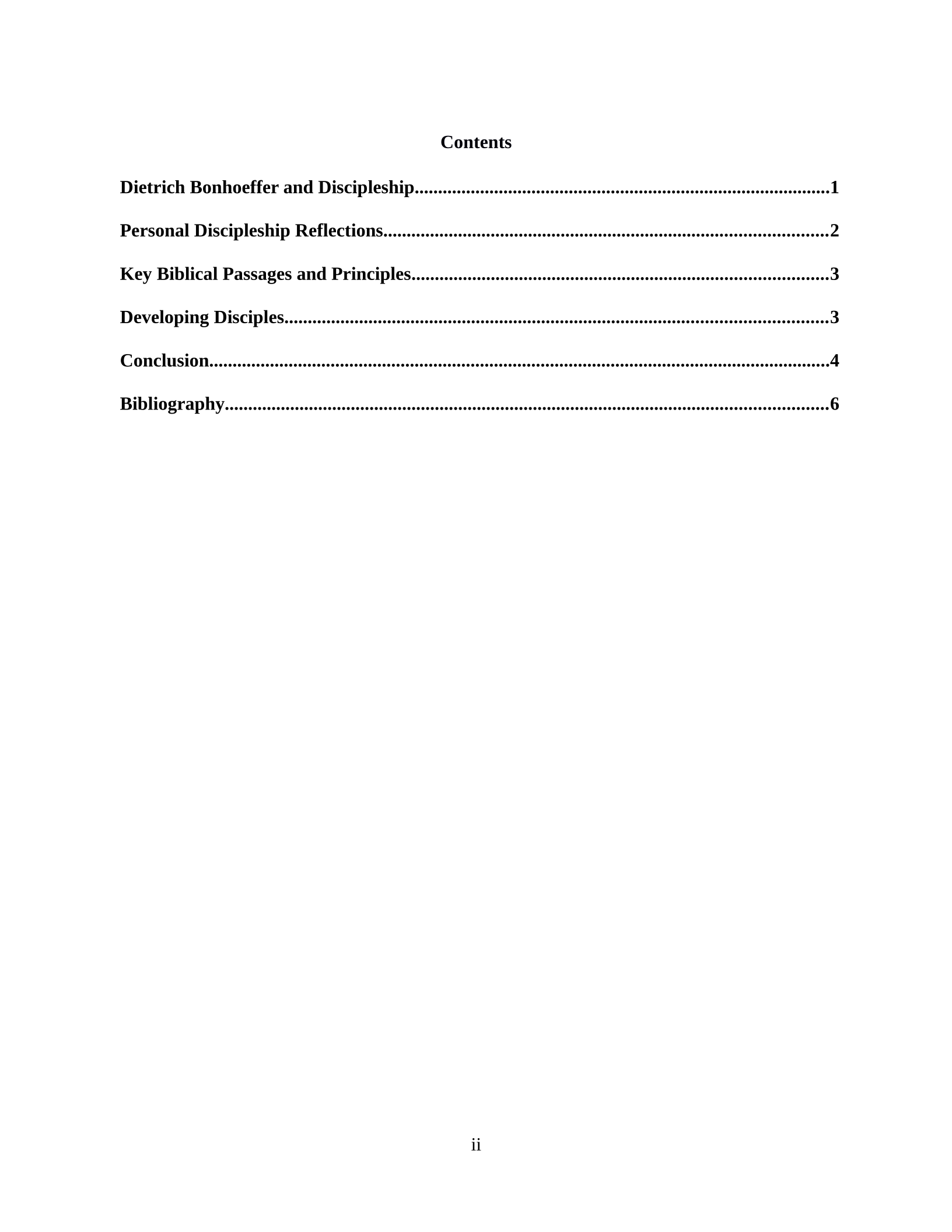
Contents
Dietrich Bonhoeffer and Discipleship.........................................................................................1
Personal Discipleship Reflections...............................................................................................2
Key Biblical Passages and Principles.........................................................................................3
Developing Disciples....................................................................................................................3
Conclusion.....................................................................................................................................4
Bibliography.................................................................................................................................6
ii
1
Discipleship Ministries has been an eight-week course to “examine the biblical, general,
and specific steps to enable a person first to be a disciple, then to discover systems, biblical
principles, and methods that create a disciple making context. The connection between spiritual
formation and discipleship will be analyzed in the context of a Biblical community in a local
church. The practical models of discipleship will be thoroughly discussed and designed.”1
This essay is a summary of what has been learned regarding the nature, purpose, and practice of
disciple making, while reflecting on the major points learned regarding the cost of discipleship,
the key passages, the best practices and key points of application in regard to disciple
making.
Dietrich Bonhoeffer and Discipleship
In reading the text by Dietrich Bonhoeffer, it describes why discipleship is costly. There
are several areas of someone’s life they must be in control of willing themselves to pursue them
consistently. As disciples of Christ, individuals must display humility, have self-denial, seek
heaven’s wealth, endure suffering, and strive to maintain peace. Each of these is what believers
are to do to ensure their relationship with the LORD aligns with the image that Jesus portrays. As
said by Bonhoeffer, “discipleship is a commitment solely to the person of Jesus Christ, a
breaking through of all legalisms by the grace of Him who calls.”2
According to Bonhoeffer, there are two kinds of grace: cheap grace and costly grace.
Cheap grace is one without price, without cost.3 This is grace that comes without discipleship;
this is what Christians enjoy when they have their sins forgiven but do not take up their cross and
follow Christ on His kingdom mission. Costly grace is grace with discipleship, where a Christian
1 Liberty University DSMN 500 Course Syllabus.
2 Dietrich Bonhoeffer, Dietrich Bonhoeffer Works, Volume 4, (Minneapolis: First Fortress Press, 2003), 59.
3 Ibid., 43.
2
takes up their cross and follows Christ (Matt. 16:24). It is the kind of grace for which a person
will gladly sell their possessions.4 Bonhoeffer goes on to explain that “when Christ calls a man,
he bids him to come and die.”5 This goes to show that there cannot be discipleship without a cost,
and believers must be ready and willing to pay the cost.
Personal Discipleship Reflections
In a modern culture that seems to have no room for absolute truths, the Church could
appear to have lost all relevance. Contrary to this observation, the gospel is the living word of
God and therefore powerful and pertinent to modern society. Therefore, all parts of the Church
play a vital role and every part and every person functions as agents of transformation. A healthy
body of Christ will comprise transformed lives that preach the gospel, practice relational living,
use their spiritual gifts to serve in ministry, and give willingly both time, money, and energy.
Christ gave the disciples a simple yet eternally binding instruction that has been termed the Great
Commission. He told them to go and make disciples in all parts of the world (Matthew 28:19-
20). Every believer has the task of bringing the good news of Christ to others, and the Church
should be equipping disciples for the Kingdom of God.
The key to personal discipleship is spiritual formation. Spiritual growth or formation is
accomplished in three areas of practice. By showcasing an upward, inward, and outward love, a
disciple will exhibit a love for God, for one another, and for neighbors. Erickson states,
“Spiritual formation is character formation. Spiritual formation in a Christian tradition is the
4 Ibid., 45.
5 Ibid., 89.
3
process of establishing the character of Christ in the person.”6 This is key for personal
discipleship.
Key Biblical Passages and Principles
There is substantial biblical support for the people of God to make disciples. It is
essential to the life of a believer and the church. The author defines a disciple as gospel centered
(1 Cor. 15:3-4), discipleship driven (Matt. 28:19-20), and family focused (Deut. 6:4-9). The
passion of the author is to mentor and disciple families and children; to come alongside parents
of all ages and give them the courage, tools, and confidence to disciple their children to become
true, missional disciples.
A Christian parent must understand their role as a steward of the
children God bestowed them and seek only for the glory of God through the
discipleship of their children. It is the reminder, “if you do not really love
Jesus, then you will not truly love the people you lead. Nothing but the love
of Christ will compel you to go cheerfully through the difficulties and
discouragements you experience as a leader.”7 Parenting in the context of
discipleship mirrors Jesus to wash feet (John 13:1-17), to lay down one’s own
life (John 15:13), to “deny himself, and take up his cross and follow” Jesus
(Matt 16:24). Only in following Jesus can a parent truly lead their family to
God.
6 Matthew Erickson, “Time to Live: Christian Formation through the Christian Year,” Journal of Spiritual
Formation and Soul Care 12 (January 2019), 31.
7 Ken Blanchard and Phil Hodges, Lead Like Jesus (Nashville: Thomas Nelson, 2005), 178.

4
Developing Disciples
The emphasis for a family discipleship model should be shifted away
from the congregational meetings to the small group, with greater emphasis
being placed on the growth groups or super small groups, comprised of two
to four people or families in regular contact for accountability, evangelism,
and spiritual transformation. Ideally, a couple that is further along in raising
children would help facilitate a group with young adults and families. This
model provides greater flexibility in meeting the unique spiritual needs of
each person faces. In this way the members of the small group are
encouraged and empowered toward involvement in the daily life of others,
providing greater encouragement, opportunity, and accountability for
participation in making disciples. “Christians need other Christians who
speak God’s word to them.”8 It will be important for these groups to
celebrate life’s achievements together and to hold each other up when
tragedy strikes. These groups become the model that will teach the children
to become the next generation of disciples. These small groups will be
challenged to thrive outside of the regular Sunday gatherings in daily
contact, encouragement, and prayer for and with one another.
Conclusion
When looking across the memberships of the church, Generation X and younger are
largely missing from the rolls. The author believes this is because these generations were no
8 Dietrich Bonhoeffer, Life Together (Minneapolis: Fortress Press, 2015), 6.
5
longer discipled by the church, they were just sent to church. Anything church or religion based
happened on Sundays or Wednesdays, and were conducted by specific, titled adults. And while
this is not all together a bad thing, the concept that Christianity is an everyday, every moment
commitment is lost on these generations. These generations were told to bring someone to the
church, not to go and be the church. The church must change this model and make
personal discipleship of utmost importance. This must be purposeful and
intentional to maintain steadfast endurance through the difficult times of
discouragement and humility during the highest points of jubilation. In this
way the Christian truly obeys the greatest commandments, to love God and
love others, through the public worship of God through proclamation of the
gospel and loving others enough to reveal truth and hope.
6
Bibliography
Blanchard, Ken and Phil Hodges. Lead Like Jesus. Nashville: Thomas Nelson, 2005.
Bonhoeffer, Dietrich. Dietrich Bonhoeffer Works, Volume 4. Minneapolis: First Fortress Press,
2003.
Bonhoeffer, Dietrich. Life Together. Minneapolis: Fortress Press, 2015.
Erickson, Matthew. “Time to Live: Christian Formation through the Christian Year,” Journal of
Spiritual Formation and Soul Care 12. January 2019.
Powered by TCPDF (www.tcpdf.org)

