


1
Running Head: PSYCHOLOGICAL REPORT
PSYCHOLOGICAL REPORT
Erin Haynes-Briggs
Liberty University
2
INTIAL INTERVIEW
PSYCHOLOGICAL REPORT
Client’s Name: Zipporah Smith
REFERRAL QUESTION/REASON FOR TESTING:
Ms. Smith was referred to counseling by the summer missions’ board for a candidate
evaluation. She is being considered as a candidate for a mission’s trip in West Africa. This
evaluation is to determine if Ms. Smith would be able to adapt well to the unknowns of a new
environment and unpredictable challenges that could arise when working with children and
family in extreme poverty and hardships. In addition, the evaluation is to identify any current
problems or concerns that Ms. Smith may have, including any issues that could result from
the challenges she may encounter in the new environment.
ASSESSMENTS ADMINISTERED:
Examinee Biography
IPIP-NEO
Duke Health Profile (DUKE) and Duke Anxiety-Depression (DUKE-AD)
Hardiness Scale (HS)
The Stress Arousal Checklist (SACL)
EXAMINEE BACKGROUND:
Ms. Smith is a 35-year-old, bi-racial (black/white) woman. She is of average height and
average weight. Ms. Smith is professionally dressed and presents a maintained exterior. She is
very clear in her thought process and shows signs of healthy insight and judgment. In the
initial interview, Ms. Smith appeared nervous about the unknowns of the evaluation process,
which quickly faded, as she grew comfortable with the process. She is open about discussing
all areas in her life and was friendly, honest, and genuine throughout the interview. Ms.
Smith’s family relationships are described as close and connective. She is close with her
parents and her three siblings and their families.
She is very active in her community, her church, and in her family. Her personal relationship
with Christ guides her in making positive, selfless choices in life and provides meaning to
honoring commitments to others. She enjoys helping others overcome obstacles and find new
ways to live positively. She perceives herself as one who will drop everything to volunteer her
assistance to others. She is very passionate about extending time and energy to others, and
feels she connects with people in distress. She does not take a lot of personal time for herself
and has a low number of close friends. She states she has many acquaintances from work and
church, but reports having only a few intimate friendships; her closest friendship is with her
sister. When Ms. Smith does take personal time, it may include reading, journal writing,
hiking, running or dancing. In times of stress, she is able to relax through learned problem-
solving skills.
3
INTIAL INTERVIEW
She is able to recognize causes of mood changes and practices self-awareness techniques in
order to maintain a healthy and stabilized mood. She has dealt with several forms of
discrimination as a child and as an adult, yet she is positive about how those circumstances
have only added to her optimistic perspective on life. One area of her life that may be
problematic for Ms. Smith is the number of extra hours she works each week, which have led
to fatigue and mood changes.
SUMMARY OF TEST RESULTS:
IPIP-NEO
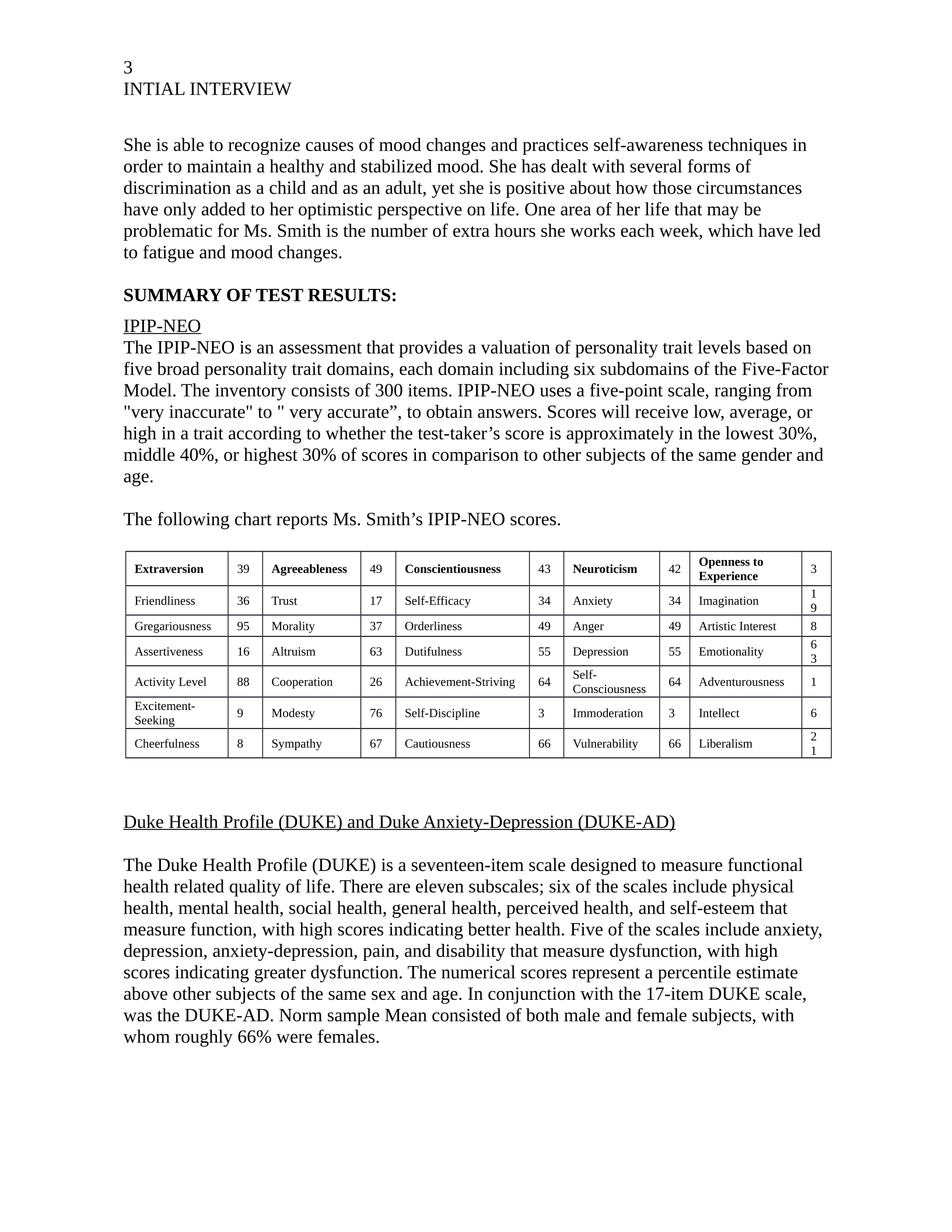
The IPIP-NEO is an assessment that provides a valuation of personality trait levels based on
five broad personality trait domains, each domain including six subdomains of the Five-Factor
Model. The inventory consists of 300 items. IPIP-NEO uses a five-point scale, ranging from
"very inaccurate" to " very accurate”, to obtain answers. Scores will receive low, average, or
high in a trait according to whether the test-taker’s score is approximately in the lowest 30%,
middle 40%, or highest 30% of scores in comparison to other subjects of the same gender and
age.
The following chart reports Ms. Smith’s IPIP-NEO scores.
Extraversion 39 Agreeableness 49 Conscientiousness 43 Neuroticism 42 Openness to
Experience 3
Friendliness 36 Trust 17 Self-Efficacy 34 Anxiety 34 Imagination 1
9
Gregariousness 95 Morality 37 Orderliness 49 Anger 49 Artistic Interest 8
Assertiveness 16 Altruism 63 Dutifulness 55 Depression 55 Emotionality 6
3
Activity Level 88 Cooperation 26 Achievement-Striving 64 Self-
Consciousness 64 Adventurousness 1
Excitement-
Seeking 9 Modesty 76 Self-Discipline 3 Immoderation 3 Intellect 6
Cheerfulness 8 Sympathy 67 Cautiousness 66 Vulnerability 66 Liberalism 2
1
Duke Health Profile (DUKE) and Duke Anxiety-Depression (DUKE-AD)
The Duke Health Profile (DUKE) is a seventeen-item scale designed to measure functional
health related quality of life. There are eleven subscales; six of the scales include physical
health, mental health, social health, general health, perceived health, and self-esteem that
measure function, with high scores indicating better health. Five of the scales include anxiety,
depression, anxiety-depression, pain, and disability that measure dysfunction, with high
scores indicating greater dysfunction. The numerical scores represent a percentile estimate
above other subjects of the same sex and age. In conjunction with the 17-item DUKE scale,
was the DUKE-AD. Norm sample Mean consisted of both male and female subjects, with
whom roughly 66% were females.
4
INTIAL INTERVIEW
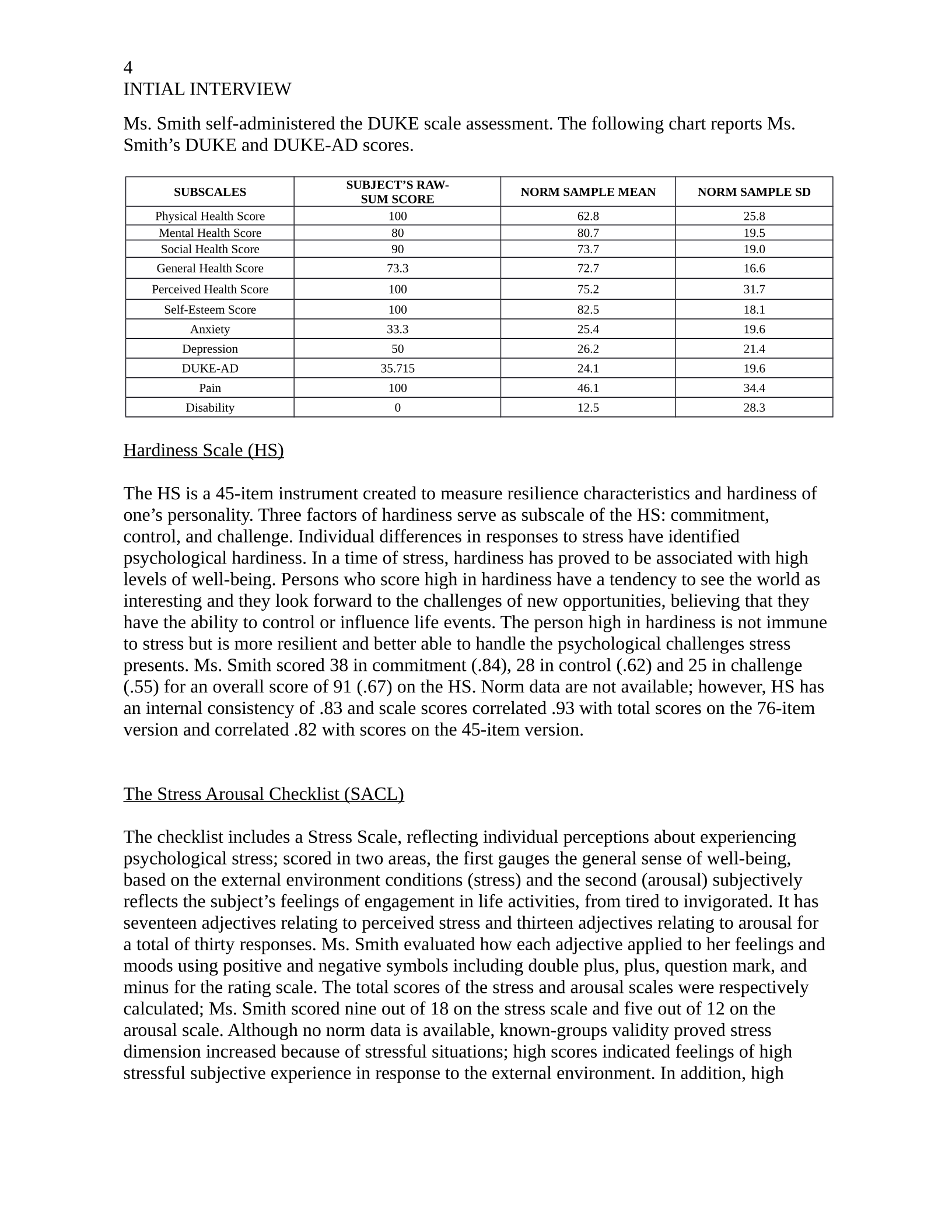
Ms. Smith self-administered the DUKE scale assessment. The following chart reports Ms.
Smith’s DUKE and DUKE-AD scores.
SUBSCALES SUBJECT’S RAW-
SUM SCORE NORM SAMPLE MEAN NORM SAMPLE SD
Physical Health Score 100 62.8 25.8
Mental Health Score 80 80.7 19.5
Social Health Score 90 73.7 19.0
General Health Score 73.3 72.7 16.6
Perceived Health Score 100 75.2 31.7
Self-Esteem Score 100 82.5 18.1
Anxiety 33.3 25.4 19.6
Depression 50 26.2 21.4
DUKE-AD 35.715 24.1 19.6
Pain 100 46.1 34.4
Disability 0 12.5 28.3
Hardiness Scale (HS)
The HS is a 45-item instrument created to measure resilience characteristics and hardiness of
one’s personality. Three factors of hardiness serve as subscale of the HS: commitment,
control, and challenge. Individual differences in responses to stress have identified
psychological hardiness. In a time of stress, hardiness has proved to be associated with high
levels of well-being. Persons who score high in hardiness have a tendency to see the world as
interesting and they look forward to the challenges of new opportunities, believing that they
have the ability to control or influence life events. The person high in hardiness is not immune
to stress but is more resilient and better able to handle the psychological challenges stress
presents. Ms. Smith scored 38 in commitment (.84), 28 in control (.62) and 25 in challenge
(.55) for an overall score of 91 (.67) on the HS. Norm data are not available; however, HS has
an internal consistency of .83 and scale scores correlated .93 with total scores on the 76-item
version and correlated .82 with scores on the 45-item version.
The Stress Arousal Checklist (SACL)
The checklist includes a Stress Scale, reflecting individual perceptions about experiencing
psychological stress; scored in two areas, the first gauges the general sense of well-being,
based on the external environment conditions (stress) and the second (arousal) subjectively
reflects the subject’s feelings of engagement in life activities, from tired to invigorated. It has
seventeen adjectives relating to perceived stress and thirteen adjectives relating to arousal for
a total of thirty responses. Ms. Smith evaluated how each adjective applied to her feelings and
moods using positive and negative symbols including double plus, plus, question mark, and
minus for the rating scale. The total scores of the stress and arousal scales were respectively
calculated; Ms. Smith scored nine out of 18 on the stress scale and five out of 12 on the
arousal scale. Although no norm data is available, known-groups validity proved stress
dimension increased because of stressful situations; high scores indicated feelings of high
stressful subjective experience in response to the external environment. In addition, high
5
INTIAL INTERVIEW
scores for arousal indicated high concentration, attention, or judgment level for ongoing
automatic activity; repetitive tasks increased stress while reducing arousal.
PSYCHOLOGICAL IMPRESSIONS:
Ms. Smith is a friendly, open, and passionate woman. She expresses herself fluently through
her word choices and use of hand gestures, which help articulate her ideas. She perceives
herself as a positive person who is merciful, direct, caring, willing to help others, and often
driven by her emotions.
Results of the IPIP-NEO (Extraversion, Agreeableness, Conscientiousness and Neuroticism
domains), DUKE (Self-Esteem subscale), and DUKE-AD (Anxiety subscale), support that
Ms. Smith appears to be capable of being both extraverted and introverted. This suggests that
she can make friends easily and function cooperatively in group settings, willing to take
action and be a leader in activities, while also being self-disciplined and equally comfortable
working alone, able to accomplish tasks in an organized manner. Ms. Smith scored highest in
the Gregariousness, Friendliness and Activity Level subdomains of Extraversion domain of
the IPIP-NEO, which indicates Ms. Smith is likely to find the company of others
pleasantly stimulating and rewarding as she bring a positive, friendly, energetic
force and drive to accomplish tasks to the mission team, showing her to be an asset to the
team.
The SACL (Stress, Arousal scale) and HS (Commitment and Control subscales) support the
notion that Ms. Smith has developed effective coping skills when dealing with stressful
situations. The SACL reported Ms. Smith having a medium score on the stress scale when
presented with stressful situations and medium-low arousal score, which means she is likely
to respond calmly, and be slow to have an emotional outburst, possessing personal resources
that allow her to cope effectively with stressful situations. Her marks on the HS (Control
subscale) appear to indicate she firmly believes in her ability to control or influence
proceedings. Ms. Smith has a strong sense of doing God’s work and being a vessel for Him to
use. This passion combined with her scores on the HS (Commitment subscale), seems to
suggest she will see the mission work as meaningful and will be committed to achieving a
positive end, thereby having higher incentive to work through stressful situations, working
competently to solve problems.
At the same time, Ms. Smith may find herself anxious in challenging environments with
which she is not familiar, as reflected in her scores on the HS (Challenge subscale), as well as
the IPIP-NEO (Anxiety domain). It would appear to be important for Ms. Smith to understand
as much of the cultural differences and potential physical challenges that may be present at
the refugee camp as possible prior to her arrival. Some of her past anxieties seemed to come
from being self-conscious about drawing attention to herself and if she inadvertently violated
a cultural norm, causing embarrassment, she could shut down and be a less effective team
member. It is likely a similar concern for Ms. Smith would be any actual physical challenges
6
INTIAL INTERVIEW
in way of climate or terrain. Via the DUKE scale assessment (Physical health, General health,
and Perceived health subscales), Ms. Smith did indicate that her health is good and not a
concern. In her interview, however, she mentioned that her weight sometimes causes her to
have a lack of energy; according to her self-assessment, she suffers from moderate anxiety
and depression (Anxiety and Depression subscales, DUKE-AD) at times regarding her health.
There has been no indication that Ms. Smith would be physically impaired by or incapable of
traveling to Ghana; mental preparation and awareness of the environment would appear to be
sufficient for her to face any such environmental challenge.
When faced with challenges, whether external or internal, Ms. Smith reports viewing them as
an opportunity or a way to learn something new, rather than getting upset, or becoming
unmotivated or frustrated. Her HS (Hardiness Scale) overall score indicates she is likely to
move forward from difficult situations sooner than others might, learn from mistakes, and be
more flexible with her plans in life. She is easy-going, agreeable, friendly, and joyful and with
her high score on the IPIP-NEO (Agreeableness domain), it seems possible her way of
interacting with others will benefit the group on the mission trip. As mentioned, there may be
moments when Ms. Smith would feel overwhelmed or discouraged, but her optimistic view is
normally her most consistent with her ways of handling setbacks, challenges, and the
unknowns of new experiences.
As was reflected in the elevated score on the IPIP-NEO (Cautiousness subdomain), Ms. Smith
reports she likes to think through situations before acting or reacting. She states she would
welcome others taking the lead and directing her activities in new surroundings. In a new
environment where learning and taking direction is needed, she is likely to excel. The ability
to allow others to lead and not feel challenged is a beneficial asset on mission trips; following
directions in an unknown and new setting can be key to a successful trip. Additionally, Ms.
Smith requires low levels of stimulus and enjoys alone time, so will not likely need to be
supervised or be with a group at all times. She may not be very adventurous; yet being
conscientious and cautious before venturing into something will probably keep her from
getting into harm’s way and becoming a liability. Instead of being impulsive, Ms. Smith is
likely to think before she acts. It appears she will set realistic goals, create well thought-out
plans, use practical organizational skills, and will work hard to accomplish projects. With the
limited amount of time available on a mission trip, Ms. Smith would seem to offer an
advantage to her team and would vigorously work to complete task. Her determined mindset
and her impassioned heart for others will most likely drive her to completing whichever tasks
she undertakes because the reward of helping others is very pleasing to her internally and she
is rewarded by seeing the progress of external goals.
The high score of the Emotionality sub-domain (Openness to Experience domain) of the IPIP-
NEO and SACL (Arousal scale) indicates Ms. Smith may experience strong emotions and
once she becomes emotional, it may also take her a little longer to get back to a normal state
than someone who is less aware of their emotions. There are positives and negatives possible,
of course, with any elevated emotional state.
On the negative side, Ms. Smith could become so fixated on helping people on the mission
trip that she would go above and beyond, putting the needs of everyone else first, draining
7
INTIAL INTERVIEW
herself and perhaps responding or behaving inappropriately in her zeal to serve. Curbing her
enthusiasm might be difficult. Seeing children in need, hearing the stories of horror and pain
from families who saw loved ones killed in front of them, knowing the needs are so great and
desiring to meet as many needs as possible might drive her emotions to arousal. This level of
high arousal could cause Ms. Smith to become overwhelmed, leading to stress and anxiety.
According to DUKE (Mental Health and Social Health subscales) and DUKE-AD (Anxiety-
Depression subscales), she has the potential to express some anxiety and experience
depression. However, her levels are low, which indicates that anxiety and depression are not
part of her daily life.
On the positive side, a focused, determined, compassionate person would be exactly the type
of person needed for a challenging mission trip and Ms. Smith gives no indication of being
someone who is unable to control her impulses and emotions. She is likely to be as resilient
as most other hardy, resilient people, generally calm and able to deal with stress, as the HS
(Hardiness scale) scores indicate that she may view herself as a little more relaxed and calmer
than the average woman. She is not likely to be overly distraught by failure and is likely to be
able to respond quite well to demands as they come along. As mentioned, she has low levels
of anxiety and depression, which indicates she will likely not be affected by future stressors
that can be associated with a challenging environment. This was consistent with information
gathered during the initial interview, wherein Ms. Smith reported that when things become
overwhelming, she has learned to appropriately and positive find alternative methods for
reliving stress, which results in stabilized moods. Her learned coping skills can ensure that
when faced with difficulties, her physical and mental status will likely remain stable.
She expresses empathy and compassion for those less fortunate. She is likely to be positive
and uplifting to those in need and enjoys encouraging others. She genuinely enjoys helping
others in need and finds as self-gratifying being able to meet the needs of others. She has no
problem putting others’ needs before her own, as indicated in the initial interview: she
reported not taking much personal time because she is actively involved in volunteering with
organizations that assist vulnerable people. The IPIP-NEO (Agreeableness domain) supports
the notion that is she emotionally driven to be moved by other people’s pain and will likely
work hard to offer help in combating injustice and find the truth behind problems. Her
tendermindedness should allow her to sympathize with other people dealing with life
challenges, as well as other team members on the mission trip. It seems she will do well on
the mission trip because the people she will be helping have experienced extreme trauma,
economic hardship, and have a lack of resources, which makes them unable to enjoy a
sustainable future and in such a situation where she can focus her attention on others, she will
likely thrive
Interpersonal conflicts are defiantly a struggle that is present in Ms. Smith’s life, more so than
struggles with environmental stressors. This is supported by the results of the SACL (Stress
Arousal Checklist) and HS (Hardiness Scale) and IPIP-NEO throughout all the domains. She
states she typically prefers familiar routines and may show signs of feeling uncomfortable
with the unknown conditions involved in an environment, as might be expected on the
mission trip, but she is flexible, and it should not take long for her to adjust to the
environmental changes. She shows concerns about being accepted by others and may get
8
INTIAL INTERVIEW
embarrassed easily, which is most likely why she works at living a well-organized and
systematic life. In moments when she perceives she is being attacked or criticized, she may
experience shame, rejection, discouragement, and sadness, which are more internal beliefs
than factual external factors. It seems these feelings are more common with people with
whom she has a close relationship or with people she feels has authority over a specific
important area in her life. Ms. Smith’s level of internal self-confidence is not particularly
high. She does not view herself as extremely effective, but that emanates from a modest
perception of self as noted in IPIP-NEO (Modesty subdomain). This aspect of Ms. Smith’s
personality may not be observed by mere acquaintances, because she gives the impression
that she is confident, full of life and joyful. The way she perceives herself does not negatively
affect her ability to work with others or her ability to remain focused on completing tasks or
confronting challenges.
CONCLUSIONS AND RECOMMENDATIONS:
Ms. Smith is a 35-year-old female who was referred for evaluation to determine if she would
be a good candidate that can emotionally, mentally, and physically handle the stresses that
may arise from an unpredictable challenging environment. She is single and is employed as an
Assistant General Manager of a hotel, while attending online college.
The psychological assessments that were used to evaluate Ms. Smith’s mental, emotional, and
physical ability included the Examinee Biography, IPIP-NEO, Duke Health Profile (DUKE)
and Duke Anxiety-Depression (DUKE-AD), Hardiness Scale (HS), and The Stress Arousal
Checklist (SACL).
Based on the results of the assessments, it is the conclusion of this examiner that Ms. Smith is
an acceptable candidate for participation in the mission trip for the following reasons:
a) Ms. Smith’s optimistic outlook on life and drive for positive interactions will
be a mutual benefit for the people she will be helping and for the other team members
of the mission group.
b) Ms. Smith is not likely to engage in negative interaction or impulsive behavior
that could cause the mission team to be viewed as a liability risk in an already
challenging environment.
c) Ms. Smith exhibits particular qualities that will support her ability to cope with
stressful situations that may arise in a challenging mission environment and she
possesses qualities that will add to the mission team’s goals.
Powered by TCPDF (www.tcpdf.org)

