Building a Research Design
2
Building a Research Design
Quantitative
Approved Research Question
Does virtual reality have more of an impact than traditional exposure therapy in adults
with PTSD?
Experimental Design (Experimental, Quasi-experimental, Correlational)
The most appropriate design for my research question would likely be a randomized
controlled trial (RCT), which falls under the category of experimental design. This design allows
for a more rigorous comparison between virtual reality exposure therapy and traditional exposure
therapy, helping establish a causal relationship between the intervention and its impact on PTSD
symptoms. It allows for better control over potential confounding variables, helping to establish
a cause-and-effect relationship between the type of therapy (independent variable) and its impact
on PTSD symptoms (dependent variable).
Participants
My participants would be adults who have been diagnosed with PTSD. It's important to
ensure that the sample is representative of the broader population of adults with PTSD to
enhance the generalizability of your findings. I would randomly assign participants to either the
virtual reality or traditional exposure therapy group to ensure that any observed differences can
be attributed to the type of therapy rather than individual differences.
Methodology
Building a Research Design
3
My study utilizes a between-subjects design, where participants are randomly assigned to one of
two groups: those receiving Virtual Reality Exposure Therapy (VRET) and those receiving
traditional exposure therapy. This design was chosen to address the research gap highlighted in
the gap statements, emphasizing the need for extensive research to determine the long-term
effects of VRET on individuals with PTSD. This allows for a direct comparison of the
effectiveness of the two interventions for individuals with PTSD.
Incorporating the methodological changes mentioned in the gap statements, such as using
reliable metrics to measure anxiety levels during VRET sessions and investigating potential
moderators of efficacy (e.g., age, gender, types of PTSD), remains relevant and strengthens the
study's design. These adjustments respond to the call for more rigorous and standardized
methodologies in VRET research, ensuring a comprehensive exploration of the intervention's
impact on individuals with PTSD.
Data Collection
Data will be collected through pre- and post-assessments of PTSD symptoms for
participants in both the Virtual Reality Exposure Therapy (VRET) group and the traditional
exposure therapy group. These assessments will be conducted using established and validated
instruments designed to measure PTSD symptom severity. Participants will complete the
assessments before the intervention and after the completion of the therapy sessions. The primary
instrument for assessing PTSD symptoms in this study is the "Posttraumatic Stress Disorder
Checklist for DSM-5" (PCL-5). The PCL-5 is a widely used self-report questionnaire that aligns
with the diagnostic criteria for PTSD outlined in the DSM-5. It provides a reliable and
standardized measure of PTSD symptom severity.
Building a Research Design
4
To extend the research and gain a more comprehensive understanding of the participants'
experiences during therapy sessions, an additional instrument that measures anxiety levels in
real-time during VRET sessions could be added. One potential tool for this purpose is the
"Subjective Units of Distress Scale" (SUDS). Participants could use the SUDS to self-report their
anxiety levels at different points during the VRET sessions. This real-time data could offer
valuable insights into the dynamics of anxiety reduction during exposure therapy.
The Cronbach’s alpha coefficient for the instruments used in this study, specifically the
PCL-5 for PTSD symptom assessment, would be reported based on the data collected during the
study. The alpha coefficient for the SUDS, if included, should also be calculated. The actual
Cronbach’s alpha values can only be determined after data collection and analysis, as they
depend on the specific responses provided by the study participants. I would report this in the
results section of the study which would provide information about the internal consistency
reliability of the instruments used.
Building a Research Design
5
Reference
Freitas, R., Velosa, V. H. S., Abreu, L. T. N., Jardim, R. L., Santos, J. a. V., Peres, B., &
Campos, P. (2021). Virtual Reality Exposure Treatment in Phobias: A Systematic
Review. Psychiatric Quarterly, 92(4), 1685–1710. https://doi.org/10.1007/s11126-021-
09935-6
Wampold, B. O. W., Wampold, B., Heppner, P. O. M., Heppner, P., Owen, J. O., Wang, K. T., &
Of, T. (2020c). Research Design in Counseling.
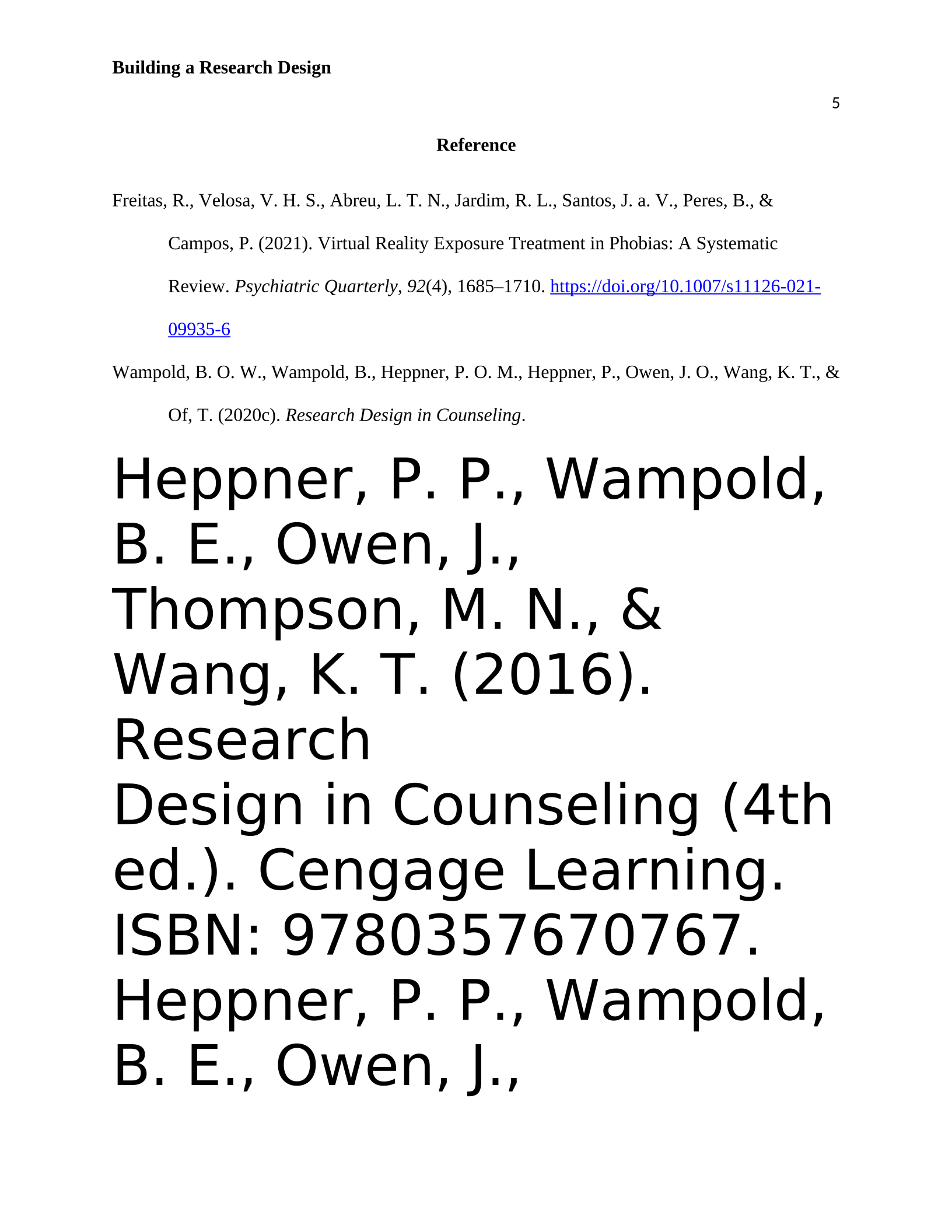
Heppner, P. P., Wampold,
B. E., Owen, J.,
Thompson, M. N., &
Wang, K. T. (2016).
Research
Design in Counseling (4th
ed.). Cengage Learning.
ISBN: 9780357670767.
Heppner, P. P., Wampold,
B. E., Owen, J.,

Building a Research Design
6
Thompson, M. N., &
Wang, K. T. (2016).
Research
Design in Counseling (4th
ed.). Cengage Learning.
ISBN: 9780357670767.
Heppner, P. P., Wampold,
B. E., Owen, J.,
Thompson, M. N., &
Wang, K. T. (2016).
Research
Design in Counseling (4th
ed.). Cengage Learning.
ISBN:
9780357670767.Wampold, B. O. W., Wampold,