



Memorandums, Meeting
Documents
and
Proposals
Memorandum
•Memoranda are brief, informal reports used to establish a record.
•They generalize the communication process by transmitting the
message from one or more authors to one or more recipients.
•E-mail messages typically take the form of memoranda.
•The memorandum is among the most versatile of organizational documents.
•From brief research reports and progress reports to thumbnail
proposals, the memo form is widely used to communicate technical and
administrative information.
•Memoranda are written for numerous internal purposes—for example,
-to request information,
-to make announcements,
-to outline policies, and
-to transmit meeting minutes.
•Thus, in most organizations, memos play a crucial role in establishing a
record of
- decisions,
-requests,
-responsibilities,
-results, and
-concerns.
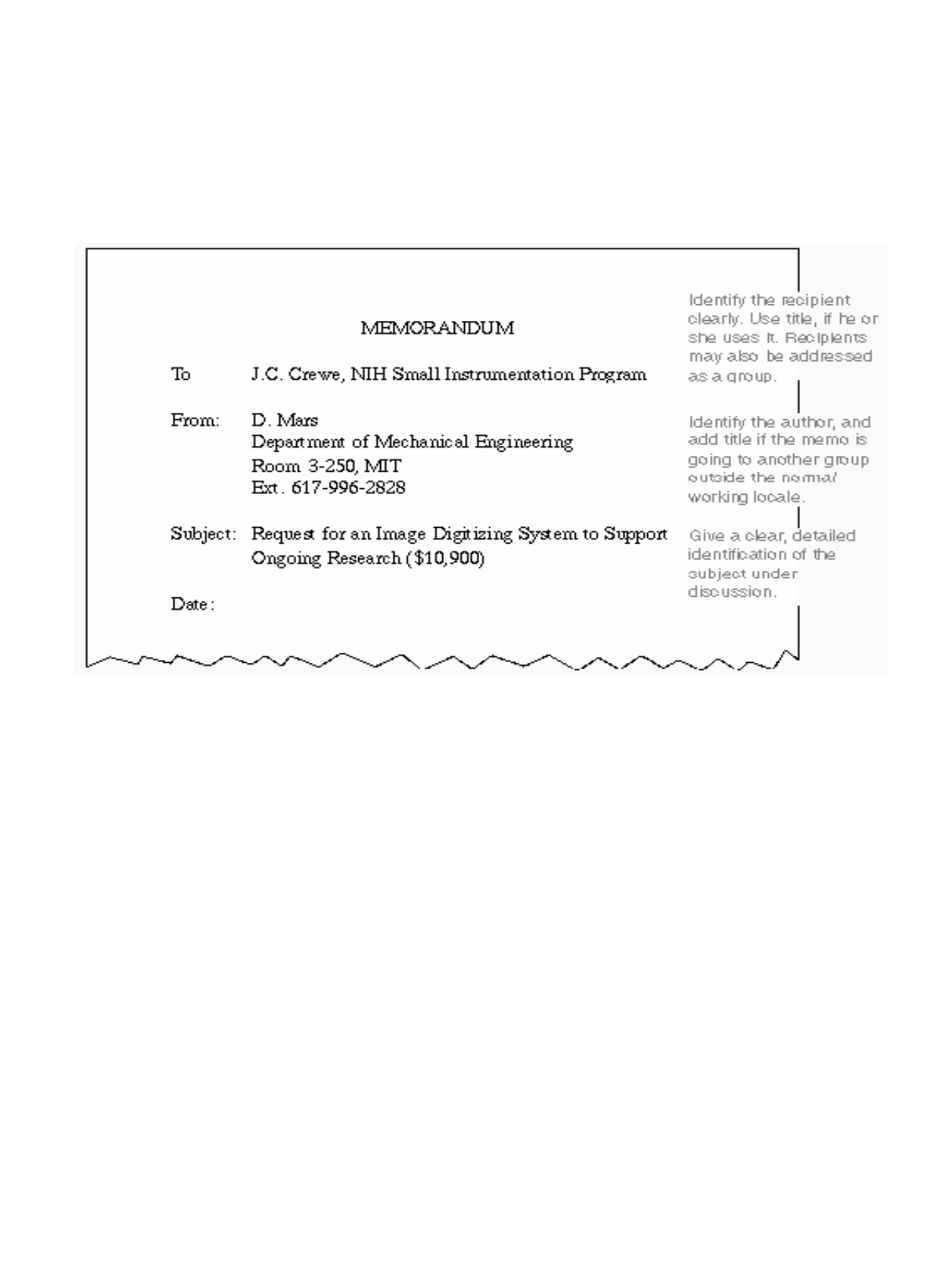
The Memo Heading
• The distinctive element of the memorandum is its heading, which is used
to frame the message in a very accessible and transparent manner.
• Example on next slide.

Meeting Documents
• Use meeting documents as tools to encourage productive and efficient
meetings.
• The two principal meeting documents are the agenda, which tells
participants what topics will be discussed at the meeting, and
minutes, which record what actually occurred.
Agenda
• An agenda is a simple list of topics to be discussed (in order o f listing),
along with the names of individuals who have agreed to lead
discussion of those topics.
• An agenda helps focus a meeting on a core of topics and allows you
to control the pace and flow of a meeting and identify important
items to be acted upon.
• Meetings without published agendas generally seem
unfocused and unproductive.
• Prepare and circulate an agenda of items to be discussed for each meeting.
• Circulation of an agenda before a meeting will allow your audience
to consider their responses to items listed and will help stimulate
discussion.
• Agendas may be circulated by e-mail or hardcopy.
• The advantage of hard-copy agendas is that they may be brought to a

meeting to facilitate the taking of notes during discussion.
• Experienced meeting leaders recognize that both hard-copies and
electronic copies of agenda are usually misplaced, so they bring enough
copies for everyone present at the meeting.
Example
Development Team Agenda
1. Report by Mr. Hamid on investigation of possible
security software
2. Report by Miss Sara on development of database prototypes
3. Discussion of possible hardware platforms
4. Review of deadlines for project
5. Agenda for next meeting
Minutes
• Keep accurate minutes of meetings, both formal and informal.
• Minutes are an essential part of organization life.
• They maintain an institutional memory of all actions taken or proposed
and the key points of discussion.
• They also inform appropriate individuals who were not present at the
meeting of the key action and discussion items.
• Minutes can be formal or informal.
• Formal minutes are often required by federal, state, or local law, by-
laws, charters, or regulations.

• They are usually distributed to the members of the group before the
next meeting, and then approved (sometimes after being amended).

• Some minutes are legally parts of the public record and available to
anyone.
• Often, however, organizational minutes are private and confidential
documents, which should be distributed only to appropriate
individuals.
• If the minutes are confidential, each page should be stamped with
a message such as "CONFIDENTIAL--DO NOT DISTRIBUTE."
•The following information, adapted from Robert's Rules of
Order, is usually included in formal minutes:
– The name of the group that is meeting and what kind of meeting
it is (for example, a general meeting, an emergency meeting, or
a meeting devoted to a single issue)
– Precisely where and when the meeting is being held
– Names of the group members in attendance and members absent;
names of all other individuals present, except for public meetings
with an audience
– The name of the person who called the meeting to order and at what
time
– A report of whether or not the previous meeting's minutes were read
and, if they were read, whether or not they were approved (or
approved with modifications)
– Summaries of any reports presented to the group and any
action taken on them (acceptance, approval, endorsement,

referral)
– A summary of the discussion of each item on the agenda and
any other important issues discussed at the meeting
– A record of all formal motions, including the name of the
individual making the motion
– A record of the vote on all motions, including the number of
votes for and against, and the number of abstentions
– The time that the meeting was formally concluded
– Informal minutes also include the date of the meeting and the
names of all
members attending or absent, but they focus more on
summarizing key
points of discussion and listing all action items
to be performed by individuals or the group.
Proposals
• In a proposal, identify a specific problem and state how you will solve that
problem.
•
Most organizations rely on successful proposal writing for their continued
existence.
• You will most likely spend a major part of your professional life writing
proposals.
•
Proposals are carefully prepared and just as carefully reviewed by
granting
agencies.
• Proposals do not succeed on the strength of a name or as a
result of flashy rhetoric.

• Rather, successful proposals demonstrate that you understand the
scope of the problem (its background, theory, and application) and,
furthermore, that you have developed a valid and well-focused
approach for reaching proposed objectives.

• All proposals develop a plan of action in response to a specific need or
problem.
• Some proposals are external, written in response to a request fo r
proposals or an invitation to bid that has been published by an
external organization.
• Other proposals are internal, written in response to a need
within your own organization.
• In either case, your proposals must show that you understand the
nature of the problem and that you have a specific and well-
developed plan for arriving at a solution.
• Most proposals share a general structure for identifying the
motivating problem, the objectives, and the proposed course of
action.
General Structure
• Learn the basic structure of a proposal.
• Proposals share a general document architecture, which is usually
modified to suit specific circumstances.
• The overall structure of a proposal can be broken down into four parts:
Proposal Structure
•Front matter

• Body
– Introduction
– Technical approach
– Management requirements
– Work plan
• End matter
Front Matter
The front matter of a proposal includes the following
components :
– Letter of transmittal
– Title page
– Summary
– Table of contents
– List of figures and tables
Body
• In the introduction to a proposal, do the following:
• Identify the motivating need or problem.
• Develop the immediate context in which this problem has been highlighted.
• In external proposals be sure you are responding to the published
need and motivation as identified by the outside agency.

• Focus your proposal by stating the key technical issues, as you
perceive them, underlying the motivating problem.
• State explicitly, and with unbiased language, your objectives.
• Identify and explain fully the technical approach you are taking to
reach your objectives.
• Ground your technical approach in a brief explication of necessary
theoretical background:
– applicable theory,
– analytical models,
– previous work, and
– hypotheses.
• Present your method and design for reaching your stated objectives.
• You will most likely make reference to figures in this section.
• State how pertinent data will be acquired, and just as important,
describe your data analysis methods.
• Explain clearly how you will manage the development of your proposal
project.
• Proposal reviewers pay strict attention to this section because here
you show that you have the required know-how to bring a project
to completion.
• In this section, you will present the following information:
– A timetable (or Gantt chart)

– Required facilities and resources
– Materials and equipment
– Personnel (include résumés in appendix)
• Include a work plan, sometimes called a project plan, as a separate
section in all lengthy proposals.
• Preliminary project plans are also sometimes appropriate in
feasibility and recommendation reports.
• In addition, most progress reports refer to all or part of previously
existing project plans.
End Mater
•End Matter
– Bibliography
– Résumés
– Appendixes
Kinds of Proposals
• Proposals may be written or oral, for government agencies or the private
sector.

Revision
•Memorandum
• Meeting Documents
– Agenda
– Minutes
•Proposals
– Proposal Structure

Revising Business Messages
In this lecture you will learn to
• Edit your messages for content and organizational style and readability.
• Choose the most correct and most effective words to make your point.

• Rewrite the sentences to clarify the relationships among the ideas
and to make your writing interesting.
• Identify the elements of paragraph.
• Choose the best design for written documents.
• Rewrite paragraphs using the appropriate development techniques.
• Proof your message for mechanics and format.
Editing your message
•Content and Organization
– Stick to the point, the main idea, in the first paragraph.
– In the middle highlight the key features of your stance.
– Eliminate redundancies.
•Style and Readability
– Re-word to stress the ‘ you’ view point.
– Clarify the relationships among ideas through placement and
combination of phrases.
•Moderate the excessive Enthusiasm
– Eliminate words that seem unfamiliar.
•Mechanics and format
– To avoid confusion spell out the abbreviated phrases.
Evaluate your content and Organization

•After a day or two review the message for content and
organization.
– Is there a good balance between the general and the specifics ?
– Have you provided enough support ?
– Have you double checked the facts and figures?
Review your Style and Readability
•Once satisfied with the structure, review style and readability.
• Readability depends on
– Word choice
– Sentence length
– Sentence structure
– Physical appearance

Access your word choice
• The two key aspects of word choice are
– Correctness
– Effectiveness
• If in doubt, check it out !
Example
• Instead of
– The data on our market share is consistent from region to region.
•Use
– The data on our market share are consistent from region to region.
Plain English
• Plain English is close to spoken English and can be more easily
understood.
Functional words and content words
• Functional words include
– Conjunctions
– Prepositions
– Articles
– Pronouns

• Functional words express relationships among content words.
Example
Some objective observers of the biscuit market give Rio the edge in
quality, but Gala is lauded for superior distribution.
(the content words are in italics)
Connotation and Denotations
• Content words have both a denotative (dictionary) and a
meaning and a connotative (associative) meaning.
Example
1. I have uncovered some interesting dirt on that Police officer.
2. My land has a fertile and dark dirt.
• Both sentences use ‘dirt’ but in different connotations.
Abstraction and Concreteness
• The more abstract a word, the more it is removed from the
tangible, objective world of things that can be perceived with
sense.

Example
• Try to Re-write the sentence without using the words in italics.
– We hold these truths to be self-evident, that all man are created
equal, that they are endowed by their creator with certain
unalienable Rights, that among these are Life, Liberty and the Pursuit
of Happiness.
Words that Communicate
• Wordsmiths are people who are concerned with being clear,
concise and accurate in their use of language.
• When you edit your message, try to think like a wordsmith.
Strong Words
• Verbs and Nouns are more concrete than adverbs and adjectives.
• The more dynamic and specific the verb, the better.
Examples
Avoid Weak Words Use strong phrases
Wealthy
businessman
tycoon
Business prosperity Boom
Hard times slump

Familiar Words
• You will communicate best with the words that are familiar to yo ur
reader.
• At the same time keep in mind, words familiar to one reader might be
unfamiliar to another.
Examples
Avoid Unfamiliar Words Use Familiar words
Ascertain Find out, learn
Consummate Close, bring about
Peruse Read, study
Short words
• Short words are usually more vivid than long ones and improve the
readability of a document.
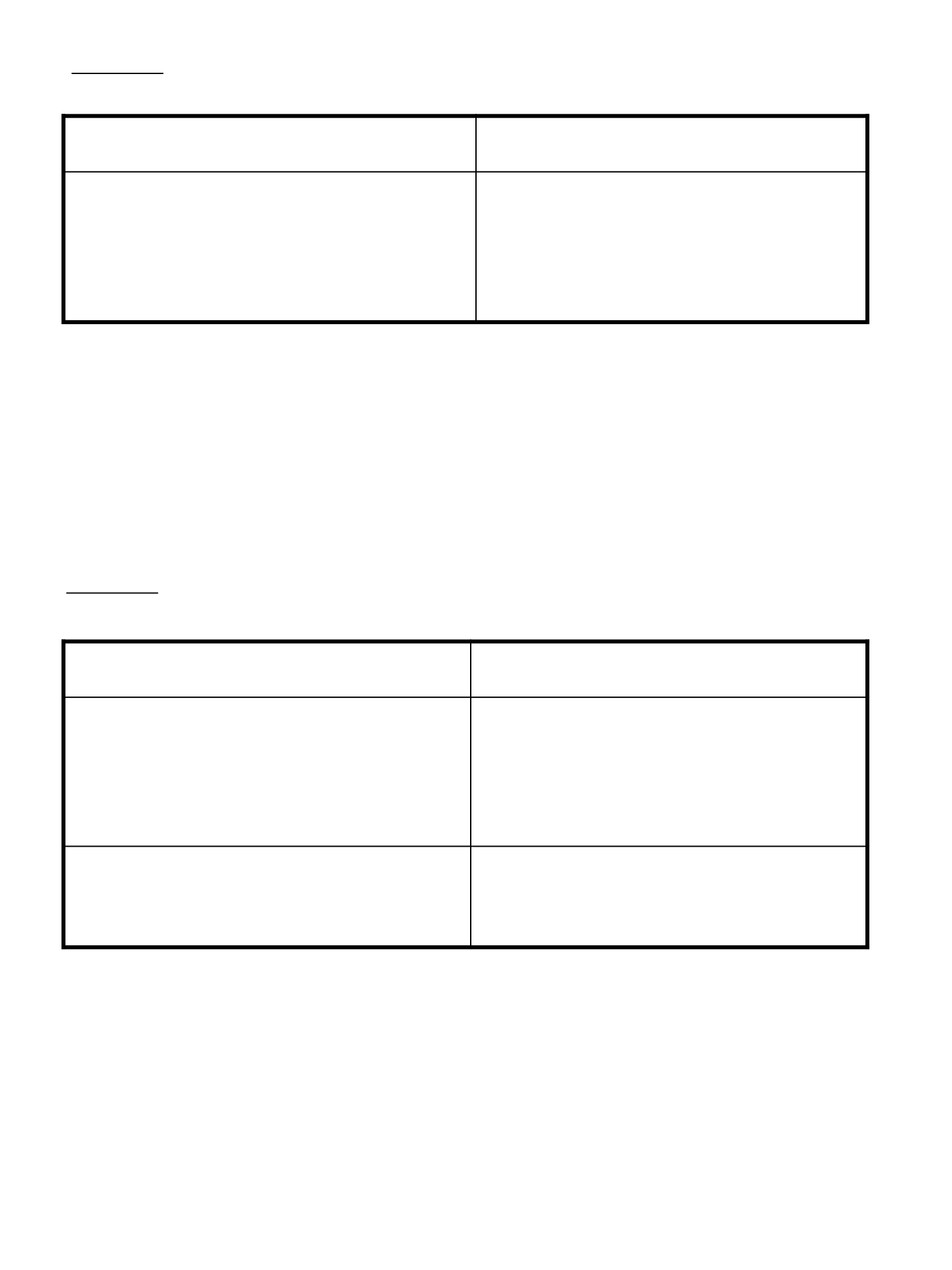
Example
Avoid Long Words Use Short words
During the precedent year, the
company accelerated productive
operations.
Last year the company
sped up
operations.
Camouflaged Verbs
• Turning verbs into nouns and adjectives weakens your writing.
•Watch for endings like –ion, -tion, -ing, -ment, -ant, -ent, -ance and –ency.
Example
Avoid Camouflaged Words Use Verbs
The manager undertook
implementation of the
rules.
The manager implemented the
rules.
Verification of shipments occurs
weekly.
Shipments are verified weekly.
Bias-Free Language
•Avoid biased language that might offend the audience.
– Cultural Bias
– Gender Bias
– Racial and Ethnic Bias
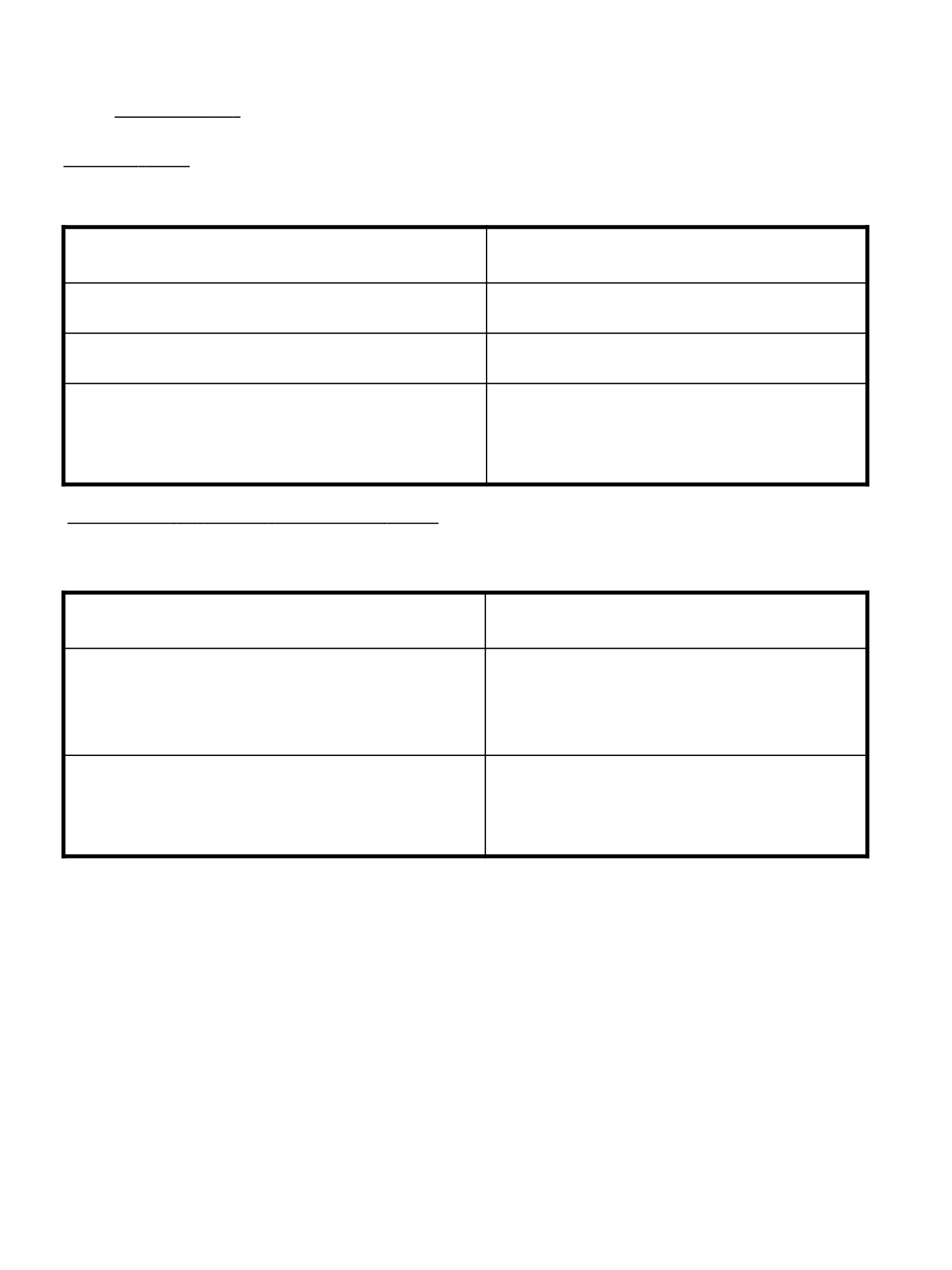
– Disability
Bias Example of
gender Bias
Unacceptable Preferable
mankind Humanity, human-kind
Man-made Artificial, synthetic
manpower Work force, human
energy
Examples of Racial and Ethnic Bias
Unacceptable Preferable
Disadvantaged Sindhi
children
Children from lower income
families
Ali is a unusually tall
Punjabi.
Ali is tall.

Example of Disability Bias
Unacceptable Preferable
Crippled workers face many
barriers on the job.
Workers who have physical
disabilities face many
problems on the job.
Rewriting your Message
•As you edit your message you will find yourself
– Rewriting passages
– Sentences
– Or even whole section
Create Effective Sentence
•
Every sentence contains a subject (noun or noun equivalent) and a
predicate
(verb and related word)
The three types of Sentence
• To give your sentence variety use the three types of sentences
– Simple
– Compound
– Complex
A Simple Sentence
• A simple sentence has a single subject and a single predicate.

– Profits have increased in the past year.
Subject is colored and predicate is underlined.
A Compound Sentence
• A compound sentence expresses two or more independent
but related thoughts.
– Wage rates have declined by five percent, and employee
turnover has been high.
Subject is colored and predicate is underlined
A Complex Sentence
• A complex sentence expresses one independent clause and
one or more dependent clauses.
– Although you may question Ali’s abilities, you must admit that
his morals are strong.
Subject is colored and predicate is underlined

Sentence Style
• Break long sentences into shorter ones to improve readability.
• Active sentences are stronger than passive ones.
• Use passive sentences to soften bad news, to put yourself in the
background, or to create an impersonal tone.
Example
Avoid Passive Sentences Use Active Sentences
Sales were increased by 32%
last month.
Sales improved by 32% last
month
Eliminate Unnecessary Words and Phrases
• Be on the lookout for
– Inefficient phrases
– Redundancies
– Unneeded relative pronouns and
articles Example
Confusing Clear
The project manager told the
engineer last week the
specifications were changed.
The project manager told the
engineer last week that the
specifications were changed.
Emphasize key thoughts

• Emphasize parts of a sentence by
– Giving them more space
– Putting them at the beginning or the end of the sentence
– Making them the subject of the
sentence Example
Less Emphatic More Emphatic
We are cutting the price to
stimulate demand.
To stimulate the demand, we are
cutting the price.
Develop Coherent Paragraphs
• Paragraphs are functional units that revolve around a single thought.
• Elements of a of the paragraph
– Topic sentence
– Related sentences
– Transitional elements

Five ways to develop a paragraph
• Five ways to develop a paragraph
– Illustrations
– Comparisons and contrasts
– Cause and effect
– Classifications
– Problems and solutions
Producing your document
• Written documents require decisions about design elements.
• Design elements include
– White space – free of art text and art work.
– Margins and line justifications – Left justified and rugged right
gives the document an open feeling.
Design Elements
– Headings and Captions – Headings help the reader quickly
identify the content.
– Type Face – refers to the physical design of the letters.
– Type styles – avoid using type styles that slow your readers down.
Example of Type face
Serif Typeface
Sans-Serif Typeface
Times Roman is often used for Helvetica is often used for

text.
TIMES ROMAN IS HARDER TO
READ IN ALL CAPS.
headings.
HELVETICA IS A CLEANER FACE
EVEN IN ALL CAPS.
Design Decisions
• For effective designs pay attention to
– Consistency
– Balance
– Restraint
– Detail
Proofing your Document
• Credibility is affected by your attention to detail and format.
• Use grammar and spell checkers wisely.

Today we learned to
• Edit your messages for content and organizational style and readability.
• Choose the most correct and most effective words to make your point.
• Rewrite the sentences to clarify the relationships among the
ideas and to make your writing interesting.
• Identify the elements of paragraph.
• Choose the best design for written documents.
• Rewrite paragraphs using the appropriate development techniques.
• Proof your message for mechanics and format.

