




What is outreach ministry?
Outreach ministry is the practice of looking beyond yourself to the people around you and
sharing the love of Christ as you serve and connect with your community. This doesn’t require a
big budget or a five-year plan. You can simply start with whatever is in your hand that you can
offer to your neighbor.
Making the most of what is in front of you
There are some days I have to really slow down in the kitchen. As I make my way around,
crafting dinner, the refrigerator is always full of surprises. Diced green peppers hide out in old
butter tins and chopped onion is nestled in repurposed cottage cheese containers. (I would be
lying if I didn’t admit that every once in a while, dinner has gotten interesting due to a case of
culinary mistaken identity.)
When you grow up in a culture where you don’t waste anything, this kind of repurposing is
common. It’s less about affording the good Tupperware, and more about maximizing every bit of
what you have. It is about resourcefulness. Everything can have extended life with a little
urgency and imagination! Outreach is no exception.
Outreach in the Bible
Scripture is full of outreach examples where there was a need, and God’s people got resourceful.
There’s the story of the crowd being fed by five loaves and two fish (Matthew 14). There’s the
time a group of friends figured out how to open up a roof to get their friend to Jesus (Mark 2).
Throughout history, God has used the unlikely, the common, the unexpected. I would even dare
to say that God delights in using the unexpected. We serve a God that is resourceful. And we
reflect God’s image.
How to start an outreach ministry
As you consider what outreach may look like for your church or ministry this upcoming season,
here are a few (resourceful) things to consider.
Ask, “What does our community need?”
This is the number one question we ask churches to consider. We immediately follow that up
with, “The best way to find out is to ask your community.” Resist the urge to start something
without sitting down with parents, nurses, public safety, teachers, whomever your neighborhood
stakeholders are, and asking, “What do you need?” Your instincts may be right. But you may
also hear things that surprise you. Or, you may discover that something you are currently
offering your congregation would also be valuable to your community if they knew about it.
Then, invite your community to dream and do with you. Your neighbors are some of your best
resources.
Look at what you have with fresh eyes (and imagination).

This is where resourcefulness gets its biggest boost! That old lobby may feel unattractive for
coffee hour, but may be dynamite for community karate lessons. That old bus may feel tired for
youth group trips, but experience new life as a food or coffee truck. Patch of dirt by the parking
lot got you down? Not for the folks needing a neighborhood garden. View what you have with
the hopefulness and creativity that the Holy Spirit inspires in all of us. God and your
neighborhood are not waiting for something to be perfect before it can have great purpose.
Besides, isn’t that the good news for all of us?
Rediscover the resources you already have.
Much like the treasures we rediscover when we spring clean, we may sometimes forget that we
already have something in our toolkit that can help our outreach efforts. Maybe people in our
pews carry professional capacity or passion around hobbies, or maybe it’s old props and
furniture found in the dark recesses of the church basement. Do not be afraid to explore the
nooks and crannies to see what is already available. Often, when staff or programs change, things
get lost or put away in the shuffle, and rediscovering them feels like finding something new. Go
explore.
Outreach ministry ideas to get your creative juices flowing
Ask at least one person in your community what they need and what they’re excited
about each week. Let their answers shape your approach to outreach.
Partner with a local agency such as a recovery group or a fitness and health organization,
to see if your building might be a good fit for community classes, meetings, or more.
Start a neighborhood garden.
Invite members of your church or community to share their expertise and hobbies by
teaching others; for example, if you have an artist in your midst, see if they’d be willing
to teach a painting or pottery class.
Reimagine an old truck or van as a food truck.
Consider hosting neighborhood dinners. Whether you potluck together or families bring
their own meals, make it a priority to get together. Share some music, play games, or plan
fun activities where you can get to know your neighbors better.
Serving others isn’t just for adults. It’s important for kids to participate in outreach, too. Ministry
leaders are often seeking out fresh children’s ministry outreach ideas. Before we can talk about
how to do outreach, we first have to know what outreach is. There is an abundance of ways
people define outreach. To help children understand, I like to say that outreach is the practice of
visiting people where they live or where they spend their time, in order to share the good news of
Jesus Christ through serving and building relationships.
Outreach can, however, be defined much more simply!

Outreach is like introducing kids to the open road
I was recently challenged by the words of Pastor Tim Wilson, lead pastor of South Harbor
Church in Byron Center, Michigan. (I’d encourage you to listen to the entire message via podcast
here, or watch on Vimeo here.)
Pastor Tim shared the story of a special car. This car had been a dream come true for its new
owner, so protecting it was the top priority. In order to carry out that directive, the owner built a
beautiful new garage just for the car. On the day the car was delivered, it was rolled into the
garage, and that garage is exactly where it stayed.
Every once in a while, the owner and his wife would go to the garage, carefully take their seats,
turn over the engine, and “enjoy” the car—while it remained in park. After a short time, they
turned the keys and returned to everyday life.
The gear had never shifted into drive. The wheels never felt the pavement. The motor never got
to roar the way it was built to do.
When the owner died, his wife chose to sell the car. The buyer sat completely amazed at the fact
that this vehicle, built for the specific purpose of cruising the open road, had never even been on
a road! By keeping it in the garage, the car would never fulfill the sole purpose for which it was
created.
“If there’s ever been a perfect metaphor for how so many people treat the church …” Pastor Tim
notes.
“If we stay in the garage, we miss the mission of the church. Christians were made for the
open road.”
There it was. Outreach defined. The point isn’t what happens inside the church building. The
point is what happens outside its walls.
When we leave the church building, what does it look like when we walk in our everyday lives?
That is outreach.
This applies to children, too.
We often see “mission projects” in children’s ministry as bringing something into the “garage.”
Pennies, school supplies, and other items collected for a specific charity or mission organization
are great and necessary ways to introduce kids to giving. But it can be difficult for kids to
understand when they never see the end result of their giving. What’s critical to remember is in
order to teach kids to have a true heart for outreach, we must take the car out of the garage! Get
children and families interacting and building personal relationships with those in need. These
experiences on the open road of faith are what directly connect a child’s story to God’s story!

How to “get the car out of the garage”
Now let me go back to my original definition of outreach: the practice of visiting people where
they live or where they spend their time, in order to share the good news of Jesus Christ through
serving and building relationships. There are takeaways from that sentence that are important but
are rarely practiced when talking about children’s ministry outreach ideas.
First, “the practice.” That means we repeat our efforts on a regular basis. Instead of choosing
multiple children’s ministry outreach ideas, choose one that you can live out weekly.
Second, “visiting people where they live or where they spend their time.” Yes, you have to
leave the building. It’s challenging with children’s ministry for certain! That’s where we can get
creative! How can you equip and empower families to carry out outreach with children?
Finally, “in order to share the good news of Jesus Christ through serving and building
relationships.” Your actions are presenting the gospel. Encourage children and families to
simply make friends with others organically and give them encouraging words from the Holy
Spirit.
Twelve children’s ministry outreach ideas
Here are twelve children’s ministry outreach ideas to consider:
1. Make muffins to hand out at a city or school bus stop each week. (If you listened to the
podcast, you know about this story!)
2. Do a weekly prayer walk through a neighborhood. Remember that kids are led by the
Holy Spirit, too! Ask them what and who they feel God leading them to pray for as they
walk.
3. Deliver cookies and thank you cards to a local fire station. Ask the firemen if the kids can
pray protection and blessings over them. Use this opportunity to teach kids to pray God’s
Word over others by praying blessings from Scripture. You can find a list to start with
here.
4. Make thank you cards to deliver to veterans. Challenge families to deliver their cards to
residents at a community veterans’ home or center. You can also purchase affordable flag
pins as a small gift to give with cards.
5. Bring bottled water to construction or road workers near your home or church on a
regular basis.
6. Serve food regularly at a local shelter and have conversations as you can with the
residents. Ask them how you can pray specifically for their needs.
7. When walking through downtown areas, our family is often asked for money by those
experiencing homelessness. We never carry cash, but we do have a powerful gift we can
give at a moment’s notice. If you’re ever in this situation, respond with “I’m sorry, we
don’t carry cash, but could we pray with you?”
8. Connect with a local group home for those with disabilities and ask what their needs are.
There may be an opportunity to play games or make crafts with residents.

9. Make and deliver encouraging cards to residents at assisted living facilities or senior
communities. Arrange a game time with residents. Serve lunch or dinner. Give
manicures. It’s possible to find a different activity to engage with residents every week!
10. Hand out popsicles at a park on warm summer days.
11. Host backyard Bible clubs at people’s houses in your community. Hosts of these clubs
have the opportunity to reach out to their neighbors to build relationships and show the
love of Christ while teaching the kids Bible stories, playing games, and doing crafts all in
their backyards! Be sure to check in with attendees regularly following the event.
12. Ask the local government where the areas of greatest need are in the community. Focus
local missional efforts in that area. Consider hosting VBS in that location. Then be
prepared to continue meeting needs and building relationships throughout the next year.
Do things like make home and auto repairs, adopt families at Christmas, or bring
Thanksgiving or other needed meals.
Community outreach goals and objectives
The first step in launching effective community outreach programs is to understand what the
program can achieve and the methods.
What is the goal of outreach?
Remember the ‘particular goal’ we spoke about in the definition? Well, the first step is
determining that goal.
Here is a more detailed breakdown of what the goals of a typical outreach program could be:
Focus on a particular issue in the community and try to address that – It could be a lack
of healthcare, a high child mortality rate, or poor community health.
Educate the community on that issue and enable them to tackle it on their own. For
instance, Planned Parenthood has 600 centers across the United States that focus on
educating the target community about reproductive health, among a few other issues
Work for policy changes that will help further your goal. In the case of planned
parenthood, they worked for the Affordable Care Act to stay.
The goal of your outreach program could also be hugely organization-centric. That is, you would
talk to the community with the sole objective of getting them to trust your organization. In such
cases, here are some goals that your outreach program can focus on:
Create awareness within the community about your organization.
Since they know your mission, they understand how you can help them and would be
able to meet you half-way.
It can encourage people in your community to volunteer or donate, thus making it a lot
simpler for your nonprofit to achieve its goals.

Please note that this does not mean marketing your organization. Your outreach program will be
more educational. It will be focused on helping the community understand how they can improve
their lives through you.
The organization-centric goals I mentioned could also be a side effect of an exceptional
community outreach program. For eg., when Planned Parenthood reached out to the community
to educate them about sexual health, the community came to know about their organization. A
lot of them turned volunteers and activists and thus actively promote their cause.
How to launch a successful community outreach strategy?
An outreach plan is documenting your approach to sharing the information with the community
you are targeting. To ensure that you are not caught unprepared with your outreach program,
here is a list of things you need to have in your community outreach action plan.
1. Conduct a needs assessment
2. Identify and know your issue
3. Set a goal
4. Create a list of stakeholders
5. Develop a strategy
6. Build a coalition and start engaging with key decision-makers
7. Craft and refine the message
8. Tailor it across channels
9. Measure your impact
Let us look at each of these a bit more in detail.
Conducting a needs assessment
A community needs assessment is the process of gathering more information about the
community you are focussed on.
It should tell you all about the strengths and resources available in that community, give
you a more accurate picture of the issue, the local policies that impact the issue, and the
environment.
For instance, if you are focussed on studying a community and its health, here is what your
framework will look like:
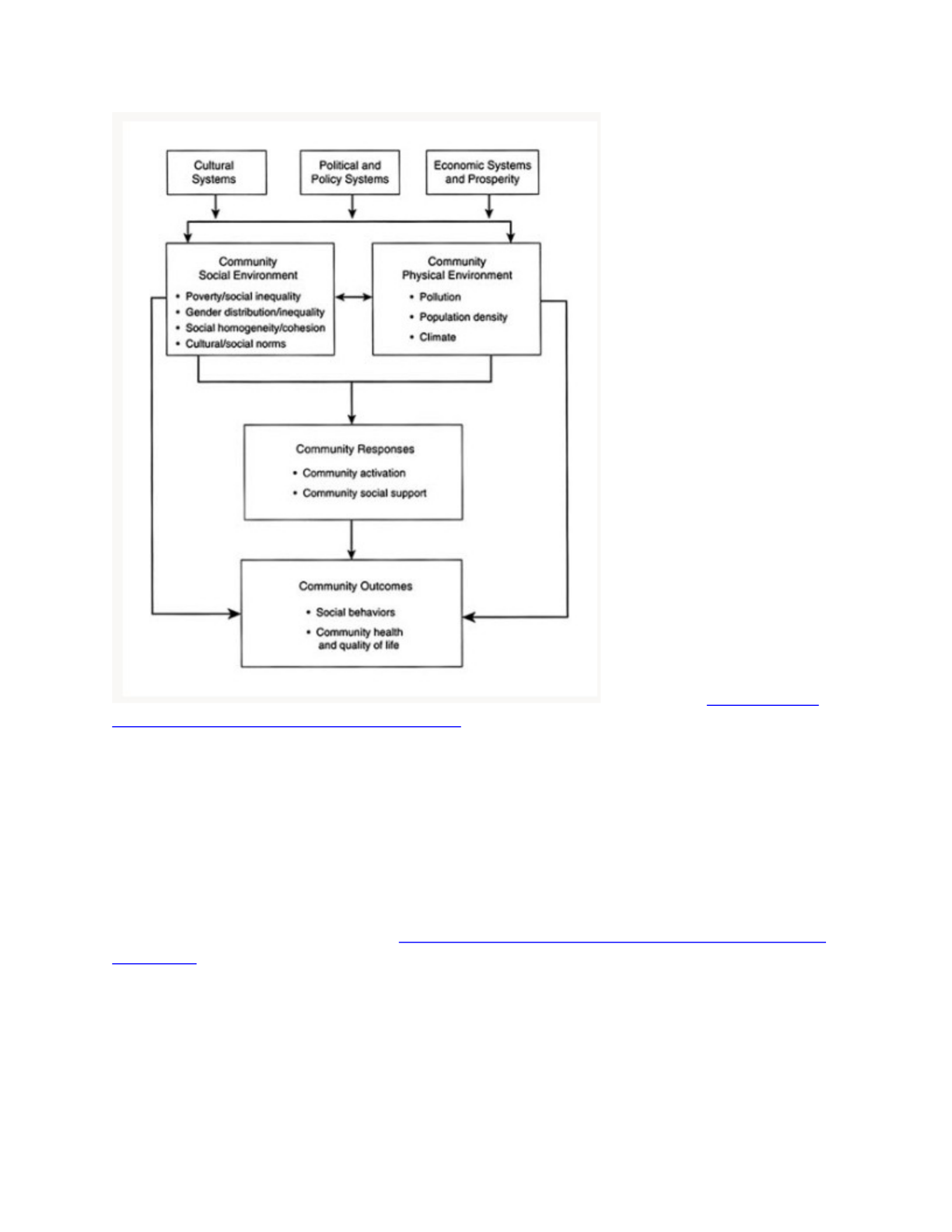
Pic Courtesy: An organizing
framework for studying community and health
Having such a clear, data-backed framework is the first step in formulating a strategic
community outreach plan.
It removes the guesswork from the process and helps you make reliable data-backed decisions.
For instance, from the above example, if you find that it is the economic system and prosperity
that is lagging behind in the community you are studying, then it is that aspect you would focus
on improving.
Need a Revision of The Basics? Read Grassroots Advocacy Definition, Strategies and Tools to
Get Started.
Identify and know your issue
A well-done assessment of needs will automatically highlight the issues within the community.
Now, your job would be to identify which one of these you want to tackle. Solving (or in
most cases trying to solve) that issue, in essence, is your goal.

As we saw above it could be more than one (e.g. educating the audience and improving
policies).
Set a goal
Once you have identified an issue, you can derive your goal. Your goal would be to sort that
issue ideally – but with measurable impact.
For instance, if you’re an advocacy group focused on increasing voter awareness, your goals
would be tied to encouraging citizens to register to vote and educating them about the
importance of participating in the electoral process.
Some questions to ask yourself when pinpointing your goals are:
Is there an actual need within my community for us to reach out?
How exactly am I going to engage with my audience?
How am I going to get them to participate in reaching my goals?
Creating an extensive list of questions, and planning how to address them individually
gives your team a realistic idea of the scope of the task.

