


Study Notes of Theory and Practice of Counseling and Psychotherapy
(10th ed) by Gerald Corey
Adlerian Therapy
Introduction
Adler founded the Society for Individual Psychology in 1912.
Freudian revisionists agreed that relational, social, and cultural factors were of great significance in
shaping personality.
Adlerian psychology principles applied to education, parenting, individual and group therapy,
and group counseling.
View of Human Nature
Focused on the person’s past as perceived in the present and how an individual’s interpretation of
early events
Inferiority Feelings
oAre normal and a source of all human striving
oAre the wellspring of creativity
oDevelop when we are young—characterized by early feelings of hopelessness
Superiority Feelings
oPromote mastery and enable us to overcome obstacles
Subjective Perception of Reality
The world is seen from the client’s subjective frame of reference described as phenomenological.
Subjective reality—paying attention to the individual the way in which people perceive their world
Strive to understand the world from the client’s vantage point
Unity and Patterns of Human Personality
For Adler, Individual Psychology:
oMeant indivisible psychology
oTakes a holistic approach in that we must understand ourselves in socially embedded contexts,
rather than in parts
oAssumes that all human behavior has a purpose in relation to achieving our goals—the guiding
self-ideal
A life movement that organizes our reality, giving meaning to life
o“fictional finalism” or “guiding self ideal”
Striving for perfection implies striving for greater competence, for the common good of others
Lifestyle, described as our perceptions regarding self, others, and the world

Social Interest and Community Feeling
Adler’s most significant and distinctive concept
oSocial interest—bonding people feel for each other
oMental health is measured by the degree to which we share with others and are concerned with
their welfare.
oPeople express social interest through shared activity, cooperation, participation in the common
good, and mutual respect.
oEmbodies a community feeling and the capacity to cooperate and contribute to something bigger
than oneself
The Life Tasks
We must successfully master three universal life tasks:
oBuilding friendships (social task)
oEstablishing intimacy (love–marriage task)
oContributing to society (occupational task)
Each of these tasks requires the development of psychological capacities for friendship and
belonging, for contribution and self-worth, and for cooperation.
Birth Order and Sibling Relationships
Five psychological positions:
(1) Oldest child—receives more attention, spoiled, center of attention
(2) Second child of only two—behaves as if in a race, often opposite to the first born
(3) Middle child—often feels squeezed out
(4) Youngest child—the baby of the family
(5) Only child—does not learn to share or cooperate with other children, learns to deal with adults
Therapeutic Goals
Collaborative arrangement between the client and the counselor
General psychological investigation or lifestyle assessment, disclosing mistaken goals and faulty
assumptions
Emphasis on health, well-being, and prevention of problems
Therapist’s Function and Goals
Client become discouraged because of mistaken beliefs, faulty values, and useless goals.
Family constellation includes parents, siblings, and others in the home, life tasks, and early
recollections.
Early recollections
oStories of events that a person says occurred before 10 years of age
Lifestyle assessment
oEarning to understand the goals and motivations of the client

Application: Therapeutic Techniques and Procedures
Phase 1: Establishing the Relationship
oSupportive, collaborative, educational, encouraging process
oPerson-to-person contact with the client precedes identification of the problem
oHelp client build awareness of his or her strengths
Phase 2: Assessing the Individual’s Psychological Dynamics
oLifestyle assessment
Subjective interview
Objective interview
Family constellation
Early recollections
Basic mistakes
Phase 3: Encouraging Self-Understanding and Insight
oInterpret the findings of the assessment.
oHidden goals and purposes of behavior are made conscious.
oTherapist offers interpretations to help clients gain
oinsight into their private logic and lifestyle.
Phase 4: Reorientation and Re-education
oAction-oriented phase; emphasis is on putting insights into practice.
oClients are reoriented toward the useful side of life.
oClients are encouraged to act as if they were the people they want to be.
Encouragement
Encouragement is the most distinctive intervention and is central to all phases of Adlerian therapy.
It is a fundamental attitude more than a technique.
Expecting clients to assume responsibility for their lives builds their self-confidence and courage.
Discouragement is the basic condition that prevents people from functioning.
Adlerian Techniques
Immediacy Avoiding the traps
Advice Confrontation
Humor Use of stories and fables
Silence Early recollection analysis
Paradoxical intention Lifestyle assessment
Acting as if Encouraging
Catching oneself Metta meditation
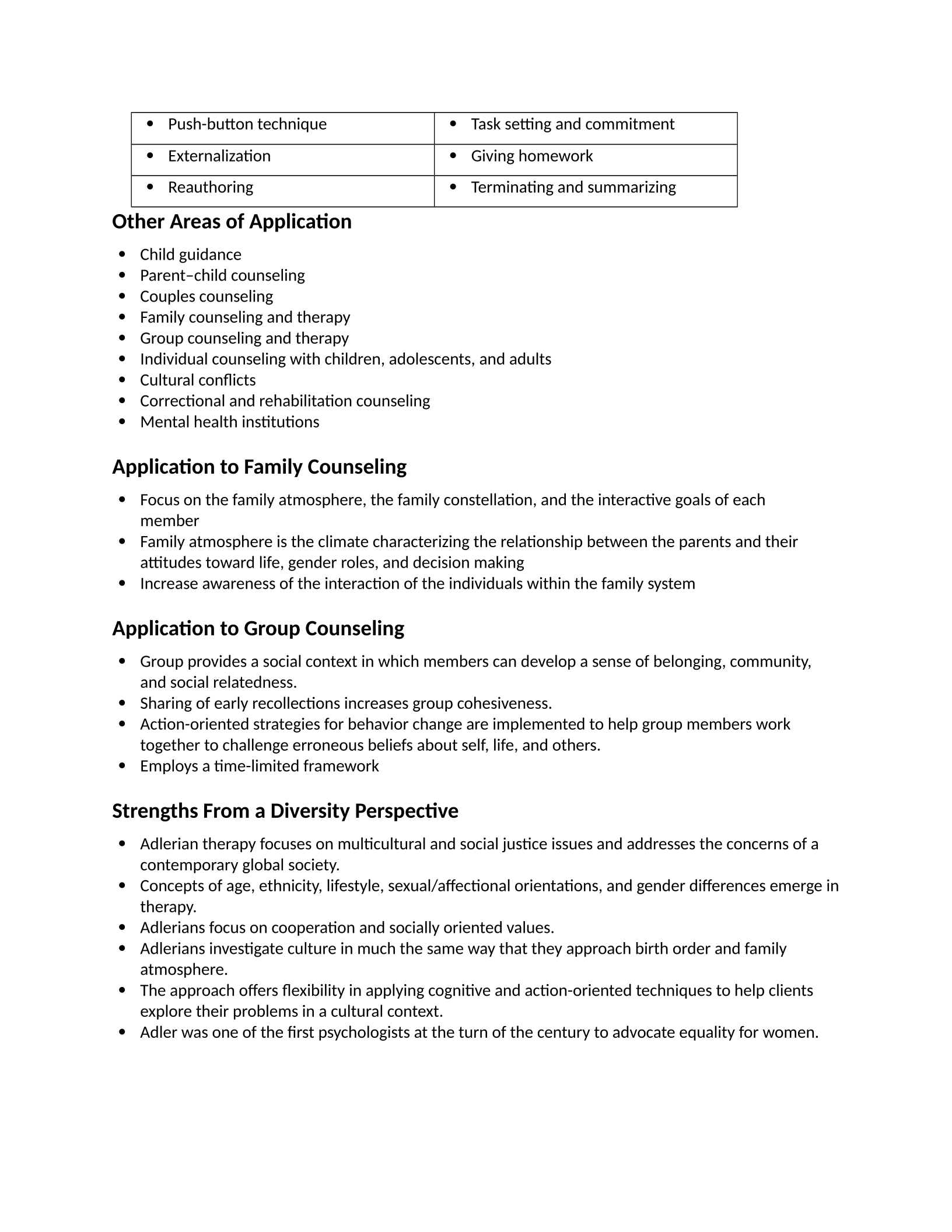
Push-button technique Task setting and commitment
Externalization Giving homework
Reauthoring Terminating and summarizing
Other Areas of Application
Child guidance
Parent–child counseling
Couples counseling
Family counseling and therapy
Group counseling and therapy
Individual counseling with children, adolescents, and adults
Cultural conflicts
Correctional and rehabilitation counseling
Mental health institutions
Application to Family Counseling
Focus on the family atmosphere, the family constellation, and the interactive goals of each
member
Family atmosphere is the climate characterizing the relationship between the parents and their
attitudes toward life, gender roles, and decision making
Increase awareness of the interaction of the individuals within the family system
Application to Group Counseling
Group provides a social context in which members can develop a sense of belonging, community,
and social relatedness.
Sharing of early recollections increases group cohesiveness.
Action-oriented strategies for behavior change are implemented to help group members work
together to challenge erroneous beliefs about self, life, and others.
Employs a time-limited framework
Strengths From a Diversity Perspective
Adlerian therapy focuses on multicultural and social justice issues and addresses the concerns of a
contemporary global society.
Concepts of age, ethnicity, lifestyle, sexual/affectional orientations, and gender differences emerge in
therapy.
Adlerians focus on cooperation and socially oriented values.
Adlerians investigate culture in much the same way that they approach birth order and family
atmosphere.
The approach offers flexibility in applying cognitive and action-oriented techniques to help clients
explore their problems in a cultural context.
Adler was one of the first psychologists at the turn of the century to advocate equality for women.

Shortcomings From a Diversity Perspective
The approach focuses on the self as the locus of change and responsibility, which may be
problematic for some clients.
Exploring past childhood experiences, early memories, family experiences, and dreams may not
appeal to all.
If clients expect the therapist to be the “expert,” they may be dissatisfied with the Adlerian’s
collaborative stance.
Contributions of Adlerian Theory
This approach is flexible and integrative; it allows for the use of relational, cognitive, behavioral,
emotive, and experiential techniques.
It is suited to brief, time-limited therapy.
Many of Adler’s ideas were revolutionary and far ahead of his time. Many of his ideas have found
their way into most of the other therapeutic approaches.
Limitations and Criticisms of the Adlerian Approach
Adler spent most of his time teaching his theory as opposed to systematically documenting it.
Many of Adler’s ideas are vague and general, which makes it difficult to conduct research on some
concepts.
Although brilliant in many ways, Adler was not scholarly.
Powered by TCPDF (www.tcpdf.org)

