


Discussion 4
Benjamin Kim
Liberty University
BUSI 680 – Advanced Project Management I
The importance of having a strong practice of risk management in projects lies in the fact
that many projects fail due to inadequate risk management in large part from the lack of attention
to details during the planning phase of a project (Lee, Keil, & Shalev, 2019). The key activities in
risk management are risk identification, risk assessment, risk response planning, and if necessary,
risk response enactment. “Risk management attempts to recognize and manage potential and
unforeseen trouble spots that may occur when the project is implemented” (Larson & Gray,
2021, p. 214). A very important point about risk management that can often be overlooked is that
it should be viewed not as a reactive approach that is employed only when problems arise, but
rather that it should be viewed as a proactive approach. The case study presented is an exercise in
risk management, taking on the responsibility and lead to organize and carryout the project of
this all-expense-paid fly-fishing adventure in Alaska for the top management of BlueNote, Inc.
In this exercise, acting as the project manager tasked with this responsibility, the project is
analyzed, a risk assessment is created, and an appropriate risk-response matrix is developed to
outline how those risks would be handled. This approach to identify, assess, and plan for all
possible risks will allow for the project to proceed as designed and reduce surprises and negative
consequences that generally arise from those surprise undesired events. In fact, as risk
management approaches are applied and exercised, greater information and knowledge will
allow for better planning of projects as the identification of risks will allow for revision and
adaption of plans to help mitigate the identified risks (Eyvindson & Kangas, 2018). One very
important point made by Eyvindson and Kangas (2018) is that no matter what, with risks, there
will always be a cost – either the cost to mitigate the risk or the cost of accepting the risky
outcomes.
Using the approaches from the textbook, the provided case study was analyzed – where
the potential risks may lie, how important they are, and how to potentially address those risks –
using the risk assessment form and a risk-response matrix. There are many areas risk could
appear in this project, especially one with explicit guidelines that must be adhered to – a trip
schedule of June 21 to June 25 and a budget not to exceed $45,000. The president was very clear
with what she wanted this trip to be and what would be included. Starting off the project with
clear guidelines like these helped in the risk management approach taken. Starting off with the
risk assessment, the details the trip – from the objective to the deliverables through the limits and
exclusions – were all reviewed to find possible areas where risk could arise. That was the
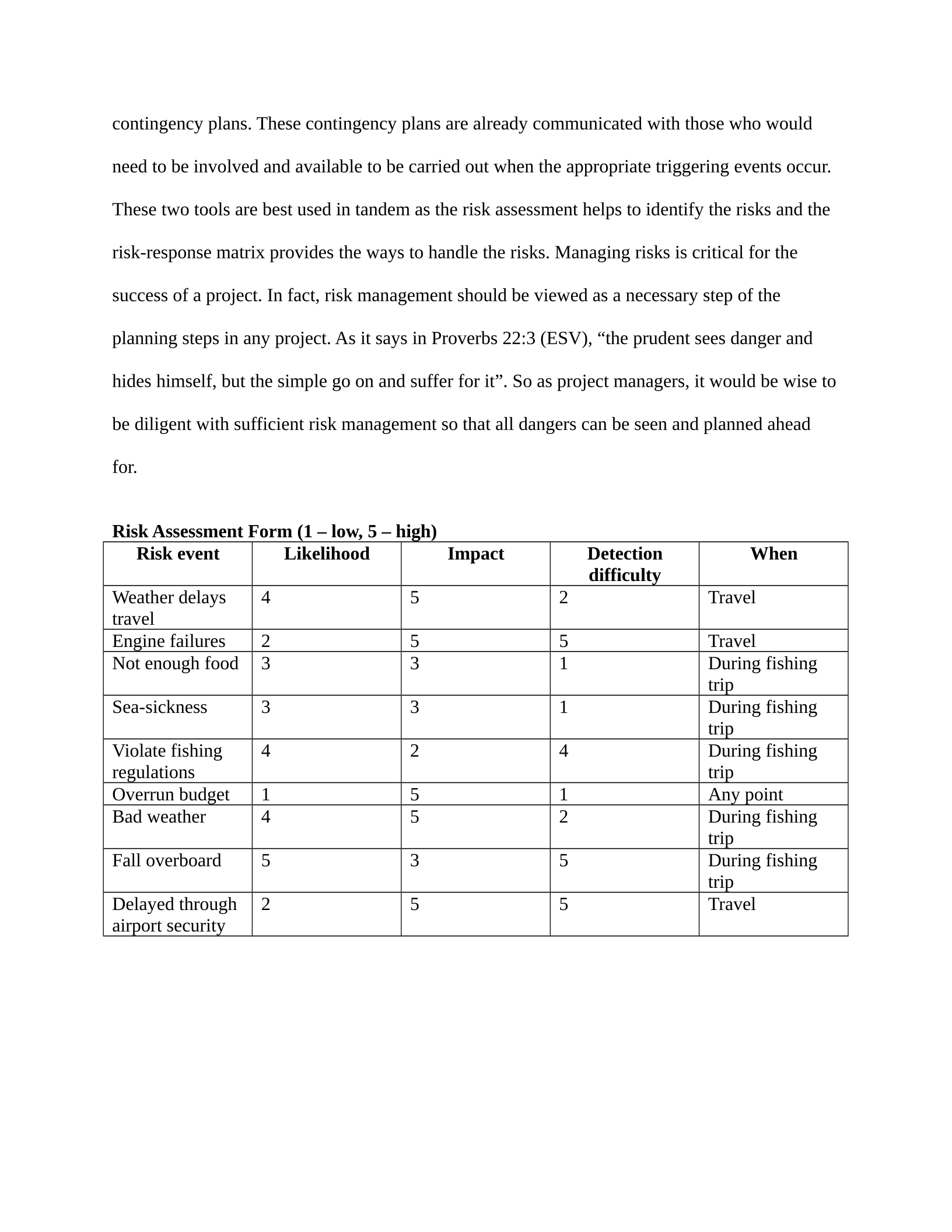
approach to put together the risk assessment form, where several risks were identified and rated
in terms of their likelihood, the impact on the project, how difficult detection would be and when
in the project they would occur. These ratings were numerical on a range from 1 to 5, where 1 is
the lowest (least likely, lowest impact, and easiest to detect) and 5 is the highest (very likely, high
impact, and very difficult to detect until it happens). After the risk assessment identified and
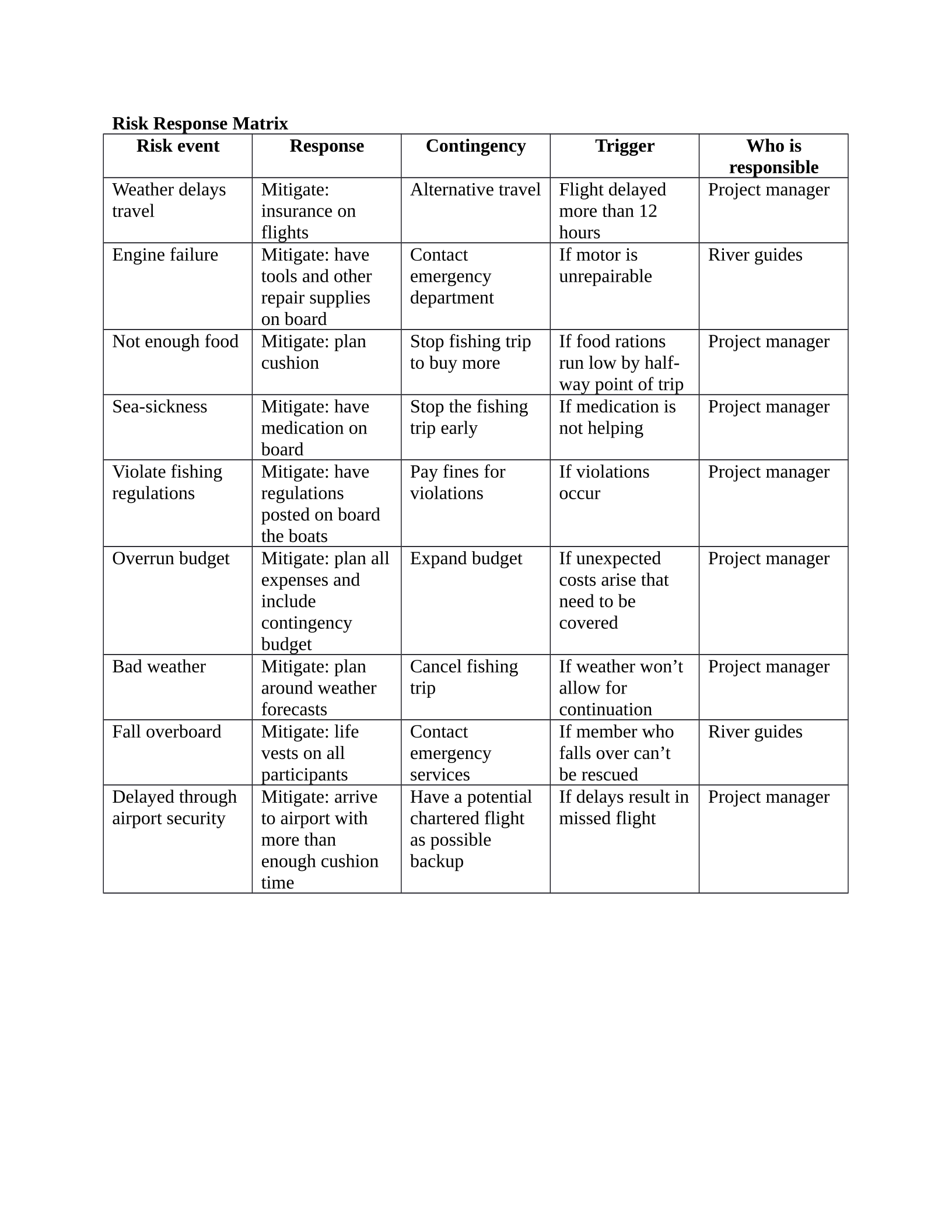
assessed the risks, the risk-response matrix was used to prepare for the risks. In this risk-response
matrix, there are five potential responses to each risk – mitigate, avoid, transfer, escalate, or
retain. Mitigating a risk is to respond in a way as to minimize the risk’s impact or likelihood.
Avoiding a risk is to eliminate the risk – usually by changing the project plans. Transferring the
risk is to pass the risk along to another party. Escalating the risk is similar to transferring, in that
the risk is outside the scope of the project or authority of the project manager, so for that reason
the risk is moved. And the final option is to retain the risk, which will usually only happen with
risks that are very unlikely to occur and so large a risk that any other response is not possible.
Along with the responses, contingency plans are included with conditions that would trigger the
contingency plans. These contingency plans are already communicated with those who would
need to be involved and available to be carried out when the appropriate triggering events occur.
These two tools are best used in tandem as the risk assessment helps to identify the risks and the
risk-response matrix provides the ways to handle the risks. Managing risks is critical for the
success of a project. In fact, risk management should be viewed as a necessary step of the
planning steps in any project. As it says in Proverbs 22:3 (ESV), “the prudent sees danger and
hides himself, but the simple go on and suffer for it”. So as project managers, it would be wise to
be diligent with sufficient risk management so that all dangers can be seen and planned ahead
for.
Risk Assessment Form (1 – low, 5 – high)
Risk event Likelihood Impact Detection
difficulty
When
Weather delays
travel
4 5 2 Travel
Engine failures 2 5 5 Travel
Not enough food 3 3 1 During fishing
trip
Sea-sickness 3 3 1 During fishing
trip
Violate fishing
regulations
4 2 4 During fishing
trip
Overrun budget 1 5 1 Any point
Bad weather 4 5 2 During fishing
trip
Fall overboard 5 3 5 During fishing
trip
Delayed through
airport security
2 5 5 Travel
Risk Response Matrix
Risk event Response Contingency Trigger Who is
responsible
Weather delays
travel
Mitigate:
insurance on
flights
Alternative travel Flight delayed
more than 12
hours
Project manager
Engine failure Mitigate: have
tools and other
repair supplies
on board
Contact
emergency
department
If motor is
unrepairable
River guides
Not enough food Mitigate: plan
cushion
Stop fishing trip
to buy more
If food rations
run low by half-
way point of trip
Project manager
Sea-sickness Mitigate: have
medication on
board
Stop the fishing
trip early
If medication is
not helping
Project manager
Violate fishing
regulations
Mitigate: have
regulations
posted on board
the boats
Pay fines for
violations
If violations
occur
Project manager
Overrun budget Mitigate: plan all
expenses and
include
contingency
budget
Expand budget If unexpected
costs arise that
need to be
covered
Project manager
Bad weather Mitigate: plan
around weather
forecasts
Cancel fishing
trip
If weather won’t
allow for
continuation
Project manager
Fall overboard Mitigate: life
vests on all
participants
Contact
emergency
services
If member who
falls over can’t
be rescued
River guides
Delayed through
airport security
Mitigate: arrive
to airport with
more than
enough cushion
time
Have a potential
chartered flight
as possible
backup
If delays result in
missed flight
Project manager
References
English Standard Version Bible. (2001). https://esv.literalword.com/
Eyvindson, K., & Kangas, A. (2018) Guidelines for risk management in forest planning – what is
risk and when is risk management useful? Canadian Journal of Forest Research, 48(4).
309-316. https://doi.org/10.1139/cjfr-2017-0251
Larson, E. W., & Gray, C. F. (2021). Project management: The managerial process (8th ed.).
New York, NY: McGraw-Hill
Lee, J.S., Keil, M., & Shalev, E. (2019). Seeing the trees of the forest? The effect of IT project
managers’ mental construal on IT project risk management activities. Information
Systems Research, 30(3). 1051-1072. https://doi-
org.ezproxy.liberty.edu/10.1287/isre.2019.0853
Powered by TCPDF (www.tcpdf.org)

