BUSI 620
Page 1 of 5
C T 6QUESTIONS FOR
RITICAL HINKING
Salvatore Chapter 12:
7. Quantity discounts are not a form of price discrimination because the firm saves on
handling large order. True or false? Explain
False. Salvatore (2015) describes price discrimination as “the charging of different prices
for different quantities of a product, at different times, to different customer groups or in
different markets, when these price differences are not justified by cost differences.” The
key part of that definition is that price discrimination is not based on cost differences.
With large orders, firms can save on shipping costs, allowing customers to buy in bulk.
8. (a) Why are first and second degree price discrimination less common than third
degree price discrimination? (b) Are lower airline fares at midweek an example of
third degree price discrimination? (c) Under what conditions would it not be useful to
charge different prices in different markets (i.e., practice third degree price
discrimination) even if possible?
First degree price discrimination is rare in practice because the firm must have exact
knowledge of “each individual consumer’s demand curve and charge the highest possible
price for each separate unit of the product sold” (Salvatore, 2015). Second degree price
discrimination is also rare because it exists only where “products and service are easily
metered, such as kilowatt-hours of electricity, cubic feet of gas and water, number of
copies duplicated, etc.” (Salvatore, 2015). (b) Lower airline fares midweek are not an
example of third degree price discrimination because midweek flights have a high
elasticity of demand; there are far more substitutes midweek than there are on the
weekends when people more frequently travel. (c) One condition where it is not useful to
charge different prices in different markets is when there is no difference of demand
elasticity. An example of this is gold; when a consumer is buying something with
currency he or she is valuing that currency against gold.
13. What are (a) the advantages and (b) the disadvantages of cost plus pricing? (c)
Why is incremental cost pricing the correct pricing method? Why is full cost pricing
equal to it?
According to Salvatore (2015), “cost-plus pricing requires less information and less
precise data than the rule of setting price at the output level at which marginal revenue
equals marginal cost;” in addition, it is fairly simple to employ. Finally, cost plus pricing
most commonly produces relatively stable prices, as long as costs to not change
drastically over time. (b) Cost plus pricing does not factor future demand for any given
product. Salvatore (2015) argues one criticism against cost plus pricing is that “cost plus
pricing is based on accounting and historical costs, rather than on replacement and
opportunity costs.” Additionally, cost plus pricing is based on the average cost of
production and not the marginal cost. (c) Incremental cost pricing is the correct pricing
method because it values the price of the product on its incremental cost, rather than the
variable costs. Also, incremental analysis pricing factors in fixed and variable costs. If an
entrepreneur can increase the sales margin of a product equal to the cost of making an
additional product, then incremental pricing and cost plus pricing will be the same.
5. See excel sheet
12. (a) Will a monopolist’s total revenue be larger with second-degree price
discrimination when the batches on which it charges a uniform price are larger or
smaller? Why? (b) How does a two-part tariff differ from bundling?

BUSI 620
Page 2 of 5
(a) A monopolist’s total revenue will be larger with second degree price discrimination
when the batches are smaller. Keeping the price smaller allows the revenue to be larger.
(b) Two-part tariff “refers to the pricing practice in which consumers pay an initial fee for
the right to purchase a product or service, as well as a usage fee or price for each unit of
the product they purchase” (Salvatore, 2015). Bundling “is a common form of tying in
which the firm requires customers buying or leasing one of its products or services to also
buy or lease another product or service when customers have different tastes but the firm
cannot price discriminate” (Salvatore, 2015).
Froeb et al. Chapter 14:
14-1: Why might Mattel set a much lower contribution margin on its Barbie dolls than
on the accessories for the dolls?
This is a type of metering scheme very similar to firms selling razor blades at a much
higher markup than the razors (Froeb et al, 2016). Essentially “high-value doll users
purchase more Barbie outfits” and accessories (Froeb et al. 2016). When these high value
doll users become bored with their current set of accessories, they will want to buy
different sets; allowing Mattel to bring in more revenue with the Barbie accessories as
compared to the actual dolls.
14-4: A manufacturer of microwaves has discovered that male shoppers have little
value for microwaves and attribute almost no extra value to an auto defrost feature.
Female shoppers generally value microwaves more than men and attribute greater
value to the auto-defrost feature. There is little additional cost to incorporating an
auto-defrost feature. Since men and women cannot be charged different prices for
the same product, the manufacturer is considering introducing two different models.
The manufacturer has determined that men value a simple microwave at $70 and one
with auto defrost at $80 while women value a simple microwave at $80 and one with
auto-defrost at $150. If there is an equal number of men and women, what pricing
strategy will yield the greatest revenue? What if women comprise them?
bulk of microwave shoppers?
The manufacturer can sell a microwave (with the auto defrost feature) to men and women
for $80: $80x2 = $160.
The manufacturer can sell a microwave (with the auto defrost feature) to just women for
$150: $150 x 1 = $150
Find what price women value the auto defrost feature at: 150-80 = $70. Knowing this, the
microwave manufacturer cannot charge women more than $140 (the $70 simple
microwave + the value of the auto defrost feature ($70)). Thus, the manufacture can
market the simple microwave to men at $70 and the microwave with the auto defrost
feature to women for $140.
Salvatore Chapter 13:
8. What is the basic difference between using a subsidy to induce producers to install
antipollution equipment and a tax on producers who pollute?
A subsidy is when a firm, organization or a specific subgroup of the economy is given a
pardon or shown support for implementing a certain economic policy or social movement
to promote a beneficial concept (promoting good practices for the environment for
example). A tax a charge that must be played to the federal or state government. The
main

BUSI 620
Page 3 of 5
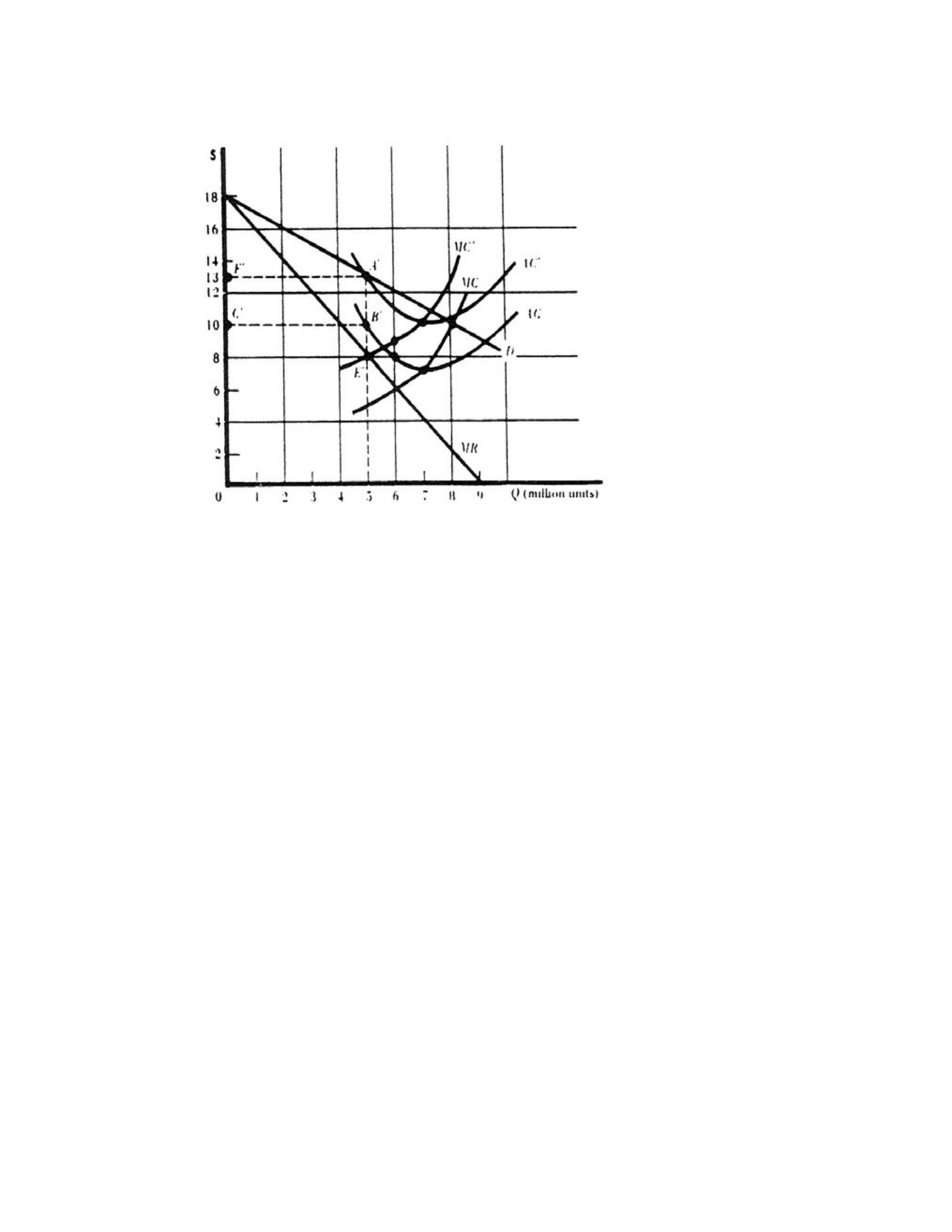
15. (a) the best level of output, price, and profits per unit and in total for the
monopolists (b) the best level of output and price with a lump sum tax that would
eliminate all the monopolist’s profits (c) the best level of output, price and profits
difference between the two is that a subsidy is paid to the producer to positively reinforce
a certain action or practice; while a tax is something the producer pays to the government.
10. Given the difficulties that the regulation of public utilities faces, would it not be
better to nationalize public utilities, as some European countries have done? Explain
your answer.
Europe of falling apart under the pressure of its socialist policies; just because other
countries enforce these failed economic practices doesn’t mean the US needs to as well.
Market place competition from a private sector is what will drive the best prices and
utility efficiency.
12. Determine whether the Justice Department would challenge a merger between
two firms in an industry with 10 equal sized firms, based on its 1984 Herfindahl-
index guidelines only. Need to calculate and compare the Herfindahl index before
and after the merger.
Before: HHI = 1000
After: HHI = 1200
The Justice Department should not challenge the merger because a merger would
increase the market share. Since it’s only a gain of 100, it will not greatly impact the
market, but it will do so by a small amount.
13. Explain (a) in what way the US trucking industry exemplify the capture theory
hypothesis of government regulation prior to the passage of the Motor Carrier Act of
1980 and (b) the result of the passage of the Motor Carrier Act in 1980.
(a)The capture theory, also known as the economic theory of regulation, is “the result of
pressure-group action and results in laws and policies to support business and to protect
consumers, workers, and the environment” (Salvatore, 2015). While government
regulation in the market place has good intention, it often falls short and can lead to high
inefficiencies. This is what happened with the Interstate Commerce Commision (ICC).
One of the main purposes of the ICC was to protect large trucking industries from the
smaller competitors; thus, creating a barrier to entry (Interstate Commerse Commission,
2016). This function was to be monitored by a federally funded commission; however,
soon prices rose. In this example, the capture theory demonstrates how the organization
can become to great for the for the government to handle. (b) The Motor Carrier Act of
1980 removed all restrictions on entry, scheduling, and pricing in the domestic trucking
industry (Interstate Commerce Commission, 2016). The Motor Carrier Act of 1980
helped deregulate the consequences of the ICC, helping to restore the market to a more
natural state.

BUSI 620
Page 4 of 5
References
Interstate commerce commison. (2016, June 21). Retrieved from
https://www.federalregister.gov/agencies/interstate-commerce-commission
Salvatore, D. (2015). Managerial economics in a global economy (8th ed.). New York,
NY: Oxford University Press.
per unit and in total with a $3 per unit tax collected from the monopolist, and (d) the
best level of output and profit per unit and in total if the government sets the price of
the product or service at $10. (e) Which is the best method of controlling monopoly
power? Why?
(a) the best level of output is 6 units at $12/unit (MR=MC). The cost per unit is $4 and the
total profit for the monopolists is $24 million.
(b) The best level of output is still 6 units a $12/unit. The lump sum tax will only increase
the AC and the MC will not change. However, with a $4/unit tax, the profit is completely
eliminated.
(c) A fixed cost of $3/unit will cause the MC and AC to shift to the left (both by $3). This
shift in the MC and AC curve causes the MC line to intersect with the MR line at 5 million
units; thus the price will have to be $13 and the AC will be $13. Once again, profits will be
zero.
(d) With a price of $10, the business will be force to choose a quantity driven by the
marginal cost. A price of $10 allows a quantity of 8 million, this drives the AC to $8. This
only allows a $2 profit/unit (10-8=2)
(e) The best method of controlling monopoly power is option d. This is because option d
allows the business to produce at the optimal quantity, where the MC = demand.
P15(b): Use the following graph for reference. A lump sum tax is a fixed cost.