


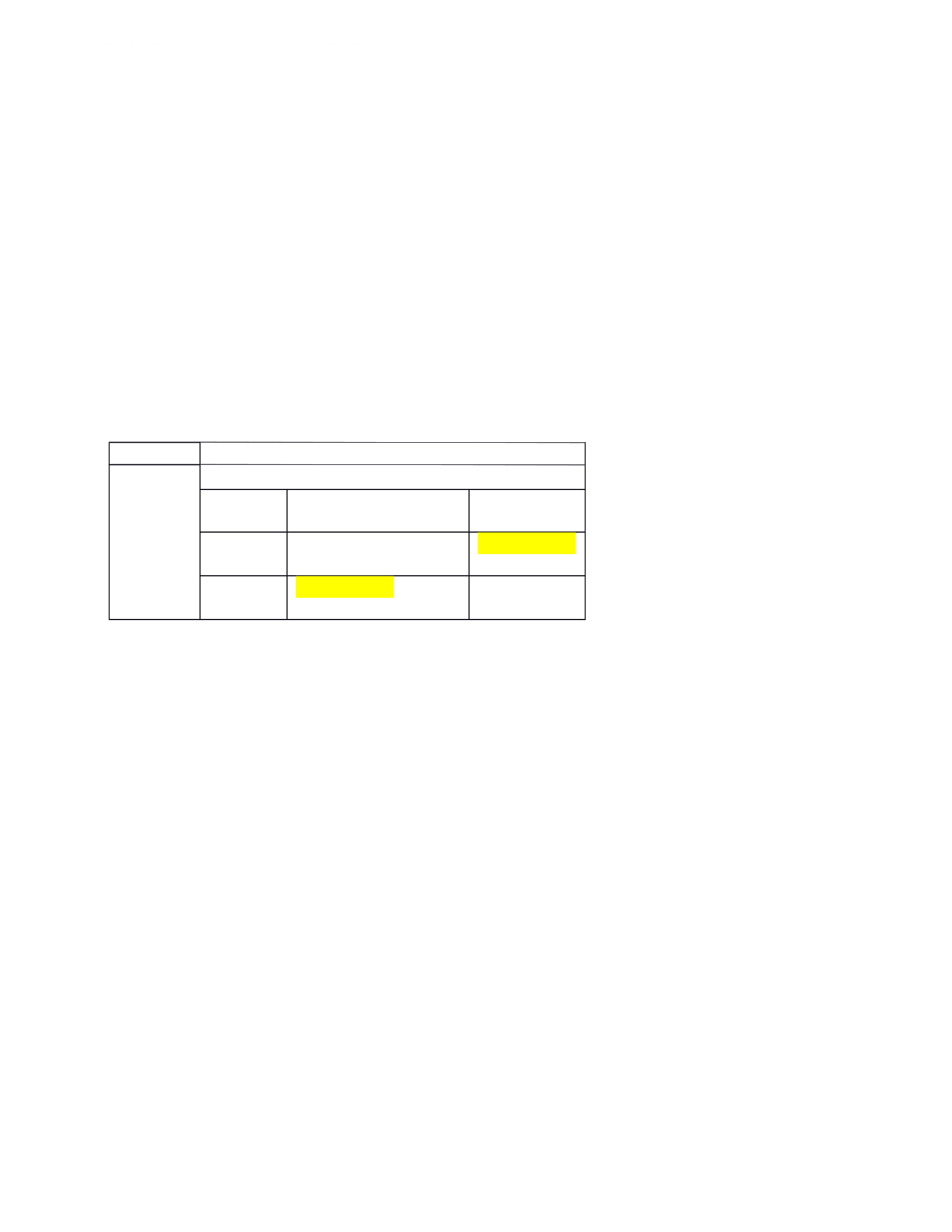
Represent the game playoff as follows
Pricing Strategy of Firm
Kroger
Regular PriceSale Price
AlbertsoRegular $4500,$4500$3000,$5000
n Price
Sale $5000,$3000$2000,$2000
price
In the above game chart, there are two equilibrium strategies:
The first Nash equilibrium strategy profile is given by Albertson adopts sale price and Kroger
adopt regular price. In this case, none of the players will have incentive to deviate as both the
strategy assures higher payoff in comparison with other alternative strategy. The Nash
equilibrium payoff received are ($5000, $3000)
The second Nash equilibrium strategy profile is given by Albertson adopts regular price and
Kroger adopt sales price. In this case, none of the players will have incentive to deviate as both
the strategy assures higher payoff in comparison with other alternative strategy. The Nash
equilibrium payoff received are ($3000, $5000) Any deviation from the Nash equilibrium
strategy will result to a lower payoff strategy.
Since there are two pricing strategies for two player in the game (Regular price, Sale price) and
(Sale price, Regular price) Thus, there is not a single dominant strategy for the firms. Meaning
there is no clear-cut pricing strategy. In the absence of clear-cut pricing strategy firms can
overcome this dilemma by announcing and guaranteeing sale price on alternative weeks. The
other way is that the firms guarantee everyday low prices such as the firm promises to charge
only the sales price. under this case the best response of the rival firm is to charge regular price
and in this way the firm which charges sale price will make higher profits of $5000
The question relates to two dominant grocers- Albertsons (AS) and Kroger (KR) who indulge I
price competition. They simultaneously announce one of the two prices of a product regular or
sale price. Thus, its need to be identified that whether a clear-cut price strategy occurs and if not
then what can be the solution.
To assess about the presence of clear cut pricing strategy, I will prepare a simultaneous game for
the two firms. The payoffs are as follows:
1.when one firm announces sale price and the other announces regular price for a
product, the firm announcing sale price earns profit of $5,000 while the firm that
charges regular price earns lower profit of $3,000.
2.When both firms announce regular price both earn $4,500 as profit.
3.when both firms go for sale price, they earn equal profit of $2,000

While there is a degree of differentiation between major grocery
chains like Albertsons and Kroger, the regular offering of sale prices
by both firms for many of their products provides evidence that
these firms engage in price competition. For markets where
Albertsons and Kroger are the dominant grocers, this suggests that
these two stores simultaneously announce one of two prices for a
given product: a regular price or a sale price. Suppose that when
one firm announces the sale price and the other announces the
regular price for a particular product, the firm announcing the sale
price attracts 1,000 extra customers to earn a profit of $5,000,
compared to the $3,000 earned by the firm announcing the regular
price. When both firms announce the sale price, the two firms split
the market equally (each getting an extra 500 customers) to earn
profits of $2,000 each. When both firms announce the regular price,
each company attracts only its 1,500 loyal customers and the firms
each earn $4,500 in profits.
Cqc= Qualcom’s cost to install CDMA technology
Cqg= Qualcom’s cost to install GSMtechnology
Ctc= T-mobiles cost to install CDMA technology
Ctg= T-mobiles cost to install GSM technology
So, Given Cqc= $1.2 billion, Cqg=$2 billion, Ctc=$2.7 billion, and Ctg=$1.1 billion
Initial strategy is (CDMA, CDMA) then we have, (CDMA, CDMA)= (16,12.9) and CDMA, GSM)=
(12.3, 8.6) T-Mobile does not have incentive to deviate from the initial strategy.
(GSM, CDMA)= (12.7, 7.4) QUALCOMM also doesn’t have any incentive to deviate from initial
strategy.
Since neither of the players has incentive to deviate from initial strategy, (CDMA, CDMA) is
Nash Equilibrium.
Initial strategy is (CDMA, GSM) then, (CDMA, GSM) = (12.3, 8.6) and (CDMA, CDMA)= (16,
12.9) T-Mobile will deviate from initial strategy, which is why this is not a Nash Equilibrium
Initial Strategy is (GSM, CDMA) then, (GSM, CDMA) = (14.7, 7.4) (GSM, GSM) = (13.5, 8.7) T-
Mobile will deviate from initial strategy. Hence (GSM, CDMA) is not Nash Equilibrium

Initial strategy is (GSM, GSM) then, (GSM, GSM) = (13.5, 8.7) (GSM, CDMA)= (14.7, 7.4) T-
Mobile will not deviate from initial strategy
(CDMA, GSM)= (12.3, 8.6) QUALCOM will not deviate from initial strategy . Since neither one
of the players has any incentive to deviate from the initial strategy (GSM, GSM) is Nash
Equilibrium. Making this game have two Nash Equilibria 1. (CDMA, CDMA) 2. (GSM, GSM).
The payoff in the normal form game is simply due to the profit maximizing behavior of both
companies. Each of the will want to maximize their expected profit and not their expected
revenue.
For example: Suppose the strategy is (CDMA, CDMA) then expected revenue for Qualcom and
T-Mobile are $17.2 billion and $15.6 billion respectively. But what companies are concerned
about profit. Reason being profits are $17.2 – 1.2 = $16 for Qualcom and $15.6 - $2.7 = 12.9 for
T-Mobile. Meaning the payoff under strategy (CDMA, CDMA)= (16, 12.9) and not (17.2, 15.6)
Similarly payoff for each strategy can be calculated.
This game has two Nash Equilibria (CDMA, CDMA) and (GSM, GSM) and however this is a
game of coordination . I don’t think there will be any difficulty because both players will want to
coordinate on the same strategy meaning none of them needs to compromise.

