


FINAL PROJECT: COMPANY ANALYSIS AND REPORT ASSIGNMENT
Lisa Borgese
School of Business, Liberty University
BUSI 532 Advanced Financial Statement Analysis
Dr. Debra Touhey
August 18th, 2023
Introduction
One of the world’s most well-known companies throughout the ages is Walt Disney
Company. With their innovation and strategic approaches, the entertainment industry has
withstood the test of time. the purpose of this assignment is to evaluate the Walt Disney
Company’s wellbeing in the entertainment industry, their stock prices, conduct a financial ratio
analysis, financial highlights, evaluation of their annual report, and give recommendations on
how to improve their economic stance in the industry and potential investment decisions. This
assessment will allow its readers to make a sound investment decision based on the information
provided in this assignment and see how Disney has overcome various changes throughout the
decades.

Overview of The Walt Disney Company
With its headquarters located in Burbank, California, The Walt Disney Company is the leader in
the entertainment industry (Aughinbaugh, 2020) Walt Disney, founder of The Walt Disney
Company, began his career at the Kansas City Film Ad Company, in Missouri. After the
completion of Alice in Cartoonland, Walt left Kansas City to pursue cinematography in
Hollywood, California in 1923. His first animated series was centered around his iconic
character, “Mickey Mouse.” In 1955, Walt opened his Disneyland, his first theme park in
Anaheim, California. Just before his passing in December 1966, Walt Disney purchased
fortythree acres of land in Bay Lake and Lake Buena Vista, Florida for “The Florida Project,”
which later came to be as we know it as Walt Disney World Resorts. After Walt’s death, his older
brother Roy Disney came out of retirement to ensure that Walt’s biggest dream was realized. He
led and supervised the project and ensured the park opening was a success. Walt Disney World
Resorts became the leading tourist destination during the 1970s and 1980s, while The Disney
Company created and produced films and gained significant profits. In the 1990s Disney gained
enormous success in the animated releases of The Litte Mermaid, Beauty and the Beast, The
Lion King, Toy Story 1 & 2, and Aladdin. In addition, Disney purchased its first Broadway theater
in 1993, the New Amsterdam Theatre, which was in a state of disrepair at the time. The
company invested $34 million in its renovation and restoration. The theater reopened in 1997
with the premiere of “King David,” followed by “The Lion King” musical1. (Thomas, 2019)
Disney theme parks have continued to prosper, with currently twelve theme parks worldwide.
Walt Disney Products/Services
The Disney Company owns several various entities in several industries, but they all tie
back to Disney’s focus, entertainment. Disney owns media networks such as Disney Channels

Worldwide, ABC Entertainment Groups, Disney Media Distributions, along with interconnected
networks; Disney also owns twelve theme parks, worldwide, countless number of cruise lines,
resorts, and vacation clubs. Disney also owns many film studios such as Marvel Studios,
DreamWorks Studios, Pixar Animation Studios, Walt Disney Animation Studios and then some.
Additionally, the company owns their own retail store chain, The Disney Store, which sells
souvenirs, home decorations, toys, and apparel worldwide.
History of The Walt Disney Company Stock Price
According to Goldman Sachs, “Although Disney issued over-the-counter stock (as Walt
Disney Productions) in 1940, it was not until November 12, 1957, that Goldman Sachs co-led the
Disney IPO at a share price of US $13.88 on the New York Stock Exchange (NYSE).” (Goldman
Sachs, 2023) Throughout the decades, Disney Company has experienced a steady growth, based
on the data from Yahoo finance, below. (Fig. 1) As one can notice that the stocks tumbled as a
reaction to the Covid-19 pandemic, when the travel and entertainment industries were on
restrictions and lockdowns, however as the world started to reopen for travel, tourism, and
entertainment, the company’s stock prices gradually picked back up. (Milman et al., 2020) In
March of 2020, The Walt Disney Company experienced its first significant stock price drop in the
company’s history, from $148.20 in January of 2020 to $81.09 in March of that same year due to
Covid-19. Since the end of the pandemic, Disney has seen their stock prices increase to a high of
$203.02 in March of 2021, but has been volatile since then. This could be due to the recent war
in Ukraine and other uncertainties globally. (Yahoo Finance, 2023)
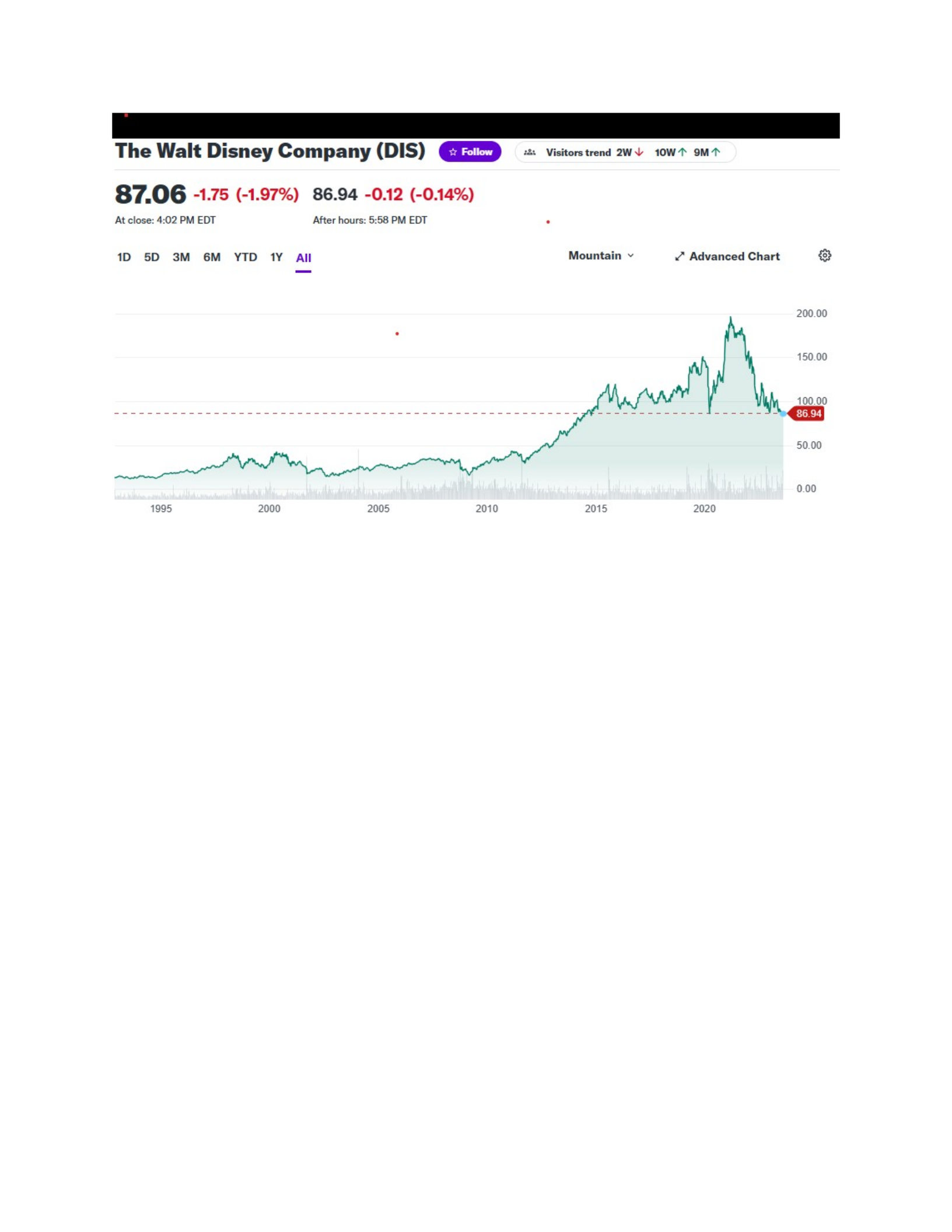
Fig. 1. Walt Disney Company stock reporting as of August 15 from Yahoo Finance.
Results of Disney's Financial Ratio Analysis
Looking at Disney’s past four years of financial statements and creating a consolidated
statement of operations, common-size income statement, financial ratios, and statement of
cash flow, one can see that Disney is doing quite well considering the Covid-19 pandemic and
rebound from the worldwide closure of the travel and tourism industry.
During the Covid-19 pandemic, Disney’s revenues took a hit dropping from $69.57
million in 2019 to $65.39 million in 2021, which is a 0.9% decrease but then recovered in 2021
and 2022 with a 1% and 1.2% increase in revenues, respectively. Refer to Table 1 & 2 in
appendix. However, the company suffered a net loss in 2020, due to the company not
generating any operating income, while the world was on lockdown, refer to Table 1 & 2 in the
appendix. Since the reopening of the travel and tourism industry, Disney has steadily increased
their revenues and has positive net cash flow.

Furthermore, one can notice that Disney’s Gross Margins have been steady, considering
the drop from 39.6% in 2019 to 32.89% in 2020, due to the pandemic. But since the end of the
pandemic, the gross margin has steadily increased each year, refer to Table 3 in appendix. The
ratios for both Operating Profit Margin and Net Profit Margin back up the analysis above,
showing that there was a drop in 2020, refer to Table 3 in appendix.
Financial Highlights and Lowlights in Disney's Annual Report
2020 was a very tough year for the travel, tourism and entertainment industries and it
was also a tough for Disney as well. Due to the Covid-19 pandemic, Disney reported a deficiency
of $710 million, whereas just a year prior, the company had gained over $777 million.
(Aughinbaugh, 2020) During the travel and tourism lockdown, Disney decided to focus their
priorities on Direct-to-Customer and Disney+. Disney was aware that once the travel ban was
lifted, and their parks and resorts were able to start opening, they were expecting that there
would be a slow growth in expected returns, however the company also realized that they could
make a significant profit in their media industry, during the lockdown, hence that is when one of
their subsidiaries, ESPN+, reached record sales.
“Although the company experienced a significant loss, Disney defeated Wall Street’s
expectations.” (Aughinbaugh, 2020) In hopes of stopping their losses in their Parks, Products
and Experiences sectors, Disney is optimistic that the company is in decent shape for years to
come. With the pandemic over and travel and tourism back to pre-pandemic levels worldwide,
Disney resorts and parks are open to full capacity levels, and they are back to generating
positive revenue, positive net income, while minimizing their expenses.

Key Summaries from CEO's Letter to Shareholder's
On December 31, 2021, Bob Iger stepped down as Chair of the Board and was succeeded
by Susan Arnold. However, on November 20, 2022, Chapek was ousted by the Disney board with
Iger reinstated as Chief Executive Officer (CEO). At the time of his rejoining Disney, Iger initially
agreed to hold the post for two years while looking for a successor.
April 3, 2023, Bob Iger, CEO, delivered his 2023 Annual Shareholder Meeting Remarks via
video where he talked about his vision and priorities for the company now and into the future.
He also acknowledged Disney’s important 100-year legacy of unparalleled storytelling and
experiences, noting the powerful connection that fans and families have formed with our
content and characters over the past century.
Main topics discussed during the video by Bob Iger were: 1) roots of the company over
the past 100 years, 2) restore creativity to the center of the company core, 3) enhance
streaming business in an effort to reduce expenses company wide, 4) upcoming additions to
parks; cruise lines; and upcoming movies, in 2023 and 2024, and 5) success that Disney has had
since the end of the pandemic.
Bob Iger went into detail of all the exciting upcoming projects that are taking place
around the world, opening in 2023- Tron ride in Epcot, Toontown in Disneyland CA, Zootopia
ThemeLand in Shanghai China, and opening in 2024 – Frozen Kingdom, Rapunzel's Forrest and
Peter Pan’s Neverland in Tokyo, Japan. He announced the seventh addition to the Disney Cruise
line fleet that will cater to the South Asian market, the home port will be Singapore.
The shareholder’s meeting concluded with Iger mentioning the “Heroes Work Here,”
career site with open roles and resources for service men, women, veterans, and their spouses.

Since its inception in 2012, Disney has hired 2,500 veteran, service men and women, and their
spouses. Iger further updated the shareholders of the continuous success of Disney Aspire, that
since its inception in 2018, has helped 13,000 employees achieve their educational goals.
Recommendations to Disney Company
Based on the information provided in the company’s financial statement and the
financial ratios created, Disney has been capable of keeping up with the pandemic challenges
and reacting quickly by implementing their streamlined services. Their Parks, Experiences, and
Product (PEP) segment was suffering during the pandemic; however, since the travel and
tourism restrictions have been lifted worldwide, the company has bounced back. According to
Kirilenko, “Once the PEP sector reaches full recovery, Disney will take off and be of higher
value.” (Kirilenko et al., 2019) It is a recommendation that Disney needs to continue the
restructuring efforts and strategic initiatives, to be able to thrive in this ever-changing world and
continue to be around for generations to come.
Investment Decision on Disney Company
It is this writer’s evaluation that Disney would be a solid investment decision. According
to Aughinbaugh, “Disney provides a wide variety of products for customers to purchase, and the
brand recognition aligns with all ages.” (Aughinbaugh, 2020) Disney is up to date with the latest
trends of their collections, merchandise, and fashion for their target market. The company has a
prominent brand value, which impacts all age groups with their new animated movies and TV
shows (Milman & Tasci, 2018) When faced with the challenge of the Covid-19 pandemic, where
many of their customer were in lockdown, Disney thought outside of the box and shifted their

focus on streaming service to ensure that they were still bring entertainment to customers
worldwide.

References
Aughinbaugh II, D. (2020). The Walt Disney Company Financial Analysis Q4 2020. NavFile.
https://www.navfile.com/center/the-walt-disney-company-financial-analysis-q4-2020
Goldman Sachs (2022). The Walt Disney Company.
https://www.goldmansachs.com/intelligence/pages/communacopia-2022/the-walt-
disneyco.html.
Kirilenko, A.P., Stepchenkova, S.O., Hernandez, J.M. (2019). Comparative clustering of
destination attractions for different origin markets with network and spatial analyses of
online reviews. Tourism Management, 72, pp. 400-410.
Milman, A., Tasci, A.D.A. (2018). Exploring the experiential and sociodemographic drivers of
satisfaction and loyalty in the theme park context. Journal of Destination Marketing &
Management, 8, pp. 385-395.
Milman, A., Tasci, A.D.A., Wei, W. (2020). Crowded and popular: The two sides of the coin
affecting theme-park experience, satisfaction, and loyalty. Journal of Destination
Marketing & Management, 18, pp. 100468.
Thomas, K. (2019). When Disney came to Broadway: Assessing the impact of corporatization in
an art world. Poetics, 77, pp. 101384.
Appendices

Table 1.
The Walt Disney Company
Consolidated Statement of Operations (in millions)
For the years ending September 30,
2019 2020 2021 2022
Revenues
Services
60,542.0
59,265.0
61,768.0
74,200.0
Products 9,028.0
6,123.0
5,650.0
8,522.0
Total Revenues
69,570.0
65,388.0
67,418.0
82,722.0
Costs and Expenses:
Cost of Services (exclusive of Depreciation and Amortization)
(36,450.0)
(39,406.0)
(41,129.0)
(48,962.0)
Cost of Products (exclusive of Depreciation and Amortization)
(5,568.0)
(4,474.0)
(4,002.0)
(5,439.0)
Total Cost of Revenues, exclusive of depreciation and
amortizati
(42,018.0)
(43,880.0)
(45,131.0)
(54,401.0)
Gross Profit
27,552.0
21,508.0
22,287.0
28,321.0
Selling, general, administrative and other
(11,541.0)
(12,369.0)
(13,517.0)
(16,388.0)
Depreciation and amortization
(4,160.0)
(5,345.0)
(5,111.0)
(5,163.0)
Restructuring and impairment charges
(1,183.0)
(5,735.0)
(654.0)
(237.0)
Operating Income
10,668.0
(1,941.0)
3,005.0
6,533.0

Other income (expense), Net 4,357.0
1,038.0
201.0
(667.0)
Interest expense, net (978.
0)
(1,491.0)
(1,406.0)
(1,397.0)
Equity in the income of investees (103.
0)
651.0
761.0
816.0
Income (loss) from continuing operations before income
taxes
13,944.0
(1,743.0)
2,561.0
5,285.0
Income taxes on continuing operations
(3,031.0)
(699.0)
(25.0
)
(1,732.0)
Net income (loss) from continuing operations
10,913.0
(2,442.0)
2,536.0
3,553.0
Loss from discontinued operations, net of income tax benefit of
$14, $9, and $10, respectively
671.
0
(32.0
)
(29.0
)
(48.
0)
Net income (loss)
11,584.0
(2,474.0)
2,507.0
3,505.0
Net income from continuing operations attributable to
noncontrolling and redeemable noncontrolling interest
(530.
0)
(390.0)
(512.0)
(360.0)
Net income (loss) attributable to The Walt Disney Company
(Disney)
11,054.0
(2,864.0
)
1,995.0
3,145.0
Table 2.
The Walt Disney Company
Common Size Income Statements
For the years ending September 30,
2019 2020 2021 2022
Revenues
Services 100% 100% 100% 100%
Products 100% 100% 100% 100%
Total Revenues 100% 100% 100% 100%
Costs and Expenses:
Cost of Services (exclusive of Depreciation and Amortization) -52% -60% -61% -59%
Cost of Products (exclusive of Depreciation and Amortization) -8% -7% -6% -7%
Total Cost of Revenues, exclusive of depreciation and -60% -67% -67% -66%

amortizati
Gross Profit 0.40 0.33 0.33
0.34
Selling, general, administrative and other
(0.17)
(0.19
)
(0.20
)
(0.2
0)
Depreciation and amortization
(0.06)
(0.08
)
(0.08
)
(0.0
6)
Restructuring and impairment charges
(0.02)
(0.09
)
(0.01
)
(0.0
0)
Operating Income 0.15 (0.03
)
0.04
0.08
Other income (expense), Net 0.06 0.02 0.00 (0.0
1)
Interest expense, net
(0.01)
(0.02
)
(0.02
)
(0.0
2)
Equity in the income of investees
(0.00)
0.01 0.01
0.01
Income (loss) from continuing operations before income
taxes
0.20 (0.03
)
0.04
0.06
Income taxes on continuing operations
(0.04)
(0.01
)
(0.00
)
(0.0
2)
Net income (loss) from continuing operations 0.16 (0.04
)
0.04
0.04
Loss from discontinued operations, net of income tax benefit of
$14, $9, and $10, respectively 0.01
(0.00
)
(0.00
)
(0.0
0)
Net income (loss) 0.17 (0.04
)
0.04
0.04
Table 3.
The Walt Disney Company
Financial Ratios
For the years ending September 30,
Ratios 2019 2020 2021 2022

Current Ratio 0.90 1.32 1.08 1.00
Cash Ratio 0.17 0.67 0.51 0.40
Debt/Equity Ratio 0.53 0.71 0.62 0.51
Gross Margin 39.6 32.89 33.06 34.24
Operating Profit Margin 15.33 -2.97 4.46 7.9
Net Profit Margin 15.89 -4.38 2.96 3.8
Total Asset turnover 0.36 0.32 0.33 0.41
Return on Equity (ROE) 12.44 -3.43 2.25 3.31
Return on Assets (ROA) 5.7 -1.42 0.98 1.54


