



Descriptive Statistics of Career Development
Objective 1 of this study sought to establish the influence of career development on employee
retention in the county Government of Meru. To achieve this respondent were presented with
statements on career development and indicated their level of agreement in each. Results of
average scores recorder are presented in Table below.
Table
Descriptive statistics of Career Development
No
.
Statement
(N=51)
12345Mea
n
(i) My
employer
offers on-
job training
6(11.8%) 5 (9.8%) 5(9.8%) 30(58.8%
)
5(9.8%) 3.45
(ii) Employees
go for
overseas
assignment
19(37.3%
)
17(33.3%
)
11(21.6%
)
1(2.0%) 3(5.9%) 2.06
(iii) There is
job rotation
12(23.5%
)
11(21.6%
)
8(15.7%) 14(27.5%
)
6(11.8%
)
2.82
(iv) Coaching
is done
12(23.5%
)
3(5.9%) 9(17.6%) 25(49.0%
)
2(3.9%) 3.04

(v) There is
mentorship
program
9(17.6%) 10(19.6%
)
15(29.4%
)
15(29.4%
)
2(3.9%) 2.82
(vi) Employees
are trained
on new
Technolog
y
14(27.5%
)
4(7.8%) 9(17.6%) 22(43.1%
)
2(3.9%) 2.92
Findings on career development revealed that respondents relatively agreed with the
statements provided. 30 (58.8%) respondents agreed to their employer offering on-job
training as evidenced by the average mean recorded of 3.45. 14 (27.5%) respondents also
agreed to existing job rotation in their respective departments resulting to the average mean of
2.84. With the recorded average mean of 3.04, 25 (49.0%) of the respondents also agreed to
coaching culture practiced in the departments. 22 (43.1%) participants agreed to trainings on
new training also representing a high average mean score of 2.92. There were however mixed
reactions on the statement about existence of a mentorship program with equal number of
participants neutral to the statement and equal number agreeing to it. One statement had the
lowest average score recorded. This was result of 11 (21.6%) participants were neutral to the
statement of employees going for overseas assignment.
The results above imply that the county government of Meru has made efforts towards
enhancing career development of the employees. Notably, the government provides on job-
training, coaching, job rotation, mentorship program and use of technology to the staff. The
implication is that employees are likely to remain loyal to the institution and therefore,
increase the retention rate. High employee retention is good for the County Government
since it can focus on service delivery as opposed recruiting and training new employees all
the time.
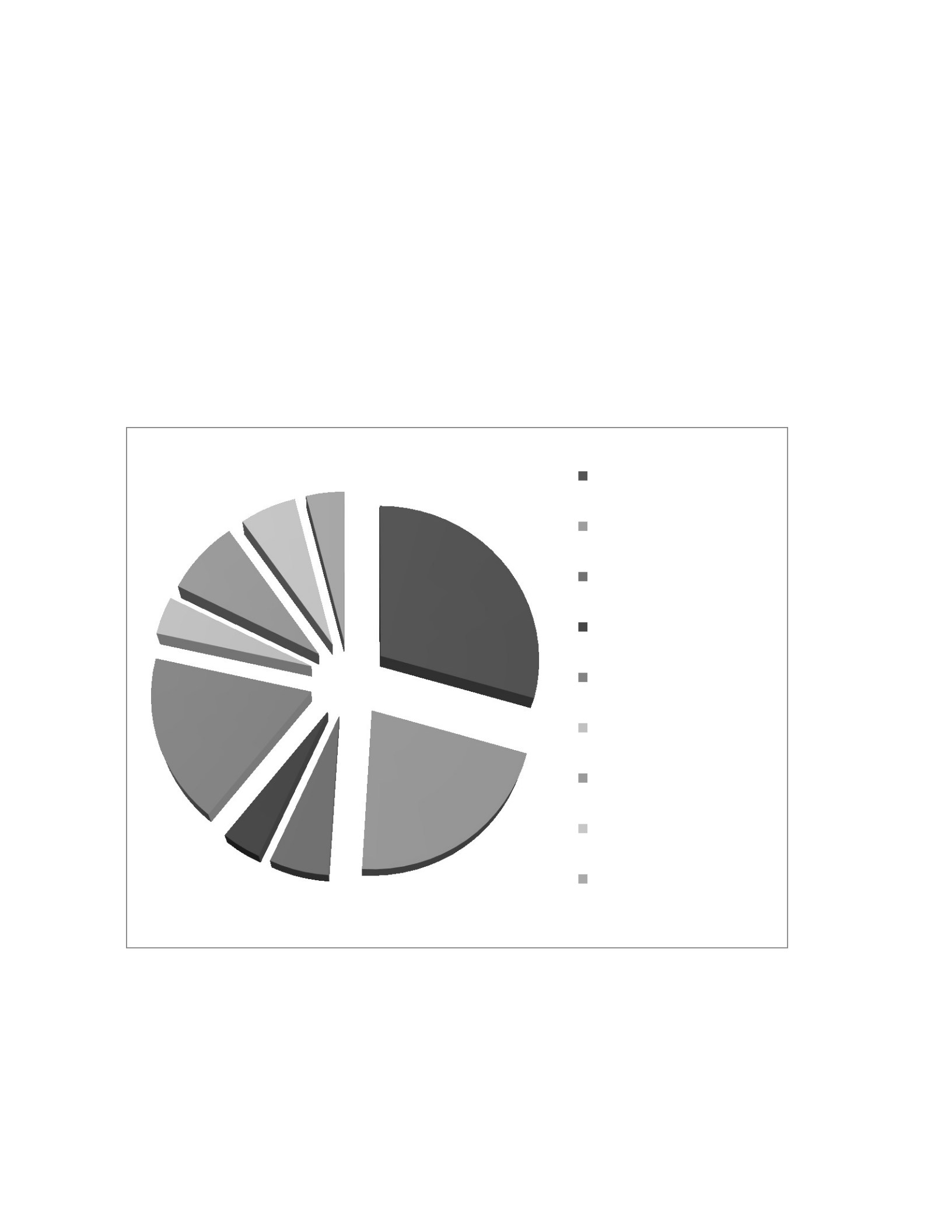
Departmental heads were further requested to offer proposals to the county government of
Meru on how career development can be enhanced in their respective departments. Their
suggestions were recorded as shown in Figure
Figure
Alternative ways of enhancing career development in Meru County Government
From results above, on-job training, job rotation and coaching are identified to be crucial for
career development in driving employee retention. The finding are in same comparison with
Norah, Susan and Waititu (2016) who noted that career development structures are
Trainings
3.92%
5.86%
7.84% 29.41%
Employees
mentorship program
Job rotation
3.92% Departmental
brochures
17.65%
Senior
managemenr
course
Goal setting
21.57%
3.92% 5.88%
Rightful Job placing in
job group
Funding for further
studies
Reward system

interrelated and, they work together to advance efficiency, retention and output of workers.
The implication of the findings is that with the enhancement of on-job training, job rotation,
coaching and other career development strategies, the employee retention level will increase.
This means that the institution can channel efforts towards realization of the primary goal
which is service delivery to the people of Meru.
Descriptive Statistics of Work-life Balance
Objective 2 of this study was to find out how work-life balance of the employees of the
County Government of Meru affected their retention. To achieve this respondent were
presented with statements touching on work-life balance and indicate their level of agreement
in each. Table 4.6 presents the results of average scores recorder.
Table 4.6
Descriptive results on work-life balance
Statement
(N=51)
1 2 3 4 5 Mean
My
employer
offers time
for social
life
6(11.8%) 6(11.8%) 11(21.6%) 23(45.1%) 5(9.8%) 3.29
There is
workplace
flexibility
4(7.8%) 3(5.9%) 9(17.6%) 31(60.8%) 4(7.8%) 3.54
Employees
are given
paid offs
8(15.7%) 8(15.7%) 8(15.7%) 22(43.1%) 5(9.8%) 3.15

Employees
are given
unpaid offs
8(15.7%) 12(23.5%) 14(27.5%) 13(25.5%) 4(7.8%) 2.86
There is a
health
insurance in
my
organization
2(3.9%) 0(0.0%) 4(7.8%) 21(41.2%) 24(47.1%) 4.27
Employees
are given
financial
support if
need be
6(11.8%) 16(31.4%) 9(17.6%) 14(27.5%) 6(11.8%) 2.96
We have an
insurance
policy in
our
organization
4(7.8%) 5(9.8%) 5(9.8%) 24(47.1%) 13(25.5%) 3.72
Employees
are entitled
to annual
leave
1(2.0%) 4(7.8%) 4(7.8%) 16(31.4%) 26(51.0%) 4.23
Results on Table 4.6 above reveals that most of the respondents agreed to the assertions
provided. Representing the highest average scores of 4.27 and 4.23, 24 (47.1%) respondents
strongly agreed to existence of a health insurance in County Government of Meru and
26(51.0%) respondents to employees entitled to annual leave. 31(60.8%) respondents agreed
on workplace flexibility evidenced by the average mean score of 3.54. Identically, 22(43.1%)
respondents also agreed to the employees being given paid of resulting to the average mean
recorded of 3.15. However, 16(31.4%) respondents differed with the statement regarding the
provision of financial support.
The findings indicated that majority of employees agreed with the statements on work- life
balance implying that work-life balance is a significant aspect for determining employee
retention in an organization. The results also imply that a number of elements are essential in
boosting work-life balance. These are; annual leaves, presence of organizational insurance
policy and workplace flexibility. Provision of these work-life balance enablers is expected to
enhance employee retention.
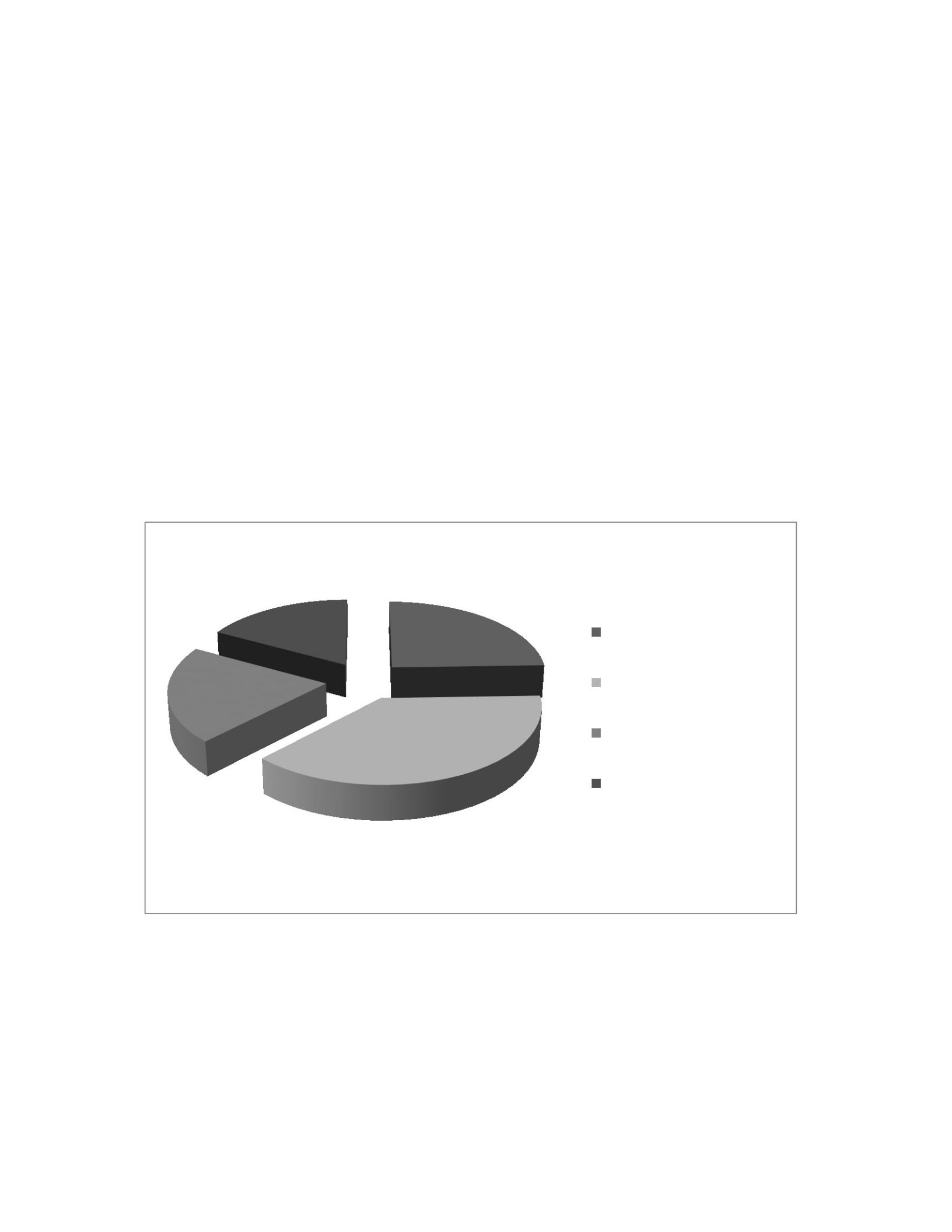
Respondents were further asked to provide suggestions on how work – life balance can be
enhanced in their respective departments. The results of this variable are presented in Figure
4.2.
Figure 1.2
Ways of enhancing work-life balance in Meru County Government
The above findings mirror those of Robert (2019)`who states that flexible work arrangements
including telecommunicating, flextime, compressed workweek and job- sharing build
employee loyalty, fulfilment and promote employee retention. This means that when there is
flexible working condition, formation of employee welfare, career enhancement opportunities
17.73% 25.49% Performance
review
21.57%
39.22%
Formation of
employee welfare
Flexing working
conditions
Career enhancement
opportunities

among others, then employees are likely to remain loyal and continue working for the County
Government.
REFERENCES
Abdulkadir, L. (2018). Influence of work-life balance on employee performance at the cabinet
affairs office, Kenya (University of Nairobi).
http://erepository.uonbi.ac.ke/bitstream/handle/11295/106022/LULA%20ABDU
LKADIR.pdf?sequence=1&isAllowed=y
Adams, J. S. (1965). Inequity in social exchange. Advances in experimental social
psychology. Academic Press.
Adekanye, E., & Nduka, S. (2017). Work-family conflict, job satisfaction and job
performance of female librarians in nine selected federal academic libraries in
south-west, Nigeria. Journal of Applied Information Science and Technology,
10(2), 215–277.
https://pdfs.semanticscholar.org/8452/3f3308bb0a0bb1729190dcf6cf559dc47f96.
pdf?_ga=2.75246162.1545720217.1591257761-983259724.1591257761
Agha, K., Azmi, F. T., & Irfan, A. (2017). Work-life balance and job satisfaction: An
empirical study focusing on higher education teachers in Oman. International
Journal of Social Science and Humanity, 7(3), 164 - 171.
http://www.ijssh.org/vol7/813-HA00017.pdf.
Alkandari, Q., & Hammad, A. A. (2009). Employees retention in private sector an
exploratory study in the State of Kuwait, (unpublished Master thesis), Open
University Malaysia. https://www.scribd.com/doc/55622649/Employees-
Retention-in-Private-Sector-an-Exploratory-Study-in-the-State-of-Kuwait
Allen, P. B. (2013). Compensation, benefits and employee turnover strategies for
retaining top talent. Compensation & Benefits Review, 45(3), 171–175
10.1177/0886368713494342
Al-Omar, A.A., Qablan, A.M., & Khasawnneh, S.M., (2009). Faculty member’s intention to
stay in Jordanian Public Universities. International Journal of Applied Educational
Studies, 1(1), 26-42. https://go.gale.com/ps/anonymous?id=GALE
%7CA180029990&sid=googleScho
lar&v=2.1&it=r&linkaccess=abs&issn=1996773X&p=AONE&sw=w
Al-Zawahreh, A. & Al-Madi, F., (2012). The Utility of Equity theory in enhancing
Organizational effectiveness. European Journal of Economics, Finance and
Administrative Sciences, 46(1), 158-170.
https://eis.hu.edu.jo/deanshipfiles/pub105362403.pdf
Amutuhaire, T. (2010). Terms of Service and Job Retention among Academic Staff

(unpublished Doctoral Dissertation), Makerere University, Kampala.
http://www.mak.ac.ug/documents/Makfiles/theses/Amutuhaire_Tibelius.pdf
Armstrong, M, (2005). Armstrong’s handbook of reward management practice:
improving performance through reward, (3rd ed.). Kogan page.
Armstrong, M. (2012). Strategic human resource management, (3th ed.). Translated by
mohammad arabi and omid mahdieh, Tehran, Cultural research office.
Armstrong, M. (2011). Increasing the effectiveness of reward management. Employee
Relations, 33(2), 106-120. 10.1108/01425451111096668
Atif, A., Kashif, U.R., Ijaz, U.R., Muhammad, A.K., & Asad, A.H., (2011). Impact of
Organizational Commitment on Job Satisfaction and Employee in Pharmaceutical
Industry. African Journal of Business Management, 5(17), 7316-7324.
https://academicjournals.org/journal/AJBM/article-full-text-pdf/7A8BF3415549.
Bartlomiejczuk, G., (2015). How do recognition programs impact employee engagement and
how have companies with a large global footprint structured such programs
to drive results? http://digitalcommons.ilr.cornell.edu/student/90
Bronchetti, E. T., & McInerney, M. (2017). Does increased access to health insurance
impact claims for workers' compensation? Evidence from Massachusetts health care
reform. https://papers.ssrn.com/sol3/papers.cfm?abstract_id=3000944
Brown, E. A., Bosselman, R. H., & Thomas, N. J. (2016). Are hospitality graduates making
too many compromises? What they give up may lead to turnover. Journal of Human
Resources in Hospitality & Tourism, 15(2), 133-146.
https://doi.org/10.1080/15332845.2016.1084853
Brundage, H., & Koziel, M., (2010). Retaining top talent.
https://www.journalofaccountancy.com/issues/2010/may/20091931.html
Bryman, A., (2008). Integrating quantitative and qualitative research: how is it done?’
Qualitative research, 6(1), 97 – 113. Sage publisher.
Cargan, L., (2007). Doing Social Research. Rowman & Littlefield Publishers Inc.
Cavico, F.J. & Mujtaba, B.G., (2010). An assessment of business schools' student
retention, accreditation, and faculty scholarship challenges. Contemporary
Issues in Education Research, 3(1), 107-118.
https://files.eric.ed.gov/fulltext/EJ1072549.pdf
Chabbra, N.L. & Mishra, A., (2013). Talent Management and employer branding:
Retention battle strategies. The Icfaian Journal of Management research, 7(11), 50-
61. https://www.iupindia.in/1108/IJMR_Talent_Management_50.html
Chemmanur, T. J., Cheng, Y., & Zhang, T. (2013). Human capital, capital structure, and
employee pay: An empirical analysis. Journal of Financial Economics, 110(2), 478-

502.
https://www.sciencedirect.com/science/article/abs/pii/S0304405X13001980
Cherry, K. (2015). Gender schema theory.
https://www.sciencedirect.com/topics/psychology/gender-schema-theory
Chiboiwa, M. W., Samuel, M. O., & Chipunza, C. (2010). An examination of employee
retention strategy in a private organisation in Zimbabwe. African Journal Of
Business Management, 4(10), 2103-2109.
http://academicjournals.org/journal/AJBM/article-full-text-pdf/46CBCBC28654
Chiekezie, O. M., Emejulu, G., & Nwanneka, A (2017).
Compensation management and employee retention of selected
commercial banks in
Anambra State,
Nigeria. Archives of Business
Research, 5(3), 115 –127. http:10.14738/abr.53.2758

