


8/29/23, 4:14 PM
Chapter 5 OB busi240
about:blank
1/4
Chapter 5 OB busi240
2/3/23
Jane DeGuire
Employee motivation: the forces within a person that affect the direction, intensity, and persistence, of
effort for voluntary behavior.
Employee behavior: employee’s emotional and cognitive motivation particularly a focused, more intense,
persistent, and positive effort toward work related goals.
Challenges of motivating employees: multigenerational and multicultural workforces, dramatic
workplace changes, less motivation through supervision.
Motivation originates from our drives.
4 drive theory:
Drive to acquire: seek, acquire, control, retain objects or experiences.
Drive to bond: from social relationships and develop mutual caring communities with others.
Drive to comprehend: satisfy our curiosity, know and understand ourselves and the environment.
Drive to defend: protect ourselves physically and socially.
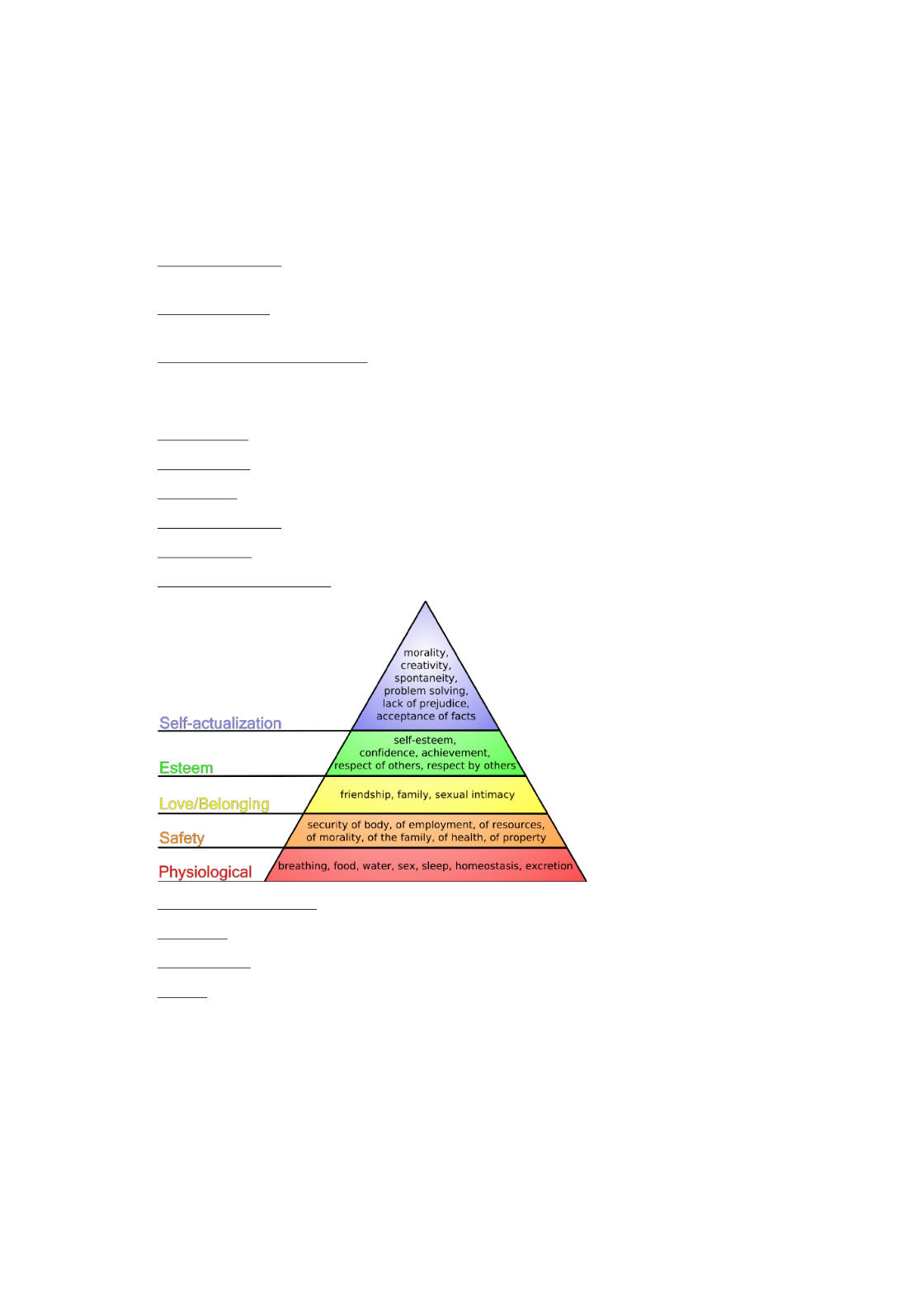
Maslow’s hierarchy of needs:
Vrooms expectancy theory
Expectancy: the belief that the more effort expanded on a task, the greater our performance
Instrumentality: the belief that if we perform well, we will receive a greater reward
Valence: what value we place on the expected outcome of our efforts

8/29/23, 4:14 PM
Chapter 5 OB busi240
about:blank
2/4
Expectancy theory and practice:
Increasing E to P expectancies: hire/train staff to adjust job duties, provide sufficient time and resources,
provide coaching and behavioral modeling to build self-efficiency.
Intrinsic: what we do because of how we feel about it (internal)
Extrinsic: what we do because we have to (physical or external)
Learned needs theory: needs for achievement (accomplish goals and things through your own effort,
clear feedback and recognition, work alone, money isn’t motivation), needs for affiliation (seeking
approval of others, conform to your expectations of them, employees are more easily biased), and needs
for power (desire to exercise control over others, persuasion, leadership position)
Social cognitive theory: much learning occurs by observing and modeling others as well as anticipating
the consequences of our behavior. The 3 components most relevant to employee motivation are learning
behavior consequences, behavior modeling, and self-regulation.
Goal setting:
S: Specific (what is the goal?)
M: measurable (how will I measure my progress?)
A: attainable (do I have the skills and resources for it?)
R: relevant (why is this goal important?)
T: time bound (when will I achieve the goal I set?)
Characteristics of effective feedback:
Specific: refers to identifiable behavior/outcome
Relevant: behavior/outcome is in their control
Credible: trustworthy
Timely: as soon as possible
Frequent: more often for learners, otherwise for others according to task cycle
Equity theory model: your own outcomes and inputs you compare with others’ outcomes and inputs
which is the perception of equity or inequity.
Chapter 6
Meaning of money at work: form of exchange, relates to needs and self-concepts, could be a tool or
drug, symbol of achievement and something to be budgeted, differs between men and women, varies
across cultures, and money motivates.
Membership/ seniority-based rewards:

8/29/23, 4:14 PM
Chapter 5 OB busi240
about:blank
3/4
Advantages: May attract job applicants, less financial insecurity, less turn over with seniority
Disadvantages: no performance motivation, discourages performers from leaving, may act as golden
handcuffs.
Competency based rewards:
Advantages: motivates learning new skills, multiskilled, flexible, adaptive employees, high product
service quality
Disadvantage: complex, over designed
Performance based rewards:
Individual rewards (bonuses, peace rate, commissions) team rewards (mostly bonuses and gainsharing
plans) organizational rewards (organizational bonuses, ESOPs, stock options, profit sharing) Evaluation
organizational rewards (ESOPs and stock options create “ownership culture” and profit sharing adjusts
pay with firms’ prosperity, weak p-o link)
Improving reward effectiveness: link rewards to performance, ensure rewards are relevant, use team
rewards, ensure the rewards are valued, watch out for unintended consequences.
Job specialization and scientific management theory:
Improves work efficiency: less time changing activities, jobs mastered more quickly, better person-job
matching.
Scientific management: promoted specialization, standardization, promoted training, goal setting,
rewards.
Job specialization problems: low motivation, job absenteeism/turnover, high wages to offset tedium,
affects work quality.
Job design and work motivation:
Core job characteristics: skill variety, task identity, task significance, autonomy, feedback
Psychological states: meaningfulness, responsibility, knowledge of results
Outcomes: motivation, performance, satisfaction, absenteeism, turnover
Job design practices that motivate:
Job rotation: builds wider skill set, highly motivated, better knowledge of issues, lower health risks,
greater flexibility.
Job enlargement: increases number and variety of job tasks, combines jobs, better skill sets.
Job enrichment: more freedom in your role, more responsibility for coordinating your own work, higher
job satisfaction, client relationships/ customer facing.
Empowerment practices: self-determination, meaning, competence, and impact.

8/29/23, 4:14 PM
Chapter 5 OB busi240
about:blank
4/4
Self-leadership practices: personal goal setting, constructive thought strategies, designing natural
rewards, self-monitoring, self-reinforcement.
Plan for permanent change:
Unfreeze: recognize change, determine the change
Change: plan the changes, implement the changes
Refreeze: changes are reinforced and stabilized, develop ways to sustain the changes
Understanding resistance to change:
Different forms: complaints, absenteeism, passive noncompliance, subtle resistance more common than
overt.
View resistance as a task conflict: signal that employees lack readiness for change or that change
strategy should be revised.
View resistance as a form of voice: redirect resistance into constructive conversation, encourages better
decisions through involvement, voice and implement increase commitment to change.
Why employees resist change: negative valence of change, fear of the unknown, not invented here
syndrome (the person who usually is the one to implement the change is not the one who is doing it this
time), breaking routines, incongruent team dynamics, incongruent organizational systems.
Strategies for minimizing resistance to change: communication, learning, employee involvement, stress
management, negotiation, and coercion.
Things that can help resistance: transformational leadership and change agent, coalitions and social
networks, pilot projects.
Four approaches to organizational change: action research approach (test through data practice and
research) appreciative inquiry approach (what worked well in the past and problem solve or reframe),
large group intervention approach (change is more successful when there’s more people involved, future
not past), parallel learning structure approach (social structures developed along a formal hierarchy).
Action research process:
1. Form client-consumer relationship.
2. Diagnose a need for change.
3. Introduce intervention.
4. Evaluate and stabilize change.
5. Disengage consultant services.
4 D cycle of appreciative inquiry: Discover, dream, deliver, and design.

