


Homework Notes: Week 3
I. Sample Spaces, Probabilities with Equally Likely Outcomes, and Unusual
Events
a. Probability Experiment – one in which we do not know what any
individual outcome will be, but we do know how a long series of
repetitions will come out.
b. Probability of an event – the proportion of times that the event occurs
in the long run.
c. Law of Large numbers – as a probability experiment is repeated again
and again, the proportion of times that a given event occurs will
approach its probability.
d. Sample Space – the collection of all the possible outcomes of a
probability experiment.
i. Examples:
1. The toss of a coin
a. The sample space is (Heads, Tails)
2. The roll of a die
a. The sample space is (1,2,3,4,5,6)
3. Selecting a student at random from a list of 10,000 at a
large university
a. The sample space consists of the 10,000 students
e. Probability Model and Events
i. In general, a collection of outcomes of a sample space is called
an event.
ii. Once we have a sample space, we need to specify a probability
of each event.
iii. Probability Model – We use the letter “P” to denote probabilities.
1. In general, if A denotes an event, the probability of event
A is denoted by P(A).
f. Probability Rules
i. The probability of an event is always between 0 and 1.
1. For any event, 0≤P(A)≤1
2. If A cannot occur, then P(A)=0
3. If A is certain to occur, then P(A)=1
g. Probabilities with Equally Likely Outcomes
i. If a sample space has n equally likely outcomes and an event A
has k outcomes, then:
1. P(A)=number of outcomes in A/number of outcomes in
each sample space=k/n
h. Sampling is a Probability Experiment
i. Sampling an individual from a population is a probability
experiment.
1. The population is the sample space and members of the
population are equally likely outcomes.
i. Unusual Events
i. Unusual Event – one that is not likely to happen.

1. In other words, an event whose probability is small.
2. Any event whose probability is less than 0.05 is
considered to be unusual.
II. Approximate a Probability with the Empirical Method
a. Example:
i. The Center for Disease Control reports that in a recent year
there were 313,752 births in the U.S. to low birth weight babies
(less than 2500 grams), while 3,477,960 were to babies with
weight greater than 2500 grams. Approximate the probability
that a newborn baby is low birth weight.
1. 3,477,960 non-low birth weight
+ 313,752 low birth weight
3,791,712 births
The proportion of births that are low birth weight is:
313,752
3,791,712 = 0.0827
III. Computing Probabilities with Equally Likely Outcomes
a. P(A) = Number of outcomes in A/
number of outcomes in the sample space = k/n
IV. The Addition Rule and The Rule of Complements
a. A or B Events and the General Addition Rule
i. Compound Event – an event that is formed by combining two or
more events.
1. One type of compound event is of the form A or B. The A
or B occurs whenever A occurs, B occurs, or A and B both
occur.
a. Probabilities of events in the for A or B are
computed using the General Addition Rule.
i. P(A) = P(A) + P(B) – P(A and B)
b. Mutually Exclusive Events
i. Two events are said to be mutually exclusive if it is impossible
for both events to occur.
c. The Addition Rule for Mutually Exclusive Events
i. If events A and B are mutually exclusive, the P(A and B) = 0.
This leads to a simplification of the General Addition Rule.
1. If A and B are mutually exclusive events, then:
a. P(A or B) = P(A) + P(B)
d. Complements
i. If there is a 60% chance of rain today, then there is a 40%
chance that it will not rain. The events “rain” and “no rain” are
complements.
ii. The complement of an event that says that the event does not
occur.
1. If A is any event, the complement of A is the event that A
does not occur. The complement of A is denoted Ac.
e. The Rule of Complements
i. P(Ac) =1 – P(A)
V. Conditional Probabilities and The General Multiplication Rule
a. Conditional Probability
i. A probability that is computed with the knowledge of additional
information is called a conditional probability.
ii. The conditional probability of an event B given an event A is
denoted P(B\A).
1. The probability is computed as P(B\A)=P(A and B)/P(A)
b. The General Multiplication Rule
i. The General Method for computing conditional probabilities
provides a way to compute probabilities for events of the for “A
and B.”
ii. If we multiply both side of the equation by P(A) we obtain the
General Multiplication Rule.
1. For any two events A and B,
a. P(A and B)=P(A)*P(B\A) or
b. P(A and B)=P(B)*P(A\B)
c. Independence
i. Two events are independent if the occurrence of one does not
affect the probability that the other event occurs.
1. For any two independent events A and B
a. P(A and B)=P(A)*P(B)
ii. If two events are not independent, we say they are dependent.
VI. Coin Tossing Probabilities
a. A fair coin is tossed twice.
i. What is the probability that the second toss is a head?
ii. What is the probability that the second toss is a head given that
the first toss is a head?
iii. Are the answers to(i) and (ii) different? Does the probability that
the second toss is a head change if the first toss is a head?
b. In part a/i, there are 4 equally likely outcomes for the two tosses
i. Sample Space= (HH, HT, TH, TT)
ii. Of these, there is 2 outcomes where the second toss is a head
(HH, TH)
1. P(second toss is H)=2/4=1/2
c. For part a/ii, we use the General Method for computing conditional
probabilities.
i. The probability of B given A is:
1. P(B\A)=Paand B)/P(A)
ii. When the outcomes in the sample space are equally likely, then:
1. P(B\A)=Number of outcomes corresponding to (A and
B)/Number of outcomes corresponding to A
iii. P(second toss is H\First toss is H)=Number of outcomes where
first toss is H and second toss is H/Number of outcomes where
first toss is H=1/2
d. For part a/iii, the two answer are the same.
i. The probability that the second toss is a head does not change if
the first toss is a head.
1. P(second toss is H\first toss is H)=P(second toss is H)
2. Two events are independent if the occurrence of one does
not affect the probability that the other event occurs.
VII. At Least Once-Type Probabilities
a. Sometimes, we need to find the probability that an event occurs at
least once in several independent trials.
i. Often, the best way to calculate this type of probability is by
finding the probability of the compliment.
1. The compliment of “at least one event occurs” is “no
events occur”.
VIII. Fundamental Principle of Counting, Permutations, and Combinations
a. If an operation can be performed in m ways, and a second operation
can be performed in n ways, then the total number of ways to perform
the sequence of two operations is mn.
i. In general, if a sequence of several operations is to be
performed, the number of ways to perform the sequence is
found by multiplying together the numbers of ways to perform
each of the operations.
1. Example:
a. A certain make of automobile is available in any of
three colors: red, blue, or green, and comes with
either a large or small engine. In how many ways
can a buyer choose a car?
i. There are 3 choices of color and 2 choices of
engine. The total number of choices is
3*2=6.
b. Permutations
i. The word “permutation” is another word for “ordering.”
1. When we count the number of permutations, we are
counting the number of different ways that a group of
items can be ordered.
a. The number of permutations of n objects is n!
i. Recall that n!=(n-1)…3(2)(1)
2. Example:
a. Five runners run a race. One of them will finish first,
another will finish second, and so on. In how many
different orders can they finish?
i. Solution:
1. The number of different orders in
which the runners can finish is:
a. 5!=5*4*3*2*1=120

3. Example:
a. Ten runners run a race. The first-place finisher will
win a gold medal, the second-place finisher will win
a silver medal, and the third-place finisher will win
a bronze medal. In how many ways can the medals
be awarded?
i. Solution:
1. We use Fundamental Principle of
Counting. There are 10 possible
choices for the gold medal winner.
Once the gold medal winner is
determined, there are 9 remaining
choices for the silver medal. Finally,
there are 8 choices for the bronze
medal.
a. The total number of ways the
medals can be awarded is:
i. 10*9*8=720.
4. Example:
a. Three runners were chosen from a group of ten,
then ordered as first, second, and third. This is
referred to as a permutation of three items chosen
from ten.
b. In general, a permutation of r items chosen from n
items is an ordering of the r items. It is obtained by
choosing r items from a group of n items, then
choosing an order for the r items.
i. The number of permutations of r items
chosen from n is denoted nPr.
ii. The number of permutations of r objects
chosen from n is:
1. nPr=n*(n-1)…(n-r+1)=n!/(n-r)!
5. Example:
a. Five lifeguards are available for duty one Saturday
afternoon. There are three lifeguard stations. In
how many ways can three lifeguards be chosen and
ordered among the stations?
i. Solution: We are choosing three items from a
group of five and ordering them. The number
of ways to do this is:
1. 5P3=5!/(5-3)!=5!/2!
=5*4*3*2*1/2*1=5*4*3=60
c. In some cases, when choosing a set of objects from a larger set, we
don’t care about the ordering of the chosen objects; we care only
which objects are chosen.
i. Example:
1. We may not care which lifeguard occupies which station;
we might only care which three lifeguards are chosen.
ii. Each distinct group of objects that can be selected, without
regard to order, is called a combination.
1. The number of combinations of r objects chosen from n is:
a. nCr=n!/r!(n-r)!
2. Example:
a. At a certain event, 30 people attend, and 5 will be
chosen at random to receive prizes. The prizes are
all the same, so the order in which the people are
chosen does not matter. How many different groups
of 5 people can be chosen?
i. Solution: Since the order of the 5 chosen
people does not matter, we need to compute
the number of combinations of 5 chosen
from 30.
1. 30C5=30!/5!(30-5)!
=30*29*28*27*26/5*4*3*2*1=142,50
6
3. Example:
a. A box of lightbulbs contains eight good lightbulbs
and 2 burned-out bulbs. Four bulbs will be selected
at random to put into a new lamp. What is the
probability that all four bulbs are good?
i. Solution: The outcomes in the sample space
consist of all the combinations of four bulbs
that can be chosen from 10.
1. 10C4=10!/4!(10-4)!
=3,628,800/24*720=210
2. The number of outcomes that
correspond to selecting four good
bulbs is the number of combinations of
four bulbs that can be chosen from
eight.
a. 8C4=8!/4!*(8-4)!
=40,320/24*24=70
b. P(four good bulbs are
selected)=70/210=1/3
IX. Factorials, Permutations, and Combinations (EXCEL)
a. Example:
i. Five runners run a race. One of them will finish first, another will
finish second, and so on. In how many different orders can they
finish?
1. Number of orders=5*4*3*2*1=120
2. Excel formula- =FACT(5)
b. Example:
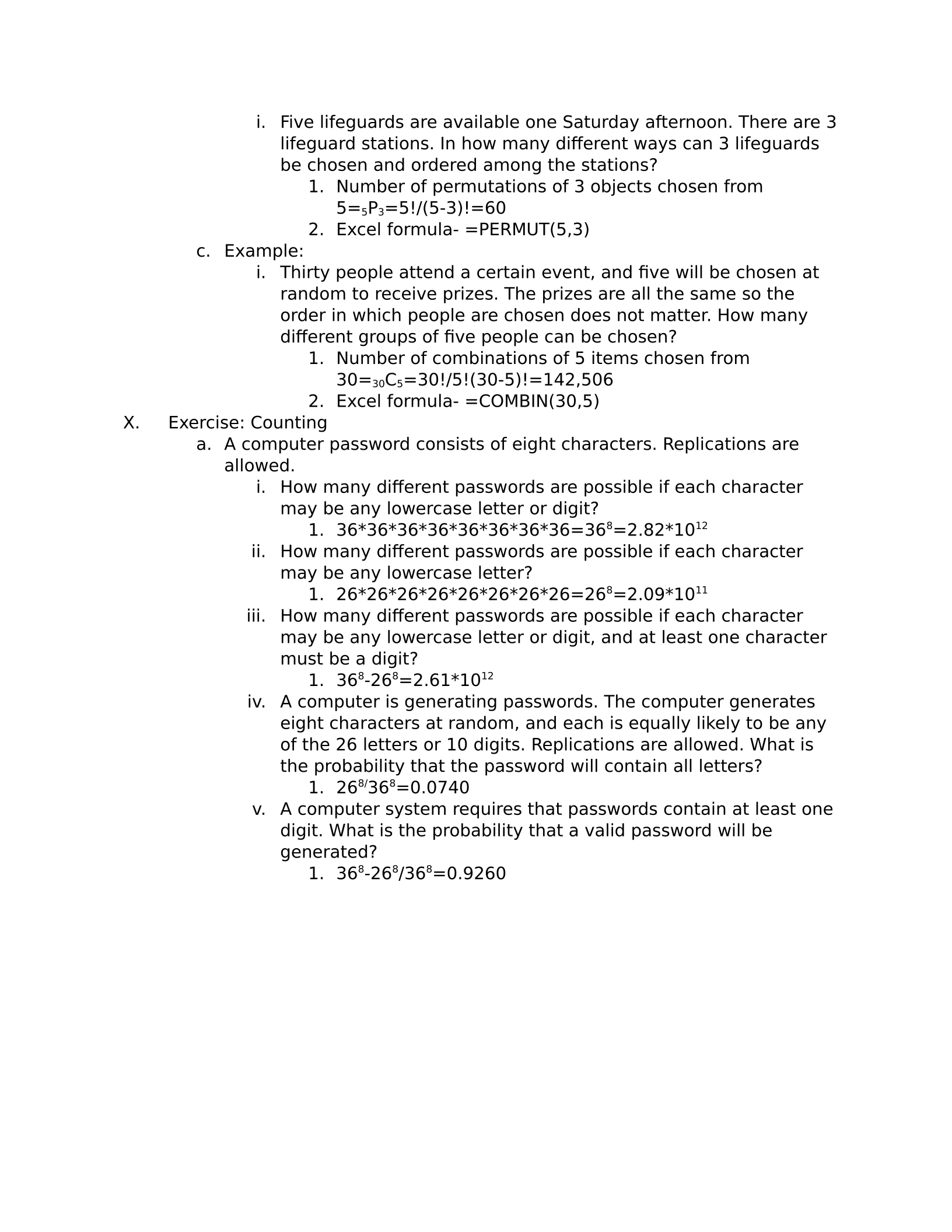
i. Five lifeguards are available one Saturday afternoon. There are 3
lifeguard stations. In how many different ways can 3 lifeguards
be chosen and ordered among the stations?
1. Number of permutations of 3 objects chosen from
5=5P3=5!/(5-3)!=60
2. Excel formula- =PERMUT(5,3)
c. Example:
i. Thirty people attend a certain event, and five will be chosen at
random to receive prizes. The prizes are all the same so the
order in which people are chosen does not matter. How many
different groups of five people can be chosen?
1. Number of combinations of 5 items chosen from
30=30C5=30!/5!(30-5)!=142,506
2. Excel formula- =COMBIN(30,5)
X. Exercise: Counting
a. A computer password consists of eight characters. Replications are
allowed.
i. How many different passwords are possible if each character
may be any lowercase letter or digit?
1. 36*36*36*36*36*36*36*36=368=2.82*1012
ii. How many different passwords are possible if each character
may be any lowercase letter?
1. 26*26*26*26*26*26*26*26=268=2.09*1011
iii. How many different passwords are possible if each character
may be any lowercase letter or digit, and at least one character
must be a digit?
1. 368-268=2.61*1012
iv. A computer is generating passwords. The computer generates
eight characters at random, and each is equally likely to be any
of the 26 letters or 10 digits. Replications are allowed. What is
the probability that the password will contain all letters?
1. 268/368=0.0740
v. A computer system requires that passwords contain at least one
digit. What is the probability that a valid password will be
generated?
1. 368-268/368=0.9260
Powered by TCPDF (www.tcpdf.org)

