


Running head: TERM PROJECT GAP ANALYSIS 1
Third Party Administrator Claim System Upgrade
BMIS 510 - B01
Liberty University

TERM PROJECT GAP ANALYSIS 2
Introduction
After an appointment, a doctor or clinic sends a bill to a third party administrator (TPA)
to process and pay the submitted medical claim. The TPA gathers and reviews all relevant
information as paper copies including the patient appointment sheet, intake forms, and the proper
services documentation. The data is manually entered into the internal claims system, to be
reviewed against the patient's healthcare policy, pricing regulations, and to determine coverage of
services. Once coverage is determined, the TPA generates and prints paper checks, remittance
advices (RA), and explanation of benefits (EOB) for covered services, mailing the paper
documents to the appropriate party based on payment assignment.

TERM PROJECT GAP ANALYSIS 3
Current Process
Scenario
The TPA is overdue for moving their Claims Processing system and process flow to an
application that includes advanced automation. The existing system and processes encompasses
healthcare providers and/or clinics submitting paper claim forms for patients seen within their
facility and multiple TPA staff manually managing and processing the received claims. These
claim forms are manually sorted, prepped, entered into, and paid out of the existing Claims
Processing system by Customer Service Representatives, Claims Examiners, and Claims Payable
Specialist staff. Additional staff members, the Claims Auditors and Benefit Configure Analysts,
manually review and maintain the patient health plan benefit configurations and provider
payment agreements within the Claims System.
The initial process was designed for managing a single health plan. However this plan did
not include options that would grow along with the growth of the company. The TPA has since
grown to managing 12 different health plans ranging over a five state area. The lack of
automation and reliance on manual processes has slowed the process time considerably while
also increasing the number of human errors.
Stakeholders
Healthcare Provider/Clinic
Patient
Customer Service Representative (CSR)
Claims Examiner
Claims Audit
Benefit Configure Analyst (BCA)
Claims Payable Specialist
Distinct Business Activities
Submitting medical claim for payment
Membership benefits managed
Medical claim and appropriate documentation reviewed

TERM PROJECT GAP ANALYSIS 4
Medical claim data entered
Patient eligibility and benefit level determined
Pricing claim edits applied
Proprietary claim edits applied
Claim adjudication completed
Claims payment process completed
RA, EOB, and payment printed
Payment and remittances mailed
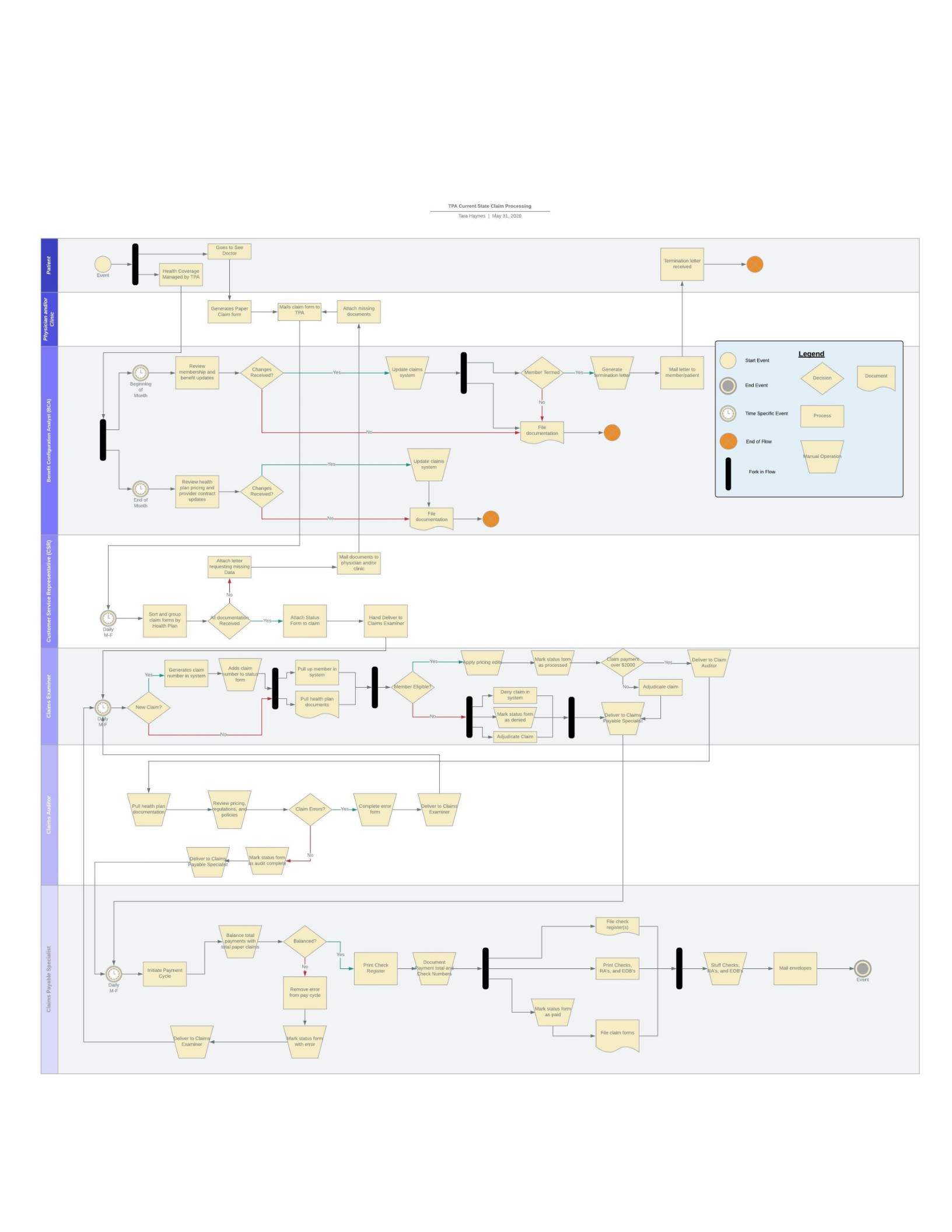
AS-IS Business Process (see Appendix A for process flow)
At the beginning of each week, the healthcare provider and/ or clinic prints and mails
manual claim forms for all patient visits from the prior week.
At the beginning of each month, the BCA reviews all received paper forms with
membership and benefit updates for each TPA managed health plan. They manually
update new and terminated members and/or change in member benefit levels in the
claims system. If a member’s coverage is terminated, a manual letter is generated and
mailed to the member. Once all updates have been completed, a manual email is
generated and sent to the Claims Examiners and Claims Audit team to notify them that all
changes have been completed.
At the end of each month the BCAs review the monthly updates related to health plan
pricing and provider contracts. They manually update all changes to the contracted
pricing rates in the claims system. Once all updates have been completed, a manual email
is generated and sent to the Claims Examiners and Claims Audit team to notify them that
all changes have been completed.
At the beginning of each day, CSRs open all newly received paper claim forms, sorting
and grouping by health plan. The CSR determines if all needed documentation has been
received to complete processing of the medical claim. If all documentation is not received

TERM PROJECT GAP ANALYSIS 5
the original paperwork is returned to the doctor and/or clinic with a letter requesting
any/all missing data.
A status form is attached to each received claim form. The sorted and prepped claim
forms are hand delivered by CSR to the specific Claims Team that processes claims for
the specific health plan.
The Claims Examiner follows a Monday through Friday schedule to determine which
health plan claims are to be processed. Depending on the day of the week, they enter each
claim into the claim system in a first-in-first-out queuing system.
oThe Claims Examiner manually generates the claim number in the claims system
based on a preset criterion and writes the claim number on the status form.
oTo process and price the claim, the Claims Examiner locates the corresponding
member in the claims system and determines eligibility and benefit level. They
then pull the corresponding health plan document from the filing cabinet.
If the member is found to not be eligible a denial code is added and the
claim is adjudicated in the claims system. The status form is marked,
indicating the claim is denied, then signed and dated by the Claims
Examiner. The claim documents are hand delivered to the Claims Payable
Specialist.
oThe Claims Examiner manually applies insurer proprietary and general pricing
claim edits using a pricing Excel spreadsheet and the corresponding health plan
documentation.
oThe status form is marked, indicating the claim is processed, then signed and
dated by the Claims Examiner.

TERM PROJECT GAP ANALYSIS 6
If the claim paid total is over $2000 the status form is marked as pending
in the claims system and the claims documents are hand delivered to the
Claims Auditors.
If the claims are less than $2000 the claim is marked as adjudicated in the
claim system and the claims documents are hand delivered to the Claims
Payable Specialist.
The Claims Auditors review any claims with a payment total over $2000 to ensure they
are valid requests and the pricing has been entered correctly.
oThe Claims Auditor pulls the corresponding health plan document from the filing
cabinet. They manually review the processed claim with the health plan
documentation to determine correct policies, procedures, compliance regulations,
and schedule of benefits have been followed.
If an error is identified, an error form is filled out and attached to the
original claim form. The error and claim forms are hand delivered to the
Claims Examiner for reprocessing.
If no errors are found, the status form is marked as audit complete and the
claims documents are hand delivered to the Claims Payable Specialist.
oThe Claims Auditors manually enter audit data into the database to document and
develop reports based on the audit findings.
The Claims Payable Specialist follows a Monday through Friday schedule to determine
which health plan claims are to be processed. Depending on the day of the week, they
compile claims for payment in a first-in-first-out queuing system.

TERM PROJECT GAP ANALYSIS 7
oThe Claims Payable Specialist initiates the claims payment process in the claims
system.
oUsing a calculator, the Claims Payable Specialist validates the total payments
being issued indicated by the claims system equal the total of the corresponding
claim forms. The payment cycle is completed and the check register printed.
If an error is identified, the claim causing the error is removed from the
payment cycle, the status form is marked with the error and the claim is
hand delivered to the Claims Examiner to review and reprocess.
oThe payment totals and check numbers are manually documented in the
corresponding Excel spreadsheet and the printed check registers are filed.
oThe status form is marked, indicating paid, manually adding the corresponding
check number and paid date, signed by the Claims Payable Specialist. The claim
forms and all documentation are then filed.
oThe Claims Payable Specialist prints the individual checks, RA’s, and EOB’s and
they are manually stuffed in envelopes. The check and RA envelopes are mailed
to the provider, and the EOB’s are mailed to the member/patient, both via US
Postal services.
Gap Analysis
The medical claims process begins when a healthcare provider treats a patient and sends a
bill of services provided to the designated payer as a medical claim. The payer reviews the claim
based on a number of factors, such as benefits and provider contracts, to determine which, if any,
services are reimbursable[ CITATION Med20 \l 1033 ]. Technical requirements and government

TERM PROJECT GAP ANALYSIS 8
and industry standards are in place regulating the timely filing and processing of insurance
claims between the medical practice and the health plan payer or TPA.
Paper claims must be printed out, completed by hand, and physically mailed to payers
increasing the chance for human error. Incorrectly printed claim forms and errors or illegible
coding, when written by hand, can cause additional delays[ CITATION Den19 \l 1033 ]. The
preference by most healthcare providers and TPAs is using electronic claim systems, either for
generating and printing the claim forms or for sending the claim forms as an electronic file.
These systems increase processing speed, provide greater accuracy, and cost less than manual
processing, with a savings of approximately $3 per claim[ CITATION Med20 \l 1033 ]. The use
of an electronic system reduces the chance of errors in the forms submitted by including software
that is designed to check for errors in the documents[ CITATION Sta18 \l 1033 ].
Paper claim forms, when received by the TPA, could be delivered to the wrong
department, lost, or damaged, causing processing and payment delays. These errors are costly for
the healthcare provider and the TPA, often resulting in the need to resubmit the claim form,
potentially creating duplicate billing issues, payment delays, or causing an inability to meeting
filing and processing guidelines. The use of scanning software is able to assist in reducing these
errors. The process includes scanning the original documents into a file using the software,
which then electronically identifies and documents information provided in the specified fields
on the claim form[ CITATION Med20 \l 1033 ]. The data is then transferred into the claims
processing software, reducing the chance of losing the physical form, and reducing the amount of
time from receipt to the start of processing the claim.
Electronic claim forms generate a file at the time the form is created, which is then sent
either directly to the TPA, or to a clearinghouse. The clearinghouse is a third-party operation,

TERM PROJECT GAP ANALYSIS 9
providing a contact point between healthcare providers and TPAs where claims are sorted and
forwarded to the appropriate TPA for each patient’s health plan. The use of electronic claim
forms allows for healthcare providers to send large numbers of medical claims on a scheduled
basis, without the need to manually create or mail each individual form.
The medical claims process requires an understanding of industry standards, individual
insurance company regulations, clearinghouse procedures, and government regulations related to
the individual health plans being managed and the claims adjudication and payment processes.
These standards and regulations change on an ongoing basis[ CITATION Den19 \l 1033 ]
creating additional work for the Claims Examiners with the need to continuously review any
changes manually to accurately process the claims. The use of an updated and more automated
claims processing system allows the ability to quickly use new regulations through scheduled
system updates maintained either by the organization’s IT team or by the software
administrator[ CITATION Abd17 \l 1033 ]. In addition, the use of workflow functionality within
the application removes the need for manual processing of every claim, providing the ability to
define and implement payment processes and rules to allow for greater automation, reducing the
processing timeline[ CITATION Vit20 \l 1033 ]. Once implemented, these processes are either
able to be scheduled or can be initiated manually, allowing for a configuration that is more
flexible to assist in identification of claims needing additional review or to enforce additional
organization specific controls to identify claims needing pricing or benefit auditing.
Once the medical claim has completed processing and is ready for payment, the use of
the TPA claims processing system provides the ability to generate and deliver the payments, RA’s
or EOB’s to the healthcare provider and/or member electronically. An electronic RA allows the
provider to upload the data and apply the amounts to their patient billing system, with the data in

TERM PROJECT GAP ANALYSIS 10
the file broken down by patient, providing the dates of service, procedures and charges, patient
financial responsibility, and the amount paid. This electronic format reduces costs related to
generating paper payments and documents, postage, and personnel hours[ CITATION Heg15 \l
1033 ].
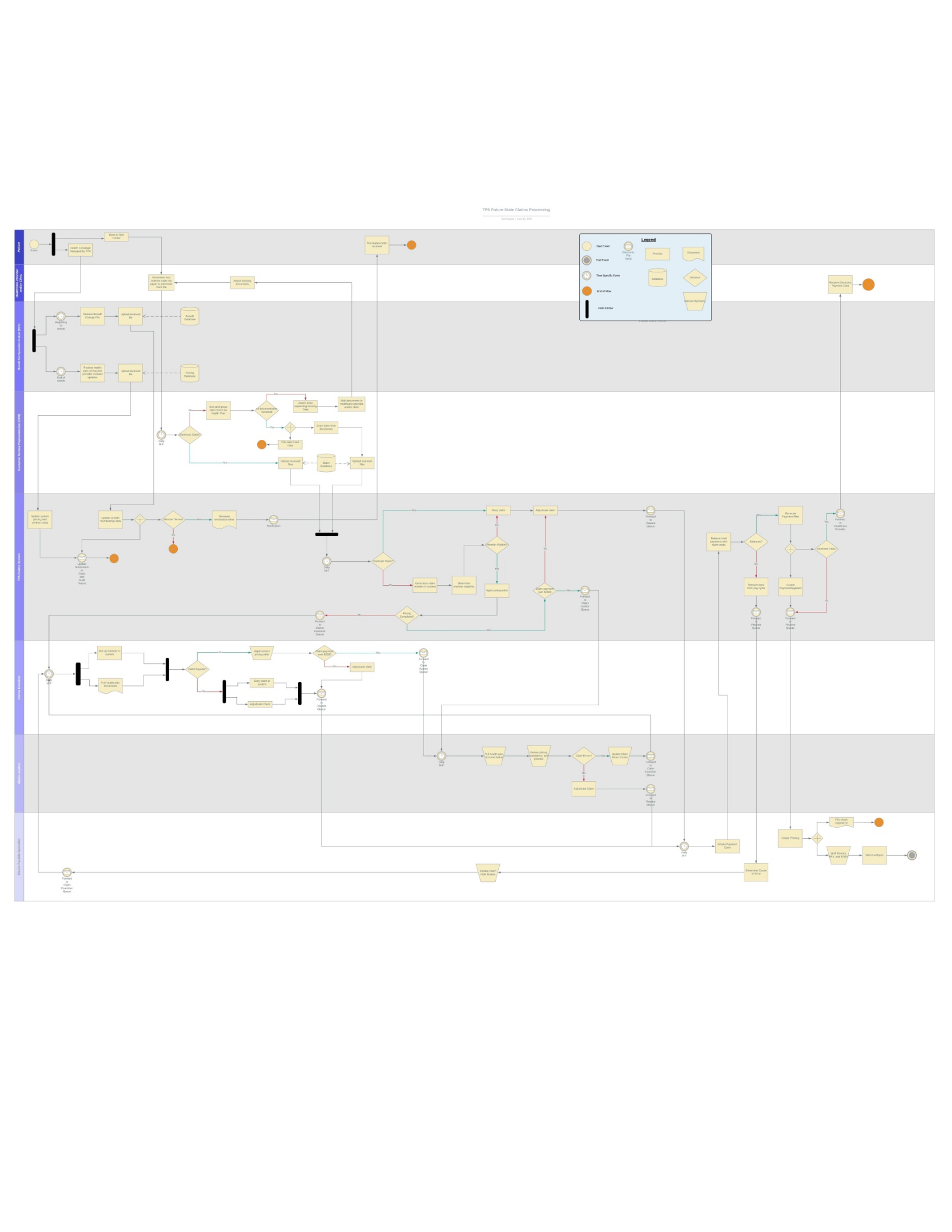
To-Be Business Process (see Appendix B for process flow)
At the beginning of each month, the BCA downloads the electronic membership and
benefit updates for each TPA managed health plan. They upload the data into the system
to update new and terminated members and/or change member benefit levels in the
claims system.
oIf a member’s coverage is terminated, the system triggers a letter to be generated
and mailed to the member.
oOnce all updates have been completed, the system triggers an electronic update
completion notification to the Claims Examiners and Claims Audit team.
At the end of each month the BCAs downloads the monthly updates related to health plan
pricing and provider contracts. They upload the new file containing all changes to the
contracted pricing rates in the claims system.
oOnce all updates have been completed, the system triggers an electronic update
completion notification to the Claims Examiners and Claims Audit team.
Daily the healthcare provider and/or clinic generate and send claim forms for all patient
visits from the previous day, either electronically or as a paper form.
At the beginning of each day, CSRs open all newly received paper claim forms, sorting
and grouping by health plan. The CSR scans the documents and uploads them to the TPA
Claims System, filing the paper forms.

TERM PROJECT GAP ANALYSIS 11
oIf all documentation is not received the original paperwork is returned to the
doctor and/or clinic with a letter requesting any/all missing data.
On a daily basis, CSRs upload all received electronic claims received the previous day
into the claims system.
The TPA claims system runs all scanned and electronic claim data through the set rules
and conditional processes.
oThe TPA claims system determines member eligibility based on uploaded
membership data.
If the member is found to not be eligible a denial code is added and the
claim is adjudicated in the claims system and forwarded to the Finance
work queue.
oClaims that flow without error automatically have insurer proprietary and general
pricing claim edits applied, are adjudicated, and forwarded to the Finance work
queue.
If the claim paid total is over $2000 the claims system forwards the claim
to the Claims Audit work queue.
oClaims that are identified with an unknown error are forwarded to the Claims
Examiner work queue for manual processing.
The Claims Examiner follows a first-in-first-out queuing system.
oTo process and price the claim, the Claims Examiner locates the corresponding
member in the claims system and determines eligibility and benefit level. They
then pull the corresponding health plan document from the filing cabinet.

TERM PROJECT GAP ANALYSIS 12
If the member is found to not be eligible a denial code is added and the
claim is adjudicated in the claims system and automatically forwarded to
the Finance work queue.
oThe Claims Examiner manually applies insurer proprietary and general pricing
claim edits based on the corresponding pricing and contract rates in the system.
If the claim paid total is over $2000 and the claim is automatically
forwarded to the Claim Audit work queue.
If the claims are less than $2000 the claim is adjudicated and
automatically forwarded to the Finance work queue.
The Claims Auditors follows a first-in-first-out queuing system, reviewing any claims
with a payment total over $2000 to ensure they are valid requests and the pricing has
been entered correctly.
oThe Claims Auditor pulls the corresponding health plan document from the filing
cabinet. They manually review the processed claim with the health plan
documentation to determine correct policies, procedures, compliance regulations,
and schedule of benefits have been followed.
If an error is identified, a notation is added to the claim notes screen in the
TPA claims system and forwarded back to the Claims Examiner work
queue.
If no errors are found, the claim is adjudicated and automatically
forwarded to the Finance work queue.
oThe Claims Auditors manually enter audit data into the database to document and
develop reports based on the audit findings.

TERM PROJECT GAP ANALYSIS 13
The Claims Payable Specialist follows a Monday through Friday schedule to determine
which health plan claims are to be processed. Depending on the day of the week, they
compile claims for payment in a first-in-first-out queuing system.
oThe Claims Payable Specialist initiates the claims payment process in the TPA
claims system.
oThe TPA system validates the totals of the claims match the total payments to be
issued.
If an error is identified, the claim causing the error is removed from the
payment cycle batch and the claim data forwarded to the Finance work
queue.
Once the cause of the error is determined a note is added to the claim note
screen in the TPA claim system and manually forwarded to the Claims
Examiner work queue.
oThe TPA system generates the payment files and payment registers.
Electronic files are forwarded automatically to the Healthcare Provider.
An automated electronic notification is sent to the Finance work queue to
print any paper documents.
oThe status form is marked, indicating paid, manually adding the corresponding
check number and paid date, signed by the Claims Payable Specialist. The claim
forms and all documentation are then filed.
oThe Claims Payable Specialist prints the check registers, paper checks, RA’s, and
EOB’s and they are manually stuffed in envelopes. The check and RA envelopes

TERM PROJECT GAP ANALYSIS 14
are mailed to the provider, and the EOB’s are mailed to the member/patient, both
via US Postal services. The check registers are filed.

TERM PROJECT GAP ANALYSIS 15
References
Abdullah, U., Ligęza, A., & Zafar, K. (2017). Performance evaluation of rule‐based expert
systems: An example from medical billing domain. Expert Systems, 34(6), e12218-
e12232. doi:https://doi-org.ezproxy.liberty.edu/10.1111/exsy.12218
Denck, J., Landschütz, W., Nairz, K., Heverhagen, J. T., Maier, A., & Rothgang, E. (2019).
Automated billing code retrieval from MRI scanner log data. Journal of Digital Imaging,
32(6), 1103-1111. doi:http://dx.doi.org.ezproxy.liberty.edu/10.1007/s10278-019-00241-z
Hegazy, T., & Hefeeda, M. (2015). Industrial automation as a cloud service. IEEE Transactions
on Parallel and Distributed Systems, 26(10), 2750-2763.
doi:10.1109/TPDS.2014.2359894
Medical Billing and Coding Online. (2020). Medical billing insurance claims process. Retrieved
June 16, 2020, from Medical Billing and Coding Online:
https://www.medicalbillingandcodingonline.com/medical-billing-claims-process/
Stair, R. M., & Reynolds, G. W. (2018). Fundamentals of information systems (9th ed.). Boston,
MA: Cengage Learning.
Vitech Systems. (2020). V3 software for insurance administration. Retrieved June 20, 2020,
from Vitech Inc.: https://www.vitechinc.com/v3-for-insurance/
‘TPA
Current
State
Claim
Processing
TERM PROJECT GAP ANALYSIS 16
Appendix A
TPA Current State Claims Processing
TERM PROJECT GAP ANALYSIS 17
Appendix B
TPA Future State Claims Processing

