


PROJECT APPROACH (METHODS) 2
Project Approach (Methods)
This study will be conducted with a flexible design using qualitative methods
specifically, an ethnographical theory design will be used. An ethnographical design works the
best for research regarding African American women and their experiences with business
leadership and entrepreneurship in order to gain insight and understanding in the choices they
have made and the paths they have taken to reach success or that has led to failure or a setback in
their progress. When conducting research using an ethnographical design, it is useful to use
narrative styled interviews, grounded theory, as well as surveys.
Ethnography is a research method characterized by extensive fieldwork where the
researcher is often immersed as an observer, and sometimes as a participant observer.
Researchers often remain immersed for an extended period and usually produce a quite
detailed account of their exploration of a social environment or culture. (Johnstone, 2007,
Context section, para. 2)
Using the method of ethnographic research is ideal for the research topic of African American
women and their relationship with success in business leadership and entrepreneurship. This is a
group that the researcher is a participant observer in as well as one that the researcher has been
fully immersed in for over 15 years. Being able to provide firsthand accounts of this personal
experience will provide the best qualitative research on this topic as well as allow access into the
African American community of women necessary to retrieve appropriate participants.
The text states, “Ethnographers study the meaning of the behavior, the language, and the
interaction among members of the culture-sharing group (Creswell & Poth, 2018, p. 90,
Definition of Ethnographic Research section, para. 1)”. This alone will not suffice for the

PROJECT APPROACH (METHODS) 3
research topic at hand; therefore, it will be combined with the design of grounded theory in order
to conduct the research properly. Using grounded theory in this research study allows for the
scope of the research to extend beyond the African American businesswomen themselves and
enter into the conversation their experiences in business, entrepreneurship, and leadership to
generate answers to the questions of how the navigate success and failure. The textbook states,
“Grounded theory is both a strategy for doing research and a particular style of analyzing the
data arising from that research (Robson & McCartan, 2016, p. 161, Grounded theory studies
section, para. 3)”. It also explains what makes up the data in the study: “This theory is
‘grounded’ in data obtained during the study, particularly in the actions, interactions, and
processes of the people involved (Robson & McCartan, 2016, p. 161, Grounded theory studies
section, para. 1)”. Using ethnography alone in this applied research project would neglect the
details that the grounded theory would be able to interpret in the data.
My personal research paradigm is the post-positivism view. Regardless of belief, it is
impossible to be completely unbiased without being completely unaware. Therefore, it is in the
best interests of the research being done to accept how this research topic is related to myself. A
research article shared, “Humans are seen as central to the research process, rather than isolated
from it. They are not controlled and studied but are participants in the process, even instigating
and benefiting from the research (McGregor & Murnane, 2010, Post-positivistic research
paradigm section, para. 2)”. As an African American female entrepreneur in leadership, this
research affects me profoundly. It will benefit me by increasing my knowledge to share with
others as a part of mentorship and refine my own practices as well.

PROJECT APPROACH (METHODS) 4
Theory
Grounded Theory
The textbook from Creswell & Poth (2018) describes grounded theory as a type of
research that is “generating or discovering a theory” that the participants involved have all taken
a part in. This research is pulled from the data found from the research through the participants’
responses and experiences. Using this form of research design in a research topic of African
American women pursuing success in business leadership and entrepreneurship will assist the
researcher in finding the key elements that can help ensure this success is found despite obstacles
that come from discrimination of ethnicity and gender. This is necessary to be able to fully
achieve results that will be useful to readers and to the researcher as well. Grounded theory has
many defining features that can help the research process flow effectively and provide the
researcher with assistance in correctly using grounded theory within the study. According to
Creswell & Poth (2018), the most important characteristics of grounded theory are:
1. Grounded theory utilizes step-taking to create a sense of movement in the research
process.
2. A researcher that uses grounded theory is seeking to create a theory that will reveal an
understanding of whatever the research topic is.
3. Memoing is a method of note-taking done by the researcher to help map out the research
process and form the theory.
4. Data and analysis are done at the same time to help the researcher evolve the theory. This
can be done by having interviews with participants while memoing the thoughts from the
researcher.

PROJECT APPROACH (METHODS) 5
5. Different types of coding will be used in conjunction with inductive procedures to create
the best format for the theory.
Using a grounded theory design method has many benefits to the researcher as well as the
research especially while using a flexible design. The need to update theory as needed according
to the direction that participants’ responses may take is imperative. The flexibility has a better
chance of assisting in the accuracy of the theory. There are multiple reasons why African
American women have failed and succeeded in becoming business leaders as well as
entrepreneurs. The purpose of the research project is to narrow down the most common ways to
reach success as well as to pinpoint what to avoid to not fail. A grounded theory design
combined with ethnographic research is the path that will get to the requested results.
Research Target
In this case, the research target population for this proposed study is comprised of
African American women who are business professionals. More specifically, the population are
African American women that are pursuing leadership positions and success in entrepreneurship.
This also includes any of the population of African American women who have failed previously
at their pursuit of success and advancement or no longer obtain these positions. Reaching
leadership is a challenging feat for African American women in multiple avenues of business as
well as creating a business of their own.
This is a very specific target population, but the population is still large enough for there
to be research primarily for it. Sales et al. (2020) have found research showing that African
American women have been minimized in corporate America through their lack of
representation in management, executives, and leadership overall. As time has passed, women in

PROJECT APPROACH (METHODS) 6
general have been offered more job opportunities as well as African Americans in general, but as
African American women, this increase has still been underwhelming because they are double
minorities (Sales et al., 2020). This is a problem that has occurred for a very long time, and this
research project has the opportunity to add to the conversation of bringing about the change
necessary for not only equality but equity as well.
Data Collection and Instrumentation
Using both methods from ethnographic research as well as grounded theory research,
data will be collected through interviews and surveys to offer data in different ways, visually and
more detailed. These methods will be of a mixed methods design using flexible and fixed
methods for a more well-rounded viewpoint. When speaking with participants, this research
topic may be considered sensitive for some, therefore there will be individuals that prefer to only
answer questions through a survey format, but there will also be individuals that would like to
elaborate on their experience and provide a why to certain choices they have made. In order to
achieve the most honest responses, the survey will be conducted anonymously through an online
link. However, the interview questions will be recorded in detail with sound and video for some
cases.
The anonymous survey will be provided to potential participants through email as well as
offer them the opportunity to share the link with other participants that are also in the African
American community of women who are in business leadership and entrepreneurs. The interview
questions will be done with handpicked participants from the researcher. This selection will be
based on different aspects of their background and experience. For example, the African
American women chosen will have at least two of the following conditions met: entrepreneur,
businesswoman, management, corporate executive, success in leadership, failure in leadership or

PROJECT APPROACH (METHODS) 7
entrepreneurship, and inability to reach leadership or entrepreneurship goals. Choosing
participants for the interview questions will be done in a way that will provide the researcher
with data for comparing similarities and differences.
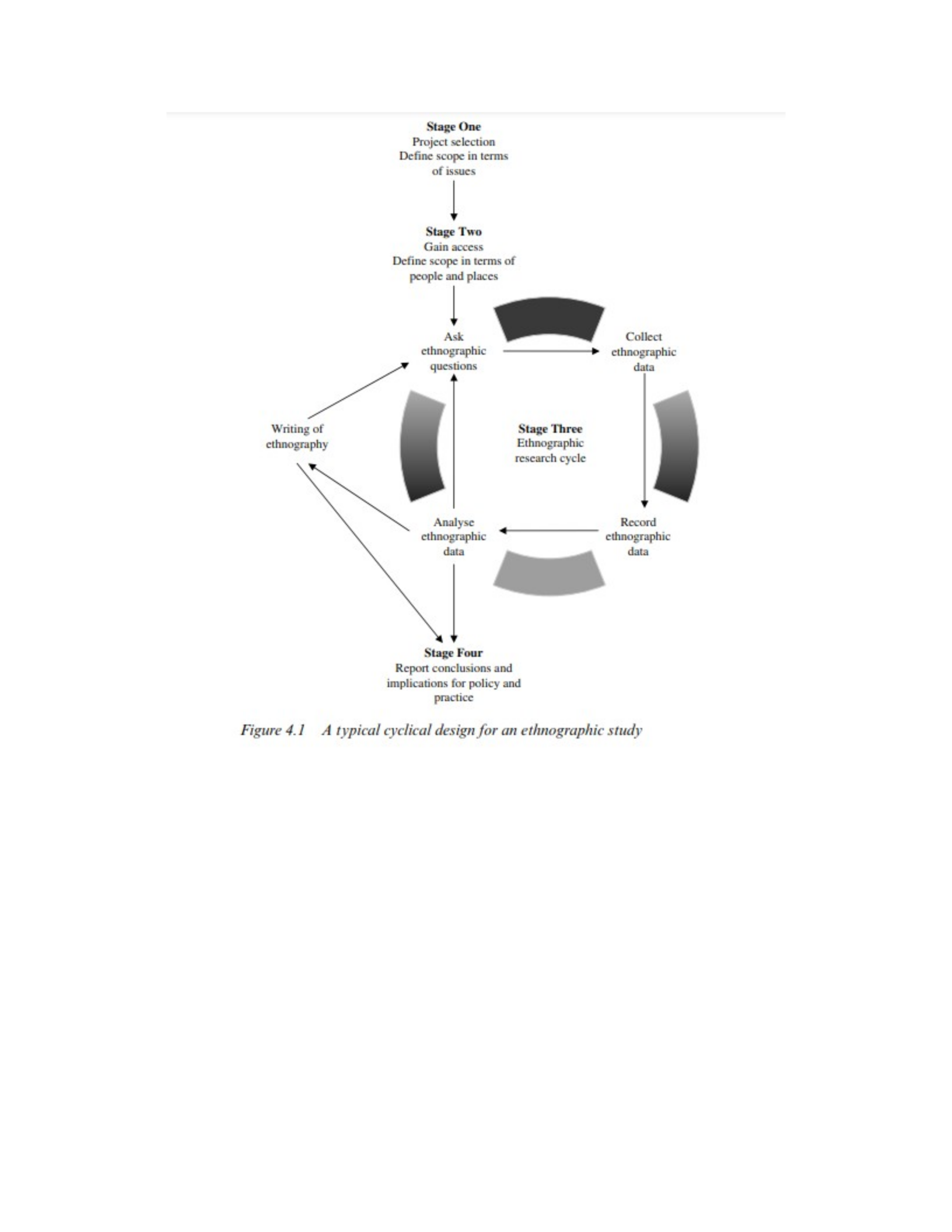
Using ethnographic research methods will include following the cyclical pattern that is
common for ethnographic studies data collection. This is shown in Figure 4.1 below. This cycle
allows the researcher to return to the questions as often as necessary while simultaneously
writing the ethnography. Being able to return to the interview questions allows the researcher to
ask any follow-up questions to better understand the experiences and responses of the
participants to refine the ethnography itself.
PROJECT APPROACH (METHODS) 8
Note. (Johnstone, 2007, p. 99, Data Collection section)
This process will only be enhanced by the use of the grounded theory method of memoing.
Memos will allow the researcher to keep notes along the entire process to be sure that no
important thought is lost in the route taken to writing the ethnography.
List of Survey/Interview Questions
The online survey will be comprised to gain knowledge of the participants’ various
experiences and understanding of their position within the African American community of

PROJECT APPROACH (METHODS) 9
businesswomen. There will be a list of “yes or no” questions as well as an option to give detail to
their experience.
Survey Questions
1. Are you a business professional?
2. Are you an entrepreneur?
3. Are you aspiring to be in leadership?
4. Are you aspiring to open a business?
5. Have you previously owned a business?
6. Have you applied for leadership/management positions?
7. Do you have guidance/mentorship in becoming an entrepreneur?
8. Do you have access to the resources to qualify to be a leader/entrepreneur?
9. Have you experienced discrimination in your process?
10. Do you offer assistance or advice to others in your community?
11. Please give a description of your experience with pursuing success in leadership
and/or entrepreneurship. (optional)
Interview Questions
1. What steps have you taken to become successful?
2. How do you gain insight to advance as an African American woman in
business/entrepreneurship?
3. What role do your peers play in your process of pursuing success in leadership?
4. What have been obstacles to you in your professional workplaces to deter you from your
goal?

PROJECT APPROACH (METHODS) 10
5. What decisions did you make that you feel led to your failure? What would you do
differently?
Data Analysis
After collecting all of the data from the online survey and interviews, the researcher will
continue in the ethnographic cyclical design to analyze the data and memos taken. Using the
survey questions, there will be a graph showing the numerical data of the responses. Analyzing
the survey data will be a much quicker process due to the quantitative nature of the survey. In
reference to the interviews, they will take a little longer to analyze and interpret for the research
project. There will be an audio and possible video component that will allow the researcher to go
back to ensure they interpreted the responses accurately.

PROJECT APPROACH (METHODS) 11
References
Creswell, J. W., & Poth, C. N. (2018).IQualitative Inquiry & Research Design: Choosing among
Five approaches. SAGE.
Johnstone, B. A. (2007). Ethnographic methods in entrepreneurship research.IHandbook of
qualitative research methods in entrepreneurshipI(pp. 97-121). Edward Elgar
Publishing.Ihttps://doi.org/10.4337/9781847204387.00013
McGregor, S. L. T., & Murnane, J. A. (2010). Paradigm, methodology and method: Intellectual
integrity in consumer scholarship.!International Journal of Consumer Studies,!34(4), 419-
427.Ihttps://doi.org/10.1111/j.1470-6431.2010.00883.x
Robson, C., & McCartan, K. (2015).IReal World Research, 4th Edition. John Wiley & Sons.
Sales, S., Galloway Burke, M., & Cannonier, C. (2020). African american women leadership
across contexts: Examining the internal traits and external factors on women leaders’ perceptions
of empowerment.!Journal of Management History,!26(3), 353-376.Ihttps://doi.org/10.1108/JMH-
04-2019-0027

