


1
RISK CHALLENGES AND INTEGRATION
Risk Challenges and Integration
Tiffany Burgi
School of Business, Liberty University
Author Note
Tiffany R. Burgi
I have no known conflict of interest to disclose.
Correspondence concerning this article should be addressed to Tiffany R. Burgi.
Email: [email protected]

2
RISK CHALLENGES AND INTEGRATION
Abstract
Risk management is an important part of what makes companies successful. Companies need to
acknowledge that and make sure they have one in place for just about every aspect of their
activities. When companies do not consider or have a risk management plan in place, it becomes
obvious when risk makes themselves known because they cause more damage than they would
have if there were a plan in place. The human side of a business can also not be ignored when
making risk management plans, which can be because of human error. When organizations make
risk management a priority having many perspectives to make it is an integral approach. They
want people from leadership, employees involved, and any outside agency a part of that group.
All stakeholders need to be represented. The leaders involved should take a strategic approach,
which ensures that it is a thought out and methodical plan. When there is also a biblical approach
in relation to risk management which includes strategic leadership, it will also lend itself to a
successful risk management plan.
Keywords: strategic leadership, risk management, people

3
RISK CHALLENGES AND INTEGRATION
Risk Challenges and Integration
Ensuring the company's livelihood is protected is essential in the business world. The
parts of that livelihood that need to be guarded are both physical and nonphysical aspects. This
protection needs to be led by the executive leaders and management. Those in charge should be
the ones that initiate the risk management plan to keep the organization protected. When
developing a plan to protect the business it is essential to note that this is not a one-and-done
when making a risk management plan. The business world is constantly changing and evolving
because of the people that work in it and the technological advancements that go with it. There
are also environmental changes that need to be tweaked over time. That was evident in the global
pandemic that started in 2020, which also ushered in new ways to communicate. Any
organization with risk plans in place should have revisited them when everything shifted in 2020
in order to be prepared for future risks. Another area to reevaluate when it comes to risk
management is how creating a risk management plan is done. The technology, new innovation,
and work environment are constantly changing, and organizations need to ensure they stay
current in order to create the best risk management plan for all involved. When a risk
management plan is done and changes are made to the plan, they need to be documented
accurately and timely every time (Miric et al., 2019). One area that has a complex risk
management plan is in the area of violence prevention. The need for a risk management plan
pertaining to violence is quickly growing (Viljoen et al., 2018). It is evident the level of violence
in society, which can be seen every night on the news. The media reflects how violence is rising
in all kinds of environments, which is just an example of how aspects and dynamics are
changing. The strategy in the risk management plan is determined by the desired outcomes of an
organization (Hagen, 2018). Knowing what the desired outcome is just one of the steps of a risk

4
RISK CHALLENGES AND INTEGRATION
management plan, but it is one that cannot and should not be overlooked. When those in charge
know what they want, the outcome looks like it can help with seeing the risk that can endanger
that outcome and make the best risk plan.
Strategic Leadership
When a company is developing their risk management procedures, having solid strategic
leadership techniques are crucial. Strategic leadership should also motivate its workers. When
leadership has motivated their employees, the employees are less likely to become a risk that
needs to be mitigated and they will also be open-minded to change or changes as it comes
pertaining to risk management (Hanke, 2020). The plans and leadership have significant impact
on the people around them and are able to enact change when needed. There are also biblical
principles to back that up as well. A good and strategic leader is a person that will look at a
situation from all sides and think outside the box when making preventative plans and/or
solutions to problems. A strategic leader may bring perspectives to the table to create a risk
management plan. Being transparent is a key quality for a strategic leader to possess because
they need to be able to create a thorough risk management plan (Garrett & Stevenson, 2020).
When leadership is developing, communicating and initiating their risk plan, they need to be
matter-of-fact when informing the employees (AL Fayi, 2022), which will be helpful in
communicating the vision of the risk plan to those it may impact at a future time. They will have
the other company leaders, employees, outside entities, and any other stakeholders make a risk
management plan. Having the right people in the room making the risk management plan is what
will protect the company and have its best interests at the forefront (Wright, 2017). Being
prepared is essential, especially for long-term viability.

5
RISK CHALLENGES AND INTEGRATION
"A prudent person foresees danger and takes precautions. The simpleton goes blindly on
and suffers the consequences" (Proverbs 22:3, New Living Translation). When organizations or
individuals have a good risk management plan in place, they are following God's word in
foreseeing dangers and making a plan for them. "Without wise leadership, a nation falls; there is
safety in having many advisers" (Proverbs 11:14, New Living Translation). Wise leadership is
strategic leadership. Taking the knowledge, an individual has and searching for more, and
putting it into action in a strategic way is very important in a company developing a risk
management plan. As strategic leaders, it is essential to humble oneself and not to be afraid to
serve when needed (Merida et al., 2015) because no one is above anyone in God's eyes. Making
sure Christian leaders keep the biblical principles will help lead their lives within the processes
of making a risk management plan will create a sound plan with the business and God. Making
sure leaders are strategic in their leadership will produce the best in the organization.
People and Risk Management
The employees are essential and needed for the good of the company. Employees are also
a resource that can often be easily overlooked. It is essential to note that there is not a select
group that is more important than others. Even down to the person that cleans the office is
necessary and could become a risk to the company intentionally and unintentionally. To reiterate,
all employees pose or could pose a risk to the company that employs them. Because all
employees can be a risk to the organization, making sure the processes that are in place for the
employees should be the most efficient so it can minimize potential risks (Matthews, 2019). By
providing a risk management plan that takes into consideration its employees will be an example
of what the appropriate way a business to conduct themselves, which can also become a model
for other businesses to follow.

6
RISK CHALLENGES AND INTEGRATION
Due to the fact that people can also lead to a risk(s), and the organization makes a risk
management plan with them as a part of it, the organization can provide learning opportunities
along with the risk management plan. When there is risk and opportunity, those in charge still are
not able to say for certain that everything will end well (Wright, 2017). There can still be a
financial loss, safety issues or personal loss. Employees may still learn from the opportunity, but
it can still come with a cost. Often, a risk in relation to other people typically is involved with the
decisions those individuals make throughout the day. There is no one industry that is immune
from those kind of decisions or from the individuals who make those decisions. There are times
when a calculated risk may be the best way, but that is something a person makes the decision
about, which, in turn, is a risk in itself. There is also an element of creativity that comes with
calculated risk (Zhang et al., 2018). The thought process that comes with calculated risk needs to
be extensive and thorough, which can mean some outlandish scenarios thought of for it. It is also
a human making a decision that another could and possibly would make a different choice
because humans are imperfect beings (Arora et al., 2020). However, despite all of the potential
risks there lies the hope that the best person is making the best decision in order for the best
possible outcome.
There is not any one area of business that does not have a human risk element involved.
When looking at the employees in the company and the risk that comes with them, they need to
look at how they can impact and influence what happens in the company (Erdei et al., 2022).
Some of the most critical areas of businesses are run by people who are not perfect. This risk is
something that needs to be planned for. There are times that this risk from people is intentional.
Yes, people are not perfect, but they can also be wanting to bring harm to the company or those
that run it, which is risk that cannot be scheduled or seen and a response to something. A variety

7
RISK CHALLENGES AND INTEGRATION
of risks need to be planned for the due to the if or when those risks will happen. Humans are a
risk at all times when they are malicious, and the damage can be far greater than when it is
accidental (Dandage et al., 2019). This is because it is often planned out the damage that is
happening.
Minneapolis Public Housing Authority
The Minneapolis Public Housing Authority provides housing subsidies for low-income
residents in Minneapolis, MN. Minneapolis Public Housing manages a Housing Choice Voucher,
a traditional Public Housing and a Moving to Work program. They have been providing
assistance for over 40 years and became an independent agency in 1991 (MPHA, 2017). They
are very successful in many areas, but, like any other organization, there is always room for
improvement. The Housing Choice Voucher program has had its share of problems. One of the
largest is the long wait list because the program allows people to remain on it and does not help
or require them to become self-sufficient. Participants remain in the program doing nothing to
improve themselves while others, that genuinely need the help, are required to wait for years, in
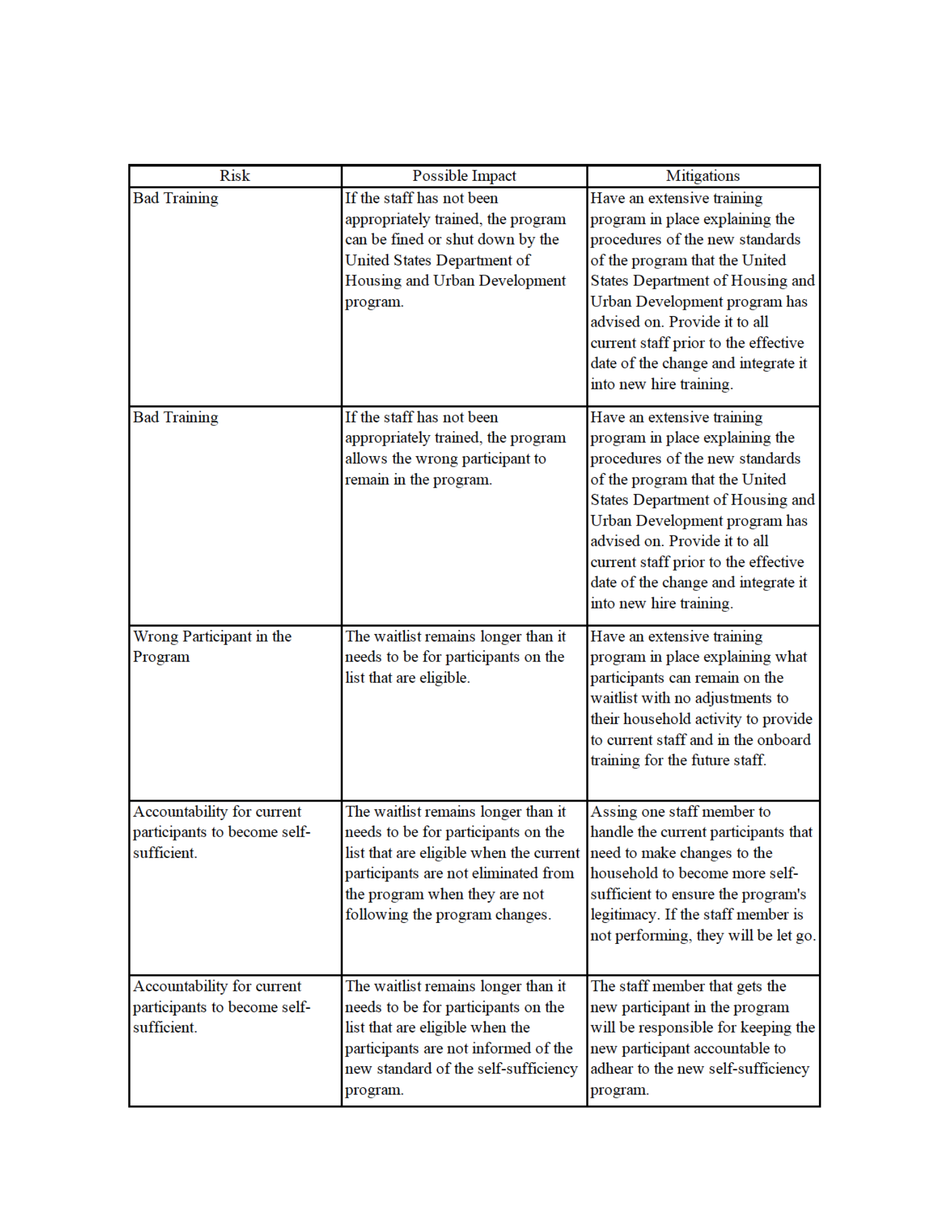
some cases, over five years of waiting for housing help. The following is a risk assessment for a
transition for the program to require able-bodied people to be improving themselves to become
self-sufficient or no longer remain on the program. This is not an actual transition currently
happening at the Minneapolis Public Housing Authority but it could help alleviate the wait list
problem.
8
RISK CHALLENGES AND INTEGRATION
Risk Management Plan

9
RISK CHALLENGES AND INTEGRATION
These are just a handful of risks, impacts and how to handle them if they occur. The
program is extensive and has many risks that can be mitigated if a proper risk management plan
is established and utilized throughout the department.
Conclusion
Risk management is something a company or organization cannot go without anymore.
They can no longer avoid the potential risks or issues that could arise. The right leadership needs
to be in place to create the best plan to protect companies and organizations. The risks are not
just technology, manufacturing or other non-tangible things. The people being led can also be a
potential risk, which needs to be taken into account. Making sure those in charge are strategic
leaders with proper risk management plans are also something God wants for people. It is
essential that individuals, leaders, and businesses remain planning for the future and have ways
to navigate risks or issues when they do go the way they were intended.

10
RISK CHALLENGES AND INTEGRATION
References
Al Fayi, S. M. (2022). Internal Audit Quality and resistance to pressure.JJournal of Money and
Business,J2(1), 57–69. https://doi.org/10.1108/jmb-11-2021-0053J
Arora, R., Ram, M., & Tyagi, V. (2020). Multi- State System Analysis with Imperfect Fault
Coverage, Human Error and Standby Strategies.JRevista Investigacion Operacional,J41(2),
214–231.J
Dandage, R. V., Mantha, S. S., & Rane, S. B. (2019). Strategy development using TOWS matrix
for International Project Risk Management based on prioritization of risk
categories.JInternational Journal of Managing Projects in Business,J12(4), 1003–1029.
Erdei, E., Kossa, G., Kovács, S., Popp, J., & Oláh, J. (2022). Examining The Correlations
Between Industry 4.0 Assets, External And Internal Risk Factors And Business
Performance Among Hungarian Food Companies.JAmfiteatru Economic,J24, 143–158.
https://doi.org/10.24818/EA/2022/59/143J
Garrett, B. L., & Stevenson, M. (2020). Open risk assessment.JBehavioral Sciences & the
Law,J38(3), 279–286. https://doi.org/10.1002/bsl.2455
Hagen, B. W. (2018).JProblem, Risk, and Opportunity Enterprise Management. Probabilistic
Publishing.J
Hanke, D. (2020). Can employees motivate themselves? the link between peer motivating
language and employee outcomes.JThe International Trade Journal,J35(1), 19–39.
https://doi.org/10.1080/08853908.2020.1826021J
Holy Bible new living translation. (2021). DaySpring; Candace Cameron Bure

11
RISK CHALLENGES AND INTEGRATION
Matthews, C. E. (2019). Minimizing risk associated with sedentary behavior.JJournal of the
American College of Cardiology,J73(16), 2073–2075.
https://doi.org/10.1016/j.jacc.2019.02.030J
Merida, T., Platt, D., & Akin, D. L. (2015).JExalting Jesus in 1 and 2 kings. B & H Publishing
Group.J
MPHA. (2017, June 17).JMPHA history. Minneapolis Public Housing Authority. Retrieved July
1, 2022, from https://mphaonline.org/about/agency-overview-2/history/?
_ga=2.240343232.2119770123.1656984757-832429244.1656984757&_gl=1%2A1w1saix
%2A_ga%2AODMyNDI5MjQ0LjE2NTY5ODQ3NTc.%2A_ga_H4PCNVFT9B
%2AMTY1Njk4NDc1Ny4xLjEuMTY1Njk4NDk2OC4wJ
Miric, M., Boudreau, K. J., & Jeppesen, L. B. (2019). Protecting their Digital assets: The use of
formal & informal appropriability strategies by App developers.JResearch Policy,J48(8),
103738. https://doi.org/10.1016/j.respol.2019.01.012J
Viljoen, J. L., Cochrane, D. M., & Jonnson, M. R. (2018). Do risk assessment tools help manage
and reduce risk of violence and reoffending? A systematic review.JLaw and Human
Behavior,J42(3), 181–214. https://doi.org/10.1037/lhb0000280J
Wright, L. (2017).JPeople, risk, and security: How to prevent your greatest asset from becoming
your greatest liability. Palgrave Macmillan.J
Zhang, S., Ke, X., Frank Wang, X.-H., & Liu, J. (2018). Empowering leadership and employee
creativity: AJdual-mechanism perspective.JJournal of Occupational and Organizational
Psychology,J91(4), 896–917. https://doi.org/10.1111/joop.12219

